An Afternoon with Michael Albert
For twenty years, Michael Albert has been popping down to the East End every Thursday afternoon to buy new stock for Blustons of Kentish Town, the celebrated dress shop founded by his grandparents Samuel & Jane Bluston in the nineteen twenties, where today the majority of customers are between eighty and one hundred years old.
“In my dad’s day, everybody came to us in vans and, because they were small manufacturers, if they didn’t have the size or colour you wanted, you could have it by the next week.” Michael recalled fondly, as we drove Eastwards through the back streets circumventing Holloway Prison, on a dress buying expedition last week.
In fact, it makes a welcome change of scene for Michael – who has worked in his parents’ shop for six days a week since he was sixteen – to hang up the grilles upon the grade II listed Art Deco facade, switch out the lights, turn the key in the old brass lock, close the padlocks that secure the grilles in place and set out on his weekly outing each Thursday at one o’clock. The wonder is that even though the suppliers no longer come to Michael, he is still able to source the stock for his shop from a handful of wholesale suppliers in the East End and most of it is manufactured in this country.
“I’ve got a little list,” Michael informed me with a twinkle in his eye, as we parked up a side street in Whitechapel. Our first stop was The Nicole Lewis Collection, for thirty years the small family business of Richard Walker – named after his two children, Nicole & Lewis. Upstairs, Richard still has the long table where he once cut patterns – but these days he simply buys the cloth and has the clothes made up at factories in East Ham and Plaistow. “We’re not Top Shop, we’re classic ladieswear,” he explained, revealing the unexpected virtue of making clothes for older people in styles that never go out fashion, since there is no requirement for Michael to update his patterns and no dead stock or wastage. He can simply recycle his designs endlessly. It appears a very satisfactory arrangement for all concerned – fulfilling a need for those who are under-represented elsewhere in the clothing industry.
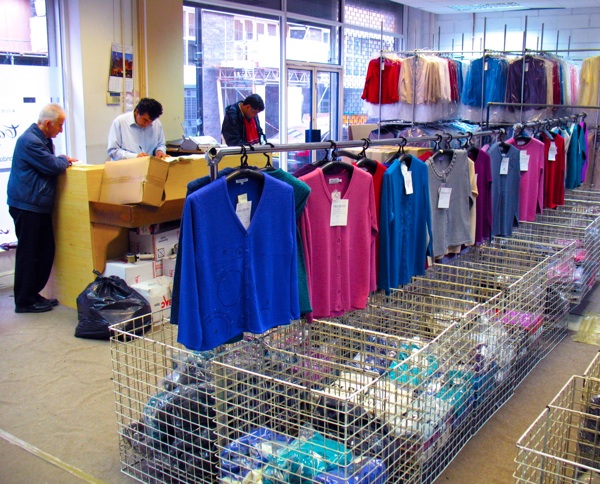
Round the corner at Capital Garment, Michael led me into a huge warehouse with ladies’ suits on rails lining the walls and knitwear in a variety of colours filling the floor. He prowled the aisles with an intent, self-absorbed expression, studying the colours and the cloth, and scratching his chin. Always, it seemed he was drawn to the plainest, least fussy designs, in a nineteen fifties palette – pale blue, shell pink, lilac, burgundy, teal and beige. “Colour is everything,” he admitted to me, “You buy a wonderful thing, but if it’s not the right colour you can’t sell it.” As Michael deliberated over a dark red sweater of conservative design knitted in a sparkly yarn, I asked if he thought his ladies might like it. “We sold something very like it in the past,” he informed me with a reserved smile.
We got back in the car and drove further East.”When my father was a boy, my grandparents had a factory in Arbour Sq and he was the delivery boy, using a great big black car for deliveries that they called “the family car.” He would call for my mother in it when they were courting, but when they got married he had to give it back to his brothers and his father,” Michael, confided me with significant look indicating how family politics and business can get mixed up.
Arriving at Michael Gold in Nelson St, Sajid Tailor welcomed us to the business his father bought from a Jewish gentleman in the seventies in Brick Lane and which today he runs with his brother from a modern showroom in Stepney. “I’ve a fair idea,” he whispered sagely, when I asked him if he knew in advance what Michael might buy. Sajid and his brother were surrounded by the patterns they send out to the factories to get their clothes made up – owners of a thriving business, they export fifty per cent overseas. “All the survivors of the East End,” declared Sajid, when he heard Michael’s itinerary for the afternoon. By now it was apparent that Michael was perhaps the longest standing customer at these companies, where they set their watches by his arrival each Thursday afternoon, a ritual extending as long as anyone can remember.
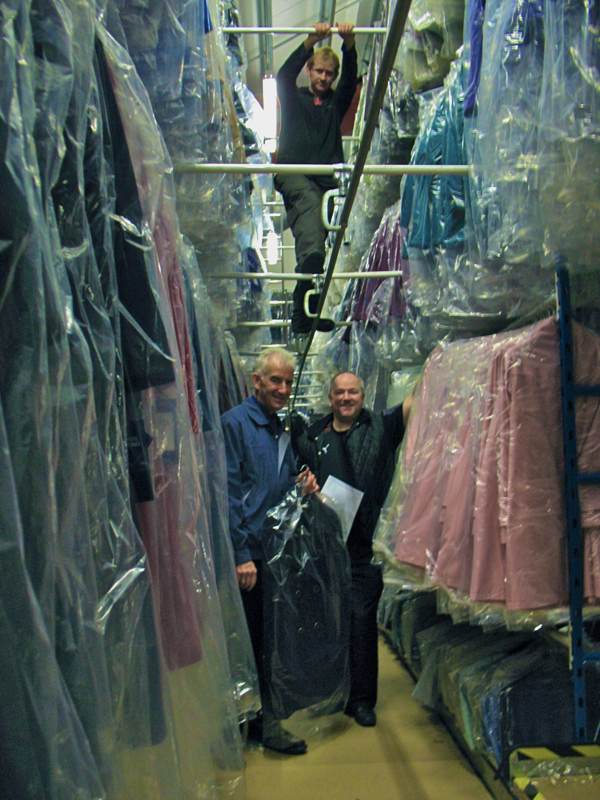
Our final destination was DBK London Ltd in Mile End, where Sales Manager Larry Peterson could not wait to show off his warehouse. “People’s eyes go pop when they see this!” he promised me, and I was not disappointed as we entered a space of seemingly indefinite dimensions where motorised clothes rails of coats ascended several storeys and warehouse men ran through the structure, clambering like monkeys among the tree tops to retrieve the required styles. “This must be the largest in the East End?” I asked. “In the world,” replied Larry with cool satisfaction.
Larry runs the business (David Barry Kester Ltd) with his brother David Barry and Maurice Kester, supplying coats to some of the biggest High St shops. “We’ve all done it our whole lives. We started off as salesmen in the market and worked our way up to where we are now,” he enthused, proudly handing me a colour catalogue of keenly priced Winter coats and a DBK corporate diary for 2012, and confessing, “I absolutely love what I do, I hardly ever go home.”
Michael and I accepted Larry’s offer of a cup of tea at a round table set with a tablecloth in the warehouse, and he admitted they were all grieving the recent loss of their former partner Laurence Matz. “I came in and found him wearing an oxygen mask. I thought it was a joke,” recounted Michael in regret, “‘I’m waiting for a lung transport,’ he said and the next thing he was dead.” We sat together in silence, contemplating mortality amongst the endless rails of coats.“I meet all my old friends in the East End each Thursday,” said Michael in recognition, shaking his head with a tender smile,“It’s ridiculous.”
“I was buying from your father thirty years ago, when this was called Snug Coats” he reminded Larry, getting lost in affectionate reminiscence now, yet adding for my benefit, “They used to make these beautiful double velour coats in pure wool with floss stitching.”
Later, as we climbed into the car outside, dusk had fallen and there was a November chill in the air. Just the right weather to sell Winter coats, Michael told me. As umbrella makers hope for rain, Michael longs for the cold weather to set in before Christmas. “Yet not so cold that old ladies won’t go out” he qualified, outlining the ideal meteorological conditions favoured by one who has been selling Winter coats since he was sixteen.
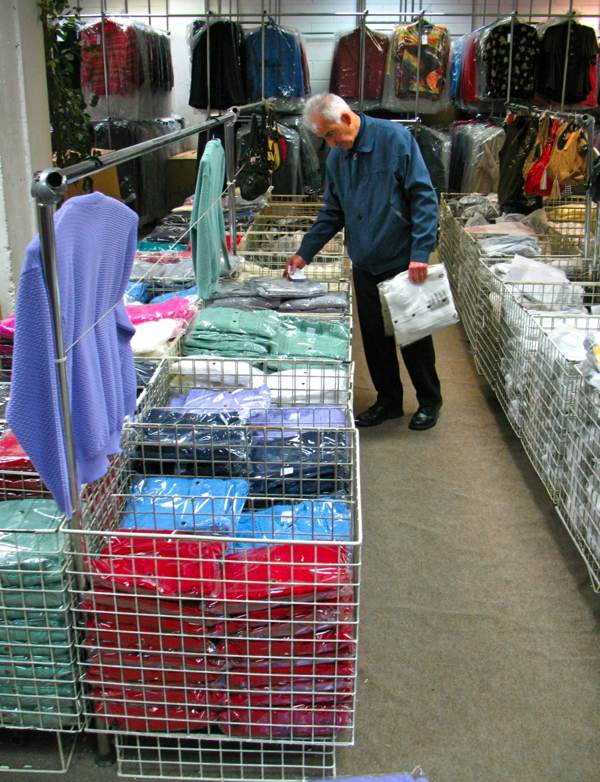
“Colour is everything – if it’s not the right colour you can’t sell it.”
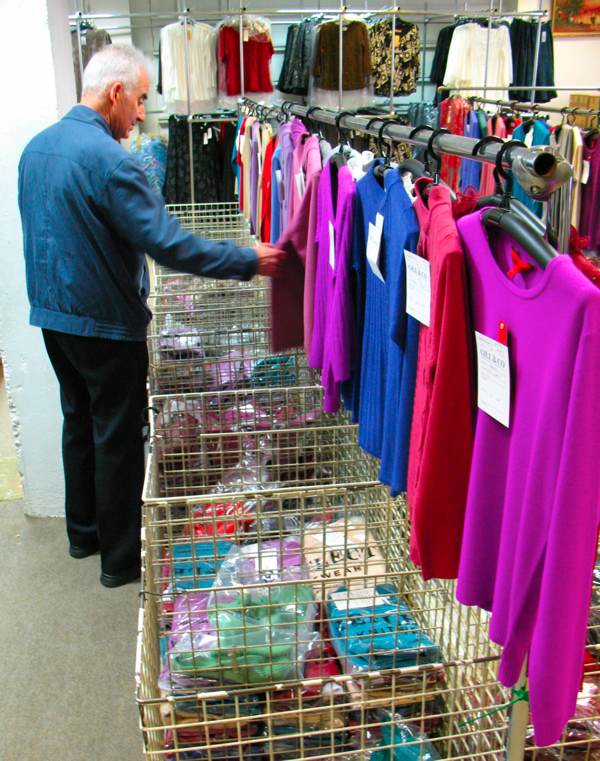
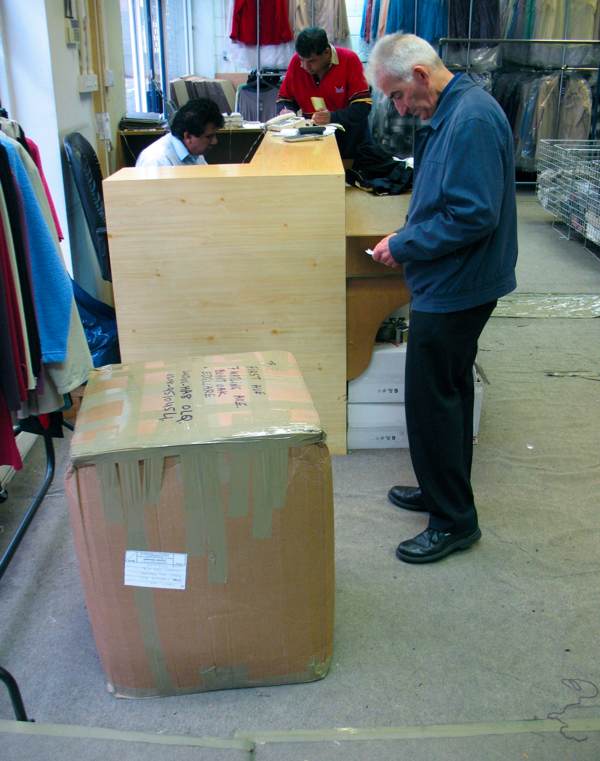
“I’ve got a little list”
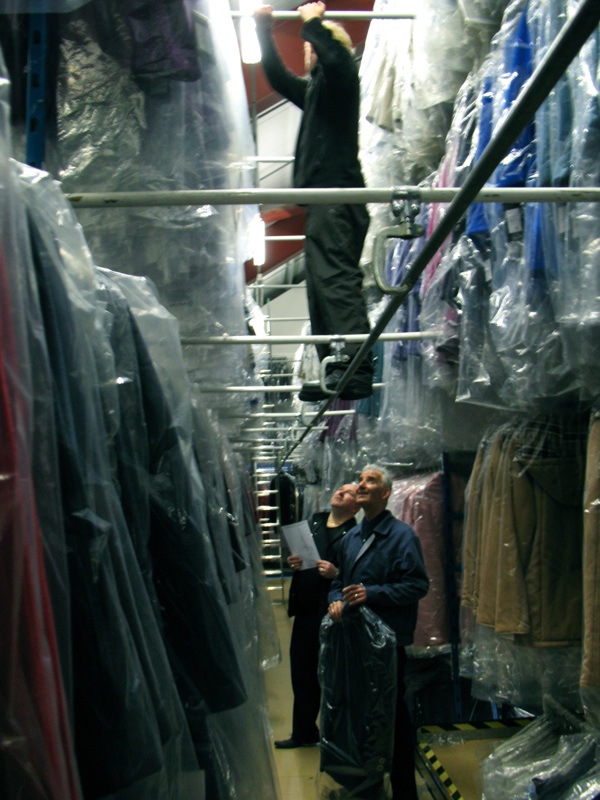
“warehouse men clambering like monkeys among the treetops”
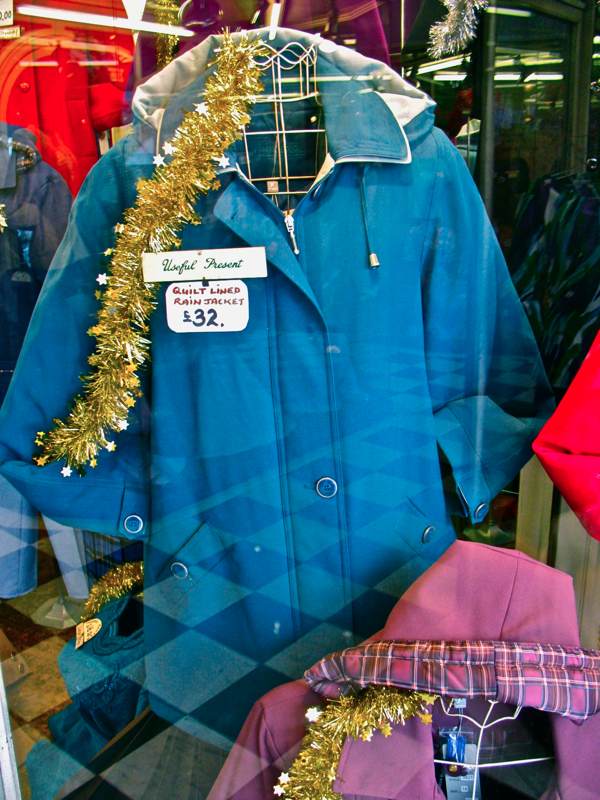
A useful Christmas present from Blustons.
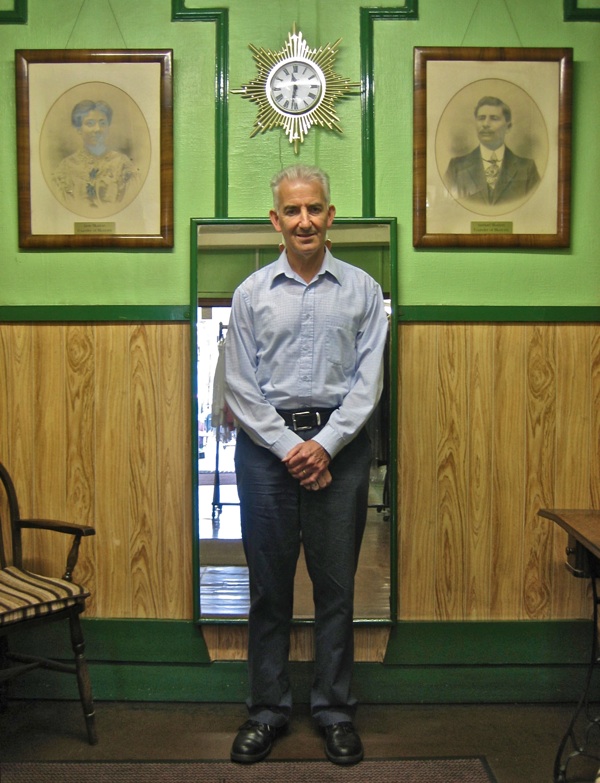
Michael Albert at the shrine to Samuel & Jane Bluston in Kentish Town.
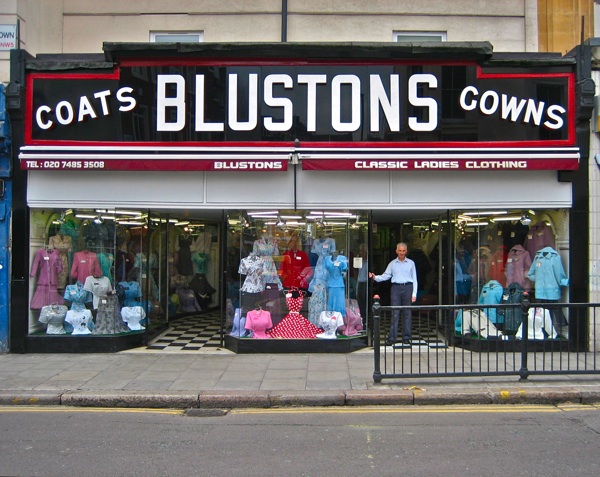
Blustons, 213 Kentish Town Road, London, NW5 2JU. 020 7485 3508
You may also like to read about
A Transformation in Princelet St

In 1996, when Architect Chris Dyson bought the last house at the end of Princelet St where it meets Brick Lane, the shabby twentieth century edifice looked like the poor relation amongst the fine eighteenth century terraces. Having collapsed in the nineteen thirties and been rebuilt successively, very little was left of this former seventeen twenties structure, yet the adjoining house – built as its twin – stood as a reminder of how it might have been. With a restoration no longer viable, instead Chris staged a transformation – using the house next door as his template, he brought a new order to the structure, allowing it to hold its own amongst its fellows once more.
“Living in this area and working on houses in Spitalfields for twenty years has taught me how me to handle the detailing, and the correct moves to make,” explained Chris, as we stood in the street and compared the facades of the neighbouring frontages. On the first and second floor, he has reinstated the windows to match those next door. Using second hand purple reds, bricklayer Keith Beckwith matched the brickwork closely and recreated the rubbed brick detailing above the windows. At street level, it was necessary to conceal a girder which had been installed in the front wall when the building was converted to a shop, so Chris chose to construct a Georgian shopfront, employing Ian Harper to paint oak grain on the facade and a contrasting burr walnut upon the door.
Within, joiner Matt Whittle has installed new panelling throughout the reception rooms in line with other Spitalfields houses of this period, while Chris has judiciously embellished the work with salvage finds to bring idiosyncrasy and detail to his design. In the hallway, a pair of fluted wooden columns from 1725 have been cleverly duplicated by carpenter Dave Thompson to frame the lobby. Similarly, in the first room, he has copied an original eighteenth niche cupboard which sits to the left of the fireplace, still flaunting its patina of two centuries, while its new counterpart sits demurely unsullied upon the right.
At the rear, Chris chose to install a large glass screen admitting the Southern light and opening onto the spectacular fern garden at basement level by Luis Buitrago. Stairs lead down to the kitchen lined with a collection of rich blue china and up to the panelled first floor drawing room, leading beyond to bedrooms and a bathroom on the second floor, and arriving at a wonderful loft space at the top that serves as master bedroom with spectacular views across the rooftops of Spitalfields towards Christchurch.
As we ascended through the narrow structure, the pair of cats that serve as the presiding spirits of the house wove their paths around us, pursuing each other playfully and competing to win our affections. Constantly, Chris drew my attention to the endless cunning details he has built into his house, secret cupboards and scavenged eighteenth century plasterwork, market finds of antiques arranged in niches that his children secretly rearrange, old fireguards from Chatsworth and elaborate beading from a Nash house in Regent’s Park.
So little remains of the original house that it is not a listed building, which gave Chris ample licence, yet he has gone to great lengths to restore the soul of the place. And today, the clutter of a busy family life and Chris’ charismatic collections countermand the elegant austerity of these finely tuned architectural spaces, confirming that this old house is alive once more – once more a home.

In the nineteen seventies

In 2009

In 2011

An eighteenth century niche cupboard retains two centuries of patina.


The terracotta urn was destined for the garden.


The view from the loft towards Christchurch, Spitalfields.
Archive image from the London Metropolitan Archive
Story includes photographs by Richard Clatworthy & Richard Powers
You may also like to read about
Laura Knight, Pottery Marks
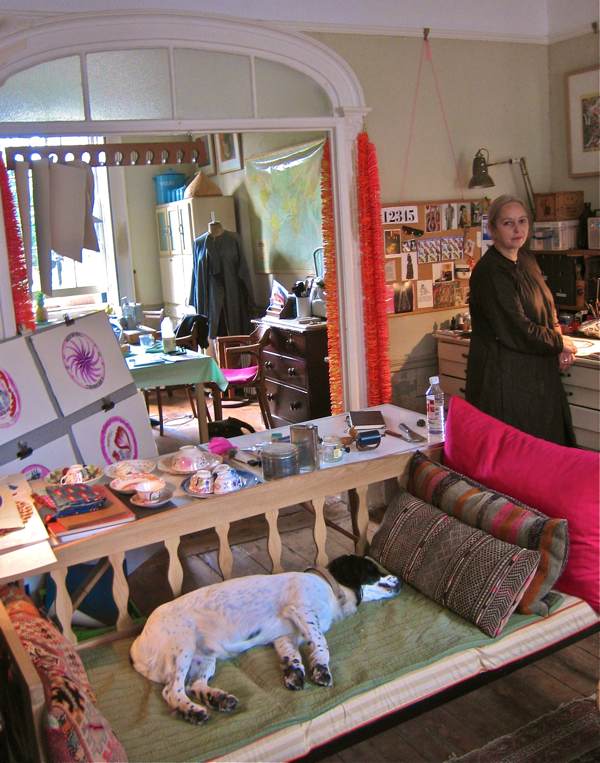
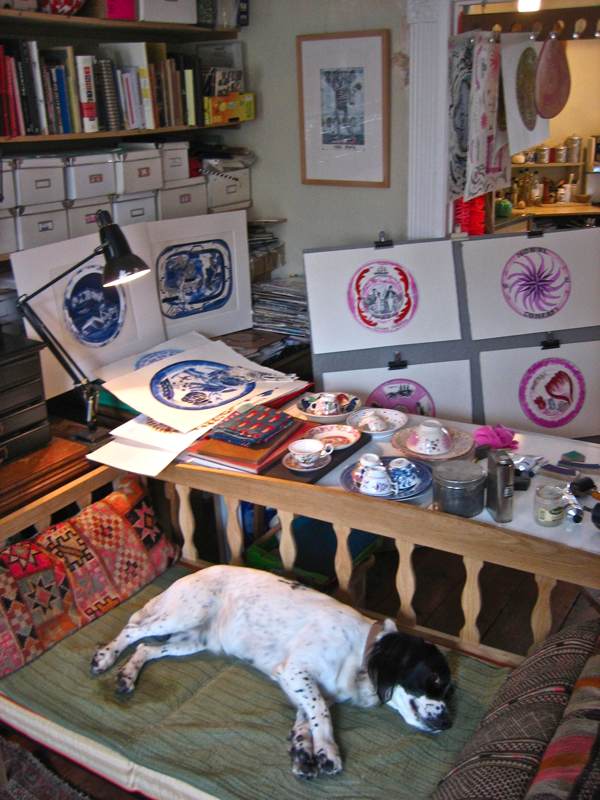
Laura Knight’s dog Moss wisely takes a nap and lets his mistress get on with completing her latest works ready for her exhibition Pottery Marks, opening at Town House in Spitalfields next Thursday 17th November. Contrary to what you might think, the cups on the table are not evidence of an imminent tea party, but placed there as a reference by Laura while making the new pictures she will be exhibiting, which have all been inspired by her collection of old china.
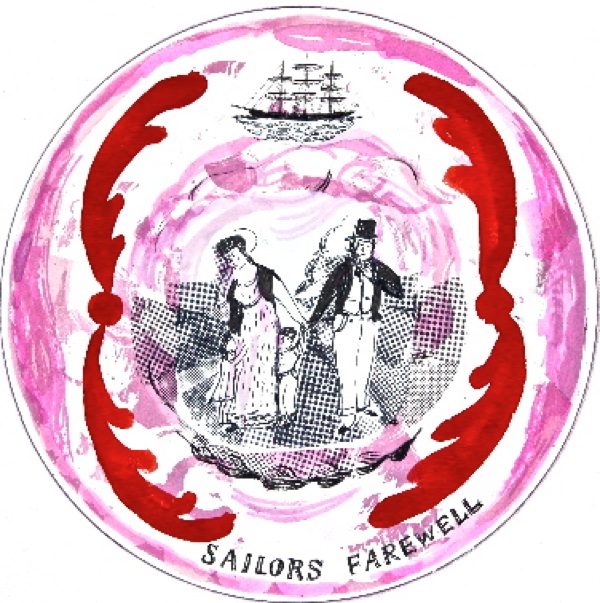
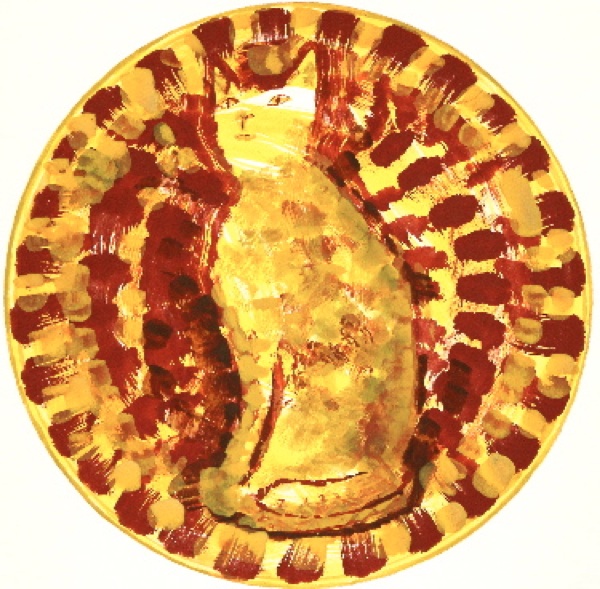
A graphic artist whose work is informed by a deep affection for vernacular English pottery of the nineteenth century, Laura Knight’s renderings of Staffordshire Figures, Willow Pattern plates and Sunderland Lustreware capture the spirit of these pieces with rare grace and economy of means. In the popular tradition of English Folk Art, using sinuous line and sensuous colour – hers is the assured work of a mature artist in control of her medium.
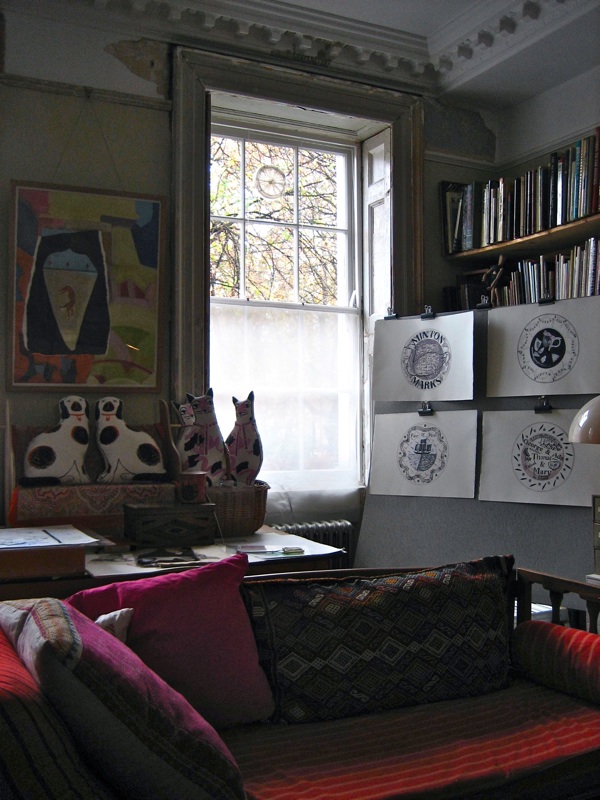
Working from a Georgian terrace in Clapton, Laura’s ground floor studio also serves as her living room and kitchen which makes it perfectly natural to have pieces of china to hand. “The funny collection of ceramics that one ends up inheriting or buying cheaply over the years.” as Laura describes it. Yet “When the original object is so appealing,” she revealed, “it’s about transforming it into something else rather than slavishly reproducing it.”
The grove of limes on the green outside were just turning gold and shedding their leaves when I paid Laura a visit, taking the opportunity to admire her collection of pictures, china, art books and other treasured paraphernalia, in these two beautifully-proportioned rooms that receive more sunlight when the trees are bare. Laura welcomed me with tea and home made apple cake at her kitchen table, before giving me a preview of the fresh pieces of work which were due at the framers later that day, including a table cloth – that Laura draped across the table – upon which she had painted calligraphic patterns and sewn images of Willow Pattern plates as if laid ready for a picnic.
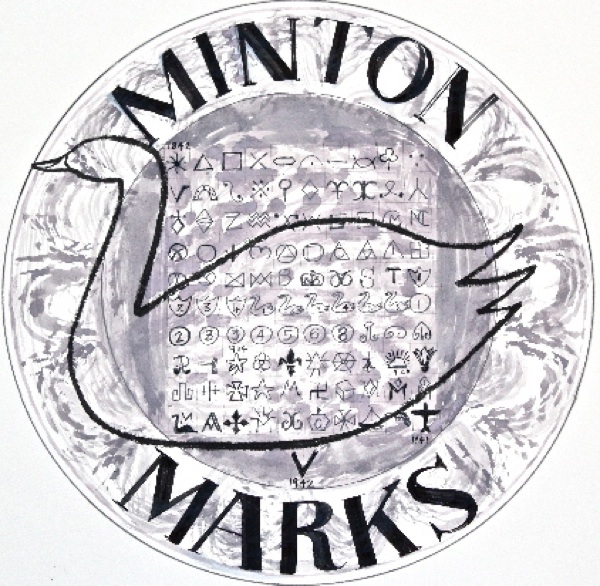
Yet I was impatient to wolf my cake and stray into the other room to examine the spirited pictures on paper Laura had created using paint, ink, collage and printing – in sets of four – in blue as homages to Willow Pattern, in pink to celebrate Sunderland Lustreware and in subtle ochre referencing Minton pottery. Here was an image of a plate for good attendance at Sunday school inscribed with the names of Laura’s grandparents who grew up in Bethnal Green, George & Ada. Here were all the Minton date stamps from 1842 to 1942, including “V” for victory and an airplane during the war years. Here were scraps of Willow Pattern, inspired by the spontaneity manifest when women chopped up transfers and scattered them on the undersides of tureens in factories a hundred and fifty years ago. Laura’s witty graphic interventions always serving to reveal the maker’s presence behind these familiar artifacts, delighting in the flaws and random elements born of mass-production done by hand.
Pottery Marks came about as a result of my interview with Laura Knight a year ago, and now I cannot wait to see her vibrant images brought together in a gallery for your interest and delight. She appreciates the emotional resonance of beloved ceramic designs which have survived in the popular imagination over generations, and her tender and poetic work is the perfect tonic at the start of an English Winter.
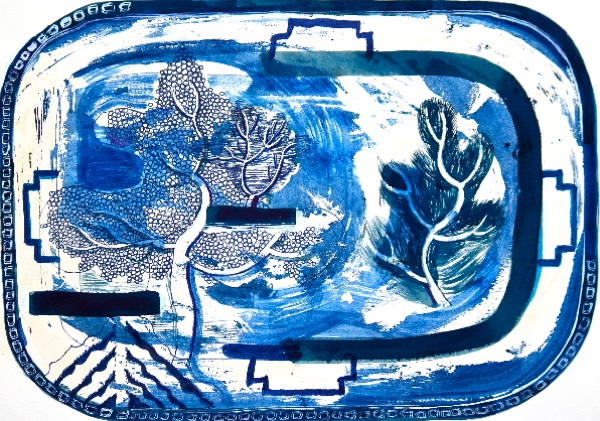

Artworks copyright © Laura Knight
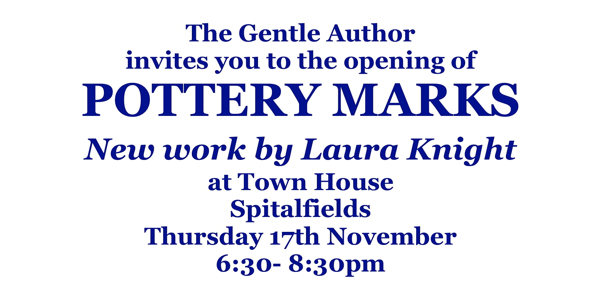
POTTERY MARKS – New work by Laura Knight, runs from Thursday 17th November – Saturday 3rd December at Town House, 5 Fournier St, Spitalfields, London, E1 6QE. Open from 11:30am – 6pm, Tuesday to Sunday.
You may also like to read about Laura Knight, Graphic Artist
Jason Cornelius John, Street Musician

Jason Cornelius John
He first sprang into my consciousness two weeks ago, early one Sunday morning, when I was down among the fly-pitchers in the Bethnal Green Rd. As if out of nowhere, he appeared from behind a telephone box with his guitar in hand declaring, “I am Jason John, I’m writing you a damn good song.” With charisma and intensity, he drew the attention of everyone within earshot and the pavement became his stage as he launched into one of his own compositions, opening his heart and channelling his emotions into a soulful ballad. Even at first sight, Jason John made an unforgettable impression.
And then yesterday, I came upon him sitting with his guitar in a doorway in Folgate St, sheltering from the drizzle on the first chilly day of the Winter, and – once we had re-established our acquaintance – we decided to take refuge in the barroom of the Water Poet where Jason spoke to me of his life as a street musician.
“I’m a West London lad. They know me around Shepherd’s Bush, Hammersmith and Acton because I grew up in Chiswick. I’ve played in Notting Hill and all over the West End, so I thought I’d travel to the East and get myself known here. Sometimes I play in Leadenhall Market, Hoxton Square and at Liverpool St. I write my own songs. I’ve always written, stories, poems and songs. I grew up playing the guitar and I can play bass, violin and piano. Being a musician, singing and playing, it’s like being a storyteller.
My first real involvement with the music scene was as roadie for the Bluetones. I knew them from school, and I stayed at their house and slept on the couch. It was a non-stop party and there were always girls. My first proper taste of the music industry – you got paid and there was always food and drink.
When they took off, I didn’t feel bad but I did wonder, “How could you just make it and leave us all behind?” Then Montrose Avenue came along and replaced the Bluetones, and they pulled more girls. My job went from being a roadie to becoming their minder, making sure they didn’t drink too much and keeping an eye on the girls too.
At smaller venues, I’d get ten to fifteen minutes to play my own songs. I played in Camden once, thirty-six people were cheering me and saying, “That was a good one,” I gave out my phone number and email many times that night. When I played the Hub at the Metropolitan University, there were rows of girls in front and they loved me – but I was frightened when they all shouted at once, I thought they were going to grab me. My girlfriend dropped me at that time – over my music – she said, “You can’t do any other job, and trying to live by playing and singing, it’s impossible.” When Montrose Avenue made it, I thought, “It’s not going to happen to me, this is the second time.” So I took off to France for a year, going down South and playing on the road, then I went to Amsterdam and lived there for a year.
I love playing and singing, that’s why I’ve dedicated my life to it. Two years ago, I was sitting playing in Allen Gardens when I found myself. I started to cry. I could literally see myself. Since that Summer, I’ve had a hunger to play to people. If I see a crowd of people, I want to win their spirit. It fills me with goodwill. When you are going around playing and singing you’ve got to feed your soul. I have a smoke and it gives me a nice merry feeling. In your head you behave like a giant. Sometimes the crowds roar and cheer for me. I walk down the street and people are hugging me.
All the businessmen in their suits and ties, they finish work and go to the pub. Then they go outside to have a smoke, and they see me and they say, “I like your look, what have you got?” I play them a song and they say, “I like that, play us another … and another, and another.” Then, if they’re still into you, they give you a card and say, “He’s never had busker for his birthday, we want you to come over.”
I’m living in Earls Court at the moment in a hotel, it’s forty pounds a night. I have to make that money each day playing on the street. You can’t give in. It’s all up to you. You’ve got to put your feeling into it, heart and soul – because how you feel, that’s how the listener’s going to feel. You got to feel emotion, I’ve played and cried in front of people, and they’ve cried too.
During the day, I rehearse in my room and then I come out and play my songs. Performing on the streets, it’s different from a pub, you’ve got to attract the people. At the end of the day, it’s for no-one else, just me and the listeners, and I’ll know that I played and sang and they felt good. You want everyone to feel a good feeling and think, “That Jason John he was a good man, he hasn’t lost the feeling.”
I walked here today from Earls Court, I followed the South Bank. I got jumped at Old St at the weekend and they took my phone – at four in the afternoon, I couldn’t believe it. The ups and downs of life. It made me cry because I needed those numbers badly. Now the weather’s getting cold, it makes it hard for me to keep playing on the street. I have to start playing in pubs and clubs but to do that I’ve got to find three people whose numbers were in my phone, so we can play together as a group. I was looking for a violinist who hangs around here, I was walking and hoping he’d turn up.”
When I expressed my concern over this immediate circumstance, Jason shrugged it off – self-reliant and philosophical, and taking one day at a time. A man of innate dignity and possessing a sympathetic nature, he impressed me with his single-minded pursuit of songwriting, risking himself and sacrificing conventional ambition for the sake of a purist desire to communicate through music. The street is an unforgiving arena for a performer yet Jason has embraced busking with consistent success and made himself at home on the pavement, creating a distinctive persona that is his alone. “I’ve always liked pin-striped flares and leather jackets, and I always wear shoes. I try to keep them as shiny as I can. If you dress smart with shoes and trousers, you can get in anywhere – but not with jeans and trainers.” he informed me authoritatively, when I complimented him on his style, layered up with old coats and silk scarves.
From the moment Jason first appeared in the market two weeks ago, it was obvious that he has a certain talent and personal charm which win him a degree of respect wherever he goes, and thus his relationship with existence is enviably untroubled, for the most part. At thirty-five years old, Jason Cornelius John knows who is and what he wants from life – as he confessed with a barely-concealed swagger, “I’m not a member of any party and I have no religion. My religion is drinking, smoking, playing music and making love to the ladies.”
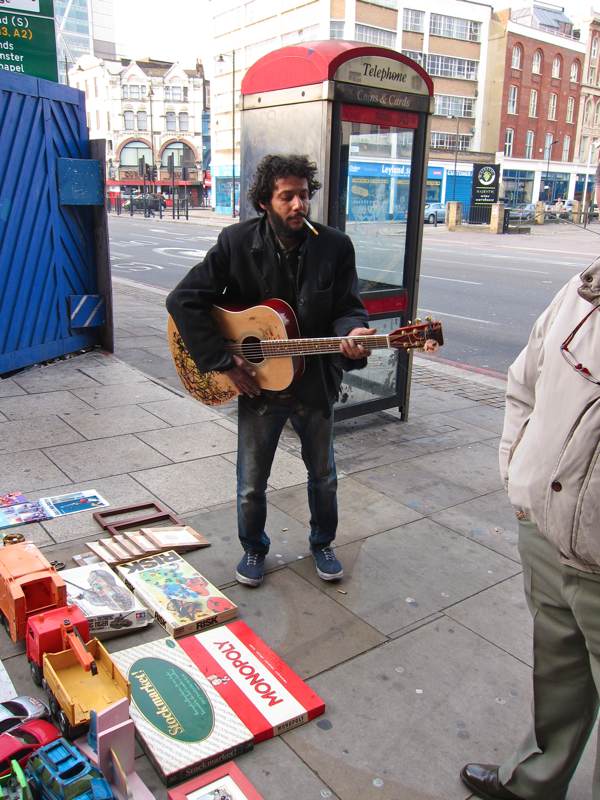
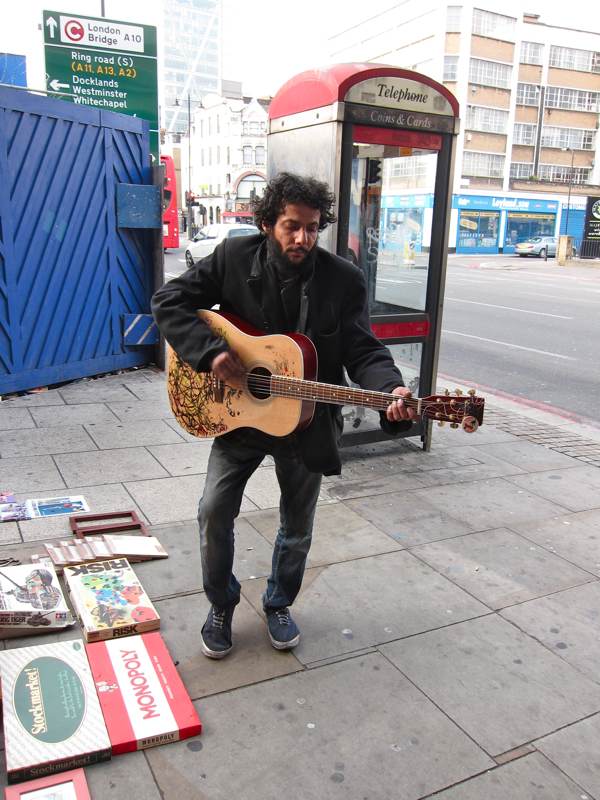
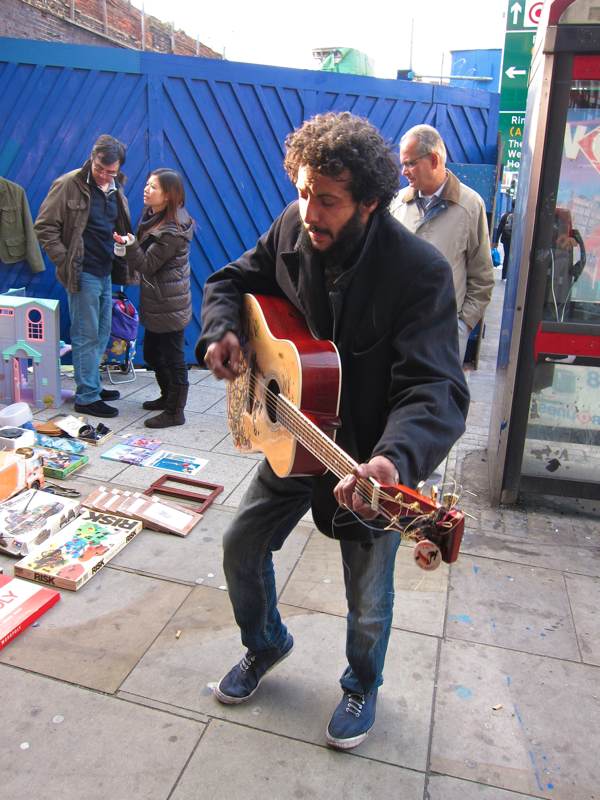
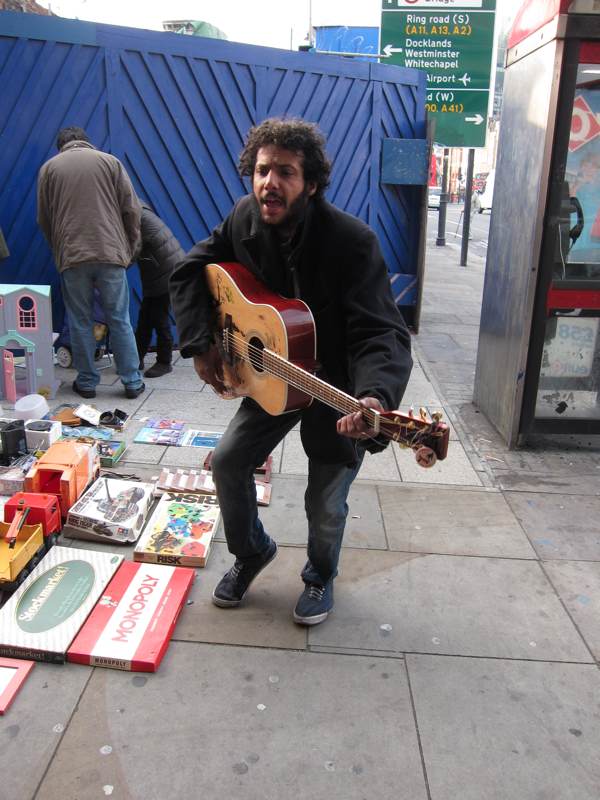
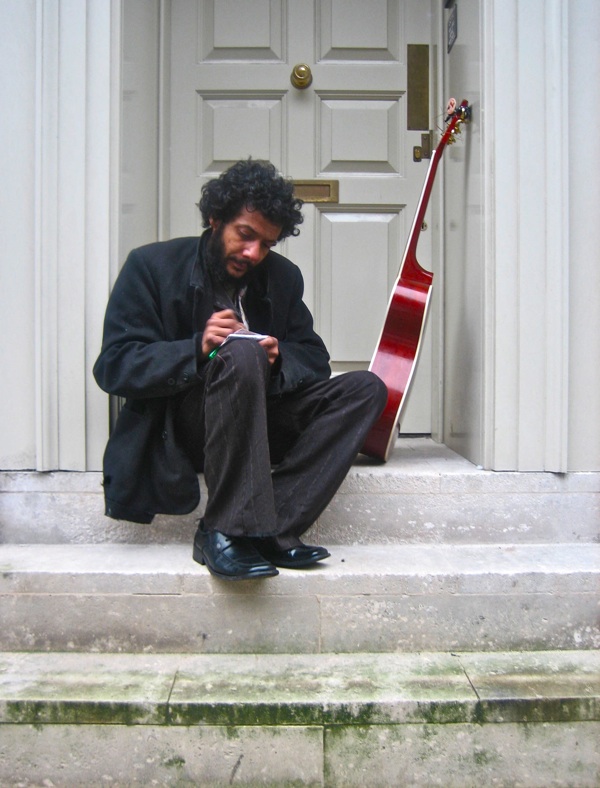
Photographs of Jason John performing copyright © Colin O’Brien
You may also like to read about
The Young Turks at The Ten Bells

Over a year ago, when I interviewed James Lowe while he was Head Chef at St John Bread & Wine, he confided to me that one day he would like to open a restaurant of his own. And now James has returned to Spitalfields as part of the culinary collective termed The Young Turks, working in partnership with Isaac Mchale to cook a set menu, changing weekly, at The Ten Bells for the next three months.
When I went round for dinner last week, it made me think of another meal long ago in a room above a pub. For when I began my career as a writer, I had a fancy agent who used to know all the smart places to eat and, desirous of feeding me up in the days before I made any income from my writing, he would take me out for lunch regularly. One day, he took me for a meal in the room above the French House in Dean St, cooked by a young chef – just starting out – by the name of Fergus Henderson. Years later, St John, the restaurant that Fergus Henderson created, is firmly established at the centre of the revival in distinctively British cuisine. Thus, when I sat down in the room above The Ten Bells on the opening night of The Young Turks, to study the menu set in plain type upon a sheet of white paper, I felt that somehow I had come full circle.
In this beautiful high-ceiled space with commanding views towards the market and the church, diners get to enjoy four courses and three snacks plus a cocktail for £39 a head, while eyeballing those on the top deck of the 67 bus going down Commercial St. There is a sense of drama, beginning the moment you step from the street into the clattery din of the bar room lined with gleaming nineteenth century ceramic tiles, before you ascend the narrow staircase to encounter a more civilised atmosphere in the dining room above, lined with pieces of art by Tracey Emin and Peter Blake from the private collection of the owner of The Ten Bells, John Twomey.
As one who feels unduly challenged by making selections from menus, I was delighted to be presented instead with a bill of fare outlining the seven plates that awaited me. To start, there were fragrant slices of ham cured by James, then fresh oysters with dulse, followed by a couple of small intensely-flavoured game sausages. By now, the order of dishes and the contrasts they presented were proving a matter of fascination. And it was a intriguing sequence that continued with squid accompanied by watercress and radish, then my favourite dish of the evening – Jerusalem Artichoke with crisps made of its skin – followed by slow-cooked ox cheek, moist and tangy in its own gravy. The meal proved to be a rare culinary experience, alive with subtle flavours and textures, yet thanks to the modest portions I did not feel overly full – just ready for the baked pears which finished off the evening nicely.
“A week ago, there wasn’t even a kitchen here,” exclaimed James in disbelief when I dropped by to visit him next morning, wedging myself in the corner next to the sink while he and Isaac set to work on another of their 9am to 1am days, preparing vegetables and checking dishes that were already slow-cooking for tonights’s service.“I met John Twomey for the first time three weeks ago, I came down to The Ten Bells to have a look at the location and liked the room immediately.” James added, just reminding himself how he came to be there surrounded by a pile of ox cheek so early in the morning.
Evidently, Isaac Mchale, a Glaswegian who worked in Sydney before he established himself in London as chef at The Ledbury and The Cafe in Victoria Park, possesses an admirable phlegmatic energy, demonstrated by applying himself with quiet persistence to peeling endless radishes.“It’s not really a money maker, it’s honestly priced and for limited run – so it’s a chance to do something that’s ours and to say this is what we’re about.” he told me candidly, before laying the radishes to one side and lifting a box of comice pears, then making short work of coring and peeling them all. “The test will be whether people choose to come back.”
Both chefs possess experience and credentials obtained at highly reputable restaurants, and a passion to forge their own identity – as James confirmed, “We’ve been doing pop-up restaurants, because this is how we prove what we’re capable of – it costs a lot of money to open a restaurant and it’s impossible if you don’t have a backer.”
Yet in spite of their ambitions, James and Isaac are wisely reticent when it comes to saying anything that might be construed as a “concept” describing their endeavour. “It’s good British food, we want to be more creative with British produce, we don’t want to reinvent the wheel,” James told me plainly, as he turned his attention from the ox cheek to opening oysters in anticipation of another service of more than two hundred dishes that night.
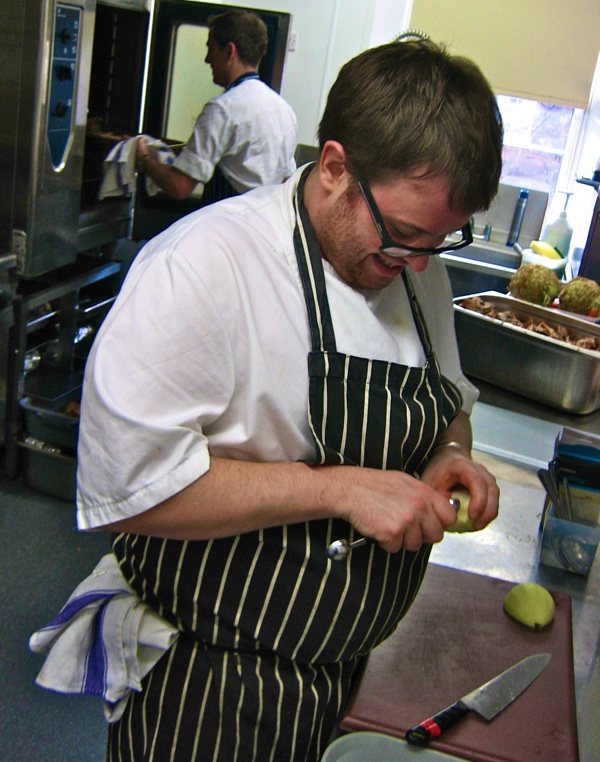


Isaac Mchale & James Lowe

You may also like to read about
Terry Coleman, Umbrella Maker

There are fewer umbrella makers in London now than you can count upon the spokes of one of their creations. Yet when I spoke with Terry Coleman, fifth generation umbrella maker and the most senior member of the trade still working in the East End, he boasted to me he had the oldest name in the world, as if it could be possible to romance his arcane profession still further. “Of all the names in the Domesday Book, only three remain and one is Coleman,” he informed me gruffly with a sagacious frown, “and in the Anglo-Saxon Chronicle for the year 626, it says, ‘Coleman and his men went back to their own country.'” – proposing that his venerable ancestry might extend even further.
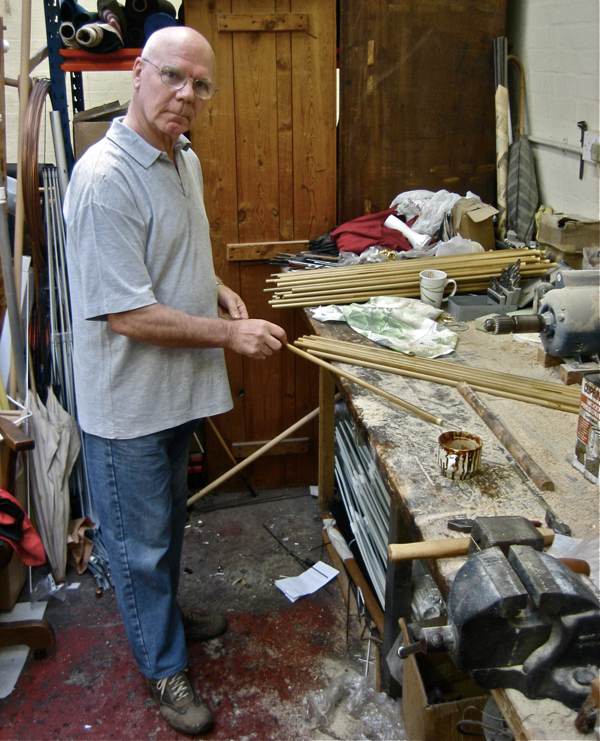
It was suitably erudite patter to accompany the “slotting” of umbrellas – cutting the grooves in the wooden shaft that hold the hand-spring and top-spring, simple devices securing the umbrella in the “up” or “down” position – as we passed a quiet morning at James Ince & Sons Ltd, Britain’s oldest umbrella maker, founded in Spitalfields in 1805 and now operating from a modest factory next to the canal in Vyner St. “There were slotting machines but it’s much quicker to do it by hand. If you use the machine, it requires no skill – you simply feed them in,” Terry declared in disdain, without lifting his eyes from an intricate pastime that filled him with such evident delight.
“We are all umbrella makers in our family, my father, his father and his father, all my aunts and uncles were umbrella makers. My father had is own company, J.W. Coleman of Hackney, and I’ve been an umbrella maker from when I left school at fourteen – there was no choice! As children, we were threadling up the umbrella covers. My dad paid us so much a dozen and we enjoyed it. Me and my brothers were racing each other. Even before we left school, we learnt the trade. I started off as a frame maker but I can do everything – I am a frame maker, cutter, finisher, machinist and tipper. All defunct trades now.”
Richard Ince, the current incumbent of the business started by his forbears more than six generations ago and a man bearing the personal distinction of being Mary Poppins’ umbrella maker, stood across the other side of the workshop, occupied at another bench yet absorbing Terry’s monologue with quiet appreciation. “When me and my brothers are gone, you’ll be the only one.” said Terry, over his shoulder and catching Richard’s eye in an affectionate glance that was indicative of their shared history – both coming from families of East End umbrella makers stretching back generations and witnessing the sharp decline of the trade at the end of the last century. James Ince & Sons Ltd was once a major business in Spitalfields, occupying a prime position in Bishopsgate and employing a large workforce, until the nineteen eighties when a capricious government decided that – for tax purposes – umbrella makers, who had been self-employed for generations, were to become employees – thereby destroying an industry already struggling to compete with cheap imports.
“I’ve been associated with Ince for years and years.” continued Terry, “At first, I worked for Richard’s grandfather, Wilfred. He was a typical City gentleman. Sometimes, he’d ask me, ‘Would you go upstairs and make the frames?’ but the other frame makers used to say, ‘Slow down!’ because they made three dozen in a day whereas I could make a gross. I remember Richard’s father Geoffrey too, an absolutely lovely man who couldn’t offend anybody. He played the organ at St Helen’s, Bishopsgate, and I used to go and sit in the organ loft with him when he played lunchtime concerts.
I set up a little workshop of my own in Hackney and I made umbrellas for Inces, from sixteen-inch up to ten-feet diameter. At one time, I would say we had the monopoly in golfing umbrellas. They were all wooden-shafted then and golf was still a top-end pursuit in the nineteen sixties, so the market accommodated an expensive umbrella. It was my grandfather and his father who pushed the trade towards leisure, and I earned a good living from Ince as a frame maker. One day in 1963, I went in and there was a bundle of golf umbrellas on imported metal frames and Richard’s grandfather said, ‘I don’t know if this is going to catch on’ – but now that’s all there is. When I started an umbrella cost a week’s wages, and all the City gents had an umbrella and a bowler hat.
Umbrella makers were traditionally self-employed, if business picked up there was always a market for skilled craftsmen. I’m retired now, but I’ve kept my hand in by making umbrellas for Inces. I wouldn’t be here today if we didn’t have this order. I haven’t done this for twenty years.”
The copper-plated iron hand springs that Terry was fitting so expertly were from old stock manufactured in the nineteen fifties and Richard Ince had invited him to come in to fit them as part of a forthcoming collaboration between James Ince & Sons Ltd and Ally Capellino, the bag lady of Shoreditch. Ally has specified all aspects of the design of this exclusive batch of umbrellas which are being manufactured at the factory in Vyner St under the personal supervision of Richard Ince. And, once the frames are complete, I shall be returning to report upon the progress of the umbrellas when Richard cuts the covers and attaches them to the frames.
It was a rare privilege to spend a few hours among the last heroic umbrella makers of the East End and be party to their soulful history which began more than two centuries ago in Spitalfields, where their ancestors once contrived contraptions out of whalebone with covers made from silk woven locally. After all this time, they carry knowledge, techniques and language that are theirs alone. This was a trade derived from the sword-stick and walking-stick makers with strong connections to the tent makers and flag makers, part of the vast interconnected panoply of skilled artisans who once existed in the East End. “It’s nice to make something,” said Terry in understated satisfaction, admiring the bundle of wooden shafts each with gleaming hand-springs fitted by hand, the rare handiwork of the East End’s senior umbrella maker, a man with a lifetime’s experience in his trade and a man with the oldest name in the world.
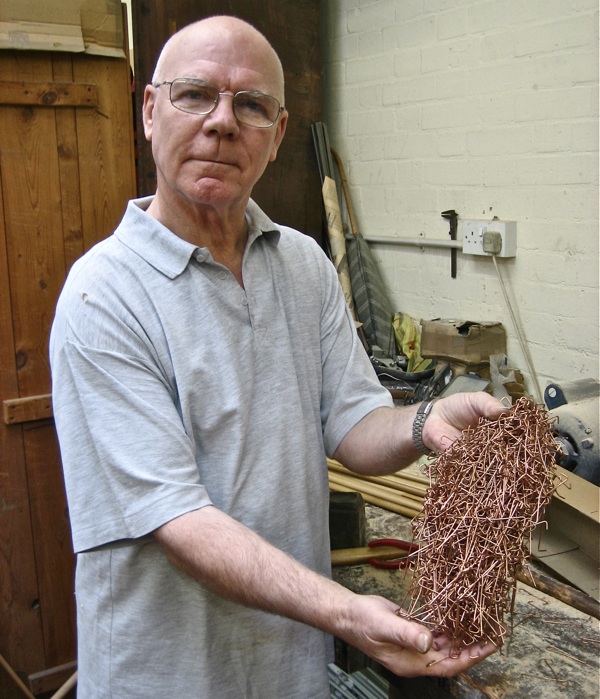
Terry shows the hand-springs from the nineteen fifties to be used for the Ally Capellino umbrellas.
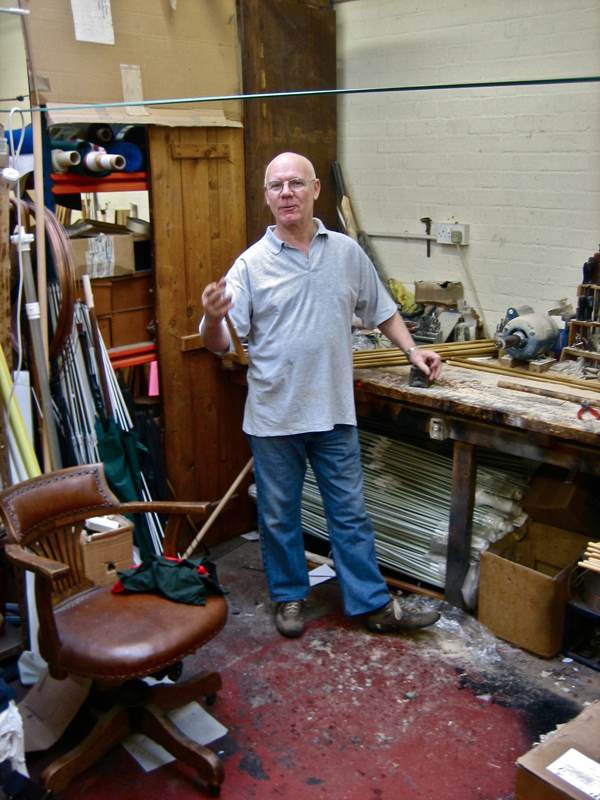
“We used to make umbrellas with a parrot’s head handle and a moving beak”
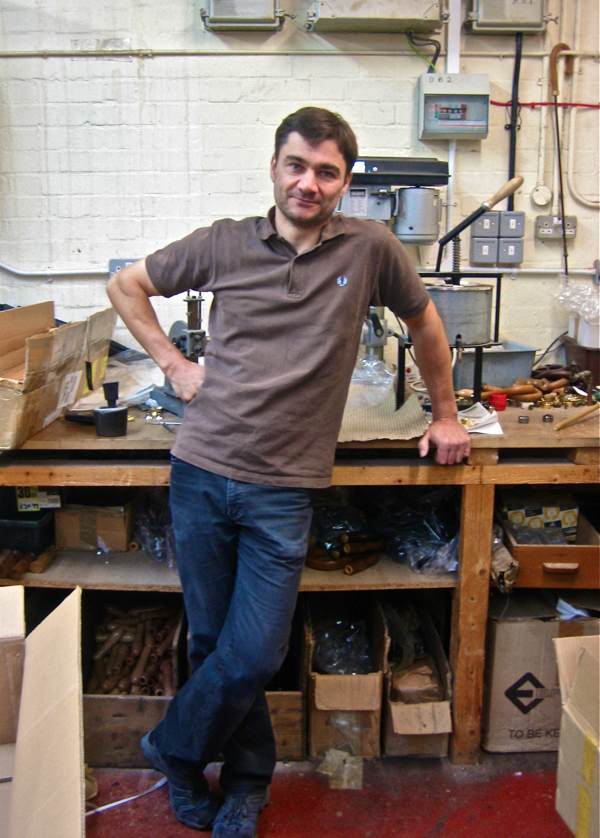
Richard Ince, sixth generation umbrella maker.
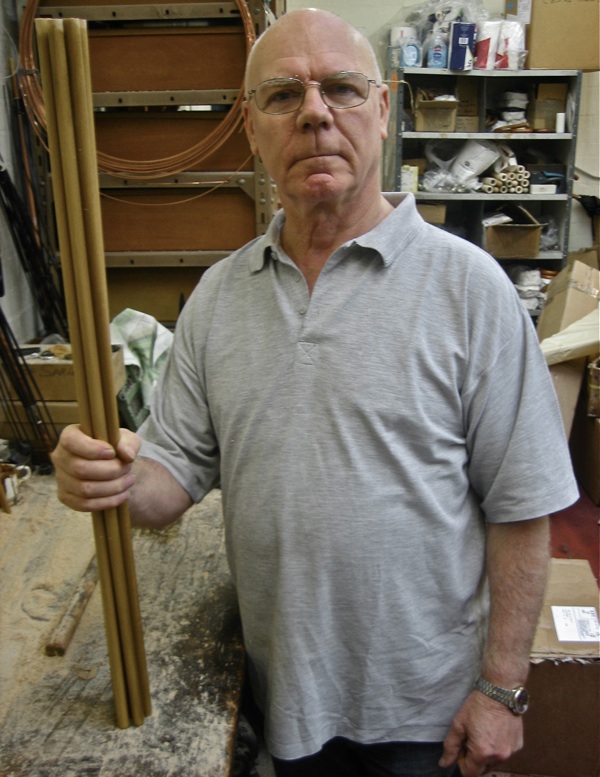
Terry Coleman, fifth generation umbrella maker.
You may also like to read about
Brick Lane Market 18

Christine Mattock
Turn left out of Shoreditch High Street station on a Sunday and you’ll encounter the long form of the Mattock family fruit and veg stall, which answers the contour of the Sclater Street viaduct with a parallel line of produce: sacks of purple potatoes; snow-white cauliflowers; gleaming aubergines; dark piles of chestnuts. Here, the mother-and-son team of Christine and Westley Mattock preside. Westley should have been Wesley, after the hero of the 1970s TV series Rich Man, Poor Man Book II, but the couple in front at the register office had the same idea, and Christine added a ‘T’ to mark the distinction. Her husband, Barry, is also part of the team – though a stroke has prevented him from hauling sacks of onions for a living. He now watches business at the stall from a car parked at the roadside. “He doesn’t miss a thing,” says Christine. It’s a friendly warning.
Christine’s father briefly kept a fruit and veg shop in Tottenham, but his heart, she says, wasn’t really in it. The trade really flows from Barry’s side of the family, who arrived from Poland, so the legend goes, after an incident involving a disrespectful ride on top of a hearse. Her mother-in-law knew the East End markets well, and remembered fly pitchers selling diamonds on the kerb. (“They’d brought them over during the war, hidden in the pom-poms on their shoes.”) But old Mrs Mattock’s experience of buying and selling went back even further – when she was a little girl she worked in her father’s kiosk on Drury Lane and the theatre staff would allow her to sneak into the back of the auditorium and watch the performances.
There’s an element of performance in Christine and Westley’s work – though the audience is changing fast. “It’s more of a tourist attraction now than a market,” says Westley. “We get more students and Yuppies these days. We used to supply thirty restaurants, but we don’t anymore. Business has folded in half in the space of a year. We just can’t buy our stuff cheap enough to give everyone a bargain.” The council, he suspects, would like to see the market wither away. Will he stay? “Of course I’ll stay. I don’t know anything but fruit and veg.” And that, he says, is a knowledge of which his customers seem less sure. “I had someone come here the other day who asked me why the potatoes had mud on them.”
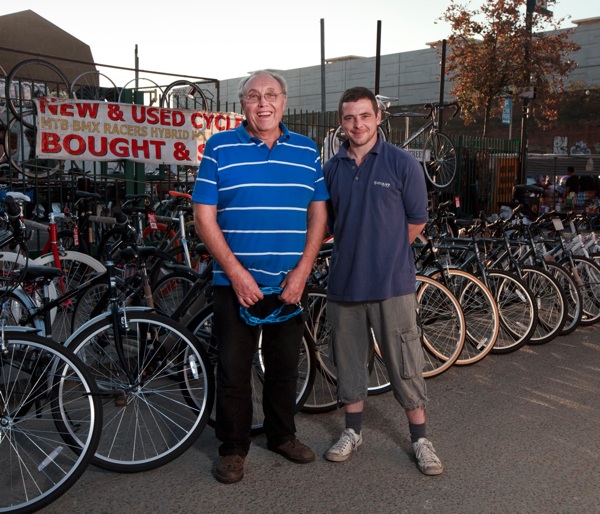
Alan Langley & Ryan
Alan Langley sold his first bicycle nearly sixty years ago – and found himself taken down to the police station for his trouble. “When I was nine years old I used to do work for an old Jewish girl in Stamford Hill, lighting her fire for her and doing the housework on the Sabbath,” he recalls. “She didn’t pay me in money, she used to give me things. And she gave me this lady’s bicycle. And I came back and sold it.” A suspicious policeman, however, decided to intervene – and Alan found himself being asked a few stiff questions in more formal surroundings. His father was understanding. “He was the sort of man who would buy and old clock and clean it up and come down here and sell it, just for the buzz of selling something.”
Alan tried other trades, too: he had a spell in the Merchant Navy, he worked for a Fleet Street press agency – and had the pleasure of seeing the future Lord Snowdon sacked for turning in a bunch of sub-standard photographs. But Alan came back to bicycles, and stuck with them for half a century. In that time his pitch has migrated from Club Row to Chiltern Street to Sclater Street, and he has acquired fifty years’ experience of the commercial life of the East End. He remembers the market when you could buy dogs and budgerigars as easily as apples and pears; he recalls the days when fly-pitchers could avoid the attentions of the council by offering the right bribe to the right official; he remembers when Goanese sailors would arrive en masse to buy bicycles, load them up into a pantechnicon and drive it back to the docks. And he’s still here: freewheeling on Sclater Street.
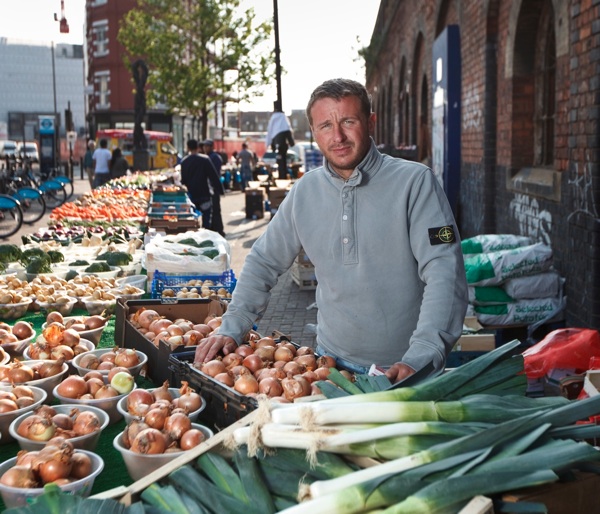
Westley Mattock
Matthew Sweet’s Envoi
And this is where I pack up my stall and wait for the Gentle Author to reclaim the pitch. Rather unwillingly, I must say – it has been a privilege to spend a week in the Author’s shoes, wandering the streets of Spitalfields and bothering some of its most interesting inhabitants with impertinent questions.
I’m not a Spitalfields resident myself, though I grew to love this area in the late nineties, when I was snooping around the place looking for the remains of Victorian opium dens – and later, when I would pop over from south of the river to take my baby daughter to Rhyme Time at the Whitechapel Idea Store – the highlight of which, I recall, was an excellent re-enactment of the story of Ibrahim and Ishmael with Action Men. (Where you there too?) I’m a Sunday visitor now, since London Transport kindly built an overground rail link between my home in SE26 and Shoreditch High Street.
But one day, if I can afford it, I hope to retire to Spitalfields. And if the Gentle Author’s successor is still padding the cobbles, I will force him or her to interview me, and I shall regale them with outrageous stories about how life used to be in the East End of the first years of the twenty-first century. And I will make it all up.
Photographs copyright © Jeremy Freedman