
Anjum Ishtaq, Heba Women’s Project

In a first-floor room above Brick Lane, a few doors south of the point at which the railway bridge bisects the street, is a modern kind of sanctuary: a place where, if you’re feeling unhappy, uncertain and isolated, you can find like-minded company and develop a few useful skills. For a place of recuperation, it can be pretty noisy, as the main room is filled with ranks of sewing machines. Up to thirty women at a time can be found hunkered down at them, feeding lengths of fabric through clattering metal teeth; shaping, stitching, talking over the squall of work. This is the Heba Women’s Project – the h-word means “women’s talent” in Arabic. That’s the force upon which this place runs – and the one it seeks to unlock in others.
Anjum Ishtaq, the ageless, quietly stylish woman who runs this centre, shows me around the premises: the meeting area with the crowded noticeboard and bookshelves; the little kitchen in which she makes me a mug of tea; the crèche, OFSTED-inspected, where the children of the Project’s clients are supervised; the sunlit workroom with its rows of workspaces; the storeroom packed with bolts of cloth, all begged and borrowed from a hundred donors. The Project has proved an unusual beneficiary of the slow death of the East End rag trade: much of its equipment and materials have come from businesses that have closed down. Nothing is wasted. And most of what is made here is sold: a stall at Spitalfields market, staffed by volunteers, ensures that the centre produces garments that end up on customers’ backs.
“We have all kinds of people here, all kinds of backgrounds. Some of the ladies who come here don’t even know how to thread the machine. Some of them have never held a pen in their lives. But sewing comes before English classes. And the first thing we do is to show them they have come to a safe place. Somewhere they can get some confidence.” The single-sex environment, Anjum says, is key to the success of the centre. “If the classes were mixed many of the women would not come. And their men would not let them come. There are many women who don’t feel comfortable even in Tower Hamlets College because of the presence of men. But they might feel confident enough to come here. And even then, a husband or a brother might come up here first to check it out.”
Like any good advocate, Anjum is much keener to talk about her cause than herself. She will, however, discuss the history that she shares with some of the users of the Project. On arriving in London from Pakistan twenty-five years ago, she felt the same disconnection from her host culture that many of her current clients can find so overpowering. “From my own experience,” she suggests, “I think you feel most comfortable in the place you spent your childhood. You know the slang, you know everything about it. And if you leave that place then you can feel there’s a kind of gap between you and everyone else. I had that gap when I first came here. But my children were born here and they don’t have it.”
The Project is not all Anjum’s own work. It owes its existence to a campaigning Yorkshirewoman named Kay Jordan, a community entrepreneur who is legendary in these parts. In 1983, Jordan, then an architect working for the Solon housing co-operative, founded the Spitalfields Small Business Association. Funded by the now-defunct Greater London Council, SSBA aimed to help local residents set up their own workshops and commercial premises in the East End. Jordan oversaw the refurbishment and development of over 62,000 square feet of derelict and underused buildings around Spitalfields. She was a socialist to whom Prince Charles came for advice on community architecture.
When Jordan died, suddenly, of meningitis, at the end of 2010, Anjum thought that the Centre might die with her. They lost funding. They endured their own financial crisis. There was a period when the possibility of closure was a problem that had to be addressed on a monthly basis. The Heba Women’s Project is now on a surer footing, but it is still in urgent need of funds. A new Saturday session, aimed, I sense, at some of the more middle-class make-do-and-menders of Spitalfields, is one new initiative that might help to secure its future.
Anjum won’t tut at anyone who drops a stitch. Come for three hours, she says, and you will go home with something to show for it. “I have ladies who tell me that they won’t be able to do anything, but they usually surprise themselves. And that look of satisfaction on their faces is what makes this job worth doing. If you have a bit of patience and you want to learn, there’s a way to learn.”

Members of Heba Women’s Project on Brick Lane.

High jinks on the South Bank.

A sponsored walk.

A trip to Victoria Park

A healthy eating class.

Anjum Ishtaq

Portraits of Anjum Ishtaq copyright © Sarah Ainslie
You may also like to take a look at
The Corner Shops of Spitalfields

Mohammed Ashraf Mujahid
When Napoleon said that the English were a nation of shopkeepers, he meant it as an insult. But he’d never been to the Costprice Minimarket at the apex of Fashion Street and Brick Lane. It is a typical corner shop: large windows blinded by adverts for Guinness and lager, walls plastered with ads for international phonecards, a volume and variety of products that would turn stocktaking into an act of desperate heroism: Sambuca, cockroach traps, memory sticks, Veuve Cliquot champagne, hair dye, air pistols, rum cream, doorbells, Swedish cider, elastic bands, corn oil, chess sets, porridge oats, rat poison, screws, coat hangers, and bottles of brandy bearing a picture of a certain French Emperor who came off rather badly at the Battle of Waterloo.
The man behind the counter today is Shafik Uddin, to whom the photographer Sarah Ainslie and I have been chatting for ten minutes before his colleague, Ruma, suddenly appears, emerging from the trap door to the cellar below. Shafik and Ruma are kept busy – the flow of customers is constant, particularly at the weekend, when Brick Lane fills up with tourists randy for a Balti. (The East European visitors, he says, are most keen on the lurid hubble-bubble pipes he stocks – which punters imagine are smoked by the Asian locals.) Despite all the traffic, Shafik says that business might be better – and might be excellent if some strange mischance removed the new Tesco Express from Shoreditch High Street. He and his boss case the supermarket’s special offers each week. When he talks about the Tesco’s recent four-for-a-quid offer on a packet of biscuits that he has priced at a pound per packet, he is voicing the anxiety of every independent grocer in the country.
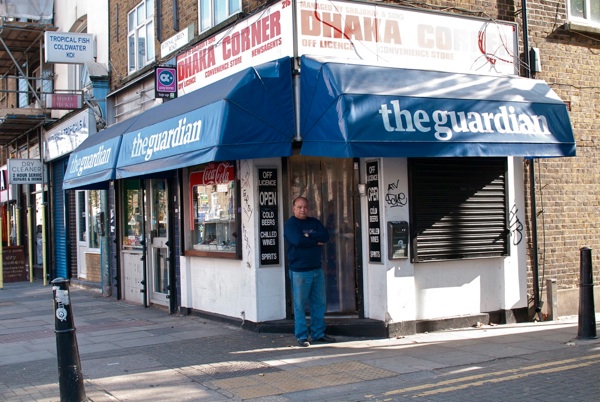
I heard nothing more optimistic from Mohammed Ashraf Mujahid, whose Grocers News and Convenient [sic] Store lies at the meeting point of Old Nichol Street and Chance Street. He has owned the place for four years, but he’s thinking of selling up and moving on. “The corner shop,” he says, “is going to die.” But he’s proud of his own store’s status as a hub of the local community, likes the fact that many of his customers are quite happy to come shopping in their pyjamas, and also understands the significance of his own role. “I see what’s going on round here. I’m security for people.” During the summer riots, his neighbours returned the favour, forming a protective cordon around the premises. The area, though, is changing subtly: the Asian families who colonised it thirty years ago are moving on. “They’re all moving east,” he says – and he means out to Dagenham rather than back to Bangladesh.
Zara’s Corner, where Spelman Street meets Chicksand Street, embodies the history of the last few decades – and a story told to me by the man minding the counter may help to explain why so many of these business are Asian-owned and run. “In the 1970s, if you were Asian and on your own, you’d get abuse if you went into a local shop,” explains Islam Uddin. “So if you ran out of milk, you’d have to phone up your mates and go in a group.” At the end of the Seventies, when the Uddins arrived on Spelman Street, there were only five families living in their block – the rest were squats, or boarded up. The original Zara was a Kenyan woman who set up the shop in the same period. There have been four changes of ownership since but, as Islam explains, the name stuck because each new proprietor had someone called Zara in their immediate family. (In the case of the current owner, it’s a niece.) Zara’s Corner occupies the ground floor of a beautiful Victorian housing development, rightly a listed building. The sign bears some tiny hand-painted images of ice-cream cones and cans of fizzy drinks. And it is another shop in which the community has a stake – a proposal to turn the place from a general store to an off-licence was met with subtle but stiff local opposition. So it remains what it was when Islam was a little boy, and was spending his pocket money on Pretzel Flipz. “We all get along here,” he says, “whatever race or religion you are. Everyone’s willing to help.”
When Sarah and I leave Zara’s Corner we strike north across Allen Gardens and the railway bridge, where a trio of street drinkers are occupying the concrete stairway. They’re in the thick of a beery argument, and the steps are wet with what I hope is Tennant’s Super. Ushaven and hare-eyed, these are fallen men who can fall no further. When Sarah and I appear, they apologise for blocking the way with touching primness.
Beyond them, where St Matthew’s Row joins the Bethnal Green Road, is Dhaka Corner, where, for the last four years, Mr Shajahan has been standing behind the sweet counter. He took on the place when the premises from which he ran a clothing company was sold from under him by the landlord. Business, he says, is bad. “We are dying,” he shrugs, echoing the words of his opposite number on Old Nichol Street. “People don’t have money to spend. They don’t have jobs. Every month you have to pay the rent, and then the rates, then electricity bills.” His shop window is evidence of his attempts to specialise: it is filled with rows of children’s shoes, school blouses and ties. One of Mr Shajahan’s suppliers, waiting to see him about an order of stock, offers his diagnosis: “There was a time when you could only get Chinese ingredients, Indian ingredients, Caribbean ingredients in a small corner shop. But now all of those have their own section in the supermarket.” I ask Mr Shajahan what he’s still selling. “Alcohol,” he replies, briskly. “To local people.” Local people, I suppose, like the men on the railway bridge.
Napoleon Bonaparte refused to accept he was beaten until his own marshals refused to take his orders. If the corner shops of England are as fated to oblivion as some of their proprietors suggest, then they are contemplating defeat with more good humour and dignity than the Emperor of France ever mustered. Here they are, among their fags and their sweets and their phonecards, finally facing their Waterloo.


Shafik Uddin


Islam Uddin



Mr Shajahan

Photographs copyright © Sarah Ainslie
You may also like to read about
The Lost World of the Laundrettes
The Stepney Witch-Bottle
“After nearly eight hundred stories, it is my pleasure to welcome Matthew Sweet to take over for a week in celebration of his new publication The West End Front by Faber & Faber on Thursday 3rd November. Matthew’s witty and erudite books have always proved an inspiration to me, and I can happily recommend his writing to you in the knowledge that you are in safe hands until my return on Monday 7th November” – the Gentle Author

In March 1954, the mud of Stepney yielded a sinister piece of seventeenth-century treasure. Out it came, from under the earth of Pennington Street, on a plot where an orchard had once stood – a bulbous stoneware bottle, upon which had been carved the shape of a face: wide, goggling eyes, a prominent nose, a savage mouth, a devilish swoop of beard. The base of the bottle was in fragments. Not because it had been pulled from the ground too sharply, or smashed by its original owner – but because it had been cracked apart by forces it could not contain.
The contents of the bottle were also recovered: a small patch of cloth and the collection of objects that had once been wrapped and pinned inside. A twist of human hair, a handful of hand-made iron nails, a tangle of metal wire, and a small collection of fingernail clippings. These, according to the archaeology correspondent of The Times, revealed the true nature of the discovery. This was a “witch-bottle or Bellarmine jug … doubtless used to employ ‘sympathetic magic’ either to injure a victim or to ward off the supposed effects of witchcraft.”
In the popular imagination, witchcraft is rural. And yet, the record shows that belief in magic continued to thrive in East London as the cobbles advanced and the meadows and marshes retreated. In 1820, the American essayist Washington Irving reported that “an old woman that lives in Bull-and-Mouth Street makes a tolerable subsistence by detecting stolen goods, and promising the girls good husbands.”
In his essay Urbanisation and the Decline of Witchcraft, Owen Davies describes the case of Mary-Ann Gable, the wife of a coppersmith who lived on Russell Street in Stepney. In 1858 Gable told a court that she had ben so troubled with “frightful pains” that she suspected herself to be under some hostile supernatural influence. She sought the help of a Mrs McDonald of Cudworth Street, Bethnal Green, who confirmed her suspicions and sold her ten doses of powders at sixpence a twist. These Gable threw on the fire while reciting a prescribed incantation, with the intention of causing “torment” to her enemy. Gable took McDonald to court not because she had been sold a large amount of worthless remedies, but because she had discovered that the old woman was also in the employ of her antagonist, and was supplying that person with the same magical instruments.
The witch-bottle was, it seems, most often used as a counter-measure of this kind. According to Cotton Maher’s Late Memorable Providence (1691), those who felt themselves to be under attack by a witch could reverse the charm by filling a bottle with urine, into which would be dropped a little package of “Nails, Pins, and such instruments as carry a shew of Torture with them”. The sharp objects inside the symbolic body of the bottle would, if the magic worked, produce excruciating pain the corporeal body of the enchanter. The urine might be that of the witch, but it seems, more often and more pragmatically, to have been the urine of the bottle-maker. The reason being, according to Joseph Blagrave’s Astrological Practice of Physic (1671), that “there is part of the vital spirit of the Witch in it, for such is the subtlety of the Devil, that he will not suffer the witch to infuse any poysonous matter into the body of the man or beast, without some of the Witches blood mingled in with it.” If you wanted the witch to die of slow strangulation, you would then bury the bottle in the ground. If you preferred something more spectacular, you could throw it on the fire, though if the cork escaped before the stoneware exploded, then the charm would fail. The cocktail or urine an iron nails usually ensured that even those Bellarmine jugs buried under the earth would burst eventually – this is what happened to the Pennington Street specimen. Many such bottles have been disinterred, but so far only one has been found intact and stoppered.
One hundred and thirty of these objects have been recovered from sites all over Britain – though few of them are of British manufacture. Most were made in Germany, where the face carved on the neck of the bottle was held to represent a wild man figure from Teutonic folklore. The name Bellarmine is thought to derive from that of Cardinal Roberto Bellarmino, a hate-figure for Protestants across seventeenth-century Europe.
Are such objects still being fashioned? A modern Pagan whom I consulted for this article professed that she had used witch-bottles as part of her practice, though she stressed that unlike Mrs McDonald of Cudworth Street, she had never filled one for commercial gain. The fliers that come through the door from practitioners of African traditions, offering to improve my finances or cause trouble for my enemies suggest that sympathetic magic is alive in modern London.
In the 1950s, Ralph Merrifield, Assistant keeper of the Guildhall Museum in the City of London, bemoaned the lack of interest in discoveries such as the Pennington Street witch-bottle. “Unfortunately,” he reflected, “many archaeologists are curiously reluctant to show any interest in the less rational aspects of human behaviour, and finds of this nature are rarely publicised or discussed. It is not clear whether this is due to a modern superstition, contradicted by history, that man is a rational animal; or to the revival of an ancient one, that there is a risk of contagion in such studies, leading, if not to possession by the powers of darkness, at least to a collapse of scientific scepticism!”
My scientific scepticism is pretty robust. But I will concede to the believers on the question of sympathetic magic. The witch-bottle eased from the Stepney mud in 1954 is now housed, with many similar examples, in the Museum of London. You only have to gaze upon the strange, savage features of the faces that they bear to feel something of what they must have meant to the people who packed them, corked them, and bedded them in the earth.
Drawing of the Stepney Witch-Bottle by Joanna Moore


Montages by Sarah Ainslie using her photographs of skeletons exhumed during the rebuilding of the Spitalfields Market in 1999.
Drawing copyright © Joanna Moore
Montages copyright © Sarah Ainslie
You may also like to read about
The Fly-Pitchers of Spitalfields

When I first came to Spitalfields, at dawn one Sunday morning in Winter long ago, I was amazed to find Brick Lane full of fly-pitchers – people selling a few items directly off the pavement. Yet as the years have gone by, these pavement traders have been pushed further and further out until they find themselves at the very edge of the territory now, crowded together along the Bethnal Green Rd upon a narrow strip of pavement beside the site of new a shopping mall. Literally at the margins, these people are suffering at the heavy hands of market inspectors constantly harassing and threatening them, causing them to pick up their things and flee – only to return later and do a little more trading before the next purge happens, in a tragic ongoing game of cat and mouse.
Commencing in the early hours and sometimes gone by first light, the existence of these traders in unknown to many visitors that come to Brick Lane on Sunday. So, for the last month, Spitalfields Life Contributing Photographer Colin O’Brien has been down there among the fly-pitchers and the result is this remarkable set of pictures which acknowledge the dignity of these people who are being subject to such unnecessary humiliation for sake of wanting to sell a little bric-a-brac.
“My name is Jason John, I’m writing you a damn good song” – these were the first words I heard when I came round the corner of the Bethnal Green Rd into Norton Folgate last Sunday morning, just as a street musician with curly dark locks appeared with theatrical aplomb from behind a telephone box, wielding his guitar and offering a tuneful accompaniment to the lively scene of pavement trading sheltered by the vast railway bridge arching over us. It can be a pitiful spectacle to witness the modest possessions that people are selling here, asking prices as little as 10p, and yet this market is remarkable for its vibrant life and sense of camaraderie that, ironically, has strengthened in the face of the current threat.
Over the weeks that Colin has taken his pictures, a stack of black sea-containers were put in place and the hoarding behind the fly-pitchers came down to reveal the pop-up shopping mall which will open here shortly. Now a fence with the logos of the international brands who will be selling their wares here in future serves as a backdrop to the fly-pitchers and the contrast between the two could not be more extreme. The developers who own the site are creating a temporary shopping mall to capitalise upon their investment whilst they raise the cash to construct a tower block for corporate clients and – for the sake of this – a few pensioners, the handicapped, those struggling on benefits and the dispossessed are being criminalised because they try to sell a few of their belongings to raise a little extra cash on a Sunday morning.
I spoke to a Jewish gentleman in his seventies as he arrived to place six worn shirts on the pavement for sale, casting glances nervously to either side. I bought one of his shirts for 50p in order to strike up a conversation with him, yet within minutes he was harshly moved on and my 50p proved to be his sole income for his effort that morning.“They’re trying to get rid of the poor people!” exclaimed one woman in grief, too scared to consent to a photograph by Colin.
The argument is used that the fly-pitchers are unlicensed and they are blocking the pavement. Yet the truth is that some have been coming to Brick Lane to trade for their entire lives, participating in the culture of unregulated pavement trading which has been in continuous existence in this corner of the East End on Sundays for centuries. And, if they are blocking the pavement now it is because they have been herded into this narrow space away from Brick Lane against their will.
Gina of Gina’s Restaurant in the Bethnal Green Rd, who started her first cafe in Brick Lane with her husband Philip Christou in 1961, opens each Sunday now to serve the same people who have been coming all these years. When they are ‘purged’ by the inspectors, they take refuge in her establishment and if the old people have failed to make enough money to pay for a Sunday lunch – which was their sole intent in getting up before dawn and coming down here – then Gina simply gives them a meal. It is a sombre experience to sit in Gina’s Restaurant among those who have taken flight and recognise that these spirited characters are the people who have been in the market longer than anyone.
The soul of the place resides with the fly-pitchers and their moral rights must be respected now – through the provision of a space where they can trade peacefully – rather than subjecting them to the current inhuman treatment which degrades us all.


Jason John, Street Musician


Mr Gil, Street Preacher


Photographs copyright © Colin O’Brien
You may also like to take a look at these other pictures by Colin O’Brien
Colin O’Brien’s Brick Lane Market
Colin O’Brien’s Clerkenwell Car Crashes
Travellers’ Children in London Fields
At Prick Your Finger

“Why not start by falling in love with a yarn?”
You might not expect a knitting shop to be an exciting place – but when I arrived at Prick Your Finger at 260 Globe Rd and reached out to discover that the bridge of a guitar had been substituted for the door handle, I realised I was in for a rock and roll experience. You might assume that hand-knitting has been rendered obsolete by cheap mass-production – lost in the fast pace of contemporary life – but you would be wrong, it is enjoying a lively renaissance at present. Knitters of all ages and backgrounds are coming together to share their skills, tossing aside patterns to express their creativity in unconventional ways and transgressing the boundaries of a creative medium that was once a byword for mundanity.
Operating from their tiny shop which has become the focus of this culture in the East End, Rachel Matthews & Louise Harvey are exuberant evangelists of the revival, espousing needlecraft as a means of individual creative expression and even of personal liberation. And I was especially keen to pay a visit because this is the time of year to embark upon an ambitious knitting project to fill the long Winter nights ahead.
“‘Why not start by falling in love with a yarn?’ that’s what we say to people when they come in, because often they bring an idea of what they like based on something they may have seen in a magazine,” admitted Rachel who opened the shop with her college pal Louise four years ago,“Instead, we try to help people focus on their relationship with the material.”
“A lot of officeworkers are losing their dexterity and feel they can’t create anything, so we offer intensive support to people who want to become knitters.” continued Rachel with a sympathetic smile, “We try to teach people dexterity in their fingers, but what we’re actually teaching is that using your hands well through knitting can give you a confidence which stays with you your whole life.”
When Rachel found this shop, the building had been partially reconstructed internally by an errant architect, leaving a labyrinth of strangely-angled rooms resembling the interior of a house drawn by Dr Seuss. Downstairs, the shop is crammed to the roof with yarn and quirky details – including a knitted fish on a shelf, crocheted mushrooms in fairy rings on the ceiling and a woven stork’s nest complete with brood in a corner. Upstairs is a large studio where classes are held nightly, enabling customers to buy their yarn and needles below then seek tuition above, receiving all the necessary technical guidance and emotional encouragement to fulfil their dreams in knitwear.
Rachel & Louise met at St Martin’s School of Art where they both studied textiles, united in solidarity as the only students in the canteen to bring their lunch in thermos flasks. “There was no gallery even to display textile work because people were embarrassed by it,” revealed Louise with comic affront, sharing a glance of reminiscence with Rachel as she revealed the origins of their fervour,“We really suffered from that.” Dismayed at the high art sensibility which forbade them to use the phrase “wallhanging,” they left with a shared desire to express their appreciation for “low craft,” the domestic skills of knitting and needlework which had become disregarded and unfashionable. “You get fed up with knitting being a big joke!” declared Rachel, flashing her eyes and crossing her arms in mock outrage.
After college, Louise designed knitwear at a fashion house while Rachel worked as a community artist spearheading the KIP movement – Knitting In Public – which has been key in the resurgence of popular needlecraft. Then the duo opened Prick Your Finger, with a playful approach to the subject yet respecting the subtle emotional meanings and deep personal investment which knitters bring to their creations.
“When customers come in they tell us why they want to knit something, and it’s usually a rite of passage, having a baby, falling in love or children leaving home,” revealed Rachel, obviously savouring all these confidences exchanged over needles. “We welcome UFOs too,” added Louise helpfully, slipping it into the conversation in a way that left me speechless,“People can bring their UnFinished Objects to us for administration and then we pass them onto to someone else to complete before returning them to the owner. There is usually a story that reveals why they are not finished, and sometimes it might involve heartbreak or death.”
“When we started we had only twenty balls of wool,” recalled Louise, rolling her eyes to take in the walls of their shop, now lined with hanks, skeins and balls of fibre in an infinite variety of colours and textures, “We found there was nowhere in London you could buy British yarn, so we decided to become haberdashers and open our own place. Now we have over one hundred suppliers, all from this country.”
In the East End, Prick Your Finger is a place of which it may truly be said that you can always be guaranteed to find a good yarn.

Louise Harvey at her knitting machine.

Rachel Matthews & Louise Harvey

Rachel Matthews with the quilt her mother made.
At Richard & Cosmo Wise’s Shop

Cosmo Wise, proud of his collection of darned nineteenth century farmer’ socks
If you cannot get excited by the new styles in the stores this season, you might prefer to go along to Richard & Cosmo Wise’s shop at 68a Cheshire St where all the clothes are between seventy and one hundred and thirty years old. These are the raiment that your great-grandparents got dragged through a hedge backwards in and yet, miraculously, survived – through endless ingenious patching and artful darning – to fall into the hands of this father and son team who cherish these magnificently damaged old togs. Searching rural France and Japan, Cosmo & Richard have amassed an extraordinarily charismatic trove of glad rags and work clothes that have inspired them to pursue a tender aesthetic of loving repair, renewing these garments and giving them a fresh life, in which their histories and idiosyncrasies can be appreciated by aficionados.
“I learnt a huge amount from those anonymous people,” Cosmo admitted to me, producing a lovingly patched-up coat from a rail and stroking it,“I feel I have a symbiotic relationship with the seamstresses of a hundred years ago. They each had their own styles of darning and repair. More than utilitarian, there’s a real sensibility present.”
The garment in question appeared to be half-and-half, two different jackets joined laterally to create a new coat in which Cosmo’s repairs were indistinguishable from those done generations ago, and lined with vintage quilted French and Japanese fabric. This eye-catching collage of textiles was also undeniably contemporary in appearance, sewn together with superlative skill and possessing a certain charisma no mass-produced item could ever match. Cosmo is keen to emphasise that his interventions are always based upon precedents, such as – in this case – the half-and-half shirts of seventy years ago with extended tails in contrasting fabric to be worn over trousers like smocks.
For just a couple of weeks, until 20th November, you can try some of these fascinating clothes for yourself in an enchanted space full of Richard & Cosmo’s glorious paraphernalia. “It’s a place where people can come to find out what we are about – where everyone’s always welcome to come round for drink,” Cosmo declared to me with reckless abandon, both supremely excited about the new venture and lacking two nights’ sleep.
In the shop you will find fine specimens of their discoveries – examples that have been sympathetically renovated alongside clothes which have been newly-made from patterns based upon old designs using pre-war fabrics, sold under their own label, “De Rien.” “We live with this stuff,” Cosmo confessed, gesturing affectionately to the rails of the most characterful old clothes I ever saw,“this shop is a more ordered version of our home. Here you will find a lot of indigo, old French hunting gear, and plenty of exceedingly patched up workwear with a lot of life to it.”
In an age of mediocre disposable High St fashion, Richard & Cosmo are visionaries who recognise the rich poetry in patched-up old garb, respecting the tale these rags tell of the time when almost all had well-made clothes. By appreciating the dignity and restraint in modest garments tailored for working people, they honour the lives of those who for whom it was the custom to wear their clothes out, rather than simply dispensing with last year’s fashions.
Each item of clothing in Richard & Cosmo’s shop has a story, and every one speaks of a different life and another world.


Click to enlarge
Dating from 1879, this tricolore fireman’s uniform was created to celebrate the centenary of the French Revolution. Designed for a pageant or parade, it is a homemade garment of the finest glazed linen. At this time, the French often sewed tricolore ribbons inside the inner pockets of frock coats to remind them of their country’s liberty.

Dating from the late thirties or early forties, this cotton flannel shirt – where the bottom is lengthened by the addition of a contrasting fabric – represents a classic example of a certain style of repair where an aesthetic choice is apparent which transcends mere utility.


This chambray shirt from the same period has been extended with the addition of two layers of fabric, a flannel and a poplin – the stripes on the extension have even been aligned with those on the original shirt. This garment is also notable for the fine darning which complements the white stitching upon the seams.


A moleskin cycling jacket from the nineteen thirties in an attractively faded ochre, with extended sleeves and a high waist to suit the posture of a rider.


Manufactured of heavy duty cotton which is brushed on one side, this grey patched jacket dates from the nineteen forties and sports some attractive contrasted patching including a waist band that resembles a built-in cummerbund.


The survival of woollens is rare and this plaid specimen with a zip-up collar dates from the early forties.


This child’s sweater with a characteristic ‘gate’ motif is also from the nineteen forties and displays some spectacularly intricate darning, especially in the armpits.


An early twentieth century apron, from the period 1915 to 1930.


Garment photographs copyright © Sofiane Boukhari
The shop was styled by Marisa de la Lopez
You may also like to read about
Richard & Cosmo Wise, Rag Dealers
Richard & Cosmo Wise’s Collection
At 68a Cheshire St daily from 11am to 7pm, seven days a week, until November 20th.
At Alexander Boyd’s Tailoring Workshop

Marek Tadeusz Markowski, Tailor
Within living memory, the rag trade was the primary industry in the East End and it was once said you could walk the entire length of the Whitechapel Rd going from one clothing factory to the next, but today it has all gone – apart from the tailoring workshop of Alexander Boyd in Bow. Yet this is no sweatshop, here – beneath a high ceiling with ample space and light – fourteen people work to the exacting standards of Marek Tadeusz Markowski, the Master Tailor, producing fine bespoke garments.
If you walk into the shop in Artillery Lane and order a suit from Clive Phythian, the Master Cutter, this is where it will be made, just few miles East of Spitalfields. To the uninitiated, it might appear that Clive is the tailor, but in fact he is the conductor of an orchestra comprising many different skills and of which Marek is the leader. And although I thought I had met tailors before, when I was introduced to Marek -a purist in the art of fine tailoring who presides with benign yet scrupulous authority over his minions – I discovered that I was meeting a tailor for the first time.
“Those people up in the West End may call themselves tailors but in fact they are coat makers, waistcoat makers or trouser makers – they are specialists. So if you ask them to make something else, they will say, “It’s not my cup of tea.” I call myself a tailor because I can do everything. If you want a suit, a shirt, breeches, a velvet smoking jacket, a pair of curtains or even your underwear darned, I can do it all because the training I had in Poland was magnificent.
My grandmother was a tailor and my grandfather was a shoemaker. I come from a family of shoemakers in Elblag, we are an old skills family. At fifteen years old, I finished school and trained as a tailor for three years. We had to learn to make everything, in three days a week of tailoring and three days at school. My teacher said to me, “You may learn this now but in the next three days you will forget,” so I worked twelve hours every day, working at tailoring before and after school, from six o’clock in the morning before classes and until eight o’clock afterwards. The system in Poland then was that the government took money off the tailor’s taxes for each apprentice, so it didn’t cost him anything. He was only paying me pocket money and the quicker I learnt, the quicker I could make money by making clothes for my friends and having my own customers.
At eighteen, I went to do an A level in tailoring and cutting at an evening college, and during the day I was opening my own business, after just three years of training. Then, in 1981, I came to visit my uncle in Bristol for a couple of months and found I couldn’t go back to Poland because the borders were closed when martial law was imposed. So I asked the Home Office to extend my visa for a few months and thought, “I’ll go back then,” but it didn’t happen. After four years, I learnt English and opened my own shop in Reigate, Surrey. I ran this until 1997, when I returned to Poland to open a tailoring shop with my brother but I discovered there was no demand there any more, those with money wanted mass-produced designer clothes like Versace.
When I returned to London in 2001, I started working for Huntsman’s in Savile Rowe and I stayed there a year and a half. Then I went to Maurice Sedwell, Gieves & Hawkes and Henry Poole, moving from one place to the next – by observing how other tailors work, you pick up little things that you can adapt to your own system. And that way you move forward because if you don’t move forward you start going back. Boyd of Alexander Boyd approached me when I was working for Wilkinson in St George St. It was Clive Phythian, Head Cutter who introduced me.“He’s a true tailor,” Clive said,“he’s got the knowledge of cutting and everything to do with tailoring.”
I am not a designer, I am a constructor. If you draw me a garment, then I can cut the pattern and make it. Sometimes I simply do a drawing from a customer’s description and then make it. I would say I am at the top of my profession. There is no secret for me as far as tailoring is concerned.
I have been in this job since July and have fourteen people working under me. We advertised in papers and on the internet, and they are from Poland, Lithuania, Slovakia and England. I can say that at the moment I have an “A team.” It’s not a big factory, it’s a small workshop. It gives me pleasure that I can pass on my knowledge and we can produce garments here that compete with the best companies in the world.”
While I was there, the skills of the workshop were focussed upon a few bespoke pieces – some fine linen jackets and a long tweed overcoat – as well as making new staff uniforms for the Boundary Hotel. A peaceful atmosphere of concentrated application presided, with the tailors constantly bringing things to refer to Marek who hovered around to offer support – in between returning to his stool that permitted him to oversee the entire workshop, as he sat with his long needle between his dexterous fingers, forming the living fabric to his will.


Marek Tadeusz Markowski
You may like to read my profile of Clive Phythian, Master Cutter at Alexander Boyd
and also take a look
At Rayner & Sturges, Shirtmakers
At Drakes of London, Tiemakers


