21st December, Wassail

There are several related traditions of “Wassail.” Firstly, wassailing is an ancient Southern English custom performed to ensure a good crop of cider apples next year, yet wassail also refers both to the salute “Waes Hail” (a contraction of the Middle English phrase “wæs hæil” meaning”good health”), and also to the drink of “wassail” which is a hot mulled cider drunk. The giving of libations and the pouring of a drink as an offering was common in many religions of antiquity.
In the cider-producing counties in the South West of England, wassailing involves singing and drinking the health of the orchards – the purpose being to awaken the cider apple trees and scare away evil spirits, ensuring a good harvest next year. The ceremonies vary from village to village but all have the same core elements. A wassail King and Queen lead the song from one orchard to the next, and the wassail Queen will be lifted up into the boughs of the tree where she will place toast soaked in wassail from a “Clayen Cup” as a gift to the tree spirits. Then an incantation is recited –
Here’s to thee, old apple tree, That blooms well, bears well. Hats full, caps full, Three bushel bags full, An’ all under one tree. Hurrah! Hurrah!
At Carhampton near Minehead, the apple orchard Wassailing is held on the Old Twelfth Night (17th January) as a ritual to ask God for a good apple harvest. The villagers form a circle around the largest apple tree, hang pieces of toast soaked in cider in the branches for the robins who represent the good spirits of the tree and then a shotgun is fired overhead to scare away evil spirits and the group sings –
Old Apple tree, old apple tree,
We’ve come to wassail thee,
To bear and to bow apples enow,
Hats full, caps full, three bushel bags full,
Barn floors full and a little heap under the stairs
My partner’s surname is Appleton – a name of Anglo-Saxon origin, originating from many of the places thus called, for example Appleton in Cumberland, Lancashire, Yorkshire, Norfolk, Cheshire, Berkshire and Kent. Recorded as “Apeltun” and “Epletune” in the Domesday Book of 1086 for the various counties, it derives from the Old English pre-seventh century “aeppeltun,” an orchard, a compound of “aeppel,” an apple, plus “tun,” an enclosure or settlement. Here I have shown two of Nick’s ancestors in the Kentish orchard from which they got their name. They wear Anglo-Saxon garb (note Aethelwulf Aeppeltun’s garnet-encrusted cloak broach), drinking ale or cider from horns and making merry on this, the shortest day of the year. Note too the drink-soaked crust in the branches, the dormant skep in the orchard and the tipsy Robin Redbreast looking on. Behold, the birth of the English binge-drinking culture.
Wassail! Drink Hale!
Illustration copyright © Paul Bommer
At NAFAS

Wendy Davis, National Chairman of NAFAS
One Christmas, my presents arrived wrapped in red foil and garnished with artfully contrived arrangements of pine cones, lichen-encrusted branches and holly leaves sprayed gold. I knew something was up – my mother had joined a flower arrangment society. The truth is that I come from a passionate family of flower arrangers. My grandmother used to stand beech leaves in jars of obscure chemicals and then flatten them under the carpet for months in preparation for Christmas when she would fix them in oasis with honesty pods and plastic hellebores. Famously, for an exceptionally ambitious display, she once grew gladioli and set them at angles using a protractor, to create the effect of the sun rising.
So you can imagine my excitement when I was invited to tea with Wendy Davis, Chairman of the National Association of Flower Arrangment Societies, at the magnificent eighteenth century headquarters in Devonshire Sq where the activities of their seventy-two thousand members are co-ordinated. Wendy was flushed with pride from a recent triumph at Westminster Abbey, where she had organised the display for the four hundredth anniversary of the King James Bible. Twenty-one years ago, a close friend took Wendy along to a flower arranging class in Llangollen, North Wales and she has never looked back since, yet she still carries an awareness of the essentially modest nature of her chosen art.
Wendy is inspired by Julia Clements, the third president after Constance Spry and Mary Pope, the pioneering founder of the Association in 1959. A legend among flower arrangers and author of dozens of classic books on the subject, Julia Clements died in November after celebrating her one hundred and fourth birthday this year. “A week before she died, we were doing flower arranging together,” Wendy confided to me, as we sipped tea from floral cups in the quiet of her panelled office. “She started flower arranging classes after the war to give people something to do that wouldn’t cost money,” explained Wendy, lapsing into respectful silence and taking another sip of her tea.
Leading me up the fine old staircase, winding through the centre of the house, Wendy showed me the expansive reception rooms with cases storing all manner of flower-arranging trophies and the grand conference room where representatives from the twenty-one regions convene. On the top floor, modestly appointed shared bedrooms provide accommodation for members from out of London whilst visiting on Association business. Staffed by a core of five paid staff and a great many voluntary helpers, the prevailing atmosphere at NAFAS is of civility and respect.
Wendy taught me how to spot the ubiquitous NAFAS triangle, the ideal compositional form for a floral arrangement, permitting the most elegant use of flowers and foliage. It need hardly be said that there is an elaborate culture at NAFAS with a refined aesthetic code of its own, maintained through demonstrators that teach the visual vocabulary and judges who qualify to make assessments in the all-important competitions. Make no mistake, flower arranging is a highly competitive global arena these days with NAFAS sending contestants to Boston for the world championships and acting as consultant to Indian universities upon the creation of flower arranging qualifications.
Wendy prefers to speak of the personal meaning that is incarnate when flowers are used to express emotion. “When I’ve done funeral flowers for members of my family and friends, it’s how I say goodbye to them,” she confessed, turning thoughtful as we descended the stairs again. Certainly, I associate flower arranging with churches and the innate poetry that exists in such ephemeral displays set against unremitting stone. Wendy related the story of an eleven-year-old boy who won a trophy in a NAFAS scheme to encourage flower arranging among the young. He could not collect the award because his father died, but he made a floral arrangement in memory of his father. “Some people said it was morbid, but I said, ‘no, creating this is part of the healing process.'” Wendy informed me with a tender smile.
I cannot deny that flower arrangements strike an emotional chord for me too. I can never walk past, I must always stop and pay due reverence to any floral composition – contemplating the thought and care expended in its creation. And flowers from the garden displayed in old china have been a fond motif throughout my life. In fact, I do not remember those Christmas presents which came adorned so beautifully with pine cones and holly, I only remember the decoration.
The flower arrangers might seem strangely placed here at the edge of the City surrounded by financial industries – yet the truth is they are a gentle civilising influence upon their neighbours, preaching their NAFAS message of “Friendship through flowers.”
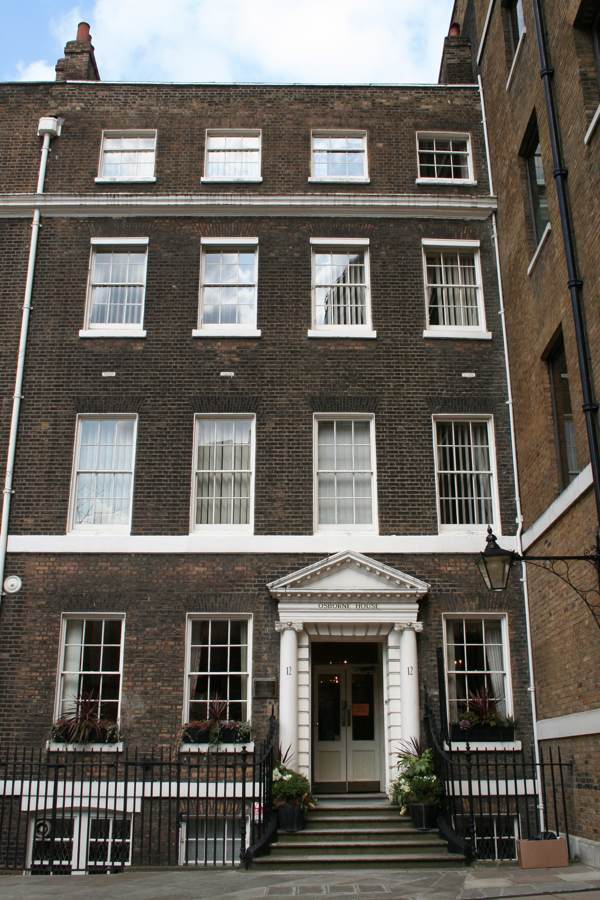
National Association of Flower Arranging Societies headquarters in Devonshire Square.
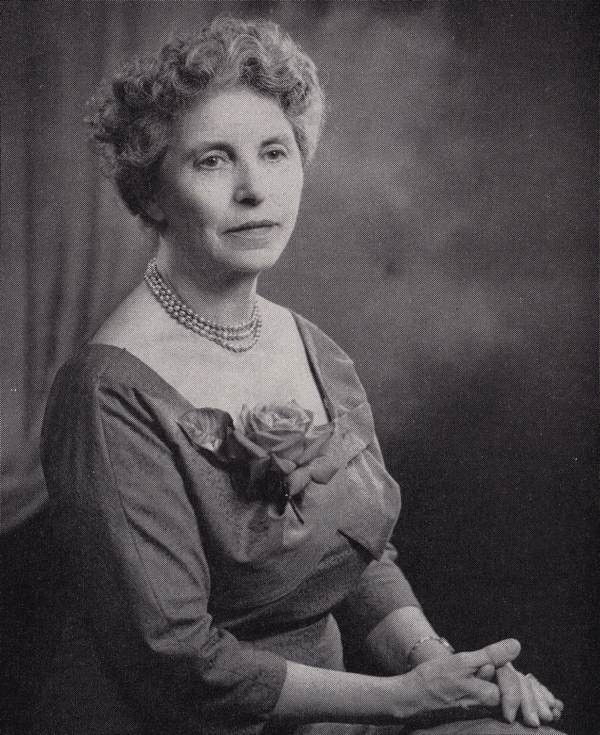
First president of NAFAS, Mary Pope – a pioneer in the flower arrangement movement.
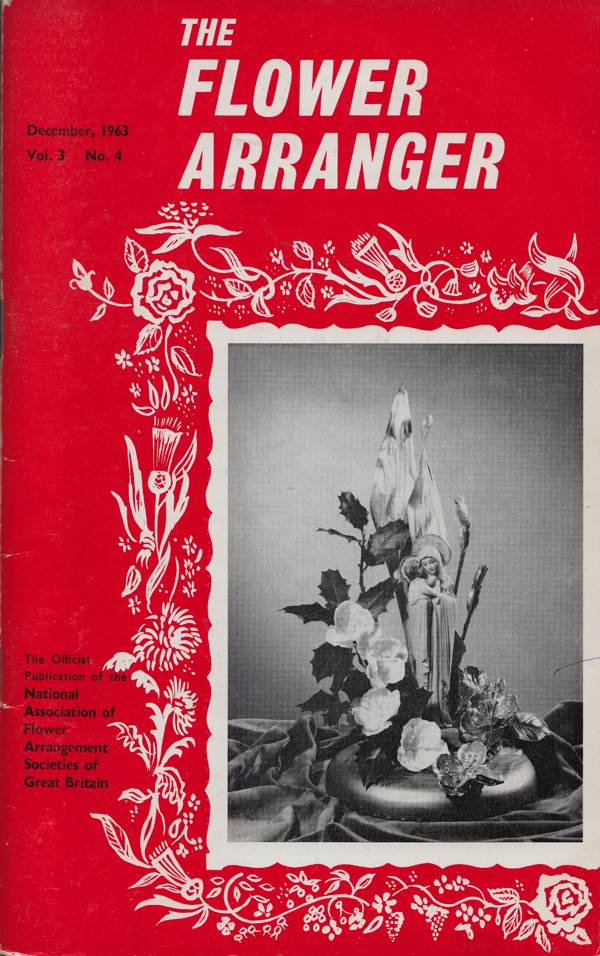

The Lady Mayoress of Plymouth admires a flower arrangement at Saltram House, 1963.
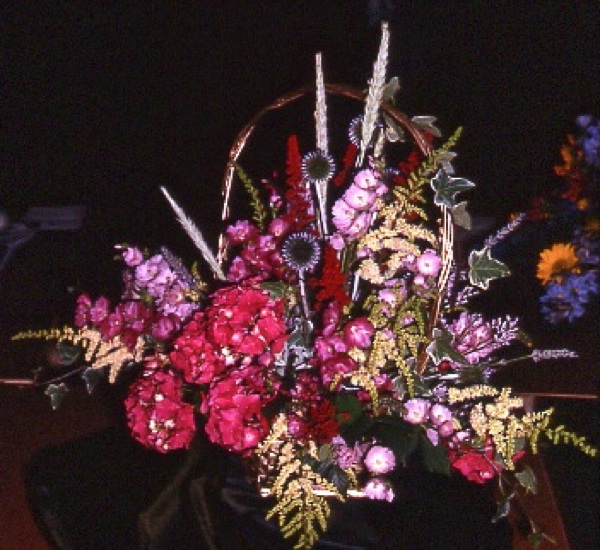

At the Buxton Festival, Mrs Russell Ritchie Innis presents the Paul Revere silver bowl to Mary Pope as a gift from the National Association of Garden Clubs of USA, 1964.
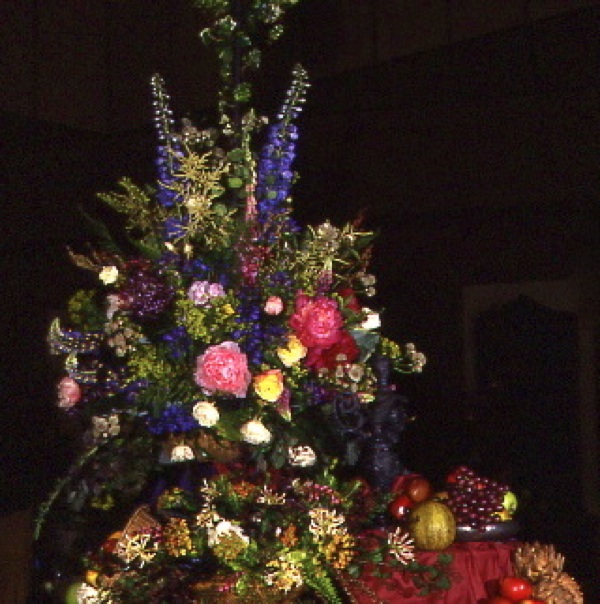

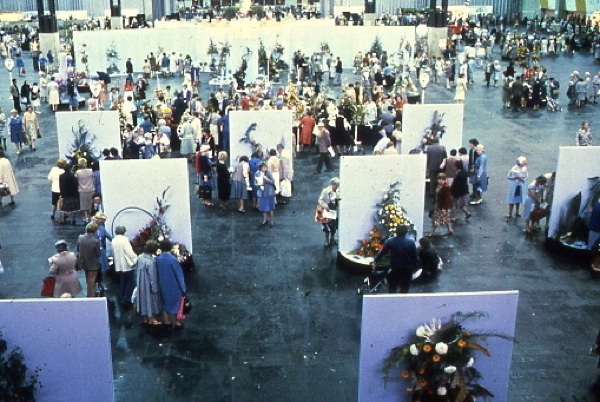
Admiring a table decoration in scarlet and green at Taunton’s Christmas exhibition, 1963.
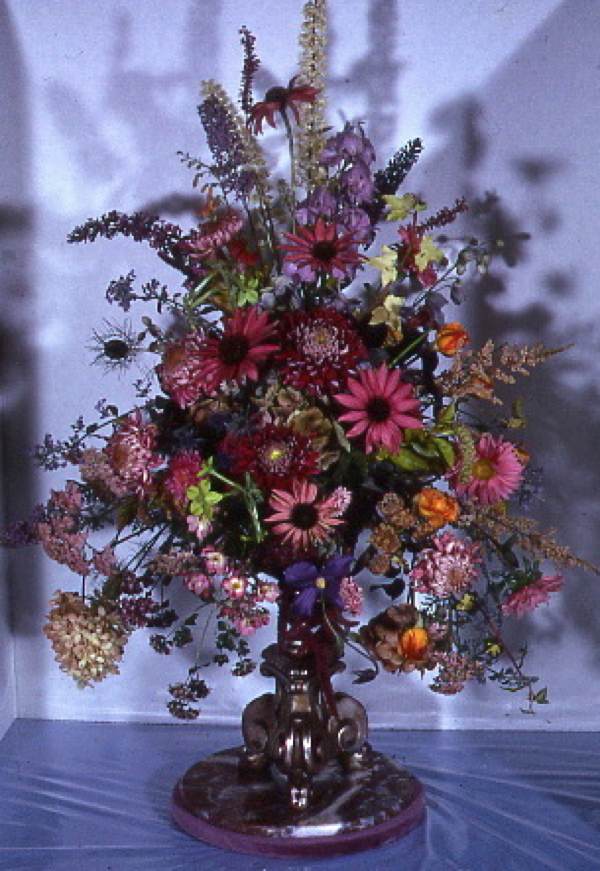

Tom Hill, winner of the trophy for the best arrangement at the Mercia & North Wales Show, Nantwich.

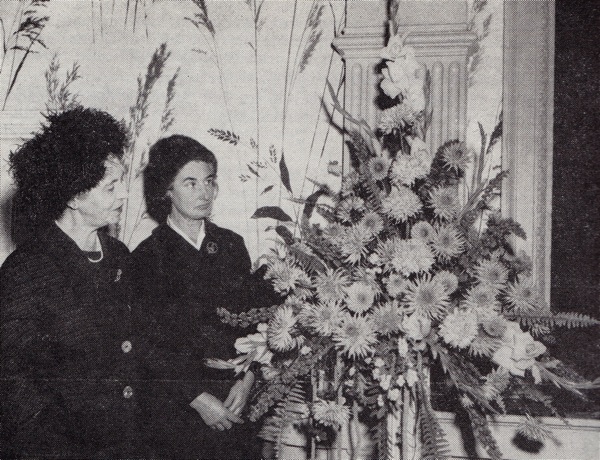
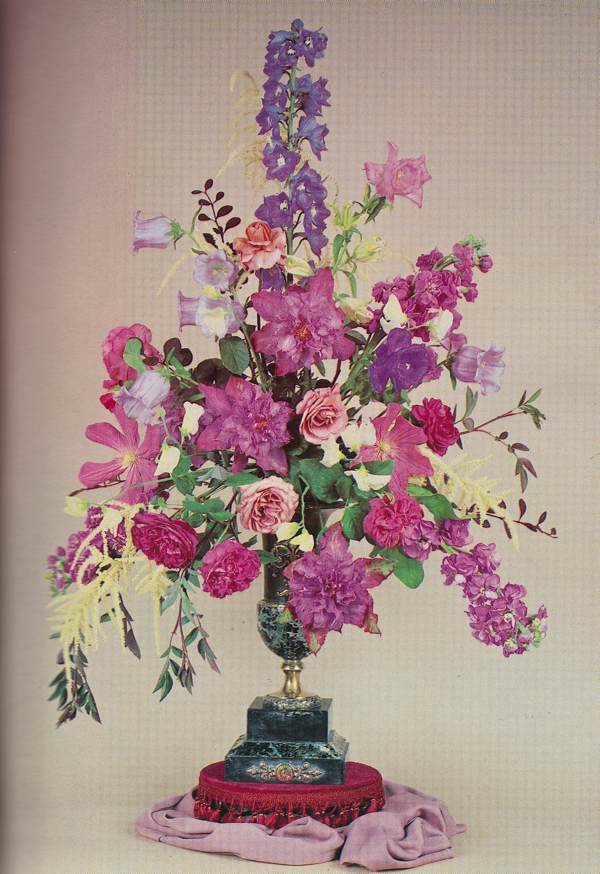
Mary Pope and Margaret Hewitt OBE admire a pedestal arrangement of the Liverpool Flower Arrangement Society staged by Hugh Mather of St Helens.
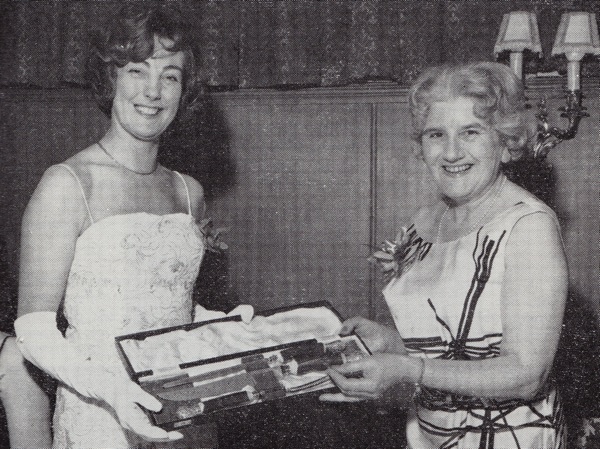
Mrs E. Allen, National Chairman receives a Sheffield carving set from Mrs B. Denton, Chairman of Sheffield Floral Club.



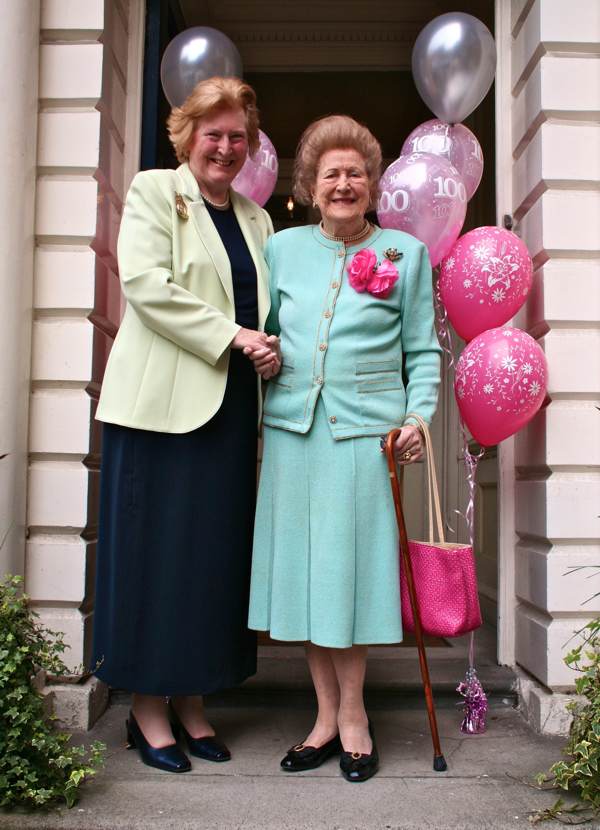
Veteran flower arranger, Julia Clements, celebrates her hundredth birthday at NAFAS in 2006.

A Christmas kissing bough engraved by Joan Hassall, from an early issue of The Flower Arranger.
Archive images copyright © NAFAS
20th December, The Box of Delights

“The Box of Delights” is a children’s fantasy novel by the former Poet Laureate John Masefield, his sequel to “The Midnight Folk.” First published in 1935 and set around Christmas-time, culminating on Christmas Day, I always find myself reading it at this time.
The protagonist is a boy of ten, Kay Harker, who on returning home to Seekings House from boarding school finds himself mixed up in a battle to possess a magical “Box of Delights,” which permits the owner to go small (to shrink), to go swift (to fly), to experience wonders contained within the box and to go into the past.
The owner of the box is an old Punch & Judy man man called Cole Hawlings whom Kay meets at the railway station on his way home. “And now, Master Harker, now that the Wolves are Running, perhaps you could do something to stop their Bite?” entreats the old man. He asks Kay to protect the magic box which brings Kay and his friends many adventures. But Kay is in danger – Abner Brown will stop at nothing to get his hands on it. Yet the police don’t believe Kay, so when his guardian, friends and the Bishop are “scrobbled” just before Christmas, he knows he must act alone…
It is a great book peopled with mysterious bright-eyed immortals, Romans, Druids, fairies, Herne the Hunter, gangsters dressed as curates, talking rats, witches and much more besides. It is quite dated but all the more charming for that – characters in the book use expressions like “it’s the Purple Pim” and “queer coughdrops”! The story also features a Brazen Head used by the evil wizard Abner Brown (assisted by his wife and Kay’s former governess, the sly witch Sylvia Daisy Pouncer) for divination – it is a motif that has long fascinated me and after which Dublin’s oldest pub is named.
Above, I have shown Cole Hawlings, the Punch & Judy man, with his booth wrapped in green baize upon his back, walking near the Drop of Dew Inn in the Bear Ward of old Condicote, accompanied by his dog Barney. Note his exceptionally bright eyes and his ring, a “longways cross” of gold and garnets. Although not immediately apparent, he is very old indeed, living into the modern day from pagan times and is none other than the medieval Spanish philosopher and alchemist Ramon Llull.
If you have not read “The Box of Delights,” I recommend you do.
Illustration copyright © Paul Bommer
At Gardners Market Sundriesmen

Paul Gardner
When people ask me about this place, I can only respond by declaring,“You cannot really say you have been to Spitalfields unless you have shook the hand of Paul Gardner, the fourth generation paper bag seller,” because Gardners Market Sundriesmen in Commercial St is the centre of our particular universe here in this corner of the East End. Established in 1870 by Paul’s great-grandfather James, this remarkable family business – the oldest here – has come to incarnate the very essence of the Spitalfields.
Other shops only sell paper bags in bulk, but Paul Gardner will sell you as few as you please – and the entire nature of his business is based upon this subtle premise, which means it has become the essential destination for the smallest traders. Stallholders, shopkeepers, designers and makers – Paul welcomes them all at his shop and many have been coming back for decades, making the regular pilgrimage and enjoying the unhurried chit-chat with Paul that has been a rare constant through volatile times. “Someone came round the other day, I hadn’t seen them in fifteen years,” Paul told me with a smile of amazement, “‘What, are you still here?’ they asked.” Yet the beauty and the wonder of it is that Gardners Market Sundriesmen is still here, to remind us what Spitalfields is all about.
“Most of my customers have been coming here a long time, so I can always find something to talk about,” Paul confided to me as we sat in the shop chatting – one morning before seven recently – while the traffic roared up and down Commercial St in the rainy darkness outside, “That’s what I say to my wife, ‘At least I enjoy going to work, I don’t have to work for someone I don’t like.'” It was coming up to the last weekend before Christmas and Paul needed to reassure himself because trade had been slow. “I must admit, it has been quiet all week,” he said, leaning over the counter with his chin propped upon his fist in contemplation, gazing towards to the door and willing customers to walk through it. “It’s a bit grim when you’re waiting like a lemon.”
If I had not been there keeping him company, sitting beside him on a vast stack of paper bags with “Fish & Chips” printed on them, Paul would have been writing in his diary, kept since the age of thirteen – making entries like, “Had a slightly better day moneywise – steamroller outside – glad to get away on time,” or “Not that busy, but I still didn’t have time to put things out.” Otherwise, Paul passes the peaceful hours by counting luggage tags and plastic bags, securing them in bundles of fifty with elastic bands. “I remember coming into the shop when I was child and smelling the paper bags,” he reminisced affectionately, as he counted, “I sat on a pile of bags and the customers gave me sixpence. My father took me to get one my first haircuts in Hanbury St and my mother cried when she saw it. One day, I had six sausage rolls – the good old days!”
Prompted by this last thought, Paul sent me across the road to get two cups of tea. It was daylight now and the procession of stony-faced office-workers had begun. When I got back, Paul was happily serving one of his long-term customers. “She’s a very pleasant lady but her cheques invariably bounce,” he revealed to me in a whisper after she left, with a smile as he put the cheque in the cash register, as if this aspect of her personality were an endearing quality. Yet – as soon as she had gone – another customer arrived, it was a fishmonger on his way to set up in Chapel Market in the rain. He threw cash onto the counter with a sample bag, declaring enigmatically, “I need them like this only different,” and dashing back to his van before the traffic warden arrived. “They expect you to be like Mystic Meg and read their minds,” Paul quipped – pulling a comic grimace as he sought the required bags – since he always remembers his customer’s previous orders.
Old market traders and young hipster designers, Nigerian jewellery sellers and Bengali garment makers, they all came wanting bags. “We’re doing a week’s trade in a day, but we have Mount Everest still to climb and we’re just at the Base Camp.” declared Trevor from Liverpool St Chicken, exercising seasonal hyperbole, as he put in his order for thousands of bags. In spite of their impatience, the traders waited quietly – a reflection of the universal esteem that Paul enjoys. Meanwhile, some complained that business was down and others bragged that it was up. Unflustered, Paul ran back and forth between the counter and the stockroom, answering the phone (“Bishopsgate 5119 Gardners”), expertly totting up the totals and the VAT with super-quick mental arithmetic, stamping receipts, giving change and sending the bags flying out the door. Then, in the middle of it all, the delivery of bags that Paul had been expecting arrived, but as soon as they were stacked on the pavement in Commercial St – before they even made it into the shop – customers began carrying them off – “I’m taking four packs of the brown paper bags, Paul,” I heard one call.
Here at the boundary of the City, this has always been the place of markets and the preserve of small businesses. Both kinds of endeavour rely upon Paul who, as custodian of the most venerable family business, carries much of the history and culture of this place. Everyone has reason to come to Gardners. Even the Rector of Christ Church buys luggage labels to write prayers upon and local residents get their Christmas wrappings from Paul. Gardners Market Sundriesmen is both the focus of the community in Spitalfields and the manifestation of what makes this neighbourhood distinctive. So, as long as we have Gardeners Market Sundriesmen, we can know that the identity of the place is alive.
“Oh blimey, I didn’t think I was going to get busy at all, but then about nine thirty it just went mental,” exclaimed Paul, mopping the perspiration from his brow and sweeping his wavy grey hair to one side, “I didn’t even realise what time it was until it was one o’clock.” He looked a little startled, until the inevitable realisation came upon him and he broke into a wide smile. “It must be Christmas!” he announced in a cheer, spreading his arms with delight. Before I departed, I helped Paul carry the remaining stacks of brown paper bags from the pavement into the shop.“Thanks for coming in, I think you brought me some good luck,” he said, as we shook hands and made our farewells.

The view from behind the counter.


“One day, I had six sausage rolls – the good old days!”

“Bishopsgate 5119 Gardners”

“I didn’t even realise what time it was until it was one o’clock”


Gardners Market Sundriesmen, 149 Commercial St, London E1 6BJ (6:30am – 2:30pm, Monday to Friday)
You may also like to read about
Chapter 4. New Sanguinary Atrocities

Late on the night of 19th December 1811, events were to take an even more remarkable turn. Mr Anderson, the Parish Constable, who lived in New Gravel Lane opposite the King’s Arms in Shadwell, decided to cross the road after closing time to get a top-up for his pint-pot from his good friend Mr Williamson, the landlord. As he opened his front door, he saw a nearly-naked man suspended in mid-air by sheets knotted together from a garret window of the pub opposite screaming, “Murder! Murder!” Mr Anderson grabbed his sword and staff from his house and emerged again just as John Turner, the lodger, dropped the last eight feet into the arms of the watchman Shadrick Newhall.
Mr Anderson prised open the pavement flap that led to the cellar of the King’s Arms. Inside, on the cellar steps, the landlord’s dead body was visible in the darkness, lying upside down with its legs splayed in the direction of the bar room above. An iron bar smothered in blood lay alongside the corpse, Mr Williamson’s throat was cut to the bone, his head was beaten in and his right leg fractured. He had put up a courageous fight, revealed by the hand dreadfully hacked up as if in his last moments he had clutched at the knife that finished him off. One thumb dangled loosely in the blood trickling down the staircase.
As Mr Andersen stood transfixed at his discovery, a cry came from the crowd gathering in the street, “Where’s the old man?” Startled from his reverie, Andersen made his way up the stairs, stepping carefully over the body. On the ground floor, he found the corpses of Mrs Williamson and the servant girl, Bridget Harrington, both slaughtered with equal cruelty. In the darkness of the first floor bedroom, he came upon the Williamson’s grandchild, Kitty Stillwell, lying in her bed asleep and unharmed. Overcome with powerful mixed emotions, he carried the sleepy little girl from the house into the street.
As John Turner recovered himself, he explained that he had seen a tall man in a long Flushing coat standing over the body of Mrs Williamson, corresponding to a description of a man seen outside the King’s Arms that night. A window at the back which had been used for escape was left open with bloodstains on the sill. It was discovered that Mr Williamson’s watch was missing.
That night, the wardens of St Paul’s Shadwell gathered in the vestry in incredulous horror, realising that they were caught up in events so chillingly macabre as to be entirely beyond control of any mortal. No-one could say how many more murders were yet to come or predict where these disquieting events might lead. They did all they could, which was to issue a reward of one hundred guineas.
Earlier that day, a critical discovery had been made concerning the maul which had been used in the slaying of Timothy Marr and his family. Although a handbill had been published requesting information as to the origin of the maul, it was only now that the blood and hair were removed from the maul to reveal the owner’s intials I.P.
As the feast of Christmas came closer and innocent children lay sleepless in their beds listening for the tinkle of St Nicholas’ sleigh bells, all across London their parents lay awake in terror craning for any sound that might presage the imminent invasion of unknown intruders with violent murderous intent.
Below you can see the site of the King’s Arms today. The building was swept away with the expansion of the London docks in the nineteenth century, now these walls that weave through Wapping are mere remnants of the docks that survived the bombing of World War II to be closed down in the late twentieth century, and behind this wall is a housing estate of recent date.
Reports will be posted as there is further news of these escalating occurrences.


Click on Paul Bommer’s map of the Ratcliffe Highway Murders to explore further
The Maul & The Pear Tree – P.D. James’ breathtaking account of the Ratcliffe Highway Murders, inspired me to walk from Spitalfields down to Wapping to seek out the locations of these momentous events. Commemorating the bicentenary of the murders this Christmas, I am delighted to collaborate with Faber & Faber, reporting over coming weeks on these crimes on the exact anniversaries of their occurrence.
The Map of the Ratcliffe Highway Murders – In collaboration with Faber & Faber, Spitalfields Life has commissioned a map from Paul Bommer which will update throughout December as the events occur. Once you have clicked to enlarge it, you can download it as a screensaver or print it out as a guide to set out through the streets of Wapping.
Ratcliffe Highway Murder Walk – Spitalfields Life will be hosting a dusk walk on Wednesday 28th December at 3pm from St Georges in the East, visiting the crime scenes and telling the bone-chilling story of Britain’s first murder sensation. The walk will take approximately an hour and a half, and conclude at the historic riverside pub The Prospect of Whitby. Booking is essential and numbers are limited, so please email spitalfieldslife@gmail.com to sign up. Tickets are £10.
Thanks to the Bishopsgate Institute and Tower Hamlets Local History Archive for their assistance with my research.
You may like to read the earlier installments of this serial which runs throughout December
19th December, Marley’s Ghost

Much of what we now think of as Christmas comes from the writings of Charles Dickens and in particular “A Christmas Carol,” his famous ghost story of 1843 which opens –
Marley was dead to begin with. There is no doubt whatever about that. The register of his burial was signed by the clergyman, the clerk, the undertaker, and the chief mourner. Scrooge signed it. And Scrooge’s name was good upon ‘Change, for anything he chose to put his hand to. Old Marley was as dead as a door-nail.
Mind! I don’t mean to say that I know, of my own knowledge, what there is particularly dead about a door-nail. I might have been inclined, myself, to regard a coffin-nail as the deadest piece of ironmongery in the trade. But the wisdom of our ancestors is in the simile and my unhallowed hands shall not disturb it, or the Country’s done for. You will therefore permit me to repeat, emphatically, that Marley was as dead as a door-nail.
Ebenezer Scrooge is a miserable old man who works in his counting house with his clerk, Bob Cratchit, who writes out records of accounts while Scrooge oversees the business.
On Christmas Eve, Scrooge receives several visitors. First, his nephew who invites Scrooge to dine with him for Christmas. Next come two gentlemen, collecting for charity, and we discover from them that Scrooge’s partner, Jacob Marley, died on Christmas Eve seven years previously. Yet Scrooge refuses to give them anything, declaring he helps the poor already through supporting prisons and workhouses. Closing up the office, Scrooge permits Bob a holiday on Christmas Day, but insists he come back to work early next morning – Boxing Day was not usually a holiday in the nineteenth century, but the day when tradesmen collected their Christmas “boxes” – tips from their customers.
That evening, at his lodging Scrooge is visited by the ghost of Jacob Marley weighed down by massive chains made up of cashboxes, keys and padlocks. The ghost says that anyone who does not mix with others in life must travel amongst them after death and tells Scrooge that he too wears a chain, even larger, and warns of three spirits which will visit that night…
Illustration copyright © Paul Bommer
18th December, Christmas Crackers
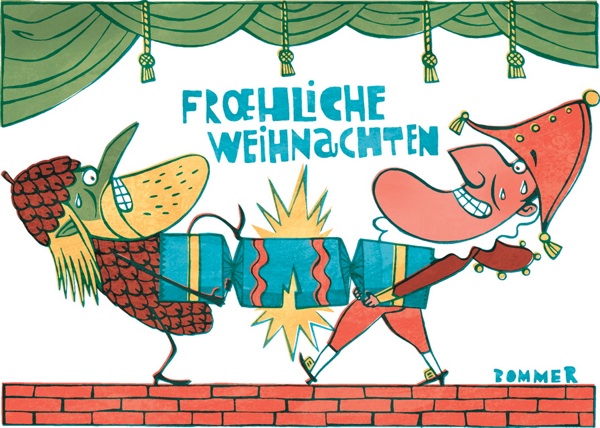
Crackers or bon-bons are an integral part of Christmas celebrations. A cracker consists of a cardboard tube wrapped in a brightly decorated twist of paper, contriving a resemblance to an over-sized sweet-wrapper. The cracker is pulled by two people and it splits unevenly – much in the manner of a wishbone – accompanied by a small bang, created by friction upon a chemically impregnated card strip (similar to that used in a cap gun).
In Russia (where they are called “хлопушка”) and in some countries of the former Soviet Union, crackers are a part of New Year celebrations – however these are closer to pyrotechnical devices, normally used outdoors and, activated by one person, produce a bigger bang accompanied by fire and smoke.
In one version of the tradition, the person with the larger portion of cracker keeps the contents, while in another, each will have their own cracker and will keep its contents regardless of who got the larger part. Typically, these contents are a coloured paper hat or crown (a hang-over from Saturnalia perhaps?), a small toy or other trinket and a motto, a joke or piece of trivia on a small strip of paper. Ready-made crackers are sold in boxes, typically with different designs in red, green and gold, but making crackers from scratch using the tubes from used toilet rolls and tissue paper is a popular activity for children, and kits can also be purchased.
Crackers were invented by Thomas J. Smith of London in 1847 – as a development of his bon-bon sweets, which he sold in a twist of paper (the origins of the traditional sweet-wrapper). As sales of bon-bons slumped, Smith came up with promotional ideas. His first notion was to insert mottoes into the wrappers of the sweets (cf. fortune cookies) but this had only limited success. He was inspired to add the “crackle” element when he heard the crackle of a log upon the fire. Consequently, the size of the wrapper had to be increased to incorporate the banger and the sweet itself was dropped to be replaced by a small gift. This new product was initially marketed as the Cosaque (i.e. Cossack) but the onomatopoeic “cracker” soon superseded it as rival varieties were introduced to the market. The other elements of the modern cracker – gifts, paper hats and varied designs – were all introduced by Tom Smith’s son, Walter Smith, to differentiate his product from the copycat manufacturers which sprang up.
The image I have drawn is based on a late Victorian greetings card that I stumbled upon on Facebook, showing a pine-cone sprit and Mr Punch pulling a cracker, with the legend “Merry Christmas” that I have replaced that with German, which I think has a charm all of its own – plus, to my Englische ears, it sounds funny!
Illustration copyright © Paul Bommer