
Columbia Road Market 74
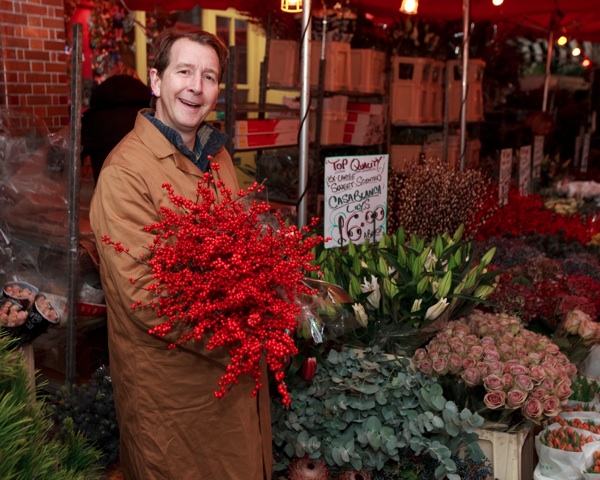
Carl Grover
The forest has come to Columbia Rd. Even before you arrive you can smell pine, drifting upon the breeze, and once you step onto the cobbles, there are needles underfoot. At either end of this narrow thoroughfare, a forest has grown overnight, filling the street with luxuriant green undergrowth and bringing the atmosphere of mystery and romance to the market which makes this Sunday before Christmas unique. You wonder – as you walk between the crowded, glistening trees – if you might emerge into a magical landscape, yet – even as this reverie takes you – sonorous voices are heard. “Is this the call of the woodland folk?” you ask.
In fact, it is the magnificent resounding tone of Denise Burridge, the diva blessed with the fullest voice amongst the hardy chorus of traders that compose the clamorous symphony of Columbia Rd Market. This is where your expectations, hopes, wishes and dreams of plants and flowers can be fulfilled, and it is all going for a song.
At the Eastern end of the street, Christmas trees are sold by the Burridges, the family who have been more involved with the history of this market than any other for generations – while, selling trees at the Western end, you will find the Hartnetts who have claim to be the longest standing traders here, for over a century. Yet, at the Western extremity, also keep an eye out for the cheery face of Albert Dean, the fourth Albert Dean in succession in his family to be selling flowers from this pitch – which means that for more than a hundred years you could have here and bought flowers from an Albert Dean on this corner.
As you make your way amongst the throng down the centre of the street, sensations crowd upon you – losing sense of yourself in the horde, the stalls appear to float by like tableaux populated with the extravagantly good-humoured spirits of flowers and herbs, offering their beneficence. (Today, Spitalfields Life Contributing Photographer Jeremy Freedman has captured these familiar market characters in their wintry guises.)
Advent is a season of ritual and tradition, and the Sunday before Christmas is my favourite time to come to Columbia Rd in anticipation of carrying off a tree, a bough of mistletoe, branches of holly, cut flowers, house plants and pots of bulbs – because, as we reach Midwinter, it tempers my sadness at the tender loss of Summer to fill the house with greenery and assure myself that life sustains itself yet, out there in the silence of the greenwood.

Mick Grover
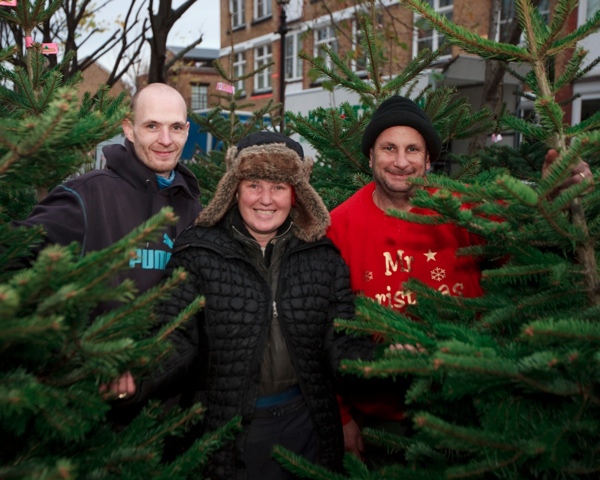
At A.E. Hartnett & Sons Ltd
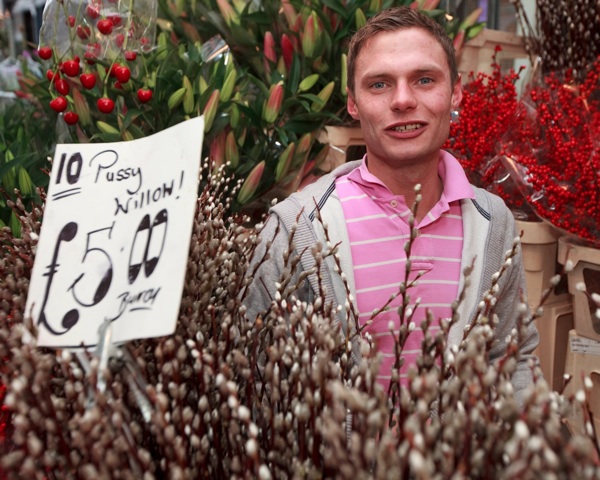
Albert Dean
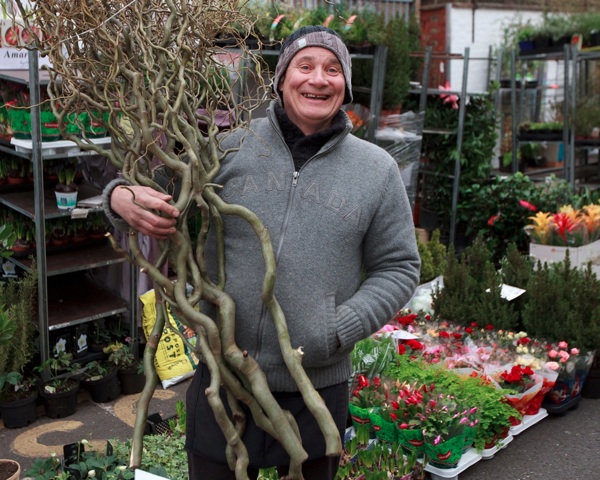
Billy Burridge
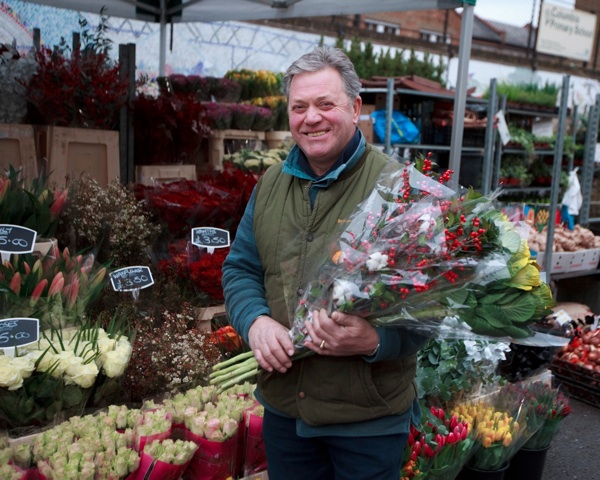
Dennis Madden
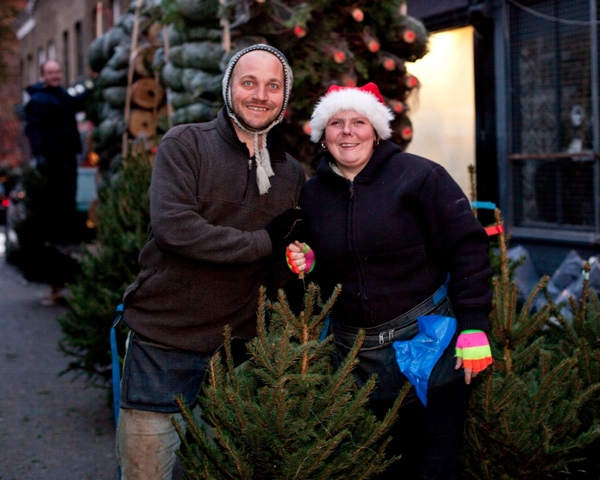
Denise Burridge and admirer

George Burridge and Luke
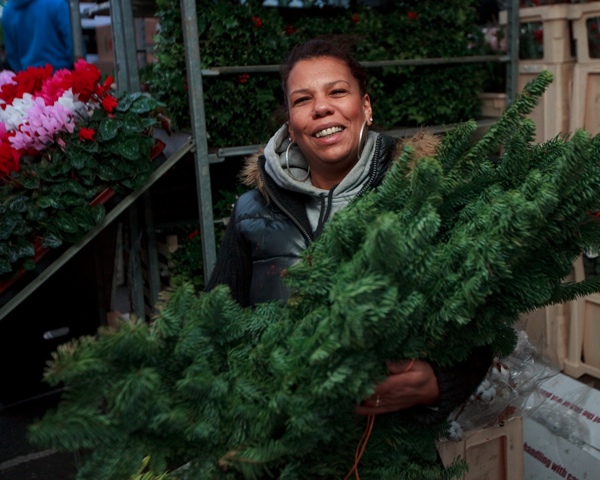
Lisa Burridge
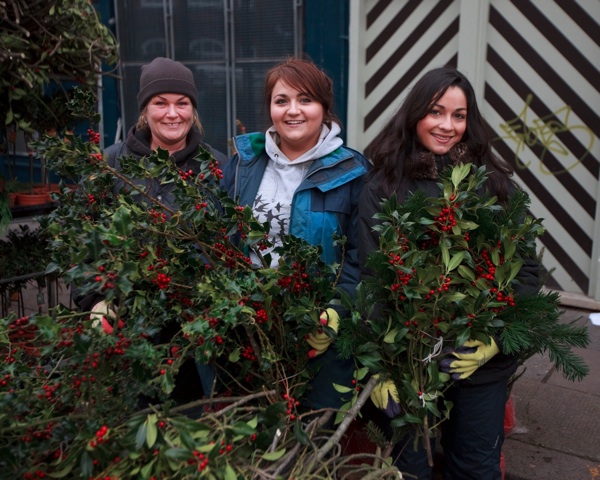
Sue, Frankie and Georgia Burridge
Photographs copyright © Jeremy Freedman
17th December, Saturnalia

Today marks the start of Saturnalia, an ancient Roman festival in honor of the god Saturnus. One of the most popular Roman festivals, it was marked by tomfoolery, mayhem, merriment and the reversal of social roles, in which slaves and masters switched places (much like the Lord of Misrule in medieval celebrations).
Saturnalia was introduced around 217 BCE to raise morale after a crushing military defeat at the hands of the Carthaginians. Originally celebrated for a day on December 17th, its popularity saw it grow until it became a week-long extravaganza, ending on the 23rd. Efforts to shorten the celebration were unsuccessful – Augustus tried to reduce it to three days and Caligula to five (Party poopers! How did they get the reputation of being hell-raisers?), but these attempts caused uproar and revolt among the Roman citizens.
Saturnalia involved the conventional sacrifices, a couch (lectisternium) set out in front of the temple of Saturnus and the untying of the ropes that bound the statue of Saturnus during the rest of the year. A Saturnalicius princeps was elected master of ceremonies for the proceedings and, besides the public rites, there were a series of holidays and customs celebrated privately – including a school holiday, the making and giving of small presents (saturnalia et sigillaricia) and a special market (sigillaria). And gambling was allowed for all, even slaves.
Saturnalia was a time to eat, drink and be merry. The toga was not worn, but rather colorful and informal ‘dinner clothes’ and the pileus (a freedman’s hat, close-fitting and brimless like a fez) was worn by everyone. Slaves were exempt from punishment and treated their masters with (a pretense of) disrespect, celebrating a banquet before, with, or served by the masters. Yet the reversal of the social order was mostly superficial – the banquet would often be prepared by the slaves and they would prepare their masters’ dinner as well. It was license within careful boundaries, reversing the social order without subverting it.
The customary greeting for the occasion is a “Io, Saturnalia!” — Io (pronounced “e-o”) being a Latin interjection related to “ho” (as in “Ho, praise to Saturn”).
Saturnus was the Roman god of agriculture and harvest whose reign was described as a Golden Age of abundance and peace by many authors. In medieval times, he was known as the Roman god of dance, agriculture, justice and strength, often portayed holding a sickle or scythe in one hand and a bundle of wheat in the other. Saturnus is sometimes identified with the Greek Cronus, the god of Time (hence chronological, chronic, &c.) who famously ate his children. Fear not, the children were later regurgitated intact through the intervention of their mother and went on to become the gods of Olympus! A gruesome tale, yet viewed metaphorically it can be seen as a simple moral – that Time eats everything in the end.
I have shown old Saturnus in his chariot pulled by winged serpents, wearing his purple robes and party pileus and brandishing his scythe. The roundels on his chariot depict the star signs Capricorn and Aquarius which he governs. Flying like this through the Winter sky, he puts me in mind of a classical Santa Claus – I did think about labelling his serpents Cometa and Vulpes (Comet & Vixen) or Saltor and Cupido (Dancer & Cupid) as a homage to “A Visit From St. Nick,” but I wasn’t sure my Latin was up to the task!
Saturday is sacred to Saturnus.
Io Saturnalia!
Illustration copyright © Paul Bommer
Chris Kelly’s Columbia School Portraits, 1996
It is my pleasure to publish Chris Kelly‘s portraits of an entire class at Columbia Primary School, Columbia Rd, Bethnal Green. Distinguished by extraordinary presence and insight, these tender pictures taken fifteen years ago are the outcome of a unique collaboration between the photographer and the schoolchildren. Chris has been taking photographs for education and health services, and voluntary organisations in the East End for almost twenty years, and these astonishing timeless portraits illustrate just one aspect of the work of this fascinating photographer.

I like myself because I am smart and cool and my name is Rufus and Rufus means red one and I really like to play with my friends.

My name is Abdul. I am eight years old. I was born in 7.10.88 and I like trainers called keebok classic.

When I grow up I want to be a singer and travel around the world. My name is Jay and I am eight years old.

My name is Imran. I am eight years old. I like going to school. I like drawing. My sister Happy gives me sweets.

Hello my name is Salma and I was born in 1988. I am eight years old. I like to go to Bangladesh. At school I like Art. I go to Columbia Primary School. And my teachers name is Lucy.

I like myself because I am smart and cool. My name is Ibrahim. My age is eight years old.

My name is Jamal. I go to Columbia School and I am eight years old. I enjoy reading and art and the new book bags. I am special because there are no other people like me.
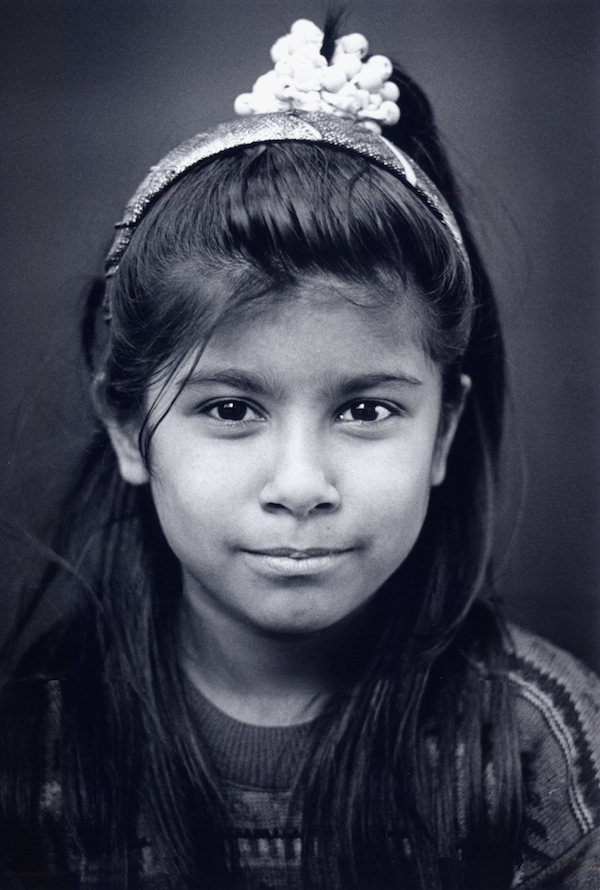
I’m eight. I like to play. My mummy loves me. My name is Shumin.

I am special because I am good at reading and maths. I am good at running. I am eight years old and I am year three. My address is London E2. My best friend is Rokib. My name is Kamal.
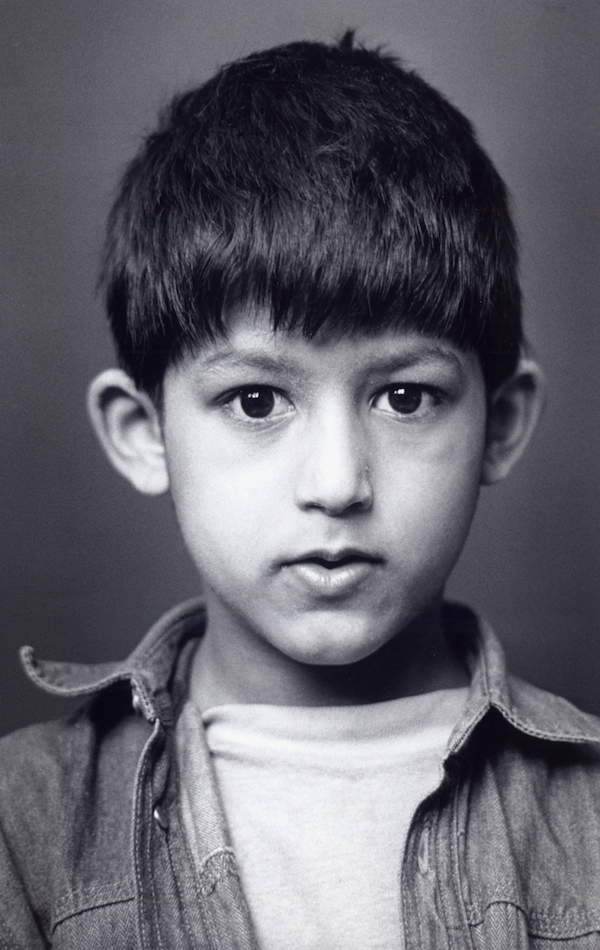
My name is Kamal Miah. I like chocolate cake with chocolate custard. I love computers at home. I learn at Columbia School. Before school I drink fizzy drink and I eat chips. My date of birth is 13.10.88. My best chocolate bar is Lion. My best colour is dark blue. I’m good at maths. Speling group is C.

I am eight years old. My name is Nazneen. I like doing maths and I like doing singing. I have three sisters. And I have lots of friends.

My name is Paplue. I like football and I like fried chicken because they give me chicken. I am eight.

My name is Rahima. I was born in October the eleventh. I’m eight years old. I go to Columbia School. I live in number thirty.

My name is Halil. I am eight years old. I like to play with my three game boys. I like to see funny films.

My name is Litha. I like chocolate. I was born in London. I am eight years old. I live in a flat. When I grow up I want to be a hairdresser.

My name is Robert. I am eight years old and I live in London E2. I like where I live because I have lots of friends to play with.

My name is Rajna. I’m good at running. I do writing at home. And I’m the middle sister.

I am eight years old. I go to school. I play in the playground and my name is Dale.

My name is Sadik. I’m eight years old. I am quite good at football. I practise with my uncle.

My name is Rokib, I am eight years old. I am special because I can read and write and I can do maths and I can be thoughtful and helpful.

My name is Shafia. I am eight years old. I have two sisters. My big sister is called Nazia and my baby sister is called Pinky.

My name is Shokar. I like kick boxing and swimming and I like football.

My name is Urmi and I like going to Ravenscroft Park. I have a black bob cut, browny skin and black eyes. I am eight years old.

My name is Wahidul. I am eight years old. My favourite prehistoric animals are dinosaurs and I like reading and science.

My name is Yousuf. I want to be a computer designer. If I want to be a computer designer I have to be an artist as well.

My name is Ferdous. I am eight years old. I go to Columbia School. My favourite thing is playing games. My date of birth is 10.12.88.

My name is Akthar. I like to go to Victoria Park. I am eight years old.

Hello my name is Fahmida. I am eight years old and I was born in 1989. I like to play skipping and Onit. I like going to school. In school I like Art.

I go to play out with my friends. I go to the shops with my mum. I go to my sisters new house. My name is Ashraf and I’m eight years old.

My name is Fateha. I go to school. I like art. I am eight years old. I am lucky that I’ve got a good art teacher.
Photographs copyright © Chris Kelly
Chris Kelly hopes to make contact with the subjects of these pictures again, now twenty-three years old, for the purpose of taking a new set of portraits. So, if you were one of these children, please get in touch with chriskellyphoto@blueyonder.co.uk
You may also like to take a look at
16th December, Three Kings

In Christian tradition, the Magi – also referred to as the Wise Men, Three Kings or Kings from the East – are a group of distinguished travellers who visited the infant Jesus bearing gifts of gold, frankincense and myrrh. “Magus” is a term derived from Greek, meaning a priest.
The Gospel of St. Matthew – the only one of the four Gospels to mention the Magi – states that they came “from the East” to worship Christ, “born King of the Jews.” Although the account does not tell how many they were, the three gifts led to the assumption that they were three, although some early traditions held that they were as many as twelve. Their identification as kings in later Christian writings is linked to Old Testament prophesies, such as that in Isaiah, which describe the Messiah being worshipped by kings.
Traditions identify a variety of names for the individual Magi. In the Western Christian church, they have been known as – Kaspar, Caspar, Gaspar, Gathaspa, Jaspar or Jaspas – Melchior, Melichior or Melchyo – and Balthasar, Bithisare or Balthassar. In my image I have shown, the Czech names for the Magi (as well as the Czech words for Three Kings and the names of their gifts). The names apparently derive from a Greek manuscript composed in Alexandria around 500 A.D. which has been translated into Latin with the title Excerpta Latina Barbari. In contrast, the Syrian Christians name the Magi – Larvandad, Gushnasaph and Hormisdas, probably Persian in origin. In the Eastern churches -Ethiopian Christianity has Hor, Karsudan and Basanater, while the Armenians have Kagpha, Badadakharida and Badadilma. One Armenian tradition identifies the Magi as Balthasar coming from Arabia, Mechior coming from Persia and Gasper coming from India.
The gifts symbolise Christ’s sovereignty (gold), divinity (frankincense) and death (myrrh, an oil used in embalming), while the day of celebration of the Three Kings’ arrival in Bethlehem is January 6th (Twelfth Night or the Feast of the Epiphany) and, in some cultures, this is the date on which children receive their Christmas gifts.
Marco Polo claimed that he was shown the three tombs of the Magi at Saveh, south of Tehran, in the 1270s – “In Persia is the city of Saba, from which the Three Magi set out and in this city they are buried, in three very large and beautiful monuments, side by side. And above them there is a square building, beautifully kept. The bodies are still entire, with hair and beard remaining.” Meanwhile, a shrine of the Three Kings at Cologne Cathedral, according to tradition, also contains the bones of the Three Wise Men. Reputedly, they were first discovered by Saint Helena on her famous pilgrimage to Palestine and the Holy Lands. The Magi are still sometimes referred to as the Three Kings of Cologne and the city’s coat-of-arms has three crowns on it in their honour.
In Poland, people take small boxes containing chalk, a gold ring, incense and a piece of amber – in memory of the gifts of the Magi – to church to be blessed on the evening of Twelfth Night. Once at home, they inscribe the date and “K+M+B+” with the blessed chalk above every door in the house to provide protection against illness and misfortune for those within. The letters, with a cross after each one, stand for names of the Three Kings — Kaspar, Melchior and Balthasar. They remain above the doors all year until they are inadvertently dusted off or replaced by new markings the next year. By happy coincidence, my dad who is Polish also has the initials K.M.B. – Krzysztof Maria Bommer!
Illustration copyright © Paul Bommer
Jimmy Huddart, Spitalfields Market Porter
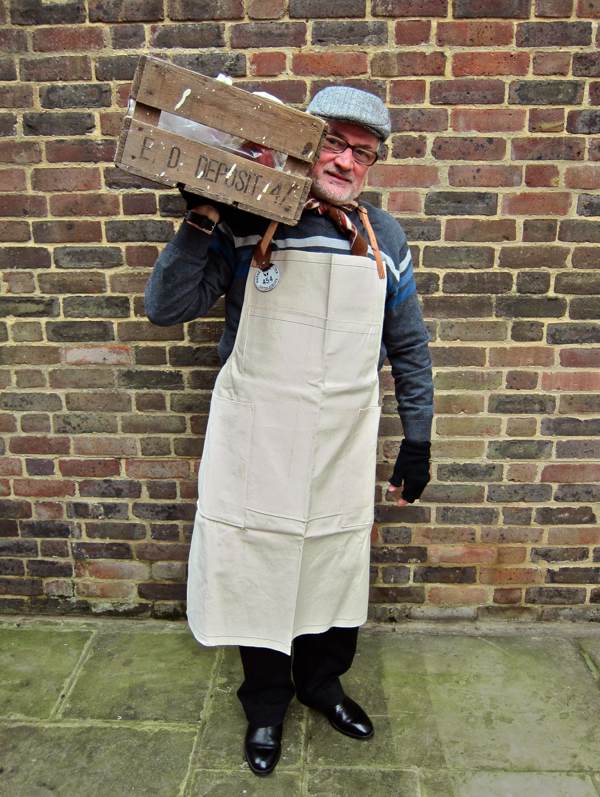
A market porter of forty years standing, Jimmy Huddart is proud to display the clothing of his trade. He keeps this apron pristine for ceremonial occasions now, but it is of the traditional design made of the full width of strong canvas, with leather straps and reinforcement across the front where the boxes cause most wear. In use, an apron like this would quickly acquire a brown tinge yet provide its owner with at least two years of wear, with prudent repairs. In the pocket, Jimmy always kept his porter’s knife and string to sew up broken sacks. And the offcuts from these aprons were used to make “cotchel” bags, which held all the fruit and vegetables that the porter might acquire for his own use, gathering it in the lining of his coat as he went about his work. “Cotchelling up,” they called it – and today, although employees in the market now get a vegetable box to take home, it is still referred to as a “cotchel.”
The most significant item in the outfit is the porter’s licence, indicated by the enamel badge. Throughout Jimmy’s time in the market, you could only work as a porter if you had one of these and it was a badge of office, denoting its own rights and privileges which had to be earned. At first, young men entered the market as “empty boys,” collecting and sorting empty wooden boxes and claiming the deposits, until they had earned the right to become licenced porters. Before the introduction of fork-lift trucks, this was intense physical work, manhandling crates of fruit and sacks of vegetables, and manoeuvring the heavy wooden barrows piled high with produce which had a life of their own once you set them going.
“I grew up in Bethnal Green, Brady St, and, at the age of twelve, I used to go to the market to watch all the tussle and bustle, and all the porters with their barrows. At school, I was very much interested in carpentry but I couldn’t get an apprenticeship, although by then I had already been introduced to the market. I loved to go up the Spitalfields with my Uncle Bill, he worked for a haulage company and we used to go around the farms in Kent to collect the English plums and apples and deliver them to the market. There was something about it, the atmosphere and the characters – a love of it developed inside me – and I wanted to become a porter. If you worked in the market or the docks you earned better than the average salary.
When I was fifteen, my uncle got me a job with Percy Dalton at the corner of Crispin St and Brushfield St. He was a well-dressed Jewish man, softly spoken, who had started his business with a barrow selling roast peanuts and he took me under his wing. The first day I started working for Percy Dalton, he showed me how to sweep the shop. He was that sort of person, hands on. He had a fruit shop at the front and in the warehouse there’d be eight people roasting peanuts. The peanut factory backed onto the alley where the lorries came, he had these red vans with Percy Dalton on the side that you always saw outside dog meetings and football matches. He was a likeable man, very popular, and people often came to him for advice. If you were in trouble you could go and speak to him, he would lend you money if you needed it. He always said, get a corner shop and you get two premises for the price of one.
I used to go out with the drivers all around the London Docks to pick up the fruit and make deliveries. I looked forward to it among my duties – being a boy, they took care of me and bought me breakfast, and they taught me how to stack a lorry. But I wanted to be a porter, so I asked in the market if I could work as an empty boy until I came of age. A job come up as a banana boy for Ruby Mollison, helping him to ripen the bananas, hanging them up in the ripening room. I used to wear a leather glove when I had to put my hand under the banana stalk because I was frightened of the spiders. When you cut a bunch of bananas, you cut a “v” shape and they come away from the stalk, and that’s where your spider might be. They could be very dangerous, especially if they were pregnant, and if you were bitten you’d have to go to hospital because your arm could get paralysed by the poison.
Then a chance came up at Gibson Pardoe as an empty boy with the view of getting a licence, and I worked with them for a year until Alf Hayes of the porters’ union came to me and said, “There’s an opportunity to work in the flower market as a porter, would you be interested?” and I was issued a porter’s licence at twenty-one. But there was decline in the fruit trade in the nineteen seventies and they brought in fork-lift trucks. The job changed, it became less physical and where you once needed four porters now you only needed two. I can recall the first time I was given an electric truck. It was one of two milk floats all sprayed up without a scratch on them and they said to me, “treat it like it was new-born baby.” My first trip with it was to go over to Commercial St, and I was making a delivery there when a forty-ton truck came past and clipped it, taking half the fibre-glass roof with it. Luckily, I wasn’t seriously injured, only shaken up. I explained to governor what happened, that it was an accident and he said, “Did you get the number plate ?” He never asked if I was hurt or injured in any way. I suppose you could say, that’s the market sense of humour.
I became elected to the union. In life, I always believed in fairness and I recognise there has to be give and take. I had to build up trust from my members and in dealing with the traders too, yet most of the problems were solved over a cup of tea and a handshake. I was the porters’ representative for ten years but Alf Hayes, who was my inspiration, he had been porters’ representative for forty years before me. The porters’ union was founded in the depression of the twenties and thirties. Although they had to keep it a secret, they invented a form of recognition so they could discuss it – it was “union” backwards, “you’ve got none.” It was lost on those who weren’t in the know, and the union became fully recognised in the late nineteen thirties.
My sport was road running and thirty-five of us formed the Spitalfields Market Runners. Celebrating the tercentenary of the market in 1982, we were supported by the traders and greengrocers and porters in a relay from the Spitalfields Market to Southend Pier and back. We each ran ten miles and the whole of the market came together to do something for charity.“
Jimmy remembers when unemployed porters once waited for work under the clock at the centre of the Spitalfields Market and how the union acquired an office so that traders seeking a porter could telephone, thereby saving the humiliation of the porters. Yet now, in common with the other London markets, the porters are becoming deregulated, losing their licences as the balance in the labour market shifts again. However, after forty years as a porter, Jimmy chooses to remain positive – because experience has granted him a broad perspective upon the endlessly shifting culture and politics of communal endeavour in market life.
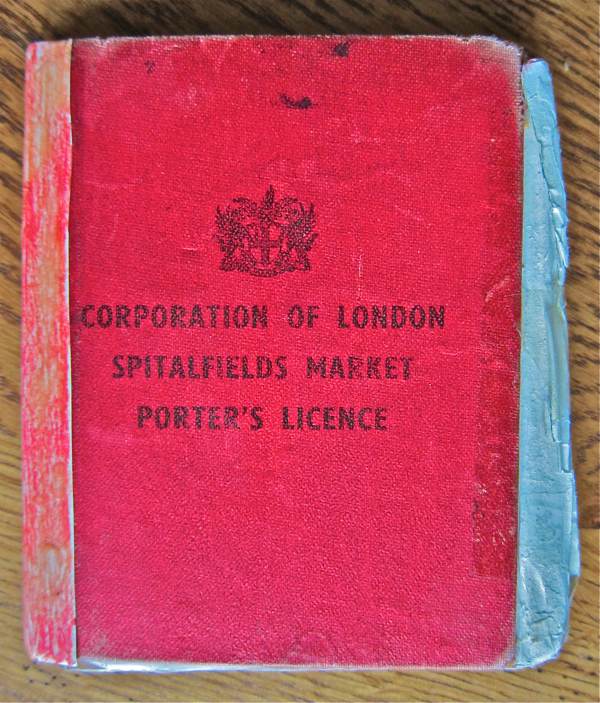
Jimmy’s Huddart’s porter’s licence.

The final year of the licenced porters.
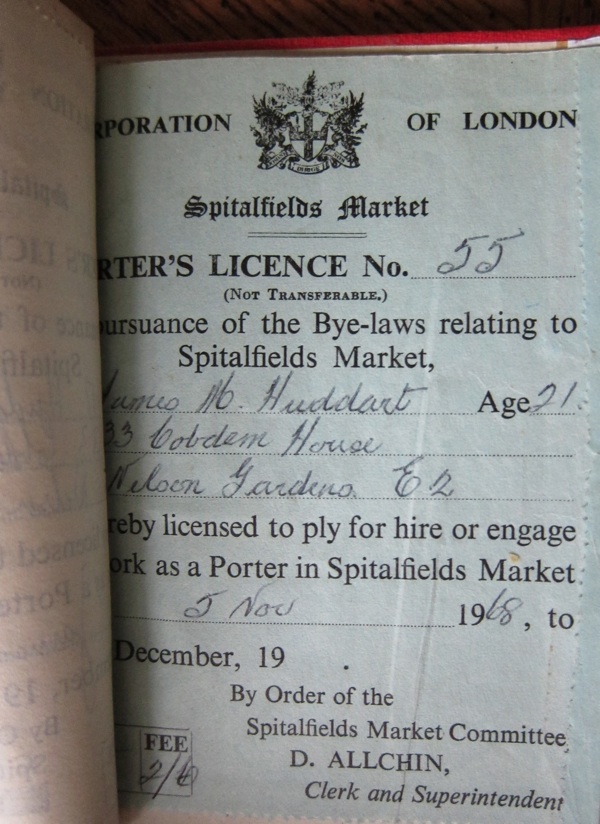
Jimmy’s first year as a porter at twenty-one years old.
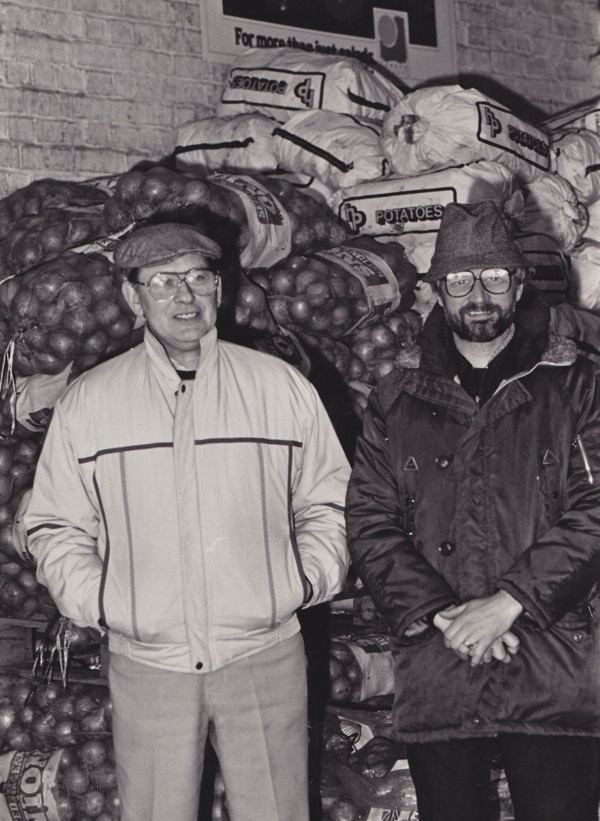
Jimmy (right) with his predecessor in the porter’s union Alf Hayes, photographed in the 1980s.

Jimmy Huddart, Honorary Fruit Porter to the Worshipful Society of Fruiterers
You may also like to read about
Peter Thomas, Fruit & Vegetable Supplier
Ivor Robins, Fruit & Vegetable Purveyor
John Olney, Donovan Brothers Ltd
Jim Heppel, New Spitalfields Market
Blackie, the Last Spitalfields Market Cat
and take a look at these galleries of pictures
Chapter 3. The Burial of the Victims

On 15th December 1811, one week after their violent deaths, the Marr family were buried in the churchyard of St George’s-in-the-East in the shadow of the pepperpot tower designed by Nicholas Hawksmoor. In spite of the frost, crowds of mourners lined the Highway from early morning and at one o’clock the coffins were carried out from the draper’s shop at 29 Ratcliffe Highway, where the deceased met their end, and into the church where two months earlier the family had attended the christening of Timothy Marr junior.
The following verse was inscribed upon the stone –
- Stop mortal, as you pass by
- And view the grave werein doth lie
- A Father, Mother and a Son
- Whose Earthly course was shortly run.
- For lo all in one fatal hour
- O’er came were they with ruthless power
- And murdered in a cruel state
- Yea, far too horrid to relate!
- They spared no-one to tell the tale
- One for the other could not wail
- The other’s fate in anguish sighed
- Loving they lived, together died
- Reflect, O Reader, o’er their fate
- And turn from sin before too late
- Life is uncertain in this world
- Oft in a moment we are hurled
- To endless bliss or endless pain
- So let not sin within your reign.
Meanwhile, no progress had yet been made in the detection of the perpetrators of the crime. Three Greek sailors loitering with blood on their trousers on the Ratcliffe Highway were arrested on the night of the murders but released again once an alibi was established, proving they had just come up from Gravesend.
More pertinently, Mr Pugh the carpenter who had undertaken the improvements to the Mr Marr’s shop was questioned. He had employed a subcontractor to make the shop window, who requested the iron chisel (discovered on the shop counter after the killings) which Mr Pugh had borrowed from a neighbour. Once the work was complete the chisel could not be found, though the contractor claimed he had left it in the shop for Mr Pugh. However, Mr Pugh was found to be of good character and had a reliable alibi too. Either Mr Marr succeeded in finding the chisel after Margaret Jewell, the servant girl, had gone out at ten to midnight to buy oysters – or he had kept it secretly all along and brought it out in vain self-defence against persons unknown – or one of the murderers had brought it into the house as a weapon and not used it.
Without any significant leads in the case, the neighbourhood was left with only speculation and the deadly brooding fear that – although the Marr family were now buried – the train of events unleashed by their savage murder on the night of 11th December was far from over.
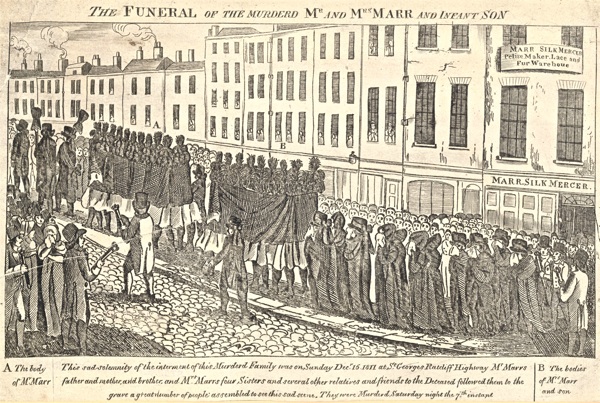


Click on Paul Bommer’s map of the Ratcliffe Highway Murders to explore further
The Maul & The Pear Tree – P.D. James’ breathtaking account of the Ratcliffe Highway Murders, inspired me to walk from Spitalfields down to Wapping to seek out the locations of these momentous events. Commemorating the bicentenary of the murders this Christmas, I am delighted to collaborate with Faber & Faber, reporting over coming weeks on these crimes on the exact anniversaries of their occurrence.
The Map of the Ratcliffe Highway Murders – In collaboration with Faber & Faber, Spitalfields Life has commissioned a map from Paul Bommer which will update throughout December as the events occur. Once you have clicked to enlarge it, you can download it as a screensaver or print it out as a guide to set out through the streets of Wapping.
Ratcliffe Highway Murder Walk – Spitalfields Life will be hosting a dusk walk on Wednesday 28th December at 3pm from St Georges in the East, visiting the crime scenes and telling the bone-chilling story of Britain’s first murder sensation. The walk will take approximately an hour and a half, and conclude at the historic riverside pub The Prospect of Whitby. Booking is essential and numbers are limited, so please email spitalfieldslife@gmail.com to sign up. Tickets are £10.
Thanks to the Bishopsgate Institute and Tower Hamlets Local History Archive for their assistance with my research.
You may like to read the earlier installments of this serial which runs throughout December
15th December, Yule Log

The Yule Log is a large wooden log, burned in the hearth as a part of Yule or Christmas celebrations. Originally an entire tree, it was carefully chosen and brought into the house with great ceremony to provide lasting warmth throughout the Twelve Days of Christmas (from Christmas Eve until Epiphany). In some European traditions, the largest end of the log would be placed in hearth while the rest of the tree stuck out into the room.
Ideally, the log would be lit with a brand made out of remnant of last year’s log, and it was hoped and considered a sign of great luck, that the log would burn throughout the twelve days. The Yule Log has frequently been associated with germanic paganism, practiced across northern Europe prior to the arrival of Christianity. One of the first to make this connection was the English historian Henry Bourne, writing in the 1720s, who described the practice occurring in the Tyne valley and theorised that it derived from sixth or seventh century Anglo-Saxon pagan customs – in old English folklore, Father Christmas was sometimes portrayed carrying a Yule Log.
The Yule Log brought prosperity and protection from evil, and by keeping the remnant of the log, the protection was believed to last all year. As well as being a protective amulet, the log became a source of rivalry – causing members of a rural communities to compete to possess the largest. According to historian and folklorist Professor Ronald Hutton, the traditions of the Yule Log died out in Britain at the end of the nineteenth century because of “the reduction in farm labour and the disappearance of the old-fashioned open hearths.”
In France and Wallonia, and francophone regions of the world – such as Quebec and in Lebanon – the Bûche de Noël (“Christmas Log”) is a traditional dessert, a cake in the shape of a Yule Log. Usually taking the form of a large cylindrical “roulade,” covered with chocolate icing, incised with a fork to resemble the tree’s bark – one end is lopped off and stood up to indicate the rings of the “log.”
I have shown here a Quebecois lumberjack, Alain Hauteville, sitting on the Yule Log he has just chopped down. The tree he chose was one that a childhood sweet-heart of his had written his initials into the bark many moons ago, before spurning him for a wealthy silk merchant in Montreal. After completing his thirsty work, young Al is enjoying a brew from his Thermos and a smoke,before dragging the lumber back to his cabin at the forest’s edge.
Illustration copyright © Paul Bommer












