
Snowfall at Bow Cemetery

On Saturday night, a hush was cast upon the East End as the first snowfall of winter came down. Many cancelled their plans for going out, consequently the traffic thinned and the pavements emptied as the falling snow took possession of the territory. Awaking to silence on Sunday morning and looking from my bedroom window, the dark boughs of the great yew tree in the back yard were weighed down with a heavy covering of white – a bucolic wintry vision filling my gaze, as if the house had been transported in the night and I had woken high in the mountains.
Even as I opened my eyes, I knew I wanted to go to Bow Cemetery where I paid a visit to admire the precocious spring bulbs last February. That year, the snow had begun before Christmas and the spring came early, whereas this year the winter has been mild until the temperatures took a dip in mid-January, making up for lost time. So, as I have been awaiting the opportunity to see this magnificent graveyard in the snow all winter, the fulfilment of my wish compensated for the indisposition of slush filling the streets.
The appealing irony of Bow Cemetery is that this vast garden of death has become the largest preserve of wildlife in East London. Created once the small parish churchyards filled up, it is where those numberless thousands who made the East End in the nineteenth century are buried. On the Western side of the cemetery, near the main entrance, are fancy tombs and grand monuments but, as you walk East, they diminish and become more uniformly modest until, at the remotest extremity, there are only tiny stones. At first, I thought these were for children when, in fact, they were simply the cheapest option. Yet even these represent an aggrandisement, beyond the majority of those who were buried here in unmarked communal graves.
My spirits lifted to leave the icy mess of the streets and enter the quiet of the cemetery where since 1966, a forest has been permitted to grow. A freezing mist hung beneath the high woodland canopy, and the covering of white served to emphasise the rich green and golden lichen hues of the stones, and subtle brown tones of the tree trunks ascending from among the graves. As on my previous visits, there were few visitors here and I quickly lost myself in the network of narrow paths, letting the trees surround me in the areas where no human footprint had yet been made.
Crows called to each other and woodpeckers hammered away high in the tree tops, their sounds echoing in the still air. Thrushes searched for grubs under leaves in the rare patches of uncovered earth beneath stands of holly, and a young fox came by – standing out as a vivid rusty brown against the pale snow – slinking along self-conscious of his exposure. The spring bulbs that I saw last year in flower at this time were evidenced only by sparse green spears, protruding from snow criss-crossed by animal and bird tracks.
It was a very different place from the lush undergrowth of high summer when I first visited and another place again from the crocus-spangled garden of spring, yet I always discover peace and solitude here – a rare commodity in the East End – and, even in this bleakest season, there was life.


You may also like to read about
Find out more at www.towerhamletscemetery.org

Apart from his necessary business, Mr Pussy did not stir from the house during the snow.
Joseph Grimaldi, Clown

Today – the first Sunday in February – is when the clowns gather for the annual church service in Dalston to remember Joseph Grimaldi, and I am delighted to launch this new print by Spitalfields Life Contributing Artist Paul Bommer, created to celebrate the father of British clowning.
“Joey” was born in 1778 in Clare Market, a slum in Holborn composed of Elizabethan shambles which survived the Fire of London, to Guiseppe – known as “Iron Legs” – an Italian pantomime artist and Rebecca a dancer, both performers at Drury Lane. The story is told that he was literally catapulted to fame when he fell into the pit while performing as a monkey at Sadler’s Wells, aged three. Grimaldi’s father died when he was nine but by then Joey was already making a living on the stage. With star quality, a natural gift for physical comedy, ceaseless inventiveness and an obsessive propensity for work, Grimaldi enjoyed the constant adulation of his audiences even if his personal fortunes where rarely stable. When his first wife Maria, daughter of the owner of Sadlers’ Wells Theatre, died in childbirth less than two years after their marriage, he sought consolation through immersion in his creative world. Developing the role of Clown, the country buffoon from the Commedia dell’Arte, he created the notion of comedy derived from audience participation, excelled in political impersonations and invented the pantomime dame too.
Growing up in Holborn and Clerkenwell, Joey was fascinated by the street life of the city and his most famous song “Hot Codlings,” premiered in “Mother Goose” in 1806, dramatises the character of a hawker selling baked apples.
Joey invited his audience to complete the last line, inviting a dialogue in which the knowing spectators would subvert the performance by calling out “Gin,” cueing him to adopt a tone of soulful disappointment, declaring “Oh for shame!” in complicit response.
In the end, Joey’s success led to his self-destruction through a relentless performance schedule, often playing two theatres on the same night and enacting demanding physical stunts. By the age of forty-eight, he was unable to continue, and his departure from the stage and farewell to his adoring audience must rank as one of the most emotional in British theatre history. Held in the affections of all circus folk today, Joseph Grimaldi’s reputation remains current in the popular imagination as the inventor of the archetype of the white faced clown that is universally recognised.
In 1820, at seven years old, Charles Dickens saw Grimaldi perform in pantomime in London and, at twenty-five years old in 1838, he rewrote Grimaldi’s Memoirs from a manuscript discovered posthumously, fitting the job into the three month gap between completing Pickwick Papers and starting Nicholas Nickleby. George Cruickshank, who lived in Amwell St round the corner from Sadlers’ Wells, drew the lively pictures, captioned below with excerpts from the text by “Boz.”

Joe’s debut into the pit at Sadlers’ Wells in 1782, aged three – “He played the monkey and had to accompany the clown (his father) throughout the piece. In one of the scenes, his father used to lead him on by a chain attached to his waist, and with this chain he would swing him round and round, at arm’s length, with the utmost velocity. One evening, when this feat was in the act of performance, the chain broke, and he was hurled a considerable distance into the pit, fortunately without sustaining the slightest injury – for he was flung into the arms of an old gentleman who was sitting gazing at the stage with intense interest.”

Master Joey going to visit his godpapa. “He used to be allowed as a mark of high and special favour, to spend every alternate Sunday at the house of his mother’s father, a carcass butcher doing a prodigious business, besides which he kept the Bloomsbury slaughter-house. With this grandfather, Joey was a great favourite, and as he was very much indulged and petted when he went to see him, he used to look forward to every visit with great anxiety. After great deliberation and much consultation with the tailors, the “little clown” was attired in the following style – he wore a green coated embroidered with as many flowers as his father had put in the garden at Lambeth, he had a laced shirt, cravat and ruffles, a cocked-hat upon his head, a small watch set with diamonds – theatrical we suppose – in his fob, and a little cane in his hand which he switched to and fro as clowns do now.”

A Startling Effect – John Kemble as Hamlet and Joseph Grimaldi as the Grave Digger.

Live properties – “He dressed himself in an old livery coat with immense pockets and a huge cocked hat, both were – of course – over his clown’s costume. At his back, he carried a basket laden with carrots and turnips, stuffing a duck into each pocket, leaving their heads hanging out, and carried a pig under one arm and a goose under the other.”

Appearing in public – “During the month he had to play “Clown” at both Sadlers’ Wells and Covent Garden Theatres, not having time to change his dress and indeed no reason for doing so if he had, in consequence of his playing the same part at both houses, he was accustomed to have a coach waiting, into which he threw himself the moment he had finished at Sadler’s Wells, and was straightaway carried to Covent Garden to begin again.”

The Barber’s shop – “Grimaldi sat himself down in a chair and the girl commenced the task in very businesslike manner. Grimaldi feeling an irresistible tendency to laugh at the oddity of the operation, but smothered by the dint of great efforts while the girl was shaving his chin. At length, when she got his upper lip, and took his nose between her fingers with a piece of brown paper, he could stand it no longer, but burst into a tremendous roar of laughter, which the girl no sooner saw than she dropped the razor. Just at this moment in came the barber, who, seeing three people in convulsions of mirth, one of them with a soapy face and a gigantic mouth making the most extravagant faces, threw his hat to the ground and laughed louder than any of them.”

Grimaldi’s kindness to the Giants. – “When “Harlequin Gulliver” was in preparation they were at a loss where to put the Brobdignagians, these figures were so cumbersome and so much in the way that the men who sustained the parts were obliged to be dressed and put away in an obscure corner before the curtain was raised. Grimaldi pitied the poor fellows so much that after the first night’s performance, he thought right to ask whether they could endure so much labour for the future. “We have agreed to do it every night,” said the spokesman of the party, “if your honour will only promise to do one thing for us, and that is just to let us have a leetle noggin of whisky.” This moderate request was readily complied with, and the giants behaved themselves exceedingly well, and never got drunk.”

The last song – “In the last place, Grimaldi acted one scene, but being wholly unable to stand went through it seated on a chair. Even in this distressing condition, he retained enough of his old humour to succeed in calling down repeated shouts of merriment and laughter. ‘Ladies & Gentlemen, in putting off the clown’s garment, allow me to drop also the clown’s taciturnity, and address you in a few parting sentences. I entered in this course of life, and I leave it prematurely. Eight and forty years only have passed over my head. Like vaulting ambition, I have overleapped myself and pay the penalty in an advanced old age. If I now have any aptitude for tumbling, it is through bodily infirmity, for I am now worse on my feet than I used to be on my head. It is four years since I jumped my last jump, filched my last oyster, boiled my last sausage and set in for retirement.'”

Portrait of Joseph Grimaldi by John Cawes, 1807.


Artist Paul Bommer shivers in the February chill at Joseph Grimaldi’s grave in Pentonville.

Copies of Paul Bommer’s Joseph Grimaldi print are available from the Spitalfields Life Online Shop.
You may also like to read about
At the 65th Annual Grimaldi Service
and these other stories about Paul Bommer’s work
The London Borough of Jam

Lillie O’Brien & I were at Covent Garden Market before dawn yesterday to get the pick of the crop of forced rhubarb. It is the only English fruit that is in season now and we bought it straight off the truck that had driven down overnight from the famous Yorkshire Triangle, where a frost pocket sweetens the rhubarb naturally and, after four generations, the Oldroyd family still grow rhubarb by candlelight in the time-honoured method. Once upon a time there was a Rhubarb Express to deliver trainloads of rhubarb to the hordes of eager Londoners craving rhubarb, but yesterday there was just Lillie & me seeking rhubarb while the city slept.
After four years as pastry chef at St John Bread & Wine in Commercial St, Lillie O’Brien struck out on her own last year to create the London Borough of Jam, a one-woman operation making small batches of the highest quality preserves from the freshest seasonal ingredients.
Seeking a name for her endeavour in the Hackney Local History Library, the label in the book identifying it as the property of the London Borough of Hackney caught Lillie’s eye and the witty identity for her new project was born. Through the autumn, Lillie filled the cellar of her house with jars of delicious jams made of the fruits of the harvest, only to have her entire stock bought out at shops and markets by greedy East Enders hungry for jam last Christmas, creating an imperative to feed the demand. Towards this end, our mission yesterday was to buy the best rhubarb, drive back to Lillie’s tiny kitchen in Clapton and make it into jam ready for sale this weekend. At five thirty, we were driving down to Covent Garden and by ten thirty we had jam, it was a highly satisfactory achievement for so early on a February morning.
At the market, we were greeted by Paul & Terry of Lenards wholesalers. By then, the night’s trading was already over but it was the ideal opportunity for a rhubarb hunt and Paul & Terry were the expert guides to lead us to the best options available. As we walked through the aisles, every fruit you might desire was on display, freighted in from each corner of the globe, yet in spite of the pristine appearance, the raspberries were bitter, the strawberries were watery and the cherries were brown at the centre. A discovery that confirmed our resolution to buy the fruit that was in season. The one diversion from our rhubarb quest was for blood oranges from Sicily, and as I stood in the sub-zero temperature of the market, I was transported to Southern climes by the intense sweetness of the ruby-red flesh of this gleaming golden fruit. Lily took a box to make some marmalade.
We found fat rhubarb and thin rhubarb, long rhubarb and short rhubarb. Some that was past its best and some that looked rather pale. Apparently, chefs like fat rhubarb to create chunks in their crumble, but Lillie prefers a smooth texture to her jam and when she opened a box of skinny rhubarb – blushing almost coral in its redness – her eyes widened in excitement and I knew we were in business.
In a state of raging anticipation, we carried our crates of gleaming rhubarb into Lillie’s tiny kitchen and Lillie shrieked with excitement at the ice-cold water as she washed the stalks in the sink. We paused briefly to admire the aesthetics of the curly dappled flowers before we beheaded them mercilessly and Lillie chopped one kilo of rhubarb into small pieces, while Chester her cheeky British Blue cat rubbed at her ankles.
Since the age of twelve, Lillie worked at a part-time job at a food store called Tartine in her home town of Melbourne, where she grew up under the influence of her mother’s cookery. “When I was a child, my mother made crab apple jelly but when you are little, you don’t like it – so she had a cupboard to herself with a year’s supply.” Lillie recalled with a sentimental grin. On leaving school, Lillie did a three year cooking apprenticeship and then five years as a chef at the celebrated Cicciolina mediterranean bistro before deciding to come travelling around Europe for six months. A tour that was cut short when a pal walked into St John Bread & Wine to ask if there were any jobs, was told a pastry chef was required and gave Lillie’s name. “I went in for a trial and stayed for four years,” admitted Lillie, “which I have to say went very quickly. I made the jam and preserves while I was there. But then I decided wanted to be part of the market here at Chatsworth Rd and I found that working at St John by day and making jam all night was quite tough. So it was time to move on from cheffing – from four years of rolling puff pastry that has given me enlarged muscles in my neck and from whisking eggs that has caused one arm to grow larger than the other! But I do miss it though…”
Lillie talked as she worked, weighing up the rhubarb and then transferring it to her beautiful copper jam pan. Copper is the best conductor of heat which means that the fruit will cook evenly, avoiding any overcooking that might compromise the flavour. This is why Lillie cooks her jam in small batches because larger amounts take longer to cook and the fruit does not cook consistently. Adding jam sugar and then the juice of a lemon, Lillie kept stirring as the liquid evaporated and the rhubarb reduced to an even texture. Meanwhile, she heated the jam jars and boiled the lids, both to sterilise them and to ensure that her hot jam had a hot jars to go into into, so there was no risk of the glass breaking.
Lillie constantly checked the consistency of the jam, its viscosity revealed by how it dripped from the spoon. Then she added the finely chopped stem ginger and the jam was almost ready. “I’m so happy, I’m beside myself with the colour! This is going to be the most beautiful rhubarb jam I ever made.” she declared in unmitigated delight, as she poured it from the pan through her jam funnel, making just four jars. This painstaking technique required Lillie to spend the rest of the day working through her twelve kilogrammes of rhubarb, yet ensured the unmediated fruitiness that characterises her jam.
An essential trip to Gardners Market Sundriesmen was required to purchase more labels for this new batch of jam before Paul Gardner left for the weekend, which meant that Paul was the lucky recipient of the first pot of jam. Then Lillie returned to her kitchen for a long day’s jam-making before writing the labels that evening, and all so the rhubarb & ginger jam can be on sale this weekend.
A lush deep pink jam with a vivid flavour that is more rhubarb than even rhubarb, a perfectly spreadable texture and a subtle piquancy of ginger – this is what I shall be having on my toast at breakfast this morning, thanks to the London Borough of Jam.

Washing the rhubarb.

Weighing the rhubarb.

The rhubarb in Lillie’s new jam pan.

Adding the jam sugar.

Testing the consistency.
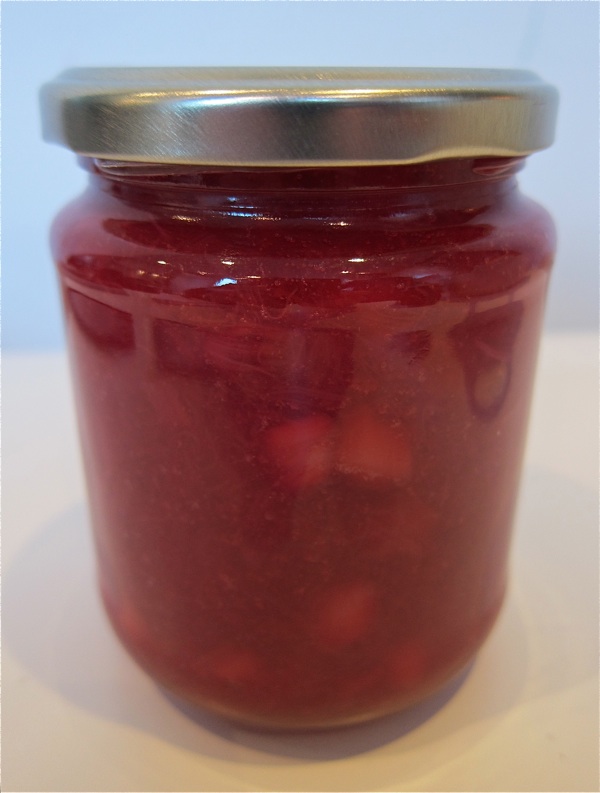
Rhubarb & Ginger Jam by the London Borough of Jam.


Paul Gardner of Gardners Market Sundriesmen gets the first pot of rhubarb & ginger jam.
You can buy jams and preserves by London Borough of Jam at Leila’s Shop, E5 Bakery and from Lillie’s fortnightly stall in Chatsworth Rd Market on alternate Sundays. She will be there this Sunday with pots of her rhubarb & ginger jam.
You may also like to read about
Night in the Bakery at St John
The Gentle Author Speaks
This interview, conducted and edited by Tim Rich, was first published last year in Random Spectacular, a limited edition magazine with a circulation of seven hundred and fifty, and I am republishing the piece today so that those who were unable to obtain a copy may read it here. The print which was commissioned to accompany the interview was created by Justin Knopp of Typoretum.
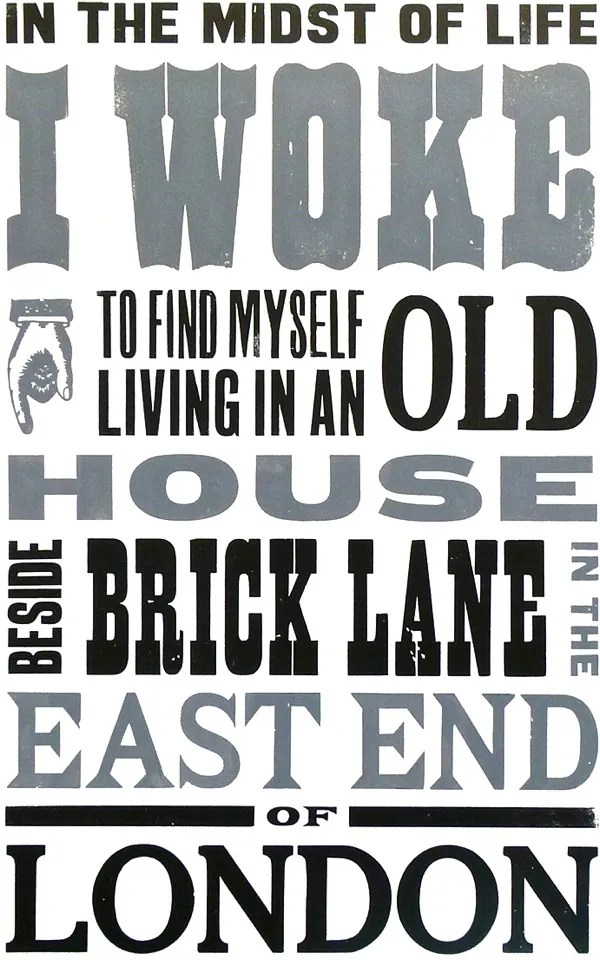
I wanted to find out more about the writer whose words transport me each day, whose stories take me through previously unseen doorways in my own neighbourhood in the East End. But that also required a promise from me – that I wouldn’t reveal the identity of The Gentle Author. I feared that this guarding of the person behind the pen might go hand in hand with a reticence to talk. What I encountered was something else entirely. Here are some of the words we exchanged over a pot of tea in East London.
Tim Rich – Your promise to readers includes a picture of a sundial on Fournier Street that features the words ‘Umbra Sumus’ – “We are shadows.” Reading your writing for the first time, I had the immediate feeling that you were either pursuing or escaping something.
The Gentle Author – Well, there’s a wonderful notion that Kierkegaard described – that being a writer is like being in the continual state of running through a burning house, trying to decide what to rescue. I do feel that sensation a lot of the time. Also, that people’s stories go unrecorded is a matter of grief to me. I think that arose after the death of my parents. I grew up in Devon around old people, and I used to knock on their doors and ask to spend a day with them. I suppose I have a vertiginous sense of all the stories in the world, and accompanying that is a sense of the loss of all the stories. So I have a compulsion to collect as many as I can, for as long as I can.
Tim Rich – Your stories became longer after a couple of months of the blog, and that coincided with you writing more pen portraits.
The Gentle Author – I have a personal sense of responsibility to people that I’ve met to do them justice. The idea of trying to sum someone up in a thousand words is terrifying. That was why the stories got longer and longer. The other thing that happened in the first year – unexpectedly – was that a lot of readers came along. It gave me a different responsibility, to not disappoint the reader. You want to give them something wonderful. So I became more ambitious.
Tim Rich – That is a terrific counterblast to the common, pessimistic notion that people don’t read much any more, and that writing for the Web should always be short. You show that the Web can be a place for a longer and more personal form of writing.
The Gentle Author – I respect the discipline of writing, that a piece should be well structured and a story well told. But I also aspire to write in an unmediated way, and to not withhold an emotionalism if that’s how I react to a subject. I am also attracted to use vocabulary in a way that it is not used in journalism, but is perhaps more common in fiction. I chose to be this voice speaking from the darkness, because I want to be in private with the reader. I want the reader to understand that the writer’s intention is benign, and that we can trust each other. And I hope the readers create their own sense of who they are listening to and take ownership of what they read. In this sense, the Gentle Author is a conceit to bring readers closer to the subject, and I want the subject to be the people I’m writing about, not me.
Tim Rich – Do you have to get into the character of the Gentle Author when you write?
The Gentle Author – Graham Greene said that reading Charles Dickens was like listening to the mind talking to itself. It is the internal voice that I aspire to in my writing – what I hear inside my mind.
Tim Rich – Tell me a little more about the ‘hare-brained’ task you have set for yourself.
The Gentle Author – I wanted readers to know they could rely on something new every day. And I felt that if I created this cage for myself, then I could have no escape. I have written more than 800,000 words in the last two years, so it has worked to that degree. It’s a miracle. I spend most of the day running around the streets after people and doing interviews. In the evening, I sit down to supper, and then I write. The golden rule is that I can’t go to sleep until it’s done. People sometimes think that I knock off six stories in advance and press a button each day, but it isn’t like that at all. I may write interviews up a few days later, but it appeals to me that the Gentle Author has no choice but to write a story every day. I’m aware that it’s an excessive way to live but my experience has taught me that life is excessive.
Tim Rich – Your interviewees tell you remarkable things about their lives. How do you earn their trust?
The Gentle Author – You have to be open-hearted and honest, and you hope people see that it is just you, and that there’s no ulterior motive – and that no one’s paying you to do it. That you are doing it for love. People are wisely suspicious of writers, so I commonly send someone a piece I have already written and they can see what the outcome of being interviewed will be like.
Tim Rich – You write about the tension between tradition and change, such as the spiraling rents that have threatened to push out merchants like Paul Gardner.
The Gentle Author – It’s very difficult to trace what’s a right or wrong way for change to happen, but it’s vital that good things don’t get destroyed. For me, Paul Gardner, the Market Sundriesman, incarnates the essence of Spitalfields. Unless you have gone and shaken hands with Paul Gardner you can’t really say you have been to Spitalfields. His shop is where all the small traders in East London go to get their bags. What happened in Paul’s case was that, after my story, the landlords relented in their original demand for an excessive rent increase and showed themselves to be enlightened, recognising he is a special case. I hope people appreciate that the things which make this place distinctive are worth holding on to. One of the lessons revealed by the crash in the City was that the short-term profit motive is destructive and people need to take a longer-term view.
Tim Rich – You seem to revel in those lively nights out with the Bunny Girls and the trannies and the boys’ club reunions, but how do you feel about Spitalfields on a Saturday night – the drinkers and clubbers?
The Gentle Author – I think it’s a beautiful phenomenon. I often go out and walk the streets just to see the crowds on a Saturday night. Nothing has changed much there. In the 1860s The Eagle Tavern on the City Road was getting 12,000 people turning up a night and there were complaints about the crowds then. I think the young people who dress up and come to show off their outfits on Brick Lane embody a wonderful flowering of culture. So many people compete for ownership of this place, but the truth is that it belongs to everybody and nobody. There is a magic in Spitalfields, but if you love the area you must also be generous to others who love it too.
Tim Rich – Will there be enough space in your life to do other types of writing, as well as your daily report?
The Gentle Author – Dickens wrote six or seven stories a week for Household Words, but he also wrote the novels of Dickens as well. My background is in fiction, and originally I envisaged that there would be a chapter of a novel by me on the first of the month through the year. That has been sidelined, but as I get more confident and more in control of what I’m doing it could resurface. I’m attracted to the idea that the Gentle Author might have fictional adventures.
Tim Rich – What about visits to other places far from Spitalfields?
The Gentle Author – I am a favoured person in that I have had so many experiences and lived so many lifetimes in my life already. I remember, I went to Los Angeles for the Millennium and I was with a friend in a car on New Year’s Eve, and we turned left onto the freeway into oncoming traffic. She said, “We’re going to die.” And I said, “I don’t mind because I’ve done so much in my life, but what about your son?” There are lots of places I would like to go back to – Beijing, Cuba – but what I do now forces me to live in the day. My mind is so crowded I don’t have much space to think about anything else.
Tim Rich – You said something curious in a story on Dennis Severs’ house, which was, “Much as I love a good chat, I have many times wished that I never had to speak again.”
The Gentle Author – I think talking is hard. We take people’s words to be the expression of who they are. But I have always felt, with me, that was a contradiction because I didn’t feel that in speech I could represent who I was. That was why I began to write, because by writing down I could wrestle with words and become more truthful to who I am. So yes, I think it would be wonderful if I could get through the rest of my life without talking. I once lived on an island in the Outer Hebrides. I was the only inhabitant and I had to row forty-five minutes to the shore to get my mail. I would not see people for months on end and I did so much writing then. Your internal monologue becomes much more apparent when all the interference of external conversations is gone. Walking is very important in that respect too. I long for the release of the mind.
Tim Rich – So, writing is a release from the deluge of thoughts in your head.
The Gentle Author – Yes. For me, the act of writing is writing it down. There are no drafts. Writing is the act of recording an internal monologue. Coming back to the notion of the mind talking to itself – for me writing is the outcome of an unquiet mind, I suppose.
Tim Rich – How has Spitalfields Life changed your life?
The Gentle Author – I walk down the street and sometimes people lean out of windows to wave and come out and shake my hand. It is a beautiful thing, yet for that to happen in the middle of this huge city is bizarre. Generally, I don’t understand why people don’t talk to each other more. I think this is a political construct, this situation where we are all alienated from one another. A book that was important to me as a student was Raymond Williams’ Culture and Society. I think one of the outcomes of mass distribution through the printing press in the nineteenth and twentieth centuries was that it made everybody strangers to each other. We see all those people out there as ‘the masses’. It’s rubbish. It’s a lie. The hope of the internet is that it allows everyone to talk to each other again, and not be strangers.
Tim Rich lives in Bethnal Green and writes at www.66000milesperhour.com
A few copies of Justin Knopp’s print are still available from the Spitalfields Life online shop.
Noel Gibson, Painter

Railway footbridge at Poplar
You have only just a week – until 9th February – to catch the revelatory exhibition of Noel Gibson’s East London Street Scenes at the Tower Hamlets Local History & Archives in Bancroft Rd, which rediscovers an important painter from the nineteen seventies whose work has not been displayed for twenty-five years. These large paintings need to be seen in the gallery to fully appreciate the quality of impasto, with vivid black lines standing out in relief from the canvas and vigorous textures created with a palette knife, imparting a dramatic presence to these soulful visions.
Noel Gibson lived in the East End from 1962 until 1974 and the paintings in this show are the outcome of this period. Born in 1928 in Glasgow, Gibson originally trained as an opera singer and then became House Manger at the London Opera Centre based in the Troxy Cinema in Commercial Rd where he lived in a flat at the top of the building. A self-taught artist, he painted in the evenings after work.
“I began as an abstract painter but when I came to Stepney, I found paintings on my doorstep. Though I think there’s still a quiet abstract quality to my paintings. I am trying to express the spirit of the buildings, the strength of them and the people who were there. This is why I don’t put people into my paintings. People turn them into an episode with a background – but I am painting the background! I love these buildings. I walk the dog and I look at them at different times of day and in different weathers, and I keep going back. In a way I am making a record of a changing, I wouldn’t say a dying area, but often I go back to check up on a detail, a colour and a whole street has gone.” Gibson said in an interview in the Times in 1972.
Immensely successful in his day, enjoying acclaim and sell-out shows – one of which at St Botolph’s in Bishopsgate was opened by Tubby Isaac the jellied eel king – Noel Gibson was featured on BBC’s “Nationwide,” a popular current affairs programme in 1972. In 1974, he moved to South London, working at Morley College and appointed Provost’s Verger at Southwark Cathedral, yet in 1985 he admitted, “I regard Tower Hamlets as the area of inspiration for my work and I will always return to it.”
Noel Gibson died in 2006 and this collection of paintings, originally bought by Tower Hamlets Council in 1970 to be shown in public buildings, came to light when the borough’s art collection was being photographed – inspiring Anna Haward to curate this beautiful show that recovers a major painter of the recent, yet already distant, East End.

Hessel St – “If this street were in Paris, everyone would have wanted to paint it.”

Brick Lane, looking north towards the Truman Brewery

St Anne’s, Limehouse

St John’s Tower

Small Red House in Bow

Street Scene in Poplar

The Victory in Poplar

Chilton St, Spitalfields

Tower House, Fieldgate St, Whitechapel

Arbour Sq

Noel Gibson
Images courtesy of Tower Hamlets Local History Library & Archives
You may also like to read about Marc Gooderam, Painter
Rosie Dastgir, Novelist

Rosie Dastgir in Whitechapel Market
Rosie Dastgir lived in Ashfield St in the shadow of the Royal London Hospital in Whitechapel for ten years from 1995 – 2005, and while she was there she began to write a novel. Then she went to live in Brooklyn, New York, but five years later completed her debut novel A Small Fortune, set in Whitechapel and Spitalfields, which is published this week in London. Yesterday, Rosie returned to the East End to take a stroll around her old territory for an afternoon of contemplation before publication day on Wednesday, and I enjoyed the privilege of accompanying her.
“The story was inspired by being in Whitechapel and the characters I met there,” she admitted to me as we walked down Brick Lane together, hunched up against the cold, with the minaret looming overhead,“I took a trip to Pakistan with my father in the nineteen eighties and then later – after he died – at the time of 9/11, I wondered what he would have made of the changes in the Islamic World.” Rosie’s novel is a bitter-sweet comedy about a British Muslim – inspired by her father who emigrated from Pakistan in the 1950s – a man who is losing control of his life and his family, as his daughter is dropping out of medical school at the Royal London Hospital and his cousin is failing as an East End estate agent.
“This is my old stomping ground,” announced Rosie with a murmur of delighted recognition as we turned the corner into the Whitechapel Rd. Then, crossing Altab Ali Park – “No matter how much money they spend on this place it will always resist gentrification,” she reassured me. Rosie’s father came to stay with her in Whitechapel in his final years.“When he died, I found a stash of his letters and diaries talking about Islam,” she revealed, adding that her novel is set in the early 2000s, after her father’s death, thereby defining a precise line between his experience and her fiction.
“I thought, ‘What am I doing, writing this in Brooklyn?'” declared Rosie, rolling her eyes humorously, “I already had the idea for it in Whitechapel and I had written a few chapters.” Her perseverance was rewarded when she found an American publisher for her novel before a British one. “That was a wonderful moment,” she confided with a modest smile, “because I had thought, ‘Maybe no-one’s going to get this?’ but it confirms this is a story that is appropriate to many cultures. It stands upon its own terms.” In retrospect, Rosie recognises that the geographical distance granted her a perspective, liberating her to write fiction.
Weaving through the narrow streets, we came upon Ashfield St and Rosie’s former house. “They haven’t even repainted the front door!” she declared in surprise, turning her back on it in disappointment to point out the houses of friends that once lived here. “I was pregnant at the time and when I saw another pregnant woman in the street, I said to her, ‘We must be friends because we’re both going to have babies!'” she told me with a grimace at the craziness of it. In spite of the chill of the afternoon, Rosie showed a buoyant energy and humour that is reflected the quality of her lively compassionate writing and graceful prose style. We sat together on the swings in Ford Sq and Rosie wondered at the gleaming new hospital tower that has sprung up since she lived here, while boys in white jalabiyas played football around us.
This is a year of significant change for Rosie, publishing her first novel and returning this summer to live in London. “I like my life in Brooklyn, but my eldest daughter is reaching thirteen and you come to the point where you need to make a decision,” she said, in quiet contemplation as we walked back towards the clamour of Whitechapel Market. Yet Rosie Dastgir’s journey has been more than simply trans-atlantic, she returns as a novelist with a distinctive voice and an outstanding first novel under her belt – and all the possibilities that fiction has to offer laid out before her.


A Day in the Life of the Chief Yeoman Warder at the Tower of London

John Keohane
Chief Yeoman Warder John Keohane wakes at 6:45am in his quarters in the Old Hospital Block and the first sight to greet his eyes as the daylight comes into focus is the mythic White Tower, gleaming in the dawn outside his bedroom window. At 7:50am each morning, trim in his Tudor uniform, he steps from his blue front door and crosses the Inner Ward of the Tower, walking down Water Lane between the ancient stone walls to reach the octagonal office in the twelfth century Byward Tower. Here John assesses the duties of his thirty-seven fellow Warders for the day, before commencing the Opening Ceremony of the Tower at 8:50am, when a contingent of soldiers in bearskins accompany him to unlock the heavy black gates at 9:00am precisely and admit the tide of visitors whose flow is as ceaseless as the Thames.
And so it has been for many years at the Tower of London. And so it was last week, when Spitalfields Life Contributing Photographer Martin Usborne and I accompanied John for a day. And so it will be today.
Only it will not be so tomorrow – because this is John’s last working day in the post of Chief Yeoman Warder. And thus the day that Martin and I shared with John was both an echo of all the other days, yet underscored with a certain poetry by the imminent conclusion of John’s time at the Tower – where he has been a Yeoman Warder since 1991.
Once John had ensured the Opening Ceremony had been completed with the essential aplomb that such rituals at the Tower require, we all strode up the hill past Tower Green to John’s Office in the Waterloo Barracks which he now shares with his successor and protégé Alan Kingshott, the current Yeoman Gaoler. Instantly, the two slipped into the freewheeling Morecambe & Wise style banter that characterises their relationship. “I just want to check my emails,” pleaded John in mock petulance, as we all piled into the tiny room and Alan vacated the work station. “I can’t get used to this desk,” John continued, squeezing himself and his voluminous Yeoman Warders’s uniform behind Alan’s newly installed office furniture with feigned distaste,“he’s got one of these ergonomically-shaped keyboards.”
“When I first arrived he was my mentor, he taught me everything,” confessed Alan reverentially, changing tone to add playfully,“It’s his fault I’m here!”
“I’ve written six pages of notes for him of things not to forget,” John confided to me to while Alan took the opportunity to get out the Brasso from a filing cabinet and polish up his belt buckle as John tip-tapped at his keyboard with one hand, stroking his beard in thought with the other. “John cleans his buckle every day,” Alan whispered to me. “And my shoes,” added John without lifting his eyes from the keyboard.
With free time on his hands, John took us on a tour of the casements, as the dwellings built into the walls of the Tower are called. Here, in the private areas of the Tower, live forty-seven families and washing lines and flower pots, even a doctor’s surgery, attested to their presence. Yet these spaces carry history as the original location of the Royal Mint and of the shooting range where Josef Jacobs, a German spy who was the last to be executed at the Tower, was shot in 1941. During his time, John has become increasingly drawn to study the events that happened here and out of all the locations it is the Bell Tower where Thomas More was imprisoned that touches him most. “It is just a bare room with a stone floor and a garderobe in the corner,” said John,“where they kept him for three months in 1543 before they took him out to Tower Hill and beheaded him. One of things that strikes me about it, the temperature is always the same. You always feel how cold it is.”
This is John’s special quality – through engaging with the past on a personal level, he has come to embody the soulful history of this place and because of his presence, and that of his fellow warders, visitors are able to appreciate the reality of the human history that has been enacted here among these monumental structures.“It’s been the epitome of my career,” John confessed to me as we sat in his quiet living room looking out onto the Inner Ward, where he once came as a ten year old child on a visit and then returned in 1972 as a young soldier on temporary duty at the Tower – though he never anticipated the part that the Tower would eventually play in his life. “I’ll miss living here,” he admitted to me, “but the house I have in Paignton is on a hill looking out across the sea towards Brixham.”
We joined the tourists in the cafeteria next door for lunch before ambling back to the Byward Tower for the Ceremony of the Word at 3pm, in which a contingent of soldiers from the barracks at the Tower collected a wallet with the password that is changed daily, necessary so the guard may know who can be admitted in case of an emergency. Then it was back to John’s office to await Mr Barley, a dapper gentleman who is a veteran of fifty-four years at Mappin & Webb, bringing John’s engraved silver salver that will remain to commemorate his time at the Tower. John scrutinised the simple text and found it satisfactory.
Already the January afternoon light was fading and it was time to prepare for the Closing Ceremony, as the Warders shepherded the sparse visitors from each of the buildings and John made the rounds collecting the bunches of keys, until the last stragglers left the Byward Gate and Warder Chris Skaife rang the bell high in the tower at 5:00pm. Later, at 10:00pm, the Ceremony of the Keys would ensure the final lockdown at the Tower. And tonight, after more than twenty years, it will signal the end of John Keohane’s tenure.
“The Tower is closed now and my day is over,” he said simply as we shook hands. It was a day in the life of the Chief Yeoman Warder at the Tower of London.


Waiting to open the Tower for the day.


Opening the gates at the Byward Tower to visitors.


John Keohane with Alan Kingshott who will succeed him as Chief Yeoman Warder.

John steps out of his front door.

John wakes each morning to the sight of the White Tower.


John stands for pictures taken by schoolchildren.

John eats a bowl of soup for lunch among the tourists in the cafeteria.

John takes delivery of the salver from Mappin & Webb commemorating his time at the Tower.


The silver figure of John presented to him as a leaving gift by the Tower.

John collects the keys from his fellow Yeoman Warders.

Chris Skaife ringing the bell at the closing of the day.

John Keohane – “The Tower is closed now and my day is over”

Photographs copyright © Martin Usborne
Residents of Spitalfields and any of the Tower Hamlets may gain admission to the Tower for one pound upon production of an Idea Store card.
You may also like to read about
Alan Kingshott, Yeoman Gaoler at the Tower of London
Graffiti at the Tower of London
The Beating of the Bounds at the Tower of London
The Ceremony of the Lilies & Roses at the Tower of London
The Bloody Romance of the Tower with pictures by George Cruickshank
John Keohane, Chief Yeoman Warder at the Tower of London


