
Leon Silver, Nelson St Synagogue

When Leon Silver opened the golden shutter of the ark at the East London Central Synagogue in Nelson St for me, a stash of Torah scrolls were revealed shrouded in ancient velvet with embroidered texts in silver thread gleaming through the gloom, caught by last rays of afternoon sunlight.
Leon told me that no-one any longer knows the origin of all these scrolls, which were acquired as synagogues closed or amalgamated with the departure of Jewish people from the East End since World War II. Many scrolls were brought over in the nineteenth century from all across Eastern Europe, and some are of the eighteenth century or earlier, originating from communities that no longer exist and places that vanished from the map generations ago.
Yet the scrolls are safe in Nelson St under the remarkable stewardship of Leon Silver, President, Senior Warden & Treasurer, who has selflessly devoted himself to keeping this beautiful synagogue open for the small yet devoted congregation – mostly in their eighties and nineties – for whom it fulfils a vital function. An earlier world still glimmers here in this beautiful synagogue that may not have seen a coat of new paint in a while, but is well tended by Leon and kept perfectly clean with freshly hoovered carpet and polished wood by a diligent cleaner of ninety years old.
As the sunlight faded, Leon and I sat at the long table at the back of the lofty synagogue where refreshments are enjoyed after the service, and Leon’s cool grey eyes sparkled as he spoke of this synagogue that means so much to him, and of its place in the lives of his congregation.
“I grew up in the East End, in Albert Gardens, half a mile from here. I first came to the synagogue as a little boy of four years old and I’ve been coming here all my life. Three generations of my family have been involved here, my maternal grandfather was the vice-president and my late uncle’s mother’s brother was the last president, he was still taking sacrament at ninety-five. My father used to come here to every service in the days when it was twice daily. And when I was twenty-nine, I came here to recite the mourner’s prayer after my father died. I remember when it was so crowded on the Sabbath, we had to put benches in front of the bimmah to accommodate everyone, now it is a much smaller congregation but we always get the ten you need to hold a service.
I’m a professional actor, so it gives me plenty of free time. I was asked to be the Honorary Treasurer and told that it entailed no responsibility – which was entirely untrue – and I’ve done it ever since. As people have died or moved away, I have taken on more responsibility. It means a lot to me. There was talk of closing us down or moving to smaller premises, but I’ve fought battles and we are still here. I spend quite a lot of hours at the end of the week. We have refreshments after the service, cake, crisps and whisky. I do the shopping and put out the drinks. The majority here are quite elderly and they are very friendly, everyone gets on well, especially when they have had a few drinks. In the main, they are East Enders. We don’t ask how they come because strictly speaking you shouldn’t ride the bus on the Sabbath. Now, even if young Jewish people wanted to come to return to the East End there are no facilities for them. No kosher butcher or baker, just the kosher counter at Sainsburys.
My father’s family came here at the end of the nineteenth century, and my maternal grandfather Lewis (who I’m named after) came at the outbreak of the First World War. As a resident alien, he had to report to Leman St Police Station every day. He came from part of the Austro-Hungarian Empire and he came on an Austrian passport, but when my mother came in 1920, she came on a Polish passport. Then in 1940, my grandfather and his brothers were arrested and my grandmother was put in Holloway Prison, before they were all interned on the Isle of Man. Then my uncle joined the British army and was told on his way to the camp that his parents had been released. My grandparents’ families on both sides died in the Holocaust. My mother once tried to write a list of all the names but she gave up after fifty because it was too upsetting. And this story is true for most of the congregation at the synagogue. One man of ninety from Alsace, he won’t talk about it. A lot of them won’t talk about it. These people carry a lot of history and that’s why it’s important for them to come together.
When Jewish people first came here, they took comfort from being with their compatriots who spoke the same style of Yiddish, the same style of pronunciation, the same style of worship. It was their security in a strange new world, a self-help society to help with unemployment and funeral expenses.”
Thanks to Leon, I understood the imperative for this shul to exist as a sacred meeting place for these first generation immigrants – now in their senior years – who share a common need to be among others with comparable experiences. Polite and softly spoken yet resolute in his purpose, Leon Silver is custodian of a synagogue that is a secure home for ancient scrolls and a safe harbour for those whose lives are shaped by their shared histories.

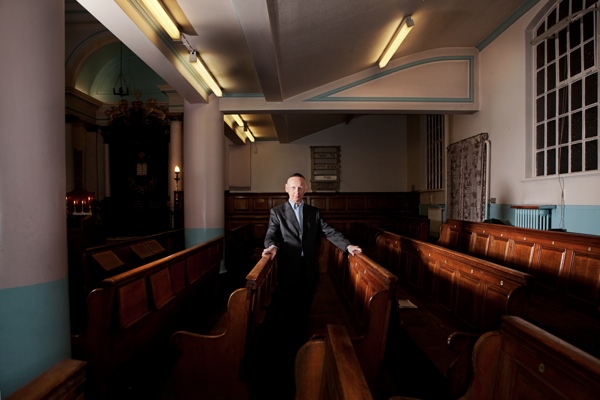

Photographs 2 & 3 © Mike Tsang
Spitalfields Life Contributing Photographer Mike Tsang is researching the Jewish East End, taking portraits and recording stories. If you would like to participate personally or by suggesting someone contact info@miketsangphotography.com
At the Halal Restaurant

It is just before midday at the Halal Restaurant, the East End’s oldest Indian restaurant, and Mahaboob Narangali braces himself for the daily rush of curry hounds that have been filling his dining room every lunchtime since 1939. On the corner of Alie St and St Mark’s Place, occupying a house at the end of an eighteenth century terrace, the Halal Restaurant has plain canteen-style decor and an unpretentious menu, yet most importantly it has a distinctive personality that is warm and welcoming.
For the City workers who come here between midday and three each day – nipping across the border into the East End – the Halal Restaurant is a place of retreat, and the long-serving staff are equally comfortable at this establishment that opens seven days a week for lunch and dinner but only get busy at lunchtime on weekdays. Stepping in by the modest side door of the Halal Restaurant, it is apparent that the small dining room to your right was the original front room of the old house while the larger room to your left is an extension added more recently. The atmosphere is domestic and peaceful, a haven from the nearby traffic thundering along Aldgate High St and down Leman St.
Even though midday was approaching, Mahaboob was happy to talk to me about his beloved restaurant and I was fascinated to listen, because I realised that what I was hearing was not simply the story of the Halal Restaurant but of the origin of all the curry restaurants for which the East End is celebrated today.
“Usman, my father, started working here in 1969. He came to Britain in the merchant navy and at first he worked in this restaurant, but then he became very friendly with the owner Mr Chandru and soon he was managing all three restaurants they had at that time. The other two were in Collum St in the City and in Ludgate Circus. Mr Chandru was the second owner, before that was Mr Jaffer who started the Halal Restaurant in 1939. Originally, this place was the mess of the hostel for Indian merchant seamen, with rooms up above. They cooked for themselves and then friends came round to eat, and it became a restaurant. At first it was just three kinds of curry – meat, meatball or mince curry. Then Vindaloos came along, that was more spicy – and now we sell more Vindaloos than any other dish. In the early nineties, Tandoori started to come in and that’s still popular.
My father worked hard and was very successful and, in 1981, he bought the restaurant from Mr Chandru. At twenty-one years old, I came to work here. It was just on and off at first because I was studying and my father didn’t want me to join the business, he wanted me to complete my studies and do something else, but I always had my eye on it. I thought, ‘Why should I work for someone else, when I could have this?’ And in 1988, I started running the restaurant. The leases of the other restaurants ran out, but we own the freehold here and I enjoy this work. I’ve only been here twenty-five years while many of our customers having been coming for forty years and one gentleman, Mr Maurice, he has been coming sixty-five years – since 1946! He told me he started coming here when was twelve.”
Intrigued to meet this curry enthusiast of sixty-five years standing, I said my farewells to the Halal Restaurant and walked over from Aldgate to Stepney to find Mr Maurice Courtnell of the Mansell St Garage in Cannon St Row. I discovered him underneath a car and he was a little curious of my mission at first, but once I mentioned the name of the Halal Restaurant he grew eager to speak to me, describing himself proudly as “a true East Ender from Limehouse, born within the sound of Bow Bells.” A little shy to reveal his age by confirming that he had been going to the Halal Restaurant for sixty-five year from the age of twelve, yet Maurice became unreservedly enthusiastic in his praise of this best-loved culinary insitution. “My father and my uncles, we all started going round there just after the Second World War.” he recalled with pleasure, “Without a doubt it is the best restaurant of any kind that I know – the place is A1, beautiful people and lovely food. I remember Mr Jaffer that started it, I remember holding Mahaboob in my arms when he was a new-born baby. Every Christmas we go round there for our Christmas party. It is the only restaurant I recommend, and I’ve fifteen restaurateurs as regular customers at my garage. When Leman St Police Station was open, all the police officers used to be in there. It is always always full.”
Held in the affections of East Enders and City Gents alike, the Halal Restaurant is an important landmark in our culinary history, still busy and still serving the same dishes to an enthusiastic clientele after more than seventy years. Of the renowned Halal Restaurant, it may truly be said, it is the daddy of all the curry restaurants in the East End.

Asab Miah, Head Chef at the Halal Restaurant, has been cooking for forty-two years. Originally at the Clifton Restaurant in Brick Lane, he has been at the Halal Restaurant for the last nineteen years.

Quayum, Moshahid Ali, Ayas Miah, Mahadoob Narangoli, Asab Miah and Sayed.

At 12:01pm, the first City gent of the day arrives for curry at the Halal Restaurant.

Abdul Wahab, Mohammed Muayeed Khan and J.A. Masum.

At 12:02pm, the second City gent of the day arrives for curry at the Halal Restaurant.

Maurice Courtnell, owner of the Mansell St Garage and the Halal Restaurant’s biggest advocate, has been going round for curry for sixty-five years. – “The place is A1, beautiful people and lovely food. I remember Mr Jaffer that started it, I remember holding Mahaboob in my arms when he was a new-born baby.”

Mahaboob Narangoli, owner of the East End’s oldest Indian restaurant.
Dioramas of Spitalfields at The Bell

As soon as Glyn Roberts, landlord of The Bell in Petticoat Lane, wrote to say he had discovered some neglected old models of Spitalfields in the cellar, I hurried over to take a look. Once upon a time, these beautiful dioramas enjoyed pride of place in the barroom but when Glyn bought the pub three years ago they had been consigned to oblivion.
Although hefty and dusty and in need of a little repair, nevertheless these models are skilfully made and full of intriguing detail, and deserve to be seen. And Glyn wishes to give them to a new home, yet he cannot find a museum or public collection that will accept them, so he asked me to pass the word around in case anyone knows of somewhere that can take the Spitalfields dioramas.
I am always curious to learn more of this corner of Spitalfields closest to the City that gives up its history less readily than some other parts, but where the market dates from the twelfth century – much older than that on the northern side of the parish which was not granted its charter until the seventeenth century. The Bell, topped off by a grotesque brick relief of a bell with a human face and newly adorned with panels of six thousand bottle tops made by Robson Cezar, King of the Bottletops, has always fascinated me. Once the only pub in Petticoat Lane, it can be dated back to 1842 and may be much earlier since a Black Bell Alley stood upon this site in the eighteenth century.
In the cellar of The Bell, Glyn dragged the dioramas out for me to examine, one by one, starting with the largest. There are four models – three square boxes and one long box, depicting Petticoat Lane Market and The Bell around a hundred years ago. In the market diorama, stalls line up along Middlesex St selling books and rolls of cloth and provisions, while a priest and a policemen lecture a group of children outside the pub. In total, more than thirty individually modelled and painted clay figures are strategically arranged to convey the human drama of the market. By contrast, the square boxes are less panoramic in ambition, one portrays the barroom of The Bell, one the cellar of The Bell and another shows a drayman with his wagon outside the Truman Brewery in Brick Lane, with a steam train crossing the railway bridge in the background.
A discreet plate on each diorama reveals the maker as Howard Kerslake’s model studio of Southend, a professional model maker’s pedigree that explains the sophisticated false perspectives and clever details such as the elaborate lamp outside The Bell – and the stuffed fish, the jar of pickled onions and the lettered mirror in the barroom – and the easy accomplishment of ambitious subjects such as the drayman’s cart with two horses in Brick Lane.
So here they are, four Spitalfields dioramas for your delight! Who can give them a home?


Click this picture to enlarge the diorama of Petticoat Lane

At the Truman Brewery Brick Lane, looking north.


The barroom of The Bell


The cellar of The Bell.


Glyn Roberts, landlord of The Bell.


The Bell in the 1930s.

You may like to read these other Petticoat Lane stories
Dennis Anthony’s Photographs of Petticoat Lane
Laurie Allen of Petticoat Lane
Irene & Ivan Kingsley, Market Traders of Petticoat Lane
and see Robson Cezar’s bottle top pictures on the exterior of The Bell.
Dan Jones at Bethnal Green Library

Click to enlarge Dan Jones’ painting of St Paul’s School Wellclose Sq, 1977
Last week, Dan Jones‘ splendid mural from 1977 of children and their rhymes in the playground of St Paul’s School Wellclose Sq was installed at the Bethnal Green Children’s Library, so Spitalfields Life Contributing Photographer Chris Kelly and I went along to join the celebrations.
The Children’s Library is on your right as you enter the building and from the lobby you can see the huge colourful painting at the far end of a long room with windows facing onto the Green. Once I reached this point, I could already hear “The wheels on the bus go round and round…” sung by an enthusiastic chorus of toddlers and their mothers led by librarian Jusnara Khanam as the beginning of a day’s festivities that involved children of all different ages coming in to the library to see Dan’s painting and enjoy some lively rhymes, songs and games.
“In 1970, I was a youth worker and I ran a youth club in the hall on the right of the painting. I used to have two hundred kids dancing in there!” recalled Dan fondly, “And so most of the children in the school were known to me.” Living close by in Cable St, Dan, who began collecting rhymes in 1947, has followed the shifting currents of playground culture over all this time. “Some of these rhymes in the painting are still to be heard in the playground there,” he told me, “But others they don’t do anymore, or only sporadically.”
A local plasterer coated three boards with a fine coat of plaster to give a smooth finish for Dan to paint on and, inspired by Bruegel’s “Children’s Games,” Dan set to work upon the dining table in his front room, painting individual portraits of the children with their rhymes inscribed alongside. It took over a year’s work and Dan framed the life of the playground with the architecture of the school, including its weathervane in the shape of tall ship and Tower Bridge looming on the horizon – all portrayed beneath a distinctively occluded London sky. And now that most schools wear primary coloured shirts, it is fascinating to observe the wide variety of characterful clothing – reflecting the styles of the time – displayed by these children.
Astonishingly, the painting caused great controversy when it was first displayed, with the Daily Telegraph accusing Dan Jones of turning East End youth against the police force, because he included the rhyme – “There’s a cop, cop, copper on the corner, all dressed up in navy blue. If it wasn’t for the law, I would sock him on the jaw. And he wouldn’t be a copper any more, more, more…” A rhyme which Dan had simply recorded along with all the others in the playground.
At first, the mural graced the London’s Children’s Centre and in recent years it filled the narrow hallway of Dan’s house, but in its new home in the Children’s Library it fits perfectly, as if it had been painted for this space. Dan’s picture hangs above the library corner, where children can play or sit on the floor and read books, casting a benign spell upon this favoured spot. And it was a beautiful spectacle to observe life imitating art as Dan led the children in reciting rhymes and singing games in front of his painting crowded with these same activities. “I haven’t done enough recording of four years olds,” Dan confided to me, ever eager to expand his vast archive of thousands of rhymes he has recorded here and around the world – some of which he played for my amusement as snatches on a CD during the lunch break. Then older children arrived from Columbia School and Bangabandhu School, and it was time to go outside for more boisterous activities on the Green, enacting the life of Dan’s painting in the spring sunshine.
More than thirty years have passed since Dan made his picture – the first of several on this subject and at this scale he has done in subsequent years – yet the delighted responses of the children at Bethnal Green Library revealed that it remains as fresh and immediate as the day he completed it in 1977.

Breuegel’s “Children’s Games,” 1560 – Dan’s inspiration.


Dan added his self-portrait recently.

Dan Jones with his grandson Rumi
Photographs copyright © Chris Kelly
You may also like to take a look at
Chris Kelly & Dan Jones in the Playground
Charles Goss’ Bishopsgate Photographs

West side of Bishopsgate Without, looking north with St Leonard’s Shoreditch in the distance
One hundred years ago, when the City elected to widen Bishopsgate – the ancient meandering thoroughfare lined with straggling buildings that followed the route of Ermine St, the Roman road north from London – Charles Goss, the first Archivist at the Bishopsgate Institute was inspired to get up early in the morning and photograph the streetscapes that were shortly to vanish from the world. Working systematically, he took this set of interconnecting pictures that record the shabby old frontages at the northern end of Bishopsgate where it meets to liberty of Norton Folgate, concentrating on the west side of the street where the Broadgate Tower designed by Skidmore Owings and Merrill stands now.
There is an ethereal quality to many of Goss’ photographs taken in the grey light of dawn, with just a few early birds on their way to work and no traffic at all on the road yet. These are quiet pictures in which silence is only interrupted by the echo of footsteps. Hoardings upon Lupinsky & Brandon, the progressive tailors – suits to measure at 137 Bishopsgate – announce the impending destruction, “These premises have been acquired by the City Corporation for the widening of Bishopsgate Street.” Fortunately, business was transferring to 80 Bishopsgate directly across the road. You will observe that many businesses had already held clearance sales and vacated their shops, but the Great Eastern Rubber Company, the Dump Shop and the Norton Folgate Toilet Club were valiantly trading on to the bitter end.
Like Henry Dixon’s images taken for the Society for Photographing the Relics of Old London that recorded ancient buildings about to be demolished in the 1880s, Charles Goss’ pictures belong to the compelling yet melancholic school of photography which illustrates the history of loss. I can readily imagine Charles Goss getting up and leaving the house in the dark with his camera and tripod, and setting up on the pavement in Bishopsgate in the early morning drizzle, attracting curious looks from passersby and questioning himself even as he went about his business. Sensibly, he reconciled any doubt, bound the pictures into a fine book with a red leather spine and put it on the shelf at the Bishopsgate Institute, reassuring himself that he was just doing his job.
Yet behind these pictures lies an unfathomable poetry that engages with the sheer strangeness of the performance of human life – rendered tangible only in the moment when the scenery is about to be abandoned and the familiar reality of the street begins to dissolve, just like an abandoned set on the back lot of a film studio. I can only wonder what Charles Goss would make of Bishopsgate today where just a few remnants of his time exist, entirely overshadowed by the vast disproportionate recent structures resembling illustrations to a futuristic novel by H.G.Wells.

In Acorn St

West side of Bishopsgate.

Entrance to Acorn St.

Bishopsgate Without, West side.

10,000 choice cigars were sold here at less than half price.

The Great Eastern Rubber Company, Mosley’s Rubber Goods stocked here.

B.A. Marcus, Lilley & Skinner, The Lord Nelson and Devon Restaurant.

The Middleton Arms for Celebrated Welch Ale.

Lupinsky & Brandon, progressive tailors.

Spy the roofer upon the ridge above G.Ringrose.

Observe The Dump Shop and the Norton Folgate Toilet Club.

The early morning sun casts its shadow over Norton Folgate a century ago.

Bishopsgate Without viewed from Norton Folgate, 1912

Bishopsgate Without viewed from Norton Folgate, 2012
Archive pictures courtesy © Bishopsgate Institute
You may also like to look at
At City Art & Framing

Clive & Ken Woolhouse
If you should find yourself walking bent-double against the ferocious blast which howls down Artillery Lane at this time of year, you can always take refuge inside in the fine old nineteenth century warehouse that houses the gallery and workshops of City Art & Framing at number thirteen. Directly on the right of the door, shielded from draughts, you will very likely discover the Woolhouse family, Ken and Joyce with their son Clive, the picture of domestic contentment as they huddle together round the cosy fireplace where their beloved German sheepdog enjoys the warmest spot.
“My dad started the business in 1989, and years later he granted me the opportunity to take it over which gave him the chance to take some time off,” explained Clive with a significant nod to his father as he made the introductions, while pulling up another chair and inviting me to join them behind the counter and warm myself at their fireside
“I used to run a shop called New Sound, selling Bang & Olufsen electronics at 228 Bishopsgate,” continued Ken, “but when the company insisted I refurbish my shop and I didn’t have the money, I didn’t know what to do. I was looking out the window one day and a van went by with “Picture Framing” on the side, so I signed up for a week’s course and that was it. I just put a picture frame in the window and people started coming in. The workshop was upstairs on the first floor but you had to go out of the door to reach the stairs to get there, so I cut a hole in the ceiling and ran up and down a ladder every time a customer came in. Eventually, we outgrew the shop and this place came up. It had been the “London Yacht Space” where I once used to come buy things for my sailing boat.”
Joyce smiled benevolently throughout, as her husband retold the oft-rehearsed tale and I could not but notice the close resemblance between father and son, emphasised by their similar beards with Clive’s being a version of his father’s. “I always wanted to work with my dad and give him some time off.” revealed Clive,“I joined him at twenty-four and I framed the pictures so that he could work three days a week.”
“And I used to serve behind the counter and help with the accounts,” added Joyce, just to complete the portrait of this family endeavour. “I never had a day off since since 1984, until Clive came to help me,” confessed Ken, in disbelief at his former self. “Before this, I had a shop in Upminster. I heard there was this place in Bishopsgate selling off some electronics but when I came up here, I liked it so much I bought the shop.” he informed me, “I was there through two IRA bombs.” This last comment was followed by a collective silence, broken only when Clive launched into the next episode in the family narrative.
“It was on a Saturday morning and I was in the cellar when it went off – “bang,” and that was it.” he said, widening his eyes for effect,“I came upstairs and because our window was flexible, it did not break. But when I went outside, there were pieces of glass hanging out of windows and all the blinds were flying about and there was paper everywhere and the streets were full of glass.”
“We heard it on the radio and we drove up to see if he was safe. It was very scary.” interposed Joyce, revisiting her fearful emotions,“When we got here, the police wouldn’t let us through the barrier, but we said, ‘We’ve got to see our son.’ Once we arrived, I saw him through the window and he was alright, and I cried with relief.” Joyce’s face crumpled into an apologetic smile at this admission, as Ken and Clive exchanged a glance of affectionate recognition.
To move our conversation forward – once the moment had been duly observed – I asked Joyce if she was an East Ender. A question which delighted her. “My maiden name was Cladingboel, a Huguenot name.” she informed me proudly, “I was born in Hoxton Sq, but we got bombed out so my dad found us a house in Hornchurch. It was right next to the aerodrome and I could watch the planes come in.”
“My mum was born in Hoxton too and moved out to Edmonton, and my wife and I met through working in a factory in Romford.” confided Ken enthusiastically, expressing pleasure at their shared history. It was a theme that he expanded further with his next statement, as if to suggest that there were some greater plan to the workings of the metropolis which was beyond the comprehension of its inhabitants, yet might be glimpsed occasionally. “During the war, my mum used to be a conductor on a trolley bus on the route which is now the 149 that stops right outside my shop in Bishopsgate.” he said. The Woolhouse family nodded in shared satisfaction, as if to agree that this present circumstance at City Art & Framing, sitting peacefully with the German sheepdog by the fire, was the ideal outcome of events prior to that moment, both recent and historical.

Clive and his father Ken, thirty years ago.

Ken Woolhouse who started the business in 1989.

Clive Woolhouse runs the business today.

The original premises at 228 Bishopsgate.

The Woolhouse family in Artillery Lane.
City Art & Framing, 13 Artillery Lane, London, E1 7LP 020 7247 2320
Bishopsgate photograph courtesy Bishopsgate Institute
You may also like to read about
Charles Jones, Gardener & Photographer

Garden scene with photographer’s cloth backdrop c.1900
These beautiful photographs are all that exist to speak of the life of Charles Jones. Very little is known of the events and tenor of his existence, and even the survival of these pictures was left to chance, but now they ensure him posthumous status as one of the great plant photographers. When he died in Lincolnshire in 1959, aged 92, without claiming his pension for many years and in a house without running water or electricity, almost no-one was aware that he was a photographer. And he would be completely forgotten now, if not for the fortuitous discovery made twenty-two years later at Bermondsey Market, of a box of hundreds of his golden-toned gelatin silver prints made from glass plate negatives.
Born in 1866 in Wolverhampton, Jones was an exceptionally gifted professional gardener who worked upon several private estates, most notably Ote Hall near Burgess Hill in Sussex, where his talent received the attention of The Gardener’s Chronicle of 20th September 1905.
“The present gardener, Charles Jones, has had a large share in the modelling of the gardens as they now appear, for on all sides can be seen evidence of his work in the making of flowerbeds and borders and in the planting of fruit trees. Mr Jones is quite an enthusiastic fruit grower and his delight in his well-trained trees was readily apparent…. The lack of extensive glasshouses is no deterrent to Mr Jones in producing supplies of choice fruit and flowers… By the help of wind screens, he has converted warm nooks into suitable places for the growing of tender subjects and with the aid of a few unheated frames produces a goodly supply. Thus is the resourcefulness of the ingenious gardener who has not an unlimited supply of the best appurtenances seen.”
The mystery is how Jones produced such a huge body of photography and developed his distinctive aesthetic in complete isolation. The quality of the prints and notation suggests that he regarded himself as a serious photographer although there is no evidence that he ever published or exhibited his work. A sole advert in Popular Gardening exists offering to photograph people’s gardens for half a crown, suggesting wider ambitions, yet whether anyone took him up on the offer we do not know. Jones’ grandchildren recall that, in old age, he used his own glass plates as cloches to protect his seedlings against frost – which may explain why no negatives have survived.
There is a spare quality and an uncluttered aesthetic in Jones’ images that permits them to appear contemporary a hundred years after they were taken, while the intense focus upon the minutiae of these specimens reveals both Jones’ close knowledge of his own produce and his pride as a gardener in recording his creations. Charles Jones’ sensibility, delighting in the bounty of nature and the beauty of plant forms, and fascinated with variance in growth, is one that any gardener or cook will appreciate.

Swede Green Top

Bean Runner

Stokesia Cyanea

Turnip Green Globe

Bean Longpod

Potato Midlothian Early

Pea Rival

Onion Brown Globe

Cucumber Ridge

Mangold Yellow Globe

Bean (Dwarf) Ne Plus Ultra

Mangold Red Tankard

Seedpods on the head of a Standard Rose

Ornamental Gourd

Bean Runner

Apple Gateshead Codlin

Captain Hayward

Larry’s Perfection

Pear Beurré Diel
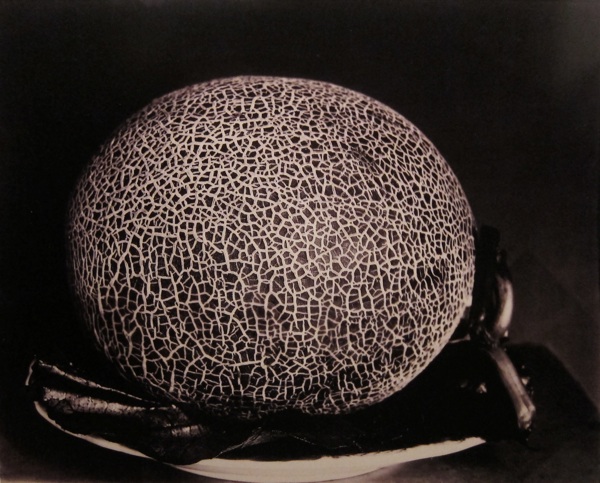
Melon Sutton’s Superlative

Mangold Green Top

Charles Harry Jones (1866-1959) c. 1904
The Plant Kingdom of Charles Jones by Sean Sexton & Robert Flynn Johnson available here
You might also like to read about
The Secret Gardens of Spitalfields
Thomas Fairchild, Gardener of Hoxton
Buying Vegetables for Leila’s Shop


