
Pearly Portraits
Photographer James Pearson-Howes did these beautiful portraits of the Pearly King & Queens and Novelist Sarah Winman, author of “When God Was a Rabbit” went along to meet the Pearlies on behalf of Spitalfields Life.
“Saturday morning in Covent Garden and low grey cloud deposits rain in torrents upon streets still warm from a previous day’s sun. I stand under cover, a little cold now, and waiting – waiting for the first sight of my storytellers, to hear tales of charitable lives, and to hear about a way of life that was born in 1875 in the heart of a thirteen year old orphan boy called Henry Croft. But the rain thumps down and the crowds thin and even a performer’s rendition of ‘Danny Boy’ cannot warm our disappointed spirits. But just as I turn to go, just when I think that the weather has won, as if on cue those swollen clouds retreat and a sunburst falls upon the square catching the glorious sway of twenty thousand pearl buttons in its golden light, in a moment, dare I say it, bordering the divine.” – Sarah Winman

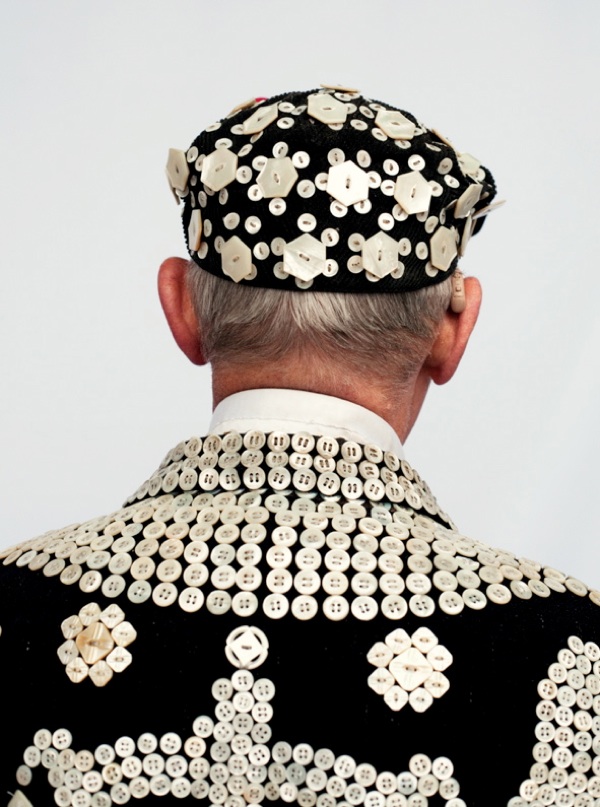
Arthur Rackley, Pearly King of Upminster
I’ve been a Pearly for thirty-two and a half years. My sister-in law Marie was born a Pearly Princess and she married my brother Jim in 1970. All three of us lived together, and when my brother died in 1980, she turned to me and said, “I’ve lost my Pearly King.” I said, “Never mind, I’ll carry on where he left off,” and for the next seven years I had a Pearly apprenticeship.
She was a Victorian lady. If she said, “Stand still,” she meant “Stand Still.” It was a regimental beginning, but a good beginning. I listened to the older members in those early days, learnt to build a story. By the time Marie passed away in 1987, she had given me a very good start.
I’ve always been with charity-minded people. My mother was a good neighbour and wherever she was wanted, she would go. My family gave me a good grounding and that’s what it’s all about. My father was a very busy man – a motor fitter from 1920-1930. I never saw a lot of him, but everyone spoke highly of him. At dinner time we’d sit down and they’d be plenty of cross-chat as we learnt what one another of us was doing. Today, children don’t get that sort of grounding. No one knows what their children are up to.
You haven’t asked me my age. Well, I’m eighty-seven, so obviously I’ve had a lot of life experience, and whenever I can pass that on, I do. I’m very proud to have met most of the royal family. My sister-in-law used to go and visit the Queen Mum, and once she took her niece’s baby with her. The Queen Mum gave the baby a biscuit and it got crumbs everywhere. The Queen Mum said, “Never mind, I’ve got a couple of hoovers here,” pointing to the dogs.
I’ve got a good memory and I like to be on my own and think back over my life. I am very busy. What am I doing now? Making a magazine rack for a friend.
I am known not only as a Pearly King, but known as someone who would help anyone.
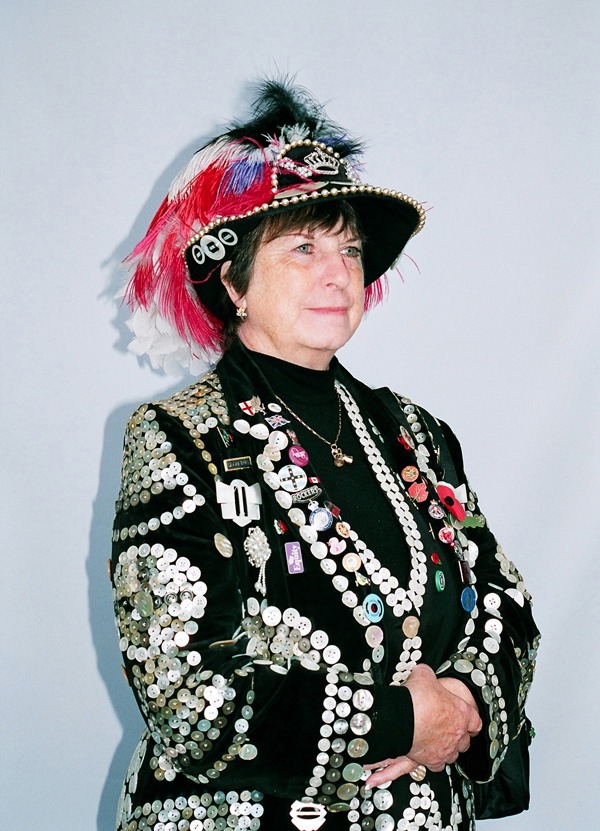

Carole Jolly, Pearly Queen of Crystal Palace and Freeman of the City of London
I was elected to be a Pearly Queen thirty-five years ago. It means so much to me. It’s about the helping, the doing good : making a difference. It takes up a lot of time, but I’m delegating a lot more now – especially with the Jubilee year. We’re asked to go everywhere really: old people’s homes, hospices, schools – we talk about the Pearly history and traditions, or sing a lot of old London songs. Those songs bring smiles and flickers of memory back to people with dementia or Alzheimer’s, and that means so much.
My proudest moment was in the old days, when we were in the ‘Association’. They used to put on a charity ball and we had quite a run of royalty attend. At one we had Princess Alice, she was a lovely royal and I had the honour of looking after her. I presented her with a carved plaque of her husband and she was thrilled, had tears in her eyes.
This is my life, my entertainment. This is my family.

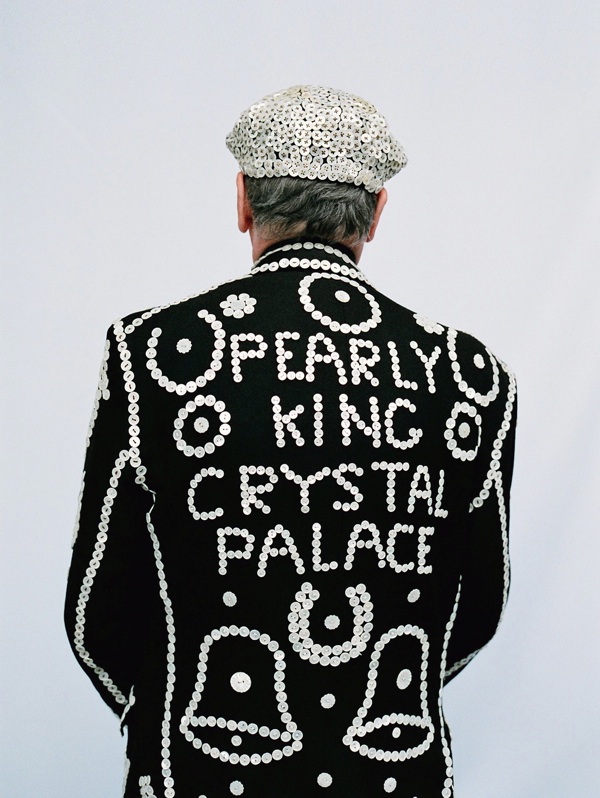
Patrick Jolly, Pearly King of Crystal Palace and Freeman of the City of London.
I was elected forty years ago in 1972. I used to run a judo club for kids where I met Fred Hitchin who was the Pearly King of Westminster. He took an interest in what I was doing. The club was struggling through lack of funds but over two years we started to go from strength to strength, and our club was chosen to represent Lewisham by the Mayor. Fred then asked me to become a Pearly King. I said, “No! You won’t get me walking around like that!” Two years of persistence and I put up me hands up.
I haven’t looked back. It’s been amazing. It means everything to me. I’ve achieved things I thought I’d never achieve. I’ve met and helped so many people.One of my proudest moments was in the eighties, we put on a Charity Ball at Chelsea Town Hall and Princess Anne attended. It was great. And then in the nineties, I met her again. I was at St James’s Palace with my eldest grand-daughter Stephanie. Princess Anne came down the line and was introduced to my grand-daughter and then she looked at me and said, “I believe we’ve met before. Chelsea.” I thought, “She remembered me!” It gave me such a buzz.
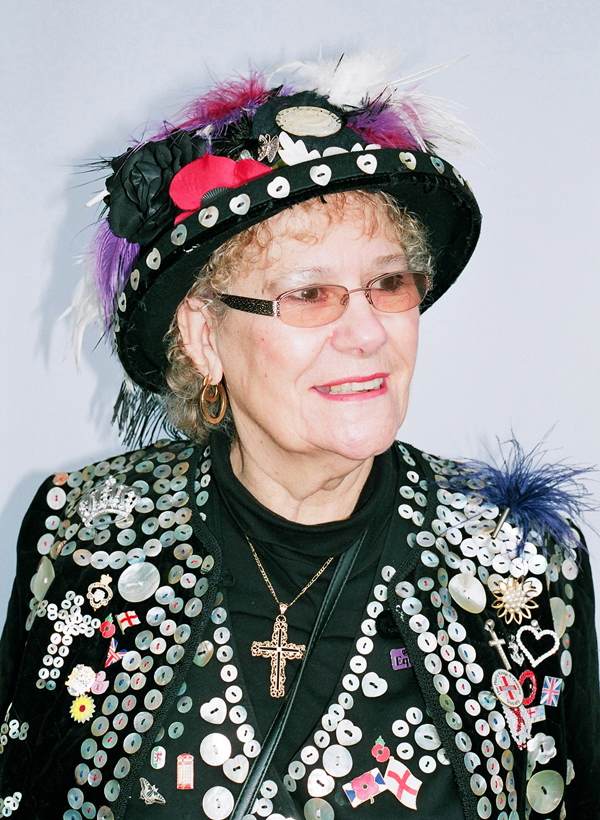
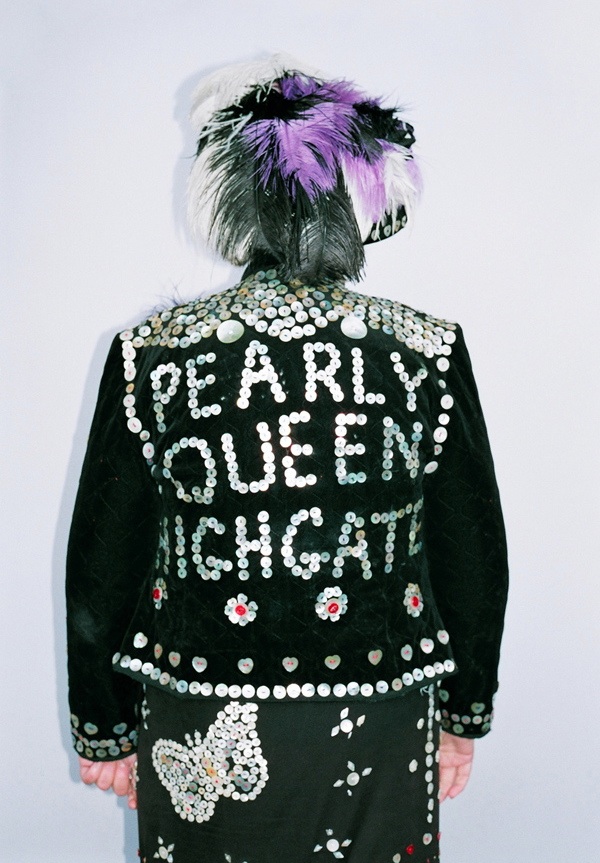
Peggy Scott, Pearly Queen of Highgate
I was elected to be a Pearly Queen five or six years ago, but I’d been doing voluntary work and charity work for thirty odd years previous. My motto is that you’ve got to give and take in this world, and always listen to someone – they’re often worse off than you and everyone’s got a tale to tell. I love life in general. I’m as nutty as a fruitcake, but if I can make one person smile a day, then I’m happy. It’s not the status of being a Pearly, I just love helping people. I’m a people’s people. You got buttons on, so what? If I had a tracksuit on I’d still be doing the same thing. I’ve got grandchildren and great-grandchildren and I’m proud of them all, and they are coming up in the world doing the same thing, and I’m bringing them up with the same ideals. Today people are too frightened. Too frightened to stop and talk. Too frightened to listen. Most people just want someone to talk to, that’s what I’ve found when I’ve been collecting.
It’s important that the East End traditions are kept alive. Our heritage and our values must not be forgotten. We’ve always looked after one another, family and friends, we’ve been brought up that way. I’m cut from nothing, but my mum was always there. She was a darling. I think she’s got wings on…
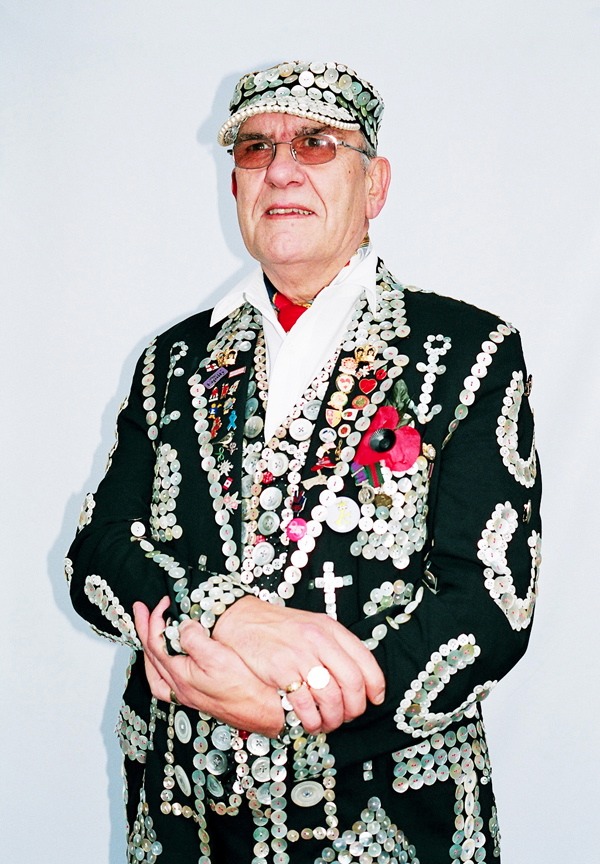
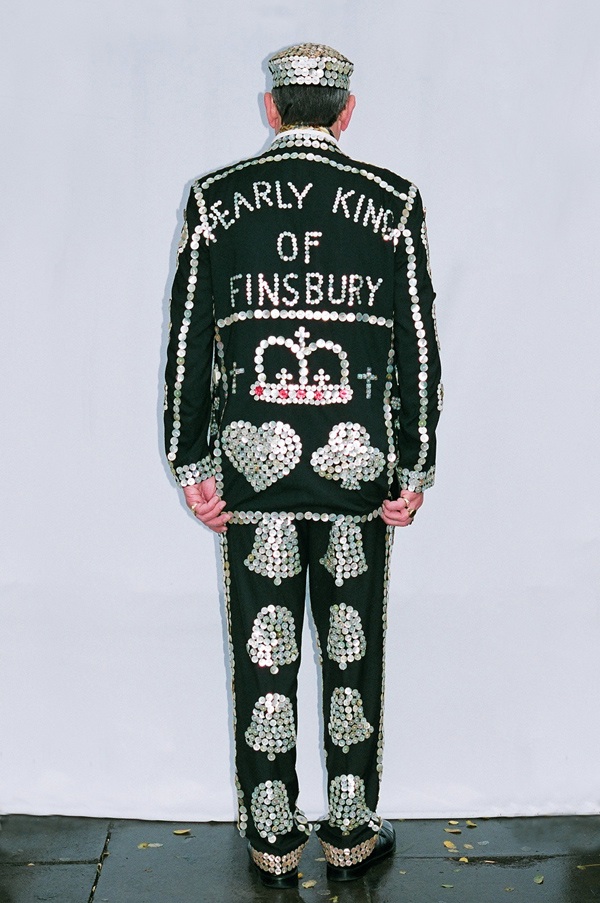
John Walters, Pearly King of Finsbury
I have been a Pearly King for about seven years now. My wife’s family were Pearly Kings and Queens in the Victorian times – they were Costermongers in Charlton Street Market, and her Nan was one of the old flower sellers of London. They had a shop called Cooper and Sons. My wife didn’t take up being a Pearly, but she encouraged me to do it. I used to sing in pubs and clubs years ago, but I gave it up because it got pretty rough back then and I thought I was a lover not a fighter.
It was then that the Pearly King of Smithfield said to me, “Why don’t you transfer your skills to the Pearly Kings and Queens?” So I did, and I never looked back.For about twenty-five years beforehand I had done charity work. Did a lot for Great Ormond Street and for the Anthony Nolan Appeal. I love doing things for children. A child being born today could be the answer to our prayers tomorrow. I work for the council and we did something for the Children’s Cancer Unit at St Bart’s Hospital. We walked from Archway to St Bart’s collecting money on the way. One of my most humbling moments was when we took that money on to the children’s ward and saw all those children happy and smiling, despite all they were going through.
Being a Pearly, well, it’s a tradition – a great London tradition. You’re representing your Borough, not just London, and the other Pearly Kings and Queens. You must behave as expected, give people time, treat people with respect. If you cut a Pearly’s heart in half it should have CHARITY written through it like a stick of Brighton Rock.

Larry Barnes ( May 16th 1926 – July 2nd 2011), late Pearly King of Thornton Heath and one of Variety Theatre’s last specialist acts.
Carole Jolly on Larry Barnes – “Larry was such a great character, a great entertainer. He came and did a job at a school fun day with Pat and me, and I’ll never forget it. Pat was asked to abseil down from the school roof. They hadn’t allowed for the weight of the buttons, and next thing we know, Pat’s hanging upside down and screaming, swinging around! He never did it again. Larry was also a magician and escapologist. He used to do an act called “Beat the Bomb”. Basically he had to escape from chains before the bomb exploded. I was on the timer. He only ever just made it. He was very knowledgeable. We loved his pipe. We miss him dearly.”
Pat Jolly on Larry Barnes – “I knew Larry in the 1960’s. I worked in Soho in a club and he’d pop in for a Guinness after a show. We lost contact for a bit, and then met up at a Pearly event with Roy Hudd. I asked Larry to be my ‘Pearly Pride’ – that’s a helper. Then he became a Pearly Consort, and then finally he became Pearly King of Thornton Heath. He was one of the few people who knew me, understood me. He always found the time to sit down and listen. Even in the darkest moments. We were life-long friends till the day he died.”
Arthur Rackley on Larry Barnes – “I often collected with Larry in Covent Garden. If it was cold, Larry would start up a song, and we’d both sing and move our feet to keep warm. He taught me this song two weeks before he died: (Tune of My Old Man) “My old man said nick what you can, And don’t get nobbled by the law. I copped a purse with a fiver in it, He said, “Good work, love, I’ll see you in a minute.” He grabbed some pyjamas, a crate of bananas, a dining set of polished chrome. I heard him holler when the Law felt his collar, So he won’t be coming home.”
Photographs copyright © James Pearson-Howes
Some of these Pearly Portraits are included in James Pearson-Howes’ new book British Folk II which can be obtained for just £10 including shipping by clicking here
Learn more about the Pearlies at the London Pearly Kings & Queens Sociey website www.pearlysociety.co.uk
Read my account of the Pearly Kings & Queens’ Harvest Festival
More of Tom & Jerry’s Life in London
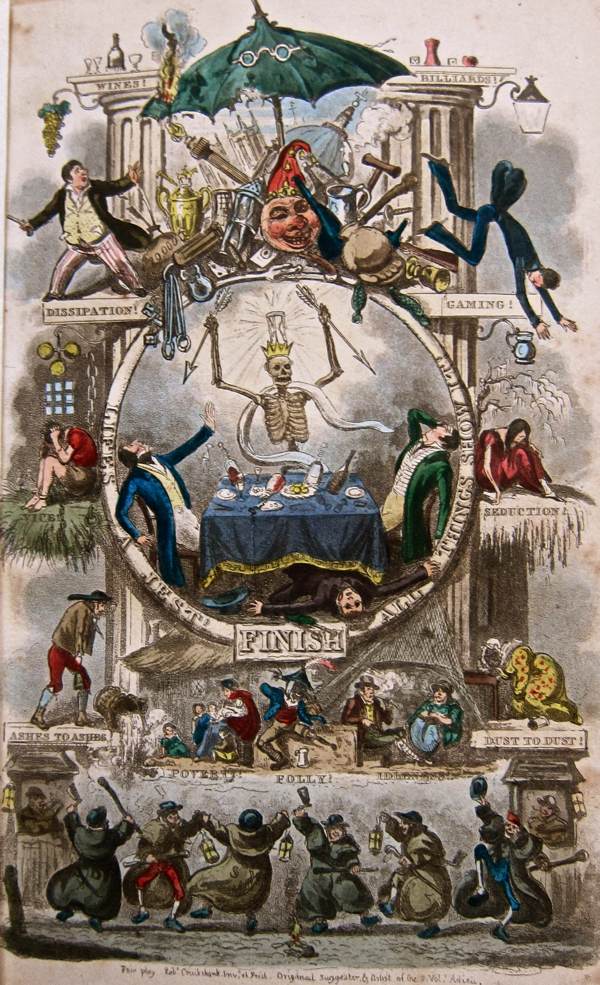
Last week, I introduced you to Tom & Jerry and their “Life in London” of 1821 and this week – thanks to a second volume, “The Finish to the Adventures of Tom, Jerry & Logic” published in 1830 – I am able to show more escapades concluding their urban existence. Derived from the real-life adventures of George Cruikshank and his brother Richard, in league with the writer Pierce Egan, the first book had been a sensational success, producing multiple stage versions and innumerable imitations. As Egan put it, “We have been pirated, COPIED, traduced, but, unfortunately, not ENRICHED.”
As before, Tom (the urbanite), Jerry (the out-of-towner) and Logic (their senior academic pal) enjoy the life of men about town, discovering all that London has to offer, losing their trousers at the brothel, getting chased by a kangaroo at the zoo and exploring the subterranean magnificence of tunnels under the Thames – among many other colourful adventures. The stories are unprecedented for their closely observed accounts of the social life of the poor and, as in the first volume, a visit to the East End is a highlight of the narrative.
Our protagonists set out to visit Half Moon Tap, a public house celebrated for the boxers that gather there, reflecting Pierce Egan’s knowledge of the culture of boxing in the capital as the pre-eminent boxing writer of his day, reporting not merely on the sport itself but writing elaborate portraits of leading boxers. Egan was editor of “Boxiana, or Sketches of Ancient and Modern Pugilism” from 1812 until 1824, and his evocative description of the clientele at the Half Moon Tap (pictured below) speaks of first hand observation – “The wit of the stage, produced by numerous dragsmen taking their morning whets, frequently creates roars of laughter, the slang remarks of the commoners in tossing off their drams, and inquiries of the swells after the movements in the Sporting World, over their glasses of sherry make the thing not only complete, but a fine picture of real life in a peculiar point of view.”
In spite of the success, Egan chose to bring Tom & Jerry, and Logic’s adventures to a close, killing off Tom and Logic with unsentimental glee, yet permitting Jerry to return to the country and enjoy married life there – “Jerry was the picture of contentment, determined to profit by his experience, and to turn to a good account, for the benefit of himself and his family, the many hair-breadth escapes and dangerous adventures he had met with in his DAY & NIGHT SCENES of his LIFE IN LONDON.” We can only all hope that the same may be said one day of our own experiences of life in the capital.
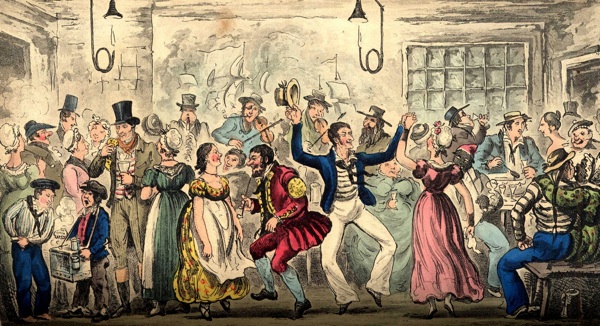
Life in the East. At the Half Moon Tap – Tom, Jerry & Logic called to the bar by the Benchers. The John Bull Fighter exhibiting his cups and ‘the uncommonly big Gentleman’ highly amused by the originality of the surrounding group.
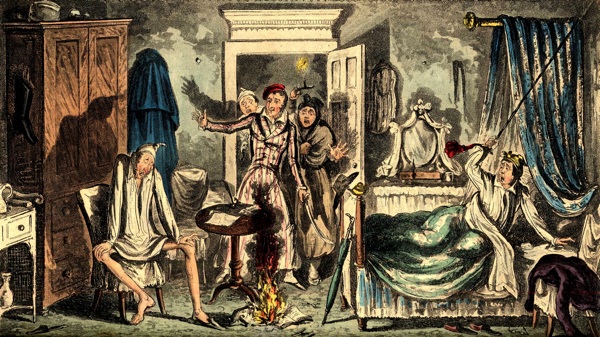
The Mistakes of a Night. The Hotel in an Uproar. Tom, sword in hand backed by a Petticoat – “False Alarm!” but no Ghost.
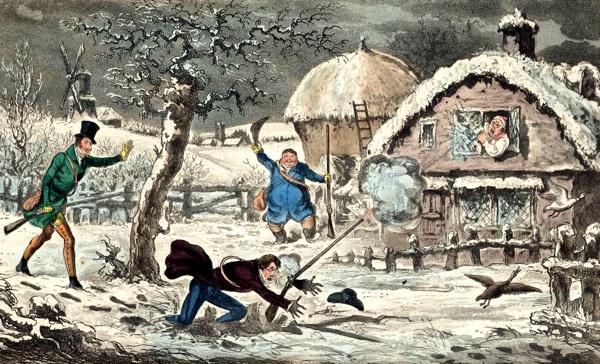
Logic’s slippery state of Affairs. A Random Hit! and the Upper Works of Old Thatchpate not insured. And the fat Knight enjoying the Scene laughing, like Fun, at Logic’s disaster.
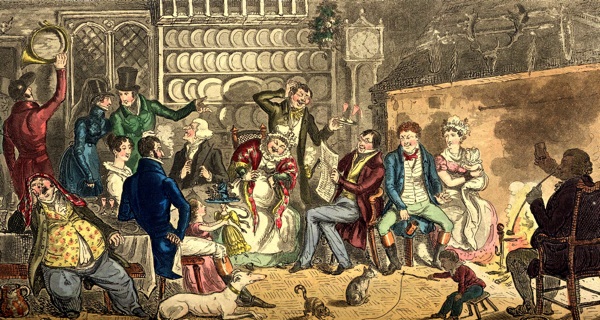
Hawthorn Hall. Jerry at Home: the Enjoyments of a comfortable fireside. Logic all Happiness. Corinthian Tom at his Ease. The Old Folks in their Glory, and the ‘uncommonly big Gentleman’ taking forty winks.
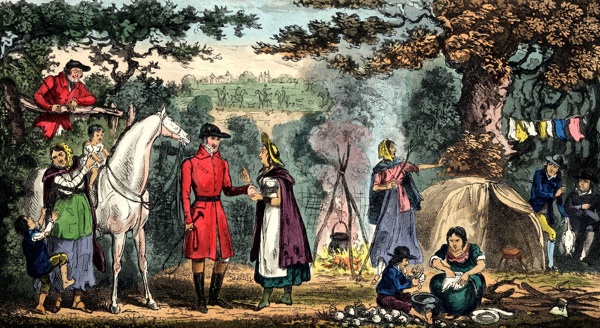
The Hounds at a Standstill. Jerry enticed by the pretty Gipsy Girl to have his fortune told.
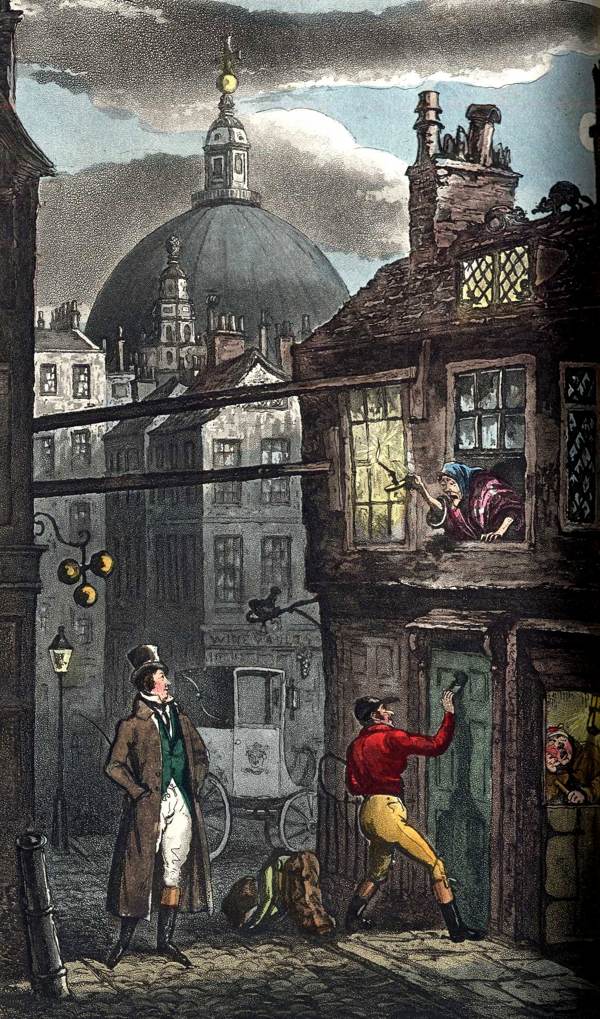
Logic’s Upper Storey but no Premises. Jerry’s Return to the Metropolis.
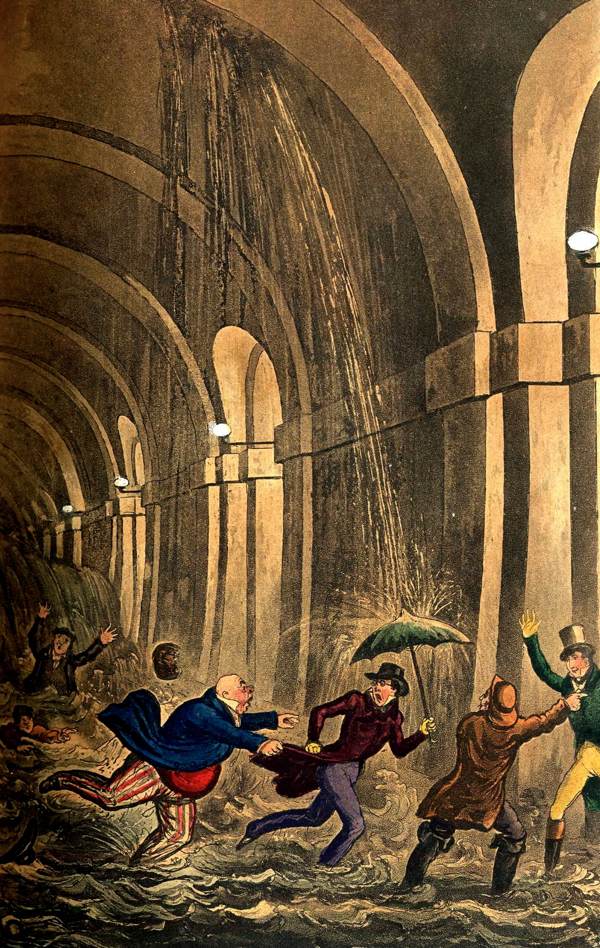
Strong Symptoms of Water on the Brain in the Floating Capital.
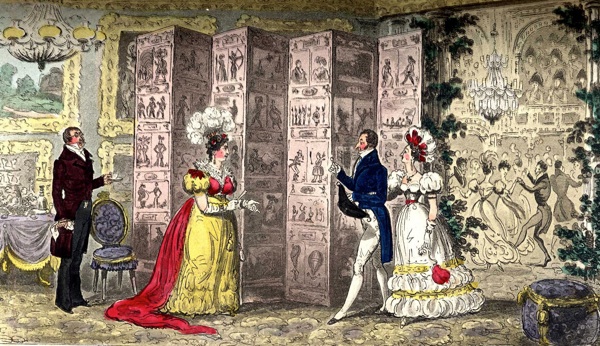
The Duchess of Do-Good’s Screen, an attractive subject to Tom & Jerry
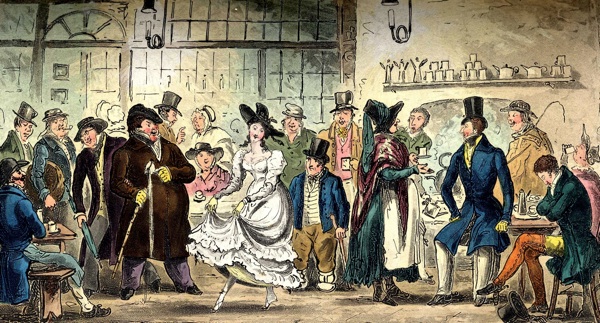
How to Finish a Night, to be Up and dressed in the Morning. Tom awake, Jerry caught napping and Logic on the go.
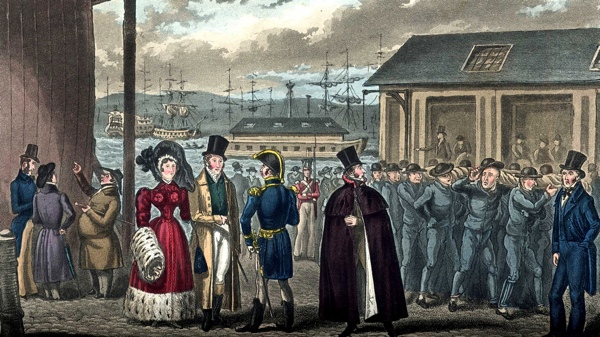
Splendid Jem, once a dashing Hero in the Metropolis, recognised by Tom amongst the Convicts in the Dockyard at Chatham.
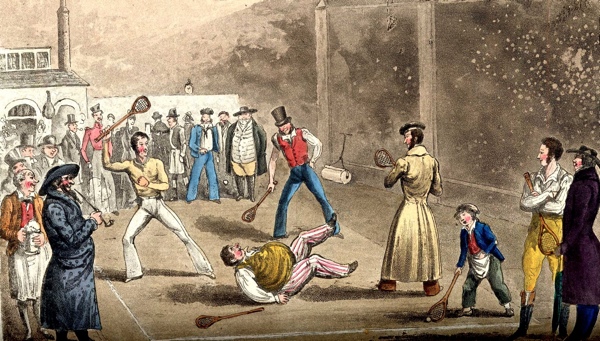
Logic visiting his old Acquaintances on board the Fleet, accompanied by Tom & Jerry to play a Match at Rackets with Sir John Blubber.
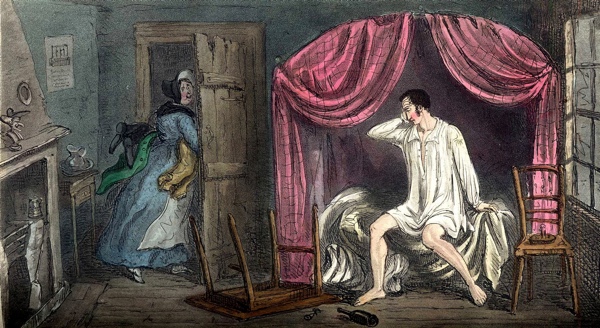
Jerry up, but not dressed! A miserable Brothel, his Pal bolted with the Togs. One of those unfortunate Dilemmas connected with Life in London, arising from the Effects of Inebriety.
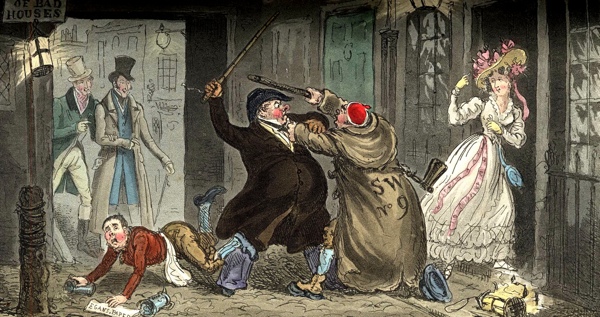
The Burning Shame! Tom & Jerry laughing at the Turn-up between the ‘uncommonly big Gentleman’ and the Hero of the Roundyken under suspicious Circumstances.
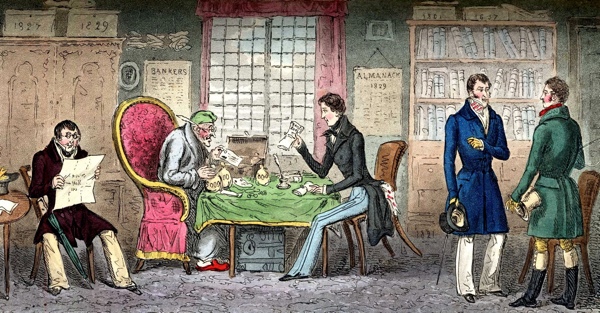
The Money Lender. The ‘High-Bred One’ trying it on, to get the best of the Old Screw, to raise the Needful towards Life in London, accompanied by Tom, Jerry & Logic.
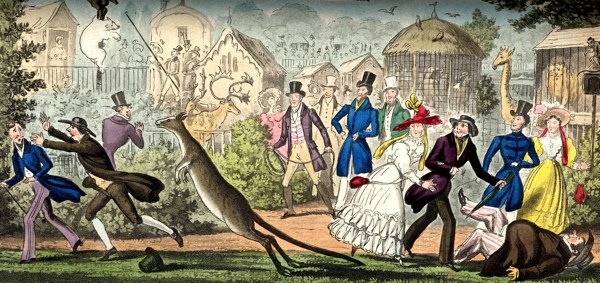
Popular Gardens. Tom, Jerry & Logic laughing at the Bustle and Alarm occasioned amongst the Visitors by the Escape of a Kangaroo.
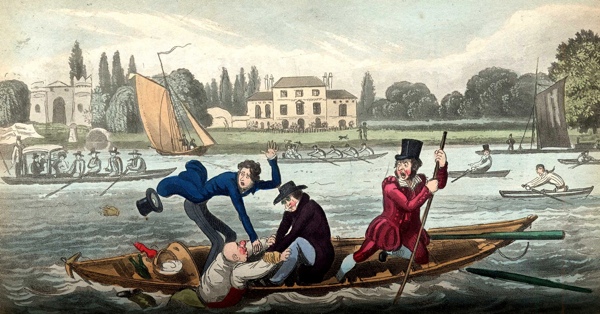
Life on the Water. Symptoms of a Drop too much for the ‘uncommonly big Gentleman.’
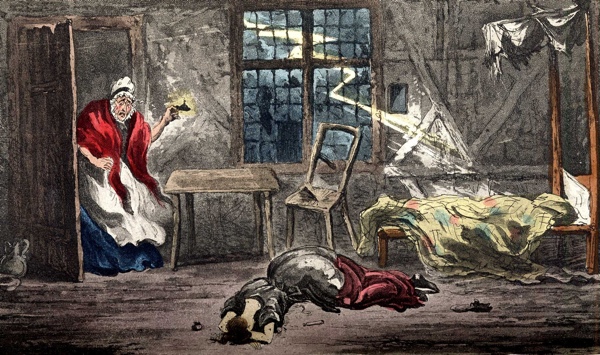
Melancholy End of Corinthian Kate! One of those lamentable Examples of a dissipated Life in London.
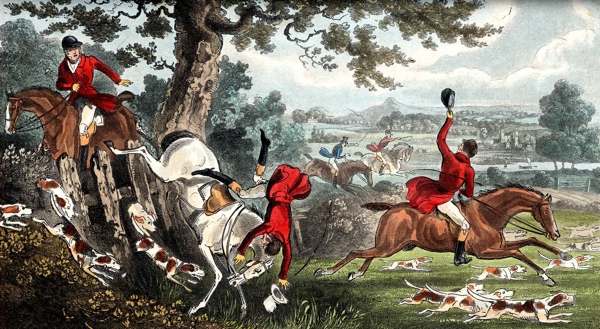
The Death of Corinthian Tom
Images courtesy © Bishopsgate Institute
You may also like to see the first instalment of
and take a look at these other pictures by George Cruikshank
Jack Sheppard, Thief, Highwayman & Escapologist
Donald Rooum, Anarchist Cartoonist
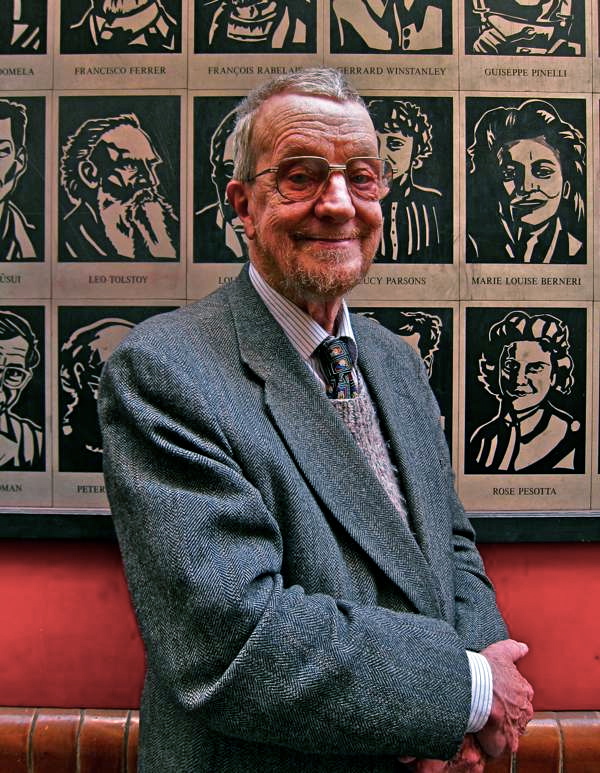
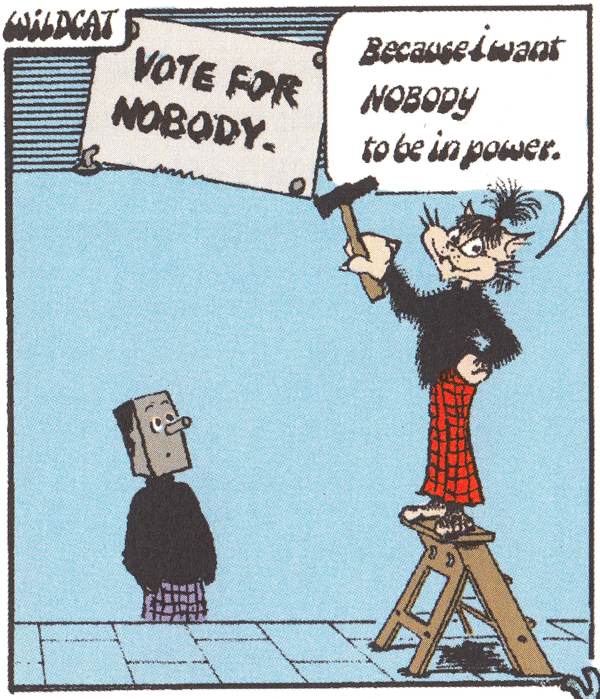
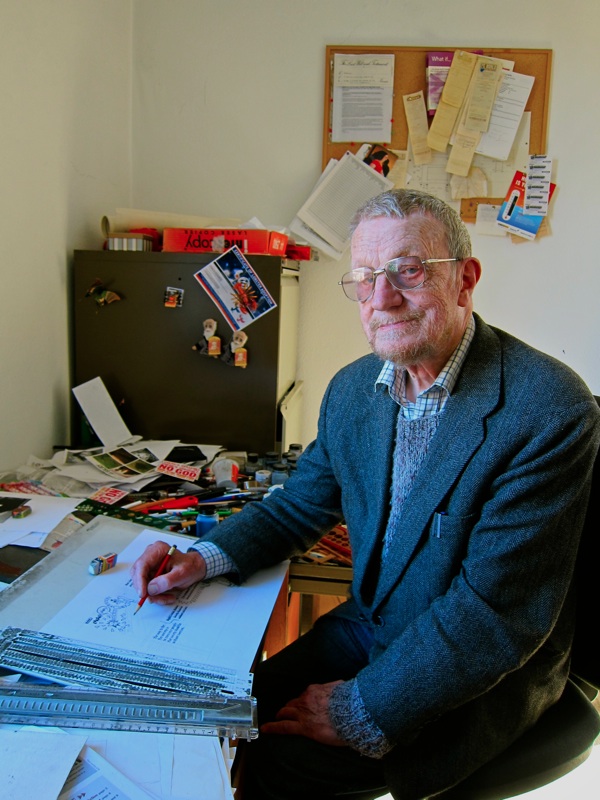
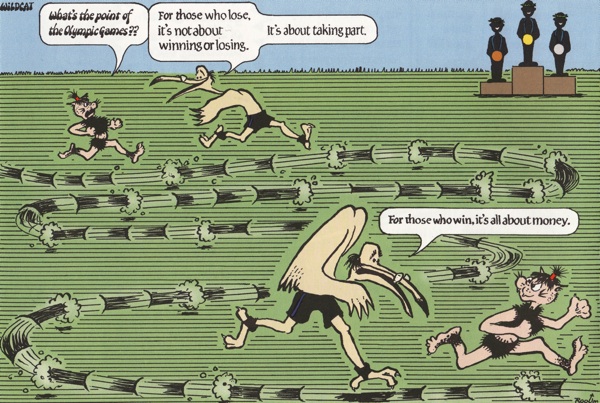
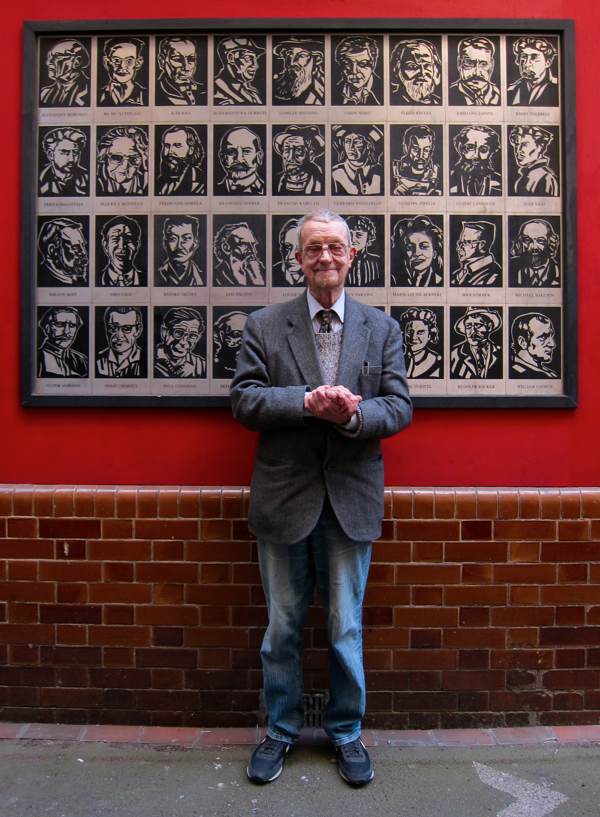
Donald Rooum looks at ease in Angel Alley, Whitechapel – surrounded by images of his fellow Anarchists and Free Thinkers – in this hotbed of East End Radicalism which has been home to the Freedom Press since 1942, almost as long as Donald has been an Anarchist. Yet in spite of the fearsome reputation acquired by Anarchists, Donald possesses a quiet nature, almost unassuming, and he has not been on a demonstration since 1963 when he was framed by the police for having a brick in his pocket. A brick which the police inadvertently – and famously – forgot to plant. It amounted to a national scandal at the time. Since then, Donald prefers to stay at home and seek his political influence indirectly by working on his long-running cartoon series, leaving it to younger Anarchists to take to the street. As he explained to me, “Someone’s got to stay at home and mind the shop.” You have heard of the Armchair Socialist? At eighty-four years old, Donald is the Carpet Slipper Anarchist and he makes no apology for it.
As we walked through the crowds in Whitechapel High St, Donald stopped occasionally to let clusters of people go by before advancing steadily along the pavement, keeping his body set in the direction he was going but turning his head slowly with independent motion, like a tortoise, taking in the life of the street around him. Arriving at his flat up six flights of stairs in an old yet well kept tenement in Stepney, Donald’s place looked as if he had moved in last week even though he has lived there fifteen years. Books spilled from the bookshelves that were the only furniture in his sparsely furnished dwelling and the drawing board where he continues to turn out his regular flow of cartoons was the sole focus of activity.
“I’ve only lived in London fifty-eight years, I came here in 1954 after I finished college in Bradford, qualifying as a commercial artist. I came to seek a job and I got one within a week in an advertising agency. I came to Holborn because the Anarchist Bookshop was there and I found lodgings close by. I stayed with a fellow Anarchist and then I was joined by a girl from Bradford. We took new lodgings together and stayed together for twenty-seven years and had four children, one of whom died at two years old. We lived in Gospel Oak and the children went to school in Camden.
I first visited London in 1944. There was a shortage of hop pickers, so there was a government scheme to get schoolboys to help with the harvest in Kent, and on my day off I came up to Speakers’ Corner and heard an Anarchist speak, and I was impressed with what he was saying. At that time, I had become disillusioned with the Communist League. My father was skilled mechanical worker and he had been a trade union organiser during the depression. He went to the union two evenings each week, one for the regular branch meeting and the other to hand out unemployment pay, until the war brought full employment.
Against my will, I was conscripted at age nineteen. My mother wouldn’t allow me to continue as a Conscientious Objector because she as being pressured by her sister. “You wouldn’t let him play with toy soldiers when he was a boy and this is the result” she said,“and now he’s frightened of being a soldier!” The truth is I was more frightened of my aunt than I was of the army. Because I was known to be an Anarchist, I was spared from posting abroad.
In 1963, I was on a demonstration against a visit by the King of Greece, when plain clothes policemen arrested eight people who happened to be in the crowd. They charged us all with carrying pieces of brick for use as weapons. The policeman who arrested me, Detective Sergeant Harold Challoner, said he found the brick in my pocket but he forgot to put it there and consequently forensics found no trace of a brick. Surely policemen are taught to make sure the evidence is as close to the truth as possible? I was acquitted and the others were found guilty but pardoned. Challoner was charged with conspiracy to pervert the cause of justice, and the other three policemen were found guilty while Challoner himself was declared mentally ill.
I only moved to the East End in 1997, but the Freedom Press acquired a printing press in Angel Alley since 1944 and I’ve been connected with them since I first moved to London in 1954. At first, I came down to the printers as a volunteer, wrapping bundles of “Freedom” in newspaper. They were printing letterpress then. It was run by anarchist Philip Sansom, and two people worked with him who had been there since they had been printing the “Jewish Express” before “Freedom” came along in 1942. When Freedom Press took it over, part of the deal was that Mr Narod, a rival printer who lent us the money, took all the Hebrew type so that he had a monopoly of it in the East End. Eventually, we paid a lot of money to have those old letterpress machines hauled off.
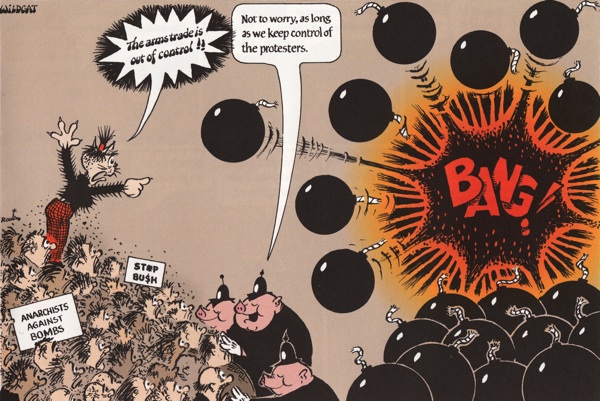
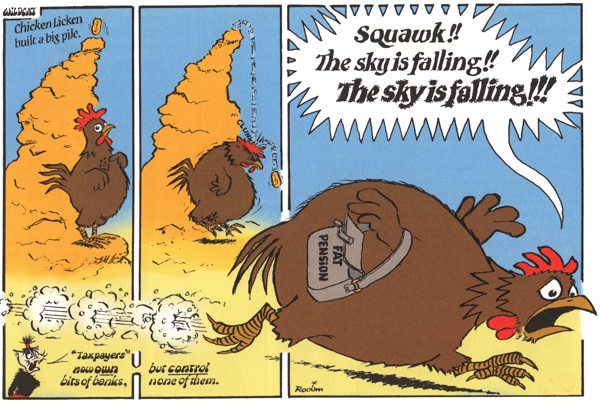
It wasn’t until quite late in my development that I became a cartoonist, though I had drawn cartoons at college and as a child. I sent six a week to the Daily Mirror at first, out of which they published two a fortnight, and the ones they didn’t publish I sent on to other publications like Private Eye. I started drawing a regular cartoon in “Peace News” in 1962 and I’ve done it ever since, on and off. I’ve drawn Wildcat in “Freedom” since 1980 and Sprite in “The Skeptic” since 1987. I don’t draw cartoons on spec anymore.
Now I am the grand old man of Freedom Press, because nobody else remembers anything any more than twenty years ago. When I was sixteen, I thought a free society would be easy to get. Now I don’t think things are going to be easy, but the civil rights movement has been good. There have been improvements. There’s no longer any law against homosexuality and no longer any corporal punishment in schools. There was an awful attitude that people who weren’t white were inferior. When I first came to London in 1944, I phoned up a boarding house and they asked me to come round in person, because there was a no coloureds policy. To me, Anarchism is an ethical stance, a point of view which regards coercion of any kind as wrong.”
Donald never told me that he edited “Freedom” for many years, that he became lecturer in typography at the London College of Printing, that he took an Open University Degree in Life Sciences and was elected a member of the Institute of Biology at eighty. Donald Rooum’s endeavours have spanned the political, the literary, the artistic and the scientific, yet it is in the levity of cartoons that he has found his ideal medium.
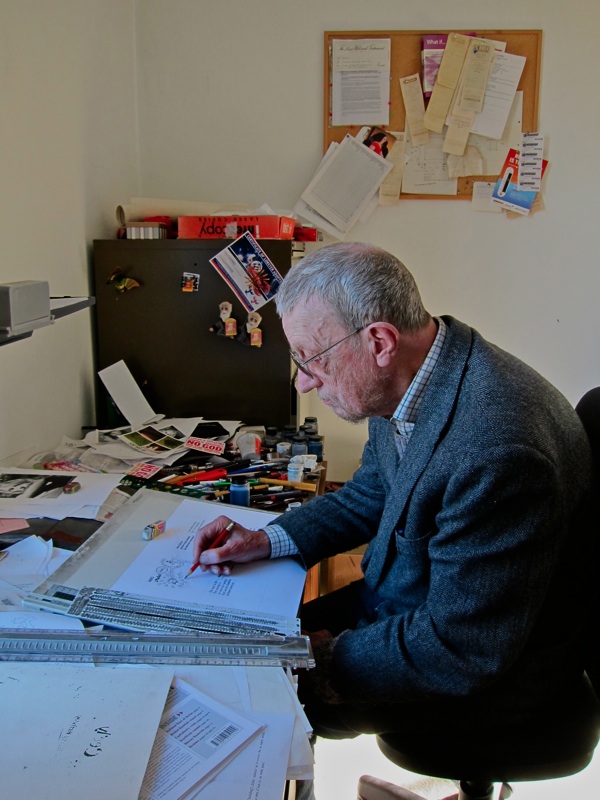
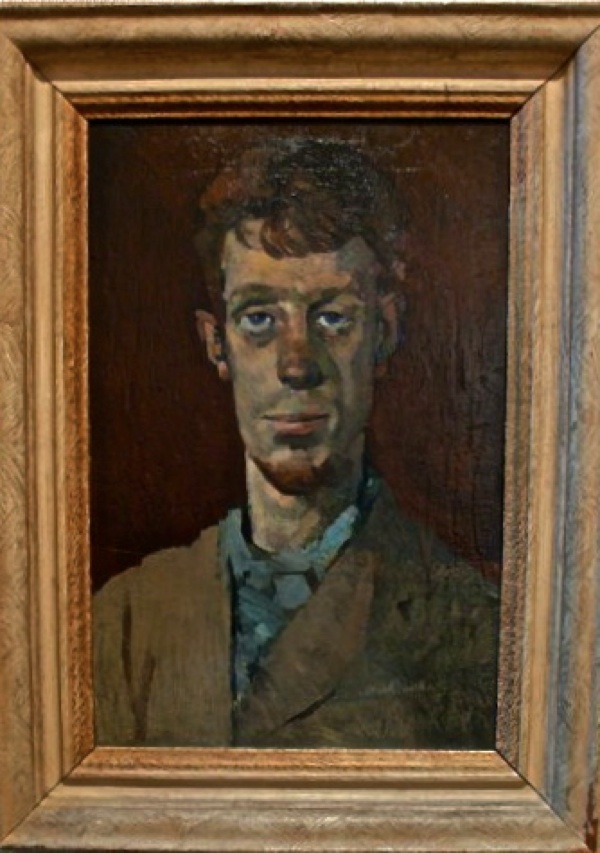
Donald Rooum, as a twenty-four year old art student in Bradford in 1952, painted by Frank Lisle.
Henrietta Keeper, Ballad Singer

Friday is an especially good day to have lunch at E. Pellicci in the Bethnal Green Rd, because not only is Maria Pellicci’s delicious fried cod & chips with mushy peas likely to be on the menu, but also – if you are favoured – you may also get to hear Henrietta Keeper sing one of her soulful ballads. Celebrated for her extraordinary vitality, the venerable Henrietta (known widely as “Joan”) is naturally reticent about her age, a discretion which you will appreciate when I reveal that she is able to pass as one thirty years her junior.
Henrietta tucked into her customary fried egg & chips last Friday as the essential warm-up to her weekly performance while I sat across the table from her enjoying the cod & chips with mushy peas, and helping her out with her chips. “My husband died fourteen years ago, of emphysema from smoking and he ate a lot of hydrolized fat.” she admitted to me, her dark eyes shining with emotion,“When he died, I threw away the biscuits and I bought a book on nutrition and studied it, and now I’ve got strong. I only eat wholemeal bread, white bread’s a killer. I am keeping well, to stay alive for the sake of my children because I love them. I don’t want to go the same way my husband did.”
“Anna Pellicci makes me laugh, ‘She says, ‘Are you still here?”” continued Henrietta with affectionate irony, leaning closer and casting her eyes around the magnificent panelled cafe that is her second home,“I first came to Pelliccis in 1947 when I got married. No-one had washing machines then, so I used to take my washing to the laundrette and come here with my three babies, Lesley hanging onto the pram, Linda sitting on the front and Lorraine the baby inside.” Yet in spite of being around longer than anyone else, Henrietta possesses a youthful, almost childlike, energy and wears a jaunty bow in her hair. “I’m so tiny,” she declared to me batting her eyelids flirtatiously, “I’m just a little girl.”
As a prelude the afternoon’s performance, I asked Henrietta the origin of her singing and she grew playful, speaking with evident delight and invoking emotions from long ago. “It all started with my dad when I was a little girl, he had a beautiful voice.” she recalled fondly, “He was a road sweeper, but years ago there wasn’t much work – so, when he couldn’t get a job, he used to stand outside the pub singing. And people put money in his hat, and he took it home and gave to my mum. That was the only entertainment we had in those days. Everybody was poor, so the best thing was to go to the pub and make your own music. When I was sixteen years old, I used to sing duets with my dad in pubs. The first song I sang was “Sweet Sixteen – When I first saw the love light in your eyes, when you were sweet sixteen…”
Henrietta got lost in the sentiment, singing the opening line of Sweet Sixteen across the table in a whisper, before the choosing the moment to assure me,“I’m a ballad singer, I don’t like to sing ‘Hey, Big Spender!’ even though I think Shirley Basset’s marvellous – that suits her voice, not mine.” I nodded sagely in acknowledgement of the distinction, before she continued with a fresh thought, “But I like Country & Western. Have you heard of Patsy Cline and Lena Martell? I like that one, ‘I go to pieces each time I see you again…'”
Born in the old Bethnal Green Hospital in the Cambridge Heath Rd, Henrietta and all her family – even her great-grandparents – lived in Shetland St opposite. Evacuated at the age of ten to Little Saxham, near Bury St Edmunds in Suffolk, Henrietta found herself with a devout Welsh family who worked on the land and went to church on Sundays. Here Henrietta excelled in the choir and “that’s how I learnt singing. I got to sing, ‘My Lord is Sweet,’ on my own and I loved it.” she confided to me with a tender smile.
Returning to the East End at the time of the doodlbugs, Henrietta was out playing with her friend Doris when they heard the sound of the Luftwaffe overhead followed by explosions. In the horror of the moment, Doris suggested they take refuge in Bethnal Green Tube Station, but Henrietta had the presence of mind to refuse and went instead to join her family sleeping under the railway arches. That night, one hundred and seventy three people were killed on the staircase as they crowded into the entrance of the tube, including Henrietta’s friend Doris. “It’s not for your eyes,” Henrietta’s father told her when they laid out the bodies on stretchers upon the pavements in lines, but she recalls it in vivid detail to this day.
We ate in silence for a while before Henrietta resumed her story.“When my children started school, I joined the Diamond “T” Concert Party,” she told me,”I had a friend who worked at Tate & Lyle in Silvertown and one of the things they did for the community was organise entertainments. We used to go to old people’s homes, churches and hospitals, and I became one of their singers for thirty years. We had quite a laugh. The only reason I left was that everyone else died.”
I understood something of Henrietta’s circumstance, her story, the origin of her singing and how she made use of her talent over all these years. I realised it was imperative that Henrietta continues singing, if she is to seek the longevity she desires, and for one born and bred in Bethnal Green, Pelliccis is the natural venue. Yet there was one mystery left – why does everyone know Henrietta as ‘Joan’ ?
“My mum was called Henrietta, and because I was the eldest I was called Henrietta, but I hated it so I when I went for my first job interview, as a machinist in Mare St making army denims, I told them I was called, “Joan.” she confessed, “They was more cockney there than I am, they said, ‘What’s your name, love?’ and I didn’t like calling out ‘Henrietta’ because it sounded so posh, I just said the first name that came into my head – ‘Joan.’ All my neighbours and my mother-in-law know me as Joan, but my family know me as Henrietta. And that’s how I told a little white lie, in case you might be wondering.”
As our conversation passed, we had completed our meals. Joan ordered a piece of bread pudding to take home to eat later and I polished off a syrup pudding with custard. And then, the moment arrived – Henrietta took her microphone from her bag and composed herself to sumon the spirit of the place, a hush fell upon the cafe and she sang…

“I’m a ballad singer, I don’t like to sing ‘Hey, Big Spender!”


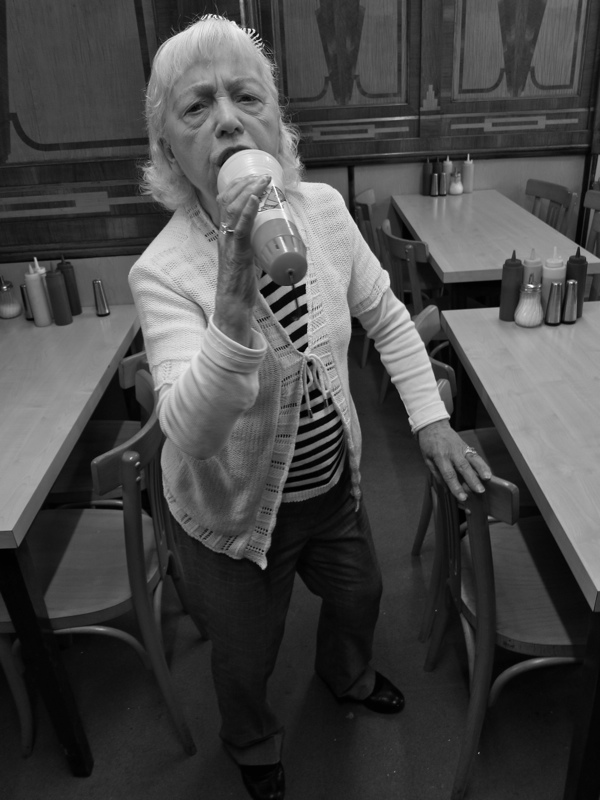


Henrietta Keeper – “I’m so tiny, I’m just a little girl.”
You may like to read my other Pelliccis stories
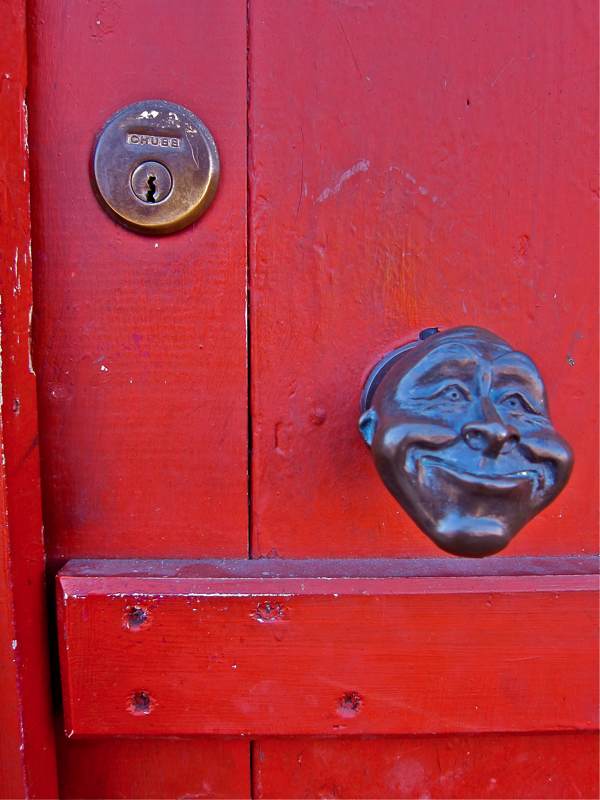
In Narrow St, Limehouse
Charles Dickens’ godfather Christopher Huffam lived and ran his sailmaking, blockmaking and chandlery business from a substantial house in Newell St, next to St Anne’s Limehouse. Huffam adored his godson, declaring the boy a prodigy, tipping him half a crown on his birthday and encouraging him to dance and perform comic songs upon the kitchen table – and also, it is said, upon the bar at The Grapes. In the company of his godfather, Dickens first explored Shadwell and Limehouse, engendering a lasting fascination with these teeming waterside regions that he returned to throughout his writing life, both in fiction and journalism.
It is a landscape that I came to know through Dickens’ writing even before I visited it for myself and, in spite of all the changes, when I walk through Shadwell and Limehouse today, I cannot dispel his vision of this distinctive area of London. So, after riffling through some bookshelves, I set out to see what I could photograph of Dickens’ imaginative perspective in these riverside streets.
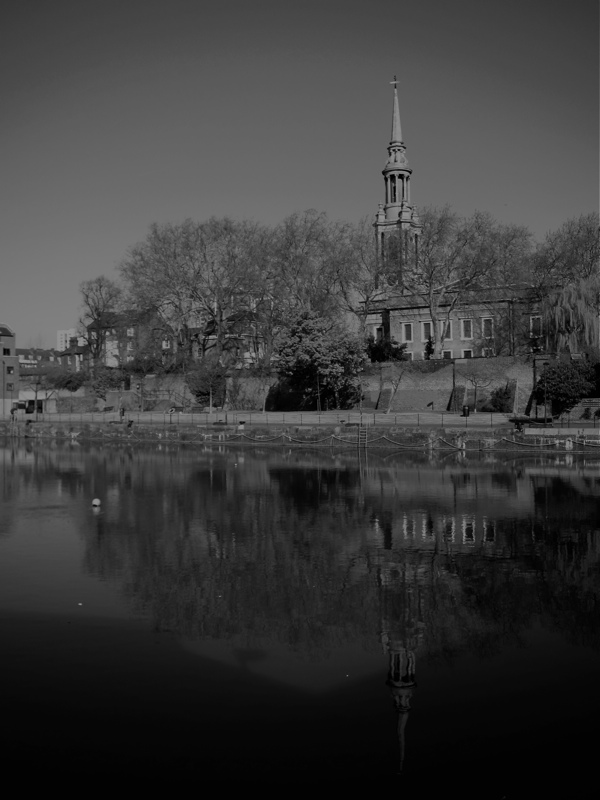
“Shadwell Church! Pleasant whispers of there being a fresher air down by the river than down by the Docks, go pursuing one another playfully, in and out of the openings in its spire. Gigantic in the basin just below the church looms my Emigrant Ship… two great gangways made of spars and planks connect her with the wharf, and up and down these gangways, perpetually crowding to and fro and in and out, like ants, are the Emigrants. Some with cabbages, some with loaves of bread, some with cheese and butter, some with milk and beer, some with boxes beds and bundles, some with babies – nearly all with children.” – The Uncommercial Traveller, Bound for the Great Salt Lake. In July 1863, Dickens visited a Mormon mission of 895 emigrants on board a ship in Shadwell Basin.
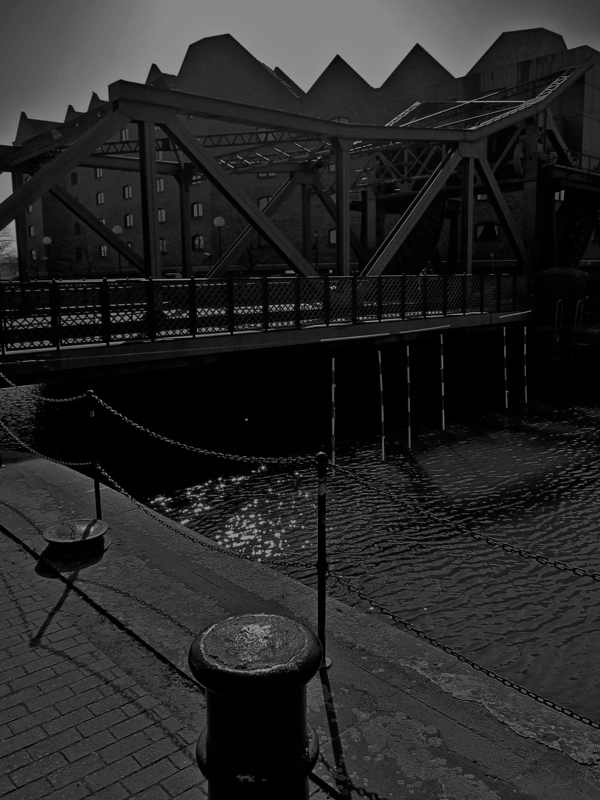
“I found myself on a swing bridge, looking down on some dark locks in some dirty water. Over against me, stood a creature remotely in the likeness of a young man with a puffed sallow face, and figure all dirty and shiny and slimy, who may have been the youngest son of his filthy father, Thames, or the drowned man about whom there was a placard on the granite post like a large thimble that stood before us. ‘A common place for suicide?’ said I, looking down at the locks. ‘Sue?’ returned the ghost with a stare. ‘Yes! And Poll. Likewise Emily. And Nancy. And Jane.'” – The Uncommercial Traveller, All the Year Round. In January 1860, Dickens visited the Wapping Workhouse for female paupers.
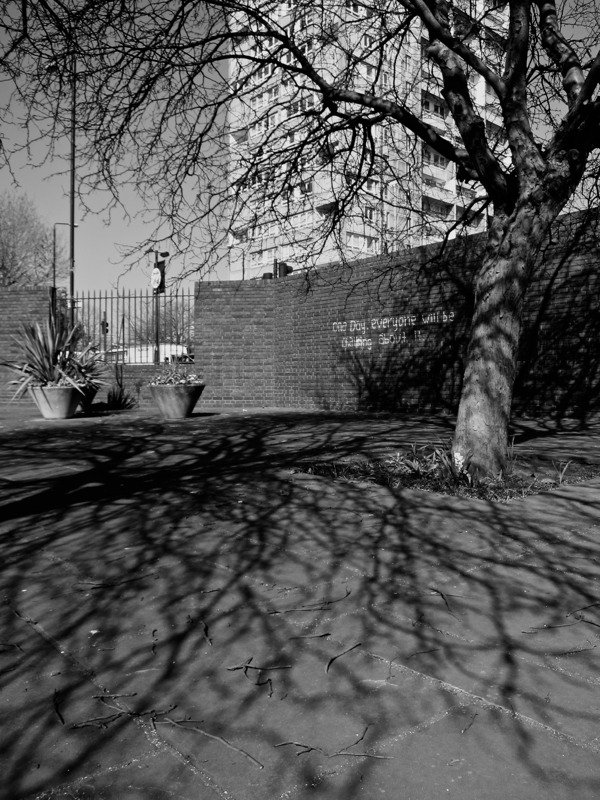
One day everyone will be chalking about it
“The wheels rolled on, and rolled on down by the Monument and the Tower, and by the Docks, down by Ratcliffe, down by where the accumulated scum of humanity seemed to be washed from higher ground..” Our Mutual Friend, Gaffer Hexham’s Abode,1864.
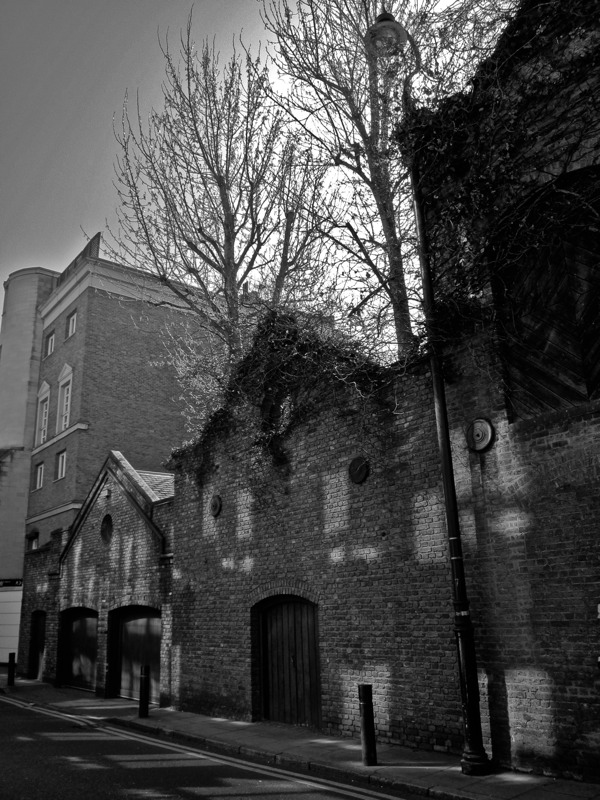
“Down by the river’s bank in Ratcliffe, I found the Children’s Hospital established in an old sail loft or storehouse, of the roughest nature, and on the simplest means. There were trap-doors in the floors where goods had been hoisted up and down, inconvenient bulks and beams and awkward staircases perplexed my passage through its wards, but I found it airy, sweet and clean. In its seven and thirty beds I saw but little beauty, for starvation in the second or third generation takes a pinched look, but I saw the sufferings of infancy and childhood tenderly assuaged.” New Uncommercial Samples, A Small Star in the East, 1868.
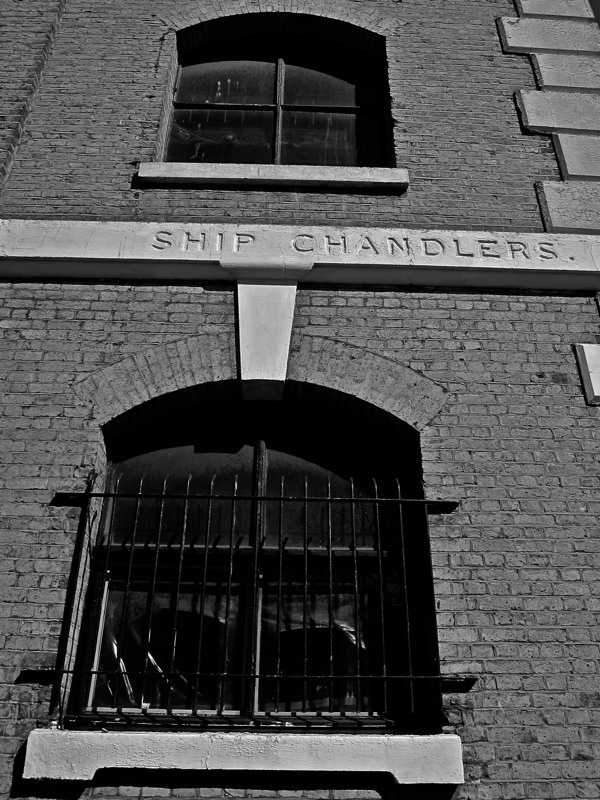
“Look at the marine store dealers, in that reservoir of dirt, drunkenness and drabs – thieves, oysters, baked potatoes, and pickled salmon, Ratcliffe Highway. Here the wearing apparel is all nautical. rough blue jackets with mother -of-pearl buttons, oilskin hats, coarse checked shirts, and large canvas trousers, that look as if they were made for a pair of bodies, instead of a pair of legs, are the staple commodities. In the window are a few compasses, a small tray containing silver watches in clumsy thick cases, and tobacco boxes, the lid of each ornamented with a ship or an anchor. A sailor generally pawns or sells all he has before he has been long ashore.” Sketches by “Boz,” Illustrative of Every-day Life and Every-day People, 1836.
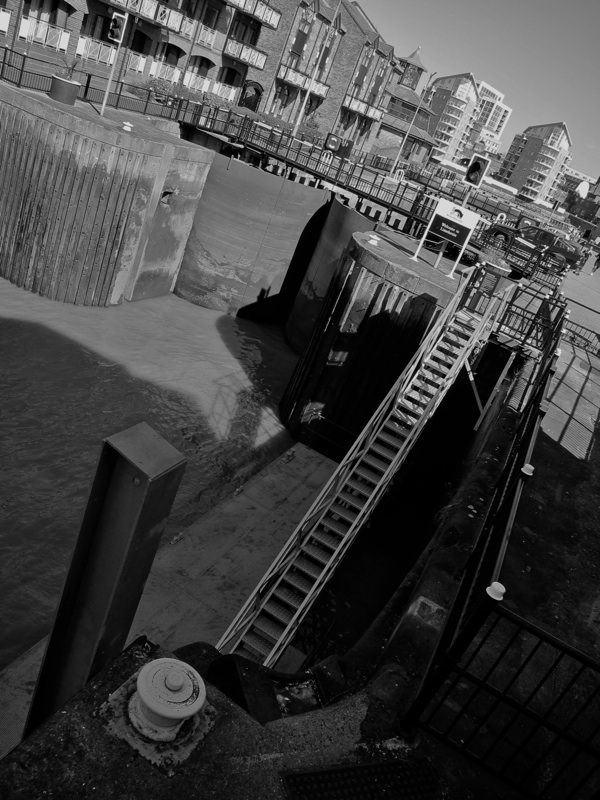
“Captain Cuttle lived on the brink of a little canal near the India Docks, where there was a swivel bridge which opened now and then to let some wandering monster of a ship come roaming up the street like a stranded leviathan. The gradual change from land to water, on approaching Captain Cuttle’s lodgings, was curious. It began with the erection of flagstaffs as appurtenances to public houses, then came the slop-sellers’ shops. These succeeded by anchor and chain-cable forges, where sledgehammers were dinging upon iron all day long. Then came rows of houses, with little vane-surmounted masts.” Dombey and Son, 1848.
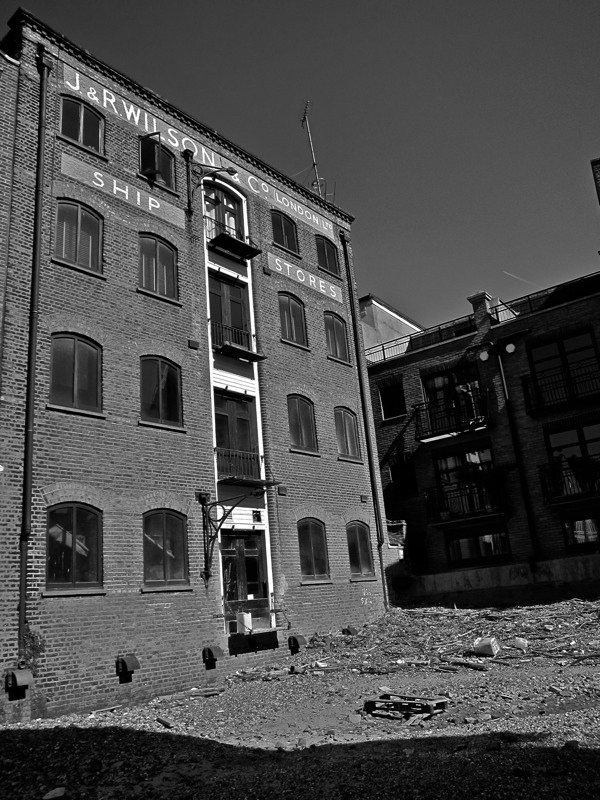
“Rogue Riderhood dwelt deep in Limehouse Hole, among the riggers, and the mast, oar, and block makers, and the boat builders, and the sail lofts, as in a kind of ship’s hold stored full of waterside characters, some no better than himself, some very much better, and none much worse.” Our Mutual Friend, Pleasant’s Mysterious Vision, 1864.
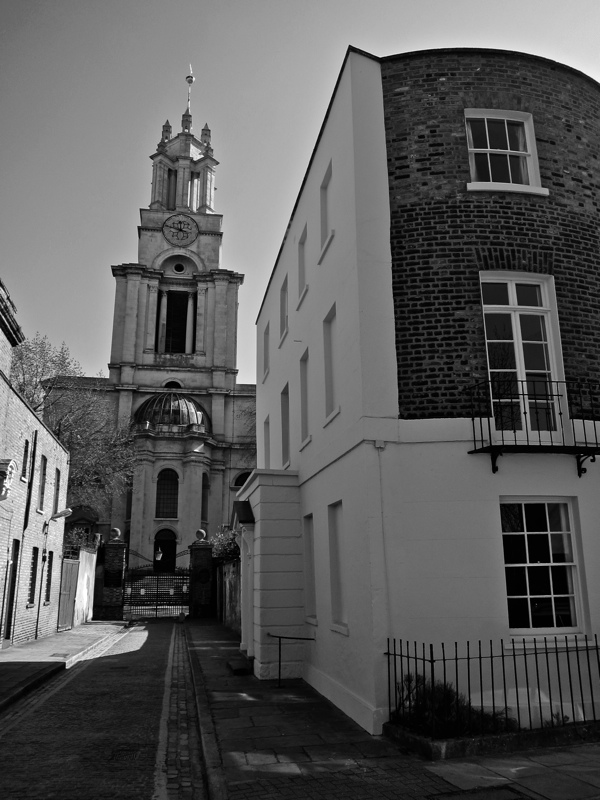
“Past Limehouse Church, at the great iron gate of the churchyard, he stopped and looked in. He looked up at the great tower spectrally resisting the wind, and he looked at the white tombstones, like enough to the dead in their winding sheets, and he counted nine tolls of the church bell.” Our Mutual Friend, Think it Out, John Proudfoot, 1864.
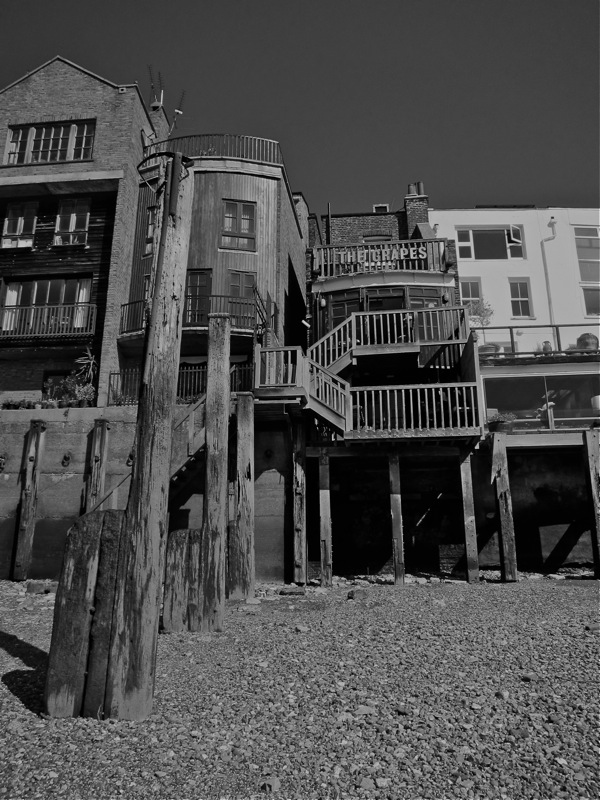
“ The Six Jolly Fellowship-Porters, already mentioned as a tavern of dropsical appearance, had long settled into state of hale infirmity. In its whole construction, it had not a straight floor and hardly a straight line, but it had outlasted and clearly would yet outlast, many a better trimmed building, many a sprucer public house. Externally, it was a narrow lop-sided wooden jumble of corpulent windows heaped one upon the other as you might heap as many toppling oranges, with a crazy wooden veranda impending over the water, but seemed to have got into the condition of a faint-hearted diver who has paused so long on the brink that he will never go in at all…” Our Mutual Friend, Cut Adrift, 1864.

Dickens in Shadwell & Limehouse – Spitalfields Life will be hosting a walk in the footsteps of Charles Dickens on Easter Monday 9th April at 3pm from St Georges in the East, visiting locations described in his novels and journalism. The walk will take approximately an hour and a half, and conclude at the historic riverside pub The Grapes.
Booking is essential and numbers are limited, so please email spitalfieldslife@gmail.com to sign up. Tickets are £10.
You may also like to read about
Charles Dickens at Park Cottage
Charles Dickens In Spitalfields
Charles Dickens in Spitalfields 2 – The Silk Warehouse
Charles Dickens in Spitalfields 3 – In the Streets
Charles Dickens in Spitalfields 4 – The Silk Weavers
Charles Dickens in Spitalfields 5 – The Young Artist
The Brick Lane Temperance Association
Joanna Moore’s Drawathon

Spitalfields Life Contributing Artist Joanna Moore did this drawing of the Brick Lane Beigel Bakery on Thursday afternoon. It was the thirteenth of fifteen drawings that she did to commission last week as part of an epic two day drawathon to raise money for the Alzheimer’s Society – in commemoration of her grandmother Christine Brock who died of the disease last year. “London blessed me with sunshine and warm temperatures, as if summer had arrived early.” said Joanna introducing her spirited drawings that she executed on the streets, travelling between each location by bicycle, “I had not quite prepared for just how gloriously bright and colourful it would be, and as a result I set out inspired and ambitious, and attacked my sheet of paper with every hue in my watercolour box … and couldn’t quite stop.”
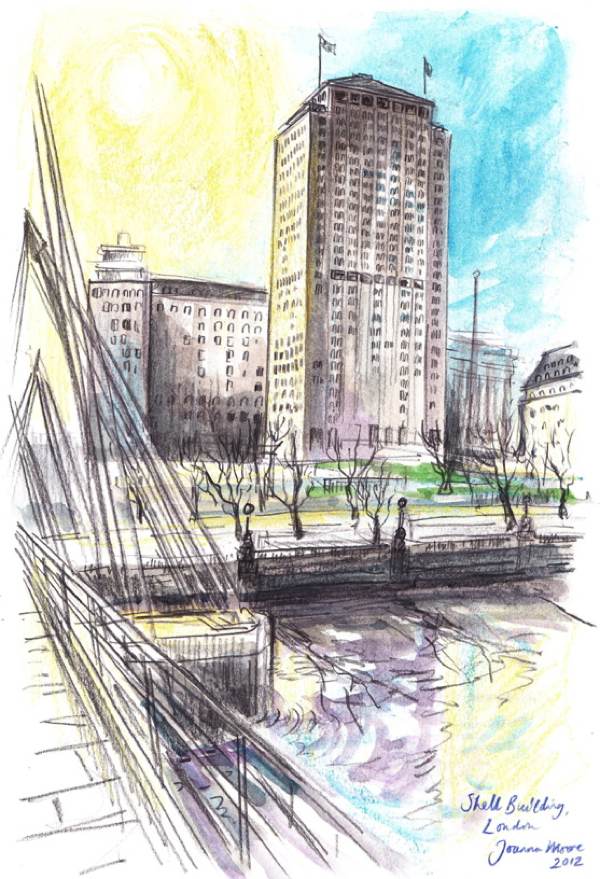
Day one, 8:00am, Wednesday. The Shell Building – I was drawing against the sun, so I was glad I brought sunglasses! Though a very simple building, the Shell Centre always looks incredibly elegant against the river, a giant monument.
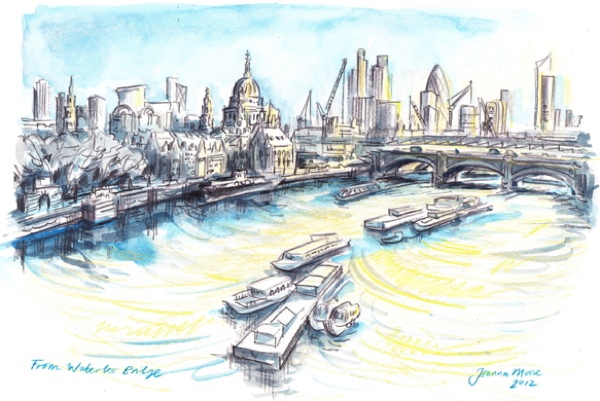
Day one, 9:30am, Wednesday. View from Waterloo Bridge – Another bridge, another bright bright drawing. At this time of the day, the City is thrown into extremes of light and shade, so the cityscape is somewhat blurred but I tried to pick out shapes from the shadows and sunlight reflecting on glass. There was so much to take in and the wind was up, blowing my hair all over the place, and I sketched quickly.
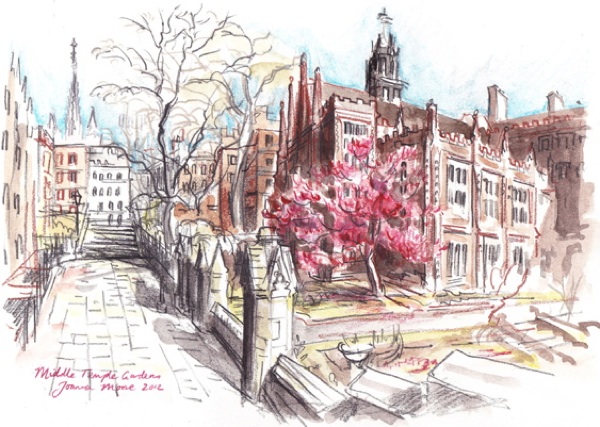
Day one, 11:00am, Wednesday. Middle Temple Gardens – Always fairly quiet, save for legal suits and wigs going back and forth, and the odd tourist. Found a lovely spot on a bench overlooking Middle Temple to see this Magnolia tree in full bloom. I love how the pinks offset the deep red of the old brickwork. I sat here and ate my picnic in the beautiful gardens before braving Fleet St…
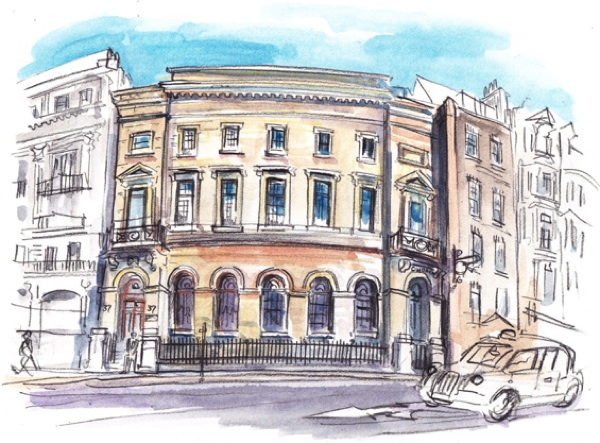
Day one, 1:00pm, Wednesday. Hoares Bank – A classical building, made tricky by busy traffic and buses constantly stopping in front of me. The sun started to make me light-headed by now, so I sought the shade.
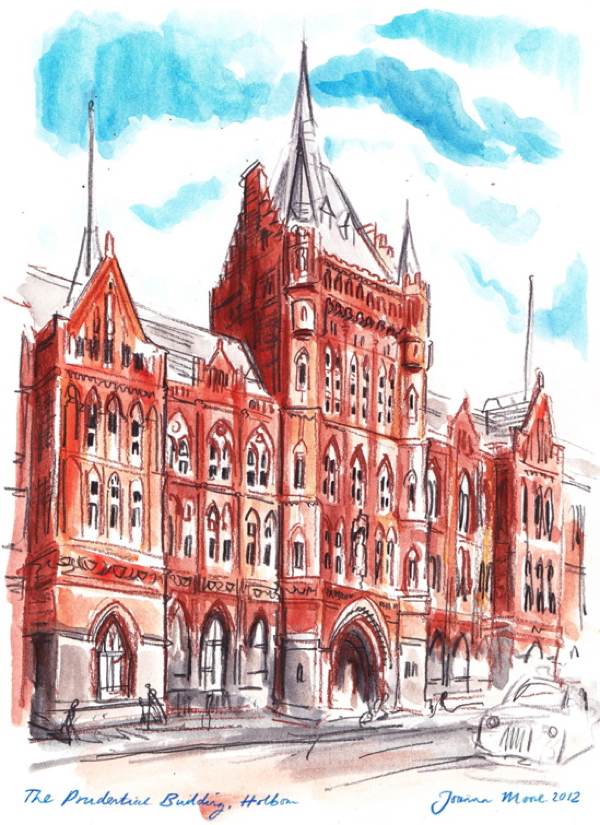
Day one, 2:30pm, Wednesday. The Prudential Assurance Building – A great Victorian building, and I had never seen it so bright and red. I hid in the shade opposite and considered how funny it was that my mum used to work here before I was born. I was desperate to spend longer here, as the architecture and ornamentation is so over-the-top, but time pushed me on so I could only do my best to sketch in every arch. The afternoon was getting me tired, and even though a large mocha Frappuccino delivered a caffeine and sugar hit, I feared the whipped cream made me even sleepier.
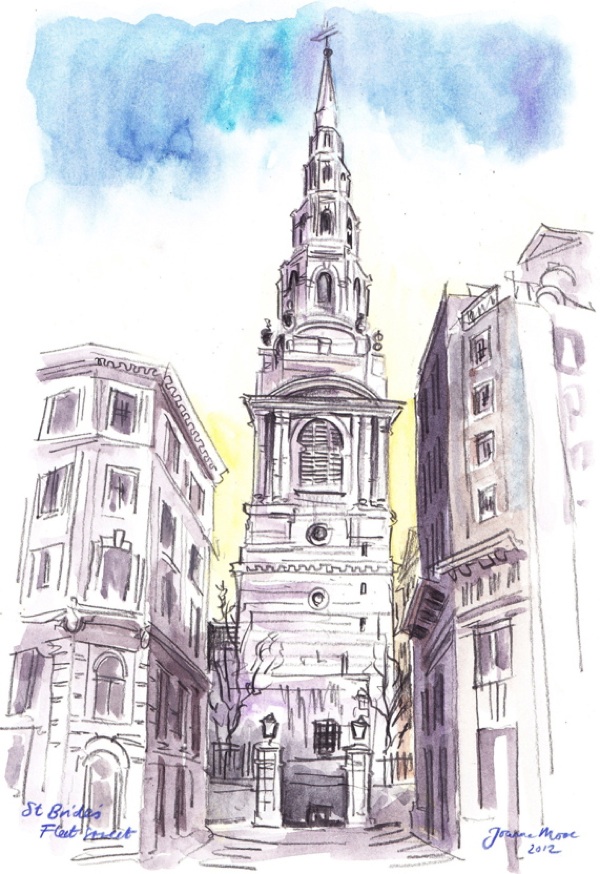
Day one, 3:45pm, Wednesday. St Brides Church – This wonderful Wren church is neatly slotted into the City fabric and tucked off Fleet St, which makes it tricky to find the best location to draw. So I ended up sitting cross-legged in the middle of Fleet St outside the Express Building and had City workers tripping over me. Once again, the sun was so bright that the shadows were extreme, and London’s Portland stone became shades of purple and blue.
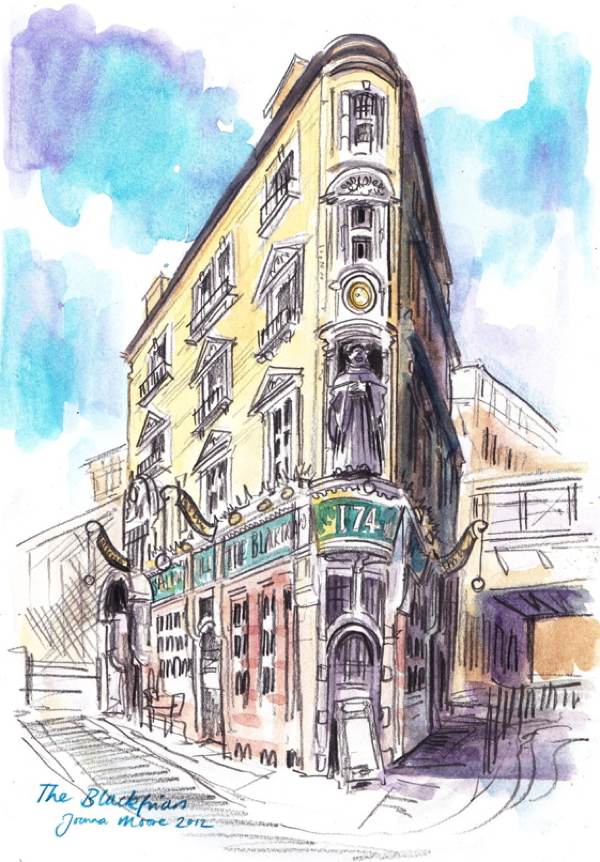
Day one, 5:00pm, Wednesday. The Blackfriars Pub – Getting very tired now and after another session on a street corner (literally next to road works for new Blackfriars station) my eyes were dry and my lungs tight. Thankfully, this request just happened to be my favourite pub in London, so I pushed through and rewarded myself with a half of ale.
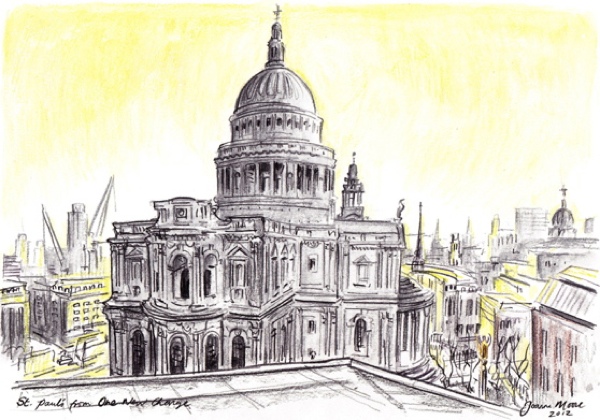
Day one, 6:00pm, Wednesday. St Paul’s from One New Change – My friend Mandy was so keen to sponsor me for a good cause that she completely forgot to tell me what to draw. Now she has moved to Australia, so I picked her a classic London scene. I have many grumblings about this new shiny shopping centre, but the view from the top is exceptional. Up in the air, my lungs were cleared and I was invigorated by the sharpness of the sun, cutting through streets and creating a halo around the monumental cathedral.
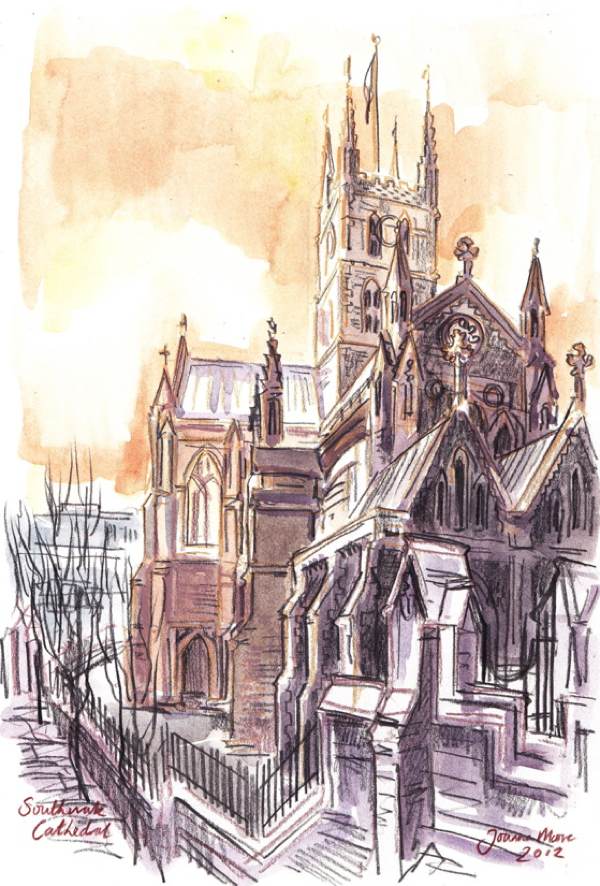
Day one, 7:30pm, Wednesday. Southwark Cathedral – Very tired now, and I hastened through the streets and across London Bridge to get to another cathedral before the light is lost. The garden here was shut by now and the market traders all packed up, but it mattered not as this view from the east end is one of my favourites. I love being raised so that I can draw both up and down the cathedral. The sunset cast the end of the church into purple shadows, apart from where it streamed through the south transept window. I had to work fast as the light faded minute by minute, which is very disorienting when you are drawing. By 8.30pm it was dark and I could no longer make any judgement, so I took my picture to a street light and in the yellow haze decided it was complete. I packed up and staggered back across the bridge, and eastwards home.
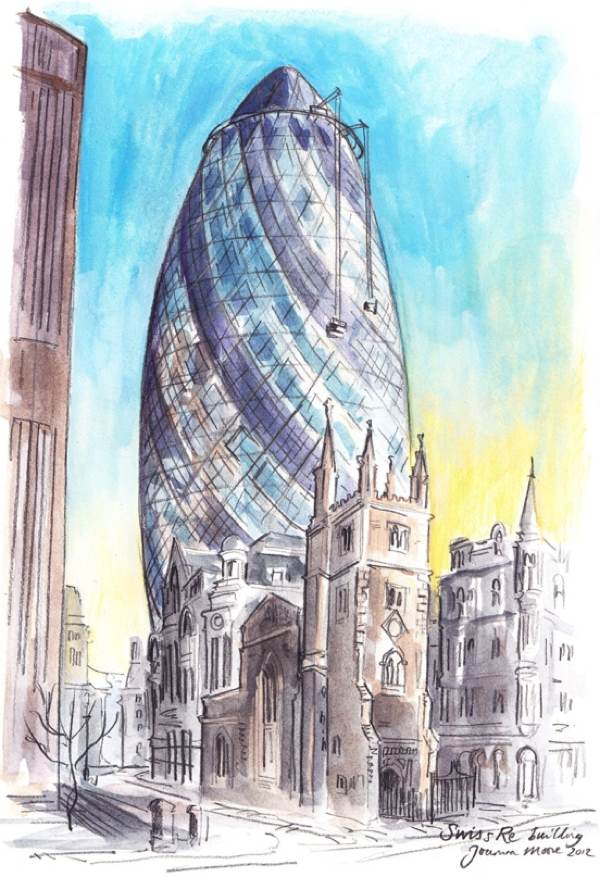
Day Two, 8:00am, Thursday Swiss Re Building – Another stunning sky. My sponsor Alex had just requested the Gherkin, but since he has been so generous with his commission and I love this view with St Andrew Undershaft, I chose to show the new against the old. The cleaners were out on the Gherkin, mesmerising to watch as, spiderlike, they worked their way up and down the glass on spindly wires.
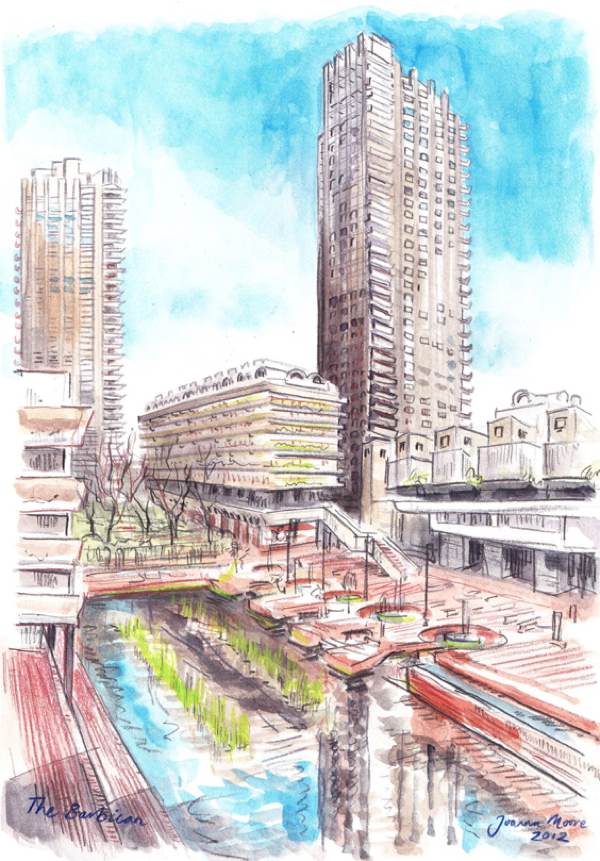
Day two, 11:15am, Thursday. The Barbican – I spend a while getting lost, wandering around the strange beast that is this 1960s development. I love it even though it scares me rigid to draw. It is not a simple modernist building, but something giant and sculptural, a maze, a monument to post-war ambitions and hopes, yet still manages to be a humane, beautifully detailed environment. This drawing took a while to set up, as I fretted over the proportions, but then got absorbed by endless windows and the distinctive balconies. Thankfully, the bright sun was helpful in discerning shapes. But yesterday began to catch up with me, and I found I was already tired. Luckily, I happened to be chanced upon by my friend Louise – a fellow Princes Drawing School student – on her way to London Zoo to draw. A quick chat and the gift of a chocolate biscuit perked me up, and I hopped back on my bike.
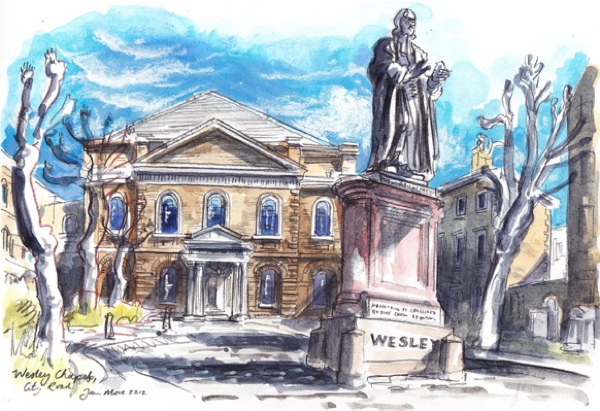
Day two, 1:30pm Thursday. Wesley Chapel – I stop for lunch at Bunhill Fields, the beautiful graveyard for dissenters opposite the chapel. I hid in the shade for a while before I staked out the best place to draw the chapel and found myself back in the sun. I felt I had to include the man himself too, and I like the contrast of his sculpture against the characterful pollarded trees. Afterwards I was met by my parents – in town to see my progress – who rewarded me with a large iced coffee and more whipped cream. By this point, I became dizzy after too much time in the sun!
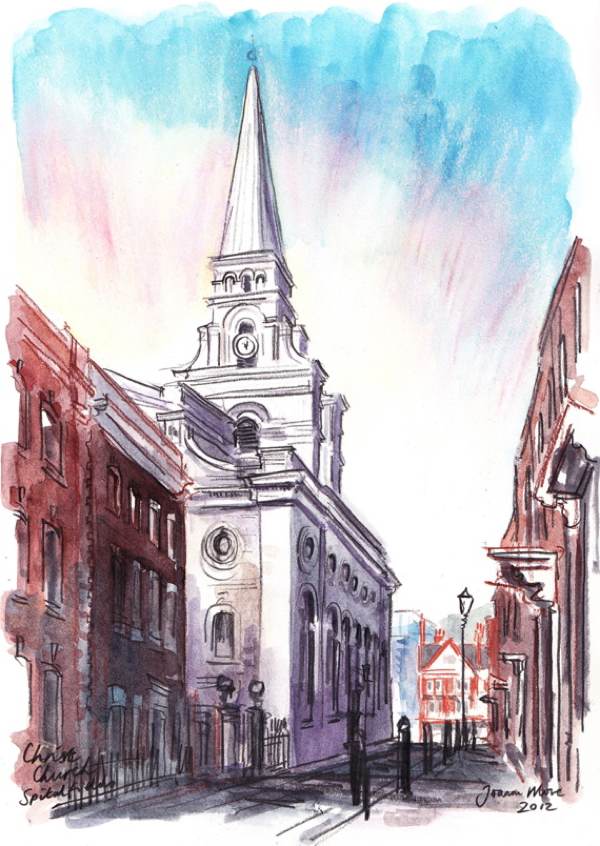 Day two, 5:15pm, Thursday. Christ Church, Spitalfields – Another regular feature of my drawings. I knew that Karen who commissioned this picture had a print of one of my drawings with a view from the front, so I decided she should have a side view. This shows the way it appears to shelter the rows of brick houses in the quiet street around it, while the busy Victorian market buildings in the bright sunlight – just a hop and skip across Commercial St – seem to exist in another world.

Day two, 7:00pm, Thursday. Former Gladding Bookshop, Whitechapel Rd – This was a request from Bob, whose ancestor once ran a bookshop on this busy street. This handsome Victorian building is a lucky survivor in an area where so much was destroyed by bombs. I pushed on with my drawing, driven by the knowledge that this is my last. I finished as the light started to fade and the traffic gathered pace. Across the road, the call to prayer was sounded from the East London Mosque, and I packed up my bike and was called home.
Drawings copyright © Joanna Moore
You may also like to take a look at other work by Joanna Moore
The Spitalfields Nobody Knows (Part One)
The Spitalfields Nobody Knows (Part Two)
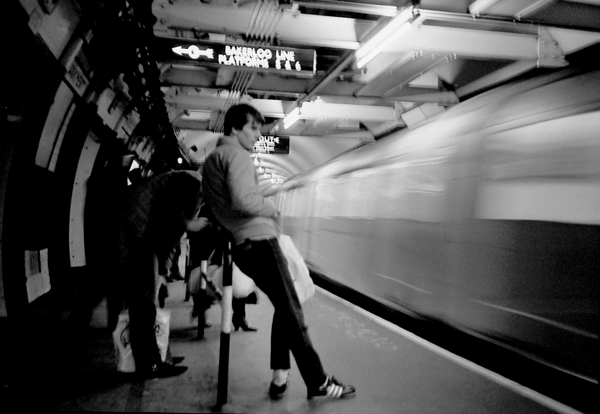
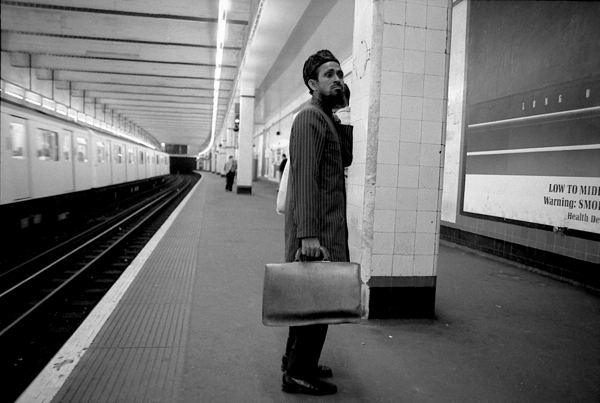
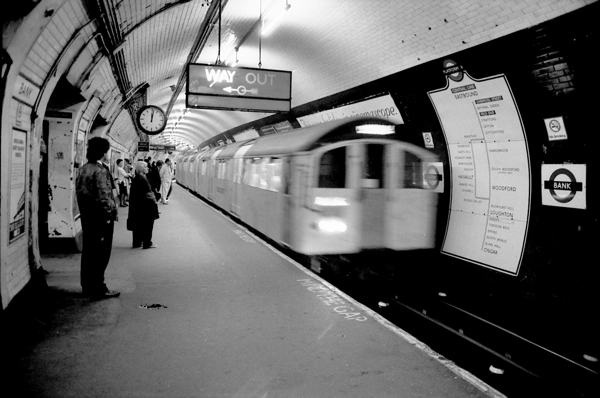
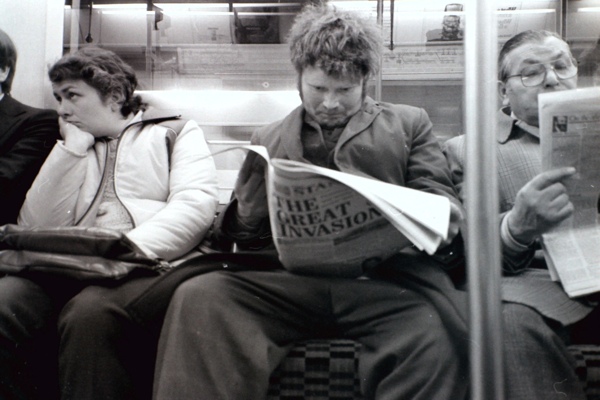
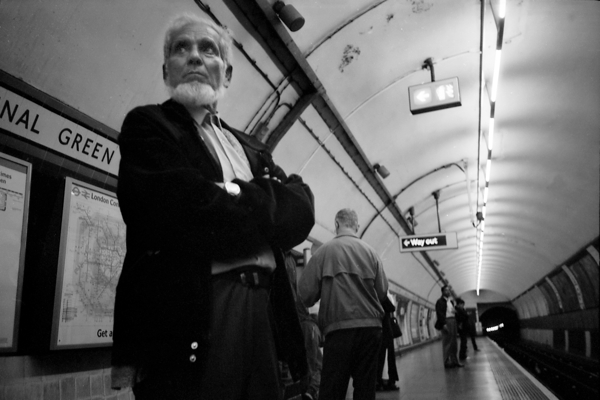
Phil Maxwell on the Tube
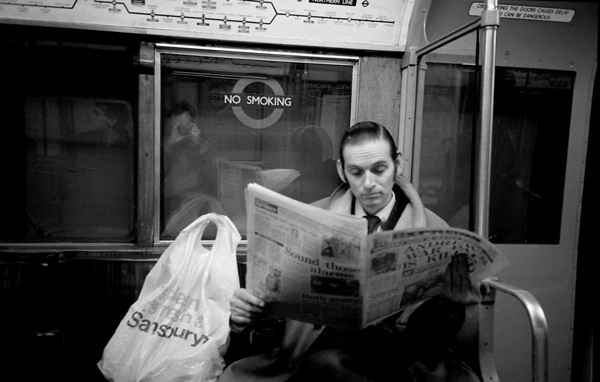
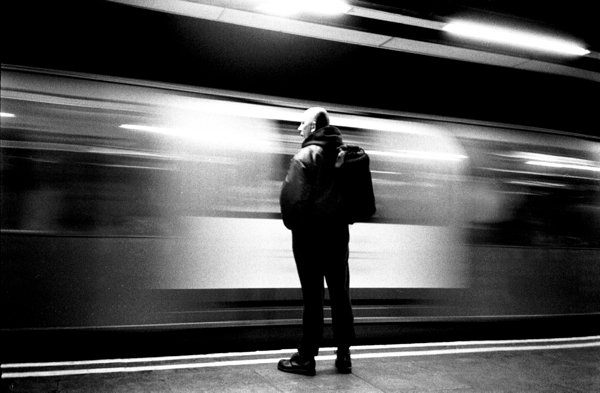
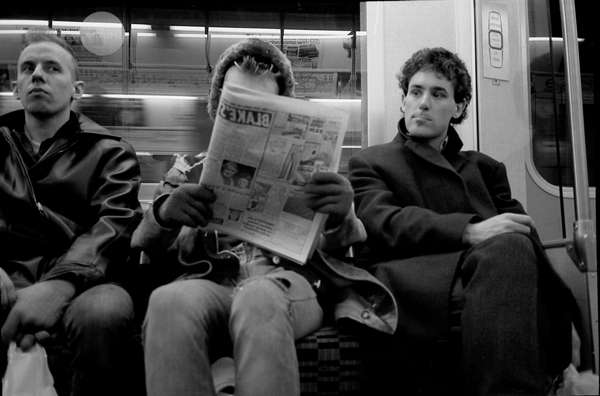
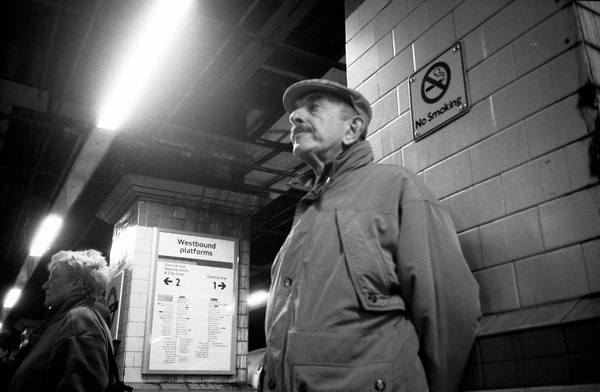
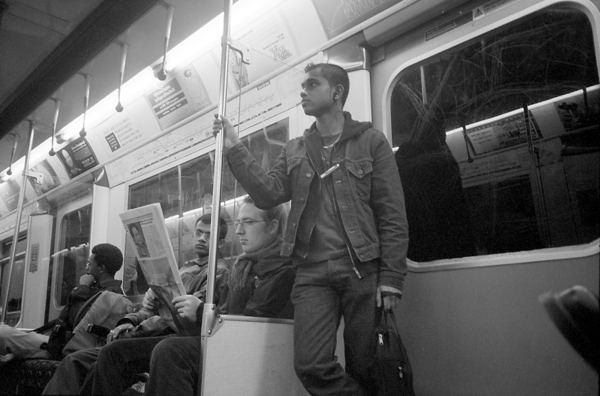
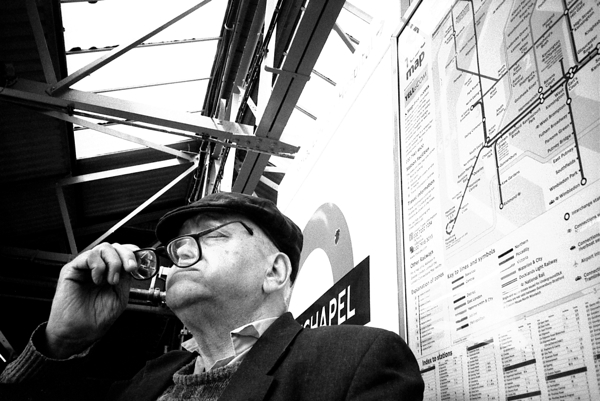
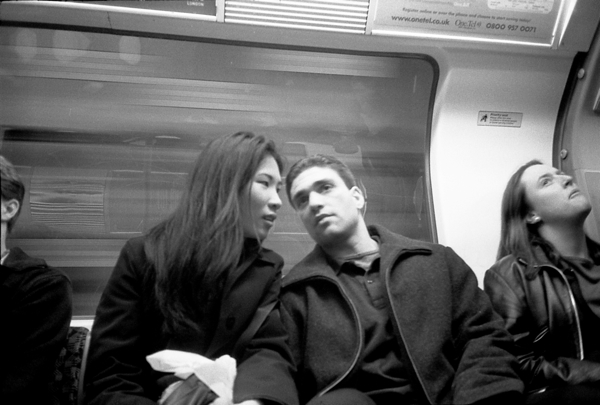
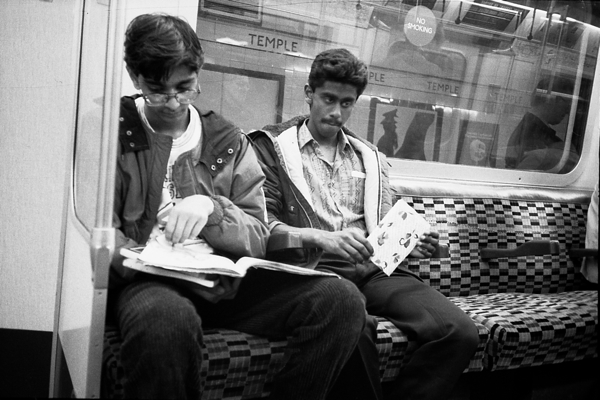
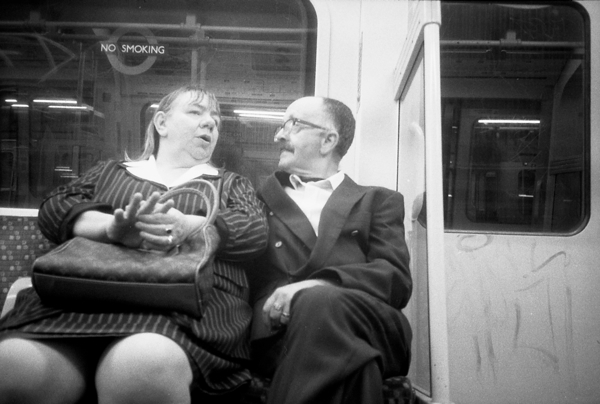
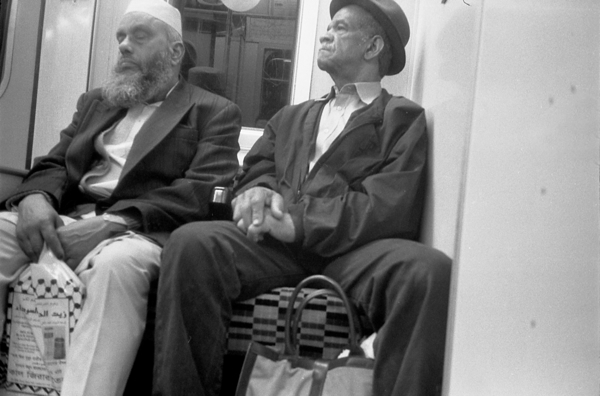
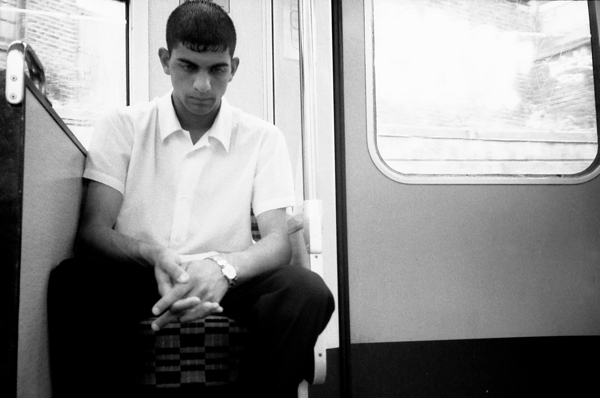
This is unique among the hundreds of pictures that East End Street Photographer Phil Maxwell has taken on the tube in the last thirty years – since he appears, reflected in the glass with his camera. On this rare occasion, Phil felt confident to raise the camera from the position he usually holds it while on the tube, nursed between his legs, because his subject was so absorbed in the newspaper.
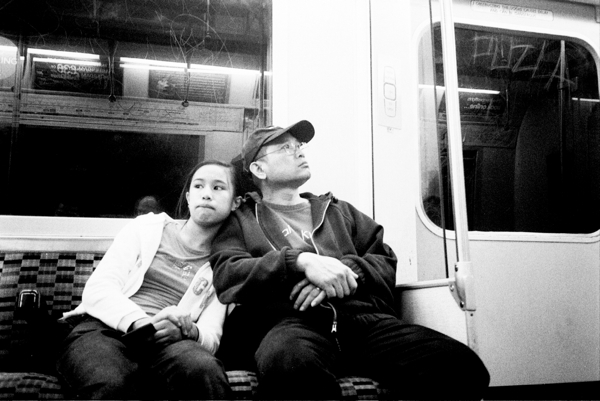
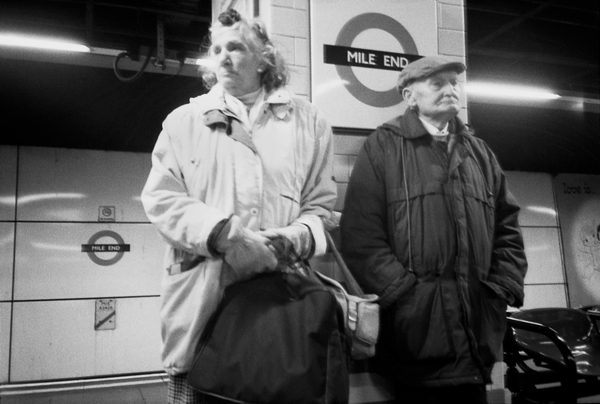
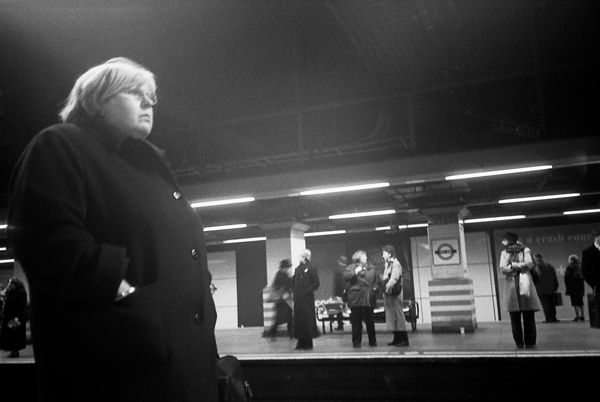
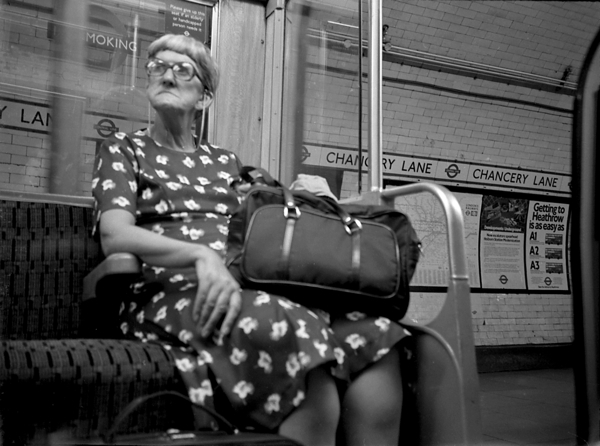
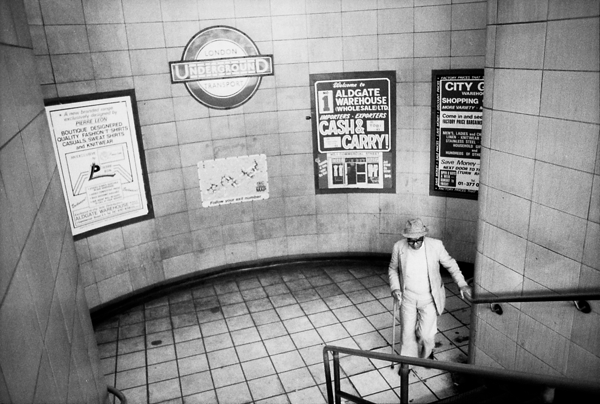
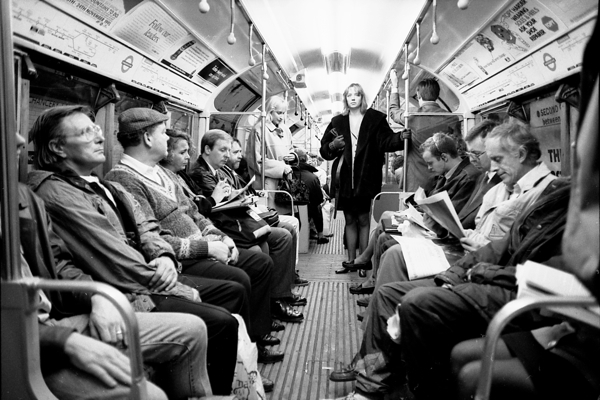
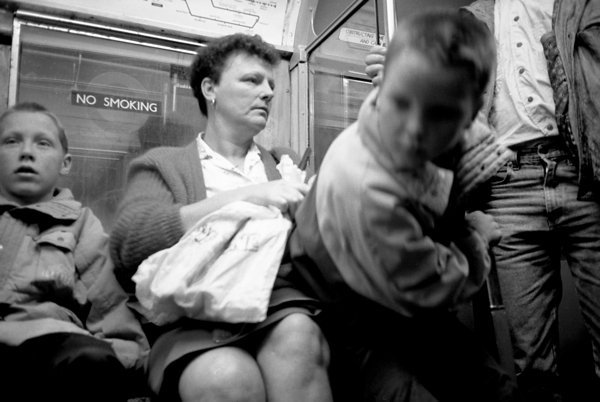
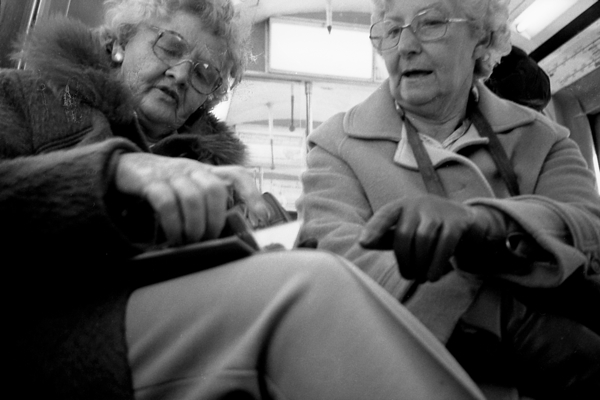
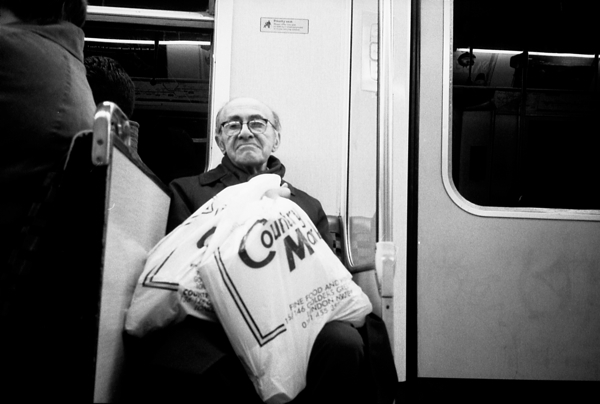
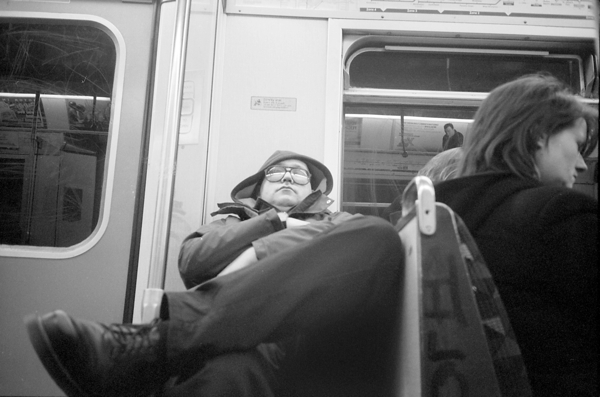
Over all this time, Phil Maxwell has perfected the trick of taking pictures without needing to look through the lens, allowing him to take these extraordinary covert photographs of unselfconscious people absorbed in their own worlds. “You have to become like a magician with the camera,” he revealed to me, “You have to know what the lens is seeing from every angle.”
This technique accounts for most of the pictures in this selection and explains the low point of view in many of them. “It’s good to photograph from low down, you see so much more,” Phil explained to me, “And it’s more challenging to the eye because we are all used to seeing at eye level.”
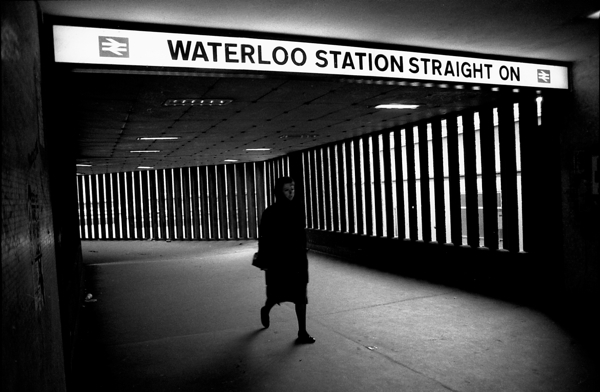
While Phil has been photographing the life of the London streets, taking pictures on the tube has proved a natural counterpoint, offering the opportunity to photograph Londoners in private within a public space.
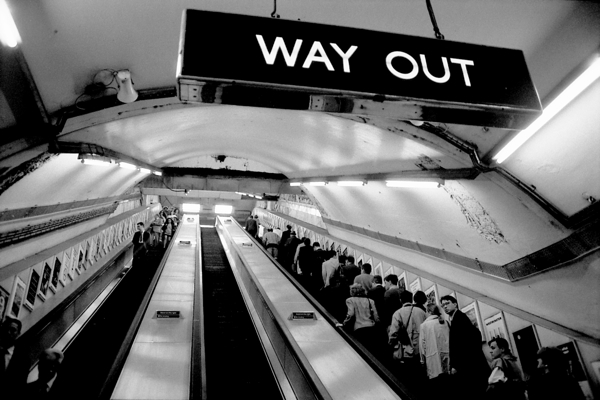
“Photographing people on the tube encapsulates all the skills required for being a street photographer. You have to deal with the constantly changing light and be judging the correct exposure. You can go from Whitechapel to the West End and it’s like travelling from day to night. In this respect, I have always regarded the tube as very special photographic studio for Londoners because it has such dramatic changes in lighting, from 100% artificial lighting one minute then bright sunlight the next.
And just as you’ve got different moods in lighting, people show different aspects of themselves at different times of day. If you take a picture at night they might be joyful and laughing from the pub, but if you take picture in the morning you will encounter the silent mournful masses – I always consider myself lucky that I don’t have a nine to five job, and there’s the evidence. Passengers may be carrying briefcases or toolboxes, but when they walk into the tube it’s as if they walk into my photographic studio.
The tube has become a very special and hallowed place for me. I’d be going from an assignment photographing a senior politician and I’d get on the tube, and I’d have as many as twenty frames left that I’d use taking pictures. If you look at my negatives, you’ll see that at one moment I am photographing Tony Blair and the next minute Mrs Smith sitting opposite me on the tube, which for me is much more interesting and enjoyable because politicians are totally plastic. It is a great joy to get on the tube, I always carry my camera with me and I always take pictures. You never know who’s going to get on and sit opposite.
People’s behaviour changes on the tube, almost as if they’ve gone into the operating theatre. Their breathing slows down and they go off and daydream, which suits me very well because they don’t realise what I’m doing when they’re on another planet.”

[vimeo http://vimeo.com/39431919 w=600&h=480]
Photographs copyright © Phil Maxwell
You can watch a film of Phil Maxwell’s tube photos by clicking here
and see more of Phil Maxwell’s work here












