
Dan Jones at Bethnal Green Library

Click to enlarge Dan Jones’ painting of St Paul’s School Wellclose Sq, 1977
Last week, Dan Jones‘ splendid mural from 1977 of children and their rhymes in the playground of St Paul’s School Wellclose Sq was installed at the Bethnal Green Children’s Library, so Spitalfields Life Contributing Photographer Chris Kelly and I went along to join the celebrations.
The Children’s Library is on your right as you enter the building and from the lobby you can see the huge colourful painting at the far end of a long room with windows facing onto the Green. Once I reached this point, I could already hear “The wheels on the bus go round and round…” sung by an enthusiastic chorus of toddlers and their mothers led by librarian Jusnara Khanam as the beginning of a day’s festivities that involved children of all different ages coming in to the library to see Dan’s painting and enjoy some lively rhymes, songs and games.
“In 1970, I was a youth worker and I ran a youth club in the hall on the right of the painting. I used to have two hundred kids dancing in there!” recalled Dan fondly, “And so most of the children in the school were known to me.” Living close by in Cable St, Dan, who began collecting rhymes in 1947, has followed the shifting currents of playground culture over all this time. “Some of these rhymes in the painting are still to be heard in the playground there,” he told me, “But others they don’t do anymore, or only sporadically.”
A local plasterer coated three boards with a fine coat of plaster to give a smooth finish for Dan to paint on and, inspired by Bruegel’s “Children’s Games,” Dan set to work upon the dining table in his front room, painting individual portraits of the children with their rhymes inscribed alongside. It took over a year’s work and Dan framed the life of the playground with the architecture of the school, including its weathervane in the shape of tall ship and Tower Bridge looming on the horizon – all portrayed beneath a distinctively occluded London sky. And now that most schools wear primary coloured shirts, it is fascinating to observe the wide variety of characterful clothing – reflecting the styles of the time – displayed by these children.
Astonishingly, the painting caused great controversy when it was first displayed, with the Daily Telegraph accusing Dan Jones of turning East End youth against the police force, because he included the rhyme – “There’s a cop, cop, copper on the corner, all dressed up in navy blue. If it wasn’t for the law, I would sock him on the jaw. And he wouldn’t be a copper any more, more, more…” A rhyme which Dan had simply recorded along with all the others in the playground.
At first, the mural graced the London’s Children’s Centre and in recent years it filled the narrow hallway of Dan’s house, but in its new home in the Children’s Library it fits perfectly, as if it had been painted for this space. Dan’s picture hangs above the library corner, where children can play or sit on the floor and read books, casting a benign spell upon this favoured spot. And it was a beautiful spectacle to observe life imitating art as Dan led the children in reciting rhymes and singing games in front of his painting crowded with these same activities. “I haven’t done enough recording of four years olds,” Dan confided to me, ever eager to expand his vast archive of thousands of rhymes he has recorded here and around the world – some of which he played for my amusement as snatches on a CD during the lunch break. Then older children arrived from Columbia School and Bangabandhu School, and it was time to go outside for more boisterous activities on the Green, enacting the life of Dan’s painting in the spring sunshine.
More than thirty years have passed since Dan made his picture – the first of several on this subject and at this scale he has done in subsequent years – yet the delighted responses of the children at Bethnal Green Library revealed that it remains as fresh and immediate as the day he completed it in 1977.

Breuegel’s “Children’s Games,” 1560 – Dan’s inspiration.


Dan added his self-portrait recently.

Dan Jones with his grandson Rumi
Photographs copyright © Chris Kelly
You may also like to take a look at
Chris Kelly & Dan Jones in the Playground
Charles Goss’ Bishopsgate Photographs

West side of Bishopsgate Without, looking north with St Leonard’s Shoreditch in the distance
One hundred years ago, when the City elected to widen Bishopsgate – the ancient meandering thoroughfare lined with straggling buildings that followed the route of Ermine St, the Roman road north from London – Charles Goss, the first Archivist at the Bishopsgate Institute was inspired to get up early in the morning and photograph the streetscapes that were shortly to vanish from the world. Working systematically, he took this set of interconnecting pictures that record the shabby old frontages at the northern end of Bishopsgate where it meets to liberty of Norton Folgate, concentrating on the west side of the street where the Broadgate Tower designed by Skidmore Owings and Merrill stands now.
There is an ethereal quality to many of Goss’ photographs taken in the grey light of dawn, with just a few early birds on their way to work and no traffic at all on the road yet. These are quiet pictures in which silence is only interrupted by the echo of footsteps. Hoardings upon Lupinsky & Brandon, the progressive tailors – suits to measure at 137 Bishopsgate – announce the impending destruction, “These premises have been acquired by the City Corporation for the widening of Bishopsgate Street.” Fortunately, business was transferring to 80 Bishopsgate directly across the road. You will observe that many businesses had already held clearance sales and vacated their shops, but the Great Eastern Rubber Company, the Dump Shop and the Norton Folgate Toilet Club were valiantly trading on to the bitter end.
Like Henry Dixon’s images taken for the Society for Photographing the Relics of Old London that recorded ancient buildings about to be demolished in the 1880s, Charles Goss’ pictures belong to the compelling yet melancholic school of photography which illustrates the history of loss. I can readily imagine Charles Goss getting up and leaving the house in the dark with his camera and tripod, and setting up on the pavement in Bishopsgate in the early morning drizzle, attracting curious looks from passersby and questioning himself even as he went about his business. Sensibly, he reconciled any doubt, bound the pictures into a fine book with a red leather spine and put it on the shelf at the Bishopsgate Institute, reassuring himself that he was just doing his job.
Yet behind these pictures lies an unfathomable poetry that engages with the sheer strangeness of the performance of human life – rendered tangible only in the moment when the scenery is about to be abandoned and the familiar reality of the street begins to dissolve, just like an abandoned set on the back lot of a film studio. I can only wonder what Charles Goss would make of Bishopsgate today where just a few remnants of his time exist, entirely overshadowed by the vast disproportionate recent structures resembling illustrations to a futuristic novel by H.G.Wells.

In Acorn St

West side of Bishopsgate.

Entrance to Acorn St.

Bishopsgate Without, West side.

10,000 choice cigars were sold here at less than half price.

The Great Eastern Rubber Company, Mosley’s Rubber Goods stocked here.

B.A. Marcus, Lilley & Skinner, The Lord Nelson and Devon Restaurant.

The Middleton Arms for Celebrated Welch Ale.

Lupinsky & Brandon, progressive tailors.

Spy the roofer upon the ridge above G.Ringrose.

Observe The Dump Shop and the Norton Folgate Toilet Club.

The early morning sun casts its shadow over Norton Folgate a century ago.

Bishopsgate Without viewed from Norton Folgate, 1912

Bishopsgate Without viewed from Norton Folgate, 2012
Archive pictures courtesy © Bishopsgate Institute
You may also like to look at
At City Art & Framing

Clive & Ken Woolhouse
If you should find yourself walking bent-double against the ferocious blast which howls down Artillery Lane at this time of year, you can always take refuge inside in the fine old nineteenth century warehouse that houses the gallery and workshops of City Art & Framing at number thirteen. Directly on the right of the door, shielded from draughts, you will very likely discover the Woolhouse family, Ken and Joyce with their son Clive, the picture of domestic contentment as they huddle together round the cosy fireplace where their beloved German sheepdog enjoys the warmest spot.
“My dad started the business in 1989, and years later he granted me the opportunity to take it over which gave him the chance to take some time off,” explained Clive with a significant nod to his father as he made the introductions, while pulling up another chair and inviting me to join them behind the counter and warm myself at their fireside
“I used to run a shop called New Sound, selling Bang & Olufsen electronics at 228 Bishopsgate,” continued Ken, “but when the company insisted I refurbish my shop and I didn’t have the money, I didn’t know what to do. I was looking out the window one day and a van went by with “Picture Framing” on the side, so I signed up for a week’s course and that was it. I just put a picture frame in the window and people started coming in. The workshop was upstairs on the first floor but you had to go out of the door to reach the stairs to get there, so I cut a hole in the ceiling and ran up and down a ladder every time a customer came in. Eventually, we outgrew the shop and this place came up. It had been the “London Yacht Space” where I once used to come buy things for my sailing boat.”
Joyce smiled benevolently throughout, as her husband retold the oft-rehearsed tale and I could not but notice the close resemblance between father and son, emphasised by their similar beards with Clive’s being a version of his father’s. “I always wanted to work with my dad and give him some time off.” revealed Clive,“I joined him at twenty-four and I framed the pictures so that he could work three days a week.”
“And I used to serve behind the counter and help with the accounts,” added Joyce, just to complete the portrait of this family endeavour. “I never had a day off since since 1984, until Clive came to help me,” confessed Ken, in disbelief at his former self. “Before this, I had a shop in Upminster. I heard there was this place in Bishopsgate selling off some electronics but when I came up here, I liked it so much I bought the shop.” he informed me, “I was there through two IRA bombs.” This last comment was followed by a collective silence, broken only when Clive launched into the next episode in the family narrative.
“It was on a Saturday morning and I was in the cellar when it went off – “bang,” and that was it.” he said, widening his eyes for effect,“I came upstairs and because our window was flexible, it did not break. But when I went outside, there were pieces of glass hanging out of windows and all the blinds were flying about and there was paper everywhere and the streets were full of glass.”
“We heard it on the radio and we drove up to see if he was safe. It was very scary.” interposed Joyce, revisiting her fearful emotions,“When we got here, the police wouldn’t let us through the barrier, but we said, ‘We’ve got to see our son.’ Once we arrived, I saw him through the window and he was alright, and I cried with relief.” Joyce’s face crumpled into an apologetic smile at this admission, as Ken and Clive exchanged a glance of affectionate recognition.
To move our conversation forward – once the moment had been duly observed – I asked Joyce if she was an East Ender. A question which delighted her. “My maiden name was Cladingboel, a Huguenot name.” she informed me proudly, “I was born in Hoxton Sq, but we got bombed out so my dad found us a house in Hornchurch. It was right next to the aerodrome and I could watch the planes come in.”
“My mum was born in Hoxton too and moved out to Edmonton, and my wife and I met through working in a factory in Romford.” confided Ken enthusiastically, expressing pleasure at their shared history. It was a theme that he expanded further with his next statement, as if to suggest that there were some greater plan to the workings of the metropolis which was beyond the comprehension of its inhabitants, yet might be glimpsed occasionally. “During the war, my mum used to be a conductor on a trolley bus on the route which is now the 149 that stops right outside my shop in Bishopsgate.” he said. The Woolhouse family nodded in shared satisfaction, as if to agree that this present circumstance at City Art & Framing, sitting peacefully with the German sheepdog by the fire, was the ideal outcome of events prior to that moment, both recent and historical.

Clive and his father Ken, thirty years ago.

Ken Woolhouse who started the business in 1989.

Clive Woolhouse runs the business today.

The original premises at 228 Bishopsgate.

The Woolhouse family in Artillery Lane.
City Art & Framing, 13 Artillery Lane, London, E1 7LP 020 7247 2320
Bishopsgate photograph courtesy Bishopsgate Institute
You may also like to read about
Charles Jones, Gardener & Photographer

Garden scene with photographer’s cloth backdrop c.1900
These beautiful photographs are all that exist to speak of the life of Charles Jones. Very little is known of the events and tenor of his existence, and even the survival of these pictures was left to chance, but now they ensure him posthumous status as one of the great plant photographers. When he died in Lincolnshire in 1959, aged 92, without claiming his pension for many years and in a house without running water or electricity, almost no-one was aware that he was a photographer. And he would be completely forgotten now, if not for the fortuitous discovery made twenty-two years later at Bermondsey Market, of a box of hundreds of his golden-toned gelatin silver prints made from glass plate negatives.
Born in 1866 in Wolverhampton, Jones was an exceptionally gifted professional gardener who worked upon several private estates, most notably Ote Hall near Burgess Hill in Sussex, where his talent received the attention of The Gardener’s Chronicle of 20th September 1905.
“The present gardener, Charles Jones, has had a large share in the modelling of the gardens as they now appear, for on all sides can be seen evidence of his work in the making of flowerbeds and borders and in the planting of fruit trees. Mr Jones is quite an enthusiastic fruit grower and his delight in his well-trained trees was readily apparent…. The lack of extensive glasshouses is no deterrent to Mr Jones in producing supplies of choice fruit and flowers… By the help of wind screens, he has converted warm nooks into suitable places for the growing of tender subjects and with the aid of a few unheated frames produces a goodly supply. Thus is the resourcefulness of the ingenious gardener who has not an unlimited supply of the best appurtenances seen.”
The mystery is how Jones produced such a huge body of photography and developed his distinctive aesthetic in complete isolation. The quality of the prints and notation suggests that he regarded himself as a serious photographer although there is no evidence that he ever published or exhibited his work. A sole advert in Popular Gardening exists offering to photograph people’s gardens for half a crown, suggesting wider ambitions, yet whether anyone took him up on the offer we do not know. Jones’ grandchildren recall that, in old age, he used his own glass plates as cloches to protect his seedlings against frost – which may explain why no negatives have survived.
There is a spare quality and an uncluttered aesthetic in Jones’ images that permits them to appear contemporary a hundred years after they were taken, while the intense focus upon the minutiae of these specimens reveals both Jones’ close knowledge of his own produce and his pride as a gardener in recording his creations. Charles Jones’ sensibility, delighting in the bounty of nature and the beauty of plant forms, and fascinated with variance in growth, is one that any gardener or cook will appreciate.

Swede Green Top

Bean Runner

Stokesia Cyanea

Turnip Green Globe

Bean Longpod

Potato Midlothian Early

Pea Rival

Onion Brown Globe

Cucumber Ridge

Mangold Yellow Globe

Bean (Dwarf) Ne Plus Ultra

Mangold Red Tankard

Seedpods on the head of a Standard Rose

Ornamental Gourd

Bean Runner

Apple Gateshead Codlin

Captain Hayward

Larry’s Perfection

Pear Beurré Diel
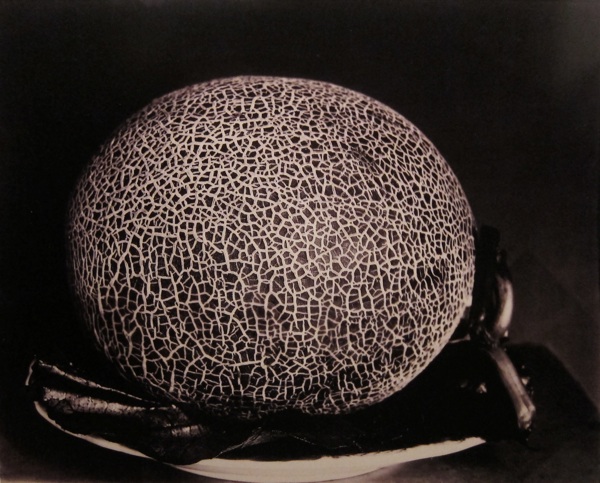
Melon Sutton’s Superlative

Mangold Green Top

Charles Harry Jones (1866-1959) c. 1904
The Plant Kingdom of Charles Jones by Sean Sexton & Robert Flynn Johnson available here
You might also like to read about
The Secret Gardens of Spitalfields
Thomas Fairchild, Gardener of Hoxton
Buying Vegetables for Leila’s Shop
Jocasta Innes, Writer, Cook & Paint Specialist

Even before I met her, Jocasta Innes had been part of my life. I shall never forget the moment in my childhood, shortly after my father lost his job, when my mother came home with a copy of “The Pauper’s Cookbook” by Jocasta Innes, engendering a sinking feeling as I contemplated the earthenware casserole upon the cover – which conjured a Dickensian vision of life sustained upon gruel. Yet the irony was that this book, now a classic of its kind, contains a lively variety of recipes which although frugal in ingredients are far from mundane.
Imagine my surprise when I went round to Jocasta’s kitchen in the magnificent hidden eighteenth century house in Spitalfields where she has lived since 1979 and there was the same pot upon the draining board in her kitchen. I opened the lid in wonder, fascinated to come upon this humble object after all these years – an image I have carried in my mind for half a lifetime and now an icon of twentieth century culture. It was full of a tomato sauce, not so different from photograph upon the famous book cover. Here was evidence – if it should ever be needed – that Jocasta has remained consistent to her belief in the beauty of modest resourcefulness, just as the world has recognised that her thrifty philosophy of make-do-and-mend is not just economic in straightened times but also allows people the opportunity to take creative possession of their personal environment – as well as being a responsible use of limited resources.
“That was the one that made me famous,'” Jocasta admitted to me as we sat down at her scrubbed kitchen table with a copy of “The Pauper’s Cook Book,” “I continually meet people who say, ‘I had that book when I was a student and left home to live on my own for the first time.'” And then, contemplating the trusty hand-turned casserole, she confided, “A lot of people didn’t like the slug of gravy running down the side on the cover.”
Yet “The Pauper’s Cookbook,” was just the beginning for Jocasta. It became one of a string of successful titles upon cookery and interior design – especially paint effects – that came to define the era and which created a business empire of paint ranges and shops at one point. Today, Jocasta still lives in the house that she used to try out her ideas, where you can find almost every paint effect illustrated, and where I visited her to learn the story of this resourceful woman who made a career out of encouraging resourcefulness in others.
“It all started when I was living in this tiny backstreet cottage in Swanage which was only fourteen foot six inches wide and I wanted to give it a bit of style. I got a book of American Folk Art from the library and plundered it for designs, cutting my own stencils out of cereal boxes. And I did a design on the walls of my little girls’ bedroom with tulips up the walls, it was so incredibly pretty.
I thought my parents had unbelievably bad taste, although I realise now it was part of the taste of their time. They loved the colours of rust and brown which I loathe but what captured my imagination was that they had some beautiful Chinese things. My father worked for Shell in China and I was born in Nanjing, one of four children. It was very lonely in a way. There were only about a dozen other children who weren’t Chinese and there wasn’t much mixing in those days. My mother taught eight to ten of us in a dame’s school with an age range of eight to thirteen. I don’t know how she did it. We had exams and there was a lot of rivalry, because if your younger sister did better than you it was pretty painful. She was a Girton Girl and must have taught us pretty well because we all went to Cambridge and so did my daughters.
I worked for the Evening Standard for a while but I was very bad journalist because I was too timid. I’ve always lived by writing and because I had done French and Spanish at Girton, I could do translations. I was desperately poor when I left my first husband and lived in Swanage, so I grabbed any translation work I could and I translated five bodice rippers from French to English, about a tedious girl called Caroline. I got so I could do it automatically and, me and my second husband, we lived on that. We just made ends meet.
“The Pauper’s Cookbook” was my first book and I had a lot of fun doing it. I planned it on two and sixpence per person per meal which would now be about 50p. And I followed it with “The Pauper’s Homemaking Book.” My mother did the embroidery and I covered a chair, it was tremendously home made and full of innocent delight in being a bit clever.
Publisher Frances Lincoln thought the chapter on paint effects could become its own book and that was “Paint Magic.” I fell in with some rich relations who had estate painters trained by Colefax & Fowler and I watched them dragging a lilac wall with pale grey and it was riveting. I didn’t know about glazes, my attempts were primitive compared to theirs. One of John Fowler’s young men, Graham Shire, he taught me how to do tortoiseshell effect and when he showed me the finished result, he said, “Magic!” Nobody liked the title at first. We had a book launch at Harrods and I thought it was going to be a handful of hard-up couples who wanted to decorate their bedsits but half the audience were rich American ladies who had flown over specially and we sold three hundred copies, pretty good for a book about paint.
I was offered a job by Cosmopolitan as Cookery and Design Editor. It was the only time I earned what I would call big money and I sent my girls to college and put my youngest daughter through Westminster School. Once I turned my back on it, I found all the debutantes in London were learning paint finishes and starting little colleges to teach it, and the bottom fell out of the paint finish market. A friend showed me a book called “Shaker Style” and I thought, ‘The writing’s on the wall.”
When I sold the house in Swanage and came to London in 1979, I only had a small amount of money. I was a single parent and my children were six and four. Friends told me to look for a house at the end of the tube lines. But I came on a tour around Spitalfields and Douglas Blaine of the Spitalfields Trust said to me, sotto voce, “I think this one might interest you.” It was part of a derelict brewing complex and the windows were covered with corrugated iron. I climbed onto the roof of what is now my larder and got in through an upper window, I prised apart the corrugated iron to let in the light and saw the room was waist deep in old televisions, mattresses, fridges and cookers. Later, I pulled up five layers of lino with bottletops between them that nobody had bothered to remove. It was tremendously mad, but fun and exciting. I said to Douglas, “I’m up for this!”
I’ve always been a gifted amateur and I think I do best in adversity.”

The Pauper’s Cookbook, first published 1971.

Jocasta’s casserole is an icon of twentieth century culture.

“The Pauper’s Cookbook” made me famous but I am more fond of my “Country Kitchen.”

Jocasta shows you how to do it yourself in her Spitalfields house in the nineteen eighties.
Portrait of Jocasta Innes © Lucinda Douglas-Menzies
At London Trimmings

Moosa, Ashraf & Ebrahim Loonat
If you ever wondered where the Pearly Kings & Queens get the pearl buttons for their magnificent outfits, I can disclose that London Trimmings – the celebrated family business run by the three Loonat brothers in the Cambridge Heath Rd – is the place they favour. And with good reason, as I discovered when I went round to investigate yesterday, because this shop has a mind-boggling selection of wonderful stuff at competitive prices.
Zips and buttons and buckles and threads and tapes and ribbons and snap fasteners and elastic and eyelets and cords and braids and marking chalk and pins, and a whole lot of other coloured and sparkly things, comprise the biggest magpie’s nest on the planet. Now I shall no longer go to fancy West End stores to buy taffeta ribbon to tie up my gifts and pay several pounds for just a couple of metres – not since I discovered that here in Whitechapel you can get a whole reel for five quid and choose from every colour of the rainbow too.
With his lively dark brown eyes and personable nature, Moosa Loonat was my expert guide to this haberdashery labyrinth. He took me on a tour starting in the trade orders department which occupies one of London Trimmings’ two premises in this fine red brick nineteenth century terrace of shops, built by the brewery that once stood across the road. Translucent glass windows might discourage the casual customer, but in fact everyone is welcome in this extraordinary store which feels more like a warehouse than a shop.
Once we had trawled through the crowded aisles here and in the basement, with Moosa pulling out all imaginable kinds of zips and buckles and toggles to explain the stories behind each and every one, he assured me with a proprietorial grin, “I know where everything is, because if you pay for it you know.” I surmise that Moosa said this because while everything has its place at London Trimmings, the overall effect might be described as organised chaos of the most charismatic kind.
Yet, as we explored, Moosa told me the story of the business and I learned there was even more going on here than you can see on the crowded shelves of this extraordinary emporium.
“The shop was started by my father Yousuf Loonat and his partner Aziz Matcheswala in 1971 at the corner of Whitechapel High St and New Rd. My dad came to this country from Gujurat just after the war. He went to Bradford where all the mills were and he worked his way down to Leicester, and from Leicester to London. He told me, at first, he worked in a factory manufacturing street lights and, in Leicester, he went into the food trade and then he got into the textile trade.
At eight years old, I used to go and help count out buttons for my father. Every single holiday, he’d say, “I’ve got lots of work for you.” In 1987, when I was seventeen years old, my father and his partner split, so he gave me a choice – “Either go to university or join the family business – but if you don’t, I’ll sell it.” I took the opportunity and I’m happy that I did. That choice was offered to my brothers too and we realised that if we didn’t all club together, we would lose it. Now every brother runs a different department.
In 1985, we had a fire and lost everything – a couple of hundred thousand pounds of stock and we only had thirty thousand pounds insurance. It was an arson attack. I remember it clearly, it was a dramatic time for the family and my dad was really upset. All our suppliers helped us, they put a freeze on what we owed them until we could repay it and allowed us a new credit account. They contributed to fitting out this new shop in the Cambridge Heath Rd too, they even paid for the sign.
It was busy in the old days, everything was sold by the box then, we had four or five vans in the road and we wouldn’t even entertain student customers. Fifteen years ago, every shop in Brick Lane had a factory above it. In this immediate neighbourhood, we had a thousand customers, now we have a hundred here. We supply the leather trade, the bag trade, the garment trade, the jacket trade, the dry-cleaning and alteration trade, and the shoe repair trade. We cater to students who buy one button and to designers like Mulberry, Hussein Chayalan, Vivienne Westwood and Alexander McQueen, and to High St stores like Top Man and River Island. During London Fashion Week, we had forty people in the shop all wanting to be served first.
Our main speciality is zips, you can buy one for 5p up to £20. We have two hundred different styles and each comes in several sizes. Other suppliers only stock up to No 5, but we have No 6, No 7, No 8, No 9, and No 10 -we even have No 4. We have double-ended zips, fluorescent zips, invisible zips, plastic zips, pocket zips, copper zips, aluminium zips, steel zips, nickel zips, satin zips and waterproof zips.
One customer comes from Ireland, an eighty-five year old man, he comes over every month with a suitcase, packs it up and is gone. Another customer comes regularly from Iceland, she spends two days in here to see what’s new. We had one tailor, he sent back an empty box of 1,044 pins he bought twenty-five years previously, saying “I’d like another one but this is the last I will need because I am over seventy.” Sometimes, people ring from New Zealand to buy press fasteners for the covers on on open-top vintage cars. Kanye West came in twice before we recognised who he was, he came in four or five times altogether, choosing trimmings. He spent a couple of hours each time and had a cup of tea.
I arrive at eight-thirty and I work until seven each day. I do an eleven hour shift. I could choose not to come because I’ve got the staff, but I’m a workaholic. We don’t open at weekends but I still come in on Saturdays to catch up. One day I could be serving customers at the counter, the next day unloading a container and the next out on the road to visit customers. It’s never the same. It’s not a mundane, everything the same, day-in-day-out job. We’ve had my father, me and my nephews all in here at once – three generations working in the same place. Some of the staff have been here thirty years and all the youngsters who came to work here straight from school have stayed.
We run a tight ship financially. The last to get paid will be me and my brothers. We only get our wages if the money’s there but if it’s not, we don’t take it.”

Moosa Loonat – “The last to get paid will be me and my brothers. We only get our wages if the money’s there but if it’s not, we don’t take it.”

Teresa Brace, Manager of Haberdashery – “It’s a lot tidier on my side of the shop!”

Moosa – “As you can see, we’re short of space…”

Ebrahim Loonat

Shirley Mayhew, Accounts Department – in the trimmings business since 1980.

“the biggest magpie’s nest on the planet”

London Trimmings, 26-28 Cambridge Heath Rd, London E1 5QH. 02077902233
Mickey Davis at the Fruit & Wool Exchange
On the day Tower Hamlets Council meet to discuss the redevelopment proposals for the London Fruit & Wool Exchange in Spitalfields, it is my pleasure to publish this memoir by Mike Brooke recalling his uncle Mickey Davis – affectionately known as “Mickey the Midget” – who became a popular hero when he took the initiative to organise the shelter in the basement of the Exchange where as many ten thousand people took refuge nightly, escaping the London Blitz.

Mickey Davis & his wife Doris in the shelter beneath the Fruit & Wool Exchange, 1941
The last time I saw Mickey Davis I was as tall as him – and I was only seven or eight, back then in the Spitalfields of the early nineteen fifties. He came to my school, Robert Montefiore Primary in Deal St, as guest of honour for our annual prize giving. I recognised him in the corridor as we left the assembly hall afterwards, standing against the wall watching us return to our classrooms. I was the proudest kid on the block – because the guest of honour was my Uncle Mickey.
He was, I recall, Deputy Mayor of Stepney (the old Metropolitan borough that later became absorbed into what we now call Tower Hamlets), a very short man, a midget through an accident at birth or defect, I’m not sure exactly. But Mickey was a giant of a man to the community he served in those post-war years and a “people’s hero” of the London Blitz of 1940, several years before I was even born, as I discovered as a journalist working in the East End more than half-a-century later.
I must have been about eight when I roller-skated through the streets of Spitalfields one afternoon and found myself in Fournier St and decided to pop in to see aunt Doris and husband Mickey who lived in a large flat on the first floor of 103 Commercial St, part of the London Fruit & Wool Exchange opposite Spitalfields Church (now known as Christ Church). The kitchen overlooked the indoor wholesale trading area and there was always a faint smell of fruit and veg in the background, while the front room overlooked Commercial St, roughly level with the overhead wires of the 647 and 665 trolleybuses. It seemed quite a posh apartment to an eight-year-old.
But I didn’t go inside that afternoon. My grandmother, aunt Doris and my late father Henry’s mother, answered the door and told me immediately that uncle Mickey was dead. It was an abrupt manner to an eight-year-old, but I knew she was upset. I left and skated straight home to Granby St, along Brick Lane, rushing to tell my mother. She had not heard about Mickey yet, but knew he had been in hospital. We did not have a phone in the house in those days.
Doris and my mother Connie had been great friends during the War and worked together. It was through Doris that my mother and father met when he came home on leave from the Royal Navy in 1943. He visited his sister at work and took a fancy to Connie. They married while he was on leave and he was recalled back to Plymouth to rejoin his ship on their wedding night, so my mother once told me.
My mother immediately put a coat on and went over to see Doris that day in 1954 when I told her about the death of Uncle Mickey. It was not until decades later that I learned the full story of Mickey Davis – and how he organised a shelter committee during the early days of the Blitz at the Spitalfields Fruit & Wool Exchange – when the BBC contacted my family in the nineteen eighties, researching a possible documentary, though I do not think the programme was ever made. It was another two decades before I did my own research for an article about Mickey Davis for a commemorative supplement in the East London Advertiser, where I was Features Editor, marking the seventieth anniversary of the start of the Blitz in September 2010,.
Mickey, who at three feet three inches tall was known as ‘”the Midget,” was an East End optician who threw his energies into organising and improving shelter life, I wrote. He had emerged as the unofficial leader who pushed for improvements to health and safety in one of the East End’s biggest air raid shelters at the Spitalfields Fruit & Wool Exchange in Brushfield St. While the local authority, Stepney Borough Council, was concerned by the 2,500 people crammed into the shelter each night, with its lack of sanitation, risking disease and infection, and lack of facilities for food, lighting and heating, it was left to Mickey set up first aid and medical units, and raise money to equip a dispensary. He even persuaded stretcher bearers and others to come in on their off duty times to minister to the sick and injured. As a popular activist and orator, he became indispensable to the people, pushing the authorities into action.
Long before medical posts became the official practice, well-to-do friends of Mickey provided his Spitalfields public shelter with drugs and equipment. A GP friend made two-hour journeys each day to the East End to spend his nights among the poor. Eight years before the NHS was set up, Mickey’s shelter in 1940 had a free medical service already up-and-running. He even devised a card index system of everyone who used the shelter, and introduced hygiene practices and protection against disease. He persuaded Marks & Spencer to donate money for a canteen and used the profits to provide free milk for children. When the wartime Government eventually appointed official shelter marshals, Mickey was replaced – but the first action of the Spitalfields Shelter Committee undertook was to vote him to be Shelter Marshal, responsible for 2,500 people.
His thinking in 1940 was a fore-runner of the post-war Welfare State that emerged in 1948. He was a man known affectionately among East Enders as “the midget with the heart of a giant.”That was the Mickey Davis, who I am proud to have called “uncle.”

Mickey Davis, popularly known as “Mickey the Midget,” who became a hero of the London Blitz – photo by Bert Hardy

Mickey (in the foreground) convenes a planning meeting in the basement of the Fruit & Wool Exchange in 1941 – photo by Bert Hardy

Musical entertainment for people sleeping in “Mickey’s Shelter” in the Fruit & Wool Exchange.

The space of “Mickey’s Shelter” unchanged today.

Graffiti remaining from the days of the shelter in the basement of the Fruit & Wool Exchange.

The Fruit & Wool Exchange today.

The Auction room at the Fruit & Wool Exchange in the nineteen thirties.
Bert Hardy photographs © Getty Images
Photo of Auction Room courtesy Bishopsgate Institute
You may also like to read about


