
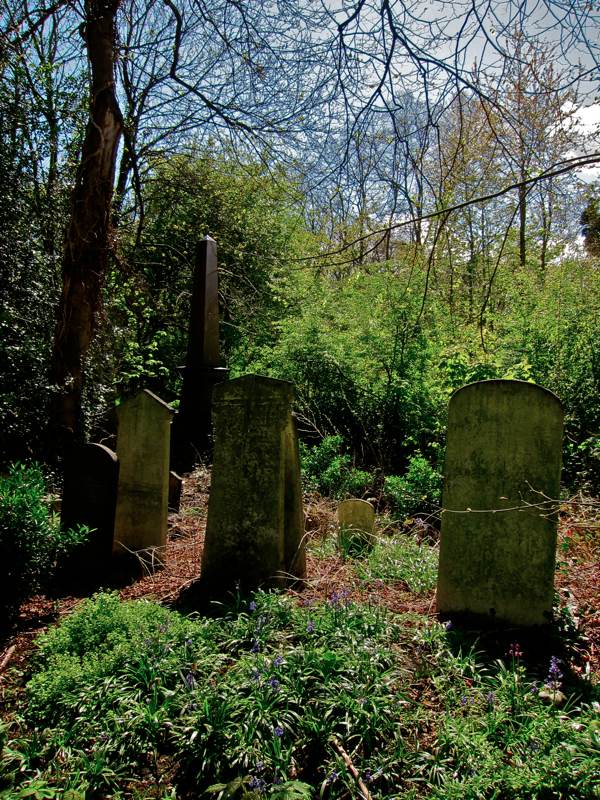
Bluebells at Bow Cemetery

With a few bluebells in flower in my garden in Spitalfields, I was inspired make a visit to Bow Cemetery and view the display of bluebells sprouting under the tall forest canopy that has grown over the graves of the numberless East Enders buried there. In each season of the the year, this hallowed ground offers me an arcadian refuge from the city streets and my spirits always lift as I pass between the ancient brick walls that enclose it, setting out to lose myself among the winding paths, lined by tombstones and overarched with trees.
Equivocal weather rendered the timing of my trip as a gamble, and I was at the mercy of chance whether I should get there and back in sunshine. Yet I tried to hedge my bets by setting out after a shower and walking quickly down the Whitechapel Rd beneath a blue sky of small fast-moving clouds – though, even as I reached Mile End, a dark thunderhead came eastwards from the City casting gloom upon the land. It was too late to retrace my steps and instead I unfurled my umbrella in the cemetery as the first raindrops fell, taking shelter under a horse chestnut, newly in leaf, as the shower became a downpour.
Standing beneath the dripping tree in the half-light of the storm, I took a survey of the wildflowers around me, primroses spangling the green, the white star-like stitchwort adorning graves, a scattering of palest pink ladies smock highlighting the ground cover, yellow celandines sharp and bright against the dark green leaves, violets and wild strawberries nestling close to the earth and may blossom and cherry blossom up above – and, of course, the bluebells’ hazy azure mist shimmering between the lines of stones tilting at irregular angles. Alone beneath the umbrella under the tree in the heart of the vast graveyard, I waited. It was the place of death, but all around me there was new growth.
Once the rain relented sufficiently for me to leave my shelter, I turned towards the entrance in acceptance that my visit was curtailed. The pungent aroma of wild garlic filled the damp air. But then – demonstrating the quick-changing weather that is characteristic of April – the clouds were gone and dazzling sunshine descended in shafts through the forest canopy turning the wet leaves into a million tiny mirrors, reflecting light in a vision of phantasmagoric luminosity. Each fresh leaf and petal and branch glowed with intense colour after the rain. I stood still and cast my eyes around to absorb every detail in this sacred place. It was a moment of recognition that has recurred throughout my life, the awe-inspiring rush of growth of plant life in England in spring.




You may also like to read about
Find out more at www.towerhamletscemetery.org
In the Footsteps of C.A. Mathew
One hundred years ago yesterday, 20th April 1912, C.A.Mathew took photographs on the streets of Spitalfields. Today I publish my pictures of the same views as they are now.


It is a hundred years ago this week that C.A.Mathew visited Spitalfields in April 1912, but he was present once again as my invisible guide when I walked through the close-knit streets to take new pictures in the same locations, and make a photographic assessment of the changes that a century has brought. I had copies of his pictures with me, and in each instance I held them up to ascertain the correct alignment of buildings and other landmarks that told me I was in the same spot exactly.
Being in his footsteps revealed that C.A.Mathew composed his photographs to expose the most sympathetic play of light and shade, demonstrating a subtlety of tone that I dare not attempt to replicate in a different season at another time of day, in another age. Yet there was the delight of recognition when I knew I had found the right place and a sense of dislocation when there was no clue left. Disoriented, I found myself half in the world of a century ago and half in the present day.
When I discovered locations that cross-referenced precisely with the pictures, I felt a sense of elation because the street acquired a whole new dimension and the people in the old photographs took on a more tangible reality, as I contemplated the places where they stood. I relished being party to this secret knowledge and I knew C.A.Mathew was with me. But equally, I recognised an emptiness in the areas that are unrecognisably changed, and recent buildings appeared mere transient constructions to my eyes that had grown accustomed to the world of 1912. C.A.Mathew forsook me in these places, and I refrained from taking photographs when I could find no visible connection. Yet I told myself to resist sentimentality, because the world that C.A.Mathew photographed two years before World War I was one of flux too, only in his pictures could it be fixed eternally.
All streets belong to cars today and we cannot linger on the roadway or step off the pavement without risking our lives. A fact that became vividly apparent to me when I stood momentarily in the middle of the Bishopsgate traffic, risking my safety in my attempt to discover C.A.Mathew’s vantage point upon Middlesex St, before following his path Eastward. I have always been fascinated by the change of scale and atmosphere, walking from the expanse of Bishopsgate through into the medieval streets at the edge of Spitalfields. And in C.A.Mathew’s pictures this change is also emphasised by social contrast, because he found these small streets full of people that lived there. There is a domestic quality that continues to draw me back to these streets, alleys and byways which still evoke their previous inhabitants through scale and form. A century ago, Bishopsgate was a major thoroughfare as it is now – and both my pictures and C.A.Mathew’s show people going somewhere. However in the alleys which are no longer inhabited as they once were, people do not occupy the space with the same sense of belonging as their predecessors in these photographs. They were more at home in these streets than we are today.
Unlike C.A.Mathew, my walk was on a working day and I found myself surrounded by suits, participants in the omnipresent corporate drama of the City, as hundreds of anxious business men took to the streets for a lunchtime walk in the September sunshine. They had escaped the office for a furtive cigarette, to make a private call or have confidential discussions about problems at work. Some passersby spied me with suspicious fleeting curiosity as I stood to take my pictures, very different from the people of a century ago who stood in groups to participate in the novelty of a photograph. Yet I delighted in the exotic drama of everyday life in the twenty-first century, seeing it from the perspective of C.A.Mathew.


In this photograph, only the bollard on the left hand side remains from the earlier picture.
C.A.Mathew’s photographs courtesy Bishopsgate Institute
C.A.Mathew, Photographer
I am republishing my story about C.A. Mathew to commemorate the centenary of the day he walked out of Liverpool St Station and spent an afternoon taking photographs in Spitalfields. His pictures have subsequently become our primary visual record of that time, and tomorrow you can see my photographs of the same views as they are now.

In Crispin St, looking towards the Spitalfields Market
On Saturday April 20th 1912, C.A.Mathew walked out of Liverpool St Station with a camera in hand. No-one knows for certain why he chose to wander through the streets of Spitalfields taking photographs that day. It may be that the pictures were a commission, though this seems unlikely as they were never published. I prefer the other theory, that he was waiting for the train home to Brightlingsea in Essex where he had a studio in Tower St, and simply walked out of the station, taking these pictures to pass the time. It is not impossible that these exceptional photographs owe their existence to something as mundane as a delayed train.
Little is known of C.A.Mathew, who only started photography in 1911, the year before these pictures and died eleven years later in 1923 – yet today his beautiful set of photographs preserved at the Bishopsgate Institute exists as the most vivid evocation we have of Spitalfields at this time.
Because C.A.Mathew is such an enigmatic figure, I have conjured my own picture of him in a shabby suit and bowler hat, with a threadbare tweed coat and muffler against the chill April wind. I can see him trudging the streets of Spitalfields lugging his camera, grimacing behind his thick moustache as he squints at the sky to apprise the light and the buildings. Let me admit, it is hard to resist a sense of connection to him because of the generous humanity of some of these images. While his contemporaries sought more self-consciously picturesque staged photographs, C.A.Mathew’s pictures possess a relaxed spontaneity, even an informal quality, that allows his subjects to meet our gaze as equals. As viewer, we are put in the same position as the photographer and the residents of Spitalfields 1912 are peering at us with unknowing curiosity, while we observe them from the reverse of time’s two-way mirror.
How populated these pictures are. The streets of Spitalfields were fuller in those days – doubly surprising when you remember that this was a Jewish neighbourhood then and these photographs were taken upon the Sabbath. It is a joy to see so many children playing in the street, a sight no longer to be seen in Spitalfields. The other aspect of these photographs which is surprising to a modern eye is that the people, and especially the children, are well-dressed on the whole. They do not look like poor people and, contrary to the widespread perception that this was an area dominated by poverty at that time, I only spotted one bare-footed urchin among the hundreds of figures in these photographs.
The other source of fascination here is to see how some streets have changed beyond recognition while others remain almost identical. Most of all it is the human details that touch me, scrutinizing each of the individual figures presenting themselves with dignity in their worn clothes, and the children who treat the streets as their own. Spot the boy in the photograph above standing on the truck with his hoop and the girl sitting in the pram that she is too big for. In the view through Spitalfields to Christ Church from Bishopsgate, observe the boy in the cap leaning against the lamppost in the middle of Bishopsgate with such proprietorial ease, unthinkable in today’s traffic.
These pictures are all that exists of the life of C.A.Mathew, but I think they are a fine legacy for us to remember him because they contain a whole world in these few streets, that we could never know in such vibrant detail if it were not for him. Such is the haphazard nature of human life that these images may be the consequence of a delayed train, yet irrespective of the obscure circumstances of their origin, this is photography of the highest order. C.A.Mathew was recording life.

Looking down Brushfield St towards Christ Church, Spitalfields.

Bell Lane looking towards Crispin St.

Looking up Middlesex St from Bishopsgate.

Looking down Sandys Row from Artillery Lane – observe the horse and cart approaching in the distance.

Looking down Frying Pan Alley towards Crispin St.

Looking down Middlesex St towards Bishopsgate.

Widegate St looking towards Artillery Passage.

In Spital Square, looking towards the market.

At the corner of Sandys Row and Frying Pan Alley.

At the junction of Seward St and Artillery Lane.

Looking down Artillery Lane towards Artillery Passage.

An enlargement of the picture above reveals the newshoarding announcing the sinking of the Titanic, confirming the date of this photograph as 1912.

Spitalfields as C.A.Mathew found it, Bacon’s “Citizen” Map of the City of London 1912.
Photographs courtesy of Bishopsgate Institute
Spitalfields Antiques Market 28

Charlotte Hamilton‘s parents were antiques dealers and, after studying graphic and interior design, she has been stalling out in Spitalfields while she decides what to do next. “It’s my first year out of university and I’m not rushing into the daily grind of nine to five,” she admitted to me candidly, even though she got up at five thirty that morning to drive up from Surrey and would not be home until seven that night. I could not but admire her pertinacity, so I joined her behind the stall for a chat during a quiet spell, where I found her taking care of a lively terrier by the name of Drum and consoling herself with a packet of fancy macaroons.

This is Bill Smith who has been thirty years in the antiques trade, pictured here with his partner Kevin Costello. “I come from Shoreditch, my dad was a dealer in Bermondsey Market, and I started working with him when I was fifteen,” Bill admitted to me, “there are customers here in Spitalfields, who have been coming every week, that I remember from Bermondsey when they used to buy from my dad.” It was astonishing evidence of the continuity which exists in the apparently transient world of markets, and of the paramount significance of integrity and reputation among the dealers. “I have one lady who has been coming every single Thursday for years from Chelmsford, she always buys something from me and takes it back with her.” he boasted.

These three eager young men, James Bullock, Oliver Griffith & Oliver Dyson, have teamed up to run a stall together. “My dad’s a dealer in Camden Passage and since I was fourteen I’ve done markets with my mum,” explained Oliver Griffith, who also works as a projectionist at the Rio cinema to support his nascent career in the antiques trade. Backing him up with moral support and practical assistance are his pals Oliver Dyson and James Bullock. It was Oliver Dyson’s idea to stall out in Spitalfields and James Bullock completes the trio as driver.

David Tilleke sold his first print in 1977 when he was a young Army Officer in Germany and involved in a Nato exercise. During a night shift while waiting for the action to start, David hand-tinted some old lithographs, until he was interrupted by General Farndale, Commander 1(British) Corps. “I am hand-colouring a few antique prints, General,” was David’s reply to the inevitable query.“Are they for sale?” was the unexpected response from the Commander, “I’ll take three.” In 1987, David quit his job as General Manager of Phillips Antique & Fine Art Auctioneers and forsook his corporate career to work independently. “I’ve always been in love with interesting old things,” he confessed to me with a delighted smile, “And it’s kept me my whole life – kept me poor!” www.antiqueprintshop.co.uk

CELEBRATING THE BOOK OF SPITALFIELDS LIFE
Please join me for a glass of wine at Foyles Gallery at Foyles Bookshop in the Charing Cross Rd next Tuesday 24th April from 6:30 – 7:30pm to view the exhibition of FIFTY SPITALFIELDS MARKET PORTRAITS by Jeremy Freedman, and bring your antiquities and curios to have them identified and valued by three celebrated experts from Spitalfields – Andrew Coram, Harvey Derriell and my pal Bill.
Tickets are free but numbers are limited, so booking is essential – email events@foyles.co.uk to reserve your ticket.
Fifty Spitalfields Market Portraits by Jeremy Freedman continues at Foyles Gallery until Friday 27th April.
Here are my profiles of the traders you can meet on Tuesday at Foyles:
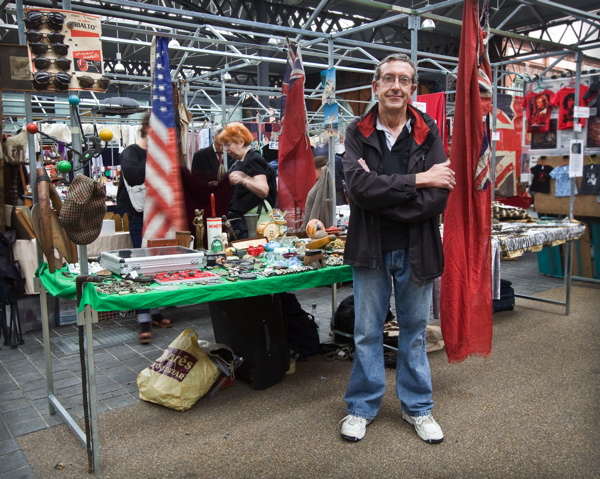
This is my pal Bill, a dignified market stalwart who deals in coins, antique whistles, gramophone needle boxes, souvenir thimbles, magic lantern slides, trading tokens, small classical antiquities and prehistoric artifacts. “I sell quite a few things, but on a low margin because it’s more interesting to have a quick turnover.” he admitted to me, speaking frankly, “I’m here more for enjoyment really – quite a few friends I’ve made over the years. I was a shy person before, but it’s made me confident having a stall. I’ve become an optimistic person.” Bill travels from Walthamstow to Spitalfields each week with all his stock in a backpack and large suitcase – practical, economic and an incentive to sell as much as possible.
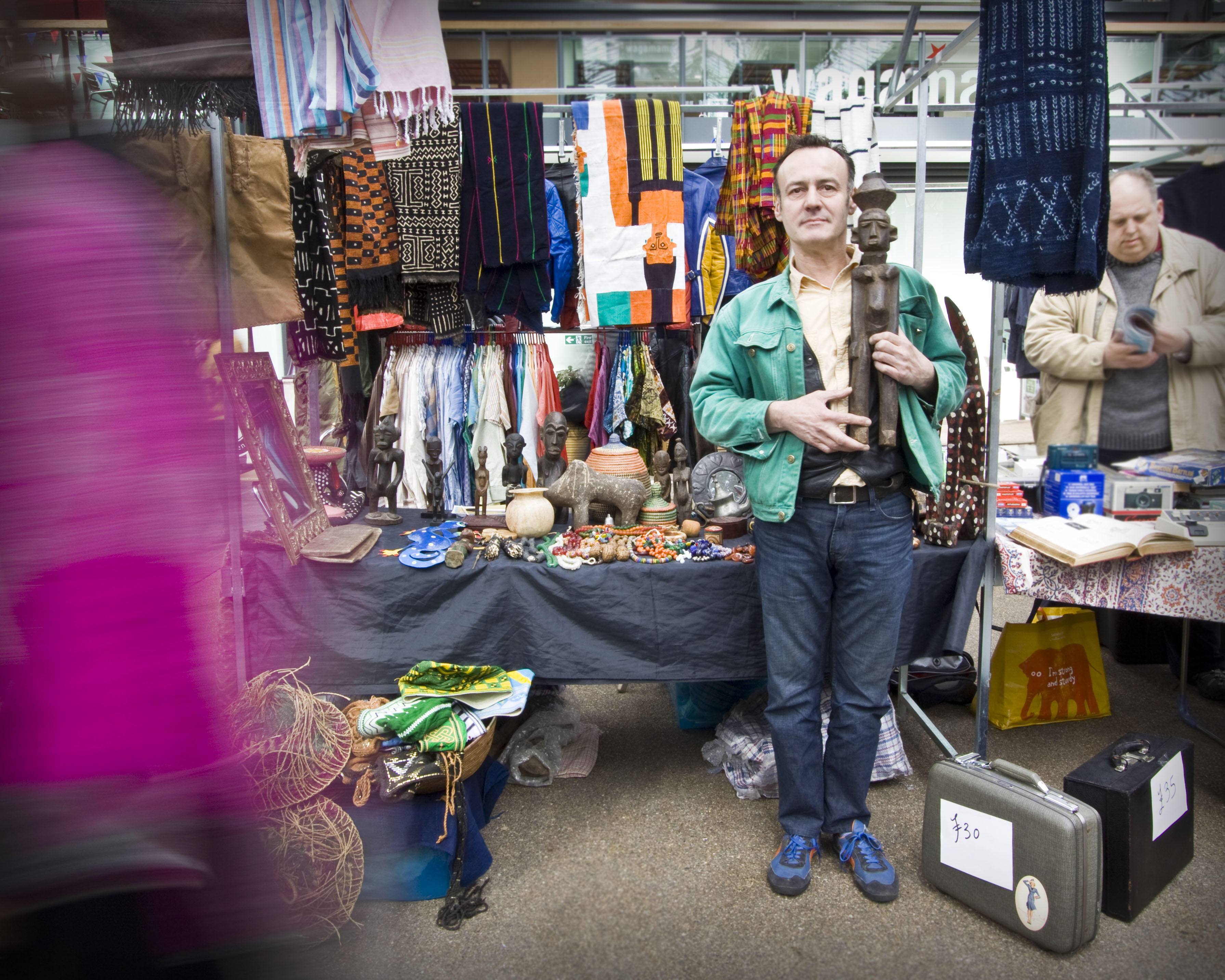
This is Harvey Derriell, a lean and soulful Frenchman of discriminating tastes, and a connoisseur of tribal art from West Africa, with his prized collection of sculptures, textiles and beads, including my own personal favourite, chevron trading beads. “Fourteen years ago, I went to Mali, and I fell in love with the place and the people and I wanted to return. Now I go back four times a year.” revealed Harvey, brimming with delight. I was dismayed to learn that the Golonina bead market is closed but Harvey reassured me that beads are still to be found. “In Bamako, they ask ‘What do you want? Drugs, gold, diamonds, girls, boys or beads?’ “ he explained.

For several years now, the most interesting shop window in Spitalfields has been that of Bedell Coram, Andrew Coram’s antique shop at 86a Commercial St. Every single day, I walk past and always direct my gaze to discover what is new. I am rarely disappointed with lack of novelty, and sometimes I am astounded by Andrew’s latest finds and ingeniously surreal displays that are worthy of Peter Blake or Marcel Duchamp.
Over a year ago, I admired three yellowed newspaper hoardings in his window, Evening Standard: THE PRINCE: TOUCHING SCENE, Evening News Late Extra: MAN-HUNT IN LEICESTER SQUARE and Evening News 6:30: LONDON HIGHWAYMEN ON WHEELS. They were gone as quickly as they appeared. “Gilbert & George bought them,” Andrew told me discreetly, “They rang to say they saw them in the window and came round next morning to buy them. They don’t usually collect old ones, they just go to the newsagent across the road each day to get them new.” Clearly, Andrew has a well-deserved following, and as I have gone about my interviews, when occasionally I have admired a delft bowl or a corner cupboard in an old house, invariably the proud owner will say, “I got it from Andrew.”
Andrew is the youngest of eight children of an antique dealer from Plymouth who was born in 1900 and died in 1980, when Andrew was still a child. His father began in domestic service and started in the antique business after World War II when the country houses of Devon were being knocked down, creating a vibrant trade in china, furniture and paintings. “He knew how to speak to those people,”explained Andrew, vividly aware of the negotiation skills that are key to his profession. When Andrew was growing up, his father was trading from Carhampton, near Minehead in Somerset, and he remembers long Summer holidays hanging around the shop. “I think my poor brother spent all his time polishing my finger marks off the mahogany furniture,” he recalled fondly.
Today, Andrew Coram is a popular figure in Spitalfields, with trenchant humour, and a fluent lyricism that he indulges when speaking of his treasured discoveries. He is a poet among antique dealers, with a melancholy streak that he resists, yet exposes when he speaks of his motives. Sitting in a chair wedged between boxes of stock, casting his eyes around at all the beautiful things that he has surrounded himself with in his shop, Andrew revealed almost apologetically, “It’s not about the money, it’s about the way that some antiques speak to you. There’s a sense of loss every time you sell something you like, which I didn’t have when I started. I think I may have lost focus. My father never lost focus because he had to support six people. It’s easy to let the things take over. You hope to do something that continually generates itself, and inspires you, so that, as you are discovering new things, you are learning more and you accumulate knowledge.”
Who cannot sympathise with this conflict? It is the quintessential dilemma that cuts to the heart of the passionate antique dealer. The modest trader spends his time searching, using his ingenuity to find wonderful things, and learns to appreciate and understand their histories, as Andrew has done. Then he collects his treasures together, and all for the purpose of disposing of them to others.
Even though his father was an antique dealer and Andrew incarnates his occupation so magnificently that I cannot think of him any other way, he did not set out to follow in his father’s footsteps. Impatient of waiting for a lucky break as an artist, Andrew started trading his personal collection in the Spitalfields Market years ago, in the days when it was free to have a stall, and he made £75 on the first day. “When you start out trading, you feel you have achieved something the first time you buy a Georgian chest of drawers or a long case clock on a hunch and it proves to be right.”, said Andrew, relating a milestone on the career path. He claims he learnt everything as he went along, that he has no conscious memories of the trade from his childhood, but I think Andrew’s upbringing accounts for the special quality of his personal sensibility that he brings to everything he does. Andrew’s unique sense of tone, his distinctive style of dress that is of no determinate period, his instinct for seeking out such charismatic artifacts and the artful displays he creates, all these attest to his special quality as an antique dealer, born and bred.
Still ambivalent about how much he chooses to keep, Andrew admitted recklessly, “There’s a part of me that would like to have nothing!” So I asked him what drew him to things that he liked and he thought for a moment, assuming his grimace of rumination. “Things that have rarity value – that you might not see again. As I said, things that speak to you. Things of which there’s a sort of … clarity about what they are … a quietness about them, even a stillness.” he replied, searching for words beyond grasp.
Then his eyes lit up, as he thought of an example to illustrate his point, and held it up, in mime,“I found this tooth, a boar’s tooth, mounted in silver with the inscription upon the base ‘Roasted upon ye Thames Jan 15th 1715/6’ – I’m not selling it!” Once we had considered this treasured momento from a frost fair together, in another mime for my delight, Andrew produced a copper pie dish with words“Lincoln’s Inn 1779” upon it, folding his fingers as if to grip the sides of the invisible dish. Then, returning to the material world, Andrew passed me a tiny delft tea bowl in pale porcelain with Chinese figures on the outside and the softest blackbird egg blue interior. It was a mid-eighteenth century English tea bowl and as I cradled it in my palm where it sat so comfortably, he told me in triumph it was worth a thousand pounds. “Holding a delicate thing like that in your hand puts you in touch the past. – it’s the story that connects us.” he said, intoxicated by the magic of the bowl, and breaking into a broad grin.
I spent much of my childhood being taken around the country antique shops of Devon and Somerset by my mother and father, and the romance of these places and my parents’ delight at their finds remain vividly with me today. I do not know if Andrew’s path and mine crossed back then, but I do know that Andrew Coram has soul and his antique shop is a proper one, of the old school, where authentic treasures are still to be found.
All portraits (except Andrew Coram) copyright © Jeremy Freedman
The Dogs of Spitalfields in Spring
Spitalfields Life contributing photographer Sarah Ainslie and writer Andrew McCaldon have been out again, braving the April showers to continue their survey of East End canines.

Paddy (Yorkshire Terrier) & Gordon Jones
“I’ve had dogs all me life but I said I wouldn’t have another one. Then my wife brought Paddy home. He’s six years old. I had to take the age of the dog into account, against the years I have left, and think, ‘Will I still be around to look after the dog?’
I originally come from Northern Ireland but I’ve lived here for fifty years. I came to do an apprenticeship as a plater at the Harland & Wolff shipyard in North Woolwich. I’d go out with the crane and set the metal plates on the sides of the ships for the riveters to attach. I’ve had quite a reasonable life. I still go back to Northern Ireland every year to see my mother –she’s ninety-three. She forgets I’m seventy-one, she still treats me like a boy.
I’ve had Paddy for a year now. He was rescued and he’s very shy because he was neglected, he’s not really come out of his shell and he won’t play with other dogs. But Paddy’s very faithful to me – he’s a one-man dog. He knows he has a home now.”

Missy (French Mastiff) & Darren
“We’ve not been together long, about five months.
The first word my wife said to me when she saw her was ‘Missy’. She’s a bit of a looker, and she’s got a very mysterious look about her, in her eyes.
She’s Miss-demeanour, she’s Miss-chevious, she’s a Miss-stery – Missy Mysterious.”

Ruby (Red Boxer) & Bernice Thompson
“Ruby started her life in the countryside in Hertfordshire, chasing pheasants and seagulls, and running after rabbits. We’d start every morning together with a walk in the woods, going ‘over the fields and far away.’
Since moving here she’s taken to the street life. We go to the launderettes, to Pelliccis – we ask for ‘Ruby’s breakfast’. Nevio creates a little bowl out of tin foil and cuts up a sausage and serves it up, asking Ruby, ‘Would you like a bowl of water with your dinner?’
She’s just an immense joy, I feel a genuine love for her. I went through four years of hell and without her I wouldn’t have got up in the morning. I worry now she’s getting old, I do.
Ruby has to smell your breath every morning – so you breathe on her face. It’s like she’s checking her puppies, her litter. I’ve done that with her every single day for the last seven and a half years.”

Sally (Wire Hair Fox Terrier) & Pablo de la Cruz
“I always dreamed of having a dog in Brazil but my Mum was allergic so I never could. When I came to live in London it was the first thing I thought about. Sally was my birthday present to myself.
My boyfriend had a dog called Sally – he told me she died tragically when she was young. So he was the one who wanted to give our new dog that name too. If it was a boy I wanted to call him George because I like the way that sounds with an English accent.
Before we had Sally – I don’t know why – there was too much focus on ourselves. Now that we have something else to think of, our relationship is more mature in a way. I always say we shouldn’t argue in front of Sally.
We share Sally and we share her love.”

Thunder (Labrador) & Georgia Pacifico
“When he was young he had all the energy of thunder! Now, he’s eleven. He doesn’t care for orders anymore – he’s had long enough of being told what to do.
Thunder’s one hundred per cent Italian and he lived for nine years in Rome. There are many more dogs in Rome than London, he had a lot more friends there. It was hotter though and he’s very furry so that was tough.
He wants to be ‘The One’ all the time, he wants to be the protagonist. He likes lady dogs but we have trouble with the other men.
He’s beautiful, he’s smart. He likes to eat pizza, our favourite. I’m not the sort of person who thinks of dogs as children – but he’s a presence, he’s always been with me. He’s old now and I can’t imagine not having him around.”

Coco (Boston Terrier/Jack Russell cross) & Ben Tidd-Cooper
“My partner named her after Coco Chanel – she’s black and white, of course.
She’s very loved and very spoiled but she’s worth it. Coco was the runt of the litter, the smallest and cutest. We didn’t realise what a responsibility having a dog would be – we learnt quickly that it’s like having a child. And I never would’ve sat in a park on my own before but, now I’ve got her, I do. It slows you down a bit too, makes you stop and go for a walk.
Coco’s been in a Vogue photo shoot! She’s quite a fashionable dog – but she still likes mud and rolling around in poo.”

Krease (Staffordshire Bull Terrier) & Glenda Lycett
“He was only born on the third of February – I’ve had him for two weeks.
He’s such a lovely traveller, on the bus, in the car. We went on a three hour trip to see my family, he sat on my lap all the way with his head on my shoulder. He played tug of war with my son’s Doberman – and won. He’s a proper East End boy!
I’ve been really ill with my breathing – but somehow, stroking him makes me relax and feel better. And after living here all my life here I’ll be moving up north with Krease soon. There’ll be a garden and woods for us both to go in.
‘Krease’ – he’d already been called that before I got him. Well, they say dogs look like their owners and I’m getting a few wrinkles now, so that suits me fine!”

Sherman (Collie) & Len Thomas
“I’ve lived in the streets round here all my life. I worked for a timber company on the Isle of Dogs – my father and my Uncle Sam did too. I was born at 54 Quaker Street, and back then as kids we used to take stray dogs home all the time.
And I’ve had a collie before, in the early seventies. I remember going down to Club Row one morning with my daughter. ‘I want a doggie, I want a doggie,’ she kept saying and like an idiot I bought it for her. I looked after that dog – we called her Sheba – for sixteen years.
Sherman’s eleven years old now. Some of my family think I’m crazy having another dog at my age. But when I was at The Dog’s Trust, they thought I might like Sherman, and so they went off and brought him out to show me. Soon as I saw him coming, I said to my daughter, ‘If that’s the dog they’re bringing for me, I’ll have him.’ Cost me eighty pounds.
It was the best thing I’ve done. I’ll have him until either he goes or I go.”

Hugo (English Springer Spaniel) & Patrycja Paradowska
“He’s just seven and a half months, our family pet.
Hugo knows certain words in Polish because we speak it at home, like sit –‘siat’, come here –‘choćt’, fetch – ‘przynieś’. But now we are in the park more, and people here speak to him in English so we’re teaching him that too.
Last week I was serving dinner for everyone. Behind me I heard the sound of plates clanging on the table. I thought people had already sat down, I turned to tell them not to start yet but what I saw was Hugo – he had jumped up on the table and was eating the dinner.
He’s very food oriented. Frankfurters – he loves them. With a bit of frankfurter in your hand you can get him to do whatever you want! He likes everything – except oranges and crisps.”

Molly (Scottish Terrier) & Sandra Esqulant
“An artist, Jenny Rose, brought Molly in as a stray. Found her miles and miles away. I said, ‘Leave him here’ – I just thought she was a boy. Well, I didn’t know – I’m old fashioned. Later one of my customers said, ‘You do realise it’s a girl?’
I kept saying to Molly, ‘Stop looking at me! Stop looking at me!’ I rang the police, I rang Battersea – no one wanted her. And so she stayed. I always say she’s about a hundred!
That’s how my husband Dennis got to know everyone, out walking Molly. Dennis was the love of Molly’s life. And he loved her too.
And Molly means so much to my customers – everyone loves her.”
Photographs copyright © Sarah Ainslie
You may also like to read about
At Dino’s Cafe

The Fruit & Vegetable Market in Spitalfields was served by an array of all-night cafes which became focal points for those that worked there, and Dino’s Cafe in Crispin St was one of the most celebrated. The lively social life at Dino’s grew famous for the high jinks that took place – such as the time someone brought a chimpanzee along dressed in a boiler suit and it went berserk when an Irish tramp in a cowboy hat began to play the accordion, or the occasion when the chain in the dark old toilet was replaced by a piece of dead poultry hanging there, so that when customers reached up to flush they grabbed a pair of chicken feet.
Three generations of the Fiori family have presided over the culinary service at Dino’s for fifty years, welcoming all comers – lorry drivers, market porters, salesmen, traders, builders and even lost souls – and they have proved themselves magnanimous hosts, opening each day from three in the morning until three in the afternoon. Today, Dino’s Cafe is a distant memory in Spitalfields because, when the market moved to Leyton, Dino’s Cafe went along with it. But when I visited last week, I found it as lively as ever, although Ernesto Fiori admitted to me that he still cherishes his memories of Crispin St and brought out a drawer full of yellowed photographs which record some of the lively characters of that era.
“It was twenty-one years ago that we left Spitalfields. I know because I was twenty-nine then and I am fifty years old today. Dino Cura first opened Dino’s Cafe in Crispin St, Spitalfields in 1946. My father Angelo and his brother ran it from the sixties, but when my uncle retired to Italy my father needed some help. So my brother Roberto and my brother-in-law Terry came into the shop. My dad turned sixty-five when I turned eighteen and I had joined straight from school. I just loved working there, I went into the kitchen as a cook, serving up eggs, bacon, sausages and toast. It was a wonderful atmosphere and you immediately felt part of a family. Customers became friends, and then they became very good friends and you got invited to their weddings and family celebrations.
The biggest thing that ever happened to us was the moving of the market from Spitalfields to Leyton. We saw that wonderful old market building, one day thriving and full of life, and the next day empty and abandoned with desks and chairs piled up that had been thrown out of the offices, ready to be destroyed. Although we had a space in the new market, we were one of the very few that carried on our original business in Spitalfields. My mum and dad stayed in the old cafe and we used to come back to visit but it was a desolate place, like a ghost town.
We left the old market on a Friday and we opened in the new market on Monday 13th May, 1991. I arrived at midnight on Sunday and the chaos was unimaginable, picking up a market of two thousand people and moving it from one place to another. Everyone in the industry was there, greengrocers and fruiterers, it was celebration of Spitalfields. It was a good thing, but we can’t help thinking back to the wonderful memories we have. We still talk about our days at the old market. It was all English or Jewish there, and all the porters were English. But as the English greengrocers have diminished ,we have had an influx of Asian traders, some Chinese and a lot of Turkish. It has kept the market alive, and three out of the five cafes at the market are Turkish now.
I sometimes regret that I haven’t done anything else, yet I must love it because I am still here. I’ve dedicated a lot to it, but it’s given me a living and its been good to me. I love it when old customers come back after fifteen years and I am still here. I’m a product of this market. “
Terry Richardson, Ernesto’s brother-in-law joined Dino’s thirty-five years ago and it was romance that led him there, the story of how he came to brewing tea behind the counter is a love story in itself.
“I used to have a hardware and grocery shop in Hornsey and my future father-in-law ran Dino’s Cafe, and I saw him when I came down to buy my groceries for the shop and I was intrigued by it. It was always busy, the nightlife, the crowds. And when he came into my shop I said, “I recognised you in Spitalfields,” and he used to bring his daughter, Marisa. That’s how I met my wife, she came to my shop to buy supplies for her father. And I used to go to her father’s cafe to eat and we’d sit talking. I didn’t want to mix my business and my private life, but when she told me she was going to Italy for three months, I asked, “Are you going to find a husband? If you don’t find one before you get back, you can go out with me.” And we did. We went to the theatre to see “Anne of Green Gables” and since that day, we have been inseparable for forty-two years. She’s very tolerant of me working at night because she understands the business.”
The youngest member of the triumvirate running Dino’s today is Steven Richardson, as he explained whilst rustling me up a ham and tomato sandwich. Terry left school at sixteen and started work at Dino’s. He revealed that his grandparents brought him down to cafe every Saturday morning since he was small. It was his Saturday pocket money job.
In April 1991, Ernesto told the Evening Standard, “They’re going to make the old market into offices and the magic will be gone. Our way of life will never be the same. Only people who have lived through this will understand.” Angelo Fiori and his wife Rose eventually closed the original cafe in Crispin St for good, and Ernesto’s brother Roberto opened Mister City Sandwich Bar in Artillery Lane, which still caters to the City lunch trade today. Twenty-one years on, it is a tribute to the conscientious nature of the Fiori family that they have kept their custom and their cafe alive, and their collection of photographs serves to remind us of the magic of the original, legendary Dino’s Cafe.


Ernesto Fiori, on the day of his fiftieth birthday – he has worked at Dino’s since he was eighteen.

Terry Richardson, at Dino’s thirty-five years.

Steven Richardson, started at Dino’s at sixteen.

Dino’s Cafe at the New Spitalfields Market today.

Dino’s Cafe in Spitalfields in 1985. (picture courtesy of Philip Marriage)

Angelo Fiori with Cuzzi outside Dino’s Cafe, Crispin St, Spitalfields

April 1991, Terry Richardson, Roberto Fiori, Steven Richardson, Rose Fiori, Angelo Fiori and Ernesto Fiori, before they left Spitalfields.

Cuny Applebaum, aged eighty-six, used to take food to the traders at their stalls.

Reg, Salesman for Tunnards.

Charlie Denham, Saleman – “A very loveable fellow, he passed away at thirty-five.”

Geoffrey Hullyer, Greengrocer from Berwick St.

Bernie Saunders, Greengrocer from Petticoat Lane.

Sean Jones, Greengrocer and Roberto Fiori.

Ronnie Erdang and Ron Dunn, Market Porters.

Three Market Salesmen.

Two Market Porters.

Ronnie Herbert, Stallholder in Bethnal Green and Harry Jones, Greengrocer from Mare St.

Jimmy Godlandson from Woodford and Joey Holmes from Ilford, two big Greengrocers.

Ginny, a Jewish lady that visited on the bus every day from the suburbs.

Cuzzy, a popular character in the market.

Irish accordion player in a cowboy hat who used to frequent Dino’s in the eighties.

Ernesto Fiori, Steven Richardson and Terry Richardson
You may also like to read about the cafe run by Roberto Fiori, the brother who stayed in Spitalfields
and take a look at Mark Jackson & Huw Davies photographs of the Spitalfields Fruit & Vegetable Market
Last week, I invited three gracious octogenarian ladies – Mavis Bullwinkle of Spitalfields, Henrietta Keeper of Bethnal Green and Joan Rose of Arnold Circus – along to the Bishopsgate Institute for a chit chat. Although they all lived within a mile of each other in the East End during World War II, they had not met before. Sarah Ainslie took their portraits, and I publish some excerpts of the chat here to give a flavour of what proved to be a lively evening.

Joan Rose – To reach eighty-six years of age and to sit here and look and see everybody smiling, it’s wonderful and I’m feeling very important at the moment. Who am I? I’m just a little girl who was born on the Boundary Street Estate in Shoreditch in 1926 from a family of costermongers, a cockney. One day, I thought “I’m sick and tired of going to Oxford Street and the department stores, I’ll go back to where I was born. I’ll go to the Boundary Estate.” And I strolled down Calvert Avenue and it was very emotional because it was at the top of the avenue that my grandparents – and I’m going back to 1874 – had a business. And I stood and I was trying to visualise my grandparents’ shop, which was a fruiterers and green grocers, when I noticed a little cafe on the right and I went in and met Leila McAlister. She has reopened my grandparents’ grocery shop and, from there, I have met such lovely people and I’ve been made Honorary Patron of the Friends of Arnold Circus.

Mavis Bullwinkle – I’m the youngest one here, I’m eighty in May. I’ve lived in this little area – Spitalfields – all my life, except for when I was evacuated to Aylesbury with the school. We were away for six years – which was very sad, to be away from your mother and your father. All things come to an end and, when I was thirteen, we came back home, which we’d been looking forward to. Every night we used to pray, “Please God, let the war be over tomorrow.” For six years we prayed and one day it was, and of course we had won, so it was marvellous, God had answered. Otherwise, I’ve lived all my life here, I’ve not married – I lived with my parents until they died. When I was a baby, I’m talking about 1932, my mother used to take me, in the afternoon, for a walk down Whitechapel Rd which was very lovely, you’d get the sun down there. It was the most beautiful road, Whitechapel Rd, very wide with trees – and you didn’t used to have so many stalls then. They had very nice shops and right at the top there was this big department store, Wickhams, and it was a lovely place to walk down.

Henrietta Keeper – I was evacuated when I was twelve and I was away for three years and came back to the doodlebugs – when the war was still on. My Dad didn’t think it was safe enough to be in the Anderson shelter – so we went up to an arch in the Bethnal Green Road and underneath it there were bunk beds. My friend, Doris said, “Me Mum’s worried about me, she’s down the tube, because the warning’s gone. Will you come with me down the tube?” So I linked my arm in my Mum’s and said, “No, I love my Mum and I want to stay here,” but she said “Oh come on.” She kept on and on, and I got fed up with it. All of a sudden, I thought, “All right, OK.” I was really going to go with her. I took two steps, and then I went back and put my arm into my Mum’s, and I said, “No, I don’t want to go. You go down there.” Everyone was racing to the tube, the police were all around, the traffic had stopped and big red buses were all lined up the length of the Bethnal Green Rd. So Doris went and there was a tube accident, one hundred and seventy-three people died, they all fell downstairs on top of each other and got suffocated – and I was saved, and I’m so glad I didn’t go.
When I was married, my husband done night work down at Smithfield Meat Market and because I was on my own in the evenings I used to write poetry. I always have to be doing something! I can’t go through life without doing anything. When I was a little girl, I used to hear my dad singing, he had the most beautiful voice and I sang in harmony with him and with my sisters – me, Marie, Kathy –we used to sing like the Andrews Sisters. I joined Tate &Lyle’s factory down at Silvertown as part of the entertainment and I was in their works concert party for thirty years, until everyone else died. We’d go every Tuesday and I’d sing. I’ve sung as far away as Ilford. I loved it, I loved every minute of it. My husband didn’t mind me doing it because they always came and picked us up, took us to the venue and brought us right back to our door, so we was safe. If they hadn’t have done that my husband probably wouldn’t have let me done it. I’m a cockney, always been a cockney but when I sing I don’t sing cockney.
Joan Rose – Everybody sings with an American accent now – do you sing with an English accent?
Henrietta Keeper -I tell you what, I talk really cockney don’t I? I mean you can hear me, but when I sing I sing the Queen’s English. I don’t know where I got it from. I’m eighty-five and I’ve had a lovely life, really.
Mavis Bullwinkle – I can’t tell you, after the war, how much the place changed because so many people moved away. My mother and father were here during the blitz, until he went into the air force. My sister and I, it didn’t cross our minds that they might get killed. We were too young to realise the danger, and my mother would make jokes about it when she came to visit us, so we didn’t dream she could be killed. We lived near Vallance Road in Deal St and the last but one V2 fell on a big block of flats in Vallance Road, Hughes Mansions – it was so close – at seven o’clock in the morning. My mother was filling up her kettle to make a morning cup of tea. All she saw was a flash, there wasn’t a sound, and she found herself surrounded with glass from the window. There’d been this terrible tragedy but she was alright. I really feel I can never complain. If I complain, I have to pull myself up and say, “Look, your mother wasn’t killed.’ But a lot of other people had been killed – and I tell myself, “You’ve got to live your life to make up for them.”
I thank God for regeneration. We prayed for years for somebody to help us because after the war, the sixties and seventies, they were hellish times here. Nobody cared about us, the people who stayed here. They did all this building because there’d been so much bombing – but the housing was only for people with children and once you got married there was no chance of staying in the area, even if your parents, grandparents had all lived there, if you didn’t have any children. And the area lost all these wonderful people who could have been useful. In our block where my parents lived, where my mother had lived since the age of four, we had two bedrooms, we didn’t have a bathroom. But my parents and us two children, both girls, although they’d lived there all their lives, there was no chance of us being re-housed. No chance of ever getting a bathroom. If they’d had a boy and a girl that might’ve been different – but because there were two girls there were just two bedrooms. The new estates were only for larger families, so you had this dead area here in Spitalfields – it was absolutely dead. We eventually got re-housed, when I was nearly fifty and my mother was nearly eighty, because the buildings got pulled down! Before that we had no bathroom.
I worked at the Royal London Hospital for forty years. People say to me, “Oh, you still live there?” and I say, “Why shouldn’t I still live there?” People ask, “Where do you come from? And you say ‘Whitechapel’ and they say ‘Oh, Jack The Ripper!’” My niece lives in Yorkshire and when I go up there, I don’t say “Can you show me the streets where the Yorkshire Ripper killed all those poor women?” I think there’s something peculiar about people who want to see where those women were killed. Here in the East End, we’ve always had a bad name. But you see how beautifully we’re all dressed? We’re real! We’re real Tower Hamlets people! Brought up in Tower Hamlets.

Question from the audience – Can you tell us about your first jobs?
Joan Rose – I worked at De La Rue’s, they used to print money in the City. I only worked there for two days because I didn’t like it, I didn’t even pick up my two days’ pay. My next job was as a machinist on the Bethnal Green Rd, in the building which is now Shoreditch House. I was fourteen and my mother said, “You have to find yourself a job, darling.” So I worked making khaki trousers for the army, but an air raid happened and I ran home because my mother was a very nervous person and I knew she was on her own. That was another week’s wages I never picked up, because I never went back. It was piece work then and at the end of the first week, I’d be lucky if I made eighteen shillings or a pound. Whatever I earned, I’d give it to my mother and she’d give me sixpence to go to the cinema. This was 1940 and – fortunately – my father, who had gone through the First World War, said he couldn’t go through another one, so he took us and we all went to live in Blackpool for ten years. I ended up being a teacher in a college, so I didn’t do too bad.
Mavis Bullwinkle – The Sir John Cass School Foundation used to pay for two girls to go to Pitmans’ College and I was a lucky one. At first, I worked as a shorthand typist in the City for five years but then I worked at the Royal London Hospital in the social work department for forty years. When I went for the interview, they said, “How much are you getting in the City?” I was only twenty-one and I was getting four pounds a week. They said, “Well, you won’t get that here – you’ll get three pounds and ten shillings,” and I had longer hours and worked Saturday mornings. But I was quite happy to do it. That’s the difference between hospitals then and now. Everybody – not just doctors and nurses, even the secretaries and the cleaners – they were all prepared to work for less money in a hospital because they wanted to do something useful. It was a totally different world. I didn’t think twice, it was what I wanted to do.
Henrietta Keeper – I was a machinist for thirty years in ladies’ tailoring. I was on the top machine and I ended up being a sample maker. They got their work, the guvnors, by taking my samples up the Richards Shop in the West End. They’d come back smiling, saying, “We’ve got work! We’ve got work!” Then we were alright for a few weeks. While everyone else was earning fifteen pound, I was earning between twenty-six and thirty pounds. I got my first job on Mare St in a firm making army denims. I’d just come home from evacuation and because I’d been away, I’d become a bit countrified so when they said “What’s your name, love?” I didn’t like saying ‘Henrietta’ – so I said the first name off the top of me head, ‘Joan!’ (to Joan Rose) I’m sorry about that, Joan. And I’ve been ‘Joan’ to me mother-in-law and all me neighbours, they all know me as ‘Joan’. I’ve got a lot of aliases. I’ve got a nickname, I had it when I was a baby. Shall I tell it to you? ‘Minxie!’
(The evening concluded with Henrietta singing an old cockney song that her father taught her.)
Photographs copyright © Sarah Ainslie
You may also like to read my pen portraits


