
Even More Trade Cards of Old London
After publishing selections of trade cards that might have been found in the eighteenth century by rummaging in a hypothetical drawer, searching down the back of a hypothetical sofa, looking under a hypothetical bed, or discovered beneath the hypothetical floorboards, it is my pleasure to show this further selection that I happened upon in the pockets of a hypothetical coat.

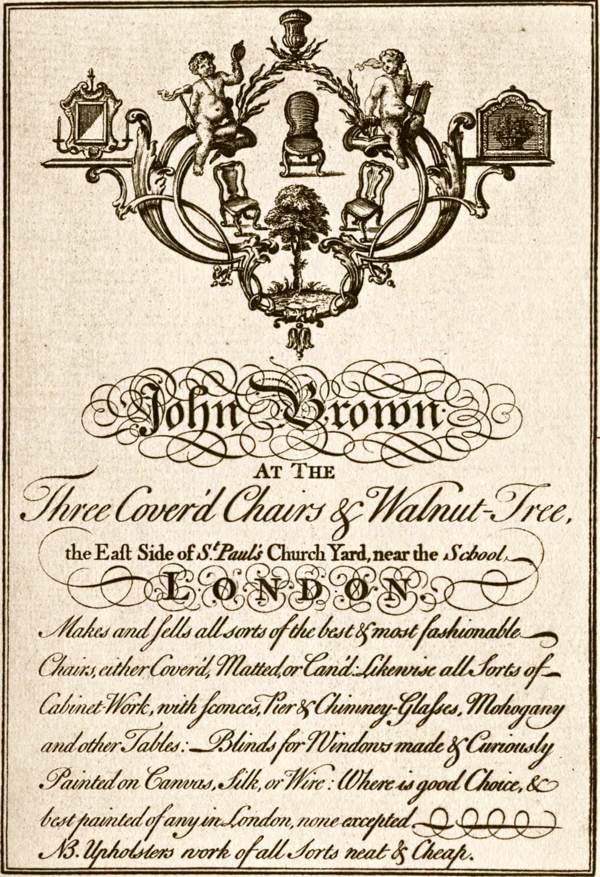
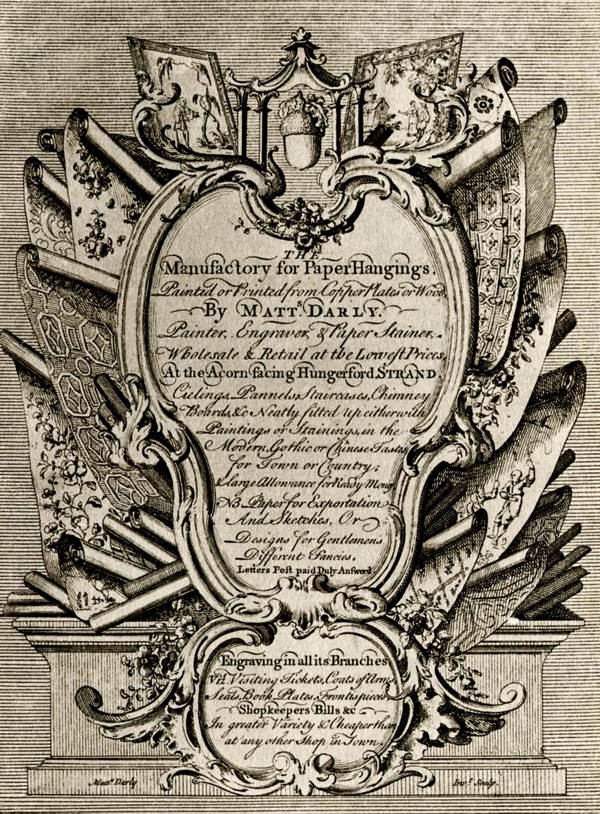
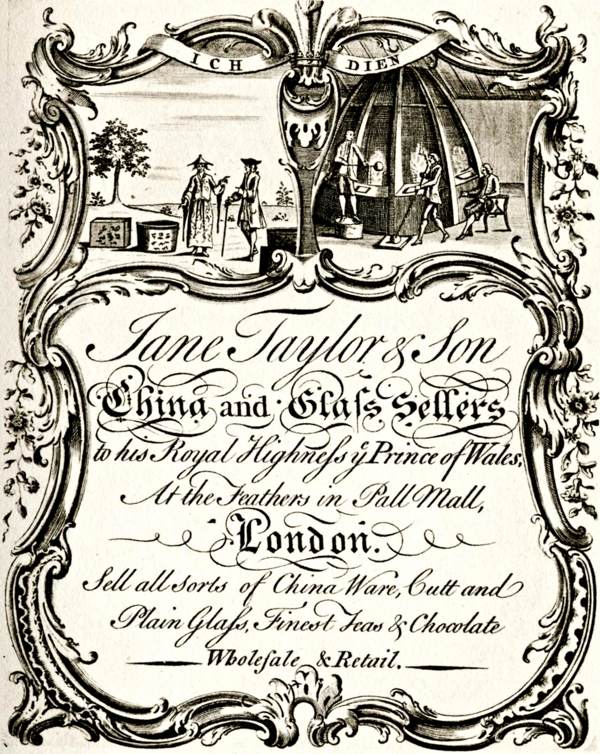
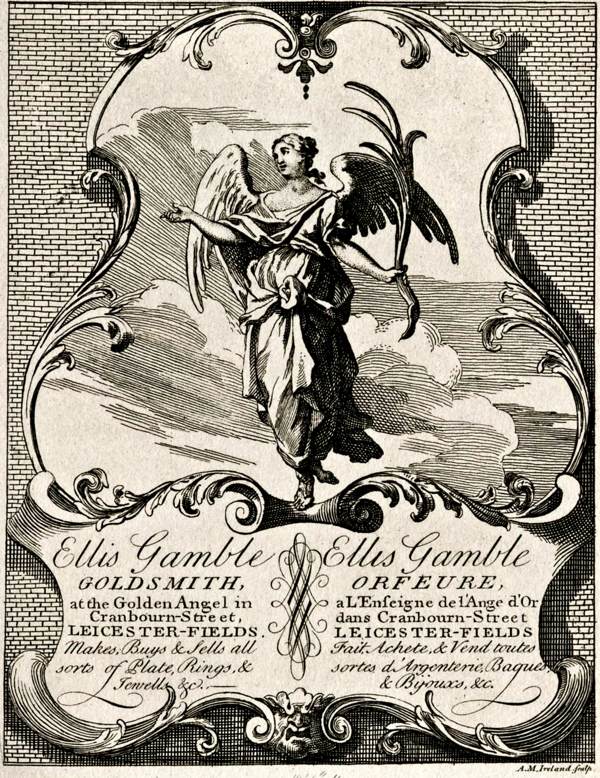
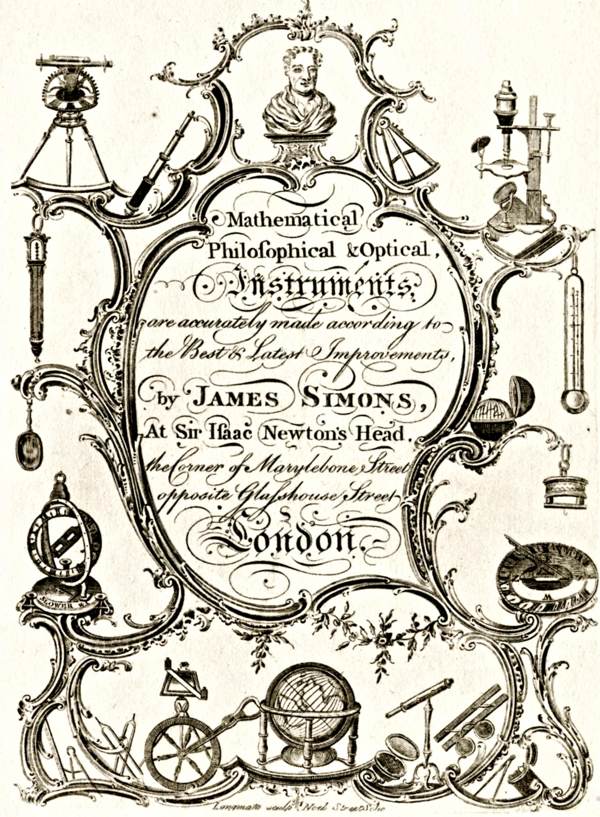
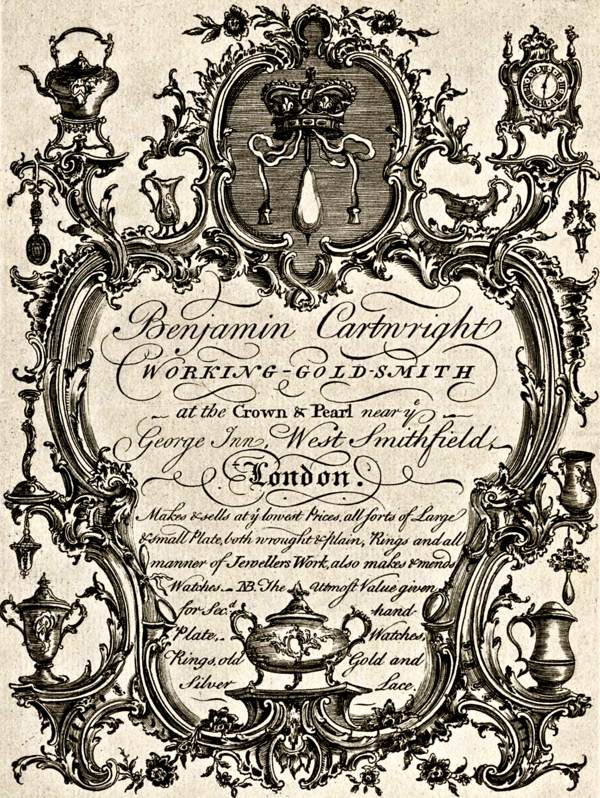
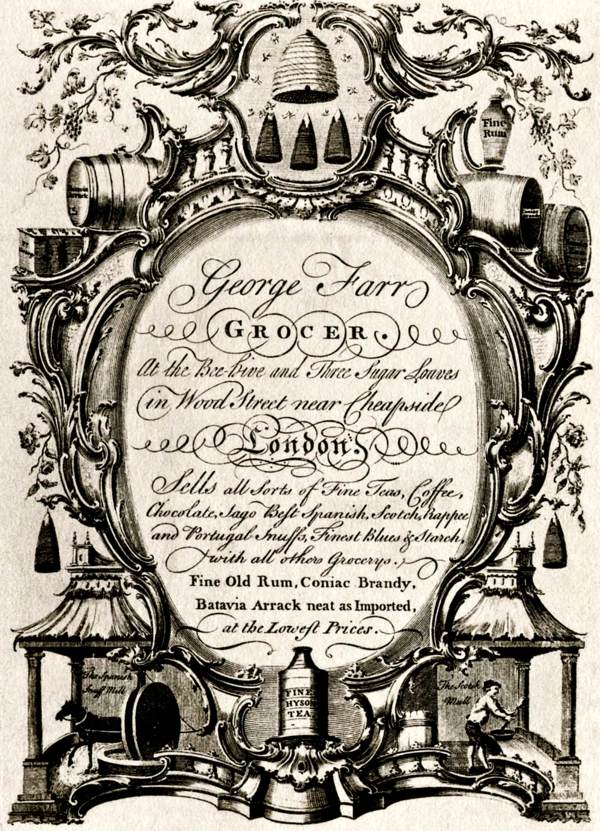
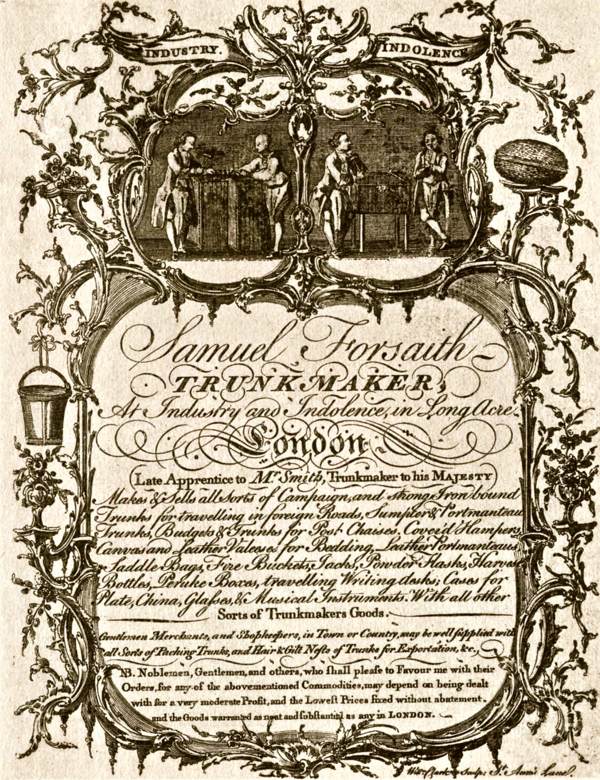
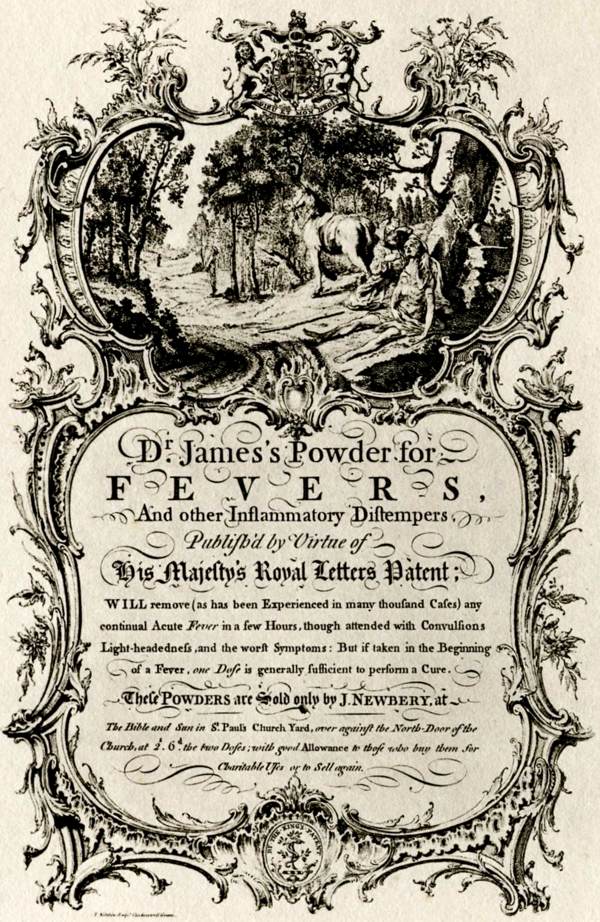
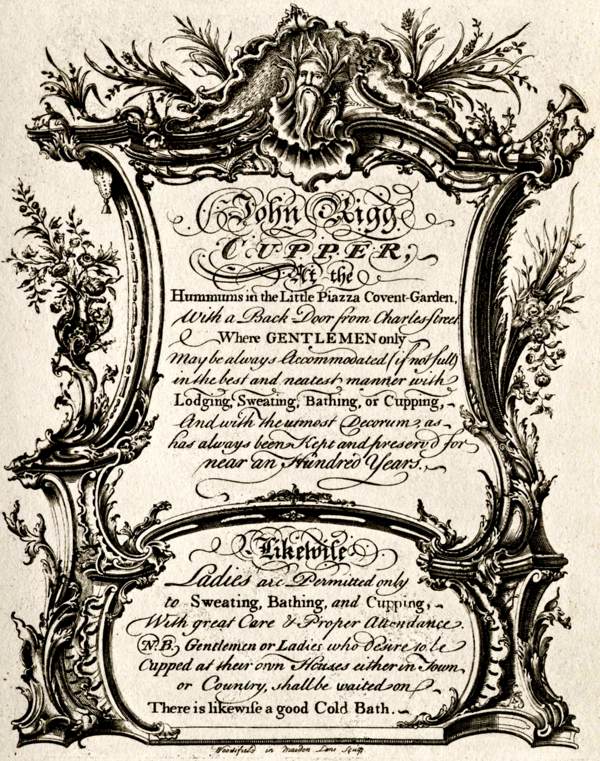
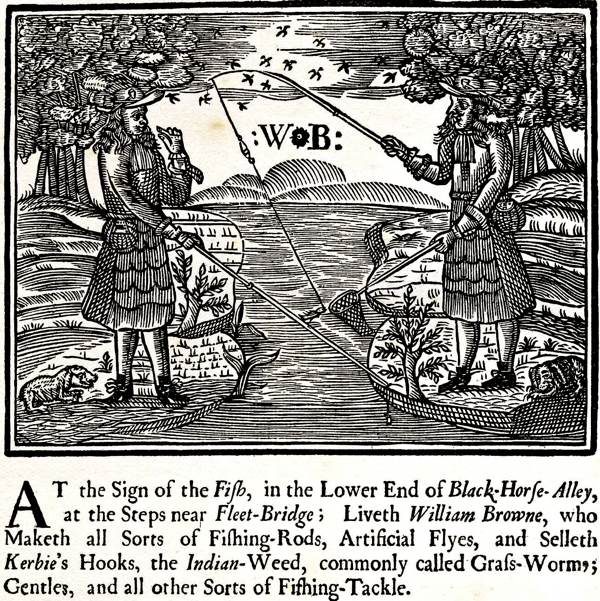
Images courtesy Bishopsgate Institute
You may like to see my earlier selections
More Trade Cards of Old London
Signs, Posters, Typography & Graphics

E2, 1962
“It could almost be a metaphor of the East End, parts of it were hanging in tatters but it was a beautiful tapestry of things that had been,” said photographer John Claridge, talking fondly of this picture of a posters peeling from a door from 1962. One of a set – first published here today – of photos of signs, posters, typography and graphics that John took in the East End during the sixties when he was in his teens and twenties.
At fifteen years old, John went to work in advertising at McCann Erickson where he encountered the inspiring figure of designer Robert Brownjohn, who had once been a pupil of Moholy-Nagy and famously created the opening credits for ‘Goldfinger’ and ‘From Russia With Love.’ “It opened up my eyes to how people communicate and the beauty of typography.” John confided, “You’re surrounded by it and you’re brought up with it, but people like Robert Brownjohn take it to another level.”
Today, John describes these photographs as coming from ‘the time when my eyes were opened,’ yet he admits he was ‘always interested in what’s not intentional,’ and these pictures all delight in the incidental visual humour and poetry of the human condition – whether a former chapel selling light bulbs that offered ‘batteries recharged,’ or a damaged poster for the mass X-Ray of 1966 that resembled a pair of lungs. “I’m still excited by them,” he confessed to me, “My work in advertising was about solving other people’s problems, but these pictures are the outcome of personal feelings.”
“People used to ask me why are you photographing that?” recalled John in amusement. Eastenders have always had the knack of communication, and it was John’s gift to see the beauty in the urban landscape through the marks made by those personalities that created it.
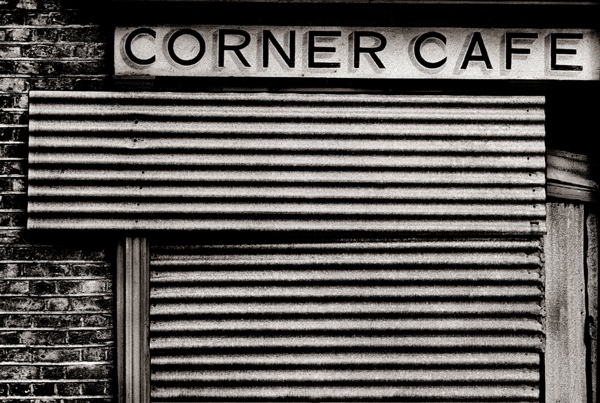
E1, 1964.

E1, 1961.

E 14, 1966. “The poster looks like a pair of lungs.”
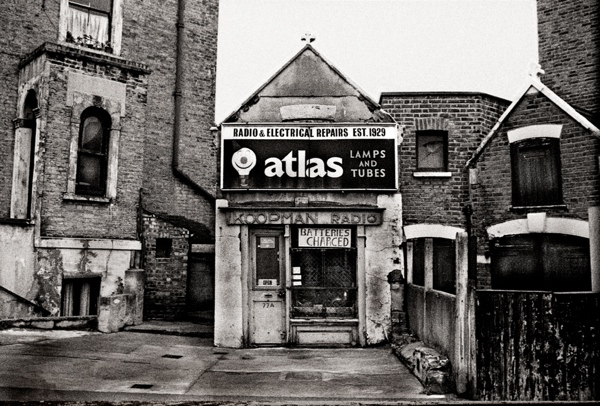
E9, 1964.

E1, 1969. “Bertrand Russell looking at the end of the world – the window is like a mushroom cloud.”

E13, 1959. “I used to go with my mum to Queens Rd Market on Saturday morning to get a few bits and pieces.”
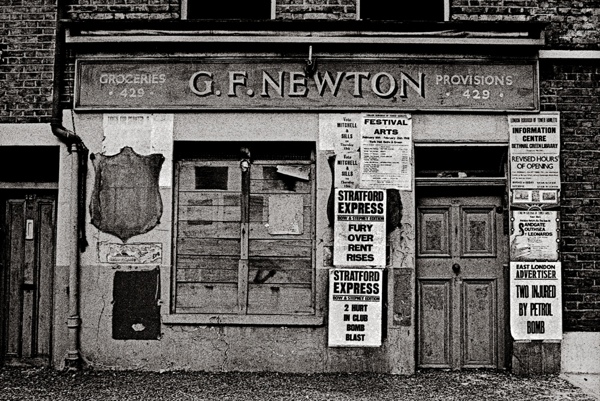
E1, 1968. “My mum and dad read the Stratford Express.”
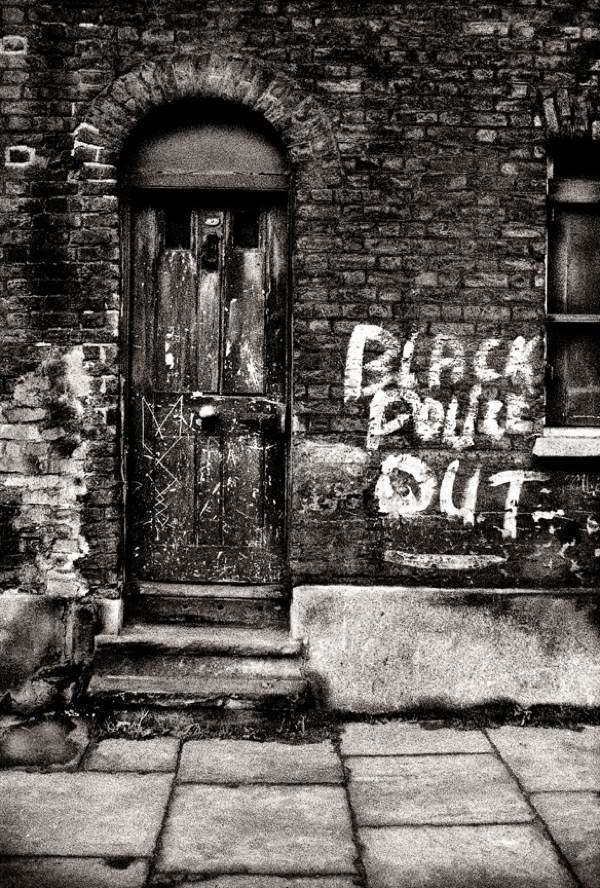
E1, 1967. “There were quite a few of these around.”

E15, 1962. “The Two Puddings was a brilliant pub.”

E14, 1970. “It reminded me of ‘Soylent Green’, the science fiction movie with Edward G. Robinson.”

E7, 1966.
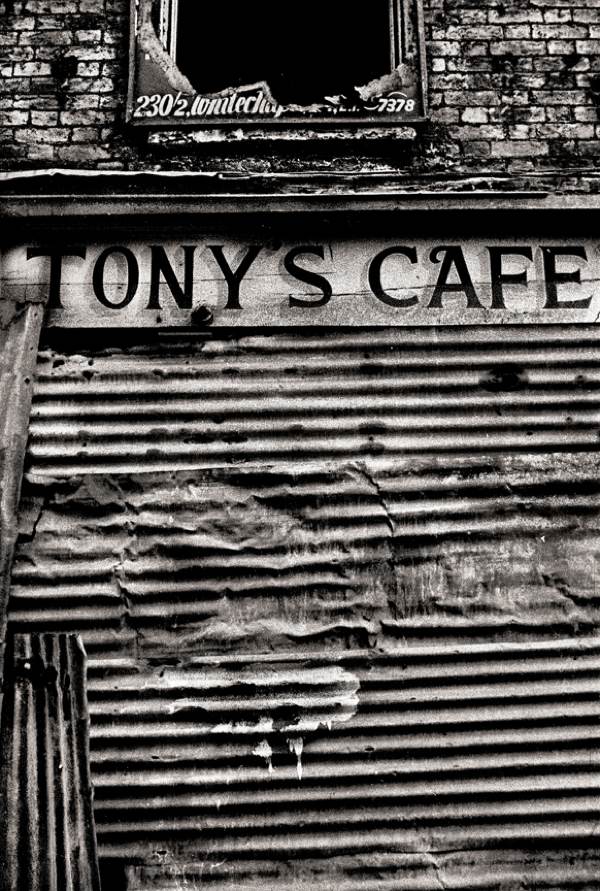
E1, 1964. “The corrugated iron looks like it’s melting, or like a painting of corrugated iron.”

E1, 1967.

E2, 1963.
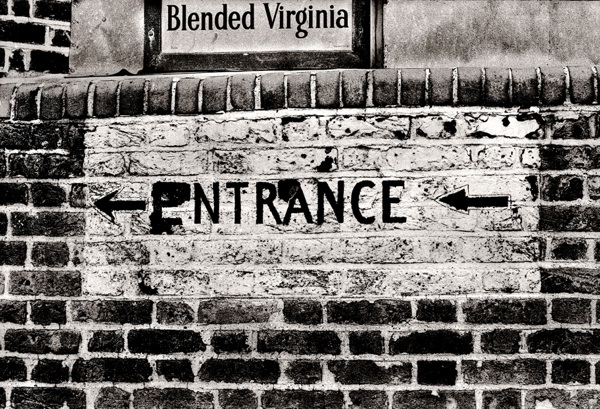
E2, 1965. “This lettering is not professional, but very human.”
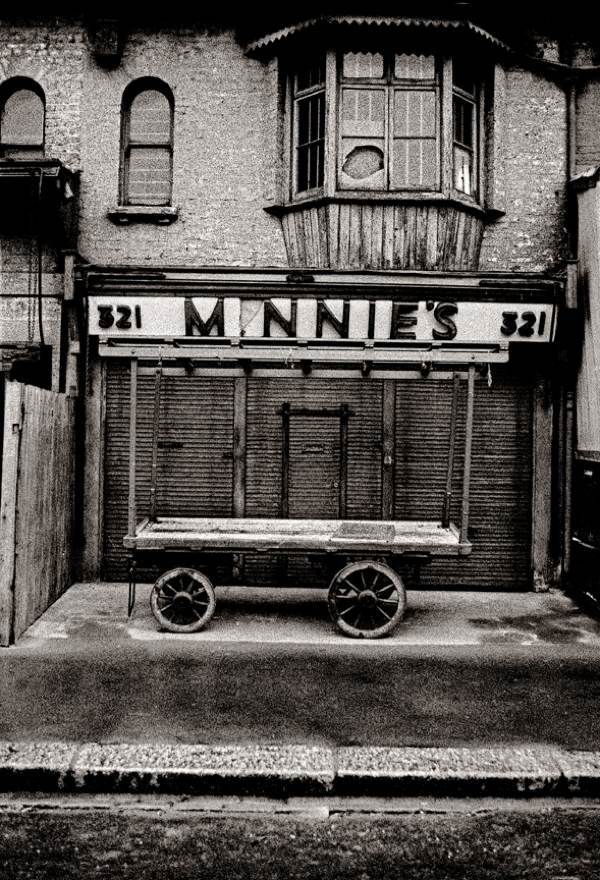
E13, 1960. “Like stepping onto a stage.”

E7, 1968.
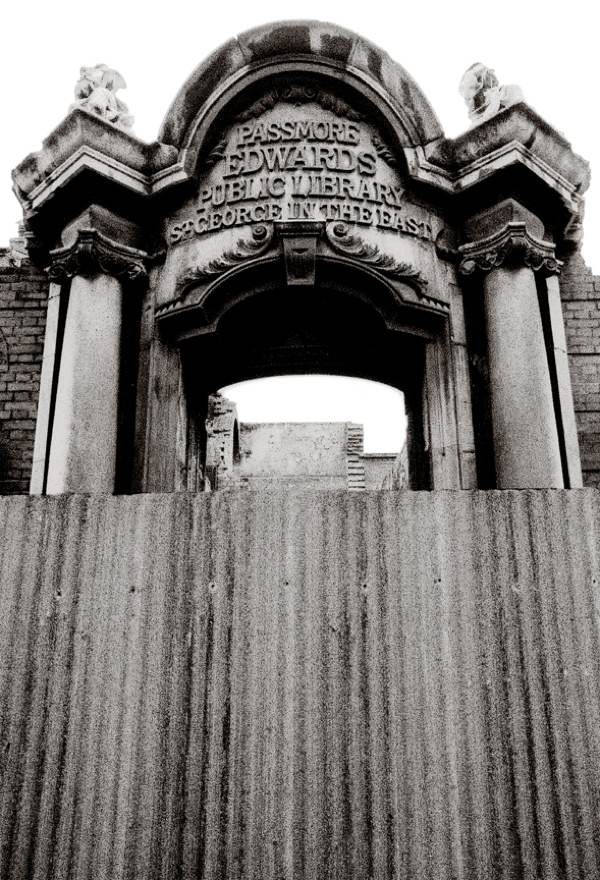
Cable St E1, 1962.
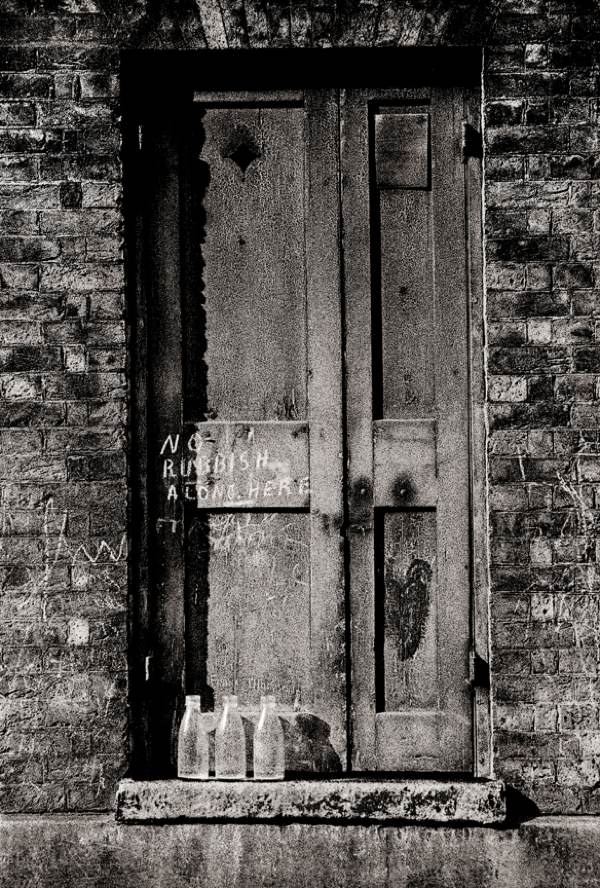
E1, 1964. “Boys used to say ‘No rubbish here,’ when they were selling in the street.”
Photographs copyright © John Claridge
You may also like to take a look at
Along the Thames with John Claridge
At the Salvation Army with John Claridge
A Walk With Clive Murphy

On Saturday, I enjoyed the privilege of accompanying Clive Murphy – the distinguished oral historian and writer of ribald rhymes – on a stroll around Spitalfields visiting some of his favourite haunts. He emerged from his red front door, having descended the stairs from his flat above the Aladin restaurant on Brick Lane where he has lived since 1974, sporting a raffish brown fedora and raincoat, and we headed directly to his usual morning destination, Nude Espresso in Hanbury St.
“It’s the best cafe I know because you don’t meet English people, only Australians and New Zealanders. They’re all so young and fresh and not at all buttoned-up,” Clive explained enthusiastically, as we were seated at a prominent table. And I felt like James Boswell accompanying Samuel Johnson, as the great raconteur let loose his celebrated gift for rhetoric, causing everyone in the small cafe to crane in attention. “I tried to congratulate them on their vocabulary, in the use of ‘titillate’ on the board outside, but then they informed me the actual wording was “open ’til late.'” Clive informed me with a sly smile of self-deprecation.“I remember when they opened and I was the only customer. The owner is Dickie Reed and the food and the coffee are good, and I do hand it to him, because he started here with nothing and now he’s got this place and a roastery and another one in Soho.” said Clive, continuing his eulogy, and only breaking off as a plate of complimentary muffins was placed in front of him.
Then we popped round to Grenson shoes next door where Martha Ellen Smith, the manager, has been working on a linocut portrait of Clive. Despite his uncertainty about the likeness, I gave the picture my approval and congratulated Martha on capturing the spirit of the man. “A friend of mine who spends all day drinking and watching porn says I am becoming a cantankerous old git,” confessed Clive, turning vulnerable suddenly as we left the shop, and requiring vigorous persuasion on my part to convince him of the lack of veracity in such an observation.
Energised by caffeine, our spirits lifted as we strode off down Brick Lane when, to my amazement, I noticed another fellow coming towards us with the same mis-matched shoes as Clive – wearing one brown shoe and one black shoe – which I had been too polite to mention until then. In fact, it was a complete coincidence and, although they were unknown to each other prior to this meeting, both men explained it was because they had problems with ill-fitting shoes, becoming at once affectionate brothers of mis-matched footwear. Yet such is the nature of Brick Lane today, this could quickly become an emergent trend in international street style for summer 2012.
We arrived at Sweet & Spicy on the corner of Chicksand St, Clive’s favourite restaurant, where he has been coming regularly for curry since 1974. Here, in the cool of the peaceful dining room, we were greeted by proprietor Omar Butt, wrestler and boxer, who runs this popular curry house started by his father in 1969. Clive recommended the hot spicy lamb and the pilau rice with saffron to me, enquiring the secret of the rice from Omar who revealed the distinctive quality was in the use of raisins, almonds and butter ghee. Pointing out the weight-lifting posters on the wall, Clive informed me that Omar had been preceded by his brother Imran Butt who was “mad for bodybuilding.”
“We used to have useful things like a laundrette, an ironmonger and an electrical shop in Brick Lane,” announced Clive, turning morose as we retraced our steps, “now one half of it is arty-farty shops and the other half curry houses, and there’s nothing else.” Yet his complaint was cut short as we were greeted by the cheery Sanjay, Clive’s friend who works as waiter in the Aladin restaurant below his flat. “I told him I was going to the supermarket one day and he asked me to bring him a present, so I got him a packet of biscuits,” recalled Clive fondly, humbled by Sanjay’s open-heartedness, “it’s amazing what a packet of biscuits can do.”
Leaving Brick Lane, we turned down Buxton St towards the rear of the brewery where Clive lived for a year in the headmaster’s study of the derelict St Patrick’s School in 1972, when he first came to Spitalfields. “I had a hurricane lamp, a camp bed and a tea chest.” he said as we reached the threshold of the Victorian Schoolhouse, “There was only electricity three days a week and I had a single cold tap on the floor below. I was scared of the meths drinkers who sat outside on the step because I was all alone, I had never been in the East End before and I had never met meths drinkers before. But then three painters moved in and we became a colony of artists, until I was flooded out.”
“I think would have made a go of it anywhere,” acknowledged Clive, in a measured attempt to sum up his forty years in the East End, “I don’t think Spitalfields has been especially generous to me, except it was where I met my heroes Alexander Hartog, the tenor and mantle presser, and Beatrice Ali, the Salvation Army Hostel Dweller, and I am grateful because they were both absolute treasures.” These individuals became the subjects of two of the most memorable of Clive’s oral histories.
By now, a blustery wind had blown up in Buxton St. It had been accumulating all morning and caused me to run down the street more than once to retrieve Clive’s hat, but now it required him to hold his fedora in place with his left hand. Yet before we went our separate ways, heading for home, Clive presented me with a packet of liquorice allsorts that he had secreted in his raincoat pocket, and I was delighted to accept them as a souvenir of our walk.


Clive and antipodean friends at Nude Espresso.

Clive at Grenson Shoes with Martha and Nathan.
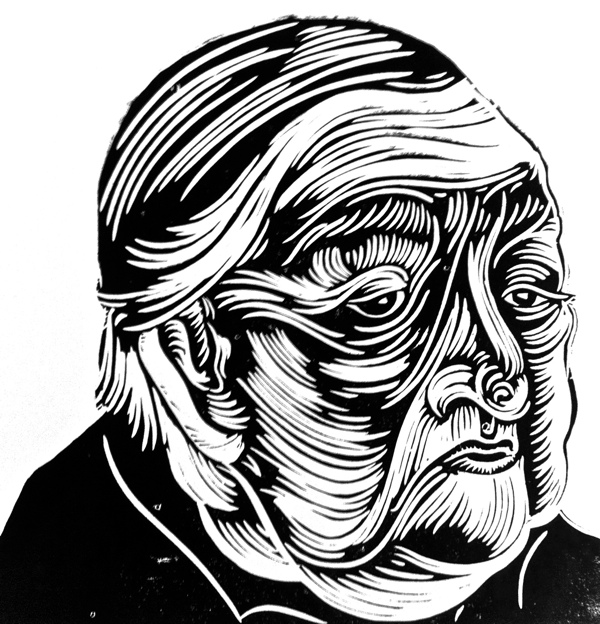
Martha Ellen Smith’s lino cut portrait of Clive.

The beginning of a trend on Brick Lane, Clive meets Mark who shares his taste in mis-matched footwear.
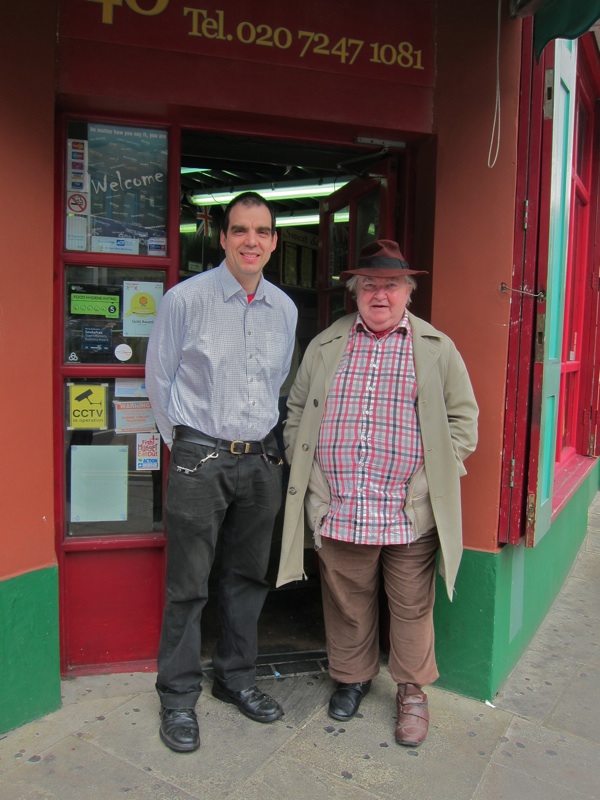
Clive with Omar Butt at Sweet & Spicy in Brick Lane where Clive has been dining since 1974.

Clive with his friend Sanjay, waiter at the Aladin Curry House, Brick Lane.

Clive at Old St Patrick’s School in Buxton St where he first lived in Spitalfields in 1972. – “I only had a hurricane lamp, a camp bed and a tea chest.”

Clive encounters a blustery corner in Buxton St.
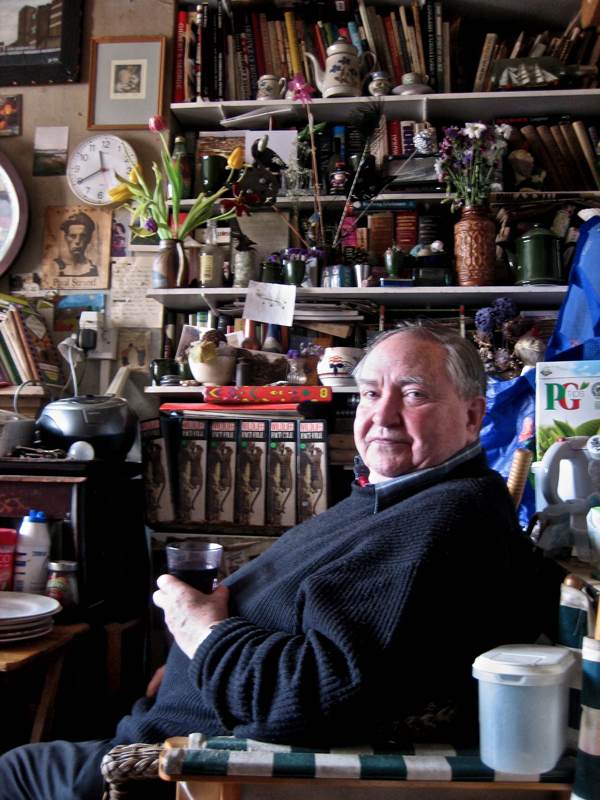
Clive in his flat above the Aladin curry house on Brick Lane where he has lived since 1974.
Copies of Clive Murphy’s oral histories can be obtained from Labour and Wait and his ribald rhymes can be bought at Rough Trade East.
You may also like to read
Clive Murphy, Oral Historian & Writer of Ribald Rhymes
More of Phil Maxwell’s Old Ladies

“There is a kind of magnificence about them.” – Phil Maxwell
I cannot resist publishing more of East End street photographer Phil Maxwell’s portraits of the heroic old ladies of Spitalfields and Whitechapel, out of the hundreds he has taken over the last thirty years.
In the first century, Boudica rode her chariot through Spitalfields on the way to raze the Roman City of Londonium in revenge for the oppression of her people. In the sixteenth century, the legendary Mother Goose drove her geese down through Bishopsgate, walking her flock of birds from Norwich to London for sale. In the last century, the Suffragettes marched from the East End to Parliament to demand votes for women.
And these old ladies of more recent years, portrayed here in Phil Maxwell’s lucid photographs, are the worthy descendants of those brave females.We celebrate them all for their beauty, their unassailable spirit and their mythic presence.
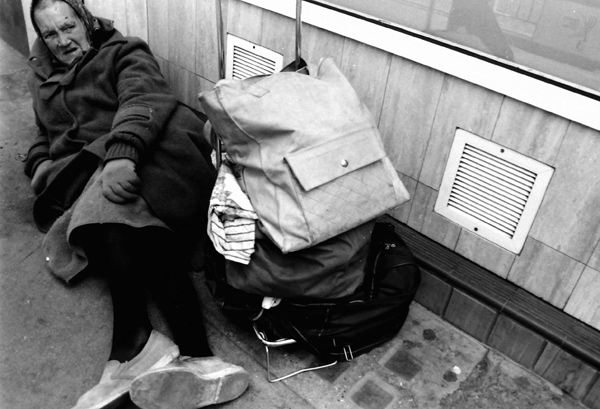

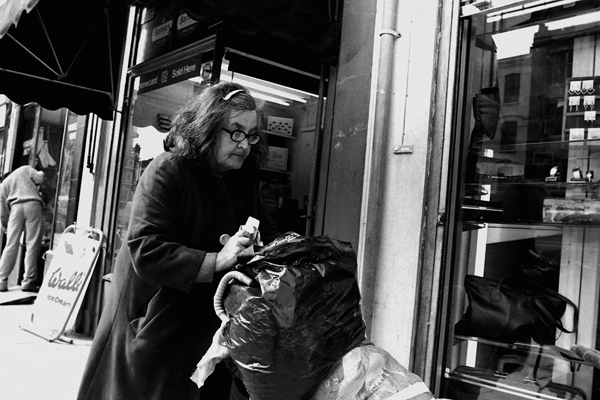


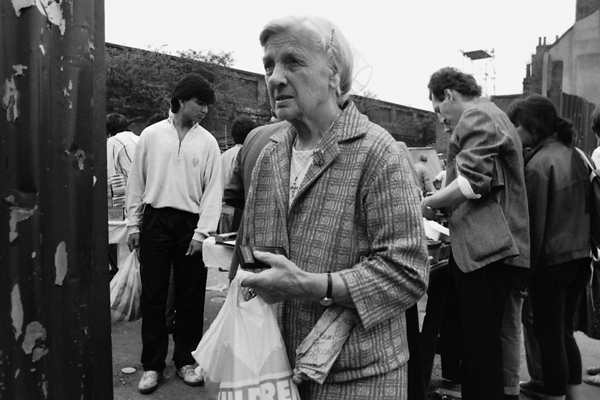

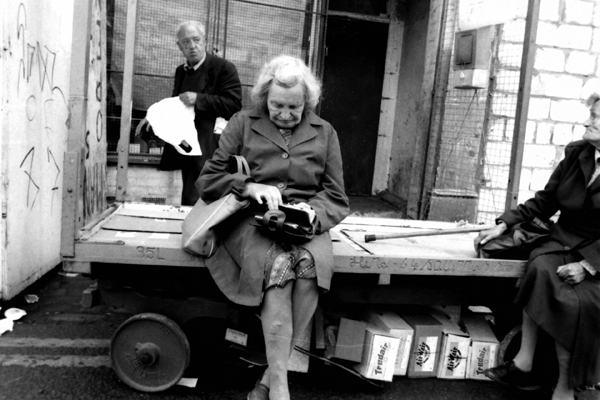


Photographs copyright © Phil Maxwell
Follow Phil Maxwell’s blog Playground of an East End Photographer
See more of Phil Maxwell’s work here
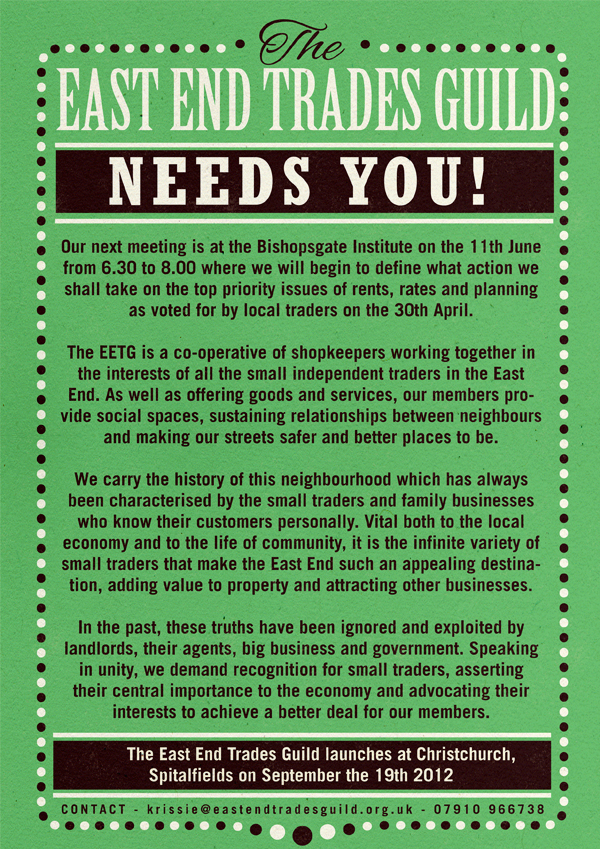
Next Meeting of the East End Trades Guild

Logo for EETG designed by James Brown.

The Broom & Whisk Makers Union design that inspired the EETG logo.
Around thirty independent shopkeepers and small traders met at the Bishopsgate Institute at the end of April to consider the potential for the East End Trades Guild as an advocate for their collective interests. When the issues facing their businesses were prioritised, it became apparent that rents, rates and planning were the subjects of greatest concern to those at the meeting.
Next Monday 11th June at 6:30pm, the traders will meeting again at Bishopsgate Institute to discuss these three issues further and explore what specific action can be taken to address them. All independent shopkeepers and small businesses in East London are invited to attend and participate in these discussions as the East End Trades Guild moves towards its formal launch on September 19th at Christ Church, Spitalfields.
Meanwhile, James Brown has produced a dignified and authoritative logo for the Guild which you can see above and, entirely fortuitously, a photograph of the Shoreditch Trades Council of one hundred years ago has surfaced. Until this picture appeared, no-one knew that there was a precedent for the East End Trades Guild, and its recent discovery presages well for this new endeavour.
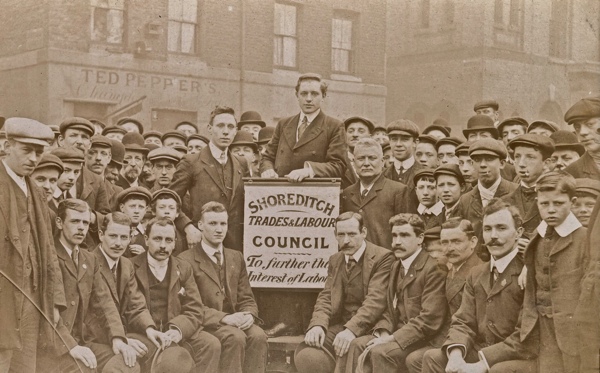
A recently discovered picture of the Shoreditch Trades Guild of a century ago.
Archive photograph courtesy Bishopsgate Institute
For more information on the background to this new initiative you may like to read
Aaron Biber, London’s Oldest Barber
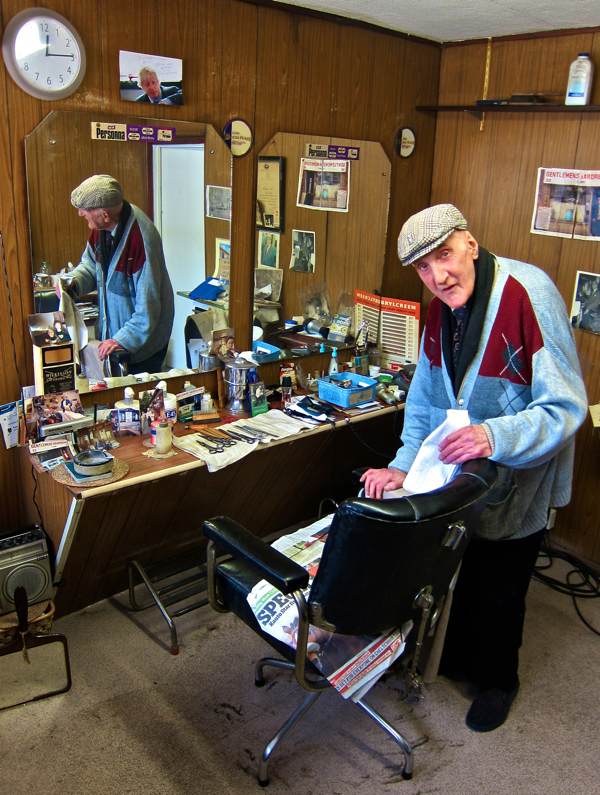
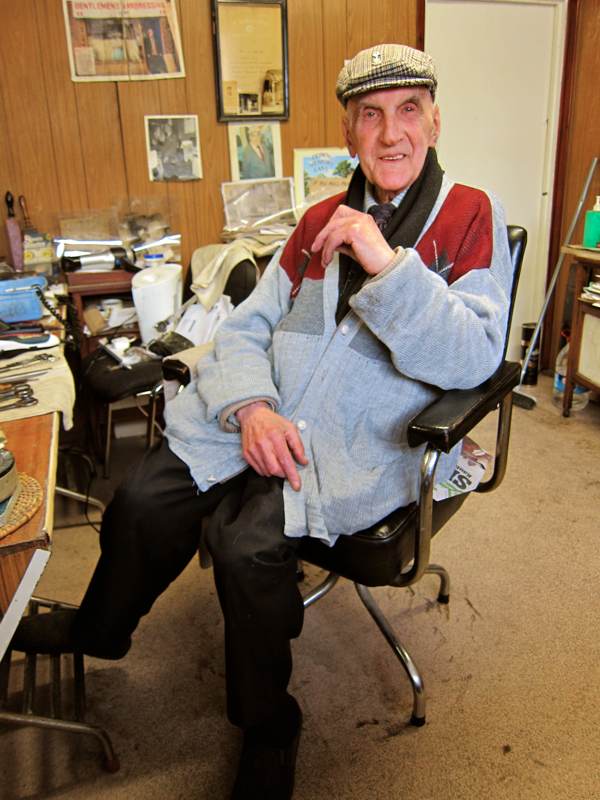
Aaron Biber has been cutting hair for seventy-eight years and he still uses the same blue steel scissors that his father gave him when he began at twelve years old, which he sharpens himself. At ninety years old, Aaron works six days a week at his tiny salon in Tottenham, waking each morning at four, driving the five minute journey from his home in Chingford and opening up the salon from six until midday.
After all this time, Aaron cannot retire because he knows nothing else. “Three doctors have told me, I would be dead within two months if I stopped,” he admitted with a helpless smile,“I can’t stop at home because my wife passed away after seventy years of marriage.”
For more than forty years, Aaron’s business was a going concern in Tottenham until one morning last summer, shortly after his wife died, when he arrived for work to discover a crowd of two hundred, including eighty interviewers outside his barber’s shop. The rioters had destroyed Aaron’s salon and he found himself at the centre of an international media storm. “I was on TV all over the world, Canada, Vietnam, Australia, Germany, Japan …” he recalled in bemusement, “And the Archbishop of Canterbury, Boris Johnson and Prince Charles, they all came to see me.”
But today, although his salon has been restored thanks to donations from an internet campaign, Aaron’s customers – many of whom had been coming for decades from all over London – have disappeared. On Monday this week, Aaron had one customer and on Tuesday also only one customer. No wonder he was delighted when I walked through the door at the end of the morning yesterday, on a day that had been a total blank, to interrupt his melancholic discourse with his pal Richard. “I’ve been cutting his hair since he was a baby,” declared Aaron to me, by way of introduction, with an affectionately dismissive flick of the wrist in the direction of his friend. A gesture reciprocated by Richard with a nod of confirmation and a loyal smile.
“They took everything, even my kettle and my chairs!” explained Aaron casting his eyes around at his memories of the destruction, “Luckily, I always carry my scissors with me, so they were safe at home.” Lesser men would be defeated what happened, but Aaron’s experience of life has granted him a sense of proportion which permits a degree of equanimity.
Aaron’s mother and father both came as refugees to the East End from Poland in the eighteen nineties. “My mother grew up on the farm, and the Russians used to ride through the village on horseback and knock people to the ground as they passed,” Aaron informed me, “My father killed a copper who assaulted him and he ran to England to escape.”
“When I was around ten years old, my mother moved out from Myrdle St where we lived because my dad wouldn’t give her a penny. She took all the children – nine sons and four daughters – to Coke St off Commercial Rd near the Bell Foundry. We went to the Jewish Board of Guardians to get an iron token for the soup kitchen, and we got bread and pilchards and kosher margarine. We used to go round the streets searching for money and once we found half a crown, we bought two salt beef sandwiches and had one shilling and eightpence left.
We had to work because we were starving. When I was ten, I went across the road to work for Mr Cohen making beigels for sixpence and then I weighed out sugar for his wife in the shop next door for tuppence, so I had eightpence. I used to wash down the horses, Ginger & Tubby, for Barney Dan, he had a cart and went round delivering stuff. He took me down to Covent Garden. I can tell you all about Covent Garden because I met my wife there, her father Alex Simmons, he designed all the sets for the theatres. I took a room in Tavistock St on the first floor, full of lads cutting hair. Later, I had a place in Hanbury St opposite the market in Spitalfields and I cut all the porters’ hair.
I cut hair for the police for fifty years, they wanted to make me a policeman at seventeen but my father said, ‘No, you don’t!’ I cut the hair for the flying squad for twenty-five years. Everyone wanted me because I cut hair properly. We used to have the police lined up outside the shop, there was a shortage of barbers.
We had all nationalities down in Cable St, Italians, Spanish, Maltese, Ghanese. I picked up all the languages. I can still speak Ghanese. We had the High Commissioner of Ghana come for a hair cut. Everyone got on and we all used to help each other out. I remember the Battle of Cable St, I was by the Royal Mint and the dockers came out of the dock to stop Mosley. I went to one of his rallies in Victoria Park to have a look but my mother warned me, she said, ‘They’ll kill you.’
During the war I was guarding Tower Bridge when Winston Churchill came along and said to me, ‘Shoot any parachutists you see coming down.’ I said, ‘What if they are ours?’ They showed me where they expected me to sleep and I said, ‘Forget it, I’m going home to my mother.’
I could have gone on the Queen Mary to America, cutting hair. There was this bloke in the docks, he said, ‘I’ll fix you up get you a job there, all you have got to do is give me a hundred pounds later.’ Most of the barbers from the East End went to America. My brother Ben opened a salon in Times Sq, but I couldn’t go because I was my mother’s blue-eyed boy, her favourite. She said, ‘No, not with them German submarines you’re not going.’ I never had any children. My mother told me, ‘It’s too much trouble.'”
If you want to have an unforgettable haircut by London’s oldest barber, and hear more stories, and experience Aaron’s barber shop wisdom, and get your locks trimmed with the seventy-eight year old blue steel scissors given to Aaron when he was twelve, head up to Tottenham. No appointment is necessary. Aaron Biber is sitting in the tiny salon waiting for you to walk through the door.
I appeal to my readers to show the spirit that has always characterised the East End, we’ve all got to pull together to keep Aaron cutting.
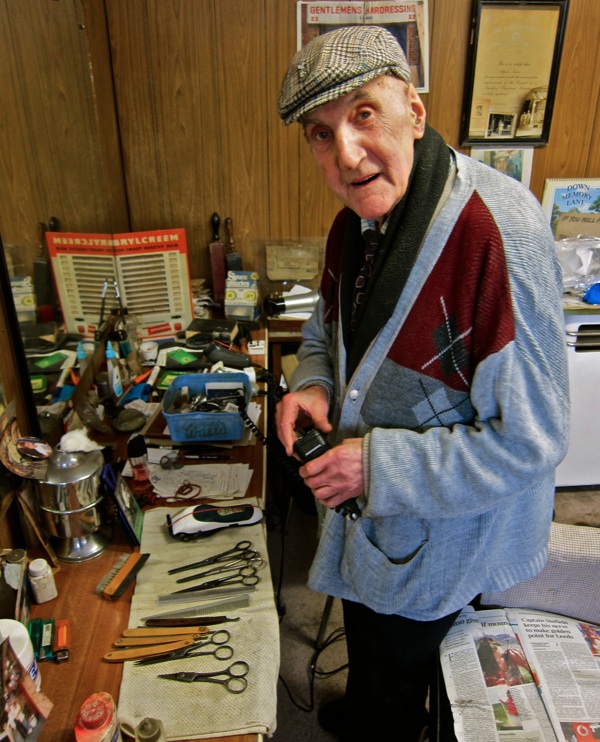
“Everyone wanted me because I cut hair properly.”
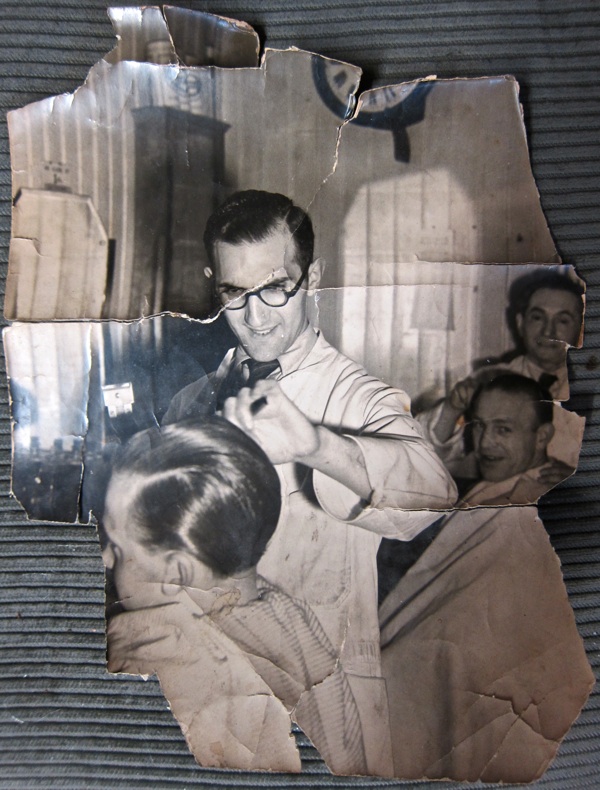
Aaron cuts hair in Cable St in 194o.
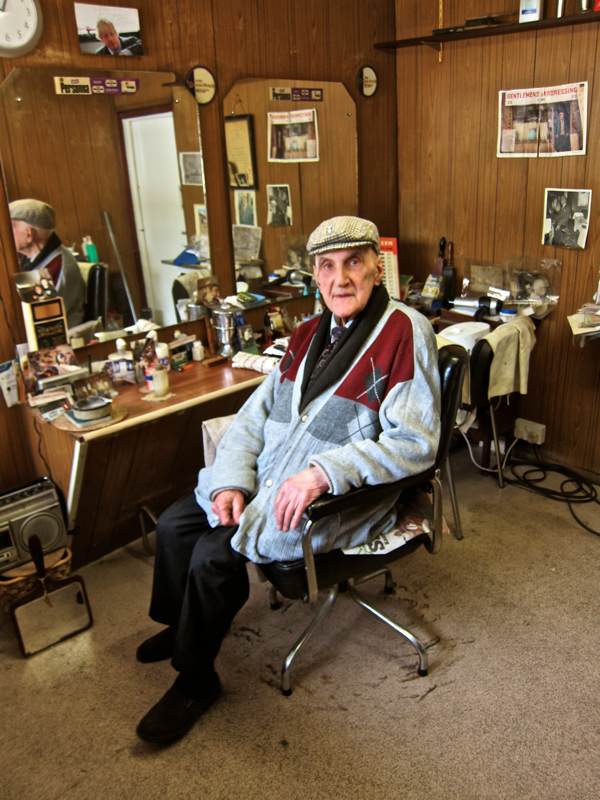
“The Archbishop of Canterbury, Boris Johnson and Prince Charles, they all came to see me.”
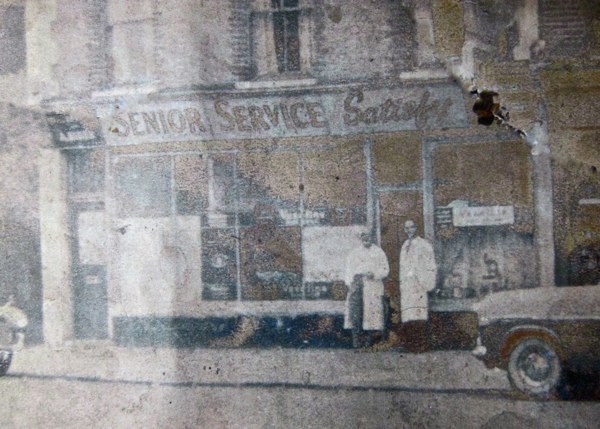
Aaron outside his salon in St Anne’s Rd in the nineteen fifties.
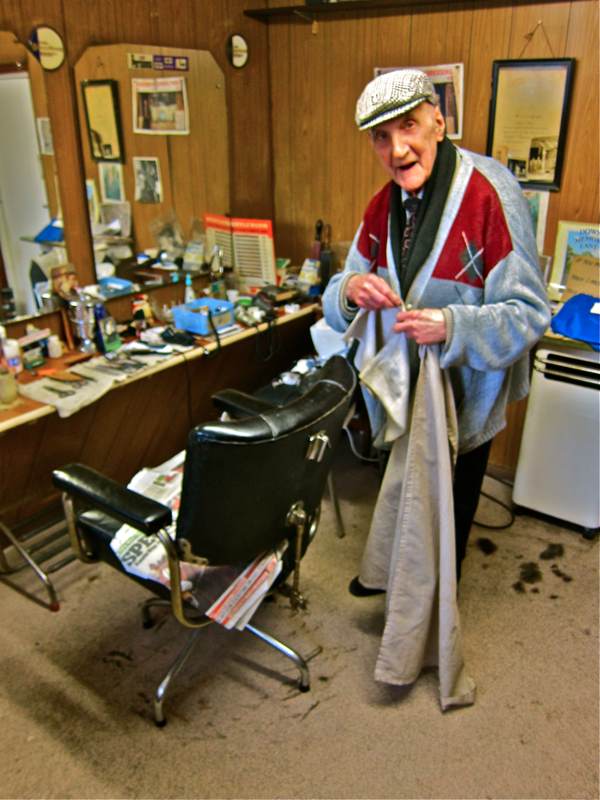
“I cut the hair for the flying squad for twenty-five years.”
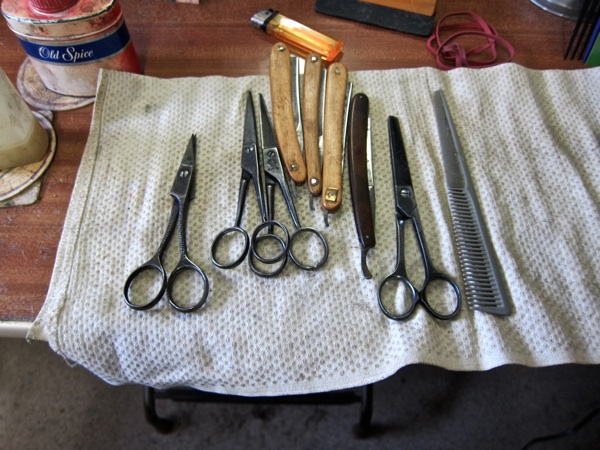
The blue steel scissors given to Aaron by his father seventy-eight years ago when Aaron was twelve years old, wrapped in a nineteen forties linen towel.
“I can still speak Ghanese.”

Aaron’s pal Richard – “I’ve been cutting his hair since he was a baby.”
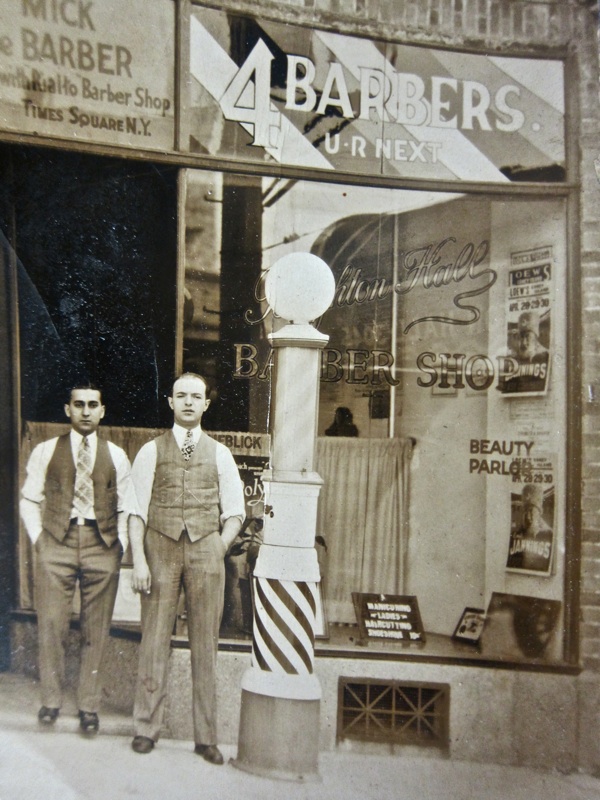
Aaron’s brother Ben (left) outside his salon in Times Sq, New York.
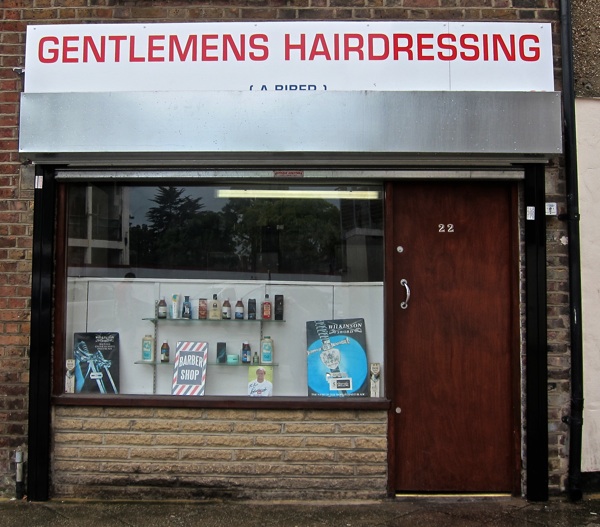
Aaron’s salon in Tottenham.
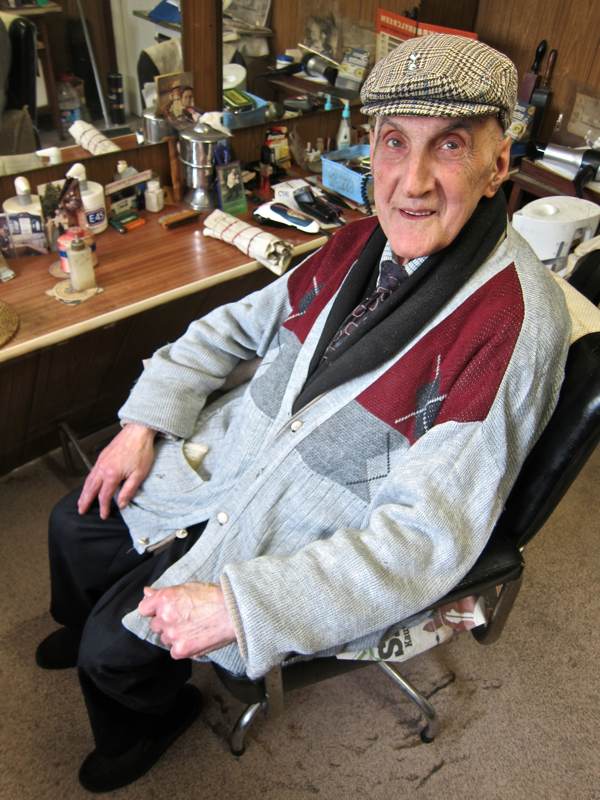
“Three doctors have told me, I would be dead within two months if I stopped.”
Visit Aaron Biber’s Gentlemen’s Hairdressing, 22 Scotland Green, Tottenham, N17 9TT
Watch a film by Mareka Carter of Aaron Biber talking by clicking here
You may also like to read about
Geoffrey Fletcher’s Pavement Pounders
The work of Geoffrey Fletcher (1923–2004) is an inspiration to me, and today I am publishing his drawings of London’s street people in the nineteen sixties from Geoffrey Fletcher’s Pavement Pounders of 1967. For an introduction to Geoffrey Fletcher’s writing, I recommend The London Nobody Knows which has been reprinted with a new introduction by Dan Cruickshank.

Charlie Sylvester -“I’m Charlie Sylvester, Charlie of Whitechapel. I’ve been on the markets over forty years. I can’t keep still too long, as I have to serve the customers. Then I must take me pram and go fer some more stock. Stock’s been getting low. I go all over with me pram, getting stock, I sell anythin’ – like them gardening tools, them baking tins and plastic mugs. All kinds of junk. Them gramophone records is classic, Ma, real classic stuff. Course they ain’t long playing? Wot do you expect? Pick where you like out of them baking tins. Well, I’ll be seeing you next you’re in Whitechapel. Don’t forget. Sylvester’s the name.”

Peanuts, Tower Hill – “We’ve only been doin’ this for a few months, me peanut pram and I. I only comes twice a week, Saturdays and Sundays. Sundays is best. It’s a hot day. Hope it will stay. I’m counting on it. How many bags do I sell in a day? I’ve never counted ’em. All I want is for to sell ’em out.”

Doing the Spoons, Leicester Sq -“I’ve been in London since 1932, doin’ the spoons, mostly. I does it when I’m not with the group – if they’re away or don’t show up. I’m about the only spoon man left. No, the police don’t bother us much – they know we’re old timers. We’re playing the Square tonight, later when the crowds will come.”

The Man with the X-Ray Eyes – “It’s the facial characteristics. I can usually guess within a year. It’s the emanations – that’s why they call me the man with the X-ray eyes. I’ve been doing it thirty-two years. Thirty -two years is a long time. I’m off-form today. Sometimes I am off-form and then I won’t take their money. I’m in show business. You see me on TV before the cameras. My show took London, Paris and New York by storm.”

Selections from ‘The Merry Widow,’ Oxford St – “You need a good breath for one o’ these. It’s called a euphonium. Write it down, same as when a man makes a euphemism at dinner. If I smoked or got dissipated, I couldn’t play. I can’t play the cornet, as it is, but that’s because I only have one tooth, as I’ll show you – central eating, as you say, Guv. I come from Oldham. When I was a boy of ten, I worked in Yates’ Wine Lodge, but I broke the glasses. I’m seventy-three now, too old for a job. But I don’t want a job, I have this – the euphonium. Life is an adventure, but things is bad today. People will do you down and not be ashamed of it. They’ll glory in it. Well, that’s it. My mother-in-law is staying with us so we have plenty to eat. She gives me the cold shoulder. I’m going for a cuppa tea. Have a nice summer and lots of luck.”

Lucky White Heather – “I’ve been selling on the London streets all my life, dearie. Selling various things – gypsy things – clothes pegs – it used to be clothes pegs. The men used to make them, but they won’t now – they’re onto other things. There wasn’t much profit in them, either. You sold them at three ha’pence a dozen. That was in the old days, dearie. Now I could be earning a pound while you’re drawing me. We comes every day from Kent. People like the lucky heather. But I’ll give you the white elephant – they’re very lucky. If they weren’t, we wouldn’t be selling them on the streets of London now, would we, dearie?”

Pavement Artist at Work, Trafalgar Sq – “I’ve been away two years, I haven’t been well, but I’m back again now. I’ve worked in other parts, but nearly always in London. Used to be outside the National Gallery, where I did Constable. I used to do copies of Constable. I do horses, dogs and other animals. The children like animals best, and give me money. I’m only playing about today, you might say. I haven’t prepared the stone. It gives it a smooth surface, makes the chalks sparkle. Makes them bright and clear, y’know. These pastels are too hard. I like soft ones, but everything’s gone up and I can’t afford them. Oh yes, I always clean off the stones. I won the prize for the best pavement artist in London.”

L.S.D. the Only Criterion, Tavistock Sq – “I’ve been here thirty years. I became a combined tipster and pavement artist because I had the talent, and because I believe in independence. Some people buy my drawings. I don’t go to the races now. I used to – Epsom, Ascot and all that. I have my regulars who come to see me and leave me money in my cap. That’s what it’s for. The rank and file are no good. It’s quiet Saturdays except when there’s a football match – Scoltand, say – and they stay round here. Weather’s been terrible – no-one about. Trafalgar Sq is where the money is, but they fights. I’ve sen the po-leece intervene when they’ve been fighting among themselves, and they say, ‘ere, move on, you?’ It’s money what’s at the bottom of it. Money an’ greed. Like I’ve got written here.”

The Best Friend You Have is Jesus – “Forty years I’ve been selling plants in London, and for over thirty years the Lord’s work has been done. In 1935, I was backing a dog – funnily enough it was called ‘Real Work’ – at New Cross. All at once, a small voice, the voice of the Lord, spoke to me and said ‘Abel (My name is Abel), I’ve got some real work for you to do.’ I gave up drink and dogs and got the posters on the barrow – the messages. I’ve been thousands of miles all over London doing the work of the Lord. London is wicked, and it’s getting worse. But God is merciful, and always gives a warning. It’s like Sodom and Gomorrah. The Lord says ‘Repent’ before His wrath comes. He could destroy London with an earthquake. Remember Noah? – how God wanted them to go in the Ark? But they wouldn’t. They said, ‘We’re going to have a good time…’ The Lord could destroy London with His elements. It dosen’t worry me as I’m doing the Lord’s work. Let these iris stand in water when you get ’em home.”

One Minute Photos, Westminster Bridge – “‘Happy Len,’ they call me, but my real name’s Anthony. Fifty years on the bridge. 1920 I came, and my camera was made in 1903. It’s the only one left. I have to keep patching it up. The man who made it was called ‘Moore,’ and he came from Dr Barnardo’s. They sent him to Canada, and he and a Canadian got together, a bit sharp like, and they brought out this camera. Died a millionaire. I’m seventy-three, and I’ve seen some rum ‘uns on the bridge. There was a woman who came up and took all her clothes off, and the bobby arrested her for indecent behaviour. Disgraceful. The nude, I mean. She was spoiling my pitch.”

Music in the Strand – “I had to make some money to live, and so I came to play in the streets. I’ve never played professionally, I play the piano as well but I never had much training. I’m usually here in the Strand but sometimes I play in Knightsbridge, sometimes in Victoria St. There’s not so many lady musicians about now. I only play classical pieces.”

Horrible Spiders – “Christmas time is the best for us, Guv, if the weather ain’t wet or cold. Then the crowds are good humoured. I like my picture and I’m going to pick out an extra horrible spider for you in return. I’ll tell you a secret – some of the spiders ain’t made of real fur. They’re nylon. But yours is real fur, and it’s very squeaky.”

Salty Bob – “Come round behind the stall and have a bottle of ale. It’s a sort of club, a private club. It’s a grand life sitting here drinking, watching the world go by. I’ve been selling salt and vinegar for fifty years and I’m seventy now. I’ve seen some changes. Take Camden Passage, it’s all antiques, like Chelsea, none of the originals left hardly. Let me pour you another drink. Here we are snug and happy in the sun. I’ve just picked up nine pounds on a horse, and I’ve got another good one for the four-thirty. Next time you’re passing, join me for another drop of ale. No, you can’t pay for it. You’ll be my guest, same as now, at our private club behind the bottles of non-brewed, an’ the bleach.”

Don’t Squeeze Me Till I’m Yours – “That’s a German accordion – they’re the best. Bought it cheap up in the Charing Cross Rd. I do the mouth organ too, this is an English one – fourteen shillings from Harrods. I began with a tin whistle and worked me way up. I’ve a room in Mornington Crescent. My wife died, luvly woman, thrombosis. I could see here everywhere, lying in bed and what not, so I cleared out. I got to livin’ in hostels. But I couldn’t stand the class of men. I work here Mondays, Fridays sometimes. I also work Knightsbridge and ‘ere. I work Aldgate Sundays. I do well there. I gets a fair livin.’ So long as I’ve got me rent, two pounds ten, and baccy money, I don’t want nothing else.”

A Barrel Organ Carolling Across a Golden Street – They received their maximum appreciation in the East End, in the days when the area was a world apart from the rest of London, and the appearance of a barrel organ in Casey Court, among patrons almost as hard pressed as the organist, meant an interval for music and dancing, while the poor little monkey, often a prey to influenza, performed his sad little capers on the organ lid.

Sandwich Man – Consult Madame Sandra – “It’s a poor life, you only get twelve shillings and sixpence a day and you can’t do much on that now, can you, sir? It was drink that got me, the drink. When I come off the farms, I became a porter at Clapham Junction, sir. I worked on the railways, but I couldn’t hold my job. So I dropped down, and this is what I do now. All you can say is you’re in the open air. Sometimes I sleep in a hostel, sometimes I stay out. Just now I’m sleeping out. It was the drink that done it, sir.”

Matchseller – “I was a labourer – a builder’s labourer – an’ I come frae Glasgow. I’ve not been down here in London verra long – eight years. Do i like it here? Weel, the peepull, the peepull are sociable, but they not gie you much, so you only exist. Just exist. I don’t sleep in no hostel, I sleep rough. I haven’t slept in a bed in four weeks. I sleep anywhere. I like a bench in the park or on the embankment. I like the freedom. Anywhere I hang my hat, it’s home sweet home to me.”

A Romany – Apart from the Romany women who sell heather and lucky charms in such places as Villiers St and Oxford St, the gypsies are rapidly disaapearing from Central London. Only occasionally do you see them at their traditional trade of selling. lace paper flowers of cowslips. Modern living vans are invariably smart turn-outs that have little in common with the carved and painted caravans of fifty years ago. They are with-it-gypises-O! Small colonies can still be found on East End bombsites, which the Romanies favour for winter quarters.

‘A Tiny Seed of Love,’ Piccadilly – “Oh yes, Guvnor, they’re good to me if the weather’s fine. Depends on the weather. I can’t play well enough, as you might say. I used to travel all over, four or five of us, saxo, drums, like that. Sometimes there was as many as eight of us. Then it got dodgy. I’m an old hand now. I’ve settled down. I got two rooms at thirty-two bob a week, Islington way. Where could you get two rooms for sixteen shillings each in London? I can easily get along at the price I pay. What’s more, I’ve married the woman who owns the house, too. She’s eight years older than I am, but we get along amicable.”
You may also like to read
Down Among the Meths Men with Geoffrey Fletcher
and take a look at












