Colin O’Brien’s Brick Lane Market
Please join me at the opening of Commonplace, an exhibition of photography by Spitalfields Life Contributing Photographer Colin O’Brien at the crypt of Christ Church Spitalfields tomorrow, Thursday 26th July, from 7-9pm. Throughout this week, I will be publishing stories that I have done in collaboration with Colin, accompanied by his photographs that span an extraordinary career extending from 1948 until the present day.

Shall we take a walk through Cheshire St, Brick Lane, Sclater St and Club Row with Colin O’Brien to experience the life of the market in the nineteen eighties?
“I loved markets as a child, because I grew up during the nineteen forties in Clerkenwell and I used to go to Leather Lane to hear the patter of the stallholders. There is this mystique about markets for me. I love being surrounded by people and I feel safe in a crowd.” Colin told me, his grey eyes shining in excitement, as we made our way through the crowd onto the bare ground between Cheshire St and Grimsby St where traders sold their wares upon the frozen earth, by the light of lamps and candles.
“I’m a bit of a collecting sort of person, myself.” Colin admitted as we scanned the pitiful junk on sale, so carefully arranged in the frost, “I like old things.” It was a bitterly cold morning which led me to ask Colin why we were there. “I tend to go when it’s snowing,” Colin revealed cheerfully as we picked our way through the slush on Brick Lane, “there is a comradeship and drama.”
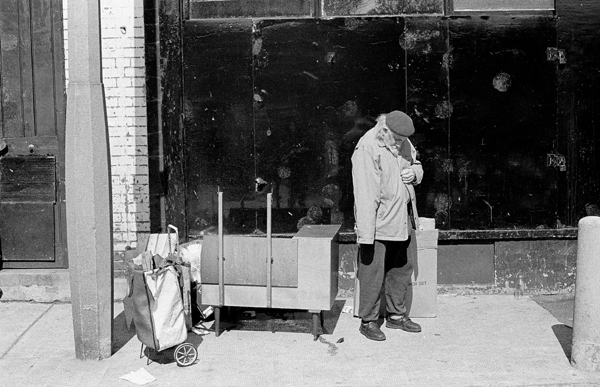
Examining Colin’s pictures later, just a fraction of the total, I realised that most were taken when the market was clearing up and portrayed individuals rather than the crowd. “Packing up is when everything happens,” he explained to me, “they dump all the unsold stuff in the street and the scavengers come to take it. You look at what’s discarded and it’s the history of the time.”
I noticed that the woman sitting at the centre of Colin’s photograph “Coming and goings at the corner of Brick Lane” was surrounded by five men and yet not one was looking at her. I realised that he had photographed her invisibility, and that the same was true for his other soulful portraits of market-goers, market-traders, homeless people, old people and marginal characters – all portrayed here with human sympathy through the lens of Colin O’Brien, yet gone now for ever.


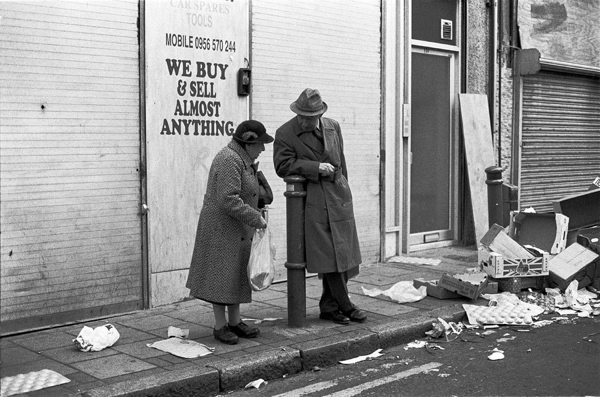

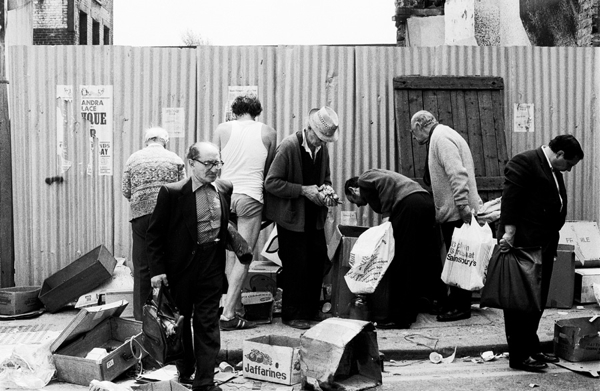


Coming and goings at the corner of Brick Lane.

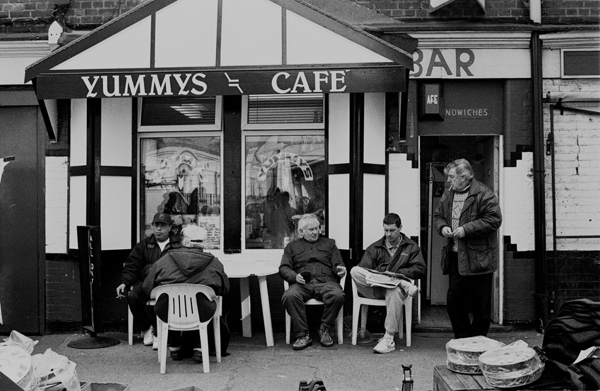

At the time of the miners’ strike.

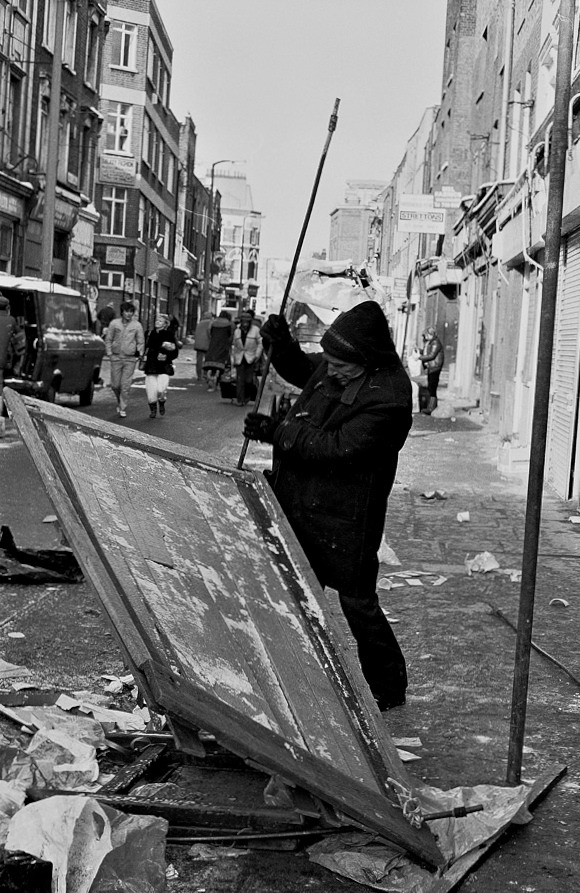
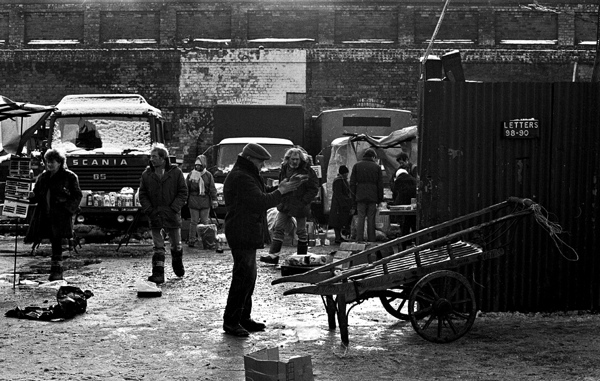


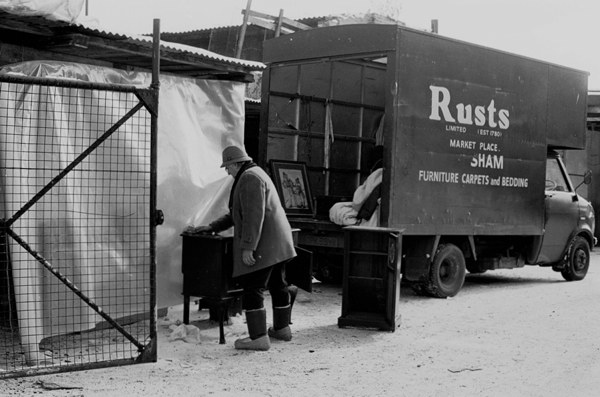
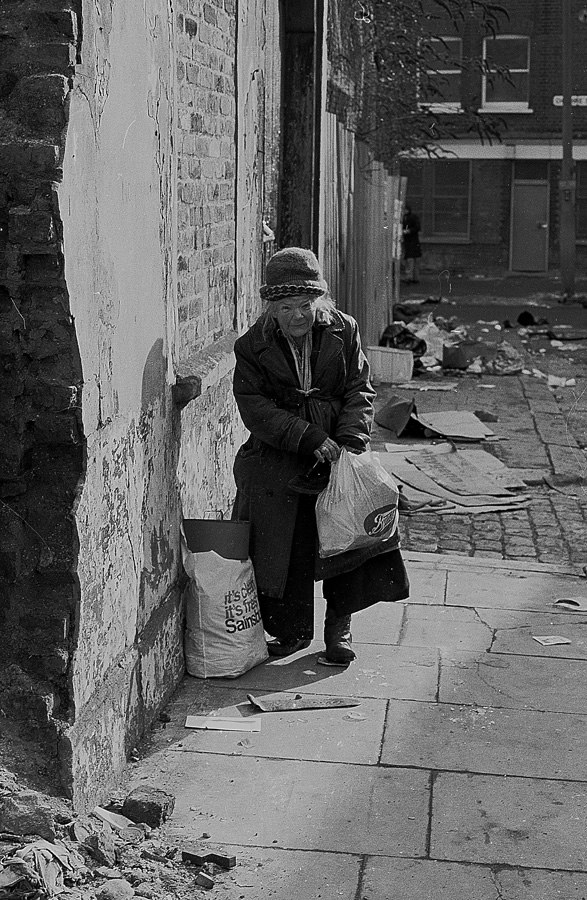

Photographs copyright © Colin O’Brien
Commonplace, Photographs by Colin O’Brien 1948-2012, runs at the Crypt of Christ Church, Spitalfields, 28th July – 26th August. Open Tuesdays, Saturdays & Sundays 1-6pm. Colin O’Brien will be talking about his work on Sunday 29th July 2pm.
Colin O’Brien’s Clerkenwell Car Crashes
Please join me at the opening of Commonplace, an exhibition of photography by Spitalfields Life Contributing Photographer Colin O’Brien at the crypt of Christ Church, Spitalfields this Thursday 26th July from 7-9pm. Over this coming week, I will be publishing stories that I have done in collaboration with Colin, accompanied by his photographs that span an extraordinary career extending from 1948 until the present day.

Accident, daytime 1957
When Colin O’Brien was growing up in Victoria Dwellings on the corner of Clerkenwell Rd and Faringdon Rd, there was a very unfortunate recurring problem which caused all the traffic lights at the junction to turn green at once. In the living room of the top floor flat where Colin lived with his parents, an ominous “crunch” would regularly be heard, occasioning the young photographer to lean out of the window with his box brownie camera and take the spectacular car crash photographs that you see here. Unaware of Weegee’s car crash photography in New York and predating Warhol’s fascination with the car crash as a photographic motif, Colin O’Brien’s car crash pictures are masterpieces in their own right.
Yet, even though they possess an extraordinary classically composed beauty, these photographs do not glamorise the tragedy of these violent random events – seen, as if from from God’s eye view, they expose the hopeless pathos of the situation. And, half a century later, whilst we all agree that these accidents were profoundly unfortunate for those involved, I hope it is not in poor taste to say that, in terms of photography they represent a fortuitous collision of subject matter and nascent photographic talent. I say this because I believe that the first duty of any artist is to witness what is in front of you, and this remarkable collection of pictures which Colin took from his window – dating from the late forties when he got his first camera at the age of eight until the early sixties when the family moved out – is precisely that.
Recently, I accompanied Colin as he returned to the junction of the Clerkenwell Rd and Faringdon Rd in the hope of visiting the modern buildings upon the site of the former Victoria Dwellings. To our good fortune, once we explained the story, Tomasz, the superintendent of Herbal Hill Buildings, welcomed Colin as if he were one of current residents who had simply been away for the weekend. Magnanimously, he handed over the keys of the top flat on the corner – which, by a stroke of luck, is currently vacant – so that Colin might take pictures from the same vantage point as his original photographs.
We found a split-level, four bedroom penthouse apartment with breathtaking views towards the City, complete with statues, chandeliers and gold light switches. It was very different to the poor, three room flat Colin lived in with his parents where his mother hung a curtain over the gas meter. Yet here in this luxury dwelling, the melancholy of the empty rooms was inescapable, lined with tired beige carpet and haunted with ghost outlines of furniture that had been taken away. However, we had not come to view the property but to look out of the window and after Colin had opened three different ones, he settled upon the perspective that most closely correlated to his parents’ living room and leaned out.
“The Guinness ad is no longer there,” he commented – almost surprised – as if, somehow, he expected the reality of the nineteen fifties might somehow be restored up here. Apart from the blocks on the horizon, little had changed, though. The building on the opposite corner was the same, the tube embankment and bridge were unaltered, the Booth’s Distillery building in Turnmills St still stood, as does the Clerkenwell Court House where Dickens once served as cub reporter. I left Colin to his photography as he became drawn into his lens, looking back into the midst of the last century and upon the urban landscape that contained the emotional history of his youth.
“It was the most exciting day of my life, when we left,” admitted Colin, with a fond grin of reminiscence, “Canvassers from the Labour Party used to come round asking for our votes and my father would ask them to build us better homes, and eventually they did. They built Michael Cliffe House, a tower block in Clerkenwell, and offered us the choice of any flat. My parents wanted one in the middle but I said, ‘No, let’s get the top flat!’ and I have it to this day. I took a photo of lightning over St Paul’s from there, and then I ran down to Fleet St and sold it to the Evening Standard.”
Colin O’Brien’s car crash photographs fascinate me with their intense, macabre beauty. As bystanders, unless we have specialist training, car crashes only serve to emphasise the pain of our helplessness at the destructive intervention of larger forces, and there is something especially plangent about these forgotten car crashes of yesteryear. In a single violent event, each one dramatises the sense of loss that time itself engenders, as over the years our tenderest beloved are taken from us. And they charge the photographic space, so that even those images without crashes acquire an additional emotionalism, the poignancy of transience and the imminence of potential disaster. I can think of no more touching image of loneliness that the anonymous figure in Colin O’Brien’s photograph, crossing the Clerkenwell Rd in the snow on New Year’s Eve, 1961.
After he had seen the interior of Herbal Hill Buildings, Colin confided to me he would rather live in Victoria Dwellings that stood there before, and yet, as he returned the keys to Tomasz, the superintendent, he could not resist asking if he might return and take more pictures in different conditions, at a different time of day or when it was raining. And Tomasz graciously assented as long as the apartment remained vacant. I understood that Colin needed the opportunity to come back again, now that the door to the past had been re-opened, and, I have to confess to you that, in spite of myself, I could not resist thinking, “Maybe there’ll be a car crash next time?”

Accident in the rain.

Accident in the rain, 2.

Accident at night, 1959.

Snow on New Year’s Eve, 1961.

Trolley buses, nineteen fifties.

Clerkenwell Italian parade, nineteen fifties.

Firemen at Victoria Dwellings, nineteen fifties.


Have a Guinness when you’re tired.


Colin’s new photograph of the junction of the Clerkenwell Rd and Faringdon Rd view, taken from Herbal Hill Buildings that now stand on the site of the former Victoria Dwellings.

Colin O’Brien sees his childhood view for the first time in fifty years.
Photographs copyright © Colin O’Brien
Commonplace, Photographs by Colin O’Brien 1948-2012, runs at the Crypt of Christ Church, Spitalfields, 28th July – 26th August. Open Tuesdays, Saturdays & Sundays 1-6pm. Colin O’Brien will be talking about his work on Sunday 29th July 2pm.
Gina’s Restaurant Portraits by Colin O’Brien
Please join me at the opening of Commonplace, an exhibition of photography by Spitalfields Life Contributing Photographer Colin O’Brien at the crypt of Christ Church, Spitalfields next Thursday 26th July from 7-9pm. Over this coming week I will be publishing stories that I have done in collaboration with Colin, accompanied by his photographs that span an extraordinary career extending from 1948 until the present day.

Gina has been cooking meals in Spitalfields for fifty years
Gina Christou and her husband Philip first opened up for business in Brick Lane in 1961 and, although the location has shifted a couple of times, many of the customers have been coming to their restaurant ever since. Today, after more than fifty years serving meals to the people of Spitalfields, Gina and her husband Philip are in semi-retirement. Yet since they live above the restaurant, they continue to open on Sunday for lunch, out of loyalty to their long-term customers, many of whom are old friends now. And it is a devotion that is gratefully reciprocated by those for whom weekends in the East End would be unimaginable without Sunday roast at Gina’s.
In Spitalfields, no-one else can match Gina and Philip’s half century of service, and so these pictures are both a tribute to their perseverance and also a celebration of the lively social scene that has grown up around this beloved restaurant in the Bethnal Green Rd which becomes the centre of the world every Sunday.
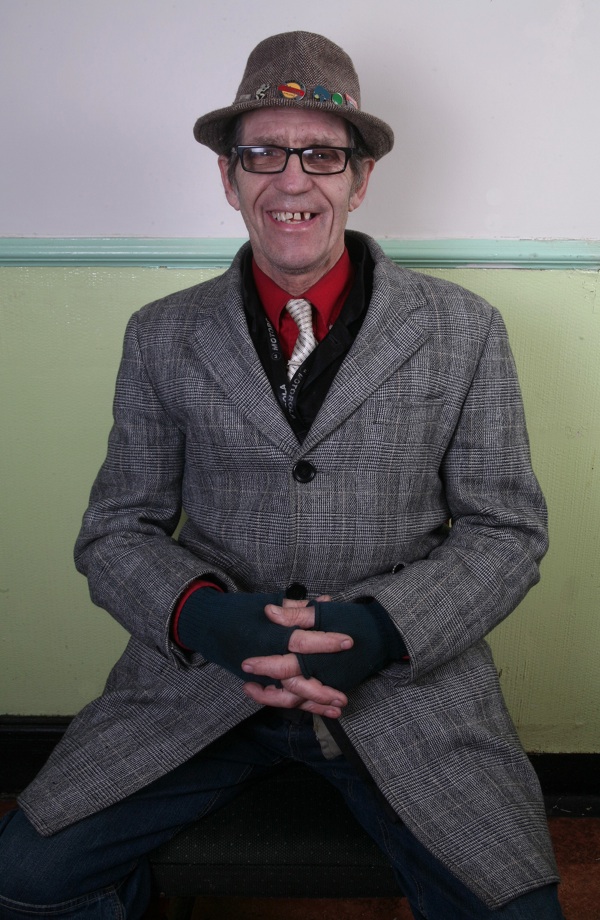
Brian Welch – “I’ve been coming to Gina’s for thirty years.”
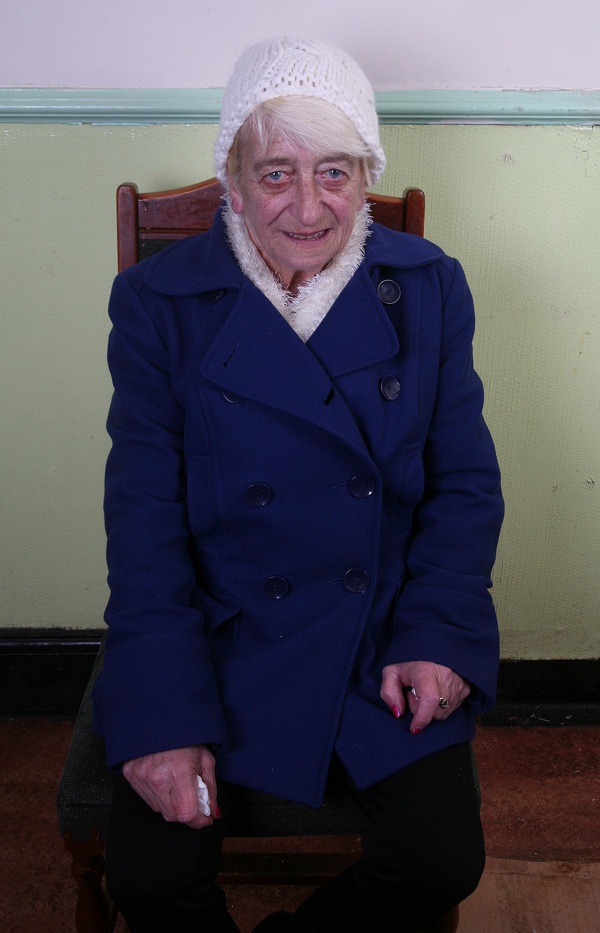
Julia Sparks – “I’ve been coming to Gina’s for thirty years.”
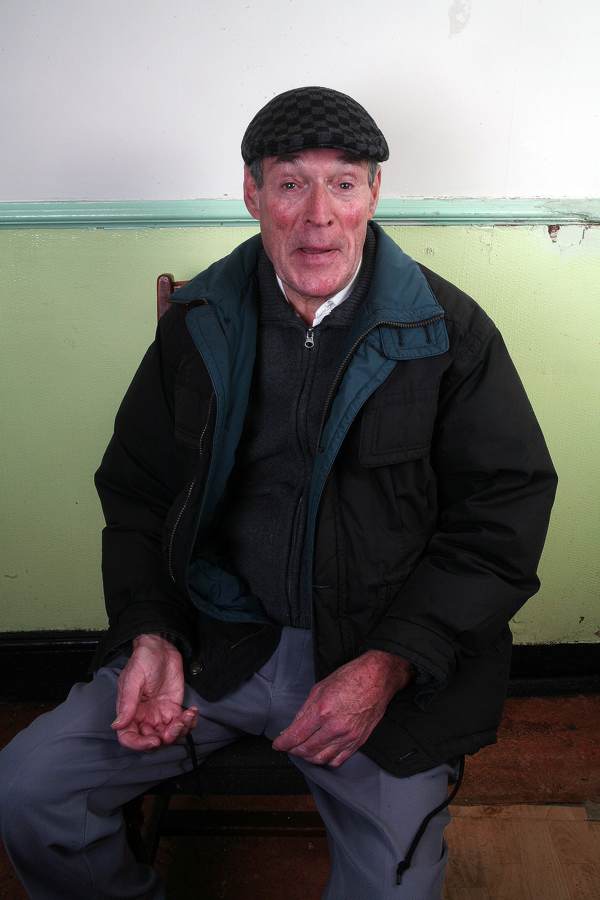
Don Aylan – “I’ve been coming to Gina’s for eighteen years.”
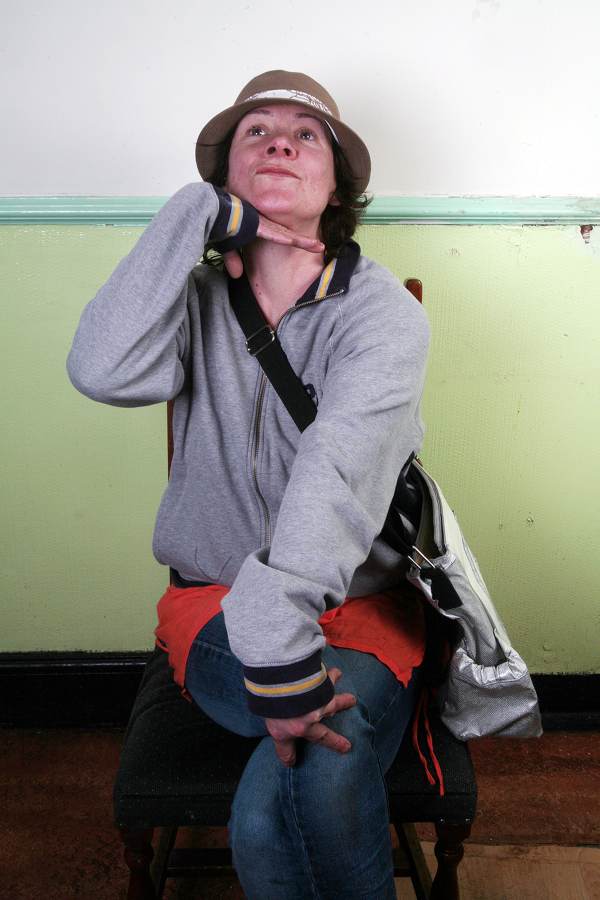
Caroline Duffy – “I’ve been coming to Gina’s about twenty years.”

Chen – “I’ve been coming to Gina’s five years.”

John Plummer – “I’ve been coming to Gina’s for seven years.”
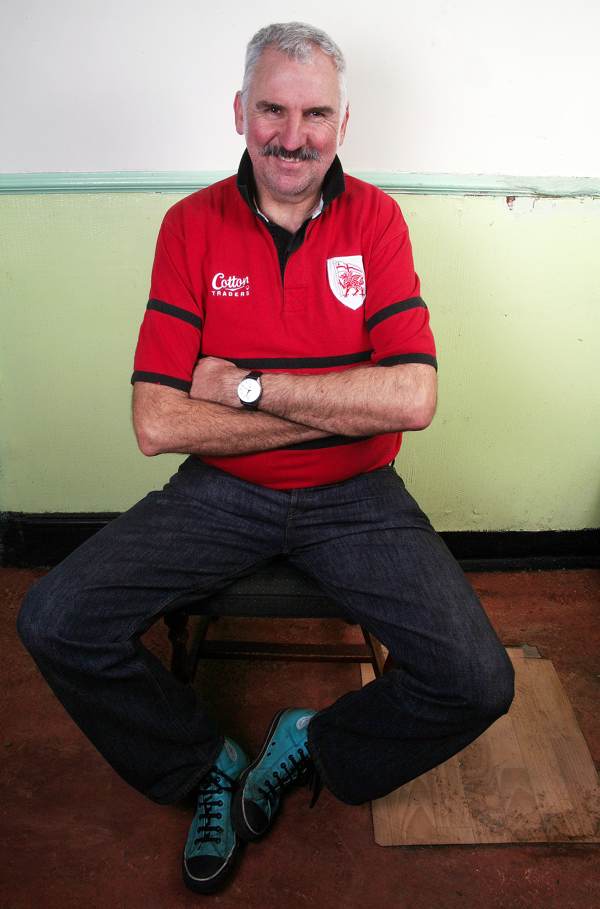
Tudor Davies – “I’ve been coming to Gina’s for twenty years.”
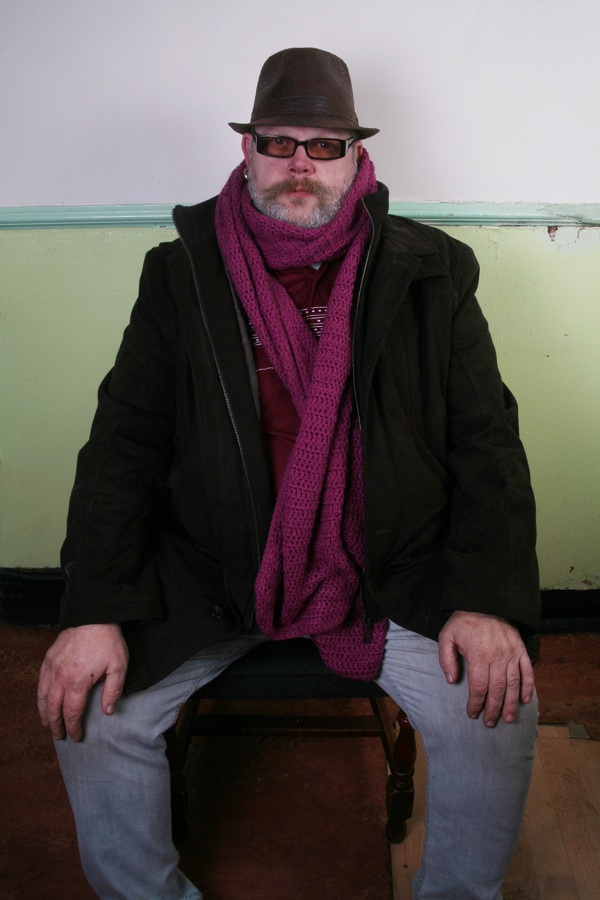
Tony Briggs – “I’ve been coming to Gina’s for thirty years.”

Sandra Benson – “I’ve been coming to Gina’s for ages … years and years.”
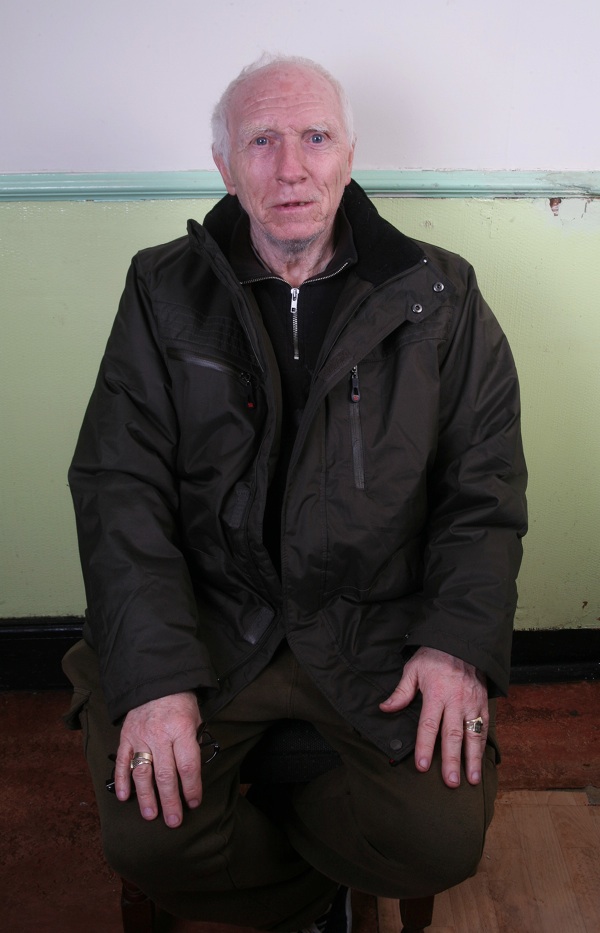
Ernie Taylor – “I’ve been coming to Gina’s about forty years.”
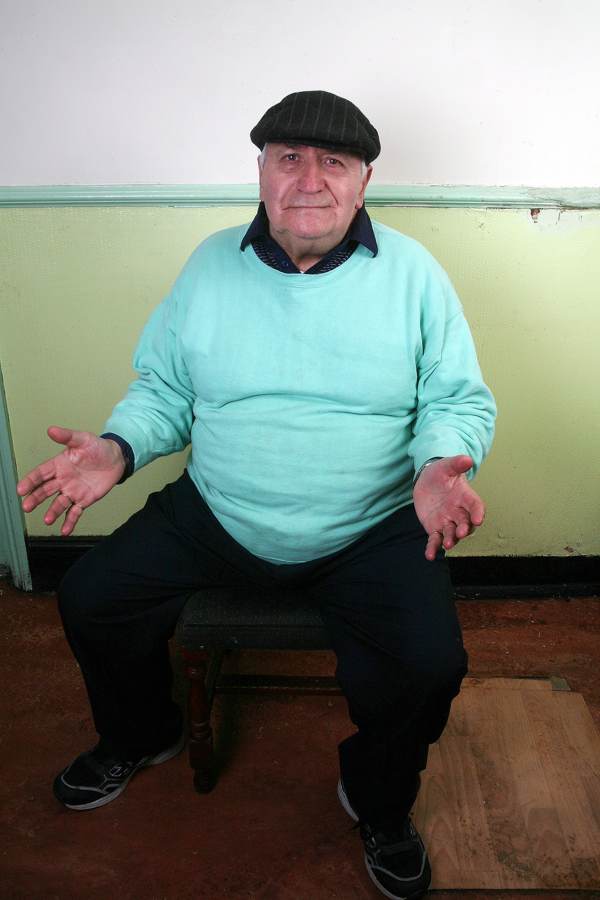
Maurice – “I’ve been coming to Gina’s for thirty weeks.”

Jake Hamilton – “I’ve been coming to Gina’s since I was ten, one year.”
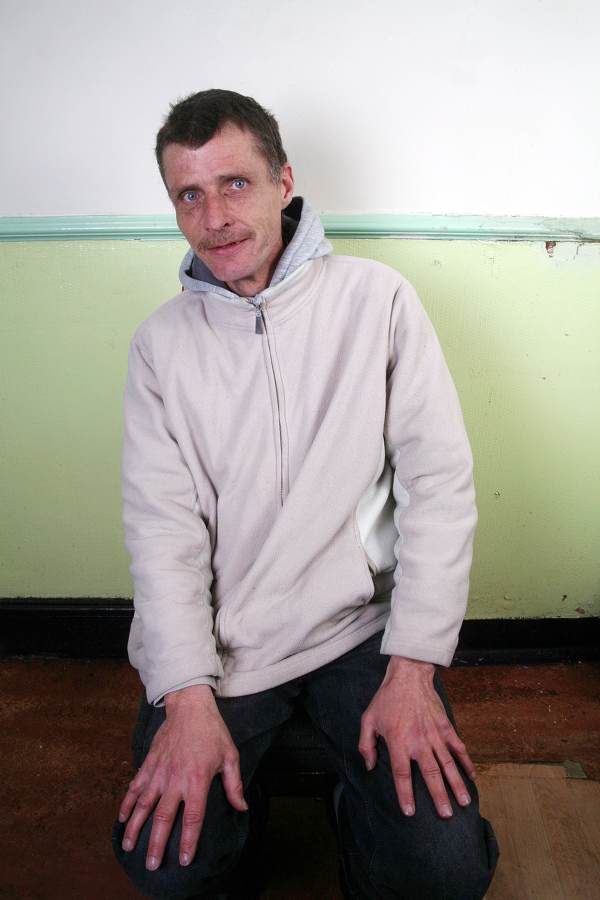
Stephen Coughlan – “I’ve been coming to Gina’s for fifteen years.”
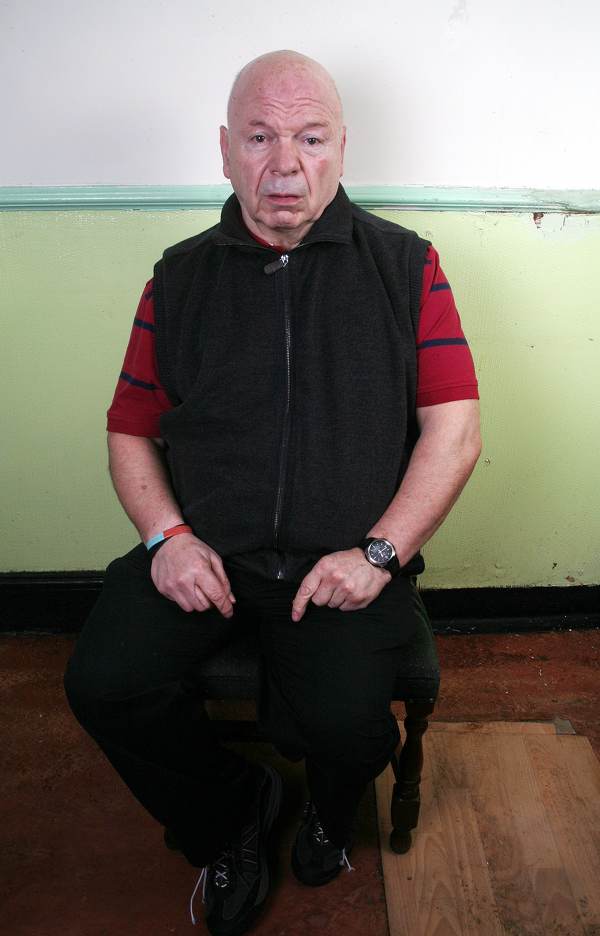
Del Martin – “I was born in Fuller St, Brick Lane. I’ve been coming to Gina’s for forty years.”

Karim Ali, waiter – “Today is my first day at Gina’s.”
Photographs copyright © Colin O’Brien
Commonplace, Photographs by Colin O’Brien 1948-2012, runs at the Crypt of Christ Church, Spitalfields, 28th July – 26th August. Open Tuesdays, Saturdays & Sundays 1-6pm. Colin O’Brien will be talking about his work on Sunday 29th July 2pm.
Colin O’Brien, Photographer
Please join me at the opening of Commonplace, an exhibition of photography by Spitalfields Life Contributing Photographer Colin O’Brien at the crypt of Christ Church, Spitalfields next Thursday 26th July from 7-9pm. Today I am republishing the first story I wrote about Colin and over the next week I will be publishing more stories that I have done in collaboration with him, accompanied by photos that span an extraordinary career extending from 1948 until the present day.

Observe this tender photograph of Raymond Scallionne and Razi Tuffano in Hatton Garden in 1948, one of the first pictures taken by Colin O’Brien – snapped when he was eight years old, the same age as his subjects. Colin forgot this photograph for over half a century until he discovered the negative recently and made a print, yet when he saw the image again he immediately remembered the boys’ names and recalled arranging them in front of the car to construct the most pleasing composition for the lens of his box brownie.
Colin grew up fifty yards from Hatton Garden in Victoria Dwellings, a tenement at the junction of Faringdon Rd and Clerkenwell Rd – the centre of his childhood universe in Clerkenwell, that Colin portrayed in spellbinding photographs which evoke the poetry and pathos of those forgotten threadbare years in the aftermath of World War II. “We had little money or food, and shoes were a luxury. I remember being given my first banana and being told not to eat it in the street where someone might take it,” he told me, incredulous at the reality of his own past,“Victoria Dwellings were very run down and I remember in later years thinking, ‘How did people live in them?’”
Blessed with a vibrant talent for photography, Colin created images of his world with an assurance and flair that is astounding in one so young. And now these pictures exist as a compassionate testimony to a vanished way of life, created by a photographer with a personal relationship to all his subjects. “I just wanted to record the passage of time,” Colin told me with modest understatement, “There were no photographers in the family, but my Uncle Will interested me in photography. He was the black sheep, with a wife and children in Somerset and girlfriends in London, and he used to come for Sunday lunch in Victoria Dwellings sometimes. One day he brought me a contact printing set and he printed up some of my negatives, and even now I can remember the excitement of seeing my photographs appear on the paper.”
Colin O’Brien’s clear-eyed Clerkenwell pictures illustrate a world that was once familiar and has now receded far away, yet the emotionalism of these photographs speaks across time because the human detail is touching. Here is Colin’s mother spooning tea from the caddy into the teapot in the scullery and his father at breakfast in the living room before walking up the road to the Mount Pleasant Sorting Office, as he did every day of his working life. Here is Mrs Leinweber in the flat below, trying to eke out the Shepherd’s Pie for her large family coming round for dinner. Here is the Rio Cinema where Colin used to go to watch the continuous programme, taking sandwiches and a bottle of Tizer, and forced to consort with one of the dubious men in dirty raincoats in order to acquire the adult escort necessary to get into the cinema. Here is one of the innumerable car crashes at the junction of Clerkwenwell Rd and Faringdon Rd that punctuated life at Victoria Dwellings – caused by lights that were out of sync, instructing traffic to drive in both directions simultaneously – a cue for Colin to reach out the window of their top floor flat to capture the accident with his box brownie and for his mother to scream, “Colin, don’t lean out too far!”
At fifteen years old, Colin’s parents bought him Leica camera. “They couldn’t afford it and maybe it came off the back of a lorry, but it was a brilliant present – they realised this was what I wanted to do,” he admitted to me with an emotional smile. “My first job was at Fox Photo in the Faringdon Rd. I worked in the library, but I spent all my time hanging around in the dark room because that was where all the photographers were and I loved the smell of fixer and developer.” he recalled, “And if I stayed there I would have become a press photographer.” But instead Colin went to work in the office of a company of stockbrokers in Cornhill in the City and then for General Electric in Holborn –“I hated offices but I aways got jobs in them” – before becoming a photographic lab technician at St Martins School of Art and finally working for the Inner London Education authority in Media Resources, a role that enabled him to pursue his photography as he pleased throughout his career.
Over all this time, Colin O’Brien has pursued his talent and created a monumental body of photography that amounts to over half a million negatives, although his work is barely known because he never worked for publication or even for money, devoting himself single-mindedly to taking pictures for their own sake. Yet over the passage of time, as a consequence of the purism of his approach, the authority of Colin O’Brien’s superlative photography – distinguished by its human sympathy and aesthetic flair – stands comparison with any of the masters of twentieth century British photography.

Members of the Leinweber family playing darts at the Metropolitan Tavern, Clerkenwell Rd, 1954.
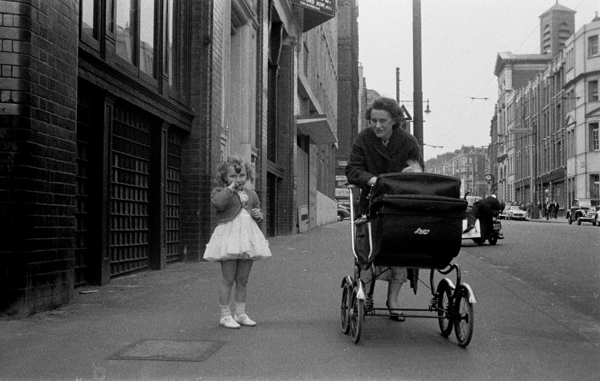
Girl in a party dress in the Clerkwenwell Rd, nineteen fifties.

Solmans Secondhand Shop, Skinner St, Clerkwenwell, 1963.
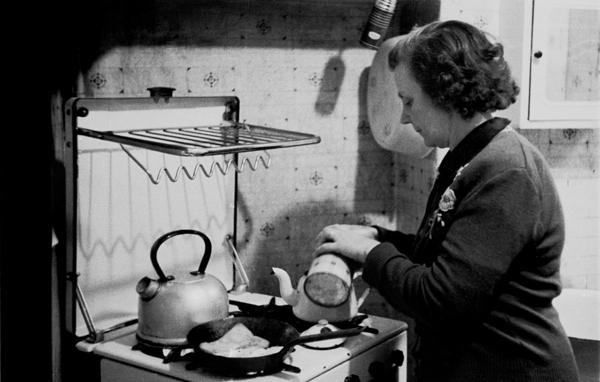
Colin’s mother puts tea in the teapot, in the scullery at Victoria Dwellings, nineteen fifties.

Linda Leinweber takes a nap, 117 Victoria Dwellings, nineteen fifties.
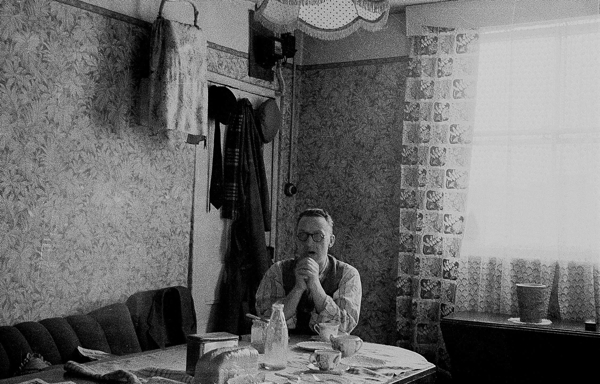
Colin’s father eats breakfast before a day’s work at the Mount Pleasant Sorting Office.
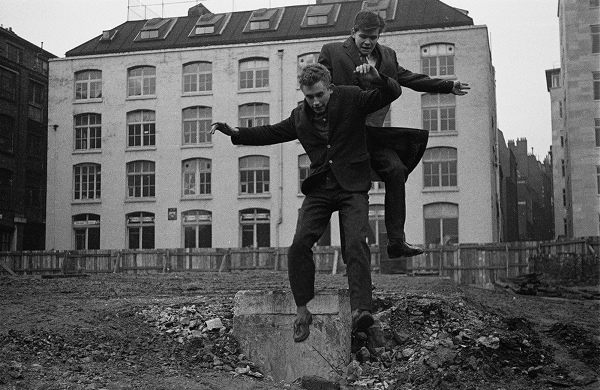
Jimmy Wragg and Bernard Roth jumping on a bomb site in Clerkenwell, late fifties.

Accident at the junction of Clerkwell Rd and Faringdon Rd, 1957.

Mrs Leinweber ekes out the the Shepherd’s Pie among her family, Victoria Dwellings, 1959.

Rio Cinema, Skinner St, Clerkenwell, 1954.
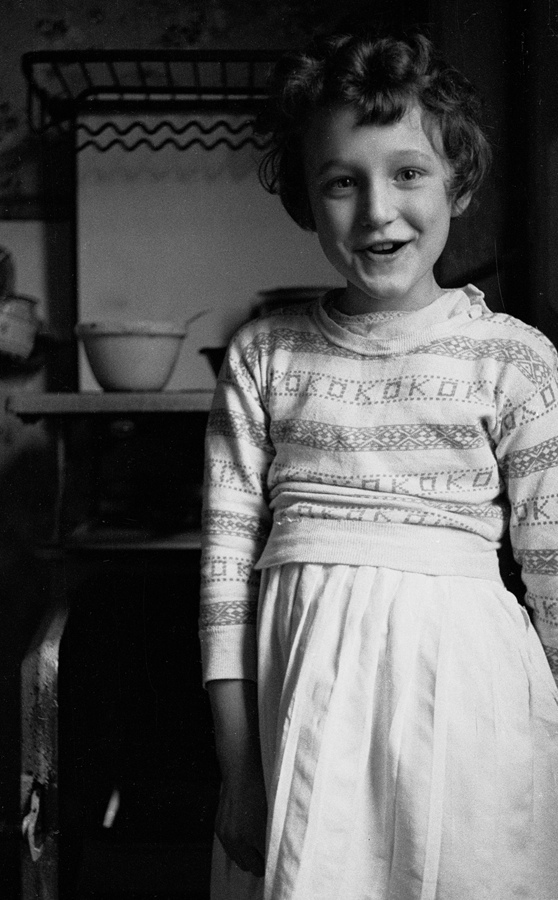
Hazel Leinweber, Victoria Dwellings, nineteen fifties.
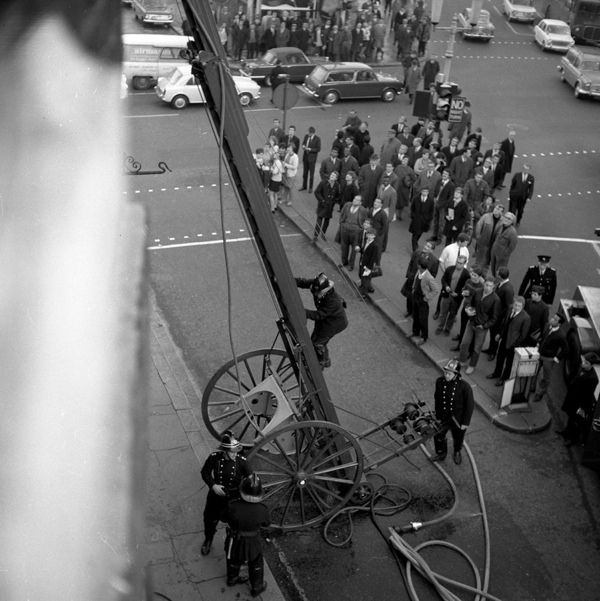
Fire at Victoria Dwellings, mid-fifties.

Colin’s mother outside her door, 99 Victoria Dwellings, nineteen fifties.

Boy at Woolworths, Exmouth Market, 1954.

Two women with a baby in Woolworths, Exmouth Market, 1954.

Cleaning the windows in the snow, Clerkenwell Rd, 1957.
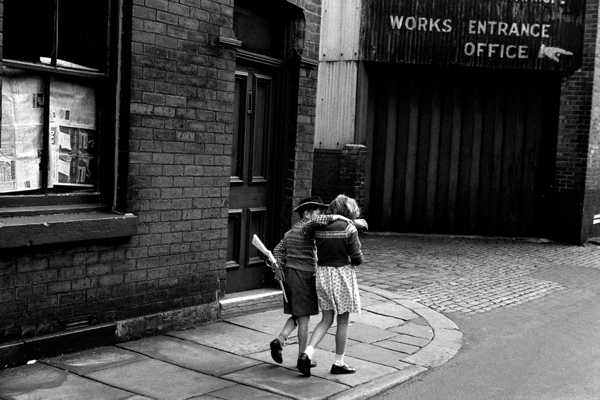
Cowboy and girlfriend, 1960.

Nun sweeping in the Clerkenwell Rd, nineteen sixties.

Colin’s window at Victoria Dwellings was on the far right on the top floor.

An old lady listens, awaiting meals on wheels in Northcliffe House, Clerkenwell, late seventies.

The demolition of Victoria Dwellings in the nineteen seventies.
Photographs copyright © Colin O’Brien
Commonplace, Photographs by Colin O’Brien 1948-2012, runs at the Crypt of Christ Church, Spitalfields, 28th July – 26th August. Open Tuesdays, Saturdays & Sundays 1-6pm. Colin O’Brien will be talking about his work on Sunday 29th July 2pm.
Even More Old Furniture Trade Cards
After publishing sets of old furniture trade cards that might have been found in the secret compartment of a hypothetical cabinet, discovered stashed behind a plate in a hypothetical alcove or down the back of a hypothetical armoire in the eighteenth century, it is my pleasure to show this further selection which were mixed up among the playing cards in the drawer of a hypothetical gaming table.
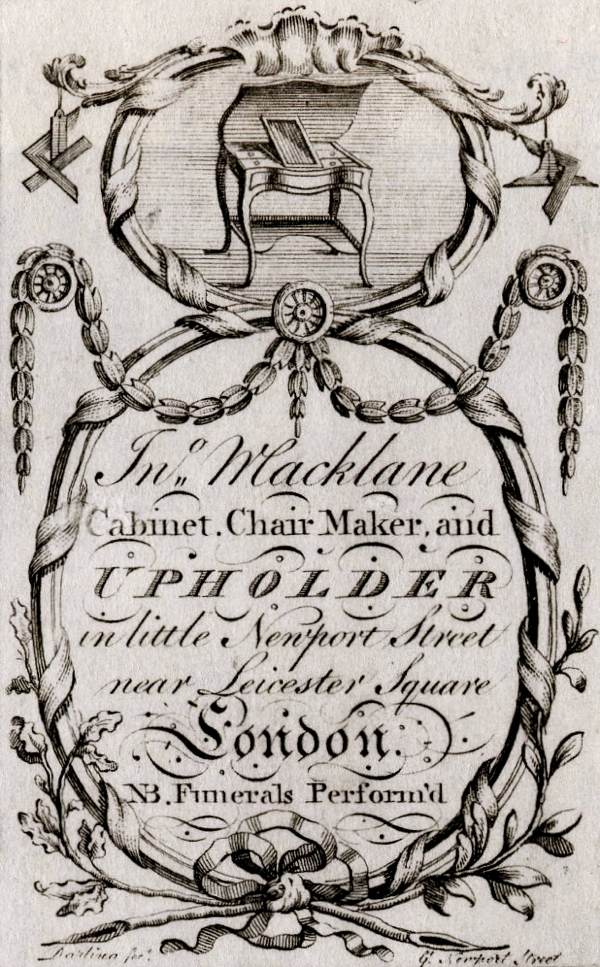


Images courtesy Bishopsgate Institute
You may like to see my earlier selections
Furniture Trade Cards of Old London
More Furniture Trade Cards of Old London
Yet More Furniture Trade Cards of Old London
More Trade Cards of Old London
Yet More Trade Cards of Old London
Even More Trade Cards of Old London
In The East End With A Bradshaw Guide

When Jack London wrote in “People of the Abyss” that he went to Thomas Cook to arrange a visit to the East End and was told such a trip could not be made, he may have exaggerated for dramatic effect. The myth that the East End was a no-go area for tourists in the nineteenth century is scotched by this Bradshaw Guide from 1862 that came into my hands recently. It contains no less than an itinerary for the casual visitor, inspiring me to use it to navigate around the territory yesterday. And you can read excerpts below, accompanied by photographs from my tour as illustrations.
Joan Rose told me she remembers coach parties of tourists pulling up outside her grandfather’s shop in Calvert Avenue in Shoreditch in the nineteen thirties. The driver would announce, “And these are the slums!” which was the cue for Alf to run out onto the pavement and shake his fist in humiliation. Just like those Rio favela tours of our own age – poverty has always been a magnet for tourism, it seems.
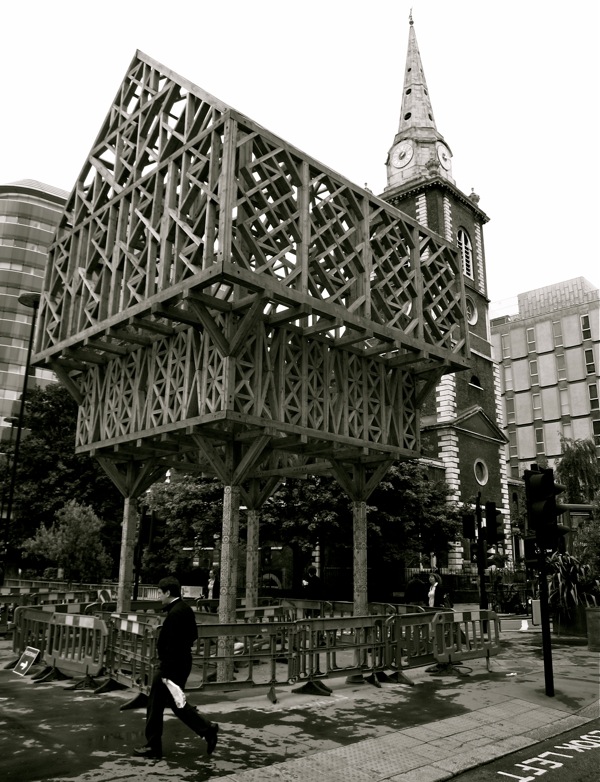
Sculpture upon the side of the “Ald gate” where Chaucer lived above the gatehouse in 1386
Aldgate – to which an omnibus from any of the main thoroughfares will serve as a conveyance, may be taken as a suitable point to commence our pilgrimage in this direction. The place derives its name from the old gate that here guarded the entrance to the City, and which was taken down in 1606.
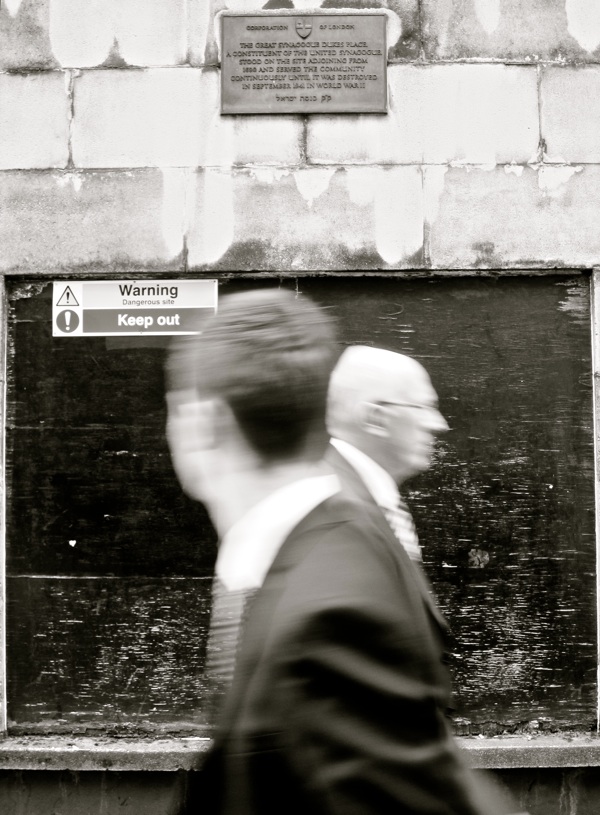
On the site of the Great Synagogue in Bevis Marks, destroyed by a bomb in 1941
Northward from Aldgate are Houndsditch, Bevis Marks and Duke’s Place, the great quarter of the Jews, and here they have settled in great numbers since the days of Oliver Cromwell.
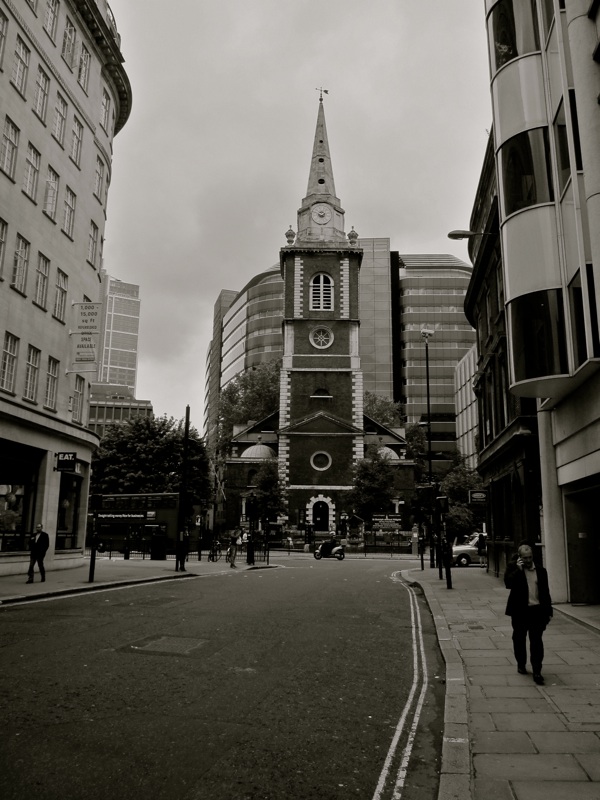
The Minories – a communication with Tower Hill, derives its name from the nuns of the order of St Clare, or minoresses who had been invited into England by Blanche, Queen of Navarre, who here found a convent for their reception.
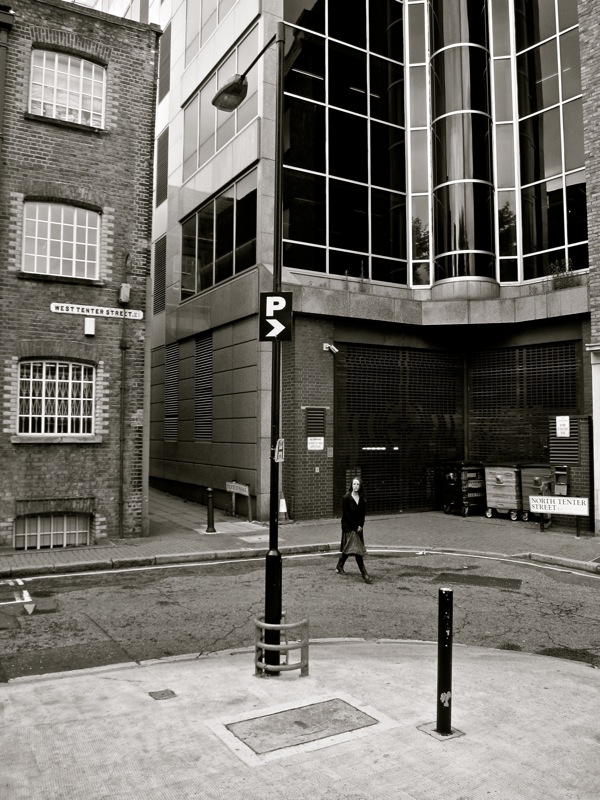
Goodman’s Fields – now a thickly populated region at the back of the Minories. Stow in his quaint fashion, tells us that, in his time, one Trollop, and afterwards Goodman, were the farmers there, and “that the fields were a farm belonging to the said nunnery, at which farm I myself,” he says,“have fetched many a halfpenny worth of milk.”
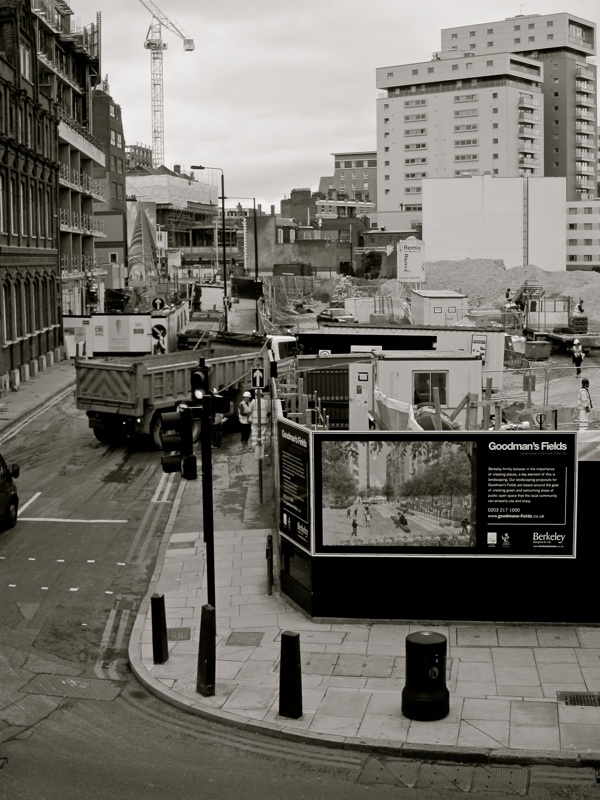
The theatre in Goodman’s Fields was where Garrick first appeared, October 19th, 1741, and here he drew such audiences of gentry and nobility that the carriages filled up the road from Temple Bar to Whitechapel.
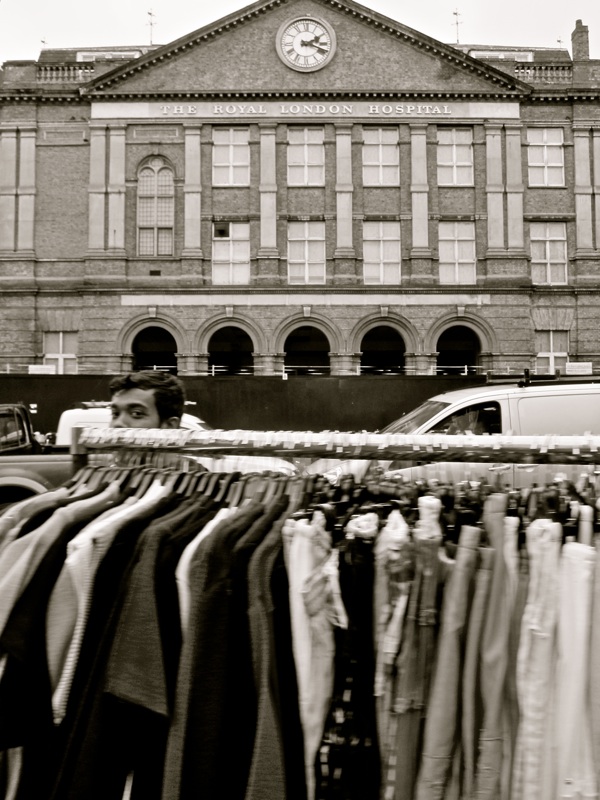
Whitechapel has nothing but the butcher’s shambles to boast of as a characteristic feature. The London Hospital was instituted in 1740 for the relief of maimed and invalided persons who are, from the nature of their avocations, subject to casualties. The patients are chiefly those employed about the docks and in shipping.
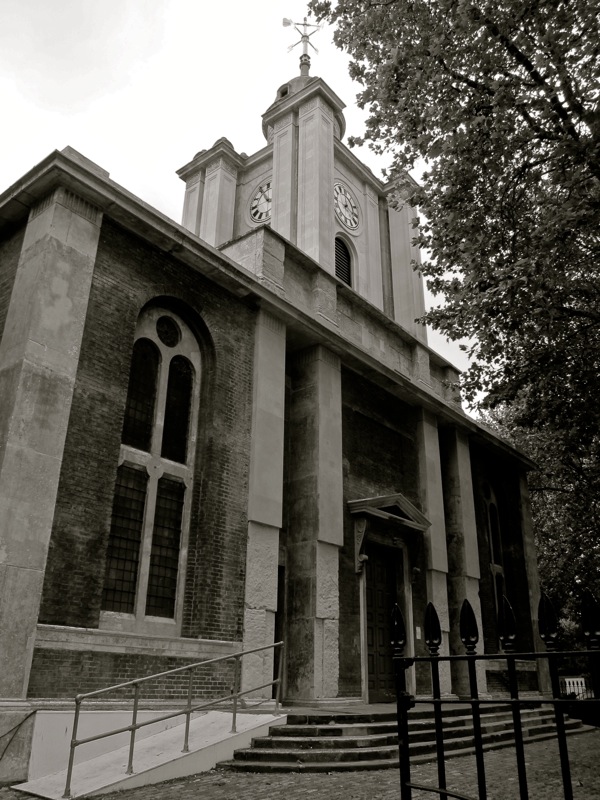
John Soane’s Church of St James, 1826-8
Passing up Globe Rd, we reach Bethnal Green, a large district chiefly populated by the silk-weavers of Spitalfields. Ten churches were erected here within the last ten years and model lodgings have materially contributed to the comfort of the poorer denizens.
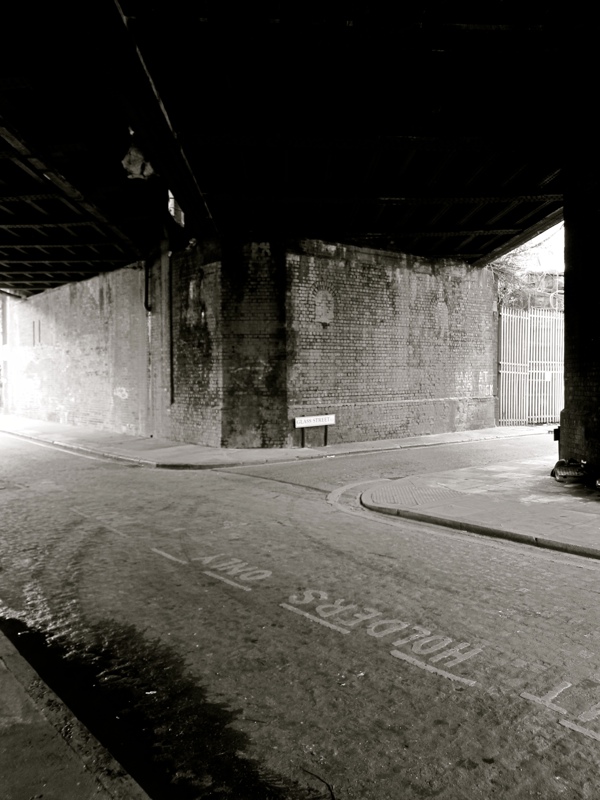
The line of the Eastern Counties Railway traverses the very heart of this squalid region, where the houses generally are miserably small and densely inhabited.
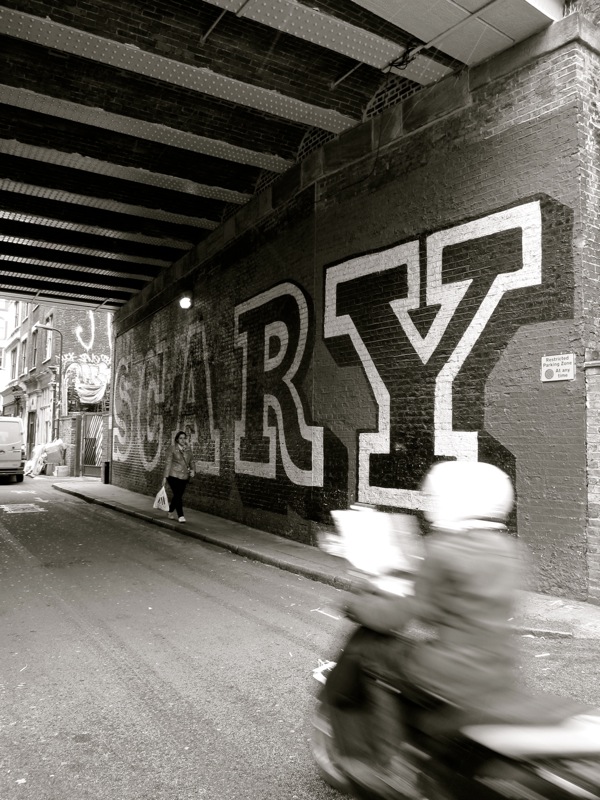
Shoreditch – notwithstanding its present uninviting appearance, this was once a genteel district much inhabited by the players of the court.
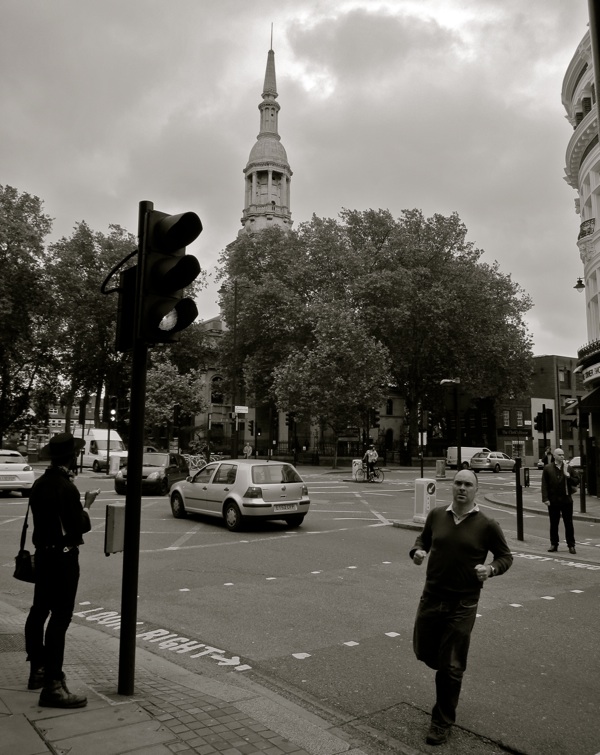
The parish church of St Leonard’s, built by Dance the City architect in 1740, presents nothing exteriorly remarkable but in the burial ground several distinguished personages are interred.
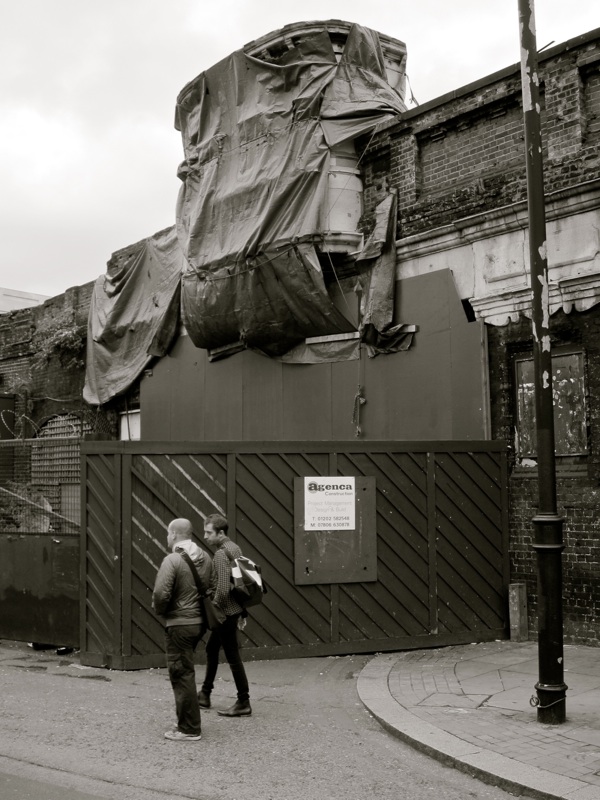
This is all that remains of the former terminus, replaced by Liverpool St Station in 1874.
In Shoreditch is the spacious terminus of the Easter Counties Railway.
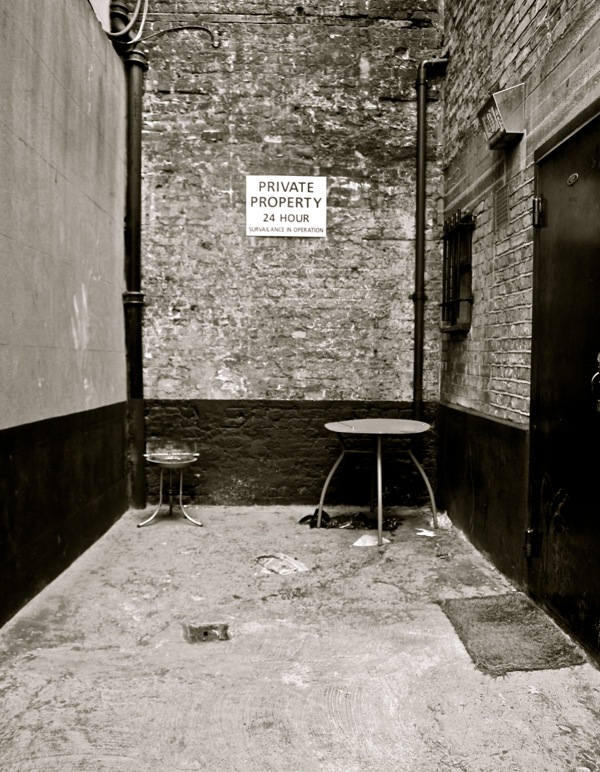
Norton Folgate – a continuation of Bishopsgate St Without, has nothing requiring notice.
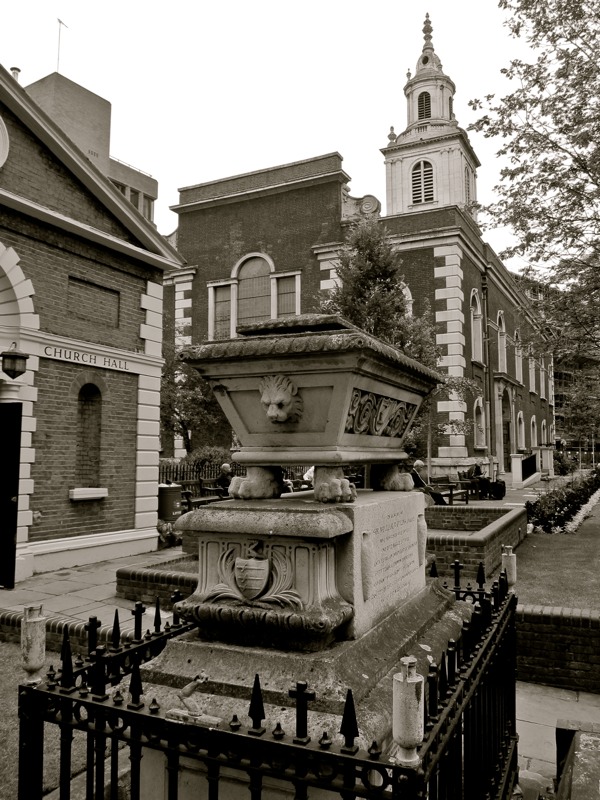
The church of St Botolph in Bishopsgate was built in 1728 and the living, in the gift of the Bishop of London, is more valuable than any other in the City.
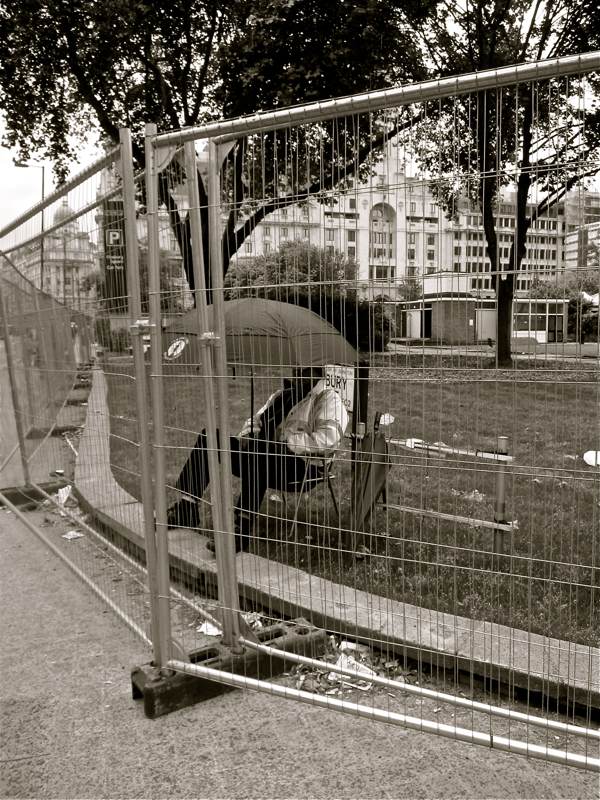
Guard on duty within the ring-fence surrounding Finsbury Sq since the eviction of Occupy London
Finsbury Sq – built in 1789, is a vestige in name at least of olden London, bringing to recollection its original appellation of Fens-bury, from the marshy nature of the soil before it was drained. Hence we may pursue our way by pavement again into the City and recruit ourselves for further expeditions in an opposite direction.
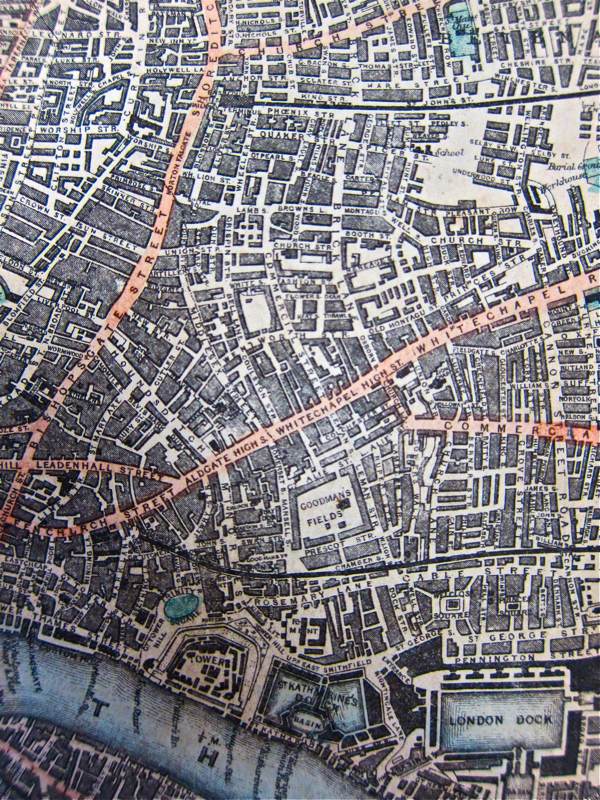
Bradshaw’s Handbook to London has been republished by Conway
Caroline Bousfield, Craftsman
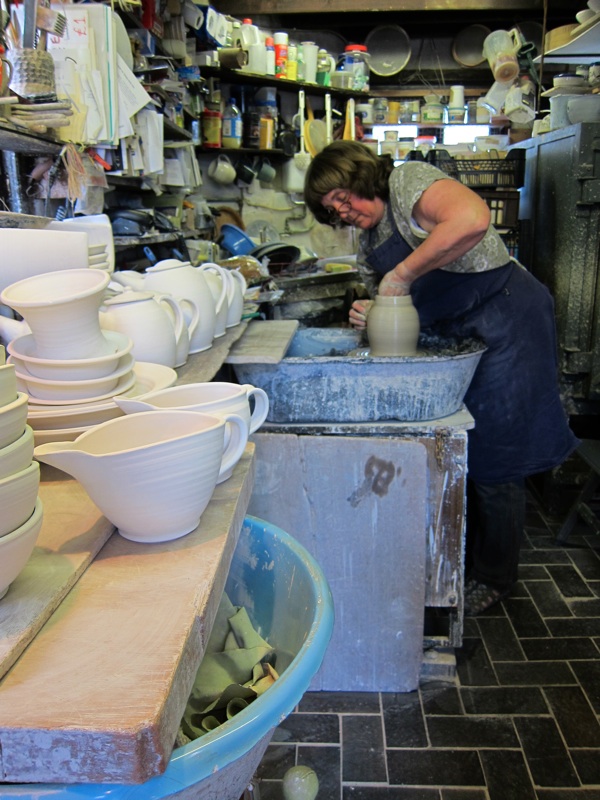
Caroline Bousfield has been making pots in this former coach house in Victoria Park Village for thirty-eight years. When local food shops began to close due to competition from supermarkets, she formed a traders’ association and they brought back a butcher, a fishmonger, a baker and a greengrocer. Then Caroline planted the roundabout outside her studio and created a garden that is now the appealing centrepiece of this lively corner of the East End. Today, her pottery workshop is the oldest-established business in Victoria Park Village and she has worked there longer than anyone else.
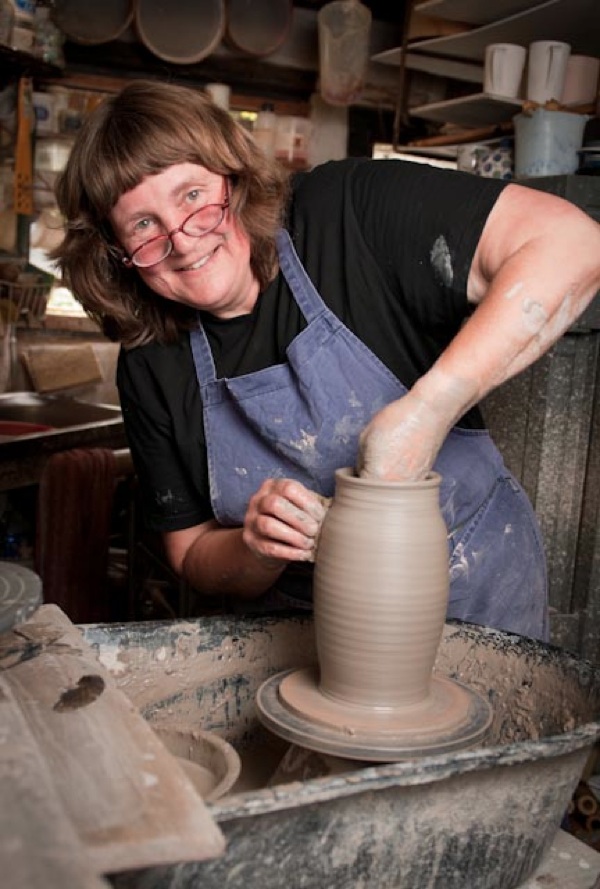
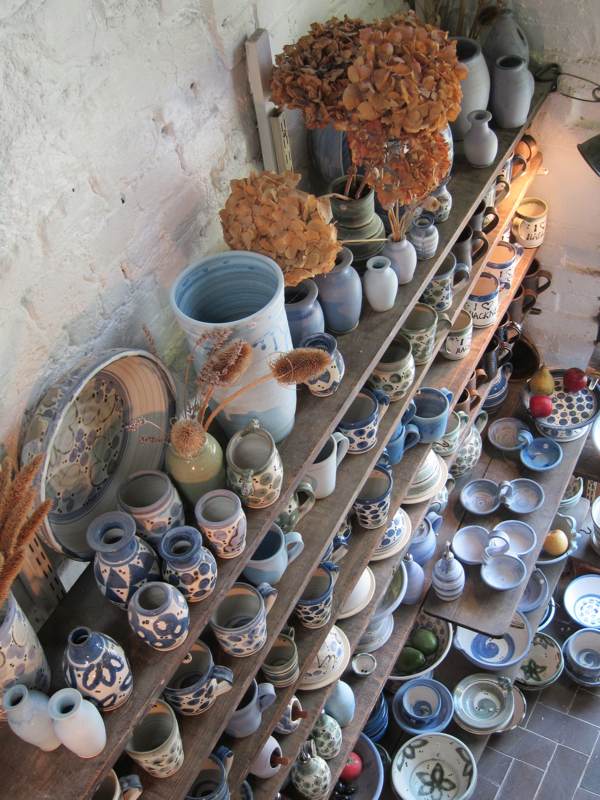
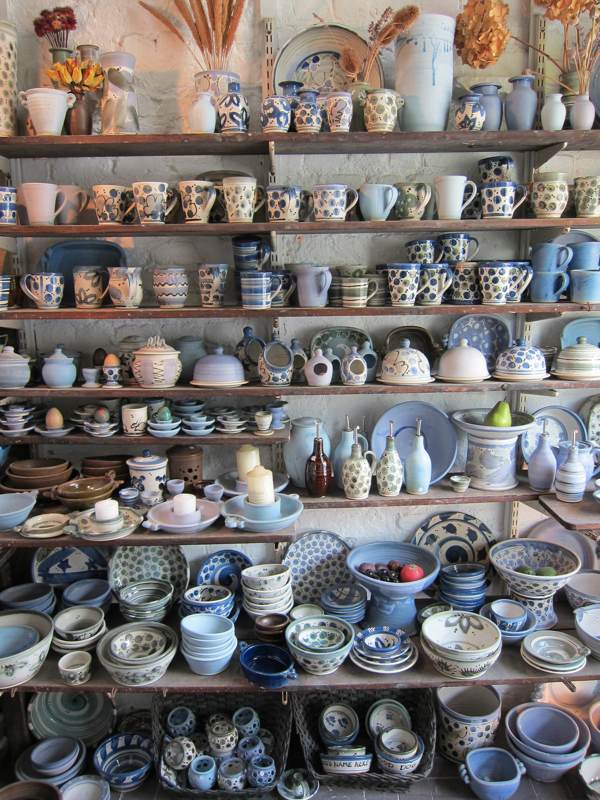
Caroline Bousfield’s story is an inspiring example of how the creative influence of a one community-spirited individual can have a huge impact upon a place, improving it for the better. Yet she presents herself modestly, wiping the clay off her hands with a cloth and welcoming everyone into her tiny workshop personally. To the left as you enter, you discover Caroline working at her wheel, surrounded by hundreds of white biscuit-fired dishes and pots awaiting glaze, while to the right is her showroom, lined wall-to-wall in shelves laden with examples of the elegant traditional studio pottery that is her forte. Drying her hands on her faded blue apron, Caroline pushes her thick brown hair away from her face to give you her full attention and you cannot but feel privileged to be there in her charismatic den.
“People always ask, how long does it takes to make a pot?” she confided to me with a complicit smile, “And there are two answers to that, two minutes or twenty years – depending on which way you look at it.”
Caroline trained originally as a potter and as a furniture maker, and has taught both continuously over the years. With characteristic lack of pretence, she calls herself a “Craftsman,” adding “My gardening is self-taught.”
“I came to London in 1972 when I got married, after doing a Teachers’ Certificate at Goldalming. My husband took a job with the Ford Motor Company in Dagenham and, as he couldn’t face commuting through the Blackwall Tunnel, we came to live here. It was thought to be a strange thing to do, to move to the East End, in those days.
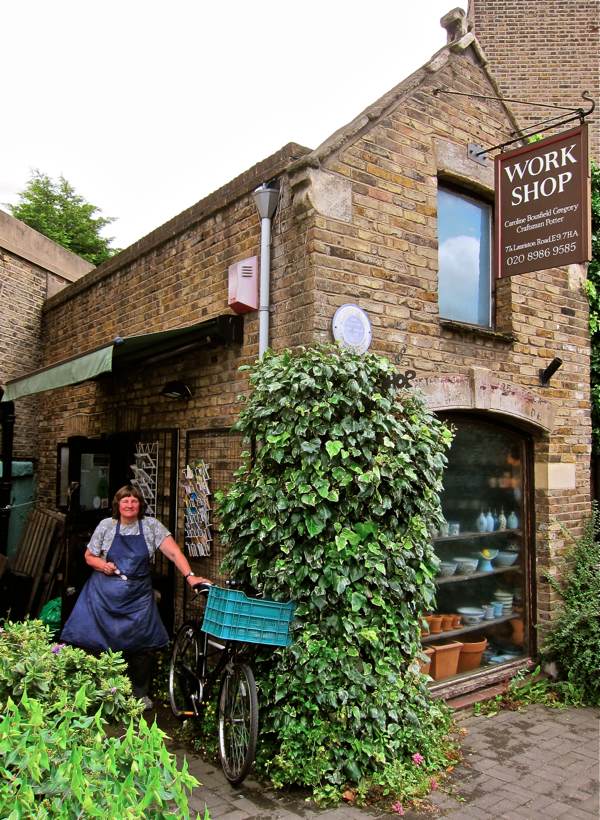
I taught pottery at Kingsway College until my two daughters came along. But I found that if you had children or a dog, people spoke to you in the street and a fellow dogwalker in Victoria Park told me that this place was for sale. It was built as a coach house and stable in 1885, and over the stone lintel you can still read the words “North Metropolitan Volunteer Fire Escape Brigade.” Mr Koopman had run it as an electrical repair shop from 1929 until he retired in 1975, and I bought it for £2,500, which was a bargain even then. My plan was to be able to make and sell my own pots in one place, and I like being here very much – if you run a shop you become a centre for local information. I remember Mr Davis, the hardware and grocer next door, every can was dusted and wiped as he took it from the shelf. And if you asked for rubber rings for jam jars, he’d opened up a trapdoor in the floor with a counterweight and return with some. ‘It says,’One shilling and sixpence’ on the label, that sounds like a lot!’ he’d say. This was already in the days of decimal currency.
When my daughters were babies, I just brought them here and got on with my work. Then I used to swap with a friend who had children, so we each got childcare for one day and my husband took care of them on Saturdays. When my children grew up, I decided I wanted to go back to making furniture and I imagined I would do that at home in the cellar, on the days I wasn’t here, but instead I started a traders’ association for local businesses. There were four butchers when I came and they all went, then the greengrocer and baker closed, so those of us who were left we discussed how to bring them back. We approached a butcher and a fishmonger and invited them to come here, and the existing shops even shuffled around to offer them the best locations.
And I started to lobby the roads’ department to let me grow plants on the roundabout, but the first answer was ‘no,’ so then I simply went over and started pulling up the weeds. In the end, I had to write a method statement and agree to wear a high-visibility vest, and pay £5 for the privilege too. They said this was because, if I got it free, I could claim squatters’ rights and build structures. Then I thought I should create an association to do it, so it was not just me – but it is just me. I’ve raised the money myself. People donate me books that I sell in the shop, and I pick the lavender and make lavender bags, and that pays for anything new I want to plant. I’ve come second and third in Hackney in Bloom but there is not really an appropriate category for roundabouts. Now people see me gardening from buses and cars, and they call me ‘The Lady On The Roundabout” locally.
There are secrets on my roundabout for anyone that works there – a patch of violets which nobody sees but me and which give a wonderful scent when in flower, a blackbird who is a regular visitor, the remains of foxes’ suppers stolen from bins and sometimes the debris of a party. If I ignore the traffic, the sound of bees on the lavender can be heard.
People who have spent a few hours working on the roundabout say that they feel differently about the place, they feel that they belong more. The climate for guerrilla gardening is quite different now from when I started on the roundabout ten years ago and I highly recommend it to anyone who lives near any unkempt public space.”
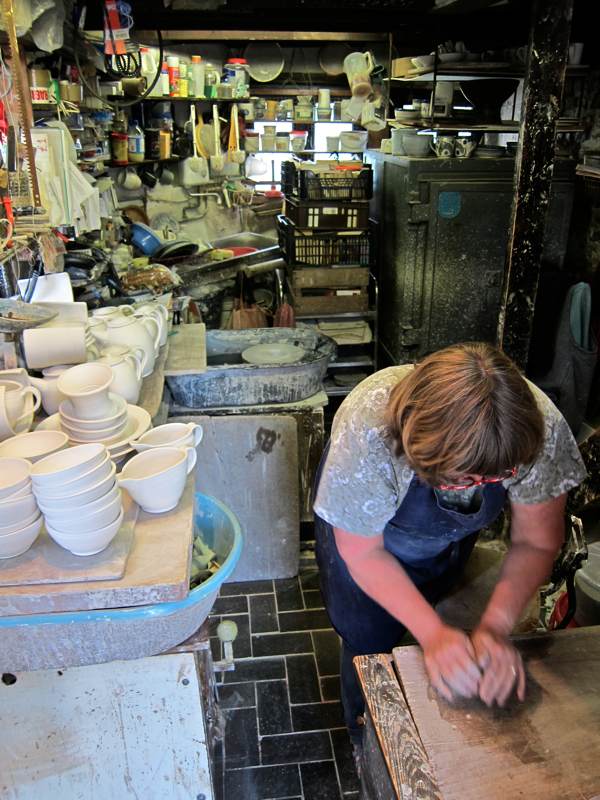
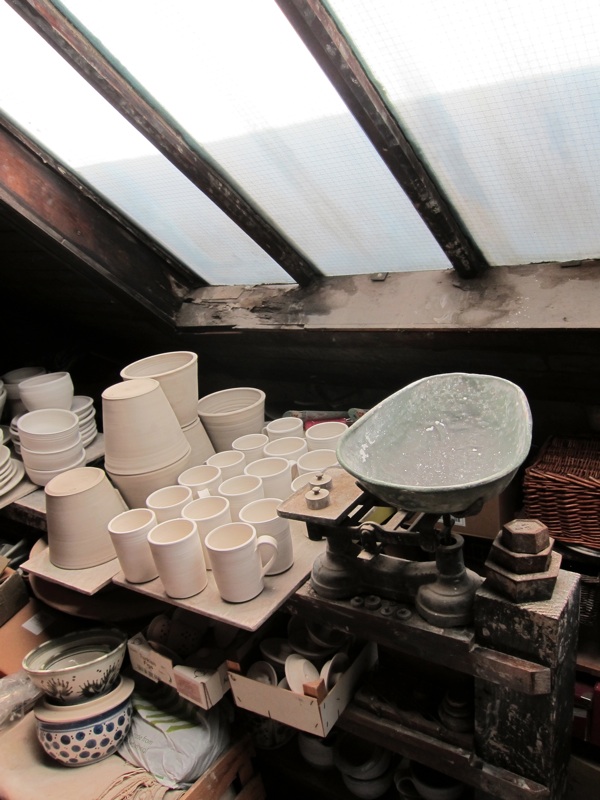
Biscuit fired pots awaiting glaze.
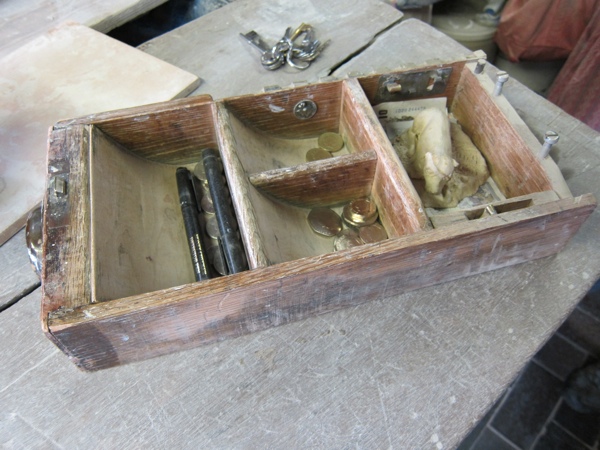
The money drawer from Mr Koopman’s Radio Shop with a sixpence that he nailed inside for luck and a dog made by a local pensioner who asked for clay to model his pet.
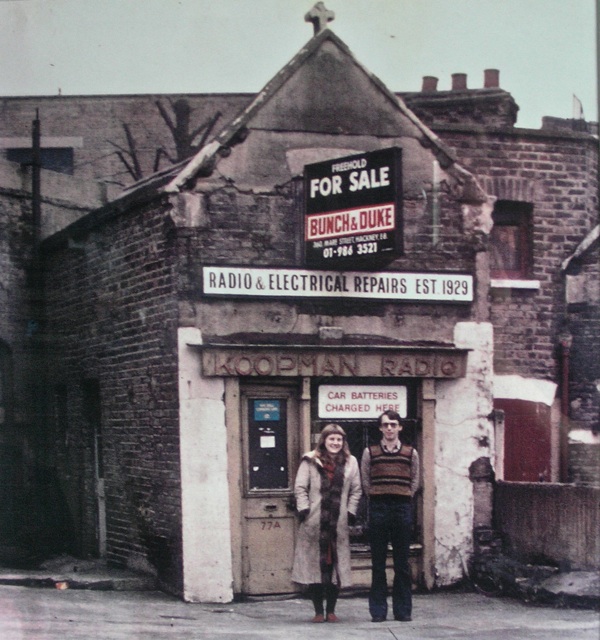
Caroline and her husband Gordon Gregory when they bought the coachhouse in 1975.
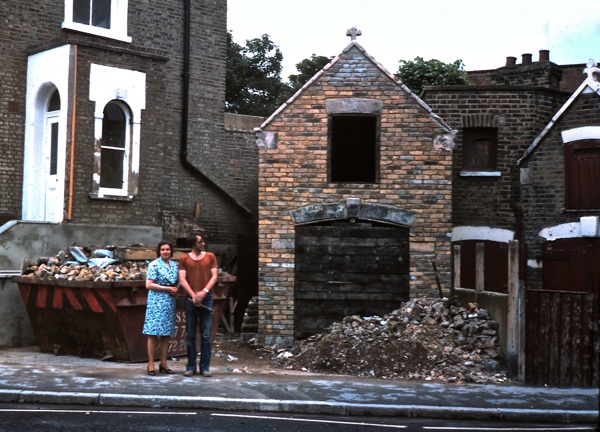
Gordon Gregory and his mother in 1975, after rebuilding the facade using the original bricks.
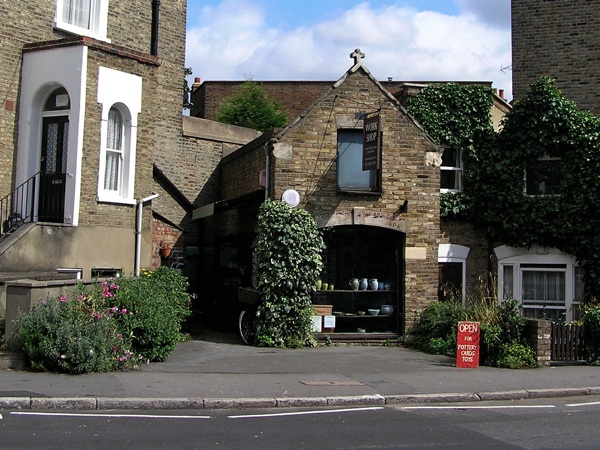
Caroline’s pottery studio today.
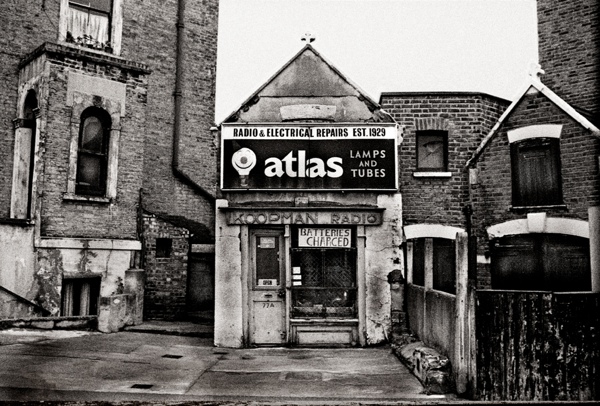
John Claridge’s photograph of the carriage house as electrical shop in 1964
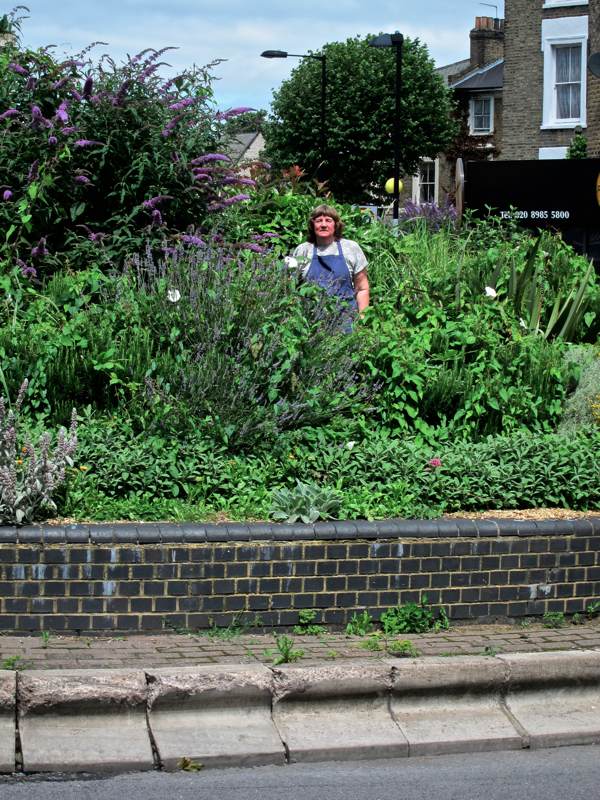
Caroline on the Victoria Park Village roundabout that she planted and where she continues to garden, becoming famous in East London as “The Lady On The Roundabout.”
1964 Archive photograph © John Claridge
Caroline Bousfield’s Pottery Workshop & Shop, 77a Lauriston Rd, Hackney, E9 7HA