
The Story of the Spitalfields Dioramas

After a little detective work and a trip to Leigh-on Sea, I am able now to tell the full story of the Spitalfields Dioramas, due to be unveiled tonight by Mavis Bullwinkle in their new home at the Bishopsgate Institute.
Truman’s Brewery commissioned the dioramas in 1972 for The Bell in Middlesex St from Howard Karslake, one of the top model makers of his day. They were designed to portray Petticoat Lane Market a century ago and, in the ten weeks they took to make, all the members of the Karslake family contributed to this epic example of the model makers’ art. Howard Karslake died young at the age of just fifty-eight in 1995 and this evening his family will be seeing the newly-restored dioramas for the first time in forty years. So, as well as being a magnificent evocation of Spitalfields in times past, they are a memorial to a uniquely talented man.
Today, Howard Karslake’s son Paul Karslake is a jobbing artist with a rock and roll style. He picked me up from Leigh-on-Sea railway station in a Bentley that he has customised spectacularly with scenes from British history, whisking me away to his studio in a former garage at the top of the hill which in its creative disorder – he told me – approximated closely to his father’s workshop.
“My father was born Michael Howard Karslake in 1932. He became very interested in models of all kinds when he went into the RAF, where he worked as an undercover topographer making incredibly detailed scale models from maps that pilots could study as a reconnaissance before they went off on a secret mission. Later, he went on to make the architect’s working model of the Thames Barrier, the model of the pilot’s seat in Concorde and models of many of the big North Sea oil rigs.
On leaving the RAF, he studied at Kingston College of Art in the same year as Terence Conran, and it was there he decided to become an architectural model maker. Then he fell in love with my mother Rachel who had just come over from South Africa and he got a job as chief model maker to Basildon Development Corporation, which gave him a council house automatically. And that’s where I was born.
But he found the work bureaucratic at the development corporation and when he got in trouble one day for not wearing a tie, he left and set up his own model making business. He had a big shed in the back garden where he worked. Before long, he won the Queen’s Award for Industry for his model of the Piper Alpha oil rig and he was made a Fellow of the Royal Society of Arts. At one time, he had seventeen people working in his business. I used to come in after to school to help and I was honoured because he valued my skills, even though I was only fourteen years old at the time. We were both perfectionists, so we clashed because you could never criticise, but I am so glad that I worked with him.
When the commission from Truman’s Brewery came along, he wasn’t that interested because it was different from his usual work but the rest of the family persuaded him to do it. At that time, Petticoat Lane was the East End equivalent of Carnaby St, it was the place to go for fashion and records. We all went there to have a look, it was bohemian and I loved it. I remember seeing Keith Emerson of Emerson, Lake & Palmer there in a mad coat.
The Bell opened at midday and shut at two-thirty in those days, and they were so strict that I wasn’t even allowed into the pub. I only went in once when the models were being fitted, and the foreman from the brewery came along and said, “How old is he? He’s not allowed to be here.” Truman’s treated The Bell as a showcase. The pub had been beautifully refurbished by the brewery with a new juke box. It was very exciting.
We began with the baseboard and then, using reference photographs, we created false perspectives and worked out where the figures were going to be. We had to set a scale and keep to it. My dad’s rule was, “If it looks right, it is right.” I remember turning the pickle jar in perspex. The biggest part of the job was the mirror behind the bar at The Bell which was etched in acid. I had to learn to do it very quickly, and then I did the gold leaf and the green enamel paint. This was where I first did airbrushing, which is the main technique I use for my paintings today. The entire family, we worked six days a week for ten weeks to complete the models. My mother Rachel made all the figures and I painted the balloon in the sky over Brick Lane and did some of the sign writing, such as my father’s name over a shop, while my little brother Vincent painted all the lettuces.We created portraits of everyone we knew, and I am in there several times.
He was very proud of it. It was a fabulous effort. The whole family worked so hard. I only have a couple of his models to remember him by – a rotary hoe that he made early in his career and one of the tractors he made at the end. I miss him, but I’ve got his eyes so if I need a top-up of my dad, I can just look in the mirror. Considering he died so young, he did quite a lot in his life.“

Howard Karslake (centre) presents the trophy he designed to racing driver Stirling Moss (left) in 1967.

Howard Karslake, modelmaker (1932 – 1995)

“Telling God a joke.” – Paul Karslake’s portrait of his father, 1997.

Paul has fond memories of making the pickle jar and the fish in a box, which is a roach and is based upon an original in his mother’s possession of 1821. The mirror behind the bar is of etched glass created by the same process as a full-size one. The landlady was made by Rachel Karslake, Howard’s wife, as a self-portrait using her own hair.

Paul Karslake stands outside his studio in Leigh-on-Sea, beside his Bentley recently painted with scenes from British history,

Click on this picture to explore the diorama of Petticoat Lane.
If you would like to attend the unveiling tonight please email Stefan.Dickers@bishopsgate.org.uk to put your name on the list. The dioramas will remain permanently on display in the Bishopsgate Institute Library to be viewed during opening hours.
You may like to read more about
Ron Cooper, Lightweight Champion Boxer
It has been my pleasure to contribute a series of interviews to BOXERS, Photographs of Boxing in London by Alex Sturrock , a large format colour book published next week by Ally Capellino. Here is my interview from the book with Lightweight Champion Ron Cooper, an East Ender who competed in the London Olympics of 1948.

Ron Cooper
I met Ron Cooper at one of the London Ex-Boxers Association reunions, held each first Sunday morning of the month at the William Blake in Old Street. At these events, you encounter hundreds of ex-boxers enjoying the camaraderie that distinguishes their sport.
Every gathering begins with the reading of a list of those who have passed away since last time, followed by a moment of respectful silence, and then it is on to club notices. Speeches and a raffle punctuate the morning and everyone takes comfort in the knowledge that due procedure has been followed in this familiar ritual. Yet, in effect, it is a Sunday service of devotion for all those who love boxing and have devoted their lives to it. And, even though the bar does not open, the sentiment of the occasion is enough to create widespread intoxication. Some of the most senior are the most playful, while handshakes, unselfconscious embraces and posing for yet another group photo, bear witness to the emotion of the moment, recognising that the ties of friendship formed a lifetime ago remain as strong as ever.
Amongst the old timers, all suited and booted, shaven and shorn and well-turned out in dark suits, the youngsters are eager to seek inspiration from their idols. And it was in this environment that I had the privilege to sit down in a quiet corner with East End boxing legend, Ron Cooper, while he told me his story in his own words.
“I was just a little cockney boy from Limehouse. I felt so proud to fight in the Olympics in London in 1948, all the buttons on my shirt busted! I still have the vest, it’s sixty-two years old and I’d probably get in it now if I done a little training.
I was working down in Millwall in the docks, doing welding after I come out the Navy. And when my father died in 1948, soon after I won the ABA lightweight championship, I didn’t want to box anymore, I’d lost all heart. In my first fight after his death, I kept looking around for the old man at the ringside, like he always was. And he wasn’t there.
Then my guvnor said, “You’ve been picked, Ron, for the Olympics.” I said, “Yes guvnor, I’ve been picked for the Olympics.” He said, “Where are you going to train?” I said, “I can’t afford to go away. I’m the breadwinner indoors, I’ve got to go to work.” I was the youngest of ten. But my guvnor was a boxing fan, so the first thing he did – I can see it as if it was yesterday – he said, “Mary, get Ronnie three weeks wages. Here’s your wages Ronnie!” And I went away with the British boxing team to Wargrave.
I can remember going to Switzerland to box for Britain in 1947 and they put a steak in front of me and I said, “What’s that? Is that a steak? I haven’t seen one of them in six years.” We was on rations. We was getting two ounces of bacon, two ounces of sugar, half a loaf of bread and a bottle of milk per person. That’s how we lived. We were starving. We had nothing. Actually, to tell you the truth, I don’t know how we done it. We were skint, weren’t we, in 1948? Food rationing ‘til when? 1954! This was three years after the war. Bomb damage everywhere.
Down at Wargrave, from fly to lightweight was going out on the road to train and from welter to middleweight was stopping in the gym. The next day, we would reverse it, they would go in the gym and we would go out on the road. And for food – I had to laugh – they used to say, “Give Ronnie Cooper the custard and jelly,” because I love custard and jelly. That – to me – was a steak. I used to say, “If there’s any meat, give it to the others” We never had no meat, did we? Everyone had to bring their own meat! But custard and jelly, I loved it, I love it now. When I used to have a fight, I said to my mum, “What you got?” And she used to say, “Your custard and jelly’s right out there, it’s red hot.”
To wear that Olympic blazer with Great Britain on it, that’s the pinnacle of amateur boxing. And you feel proud with the old beret on, little twenty-year-old walking down, still wiping your nose. I boxed at Wembley, I boxed the Dutch champion, Jan Remie, and I beat him. He was like a bull. He wouldn’t leave me alone. He went jab, jab, jab and I went bang, bang, bang.
The second one – I boxed the European champion, Matthew McCullagh – the only thing I remember was when I came round, I’m sitting there and someone was hitting me round the face. I said, “All right, when am I on then?” They said, “Son, you have been on and you’re out.” I said, “How did I get on in the fight?” They said, “You lost!” They said, “Do you remember when you got put down on the floor?” I said, “No.” It was the first time I ever got decked as an amateur. They said, “Do you know you had him on the floor?” I said, “No.”
I got put down in the first round but they told me I had him down in the second round and the third round. They told me, “What a fight! What a fight!” I told them, “I didn’t feel a thing. I don’t remember going in, I don’t remember coming out. I don’t remember it.” They told me, “You’ve lost on points but what a fight you’ve had.” I had a lovely letter from the RSBA telling me what a fantastic fight it was. I’d never got knocked out, only when I got married.
I had twenty-six fights as a pro and won twenty-three, and I’ve fought four area champions and knocked them out. I never done bad. Years ago, I used to have eight rounds in a week, today they wouldn’t do it. We never had the vitamins these kids have today. To be a champion and reach the top noddle, you have to be dedicated. It was through hard work that I got there. I say to kids, “You can be fit as a fiddle but if you want to reach the top, you’ve got have a bit of dedication, a bit of hard work.”
Whether it’s running or swimming, boxing, wrestling, hockey, football – you name it – you have to sacrifice things. You’ve got to do it. And to go in the ring you’ve got to have a bit of heart, haven’t you? Any sport, you’ve to have a bit of heart. When I started boxing, no way in my lifetime did I think that I’d have been boxing in the Olympic Games.”

Ron Cooper when he competed in the London Olympics 1948.

Charlie Edwards is nineteen years old and has been training to compete in the 2012 Olympics – “It’s an adrenalin rush when you’re winning, I’ve never felt a buzz like it. I love it, I’ve loved it ever since I first went into the gym. It’s a huge feeling, you want it so bad.”
Photographs copyright © Alex Sturrock


Copies of BOXERS are available from Ally Capellino and Rough Trade in east and west London.
At Stratford le Bow, June 27th 1556
This story contributed by Kate Cole inspired me to go to Stratford yesterday – amidst all the shopping malls and Olympic razzmatazz – to take a picture of the memorial to the thirteen martyrs burnt alive there for their beliefs on this day in 1556.

Today is the anniversary of the burning of thirteen people at Stratford le Bow in 1556, executed in the most horrible manner because of their faith. It was the largest burning of a group of people in Tudor times and the grim spectacle was watched by a crowd of over twenty thousand.
For ordinary citizens, the reign of the Tudor monarchs was one of the bloodiest and dangerous of times to live in English history. The country had been in religious turmoil since Henry VIII’s break with Rome in the 1530s, caused by his marriage to Anne Boleyn. And when Henry died on 28th January 1547,the boy-king, Edward VI, imposed even greater religious changes, designed to eradicate Catholicism and embrace Protestantism fully. But then, after Edward’s premature death in July 1553 and, after she had dispelled Lady Jane Grey’s Protestant henchmen’s attempts to seize the throne, Mary, the eldest child of Henry VIII, became queen. She was a devout woman who was determined to restore the English people to the Catholic faith led by the Pope in Rome.
This period of volatile religious policies was a troubled time for members of parishes across the country, in which disobedience to a monarch’s religious edict could quickly lead to a violent death. Burnings such as the 1555 execution of the bishops Hugh Latimer and Nicholas Ridley, followed by the 1556 burning of the Archbishop of Canterbury, Thomas Cranmer, are remembered to this day. However, many that burnt in the fires of Mary’s reign were ordinary people – artisans, craftsman, labourers, and their wives – who are largely forgotten.
Those that died on 27th June 1556 at Stratford le Bow were just such men and women. John Foxe, writing seven years later in 1563 during the Protestant Queen Elizabeth I’s reign, listed those that died that day. From his book The Acts and Monuments (more commonly known as Foxe’s Book of Martyrs), we find they were –
These thirteen were all working men and women with such strong religious convictions that, despite being given the opportunity to renounce their faith in return for their lives, they chose a painful death instead. After they were condemned, John Feckenham, the Dean of St Paul’s, preached against them at Paul’s Cross. He criticised them for all having different Protestant views and the group responded by producing a joint declaration of faith. Originally, the group comprised of sixteen but Feckenham continued to visit them whilst they were in gaol, and three recanted and were released but the rest did not and accepted their fate.
According to a woodcut in the 1570 edition of John Foxe’s Book of Martyrs, the eleven men were tied to wooden stakes but the two women were loose within the pyre. Although no other contemporary account of the burning survives, one can only hope that the authorities permitted the families and friends’ requests to tie bags of gunpowder around the victims’ necks, in an attempt to dispatch them with the least amount of suffering possible.
Three hundred years later, in 1878, a memorial to these thirteen, and other victims of Mary’s burnings, was unveiled in St John’s churchyard, Stratford. There has been much debate amongst historians as to whether this particular appalling event took place in Stratford on Stratford Green or in Bow near Bow Church – and because of the number of spectators, it is more likely to be Bow. So this Victorian Gothic memorial might be in the wrong location. But wherever the burnings actually took place, the memorial rightly commemorates those thirteen unfortunate men and women from Essex, Hertfordshire, Sussex and London who died for their beliefs on 27th June 1556.

Memorial at Stratford of 1878 to those martyrs who died for their faith in the reign of Mary.

Read Kate Cole’s story of Thomas Bowyer, the martyr from Great Dunmow.
You may also like to read
The Return Of Vicky Moses

Vicky outside the former Providence Row Shelter where she stayed as a ten-year-old in 1958
Vicky Moses returned to Spitalfields for the first time in over fifty years while house-hunting last October, and had the strange experience of encountering her younger self at the Providence Row Shelter in Crispin St, where she had once stayed as child. Now Vicky has moved into a flat nearby in the Petticoat Tower and confesses that it is no accident that after all these years she has chosen to make her permanent home in Spitalfields.“The place feels comfortable to me,” she confirmed when I met her in Crispin St outside the former Providence Row Shelter yesterday.
“During the winter of 1958, my mother took myself, aged ten, with my sister and brother aged six and four, and a six-month-old baby, to London to get away from my violent father. Arriving at Victoria Station with just the housekeeping money, Mum had no option but to seek help. She went first to what is now The Passage, a charitable hostel in Carlisle Place in Victoria, but there was no help there for a family such as ours. Eventually – having walked right across London looking for somewhere to stay – by that evening we arrived at the doors of Providence Row in Spitalfields where we were given beds and this became our temporary home.
As a ten-year-old, I was able to take it all in and remember it well, even now. It was such a contrast to our suburban life, but we were safe and secure and with our mother, our rock.
My memories of Providence Row are these – From the street you went up steps to the door, and inside was a long large room with a huge wooden table running through the middle, and, on either side, along the walls, were wooden benches. Women and children were separated from the men who were downstairs.
Each night, before going to bed, we were given a mug of cocoa and a thick slice of bread and butter. We all went to bed about the same time. The dormitory had beds arranged, hospital-style, around the walls, facing into the room, and a double row ran down the centre. We were in the women’s dormitory, my sister and I sharing a single bed, Mum sleeping with my brother with the baby in-between. In the bed next to ours, an old woman slept fully clothed, muttering and snoring which I found most disturbing.
In the mornings, we went down for breakfast – a mug of tea and another thick slice of bread and butter. Then we had to go out as the refuge was closed during the day, so there was nothing to do but walk the streets.
Mum took this opportunity to show us the sights of London that were within walking distance. She showed us Billingsgate Fish Market and we went to St Paul’s, to Petticoat Lane Market where the crockery seller enthralled me with his banter and where I first tasted hot chestnuts, and to Fleet St and the Tower of London and Tower Bridge. I remember waiting and then eventually seeing the Bridge open and close for a ship to pass through.
There were the bomb sites too, fascinating places for a child. I read ‘An Episode of Sparrows’ by Rumer Godden when I was twelve and I saw the film version ‘Innocent Sinners’. It was all familiar to me because I knew the location, I’d lived there. ‘A Kid for Two Farthings’ was another film I saw not long after our stay – I must watch it again to relive those days, to see it again through my child’s eyes.
The days were very long and we had to be fed, which meant food on park benches. And it was cold. But eventually 5pm would come round and we could return to the refuge.
We should have been at school, of course, and my eleven-plus exam was approaching. I’d been learning long division of pounds, shillings and pence, so Mum taught me this at the shelter in the evenings. I knelt at the bench with a piece of paper on which Mum had written some sums and next to me were her spare coins to help me. The other residents must have thought this odd, but Mum was not to be deterred, the eleven-plus was important and preparation continued regardless of circumstances.
Next to us on the bench, sat another mother with her two daughters, the only other family I can remember. One daughter was my age, and the other was younger. I played with the older girl and we became friends, even though there was nowhere for us to go and play or even talk, other than by sitting beside each other on the bench.
The other residents came from an existence very different to mine. They were poor, desperate people from a Dickensian world – people whose problems were not solved by the new welfare state, but I didn’t feel threatened, and the nuns and lay staff were kind, and our Mum was our star.
When the time came for us to leave – we were moving on to stay with my uncle – I remember a nun came to the door to see us off. I can see her standing at the top of the steps. Mum needed to pop back inside to say goodbye to someone, and asked me to hold onto the pram and watch the others. She put her purse under the pram cover and went inside. Five minutes later she reappeared and went for her purse. It had gone. Someone had seen her go and distracted me from my task.
Those were strange days but ones I will never forget and, in many ways, I’m glad I had this experience though I wish the circumstances that led us there had been different.”
Vicky passed her eleven-plus exam in 1959.

Vicky (far right holding the baby) with her brothers and sisters in the spring of 1959, six months after their stay in the Providence Row Shelter.

The dormitory – Vicky’s mother and her two youngest children slept in the bed in the foreground, while Vicky and her sister shared the next bed in the front of the picture.

Sister Fidelma outside Providence Row’s Gun St entrance, pictured in Catholic Life, 1976.
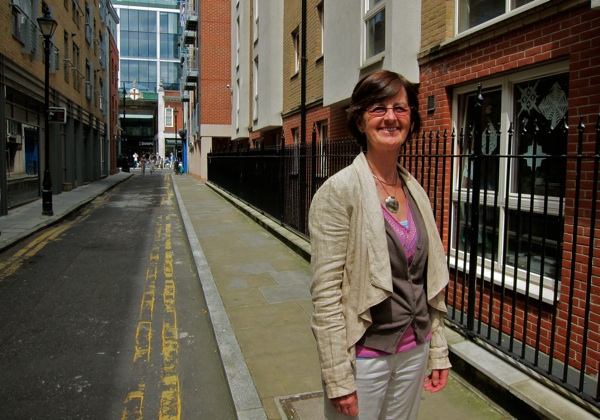
Vicky stands in Gun St where Sister Fidelma once stood.

The shelter seen from the corner of Crispin St and Whites Row, a century ago.

Vicky is now a resident of Spitalfields and the shelter has been converted as student accommodation.


Extracts from a pamphlet produced by Providence Row in 1960.
Click here to read about the continuing work of Providence Row in Spitalfields.
You may also like to read about
Invasion Of The Monoliths

In the Beginning
“The rich got richer and the poor got bathrooms” – this is photographer John Claridge’s caustic verdict upon the invasion of the monolithic tower blocks in the East End of his youth, as recorded in this set of pictures taken between 1962 and 1982, and published here for the first time.
“In the terraces of two-up two-downs, people could talk over the garden fence but in the towers they became strangers to each other. The culture of how they lived was taken away from them, and I knew a lot of people that got fucked up by it.” John told me, still angry about the wilful destruction of communities enacted in the name of social progress. “It was a cheap shot. People were making a fortune out of putting up crap.” he revealed in contempt, “I don’t think anyone has the right to destroy other people’s lives in that way and tie it up with a silk ribbon.”
While in London’s richer neighbourhoods old terraces were more likely to be renovated and preserved, in the East End and other poorer districts pressure was exerted through slum clearance programmes to force people from their homes, demolishing swathes of nineteenth century housing in preference to simply installing modern amenities. In retrospect, many of these schemes appear to have been driven by little more than class prejudice and created more social problems than they solved, dislocating communities and systematically erasing centuries of settled working class culture.
John’s photographs record how the monoliths first asserted their forbidding presence upon the landscape of the East End, arriving like the Martian fighting machines in the War of the Worlds. “You made fun of it and got on with your life,” he admitted to me and, with sardonic humour – adopting titles from cinema and jazz – he confronts us in these pictures with a series of mordant graphic images that imprint themselves upon the consciousness.
Today, as new tower blocks rise at the top of Brick Lane and the proposal to replace the London Fruit & Wool Exchange in Spitalfields with a larger block is referred to the Mayor of London after being rejected by Tower Hamlets, John Claridge’s vivid photographs of the monoliths remain as resonant as ever.

On Dangerous Ground – “They didn’t half put them up quick, I’m telling you.”

Gloomy Sunday

Room With a View – “Which is the view, from this window or from the block?”

The Dark Corner

The Four Horsemen

Foggy Day

Three Steps to Heaven

Caged – “An old lady who lived in a block in which the lift broke told me she felt like a caged animal.”

Freedom is Just Another Word – “Prefabs offered one kind of freedom and tower blocks offered another – but then the word didn’t mean anything anymore.”

Stranger on the Third Floor – “Once the small businesses go, people became estranged from their local environment.”

Odds Against Tomorrow – “There were still a few people left in this derelict terrace because they didn’t want to move out, but the odds were against them.”

House of Cards – “When a gas stove blew up and part of Ronan Point collapsed, my father, who was a qualified engineer, went to check it out – there were bolts missing and it had been constructed on the cheap.”

Dark Water -“These reminded me of apartment buildings in the Eastern Bloc.”

House of Strangers

Undercurrent

Out of Nowhere

High Wall

Dark Passage

Lift to the Scaffold
Photographs copyright © John Claridge
You may also like to take a look at
Along the Thames with John Claridge
At the Salvation Army with John Claridge
A Few Diversions by John Claridge
Phil Maxwell’s Old Ladies in Colour

Previously, I published two selections of Phil Maxwell‘s black and white photographs of old ladies, but today I am publishing this collection of his more recent pictures of old ladies in glorious colour, just in case anyone should be under the misapprehension that old ladies are a thing of the past in the East End. As much we celebrate the flourishing of youth culture bringing new life to the streets, we cherish these spirited seniors. They are streetwise and they have got guts. We take consolation in their indomitable vitality, and draw reassurance that – thanks to their abiding presence – no Californian culture of make-overs, of everyone aspired to eternal youth and model-good-looks through dieting, waxing, plastic surgery, personal styling and strenuous exercise, could ever prevail here. As long as the old ladies are with us, we know the true spirit of the East End is alive.


Photographs copyright © Phil Maxwell
Follow Phil Maxwell’s blog Playground of an East End Photographer
See more of Phil Maxwell’s work here
More of Phil Maxwell’s Old Ladies
Spitalfields Speaks
Today is the Spitalfields Music Midsummer Street Party and I am publishing these excerpts from Spitalfields Speaks – recordings of three people from Spitalfields Life by sound artist Duncan Chapman. At the party this afternoon, there will be a ‘Spitalfields Speaks Hut’ in Market St where you can record your own contribution to a collaborative sound-art piece to be performed at The Waterpoet at 4pm, or pick up headphones to listen while exploring the neighbourhood.

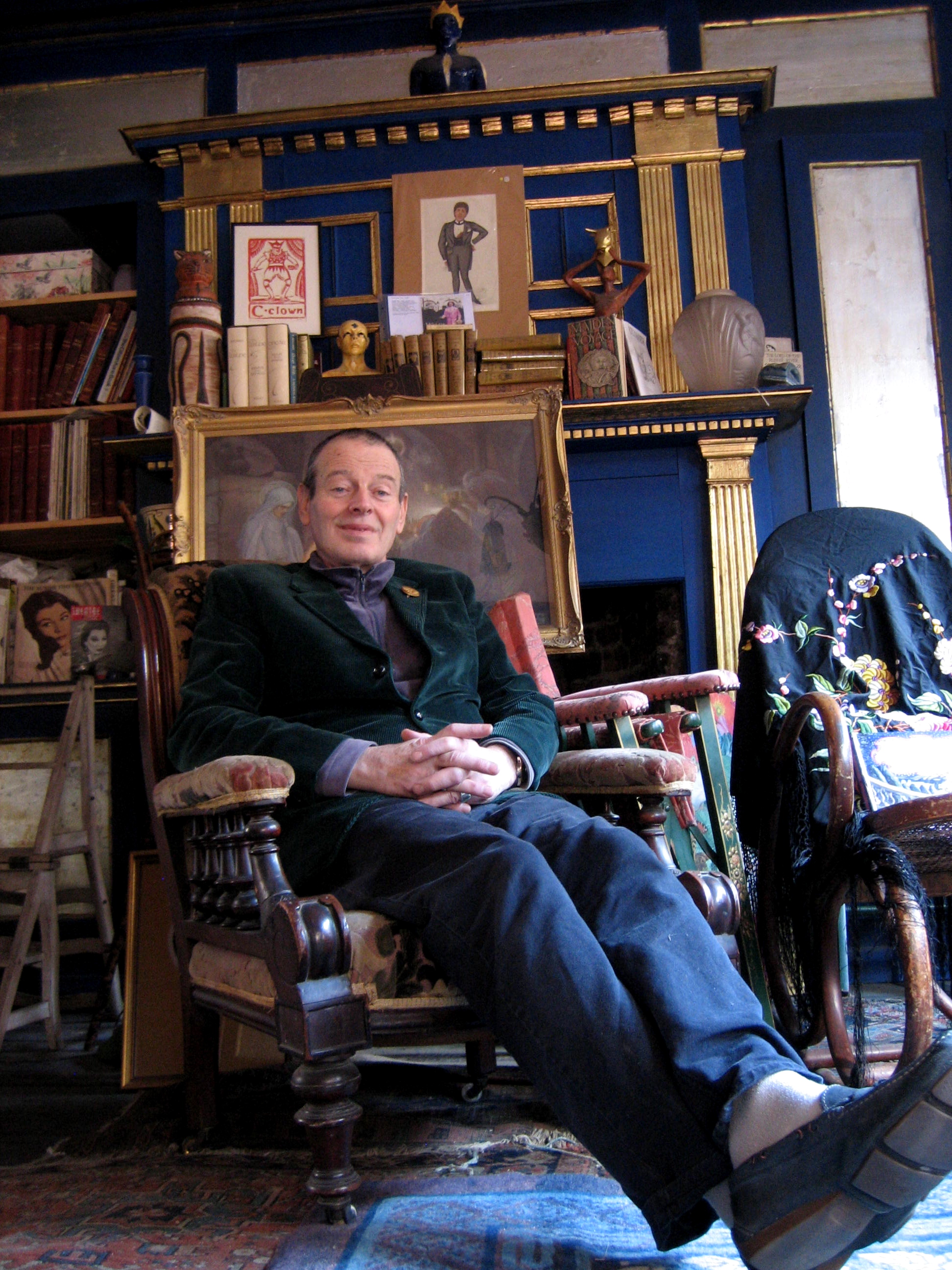
Can sounds become extinct? Can a house have a life of its own? Welcome to Rodney Archer’s eighteenth century house on Fournier St where he has lived since 1980. Rodney invites you to listen to the sounds that characterise it – the creaky stairs, the humming of the gas lights, the trickling water of the fountain… Click here to listen to the sound of Rodney’s bell.

Click here to listen to the sound of Rodney’s creaking door.
Click here to listen to the sound of Rodney’s gaslights.

Click here to listen to the sound of the fountain in Rodney’s garden.

Marge Hewson has been the nursery nurse at Christ Church Primary School on Brick Lane since 1971. Every morning for the past forty-one years, she has collected schoolchildren from their homes on the Chicksand Estate and delivered them safely to school. Click here to listen to part one.

Join Marge on her daily journey – although it does not even cover a mile in distance, it covers a lifetime of stories and memories for Marge and the generations of schoolchildren who have joined her. Click here to listen to part two.

A former sea captain in the Merchant Navy and now a Justice of the Peace, Captain Shiv Banerjee takes you on a voyage from India to the East End, dropping anchor at various ports en route. Click here to listen to part one.

Shiv Banerjee talks about his life at Toynbee Hall in Spitalfields, where he arrived in 1975 and has lived ever since. Click here to listen to part two.


