
Cries Of London Scraps
It is my pleasure to publish these modest Victorian die-cut scraps which are the latest acquisition in my ever-growing collection of the Cries of London. The Costermonger scrap has the name “W. Straker, Ludgate Hill” rubber-stamped on the reverse and – sure enough – by pulling the London Trade Directory for 1880 off the shelf, I found William Straker, Silver & Copperplate Engraver, Printer, Die Sinker, Wholesale Stationer & Stamp Cutter, 49/63 Ludgate Hill. These mass-produced images appeal to me with their vigorous life, portraying their subjects with their mouths wide open enthusiastically crying their wares – all leading players in the drama of street life in nineteenth century London.

Newspaper seller (The Star was published in London from 1788-1960)

Sandwich-board man (Dan Leno started his career in Babes in the Wood at Drury Lane in 1888)

Milkman

Sweep

Watercress seller

Crossing sweeper

Shoe-shine

Buttonhole seller

Costermonger

You can read my feature about William Marshall Craig’s prints of the Cries of London in the September issue of World of Interiors on the newstands now.
You may also like to take a look at these other sets of the Cries of London
Geoffrey Fletcher’s Pavement Pounders
William Craig Marshall’s Itinerant Traders
H.W.Petherick’s London Characters
John Thomson’s Street Life in London
Aunt Busy Bee’s New London Cries
Marcellus Laroon’s Cries of London
More John Player’s Cries of London
William Nicholson’s London Types
Francis Wheatley’s Cries of London
John Thomas Smith’s Vagabondiana of 1817
John Thomas Smith’s Vagabondiana II
John Thomas Smith’s Vagabondiana III
Thomas Rowlandson’s Lower Orders
More of Thomas Rowlandson’s Lower Orders
Libby Hall, Collector Of Dog Photography
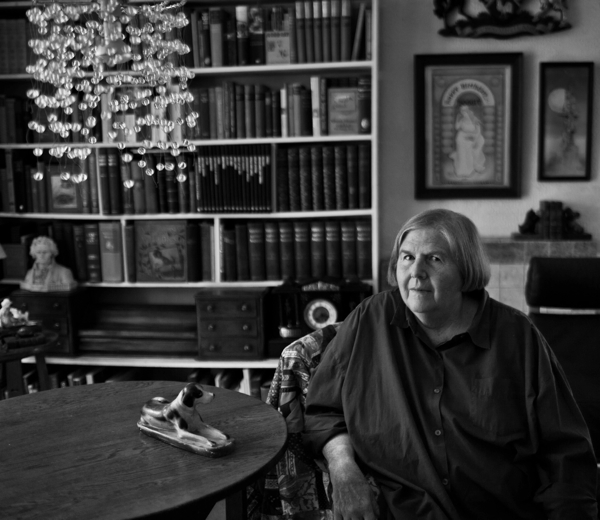
Libby Hall
Between 1966 and 2006, Libby Hall collected old photographs of dogs, amassing many thousands to assemble what is possibly the largest number of canine pictures ever gathered by any single person. Libby began collecting casually when the photographs were of negligible value, but by the end she had published four books and been priced out of the market. Yet through her actions Libby rescued an entire canon of photography from the scrap heap, seeing the poetry and sophistication in images that were previously dismissed as merely sentimental. And today, we are the beneficiaries of her visionary endeavour.
A joyful iconoclast by nature who has recently had, “Stop! Do not resuscitate, living will extant,” tattooed on her chest – Libby Hall is a born and bred New Yorker originating from the Upper East Side of Manhattan, who moved into her house in Clapton in 1967 with her husband the newspaper cartoonist, Tony Hall, and has stayed ever since.
Contrary to our expectations and in spite of the multiple signs in a plethora of languages warning us to beware of the dog, Spitalfields Life Contributing Photographer Martin Usborne and I found Libby without any canine company when we paid her a visit recently. “I’ve never lived without a dog before,” she confessed, revealing that her beloved dog Pembury had died just a few weeks previously on the couch in the front room, “there is a stillness and the place does seem incredibly quiet.”
We spent an enjoyable summer’s afternoon with Libby in the cool of her old house, studying the pages of proofs of dog photographs that line the walls, while she regaled us with the story of how it all began.
“My husband Tony and I used to go to Kingsland Waste, where we had a friend who did house clearances, and in those days they sold old photo albums and threw away the pictures. So I used to rescue them and I began sorting out the dogs – because I always liked dogs – and it became a collection. Then I started collecting properly, looking for them at car boot sales and auctions. And eventually a publisher offered me an advance of two thousand pounds for a book of them, which was fantastic, and when each of my books was published I just used the royalties to buy more and more photographs. I had a network of dealers looking out for things for me and they would send me pictures on approval. They were nineteenth century mostly and I only collected up until 1940, because I didn’t want to invade anyone’s privacy. Noboby was interested until my first book was published in 2000, and afterwards people said I had shot myself in the foot because everybody started collecting them and they became very expensive, but by then I had between five and six thousand photographs of dogs.
Dogs have always been powerfully important to me, I’ve lived with dogs since the beginning of my days. There’s a photo of my father holding me as baby in one arm and a dog in the other – dog’s faces were imprinted upon my consciousness as early as humans, and I’ve always lived with dogs until six weeks ago when my dog Pembury died. For the last month, friends have been ringing my bell and there’s only silence because he doesn’t come and I open the door to find them in tears. It was an intense relationship because it was just the two of us, Pembury and me, and as he got older he depended on me greatly. So it is good to have my freedom now but only for a little while. At one point, we had three dogs and four cats in this house. We even had a dog and a cat that used to sleep together, during the day they’d do all the usual challenging and chasing but at night they’d curl up in a basket.
When I was eleven, I wanted a dog of my own desperately, I’d been campaigning for five years and I wanted a cocker spaniel. My father contacted a dog rescue shelter in Chester, Connecticut, and they said they had one. But as we walked past the chain link fence, there was a dog barking and we were told that it was going to be put down the next morning. Of course, we took that dog, even though he wasn’t a cocker spaniel. We wondered if they always told people this, but Chester and I were inseparable ever after.”
With touching generosity of spirit, Libby confided to me that her greatest delight is to share her collection of pictures. “What matters to me is others seeing them, I never made any money from my books because I spent it all on buying more photographs.” she said.
These photographs grow ever more compelling upon contemplation because there is always a tension between the dog and the human in each picture. The presence of the animal can unlock the emotional quality of an image of people who might otherwise appear withheld, and the evocation of such intimacy in pictures of the long dead, who are mostly un-named, carries a soulful poetry that is all its own. Bridging the gap of time in a way that photographs solely of humans do not, Libby’s extraordinary collection constitutes an extended mediation upon mortality and the fragility of tender emotions.
“I put my heart and soul into it, and it was very hard giving up collecting, but my fourth book was the ultimate book, and it coincided with the realisation that my husband Tony was dying, so I realised that it was the end of a period of my life.” Libby concluded with a melancholy smile, sitting upon the couch where Pembury expired and casting her eyes thoughtfully around the pictures of dogs lining the walls. I asked Libby how she felt now that her collection is housed elsewhere. “I’ve got the books,” she reminded me, placing her hand upon them protectively, “I have no visual memory at all, so I keep going back to look at them.”
Libby Hall plans to get a new dog in the autumn.


The two stripes on this soldier’s sleeve meant he had been wounded twice and was probably on leave recovering from the second wound when this photograph was taken.


HRH the Princess of Wales with her favourite dogs on board the royal yacht Osborne.

John Brown 1871. The dogs are Corran, Dacho, Rochie and Sharp, who was Queen Victoria’s favourite.


George Alexander, Actor/Manager, with his wife Florence.

This photograph of Mick came with the collar he is wearing.

Queen Victoria and Sharp (pictured above with John Brown) at Balmoral in 1867.


Ellen Terry.


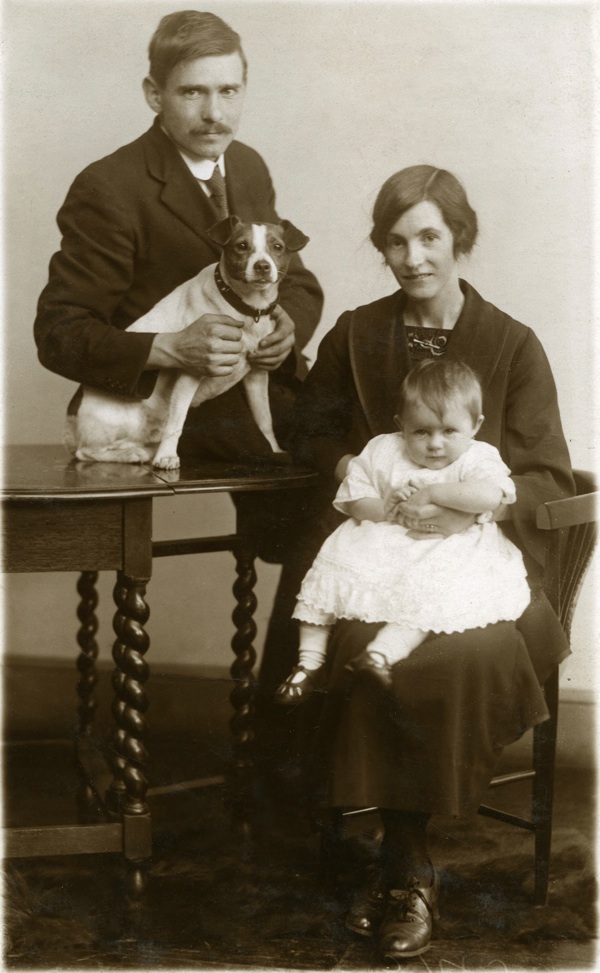

Charles Dickens with his devoted dog Turk.


Libby’s recently deceased dog Pembury wearing the vest that was essential in his last days.

Libby on the couch where Pembury died six weeks ago.

One of Libby’s six dog dolls’ houses. – “I think dolls’ houses with dolls are rather scary but dolls’ houses with dogs are ok.”

Libby Hall – “I put my heart and soul into it.”
[youtube VYXUJvTQ9IM nolink]
[youtube dxQ4OJG4kr8 nolink]
Portraits of Libby Hall copyright © Martin Usborne
Dog photographs copyright © The Libby Hall Collection at the Bishopsgate Institute
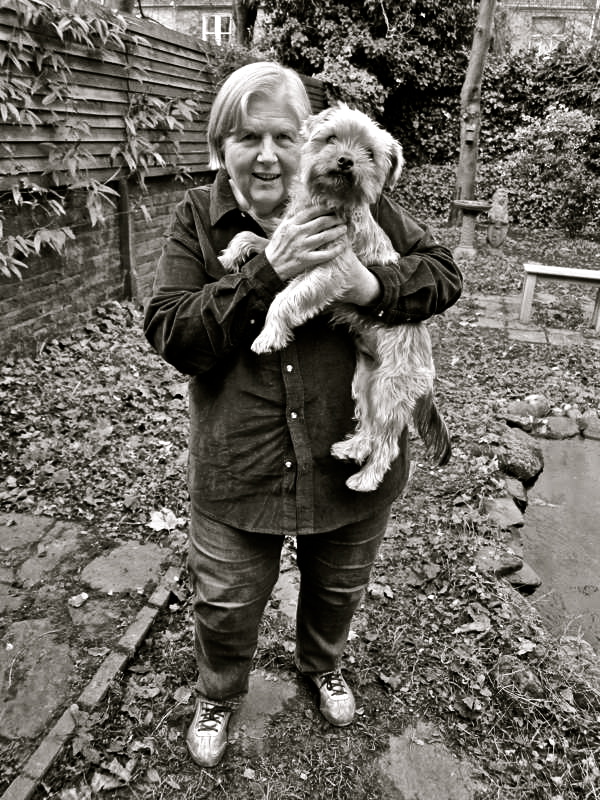
Updated in December 2012 – Libby Hall with her new dog Pip.
Libby Hall selected these favourite dog photographs from her books – Prince and Others, Prince and Other Dogs II, Postcard Dogs, Postcard Cats and These Were Our Dogs, all published by Bloomsbury.
You may also like to take a look at
The Dogs of Spitalfields in Spring
The Dogs of Spitalfields in Winter
A Nation Of Shopkeepers by John Claridge

Ross Bakeries, Quaker St, 1966
I am grateful to John Claridge for his prescience in taking these photographs, published here for the first time, because if I could travel back to the East End of half a century ago this is exactly what I should like to see – the local shops and the faces of the shopkeepers.
“I used to go to the shops with my mum every Saturday morning, and she’d meet people she knew and they’d be chatting for maybe an hour, so I’d go off and meet other kids and we’d be playing on a bombsite – it was a strange education!” John told me, neatly illustrating how these small shops were integral to the fabric of society in his childhood.“People had a pride in what they were selling or what they were doing” he recalled,“You’d go into these places and they’d all smell different. They all had their distinct character, it was wonderful.”
Although generations of the family were dockers, John’s father warned him that the London Docks were in terminal decline and he sought a career elsewhere. Consequently, even as a youth, John realised that a whole way of life was going to be swept away in the changes which were coming to the East End. And this foresight inspired John to photograph the familiar culture of small shops and shopkeepers that he held in such affection. “Even then I had the feeling that things were going to be overrun, without regard to what those in that society wanted.” he confirmed to me with regret.
As the remaining small shopkeepers now join together to form the East End Trades Guild to fight for their survival, in the face of escalating rents and the incursion of chain stores, John Claridge’s poignant images are a salient reminder of the venerable tradition of local shops here that we cannot afford to lose.

Shop in Spitalfields, 1964.
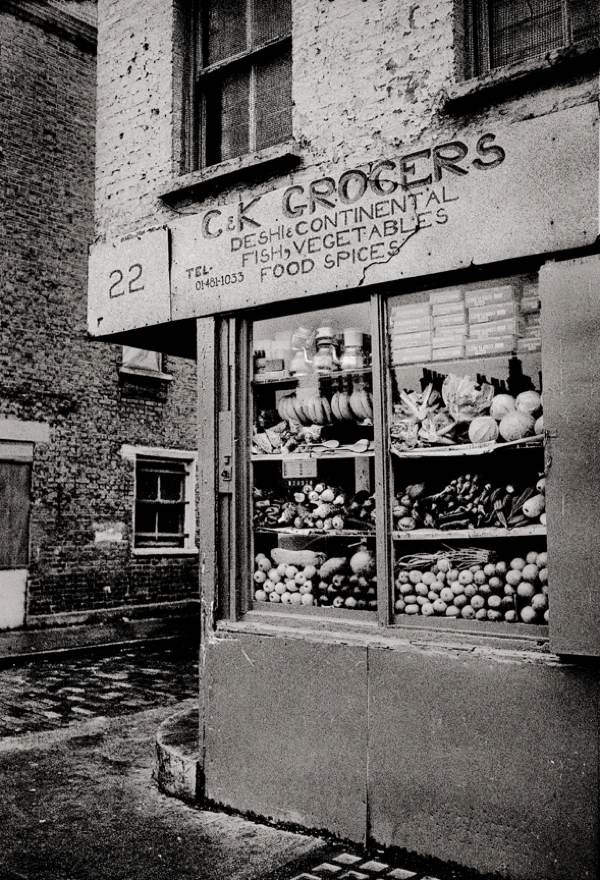
C & K Grocers, Spitalfields, 1982 – “From the floor to the roof, the shop was stocked full of everything you could imagine.”

Cobbler, Spitalfields, 1969.

Flo’s Stores, Spitalfields, 1962 – “All the shops were individual then. Somebody painted the typography themselves here and it’s brilliant.”

Fruit & Veg, Bethnal Green 1961 – “I’d been to a party and it was five o’clock in the morning, but she was open.”
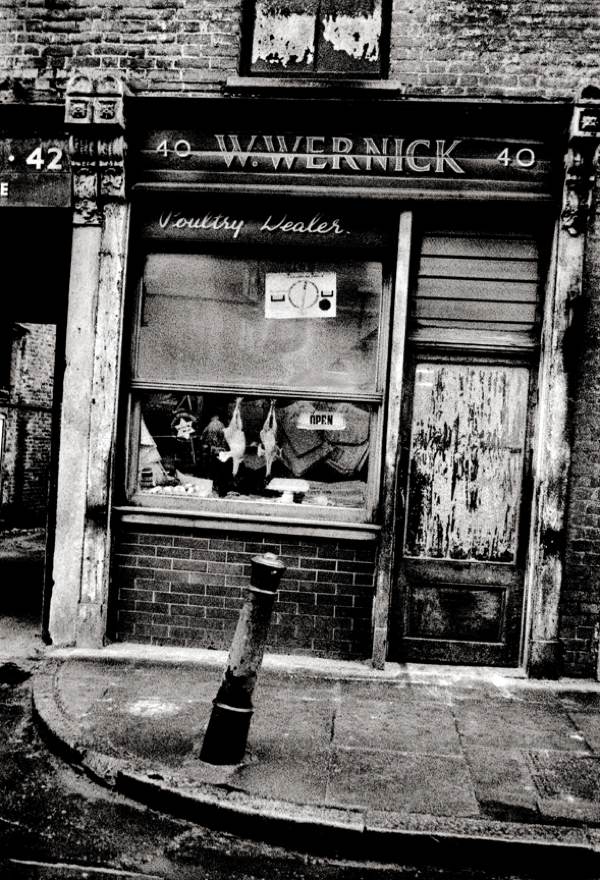
W.Wernick, Spitalfields, 1962.

Fishmonger, Spitalfields, 1965.

Corner Shop, Spitalfields, 1961 – “The kid’s just got his stuff for his mum and he’s walking back.”

At W.Wernick Poulterers, Spitalfields, 1962 – “She’s got her hat, her cup of tea and her flask. There was no refrigeration but it was chilly.”

Fiorella Shoes, E2, 1966 – “There’s only four pairs of shoes in the window. How could they measure shoes to fit, when they couldn’t even fit the words in the window? The man next door said to me, ‘Would you like me to step back out of the picture?’ I said, ‘No, I’d really like you to be in the picture.”

Bertha, Spitalfields, 1982 – “Everything is closing down but you can still have a wedding! She’s been jilted at the altar and she’s just waiting now.”

Bakers, Spitalfields, 1959 – “There’s only three buns and a cake in the window.”

Jacques Wolff, E13 1960 – “His name was probably Jack Fox and he changed it to Jacques Wolff.”

Waltons, E13 1960 – “They just sold cheap shoes, but you could get a nice Italian pair knocked off from the docks at a good price.”

Churchman’s, Spitalfields, 1968 – “Anything you wanted from cigarettes to headache pills.”

White, Spitalfields 1967 – “I saw these three kids and photographed them, it was only afterwards I saw the name White.”

The Door, E2 1960.

The Window, E16 1982 – “Just a little dress shop, selling bits and pieces. The clothes could have been from almost any era.”

Victor, E14 1968 – “There’s no cars on the road, the place was empty, but there was a flower shop on the corner and it was always full of flowers.”
Photographs copyright © John Claridge
You may also like to take a look at
Along the Thames with John Claridge
At the Salvation Army with John Claridge
A Few Diversions by John Claridge
Signs, Posters, Typography & Graphics
Views from a Dinghy by John Claridge
In City Churchyards

In the churchyard of St Dunstan’s in the East, Idol Lane
If ever I should require a peaceful walk on a Sunday afternoon when the crowds are thronging in Brick Lane and Columbia Rd, then I simply wander over to the City of London where the streets are empty at weekends and the many secret green enclaves of the churches are likely to be at my sole disposal. For centuries the City was densely populated, yet the numberless dead in the ancient churchyards are almost the only residents these days.
Christopher Wren rebuilt most of the City churches after the Great Fire upon the irregularly shaped medieval churchyards and it proved the ideal challenge to develop his eloquent vocabulary of classical architecture. Remarkably, there are a couple of churches still standing which predate the Fire while a lot of Wren’s churches were destroyed in the Blitz, but for all those that are intact, there are many of which only the tower or an elegant ruin survives to grace the churchyard. And there are also yards where nothing remains of the church, save a few lone tombstones attesting to the centuries of human activity in that place. Many of these sites offer charismatic spaces for horticulture, rendered all the more appealing in contrast to the sterile architectural landscape of the modern City that surrounds them.
I often visit St Olave’s in Mincing Lane, a rare survivor of the Fire, and when you step down from the street, it as if you have entered a country church. Samuel Pepys lived across the road in Seething Lane and was a member of the congregation here, referring to it as “our own church.” He is buried in a vault beneath the communion table and there is a spectacular gate from 1658, topped off with skulls, which he walked through to enter the secluded yard. Charles Dickens also loved this place, describing it as “my best beloved churchyard”
“It is a small small churchyard, with a ferocious, strong, spiked iron gate, like a jail. This gate is ornamented with skulls and cross-bones, larger than the life, wrought in stone … the skulls grin aloft horribly, thrust through and through with iron spears. Hence, there is attraction of repulsion for me … and, having often contemplated it in the daylight and the dark, I once felt drawn towards it in a thunderstorm at midnight.” he wrote in “The Uncommercial Traveller.”
A particular favourite of mine is the churchyard of St Dunstan’s in the East in Idol Lane. The ruins of a Wren church have been overgrown with wisteria and creepers to create a garden of magnificent romance, where almost no-one goes. You can sit here within the nave surrounded by high walls on all sides, punctuated with soaring Gothic lancet windows hung with leafy vines which filter the sunlight in place of the stained glass that once was there.
Undertaking a circuit of the City, I always include the churchyard of St Mary Aldermanbury in Love Lane with its intricate knot garden and bust of William Shakespeare, commemorating John Hemminge and Henry Condell who published the First Folio and are buried there. The yard of the bombed Christchurch Greyfriars in Newgate St is another essential port of call for me, to admire the dense border planting that occupies the space where once the congregation sat within the shell of Wren’s finely proportioned architecture. In each case, the introduction of plants to fill the space and countermand the absence in the ruins of these former churches – where the parishioners have gone long ago – has created lush gardens of rich poetry.
There are so many churchyards in the City of London that there are always new discoveries to be made by the casual visitor, however many times you return. And anyone can enjoy the privilege of solitude in these special places, you only have to have the curiosity and desire to seek them out for yourself.

In the yard of St Michael, Cornhill.

In the yard of St Dunstan’s in the East, Idol Lane.

At St Dunstan’s in the East, leafy vines filter the sunlight in place of stained glass.


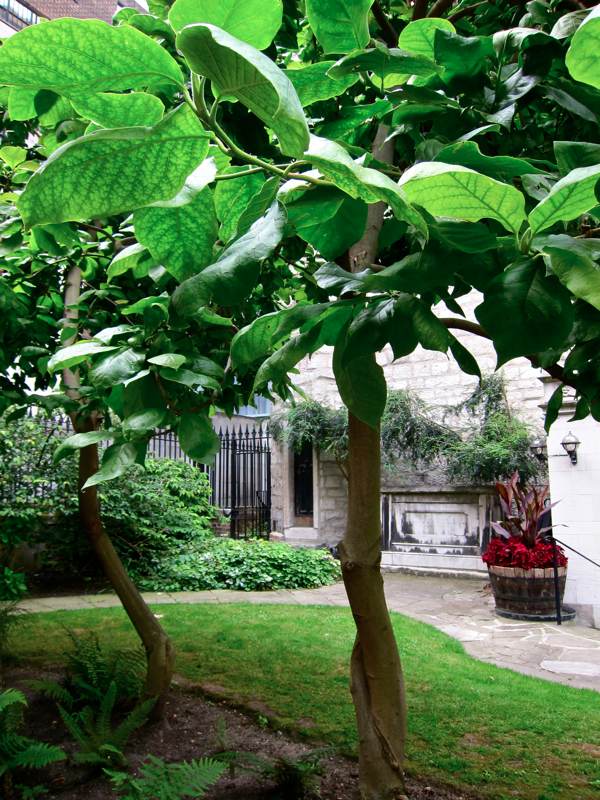
In the yard of St Olave’s, Mincing Lane.

This is the gate that Samuel Pepys walked through to enter St Olave’s and of which Charles Dickens wrote in The Uncommercial Traveller – “having often contemplated it in the daylight and the dark, I once felt drawn towards it in a thunderstorm at midnight.”

Dickens described this as ““my best beloved churchyard.”


In the yard of St Michael Paternoster Royal, College St.


In the yard of St Lawrence Jewry-next-Guildhall, Gresham St.

In the yard of St Mary Aldermanbury, Love Lane, this bust of William Shakespeare commemorates John Hemminge and Henry Condell who published the First Folio and are buried here.


In the yard of London City Presbyterian Church, Aldersgate St.


In the yard of Christchurch Greyfriars, Newgate St, the dense border planting occupies the space where once the congregation sat within the shell of Wren’s finely proportioned architecture.

In the yard of the Guildhall Church of St Benet, White Lion Hill.


In St Paul’s Churchyard.
You may also like to read about
A Bus Stop in Bethnal Green
Amanda Jones took these photographs of the bus stop across the window from her flat. “I enjoy observing people and, when you do, London is a paradise…” she admitted to me, “so I take a picture of my view every day while having breakfast, or just as I am about to leave for work, with my coat on, the bag and the lunch box in my hands, and in a rush because I had nearly forgotten.”
Once she had accumulated a series of these photographs, Amanda decided to publish them and the result is The Bus Stop – a daily blog which traces the compelling drama of life at the kerbside. “I really like living in the East End because you feel part of it, just as if you were in a small town,” she explained, “and doing this project has helped me to realise this, because there are so many people who crop at the bus stop in my pictures on more than one day!”
How many recurring characters can you can spot among these favourite photographs from Amanda’s growing archive?
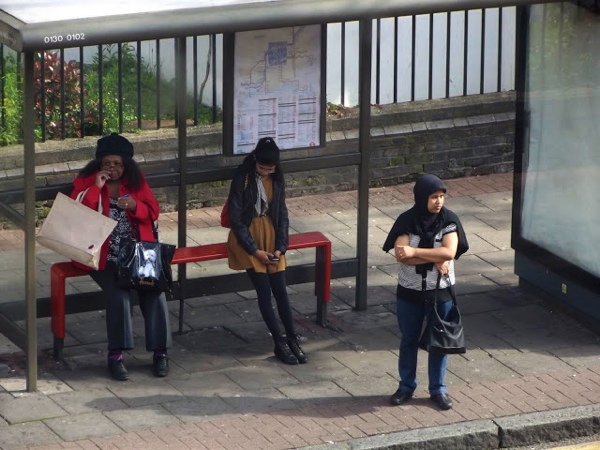
Thursday July 19th, 9:06
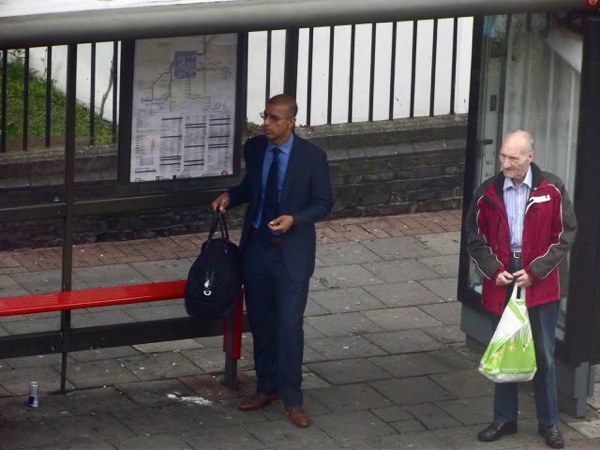
Monday July 16th, 9:06
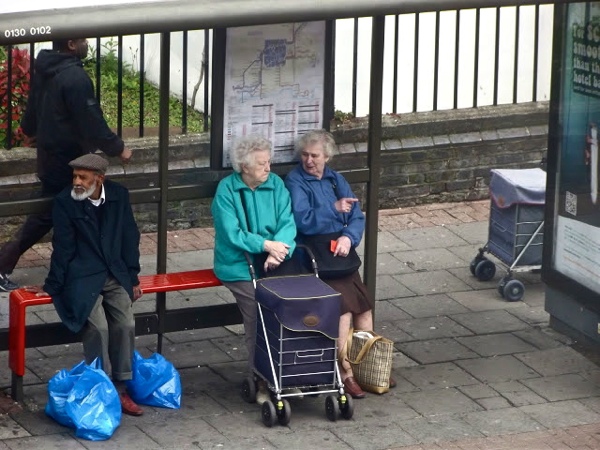
Saturday July 7th, 11:49
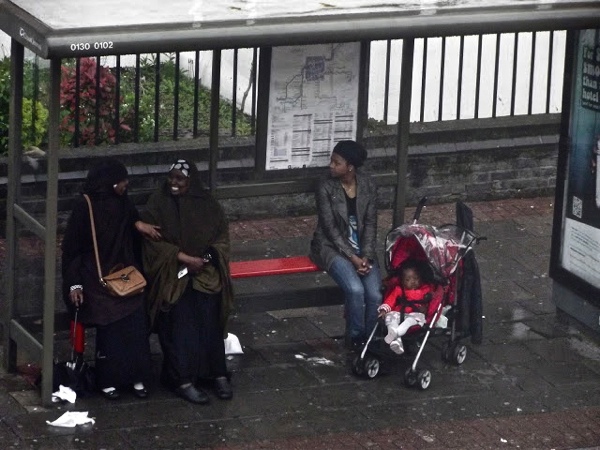
Friday July 6th, 9:16

Saturday June 30th, 11:49
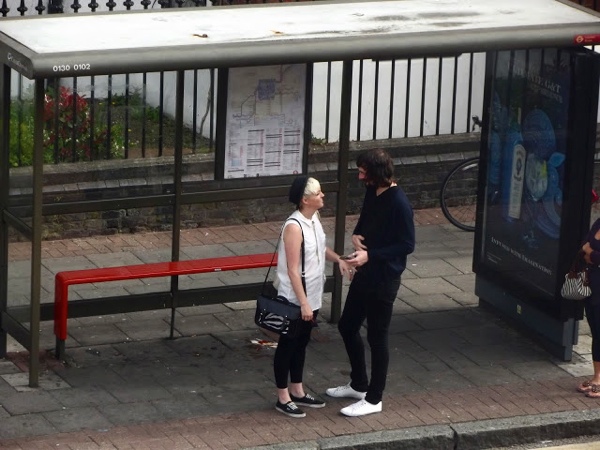
Tuesday June 26th, 8:09
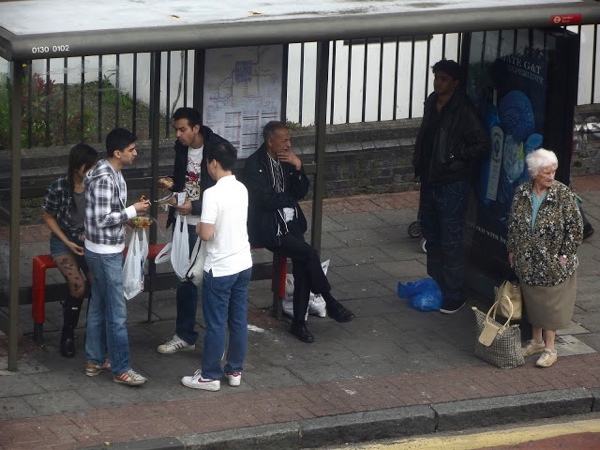
Saturday June 23rd, 11:40
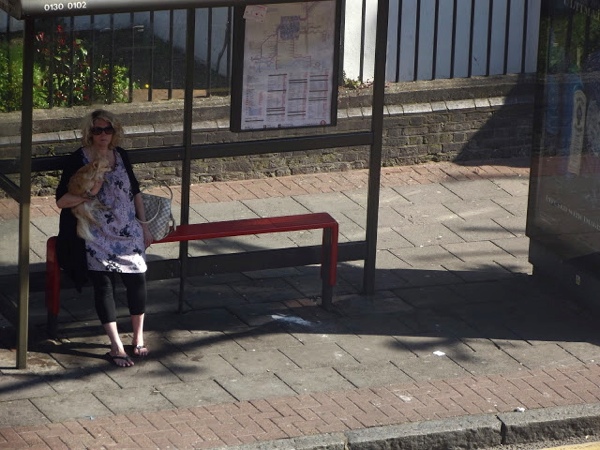
Wednesday June 30th, 9:17
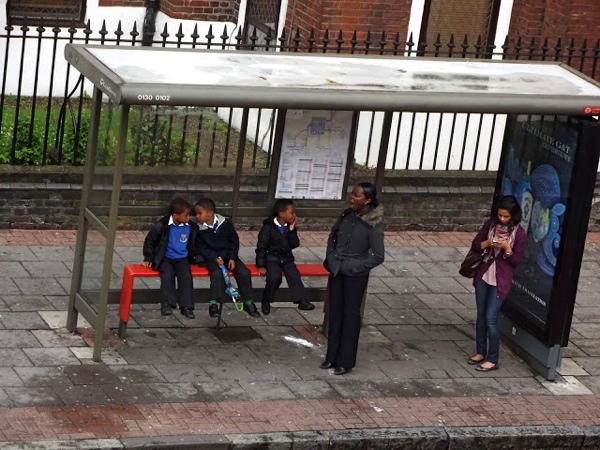
Monday June 18th, 8:47
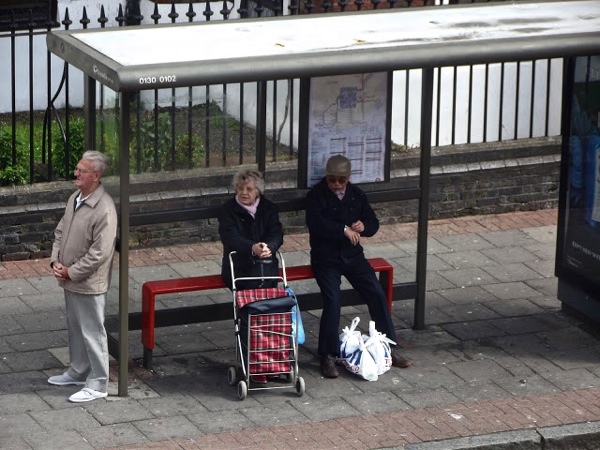
Saturday June 16th, 10:02

Friday June 15th, 9:00
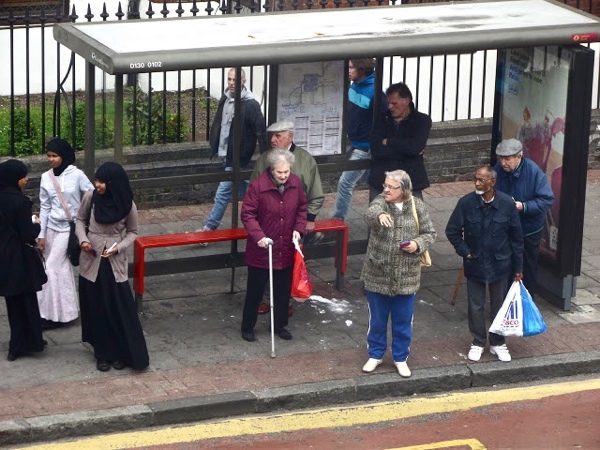
Saturday June 10th, 12:07
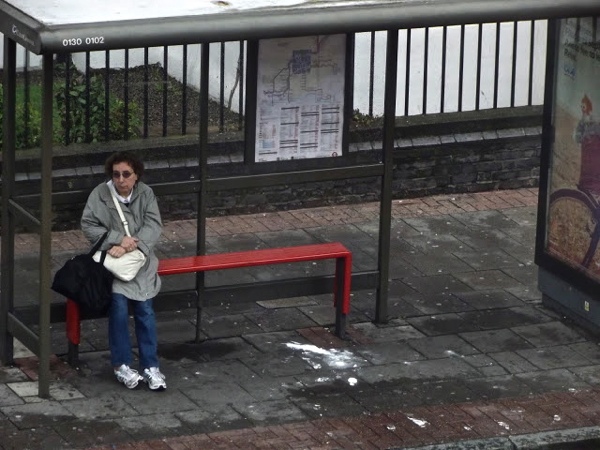
Friday June 8th, 9:00
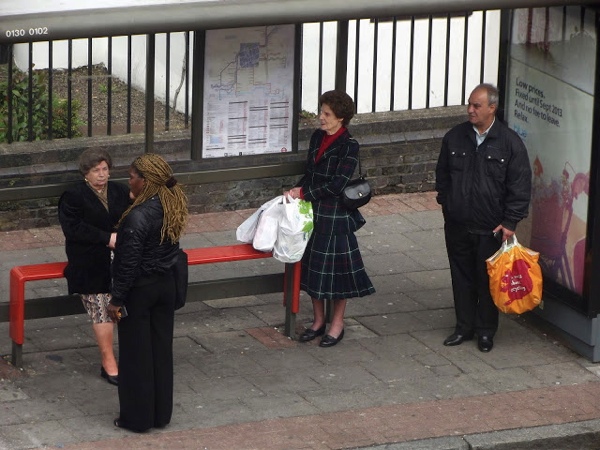
Jubilee Bank Holiday Tuesday June 5th, 11:54
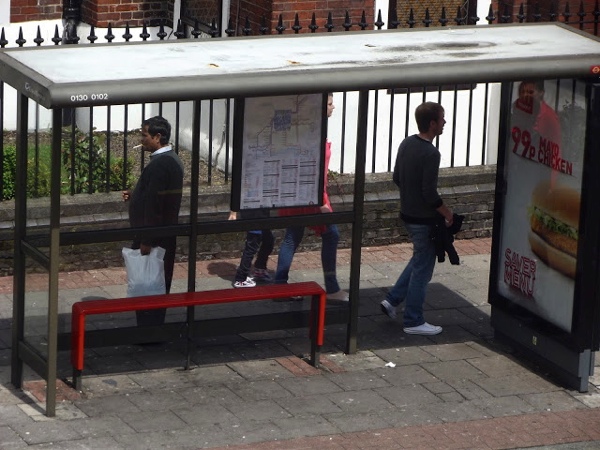
Bank Holiday Monday June 4th, 12:28
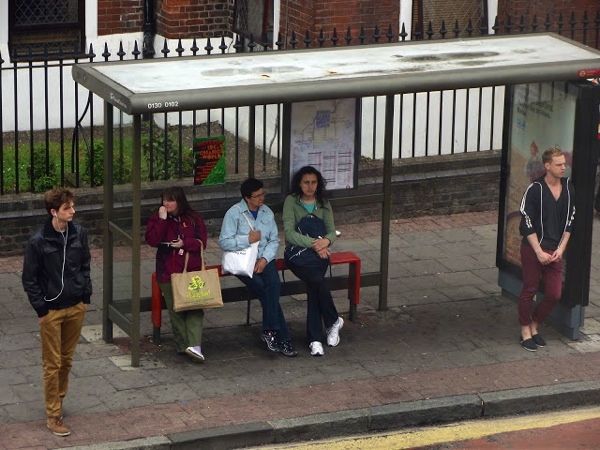
Saturday June 2nd, 11:46
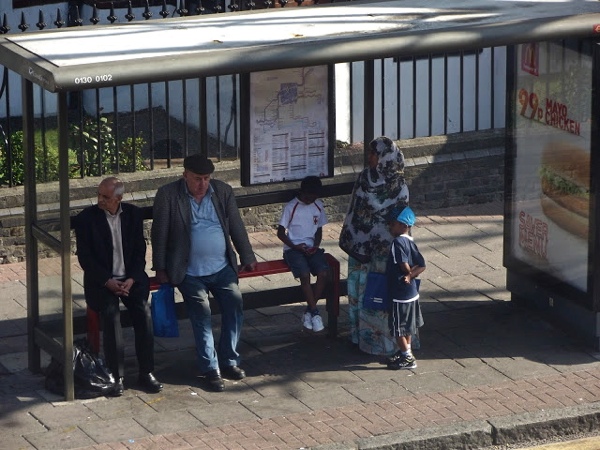
Wednesday May 30th, 8:55
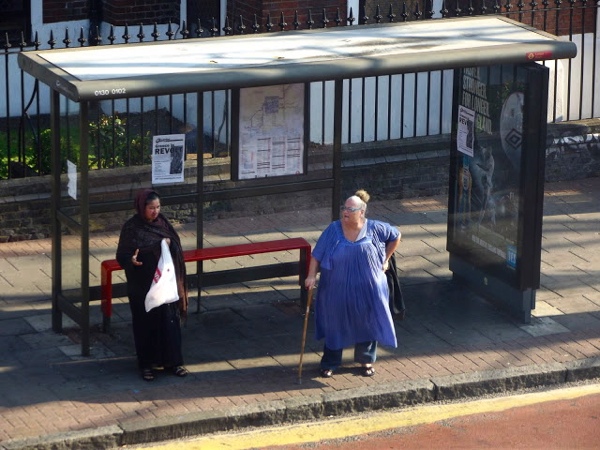
Tuesday May 29th, 8:02
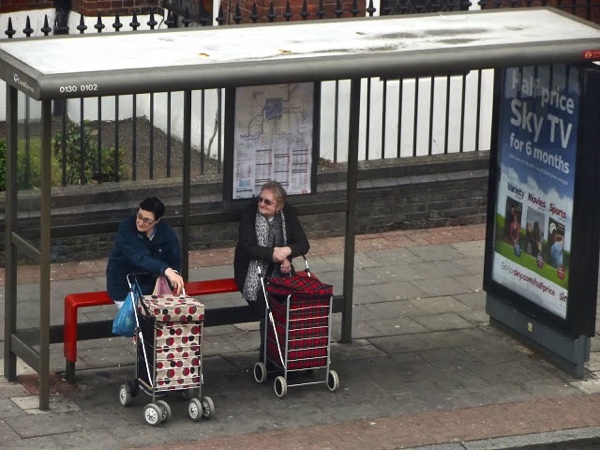
Saturday May 19th, 11:10
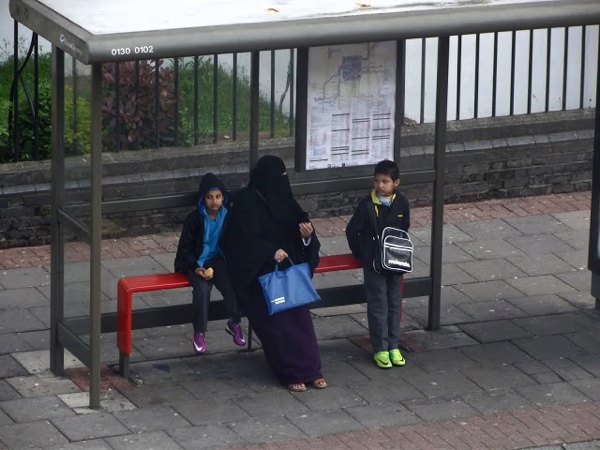
Friday May 11th, 8:54
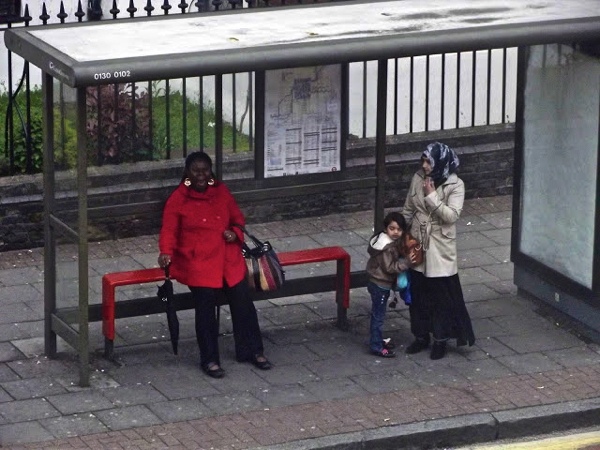
Wednesday May 2nd, 8:19
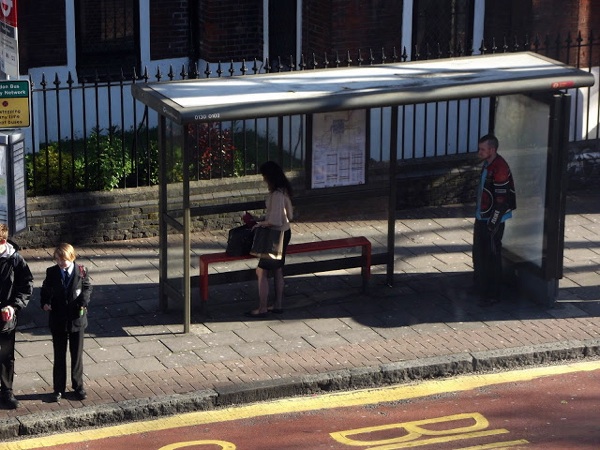
Monday April 30th, 8:03
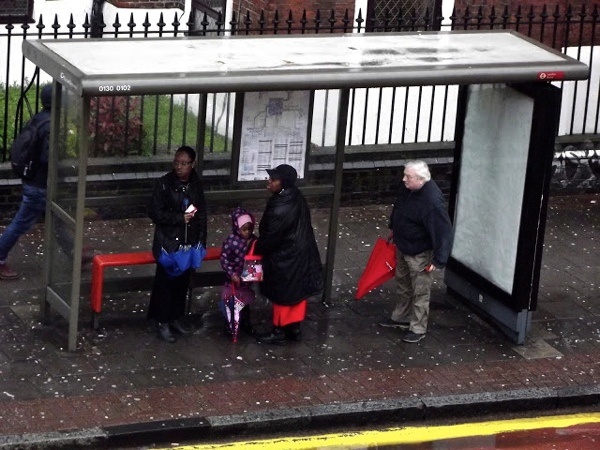
Sunday April 29th, 12:58
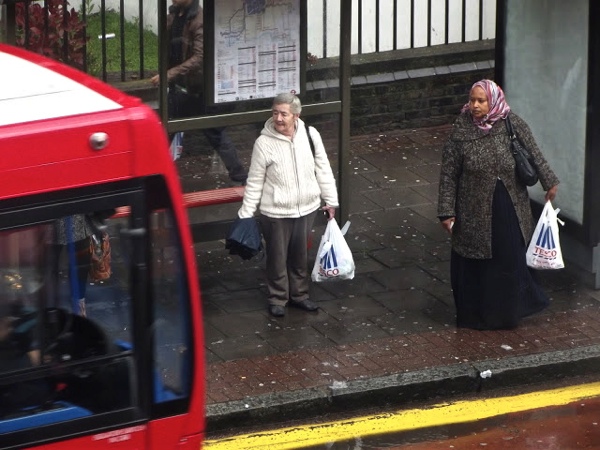
Thursday April 26th, 9:00

Tuesday April 17th, 6:31
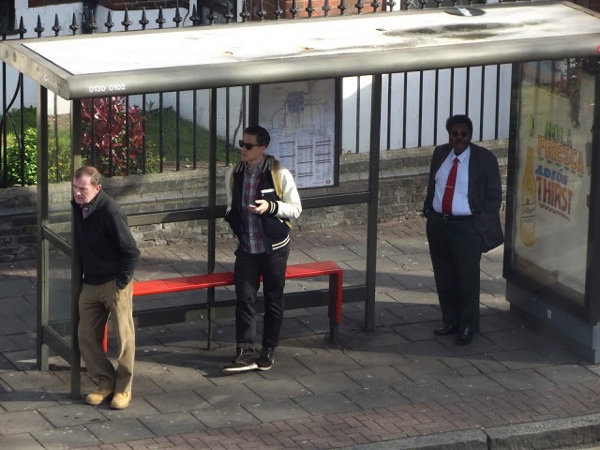
Wednesday April 11th, 9:07
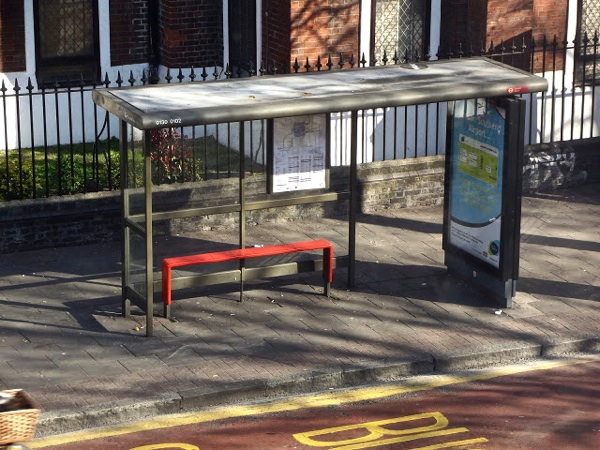
Wednesday March 26th, 9:00
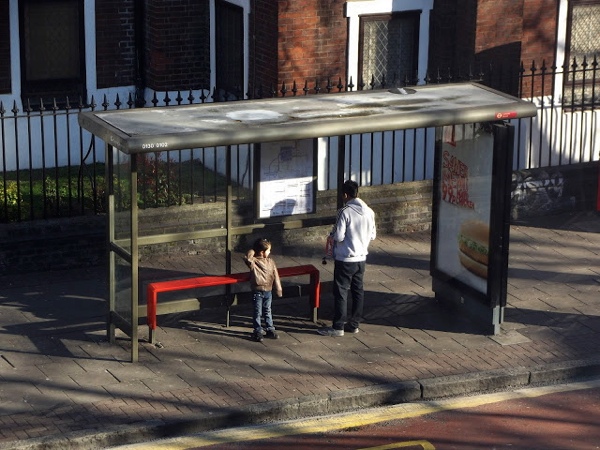
Monday March 19th, 8:23
Photographs copyright © Amanda Jones
Follow The Bus Stop daily to keep in touch with the latest installment of the drama at the kerbside.
You may also like to take a look at
On The Rounds With The Olympic Milkman

Kevin Read
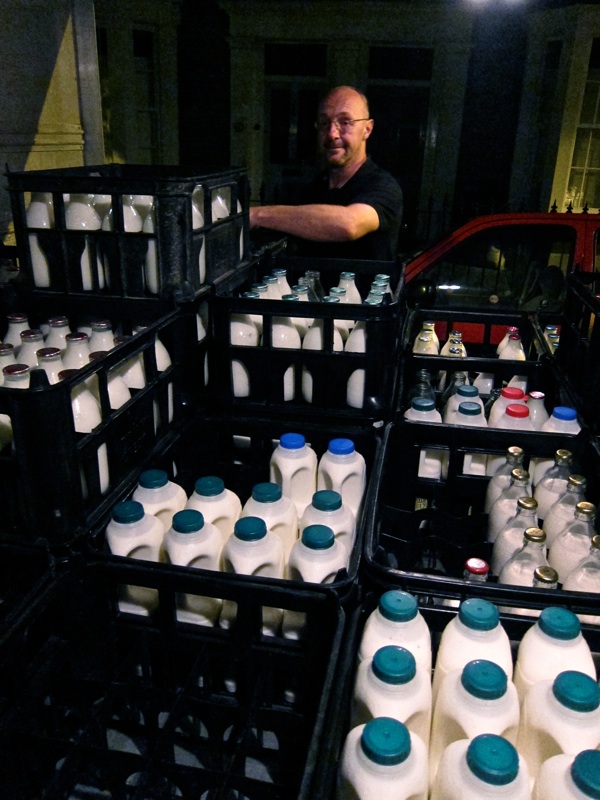
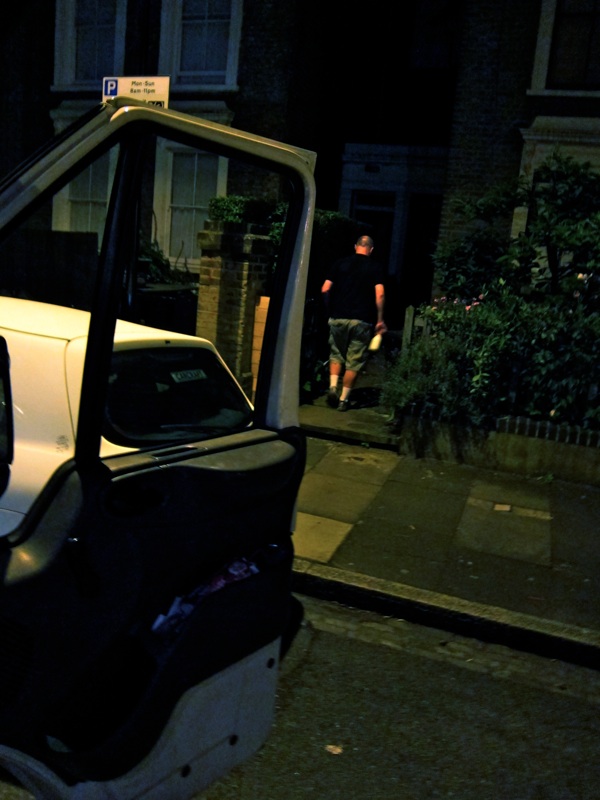
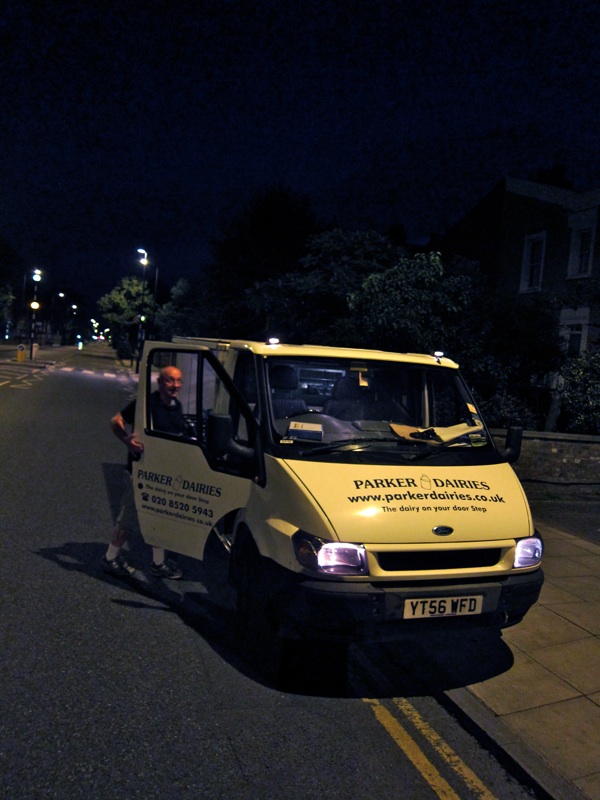
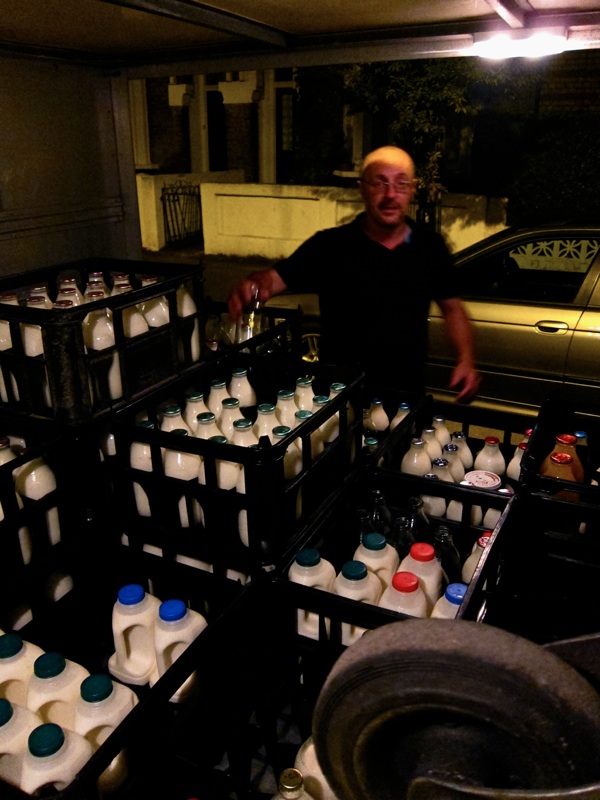
If delivering milk ever became an Olympic sport then Kevin Read, the Spitalfields milkman, would undoubtedly win a gold medal for Britain. Kevin does his entire round on the run – carrying three bottles in each hand effortlessly as he pounds up and down staircases, leaping in and out of his van – displaying astonishing stamina in his six hour circuit each night, stretching from the East End to the West End.
“I like to think of myself as the Olympic Milkman,” Kevin admitted yesterday morning when he picked me up in Spitalfields at three, “I been delivering to the site for more than six years now, since before they put the fence up.” It was a clear summer’s night and, as we drove through Whitechapel, crowds were leaving prayer at the mosque and a few vans were making deliveries, but once we passed these, the streets were empty. “We feared there would be road chaos, pavement chaos, train chaos – you name it – but in reality it’s been fairly quiet,” Kevin assured me. We barrelled east in his diesel milk float along the deserted Mile End Rd, between the empty bus lane and the empty Olympic lane, skirting the Olympic site with its tall red sculpture that looks like a meccano kit where someone lost the instructions and the empty Olympic Stadium in which images of the flame burned through the night on huge screens.
Our first call was to deliver a pallet-load of breakfast cereal to Bovis, the contractors who built the athletes’ village. The wind echoed like a strange ghostly choir as we ascended the lift of an empty tower block on top of the shopping centre opposite the site to make our delivery. From here we could see the futuristic buildings of the Olympics gleaming in floodlights beneath the golden moon in a deep blue sky. Next we drove over to deliver milk to the Olympic transport department, through a dark maze of temporary access roads, encountering numerous security checks and crossing empty parking lots, in a secret hinterland of the site used as a service entrance.
Since the Olympics were announced, this has been first port of call for Kevin every night, delivering enough milk to make the tea for everyone that worked to conjure this intricate landscape, currently home to the world’s sporting heroes.“On every sign, while this was under construction, they had the phrase, ‘You are part of it,'” Kevin told me proudly, “It was good because every cleaner, every road sweeper, every electrician and labourer saw that, and we all felt it too.”
Two years have passed since I first joined Kevin in his cabin and he revealed his quest to rebuild the lost milk rounds of the East End. And the good news Kevin has to impart now is that he has acquired many more customers over the intervening time and his round has grown significantly. “It’s definitely a trend,” he confirmed, speaking of the return to the delivery of glass bottles of fresh milk direct to the doorstep, “but you’ve got to break people’s habits and, in a city where 20% of the population moves every year, you have be continuously canvassing just to keep up.”
By now we were into the round proper, navigating at speed through narrow streets of housing, scattering this year’s fox cubs that take possession of the byways at this hour, as Kevin spiralled around in his float, making all his calls and moving steadily westwards while the dawn came up around us. “A year ago there were gangs roaming the streets, I got lumps of wood thrown at my van,” he confided to me, recalling last August’s riots, “but I just went off to do other parts of my round and came back later to make my deliveries, I wasn’t going to let them stop me.”
“People don’t understand this is a service industry, not a food industry,” Kevin continued evangelically, philosophising about the subject of milk delivery as he scrabbled through his notes to check which customers were on holiday, and warning me gently not to slam the van door because people sleep with their windows open at this season, “I try to give the service I’d like myself.”
We coasted along Cable St in the pink sunrise, turning onto the Highway and taking a circuitous route, avoiding Olympic traffic restrictions, to arrive at a cluster of nineteenth century blocks in which Eileen, one of Kevin’s most senior customers, resides. Eileen lives in the flat where she was born with her five siblings, all now between the ages of seventy-one and eighty-three, and she still shares it with two of them. When a bomb destroyed the next building during the blitz killing almost fifty people, Eileen and her young brothers were only children, yet they pulled people from the rubble and an empty space exists to this day between the blocks. I sat and contemplated it as Kevin ran upstairs with Eileen’s pints of milk yesterday.
It was six forty, and Kevin had a series of calls to make within the Central London Congestion Zone before the charge for entry began at seven o’clock. Passing the Tower of London, we crossed quickly through the Barbican to Charterhouse next to the old Smithfield Market to make a delivery and then hastened north to the streets behind St Luke’s Old St, where Kevin also delivers to the office of shoe designer Christian Louboutin. At last, we reached the Old St roundabout which marks the boundary of the Congestion Zone with just three minutes to spare, and were on our way to deliver the milk to Crossrail, London’s next grand project after the Olympics.
Kevin took it all in his stride but I had been sweating as the minutes ticked away before seven and was relieved as we headed back down Great Eastern St towards Spitalfields. Kevin is a consummate professional, experienced and indomitable. He travelled fifty-file miles yesterday, as he does every night throughout the year, after just five hours sleep, to deliver the milk to the East End, old and new. This is the heroic work of the Olympic milkman that no-one sees, bringing us essential supplies for a new day.
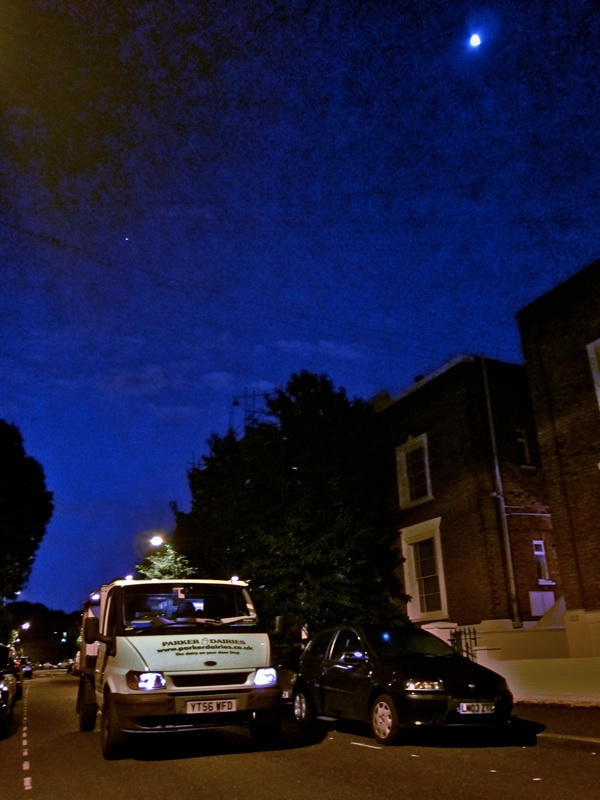
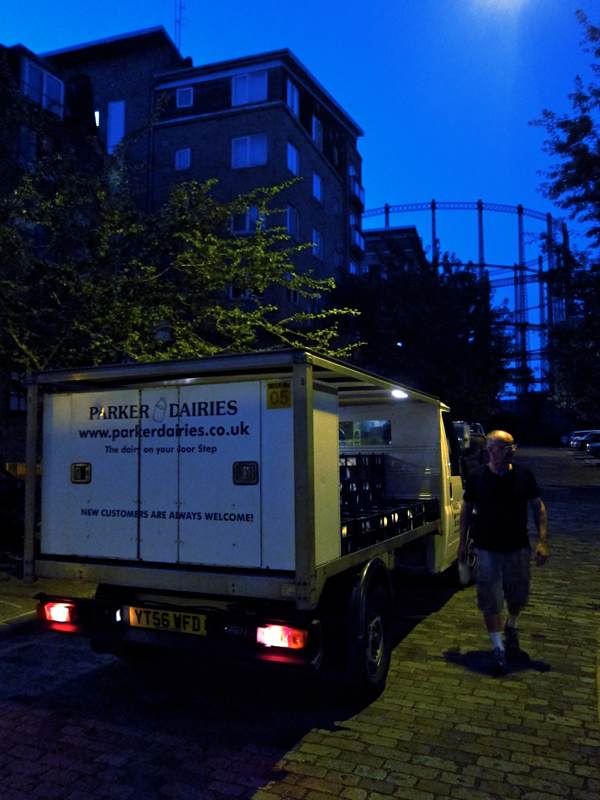
By Broadway Market.
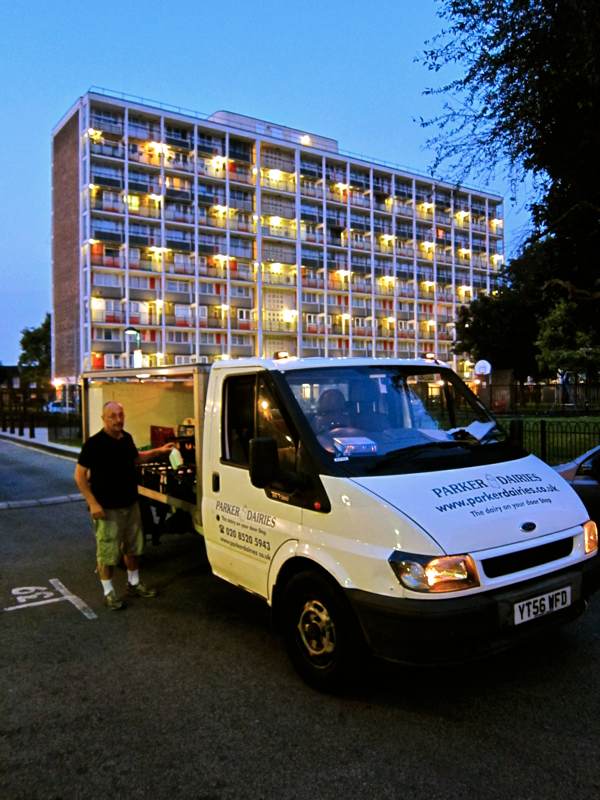
In Bancroft Rd.
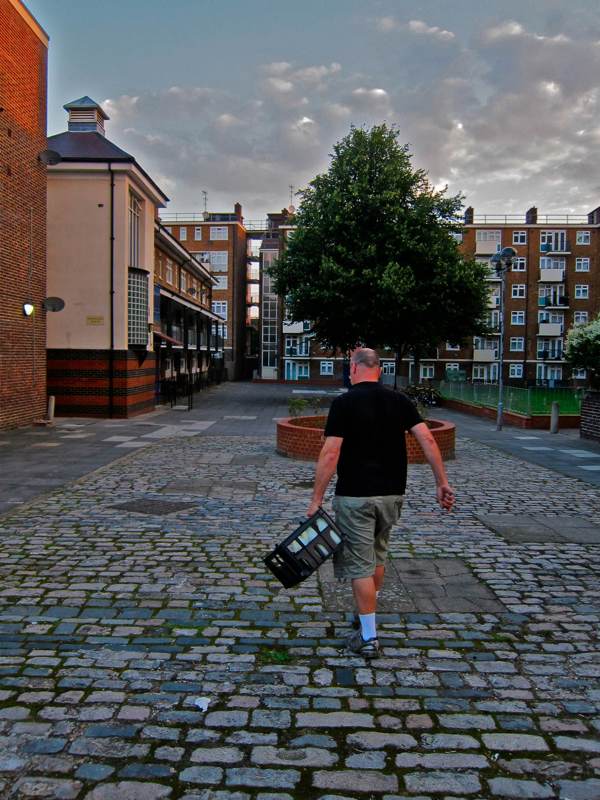
In Stepney.
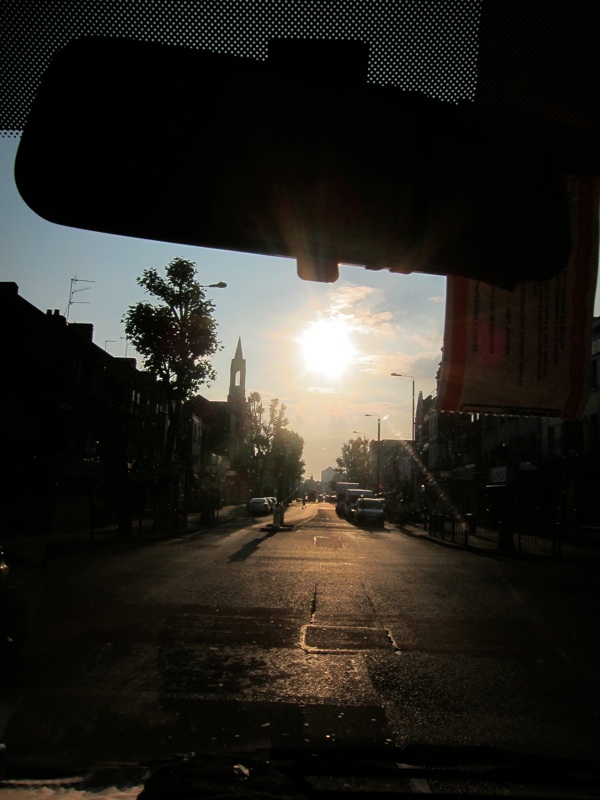
Sunrise over the Bethnal Green Rd.
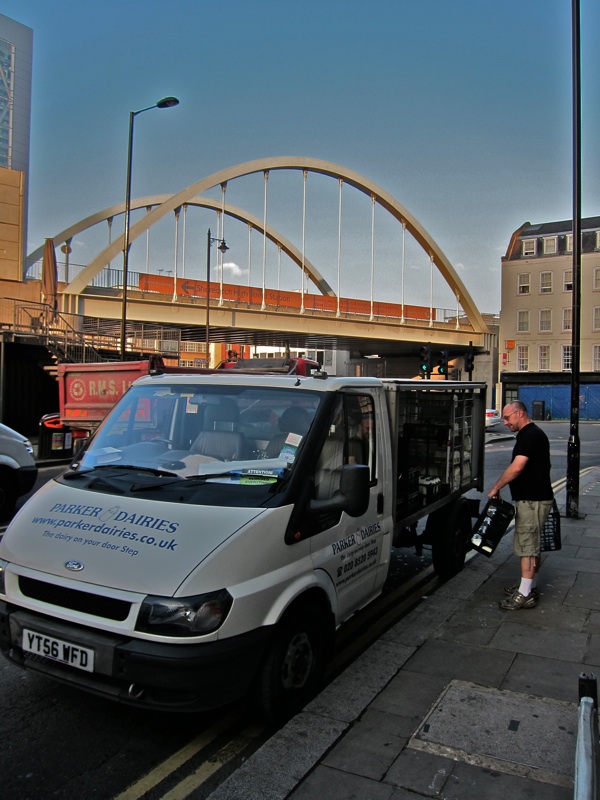
In Shoreditch.
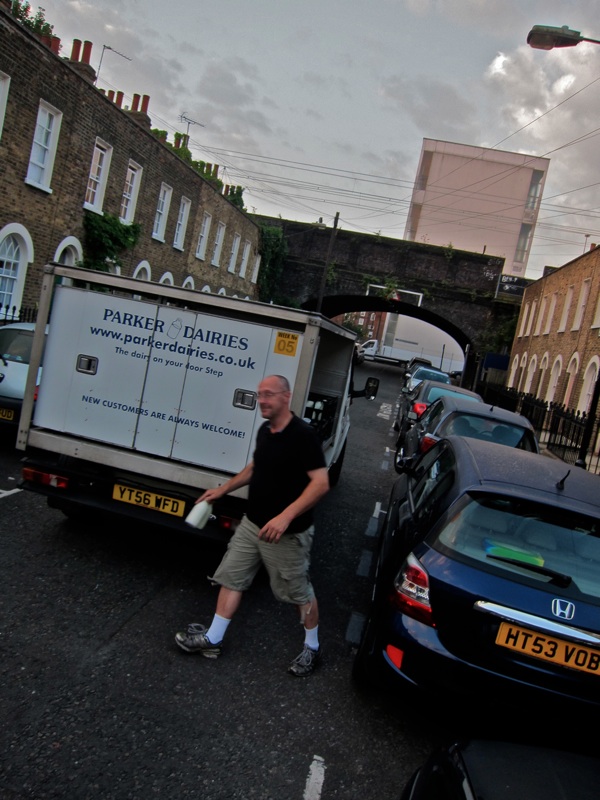
In Shadwell.
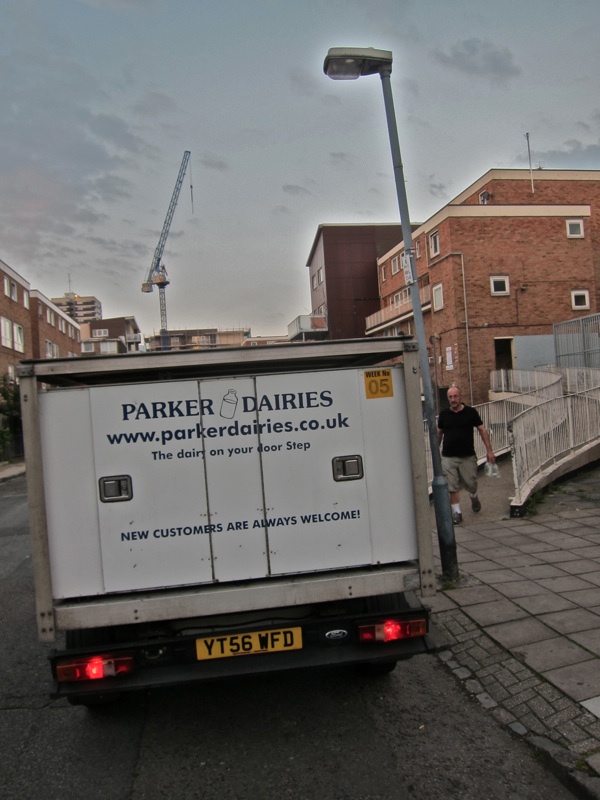
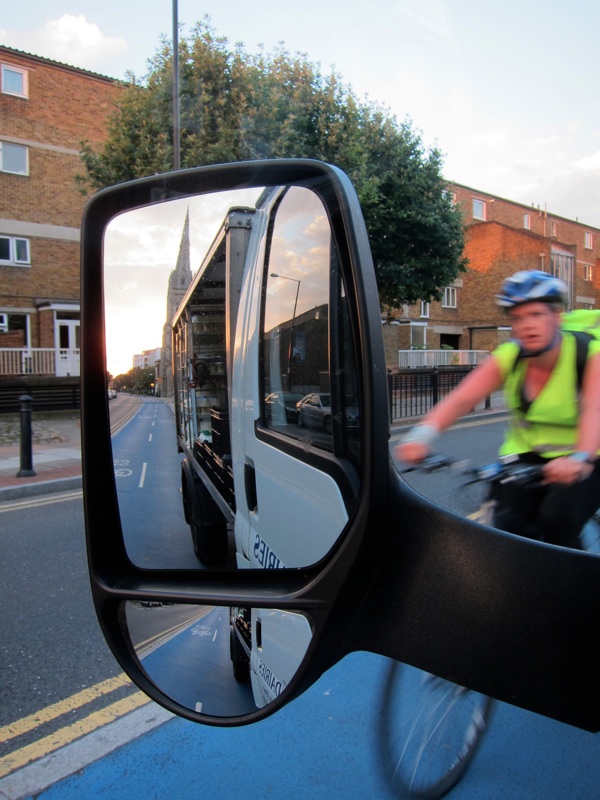
In Cable St.
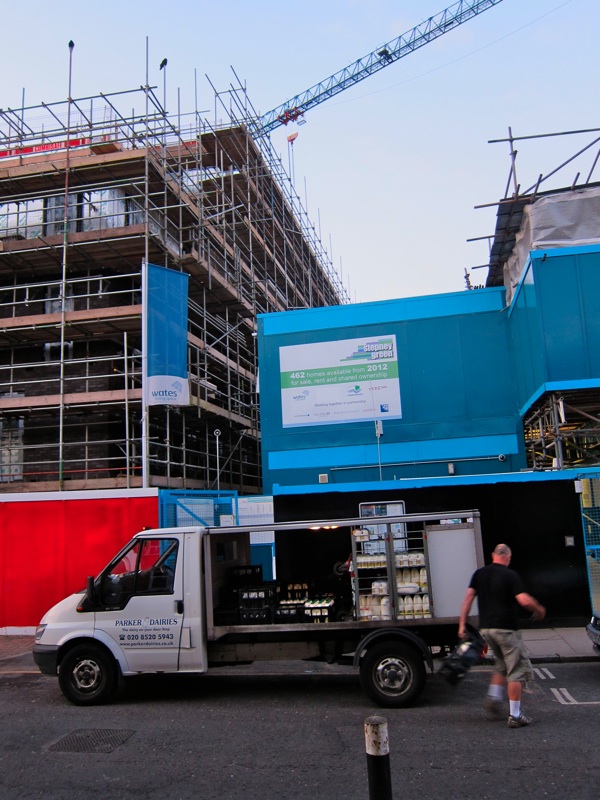
In Stepney Green.
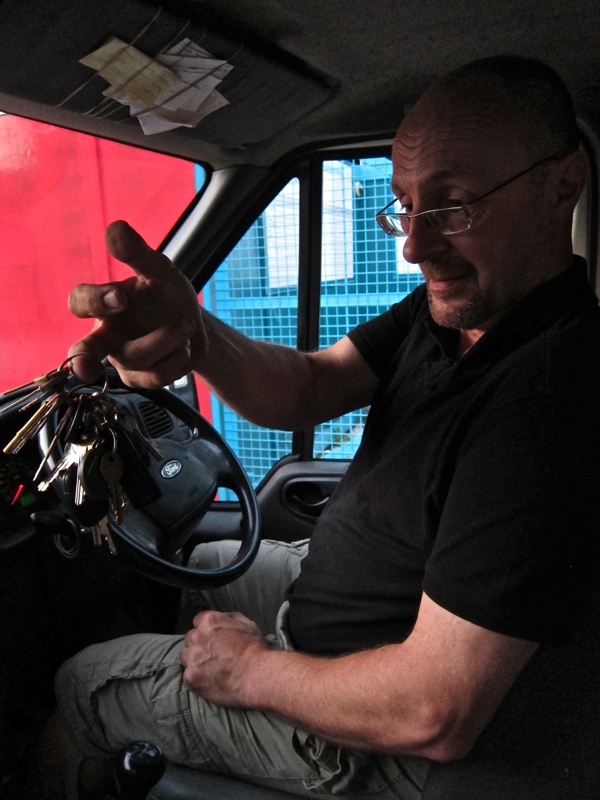
“Look, a lot of people trust me!”
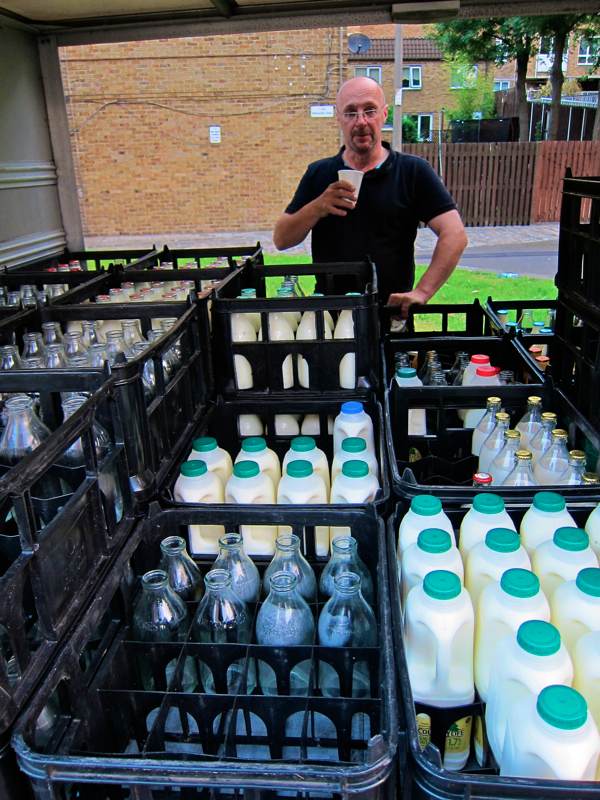
A quick cuppa on the go.
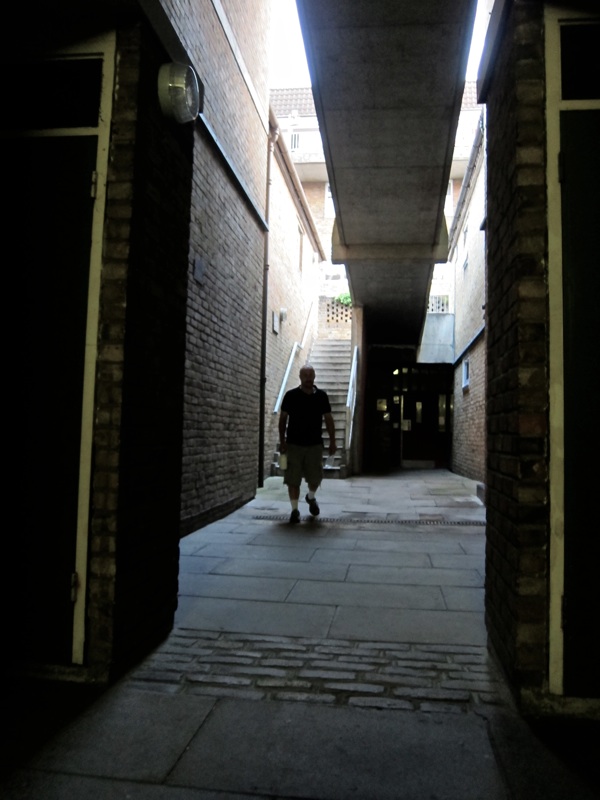
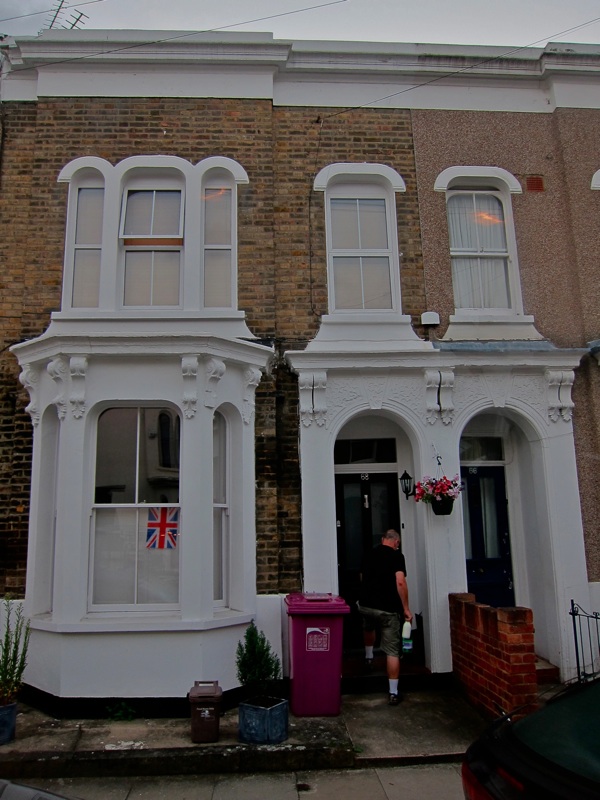
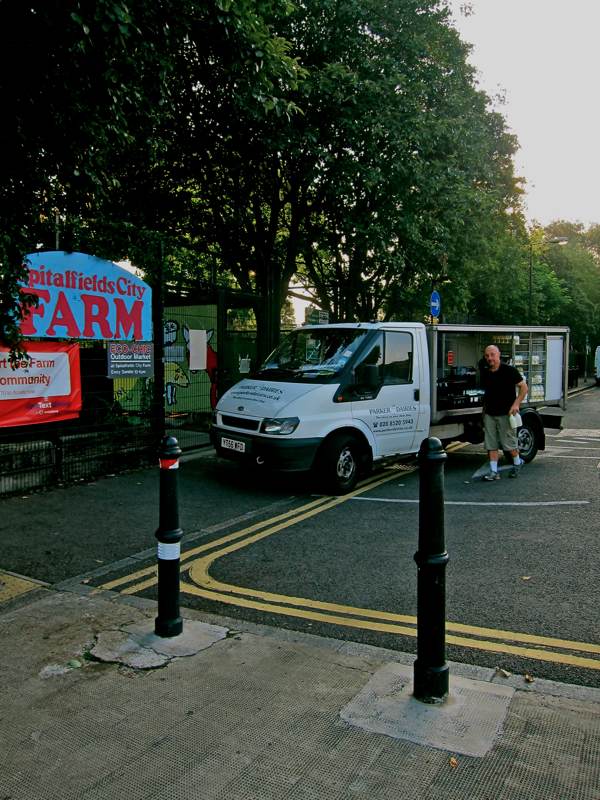
Delivering milk to the farm.
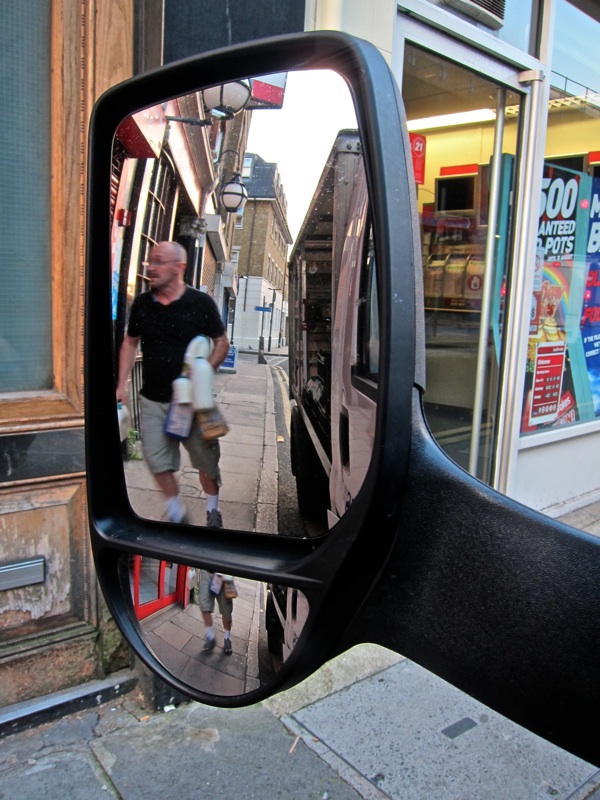
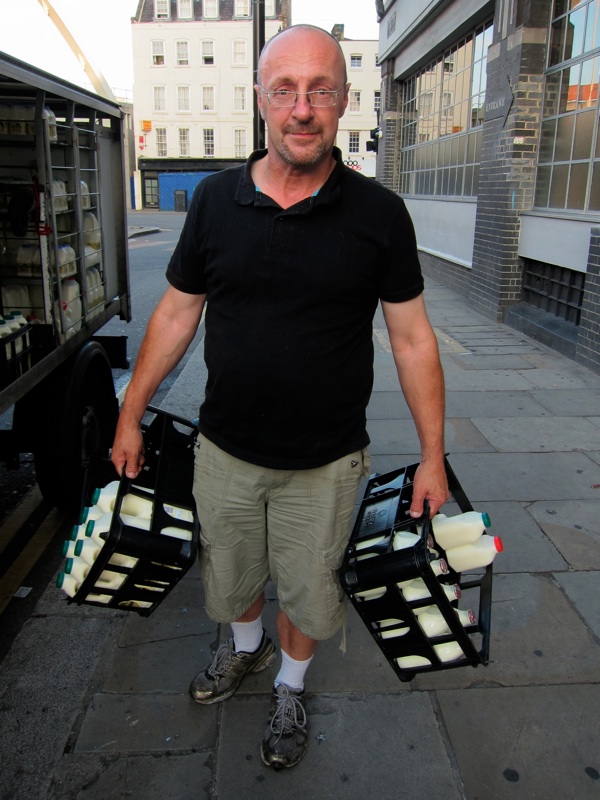
If you want Kevin Read to deliver milk or yoghurt or eggs or fresh bread or even dogfood to you, contact him directly by calling 07940095775 or email kevinthemilkman@yahoo.co.uk
You may also enjoy
Victorian Tradesmen Scraps
As my collection of the Cries of London has grown, I have widened the scope of the endeavour to include images of all tradesmen and these die-cut Victorian scraps are my latest discovery.
Enlarged here to several times their actual size, the detail and characterisation of these figures is revealed splendidly. Printed by rich-hued colour lithography, glossy and embossed, these appealing images celebrate the essential tradesmen and shopkeepers that were once commonplace but now are scarce.
In the course of my interviews, I have spoken with hundreds of shopkeepers and stallholders – and it is apparent that most only make just enough money to live, yet are primarily motivated by the satisfaction they get from their chosen trade and the appreciation of regular customers.
Here in the East End, these are the family businesses and independent traders who have created the identity of the place and carry the life of our streets. Consequently, I delight in these portraits of their predecessors, the tradesmen of the nineteenth century – rendered as giants by these monumental enlargements.


You may also like to take a look at these other sets of the Cries of London
Geoffrey Fletcher’s Pavement Pounders
William Craig Marshall’s Itinerant Traders
H.W.Petherick’s London Characters
John Thomson’s Street Life in London
Aunt Busy Bee’s New London Cries
Marcellus Laroon’s Cries of London
More John Player’s Cries of London
William Nicholson’s London Types
Francis Wheatley’s Cries of London
John Thomas Smith’s Vagabondiana of 1817
John Thomas Smith’s Vagabondiana II
John Thomas Smith’s Vagabondiana III
Thomas Rowlandson’s Lower Orders












