
Even More Old Furniture Trade Cards
After publishing sets of old furniture trade cards that might have been found in the secret compartment of a hypothetical cabinet, discovered stashed behind a plate in a hypothetical alcove or down the back of a hypothetical armoire in the eighteenth century, it is my pleasure to show this further selection which were mixed up among the playing cards in the drawer of a hypothetical gaming table.


Images courtesy Bishopsgate Institute
You may like to see my earlier selections
Furniture Trade Cards of Old London
More Furniture Trade Cards of Old London
Yet More Furniture Trade Cards of Old London
More Trade Cards of Old London
Yet More Trade Cards of Old London
Even More Trade Cards of Old London
In The East End With A Bradshaw Guide

When Jack London wrote in “People of the Abyss” that he went to Thomas Cook to arrange a visit to the East End and was told such a trip could not be made, he may have exaggerated for dramatic effect. The myth that the East End was a no-go area for tourists in the nineteenth century is scotched by this Bradshaw Guide from 1862 that came into my hands recently. It contains no less than an itinerary for the casual visitor, inspiring me to use it to navigate around the territory yesterday. And you can read excerpts below, accompanied by photographs from my tour as illustrations.
Joan Rose told me she remembers coach parties of tourists pulling up outside her grandfather’s shop in Calvert Avenue in Shoreditch in the nineteen thirties. The driver would announce, “And these are the slums!” which was the cue for Alf to run out onto the pavement and shake his fist in humiliation. Just like those Rio favela tours of our own age – poverty has always been a magnet for tourism, it seems.

Sculpture upon the side of the “Ald gate” where Chaucer lived above the gatehouse in 1386
Aldgate – to which an omnibus from any of the main thoroughfares will serve as a conveyance, may be taken as a suitable point to commence our pilgrimage in this direction. The place derives its name from the old gate that here guarded the entrance to the City, and which was taken down in 1606.

On the site of the Great Synagogue in Bevis Marks, destroyed by a bomb in 1941
Northward from Aldgate are Houndsditch, Bevis Marks and Duke’s Place, the great quarter of the Jews, and here they have settled in great numbers since the days of Oliver Cromwell.

The Minories – a communication with Tower Hill, derives its name from the nuns of the order of St Clare, or minoresses who had been invited into England by Blanche, Queen of Navarre, who here found a convent for their reception.

Goodman’s Fields – now a thickly populated region at the back of the Minories. Stow in his quaint fashion, tells us that, in his time, one Trollop, and afterwards Goodman, were the farmers there, and “that the fields were a farm belonging to the said nunnery, at which farm I myself,” he says,“have fetched many a halfpenny worth of milk.”

The theatre in Goodman’s Fields was where Garrick first appeared, October 19th, 1741, and here he drew such audiences of gentry and nobility that the carriages filled up the road from Temple Bar to Whitechapel.

Whitechapel has nothing but the butcher’s shambles to boast of as a characteristic feature. The London Hospital was instituted in 1740 for the relief of maimed and invalided persons who are, from the nature of their avocations, subject to casualties. The patients are chiefly those employed about the docks and in shipping.

John Soane’s Church of St James, 1826-8
Passing up Globe Rd, we reach Bethnal Green, a large district chiefly populated by the silk-weavers of Spitalfields. Ten churches were erected here within the last ten years and model lodgings have materially contributed to the comfort of the poorer denizens.

The line of the Eastern Counties Railway traverses the very heart of this squalid region, where the houses generally are miserably small and densely inhabited.

Shoreditch – notwithstanding its present uninviting appearance, this was once a genteel district much inhabited by the players of the court.

The parish church of St Leonard’s, built by Dance the City architect in 1740, presents nothing exteriorly remarkable but in the burial ground several distinguished personages are interred.

This is all that remains of the former terminus, replaced by Liverpool St Station in 1874.
In Shoreditch is the spacious terminus of the Easter Counties Railway.

Norton Folgate – a continuation of Bishopsgate St Without, has nothing requiring notice.

The church of St Botolph in Bishopsgate was built in 1728 and the living, in the gift of the Bishop of London, is more valuable than any other in the City.

Guard on duty within the ring-fence surrounding Finsbury Sq since the eviction of Occupy London
Finsbury Sq – built in 1789, is a vestige in name at least of olden London, bringing to recollection its original appellation of Fens-bury, from the marshy nature of the soil before it was drained. Hence we may pursue our way by pavement again into the City and recruit ourselves for further expeditions in an opposite direction.

Bradshaw’s Handbook to London has been republished by Conway
Caroline Bousfield, Craftsman

Caroline Bousfield has been making pots in this former coach house in Victoria Park Village for thirty-eight years. When local food shops began to close due to competition from supermarkets, she formed a traders’ association and they brought back a butcher, a fishmonger, a baker and a greengrocer. Then Caroline planted the roundabout outside her studio and created a garden that is now the appealing centrepiece of this lively corner of the East End. Today, her pottery workshop is the oldest-established business in Victoria Park Village and she has worked there longer than anyone else.
Caroline Bousfield’s story is an inspiring example of how the creative influence of a one community-spirited individual can have a huge impact upon a place, improving it for the better. Yet she presents herself modestly, wiping the clay off her hands with a cloth and welcoming everyone into her tiny workshop personally. To the left as you enter, you discover Caroline working at her wheel, surrounded by hundreds of white biscuit-fired dishes and pots awaiting glaze, while to the right is her showroom, lined wall-to-wall in shelves laden with examples of the elegant traditional studio pottery that is her forte. Drying her hands on her faded blue apron, Caroline pushes her thick brown hair away from her face to give you her full attention and you cannot but feel privileged to be there in her charismatic den.
“People always ask, how long does it takes to make a pot?” she confided to me with a complicit smile, “And there are two answers to that, two minutes or twenty years – depending on which way you look at it.”
Caroline trained originally as a potter and as a furniture maker, and has taught both continuously over the years. With characteristic lack of pretence, she calls herself a “Craftsman,” adding “My gardening is self-taught.”
“I came to London in 1972 when I got married, after doing a Teachers’ Certificate at Goldalming. My husband took a job with the Ford Motor Company in Dagenham and, as he couldn’t face commuting through the Blackwall Tunnel, we came to live here. It was thought to be a strange thing to do, to move to the East End, in those days.
I taught pottery at Kingsway College until my two daughters came along. But I found that if you had children or a dog, people spoke to you in the street and a fellow dogwalker in Victoria Park told me that this place was for sale. It was built as a coach house and stable in 1885, and over the stone lintel you can still read the words “North Metropolitan Volunteer Fire Escape Brigade.” Mr Koopman had run it as an electrical repair shop from 1929 until he retired in 1975, and I bought it for £2,500, which was a bargain even then. My plan was to be able to make and sell my own pots in one place, and I like being here very much – if you run a shop you become a centre for local information. I remember Mr Davis, the hardware and grocer next door, every can was dusted and wiped as he took it from the shelf. And if you asked for rubber rings for jam jars, he’d opened up a trapdoor in the floor with a counterweight and return with some. ‘It says,’One shilling and sixpence’ on the label, that sounds like a lot!’ he’d say. This was already in the days of decimal currency.
When my daughters were babies, I just brought them here and got on with my work. Then I used to swap with a friend who had children, so we each got childcare for one day and my husband took care of them on Saturdays. When my children grew up, I decided I wanted to go back to making furniture and I imagined I would do that at home in the cellar, on the days I wasn’t here, but instead I started a traders’ association for local businesses. There were four butchers when I came and they all went, then the greengrocer and baker closed, so those of us who were left we discussed how to bring them back. We approached a butcher and a fishmonger and invited them to come here, and the existing shops even shuffled around to offer them the best locations.
And I started to lobby the roads’ department to let me grow plants on the roundabout, but the first answer was ‘no,’ so then I simply went over and started pulling up the weeds. In the end, I had to write a method statement and agree to wear a high-visibility vest, and pay £5 for the privilege too. They said this was because, if I got it free, I could claim squatters’ rights and build structures. Then I thought I should create an association to do it, so it was not just me – but it is just me. I’ve raised the money myself. People donate me books that I sell in the shop, and I pick the lavender and make lavender bags, and that pays for anything new I want to plant. I’ve come second and third in Hackney in Bloom but there is not really an appropriate category for roundabouts. Now people see me gardening from buses and cars, and they call me ‘The Lady On The Roundabout” locally.
There are secrets on my roundabout for anyone that works there – a patch of violets which nobody sees but me and which give a wonderful scent when in flower, a blackbird who is a regular visitor, the remains of foxes’ suppers stolen from bins and sometimes the debris of a party. If I ignore the traffic, the sound of bees on the lavender can be heard.
People who have spent a few hours working on the roundabout say that they feel differently about the place, they feel that they belong more. The climate for guerrilla gardening is quite different now from when I started on the roundabout ten years ago and I highly recommend it to anyone who lives near any unkempt public space.”


Biscuit fired pots awaiting glaze.


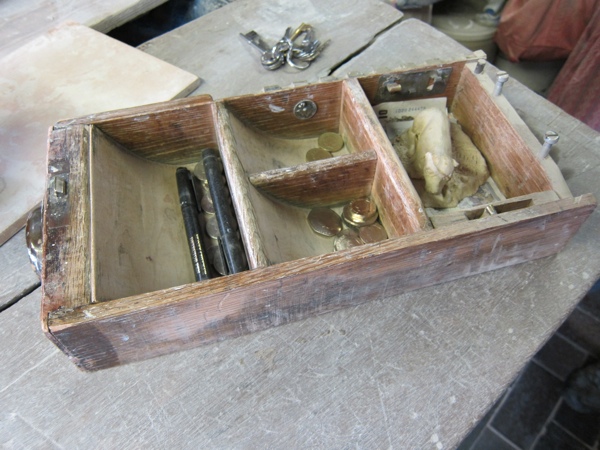
The money drawer from Mr Koopman’s Radio Shop with a sixpence that he nailed inside for luck and a dog made by a local pensioner who asked for clay to model his pet.

Caroline and her husband Gordon Gregory when they bought the coachhouse in 1975.

Gordon Gregory and his mother in 1975, after rebuilding the facade using the original bricks.

Caroline’s pottery studio today.

John Claridge’s photograph of the carriage house as electrical shop in 1964

Caroline on the Victoria Park Village roundabout that she planted and where she continues to garden, becoming famous in East London as “The Lady On The Roundabout.”
1964 Archive photograph © John Claridge
Caroline Bousfield’s Pottery Workshop & Shop, 77a Lauriston Rd, Hackney, E9 7HA
The Chicken Shops of Spitalfields

Al-Halal Fried Chicken, 63 Brick Lane
While the rest of humanity may strive towards perfection as an ever-unattainable goal, in the world of Fried Chicken perfection has already been achieved and is omnipresent – or so it appears from the number of Perfect Fried Chicken shops that line our East End streets. In fact, such is the familiarity of Perfect Fried Chicken that the acronym “PFC” is widely used and recognised among the cognoscenti. Yet, beyond this, several of the more ambitious Fried Chicken shops even claim to have surpassed perfection by advertising “PFC plus” upon their hoardings.
“What is this Fried Chicken that is beyond perfection?” I wondered as a mere PFC neophyte. And so I asked Spitalfields Life Contributing Photographer Sarah Ainslie to join me on a PFC safari to explore this fascinating phenomenon of the ubiquitous Perfect Fried Chicken shops.
My presumption was that the pace of fast food precluded the opportunity of any conversation, but at Perfect Fried Chicken Express in the Bethnal Green Rd, where we commenced our journey, we received the first of a series of friendly welcomes that were to characterise our itinerary. Sarah & I began mid-morning so that we could observe the accumulation of the lunchtime rush upon our tour and in Bethnal Green we found the staff wiping down the counters and making their final preparations for the day’s trading.
With so many mirrors, reflective surfaces and shiny plastic panels, interspersed by gaudy advertisements illustrating meal deals in graphic colour photography, all cast within a glimmering fluorescent glow, it is difficult to resist the fairground glamour of the Fried Chicken Shops. Yet circumstances are far from perfection in the trade, as Saba Kuru who has been manager of Favorite Fried Chicken for the past six years outlined to me. “The council used to decide how many chicken shops there could be in an area,” he revealed with distain, ” but now anyone can get a licence and you even have chicken shops next to one another. It means the price goes down and the chicken hangs around and gets dried out.” But at Favorite Fried Chicken, customers have no fear of dried-out chicken because Saba and his assistant Shakala keep the Fried Chicken moving fast, thereby ensuring its succulent consistency and maintaining the proud reputation of this jewel of a shop at the western end of Bethnal Green Rd.
Popping in briefly to shake hands with Moshin, who has been manager of Chicken Hut further down the Bethnal Green Rd for eight years, we crossed over to Brick Lane where, on the corner of Bacon St, we encountered the East End’s newest Chicken Shop. Operating under the unconventional name of Peppers and promising “Fresh and Healthy” Fried Chicken, there we were greeted by Junaig behind the counter who was keen to promote the opening offer of twenty-two halal chicken wings for just five pounds.
At 63 Brick Lane, we visited Spitalfields’ original Fried Chicken shop, Al-Halal Fried Chicken run by Mr Suhel for the past fifteen years. In this tiny sparkly shop, a team of four led by Mr Suhel were waiting, eager to serve. “The prices have not gone up in all the time I have been here,” Mr Suhel assured me, gesturing with a wry grin to his gleaming display of photographs of Fried Chicken meals each individually priced, “Competitiveness is the problem, because someone is always going to sell it 1p cheaper, meanwhile the wholesale price of chicken has gone from £20 to £30 a box.” And that was the limit of our conversation because there was now a constant stream of hungry customers ordering meals.
The lunchtime rush was in full flood and crowds prevented us venturing into the Al-Badar Fried Chicken & Curry Restaurant further down the Lane, in spite of the enticing smells that were drawing us there. In Osborn St, arriving at the south end of Brick Lane we paid a visit to Southern Fried Chicken, a tiny operation run by Abdul Basith for the last twelve years. The entire shop is no bigger than a domestic dining room and here we found the customers eager advocates for Mr Basith’s culinary skills. While Toufix Alam tucked into his Fried Chicken burger in delighted silence, his colleague at the next table extolled the superlative efficiency of the swift service which allowed her to make the most of her short lunchbreak. “Do you come here every day?” I asked, only to be met with a grin of amazement. “Only once a week,” was her reply and I realised that – much as she would like to come here each day – the need to watch her waistline precluded it.
Turning the corner into the Whitechapel Rd, we entered a region where seemingly every other shop was a Chicken Shop, but unfortunately by now we had already eaten so much Fried Chicken that we could only walk past them all in wonder, admiring their permutations of design, their colourful posters and ingenious names. We had arrived at the culmination of our journey, in Chicken City. Everywhere, happy people were to be seen eating Fried Chicken.
Far from being the transitory anonymous spaces offered by fast food chains, the independently run Chicken Shops are safe havens from the clamour of the city, where anyone can eat for as little as one pound and be assured of a welcome too. No wonder people feel comfortable in Chicken Shops. No wonder people love them.

Mahee Abbasi at PFC Plus in Whitechapel.

Junaig at Peppers in Brick Lane – “Twenty-two spicy wings for five pounds!”


Toufix Alam with his Fried Chicken Burger.

Saba Kuru – “Everybody likes chicken and chips.”


At Peppers, Spitalfields’ newest Fried Chicken Shop.


Shakala, customer assistant at Favorite Fried Chicken.

In Whitechapel’s Chicken City.


Mr Suhel and his team at Al-Halal Fried Chicken in Brick Lane.


Afzol Miah at Perfect Fried Chicken Express.
Photographs copyright © Sarah Ainslie
[youtube EnZq4EPgZ90 nolink]
The fastest Chicken Shop in Ilford.
You may also like to read about
The Corner Shops of Spitalfields
The Lost World of the Laundrettes
People On The Street & A Cat

Brick Lane 1966
“Sometimes there is no reason, but you have to do it and that’s what makes magical things happen.” photographer John Claridge said, introducing this set of pictures published here for the first time,“There is no why or wherefore of doing it, because it’s not from the head – it’s from the heart.”
I took John’s declaration as a description of his state of rapture as he wandered the pavements of the East End to take these photographs of people on the street, going about their daily lives.“I used to get up early and walk around,” he confided to me and I understood the sense of loneliness that haunts these evocative pictures, in which the subjects appear distant like spectres, self-absorbed and lost in thought.
“The important word is ‘request'” said John, speaking of the photo of the man at the request bus stop, “He’s in some kind of world that we are not party to.” In John’s youthful vision – enthralled by the writing of Franz Kafka – the East End street became an epic stage where an existential drama was enacted, peopled by characters journeying through a strange landscape of forbidding beauty.
John knew he was photographing a poor society within a poor environment, but he was a part of it and held great affection for it. “Just another day of people walking around,” he concluded to me with uneasy levity – emphasising that while these images are emblematic of a world which time may have rendered exotic, it is also world that was once commonplace to him.

Whitechapel, 1960

Whitechapel, 1981.

E13, 1962 -“This was taken from my window at home.”

Spitalfields, 1962 – “They look like they are up to no good.”

Whitechapel, 1968 -“Where did the boy get that peaked cap?”

Spitalfields, 1961. -“An old man stops to light up.”

Spitalfields, 1961 – “A moment, a story in itself.”

Whitechapel, 1982

Spitalfields, 1982 – “I walked past her and just grabbed the picture as I went by.”

Spitalfields, 1962

Spitalfields, 1968 – “The dog is looking at the rubbish in exactly the same way as the man is looking at the rubbish.”

At the ’59 Club, 1973

Weavers’ Fields, 1959 An old lady walks across a bombsite in Bethnal Green.

Whitechapel, 1964

E16, 1964 –“The important word is ‘request.’ He’s in some kind of world that we are not party to.”

Whitechapel, 1982

E16, 1982 -“He’s going home to his dinner.”

Princelet St, 1962 – “Just a man and a pigeon.”

Spitalfields, 1968 -“I like the shadows, where they’re falling.”
Photographs copyright © John Claridge
You may also like to take a look at
Along the Thames with John Claridge
At the Salvation Army with John Claridge
A Few Diversions by John Claridge
Viscountess Boudica’s Blog

Viscountess Boudica Denvorgilla Veronica Scarlet Redd
In recent weeks, I have had the privilege of assisting Viscountess Boudica in setting up her blog entitled There’s More To Life Than Heaven & Earth, comprising a string of short stories accompanied by vivid illustrations that will accumulate to become the autobiography of the Brick Lane Trendsetter formerly known as Mark Petty. “It’s regarding people in situations I once knew,” she explained to me, sitting eagerly at her keyboard, “and is mainly based on the Braintree years and the trouble I had there which led to me being forced out of town.”
Written from raw personal experience, these comic tales recount the sentimental education of the Viscountess through a string of disastrous emotional involvements. Yet in spite of the multiple humiliations, the violence and the angry phone calls, Boudica looks back on these experiences fondly, even showing compassion for her tormentors. “I always try to see the good in everybody,” she assured me with characteristic generosity of spirit.
“They’d all been in the nick and had criminal tendencies, such as gay-bashing, mugging, extortion or housebreaking.” she admitted, “And they were all in denial, they didn’t like gay men and so they tried to think of me as a woman. They thought of me as their bit on the side, I was the one to hem their trousers and cook their dinners.” Regrettably, the conflicted nature of these men always resulted in problems for Boudica – problems that became compounded when their girlfriends found out and turned jealous. “I think they tried to play us off against each other,” Boudica confessed to me, rolling her eyes for dramatic effect.
Combining magic realism with the humour of Carry-On films, Boudica’s blog is both an elaborate satire upon sexual repression and an unmediated portrait of a highly individualistic world view.“It’s a warning to others and I hope people will try to learn from my mistakes, because it’s a chapter in my life that’s finished.” Boudica assured me, looking forward, “Justin Timberlake would be my ideal man now. I sent him a watch and he sent me his picture back.”
There are just around a dozen stories on the site to date, but I have had a sneak preview of some of the wonders that are to come – and I publish a selection of Boudica’s drawings below – so I recommend you follow this unique endeavour as it develops. The Viscountess is waiting for your comments!


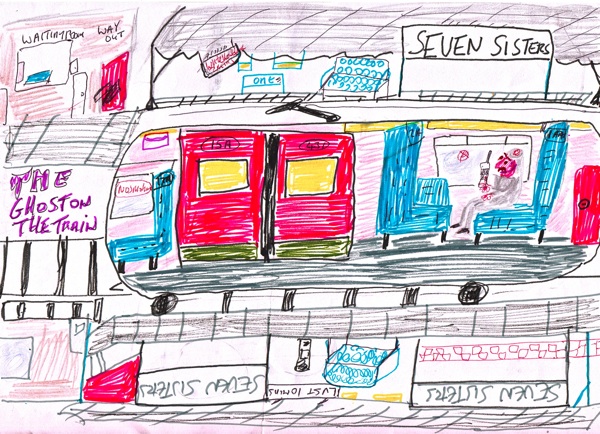


Drawings copyright © Viscountess Boudica
Follow There’s More To Life Than Heaven & Earth to read Viscountess Boudica’s stories
Read my original profile of Mark Petty, Trendsetter
and take a look at Mark Petty’s Multicoloured Coats,
Yet More Old Furniture Trade Cards
After recently publishing selections of old furniture trade cards that might have been found in the secret drawer of a hypothetical cabinet or discovered stashed behind a plate on the top shelf of a hypothetical alcove in the eighteenth century, it is my pleasure to show this further selection which had fallen down the back of a hypothetical armoire.


Images courtesy Bishopsgate Institute
You may like to see my earlier selections
Furniture Trade Cards of Old London
More Furniture Trade Cards of Old London
More Trade Cards of Old London
Yet More Trade Cards of Old London
Even More Trade Cards of Old London


