
The Newspaper Distributors of Old London
Commonplace, an exhibition of photography by Spitalfields Life Contributing Photographer Colin O’Brien opens today the crypt of Christ Church Spitalfields and runs until 26th August. Colin will be talking about his work tomorrow, Sunday 29th July 2pm. Throughout this past week, I have been revisiting stories I have done in collaboration with Colin, accompanied by his photographs that span an extraordinary career extending from 1948 until the present day.

When Colin O’Brien was growing up in a slum tenement in Clerkenwell in the nineteen forties, his mother used to give him a penny and send him out to buy a copy of the Evening Standard.
Since 1827, the streets of London echoed to the cry of “Standodd! Midday Special! Standodd! Evening Special!” and, at its peak, there were over seven hundred distributors sending the paper as far afield as Liverpool and Brighton. Yet by the time the Evening Standard became a free paper two years ago, there were just one hundred and sixty distributors and today there are only sixty left. So when a handful of heroic distributors from the glory days of the Evening Standard gathered at the Bishopsgate Institute, one Saturday in January, for old times’ sake, I asked Colin to be there to take their portraits.
“I used to be a paper boy when I was at school in Catford in 1962.” recalled John Cato who worked for the Standard until 2008, “And when I left school at fifteen in 1965, the guy who delivered the Evening Standard asked me if I’d like to be his van boy. I had to be at the station to collect the papers at ten and I’d go off with him in the van to deliver and collect the money from the sellers. Then I’d go home for lunch and at two o’clock there’d be another driver I worked with to deliver the later editions. We got paid weekly, so on Friday I’d go back to Shoe Lane with the driver to collect my wages and I used to mix with the other van boys and we all made friends. Sometimes we used to socialise with the van boys from the Evening News, even though they were our competitors.”
It was a furious business, bundling up the papers and tying them up with string as they came off the printing presses in Shoe Lane, then sending them off continuously in the fleet of vans as the editions updated through the day. Years now after they retired, most of these men still have the ink-stained hands and backache that are marks of a lifetime in newspaper distribution.
Frank Webster started as a rounds boy, delivering papers to newsagents by bicycle four times a day.“I was thirty years old before I graduated to a driver,” he told me with shrug, “they said it was the longest apprenticeship – in fact, it was a bit of a closed shop, the families knew each other for generations. You needed a relative in the business to get a job and it was based on seniority, it was dead man’s shoes. Yet I always enjoyed going to work, being outdoors and meeting all the vendors, they were such characters.”
“Most of us took early retirement between 2007-2009 when they were trying to cut costs, before they sold the paper to Alexander Lebedev for £1 and it went free,” explained Rob Dickers with a philosophical grin. He started at fifteen and his father worked for thirty years as a compositor at the Standard since before World War II. “From the late sixties, there was a great sense of camaraderie but when the printing moved out from Shoe Lane to Rotherhithe and we were deunionised, the money dropped.” Rob and his pal John Cato were very active in the Chapel, as the branch of the union was termed. “I became Father of the Chapel, the shop steward,” revealed John, “The management de-recognised the union but I built it up again from three to eighty. That’s my claim to fame really.” John’s efforts ensured his members received better pensions and redundancy deals, crucial for the employees as the industry itself began to flag.
The retrospective irony is that while the newspaper managements enacted aggressive policies upon their workforce to drive costs down during the last decades of the twentieth century, in this century the entire newsprint industry finds itself eclipsed by electronic media. Yet these proud men are the last of a hardy breed who devoted their lives to keep the papers rolling and then fought fiercely against tyrannical employers to protect their livelihood as the world changed around them.
On the day after Colin O’Brien took these portraits, the printing of the Evening Standard moved from Rotherhithe to Broxbourne and the first issue of the London Evening Standard not printed in London hit the streets. A new chapter opened for the capital’s most famous paper and the implications of this new development were yet to be discovered. No longer is the cry of “Standodd! Midday Special! Standodd! Evening Special!” to be heard upon the streets of London and the soul of the city is the lesser for it.

Victor Wilson, Distributor at the Evening Standard, 1972 – 2007.


Frank Webster, Distributor at the Evening Standard, 15th August 1966 – 30th September 2007.


Ron Chadwick, Distributor at the Evening Standard, 1963 – 2006.

Former Evening Standard headquarters at Shoe Lane.

David Patten, Distributor at the Evening Standard, 1966 – 2009.


John Cato, Distributor at the Evening Standard, 1965 -2008.


Peter Steward, Distributor at the Evening Standard from 1964.


Brian Eller, Distributor at the Evening Standard from 1970 -2008.

Rob Dickers’ Newspaper Distributor’s knife. The notch on the top knife was worn by winding string around the handle to tie the bundle. “They wouldn’t let you go to work without one of these and a union card,” said Rob.


Barry Pach worked in the Bill Room at the Evening Standard from 1960 – 1989, writing the bills for the newspaper hoardings by hand.


Portraits and final photograph © Colin O’Brien
Archive images courtesy of Bishopsgate Institute
Commonplace, Photographs by Colin O’Brien 1948-2012, runs at the Crypt of Christ Church, Spitalfields from today, 28th July until 26th August. Open Tuesdays, Saturdays & Sundays 1-6pm. Colin O’Brien will be talking about his work on Sunday 29th July 2pm.
Colin O’Brien Goes Back To School
Commonplace, an exhibition of photography by Spitalfields Life Contributing Photographer Colin O’Brien runs at the crypt of Christ Church Spitalfields from tomorrow, Saturday 28th July until 26th August. Colin O’Brien will be talking about his work this Sunday at 2pm. During this week, I am revisiting stories I have done in collaboration with Colin, accompanied by his photographs that span an extraordinary career extending from 1948 until the present day.

This is Colin O’Brien, head boy at Sir John Cass School in Aldgate, on the day he left the school in 1955, proudly holding aloft the Lord Broughshane Cup and making a fine show of facing the future with confidence. Standing up straight, with his hair neatly brushed, he is the incarnation of youthful optimism.
So, as you can imagine, Colin was a little tentative when he returned to his old school last year, more than half a century later – for the first time since that day – to attend the leavers’ evening and meet the class of 2011.
“I think I was eager to please, and I was very happy,” was Colin’s self-effacing explanation when I asked how he became head boy, as we walked up Aldgate to Sir John Cass School, “I was always top of the class, even though I am not academic and I left with no qualifications.”
While still at school, Colin had shown flair in photography, recording the life around him in Clerkenwell where he grew up and even the car crashes that he witnesses from his window, so it was perfectly natural for him to take a set of pictures of his classmates to record the moment when they knew each other best – before they went their separate ways for ever.
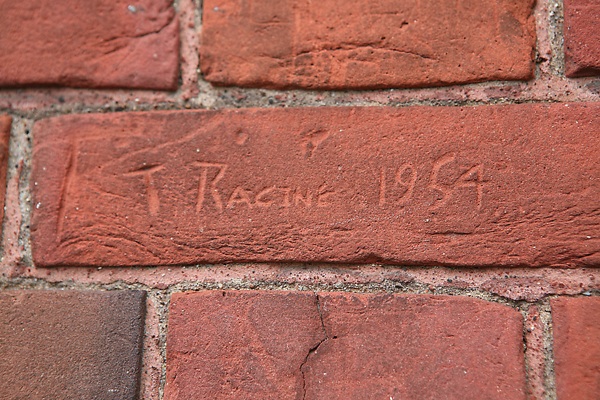
I joined Colin on a sentimental quest to discover his youthful self of this photograph taken in July 1955 at the Sir John Cass School. We looked first in the school trophies cabinet for the Lord Broughshane Cup but it was no longer to be found and, to Colin’s surprise, when he climbed up to the rooftop playground where the picture was taken, he discovered that a garden had grown there, with beehives in a row, and flowers and vegetables sprouting where once he used to play. Yet, unexpectedly, evidence of his youthful presence remained in the form of indentations in the bricks, where Colin and his pals used to polish pennies by rubbing them into the wall, creating round notches that remain half a century later. And, to Colin’s delight, there were names graven into the brick too, among them “S.Worthington 1955″ and“Tony Racine 1954.” – names that he remembered as those of his classmates.
Once these unforseen discoveries confirmed that Colin’s memory was not a dream, his photographs not mirages and his youthful self not a spectre, we were emboldened to enter the assembly hall where, beneath the gaze of eighteenth century worthies that lined the walls, the current pupils of Sir John Cass School were gathered with their parents to say farewell to the leavers. Unlike Colin, who left at fifteen to face the world, these pupils were only completing their Primary education at ten or eleven and going on to Secondary education in the Autumn. Yet they were each required to stand up and complete a sentence that began, “When I leave university, I want to be…” and they did so with admirable resolve and ambition, even the ten-year-old realist who rewrote the sentence declaring, “I don’t know yet what I want to do when I leave university.”
Colin was there to give out the prizes to his youthful counterparts at the culmination of the evening, after performances by members of the school string orchestra and drama presentations. He shook hands with each of the leavers as they were given their bible, dictionary and thesaurus – revealing to me later that he still had his own leavers’ bible at home. And then, as the event drew to its close and all the achievements both individual and collective had been celebrated, the equivocal emotional nature of the event became apparent, as in the melee a few gave way to quiet tears. Meanwhile, there were a host of others running around with digital cameras to collect pictures of classmates as keepsakes, just had Colin had done all those years earlier.
As we descended a staircase afterwards, Colin pointed out the spot where he was first told about sex, admitting that he did not believe it at the time. In the playground, he confessed that this was where he felt the tingling sensation inspired by the object of his nascent affection Olive Barker, the daughter of the caretaker of the Bishopsgate Institute. “She never even looked at me,” recalled Colin fondly, “It was my first experience of love.”

Colin O’Brien, 18th July, 2011

Colin O’Brien, July 1955


Olive Barker, the object of Colin’s unrequited youthful affection is on the right.


Colin & the girls


Mr Hunt with members of his class.




Sir John Cass School leavers, 2011.

The notches in the wall where the class of 1955 once polished pennies.
Photographs copyright © Colin O’Brien
Commonplace, Photographs by Colin O’Brien 1948-2012, runs at the Crypt of Christ Church, Spitalfields. Open Tuesdays, Saturdays & Sundays 1-6pm.
The Fly-Pitchers Of Spitalfields
Please join me tonight at the opening of Commonplace, an exhibition of photography by Spitalfields Life Contributing Photographer Colin O’Brien at the crypt of Christ Church Spitalfields from 7 – 9pm. Throughout this week, I am publishing stories I have done in collaboration with Colin, accompanied by his photographs that span an extraordinary career extending from 1948 until the present day.

When I first came to Spitalfields, at dawn one Sunday morning in Winter long ago, I was amazed to find Brick Lane full of fly-pitchers – people selling a few items directly off the pavement. Yet as the years have gone by, these pavement traders have been pushed further and further out until they find themselves at the very edge of the territory, crowded together upon a narrow strip of pavement along the Bethnal Green Rd. Literally at the margins, these people suffer at the heavy hands of market inspectors harassing and threatening them, causing them to pick up their things and flee – only to return later and do a little more trading before the next purge happens, in a tragic ongoing game of cat and mouse.
Commencing in the early hours and sometimes gone by first light, the existence of these traders is unknown to many visitors who come to Brick Lane on Sunday. So, last winter, Colin O’Brien spent a month down among the fly-pitchers and the result was this remarkable set of pictures that acknowledge the dignity of these people who are subject to such unnecessary humiliation for sake of wanting to sell a little bric-a-brac.
“My name is Jason John, I’m writing you a damn good song” – these were the first words I heard when I came round the corner of the Bethnal Green Rd into Norton Folgate to meet Colin, one Sunday morning, just as a street musician with curly dark locks appeared with theatrical aplomb from behind a telephone box, wielding his guitar and offering a tuneful accompaniment to the lively scene of pavement trading, sheltered by the vast railway bridge arching over us. It can be a pitiful spectacle to witness the modest possessions that people sell in the Bethnal Green Rd, asking prices as little as 10p, and yet this market is also remarkable for its vibrant life and sense of camaraderie which, ironically, became strengthened by the threat to destroy it.
Over the month that Colin took his pictures, a stack of black sea-containers were put in place and the hoarding behind the fly-pitchers came down to reveal a pop-up shopping mall which opened soon afterwards. For a couple of weeks, a fence with the logos of the international brands that would be selling their wares there in future served as a backdrop to the fly-pitchers and the contrast between the two could not be have been more extreme. The developers who own the site created the temporary shopping mall to capitalise upon their investment until they raised the finance to construct a tower block for corporate clients and – for the sake of this – a few pensioners, the handicapped, those struggling on benefits and the dispossessed were being criminalised for trying to sell a few of their belongings to raise a little extra cash on a Sunday morning.
I spoke to a Jewish gentleman in his seventies as he arrived to place six worn shirts on the pavement for sale, casting glances nervously to either side. I bought one of his shirts for 50p in order to strike up a conversation with him, yet within minutes he was harshly moved on and my 50p proved to be his sole income for his effort that morning.“They’re trying to get rid of the poor people!” exclaimed one woman in grief, too scared to consent to being photographed by Colin.
The argument is commonly used that the fly-pitchers are unlicensed and they block the pavement. Yet the truth is that some have been coming to Brick Lane to trade for their entire lives, participating in the culture of unregulated pavement trading which has been in continuous existence in this corner of the East End on Sundays for centuries. And, if they are blocking the pavement today, it is because they have been herded into this narrow space away from Brick Lane against their will.
Gina of Gina’s Restaurant in the Bethnal Green Rd, who started her first cafe in Brick Lane with her husband Philip Christou in 1961, opens each Sunday to serve the same people who have been coming all these years. When they are ‘purged’ by the inspectors, they take refuge in her establishment and if the old people fail to make enough money to pay for a Sunday lunch – which was their sole intent in getting up before dawn and coming down here – then Gina simply gives them a meal. It was a sombre experience to sit in Gina’s Restaurant among those who had taken flight and recognise that these spirited characters were the people who had been in the market longer than anyone.
When the shopping mall opened, the demographic of the passersby on the pavement changed at once, as if decades had passed overnight, with affluent shoppers replacing the market people. Yet, six months later, the new shops are struggling find customers. Meanwhile, demonstrating stubborn resilience, the fly-pitchers continue to trade on the Bethnal Green Rd upon an even smaller strip of pavement opposite the stack of sea containers and they are still under threat of harassment. I was told that, on average, these traders can expect to make no more than £12 on a Sunday morning,
Colin O’Brien’s pictures witness a shameful episode which remains unresolved. The soul of this place resides with the fly-pitchers, whose moral rights should be respected – through the provision of a space where they can trade peacefully – rather than constantly subjecting them to this inhuman treatment which degrades us all.


Jason John, Street Musician


Mr Gil, Street Preacher


Photographs copyright © Colin O’Brien
Commonplace, Photographs by Colin O’Brien 1948-2012, runs at the Crypt of Christ Church, Spitalfields, 28th July – 26th August. Open Tuesdays, Saturdays & Sundays 1-6pm. Colin O’Brien will be talking about his work on Sunday 29th July 2pm.
Colin O’Brien’s Brick Lane Market
Please join me at the opening of Commonplace, an exhibition of photography by Spitalfields Life Contributing Photographer Colin O’Brien at the crypt of Christ Church Spitalfields tomorrow, Thursday 26th July, from 7-9pm. Throughout this week, I will be publishing stories that I have done in collaboration with Colin, accompanied by his photographs that span an extraordinary career extending from 1948 until the present day.

Shall we take a walk through Cheshire St, Brick Lane, Sclater St and Club Row with Colin O’Brien to experience the life of the market in the nineteen eighties?
“I loved markets as a child, because I grew up during the nineteen forties in Clerkenwell and I used to go to Leather Lane to hear the patter of the stallholders. There is this mystique about markets for me. I love being surrounded by people and I feel safe in a crowd.” Colin told me, his grey eyes shining in excitement, as we made our way through the crowd onto the bare ground between Cheshire St and Grimsby St where traders sold their wares upon the frozen earth, by the light of lamps and candles.
“I’m a bit of a collecting sort of person, myself.” Colin admitted as we scanned the pitiful junk on sale, so carefully arranged in the frost, “I like old things.” It was a bitterly cold morning which led me to ask Colin why we were there. “I tend to go when it’s snowing,” Colin revealed cheerfully as we picked our way through the slush on Brick Lane, “there is a comradeship and drama.”
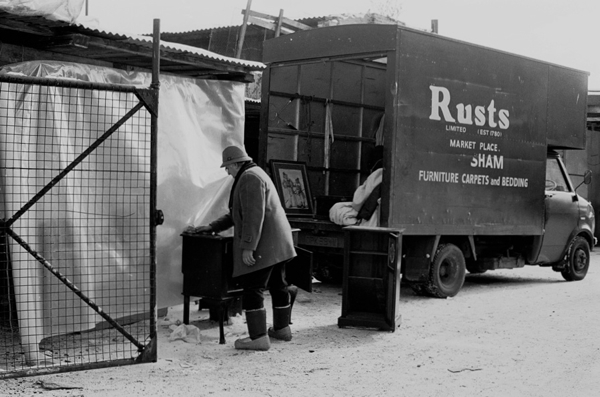
Examining Colin’s pictures later, just a fraction of the total, I realised that most were taken when the market was clearing up and portrayed individuals rather than the crowd. “Packing up is when everything happens,” he explained to me, “they dump all the unsold stuff in the street and the scavengers come to take it. You look at what’s discarded and it’s the history of the time.”
I noticed that the woman sitting at the centre of Colin’s photograph “Coming and goings at the corner of Brick Lane” was surrounded by five men and yet not one was looking at her. I realised that he had photographed her invisibility, and that the same was true for his other soulful portraits of market-goers, market-traders, homeless people, old people and marginal characters – all portrayed here with human sympathy through the lens of Colin O’Brien, yet gone now for ever.


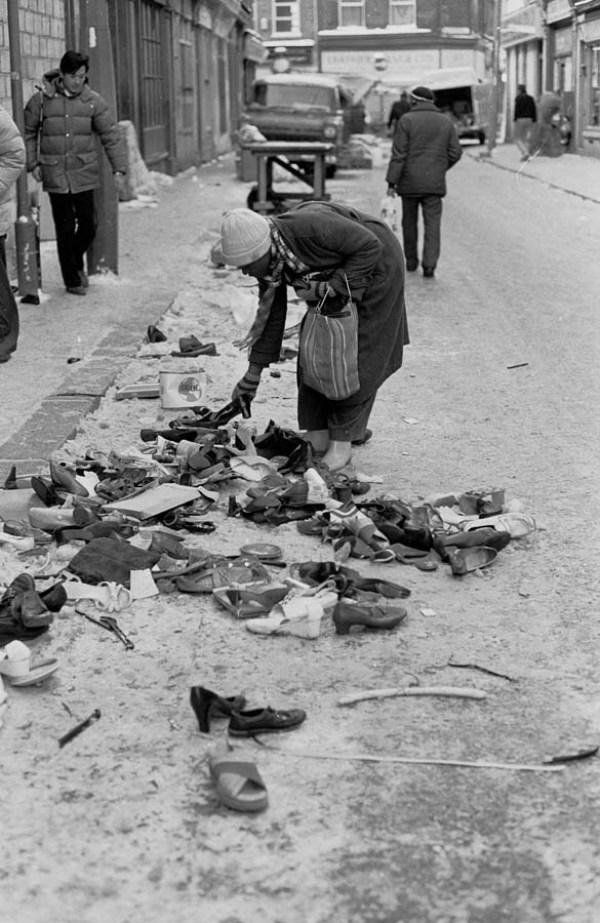


Coming and goings at the corner of Brick Lane.


At the time of the miners’ strike.




Photographs copyright © Colin O’Brien
Commonplace, Photographs by Colin O’Brien 1948-2012, runs at the Crypt of Christ Church, Spitalfields, 28th July – 26th August. Open Tuesdays, Saturdays & Sundays 1-6pm. Colin O’Brien will be talking about his work on Sunday 29th July 2pm.
Colin O’Brien’s Clerkenwell Car Crashes
Please join me at the opening of Commonplace, an exhibition of photography by Spitalfields Life Contributing Photographer Colin O’Brien at the crypt of Christ Church, Spitalfields this Thursday 26th July from 7-9pm. Over this coming week, I will be publishing stories that I have done in collaboration with Colin, accompanied by his photographs that span an extraordinary career extending from 1948 until the present day.

Accident, daytime 1957
When Colin O’Brien was growing up in Victoria Dwellings on the corner of Clerkenwell Rd and Faringdon Rd, there was a very unfortunate recurring problem which caused all the traffic lights at the junction to turn green at once. In the living room of the top floor flat where Colin lived with his parents, an ominous “crunch” would regularly be heard, occasioning the young photographer to lean out of the window with his box brownie camera and take the spectacular car crash photographs that you see here. Unaware of Weegee’s car crash photography in New York and predating Warhol’s fascination with the car crash as a photographic motif, Colin O’Brien’s car crash pictures are masterpieces in their own right.
Yet, even though they possess an extraordinary classically composed beauty, these photographs do not glamorise the tragedy of these violent random events – seen, as if from from God’s eye view, they expose the hopeless pathos of the situation. And, half a century later, whilst we all agree that these accidents were profoundly unfortunate for those involved, I hope it is not in poor taste to say that, in terms of photography they represent a fortuitous collision of subject matter and nascent photographic talent. I say this because I believe that the first duty of any artist is to witness what is in front of you, and this remarkable collection of pictures which Colin took from his window – dating from the late forties when he got his first camera at the age of eight until the early sixties when the family moved out – is precisely that.
Recently, I accompanied Colin as he returned to the junction of the Clerkenwell Rd and Faringdon Rd in the hope of visiting the modern buildings upon the site of the former Victoria Dwellings. To our good fortune, once we explained the story, Tomasz, the superintendent of Herbal Hill Buildings, welcomed Colin as if he were one of current residents who had simply been away for the weekend. Magnanimously, he handed over the keys of the top flat on the corner – which, by a stroke of luck, is currently vacant – so that Colin might take pictures from the same vantage point as his original photographs.
We found a split-level, four bedroom penthouse apartment with breathtaking views towards the City, complete with statues, chandeliers and gold light switches. It was very different to the poor, three room flat Colin lived in with his parents where his mother hung a curtain over the gas meter. Yet here in this luxury dwelling, the melancholy of the empty rooms was inescapable, lined with tired beige carpet and haunted with ghost outlines of furniture that had been taken away. However, we had not come to view the property but to look out of the window and after Colin had opened three different ones, he settled upon the perspective that most closely correlated to his parents’ living room and leaned out.
“The Guinness ad is no longer there,” he commented – almost surprised – as if, somehow, he expected the reality of the nineteen fifties might somehow be restored up here. Apart from the blocks on the horizon, little had changed, though. The building on the opposite corner was the same, the tube embankment and bridge were unaltered, the Booth’s Distillery building in Turnmills St still stood, as does the Clerkenwell Court House where Dickens once served as cub reporter. I left Colin to his photography as he became drawn into his lens, looking back into the midst of the last century and upon the urban landscape that contained the emotional history of his youth.
“It was the most exciting day of my life, when we left,” admitted Colin, with a fond grin of reminiscence, “Canvassers from the Labour Party used to come round asking for our votes and my father would ask them to build us better homes, and eventually they did. They built Michael Cliffe House, a tower block in Clerkenwell, and offered us the choice of any flat. My parents wanted one in the middle but I said, ‘No, let’s get the top flat!’ and I have it to this day. I took a photo of lightning over St Paul’s from there, and then I ran down to Fleet St and sold it to the Evening Standard.”
Colin O’Brien’s car crash photographs fascinate me with their intense, macabre beauty. As bystanders, unless we have specialist training, car crashes only serve to emphasise the pain of our helplessness at the destructive intervention of larger forces, and there is something especially plangent about these forgotten car crashes of yesteryear. In a single violent event, each one dramatises the sense of loss that time itself engenders, as over the years our tenderest beloved are taken from us. And they charge the photographic space, so that even those images without crashes acquire an additional emotionalism, the poignancy of transience and the imminence of potential disaster. I can think of no more touching image of loneliness that the anonymous figure in Colin O’Brien’s photograph, crossing the Clerkenwell Rd in the snow on New Year’s Eve, 1961.
After he had seen the interior of Herbal Hill Buildings, Colin confided to me he would rather live in Victoria Dwellings that stood there before, and yet, as he returned the keys to Tomasz, the superintendent, he could not resist asking if he might return and take more pictures in different conditions, at a different time of day or when it was raining. And Tomasz graciously assented as long as the apartment remained vacant. I understood that Colin needed the opportunity to come back again, now that the door to the past had been re-opened, and, I have to confess to you that, in spite of myself, I could not resist thinking, “Maybe there’ll be a car crash next time?”

Accident in the rain.

Accident in the rain, 2.

Accident at night, 1959.

Snow on New Year’s Eve, 1961.

Trolley buses, nineteen fifties.

Clerkenwell Italian parade, nineteen fifties.

Firemen at Victoria Dwellings, nineteen fifties.


Have a Guinness when you’re tired.


Colin’s new photograph of the junction of the Clerkenwell Rd and Faringdon Rd view, taken from Herbal Hill Buildings that now stand on the site of the former Victoria Dwellings.

Colin O’Brien sees his childhood view for the first time in fifty years.
Photographs copyright © Colin O’Brien
Commonplace, Photographs by Colin O’Brien 1948-2012, runs at the Crypt of Christ Church, Spitalfields, 28th July – 26th August. Open Tuesdays, Saturdays & Sundays 1-6pm. Colin O’Brien will be talking about his work on Sunday 29th July 2pm.
Gina’s Restaurant Portraits by Colin O’Brien
Please join me at the opening of Commonplace, an exhibition of photography by Spitalfields Life Contributing Photographer Colin O’Brien at the crypt of Christ Church, Spitalfields next Thursday 26th July from 7-9pm. Over this coming week I will be publishing stories that I have done in collaboration with Colin, accompanied by his photographs that span an extraordinary career extending from 1948 until the present day.

Gina has been cooking meals in Spitalfields for fifty years
Gina Christou and her husband Philip first opened up for business in Brick Lane in 1961 and, although the location has shifted a couple of times, many of the customers have been coming to their restaurant ever since. Today, after more than fifty years serving meals to the people of Spitalfields, Gina and her husband Philip are in semi-retirement. Yet since they live above the restaurant, they continue to open on Sunday for lunch, out of loyalty to their long-term customers, many of whom are old friends now. And it is a devotion that is gratefully reciprocated by those for whom weekends in the East End would be unimaginable without Sunday roast at Gina’s.
In Spitalfields, no-one else can match Gina and Philip’s half century of service, and so these pictures are both a tribute to their perseverance and also a celebration of the lively social scene that has grown up around this beloved restaurant in the Bethnal Green Rd which becomes the centre of the world every Sunday.

Brian Welch – “I’ve been coming to Gina’s for thirty years.”

Julia Sparks – “I’ve been coming to Gina’s for thirty years.”

Don Aylan – “I’ve been coming to Gina’s for eighteen years.”

Caroline Duffy – “I’ve been coming to Gina’s about twenty years.”

Chen – “I’ve been coming to Gina’s five years.”

John Plummer – “I’ve been coming to Gina’s for seven years.”

Tudor Davies – “I’ve been coming to Gina’s for twenty years.”

Tony Briggs – “I’ve been coming to Gina’s for thirty years.”

Sandra Benson – “I’ve been coming to Gina’s for ages … years and years.”

Ernie Taylor – “I’ve been coming to Gina’s about forty years.”

Maurice – “I’ve been coming to Gina’s for thirty weeks.”

Jake Hamilton – “I’ve been coming to Gina’s since I was ten, one year.”

Stephen Coughlan – “I’ve been coming to Gina’s for fifteen years.”

Del Martin – “I was born in Fuller St, Brick Lane. I’ve been coming to Gina’s for forty years.”

Karim Ali, waiter – “Today is my first day at Gina’s.”

Photographs copyright © Colin O’Brien
Commonplace, Photographs by Colin O’Brien 1948-2012, runs at the Crypt of Christ Church, Spitalfields, 28th July – 26th August. Open Tuesdays, Saturdays & Sundays 1-6pm. Colin O’Brien will be talking about his work on Sunday 29th July 2pm.
Colin O’Brien, Photographer
Please join me at the opening of Commonplace, an exhibition of photography by Spitalfields Life Contributing Photographer Colin O’Brien at the crypt of Christ Church, Spitalfields next Thursday 26th July from 7-9pm. Today I am republishing the first story I wrote about Colin and over the next week I will be publishing more stories that I have done in collaboration with him, accompanied by photos that span an extraordinary career extending from 1948 until the present day.

Observe this tender photograph of Raymond Scallionne and Razi Tuffano in Hatton Garden in 1948, one of the first pictures taken by Colin O’Brien – snapped when he was eight years old, the same age as his subjects. Colin forgot this photograph for over half a century until he discovered the negative recently and made a print, yet when he saw the image again he immediately remembered the boys’ names and recalled arranging them in front of the car to construct the most pleasing composition for the lens of his box brownie.
Colin grew up fifty yards from Hatton Garden in Victoria Dwellings, a tenement at the junction of Faringdon Rd and Clerkenwell Rd – the centre of his childhood universe in Clerkenwell, that Colin portrayed in spellbinding photographs which evoke the poetry and pathos of those forgotten threadbare years in the aftermath of World War II. “We had little money or food, and shoes were a luxury. I remember being given my first banana and being told not to eat it in the street where someone might take it,” he told me, incredulous at the reality of his own past,“Victoria Dwellings were very run down and I remember in later years thinking, ‘How did people live in them?’”
Blessed with a vibrant talent for photography, Colin created images of his world with an assurance and flair that is astounding in one so young. And now these pictures exist as a compassionate testimony to a vanished way of life, created by a photographer with a personal relationship to all his subjects. “I just wanted to record the passage of time,” Colin told me with modest understatement, “There were no photographers in the family, but my Uncle Will interested me in photography. He was the black sheep, with a wife and children in Somerset and girlfriends in London, and he used to come for Sunday lunch in Victoria Dwellings sometimes. One day he brought me a contact printing set and he printed up some of my negatives, and even now I can remember the excitement of seeing my photographs appear on the paper.”
Colin O’Brien’s clear-eyed Clerkenwell pictures illustrate a world that was once familiar and has now receded far away, yet the emotionalism of these photographs speaks across time because the human detail is touching. Here is Colin’s mother spooning tea from the caddy into the teapot in the scullery and his father at breakfast in the living room before walking up the road to the Mount Pleasant Sorting Office, as he did every day of his working life. Here is Mrs Leinweber in the flat below, trying to eke out the Shepherd’s Pie for her large family coming round for dinner. Here is the Rio Cinema where Colin used to go to watch the continuous programme, taking sandwiches and a bottle of Tizer, and forced to consort with one of the dubious men in dirty raincoats in order to acquire the adult escort necessary to get into the cinema. Here is one of the innumerable car crashes at the junction of Clerkwenwell Rd and Faringdon Rd that punctuated life at Victoria Dwellings – caused by lights that were out of sync, instructing traffic to drive in both directions simultaneously – a cue for Colin to reach out the window of their top floor flat to capture the accident with his box brownie and for his mother to scream, “Colin, don’t lean out too far!”
At fifteen years old, Colin’s parents bought him Leica camera. “They couldn’t afford it and maybe it came off the back of a lorry, but it was a brilliant present – they realised this was what I wanted to do,” he admitted to me with an emotional smile. “My first job was at Fox Photo in the Faringdon Rd. I worked in the library, but I spent all my time hanging around in the dark room because that was where all the photographers were and I loved the smell of fixer and developer.” he recalled, “And if I stayed there I would have become a press photographer.” But instead Colin went to work in the office of a company of stockbrokers in Cornhill in the City and then for General Electric in Holborn –“I hated offices but I aways got jobs in them” – before becoming a photographic lab technician at St Martins School of Art and finally working for the Inner London Education authority in Media Resources, a role that enabled him to pursue his photography as he pleased throughout his career.
Over all this time, Colin O’Brien has pursued his talent and created a monumental body of photography that amounts to over half a million negatives, although his work is barely known because he never worked for publication or even for money, devoting himself single-mindedly to taking pictures for their own sake. Yet over the passage of time, as a consequence of the purism of his approach, the authority of Colin O’Brien’s superlative photography – distinguished by its human sympathy and aesthetic flair – stands comparison with any of the masters of twentieth century British photography.

Members of the Leinweber family playing darts at the Metropolitan Tavern, Clerkenwell Rd, 1954.

Girl in a party dress in the Clerkwenwell Rd, nineteen fifties.

Solmans Secondhand Shop, Skinner St, Clerkwenwell, 1963.

Colin’s mother puts tea in the teapot, in the scullery at Victoria Dwellings, nineteen fifties.

Linda Leinweber takes a nap, 117 Victoria Dwellings, nineteen fifties.

Colin’s father eats breakfast before a day’s work at the Mount Pleasant Sorting Office.

Jimmy Wragg and Bernard Roth jumping on a bomb site in Clerkenwell, late fifties.

Accident at the junction of Clerkwell Rd and Faringdon Rd, 1957.

Mrs Leinweber ekes out the the Shepherd’s Pie among her family, Victoria Dwellings, 1959.

Rio Cinema, Skinner St, Clerkenwell, 1954.

Hazel Leinweber, Victoria Dwellings, nineteen fifties.

Fire at Victoria Dwellings, mid-fifties.

Colin’s mother outside her door, 99 Victoria Dwellings, nineteen fifties.

Boy at Woolworths, Exmouth Market, 1954.

Two women with a baby in Woolworths, Exmouth Market, 1954.

Cleaning the windows in the snow, Clerkenwell Rd, 1957.

Cowboy and girlfriend, 1960.

Nun sweeping in the Clerkenwell Rd, nineteen sixties.

Colin’s window at Victoria Dwellings was on the far right on the top floor.

An old lady listens, awaiting meals on wheels in Northcliffe House, Clerkenwell, late seventies.

The demolition of Victoria Dwellings in the nineteen seventies.
Photographs copyright © Colin O’Brien
Commonplace, Photographs by Colin O’Brien 1948-2012, runs at the Crypt of Christ Church, Spitalfields, 28th July – 26th August. Open Tuesdays, Saturdays & Sundays 1-6pm. Colin O’Brien will be talking about his work on Sunday 29th July 2pm.


