
At Gaby’s Deli
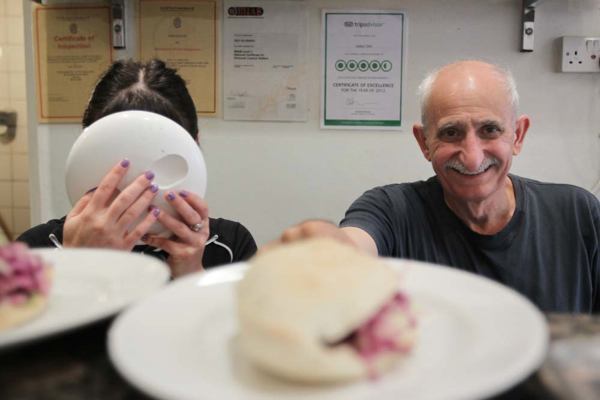
It is my pleasure to welcome this report from the West End by Jenny Linford accompanied with photographs by Simon Mooney. The only independent cafe around Leicester Sq, Gaby’s Deli is a London institution where you can dine for as little as five pounds and discover yourself rubbing shoulders with West End stars too. After a threat of closure by the landlord, a popular campaign won a reprieve but now Gaby is on a monthly lease which offers no security. So we thought it an opportune moment to celebrate the wonders of this cherished cafe and Gaby Elyahou himself, the man who brought falafels to London.
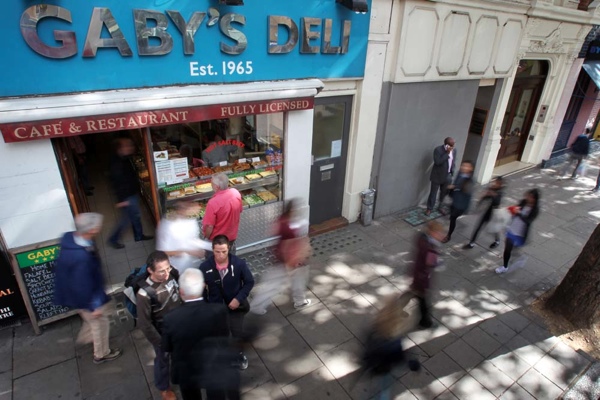
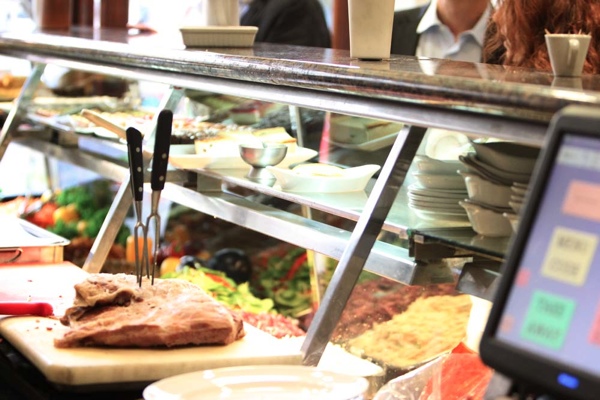
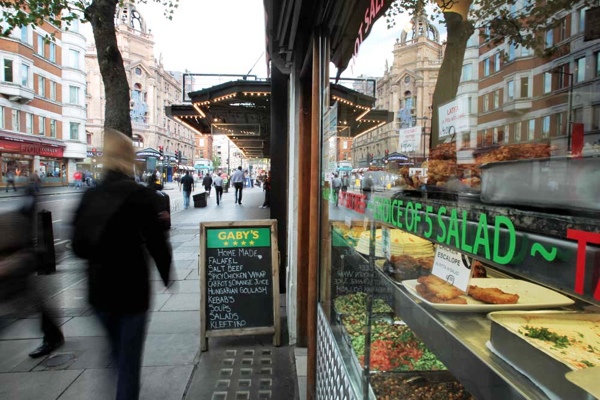
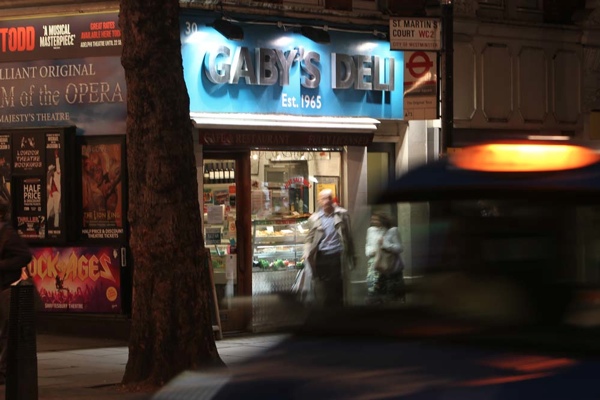
For as long as I can remember, Gaby’s Deli on Charing Cross Rd has been part of my London cityscape. Just down from the Wyndham Theatre, it is a familiar West End presence – a modest façade with Gaby’s trademark colourful salads proudly displayed in the window. Since last year, this modest, down-to-earth eaterie has been under threat, with Gaby given notice to quit by his landlords, Gascoyne Holdings.
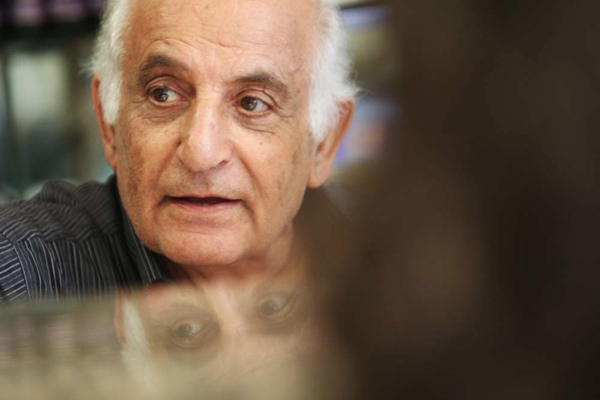
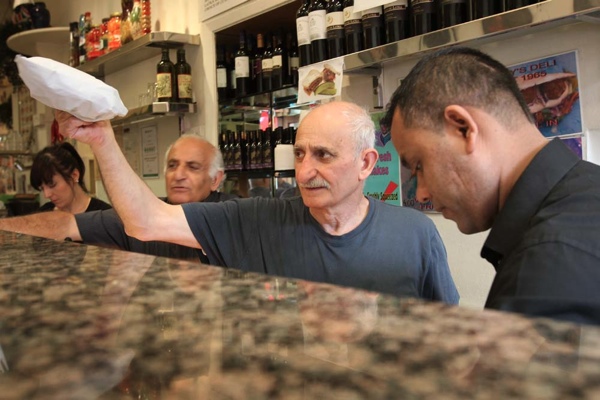
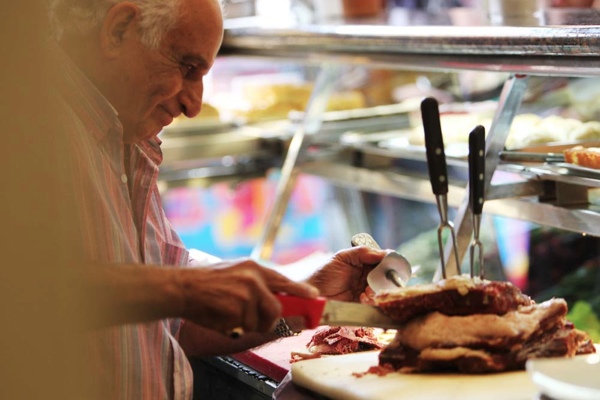
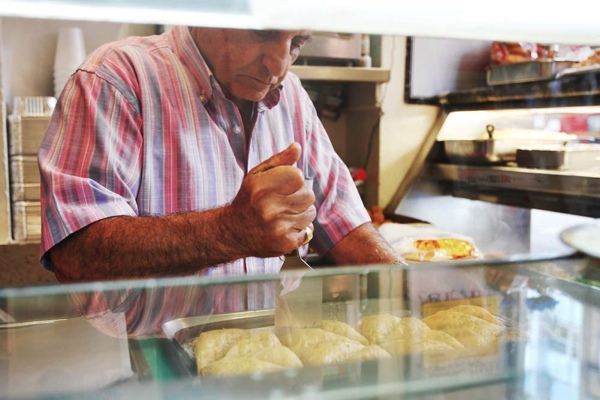
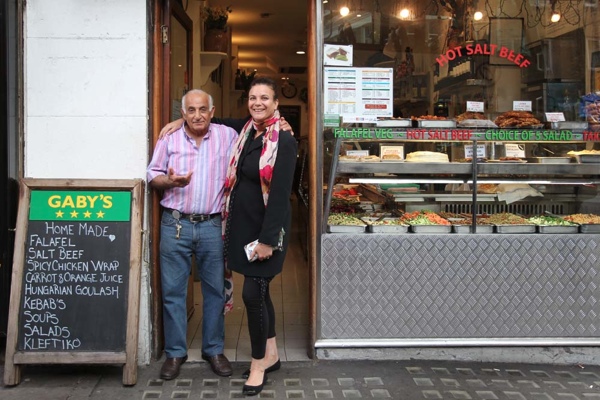
“I’ve been here since 1964,” explains Gaby, a sprightly, dapper figure, with a shrewd face and wonderfully alert eyes. “It was a salt beef bar before I took it over. I added more dishes, bought an espresso machine, started to concentrate on the salads – we do thirty-seven, all home-made. The people who eat here, they know about salt beef. It’s a meal. You can see how much meat we put in the sandwich. I think it’s the best sandwich in the world. I mean it. What other sandwich can you have so much meat in?”
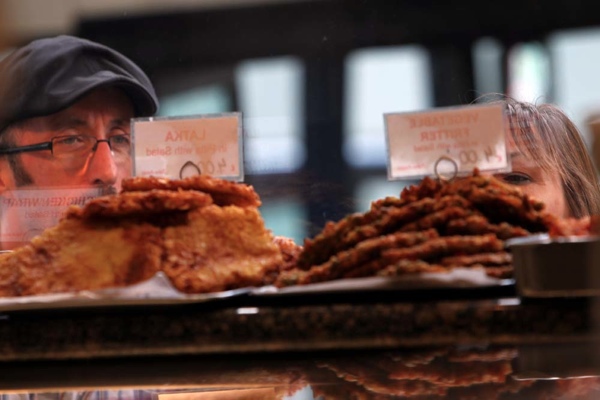
As we chat, Gaby insists on ordering me a plate of his falafel to sample. It arrives promptly – a generous serving of crisp, freshly-fried falafel on a bed of humous, topped with foul medames, then tahini, sprinkled with parsley, with two warm pitta bread on the side. Truly tasty food. Watching Gaby in action, teasing the old ladies sitting to our left, calling out a friendly greeting to a customer walking by, noticing that a customer needs sugar for his coffee, I realise, however, it is not simply the good, fresh food and the reasonable prices which bring people back here time and time again. This is a place with a human face to it. Gaby is one of a fast-vanishing breed of proper, old school proprietors – alert, democratic, experienced, proud of his business, relishing the face-to-face contact with all his customers, gloriously nosy and interested in everyone who comes in. As a result, in a world where clonetown franchises dominate, Gaby’s has that rare quality – personality.
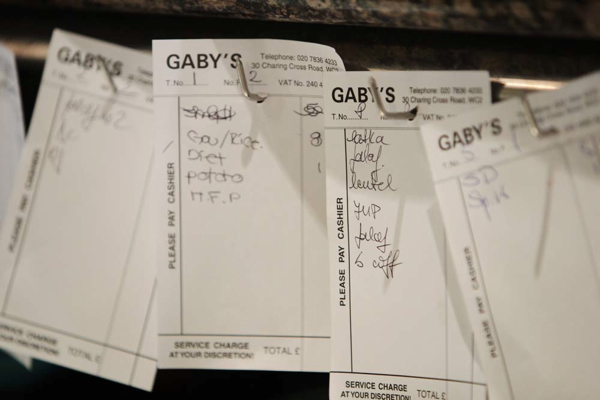
“There are too many chains around here now,” says Gaby thoughtfully. “We serve home-made soup, really filling, moussaka, meatballs, goulash. We have a special every day,” he gestures towards the board. “Tell me – in the West End, where else can you sit and eat a meal for six or seven pounds? I don’t have tablecloths or a waiter with a white starched short, but all the food is freshly made. We get in at 8am – we have to prepare the food. It’s a lot of work. Eating a sandwich – that’s boring! There are too many sandwich shops. We get a lot of theatre people, always have done, always actors. They want something light before the show, so they have a salad.”
“People come back here. We have customers returning from America, Scandinavia, South Africa, from Timbuktu – they come from all over the world. I just had a customer tell me that his grandparents from South Africa always come here when they’re in London, so they told him to come.”
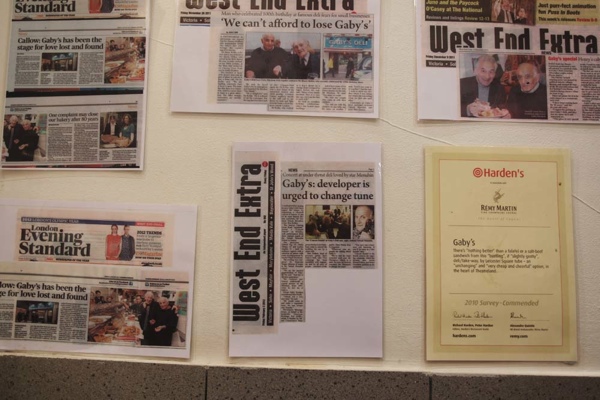
The announcement that Gaby’s was being closed down saw an extraordinary response from his customers, with their Campaign to Save Gaby’s launched on Facebook quickly attracting thousands of supporters. A series of Falafel Cabarets were launched, with Gaby’s thespian customers, such as the actors Henry Goodman and Simon Callow, generously performing to help spread the word.
Among the Save Gaby’s team is Steve Engelhard, who explains why he joined the campaign. “I’ve known Gaby’s for many years. I think it was my big brother who first alerted me to it. We’re a family with Jewish origins – so salt beef, falafel, salads are comfort food as far as I’m concerned. Gaby’s is affordable, it’s unpretentious, the quality is high and it’s very individual – there’s none of the blandness which goes with chains. When I heard that Gaby’s was threatened, I thought I’ve seen too many of my favourite places closing. I’m not a campaigner by habit but it pleases me no end that there’s such a community of people willing to make a stand about this. I think it’s a sense of maintaining a personal landscape, a personal identification with something that contributes to the quality of life and to the soul of London. Without individual places like Gaby’s, the West End could easily be as bland as any standard high street.”
The affection in which Gaby’s is held is almost palpable. Gaby’s customers, when they realise that I am writing about the Save Gaby’s campaign, are eager to tell me what Gaby’s means to them. A middle-aged man, who has been sitting together with his wife and young daughter eating a meal at a table next to me, stops unprompted to talk to me. “I first came here in my early twenties, so have been coming here for twenty-five years now. It would be a terrible shame if it went. It’s a disgrace that Westminster Council didn’t protect it. Walk to Leicester Sq – all you see are crappy pizza and pasta restaurants. They should be protecting this – tourists want London proper, not chain London. This is an iconic, one-off restaurant.” An elegantly-dressed, elderly gentleman pauses shyly on his way out to tell me “I’ve been coming here for decades. It’s desperately sad. So much of London is under threat. It seems wrong that someone who’s been here for so long can be kicked out when so many people care about it.”
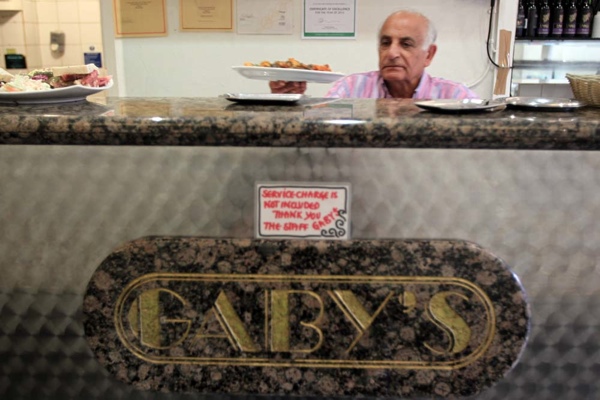
Gaby himself is touched by the campaign, wryly amused at the fuss his customers are stirring up. “It was all from the customers. People came and said “We’re not going to let you go.” Boris Johnson, Ken Livingston, actors – they all come here to show support. The newspapers, TV they’ve all come here. I know a lot of people. Fifty years here, it’s not three months. I hope they don’t spoil the West End, but I think they will.” He pauses and shrugs expressively. A neatly printed notice sellotaped to the counter behind him reads: ‘Thank you to our customers who set up and signed up to Save Gabys Deli on Facebook. We are very touched by all your support. The management and team at Gaby’s.’
“The only hope,” explains Steve Engelhard from the Save Gaby’s campaign, “is to change the mind of Gascoyne Holdings and its directors, notably Lord Salisbury – because everything else has been tried. Westminster have granted the planning consent. The only remaining hope is to change the minds of the owners. We’ve had huge press coverage. The question is do these people want to minimise the bad publicity they’re getting? Do they want to be clever and get good publicity for doing the right thing in the end and saving a well-loved institution?” If affection and loyalty alone were enough to save Gaby’s deli, then its future would absolutely be assured.
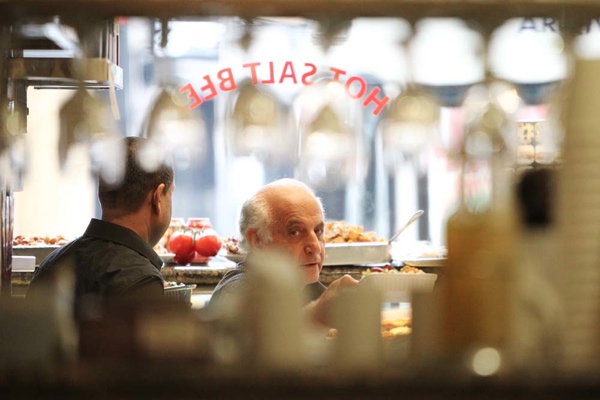
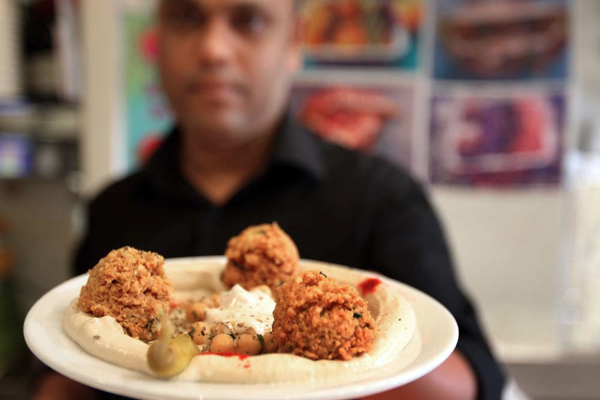
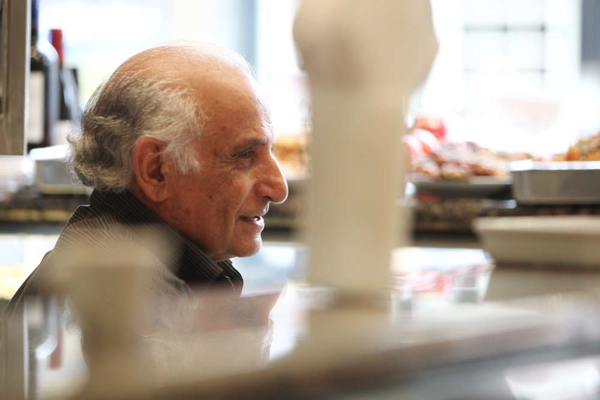

Photographs copyright © Simon Mooney
Gaby’s Deli, 30 Charing Cross Road, London, WC2H 0DE
You may like to write direct to Lord Salisbury – The Marquess of Salisbury, Hatfield House, Hatfield, Hertfordshire, AL9 5NQ
Graphics & Graffiti

Bethnal Green 1969
“I’m for Street Art but not the defiling of beautiful things, so I thought let’s look at this period when graffiti had a different kind of expression.” photographer John Claridge said to me, introducing these pictures of graphics and graffiti from the East End, published here for the first time. Before the culture of tagging came from across the Atlantic to dominate the streets, graffiti manifested itself differently, as these political examples – above and below – illustrate.
John does not see any absolute distinction between graffiti and graphics, both are representations of language – whether graven on walls or painted on fascias – and they spoke to him in a symphony of diverse cacophonous voices when he walked these familiar streets “Typography was always around me in the East End, whether I went to the fairground or the market there was always lettering.” he recalled, “So that when I got the job at McCann Erickson at fifteen and met Robert Brownjohn, one of the finest typographers, my eyes were already open to the power of typography, how it communicates on many levels and how it can take you places emotionally.”
In John’s eyes, every piece of graffiti or graphics illustrates the intentions of those who put it there and he delights in interpreting the different sensibilities at play which combine to create the rich visual texture of the streetscape. “I’ve got some wood type and to use it you’ve got to make decisions, so there’s an underlying meaning to everything, but when lettering is automated you don’t think about it.” he explained to me wryly, taking pleasure in the human quality of typography done by hand and the vibrant culture of marks on the wall that extends back to the earliest cave art.

Urinal, Spitalfields 1969 – “Wages not war profits. Houses not subs. Tory or Labour = Tory. Fight for a wage increase.”

Burton, Whitechapel 1982. – “It’s like entering a temple.”

Pedley St Bridge, Spitalfields, 1987 – “this records the beginning of the tagging that dominates today.”

Neals Rapid Crane, Silvertown 1963.

Three Flags, 1964 – “What kind of shop puts an empty box in the window?”

Mixed Spice, 1976 – “In the old spice warehouse in Wapping. I just thought these stencils were beautiful, used and put back on the table.”

Mental Illness, Spitalfields 1969.

Weaver House, Spitalfields 1982. – “See how they spelled ‘for.’ That’s graffiti calling for help.”

Ajax Works, E14 1982.

Dance Wall, Bethnal Green 1964.
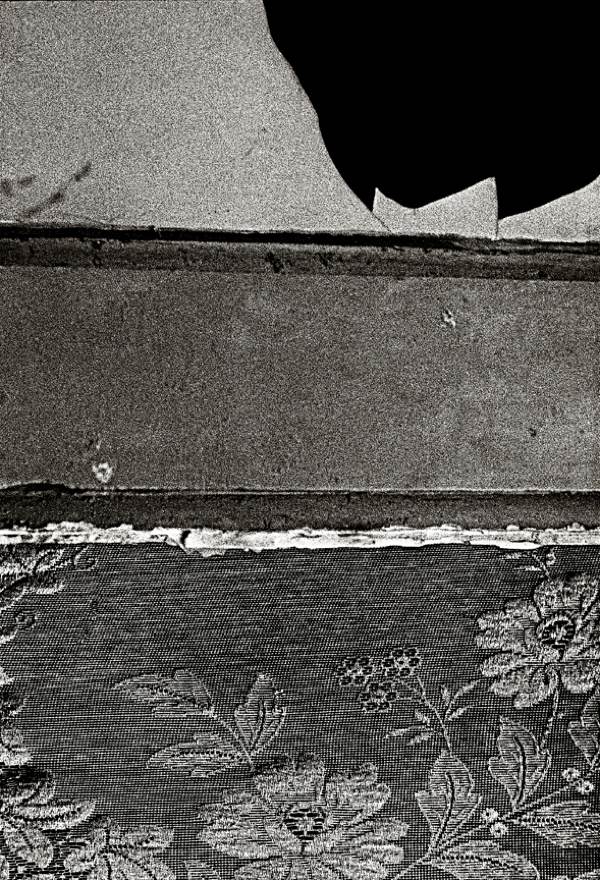
Window, Spitalfields 1968 – “It was a derelict place but someone had pinned up this delicate stuff.”

French Polisher, Spitalfields 1961 – “It must have been a wonderful shop at one time.”
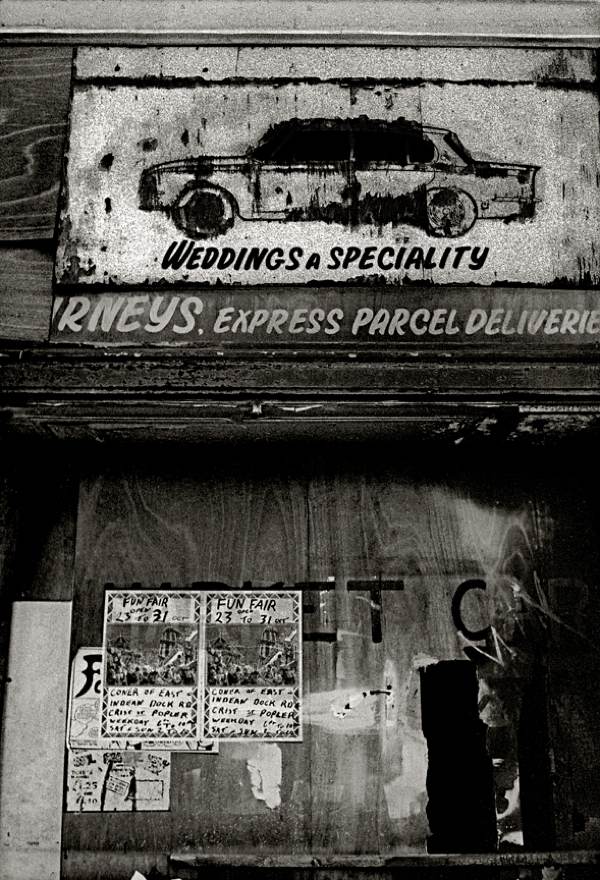
Weddings a Speciality, E14 1982 -” FunFair – Coner of East Indean Dock Rd, Crisp St Popler.” (sic)

All Roots Fresh Daily, Spitalfields 1966 – “They used anything they could get hold of to board it up.”

Laurel Tree, Brick Lane 1960s – “It’s an Asian barber now.”

Men, Wapping 1964 – “You expect to see Sherlock Holmes appear.”

Whites Stores, Spitalfields 1967 – “Nice piece of lettering. They’ve done it themselves and, whether you like it or not, it’s got character.”

Yau Lee Laundry, E7 1968 – “We used to go to Limehouse when it was Chinatown.”

Grocer’s Window, Spitalfields 1964.
Photographs copyright © John Claridge
You may also like to take a look at
Along the Thames with John Claridge
At the Salvation Army with John Claridge
A Few Diversions by John Claridge
Signs, Posters, Typography & Graphics
Views from a Dinghy by John Claridge
In Another World with John Claridge
A Few Pints with John Claridge
Some East End Portraits by John Claridge
John Fairburn’s Chapbooks
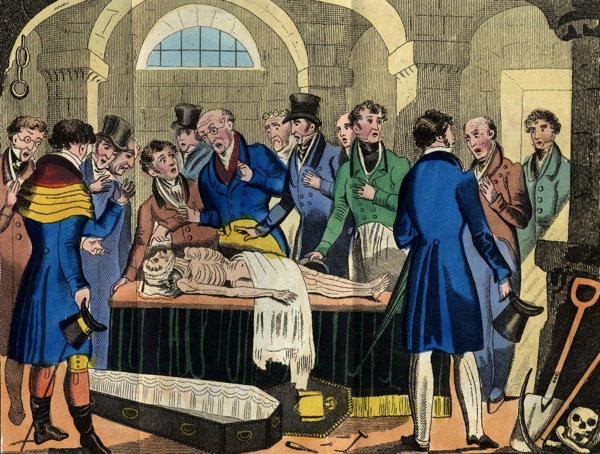
The Coroner’s jury viewing the murdered body of Margaret Hawse
Between the publication of a print of the execution of Marie Antoinette in 1793 and an ABC of the Great Exhibition in 1851, the name of John Fairburn was synonymous with the production of vivid and popular sixpenny chapbooks in London.
“This is English Folk Art of the best kind, dramatic and with a strong sense of good and evil – of ethics behind it,” curator Ruth Richardson assured me, when I went to take a look at the collection in the Bishopsgate Institute. And, while I was immediately entranced by the lurid and violent scenes tinted in such irresistibly gaudy colours, on closer examination it became apparent that beyond the voyeuristic fascination with extremes of behaviour, there was a certain human sympathy present – exposing injustice and drawing attention to the vulnerability of those at the bottom of the social pile.
“All his work – without exception – was patriotic never seditious, but he was a supporter of democracy and what we would call ‘human rights,’ which he would call ‘the rights of man.’ He’s also quite clear about the equality of the sexes, supports Catholic emancipation, the abolition of slavery and stands against ill-treatment in the Navy.” Ruth explained, articulating the editorial policy that underlies Fairburn’s publications.
A recurring theme in these chapbooks is the abuse of servants and apprentices. In particular, Eliza Fenning, a young servant of genteel manners who was executed upon the accusation of attempting to poison her employers with arsenic in the dumplings, which she also ate. She declared her innocence and retained dignity even to the scaffold. It was subsequently discovered that a psychotic relative had previously threatened to poison the family, but then it was too late for Eliza who – as a servant and therefore the person of lowest moral worth in the household – had taken the fall. Other cases report examples of those who, apprenticed from the workhouse by sadistic employers and denied any protective monitoring, became subjected to horrific abuse. Charles Dickens loved Fairburn’s chapbooks and Ruth believes that he may actually have worked for Fairburn undertaking some of these court transcripts which prefigure elements in his own work, most obviously the apprenticeship suffered by Oliver Twist.
As a printer-publisher, John Fairburn and then his son of the same name, operating from the Minories near the Tower of London and later from Ludgate Hill, produced a wide range of popular publications, all characterised by the same editorial flair.“You get a feeling of the bubbling creativity of their workshop,” Ruth admitted to me,“There is a feeling of joy about them, even when murder is the subject.”
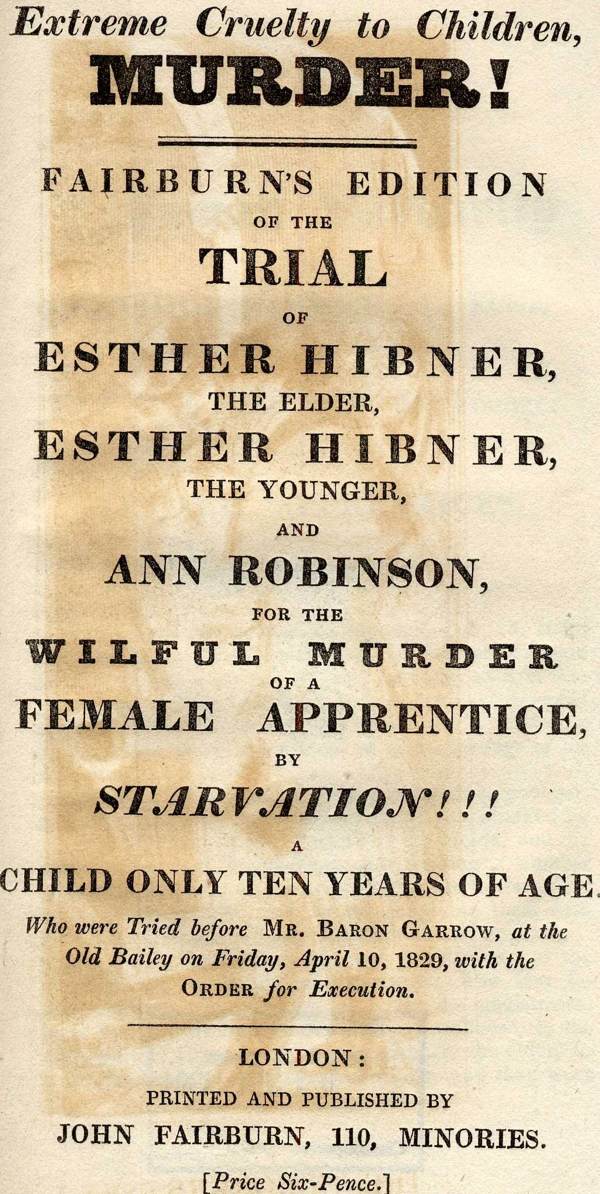
Transcript of the trail for the murder of servant Margaret Hawse, aged ten years, 1829.
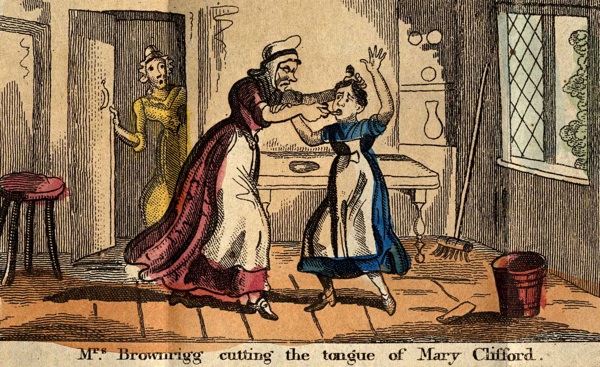
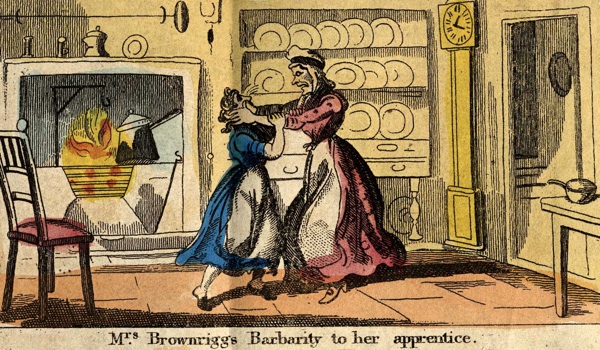

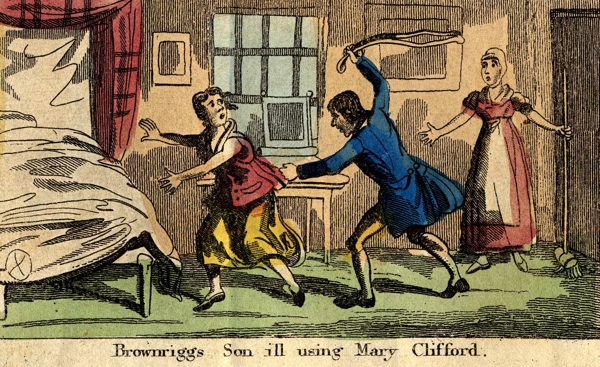
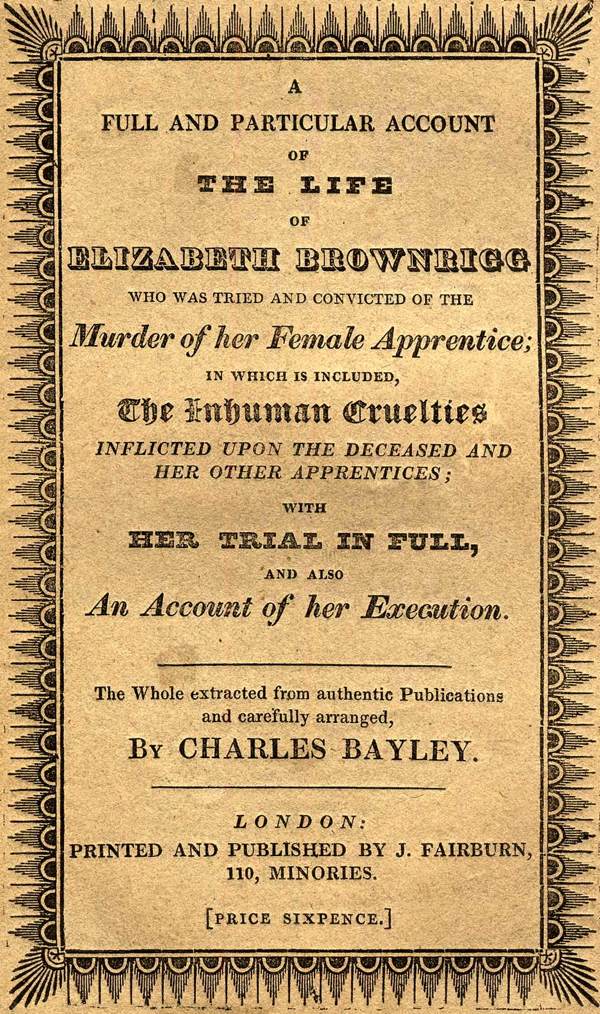
Transcript of the trial for the abuse and murder of servant Mary Clifford.

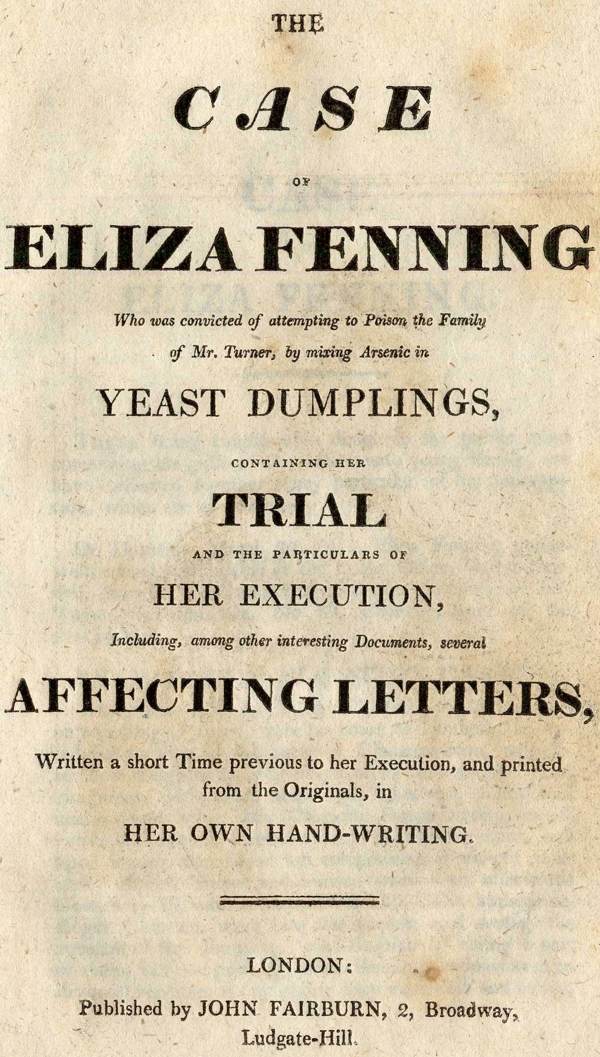
Mis-trial of servant Eliza Fenning, executed upon accusation of poisoning her employers.
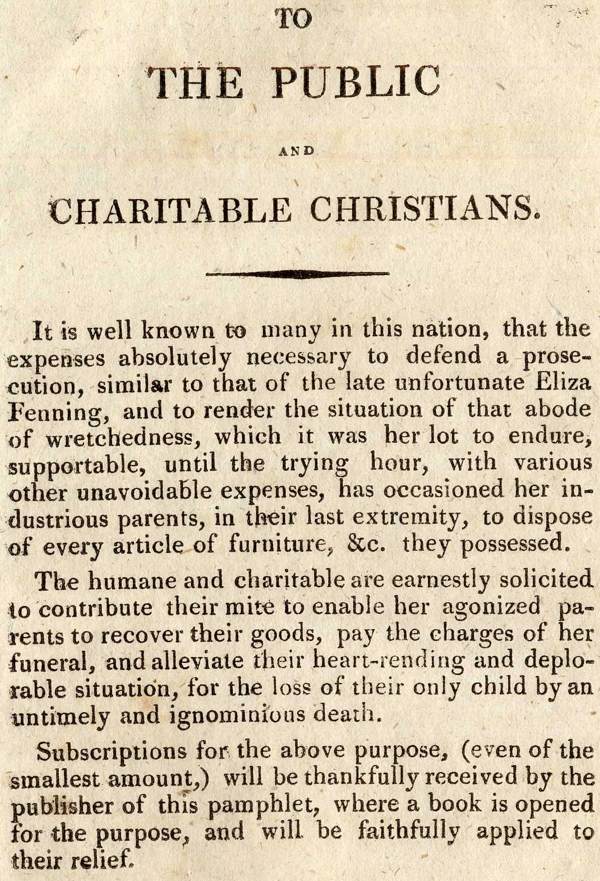
Appeal by John Fairburn on behalf of the parents of Eliza Fenning.
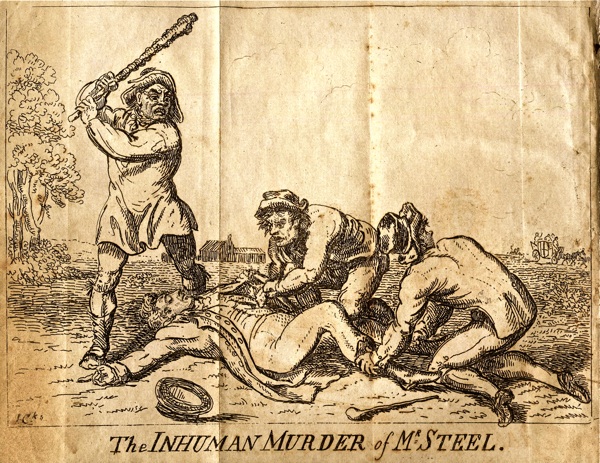
Illustration by Isaac Cruickshank (father to George) of the Murder of Mr Steele, 1802.
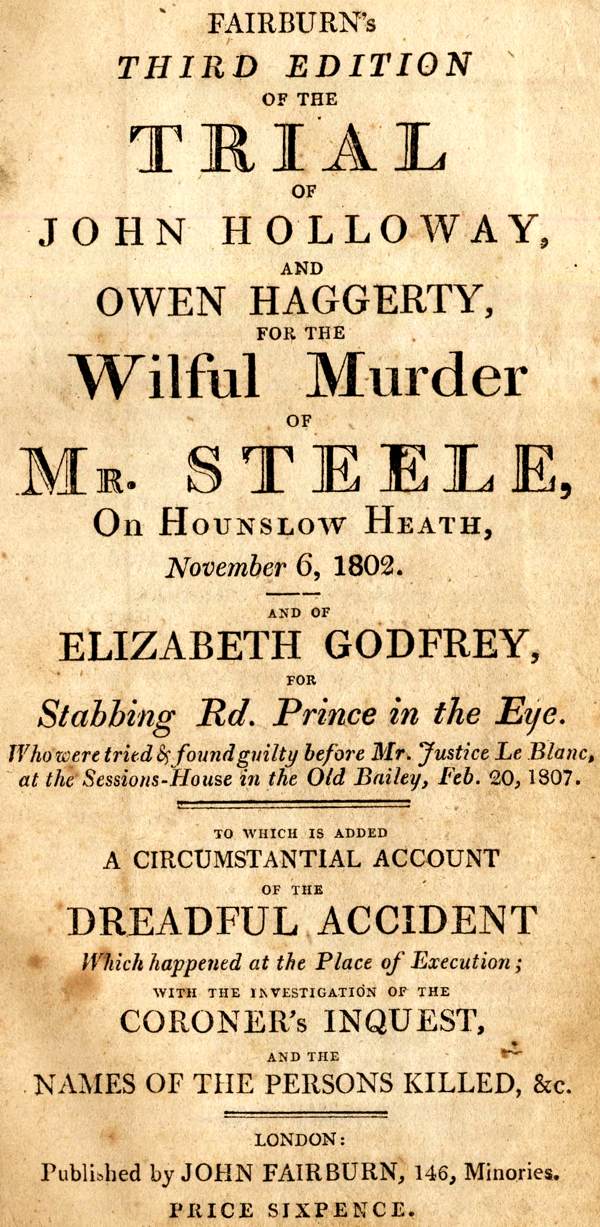
Transcripts of the trials of John Holloway and Owen Hagerty for the murder of Mr Steel and of Elizabeth Godfrey for the murder of Rd Prince, with an account of those trampled at her execution.
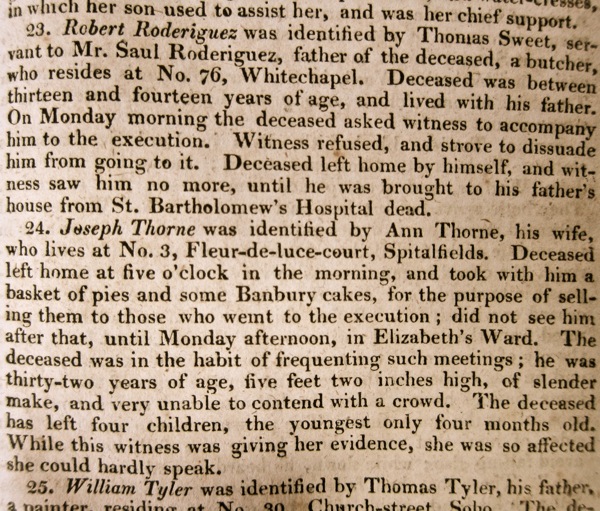
Two East Enders were among those trampled at Elizabeth Godfrey’s execution in 1807.

The Magna Carta.
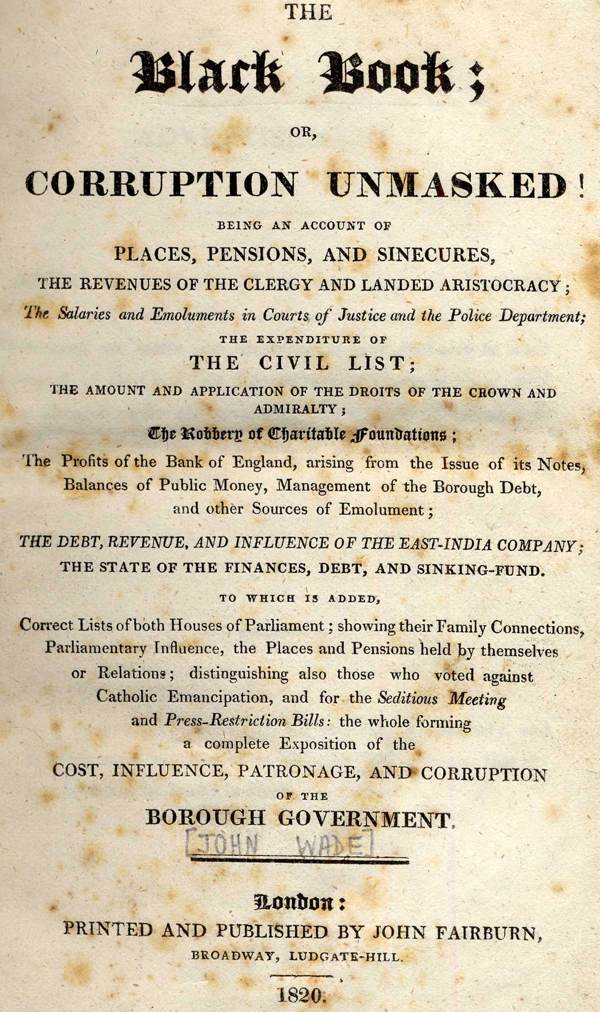
Exposure of corruption in Parliament and elsewhere.
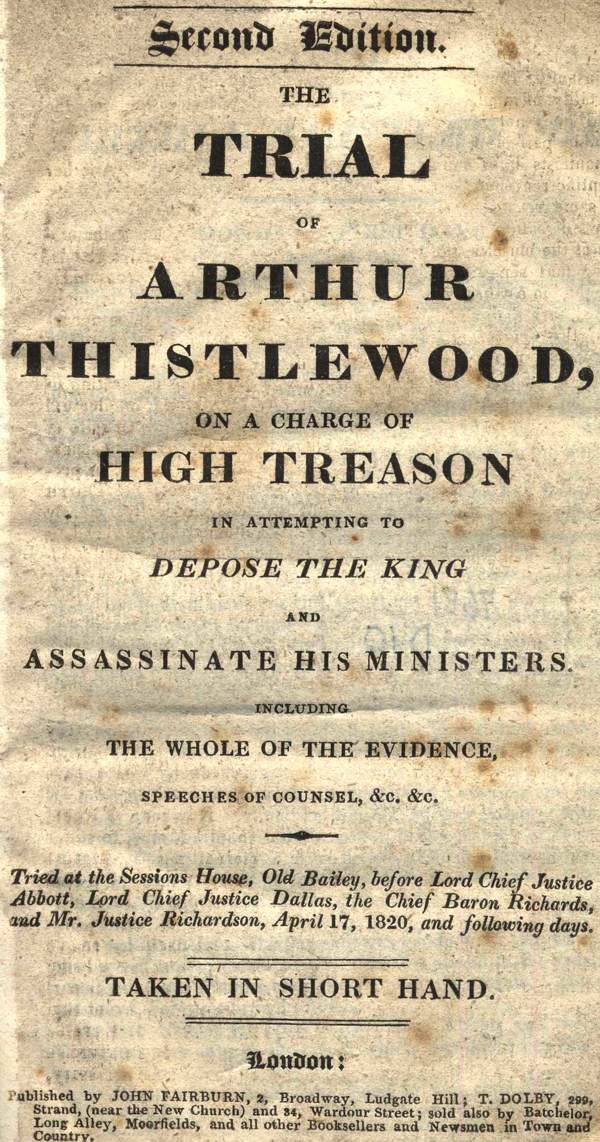
An attempt to assassinate the king.
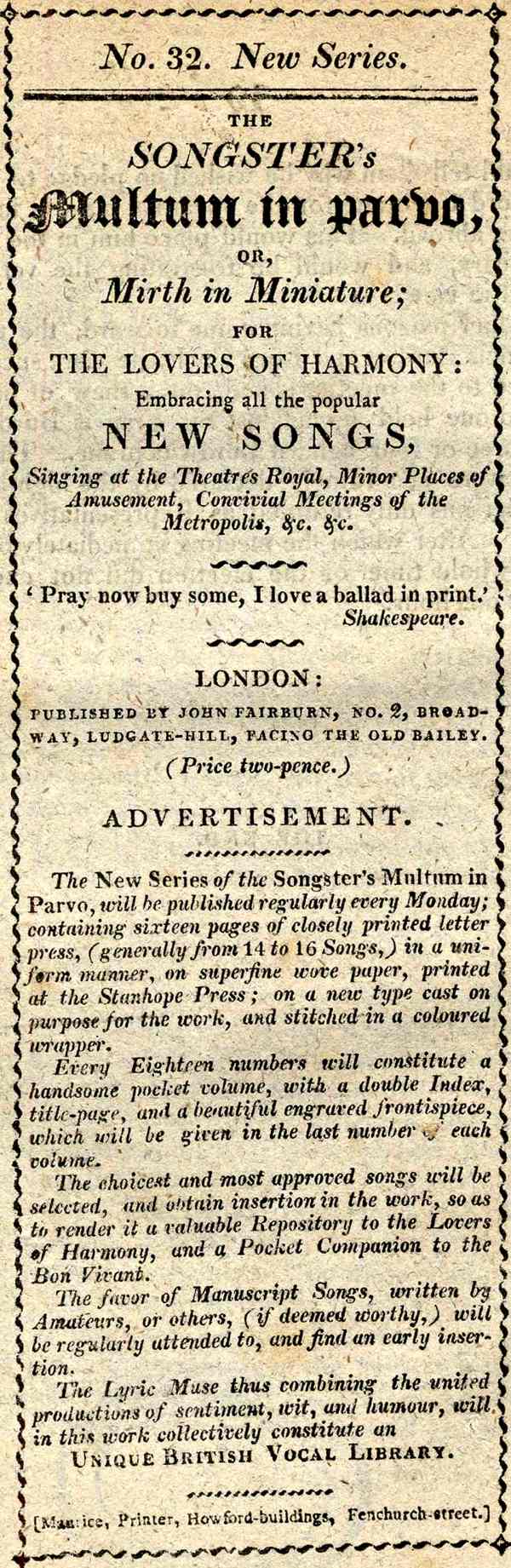
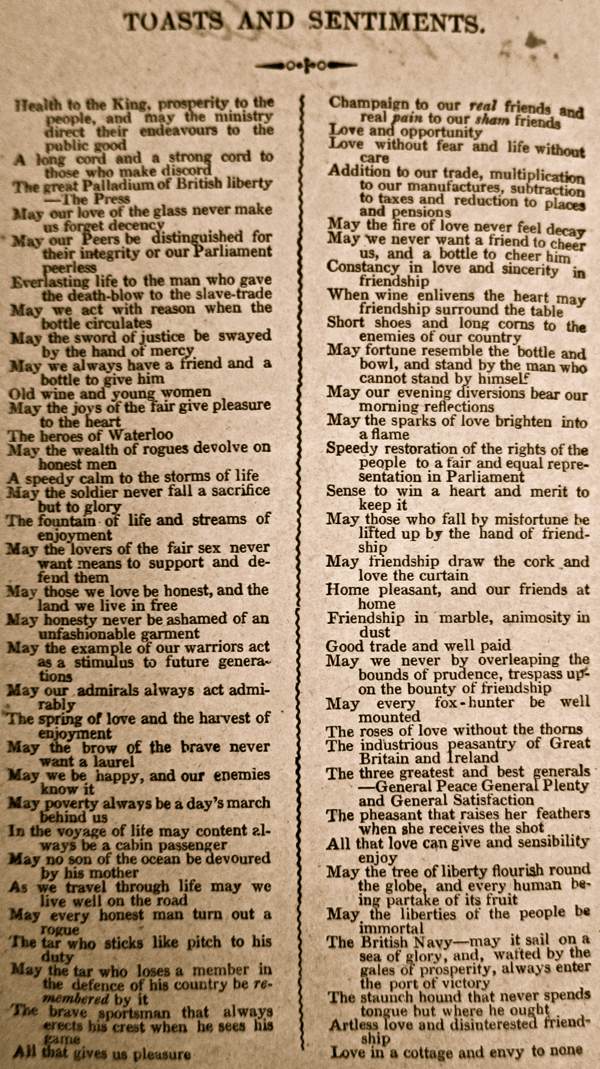
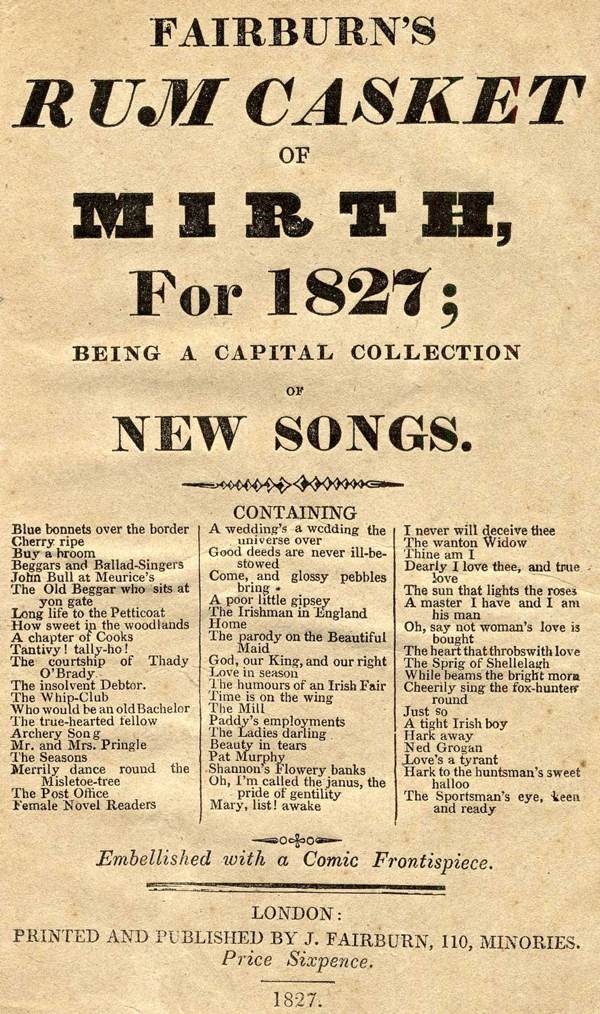
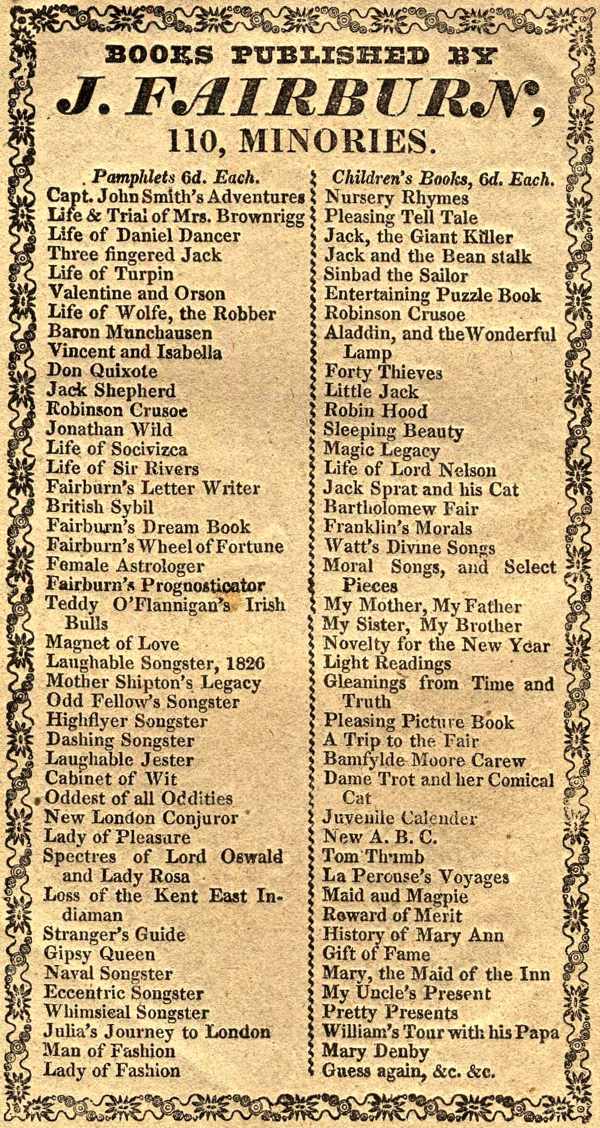
Images courtesy Bishopsgate Institute
An exhibition of John Fairburn’s Chapbooks guest curated by Dr Ruth Richardson runs at Bishopsgate Institute Library until December.
You might also like to take a look at
C.A.Mathew At Sandys Row Synagogue

Please come along and raise a glass next Thursday 20th September at 6:30pm to celebrate the first exhibition of the pictures by the enigmatic photographer C.A.MATHEW, taken in the streets of Spitalfields in 1912.
The photographs from the Bishopsgate Collection are being exhibited at Sandys Row and this is an ideal opportunity to visit London’s oldest Ashkenazi Synagogue – occupying a building which has existed as a place of worship for two hundred and fifty years, first built as a Huguenot Chapel in 1766.
Additionally, making a rare public appearance, the distinguished poet of the East End, Bernard Kops, will read a poem he has written for the occasion.
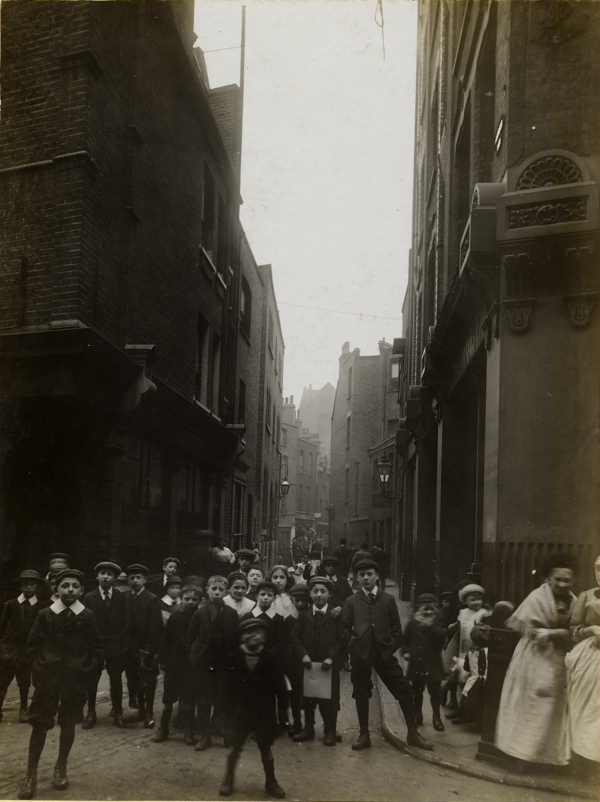
Sandys Row looking from the northern end – note the horse and cart approaching.
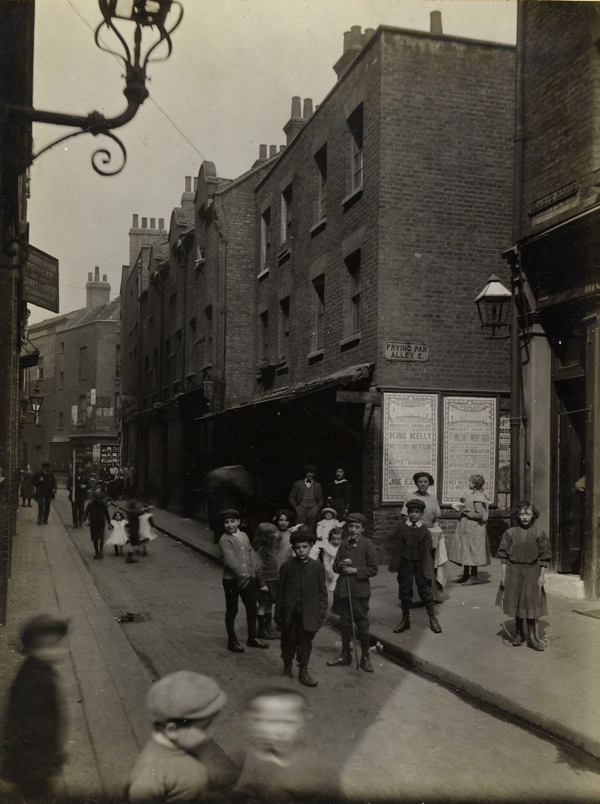
Sandys Row looking from the southern end with Frying Pan Alley on the right.
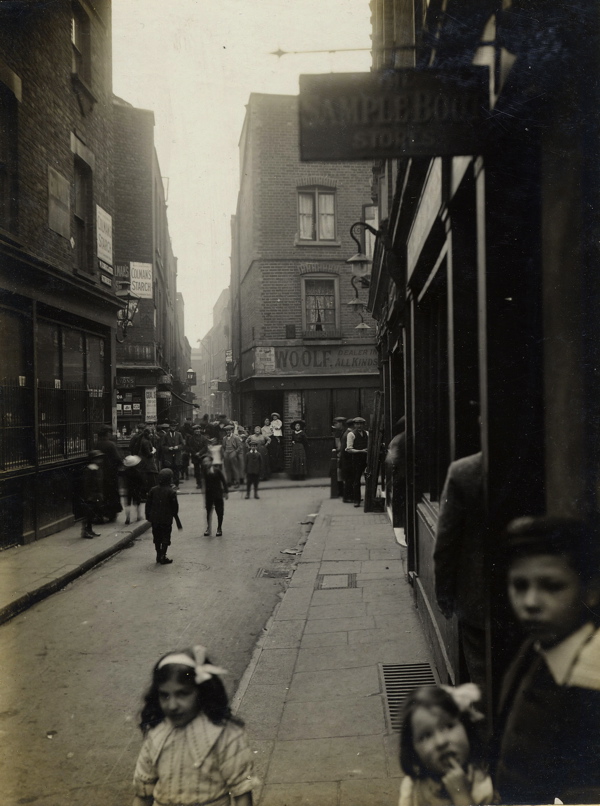
Widegate St looking towards Sandys Row.

Bernard Kops
C.A.Mathew photographs courtesy Bishopsgate Institute
Bernard Kops portrait copyright © Lucinda Douglas-Menzies
Invitation designed by James Brown
You may also like to read more about
and
In the Footsteps of C.A.Mathew
and my profile of
Saeed Malik, Shoe Seller

At Bina Shoes
May I introduce Saeed Malik, the suave shoe seller of Wentworth St? If you are looking for something dainty and strappy to enhance your twinkletoes, then Saeed at Bina Shoes is your man. Sandwiched between the shops run by the African ladies that sell the ‘Wax’ fabric, Saeed can sell you the glamorous shoes and bags in multiple colours and metallic finishes to match these kaleidoscopic textiles.
You might think that Saeed set up shop to complement the famous fabric shops, but Bina Shoes predates them all. When Saeed came here with his father, they were among the first Asians to open a stall. Theirs was just across the road from the current premises.
Wentworth St was exclusively Jewish businesses at that time, yet Saeed saw them all depart in the intervening years. Working in the shoe trade for four decades, he has witnessed an extraordinary growth in his own family business and experienced the roller-coaster of the commercial world of at first hand too.
“My dad had a shoe stall on the corner of Old Castle St in the seventies and it was the biggest stall here, and it was jam-packed with people buying. He was one of the first Asians and he had to put up with a lot of discrimination from the Jewish guys for selling on their territory. My father came over from Pakistan in 1961 but, instead of living within the Asian community, he found a place in Romford and we were the only Asians there. I was born in 1960, number five of seven children, and we came from Pakistan to join him in Romford in 1965.
I joined the infant school, it wasn’t that bad. We got through it. When you are in the playground things could be difficult, but with my elder brother there I never had any problems. Romford was a safe place, it was the East End that was dangerous for us. There were punch-ups and scuffles in this area but my father always stood up for himself.
He started off working for someone else and then he had his own stall in Romford Market. My uncle worked for a man who sold shoes, so he said, ‘Why don’t you do that?’ Romford was a busy market then and, as we lived there, moving the stock around wasn’t a problem. In those days a lot of people didn’t drive, but when I was sixteen my dad got an Anglia and he did Romford Market on Wednesdays, Thursdays and Fridays, and came here to Wentworth St to sell on Sundays. It was difficult to get a licence but he got one in 1976 when another guy gave it up.
In 1978, we founded Bina Shoes. These were the days of platform shoes and we couldn’t sell them quick enough. It was a young people’s fashion, every teenage girl wanted it. They all wanted to look like rock stars and they could get it from the market at affordable prices. The business was growing and we started importing shoes from Italy.
I had always helped out on the stall since I was twelve. It was a family thing, and everyone was involved and we loved what we were doing. The stall was a great outlet and soon we had two stalls, and we opened a warehouse in the Bethnal Green Rd where we stored stock from our Italian suppliers and sold wholesale. It was just across the road from the corner of Brick Lane where the National Front sold their newspapers on Sundays, but fortunately we weren’t around then.
We got this shop in Wentworth St in 1983 and moved our stock to a larger warehouse in Shoreditch High St. Those were good days, when supply could not meet demand. People were happy, they had money and they enjoyed it. You had easy parking round here then and the area was thriving. If you couldn’t afford a shop, you could get a stall in the market and you’d go home with only half the stock that you brought.
In the nineties, we used to go regularly to Italy and visit the factories, creating our own designs. It was part of the job, and when I was thirty-four I took over the business. We always sold everything we made then. We were a family business and we could easily relate to the Italian factories which were also family run. But eventually, we had to get out of the wholesale business because we couldn’t get companies to pay us for their orders. And the alarm would go off at two in the morning because somebody had broken in to the warehouse. I got sick of it. One day, I went to work after the Bank Holiday, and they had cut a great big hole in the roof and taken all the boxes of our stock out through it. ‘That’s enough,’ I thought. It hurts when you put your your heart and soul into something, and it gets taken away from you. We sold the warehouse in 2004. If we’d started ten years later, we wouldn’t have been so adventurous.”
Today, Saeed has three sons aged seven, eight and nine that are the delight of his existence, and he commutes each day from his home in Hornchurch to his single premises in Wentworth St, when once Bina Shoes had four shops. Yet although the glory days of shoe-selling in the eighties are over and he no longer enjoys extended trips to Milan, Saeed is comfortable with this more modest endeavour. In spite of the set-backs, the business has travelled a long way from its origins as a single stall in Romford Market. Now Saeed just wants to sell the two floors of shoes that he has filling the building above his shop. So maybe you can give him a hand with that? If you are looking for fancy Italian shoes at a keen price in Spitalfields, Bina Shoes is the place to look.
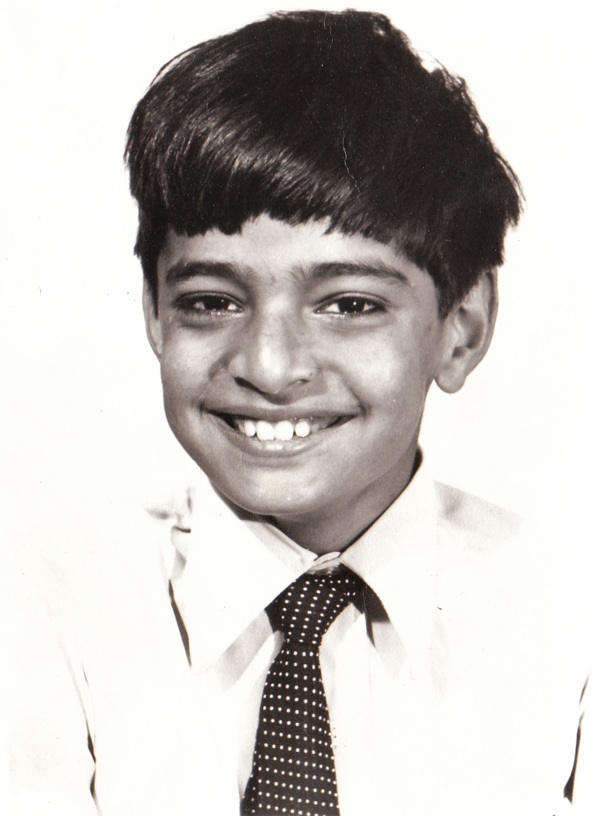
Saeed at school.
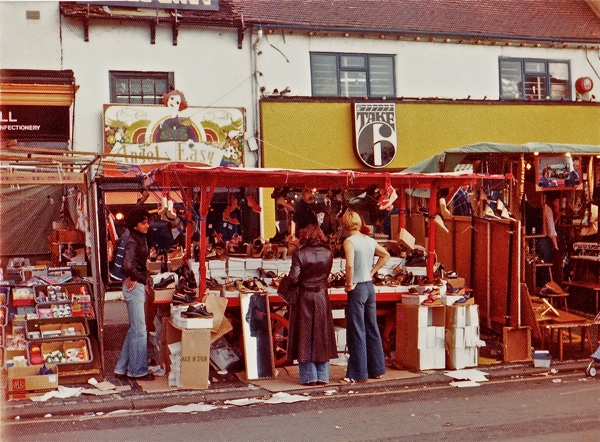
The shoe stall in Romford Market in the seventies.
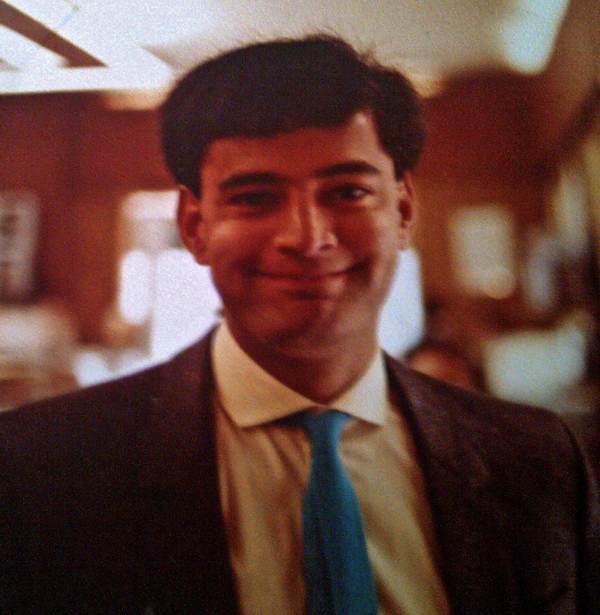
Saeed at twenty in Milan.
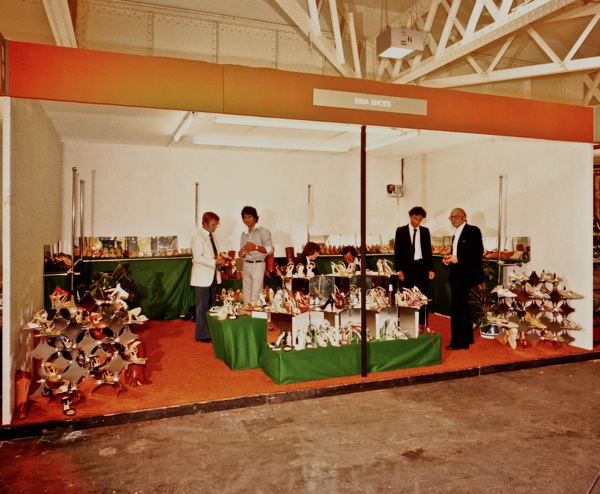
Bina Shoes stand at a trade fair in Earls Court in the seventies.
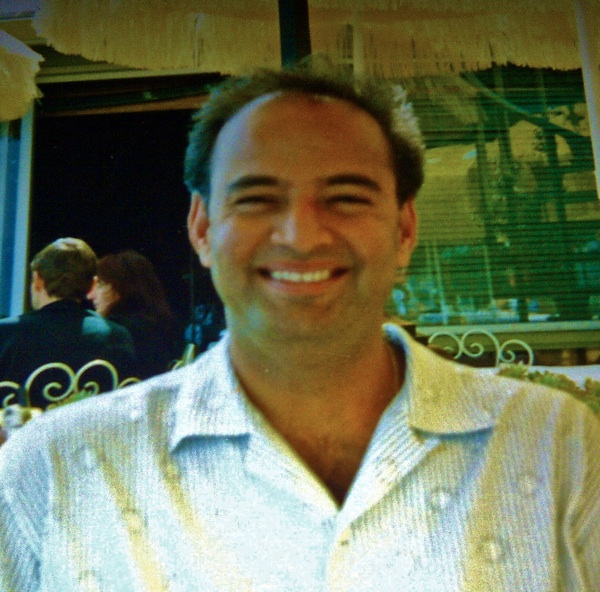
Saeed at thirty in 1990.
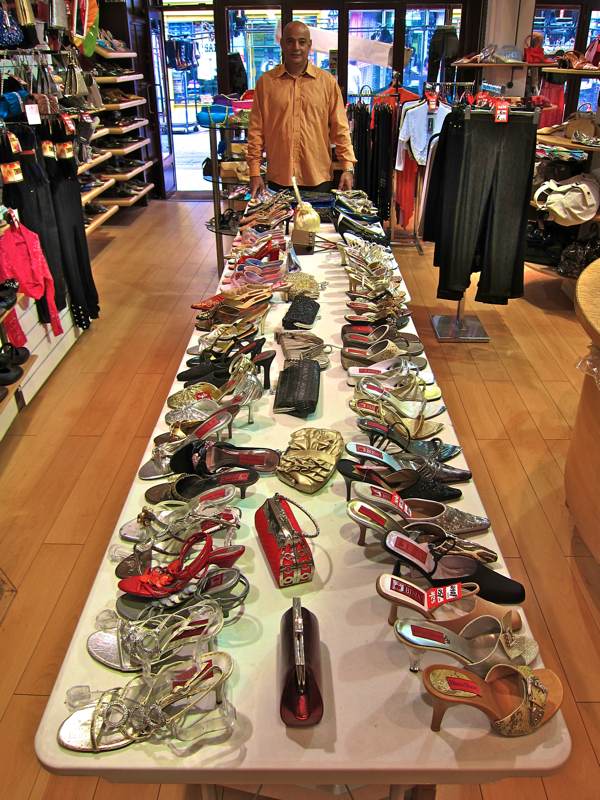
Saeed at Bina Shoes today.
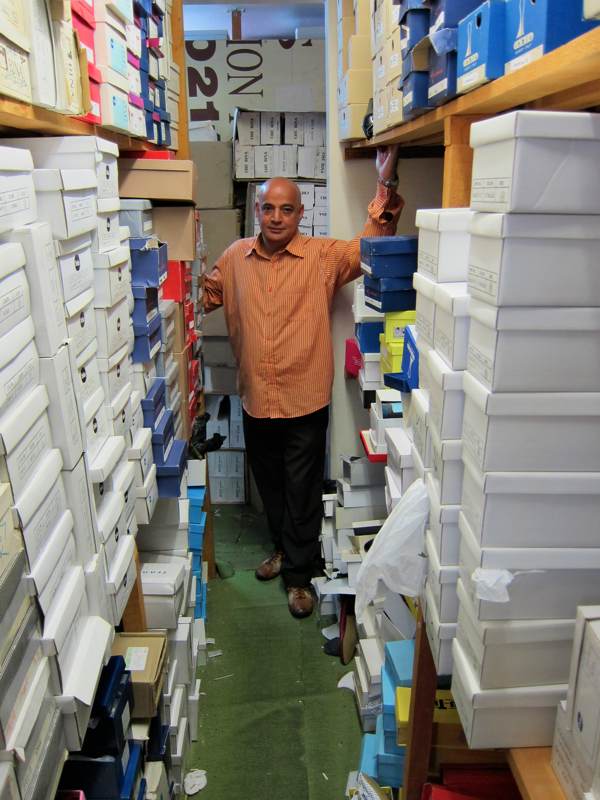
Saeed has two floors of stockrooms above his shop.
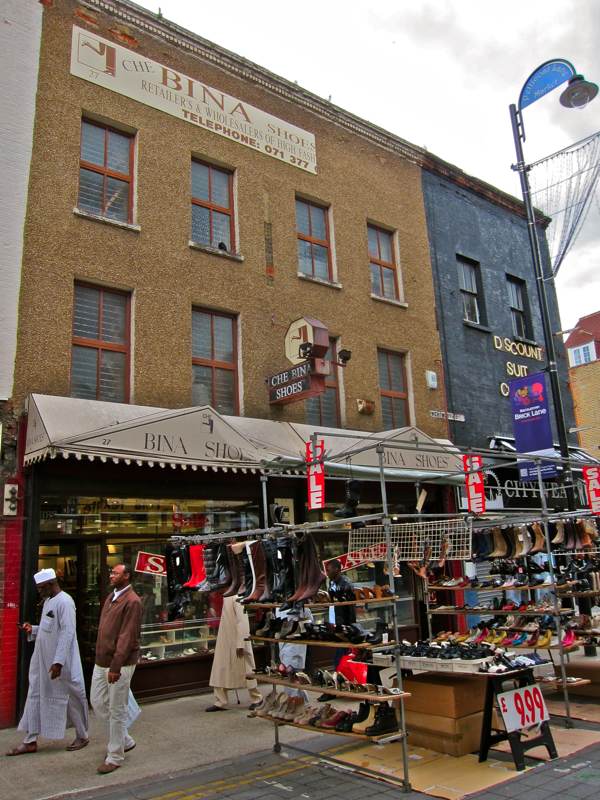
Bina Shoes, 27 Wentworth Street, London, E1 7TB
You may also like to read these other stories of Petticoat Lane
The Wax Sellers of Wentworth St
Miriam Lantsbury, Headway East
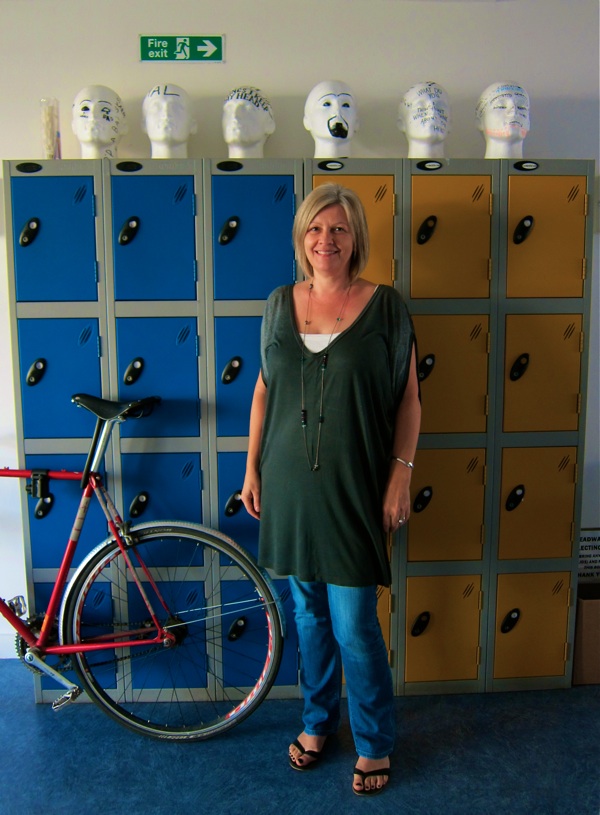
Miriam Lantsbury has such an open and direct manner that you might imagine she has always known what she was going to do in life. Yet she had no plan, even if she is blessed with a clear personal sense of what is important to her and the moral courage to implement her ideas, whether they conform to accepted wisdom or not.
Without access to higher education, but possessing a sharp intelligence and talent for working with people, Miriam steered a path through the maze of the health service to become a quiet iconoclast, creating Headway East – a creative environment unlike any conventional clinic where survivors of brain injuries can engage in community life and rediscover their self-esteem.
Around twenty to thirty people participate in the activities each day at the centre beside the Regent’s Canal, the only one of its kind in the East End. It is a sympathetic place which permits the opportunity for members of this particular community to find their new selves in the aftermath of the life-changing experiences they have suffered, and to re-balance.
When you arrive at the day centre, you encounter people involved in all kinds of tasks and it is unclear at first who is who, or who is in charge. Yet a relaxed purposeful atmosphere prevails. And this is exactly how Miriam wants it – how she set it up and how Headway East is distinct from other such endeavours across the country. Drawing upon her experiences as a nurse in a hospital where the very structure of its organisation prevented her from treating those in need of support with the care and respect she believed they deserved, Miriam set out to reconfigure the relationships and the nature of the care, and create something more humane.
“I was born in Hackney and grew up in Wanstead. I come from a family where going to university was never considered as an option and, when I left school at seventeen, I didn’t know what I wanted to do. Our careers education was non-existent, but I met someone who was training to be a physiotherapist and I was fascinated by what she was doing. So I thought the best thing would be to get a job at a hospital and I wrote to the Royal London Hospital in Whitechapel. They asked me to an interview and said, ‘We’ll offer you a job as an auxiliary nurse,’ and within six months the ward sister and the nursing officer told me that I ought to train and become a nurse. It was never a decision. I found it interesting but I didn’t want to stay in the health service. The frustrations of the nursing profession were that you just had to do what you were told, which was no problem as far as I was concerned, but you might be in the middle of bathing an old person who was naked under a bed sheet and when they’d say, ‘Go for your coffee break now,’ you’d be expected to go – and that drove me mad.
I qualified and trained and became a Mildmay nurse, I’m a christian and it was still a christian mission then. I did my first six months there and the rest of my training at the Royal London, Mile End, St Clements and Great Ormond St. But then I got married at twenty-two and had three children and in between I did some community nursing in the evenings. I would go all over Tower Hamlets including Spitalfields. In those days, they would let you go out on your own. I was accosted on a few occasions. Then I did all kinds of jobs while my kids were growing up, book-keeping (because I’ve a bit of a head for figures), working in a playgroup, some nursing and being a receptionist at a doctor’s surgery. When my youngest went to school, I looked for something more permanent and that’s when I joined the Community Health Council as a complaints officer.
My husband saw an advert in the Guardian for someone to set up a Headway house in East London for people with brain injuries. It was just two and a half days. I went along to an interview at a day centre in Homerton and I was interviewed by five people including a psychologist and a neurologist, and it was a very hot day. They offered me the job, and I was presented with a room with nothing in it and a brief to set up a day centre. Most people with brain injuries were in hospital for two years receiving intensive support, but then they went down hill once they were released because social services knew nothing about it. So all the expensive care they had received was wasted and neurologists were seeing people decline after rehabilitation. Twenty-four-year-olds with brain injuries were sent to old people’s day centres because there was no specialist provision in East London.
No-one was there to meet me when I started work, I had to work it out for myself. I rang up the chairman and said, ‘Do you think I should come and see you?’ Then I went to visit some other Headway groups and started to learn about them for myself. I came up with a plan that included what activities we would do, how to run it day to day, how to recruit volunteers and how to get funding. We are a completely separate charity from the national umbrella group.
And now this has become a community. When I first started, I based it on what I knew and I’ve always had a lot of people around at my home, so I treated this the same way. It’s user-led because it was the most natural thing to ask people what they want to do, even if they don’t always answer. We work as co-producers here, which means that everybody participates in some way in whatever we do. What’s important is that when you arrive, it’s not obvious who is who. It’s not just about what the professionals do for the members. We have loads of activities going on which people are encouraged to join and the secret is developing activities that people want to do. There’s no point if nobody’s interested, and so you have to be continuously rethinking what you do. You can’t ever say, ‘We’ve arrived, this is how we do it.’ It doesn’t work like that.
People with brain injuries deserve our respect, but we are also interested in what they have to offer. Like the members do the cooking and I eat the food! They have experience of a life-changing event that they can pass on. It’s about treating people as I would like to be treated if I had a brain injury, not patronised but encouraged to figure out how to create a positive future. It’s fifteen years since I started this. I deliberately did not employ health service professionals because they have too many preconceptions. We have an ex-agricultural researcher, an ex-park ranger, an artist, a psychologist, and an ex-receptionist working here. All I did was employ the staff.”
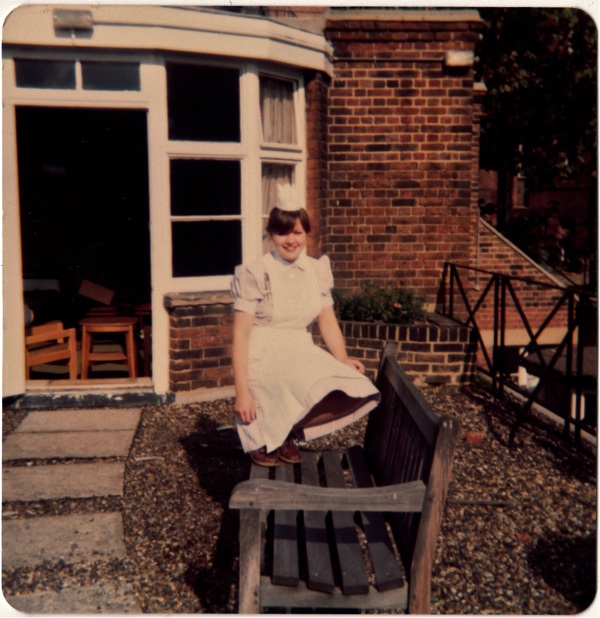
Miriam on the roof of the Mildmay Hospital while training to be a nurse in spring 1979.
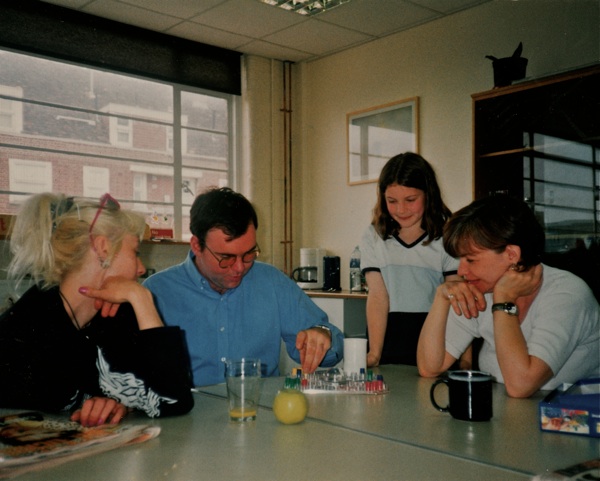
Miriam (right) with the very first person to come to participate at Headway East in 1997.
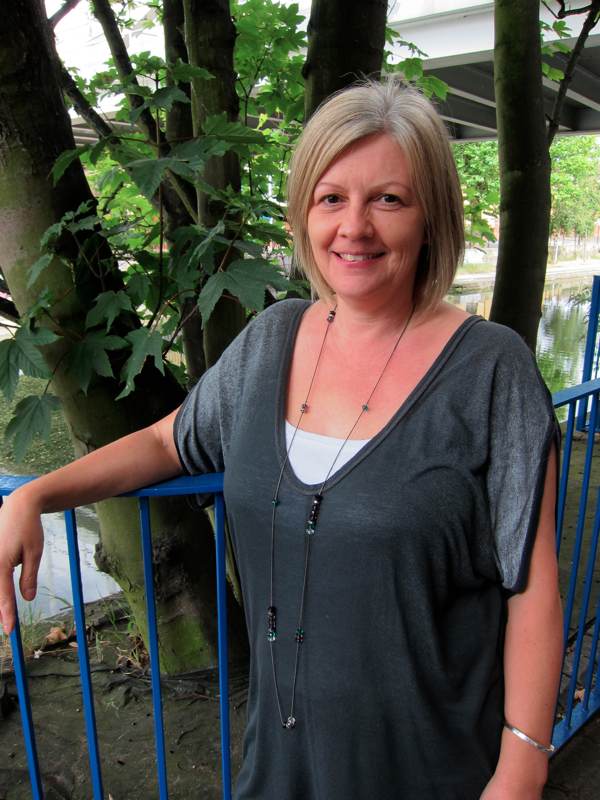
Miriam Lantsbury, CEO and founder of Headway East – “All I did was employ the staff.”
You may also like to read about
More Victorian Tradesmen Scraps
Here is another set of scraps I have acquired in my ever-growing collection of Cries of London and popular images of tradesmen. With their gaudy chromo-lithographic hues, these lively pictures celebrate the industry of their subjects, expressed in both the exertion and the absorption of their labour. I cannot resist the feeling that the artist who designed this handsome set proudly accented it towards his own trade by including portraits of the lithographic artist and the colour printer – thereby illustrating the means of production of these scraps.


You may also like to take a look at my other scraps












