
Marc Gooderham, Painter
Come and see Marc Gooderham’s pictures at The Artists of Spitalfields Life opening at Ben Pentreath Ltd on Wednesday 7th November.
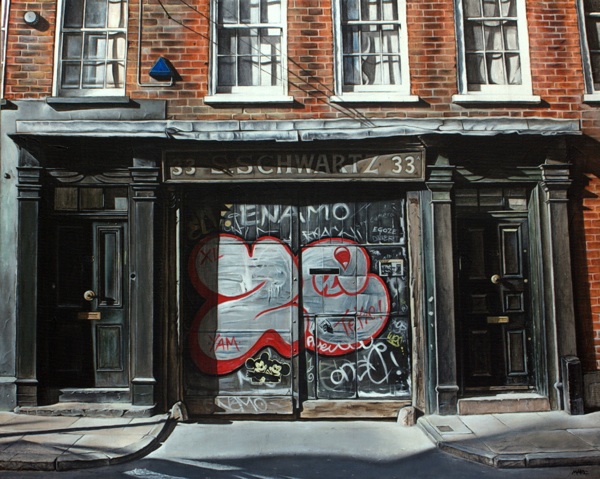
Later Afternoon, Fournier St, Spitalfields
There are so many art galleries in my neck of the woods that I have adopted the Jean-Luc Godard approach to visiting them. In other words, I take it at a run just as Anna Karina, Sami Rey and Claude Brasseur sprinted through the Louvre in “Band à Part.” Yet very occasionally – as I am nipping in and out of every gallery in Redchurch St on the first Thursday of the month – something will stop me in my tracks and cause me to linger. Such was the case when I first came upon the visionary paintings of Marc Gooderham.
Here was the world – the very streets – that I knew, but subtly transformed as if by memory or dream. Marc chooses places that exist in the periphery of vision and recreates them in his mind’s eye, revealing the otherness of the familiar with understated surrealism.
It was this shock of recognition that first halted me in front of his pictures, pausing to establish the locations and then becoming seduced by the brooding melancholy of these deserted streets, absent of pedestrians yet haunted by the presence of all those who have come through. With some of these places, I thought only I had spotted their unlikely appeal – because, like Marc, I am drawn to the shabby poetry of these disreputable and neglected corners, sites that characterise the distinctive identity of London more truthfully than the homogeneous sheen of all the gleaming corporate palaces.
“This project started from exploring the city and wandering the streets, so I know it will be an endless undertaking because there’s always something new to discover around every corner,” Marc admitted to me with a helpless smile, as we trudged the empty streets around Petticoat Lane one morning recently. “What makes this such a fascinating place is the proximity of the City of London to these old terraces – and the contrast of the street art makes it even more interesting.” he continued, raising his eyes to the boarded up, tumbledown buildings. “I try to avoid catching the bus,” he confessed as we crossed Commercial St, “so I get the chance to walk and discover the next site for a painting. Once I find the site, I take lots of photographs and make sketches, looking for the best time of day.”
Starting with a pencil sketch to establish the perspective, Marc builds up his paintings in washes of acrylic upon canvas. At first he paints the sky, then the architecture and finally the accretions upon the surface of the buildings. He calls these, the three key elements to a painting – elements that combine in a moment circumscribed by the fleeting light. It is a moment set against the age of the buildings and the ephemeral street art which can change overnight.
When Marc and I visited some of his locations, I was fascinated to discover he had rearranged them in his pictures, removing lampposts and reconfiguring the proportions to create his desired effect. Just as these sites do not draw attention to themselves, Marc’s paintings are quiet works that withhold their painterly and conceptual sophistication behind a superficial veil of heightened realism.
A softly-spoken man with gentle intense eyes, Marc works three days of every week at a job to pay the bills and spends the rest of his time devoted to his paintings which each take six weeks from conception to completion. For the last two years, Marc has been working on this epic series of paintings of lonely corners, assembling a set that he plans eventually to show as a gazetteer of his personal vision of London. Or, as Marc put it plainly, “Two years ago, I devoted my life to painting.”
Inspired by L.S. Lowry and Edward Hopper, Marc Gooderham’s cityscapes beneath a Northern sky possess a soulfulness and mystery that hint at undisclosed life behind those doors and windows. They are well-worn settings for the enigmatic human drama of the city, comprising more stories than you can ever know.
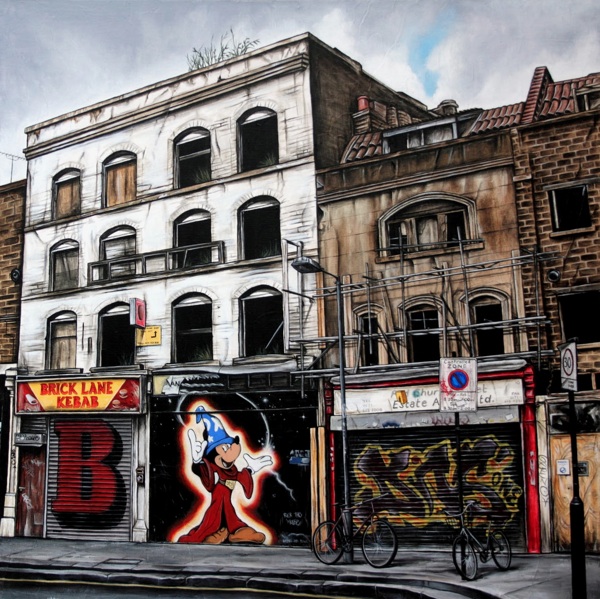
Together Again, Redchurch St.
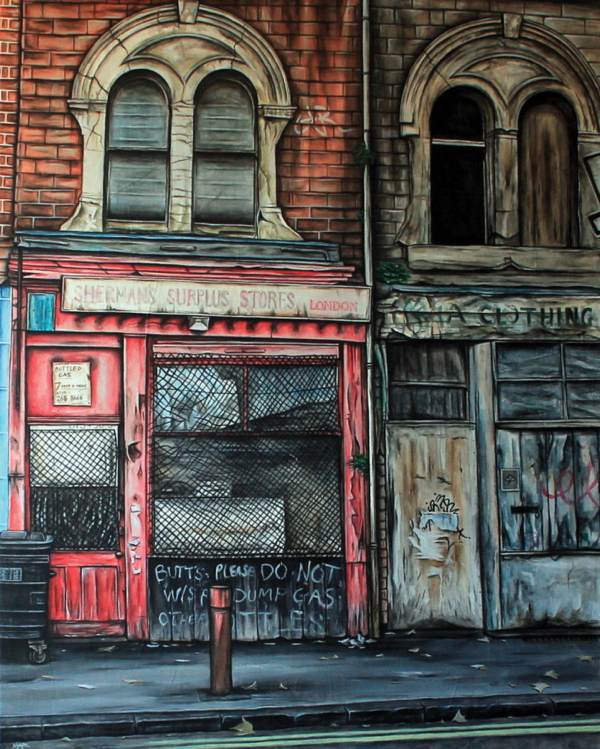
Vallance Rd, Whitechapel
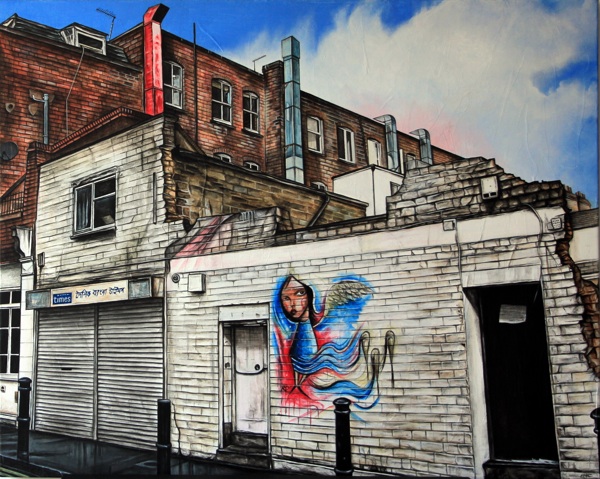
Fallen, Hanbury St.
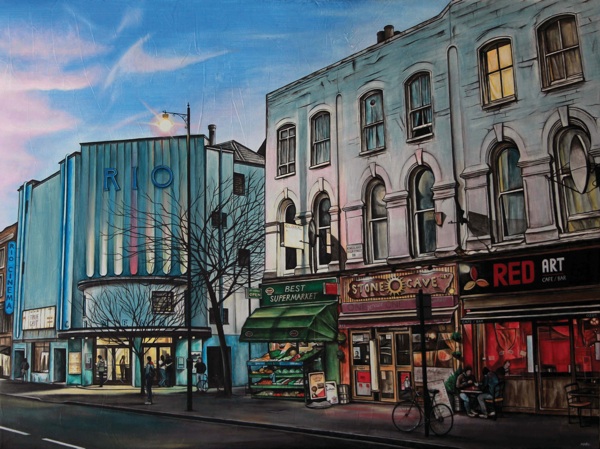
Rio Cinema, Dalston.
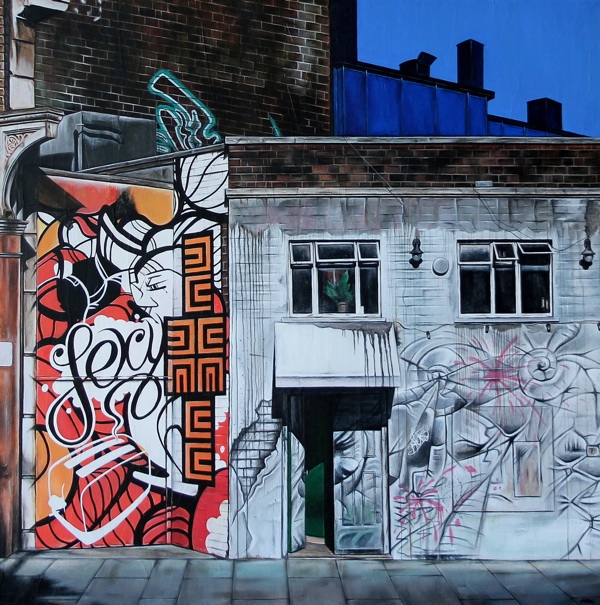
The Tyger, Great Eastern St.
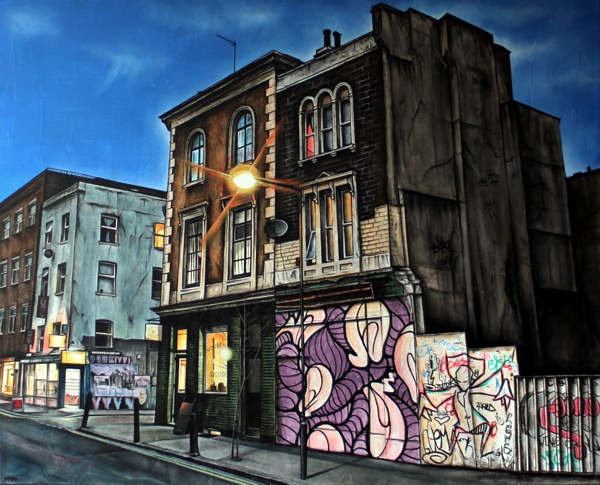
Corner of The Street, Redchurch St.

The Lonely Stretch, Coronet St.
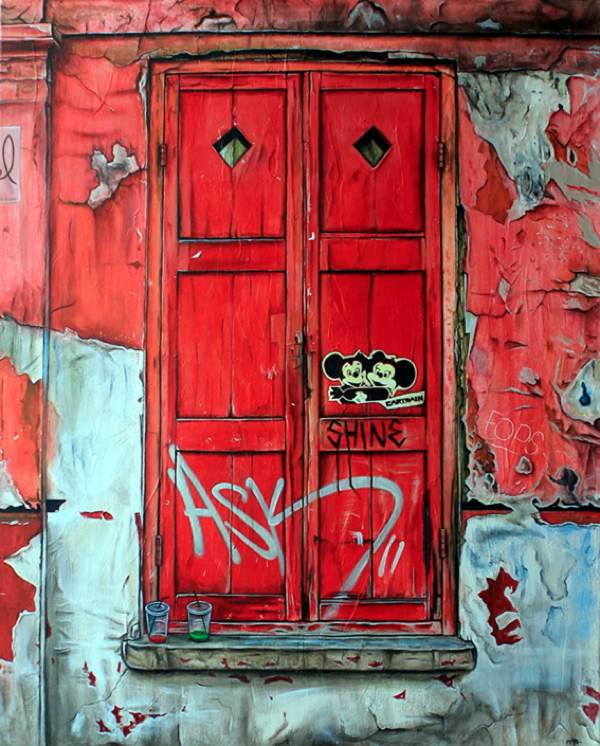
Back To The Old House, Princelet St.
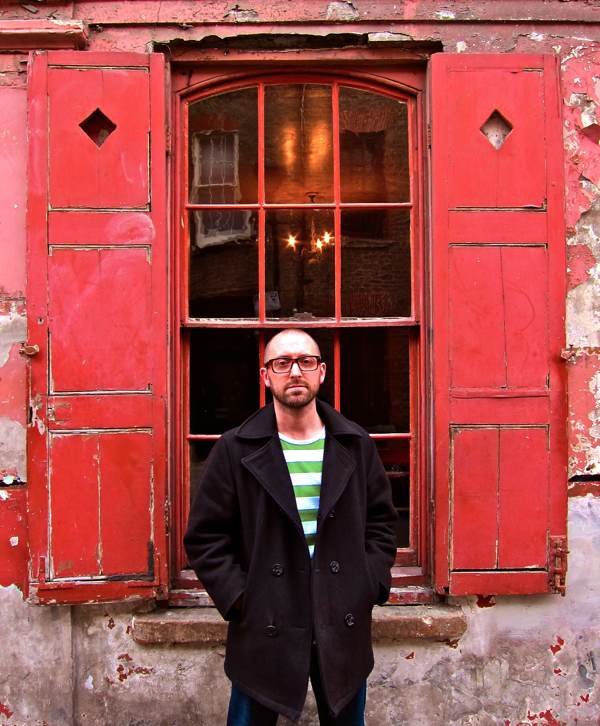
Marc Gooderham
Paintings copyright © Marc Gooderham
You may also like to read about
Recent Paintings by Marc Gooderham
Anthony Eyton, Painter
Come and see Anthony Eyton’s pictures of Spitalfields at The Artists of Spitalfields Life opening at Ben Pentreath Ltd on Wednesday 7th November.
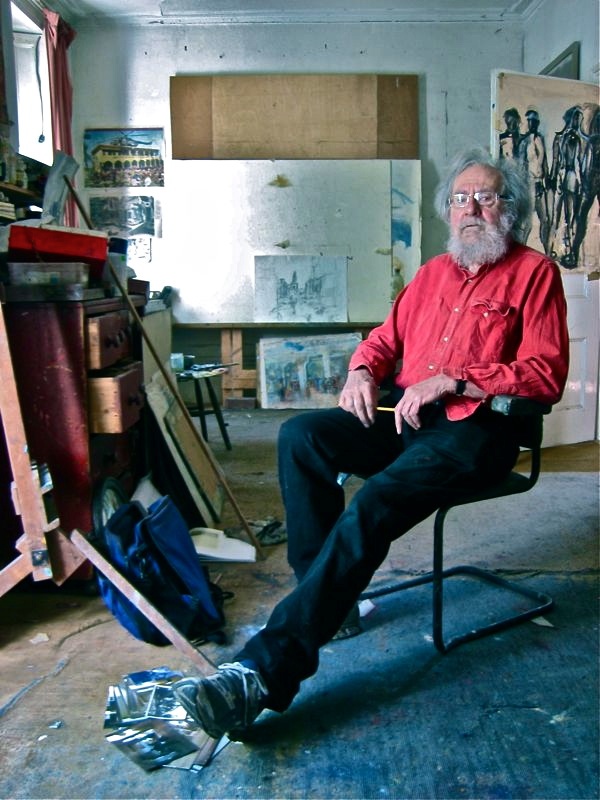
I took the 133 bus from Liverpool St Station, travelling down South of the river to visit the eighty-eight year old painter Anthony Eyton at the elegant terrace in the Brixton Rd where has lived since 1960 – apart from a creative sojourn in Spitalfields, where he kept a studio from 1968 until 1982. It was the 133 bus that stops outside his house which brought Anthony to Spitalfields, and at first he took it every day to get to his studio. But then later, he forsook home comforts to live a bohemian existence in his garret in Hanbury St and the result was an inspired collection of paintings which exist today as testament to the particular vision Anthony found in Spitalfields.
A tall man with of mane of wiry white hair and gentle curious eyes, possessing a benign manner and natural lightness of tone, Anthony still carries a buoyant energy and enthusiasm for painting. I found him working to finish a new picture for submission to the Royal Academy before five o’clock that afternoon. Yet once I arrived off the 133, he took little persuasion to lay aside his preoccupation of the moment and talk to me about that significant destination at the other end of the bus route.
“That biggest strangest world, that whirlpool at Spitalfields, and all the several colours of the sweatshops, and the other colours of the degradation and of the beautiful antique houses derelict – I think the quality of colour was what struck me most.” replied Anthony almost in a whisper, when I asked him what drew him to Spitalfields, before he launched into a spontaneous flowing monologue evoking the imaginative universe that he found so magnetically appealing.
“From Brick Lane to Wilkes St and in between was special because it’s a kind of sanctuary.” he continued, “And looking down Wilkes St, Piero della Francesca would have liked it because it has a kind of perfection. The people going about their business are perfectly in size to the buildings. You see people carrying ladders and City girls and Jack the Ripper tours, and actors in costume outside that house in Princelet St where they make those period films, and they are all in proportion. And the market was still in use then which gave it a rough quality before the City came spilling over and building its new buildings. Always a Mecca on a Sunday. I used to think they were all coming for a religious ceremony, but it’s pure commerce, and it’s still there and it’s so large. It’s very strange to me that people give up Sunday to do that… – It’s a very vibrant area , and when Christ Church opens up for singing, the theatre of it is wonderful.”
Many years before he took a studio in Spitalfields, Anthony came to the Whitechapel Gallery to visit the memorial exhibition for Mark Gertler in 1949, another artist who also once had a studio in an old house in one of the streets leading off the market place. “Synagogues, warehouses, and Hawksmoor’s huge Christ Church, locked but standing out mightily in Commercial St, tramps eating by the gravestones in the damp church yard. “Touch” was the word that recurred,” wrote Anthony in his diary at that time, revealing the early fascination that was eventually to lead him back, to rent a loft in an eighteenth century house in Wilkes St and then subsequently to a weavers’ attic round the corner in Hanbury St where the paintings you see below were painted.
Each of these modest spaces were built as workplaces with lines of casements on either side to permit maximum light, required for weaving. Affording vertiginous views down into the quiet haven of yards between the streets where daylight bounces and reflects among high walls, these unique circumstances create the unmistakable quality of light that both infuses and characterises Anthony Eyton’s pictures which he painted in his years there. But while the light articulates the visual vocabulary of these paintings, in their subtle tones drawn from the buildings, they record elusive moments of change within a mutable space, whether the instant when a model warms herself at the fire or workmen swarm onto the roof, or simply the pregnant moment incarnated by so many open windows beneath an English sky.
Anthony’s youngest daughter, Sarah, remembers coming to visit her father as a child. “It was a bit like camping, visiting daddy’s studio,” she recalled fondly, “There were no amenities and you had to go all the way downstairs, past the door of the man below who always left a rotten fish outside, to visit the privy in the yard that was full of spiders which were so large they had faces. But it was exciting, an adventure, and I used to love drawing and doing sketches on scraps of paper that I found in his studio.”
For a few years in the midst of his long career, Spitalfields gave Anthony Eyton a refuge where he could find peace and a place packed with visual stimuli – and then two years ago, a quarter of a century after he left, Anthony returned. Frances Milat who was born and lived in the house in Hanbury St came back from Australia to stage a reunion of all the tenants from long ago. It was the catalyst for a set of circumstances which prompted Anthony to revisit and do new drawings in these narrow streets which, over all this time, have become inextricable with his identity as an artist.
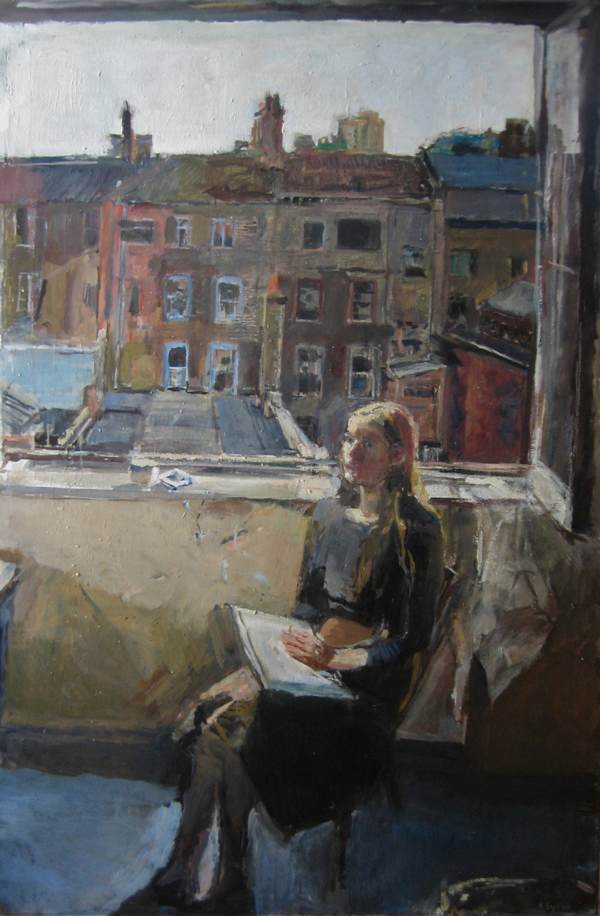
Christine, 1976/8. – “She was very keen that the cigarette smoke and grotty ashtray should be in the picture to bring me down to earth.”
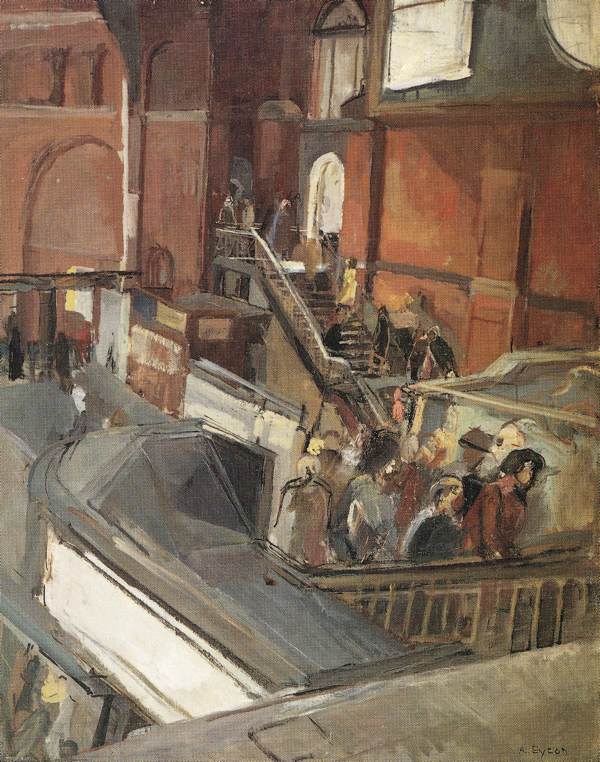
Liverpool St Station, mid-seventies.
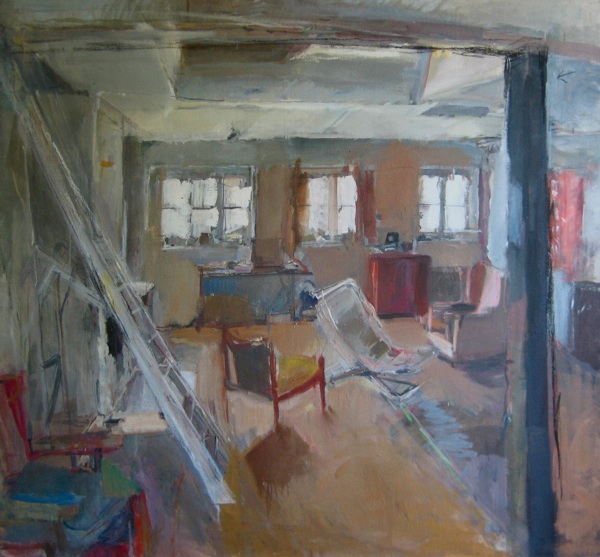
Studio interior, 1977.
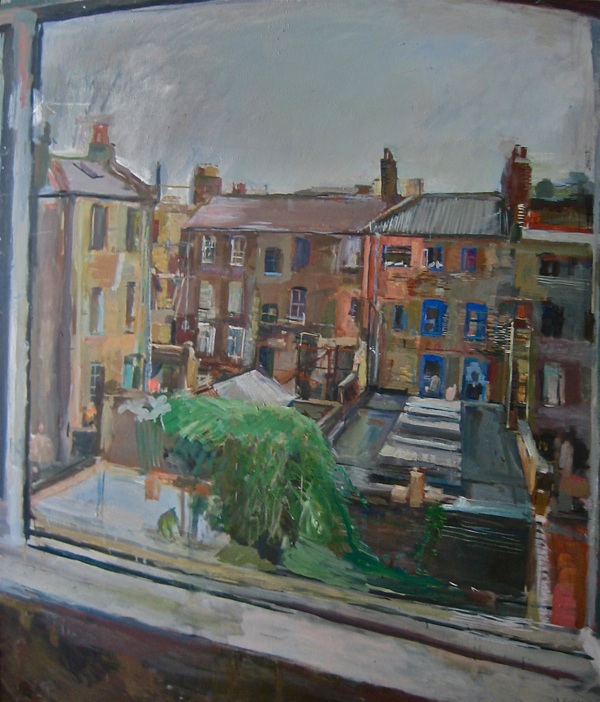
Back of Princelet St, 1980

Girl by the fire, 1978.
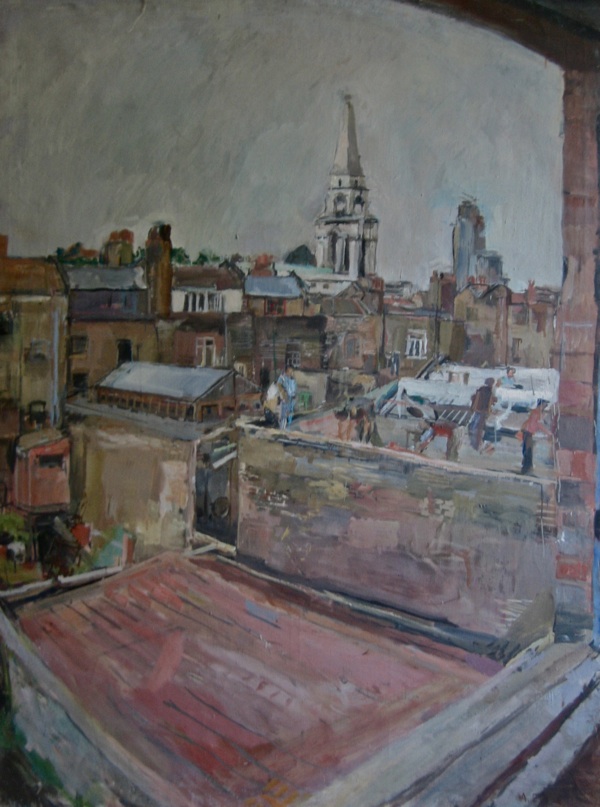
Workers on the roof, 1980
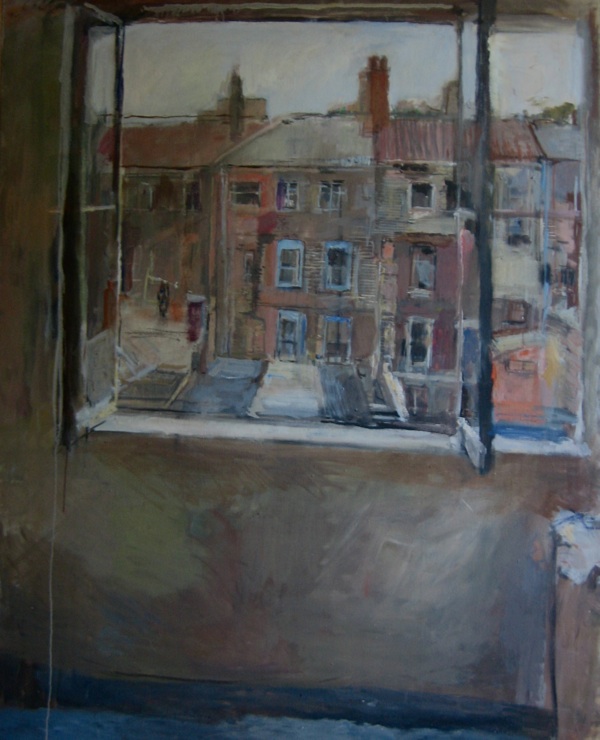
Open window, Spitalfields, 1976.
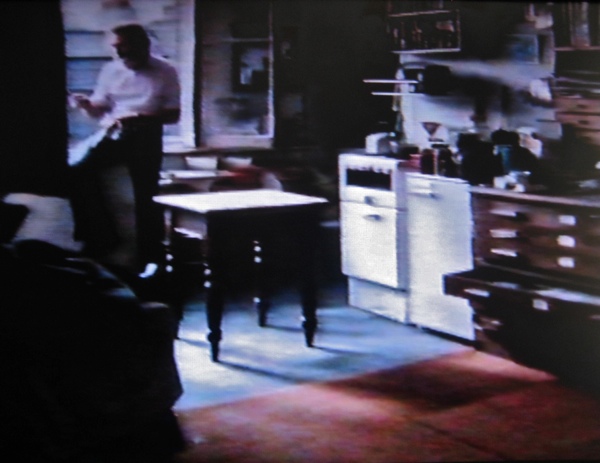
Anthony Eyton working in his Hanbury St studio, a still from a television documentary of 1980.

Wilkes St, 2011
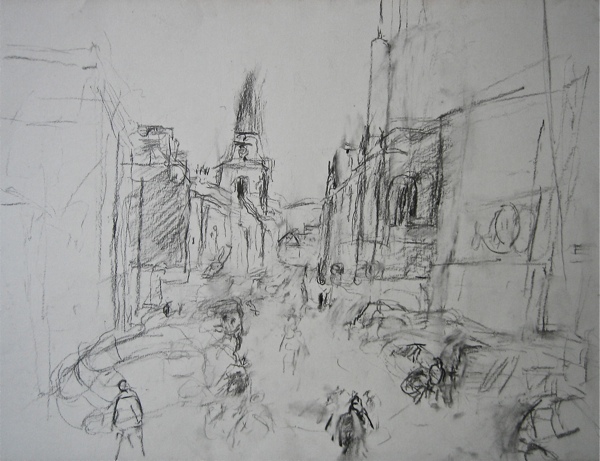
Fournier St from Banglatown, 2011
Pictures copyright © Anthony Eyton
Watch a film of Anthony Eyton in his extraordinary garden here.
You may also like to read about
Adam Dant & The Map Of Spitalfields Life
Come and see The Map of Spitalfields Life drawn by Adam Dant at The Artists of Spitalfields Life opening at Ben Pentreath Ltd on Wednesday 7th November.
[youtube mvq38fBhGDI nolink]
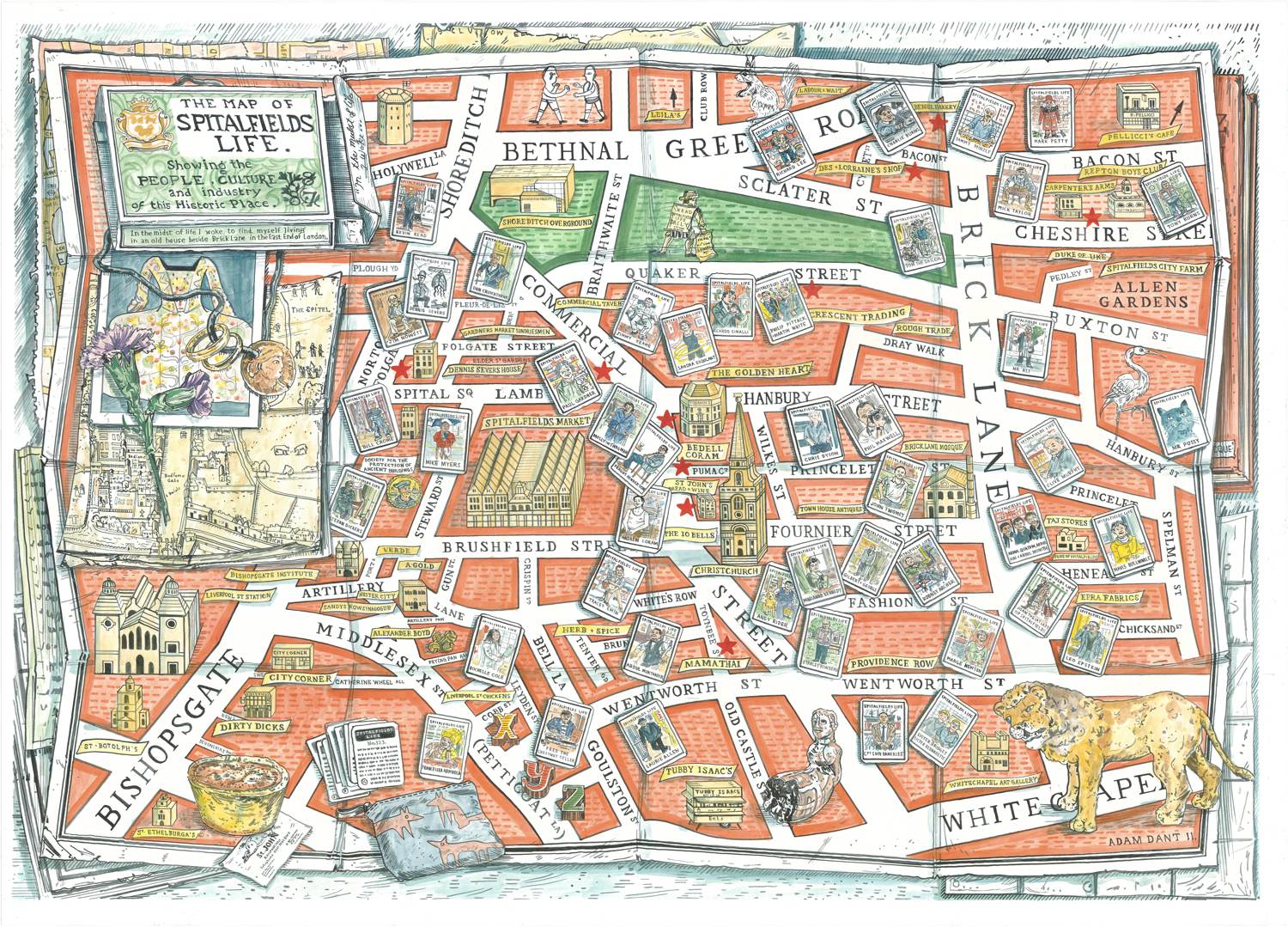 Click to enlarge the map
Adam Dant and I burnt the midnight oil to contrive The Map of Spitalfields Life for your delight and, once it was done, we could barely contain our excitement to show it to the world.
It was produced under conditions of the strictest secrecy and, before the unveiling, Adam Dant and I alone knew who was on the map. I ran around Spitalfields like the White Rabbit, delivering invitations. Yet although those who got an invitation were confirmed of their place on the map, they did not discover who else was on it until Sandra Esqulant. landlady of The Golden Heart, unveiled it. Rumour, gossip and speculation about the map spread like wildfire through the narrow streets of Spitalfields, and the conflagration reached white heat by the day of the unveiling.
The Map of Spitalfields Life is published by Herb Lester and full-colour copies are on sale at £4. This pocket-sized edition is the ideal companion to a walk through the streets of Spitalfields. Illustrated in colour by Adam Dant, cartographer extraordinaire, with fifty portraits of the people who make Spitalfields distinctive. On the reverse, you will find the stories of all those portrayed on the front written by yours truly, plus a guide to the essential Spitalfields landmarks and destinations.
Adam Dant has produced a hand-tinted limited edition for collectors and Spitalfields aficionados, suitable for framing at £420, each copy signed by the artist and The Gentle Author.
Adam Dant said, “We hope this map may assist the cartographic aesthetic to leap forward beyond the homogeneity of computerised rendering and the turgid angst of psycho- geography.”
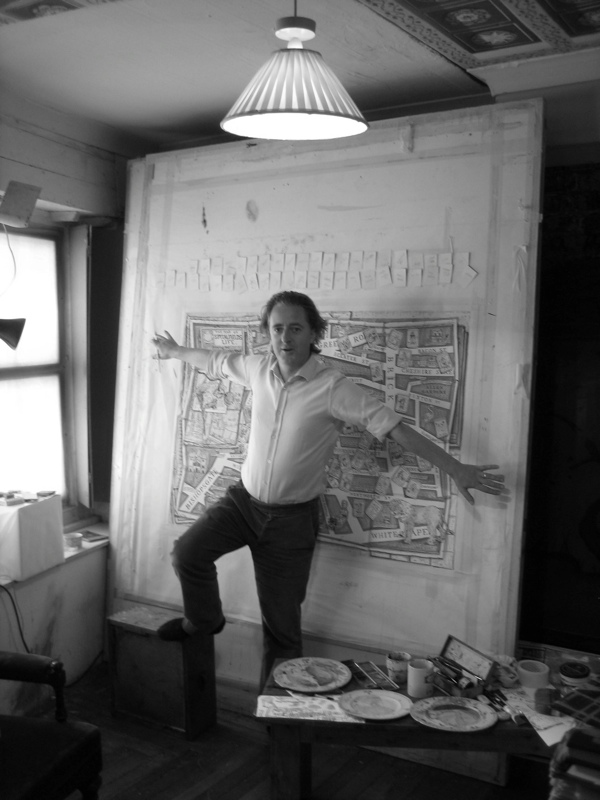
Adam Dant tries vainly to hide The Map of Spitalfields Life from prying eyes.
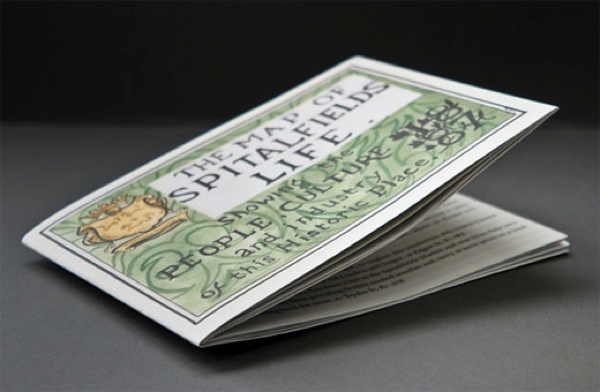
Photograph of the Herb Lester edition of the map by Stephanie Lynn
You may also like to read about
Unveiling The Map Of Spitalfields Life
and these other maps by Adam Dant
Map of the History of Shoreditch
Map of Shoreditch in the Year 3000
Map of Shoreditch as the Globe
Map of the History of Clerkenwell
Map of the Journey to the Heart of the East End
Map of the History of Rotherhithe
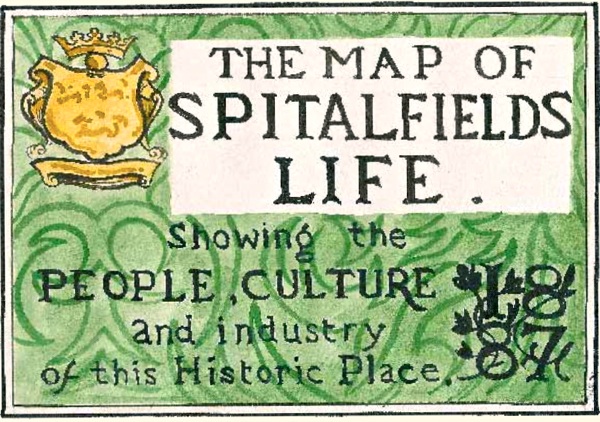
Click here to buy a copy of The Map of Spitalfields Life drawn by Adam Dant with descriptions by The Gentle Author
Alfred Daniels, Painter
Come and see Alfred Daniels’ new painting of the Gramophone Man from Wentworth St at The Artists of Spitalfields Life opening at Ben Pentreath Ltd on Wednesday 7th November.
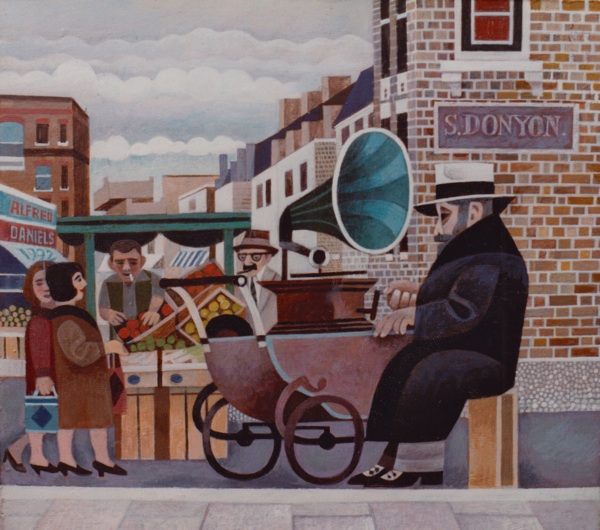
The Gramophone Man
“I’m not really an East Ender, I’m more of a Bow boy,” asserted Alfred Daniels with characteristic precision of thought, when I enquired of his origin. “My parents left the East End, because they were scared of the doodlebugs and bought this house in 1945,” he explained, as he welcomed me to the generous suburban mansion in Chiswick where he lives today. Greeting me in his pyjamas and dressing gown in the afternoon, no-one could be more at home than Alfred in his studio occupying the former living room of his parents’ house. And yesterday, he was snug in the central heating and just putting the finishing touches to a commission that his dealer was coming to collect at six.
Alfred is at the point in life now where the copyright payments on the resale of works from his sixty year painting career mean he no longer has to struggle. “I’ve done hundreds of things to make a living,” he confessed, rolling his eyes in amusement, “Although my father was a brilliant tailor, he was a dreadful business man so we were on the breadline for most of the nineteen thirties – which was a good thing because we never got fat …” Smiling at his own bravado, Alfred continued painting as he spoke, adding depth to the shadows with a fine brush. “This is the way to make a living,” he declared with a flourish as he placed the brush back in the pot with finality, completing the day’s work and placing the painting to one side, ready to go. “The past is history, the future is a mystery but the present is a gift,” he informed me, as we climbed the stairs to the upstairs kitchen over-looking the garden, to seek a cup of tea.
Alfred had spent the morning making copious notes on his personal history, just it to get it straight for me. “This has been fun,” he admitted, rustling through the handwritten pages. “My grandfather came from Russia in the 1880s, he was called Donyon, and they said, ‘Sounds like Daniels.’ My grandfather on the other side came from Plotska in Poland in the 1880s, he didn’t have a surname so they said ‘Sounds like a good man’ and they called him Goodman. My parents, Sam and Rose, were both born in the 1890s and my mother lived to be ninety-two. I was born in Trellis St in Bow in 1924 and in the early thirties we moved to 145 Bow Rd, next to the railway station. I can still remember the sound of the goods wagons going by at night.
One good thing is, I gave up the Jewish religion and thank goodness for that. It was only when I was twelve and I read about the Hitler problem that I realised I was Jewish. Fortunately, we weren’t religious in my family and we didn’t go to the synagogue. But I went to prepare for my Bar Mitzvah and they tried to harm me with Hebrew. We were taught by these Russians and if you didn’t learn it they bashed you. That put me off religion there and then. Yet when we got outside the Black Shirts were waiting for us in the street, calling ‘Here look, it’s the Jew boys!’ and they wanted to bash me too. Fortunately, I could run fast in those days.
My mother used to do all the shopping in the Roman Rd market. She hated shopping, so she sent me to do it for her in Brick Lane. It was a penny on the tram, there and back. But they all spoke Yiddish and I couldn’t communicate, so I thought, ‘I’d better listen to my grandmother who spoke Yiddish.’ I learnt it from her and it is one of the funniest languages you can imagine.
Although my parents were poor, my Uncle Charlie was rich. He was a commercial artist and my father said to him, ‘The boy wants to learn a craft.’ So Charlie got me a place at Woolwich Polytechnic to learn signwriting but I spent all day trying to sharpen my pencil. Then he took me out of the school and got me a job as a lettering artist at the Lawrence Danes Studio in Chancery Lane. It was wonderful to come up to the city to work, and his nephew befriended me and we went to art shops together to look at art books. We drew out letters and filled them in with Indian Ink, mostly Gill Sans. Typesetters usually got the spacing wrong but if you did it by hand you could get it right. It was all squares, circles and triangles.
When Uncle Charlie started his own studio in Fetter Lane above the Vogue photo studio, he offered me a job at £1 a week. Nobody showed me how to do anything, I worked it out for myself. He got me to do illustrations and comic drawings and retouching of photographs. At night, we went down in the tube stations entertaining people sheltering from the blitz. I played my violin like Django Reinhardt and he played like Stefan Grappelli, and one day we were recorded and ended up on Workers’ Playtime.
I had been doing some still lifes but I wanted to paint the beautiful old shops in Campbell Rd, Bow, so I went to make some sketches and a policeman came up and asked to see my identity card. ‘You can’t do this because we’ve had complaints you’re a spy,’ he said. It was illegal to take photographs during the war, so I sat and absorbed into memory what I saw. And the result came out like a naive or primitive painting. When Herbert Buckley my tutor at Woolwich saw it, he said, ‘Would you like to be a painter? I’ll put you in for the Royal College of Art. To be honest, I should rather have done illustration or lettering. At the Royal College of Art, my tutors included Carel Weight – he said, ‘I’m not interested in art only in pictures.’ – Ruskin Spear – ‘always drunk because of the pain of polio’ – and John Minton – ‘ a lovely man, if only he hadn’t been so mixed up.'”
Alfred was keen to enlist, “I wanted to stop Hitler coming over and stringing me up !” – though he never saw active service, but the discovery of painting and of his signature style as the British Douanier Rousseau stayed with him for the rest of his life. After Alfred left the East End in 1945, he kept coming back to make sketchbooks and do paintings, often of the same subjects – as you see above and below, with two images of the Gramophone man in Wentworth St painted fifty years apart.
With natural generosity of spirit, Alfred Daniels told me, “Making a painting is like baking a cake, one slice is for you but the rest is for everyone else.”

The Gramophone Man in Wentworth St, 1950

Sketchbook pages – Cable St, April 1964.
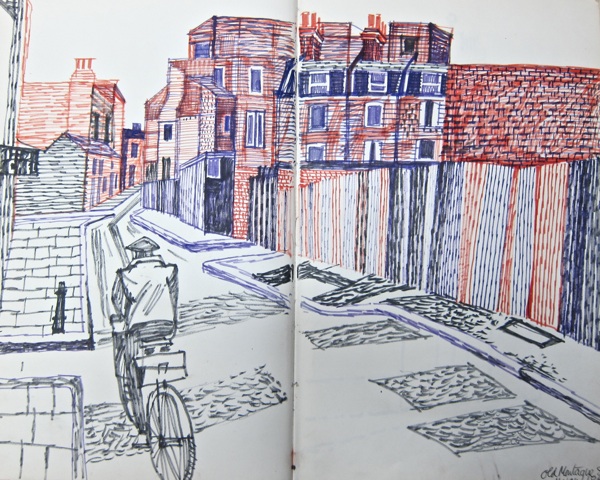
Sketchbook pages – Old Montague St, March 1964.

Sketchbook pages – Hessel St, April 1964.
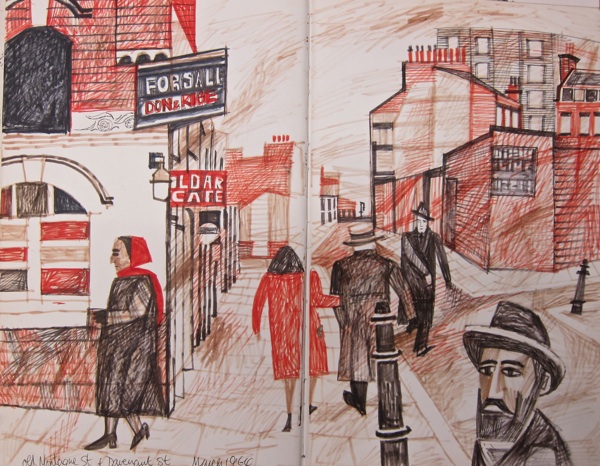
Sketchbook pages – Old Montague St & Davenant St, March 1964.
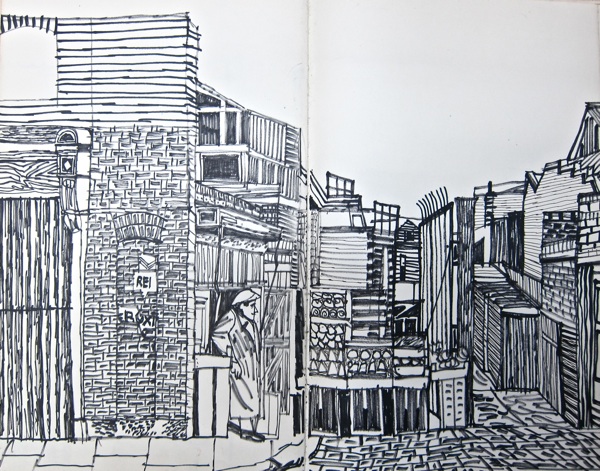
Sketchbook pages – Fruit Seller in Hessel St, March 1964.

Leadenhall Market, drawing, 2008.

Billingsgate Market.

Tower Bridge, 2008.

The Royl Exchange, 2008.

Crossing London Bridge, 2008.

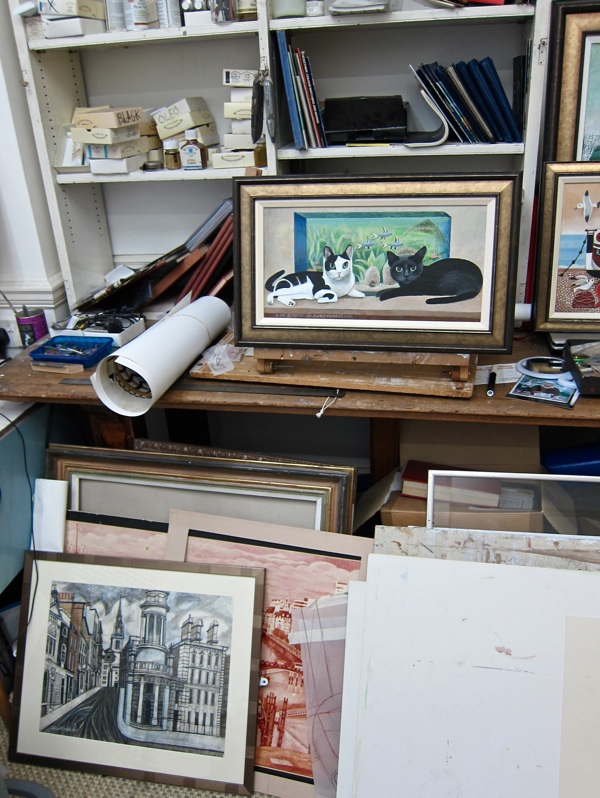
In Alfred’s studio
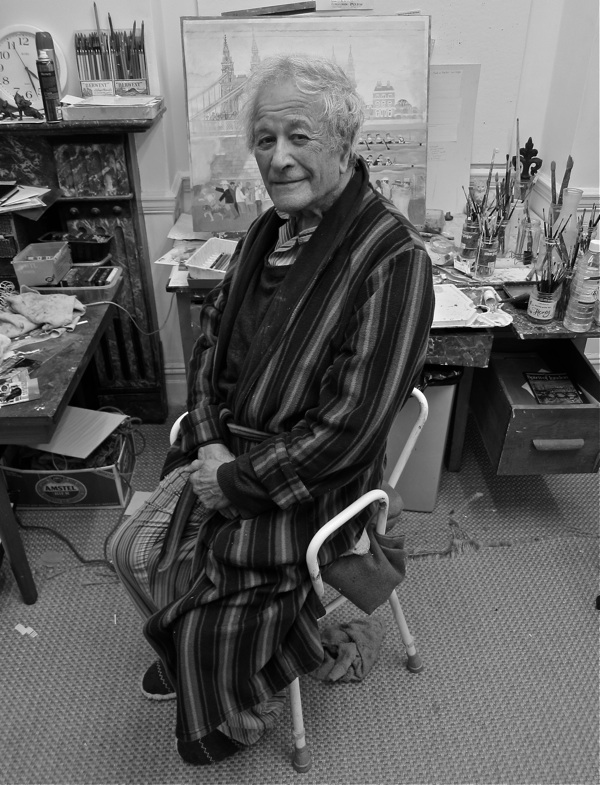
Alfred Daniels, Artist
You may also like to read about
Robson Cezar, King Of The Bottletops
Come and see Robson Cezar’s bottletop pictures at The Artists of Spitalfields Life opening at Ben Pentreath Ltd on Wednesday 7th November.

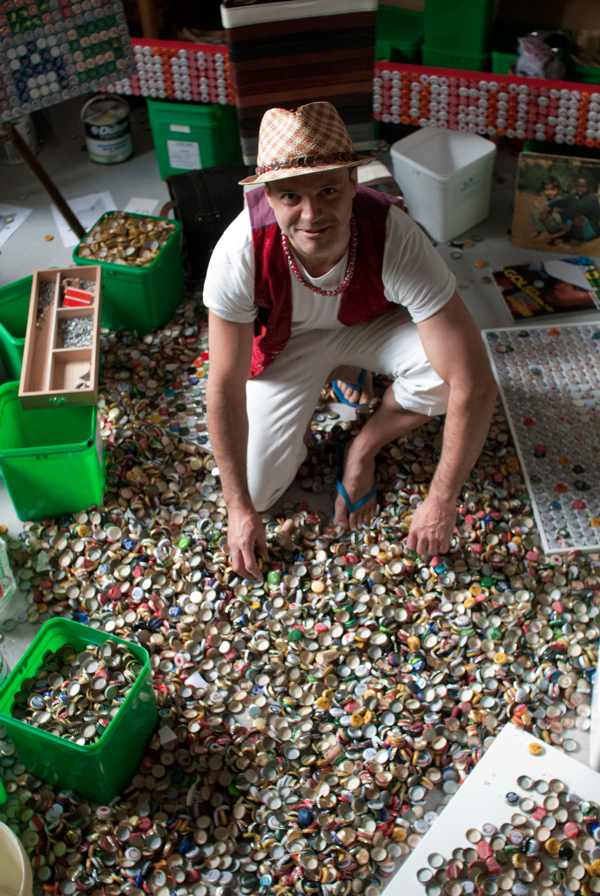
If you are a regular in the pubs around Spitalfields, you may have noticed a man come in to collect bottletops from behind the bar and then leave again with a broad smile, clutching a fat plastic bag of them with as much delight as if he were carrying off a fortune in gold coins. This enigmatic individual with the passion for hoarding bottletops is Brazilian artist and Spitalfields resident Robson Cezar, and he needs to collect thousands because he makes breathtakingly intricate pictures with them.
Each day, Robson cycles from Spitalfields down to his studio at Tower Bridge where he delights to store his vast trove – the king of bottletops in his counting house – spending endless hours sorting them lovingly into colours and designs to organise his finds as the raw material for his very particular art. An art which transforms these ill-considered objects into works of delicacy and finesse, contrived with sly humour, and playing upon their subtle abstract qualities of colour and contrast.
It all started a couple of years ago, when he asked Sandra Esqulant at The Golden Heart in Commercial St to collect her bottletops for him. For months she gathered them conscientiously and it gave Robson the perfect excuse to drop in regularly. And last year, I showed you some smaller pictures he made, but over this last Winter Robson has begun creating larger, more elaborate bottletop works. As a consequence, Robson often sets out now to visit several bars each night to collect the harvest of bottletops which he needs, that is obligingly – if incidentally – created by the thirsty boozers of our neighbourhood.
And in return for the patronage of getting their bottletops, Robson makes pictures for the pubs. At first he made a golden heart in bottletops as a personal gift for Sandra, but when The Bell in Middlesex St offered him the opportunity to cover the exterior of the pub with bottletops, he seized the opportunity to do something more ambitious. Using over six thousand bottletops, and subtly referencing the colours of the red brick and the green ceramic tiles, Robson has contrived a means to unify the exterior of the building and render it afresh as a landmark with his witty texts. And since they were installed last year, people smile and stop in Middlesex St to take photographs when they catch sight of Robson’s bottletop panels on The Bell. With such eye-catching street appeal, Robson’s work is a natural complement to Ben Eine’s alphabet that he painted on all the shutters along this street last year.
A week ago, Robson’s latest picture was installed at the Carpenters Arms in Cheshire St where landlords Eric & Nigel have been obligingly collecting bottletops for over a year. Hung up on the roof beam in the bar, this is in a different vein from Robson’s works at The Golden Heart and The Bell – creating a stir among the regulars, who are puzzling over the choice of phrase SCREAM PARTNERS for the CARPENTERS ARMS. Go round to take a look yourself and if cannot work it out at once, then a couple of drinks will increase your powers of lateral thinking.
Robson Cezar came to Spitalfields in the footsteps of fellow Brazilian artist Helio Oiticica, who along with Caetano Veloso was one of the many Brazilian cultural exiles in London in the nineteen sixties. Oiticia staged an exhibition at the Whitechapel Gallery in 1967, introducing the new cultural movement of Tropicalia to Europe by recreating a favela in the gallery. And now Robson is creating his own Tropicalia here in the twenty-first century, reinventing this poverty aesthetic with a pop exuberance that reflects the cosmopolitanism of his own life experience – which began in a favela in Brazil and took him on a journey from South to North America and eventually to Europe, where he found his home in the East End of London.
Combining the sensibility of a fine artist with the painstaking technique of a folk artist, Robson’s bottletop pictures are egalitarian in nature yet sophisticated in intent. They look like signs but they are not signs, or rather they are pictures pretending to be signs. Their exquisite technique and colouration is a crazy joke in contrast to the misrule engendered by the volume of alcohol imbibed to produce this number of bottletops. Yet the lush shimmering beauty of Robson Cezar’s work enchants us with all the bottletops that litter our streets disregarded, and reminds us of all the other pitiful wonders of human ingenuity that we forget to notice.


At the Bell in Middlesex St.


At the Carpenters Arms, Cheshire St.

Why SCREAM PARTNERS at the CARPENTERS ARMS?

Portraits of Robson Cezar in his studio copyright © Sarah Ainslie
Artworks copyright © Robson Cezar
James Brown at Gardners Market Sundriesmen
Come and see James Brown’s Gardners’ Market Sundriesmen print at The Artists of Spitalfields Life opening at Ben Pentreath Ltd on Wednesday 7th November.

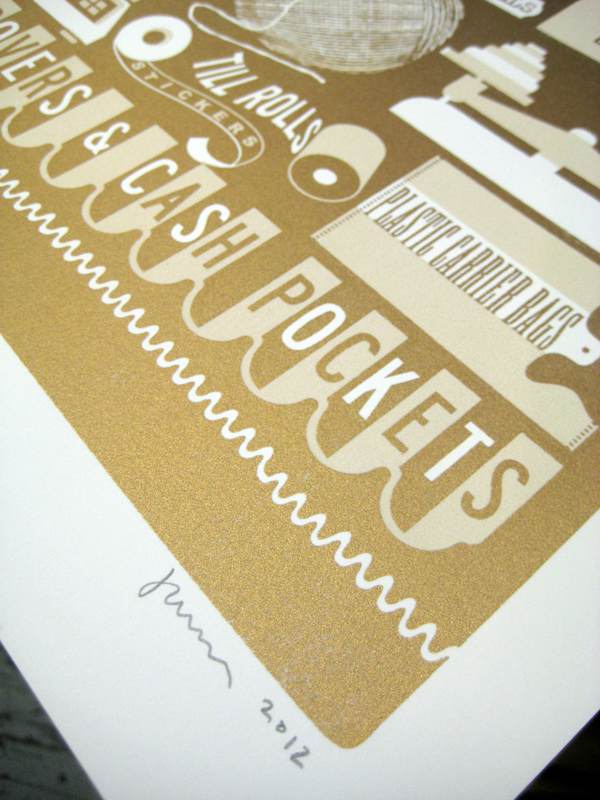
This is illustrator & printmaker, James Brown, presenting Paul Gardner, the fourth generation paper bag seller, with a copy of the beautiful print he has created to celebrate this beloved and historic Spitalfields institution, Gardners Market Sundriesmen. When a one hundred and forty year old business advertises for the first time, something special is required and – working in collaboration with Paul – James has contrived a paper bag printed in gold and emblazoned with symbols of all the different items to be purchased at Gardners.
“Knowing about Paul and his story through Spitalfields Life, I thought it would be great to produce a design that he could use as a promotional flyer and that I could also make into a nice limited edition print too,” explained James shyly, standing in front of Paul and aware of the huge departure this first piece of advertising represents for Gardners.
Through supplying the bags, in this area traditionally occupied with small shops and markets, Gardners is naturally the epicentre. Yet with new people coming to set up stalls and open shops all the time, James’ beautiful postcards of his print constitute an ideal introduction to this uniquely appealing shop that will sell you as few bags as you need. James & I distributed the cards in shops and markets on Paul’s behalf, but you can pick up some yourself direct from Gardners Market Sundriesmen in Commercial St and take the opportunity to admire the limited edition print at The Artists of Spitalfields Life exhibition in Bloomsbury next week.
“Paul has so many stories to tell, my visits to Gardners were always lengthy and lively.” confided James, savouring the year it has take to develop his design. “It’s been great to get to know Paul and I really hope the flyer works for him, he is a lovely guy and offers a level of service that cannot be surpassed by any of the online bag and sundries suppliers.”
When I first met James Brown a couple of years ago, he had just quit a ten year career as a textile designer and struck out anew as an illustrator and printmaker, sharing a studio with his brother in Hackney Wick. Since then, I have been delighted to see his bravura designs turning up all over the place. “It’s snowballed really,” he admitted with a private smile of satisfaction, “And now I am making a living at it – exactly what I wanted to do and it’s brilliant!”
 James’ screenprint celebrating Gardners Market Sundriesmen, Spitalfields’ oldest family business.


You may also like to read about
Paul Bommer & The Great Fire Of London
Come and see Paul Bommer’s series of forty-eight delft tiles inspired The Great Fire of London 1666 at The Artists of Spitalfields Life opening at Ben Pentreath Ltd on Wednesday 7th November

Like Pieter Breughel, George Cruickshank and Ronald Searle, Paul Bommer’s work is firmly rooted in the European grotesque and populated with distinctive specimens of humanity – conjured into being through his unique quality of line, waggish, calligraphic and lyrical by turns. Fascinated by culture and lore, Paul celebrates the strange stories that interweave to create social identity and the fabric of history, turning his attention to The Great Fire Of London in this latest series of limited edition Delft tiles.
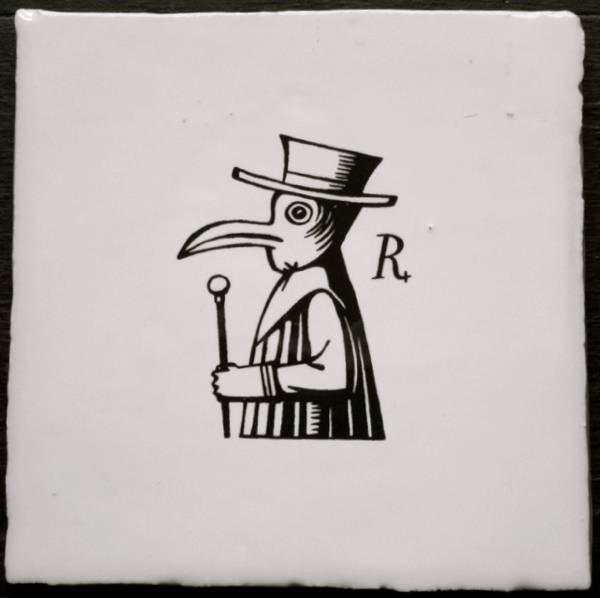
Pest Doctor 1665
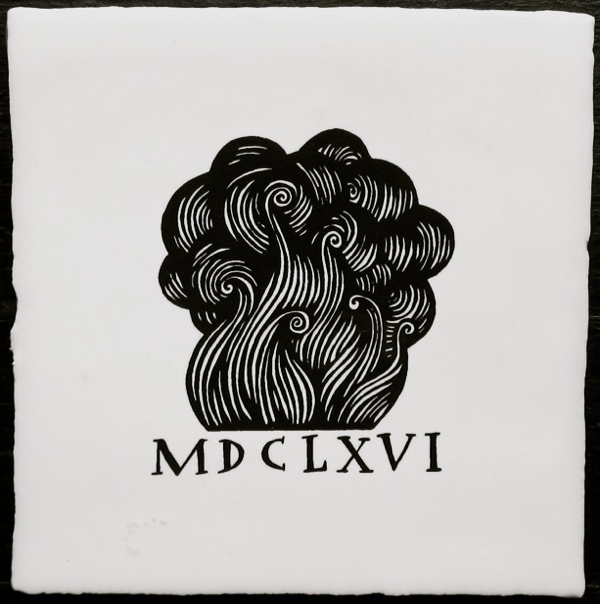
Annus Mirabilis 1666
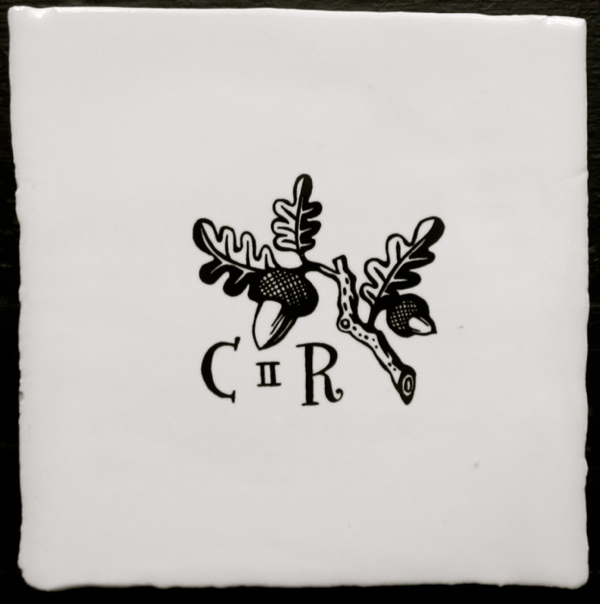
King Charles II
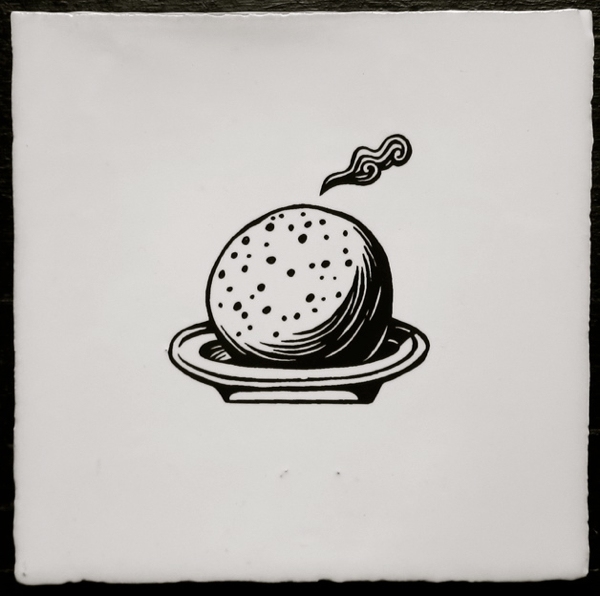
Pudding Lane
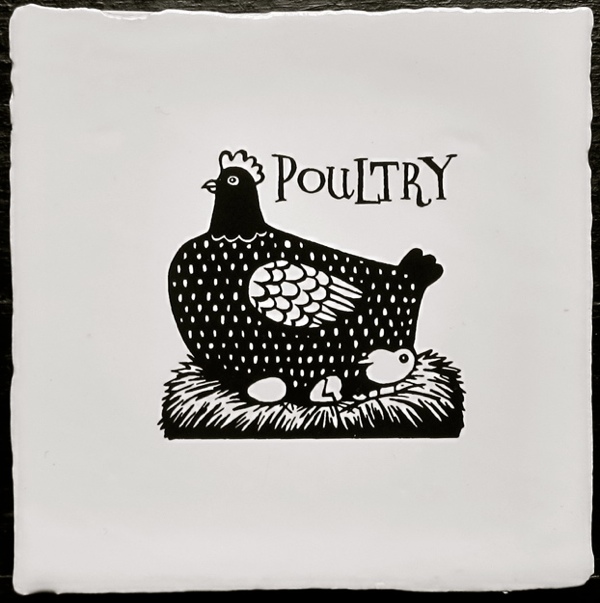
Poultry
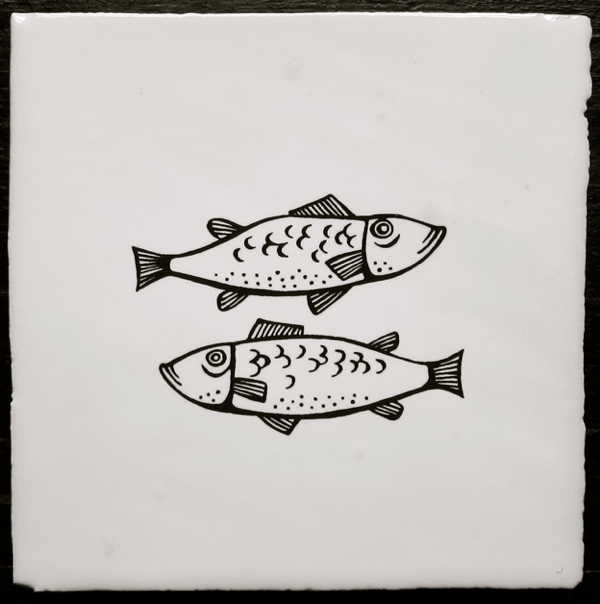
Fish St Hill
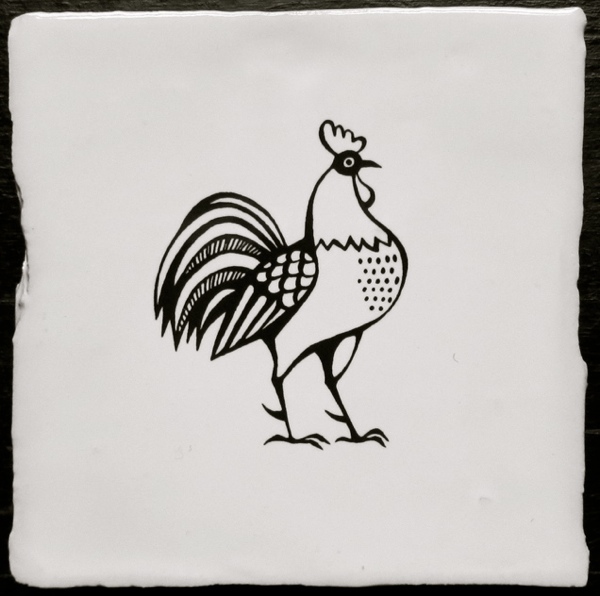
Cock Lane
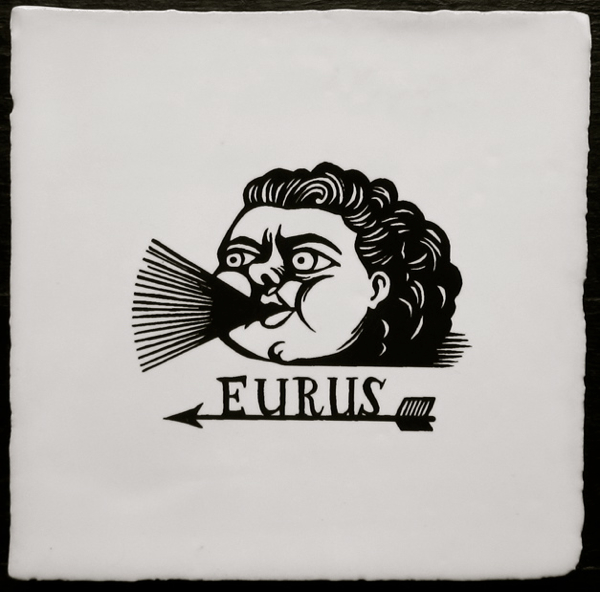
Eurus – The East Wind, that blew the Fire towards St Pauls.
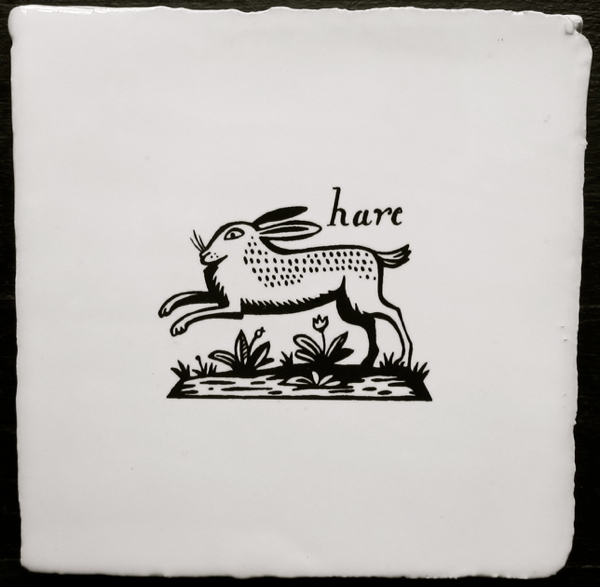
Hare Court
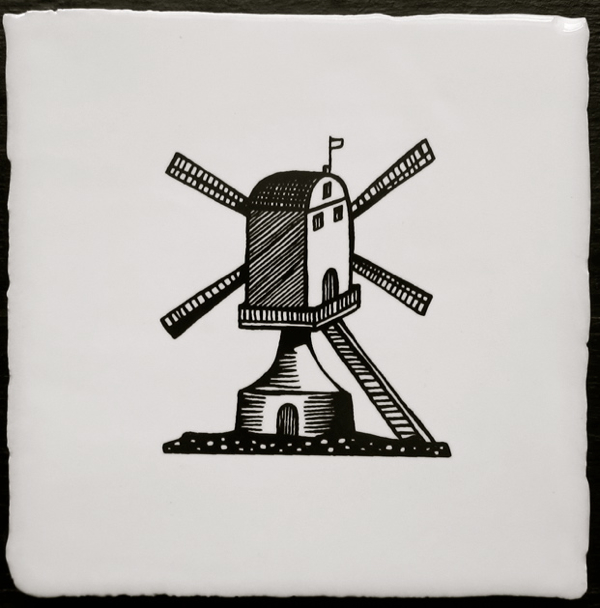
Windmill
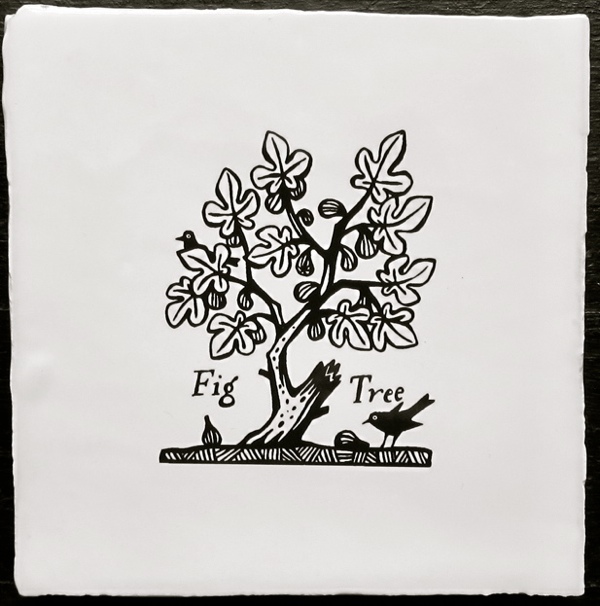
Fig Tree Court
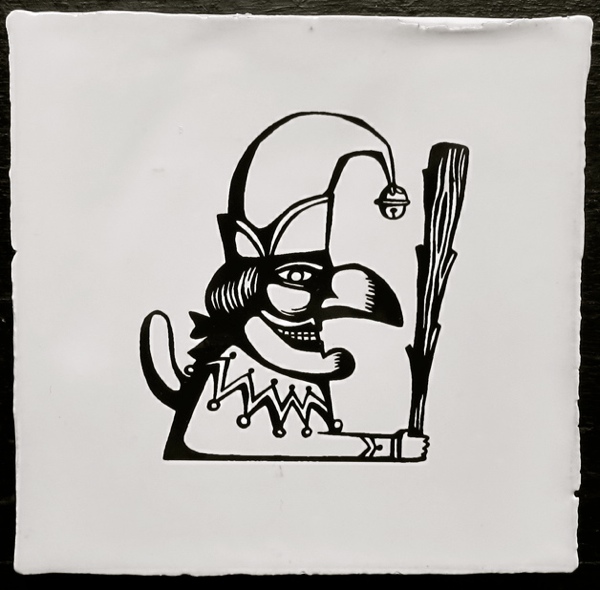
Mister Punch – first recorded in Pepys diary
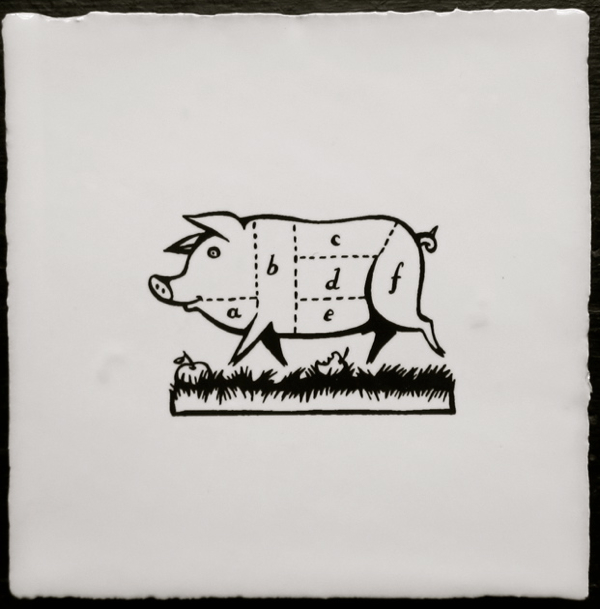
Smithfield Market
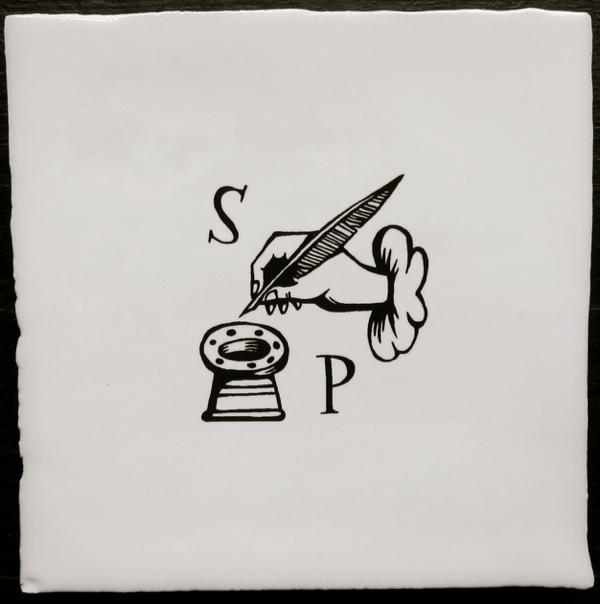
Samuel Pepys
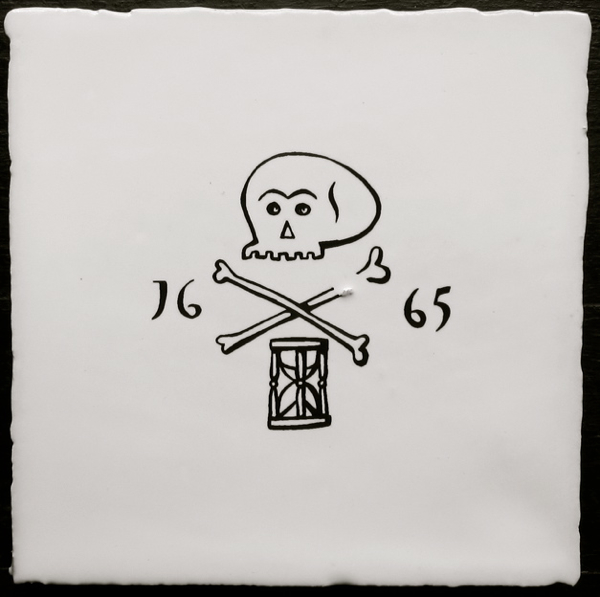
Memento Mori of the Plague
Tiles copyright © Paul Bommer
You may also like to take a look at
Paul Bommer’s Cockney Alphabet
Paul Bommer & Christopher Smart & His Cat Jeoffry












