
Phil Maxwell At The Old Spitalfields Market

Since 1981, when he moved to London from Liverpool, Phil Maxwell has been taking pictures daily on Brick Lane, creating an unparalleled canon of photography that records the changing face of Spitalfields over the last thirty years.
So, in 1991, when the nocturnal Fruit & Vegetable Market which flourished here for more than three centuries was to be moved out, Phil turned his attention to capturing the last days of this unique phenomenon. These pictures compose Phil’s personal elegy to the Market which – along with the Truman Brewery – once comprised the core of Spitalfields’ historic identity as London’s first industrial suburb.
“It was a great place to wander around because there was so much life in it,” Phil recalled fondly, “The Market had its own ecosystem that surrounded it, including the homeless people who gravitated there, the ladies of the night who ran a cottage industry servicing the lorry drivers, the women from Hackney who came every day to scavenge discarded vegetables, and the twenty-four hour pub and cafe trade. A lot of different people came through Spitalfields then.
I think of the Fruit & Vegetable Market as a dynamic and energetic place in contrast to the City of London next door. It was a barrier, as if there was a wall preventing the City expanding any further. But since the Market left the City has moved closer, causing a large increase in the price of property and land which increases rents. You can see the result today – it’s become very difficult for small businesses to survive because rents have become so high. There is no comparison between the liveliness of the Fruit & Vegetable Market and what you have now”


Photographs copyright © Phil Maxwell
Follow Phil Maxwell’s blog Playground of an East End Photographer
See more of Phil Maxwell’s work here
Phil Maxwell & Sandra Esqulant, Photographer & Muse
More of Phil Maxwell’s Old Ladies
Phil Maxwell’s Old Ladies in Colour
and more pictures of the old Fruit & Vegetable Market here
Mark Jackson & Huw Davies’ Photographs of the Spitalfields Market
John Claridge’s Boxers (Round Eight)
And still they come, the members of London Ex-Boxers Association – like an endless horde of pirates out of Peter Pan. Yet Contributing Photographer & Ex-Boxer John Claridge is more than a match for them, as you can see from this latest gallery of handsome rogues comprising the Eighth Round in his ongoing portrait project.

Tony Garrett (First fight 1964 – Last fight 1971)

Bob Williams (First fight 1976 – Last fight 1987)

Chas Monksfield (First & last fight 1956)

James Clegg (Member of LEBA for forty-one years)

Dave Potton (First fight 1957 – Last fight 1959)

Frank Rock (First fight 1970 – Last fight 1985)

Mark Taha (Boxing enthusiast & LEBA member for nine years)

Dave Stone(First fight 1948 – Last fight 1964)

Eric Blake (First fight 1957 – Last fight 1973)

Alfie Hills (First fight 1943 – last fight 1951)

Roger Smith (First fight 1948 – Last fight 1958)

Vernon Sollars (First fight 1963 – Last fight 1974)
Photographs copyright © John Claridge
Take a look at
John Claridge’s Boxers (Round One)
John Claridge’s Boxers (Round Two)
John Claridge’s Boxers (Round Three)
John Claridge’s Boxers (Round Four)
John Claridge’s Boxers (Round Five)
John Claridge’s Boxers (Round Six)
John Claridge’s Boxers (Round Seven)
and these other pictures by John Claridge
Along the Thames with John Claridge
At the Salvation Army with John Claridge
A Few Diversions by John Claridge
Signs, Posters, Typography & Graphics
Views from a Dinghy by John Claridge
In Another World with John Claridge
A Few Pints with John Claridge
Some East End Portraits by John Claridge
Sunday Morning Stroll with John Claridge
Tony Hall, Photographer

Bonner St, Bethnal Green
Tony Hall (1936-2008) would not have described himself as a photographer – his life’s work was that of a graphic designer, political cartoonist and illustrator. Yet on the basis of the legacy of around a thousand photographs that he took – of which I publish a first selection of East End images today – he was unquestionably a photographer, blessed with a natural empathy for his subjects and possessing a bold aesthetic sensibility too.
Recently Tony’s wife Libby Hall, known as a collector of dog photography, has revisited her husband’s photographs before giving them to the Bishopsgate Institute where they will be held in the archive permanently. “It was an extraordinary experience because there were many that I had never seen before and I wanted to ask him about them.” Libby confessed to me, “I noticed Tony reflected in the glass of J.Barker, the butcher’s shop, and then to my surprise I saw myself standing next to him.”
“I was often with him but, from the mid-sixties to the early seventies, he worked shifts and wandered around taking photographs on weekday afternoons.” she reflected, “He loved roaming in the East End and photographing it.”
Born in Ealing, Tony Hall studied painting at the Royal College of Art under Ruskin Spear. But although he quickly acquired a reputation as a talented portrait painter, he chose to reject the medium, deciding that he did not want to create pictures which could only be afforded by the wealthy, turning his abilities instead towards graphic works that could be mass-produced for a wider audience.
Originally from New York, Libby met Tony when she went to work at a printers in Cowcross St, Clerkenwell, where he was employed as a graphic artist. “The boss was member of the Communist Party yet he resented it when we tried to start a union and he was always running out of money to pay our wages, giving us ‘subs’ bit by bit.” she recalled with fond indignation, “I was supposed to manage the office and type things, but the place was such a mess that the typewriter was on top of a filing cabinet and they expected me to type standing up. There were twelve of us working there and we did mail order catalogues. Tony and the others used to compete to see who could get the most appalling designs into the catalogues.”
“Then Tony went to work for the Evening News as a newspaper artist on Fleet St and I joined the Morning Star as a press photographer.” Libby continued,” I remember he refused to draw a graphic of a black man as a mugger and, when the High Wizard of the Klu Klux Klan came to London, Tony draw a little ice cream badge onto his uniform on the photograph and it was published!” After the Evening News, Tony worked at The Sun until the move to Wapping, using this opportunity of short shifts to develop his career as a graphic artist by drawing weekly cartoons for the Labour Herald.
This was the moment when Tony also had the time to pursue his photography, recording an affectionate chronicle of the daily life of the East End where he lived from 1960 until the end of his life – first in Barbauld Rd, Stoke Newington, then in Nevill Rd above a butchers shop, before making a home with Libby in 1967 at Ickburgh Rd, Clapton. “It is the England I first loved …” Libby confided, surveying Tony’s pictures that record his tender personal vision for perpetuity,“… the smell of tobacco, wet tweed and coal fires.”
“He’d say to me sometimes, ‘I must do something with those photographs,'” Libby told me, which makes it a special delight to publish Tony Hall’s pictures today for the first time.
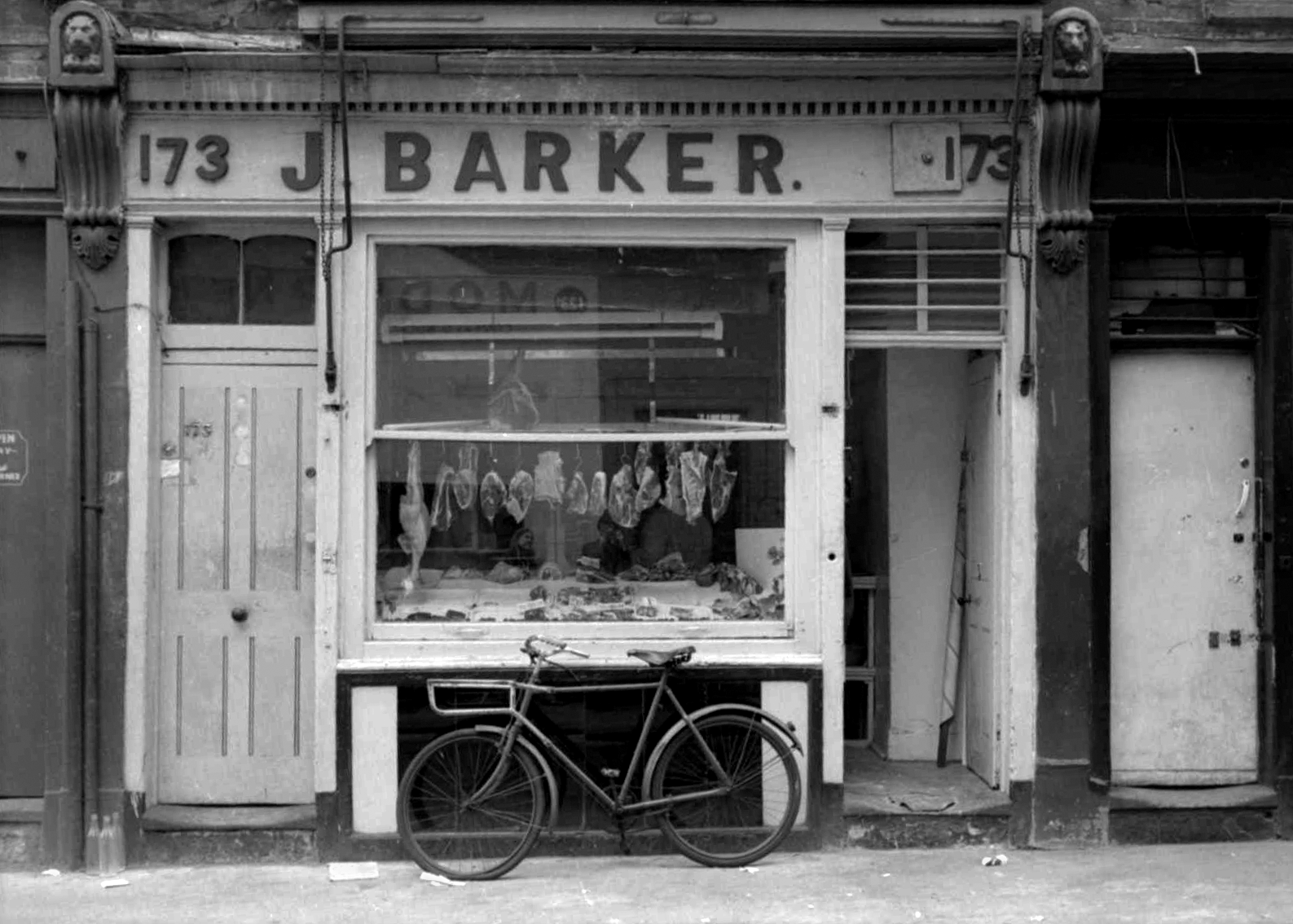
Click this picture to enlarge and see the reflection of Tony & Libby Hall in the window of J. Barker.

Children with their bonfire for Guy Fawkes


In the Hackney Rd

“I love the way these women are looking at Tony in this picture, they’re looking at him with such trust – it’s the way he’s made them feel. He would have been in his early thirties then.”


On the Regent’s Canal near Grove Rd


On Globe Rd

In Old Montague St

In Old Montague St

In Club Row Market

On the Roman Rd


In Ridley Rd Market

In Ridley Rd Market

In Artillery Lane, Spitalfields

 Tony & Libby Hall in Cheshire St
Photographs copyright © Libby Hall
Images Courtesy of the Tony Hall Archive at the Bishopsgate Institute
Libby Hall & I would be delighted if any readers can assist in identifying the locations and subjects of Tony Hall’s photographs.
You may also like to read
James Brown at W.F.Arber & Co Ltd

James Brown & Gary Arber
In the week before Christmas, I always want to go and visit my friend Gary Arber, the custodian of W.F.Arber & Co Ltd, the family printing business and former toy shop at 459 Roman Rd started by his grandfather in 1897. This year, James Brown furnished my excuse for a visit, as I accompanied him when he called round to present Gary Arber with the print of the famous green W.F.Arber shopfront which he has created as a tribute to this celebrated business where once the suffragettes’ handbills were printed in the basement.
James rang the bell and Gary emerged to greet us from behind a pile of boxes in his blue boiler suit that is subtly reminiscent of his former career as a flying ace. An experienced third-generation printer, Gary immediately pointed out the quoins on either side of the phrase “A PICTURE” and I think I noticed a barely-concealed sigh of relief from James when Gary gave the work his approval. We were informed that when Gary’s grandfather originally did the sign-writing in 1897, the number 459 flanked the name on both sides of the fascia but when Gary repainted it in 1947 and again last year, he found it sufficient to paint it just once, cocking a snook at the paltry demands of symmetry.
In former times, there would be queues outside W.F.Arber & Co Ltd at this time of year as East Enders lined up to collect the toys they had been saving for all year through the Christmas Club. Nowadays, Gary is able to enjoy peace and quiet in December since chain stores took the toy trade away. But he keeps the age-old posters for Triang and Scalextrics upon the counter and century-old wooden display cases for dolls still line the walls today, and he delighted to show us his nineteen fifties Mr Happy wallpaper in the former toy showroom at the back. Sometimes collectors come in to make Gary offers for his residual stock of toys and memorabilia, yet he wisely chooses to keep everything for his personal enjoyment.
One year, a thief broke in and stole a box of toys including a handsome train that had been in for repairs. When the box was recovered in an abandoned house nearby, the train was still there – but, by the time the police returned the box to Gary, the train was missing. Imagine Gary’s surprise when the Chief Constable’s son brought the train in for repair the next year and Gary recognised it from the serial number he scratched upon the inside of the case when it was first mended. Characteristically, Gary kept this information to himself until now, choosing instead to savour the knowledge that had been granted to him privately.
Do not make the foolish mistake of going to W.F.Arber & Co Ltd Printing Works and asking for printing, because Gary does not take on printing jobs. Instead, he keeps the business ticking over with a few sales of stationery while focussing upon his primary interest – that of maintaining the premises as a receptacle for stories. His big achievement this year has been the repair of the roof, creating another bulwark against the passage of time at his extraordinary shop. And it was my great delight make the call, deliver the print, present Gary Arber with the compliments of the season and know that all is well at W.F.Arber & Co Ltd.
James Brown’s “Arber & Co Ltd” is one of a series of screenprints of shopfronts currently displayed in his exhibition LOVE & WORK at the Town House, 4 Fournier St, Spitalfields until 23rd December.

James Brown’s print – “Writing is a picture of the writer’s heart.”

Gary Arber’s shopfront before the Olympics
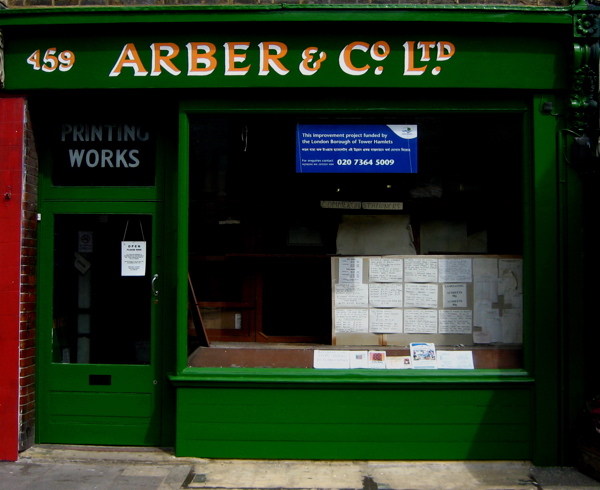
Gary’s Arber’s shopfront after the Olympics

My portrait of Gary Arber in the Comp Room at W.F.Arber & Co Ltd
You may like to read these other stories about W.F.Arber & Co Ltd
and
and
Colin O’Brien’s Pellicci Portraits (Part 3)
Contributing Photographer Colin O’Brien & I were back at E. Pellicci, 332 Bethnal Green Rd this week. Colin had ham, egg & chips and I had steak pie with mash, then we both finished it off with syrup pudding & custard. Yet somehow we also managed to fit in these portraits of the other diners at London’s best-loved family-run cafe, our fellow refugees from the frost outside.

Thomas Felton – “I come to Pelliccis a couple of times every week for a fry-up – especially when I have a hangover, like today.”

Giles Allen – “I’ve been coming to Pelliccis once a month for five years.”

Frankie Charles – “I’ve been coming to Pelliccis for twenty-five years. I’m local and I’ve been coming here all my life, I come every day when I can.”

Vicky Prior – “This is just my second time but I can see I’m going to become a regular.”

Samuele Mori & Elena Andreucci – “We are Maria Pellicci’s cousins and we just arrived from Tuscany.”

Edward Andrews – “I’ve been coming to Pelliccis nearly every day for thirty years.”

Helen Radia – “I live in North London and I first came to Pelliccis five years ago, so now I come every three or four weeks.”

Kevin Rowland of Dexy’s Midnight Runners – “I first came in here in the eighties.”

Ling Chang – “My second time at Pelliccis, I like it very much.”

Frank Østervold – “I’m a Norwegian from Bergen, so every time I am in London I come here. I work in the music industry and I’m a Tottenham fan.”

“Posh Malcolm” Browning – “My first time in here!”

Mr Mondo, also known as “Meatballs Dave” – “I come to Pelliccis for the social and the best chips in London. I’ve only been coming for two years but it feels like a lifetime – in a nice way…”

Rodney Archer – “I come to Pelliccis every Wednesday and Saturday. On Wednesday I am the gay mascot for the Repton Boxers and on Saturday we bet on the horses.”

Pauline Harris – “I’ve been coming to Pelliccis once a week for over forty years.”

Nevio Pellicci – “I started coming here on Saturdays when I was ten, and all the old folks would give me a pound and I’d go home loaded.”
Photographs copyright © Colin O’Brien
You may like to take a look at
Colin O’Brien’s Pellicci Portraits ( Part One)
Colin O’Brien’s Pellicci Portraits (Part Two)
and read these other Pellicci stories
Maria Pellicci, The Meatball Queen of Bethnal Green
and see these other Colin O’Brien stories
Colin O’Brien’s Clerkenwell Car Crashes
Colin O’Brien’s Kids on the Street
Travellers’ Children in London Fields
Colin O’Brien’s Brick Lane Market
Eleanor Crow’s East End Cafes

Syd’s Coffee Stall, Shoreditch High St
Illustrator Eleanor Crow made this set of watercolour portraits of cafes as a tribute to those cherished institutions which incarnate the essence of civility in the East End. “It’s because they’re individual concerns, often owned by families across generations who get to know all their customers,” admitted Eleanor, revealing the source of her devotion to cafe culture ,“I like the frontages because each is designed uniquely for that café with wonderful sign-writing or lettering and eye-catching colours. Some of these cafés have been here for a very long time and everyone in the area is familiar with them, and is very fond of them. They make the streets into a better place and are landmarks upon the landscape of the East End.”

E. Pellicci, Bethnal Green Rd

Savoy, Norton Folgate

Time for Tea, Shoreditch High St

Dalston Lane Cafe

Paga Cafe, Lea Bridge Rd

Lennies Snack Bar, Calvert Avenue

Marina Cafe, Mare St

Kingsland Cafe, Kingsland Rd

Grab & Go, Blackhorse Lane

Gina’s Restaurant, Bethnal Green Rd

Copper Grill, Eldon St

Billy Bunter’s Snack Bar, Mile End Rd

Beppe’s Cafe, West Smithfield

B.B. Cafe, Lea Bridge Rd

Savoy Cafe, Graham Rd

A.Gold, Brushfield St

Arthur’s Cafe, Kingsland Rd

Cafe Bliss, Dalston Lane

Cafe Rodi, Blackhorse Lane
 Rossi Restaurant, Hanbury St (Gone but not forgotten)

Eleanor Crow at E.Pellicci
Drawings copyright © Eleanor Crow
Portrait copyright © Colin O’Brien
You may also like to read
At Regis Cafe, Leadenhall Market
At Syd’s Coffee Stall, Shoreditch High St
The Return of David Power
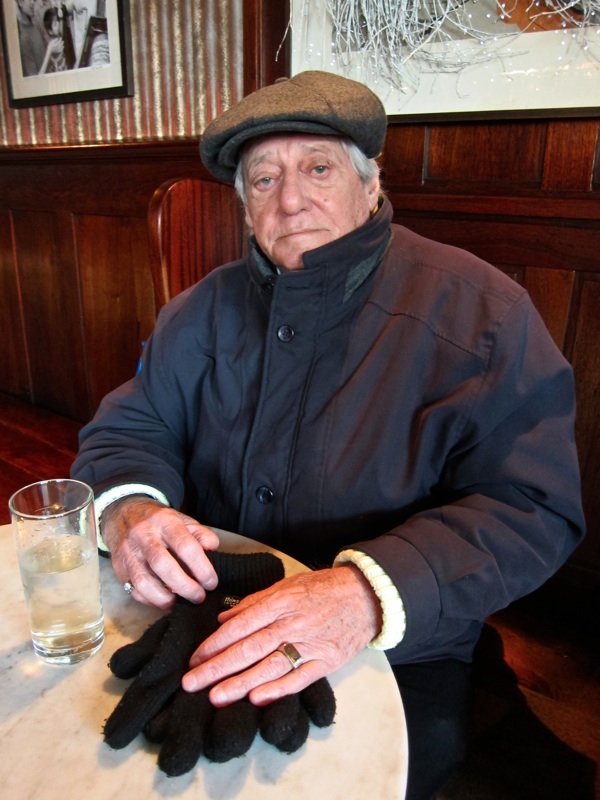
David Power at The Golden Heart where he played the piano in 1946
By chance, I bumped into David Power, the Showman & Ex-Musical Prodigy at the London Ex-Boxers Christmas shindig recently, where I had the pleasure of introducing him to Frances Mayhew of Wilton’s Music Hall. So yesterday, after he had paid a visit upon Frances at Wiltons to arrange a date for an evening of Music Hall in the spring for which he will be impresario and compere, David walked up from Wapping through the frost to Spitalfields for a celebratory drink with me by the fireside at The Golden Heart. “I was spellbound,” admitted David, in wonder at seeing Wilton’s for the first time, “I closed my eyes and expected to hear Burlington Bertie…”
David’s appearance at Wilton’s Music Hall marks his return to the East End as an entertainer for the first time since he performed in Spitalfields as a youth. “I played the piano in here when I was fourteen years old, in the nineteen forties just after the war.” he recalled, casting his soulful eyes around the empty barroom of The Golden Heart, “I had to wear a hat and a false moustache because I wasn’t old enough to go in a pub. I played Friday, Saturday and two sessions on Sunday, and I got a pound.”
“They mostly sold stout in them days and there were very few women in here. Instead, the men took their wives and mothers home a bottle of stout just to keep them quiet. The piano player had fallen ill and they heard me playing the piano from the window of my Aunt Sarah’s at 98 Commercial St. Now I loved my Aunt Sarah, but every word out of her mouth was swearing, while my Uncle Jimmy, he was the gentlest, mildest man you could imagine and my cousins were the same. Yet Aunt Sarah made up for the lot of them, she had more front than Tower Bridge.”
We braved the cold to revisit the doorstep of the notorious Aunt Sarah at 98 Commercial St and found her long gone. “It’s very difficult for me to explain to you, because it was a very tough life round here,” David confided to me with a grimace. “‘You’ve been with the kurwas?’ they used to ask,” he said, raising a significant smile as we entered the park next to Christ Church, known to David as Itchycoo Park, “That means you’ve been in here having sex on a gravestone with a prostitute.”
Crossing Commercial St, we entered Toynbee St passing the Duke of Wellington. “That’s where Stafford murdered his son, he got involved in slot machines,” David declared dryly, in passing, as we approached the former premises of Hymie the Barber. “All the stars used to come here for a shave and a haircut for a half crown,” he announced, “all the market boys.” Turning down Brune St, we crossed into the old market building where David started work at fifteen. He stood and scratched his head, surveying the chain restaurants and office workers doing their Christmas shopping, on the site where he was once employed in the fruit & vegetable market. “This place, years and years ago, it was alive,” he assured me, “People came from miles and miles around. At three o’clock in the morning it was buzzing, like a great theatre, and the cafes were open twenty-four hours a day. Most of those men were strong as lions.”
“I’m going back seventy years, I’ve never been back before,” David protested, in trepidation, as we walked down Commercial St, turning into Thrawl St in search of Faulkner St where he grew up. We found the buildings were gone and the street renamed Nathaniel Close. Similarly, in Old Montague St, where David’s grandparents lived there was no trace of the two-up-two-down cottages that he remembered. We stood amidst the chaos of the building works at the rear of the London Metropolitan University. “My grandfather, David Solomon, was the British Lightweight Bare-Fisted Boxing Champion,” David asserted, as if to conjure him into existence to spite the erasure of his world.
Seeking refuge from the chill, we entered a cafe in Middlesex St for hot mugs of tea, and within five minutes a woman came in and asked David, “How’s your cousin?” Thereby confirming the unexpected truth that even after all this time, the movements of people and the rebuilding of neighbourhoods, ties of kinship among East Enders do survive. David was heartened enough to order a sausage and tomato. “Whether it was good or bad, we didn’t know any different,” he ruminated, as he cut his sausage.“But I think you would have liked it, living in my time, in the nineteen fifties,” he conceded tenderly.
As we tucked in to our lunch, I realised we had been on an emotional journey together and I understood how it important it will be for David to perform in the East End for the first time, after all these years. “There’s going to be a lot of top professionals. I’ll get the TV down, they have nothing on for over forty-fives. All you see is murder and killing and X Factor, but there’s so much more talent out there.” he bragged, “We’ll have an opera singer and a Russian musical prodigy and a magician, and I’m going to get Roy Hudd.”
I was already looking forward to being at Wilton’s Music Hall next year and hoping you will be there with me to celebrate the triumphant return of David Power, the Showman.

Outside 98 Commercial St where David’s Aunt Sarah lived in the thirties and forties – “She had more front than Tower Bridge.”

In Itchycoo Park, “‘You’ve been with the kurwas?’ they used to ask…”

At the former premises of Hymie the Barber in Toynbee St -“All the stars came here, all the boys in the market.”

“My cousin Sammy Lissner stood here for seventy years on the corner of Wentworth St selling fruit & vegetables.”
Read my original profile


