
Clive Murphy, Up In Lights
[youtube rmQzAUbb1Tc nolink]
film by Sebastian Sharples
Originally published in 1980, Clive Murphy’s wonderfully candid account of Marjorie Graham – the chorus girl who fell upon hard times and became a lavatory attendant at the Metropole Cinema in Victoria – is to be republished by Pan Macmillan later this month. Simultaneously heartwarming and heartbreaking, Marjorie’s wit and resilient good humour in the face of the perils of show business life make this a compelling read.
In collaboration with our friends at Labour & Wait, we are proud to be hosting a tea party in celebration of Clive at the Bishopsgate Institute at 2pm on Saturday 25th May and we hope you will join us for what promises to be a sparkling literary event. Distinguished actress and Spitalfields resident Siân Phillips will be with reading selections from the book and Clive’s favourite lemon sponge will be served. Admission is free but capacity is limited, so we advise you to call 020 7392 9200 and reserve your ticket at once.
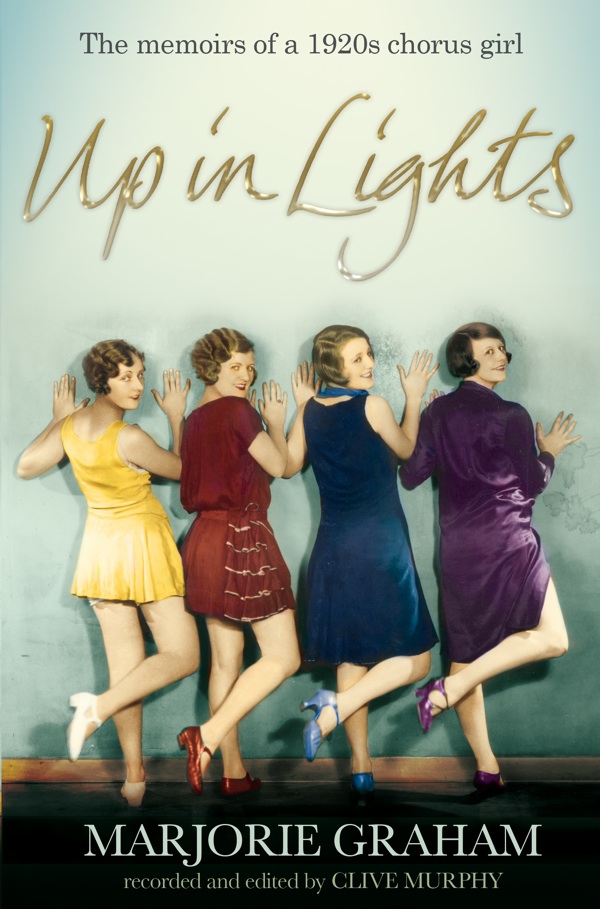
Clive Murphy recalls the creation of UP IN LIGHTS
“In September 1970, I finished recording the memoirs of a retired London lavatory attendant. He lived, with his wife Johanna, in the dank basement of a house in Pimlico where I’d rented a bedsitter.
Moving a year later to a bedsitter a few streets away, whom should I find living there in another dank basement, with her husband Jock, but Marjorie Graham, a retired female lavatory attendant, as happy to reminisce as her male predecessor.
Coincidence, Luck or Fate, call it what you will – by the end of 1973 I was ready to offer publishers my brace of memoirs which would make a fortune for all concerned. My attempts, though, to arouse interest were firstly rejected out of hand. One editor replied, ‘Write to us again when you’ve recorded an attendant that’s a hermaphrodite and we might publish them as a trio.’ Marjorie and her male counterpart were only taken on seven years later, along with other books I’d taped, by the publisher Dennis Dobson, to the delight, I’m glad to say, of many readers. The going had often been rough for me. A whole book per person takes more stamina than a short portrait . . .
Ronald Blythe wrote of Marjorie as a ‘dancing, easyish, drinking lady whose fate it was never quite to get through,’ reading her was ‘like eating meringues sprayed with “Evening in Paris.”’ Though he failed to mention her sparkle and her sense of fun in face of tragedy, I prefer John Betjeman’s enigmatic ‘deeply moving and authentic and compulsive reading. Her story has the full gloom of Tottenham Court Rd Underground Station and the precariousness of being alive. The lady is loveable indeed. My word what a good book.’
Sadly, Marjorie died of a heart attack aboard a bus in Victoria in 1974 before seeing her name up at least in literary lights. But now they are to be up – I hope she is looking down – in lights that are even brighter.”
Clive Murphy, 19th February 2013, Spitalfields

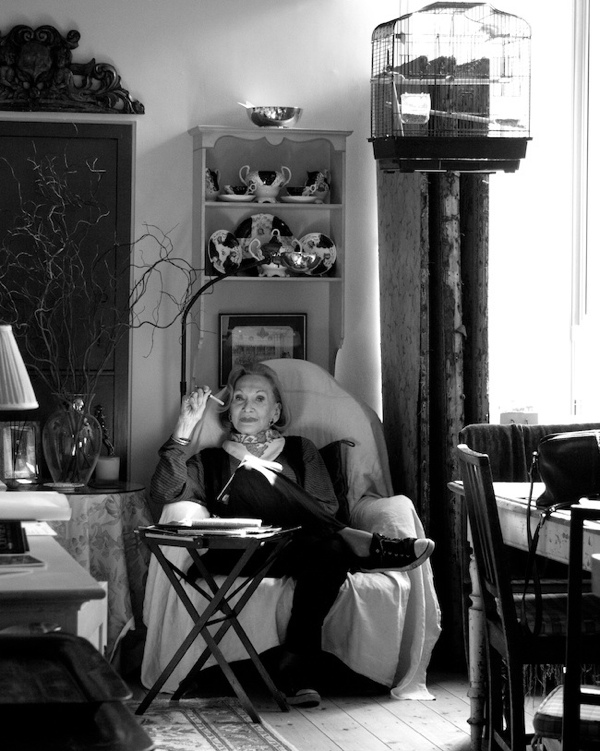
Sian Phillips, distinguished actress and Spitalfields resident, will be reading from “Up In Lights.”
Portrait of Sian Phillips © Lucinda Douglas-Menzies
You may like to read my other stories about Clive Murphy
At Jocasta Innes’ House

The first house I ever visited in Spitalfields was Jocasta Innes’. A quarter of a century ago I came here, one bitterly cold winter morning, with my friend Joshua Compston to visit Brick Lane Market, and it was an unforgettable adventure to step through the gate in the wall into the tiny courtyard and enter her secret enclave.
After all these years, the old house is unchanged but now Jocasta is gone – making it a poignant experience to return and photograph her home, recording the paint effects that became her speciality. Yet I was blessed with bright May sunshine and a welcome from Jocasta’s partner, the architect Sir Richard MacCormac, who graciously took me on a tour, revealing a few of the memories that this house contains for him.
“I remember when I first came to visit Jocasta after she moved in, in 1979. Only the top floor was habitable then and she was sitting upstairs typing her bestseller by the heat of a two-bar electric fire. That was ‘Paint Magic.’
Her decoration of the drawing room is inspired by Roman wall painting, She was incredibly well-read, she won an exhibition to Girton College Cambridge and she was imbued with the rigour of scholarship, that came from her mother who ran a little school and taught her daughters herself. There are three and a half thousand books in this house, including a great many cookbooks, and Jocasta had read all of them. When she wrote her ‘Country Kitchen’ the level of research was extraordinary, she learnt to make a smokehouse for curing herrings, how to make sausages and bake bread, but – with Jocasta – this knowledge was always presented with a jaunty attitude and a lightness of touch.
The pub next door was called The Romford Arms when Jocasta first came here and that’s where we met. In those days, the old residents of Spitalfields all wanted to get to Romford as soon as they could. It took a while for Spitalfields to recover. In ‘Ian Nairne’s London,’ he described it as ‘poor tottering Spitalfields.’ It was yet to be a cause for conservation and the Church Commssion were deliberating about demolishing Christ Church.
I bought part of the brewery next to the pub and another architect, Theo Crosby, had bought the other half, and Jocasta’s house was in the middle. She was sitting in the pub and I knew she detested architects, yet she pretended she didn’t know I was an architect. When I asked her what she was reading, she said ‘1001 Ways to do Without an Architect’ … and we lived together ever since.
She thought all architects were colour blind and to some extent she was right. We collaborated on the Ruskin Library at Lancaster University. She had read more Ruskin than I did, she appreciated his sonorous prose, whereas I had absorbed the idea that architecture could be imbued with a sense of time and memory. The interior of the library was lime-rendered in an ochre, and the archive itself was a big glass box coming up out of the floor, finished in polished red Venetian plaster. And that started off our collaboration. After that, we designed the exhibition ‘Ruskin, Turner & The Pre-Raphaelities’ at Tate Britain, using colour in a symbolic sequence throughout, and also “Surrealism, Desire Unbound’ at the same gallery in 2001.
In the days when Jocasta was restoring her house, my office was in Covent Garden and my supervising architect said, ‘You’ve got to come over to Spitalfields and see this. There’s this woman in a black and silver body suit up a step ladder with a blow torch, ordering men around!’ That was Jocasta. She was so brave, so dauntless.”

The exterior is lime wash on top of the brickwork using earth pigments.


The Drawing Room

In the Drawing Room, the walls are colour washed with a stencilled border and simple graining upon the door frame.


Jocasta’s Kitchen.

Jocasta’s dog Bella.


In the hallway and stairwell, trompe l’oeil Roman stone blocks above a splattered paint effect to evoke granite, with a checkerboard painted floor.


A mahogany wood-grained door on the right and concealed door to the left.


In the bedroom, the walls are loosely dragged and the tile effect in the fireplace is painted.

“There are three and a half thousand books in this house, including a great many cookbooks, and Jocasta had read all of them.”

Painted in Shanghai in the nineteen-twenties, a portrait of Jocasta’s mother who was of an Argentinian/Irish family.

Jocasta’s dog Bruno.
My thanks to Decorative Artist, Ian Harper, for specifying the paint effects.
You may also like to read about
The City Churches of Old London
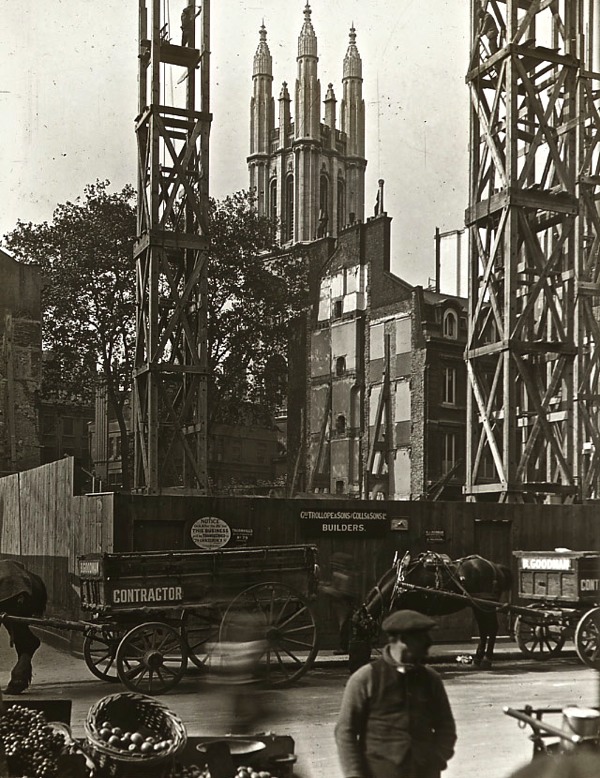
St. Michael, Cornhill, 1912
It was these murky glass slides of City churches (and a few nearby), taken for the London & Middlesex Archaeological Society a century ago and held in the collection at the Bishopsgate Institute, that inspired me to go out and take my own pictures of these same buildings last winter. Yet revisiting the old photographs, after I have taken my own, makes me acutely aware of how the cityscape around these curious architectural masterpieces has changed.
As shabby old residents that have survived from another age, the churches speak eloquently of an earlier world when the City of London was densely populated and dozens of places of worship were required to serve all the tiny parishes crowded up beside each other. Yet in spite of the encroachment of towers around them, these intricately wrought structures stubbornly hold their own against newcomers today.
In the process of getting to know them, I acquired a literary companion – John Betjeman, who knew these churches as well as anyone and was refreshingly candid in his opinions. While grieving the loss of seven Wren designs to the German bombers in World War II, he managed to find a silver lining.“They did us a favour in blowing out much bad Victorian glass,” he declared with unapologetic prejudice.
Yet I could not but concur with his estimation of the contemporary significance of these churches when he wrote – “As the impersonal slabs of cellular offices rise higher into the sky, so do the churches which remain in the City of London today become more valuable to us. They maintain a human scale…” And that was in 1965, before most of the financial towers were built.

St Mary le Bow, Cheapside, 1910

St Augustine, Watling St, 1921 – now part of St Paul’s School
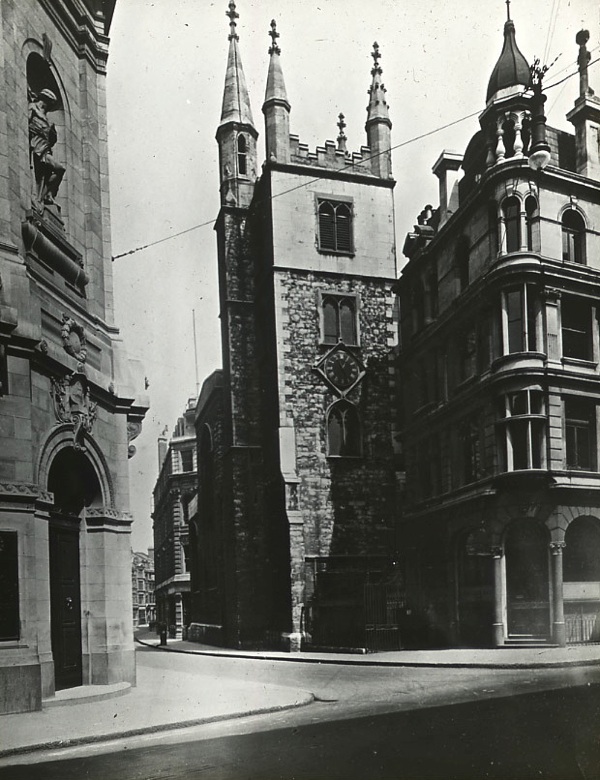
St Andrew Undershaft, St Mary Axe, c. 1910

St Mary Abchurch, c. 1910

St Margaret Patterns, Eastcheap, 1920
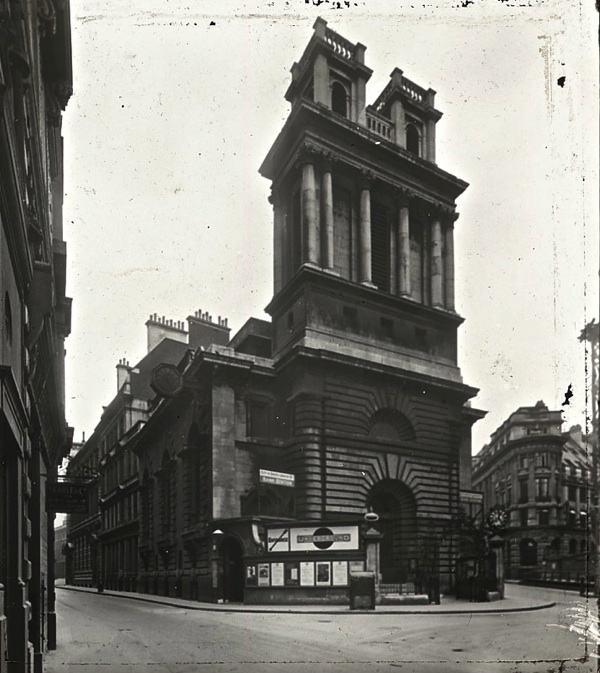
St Mary Woolnoth, Lombard St & Bank Tube station, c. 1920

St Stephen Walbrook, 1917

St Clement Danes, c. 1910

St Alban, Wood St, c. 1875 – only the tower remains

St Clement Danes, c. 1900

St Margaret, Lothbury, 1908

St George the Martyr, Borough, 1910

St. Katherine Coleman, Magpie Alley, c. 1910 – demolished in 1926

St. Magnus the Martyr, c. 1910

St Magnus the Martyr & the Monument from the Thames, c. 1920

St Dunstan in the East, 1910

St Dunstan in the East, 1910
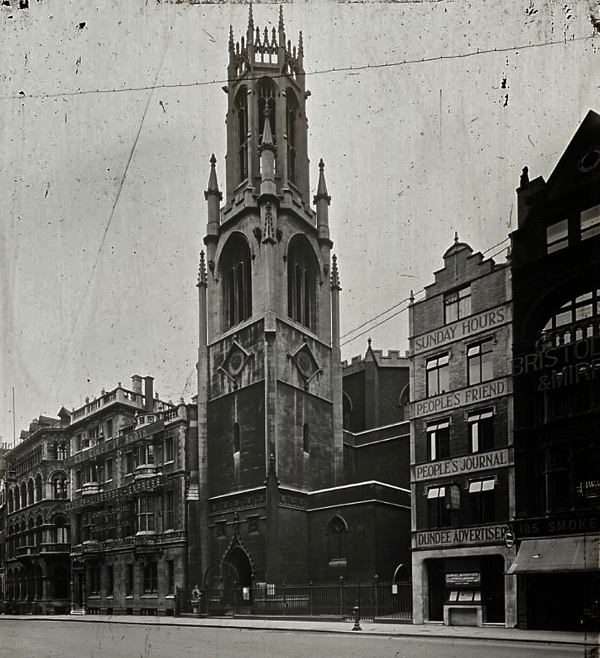
St Dunstan in the West, Fleet St, c. 1910

St. Michael Paternoster Royal, 1922
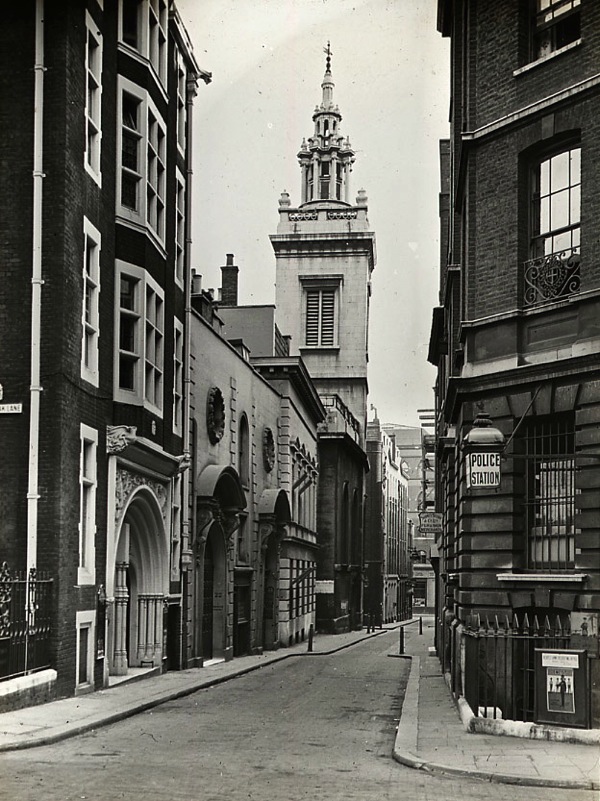
St. Michael Paternoster Royal, 1922

St. Michael Paternoster Royal, 1922

St Bride, Fleet St, 1922

St Dunstan in the East, 1911

St Mary Le Strand
Images copyright © Bishopsgate Institute
You may also like to take a look at my pictures of
and these other glass slides of Old London
The High Days & Holidays of Old London
The Fogs & Smogs of Old London
Blossom Time in the East End

In Bethnal Green
Let me admit, this is my favourite moment in the year – when the new leaves open fresh and green, and the streets are full of trees in flower. Several times, in recent days, I have been halted in my tracks by the shimmering intensity of blossom at its peak. And so, I decided to enact my own version of the eighth-century Japanese custom of hanami or flower viewing, setting out on a pilgrimage through the East End with my camera to record the wonders of this fleeting season that marks the end of winter incontrovertibly.
In his last interview, Dennis Potter famously eulogised the glory of cherry blossom as an incarnation of the overwhelming vividness of human experience. “The nowness of everything is absolutely wondrous … The fact is, if you see the present tense, boy do you see it! And boy can you celebrate it.” he said and, standing in front of these trees, I succumbed to the same rapture at the excess of nature.
In the post-war period, cherry trees became a fashionable option for town planners and it seemed that the brightness of pink increased over the years as more colourful varieties were propagated. “Look at it, it’s so beautiful, just like at an advert,” I overheard someone say yesterday, in admiration of a tree in blossom, and I could not resist the thought that it would be an advertisement for sanitary products, since the colour of the tree in question was the exact familiar tone of pink toilet paper.
Yet I do not want my blossom muted, I want it bright and heavy and shining and full. I love to be awestruck by the incomprehensible detail of a million flower petals, each one a marvel of freshly-opened perfection and glowing in a technicolour hue.

In Whitechapel
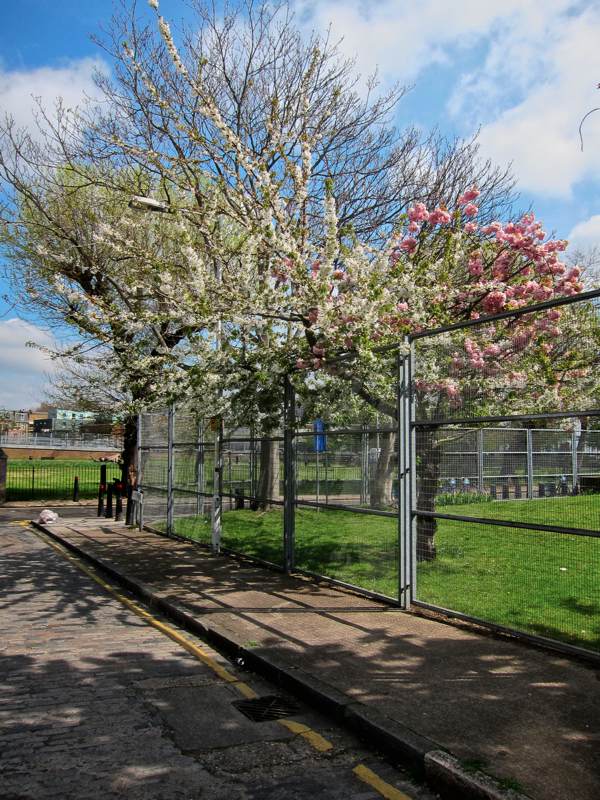
In Spitalfields
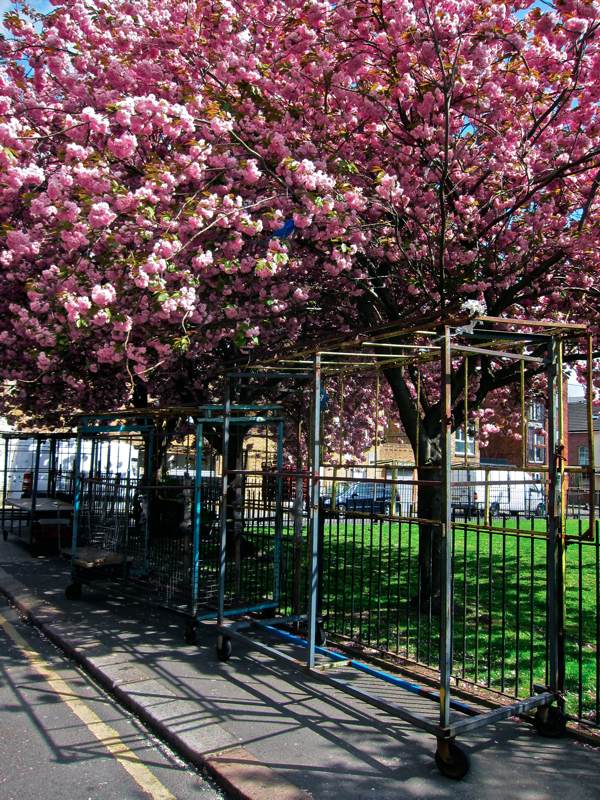
In Weavers’ Fields
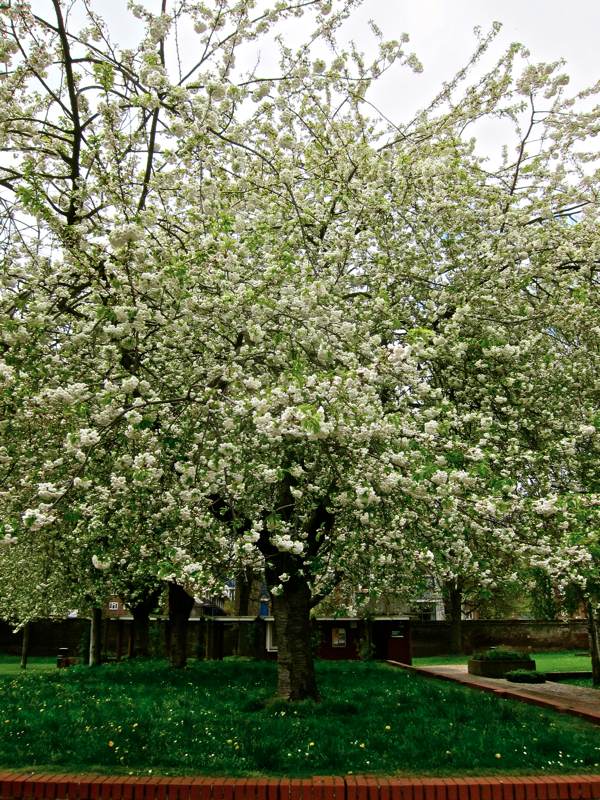
In Haggerston

In Weavers’ Fields
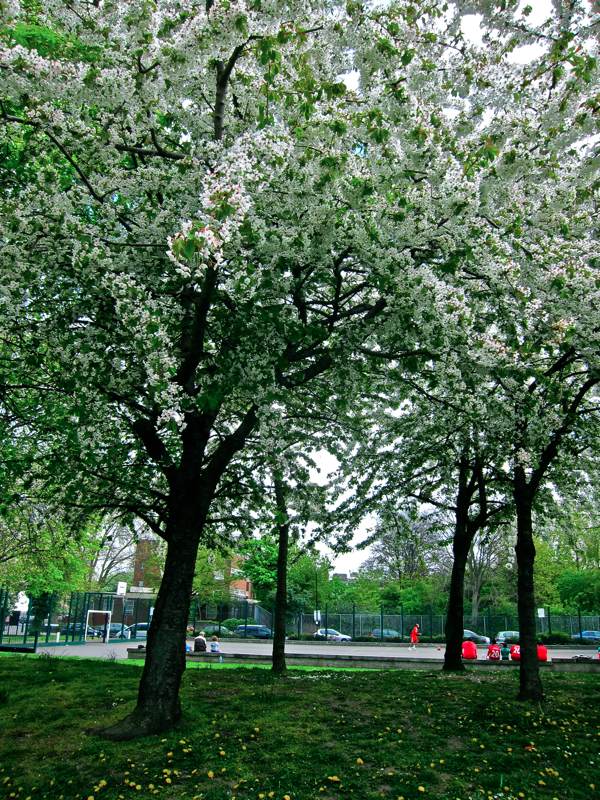
In Bethnal Green
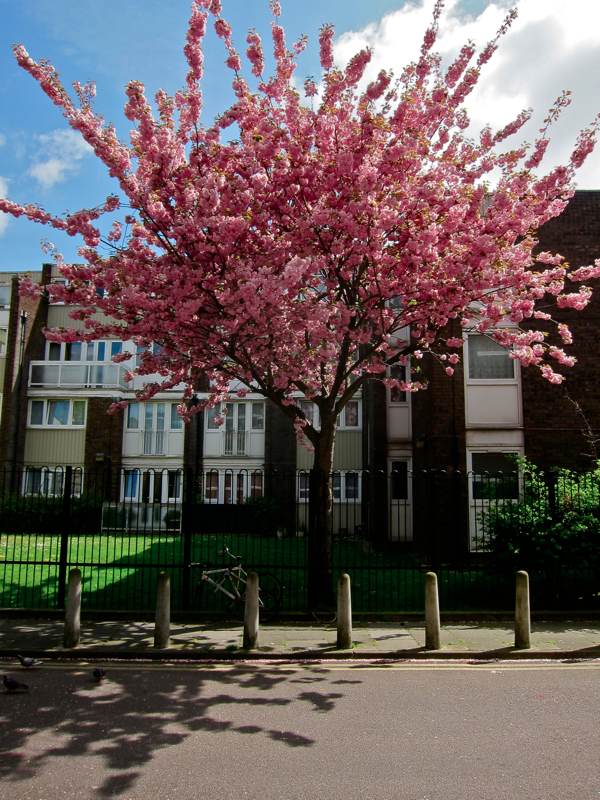
In Pott St

Outside Bethnal Green Library

In Spitalfields
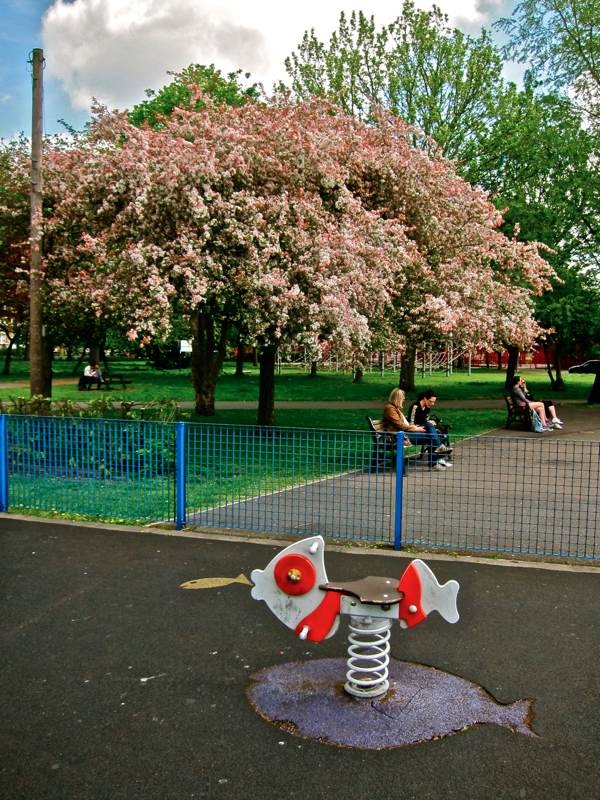
In Bethnal Green Gardens

In Museum Gardens

In Museum Gardens
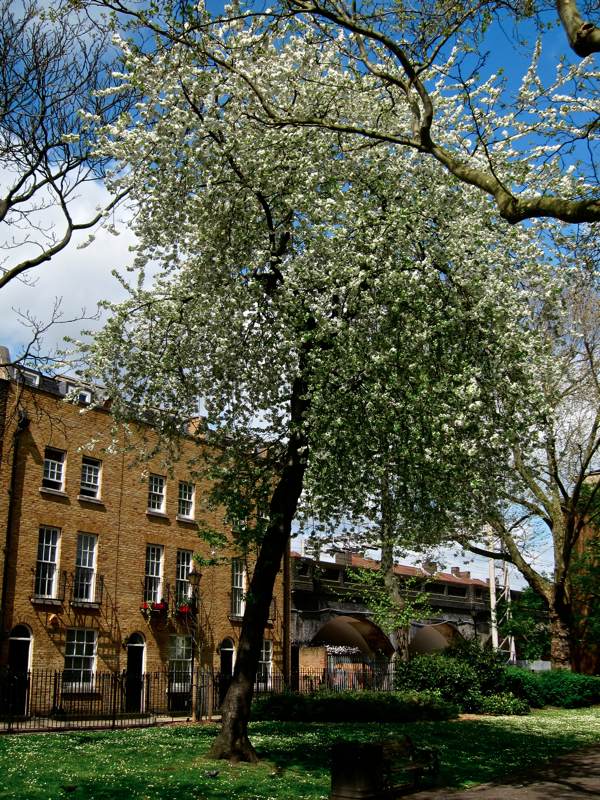
In Paradise Gardens

In Old Bethnal Green Rd
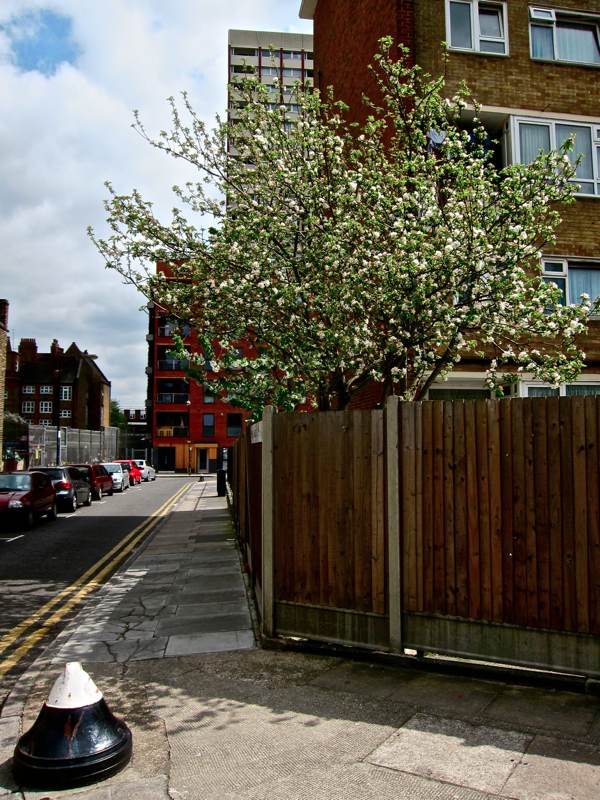
In Pollard Row
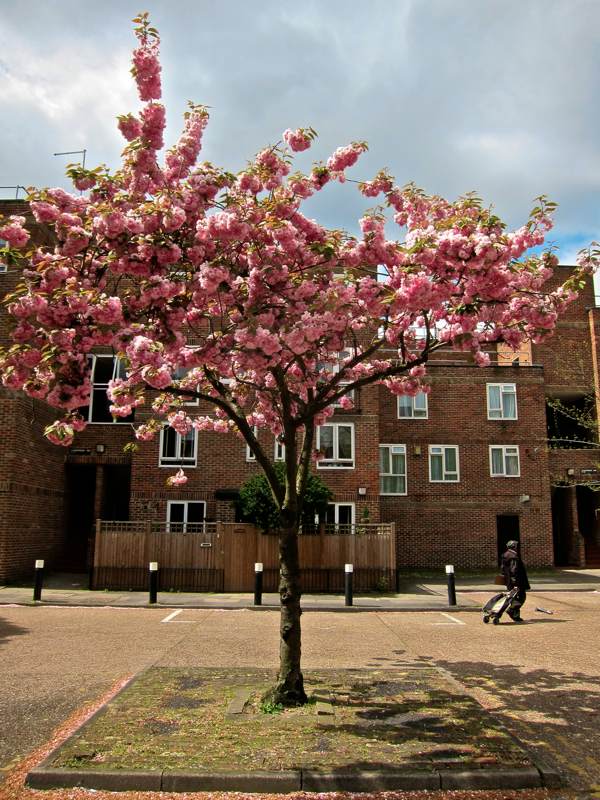
In Nelson Gardens

In Canrobert St

In the Hackney Rd
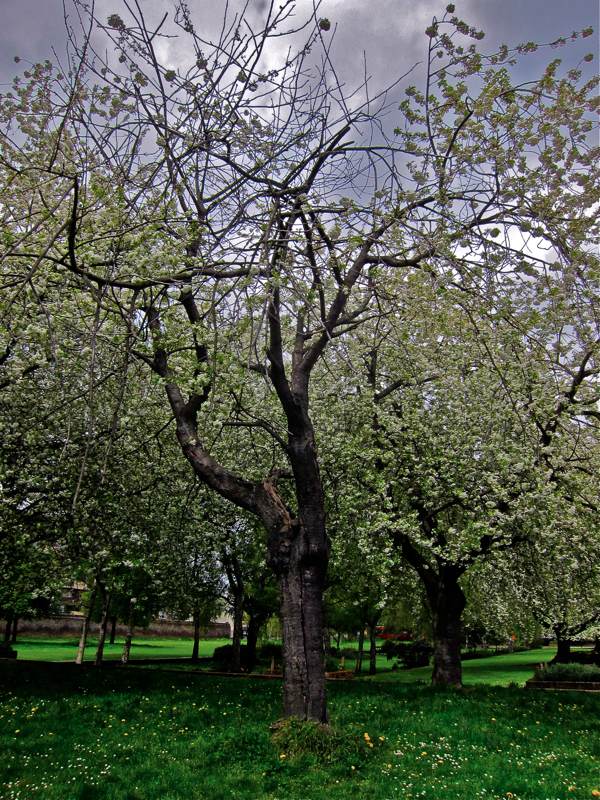
In Haggerston Park
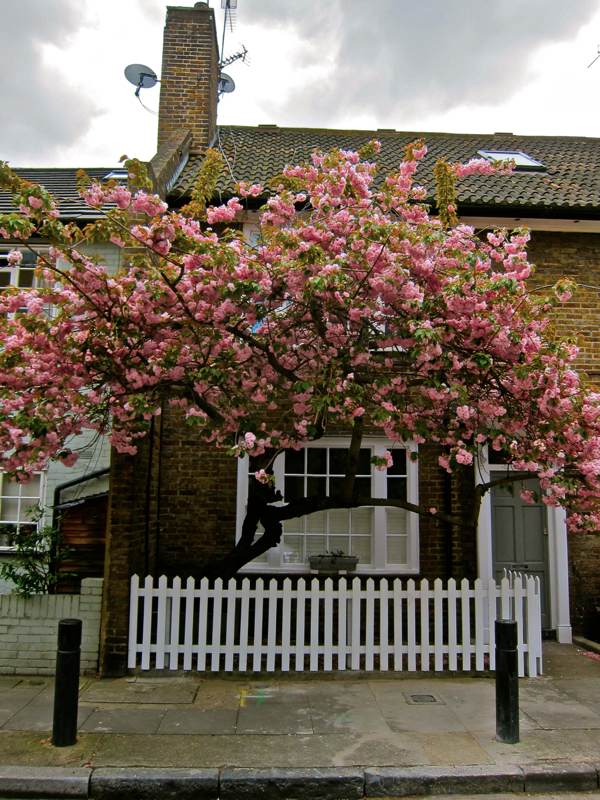
In Shipton St

In Bethnal Green Gardens

In Haggerston
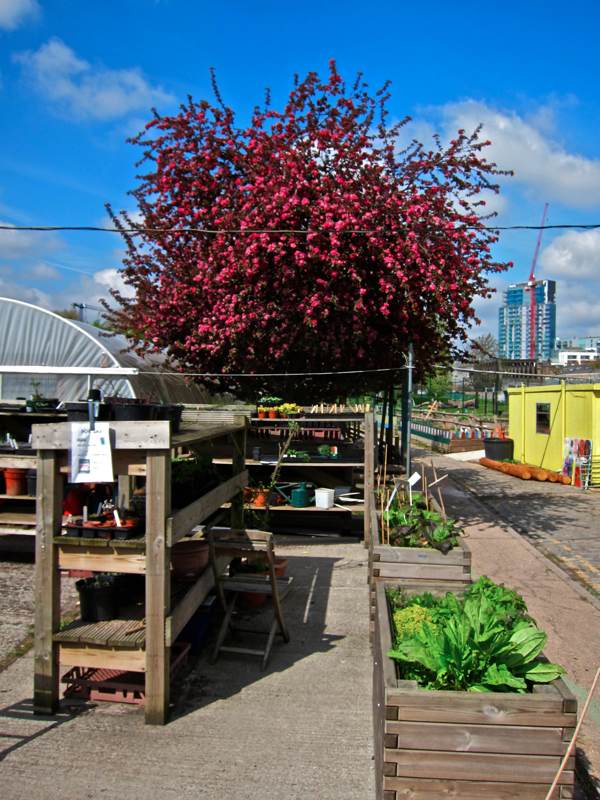
At Spitalfields City Farm
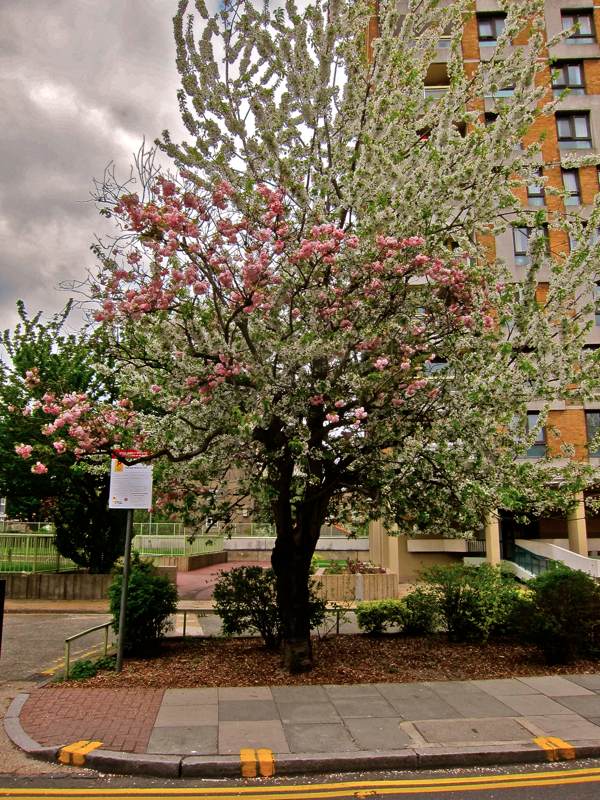
In Columbia Rd
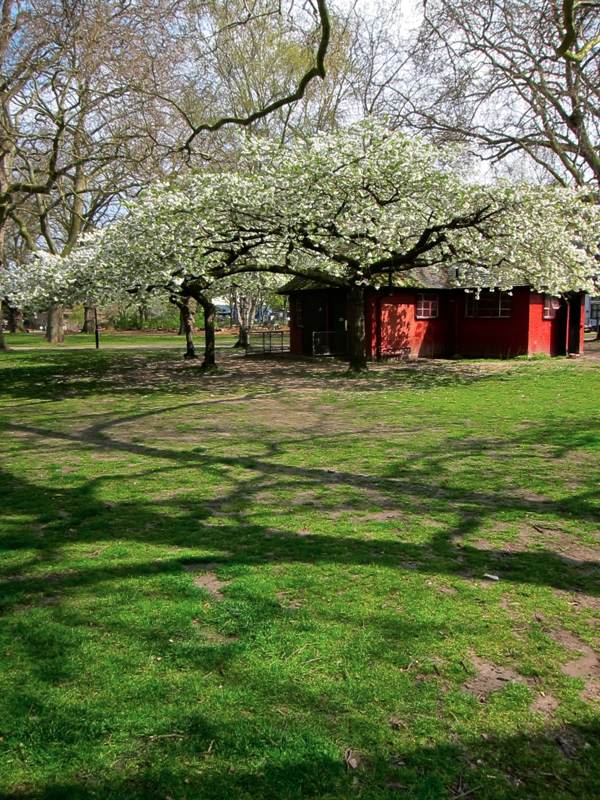
In London Fields
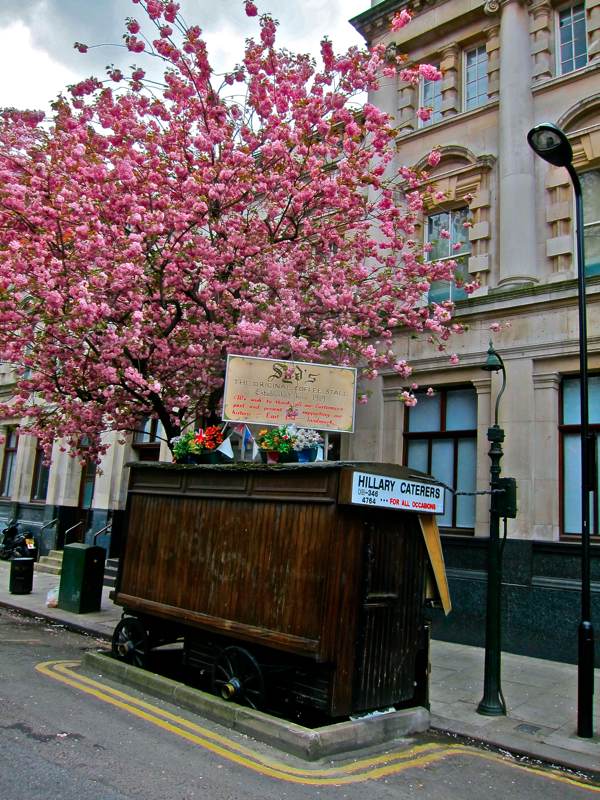
Syd’s Coffee Stall, Calvert Avenue
You may like to take a look back at
Clive Murphy, Exhibitionist
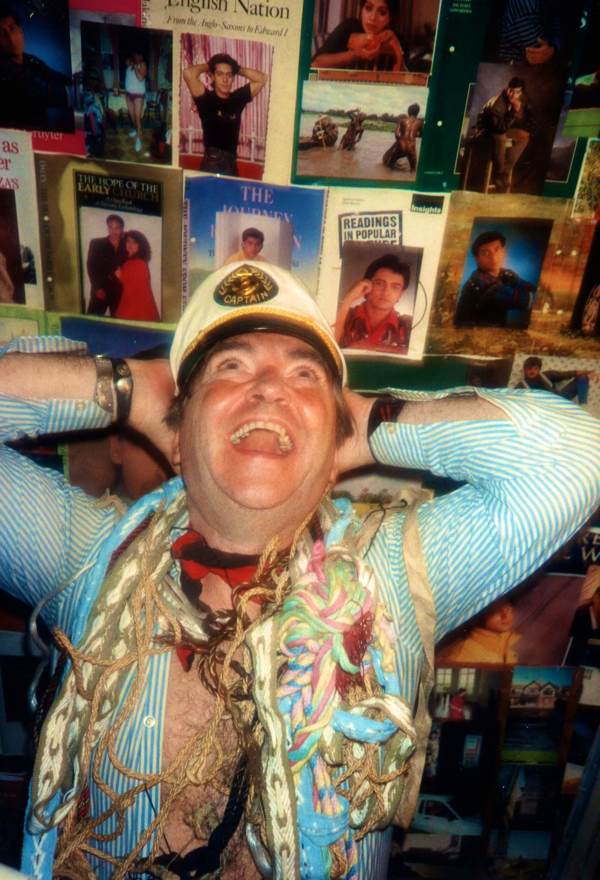
Clive plays the giddy goat, 30th September 1992
“I’m definitely up to mischief because I’ve got a bare chest, but who the photographer is I have no idea…” chuckled Clive Murphy, the celebrated novelist and oral historian, when I pulled this photo out of one of the more than one hundred and fifty albums of pictures he has taken, recording every intimate detail of his life in Spitalfields in recent decades.
Clive is an unapologetic and self-declared exhibitionist, though “only indoors and for one other person” he emphasised – just in case anyone gets the wrong idea.“I am an actor at heart and I just love playing for the camera,” Clive continued, “Unfortunate guests get asked, ‘Would you mind if I dress up and you take my photo?'”
These photographs permit us to participate in the private drama of Clive Murphy’s imaginative world, contained within the two crowded rooms above the Aladin curry house on Brick Lane where has lived since 1973. One of Spitalfields most charismatic interiors, it has become crammed with pictures, papers and mementos of the passing years, until today you can barely get in the door. Assuming alternative identities is in the nature of a novelist and in Clive’s photographs we see it made manifest, in images that record the early stages of accumulation in his famous flat.
“I thought all these pictures had gone to landfill, but I see some escaped,” admitted Clive, referring to the many hundreds of photographs of him in his underpants which he resigned to the recycling bin at the time of transferring his personal archive to the Bishopsgate Institute earlier this year. “I am a pants and beachwear fetishist,” he confided to me, as if any explanation were necessary for his compulsive “dressing down” in front of the lens. Yet those pictures will remain an eternal enigma in the cultural history of Spitalfields and instead we must content ourselves with these playful shots of Clive dressing up.
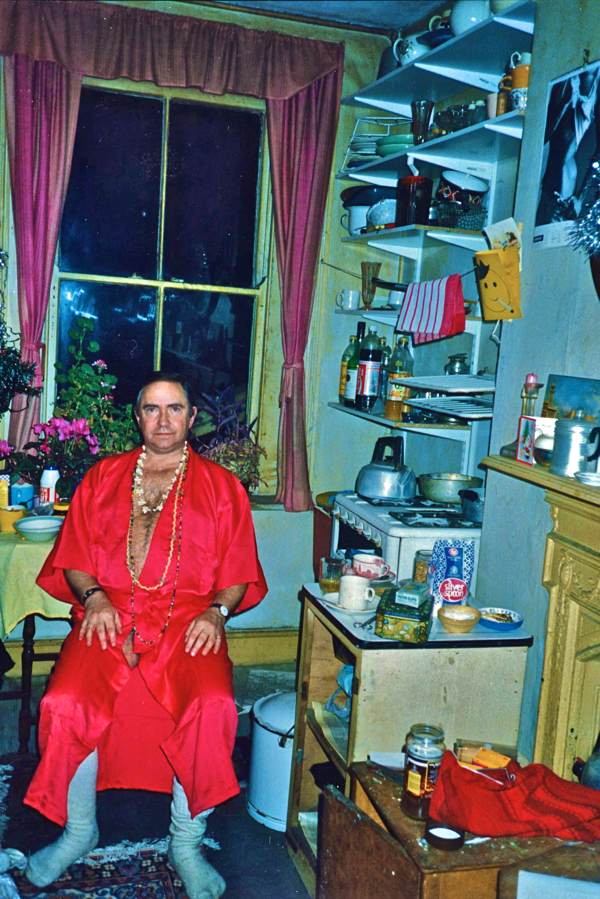
22nd December 1991, picture by Mr Gaffar. “Observe how ornate I am with two necklaces and a bangle. and those aren’t socks, they’re stockings…”
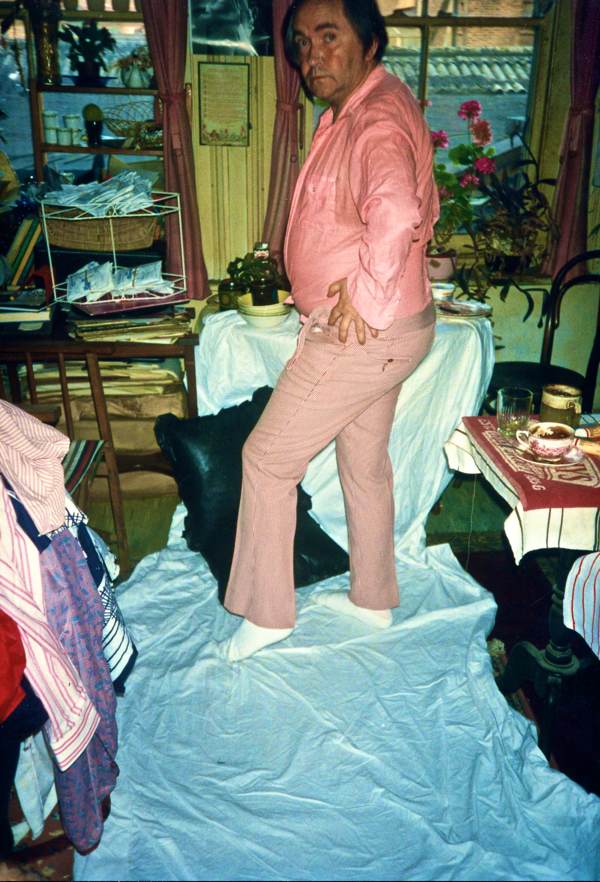
21st May 1992, picture by Billy Ranoo. “Look at the hand on the hip , I’ve put down a sheet on the kitchen floor and put those black cushions there for the picture.”
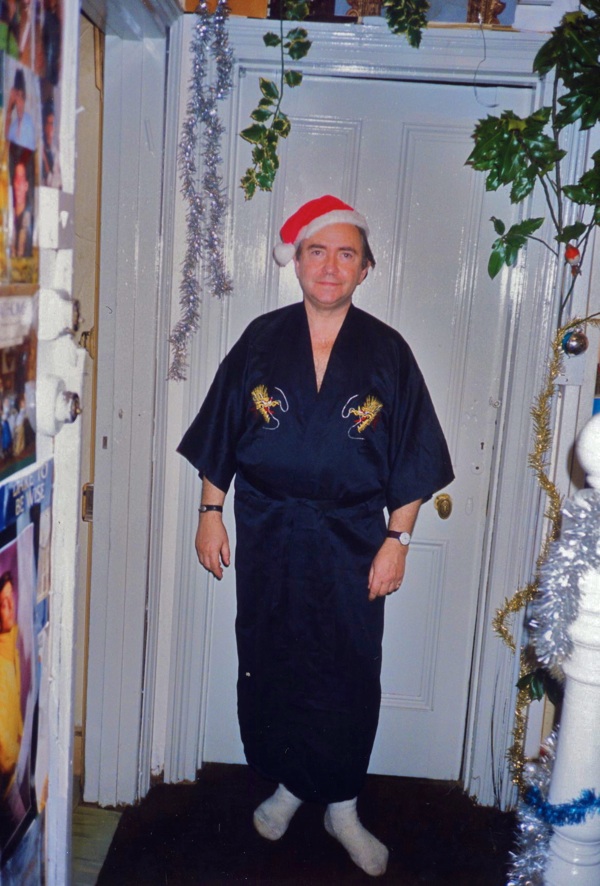
22nd December 1991, picture by Mr Gaffar. “I’m wearing one of several dressing gowns. I like dressing gowns and robes, but it must have been freezing with only my underwear and socks on underneath.”
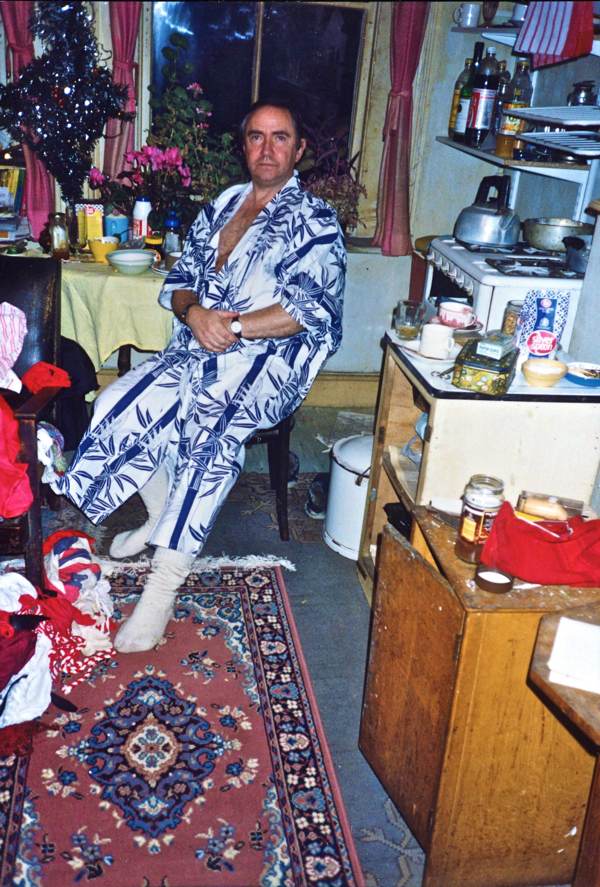
22nd December 1991, picture by Mr Gaffar. “This was in my kitchen when it had a decent carpet. I’m rather pleased to see I had a tan in those days.”
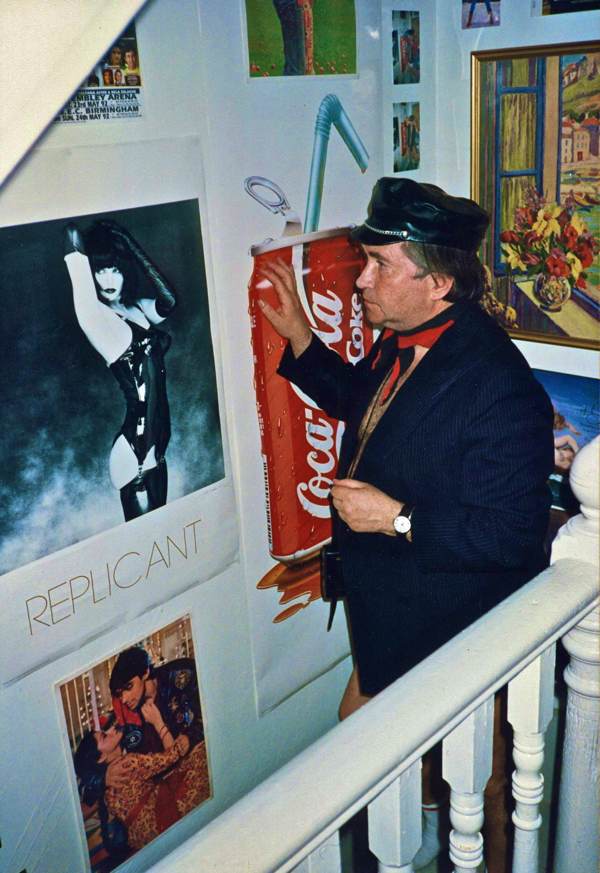
21st May 1992, picture by Billy Ranoo. “I like this picture very much because it makes me look macho and interesting.”
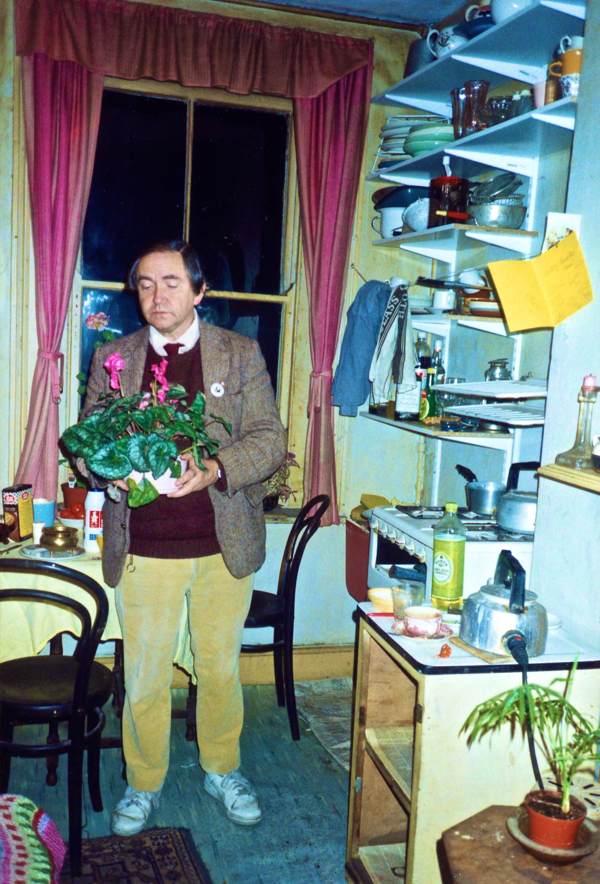
27th November 1991, admiring cyclamen in an aesthetic manner. “Just to show I do dress normally sometimes.”
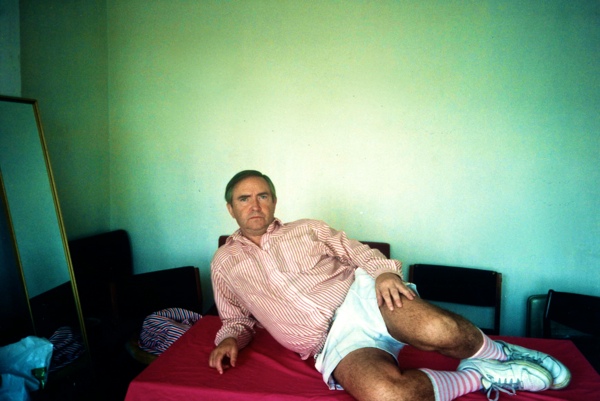
21st August 1992 “I was upstairs and we rearranged the furniture for the photo. It may be taken in the card room above my flat where my landlord let his pals play cards.”
Photographs courtesy of the Clive Murphy Archive at the Bishopsgate Institute
You may like to read my other stories about Clive Murphy
Clive Murphy’s oral histories are available from Labour and Wait
and his ribald rhymes are available from Rough Trade
The Statues & Effigies of Old London
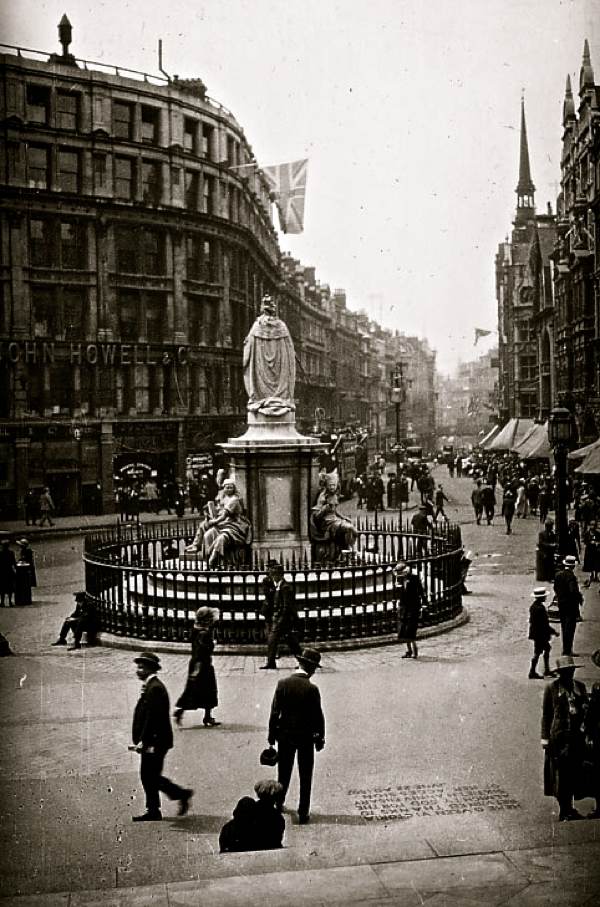
Queen Anne gazes down Ludgate Hill eternally
Do you ever get the feeling you are being watched from above? That there is a silent figure observing from a strategic vantage point? Many of the statues and effigies of old London – as photographed a century ago by the London & Middlesex Archaeological Society for magic lantern shows at the Bishopsgate Institute – are so familiar as to be invisible to the casual passerby, but they have got their eyes on you.
Over the years, they have seen everything from their plinths – riots and marches, weddings and funerals, bombs and parties, war and peace, tourists and commuters. With frozen postures and implacable composures, the statues and effigies have no choice but to carry on watching – growing infinitely wise and eternally bored.
Gods, monarchs, Nelson & Wellington, and Victorian worthies alike, after all this time, many are shorn of the details of their original significance, exchanging it for a simpler heroism derived from the longevity of their images. The statues and effigies of London are the oldest residents of the streets, and – over time – these familiar weathered stone and bronze figures have become universally appreciated for their usefulness as memorable landmarks and fond embodiments of the places they inhabit.
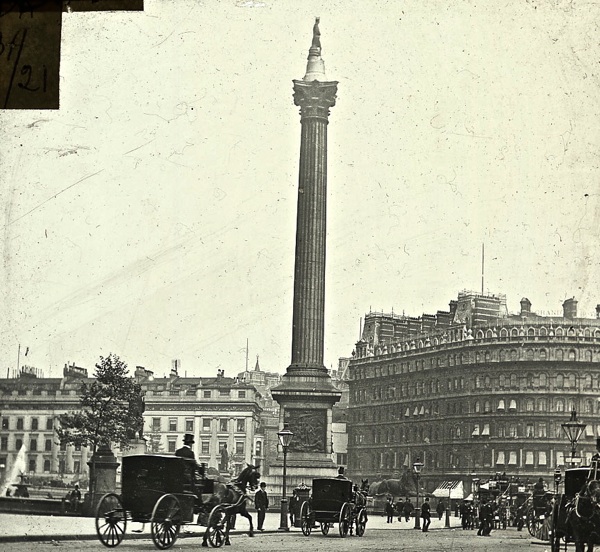
Nelson’s Column in Trafalgar Sq, c. 1910

Achilles in Hyde Park, c. 1910

Prince Albert, c. 1910

Alfred the Great in Trinity Sq, Southwark, c. 1910

Charles II, c. 1910

Caroline of Brunswick, c. 1910
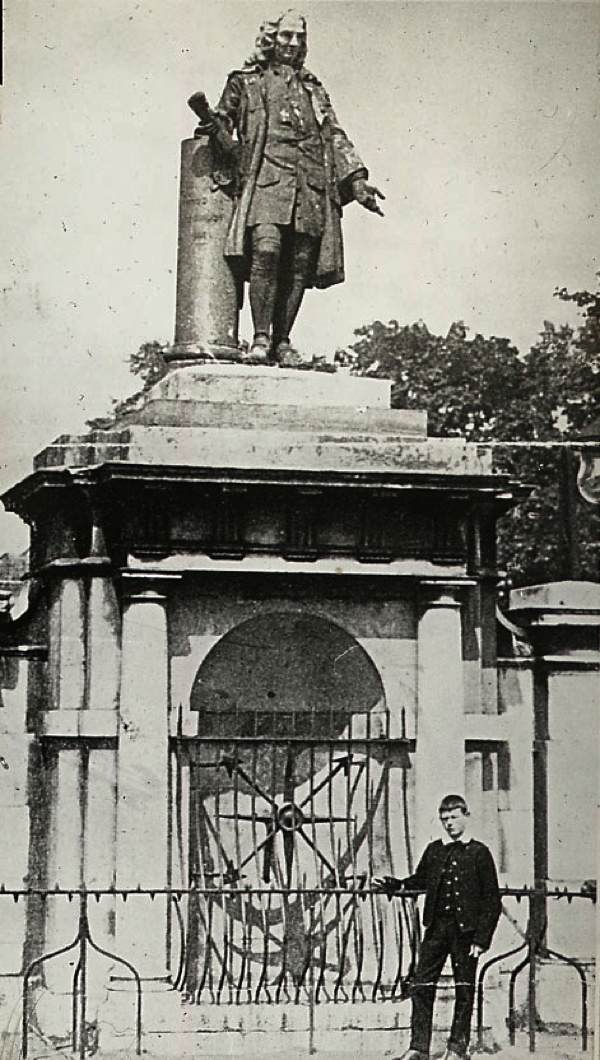
Thomas Coram, c. 1910

Charles Darwin in the Natural History Museum, c. 1910

John Franklin, c. 1910

General Gordon in Trafalgar Square, c. 1910

Crimean Memorial, c. 1900

Rowland Hill in King Edward St, c. 1910

Capt Maples at Trinity Almshouse, Mile End Rd, c. 1920

Gog at the City of London Guildhall, c. 1910 – note the box camera caught in the left corner of the frame

Magog at the City of London Guildhall, c. 1910

Richard the Lionheart in Palace Yard, c. 1910

Sir Hans Sloane in Apothecaries’ Gardens, Chelsea, c. 1920

Temple Bar, Fleet St, c. 1870

Queen Anne at St Paul’s Cathedral, c. 1920

James II, c. 1910

House of Parliament, St Stephen’s Hall, c. 1920

One of Landseer’s lions at the base of Nelson’s Column, c. 1910

George Peabody, c. 1910

Peter Pan in Kensington Gardens, c. 1915

Physical Energy in Kensington Gardens, c. 1910

Duke of Wellington, c. 1910

Wellington Arch at Hyde Park Corner, c. 1880

Duke of York’s Column at Waterloo Place, c. 1900
Images copyright © Bishopsgate Institute
You may also like to take a look at
The High Days & Holidays of Old London
The Fogs & Smogs of Old London
In the Company of Mr Pussy
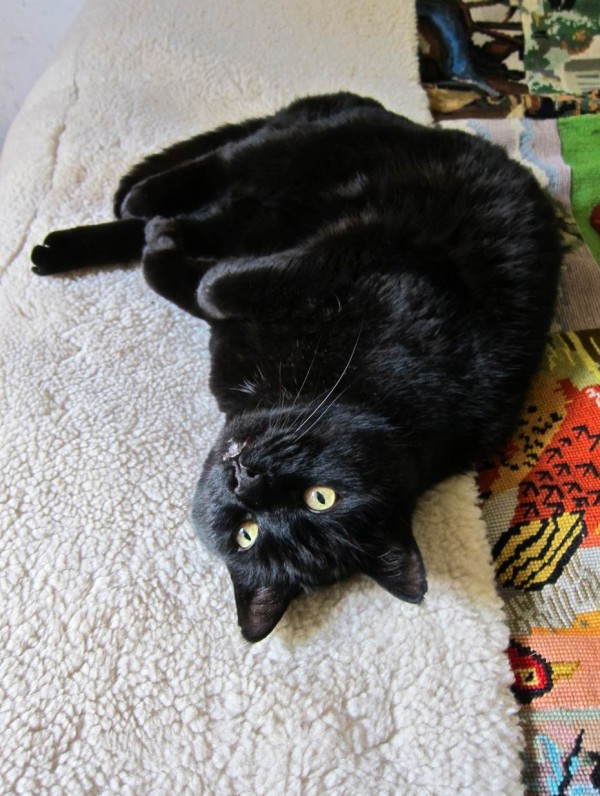
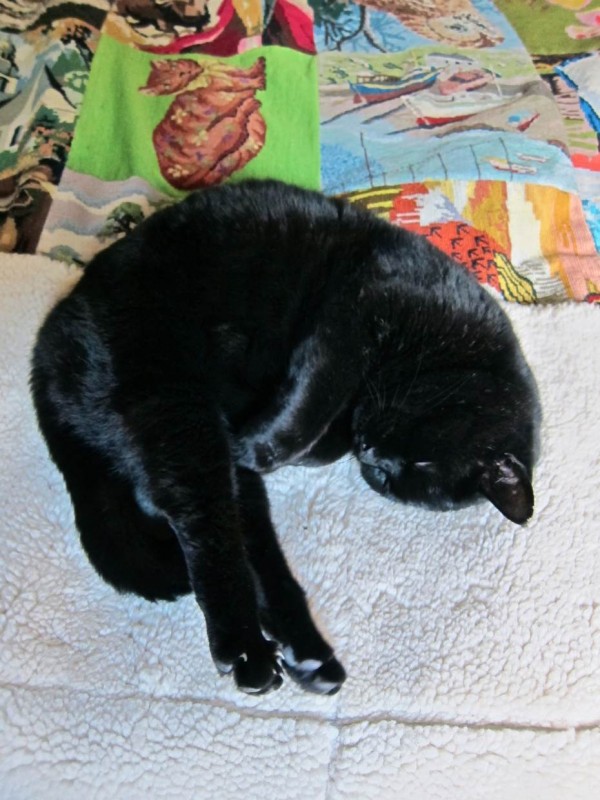
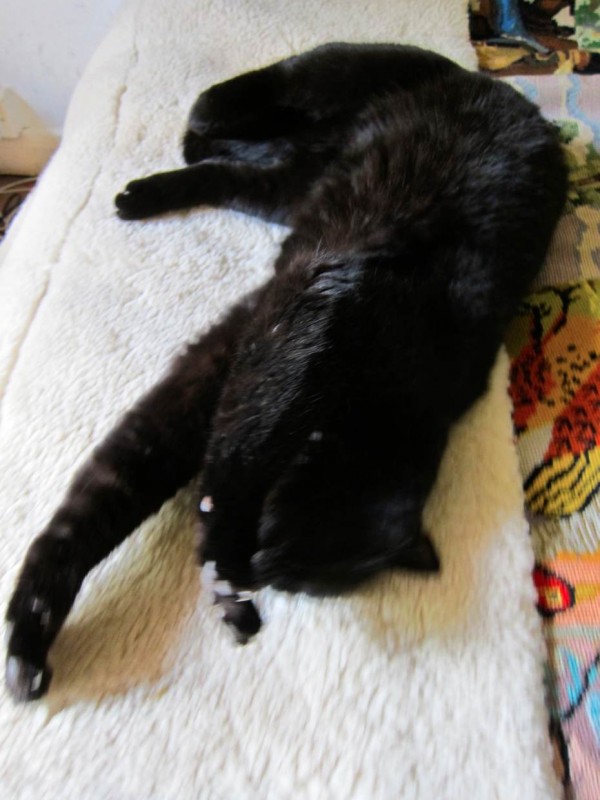
Unless I am out on the streets pursuing the subjects of my interviews, I spend most days of the week alone in the house with my old cat, Mr Pussy. When I am sitting writing, he likes to doze and thus offers undemanding company, savouring the quietude that reigns while I am composing my sentences. If I am working in bed, he will curl up on the covers so that I can just feel his weight pressing against my leg. If I am writing at my desk, he will perch upon an old stool with a seat woven of straw, attendant like a loyal secretary. If I am sitting beside the stove for warmth late at night, he will stretch out upon the bare floor to his greatest extent, until he resembles an animal skin rug.
A modest creature, he draws pleasure from my company and I am always flattered that he seeks me out to rest nearby. He does not draw attention to himself – just the occasional shrill exclamation upon entering the house to announce his return and sometimes a gentle tap of the paw upon my leg, as a reminder, should I neglect to fill his dish. At mealtimes, he commonly positions himself at my feet as I settle in the wing chair to eat my dinner, tracing the air with his nose to ascertain the menu. Yet he is rarely insistent and, if I grant him a morsel or permit him to lick the plate, he will do no more than taste, since he is curious rather than greedy and his concern is not to satiate his appetite but to feel included.
Even if others are around, it is in the nature of writing that it is a solitary activity. A connoisseur of stillness and a creature of tact, Mr Pussy understands this instinctively. He lounges in a silent reverie while I am working, before falling asleep and snuffling quietly to himself. During these long afternoons of contemplation, if I should lose concentration upon the task in hand, my thoughts often turn to my mother and how the pattern of my day has come to reflect hers. Once she had finished the housework, she delighted to sit for hours reading a novel just as I settle down to write once the day’s errands are accomplished – each of us enjoying the company of a cat.
I remember vividly how, when she was dying, she sought to make a reckoning of her life. My mother was insistent that I must have no doubt of her love for me and of my father, forgiving his volatile nature that had coloured the happiness of their marriage. “He couldn’t help it,” she admitted to me with a distracted frown. And then, quite unexpectedly, referring to the grey tabby that was my childhood pet, she said, “And the cat, she helped me, she was always with me.” In that moment, I recalled how the creature followed her around each day as she did the housework which caused her such anxiety and I remembered how, returning from school, I found her once cradling it as she wept for her loneliness. When the beloved animal expired, she vowed never to have another, such was the depth of her attachment.
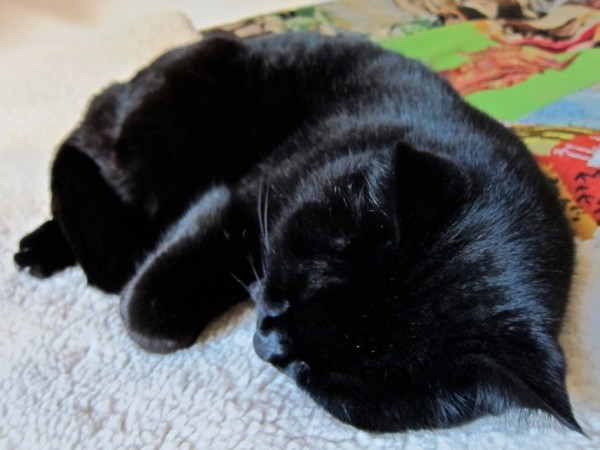
Yet, after my father died, I acquired a black kitten in Mile End and presented it to her as a distraction from her grief. And thus, in my mother’s company, Mr Pussy grew accustomed to the afternoon routine, the empty house and the presence of one silently absorbed. Thus, when the cat and I are all alone now in the stillness of the middle of the day, it is as if time stops. My mother’s placid nature moulded his behaviour and, years after she died, his habits are the same. Mr Pussy seeks me out each afternoon to share the passage of the hours before nightfall and I acquiesce, thankful for the peace that prevails in his company.
You may also like to read
and take a look at
The Cats of Spitalfields (Part One)












