
Samuel Pepys in Spitalfields, 1669
Contributing Artist Paul Bommer sent me this sly drawing, envisaging Samuel Pepys’ visit to Spitalfields, three hundred and forty-four years ago today.

Up and to the Office, and my wife abroad with Mary Batelier, with our own coach, but borrowed Sir J Minnes’s coachman, that so our own might stay at home, to attend at dinner – our family being mightily disordered by our little boy’s falling sick the last night, and we fear it will prove the small-pox.
At noon comes my guest, Mr Hugh May, and with him Sir Henry Capell, my old Lord Capel’s son, and Mr. Parker, and I had a pretty dinner for them, and both before and after dinner had excellent discourse, and shewed them my closet and my Office, and the method of it to their great content, and more extraordinary, manly discourse and opportunity of shewing myself, and learning from others, I have not, in ordinary discourse, had in my life, they being all persons of worth, but especially Sir H. Capell, whose being a Parliament-man, and hearing my discourse in the Parliament-house, hath, as May tells me, given him along desire to know and discourse with me.
In the afternoon, we walked to the Old Artillery-Ground near the Spitalfields, where I never was before, but now, by Captain Deane’s invitation, did go to see his new gun tryed, this being the place where the Officers of the Ordnance do try all their great guns, and when we come, did find that the trial had been made – and they going away with extraordinary report of the proof of his gun, which, from the shortness and bigness, they do call Punchinello. But I desired Colonel Legg to stay and give us a sight of her performance, which he did, and there, in short, against a gun more than twice as long and as heavy again, and charged with as much powder again, she carried the same bullet as strong to the mark, and nearer and above the mark at a point blank than theirs, and is more easily managed, and recoyles no more than that, which is a thing so extraordinary as to be admired for the happiness of his invention, and to the great regret of the old Gunners and Officers of the Ordnance that were there, only Colonel Legg did do her much right in his report of her.
And so, having seen this great and first experiment, we all parted, I seeing my guests into a hackney coach, and myself, with Captain Deane, taking a hackney coach, did go out towards Bow, and went as far as Stratford, and all the way talking of this invention, and he offering me a third of the profit of the invention, which, for aught I know, or do at present think, may prove matter considerable to us – for either the King will give him a reward for it, if he keeps it to himself, or he will give us a patent to make our profit of it – and no doubt but it will be of profit to merchantmen and others, to have guns of the same force at half the charge.
This was our talk – and then to talk of other things, of the Navy in general and, among other things, he did tell me that he do hear how the Duke of Buckingham hath a spite at me, which I knew before, but value it not: and he tells me that Sir T. Allen is not my friend, but for all this I am not much troubled, for I know myself so usefull that, as I believe, they will not part with me; so I thank God my condition is such that I can retire, and be able to live with comfort, though not with abundance.
Thus we spent the evening with extraordinary good discourse, to my great content, and so home to the Office, and there did some business, and then home, where my wife do come home, and I vexed at her staying out so late, but she tells me that she hath been at home with M. Batelier a good while, so I made nothing of it, but to supper and to bed.
Tuesday 20th April, 1669
Illustration copyright © Paul Bommer
Paul Bommer’s work can be seen at Pick Me Up Somerset House, from today until 28th April.
You may also like to take a look at
Kate Parry Frye’s Suffrage Diary
Elizabeth Crawford, bookdealer and writer specialising in the Women’s Suffrage Movement, reveals how she discovered Kate Parry Frye’s Suffrage Diary, telling the forgotten story of one woman’s contribution to the campaign for Votes for Women which took place in the East End a century ago.

Kate Parry Frye (1878-1959)
Operating from 321 Roman Rd, Sylvia Pankhurst’s ‘East London Federation of Suffragettes’ is the most famous of the groups in the East End who backed George Lansbury, the Labour MP, when he resigned his Bromley & Bow seat to fight a by-election on the ‘Votes for Women’ issue in the autumn of 1912. Yet, also knocking on doors and holding meetings was the ‘New Constitutional Society for Women’s Suffrage’ about which very little was known, until now.
In 1912, the diarist, Kate Parry Frye, was out on the streets of Bow canvassing for Lansbury and she also took part in a short, sharp Whitechapel campaign, a year later. Her voluminous diary has only recently come to light, replete with an archive of associated ephemera, recording her efforts to convert the men and women of Southern England to the cause of ‘Votes for Women.’ Her diary entries, written while she was a paid organiser for the Society, bring to life what was – in her eyes – the alien territory of the East End.
I discovered the diaries piled in boxes in a dripping North London cellar while working in my capacity as book dealer. Loath to reject this record of one woman’s entire life, however unsellable the soaking volumes appeared, curiosity got the better of my common sense and I purchased them. Once they were dried out, I began to read them and the existence of the diarist took shape – or, rather, Kate reshaped herself as she came to life.
Her story is not extraordinary in outline, but extraordinary in the engrossing details of life that she committed to paper. Where another diarist might select only the highlight of a day, Kate gives us train times, meal times, details of the contents of those meals, details of lodgings, landladies, restaurants, tube lines, parties, palm readings, clothes-buying, dog-walking, dentist and doctor visits, attendance at election meetings, Suffrage campaigning – both as a volunteer and as an employee – and of play-going and play-writing.
Kate, a well brought-up daughter of the ‘grocerage,’ had been a devotée of the stage, pursuing acting until she realised the theatre would never pay. And being able to pay her way became increasingly important when her father, who in the eighteen-eighties developed a chain of grocery shops, forsook his business for politics, holding the North Kensington seat as a radical Liberal MP. Beguiled by Westminster, he subsequently lost control of his family business and, eventually, even of his home – which led to Kate taking up work as a paid organiser for the New Constitutional Society.
It is extraordinary that, even after a hundred years, new primary material such as Kate Parry Frye’s Diary has surfaced, allowing us access to the experience, without the interference of hindsight, of the life of a Suffragette. Recognising the value of Kate’s experience, I decided that rather than selling the manuscripts of her diaries I would edit the entries for 1911-1915 as Campaigning for the Vote: Kate Parry Frye’s Suffrage Diary.
With Kate as a guide, readers may trace the ‘Votes for Women’ campaign day by day, as she knocks on doors, arranges meetings, trembles on platforms, speaks from carts in market squares, village greens, and seaside piers – enduring indifference, incivility and even the threat of firecrackers under her skirt. Her words bring to life the experience of the itinerant organiser – a world of train journeys, of complicated luggage conveyance, of hotels and hotel flirtations, of boarding houses, of landladies, and of the quaintness of fellow boarders. No other diary gives such an extensive account of the working life of a Suffragette, one who had an eye for the grand tableau as well as the minutiae, such as producing an advertisement for a village meeting or, as in the following entries, campaigning in Whitechapel.
Saturday September 27th 1913
Another boiling day. On top of a bus to Whitechapel. A meeting of women and girls who had been before – and a tea given by Miss Raynsford Jackson who afterwards addressed them and could not be heard beyond the first row, I should say, and in any case was very tedious. However one girl ended by playing the piano and made a deafening row. Miss Mansell, Miss McGowan’s nice friend, was there – she is a dear – she did all the tea. I chatted and handed round. The girls were so nice – nearly all Jewesses. The pitiful tales they tell of the sweated work is awful – and they are so intelligent – and quite well dressed. The Jews are an example to the gentile in that way.
Wednesday October 1st 1913
Bus to Piccadilly Circus – lunch at [Eustace] Miles [a vegetarian restaurant] – by train from Charing Cross to St Mary’s [the nearest railway station to the Whitechapel Committee room], getting there at two o’clock. I need not have hurried as we did not start out on our Poster Parade until three o’clock. Miss McGowan, Miss Simeon, Miss Goddard and myself, with Miss Mansell to help give out bills. It was a great success – the Whitechapel folks were very entertained and very few were rude and rough. We got back about five all very tired – it is tiring work, the pace is so slow and one has to be so keenly on the lookout for everything – and the mud and dirt in the gutter is so horrid. Then after tea I went off to Mark Lane again to give out bills. Had some sardines on toast at Lyons and to the Committee room 136 Whitechapel Rd at 7.45pm where I was joined by Mrs Merivale Mayer and Mrs Kerr and we all went off to Mile End Waste for an open-air meeting at eight o’clock. I gave out hand bills and chatted to the crowd. Some of our girl friends were there – they are so affectionate and nice. I was simply dead from standing and did not get home until 10.45pm. I was so tired I wept as I walked from the station.
Kate Frye’s account of the activities of the New Constitutional Society is the fullest that exists. Nothing of the Society’s archive has survived, presumably destroyed when the society dissolved in 1918, once the vote was won and its work done. Although she never again had reason to venture into the East End, the Suffrage movement had opened Kate’s eyes to the deprivations endured by its people and gave reality to her hope that after women got the vote ‘something would be done’..

Members of the New Constitutional Society for Women’s Suffrage in their workroom.

“It was all simply magnificent, 70,000 of us, five abreast, and some of the sections were just wonderful – a real pageant and I enjoyed myself tremendously. It started at 5.30pm and it was not much after 6pm when we were off. We were in a splendid position. The end had not left the Embankment before we started the meeting at 8.30pm, seven miles, a thousand banners and seventy bands. We were just behind one and it was quite lovely marching to it. We all kept time to it and at least walked well. Several of the onlookers I heard say that ours was the smartest section. We went along at a good steady pace – not nearly so much stopping about as usual and it was lovely to be moving, though I had not found the wait long. Such crowds – perfectly wonderful – there couldn’t have been many more and they must have waited hours for a good view. The stands were crowded too and one could see the men lurking in the Clubs – some of them looking very disagreeably.”

Kate Parry Frye’s Diary entry for Thursday May 21st 1914

Kate kept one of the handbills that she distributed around Whitechapel – The New Constitutional Society translated their message into Yiddish. Thursday, October 2nd 1913 “To Whitechapel at 10.30am. Miss Goddard was the only one who turned up till afternoon so she and I went off to the Docks to give out handbills. We had a funny morning, as I got arrested twice. The first time by a young and foolish Policeman for holding a Public Meeting where it was not allowed. ‘Now then young woman come out of this,’ with a most savage pull at my arm, nearly knocking me over. It was so absurd.”


In February 1910, Members of the House of Commons formed what was termed the Conciliation Committee to prepare a private member Conciliation Bill acceptable to all parties. The Bill passed its first reading on 14th June and, in order to give the campaign maximum publicity, the Women’s Social & Political Union and another militant society, the Women’s Freedom League, joined together with other societies to mount a spectacular procession through London. Kate, to her delight, marched with the actresses,“Everyone was interested in us and sympathisers to the cause called out ‘Well done, Actresses.'”


Black Friday‚ 18th November 1910. At a meeting in Caxton Hall, members such as Kate, heard the news that, with the two houses locked in a battle for supremacy, Parliament was to be dissolved. This meant that the Conciliation Bill would be killed. In retaliation, the WSPU immediately ended the truce it and prepared to resume militant tactics. A deputation of three hundred women, divided into groups of ten, set out from Caxton Hall for Parliament and in Parliament Sq met with violence such as they had never previously encountered. This day has gone down in Suffrage history as Black Friday. As Kate reported, “I was almost struck dumb and I felt sick for hours. It was a most horrible experience. I have rarely been in anything more unpleasant. It was ghastly and the loud laughter & hideous remarks of the men – so-called gentlemen – even of the correctly attired top-hatted kind, was truly awful.”


Saturday, July 3rd 1926, Mrs Pankhurst addressing the last Suffrage Demonstration – to persuade the government to give votes to women at twenty-one‚ and for peeresses in their own right to be given a seat in the House of Lords. “[After lunch] changed, off with John‚ bus to Marble Arch and walked to Hyde Park Corner. Sat a little then saw the procession of women for equal franchise rights and to the various meetings and groups. Heard Mrs Pankhurst and she was quite delightful.”

Photograph of Kate Parry Frye at Berghers Hill in the thirties.
Campaigning for the Vote: Kate Parry Frye’s Suffrage Diary – edited by Elizabeth Crawford can be ordered direct from the publisher Francis Boutle and copies are on sale in bookshops including Brick Lane Bookshop, Broadway Books, Newham Bookshop, Stoke Newington Bookshop and London Review Bookshop.
In the Kitchen at Headway East

Joseph Trivelli, Head Chef at the River Cafe, spends his day off each week working in the kitchen with members at Headway East, the community centre for people who have acquired brain injuries, either through accident or some other cause. Last week, Joseph and his team prepared a three-course dinner for thirty-five as a fund-raiser for the centre, so Contributing Photographer Patricia Niven and I went along to see what was cooking.
Even at three in the afternoon, we were welcomed by an appetising fragrance in the kitchen as the Joseph’s proteges Oliver, Jason and Keith put together fillets of lemon sole with hops, peas, olives, fresh oregano and onions, ready for baking in paper packets. Joseph’s dinner comprised a menu of seasonal ingredients that could be prepared in advance and then cooked freshly to be delivered from the oven to the table that evening. By five, we ogled as they rolled sheets of pasta through the machine and then piped a filling of salt cold onto it in bite-sized portions that were wrapped up into convincingly professional ravioli.
At six, Oliver sliced kohlrabi and Jason chopped carrots as crudites for starters, then Keith cut up tomatoes to make a sauce for the ravioli. Meanwhile, Joseph made ice cream to accompany the rhubarb served with Oliver’s shortbread. And there was just time for the team to slip into their chef’s whites in order to welcome the diners as they began to arrive at seven. They had paid £30 each for their dinner served at long tables under a railway arch.
“I’m not just here for them, I’m here so I can try things I couldn’t do at work,” Joseph Trivelli admitted to me, quietly proud of his team as service commenced.

Oliver Herz
” I made the shortbread to go with the rhubarb – I think I’ve got a slight advantage in that my wife is from Scotland. I’ve been coming to Headway since 2003 and cooking breakfast for a dozen people. After my head injury, I lost my job in local government and was given my pension. At first, I came here while I was doing rehabilitation and I liked it, and now I’ve been coming for over ten years. I’ve always been good in the kitchen, though I’ve never been paid to cook. I think it’s to do with the fact that I’m greedy, and I have an allotment so I don’t just cook food, I grow it.”

Jason Lennon
“I was told by one of my support-workers that there was a place where you could come to relax and enjoy the good part of life. Three years, I’ve been coming here to Headway now and it’s really been true. Where I live, it’s not a very nice place for me to be but I have a garden in Abbey Rd where I go most days and grow herbs, carrots, cauliflowers, cabbages and aubergines. I’ve had it five years. I eat the things I grow in vegetable stew. My mother taught me to cook back in Jamaica and I cook at home.”

Keith Emanuel
“I help in the kitchen every Friday at Headway, cooking for the members. On Tuesdays and Thursdays, I help out at St Mary’s Secret Garden and I do voluntary gardening for Homerton Hospital – I’m making a garden for the patients. I had a brain haemorrhage about thirteen years ago and they sent me to a place for handicapped people because there was nowhere for those who had a brain haemorrhage. But then someone told me about this place and I’ve been coming here about eight years. Before all this, I used to do catering and I worked for a big catering firm in Oxford St for seven years.”

Joseph Trivelli, Head Chef at The River Cafe
“I was at a bit of a loose end one day and they had built a pizza oven here, so they asked me over to teach people to make pizza dough for a party. But I couldn’t resist coming back to make pizzas myself and it grew from there. I’ve been coming in every week since Christmas on my day off from The River Cafe and we make lunch for thirty members for a couple of pounds each. Tonight we are cooking dinner for thirty-five people as fundraiser, but this is just the very, very beginning of what we could do.”

Preparing the fish parcels.

Lemon sole with hops, peas, olives, spring onions, and fresh oregano, baked in a paper parcel.

Preparing fresh ravioli filled with salt cod.


Serving the ravioli


Photographs copyright © Patricia Niven
If you would like to attend a dinner cooked by Joseph Trivelli and his team contact Headway East
You may also like to read about
Nicholas Sack in the City

“I’ve done a lot of loitering on street corners,” Photographer Nicholas Sack confessed to me shamelessly, when I quizzed him about his curious pictures of the workers in the City of London, “it might take several visits to the same spot for the right arrangement of people to form in the viewfinder.”
Nicholas’ photographs brilliantly capture the strange dynamic which exists upon the pavements of the City in contrast to the narrow streets of the East End, where people jostle each other as they wander through the crowded markets. In the City, pedestrians maintain a respectful distance as they walk and the overbearing corporate architecture creates tense spaces which are not designed for lingering. “The smart and unshowy attire of office workers appeals to my love of order,” Nicholas admitted to me, revealing his equivocation on the subject, “yet the human figure can look physically rather absurd, especially when walking – Lowry knew that, and so did John Cleese.”
Working on film and framing his subjects immaculately, Nicholas uses photography to expose the spatial dynamics of power with humour and sardonic poetry. “Over many years of stalking the streets, I have learned how to lift things out of the ordinary.” he confided to me – exercising an anthropologist’s scrutiny upon the ways of that mysterious tribe which inhabits the Square Mile.


Photographs copyright © Nicholas Sack
“Uncommon Ground,” Nicholas Sack’s new book of photography is available here
Matchbox Models by Lesney
Continuing my series of the great hardware and trade catalogues of the East End, it is my pleasure to publish the Matchbox 1966 Collector’s Guide & International Catalogue by Lesney Products & Co Ltd of Hackney Wick (courtesy of Libby Hall). The company was founded by Leslie & Rodney Smith in 1947 , closed in 1982 and the Lesney factory was demolished in 2010.

It all began in 1953, with a miniature diecast model of the Coronation Coach with its team of eight horses. In Coronation year, over a million were sold and this tremendous success was followed by the introduction of the first miniature vehicle models packed in matchboxes. And so the famous Matchbox Series was born.


More than five hundred million Matchbox models have been made since the series was first introduced during 1953, and today over two million Matchbox models are made every week. The life of a new model begins at a design meeting attended by Lesney senior executives. The suitability of a particular vehicle as a Matchbox model is discussed and the manufacturer of the full-sized car is approached for photographs, drawings and other information. Enthusiastic support is received from manufacturers throughout the world and many top secret, exciting new cars are on the Matchbox drawings boards long before they are launched to the world markets.

1. Once the details of the full-size vehicle have been obtained, many hours of careful work are required in the main drawing office in Hackney.

2. In the pattern shop, highly specialised craftsmen carve large wooden models which form the basic shape from which the miniature will eventually be diecast in millions.

3. Over a hundred skilled toolmakers are employed making the moulds for Matchbox models from the finest grade of chrome-vinadium steel.

4. There are more than one hundred and fifty automatic diecasting machines at Hackney and all have been designed, built and installed by Lesney engineers.

5. The spray shop uses nearly two thousand gallons of lead-free paint every week, and over two and a half million parts can be stove-enamelled every day.

6. Final assembly takes place over twenty lines, and sometimes several different models and their components come down each line at the same time.

7. Ingenious packing machines pick up the flat boxes, shape them and seal the model at the rate of more than one hundred and twenty items per minute.

8. Ultra-modern, automatic handling and automatic conveyor systems speed the finished models to the transit stores where electronic selection equipment routes each package.

From the highly individual, skilled worker or the enthusiast who produces hand-made samples of new ideas, to the multi-million mass assembly of the finished models by hundreds of workers, this is the remarkable story of Matchbox models. Over three thousand six hundred people play their part in a great team with the highest score in the world – over a hundred million models made and sold per year. Enthusiasts of all ages throughout the world collect and enjoy Matchbox models today and it is a true but amazing fact that if all the models from a year’s work in the Lesney factories were placed nose to tail they would stretch from London to Mexico City – a distance of over six thousand miles!
You may also like to take a look at these other magnificent catalogues
Helen Taylor-Thompson & The Mildmay Hospital

Helen Taylor-Thompson
What would you do if your local hospital was cut? Would you shrug your shoulders? Would you sign a petition? Would you go on a march? Helen Taylor-Thompson did something more effective than any of these things, she took over the hospital and reopened it herself. Yet it was not such a radical act as you might assume, since the story of the Mildmay Hospital in the East End is that of a succession of strong women driven by a passion to care for the sick and the outcast, ever since the eighteen-sixties when it was established to minister to those in Shoreditch suffering from the cholera epidemic.
Catherine Pennefeather recruited eleven women to work with her and opened the first mission hospital in a warehouse in Cabbage Court in the Old Nichol in 1866, as a memorial to her husband, the Irish evangelist William Pennefeather. Working among people living in the most deprived conditions, Catherine insisted upon a personal approach that respected the dignity of everyone that came into her care, however degraded they might have become by their circumstances. In 1890, a foundation stone was laid for a purpose-built hospital which opened in 1892 and the Mildmay Hospital served the people of the East End continuously until it was shut by Margaret Thatcher’s government in 1982.
Demonstrating heroic independence of spirit, Helen Taylor-Thompson refused to let the noble history and tradition of care that the Mildmay represented be broken. She reopened it in 1985 and when, three year later in 1988, Mildmay inaugurated Europe’s first dedicated HIV clinic – the prescience of her action in saving the hospital became fully apparent. At the clinic, it was Helen who delivered the circumstance in which Princess Diana came to the Mildmay and kissed a patient who was dying of AIDS upon the cheek, a powerful gesture that reverberates in the collective memory to this day and that contributed to overcoming the ignorance and prejudice which surrounded the disease at that time. It was an event that occurred within a climate in which staff of the Mildmay were shunned in the neighbourhood and even refused haircuts at local barbers out of misplaced fear of infection.
A pioneer by nature, Helen Taylor-Thompson is the direct descendant of the missionary Dr David Livingston and the daughter of the Chairman of the African Inland Mission. At eighteen, she was recruited into the Special Operations Executive during World War II, working in the First Aid Nursing Yeomanry (FANY), and her wish to be parachuted into occupied France to work with the Resistance was only frustrated when, as she was under twenty-one, parental consent was required but secrecy forbade her asking. Yet her missionary pedigree and experience in Special Operations became invaluable assets when she faced her biggest challenge in Shoreditch. “I’ve had quite a life haven’t I?” she confessed to me in bemusement, looking back.
A quarter of a century after the reopening, the Mildmay Hospital is building a brand new hospital for itself and Helen Taylor-Thompson remains undiminished in her fervour to be of service to humanity – applying herself these days to an ambitious educational project Thare Machi, designed to prevent HIV infection among people in the poorest countries. But, when I met her recently, I managed to persuade her to reveal the untold story of her involvement with the Mildmay Hospital and it proved to be an inspirational tale.
“The Mildmay was a little general hospital, much loved, with just a few wards and an A&E department. In the seventies, the District Health Authority had tried closing it but they were frightened to do so because it had such a good reputation. Other small hospitals were closing locally and many people felt the Mildmay had had its day, yet I believed it was still valuable because it was a Mission hospital and it worked with the most vulnerable people. I was chairman of the Hospital Advisory Council which I had formed to support the Mildmay and, when I saw that it was next in line to close, I got the community behind me to fight and we marched to Trafalgar Sq, and I clambered up among the lions and pleaded for the Mildmay not to close. It was fun but it didn’t do any good. They said, ‘It’s got to close,’ and it did. So then, a whole lot of people said, ‘We must go out in Glory,’ but I didn’t. I said, ‘We will fight for it and get it back.’
I had only one or two people who agreed with me, but a solicitor said, ‘Legally they can’t close it without giving the Mission the option of taking it back.’ So I went to the MP Peter Shore and said, ‘I want you to work with me to get it back.’ Then I wrote a letter to Kenneth Clarke to ask if I could have it back, and I knew it would have to be on a lease and seven years was too short and I didn’t think they’d give me twenty-one years, so I requested ‘a long lease.’ And two months later, I got a letter back offering it to me on a peppercorn lease for ninety-nine years – with strings attached.
As a Christian, I put this down to prayer. I was at the top of the stairs and I thought, ‘I can’t do this on my own,’ and the phone rang at the foot of the stairs. The caller said, ‘You don’t know who I am but I am the father of one of the nurses and I wondered if you’d like some help.’ He was working for the GLC and he could use the photocopier after hours. I employed an accountant to do a feasibility study and the plan was that we were going to work with young people who had suffered chronic injuries in accidents and people with Multiple Sclerosis, because they weren’t being taken care of.
But the District Health Authority didn’t want us to reopen the hospital, they wanted to sell it and get the money. We were examined and they told me we were incapable of doing it. If we hadn’t made a go of it after a year, they were going to take it away from me. I still had to find the money, so I sold the Mildmay Convalescent Home for half a million and I discovered there was a thing called ‘free money’ – the money which the hospital had in 1948 when it was taken over by the NHS. It had been put into a trust to be used for the hospital. I had no idea how much there was but I said, ‘You’ve got to give me that money.’ – it was £365,000! So we just had enough for eighteen months. The hospital had been closed for three years and vandals had got in, so I said to the NHS, ‘You’ve got put it right for us.’ I realised that we needed to get in six months before the contract was signed, so that we could sign the contract and admit the first patient on the same day. Elizabeth Willcocks, the previous matron who was in retirement, agreed to come back for two years and we reopened.
Thirteen months later, we were asked if we would take some AIDS patients. At that time, they were treated like lepers. So I went to the Matron and the Medical Director, and they both said, ‘The Mildmay has always looked after the people that nobody else wants to look after.’ We had the top floor which had formerly been the children’s ward and we didn’t know what to do with it, so I took the proposal to the board and I said, ‘I want a unanimous answer,’ and they said, ‘Let’s get on with it!’
Then we had big trouble – bricks thrown through the windows and a lot of Christians saying we shouldn’t be doing it and homosexual groups saying, ‘Boycott them, they’re Bible Bashers!’ We decided, ‘We’ll take no notice, we’ll open up and we’ll show love and great care.’ In October 1988, we opened the first hospice in Europe dedicated to treating people with AIDS. We had so many, we turned the whole hospital of thirty-six beds over to them. We had found our purpose, and the government were good and supported us with money.
The press used to be on the roof of the building opposite with telephoto lenses because we had some quite well-known people as patients. You’d think it was a sad place because people were dying, but it was happy because the patients were so well looked after and the doctors made sure they suffered no pain. Princess Diana came regularly and there was a patient called Martin who was dying and had lost touch with his family for eleven years. I said to him, ‘Would you like to give her the bouquet?’ The BBC were there and he gave Diana the bouquet, and they filmed her as she kissed him. Within twenty minutes, his mother rang and wanted to come to see him, and the whole family were reunited and shortly afterwards he died.
The Chairman of the District Health Authority, who had interrogated me, came to see me privately and he said, ‘I wish I hadn’t voted against you reopening the Mildmay.’ I said, ‘I’m very glad you did because it put more pressure on me to make the hospital independent, without that maybe I’d never have been able to get it back?'”

The first Mildmay Mission operated from a warehouse in Cabbage Court in the Old Nichol in 1866.
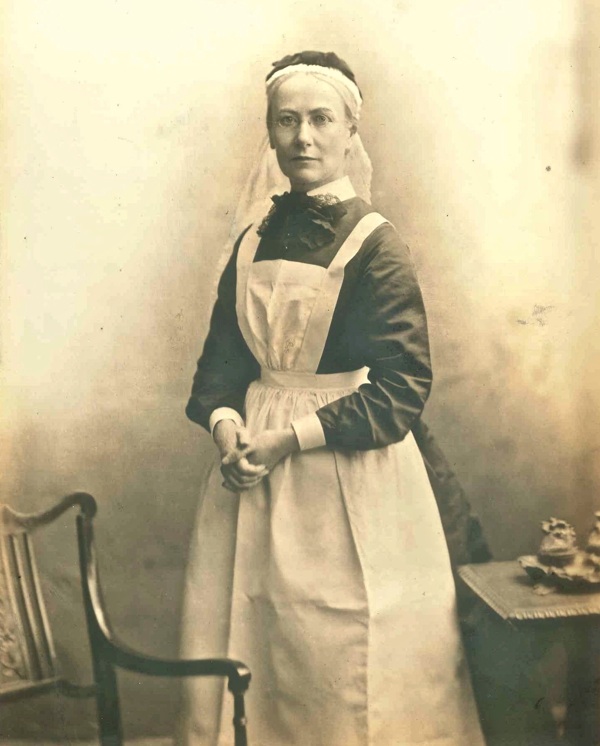
Emily Goodwin, the first matron at the new Mildmay Hospital, 1892


Sister Louise Blakeney, First Theatre Sister, 1909.


Miss Mulliner & Dr Gauld in the hospital pharmacy, 1909.

Matron and sisters in the nineteen twenties.


In the hospital kitchens.

The Mildmay Hospital with extra wards in Nissen huts during World War II.

Mildmay staff in 1966.

Detail, showing the Milmay cat.

Miss Stockton, Elizabeth Willcocks (Matron), Sister Edwin and Dr Buxton at the Mildmay in 1964.
Portrait of Helen Taylor-Thompson copyright © Patricia Niven
The Huguenots of Spitalfields

The wooden spools that you see hanging in the streets of Spitalfields indicate houses where Huguenots once resided. These symbols were put there in 1985, commemorating the tercentenary of the Revocation of the Edict of Nantes which brought the Huguenots to London and introduced the word ‘refugee’ to the English language. Inspired by the Huguenots of Spitalfields Festival, I set out in search of what other visual evidence remains of the many thousands that once passed through these narrow streets and Dr Robin Gwynn, author of The Huguenots of London, explained to me how they came here.
“Spitalfields was the most concentrated Huguenot settlement in England, there was nowhere else in 1700 where you would expect to hear French spoken in the street. If you compare Spitalfields with Westminster, it was the gentry that stayed in Westminster and the working folk who came to Spitalfields – there was a significant class difference. And whereas half the churches in Westminster followed the French style of worship, in Spitalfields they were not interested in holding services in English.
The Huguenots were religious refugees, all they needed to do to stop the persecution in France was to sign a piece of paper that acknowledged the errors of John Calvin and turn up at church each Sunday. Yet if they tried to leave they were subject to Draconian punishments. It was not a planned immigration, it was about getting out when you could. And, because their skills were in their hands, weavers could leave whereas those whose livelihood was tied up in property or land couldn’t go.
Those who left couldn’t choose where they were going, it was wherever the ship happened to be bound – whether Dover or Falmouth. Turning up on the South Coast, they would head for a place where there were other French people to gain employment. Many sought a place where they could set their conscience at rest, because they may have been forced to take communion in France and needed to atone.
The best-known church was “L’Eglise Protestant” in Threadneedle St in the City of London, it dealt with the first wave of refugees by building an annexe, “L’Eglise de l’Hôpital,” in Brick Lane on the corner of Fournier St. This opened in 1743, sixty years after a temporary wooden shack was first built there. There were at least nine other Huguenot Chapels in Spitalfields by then, yet they needed this huge church – it was an indicator of how large the French community was. I don’t think you could have built a French Church of that size anywhere else in Britain at that time.The church was run by elders who made sure the religious and the secular sides tied up so, if you arrived at the church in Threadneedle St, they would send you over to Spitalfields and find you work.
It was such a big migration, estimated now at between twenty to twenty-five thousand, that among the population in the South East more than 90% have Huguenot ancestors.“

Sundial in Fournier St recording the date of the building of the Huguenot Church.

Brick Lane Mosque was originally built in 1743 as a Huguenot Church, “L’Eglise de l’Hôpital,” replacing an earlier wooden chapel on the same site, and constructed with capacious vaults which could be rented out to brewers or vintners to subsidise running costs.

Water head from 1725 at 27 Fournier St with the initials of Pierre Bourdain, a wealthy Huguenot weaver who became Headborough and had the house built for him.

The Hanbury Hall in Hanbury St was built in 1719 as a Huguenot Church, standing back from the road behind a courtyard with a pump. The building was extended in 1864 and is now the church hall for Christ Church, Spitalfields.

Coat of arms in the Hanbury Hall dating from 1740, when “La Patente” Church moved into the building, signifying the patent originally granted by James II.

In Artillery Lane, one of London oldest shop fronts, occupied from 1720 by Nicholas Jourdain, Huguenot Silk Mercer and Director of the French Hospital.

Memorial in Christ Church.

Memorial in Christ Church.

At Dennis Severs’ House in Folgate St.

Graffiti in French recently uncovered in a weavers’ loft in Elder St

Former Huguenot residence in Elder St.

The Fleur de Lis was adopted as the symbol of the Huguenots.

Sandys Row Synagogue was originally built by the Huguenots as “L’Eglise de l’Artillerie” in 1766.
Sandys Row Photograph copyright © Jeremy Freedman
You may also like to take a look at


