Skip to content

At The Cemetery With Barn The Spoon

January 16, 2013
by the gentle author

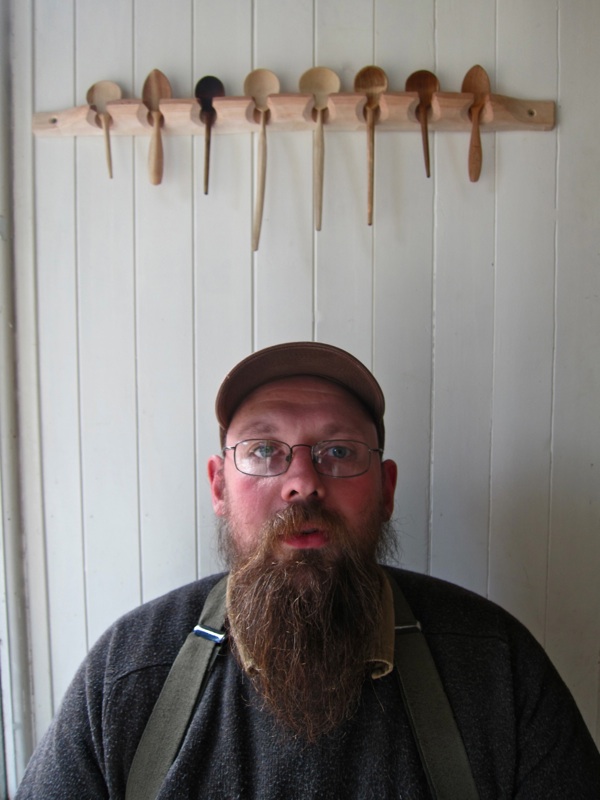
Barn the Spoon, the spoon carver, asked me to meet him at Bow Cemetery last week. With characteristic generosity of spirit, he wanted to make me a “special eating spoon” and the purpose of our meeting at the cemetery was to find the necessary bent branch from which to manufacture the spoon.

Within minutes of my arrival on that misty morning, Barn came striding from the undergrowth, clutching an armful of tools, and beckoned me to follow him into the tall trees that have overtaken this vast disused graveyard where countless thousands lie buried. These days, the forest is managed as a nature reserve and necessary thinning of the trees provides a constant source of the green wood that is perfect for Barn’s purpose. In other words, the East Enders of the nineteenth century are coming back to us now as spoons.

“What I am famous for is making straight spoons from straight branches, but what I am best at is making bent spoons from bent branches,” Barn declared when we reached a clearing, casting his eyes around critically at the felled trees, cut down to give light and space for new growth. Then he began rummaging through a pile of logs, tossing each aside in disdain as he searched for the ideal one. “It’s surprisingly difficult to find a bent branch!” he complained with cheerful irony, literally unable to see the wood for the trees.

“The beauty of making a bent spoon from a bent branch is that the grain of the wood runs into the bowl and makes it a lot stronger than a straight spoon from a straight branch,” Barn explained, once he had selected his ideal specimen and lopped off a twelve-inch portion.  Squatting down and placing the sycamore branch onto a round block cut from a large tree trunk, Barn used his axe as a chisel, striking the top of it with another stub of a branch to split the log down the grain. “The hours I’ve spent kneeling in mud…” he exclaimed with a chuckle of satisfaction as the bent log split neatly, revealing the gleaming naked wood riven by the parallel lines of the grain.

Employing his sharp axe, Barn began shaping the blank of the bent spoon quickly with intense concentration. This is called “axing out.” “I’m thinking what shape the bowl is going to be and it’s decided by the bend,” he informed me, without taking his eyes off the task in hand. While Barn was absorbed in his work, I stood and looked around at the gravestones surrounding us and the trees ascending all around to the forest canopy above. There was a stillness punctuated solely by the echo of Barn’s axe. “We’ve been lucky with our bits of wood,” he assured me, as we surveyed the line of blanks laid upon a log at the end of the morning.

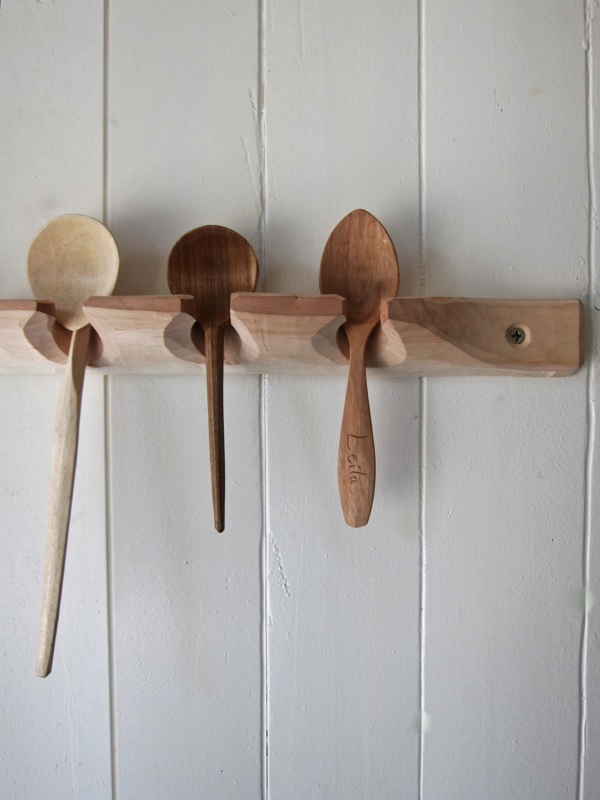
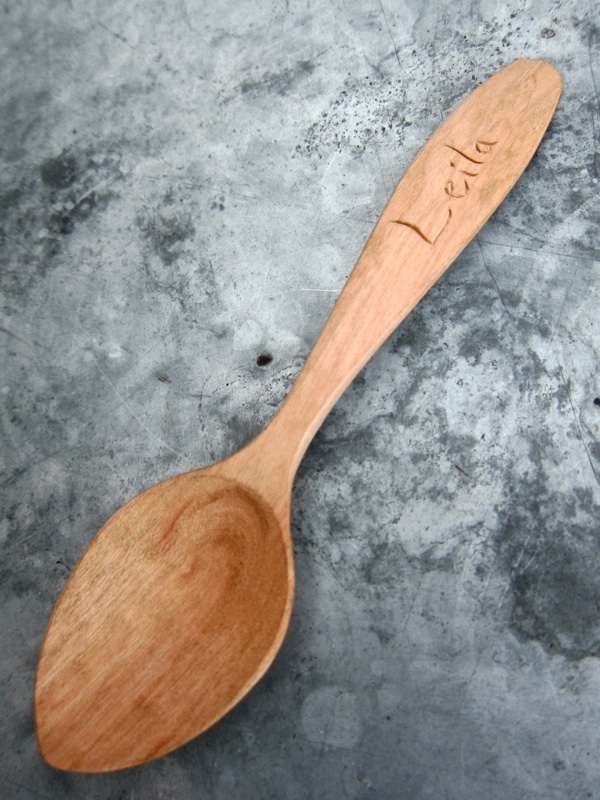
A couple of days later, I paid a visit to Barn’s shop in the Hackney Rd. Making a bent spoon takes several hours, considerably longer than a straight one, and so I had to wait to see my completed spoon. “It’s a folk tradition because it’s much slower than making a straight spoon, so typically it was made for loved ones rather than just for sale.” Barn admitted as he showed me a picture of an old Welsh spoon that had been his inspiration for the special eating spoon he had made me. I understood that a bent spoon requires a greater degree of skill than a straight one and is a spoon carver’s tour de force.

When I held my spoon up for the first time, I was astonished how light it was. Yet it was as strong as it was delicate, and subtly translucent like the bone of a small animal. Instinctively, I picked it up between my thumb and forefinger, and it sat there naturally. It was quick with its own life.

I was fascinated by the geometry of the planes meeting at the neck, reminiscent of medieval stone vaulting, and by the balance between the flat stem and the curvaceous bowl, all framed with neat sharp edges. I loved the detail of the gleaming knot in the wood, perfectly positioned at the end of the handle, and I was curious by the subtle asymmetry at the end of the bowl. Barn explained that this was because wooden eating spoons always wear on one side through scraping the bottom of the dish and so, over time, spoon makers carved them that way, adopting the shape into the design.

My bent spoon was so modest and yet so fine. It was a perfect piece of work. A quiet masterpiece of spoon carving by Barn the Spoon.

“It’s surprisingly difficult to find a bent branch!”

“The hours I’ve spent kneeling in mud…”

“I’m thinking what shape the bowl is going to be and it’s decided by the bend.”

“That’s going to be a nice one.”

“We’ve been lucky with our bits of wood.”

“I’m working from beneath the bowl which will define how I take off the rest.”

“What I am famous for is making straight spoons from straight branches, but what I am best at is making bent spoons from bent branches.”

Visit Barn the Spoon at 260 Hackney Rd, E2 7SJ. Friday – Tuesday, 10am – 5pm.

You may also like to read my original pen portrait

Barn the Spoon, Spoon Carver

and these other cemetery stories

At Bow Cemetery

Snowfall at Bow Cemetery

Spring Bulbs at Bow Cemetery

Bluebells at Bow Cemetery

Find out more at www.towerhamletscemetery.org

So Long, Marge Hewson

January 15, 2013
by the gentle author

Marge Hewson died yesterday, and today I am republishing my pen portrait of her as tribute to a woman who lived her life on Brick Lane and was loved by generations of pupils at Christ Church School, where she was Nursery Nurse for over forty years.

Marge Hewson, Chicksand House, Spitalfields, 1959

On any school morning in Spitalfields, you may always rely upon spotting Marge Hewson between eight thirty and nine o’clock – traversing the streets from Greatorex St to the Chicksand Estate – trudging around in all weathers, ringing doorbells and collecting up her beloved charges until she has acquired a crocodile of as many as twenty small children, that she ushers safely to Christ Church School in Brick Lane where she has been Nursery Nurse for forty years.

As a consequence, she is one of the most popular people you could ever meet, cherished by generations of local people for whom Marge’s benign presence is an integral part of their childhood landscape. “As big as they are, they’ll still stop me and ask for a hug in the street, even teenagers.” she revealed with a proud blush, as a significant indicator of the outcome of a life lived at the very centre of her community.

“I must admit I have never got away from here, but I am not unhappy with it,” confided Marge upon quiet consideration, when I dropped by to visit her at the school yesterday after four o’ clock, once it had emptied out of pupils and peace reigned. “You can’t really put into words what it was like,” said Marge to me, with characteristically shrewd reserve and a self-effacing smile, before proceeding to evoke her Brick Lane childhood with lyrical ease.

“I was brought up in Flower & Dean St just off Brick Lane – the “Flowerie” we called it. Just a few small shops and tenements, all pulled down now. You knew everybody and everybody knew you, and nobody had any money. You learnt to stand on your own two feet, I think I had a very happy childhood.

Children don’t have freedom now. When I was ten, me and my friend would take a picnic and go to Victoria Park and spend the whole day there. We were often out on the street until ten o’clock at night. There was a policeman on the beat and we used to stand around the lamppost until he came at nine thirty, and he’d say “It’s time you went home.” So we’d stay until he came back on his round again later and then we’d all run home to bed.

We weren’t allowed to go up Brick Lane beyond Princelet St because of the Maltese cafes with prostitutes standing outside. We used to try to bunk into the Mayfair cinema across the road if we could get in the back door. At the bottom of Osborn St was a bomb site called the Chimney Debris where we played, and we went to Woolworths to buy bamboos, and make bows and arrows, and played Robin Hood there. There was no TV, so I went to the library every day. I used to go swimming every day too, at the Goulston St Baths and I balanced my little brother with his bottle where I could see him in the changing rooms, so I could keep an eye on him while I swam lengths. Then we’d buy stale cakes from the bakery on the corner afterwards.

Every Saturday we played Bagatelle, or Newmarket with the four kings, and we had a jar of pennies and my mother would turn them out, and as a family we’d all sit down together. I’d see all the boys come on leave from National Service on Saturday night to visit their girls. They’d all go up Whitechapel Waste to Paul’s Record Shop, where I was too young to go –  the boys in their suits and the girls all dressed up. And on Sunday mornings, there was always an escapologist in chains who escaped from a sack on the corner of Wentworth St, it was lovely to go and watch him.”

Christ Church School is a hundred yards from Flower & Dean St where Marge grew up and – while her contemporaries have moved out of the neighbourhood – apart from a foray to the Isle of Dogs, Marge has chosen to live within walking distance of her old territory and she finds it suits her very well. In  her time, the East End has transformed through slum clearance and rebuilding, and the movement of peoples in and out of the neighbourhood. And although she would never claim it, Marge through her emotional presence at the school over four decades has become part of the consistent identity of this place as a magnanimous harbour to newcomers, carrying forward the best of the old into the new East End.

“I began here at the school in 1979 before East Pakistan became Bangladesh, there wasn’t too many Bengali children here then but as others left and more arrived it became 100% Bengali. Now I see another change, we have more children of different races, including Colombians and Eastern Europeans which makes it a truly multicultural school. When the Bangladeshis first came there wasn’t much English spoken, they used to turn up at all times of the day and with layers and layers of clothing against the cold.

At first we had only one big classroom and fifty children with just me and one teacher. A lot didn’t speak English and sometimes I would take a child home but the mother wouldn’t answer the door because she didn’t understand the language, so then I’d have to grab a passerby to translate. Conditions were hard for Bengalis, with families living in one room in tenements, and we worked as a team to help with their problems, taking them to hospital or the doctor if they didn’t speak English.”

I realised Marge Hewson was reluctant to talk about all the work she did, because she chooses discretion when speaking of the past disadvantage of those who are her community today. Instead she wanted to confess how much it means to have this role at the school which has given her such profound emotional reward and sense of belonging.

“I came here for six months and I stayed forty years, and there are children here now – I knew their parents when they were little. I like this school, I know all the people and I know this area back to front. I’ve got a lot of affection for the families round here. If I lost my purse, or I needed anything, I could knock on any door and they would help me, I know. I love my life in Brick Lane.”

Chicksand House 1959 – Marge on the right, with Sandra her sister-in-law and Mary her mother-in-law.

Marge at Chicksand House with her first child, 1961.

Marge enjoys a knees up at a wedding in the sixties.

With a class at Christ Church School, 1977.

In the school playground with her husband Philip, a cab driver, in the nineteen seventies.

Marge Hewson, Nursery Nurse

You may also like to read about

Phil Hewson, Tai Chi Master of Stepney

Chaplin in Spitalfields & Whitechapel

January 14, 2013
by the gentle author

Somehow, it came as no surprise to discover that he had been here – because I always thought of Charlie Chaplin as the one who carried a certain culture of the penniless, the ragged and the downtrodden from Europe across the Atlantic, translating it with such superlative success into an infinite capacity for hope, humour and resourcefulness in America. For centuries, Spitalfields has offered a refuge to the homeless and the dispossessed, so it makes sense that the most famous tramp of all time should have known this place.

Last year, Vivian Betts who grew up in The Primrose in Bishopsgate gave me handful of playbills that had been in the pub as long as she remembered and which she took with her when they left in 1974 before the building was demolished. These bills were for the Royal Cambridge Theatre of Varieties in Commercial St. Opening in 1864, this vast two thousand seater theatre with a bar capacity of another thousand must have once presented a dramatic counterpoint to the church on the other side of the Spitalfields Market. Yet in the nineteenth century, it was one among many theatres in the immediate vicinity, in the days when the East End could match the West End for theatre and night life.

The ten-year-old Chaplin performed here as one of The Eight Lancashire Lads, a juvenile clog dance troupe, on Tuesday 24th October 1899 as part of the First Anniversary Benefit Performance, celebrating the reopening of the theatre a year earlier, after a fire that had destroyed it in 1896.

Before he died, Chaplin’s alcoholic father signed up his son at the age of eight, in November 1898, with his friend William Jackson who managed The Eight Lancashire Lads, in return for the boy’s board and lodgings and a payment of half a crown a week to Chaplin’s mother Hannah. The engagement took Chaplin away from his pitiful London childhood and from his mother who had struggled to support him and his elder brother Sydney on her own, existing at the edge of mental illness while moving the family in and out of a succession of rented rooms until her younger son ended up in the workhouse at seven.

“After practising for eight weeks, I was eligible to dance with the troupe. But now that I was past eight years old, I had lost my assurance and confronting the audience for the first time gave me stage fright. I could hardly move my legs. It was weeks before I could do a solo dance as the rest of them did.” Chaplin wrote of joining The Eight Lancashire Lads with whom he made his debut in Babes in the Wood, on Boxing Day 1898 at the Theatre Royal, Manchester.“My memory of this period goes in and out of focus,” he admitted later, “The outstanding impression was of a quagmire of miserable circumstances.”

Yet Chaplin’s experience touring Britain when Music Hall was at its peak of popularity proved both a great adventure and an unparalleled schooling in the method, technique and discipline that every performer requires to hold an audience. “Audiences like The Eight Lancashire Lads because, as Mr Jackson said, we were so unlike theatrical children. It was his boast that we never wore grease paint and our rosy cheeks were natural. If some of us looked a little pale before going on, he would tell us to pinch our cheeks,” Chaplin recalled,“But in London, after working two or three Music Halls a night, we would occasionally forget and look a little weary and bored as we stood on the stage, until we caught sight of Mr Jackson in the wings, grinning emphatically and pointing to his face, which had an electrifying effect of making us break into sparkling grins.”

The handbills that Vivian Betts gave me for the Royal Cambridge Theatre of Varieties date from 1900 and, significantly, one contains the announcement of Edisonograph Animated Pictures as part of the programme, advertising the new medium in which Chaplin was to become pre-eminent and that would eventually eclipse Music Hall itself.

As soon as he had mastered the dance act, Chaplin was impatient to move on to solo comedy. “I was not particularly enamoured with being just a clog dancer in a troupe of eight lads. Like the rest of them I was ambitious to do a single act, not only because it meant more money but because I instinctively felt it would be more gratifying than just dancing,” he wrote later of his precocious ten-year-old self, “I would like to have been a boy comedian – but that would have required nerve, to stand on the stage alone.”

It was in Whitechapel in the autumn of 1907 that the seventeen-year-old Chaplin made his solo comedy debut, at a Music Hall in the Cambridge Heath Rd. “I had obtained a trial week without pay at the Foresters’ Music Hall situated off the Mile End Rd in the centre of the Jewish quarter. My hopes and dreams depended on that trial week,” he declared. Yet the young Chaplin made a spectacular misjudgement. “At the time, Jewish comedians were all the rage in London, so I thought I would hide my youth under whiskers. I invested in musical arrangements for songs and funny dialogue taken from an American joke book, Madison’s Budget.” Chaplin was foolishly unaware that a Jewish satire might not play in the East End in front of a Jewish audience. “Although I was innocent of it, my comedy was most anti-Semitic and my jokes were not only old ones but very poor, like my Jewish accident.”

The disastrous consequences of Chaplin’s error in Whitechapel were to haunt him for the rest of his career. “After the first couple of jokes, the audience started throwing coins and orange peel and stamping their feet and booing. At first, I was not conscious of what was going on. Then the horror of it filtered into my mind. When I came off stage, I went straight to my dressing room, took off my make-up, left the theatre and never returned. I did my best to erase the night’s horror from my mind, but it left an indelible mark on my confidence.” he concluded in hindsight, conceding, “The ghastly experience taught me to see myself in a truer light.”

In 1908, Chaplin signed with Fred Karno’s comedy company in which he quickly became a rising star and, touring to America in 1913, he was talent spotted by the Keystone Film Studios and offered a contract at twenty-four years old for $150 a week. “What had happened? It seemed the world had suddenly changed, had taken me into its fond embrace and adopted me.” he wrote in astonishment and relief at his change of  fortune in a life that had previously comprised only struggle.

Now I shall always think of the ten-year-old Chaplin when I walk down Commercial St, on his way to the Cambridge Theatre of Varieties, pinching his sallow cheeks to make a show of good cheer and with his whole life in motion pictures awaiting him.

At the northern end of Commercial St is the site of The Theatre, the first purpose-built theatre, where William Shakespeare performed and his early plays were staged. At the southern end of Commercial St is the site of the Goodman’s Fields Theatre, where David Garrick made his debut in Richard III and initiated the Shakespeare revival. And in middle was the Royal Cambridge Theatre of Varieties, where Charlie Chaplin played. Most that pass down it may be unaware, yet the line of Commercial St traces a major trajectory through our culture.

Charlie Chaplin performed with The Eight Yorkshire Lads at the Royal Cambridge Theatre of Varieties in Commercial St on Tuesday 24th October 1899.

The extension of the Godfrey & Phillips cigarette factory replaced the demolished Royal Cambridge Theatre of Varieties in 1936.

The entrance of the Godfrey & Phillips building echoes the entrance of the Royal Cambridge Theatre of Varieties.

Foresters Music Hall, 95 Cambridge Heath Rd – where Charlie Chaplin gave his disastrous first solo comedy performance in 1907 – demolished in 1965.

My grateful thanks to David Robinson, Chaplin’s biographer, for his assistance with this article.

You may also like to read about

Shakespeare in Spitalfields

David Garrick in Aldgate

A Walk in Whitechapel

January 13, 2013
by Rosie Dastgir

One Sunday, I came across the Zoar Chapel of the Free Presbyterian Church of Scotland tucked between a row of houses along Varden St. It was the Sunday before Christmas and I could hear the minister’s voice preaching to his congregation percolating into the street as I passed by. Nearby, on Nelson St, is the East London Central Synagogue, one of few remaining in the area.  But there is no trace of the Jewish school on Christian St where the funeral director Gulam Taslim tells me he used to go to haida with his Jewish friends.

Walking around the neighbourhood, I come across shop fronts advertising Islamic schools and courses, springing up to fill a demand for a religious-based education that is not fulfilled in the mainstream. Along New Rd is “The Tayyibun Institute For The Teachings of Qu’ran and Sunnah” offering classes and advertising its online services. Oceans of Knowledge are at our disposal, the foundation proclaims on its shop window. Registration at the centre is segregated; women are permitted to register between 10 am and 4 pm, and men from 4 pm till evening.  Courses on offer include: Quarani and Tajweed Studies, Arabic Language, FIQH Studies, Hadith Studies, Islamic History Studies, Tarbiyyah Studies, and Authentic Spiritualisation.  According to the website, many of the teachers have gained their academic qualifications in Saudi Arabia and Egypt. Outside one morning, I pass by a cluster of women in hijabs and burkas excitedly gathering to register for classes. Devout observation of the faith seems to be increasing these days in Whitechapel.

Interestingly, it appears to be reflected in some of the local shops popping up in the area.  Nestled amongst the longstanding Indian style sweet shops around New Rd is one such new arrival: Yummy Yummy Halal Sweets. An array of temptingly coloured sweets with familiar names – sherbet flying saucers, mint humbugs, strawberry bonbons, apple shoelaces – line the shelves in big glass jars.  A man in a long black robe and prayer cap stands outside by the sandwich board, handing out leaflets with special offers on the sweets. You can look up their products on their website, and follow them on Twitter and Facebook.  The site offers  an astonishing range of sweets that are not haram – the gelatin that is used is vegetarian – or if you are planning a special event, you can rent a popcorn maker, candyfloss machine and even a chocolate fountain.

At the shop counter are piles of leaflets about Islam: “The Muslims without Shariah Are like Fish Without Water” says one. “Is Islam a Threat to Britain?” poses another. A third has instructions and diagrams on how to wear a hijab correctly. When I chat to one of the shop assistants, a student volunteer, he is eager to tell me about the beauty of Islam, which he is studying part time – though not at the Tayyibun Institute, he says ruefully, because he was too late to enroll.  There is a sister shop on the Mile End Rd and judging by the numbers of parents who take their kids here for sweets, business is thriving.

Yet it is unclear how long these idiosyncratic local shops can survive in the face of competition from the high street chain stores which are coming to Whitechapel, thundering towards us from Aldgate and the City.  There is a Costa Coffee on the corner of New Rd and Walden St, a reflection of the changing demographic around the hospital. Tesco Metros seem to breed with one another overnight when no one is looking. A Metro begets an Express, or perhaps it is the other way around.  In any event, these modern temples to grocery shopping attract a steady stream of customers from the neighbourhood at all times of the day or night. Nobody seems too bothered that they are annihilating local shops.  Or are they?

Around Fordham and Romford St, there are a slew of small independent shops that are managing to survive, and even thrive; a haj and umrah travel specialist, the Bangla Super Store, Hindi and Bengali Lava Video, Film Asia Weddings, Grace Gents barber, a tailor shop, a carpet seller, the Java coffee shop which shares its premises with a hairdresser.

On New Rd, a string of swish new cafes cater for the expanding student population, as well as for young locals, though some of the older style eateries persist.  There’s the traditional style Cafe Donatello on Turner St, offering multiple variations on a theme of English breakfast, displayed in bright coloured photos on the wall outside. It is very popular with local council employees, contractors and craftsmen working nearby who pop in for a fry-up or a sandwich.  A neatly brown painted restaurant has just opened on New Rd; Masala Desi Eatery, featuring Pakistani food.  Arguably fancier than its poorer cousins in the side streets, its stairs are studded with blue LED lighting and glistening cabinets show off prepared foods. Outside, its terracotta tiled roof gives it a distinctly Italianate look.  But the old curry and kebab houses still attract the faithful, and whether the Masala Desi Eatery will be a hit and divert their custom is uncertain.

I did not notice it at first, The Whitechapel Hotel, but perhaps it portends something of the Crossrail era, when that eventually arrives: a smart, modern establishment, that has recenty opened on New Rd. The bedroom curtains remain resolutely shut, though the reception looks busy, with its permanently on flat screen TV above the desk, and beside it, the Sahara Grill, where people in suits gather for meetings. Now I cannot stop peering at it whenever I go past to see who, if anyone, checks in.

Whitechapel photographs copyright © Colin O’Brien


ENVOI

Dear Readers, I’ve much enjoyed writing for Spitalfields Life this week.  Thank you so much for reading the stories about this corner of London – Rosie Dastgir

At St Joseph’s Hospice Choir

January 12, 2013
by Rosie Dastgir

[youtube fP8q71kKyUA nolink]

“Sometimes in our lives, we all have pain, we all have sorrow,
But, if we are wise, we know that there’s always tomorrow.”

“Lean on Me,” the pop song by Bill Withers, is an old favourite with the St Joseph’s Hospice Community Choir.  Solemn lyrics containing the seeds of hope are countered by a measured yet upbeat tune. You can see why it is so popular.

The Choir have been gathering to sing every Thursday night for the past two years.  Around twenty-five singers congregate in the Finding Space Club – an area devoted to alternative treatment and care, such as yoga, acupuncture, Tai Ji Quan – overlooking a small courtyard garden, prettily laid out with a stone fountain at its centre.

Simon Robey, manager of complementary therapies at the Hospice, describes how he wanted the space to be filled with life-affirming activities, rather than simply offering treatment.  To that end, he had the idea of starting up the choir.  He contacted Gina Fergione, a professional singer and music teacher who had taught his daughter piano.  She leapt at the idea with great enthusiasm and the choir was born.

The choir is open to the public, as well as the staff, volunteers, patients and their families at St Joseph’s.  About forty have signed up, and around a core group of twenty-five show up to sing every week. They represent a wide range of ages and backgrounds, from all over the world – that is, the East End of London.

It is a foggy, dank and wintry evening when I go to the Hospice to meet the Choir and hear them sing.  Yet nobody is deterred. The singers arrive in good time, well in advance of Gina, so there is time for socializing and chit chat around the coffee and tea making area.

The first to arrive is Paul, poet and songwriter, who has been singing with the Choir since its inception two years ago.  Tall, with a silvery mane of hair, Paul explains that his wife, Tersia, died here in the Hospice two and a half years ago, on St Valentine’s Day, leaving Paul to care for their young son, Otis.

“My partner didn’t know me as a poet,” he muses, falling silent.  She died before he published. Nowadays, Paul goes out and about in Newham, volunteering as a bereavement befriender.

The cluster of singers grows. Heike, a German lady, Janice, a young podiatrist, and Daisy, an East Ender via the Carribean, arrive one after the other.  All are keen volunteers.

As Paul tinkers with a music recording he has brought along to play, complete with poetry offerings from Benjanmin Zephaniah, more members of the choir gather round the coffee tables.  Terry arrives, slightly breathless, but perky. He is a pensioner, with wispy grey hair, and a broad white toothed grin. A  true cockney, he tells me, born in Shoreditch, now living in Bethnal Green.  We swap London Transport tales – the buses up the Cambridge Heath Rd are on diversion thanks to the massive excavation around Mile End for Cross Rail.

“Ruined London, it ‘as,” he tells me, when I am enthusing about the increased train links. Have I seen Tottenham Court Rd? he asks.  I have not, but promise him I shall. He is been treated for cancer here, but now he is back at home. “I’ve still got cancer,” he admits. Small scarlet bruises pepper his forearms.

Tony, a retired bus conductor from Barbados, now living in Stoke Newington, tells me that his brother-in-law fell sick and died recently in the Hospice.  The man’s wife died there too, in 2008.

“The last thing my brother in law wanted was a priest, and so he got that, and then he did die happily,” he says.  Tony’s own Methodist minister came, and gave his brother in law the last rites.

Terry interrupts.  “Cuppa tea?  One sugar, Two sugars?”

Does he miss Barbados at this time of year?

“I’m so active, I don’t miss it.  I love it, but since I’ve retired I don’t have a vacant life, I don’t miss it.  I go to Barbados every two years for two weeks.”

He and his wife love going back.  But he cannot swim, he says, so he stays out of the sea and the sun.

Carol, a middle aged local woman, who lives a bus ride away, is scribbling something on a piece of paper.  A friend’s eightieth, she explains, and she is making a note to drop her a birthday card. Dressed smartly in pink skirt and top, Carol is amiable and sweet natured, cheerfully looking out for her friends. The note done, she is delving into a plastic bag and fishing out a pair of embroidered kid gloves for fellow singer, Doreen, who needs to borrow them for a music hall number she is performing.  Doreen is a pensioner studying at the University of the Third Age.

“Sounds posh, but it ain’t,” she reassures me.  They offer an opera group, music appreciation, and a book group. “For the Christmas party, the fellah that does the singing wants to do “I Remember It Well” as a duet –  in costume.  But all I lack is the gloves. “

“Just up your street,” says Daisy, who is a leading light in the annual St Joseph’s jumble sale, a key event in the Hospice’s calendar.  People line up round the block to snag a bargain.

Carol smiles happily that the gloves fit her friend.  She admires Doreen’s big sparkly necklace, offset by her lilac knit top.

Sam ambles over.  An elderly man, born in Antigua, he emigrated to England at the age of twenty-four.  The choir was recommended to him by a friend from his men’s group, he says.  He exudes buried suffering, speaking haltingly at first.

“I like singing.  It’s one of my bad habits,” he chuckles, relaxing a little. “I’m just greedy about it.”

“Cuppa tea, Sam?” cries Carol, and Sam says, “Oh yes please!”

“My kids are all grown up,” Sam explains, “but I don’t see them.” He sinks into reverie for a moment, as if he is trying to make sense of the estrangement.

“Everything is different now, you know? Kids don’t want to see you when you get on in age.  They want to be in different … groups, and if you tell them anything, they don’t want to listen.”

In the background, the pianist is practising the opening bars of Lean On Me, on the digital Yamaha.

“Everything in this world is so changed.  It’s an upside down world,” Sam declares. It is hard to disagree with him.

These days, he lives alone in Stepney Green, having separated from his wife who moved out of London.  Years ago, when they lived together, they were forever arguing.  Now they are close friends. “She’s a very nice person, a good woman. She calls me,” he says. “I still really love her.”

Carol sets down a cup of tea, and a Kit Kat, for Sam.  He smiles appreciatively. “Sam’s always good to me,” Carol says.  “Gives me sweets and things.”

“People are so good mannered here,” Sam exclaims, suddenly animated. “Everybody, everyone! I like that.  I like everyone here.  There is nobody that is not nice.”

Gina has arrived and is busy getting organized: looking through the music, adjusting the chairs, saying hello to everyone. She gives Terry a hug.

“The lady that .. “ Sam is overcome.  “Oh, Gina, she is such a nice person,” he manages to say.  “It’s a lovely place, it gives me joy in my heart when I come here.”

Meanwhile, Terry is moaning about the exorbitant cost of cars.  “You’d get a Ford for five hundred quid in Dagenham, or get it unpainted for three hundred quid.” I am surprised and for a moment tempted myself, until he adds: “Oh but that was in 1945.”

Gina, the choir leader, is a petite, pretty woman in polka dot dress and scarlet cardigan. She wears her long, dark hair loose, and in between dashing around, she sips from a mug, a gift from Sam, which says: Best Teacher Ever.   She is clearly adored by the choir. Gathering the singers together, she guides them with warm up exercises, swinging their arms, feeling the tips of their toes, limbering up.

“We sing with our whole bodies,” she says.  Her words chime somehow with what the Hospice movement is about: treating and nurturing the body, the heart and mind, life to the very end.

The choir give a heartfelt and tuneful rendition of “Lean On Me.”  The line up that evening features an eclectic range of songs; Gina likes a good mix.  There is a Jamaican song, “Banyan Tree,” a Nigerian acopella, a contemporary piece by the pianist, Chris Scobie, based on the Song of Solomon, and the round “Oh How lovely is the evening.”

The singing is indeed lovely.  Still, Gina does not coddle the choir; she is kind but firm when she tells them that something needs work and very enthusiastic when a piece is sung well.

That evening, they visit the wards and sing four songs.

“Make it beautiful,” says Gina, before they leave, and you know that they will.

The choir move upstairs in a phalanx, upbeat and determined, and Gina assembles them in a corridor.  A nurse helps along an elderly gentleman in suit trousers and braces, on a zimmer frame; he is been waiting eagerly for the choir all evening.

Everyone is focused on Gina who raises her hand to conduct.  A deep breath is inhaled in unison, and the singing begins.  Richly textured voices, high and low, old and young, flow through the hallways and into the wards.  As we move upstairs, we pass a room, and glimpse an extended family gathering around a bed for a night’s vigil.  Someone is nearing the end of life.

Founded in 1905, St Joseph’s Hospice is under the auspices of the Religious Sisters of Charity, and cares for people from all backgrounds with serious, life threatening illnesses – such as cancer, Motor Neuron Disease, heart failure, Parkinson’s Disease. It covers primarily the City of London, Hackney, Newham, Tower Hamlets, and beyond. All services are provided free.

Daisy

Simon

Doreen

Sam

Paul

Janice

Tony

Gina

Terry

Heike

Photographs copyright © Patricia Niven

You may also like to take a look at these other portraits by Patricia Niven

Patricia Niven’s Golden Oldies

At the Surma Centre

A Pearly Remembrance

Phil Hewson, Tai Chi Master Of Stepney

January 11, 2013
by Rosie Dastgir

Phil Hewson, Tai Chi Master of Stepney

On a brisk, sunny morning, light streams into the Stepney Scout Hall where a group of men and women dressed in softly shaded loose clothing are moving gracefully in unison.   They have gravitated to the weekly Tai Chi class, lead by seventy-five year old Phil Hewson,  former boy boxer and sometime taxi driver, and founder of the Tai Chi School of Form and Intention.  Sitting on the sidelines, Phil is hunched against the cold, dressed in duffle coat layered over a chunky sweater.  As his players sculpt the air with their hands, weaving their bodies with elegant and fluid geometric precision, Phil sits watching, hawkeyed and alert.  He appears to be the epitome of strength and vulnerability; force and softness – qualities that are at the core of Tai Chi philosophy.

“I’m the master here,“ Phil says, “but Dawn is my main lady.” Dawn, a former City trader, became ill when she was working for a bank and came across Phil when she was looking out for a class that would teach her breathing.  A flyer dropped on her door mat, which in retrospective seems improbably lucky – learning Tai Chi with Phil changed her life.  She has worked with him for the past ten years and is following in his footsteps as a future master in Tai Chi.

Today’s class comprises a motley crowd of East Enders and new migrants, including a cabbie, a Spanish lady, a former city worker, and a local artist.  On Thursdays, Phil teaches a sizeable group of taxi drivers, some of whom have been coming to his classes for thirty years.  He has transformed many lives over several decades. “When you do Chi Kung,” he explains, “it is the expertise of fighting, but it could also be flower arranging or art.  Then there is Tai Chi Chi Kung, and that’s what we do, basically.” In both these practices, the players move with fluidity,  gently shifting their weight from one foot to the other; it is intrinsically linked to the notion of balancing the ying, the soft and feminine side, with the yang, the hard and masculine side that lie within us all.

As the players reach the end of a movement, closing their eyes in meditation, Phil speaks to them with quiet clarity and concentration. “Tai Chi,” he says, “is a martial art.  Of course it is.  And the lowest level is dealing with attack.  Any idiot can do that!  Any boxer, karate, or Kung Fu fighter.  It’s a street fight.” And Phil should know all about street fights, growing up in the East End he recalls the Spitalfields fighters from his childhood, Danny Maguire and Buster Osborne, going outside for a spot of ‘cobbles’ – street fighting.

Phil takes a deep breath. “The next level is dealing with life.  That’s the real opponent. Dealing with our egos, chasing after the next thing – a better car, a better iPhone, on and on and on it goes.   Until you get a tragedy in your life, and you realize that your health and your strength and your well being are what is important. “

As the players move as distinct individuals yet in synch with one another, Phil intones, “We live here together, with every tree, every animal, and you think you’re more important than an insect? You’re not. Everything that lives and breathes has its place on this earth.  We’re just a part of the whole, and we need to concentrate on the whole.”

Following his guidance, the group allow their heads to fall down to their chests and slowly bend forward, doubling over for a minute or two. Then, raising themselves upright once more, they open their eyes; mentally preparing, as Phil says, for a relaxing day ahead.

“I am so, so proud of you!” he says, his piercing blue eyes gazing at every one of them, as if they were his family, “your work’s come along so much!  Hasn’t it? “ They beam happily for a moment, then disperse – hugging and saying goodbye to each other with a sense of genuine camaraderie.

Wally, a cab driver in the class, tells me that Phil’s nickname is Loz.  Apparently, it dates back to his days as a teenage prize fighter –  when he used to goad his opponent, “Come on, loz be having yer!” His fighting days are long past, yet his  trajectory from boxer to cabbie to Tai Chi master is compelling.

Born in 1937, on Flower and Dean St off Brick Lane, Phil grew up in a family of seven, sharing two rooms, with a scullery, in what he describes as one of the most horrendous tenement blocks in the area. He left school at fourteen and became a boxer, a prize fighter.

“I was doing fairgrounds,” he says, over breakfast at a café nearby, “going up Goose Fair, that sort of stuff, doing a fight for a fiver.  Which in those days was a lot of money – my dad earned about £1.50 a week.” His father was a street trader, his mother worked in a café in Whitechapel.

From boxing he moved onto Karate. “I found it very two dimensional,” he says bluntly.  The waitress comes over and takes his order, a reduced vegetarian breakfast, plus coffee.  “And hurry up!” he cries, with a cackle. “I’m only kidding!” He is a regular here and very popular.

“Now where was I?” We pick up the thread of his career again – after karate, he went into Kung Fu. There was also a short spell working in Spitalfields Market.  Then he set his sights on becoming a taxi driver, so he did the Knowledge.  The first day he sat in his cab, he realized that that was a huge mistake: he hated it.  “The inactivity!”

So he chucked it in, and learnt Tai Chi under the tutelage of various Chinese Masters, eventually opening up his own school.

“When I first took up Tai Chi,” he explains, “I saw it completely as a Martial Art, which it is, but the mistake you make is mixing up the internal and the external.” He offers karate as an example of ‘external’ force, using power and muscle.  Tai Chi is different.  The key is being soft.   You use your internal energy, the Chi, to defeat or defuse the power of an opponent.  Form is the physical and external expression of Tai Chi.  “A girl can defeat most guys,” he says, with obvious pleasure. “One of the great things about Tai Chi – I’m almost ashamed to say it, like I’m trying to be a feminist –  but I absolutely love it when the girls are better than boys.  Dawn uses softness to overcome.  The girls do the form better than the fellas.”

He stretches out his arm with deceptive languor, like a big cat, wrapping it around mine, gently but with precision.  “So when I take your arm martially,” he says, firmly pulling it towards his body, “I can use your power to pull you back, and break your wrist or arm.” Before I can react, he lets go, quickly reassuring me he would never do such a thing.  I am in no doubt.  His bright blue eyes twinkle with glee at the beauty of what he has mastered over years of practice; strength in softness, power in vulnerability.    You can see how Tai Chi is a way of life for Phil, permeating every aspect of his life.

Out of his entire family, he is the sole member remaining in the East End, where he lives with his wife, Marjory, who works in a primary school in Spitalfields. After three quarters of a century in the area, I wonder how he finds it these days.

“We like it, the East End,” he says simply. “We like the mixture of people – it eliminates racism, in most cases.” He pauses and adds reflectively, “I think so. You hear some of the gym users – not my lot – talking about black bastards, Paki bastards, and all that stuff – horrible stuff, it upsets me.  I’ve two Pakistanis in my class, Salim and Sahid, – you couldn’t meet two nicer blokes, and me with my Jewish background p we’re like that!” He crosses his fingers, waving them in my face.  “It doesn’t need to be like that.“

Evacuated during the Second World War to a family in Newcastle on Tyne, he tells me with a laugh that it did not last long.  “About two weeks!” The family did not take to Jews, so his parents came and got him and his brother.

“That’s how I got to see the bombing, you see,” he tells me, lamenting the fact that having lived through all that horror, the human race has not learnt a thing. “I hate the way we treat this world,” he says, with anguish. Recently, he began to use twitter, following stories about palm oil – the deforestation that resulted in its production.

“And all these orang-utangs are being destroyed in the name of palm oil!  For Nutella!  I saw these photos of them killing the mother, and the little babies left behind.  It upsets me so badly.” His eyes brim. “This is our world and we are destroying it.  They are living, breathing things.”

The world is a brutish place and hard to avoid.  How do you live with it?  How do you cope with life, the opponent, as he terms it?

“Softly,” Phil says, “that’s how you deal with it.  You don’t get involved with it.  It’s not going to give you anything, like a big flashy Merc.  Tai Chi teaches you to deal with life, with suffering.  The Hitlers and Saddams and Genghis Khans of this world never win in the end.  Softness wins, every time.”

He gives a smile.   “It’s the philosophy laid down by Lao Tzu – I don’t wanna do your brain in with all this stuff – but water breaks concrete, trees bend in the wind, everything is softness. “

When I go home, I throw out my giant pot of Nutella and spend the day holding onto these wise words from the Tai Chi Master of Stepney.

Phil Hewson, Tai Chi Master of Stepney

Photographs copyright © Sarah Ainslie

You may also like to read about

Marge Hewson, Nursery Nurse

At The Lahore One Kebab Restaurant

January 10, 2013
by Rosie Dastgir

‘To the jaded eye, the Commercial Road in East London is little more than a conveyor belt for courier bikes and lorries to the east coast; an ancient thoroughfare for the flow of trade now flanked with glassily optimistic city flats, dusty baby-clothes suppliers, the odd haberdashery warehouse, wholesale fashion outlets and a permanently shut Lloyds Bank with only a sprouting of ragwort at its entrance to commemorate the death of business. But Harris noticed none of it as he sought out a suitable place to take the lady Shakespeare scholar on his arm for dinner. What he saw was a road studded with a string of brightly lit curry and kebab houses, each one almost a replica of the last, yet quietly boasting a subtle difference in sauce or cooking method or regional bias, visible only to the naked eye of a true native. The eateries were all Lahori, though they served what they termed Indian food.” – extract from Rosie Dastgir’s novel, “A Small Fortune.”

When I first lived in Whitechapel in the mid nineteen-nineties, the Lahore restaurants were some of the best eateries in the vicinity.  I remember around that time that my father stopped off at the Lahore One Kebab Restaurant on a road trip to Mecca with a group of fellow pilgrims.  Years later, when he was dying, I took him there again.  He could never get rid of the memory of those kebabs, and he enjoyed one of his last meals at that restaurant on Commercial Rd.

Revisiting it, I find that little has changed – on the outside, at least.  The dazzling neon sign sits above a modest frontage, displaying a couple of favourable press reviews and the menu. When I step inside, I see that the interior has been transformed.  The Formica tables have gone, replaced with modern ply and steel ones, and matching chairs. The halogen lighting is bright, the plywood clad walls homely, yet sleek. No flock wallpaper in this establishment.  Fragrant smells curl out from the kitchen.  Ali, one of the waiters, from Sialkot, Pakistan, is getting ready for the lunchtime rush.  He was not always a waiter, he confides, but a former newspaper man at the Jhang newspaper in Pakistan before coming to England.  Clearly he is a seasoned multi-tasker, setting tables, attending to customers as they arrive, while stopping now and then to discuss the troubling situation in his home country, citing the resurgent Taliban and the lack of decent education for its burgeoning young population.

The lunchtime crowd are gathering.  Nestled around a cosy booth sit four guys; two younger, two elder.  They pore over the menu, joking and chatting.  I ask them where they are from – meaning which neighbourhood of London.

Rahul, casually hip in baseball cap, bomber jacket, designer specs, pipes up, “He’s from Bangladesh, and I’m Indian.”

“You’re not from India, you’re from Essex,” says Andy White Patel, the elder man beside sitting him. Much laughter.

“Essex is my religion,” Rahul admits. “Nothing Indian about me.”

Rahul is lunching with his father, Rajesh, a newsagent in Watney Market. Rahul’s mate,  Quyum, works in the rag trade.  They are regulars here.

Andy White Patel tucks into chicken biryani.  Normally they get kebabs, they tell me, or the famous chicken tikka roll, but today they have a bit more time.  Hence the fancier choice.

The restaurant was established in 1984 by Mohammed Anjum. Smartly dressed in open necked checked shirt, Mr Anjum emanates confidence and authority as he oversees his highly successful business.  He was born and educated in Lahore, Pakistan, and arrived in London in 1981 as an electrical engineer, with the intention of pursuing further study.  But he ploughed another course instead; the food business.

“When I came to this country, I noticed that people are dying for this kind of food, and I thought to myself why don’t you something like this, and do it properly?”

Proper Lahore cooking, he explained, should be like home cooking.  Cities like Lahore, Lucknow, Benares, Hyderabad, are all synonymous with great cooking, and that was what he saw he must tap into. This was the task and the challenge he set himself, helped by what he learnt from his mother-in-law who taught him the art of creating home cooking rather than traditional ‘Indian restaurant’ food popular with Brits: Madras and Vindaloo curries, chicken masala in bright orangey sauce.

“Lots of Asians come to my restaurants,” he explains. “About 90%.  And the second generation, the younger crowd, still love coming back to the place they visited with their parents.”

Mr Anjum muses that many Asian people have moved out to Ilford, Chigwell and beyond.  But he has stayed locally, living close to the Royal London Hospital. He implies that this is a more modest choice, he has chosen to spend his money on educating his children, a choice that sets him apart from some of his peers running similar eateries in the area.

“They prefer to open more and more branches,” he says, “and want their kids to go into the business.” Mr Anjum had other plans for his four children.  His two sons were educated at City of London School for Boys, and St Pauls.  His eldest daughter is at UCL, though considered Cambridge University, plumping to stay in London.  Raj, one of his sons, is studying and working part time at the Lahore One.

“It isn’t easy to teach anyone,” he tells me, “specially when you’re handling a knife, and chopping an onion,  Doing it at home is fine, but on a commercial basis – it’s something else. You have to learn the technique; I try to teach Ameer, my son. He’s only a twenty-one year old boy – young, good at learning, a very good learner, but my feeling is, you can’t learn it over night.”

Mr Anjum is clearly a dedicated and very hard worker himself.  The restaurant is testimony to that. This autumn he took his youngest son up to Oxford, where he is now studying geography.

“I drove him up there, took him to his room,” he recalls, eyes shining,“My hard work has paid off, I can send you here.”

Mr Anjum was the son of a graduate stenographer, who worked at Grindlays Bank, during the days of British rule in India.  He quickly realized, in that environment, that an education is all important. As did his son, years later, bringing up his children and running a business in the modern East End of London.

I wonder what he thinks about how the East End has changed. “The East End had a bad reputation back in nineteen-eighties,” he says.  But he dwells on something positive he remembers: the mixed Jewish and Asian community. “I remember Jewish community helped our business at that time, as halal and kosher is similar and they ate our food.  And that was good.”

I want to hear about the legendary menu.  What is so special about it and how it is distinguished from traditional Brit Indian restaurant food?

“It is curry, fried chicken.  Chicken Karahi is Pakistani.  It is boneless, so you can eat it with a knife and fork, rather than holding a piece of bone in your hand, sitting opposite someone …” he says, implying as he does with a shake of the head that it is a little uncouth.  “These days, that fashion for eating with the hands is almost over.”

The restaurant uses boneless chicken not minced up in a machine for ease of production, like so many restaurants in places like Manchester and Birmingham.

“The basic thing is always fresh ingredients, fresh meat and vegetables, nothing is frozen.  And we don’t compromise on the spices, or on the quality, where we buy it. That is the main key to the success of the menu.  You can get things on the cheap, but we’ve not done that.  For the last twenty years, we’ve maintained the standard of the food we serve.”

Mr Anjum describes his food with passion and affection.  He remembers how he catered a wedding party in Brighton, serving his signature Lahore chicken, which was recognized by one of the guests who used to frequent the Lahore One when he was younger with his father.

“He was shocked.  I was flattered. It was a good compliment.”

The food is a creation rather than something precooked and reheated.   “I don’t do take away.  We don’t do home delivery.  You want people to come to the restaurant – not serve fast food.   Sometimes people call cabs and we send the food to them, but we don’t do the home delivery thing.”

I do not blame him. A great place for dinner or, if you are Harris, a first date.

Mohammed Anjum founded the Lahore One Kebab Restaurant in 1984.

Photographs copyright © Jeremy Freedman

You may also like to read

The Curry Chefs of Brick Lane