
Tower Hamlets Women For Peace
David Hoffman will be in conversation with Gaynor Tutani at the Museum of the Home on Wednesday 20th November at 6:30pm. They will be showing photographs and discussing his new book and exhibition ENDURANCE & JOY IN THE EAST END.
This is the only event David is doing in person, so if you want to hear him speak please book now.

East End Peace Women’s Group in action in Dalston
Contributing Photographer David Hoffman‘s astonishing images of women’s protest in the eighties are an enduring and inspirational witness to our unquenchable desire for justice.
“Some of these photographs are of our gang, Tower Hamlets Women for Peace, along with two blokes from Tower Hamlets Campaign for Nuclear Disarmament, blocking the Whitechapel Rd near the Cambridge Heath Rd crossing early in the morning of Tuesday 20th Dec 1983. Most of us were nicked and defended ourselves in a remarkable court case at which we were all found guilty but unconditionally discharged.
Other photographs show when we blocked Whitechapel Rd close to the Vallance Rd crossing, sometimes by crossing the road back and forth repeatedly rather than sitting down. We did this whenever we got a message on the Greenham ‘phone-tree’ that Cruise nuclear convoys were on the road. We wanted to publicise this as well as the fact that Whitechapel Rd is a Military Service Route to be taken over as such should our government or the United States government decide to wage a nuclear war.
There are also photographs here of the Blood Money demo outside British Association of Film & Television Arts at 195 Piccadilly where there was a conference of arms traders and manufacturers on International Women’s Day, 8th March 1984. Our Peace Group joined others there to chuck red paint in their general direction. One of the pictures shows the arrest of an older woman in a shawl writing a note on her wrist, who was the one who had the good wheeze – sadly not possible on modern public transport – of hopping onto a bus and chucking her paint from the platform as it passed. Unfortunately, the cops caught up with the bus at the traffic lights.
Various arrests and court cases ensued, of which I remember only my own at which I got off by showing – with the help of David Hoffman’s photos – that my red paint had actually hit BAFTA’s door, not the public pavement I was accused of damaging.” – A Member of Tower Hamlets Women for Peace

East End Peace Women’s Group in action in Whitechapel


East End Peace Women’s Group in action in Hackney


East End Peace Women’s Group in action in Piccadilly


“I started photographing protest and other social issues in the seventies. I was living in Whitechapel at that time and the women I knew were involved in squatting and generally trying to resist the horrors of the Thatcher era. The women’s peace movement really took off with the establishment of the American nuclear missile base in Greenham and East End women were among the most active and committed.
I felt privileged to be trusted with advance notice of some of the actions and to be able to photograph them. These pictures are from the winter of 1983-84 and, if anyone has caption information or memories to share, I would love to be able to add that to these images.”
David Hoffman


East End Peace Women’s Group in action in Whitechapel
Photographs copyright © David Hoffman

Cover price is £35 but you can buy it from Spitalfields Life for £30
CLICK HERE TO ORDER A SIGNED COPY OF ENDURANCE & JOY

Old Dame Trot & Her Comical Cat
Photographer David Hoffman will be in conversation with Gaynor Tutani at the Museum of the Home on Wednesday 20th November at 6:30pm, discussing his new book and exhibition ENDURANCE & JOY IN THE EAST END.
This is the only event David is doing in person, so if you want to hear him speak please book now.
I must confess that I identify closely with Old Dame Trot – as illustrated in this early nineteenth century chapbook – knowing all too well how it is to share a home with a large feline personality…


You may also like to read about
David Hoffman’s East End
Photographer David Hoffman will be in conversation with Gaynor Tutani at the Museum of the Home on Wednesday 20th November at 6:30pm, discussing his new book and exhibition ENDURANCE & JOY IN THE EAST END.
This is the only event David is doing in person, so if you want to hear him speak please book now.
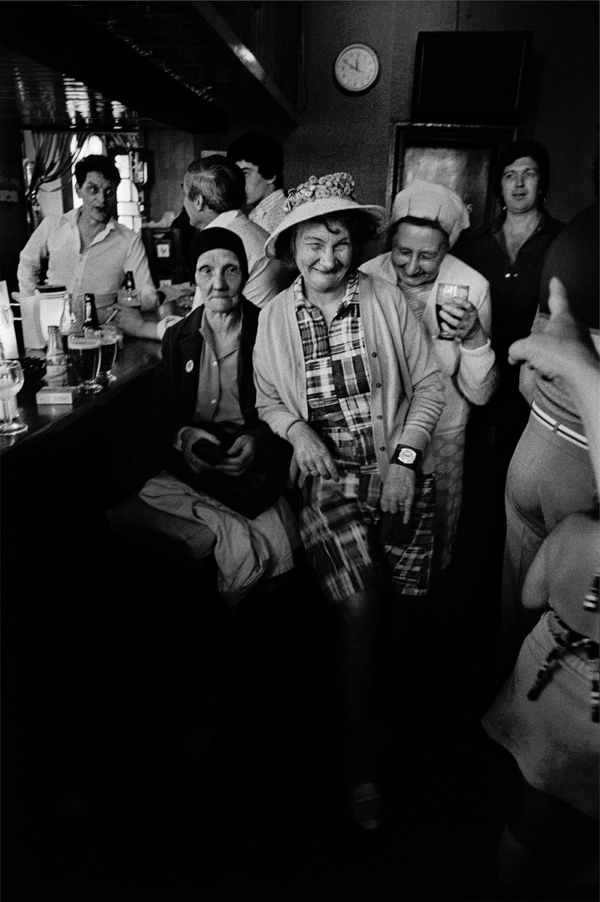
“I took these photographs thirty to forty years ago – they are all from the East End, mostly around Whitechapel and Spitalfields.
I was born in the East End, but my parents’ upward mobility whisked me out to suburbia and it was only in my twenties that I gravitated back to my roots. I was immediately entranced by the atmosphere of joy and dilapidation. It was the spirit of the people you see in these pictures that lifted my spirits and showed me the direction which my career has followed ever since.” David Hoffman


Photographs copyright © David Hoffman
You may also like to take a look at
David Hoffman at Fieldgate Mansions
David Hoffman at Smithfield Market
Cover price is £35 but you can buy it from Spitalfields Life for £30
CLICK HERE TO ORDER A SIGNED COPY OF ENDURANCE & JOY
Henry Silk’s Still Life

In 1930, basketmaker and artist Henry Silk sits alone in his sparsely furnished room in Rounton Rd in Bow surrounded by few personal possessions. He glances in the mirror and realises that he is no longer young. Yet the pair of medals from the Great War laid on the table remind him how lucky he is to be alive.
He wakes in the camp bed in the early morning and the empty green room is flooded with light as dawn rises over the rooftops of the East End and washing flaps on the line. Weaving baskets suits a contemplative nature and, when Henry returns from the kitchen with a cup of tea, he sits at the table with the pink cloth and studies the objects upon the surface in the morning sunlight.
The forms and colours of these familiar things fascinate him. His pipe, his purse and his pocket knife that he carried for years are as commonplace to him as his own hands. Each day, Henry paints a picture to catalogue his personal possessions, comprising the modest landscape of his existence. It is a whole life in a handful of paintings.


Henry Silk and his sister
You may also like to read about
Henry Silk, Basketmaker & Artist

Click here to buy a copy of EAST END VERNACULAR for £25
Mickey Davis At The Fruit & Wool Exchange
Photographer David Hoffman will be in conversation with Gaynor Tutani at the Museum of the Home on Wednesday 20th November at 6:30pm, discussing his new book and exhibition ENDURANCE & JOY IN THE EAST END. This is the only event David is doing in person, so if you want to hear him speak please book now.
Mike Brooke recalls his uncle Mickey Davis – affectionately known as “Mickey the Midget” – who became a popular hero when he took the initiative to organise the shelter in the basement of the Exchange where as many ten thousand people took refuge nightly, escaping the London Blitz. Mickey’s story is featured in Steve McQueen’s new film Blitz which we wholeheartedly recommend to our readers.

Mickey Davis & his wife Doris in the shelter beneath the Fruit & Wool Exchange, 1941
The last time I saw Mickey Davis I was as tall as him – and I was only seven or eight, back then in the Spitalfields of the early nineteen fifties. He came to my school, Robert Montefiore Primary in Deal St, as guest of honour for our annual prize giving. I recognised him in the corridor as we left the assembly hall afterwards, standing against the wall watching us return to our classrooms. I was the proudest kid on the block – because the guest of honour was my Uncle Mickey.
He was, I recall, Deputy Mayor of Stepney (the old Metropolitan borough that later became absorbed into what we now call Tower Hamlets), a very short man, a midget through an accident at birth or defect, I’m not sure exactly. But Mickey was a giant of a man to the community he served in those post-war years and a “people’s hero” of the London Blitz of 1940, several years before I was even born, as I discovered as a journalist working in the East End more than half-a-century later.
I must have been about eight when I roller-skated through the streets of Spitalfields one afternoon and found myself in Fournier St and decided to pop in to see aunt Doris and husband Mickey who lived in a large flat on the first floor of 103 Commercial St, part of the London Fruit & Wool Exchange opposite Spitalfields Church (now known as Christ Church). The kitchen overlooked the indoor wholesale trading area and there was always a faint smell of fruit and veg in the background, while the front room overlooked Commercial St, roughly level with the overhead wires of the 647 and 665 trolleybuses. It seemed quite a posh apartment to an eight-year-old.
But I didn’t go inside that afternoon. My grandmother, aunt Doris and my late father Henry’s mother, answered the door and told me immediately that uncle Mickey was dead. It was an abrupt manner to an eight-year-old, but I knew she was upset. I left and skated straight home to Granby St, along Brick Lane, rushing to tell my mother. She had not heard about Mickey yet, but knew he had been in hospital. We did not have a phone in the house in those days.
Doris and my mother Connie had been great friends during the War and worked together. It was through Doris that my mother and father met when he came home on leave from the Royal Navy in 1943. He visited his sister at work and took a fancy to Connie. They married while he was on leave and he was recalled back to Plymouth to rejoin his ship on their wedding night, so my mother once told me.
My mother immediately put a coat on and went over to see Doris that day in 1954 when I told her about the death of Uncle Mickey. It was not until decades later that I learned the full story of Mickey Davis – and how he organised a shelter committee during the early days of the Blitz at the Spitalfields Fruit & Wool Exchange – when the BBC contacted my family in the nineteen eighties, researching a possible documentary, though I do not think the programme was ever made. It was another two decades before I did my own research for an article about Mickey Davis for a commemorative supplement in the East London Advertiser, where I was Features Editor, marking the seventieth anniversary of the start of the Blitz in September 2010,.
Mickey, who at three feet three inches tall was known as ‘”the Midget,” was an East End optician who threw his energies into organising and improving shelter life, I wrote. He had emerged as the unofficial leader who pushed for improvements to health and safety in one of the East End’s biggest air raid shelters at the Spitalfields Fruit & Wool Exchange in Brushfield St. While the local authority, Stepney Borough Council, was concerned by the 2,500 people crammed into the shelter each night, with its lack of sanitation, risking disease and infection, and lack of facilities for food, lighting and heating, it was left to Mickey set up first aid and medical units, and raise money to equip a dispensary. He even persuaded stretcher bearers and others to come in on their off duty times to minister to the sick and injured. As a popular activist and orator, he became indispensable to the people, pushing the authorities into action.
Long before medical posts became the official practice, well-to-do friends of Mickey provided his Spitalfields public shelter with drugs and equipment. A GP friend made two-hour journeys each day to the East End to spend his nights among the poor. Eight years before the NHS was set up, Mickey’s shelter in 1940 had a free medical service already up-and-running. He even devised a card index system of everyone who used the shelter, and introduced hygiene practices and protection against disease. He persuaded Marks & Spencer to donate money for a canteen and used the profits to provide free milk for children. When the wartime Government eventually appointed official shelter marshals, Mickey was replaced – but the first action of the Spitalfields Shelter Committee undertook was to vote him to be Shelter Marshal, responsible for 2,500 people.
His thinking in 1940 was a fore-runner of the post-war Welfare State that emerged in 1948. He was a man known affectionately among East Enders as “the midget with the heart of a giant.”That was the Mickey Davis, who I am proud to have called “uncle.”

Mickey Davis, popularly known as “Mickey the Midget,” who became a hero of the London Blitz – photo by Bert Hardy

Mickey (in the foreground) convenes a planning meeting in the basement of the Fruit & Wool Exchange in 1941 – photo by Bert Hardy

Musical entertainment for people sleeping in “Mickey’s Shelter” in the Fruit & Wool Exchange.

The space of “Mickey’s Shelter” prior to demolition.

Graffiti remaining from the days of the shelter in the basement of the Fruit & Wool Exchange.

The Fruit & Wool Exchange prior to redevelopment

The Auction room at the Fruit & Wool Exchange in the nineteen thirties.
Bert Hardy photographs © Getty Images
Photo of Auction Room courtesy Bishopsgate Institute
You may also like to read about
Samuel Pepys At St Olave’s

Click here for more information

Do you see Elizabeth Pepys, leaning out from her monument and directing her gaze across the church to where Samuel sat in the gallery opposite? These days the gallery has long gone but, since her late husband became celebrated for his journal, a memorial to him was installed in 1883 where the gallery once was, which contains a portrait bust that peers back eternally at Elizabeth. They will always see eye-to-eye even if they are forever separated by the nave.
St Olave’s on the corner of Seething Lane has long been one of my favourite City churches. Dating from the eleventh century, it is a rare survivor of the Great Fire and the London Blitz. When you walk in from Hart St, three steps down into the nave immediately reveal you are entering an ancient building, where gothic vaults and medieval monuments conjure an atmosphere more reminiscent of a country church than one in the City of London.
Samuel Pepys moved into this parish when he was appointed Commissioner of the Navy Board and came to live next to the Navy Office at the rear of the church, noting his arrival at “my house in Seething Lane” in his journal on July 18th 1660. It was here that Pepys recorded the volatile events of the subsequent decade, the Plague and the Fire.
In Seething Lane, a gateway adorned with skulls as memento mori survives from that time. Pepys saw the gate from his house across the road and could walk out of the Navy Office and through it into the churchyard, where an external staircase led him straight into the private Navy Office pew in the gallery.
The churchyard itself is swollen above surrounding ground level by the vast number of bodies interred within and, even today, the gardeners constantly unearth human bones. When Elizabeth and the staff of the Navy Office took refuge from the Plague south of the river, Pepys stayed behind in the City. Countless times, he walked back and forth between his house and the Navy Office and St Olave’s as the body count escalated through the summer of 1665. “The sickness in general thickens round us, and particularly upon our neighbourhood,” he wrote to Sir William Coventry in grim resignation.
The following year, Pepys employed workers from the dockyard to pull down empty houses surrounding the Navy Office and his own home to create fire breaks. “About 2 in the morning my wife calls me up and tells me of new cries of fire, it being come to … the bottom of our lane,” he recorded on 6th September 1666.
In the seventeenth century vestry room where a plaster angel presides solemnly from the ceiling, I was able to open Samuel Pepys’ prayer book. It was heart-stopping to turn the pages. Dark leather covers embossed with intricate designs enfold the volume, which he embellished with religious engravings and an elaborate hand-drawn calligraphic title page.
Samuel and Elizabeth Pepys are buried in a vault beneath the nave. Within living memory, when the Victorian font was removed, a hole was exposed that led to a chamber with a passage that led to a hidden chapel where a tunnel was dug to reach the Pepys vault. Scholars would love to know if he was buried with his bladder stone upon its silver mount, but no investigation has yet been permitted.
If you seek Samuel Pepys, St Olave’s is undoubtedly where you can find him. Walk in beneath the gate laden with skulls, across the graveyard bulging with the bodies of the long dead, cast your eyes along the flower beds for any shards of human bone, and enter the church where Samuel and Elizabeth regard each other from either side of the nave eternally.

St Olave’s at the corner of Seething Lane

“To our own church, and at noon, by invitation, Sir W Pen dined with me and Mrs Hester, my Lady Betten’s kinswoman, to dinner from church with me, and we were very merry. So to church again, and heard a simple fellow upon the praise of Church musique, and exclaiming against men’s wearing their hats on in the church, but I slept part of the sermon, till latter prayer and blessing and all was done without waking which I never did in my life…” SAMUEL PEPYS, Sunday 17th November, 1661

Samuel Pepys’ memorial in the south aisle


Samuel Pepys’ prayerbook

Engraved nativity and fine calligraphy upon the title page of Pepys’ prayerbook

Door to the vestry

The oldest monument in the church, 1566

Memorial of Peter Capponi, a Florentine merchant & spy, 1582


Paul Bayning, 1616, was an Alderman of the City & member of the Levant company

A Norwegian flag hangs in honour of St Olave


The gate where Pepys walked in from the Navy Office across the street

Sculpture of Samuel Pepys in the churchyard


You may also like to read about
The Pubs Of Old London

The Vine Tavern, Mile End
I cannot deny I enjoy a drink, especially if there is an old pub with its door wide open to the street inviting custom, like this one in Mile End. In such circumstances, it would be affront to civility if one were not to walk in and order a round. Naturally, my undying loyalty is to The Golden Heart in Commercial St, as the hub of our existence here in Spitalfields and the centre of the known universe. But I have been known to wander over to The Carpenters’ Arms in Cheshire St, The George Tavern in Commercial Rd and The Marksman in Hackney Rd when the fancy takes me.
So you can imagine my excitement – especially now the pubs have re-opened – to discover all these thirst-inspiring images of the pubs of old London among the thousands of glass slides left over from the days of the magic lantern shows given by the London & Middlesex Archaeological Society at the Bishopsgate Institute a century ago. It did set me puzzling over the precise nature of these magic lantern lectures. How is it that among the worthy images of historic landmarks, of celebrated ruins, of interesting holes in the ground, of significant trenches and important church monuments in the City of London, there are so many pictures of public houses? I can only wonder how it came about that the members of the London & Middlesex Archaeological Society photographed such a lot of pubs, and why they should choose to include these images in their edifying public discourse.
Speaking for myself, I could not resist lingering over these loving portraits of the pubs of old London and I found myself intoxicated without even lifting a glass. Join me in the cosy barroom of The Vine Tavern that once stood in the middle of the Mile End Rd. You will recognise me because I shall be the one sitting in front of the empty bottle. Bring your children, bring your dog and enjoy a smoke with your drink, all are permitted in the pubs of old London – but no-one gets to go home until we have visited every one.

The Saracen’s Head, Aldgate

The Grapes, Limehouse

George & Vulture, City of London

The Green Dragon, Highgate

The Grenadier, Old Barrack Yard

The London Apprentice, Isleworth

Mitre Tavern, Hatton Garden

The Old Tabard, Borough High St

The Three Compasses, Hornsey

The White Hart, Lewisham

The famous buns hanging over the bar at The Widow’s Son, Bow

The World’s End, Chelsea, with the Salvation Army next door.

The Angel Inn, Highgate

The Archway Tavern, Highgate

The Bull, Highgate

The Castle, Battersea

The Old Cheshire Cheese, Fleet St

The Old Dick Whittington, Cloth Fair, Smithfield

Fox & Crowns, Highgate

The Fox, Shooter’s Hill

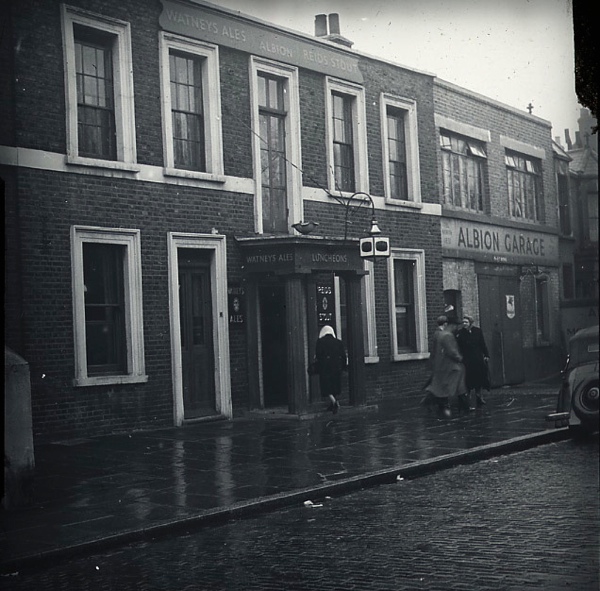
The Albion, Barnesbury

The Anchor, Bankside

The George, Borough High St
Images courtesy Bishopsgate Institute
You may also like to read about
Sandra Esqulant, The Golden Heart


