
At Toynbee Hall

Arnold Toynbee was the Economic Historian who coined the phrase “Industrial Revolution” to describe the transformation that came upon this country in the first half of the nineteenth century as a result of technological advance. As early as the eighteen-seventies, he recognised that the free market system disadvantaged the poor, and he came to Whitechapel from Oxford to encourage the creation of trade unions and public libraries, as a means to give practical expression to his social beliefs.
When Toynbee died from exhaustion at the age of thirty in 1883, his friend Samuel Barnett, working in partnership with his wife Henrietta Barnett, established an experimental university settlement in the East End founded upon these ideals and they named it Toynbee Hall. Opening on Christmas Eve 1884, it attempted to recreate a collegiate environment where the educated intellects of Oxford & Cambridge might live and work among the poor. Already, Samuel had been vicar of St Jude’s in Whitechapel since 1873, while his wife Henrietta had worked with Octavia Hill on social housing projects and counted John Ruskin as a personal mentor.
Residents were encouraged to place citizenship above self-interest and dedicate themselves to relationships that overcame class barriers. Barnett believed that educational and social projects undertaken by the students encouraged a social conscience among future generations of political leaders. It was an ethos that became manifest when Clement Attlee who had been secretary at Toynbee Hall became Prime Minister in 1945. Thus the entire project of the Welfare State and attendant modern notions of Social Welfare in Britain can be traced back to their origin in the work begun in Commercial St – which explains why more recent Prime Ministers such as Tony Blair came to launch his campaign to end child poverty at Toynbee Hall in 1999 and David Cameron chose to announce his Welfare Reforms here in 2011.
True to his belief in the social value of culture, Samuel Barnett founded the Whitechapel Gallery round the corner, that opened its doors in 1901, and Henrietta Barnett created Hampstead Garden Suburb in 1907, as the embodiment of her notion of humane housing for Londoners.
Despite damage by wartime bombing and the accretion of more recent buildings, the core structure of Samuel & Henrietta Barnett’s Toynbee Hall remains today. Built in the nineteenth-century Elizabethan style by Elijah Hoole, with gables, tall chimneystacks, mullioned windows and diamond-paned casements, and embellished with magnificent old fig trees, the dignified collegiate atmosphere prevails. At the heart of it are the oak-panelled Lecture Hall and the Dining Room (now the CR Ashbee Hall) with its original low table, conceived as a means to encourag those sitting around it into a more relaxed inter-relationship.
CR Ashbee, who later founded the Art Workers Guild in Bow, came here after graduating from Cambridge in 1886 and applied the principles of John Ruskin directly, by setting to work with his students to redecorate the dining room in the Arts & Crafts style. His tree of life design in relief upon the gilded plaster rondels became the symbol of Toynbee Hall. These medallions once punctuated murals painted by his students and early photos show his famous table surrounded by Morris’ Sussex chairs. Tantalisingly, murals in both of these major rooms have been painted out and, apart from the table, none of the original furnishings survive. Yet this sturdy old table, scratched and worn, evokes the presence of those who have gathered round it and the passionate discourse that has passed across it for over a century.
To visit Toynbee Hall is to be reminded of the origin of the notion of a modern compassionate society, the importance of universal education, and the duty of government to temper the excesses of the free market for the public benefit – and to recognise that these are ideas still worth striving for today.

Samuel Barnett with graduates of Oxford & Cambridge at Toynbee Hall c.1903-5


The Lecture Hall, c. 1900


Samuel Barnett

Henrietta Barnett


Painting a mural in the Lecture Hall in the nineteen-thirties

In the Lecture Hall today

Crests of Oxford and Cambridge colleges line the walls of the CR Ashbee Hall today

Busts of former luminaries – this one is John Profumo

The famous low table in sections designed by CR Ashbee as part of the room, to encourage a more relaxed relationship among those who sat around it

Rondels by CR Ashbee depicting the tree of life that became Toynbee Hall’s symbol – although a paint scheme based upon the original colours was introduced in the eighties, these walls were once painted with murals under the supervision of CR Ashbee

Sketch of the CR Ashbee Hall showing original furnishings including Sussex chairs by William Morris

Students’ common room

A scientific experiment

Elevation on Wentworth St

Original facade onto Commercial St

Bomb damage to the Commercial St facade

The clock tower of 1893

Bomb damage seen from the internal courtyard

The view from Commercial St once the bomb damage was cleared away

The view from Commercial St today
You may like to read about Toynbee Hall resident
King Of The Bottletops In Spitalfields
Robson Cezar
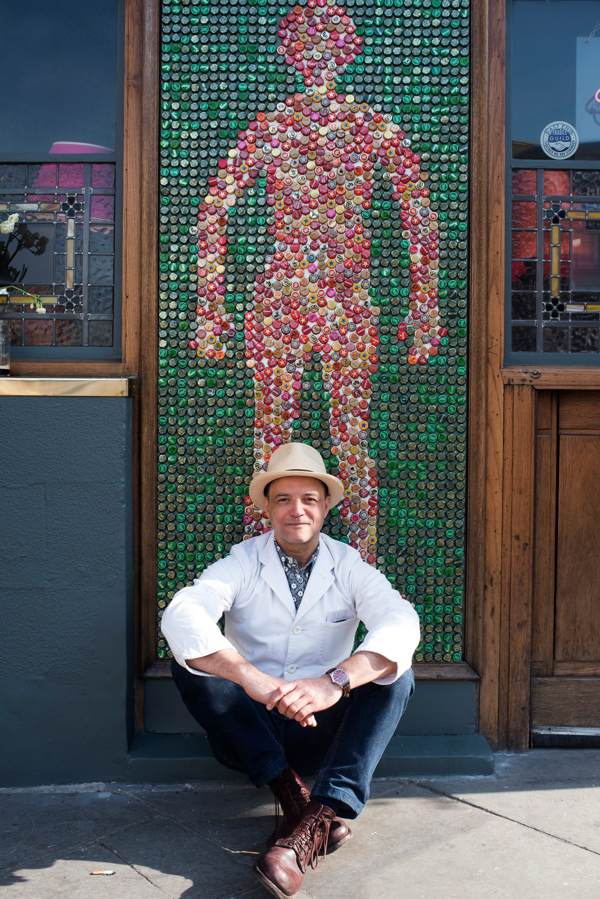
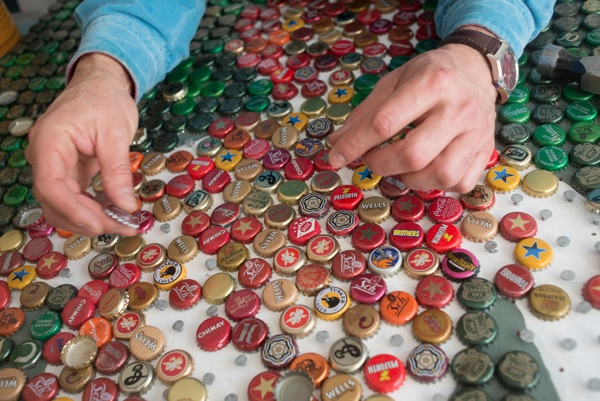
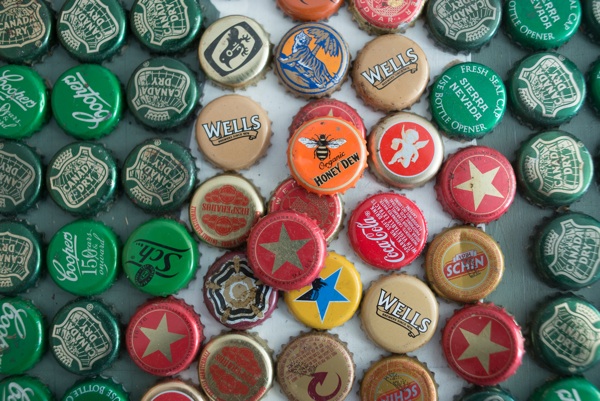
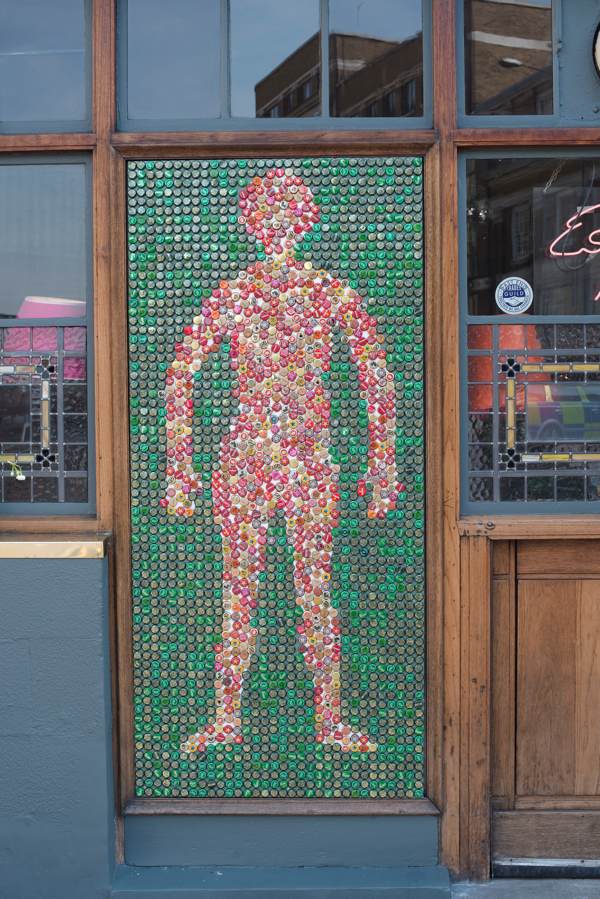
Have you seen the bottletop man at the corner of Hanbury St? You might not notice him among the regulars that gather on the pavement outside The Golden Heart but, when the crowds thin out, he is still there, standing sentinel and keeping watch along Commercial St after everyone else has gone home.
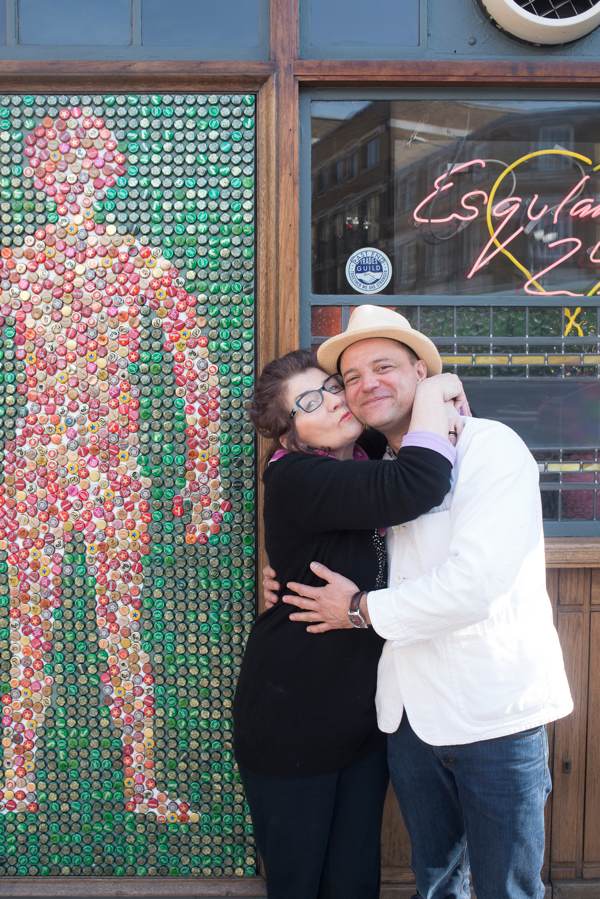
Yet, in the morning, he is ready to welcome visitors even before the pub opens and stands patiently like a Guardsman while tourists take each other’s photographs beside him. This new presiding spirit of the neighbourhood is the latest work of Robson Cezar, Artist and Spitalfields resident, known as the King of the Bottletops, pictured here by Contributing Photographer Sarah Ainslie.
Meanwhile just a hundred yards away, another beloved Spitalfields institution, Mama Thai the cafe and noodle bar in Toynbee St, has acquired a sparkling new fascia of seven thousand bottletops.
If you would like to meet Robson Cezar and learn how to do it yourself, you can visit him at Spitalfields City Farm where he is Artist-in-Residence from Thursday 21th August until Sunday 7th September. Come along to the farm any weekday (except Mondays) between 10am and 4pm. Introductory workshops take place between 11am & 1pm and between 2pm & 4pm on Saturdays and Sundays. Everyone is welcome to turn up at the free weekday sessions but places at the weekend workshops must be booked by email to Rossana@spitalfieldscityfarm.org
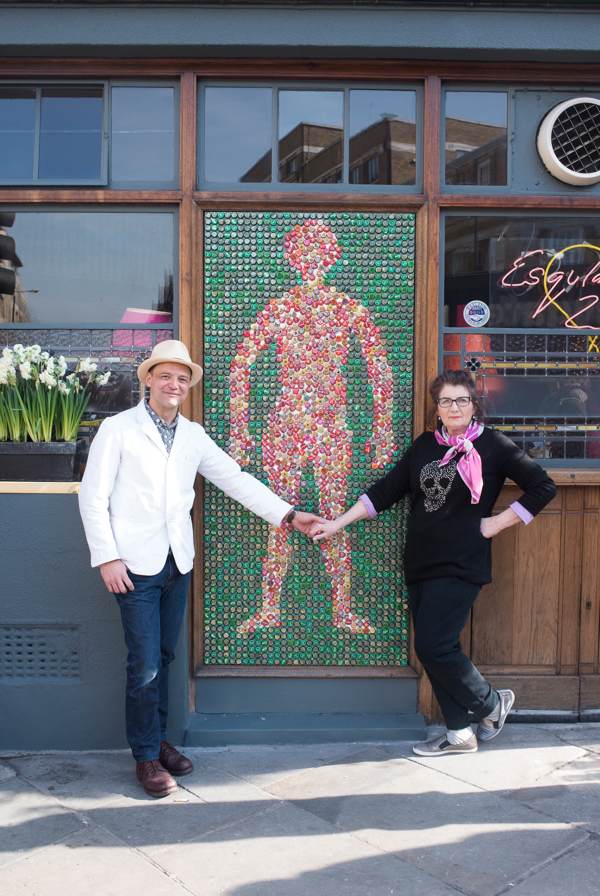
Robson Cezar and Sandra Esqulant, Landlady of the Golden Heart
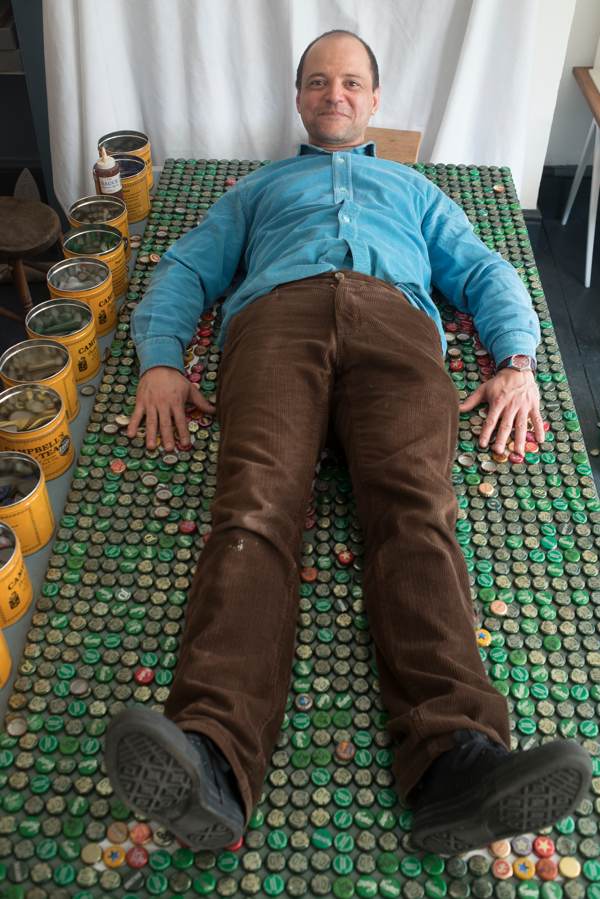
Robson Cezar made the bottletop man in his own image
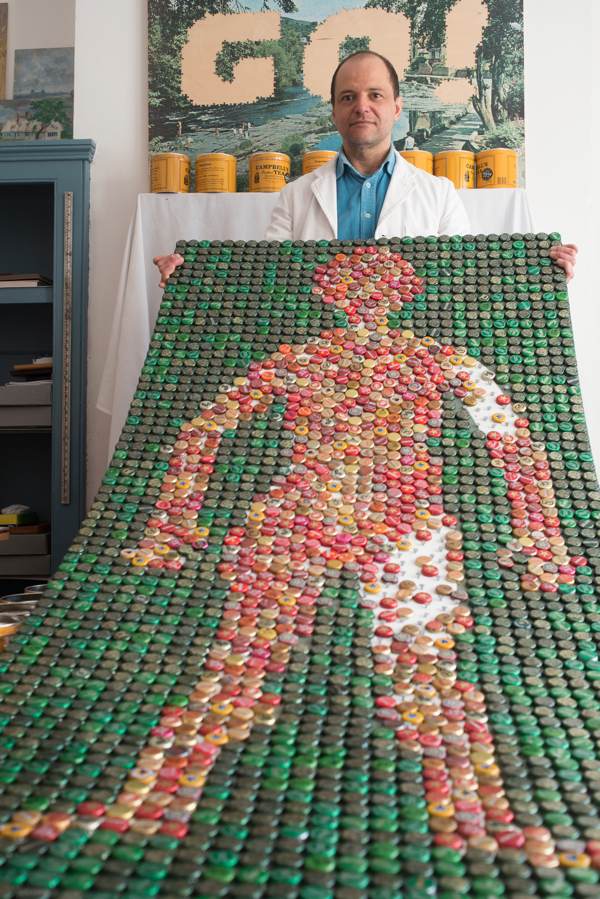
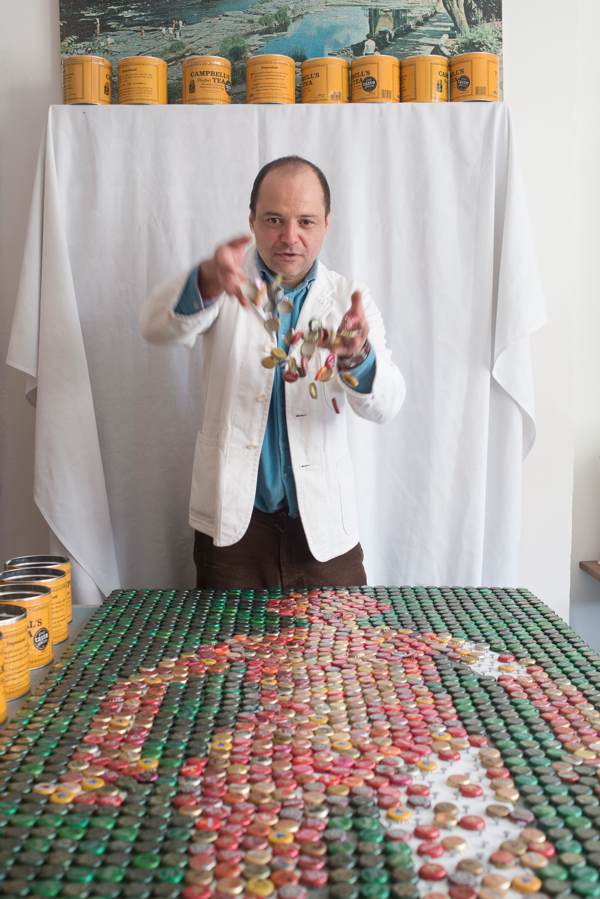
Robson Cezar conjures the bottletop man into life
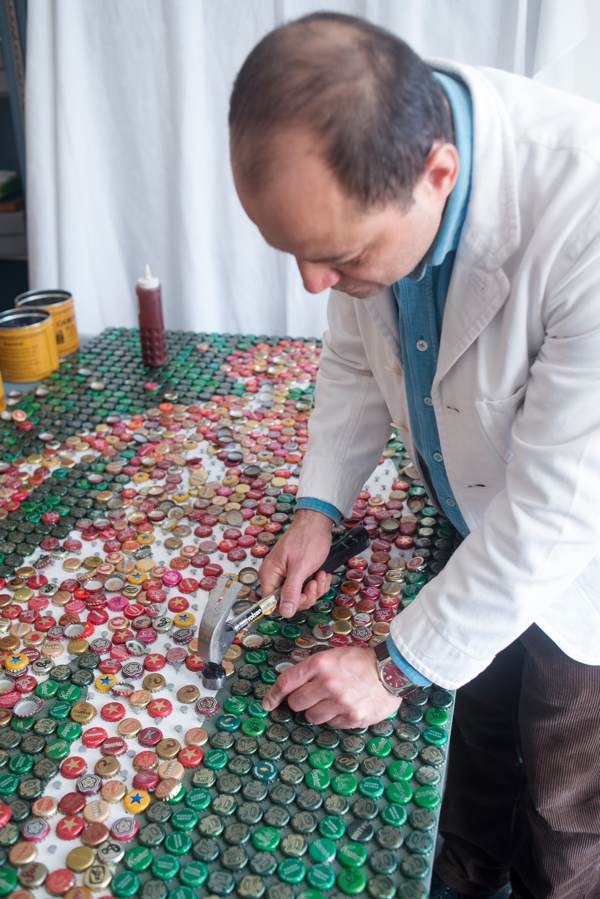
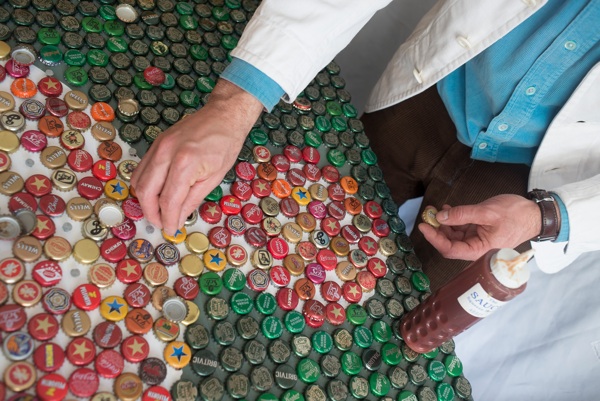
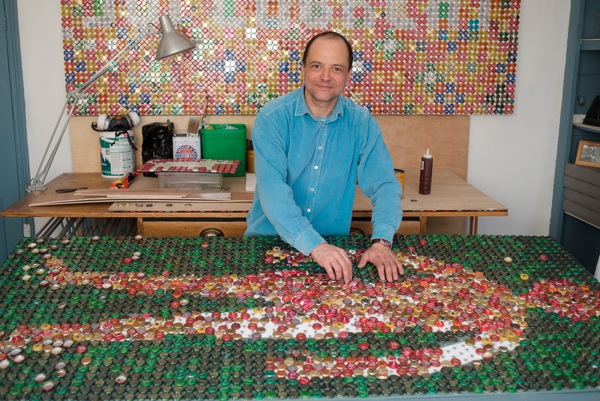
Robson the bottletop physician
At the Golden Heart
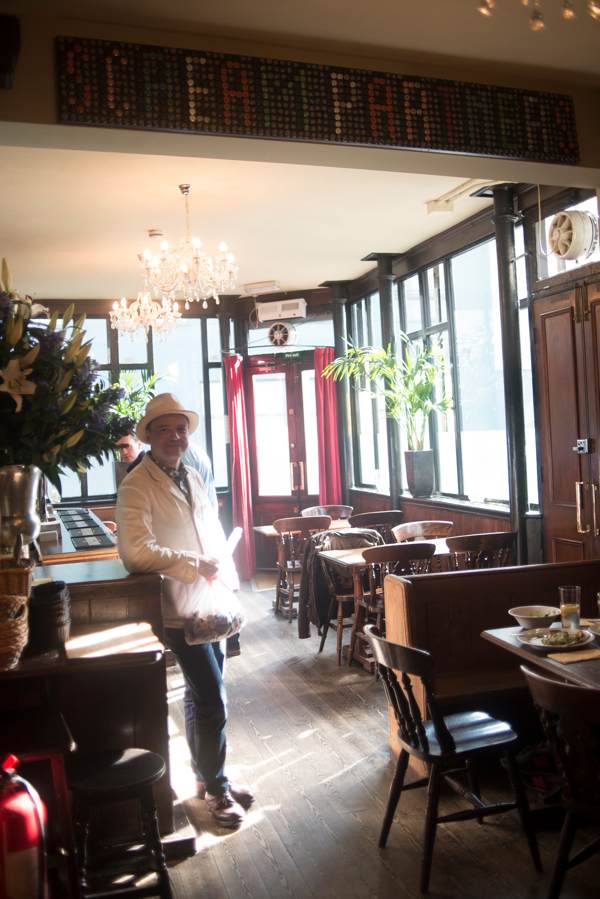
Collecting bottletops at the Carpenters Arms
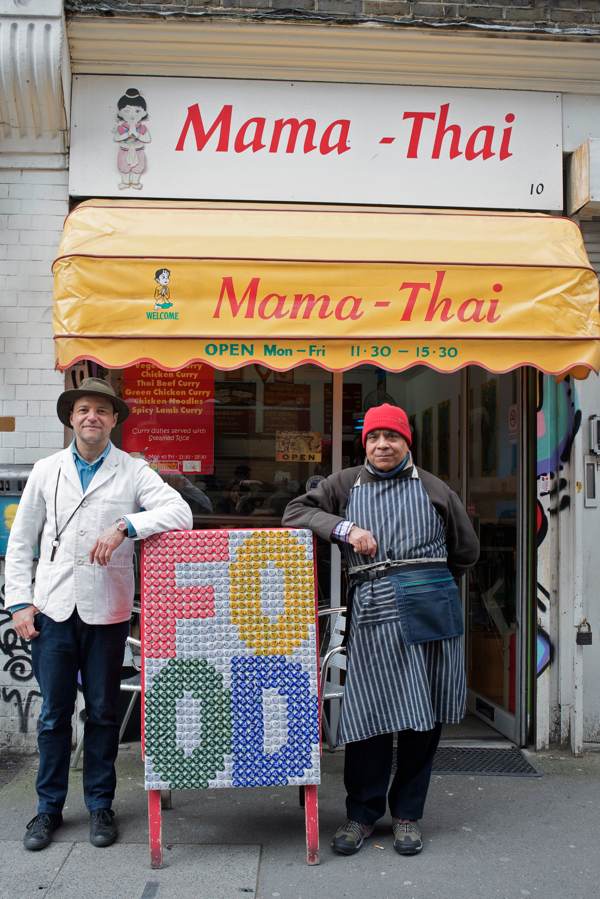
Robson and Raj Chawla at Mama Thai, before the new fascia – it all started with the sandwich board
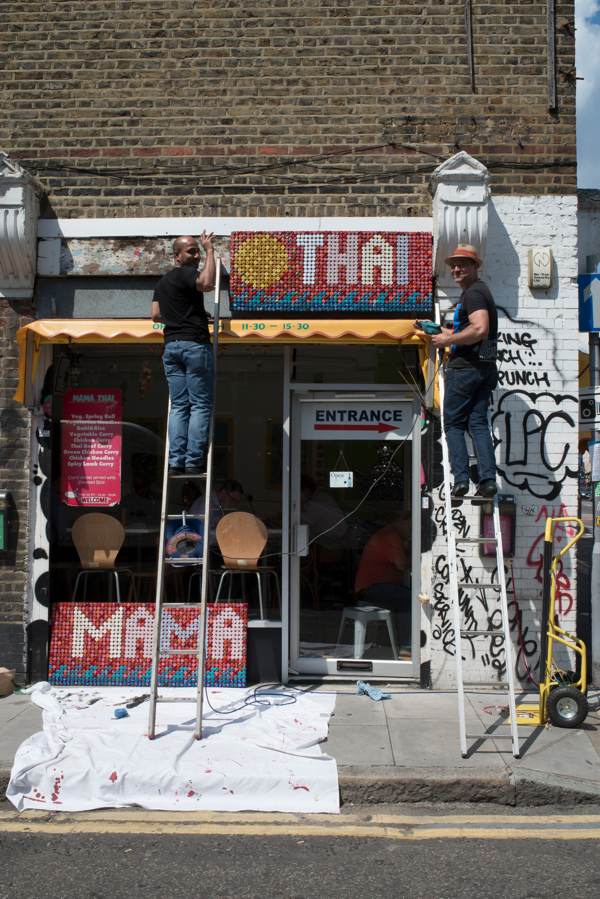
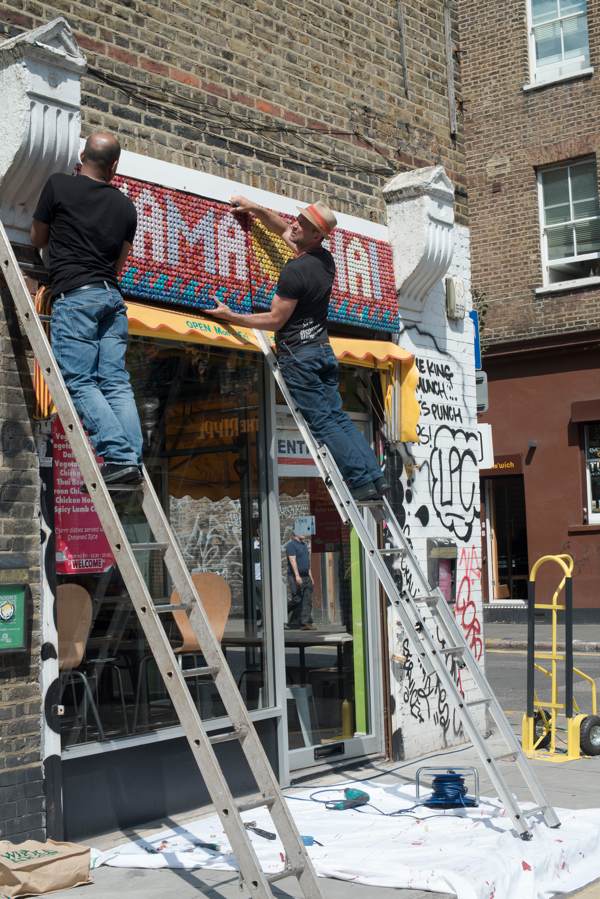
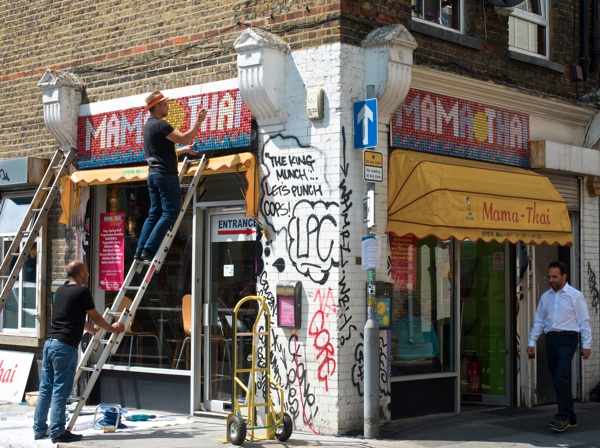
The corner of Brune St and Toynbee St
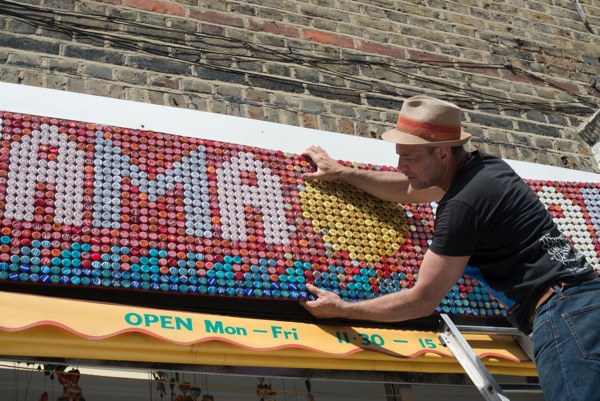
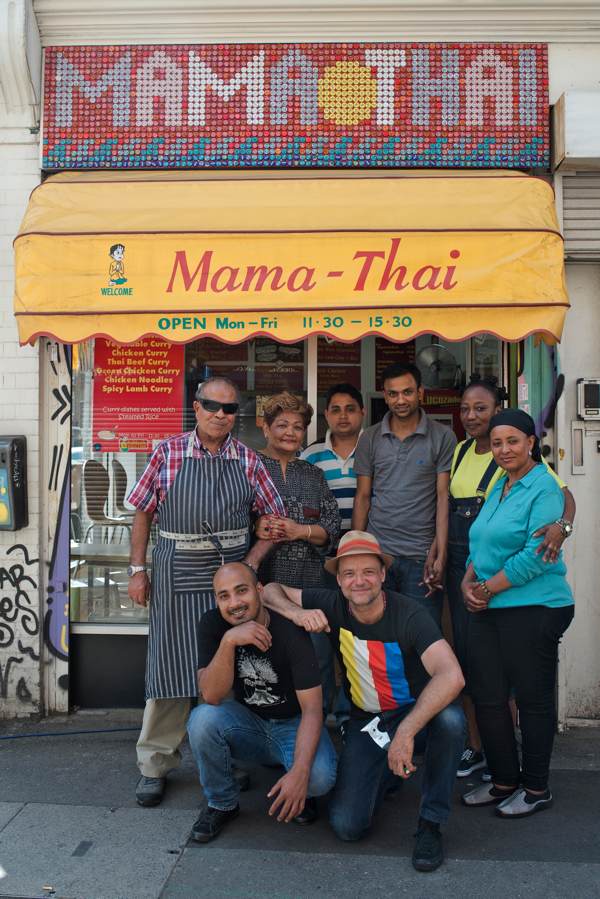
The celebrated Pam Chawla, Mama Thai herself, stands holding Raj’s arm (standing second from left)
Photographs copyright © Sarah Ainslie
You may also like to read about
In Old Bermondsey
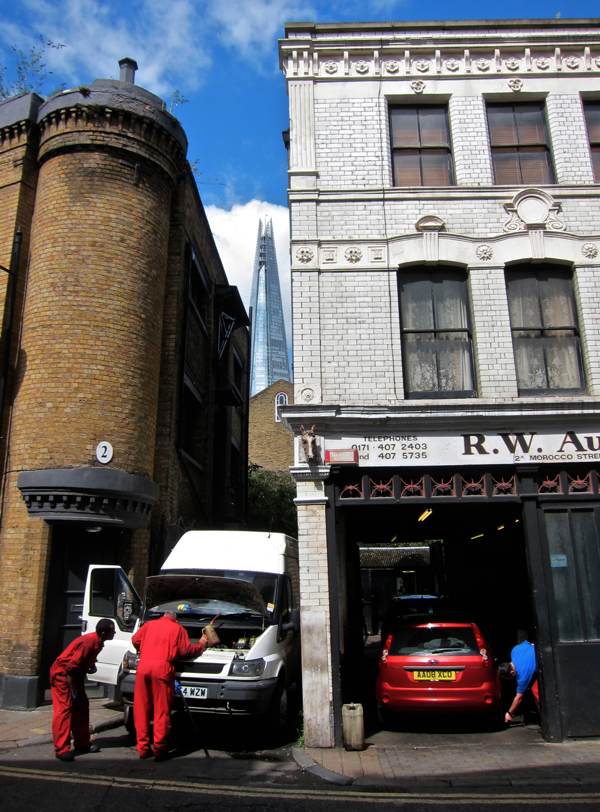
The horse’s head upon the fascia reveals that RW Autos was once a farrier
Twenty-five years ago I had reason to visit Bermondsey St frequently but I have hardly been there since, so I thought it was time to walk down across the river and take a look. Leaving the crowds teeming like ants upon the chaotic mound that is London Bridge Station in the midst of reconstruction, I ventured into Guy’s Hospital passing the statue of Thomas Guy, who founded it in 1721, to sit with John Keats in a stone alcove from old London Bridge now installed in a courtyard at the back.
From here, I turned east through the narrow streets into Snowsfields, passing the evocatively named Ship & Mermaid Row, and Arthur’s Mission of 1865 annotated with “Feed my Lambs” upon a plaque. An instruction that has evidently not been forgotten, as the building adjoins the Manna Day Centre which offers refuge and sustenance to more than two hundred homeless people each day.
At the end of Snowsfields is the crossroads where Bermondsey St meets the viaduct carrying the railway to and from London Bridge, and the sonorous intensity of the traffic roaring through, combined with the vibration from the trains rattling overhead, can be quite overwhelming. Yet the long narrow street beckons you south, as it has done for more than a thousand years – serving as the path from the Thames to the precincts of Bermondsey Abbey, a mile away, since the eleventh century. When I first came here, I never ventured beyond Bermondsey Sq. Only when I learned of the remains of the medieval gatehouse in Grange Walk beyond, with the iron hinges still protruding from the wall today, did I understand that Bermondsey St was the approach to the precincts of the Abbey destroyed by Henry VIII in 1536.
There is an engaging drama to Bermondsey St with its narrow frontages of shops and tall old warehouses crowded upon either side, punctuated by overhanging yards and blind alleys. A quarter of a century ago, everything appeared closed down, apart from The Stage newspaper with its gaudy playbill sign, a couple of attractively gloomy pubs and some secondhand furniture warehouses. I was fascinated by the mysteries withheld and Bermondsey St lodged in my mind as a compelling vestige of another time. Nowadays it appears everything has been opened up in Bermondsey St, and the shabbiness that once prevailed has been dispelled by restoration and adaptation of the old buildings, and the addition of fancy new structures for the Fashion & Textile Museum and the White Cube Gallery.
Yet, in spite of the changes, I was pleased to discover RW Autos still in business in Morocco St with the horses’ heads upon the fascia, indicating the origin of the premises as a farrier. Nearby, the massive buildings of the former London Leather Exchange, now housing dozens of small businesses, stand as a reminder of the tanning industry which occupied Bermondsey for centuries, filling the air with foul smells and noxious fumes, and poisoning the water courses with filth.
The distinctive pattern of streets and survival of so many utilitarian nineteenth and eighteenth century structures ensure the working character of this part of Bermondsey persists, and you do not have to wander far to come upon blocks of nineteenth century housing and old terraces of brick cottages, interspersed by charity schools and former institutes of altruistic endeavour, which carry the attendant social history. Thus Bermondsey may still be appreciated as an urban landscape where the past is visibly manifest to the attentive visitor, who cares to spend a quiet afternoon exploring on foot.
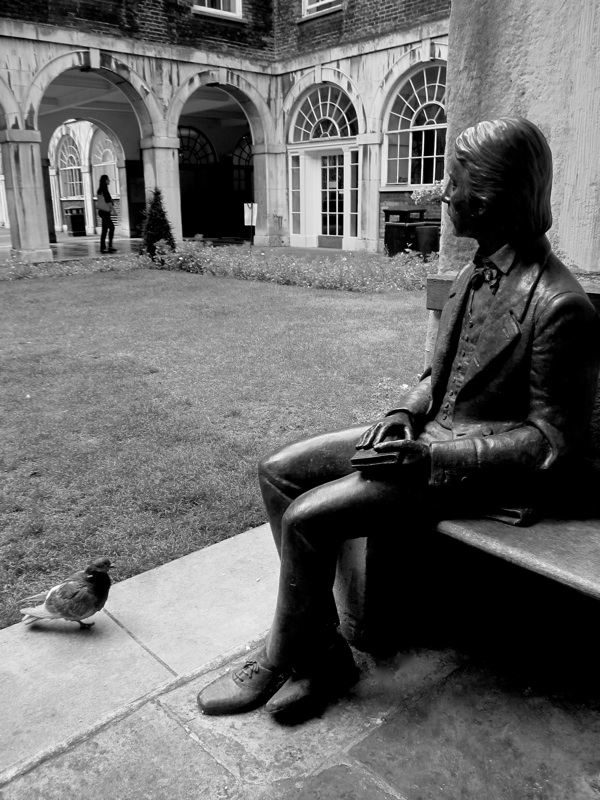
John Keats at Guy’s Hospital
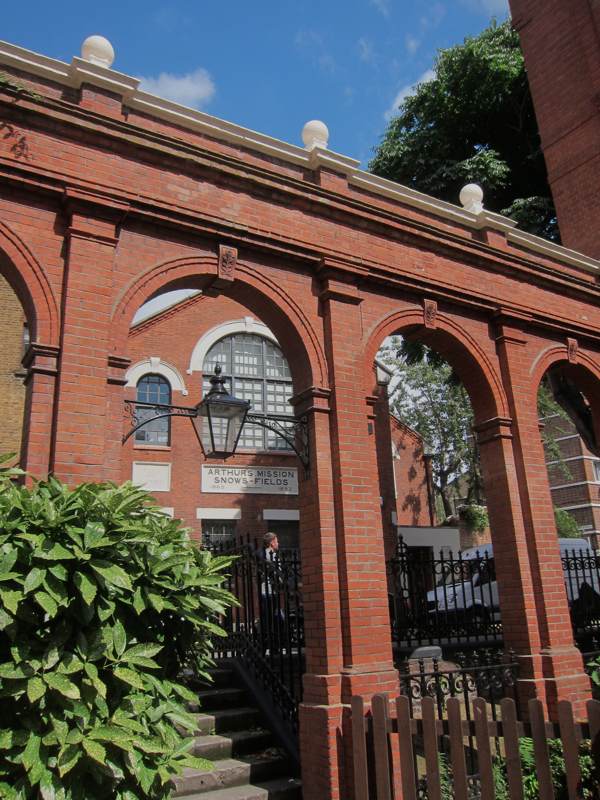
Arthur’s Mission in Snow’s Fields seen from Guinness Buildings 1897
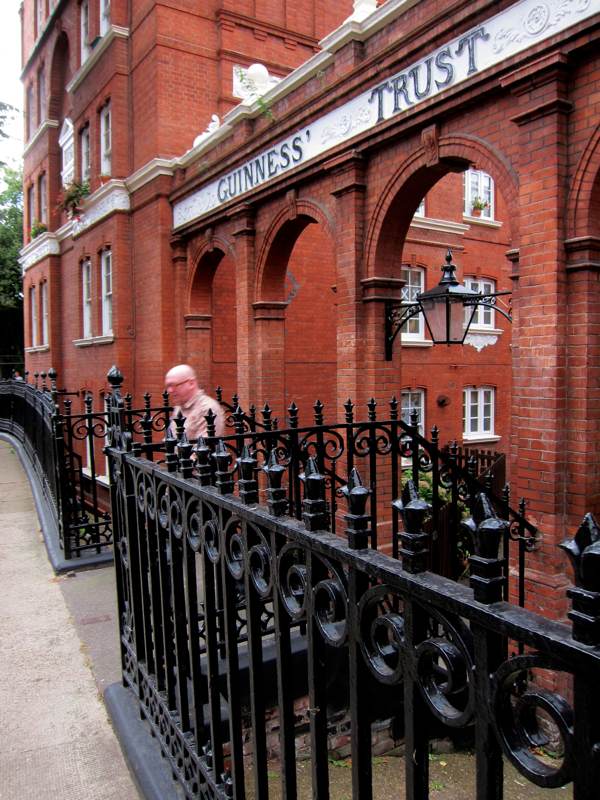
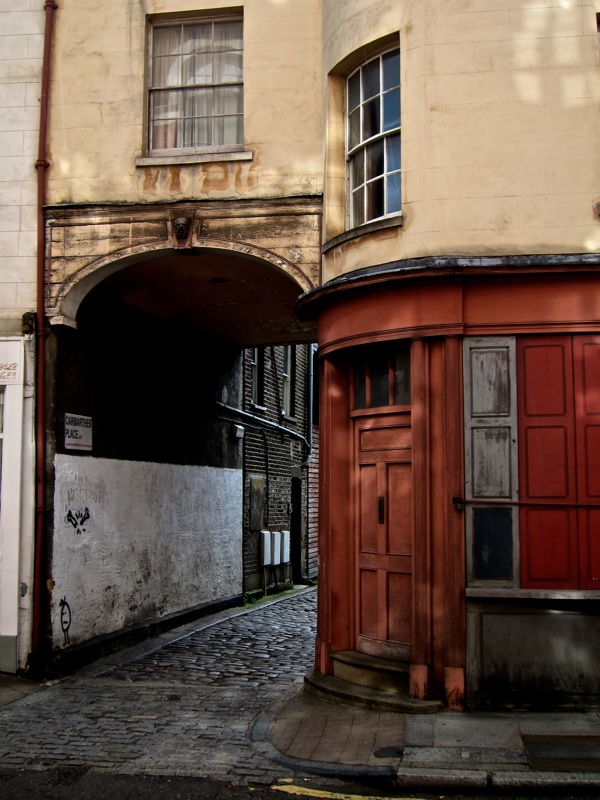
In Bermondsey St
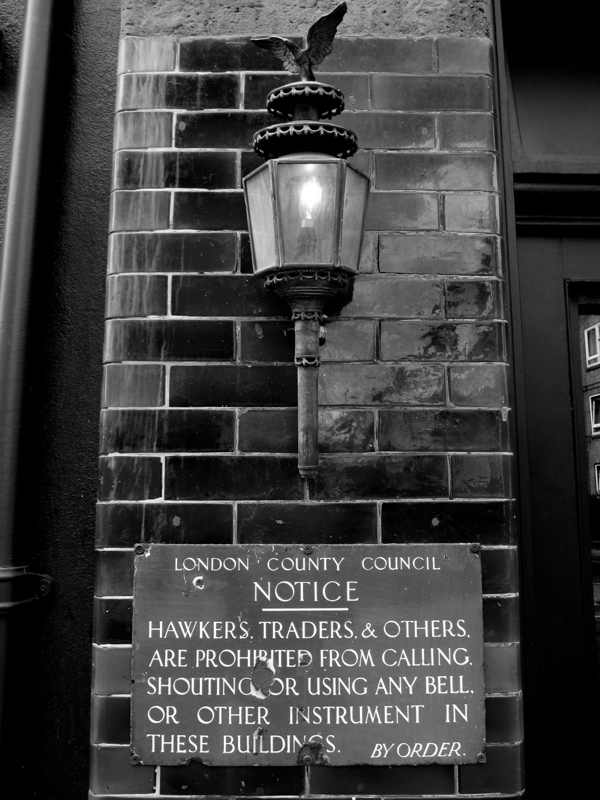
At the Woolpack
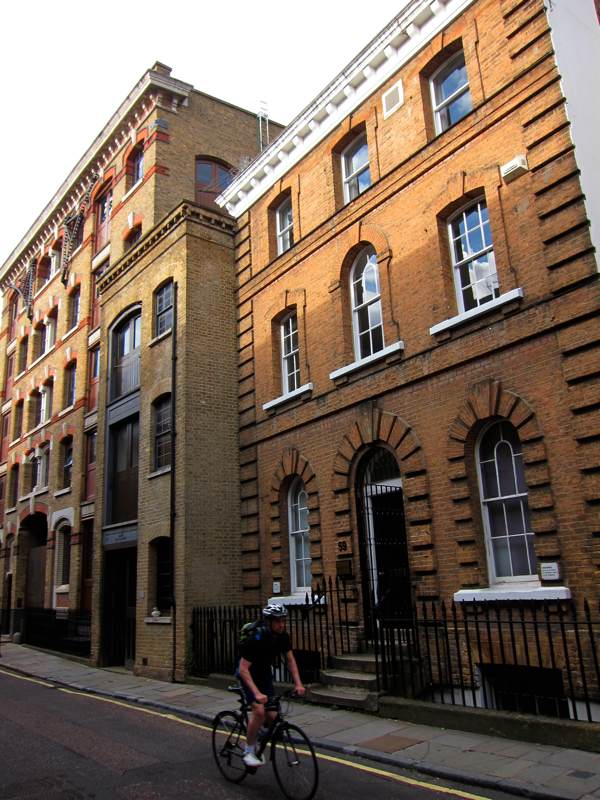
Old warehouses in Bermondsey St


St Mary Magdalen Bermondsey – the medieval tower is the last remnant of the Abbey founded in the eleventh century
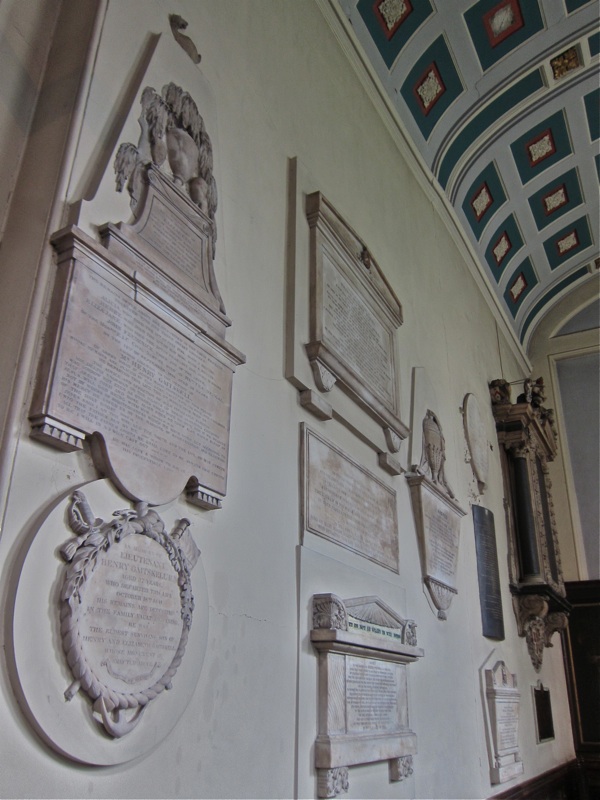
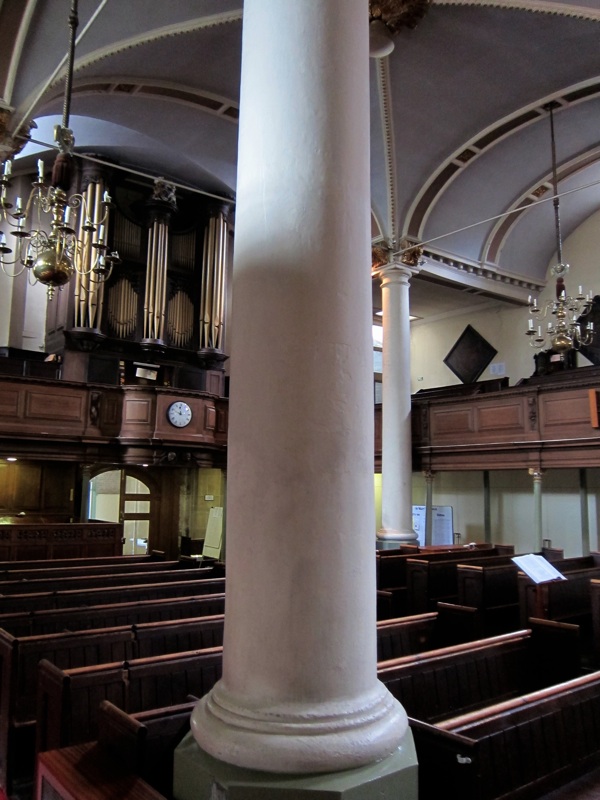
In St Mary’s Bermondsey St
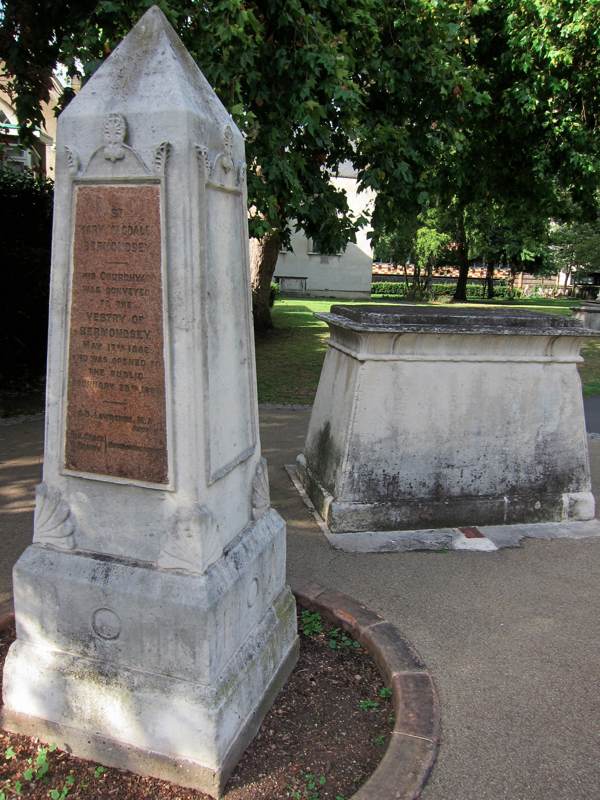
In St Mary Magdalen Graveyard
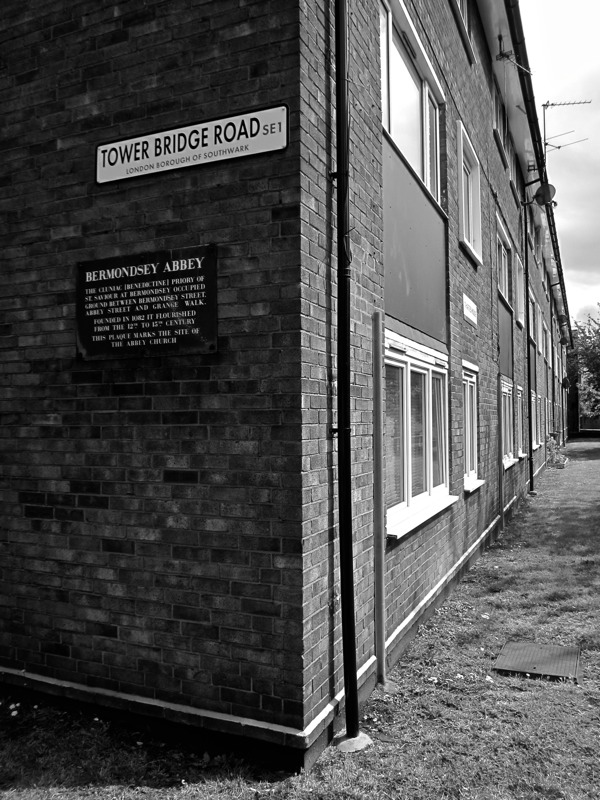
This plaque marks the site of the abbey church
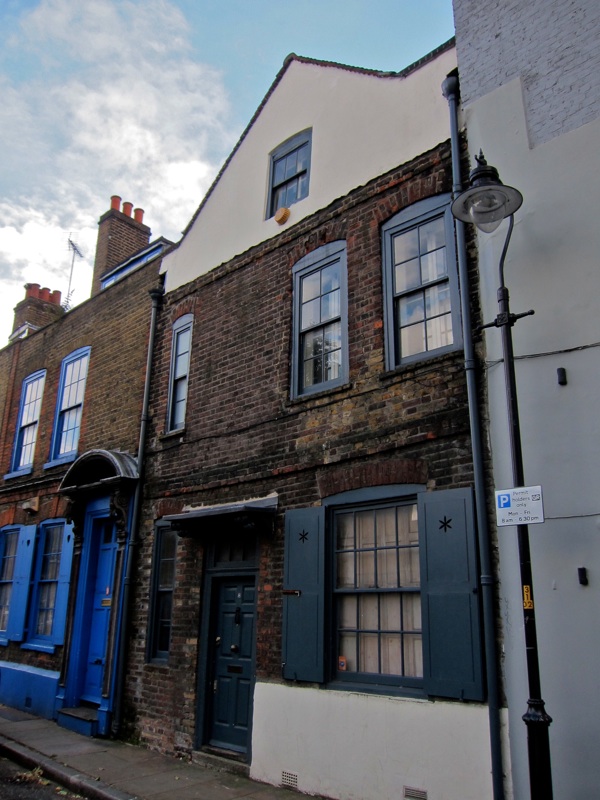
Old houses in Grange Walk – the house on the right is claimed to be the Abbey gatehouse with hinges of the gates still visible
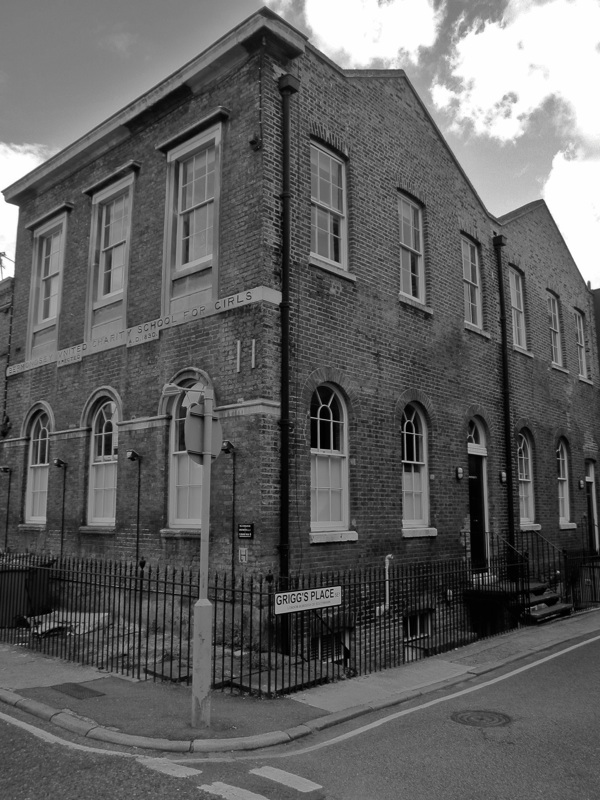
Bermondsey United Charity School for Girls in Grange Walk, 1830

In Grange Walk
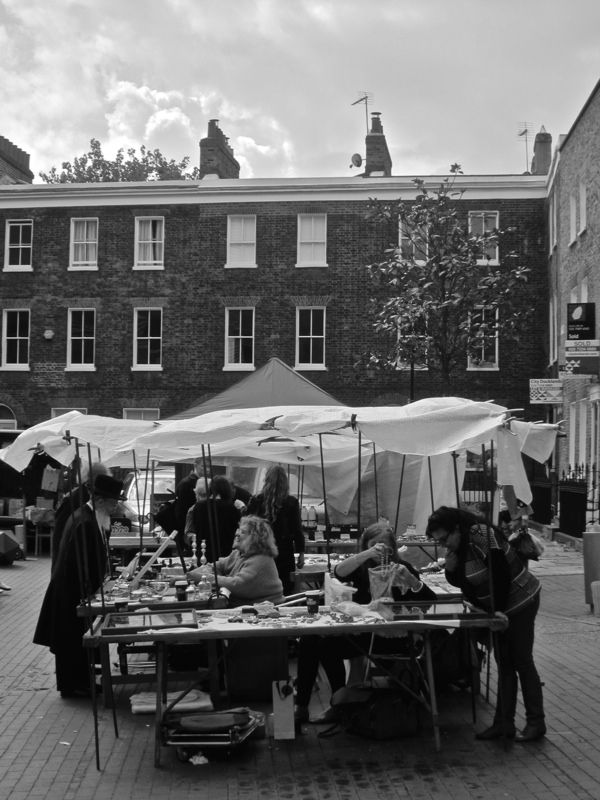
Bermondsey Sq Antiques Market every Friday

A cottage garden in Bermondsey
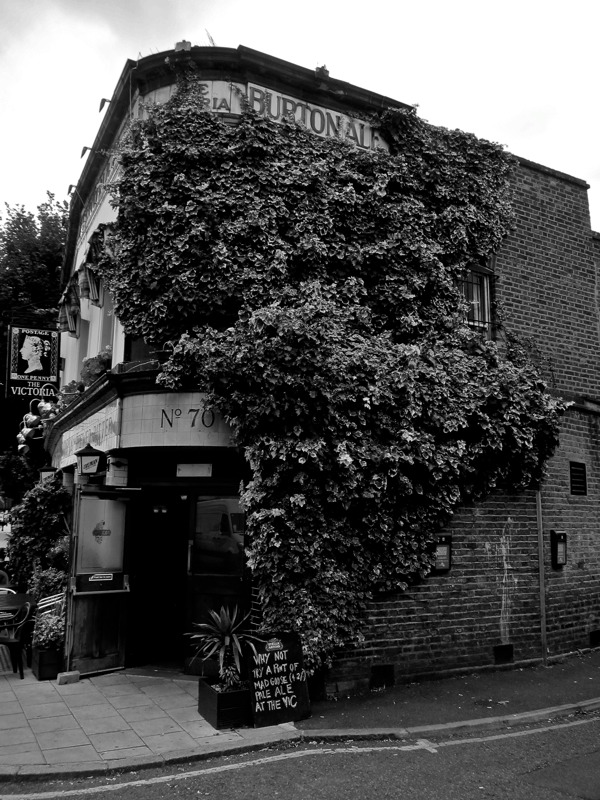
The Victoria, a magnificent tiled nineteenth century pub with its original spittoon, in Pages Walk

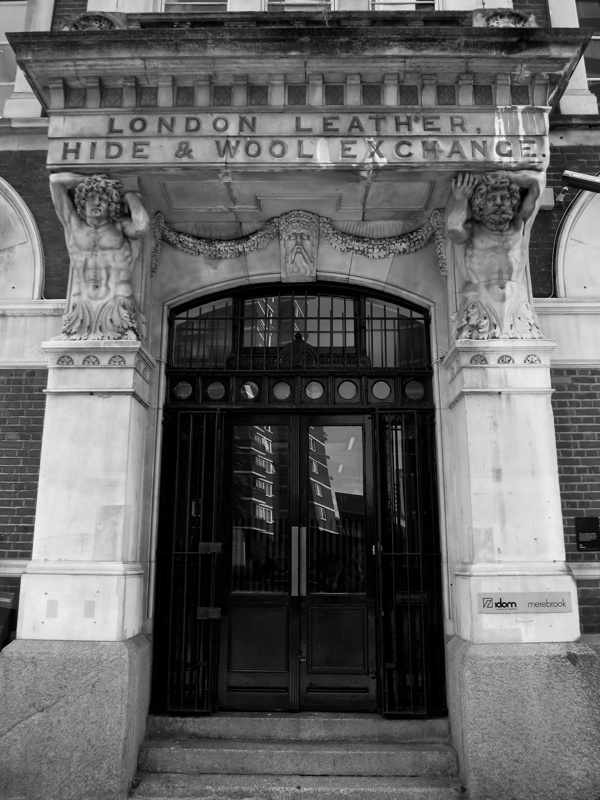
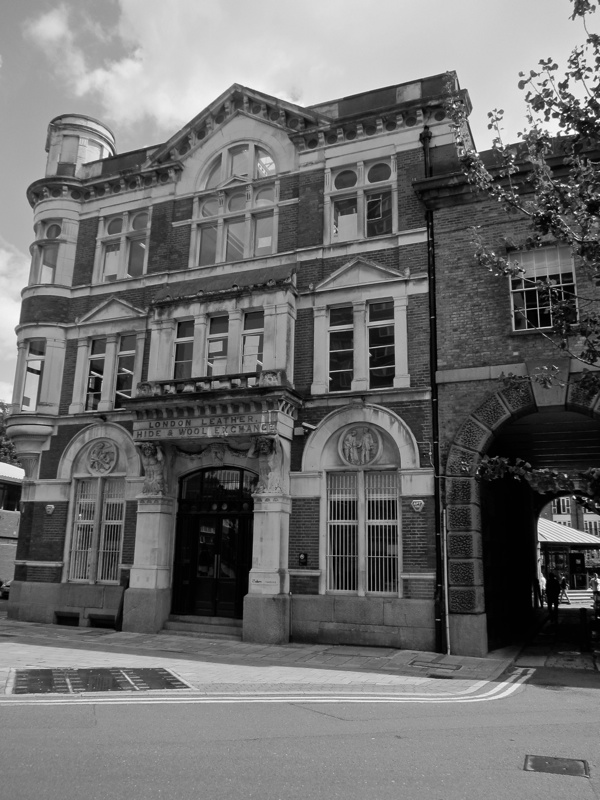
London Leather, Hide & Wool Exchange built 1878 by George Elkington & Sons, next to the 1833 Leather Market, it remained active until 1912.

At the entrance to St Thomas’ Church
You may also like to take a look at
Noel Gibson in Bow

Railway footbridge at Poplar
There is a rare chance to see the work of East End painter Noel Gibson (1928-2006) at the Nunnery Gallery in Bow until September 21st. These large paintings need to be seen in the gallery to fully appreciate the quality of impasto, with vivid black lines standing out in relief from the canvas and vigorous textures created with a palette knife, imparting a dramatic presence to these soulful visions.
Born in Glasgow, Gibson originally trained as an opera singer and then became House Manger at the London Opera Centre based in the Troxy Cinema in Commercial Rd. A self-taught artist, he painted in the evenings after work.
“I began as an abstract painter but when I came to Stepney, I found paintings on my doorstep. Though I think there’s still a quiet abstract quality to my paintings. I am trying to express the spirit of the buildings, the strength of them and the people who were there. This is why I don’t put people into my paintings. People turn them into an episode with a background – but I am painting the background! I love these buildings. I walk the dog and I look at them at different times of day and in different weathers, and I keep going back. In a way I am making a record of a changing, I wouldn’t say a dying area, but often I go back to check up on a detail, a colour and a whole street has gone.” Gibson said in an interview in the Times in 1972.
Immensely successful in his day, enjoying acclaim and sell-out shows – one of which at St Botolph’s in Bishopsgate was opened by Tubby Isaac the jellied eel king – Noel Gibson was featured on BBC’s “Nationwide,” a popular current affairs programme in 1972. In 1974, he moved to South London, working at Morley College and appointed Provost’s Verger at Southwark Cathedral, yet in 1985 he admitted, “I regard Tower Hamlets as the area of inspiration for my work and I will always return to it.”

Hessel St – “If this street were in Paris, everyone would have wanted to paint it.”

Brick Lane, looking north towards the Truman Brewery

St Anne’s, Limehouse

St John’s Tower

Small Red House in Bow
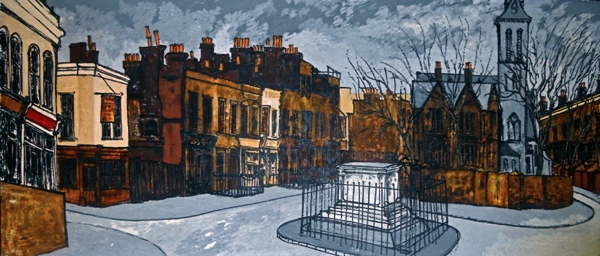
Street Scene in Poplar

The Victory in Poplar

Chilton St, Spitalfields

Tower House, Fieldgate St, Whitechapel

Arbour Sq

Noel Gibson
Images courtesy of Tower Hamlets Local History Library & Archives
Empty Streets: Noel Gibson’s East London (1967-75) is at the Nunnery Gallery, 181 Bow Road, E3 2SJ until 21st September
Ray Newton, Historian Of Shadwell
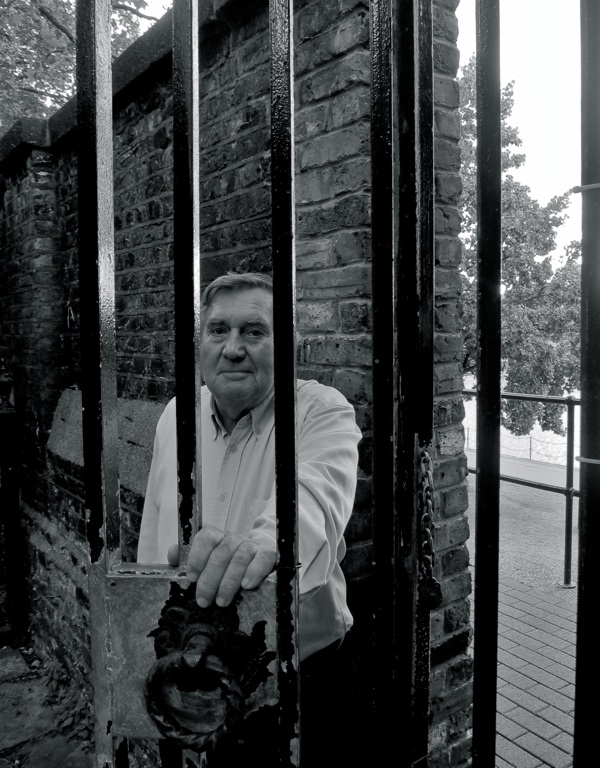
Ray Newton at the churchyard gate of St Paul’s Shadwell
You do not meet many people who can say they come from Shadwell these days, not in the way that Ray Newton can when he tells you his family have been there since at least 1820 – which is only as far he chooses to probe, yet more than sufficient to claim Shadwell as his place of origin.
Ray has dedicated himself to learning the history of Shadwell and, for the past thirty years, he has run the local history trust with Madge Darby who is his counterpart in Wapping. Between the pair of them they are able to enjoy specialist conversations that trace niceties of historical detail, especially concerning the boundary between their adjoining Thames-side parishes. “Madge will tell you that the Prospect …” Ray began, referring to the ancient Prospect of Whitby riverside pub by its familiar name, “Madge will tell you that the Prospect is in Wapping because, since the early nineteenth century when the Docks were built, the Wapping people have said that you have to cross water to get to Wapping – yet prior to that the Prospect was in Shadwell.”
In confirmation of this assertion, Ray took me round the back of St Paul’s Church in Shadwell and gestured significantly towards a blank wall before turning one hundred and eighty degrees to indicate a route crossing the Basin towards the Thames. “This used to be Fox’s Path, from the Highway down to the Prospect,” he informed me, “it was raised on stilts across the marshes that were here before the Docks.”
Thus Ray’s thesis about the shifting boundary of Shadwell and Wapping was proven, though it left me with an unfulfillable yearning to cross Fox’s Path upon the long-gone stilts over the marshes and down to the Prospect of Whitby.
“My father, Thomas Newton, was born in 1904 in Cornwall St off Watney St Market but he lived his early life in Juniper St, which was swarming with hundreds of children then. Although it was a big family, my grandfather John Newton had a good job, he was a foreman in a cold store at Bankside, so my father got educated and he could read and write letters for people in Juniper St.
We were lucky because my dad had a secure job and even in the thirties, when there were no jobs, he worked. At twelve years old, my father left school and went to work with my grandfather at the cold store, and his brothers worked there with him too. When he was fourteen, he went to Broad St Boys’ Club in the Highway that was run by the son of Bombardier Billy Wells (the man who wielded the hammer on the gong at the start of J. Arthur Rank films) and, at eighteen years old, my father became a professional boxer. He fought against Raymond Perrier, the Champion of France, and beat him and he topped the bill in the twenties. He fought all over the East End but, because he was boxer not a fighter, he had trouble with his eye and he had to have an operation. After that, he couldn’t box anymore so he became a manager and ran a gym in Davenport St above the Roebuck.
My mother, Maria Edgecombe, was born in Gravesend. Her mother was a farmer’s daughter who married my grandfather, who was a waterman who came from Shadwell and worked for the Tilbury Dock Company. When it was taken over by the Port of London Authority, he moved out and worked on the Pierhead and they lived in Cable St, where my mother met my father and they had three boys and a girl. On my dad’s side, they were all dockers and on my mother’s side they all worked for the Port of London Authority. They were different people, because in the docks it was all casual labour whereas the Port of London Authority was regular employment. It was very hard work in the docks but I never met anyone that didn’t love working there. The docks could find a job for anyone.
When the War came, my dad was still working in the cold store and it was a reserved occupation. He joined the Home Guard and his job was to guard the London Dock and the King Edward VII Memorial Park which was the entrance to the Rotherhithe Tunnel – and he was given five rounds of ammunition. I remember him in his uniform because I was born just before the War.
My father was always into everything sporty and boxing was his life so, when his father died, he become a bookmaker and set himself up as a turf accountant and gave up the docks. Next, he decided to be a publican and bought a pub on the Highway opposite Free Trade Wharf called the Cock but, while I was doing National Service, he became ill. At fifty-one, he was told he had lung cancer and had five years to live, and he died at fifty-six. He was a lad but he wasn’t a criminal. He was a hard man and he could fight anyone just like that, yet he was also very generous. He was into everything, he organised dances and sold tickets.
We had a boxing gym in the cellar of the pub and he gave away all the equipment to the St Georges Boxing Club in the church crypt – where they produced a world champion, Terry Marsh. I didn’t want him to give it away because I thought they’d damage it but he said to me, ‘You don’t know what it’s like to have no money.’
At twenty-three years old, I took over the pub and I was a publican right on the docks, serving seamen and dockers. So you had to be a little hard – but I’m not. During the days, it was dockers, lightermen and ships’ captains but at nights, and at weekends, local families came. We had a piano player and everyone knew the words, they had competitions – one song in the Saloon Bar then one in the Public Bar. In the Saloon, you could charge what you pleased but in the Public Bar the drinks’ prices were set. Ships’ officers, customs’ men and the management of Free Trade Wharf went into the Saloon and dockers and lightermen went in the Public Bar – they never met, that was the class system.
I ran the pub until it was pulled down to make way for the widening of the Highway and I was rehoused in Gordon House, where I still live today. After the pub came down, I worked for my elder brother – he was a bookmaker – in his betting shops, but it wasn’t me. When he decided to sell the shop in Walthamstow, I stayed 0n and worked for the new people – for the company which became City Tote.
Yet I realised I didn’t want to do this for the rest of my life so, at thirty-two, I decided to get an education and, after the shop closed at night, I used to go to evening classes. I enrolled for a basic English class and the teacher said, ‘Write something down so I can look at it,’ and when he saw it he said, ‘This ain’t your class but if you help me with teaching the other students, I’ll mark your essay each week.’ So I got a year of personal tuition.
Then I was doing my homework in the betting shop one day, when two young men who were different from the other punters asked what I was doing. I said, ‘I’m doing O levels.’ They were lecturers and they said, ‘We’ll help you with your O levels if you’ll teach us gambling.’ After I did my O levels and A levels, I realised that if I don’t go to university, I’d be disappointed for the rest of my life, so I went to Middlesex Polytechnic and did a four year degree in Social Sciences. While I was a student, I was working as an Adult Literacy volunteer and after I got my degree I became a lecturer in Social Sciences at West Ham College, but the most rewarding thing I did was teaching partially blind people.
After thirty-six years of teaching, I retired and for the past ten years I’ve had an allotment in Cable St Gardens, and I’m secretary of the History of Wapping Trust. I used to teach a Local History class and one day Madge Darby came along, there’s nothing about Wapping she didn’t know. We published over twenty books. We never set out to make money, it is a thing we did for love.
Once upon a time, we were all in the same boat, we all went to the same school, we all went to the same pub, we all had the same doctor and everybody knew everybody. Now nobody knows anybody. I think I was lucky because I worked in a pub at twenty-three and I met the full range of people, and it got me interested in local history.”
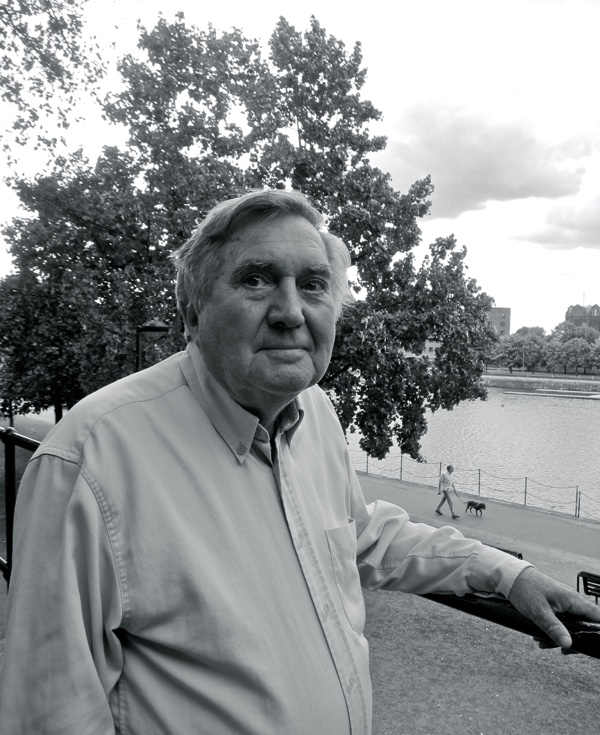
Ray upon the steps overlooking Shadwell Basin
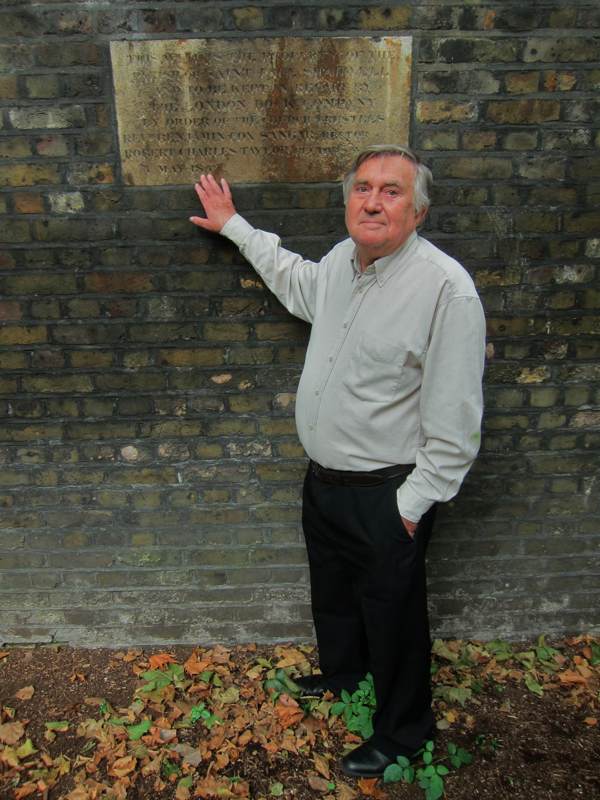
Ray shows the stone plaque in the churchyard wall of St Paul’s Shadwell, placed after it was shored up when Shadwell Basin was being excavated between 1828-32 and the church began to slide downhill
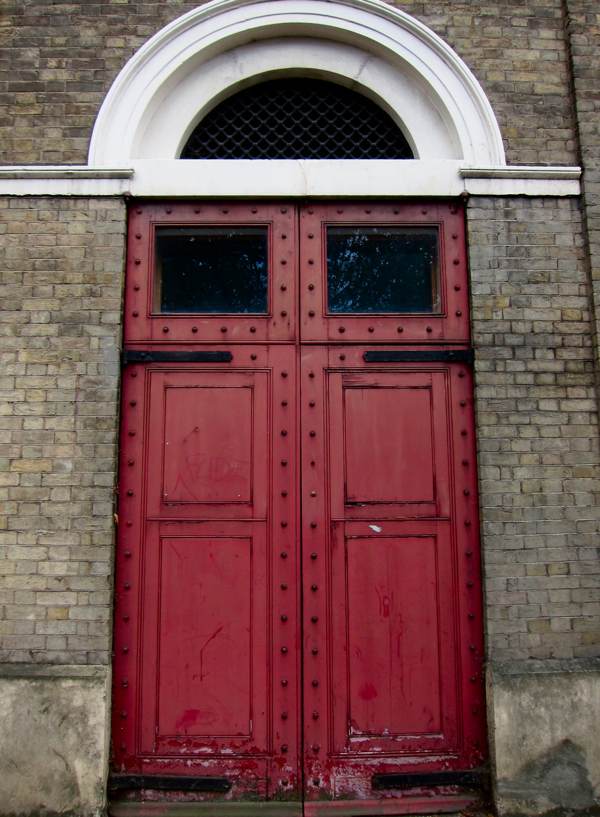
Ray pointed out these early nineteenth century doors facing the Highway, in the side of the Vestry at St Paul’s Shadwell, which were once the entrance to Shadwell’s first Fire Station
You may also like to read about
Truman’s Spitalfields Pub Crawl
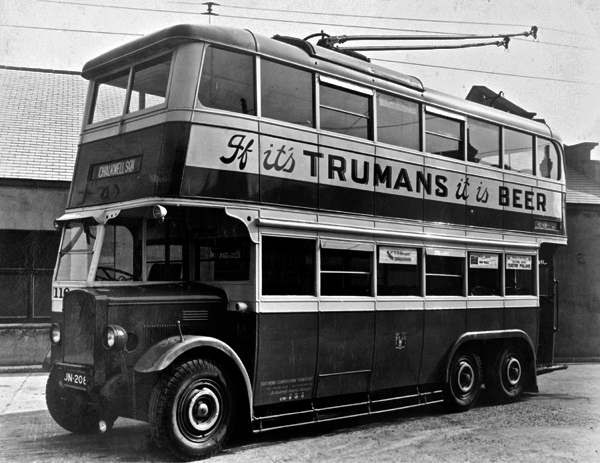
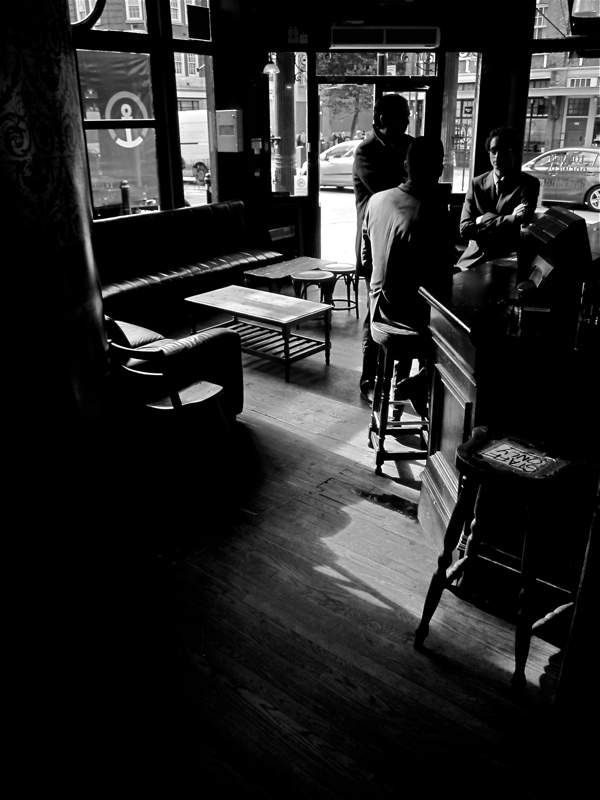
Fancy a couple of pints on Friday night? You are invited to come along on Truman’s pub crawl in Spitalfields this Friday in the company of Derek Prentice former Master Brewer in Brick Lane and Jack Hibberd of Truman’s Beer to learn the history of the rise and fall and rise again of brewing in the East End, and enjoy the opportunity to sample some of fine ales now being brewed by Truman’s. To join the party, simply meet at at 6:30pm this Friday 15th August at the Pride of Spitalfields in Heneage St and look forward to visiting some of the celebrated hostelries in these pictures.
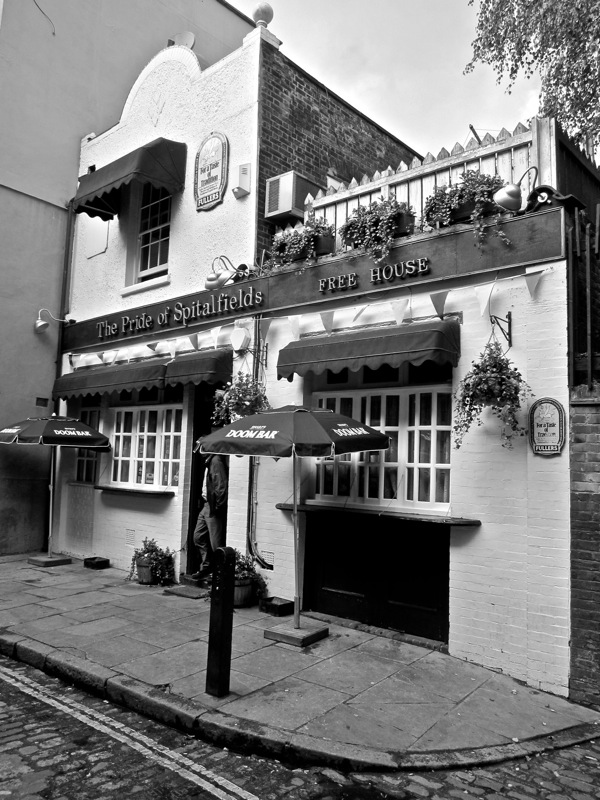
The Pride of Spitalfields, Heneage St

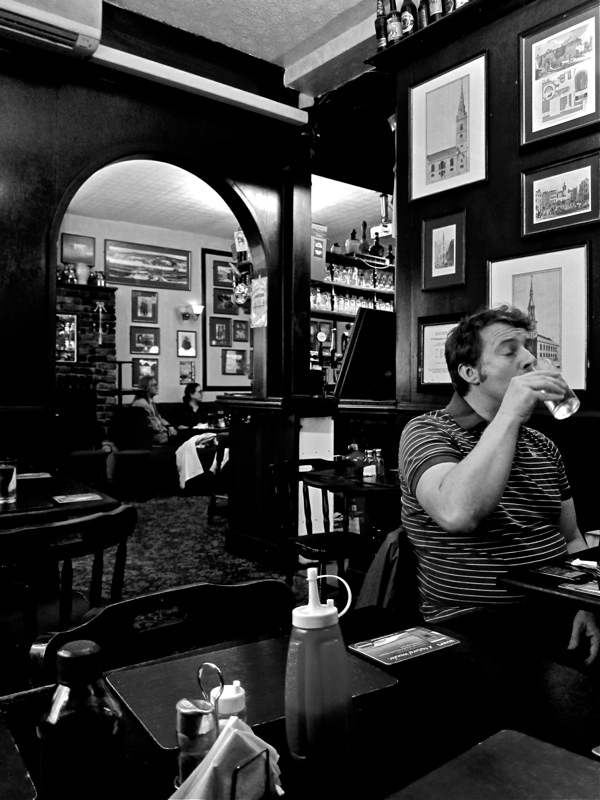
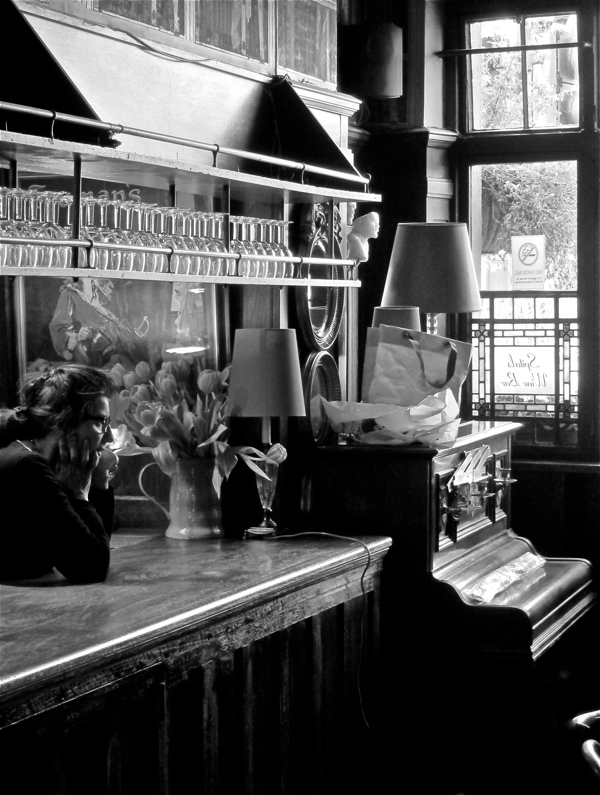
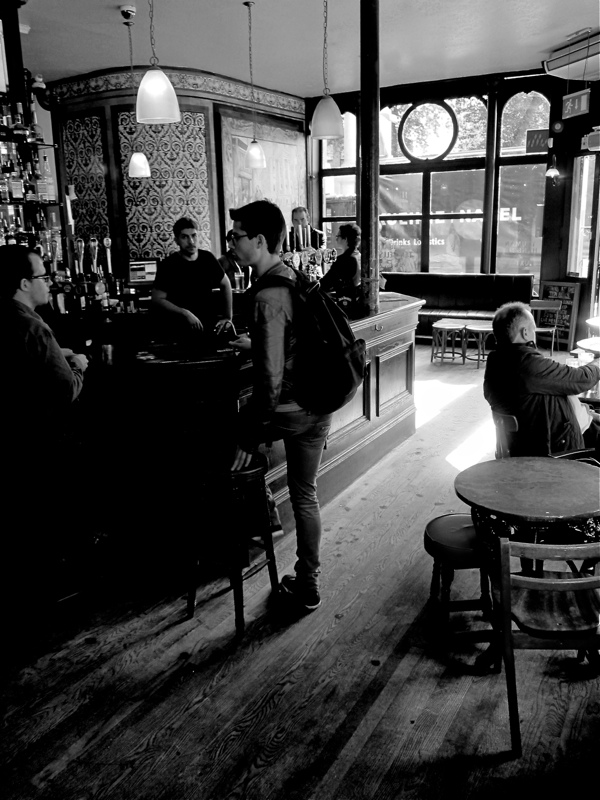
Sandra Esqulant at The Golden Heart, Commercial St
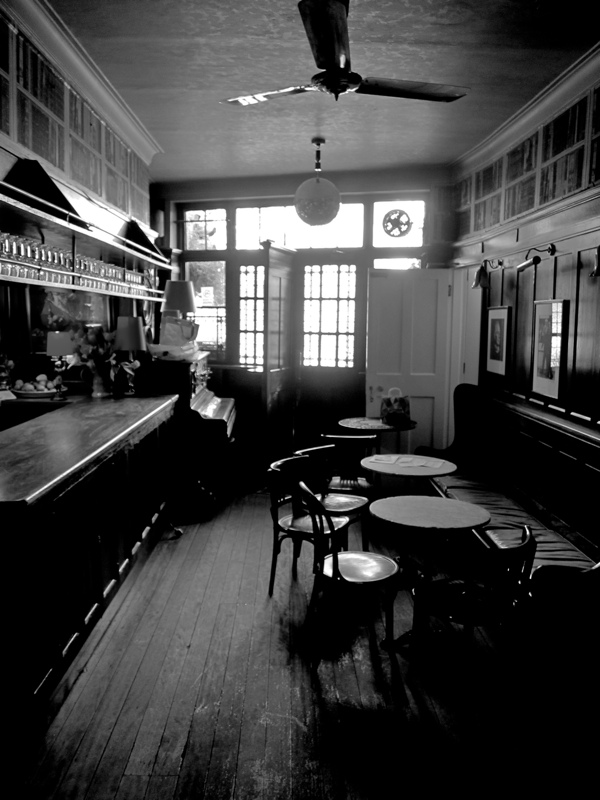
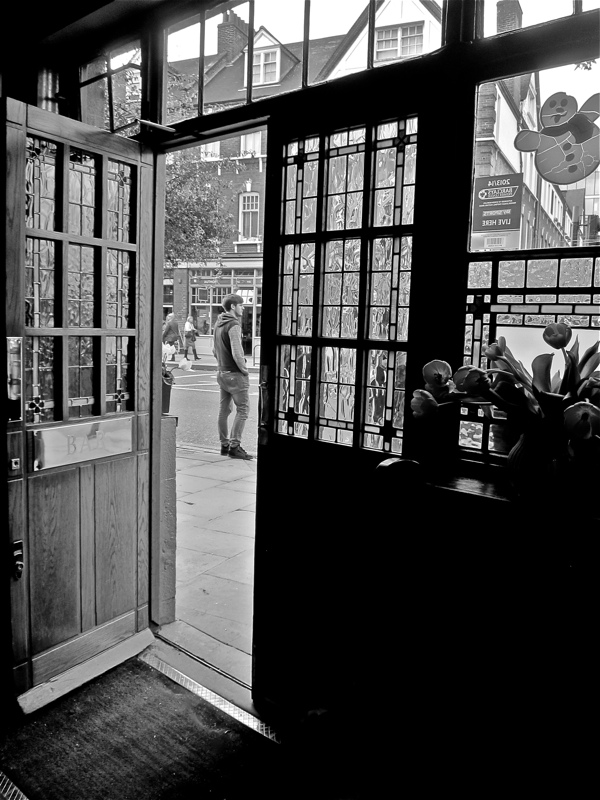
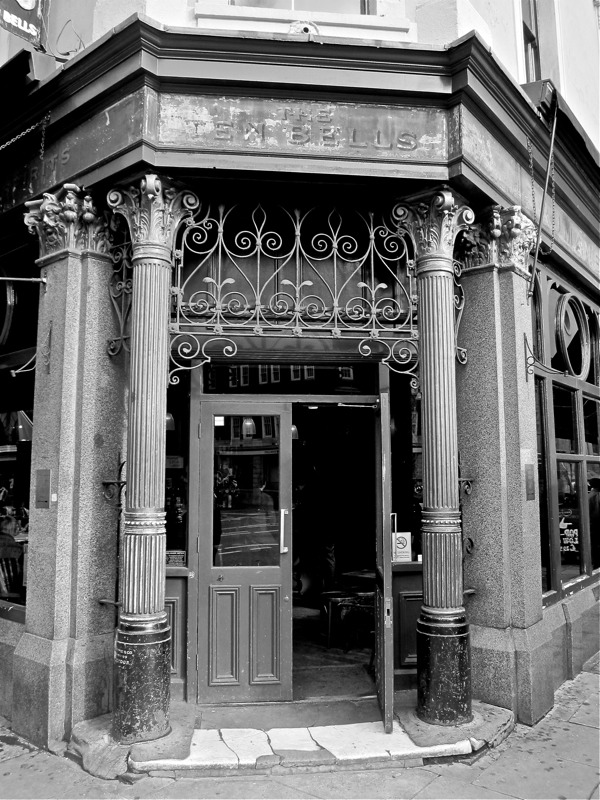
Ten Bells, Commercial St

You may also like to read my stories about Truman’s Beer
First Brew at the New Truman’s Brewery
Tony Jack, Chauffeur at Truman’s Brewery
Truman’s Returns to Spitalfields
and take a look at
The Gentle Author’s Next Pub Crawl
The Gentle Author’s Spitalfields Pub Crawl
The Gentle Author’s Dead Pubs Crawl
The Gentle Author’s Next Dead Pubs Crawl
The Gentle Author’s Wapping Pub Crawl
WW1 At Gardners’ Market Sundriesmen
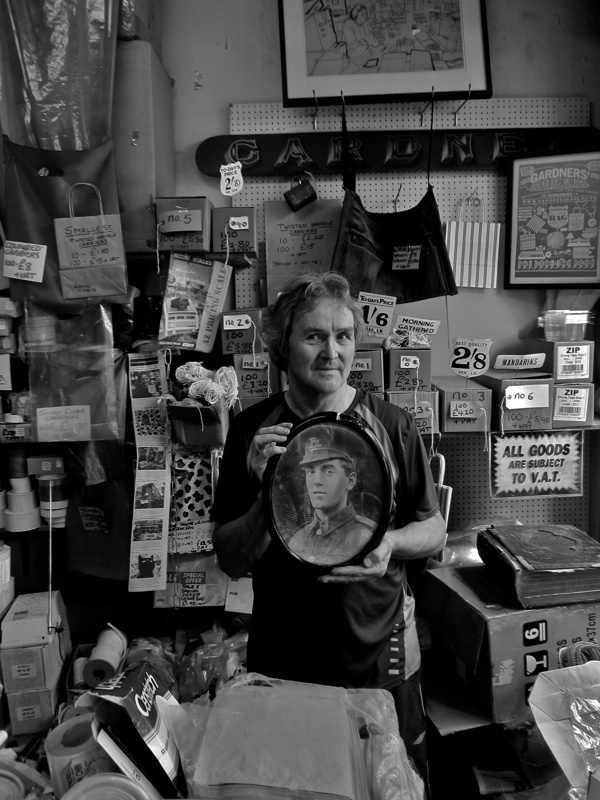
Paul Gardner with the portrait of his Great Uncle Claud Gardner
At Spitalfields’ oldest family business, Gardners Market Sundriesmen – in Commercial St since 1870 and now into the fourth generation – the past is never far away. Paul Gardner, the current incumbent, keeps a large old family bible under the counter, with a detailed list of all the comings and goings of the Gardners in Spitalfields over the past hundred and forty years written in the front, so that he may consult it whenever the need arises. “In my grandfather’s generation, there were thirteen in the family but only eight made it to adulthood,” he admitted to me.
The centenary of the outbreak of World War One proposes just such a moment of reflection by Paul, contemplating the lives of his grandfather Bertie (John) Gardner and Great Uncle (William) Claud Gardner whose fates were decided by the conflict in tragically divergent ways.
The story is often told of Bertie Gardner, the Scale Maker, who was enlisted in 1914 but called back off the train to Calais because his profession was deemed essential to the War effort. It was a stroke of good fortune that saved his life and brought him back to pass his years checking the scales in the Spitalfields Market weekly and selling bags from the shop in Commercial St, until he died from a heart attack in 1958 upstairs in the flat above the family business.
Yet his brother Claud never joined the business and was granted no reprieve. He was sent to the front where he died in 1917 and Paul keeps a copy of The Daily Sketch, with the news of Claud’s death, in the shop to this day. It was sent to the family in Commercial St by the newspaper rolled up in a tube and, if you ask, Paul will remove the tattered paper of a century ago from its cardboard tube and point out to you that the picture is not of Claud but a random portrait serving as a generic illustration. If deliberate and not a mistake, this was a strangely callous act by the newspaper – it seemed to me – since, although the readers might be unaware, it must have been a grave disappointment for his family, serving only to compound their loss.
“Bertie was born over the shop in Commercial St in 1893,” Paul told me, picking up the story of his grandfather who died when he was just two years old, “He joined up for the Merchant Navy in 1911 as a Pantry Boy and was discharged on May 20th 1914, so he came out prior to the war. It was my Nan who told me how he was called up again, but was called back off the train because he was one of the last Scale Makers in London and, obviously, being so close to the Spitalfields Market it was a very important job.” And Paul took this opportunity to retrieve the ledgers from the eighteen-nineties, so that we could enjoy poring through the columns of elegant script and recognise familiar addresses of customers all over the East End.
“I was only small when Bertie died and he just had one son, Roy my dad, so I only know him from what people say.” Paul continued, “Joan Rose told me that although she was a child, he always treated her like an adult when she came to buy bags for her grandfather’s greengrocers in Calvert Avenue. My Nan told me Bertie was a stickler for punctuality and, if he went upstairs to the flat for his dinner and if it wasn’t ready, he’d throw a wobbly – that was from his time in the Merchant Navy. He was very tidy and organised, and my Nan used to clean the shop every day.”
“Bertie went into the business with his elder brother Jimmy, they took over from their father and were B & J Gardner, but then Jimmy had a heart attack and it became B. J Gardner. When they started out they were Scale Makers, but then they diversified into sales tickets and paper bags, even pairs of bellows and carpet beaters – I’ve still got one somewhere. They used to paste the paper bags in the shop in those days. The apprentices slept down below in the basement and the family lived up above. They went round in a pony and trap to all the grocers to service the scales regularly, and sometimes, he took my Nan and all the family to Bournemouth in it. They kept the pony and trap in Fleur de Lis St and the pony was called Pat. We had the carriage lamp for years afterwards, I remember it in my time.”
“He had a working life and he was a hard-working sort of person, ” Paul concluded, lapsing into silence.
If Bertie had not been a Scale Maker, he might not have been spared combat in 1914 and history would have been different – and Paul Gardner might not be behind the counter at Gardners’ Market Sundriesmen today. Yet Bertie was fortunate enough to live and accumulate stories and be remembered by his descendants, unlike his elder brother, Claud, whose life was cut short and whose death was recorded in a newspaper, illustrated by a photograph of someone else. Thus is the curious manner in which the modest lives of Scale Makers and Bag Sellers in Spitalfields are intertwined with the great events of history.
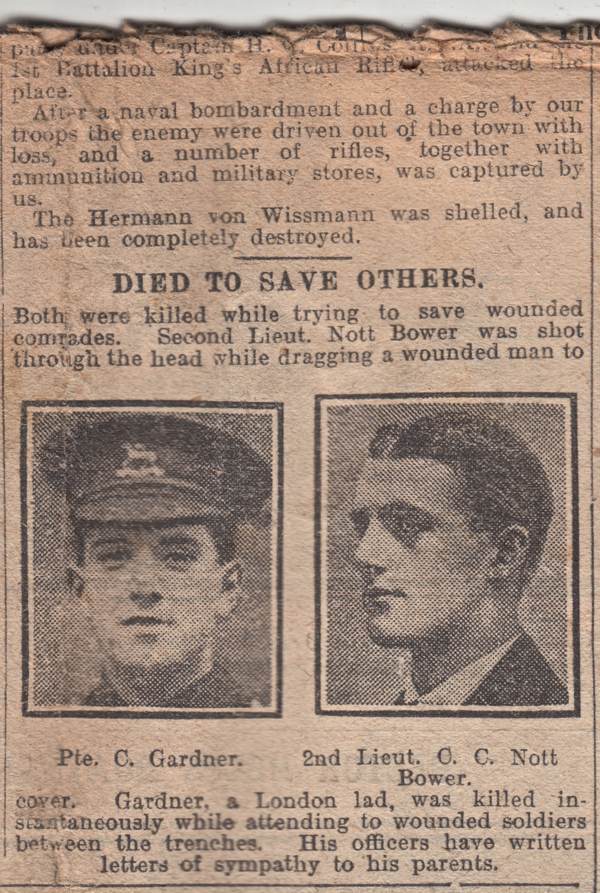
Announcement of Claud Gardner’s death in the Daily Sketch – the paper did not have a photo and substituted a random soldier portrait in his place
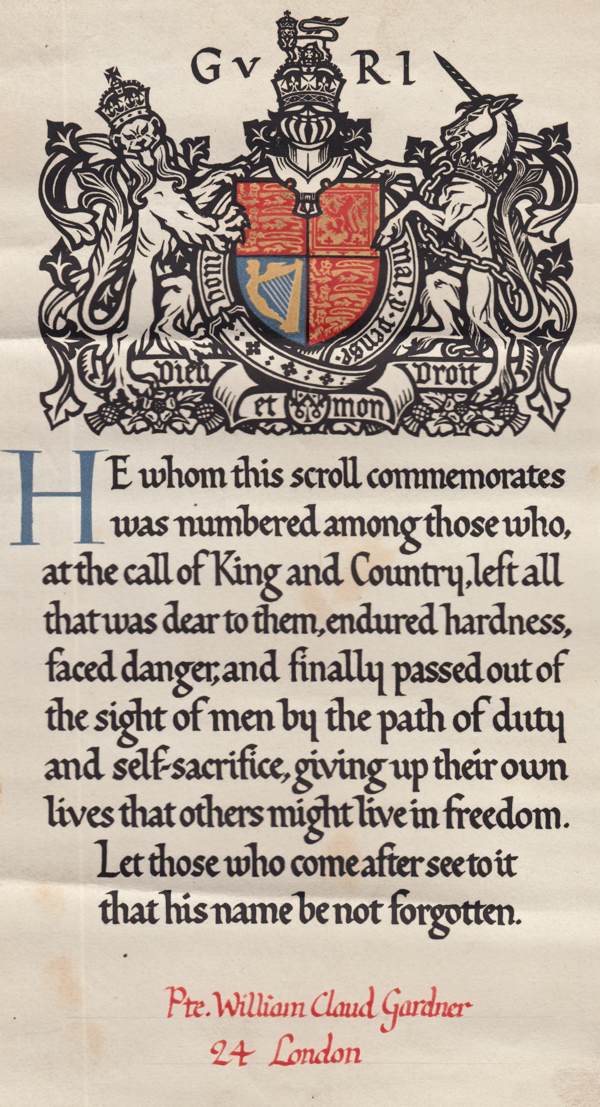
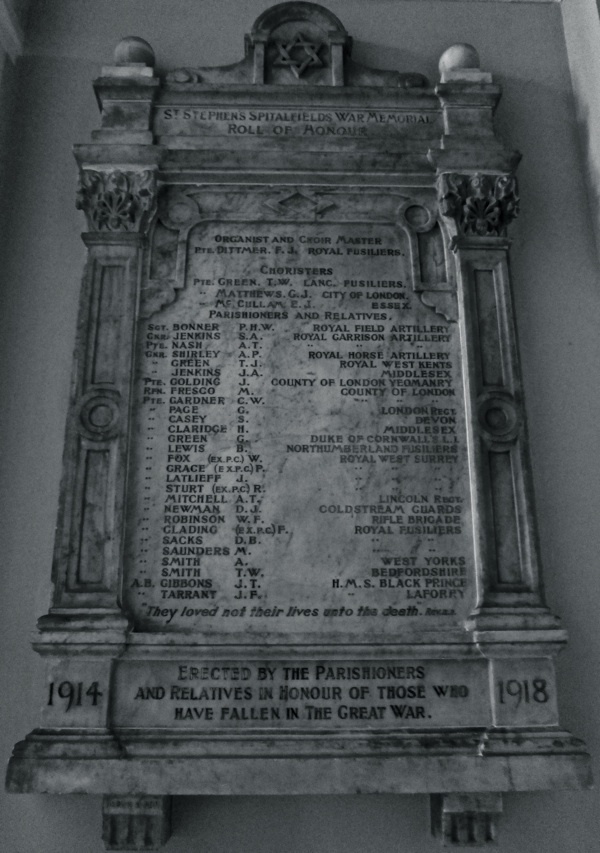
Claud Gardner’s name is upon the memorial in Christ Church Spitalfields, formerly in St Stephen’s
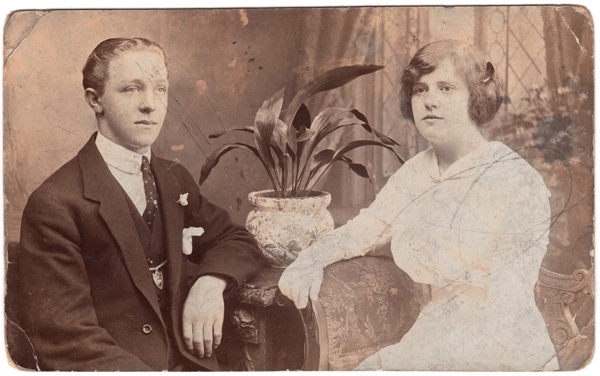
Bertie Gardner & Evelyn Hayball
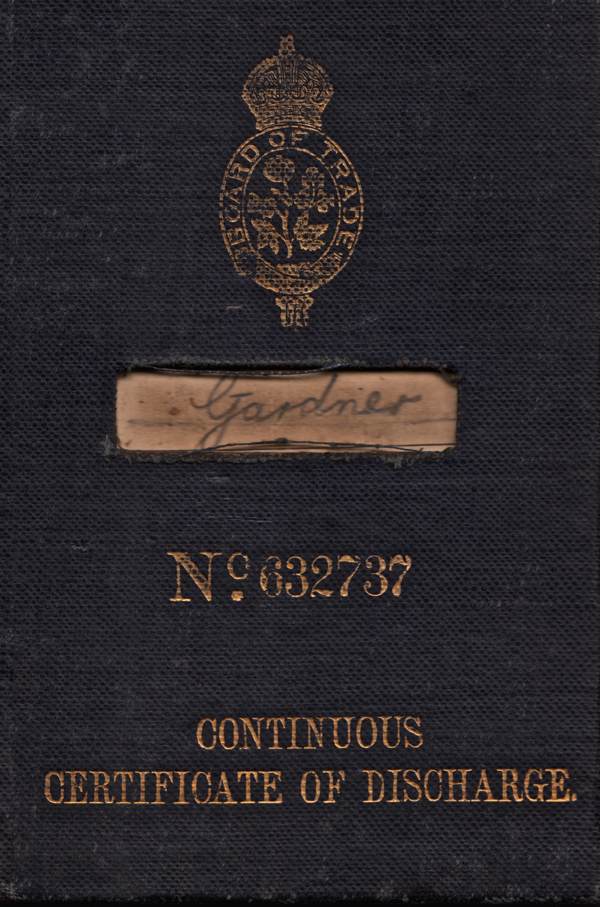
Bertie Gardner’s Certificate of discharge from the Merchant Navy
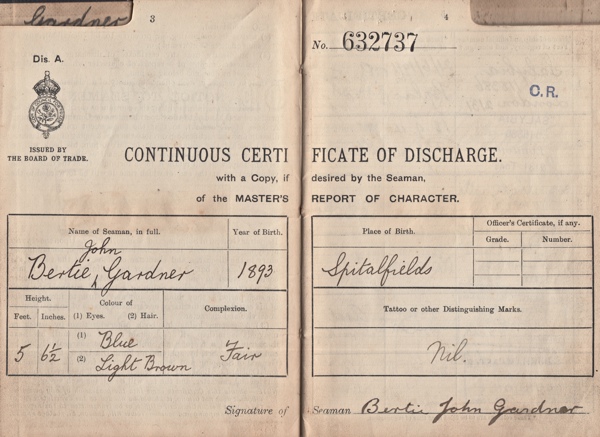
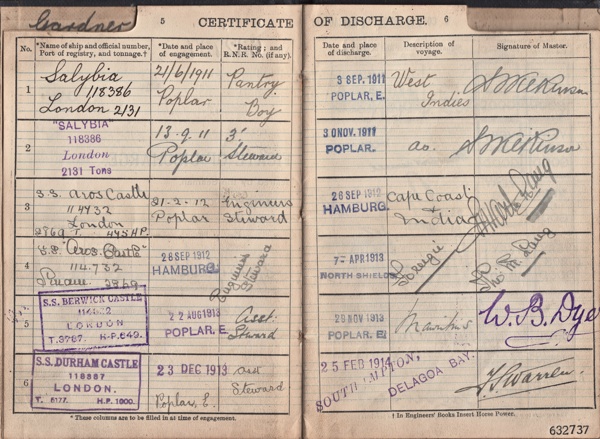
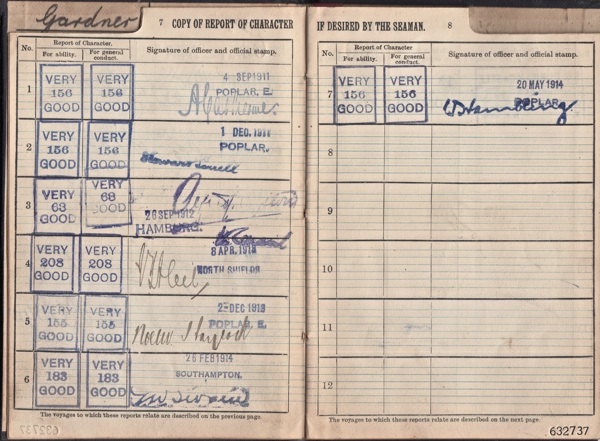
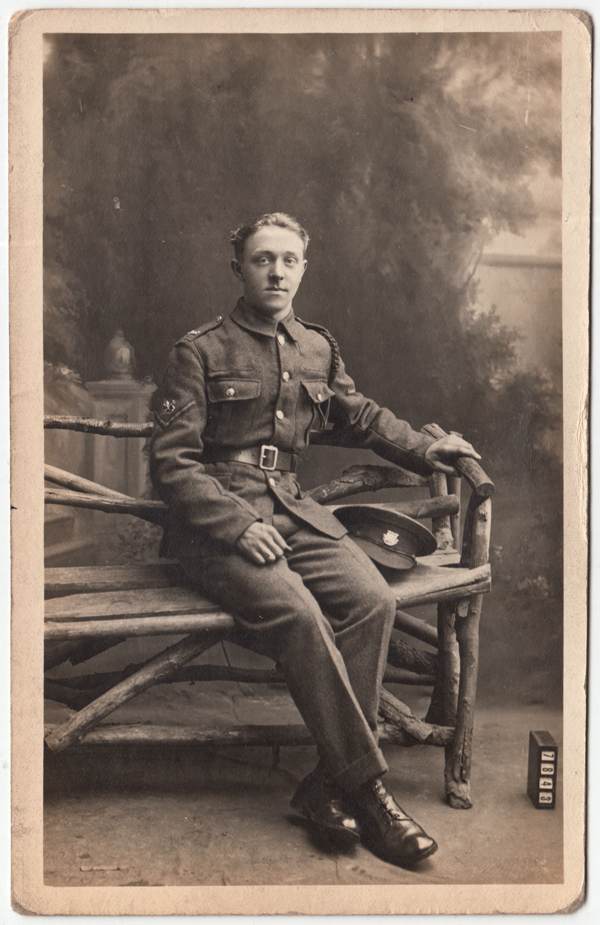
Bertie Gardner in uniform
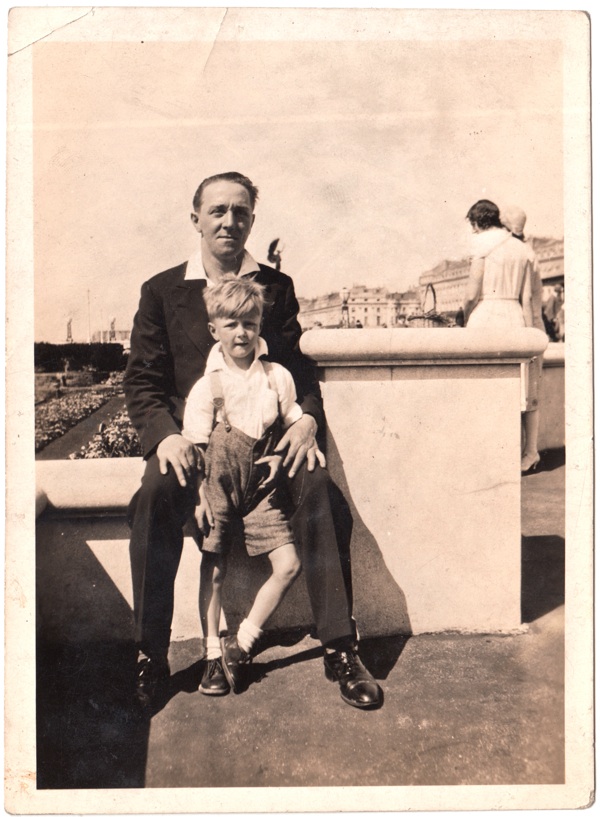
Bertie with Paul’s father Roy

Outside the shop in Commercial St
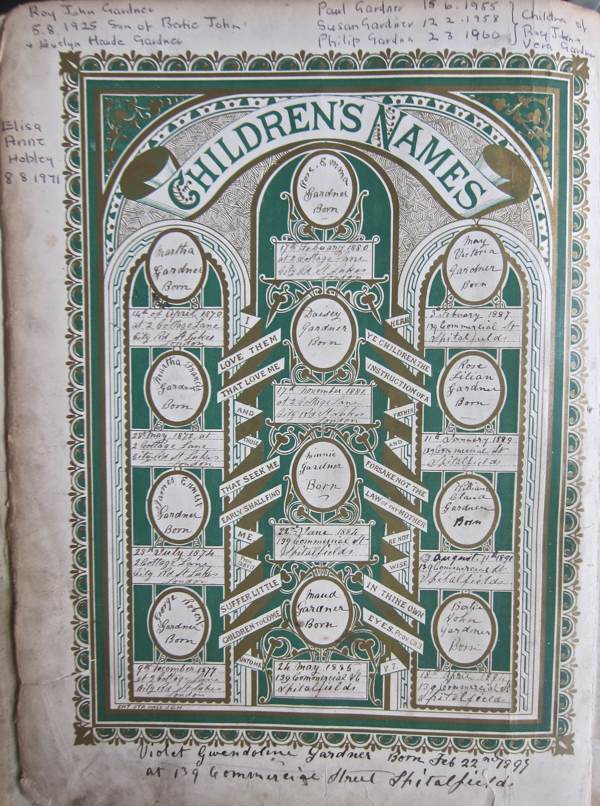
The Gardners’ family bible, with more that four generations of Scale Makers and Bag Sellers
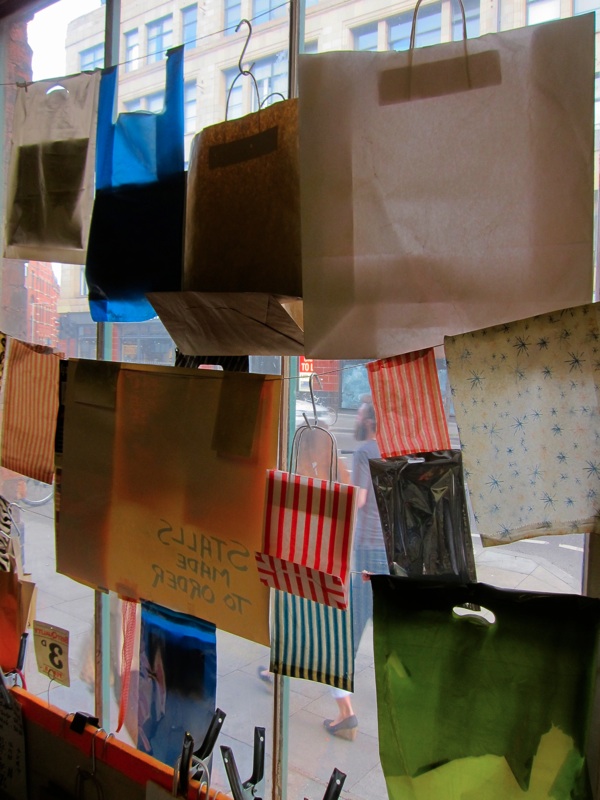
Gardners’ Market Sundriesmen, 149 Commercial St, E1 6BJ (6:30am – 2:30pm weekdays)
You may like to read my other stories about Paul Gardner
Paul Gardner, Paper Bag Seller
At Gardners’ Market Sundriesmen
Joan Rose at Gardners’ Market Sundriesmen
James Brown at Gardners’ Market Sundriesmen












