
In Mile End Old Town

Much of the streetscape of the East End was broken in the last century, with fine squares lost in Stepney, Spitalfields and Haggerston, yet in Mile End an entire quarter of early-nineetenth century construction still exists surrounding Tredegar Sq (1823-9) and is cherished to this day. Taking advantage of the dramatic lighting afforded by the April weather, I spent an afternoon in these streets with my camera this week. Within a stone’s throw of St Clement’s Hospital, formerly the City of London Union Workhouse, I discovered a stuccoed terrace worthy of Belgravia – while the intervening streets were filled by houses which manifested all the degrees of social and economic distinctions that lay between the two.

Terrace in Mile End Rd erected by Ratcliffe builder, William Marshall ,in 1822-4

Formerly the City of London Union Workhouse, 1849

Tredegar Sq, 1828-9


Stucco was applied upon the north side of Tredegar Sq in the eighteen-thirties


Tredegar Square was re-landscaped in 1951

40 Tredegar Sq was formerly home to brush-maker Henry Wainwright who murdered his mistress and buried her dismembered body under the floor of his Whitechapel warehouse in 1875

Litchfield Rd – Sir Charles Morgan, Lord Tredegar sold this land for development

In Coborn Rd

Coborn Rd

Coborn Rd

Central Foundation School for Girls, Morgan St

School Entrance, College Terrace

Holy Trinity Church, Morgan St

Eighteen-thirties villa, Rhondda Grove

Cottage Grove of 1823, now Rhondda Grove
You may also like to take a look at
Return Of The East London Group
In 2012, David Buckman published From Bow to Biennale which recovered the lost history of The East London Group, one of the major artistic movements to come out of the East End in the last century yet – extraordinarily – almost forgotten until recently.
Today, we preview some of the works – several of which have not been seen publicly in generations – from the major retrospective of nearly seventy paintings by members of the Group, accompanied by archive material, which opens at the Nunnery in Bow on May 9th and runs through into the summer.

Columbia Market, Bethnal Green by Albert Turpin

Canal at Mile End by Walter Steggles

St Clements Hospital Bow by Grace Oscroft

Bryant & May Factory, Bow by Grace Oscroft

Old Houses in the East End by Grace Oscroft, dated 1934

Hackney Empire by Albert Turpin

Pavilion in Grove Hall Park, Bow, by Harold Steggles
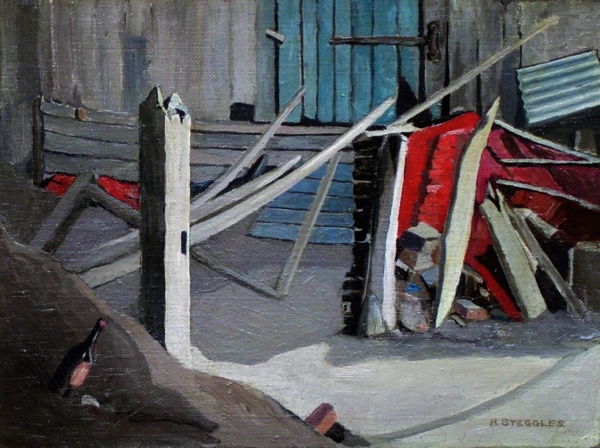
The Lumber Yard by Harold Steggles, dated 1929

The Scullery by Walter Steggles

The Stable by Walter Steggles, exhibited at the Tate 1929

Brymay Wharf by Walter Steggles

Bow Backwater by Walter Steggles

Brymay Wharf by Walter Steggles

Old Ford Rd by Harold Steggles

The Chapel by Walter Steggles, dated 1932

Railway siding by Walter Steggles, dated 1929

Bow Bridge by Walter Steggles

Blackwall by Harold Steggles

Warner St, Clerkenwell, by Harold Steggles

Canonbury Tower by Harold Steggles, dated 1938

Canonbury Grove by Elwin Hawthorne

Canvey Island by Walter Steggles

The Chair by the Bed by Henry Silk
You can read more about the East London Group
Albert Turpin, Artist & Mayor of Bethnal Green
Henry Silk, Artist & Basketmaker
From Bow to Biennale: Artists of the East London Group by David Buckman can be ordered direct from the publisher Francis Boutle and copies are on sale in bookshops including Brick Lane Bookshop, Broadway Books, Newham Bookshop, Stoke Newington Bookshop, London Review Bookshop, Town House, Daunt Books, Foyles, Hatchards and Tate Bookshop.
At The Whitechapel Mission

At dawn on Easter Tuesday, while most of the world was still sleeping, Contributing Photographer Colin O’Brien & I paid a visit to the Whitechapel Mission which has been caring for the homeless and needy since 1876. The original building, constructed as the “Working Lads Institute” in 1885, still stands next to Whitechapel Underground Station, but these days the Mission operates from a seventies brick and concrete edifice east of the Royal London Hospital.
Whitechapel Rd was desolate at that hour but inside the Mission we encountered a warm community and were touched by the generous welcome we received there. Many of these people had been out on the street all night, yet they immediately included us within the particular camaraderie which exists among those who share comparable experiences of life and attend the day centre here regularly. Between six and eleven each morning, the door is open. Breakfast is served, showers are available, clothes are distributed, there is the opportunity to make phone calls and collect mail, and to seek the necessary advice which could lead to life off the street.
Our guide was Tony Miller, Director of the Mission, who has lived, worked and brought up his family in this building for the last thirty-five years. Charismatic and remarkably fresh-faced for one who opens up his door to the capital’s homeless every day of the year, he explained that if the temperature drops below freezing they offer a refuge for those sleeping rough. In the winter before last, Tony had around one hundred and fifty people sleeping upon every available inch of floor space and, while the other staff were off-duty, he sat watch through the long hours of the night. As a consequence, he contracted a rare and virulent strain of Tuberculosis from which he has only just recovered.
Yet Tony’s passion for the Whitechapel Mission remains undimmed by this grim interlude. “I lost five stone and I still want to make a difference! They started this Mission in 1876 because they were angry that, in their day, there were people without homes and here we are today in 2014 and the problem is still with us,” he declared, filling with emotion, before distinguishing for me some of the strains of humanity who stream through his door daily. There are those who were once living in care – many have mental health problems and around a third grew up in orphanages. There are those who are have no skills and cannot support themselves. There are the angry ones who feel let down and maybe lost their homes – these, Tony says, are the easiest to help. Around a sixth are ex-servicemen without education or skills, and around a third are mentally ill. “The ones that get me the most are those young people who leave the care system without education or prospects and end up on the street within twelve months,” he confided. Last year, the Mission supported one hundred and thirty-four people off the street and into flats, and two hundred people into hostel accommodation.
“Most people want reconnection, but they can live on the streets for twenty years after a row,” Tony assured me, “So, if we can ring up mum and they can say ‘sorry,’ then we’ll happily sub them for a bus ticket home if it means one less person on the street.” As we walked through the cafeteria, diners came up to welcome and engage us in multiple extended conversations, telling their stories and trusting Colin O’Brien to take their pictures.
“These people have validated my life – giving me a purpose and a job, and that makes me guilty because, from other people’s suffering, I live,“ Tony revealed in regret, “It’s a disgrace that this place is still here and it’s still needed, it should have been closed down years ago.”


Tony Miller, resident Director of the Whitechapel Mission for the past thirty-five years
Photographs copyright © Colin O’Brien
Click here to learn more about The Whitechapel Mission
You may also like to take a look at
Zed Nelson’s Portrait Of Hackney
Today we preview the third in Hoxton Minipress‘ Photo Stories Zed Nelson’s Portrait Of Hackney – a personal vision of the contradictions and cultural clashes in his home borough.
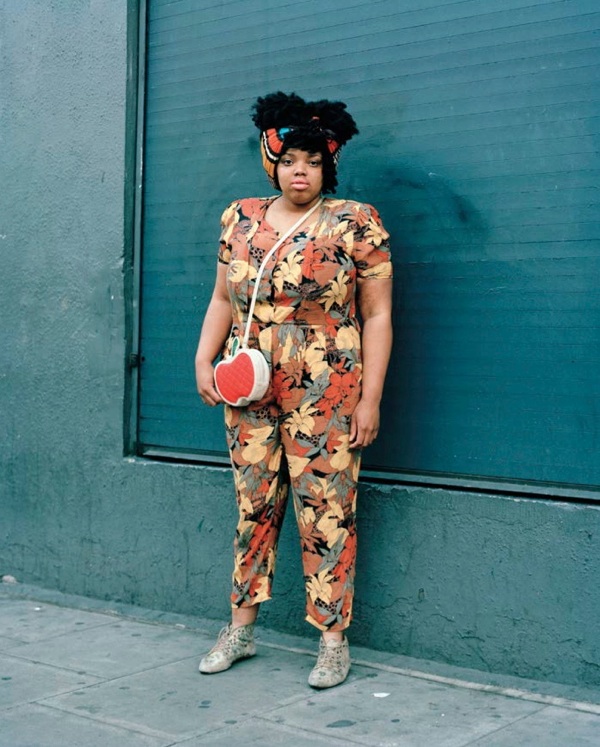
GROWING UP IN HACKNEY
I was born in Uganda, East Africa, but from the age of three Hackney has been my home.
I went to a forward-thinking experimental primary school in East London that encouraged art and independent thought, until my parents, as seventies hippies, plucked me out of school and took me and my sister on a one-year road trip to India, travelling overland from Britain in a diesel truck.
When we returned, I had the misfortune of ending up at an extremely rough comprehensive school. I found out years later it had the worst academic record of any school in the capital and in subsequent years was closed down. It was set on a concrete landscape with not a blade of grass in sight. The school was encircled by housing estates and chain-link fences. It was not a place of learning, but more of survival.
Over the next few years I pierced my ears, shaved my head into a mohican, got a tattoo, was arrested for smoking dope, took acid in Abney Park Cemetery and buzzed around the streets in a motorbike gang. We were hardly Hells Angels though, we were so young we were restricted to 100cc motorcycles with L-plates. Most of the time it was harmless fun, but it turned dark. One friend became addicted to heroin and was murdered in a squat, another was badly injured in a motorbike accident, and another sent to jail for GBH after a fight got out of hand. Basically, I was the product of a bad inner city education, with the kind of friends that go with it.
At the age of eighteen, photography gave me a passport back to civilization, and the minute I started college I remembered there was so much more to do. I have since travelled widely through my photographic work, but remained living in Hackney and am watching with fascination as the area goes through a metamorphosis.
There’s a recurring motif in these images of Hackney, of cracked pavements and walls, melting tarmac, and weeds and roots bursting through concrete. It is as if nature is trying to reclaim the land, and Hackney – under-funded, neglected and poorly maintained – is constantly being sucked back into the earth. It amuses me to see this, as I find other, wealthier areas where nature has been conquered depressing and disconcerting – covered over in tarmac, cemented and de-weeded.
Zed Nelson 2014


Click here to buy ZED NELSON’S PORTRAIT OF HACKNEY direct from Hoxton Minipress
Photographs copyright © Zed Nelson
You may also like to take a look at these other Hoxton Minipress titles
Joseph Markovitch, I’ve Lived In East London For Eighty-Six & A Half Years
Madeleine Waller’s East London Swimmers
Today we preview the second in Hoxton Minipress‘ Photo Stories series Madeleine Waller’s East London Swimmers featuring the hardy souls from London Fields Lido.

Laura, Performance Artist

“I’m a countryside girl, I grew up in the middle of nowhere in Devon and always swam in the sea. So being in London can be very intense, but swimming in winter in an outdoor pool feels like reconnecting with nature.”

Paul, Bus Driver

“No-one taught me how to swim, I just watched other people and got on with it. I like to push myself – ninety to a hundred lengths of the pool. I have a few hours off between shifts of driving the bus and I find swimming helps me relax. The thing about driving in London is that no one seems to care whereas swimming is about taking pride in yourself. You have to have discipline. If you are good at something then go for it because we aren’t here forever.”

Karina, Travel Agent

“This pool doesn’t have the chlorine that makes your hair go green like some public pools. I love all the sensations – the water surrounding you, the different temperatures you feel, going in, going out and stepping into the cold from the heat – particularly in winter. It allows me to cope with being in the city.

Nick, Property Developer

“I got into swimming after getting caught up in the tsunami in Thailand. I was on a family holiday when the wave came in and I managed to grab my son from his pram and leg it up a hill. I looked back and saw the pram disappear. When I returned home. I had a fear of open water so I entered a race in Lake Windermere and my passion for long distance swimming was born. Last year I swam from Spain to Morocco. Next I’m swimming from Robben Island to Cape Town.”

Kathryn, Office Worker

“I used to go to a lot of alternative clubs. Now I feel I’ve got too old for that and I’ve taken to regular swimming – it becomes an addiction. When I first started, the endorphins kicked in after sixteen laps. Today I feel good after eleven and a half kilometres. My longest swim was the length of Lake Windermere in eight hours and twenty minutes without a break. Sometimes when I’m dreaming, I’m dreaming of swimming. It’s happiness.”

Mike, Jazz Musician

“When I was thirty. I nearly drowned in a garden swimming pool. People watching thought I was having fun until a twelve-year-old saved me. I have always loved the water but I didn’t learn to swim until I was forty-four. It felt like I was learning to fly – conquering a new element. Now when I swim I get pretty much the same feeling. It never goes away.”

Dane, Entrepreneur

“I learnt to swim because I went to South Africa and wanted to swim with sharks but they wouldn’t let me because I couldn’t swim fifty yards. Now I swim almost everyday. The water has a cleansing process. I can let go and totally be me. At this point in my life, I’m the number one priority.”

London Fields Lido

Click to buy EAST LONDON SWIMMERS BY MADELEINE WALLER direct from Hoxton Minipress
Photographs copyright © Madeleine Waller
You may also like to take a look at these other Hoxton Minipress titles
Joseph Markovitch, I’ve Lived In East London For Eighty-Six & A Half Years
Yet More Drypoint Etchings By Peta Bridle
This week Peta Bridle sent me her latest additions to the growing portfolio of drypoint etchings she has been working on for more than year, many inspired by stories and characters from the pages of Spitalfields Life.

Gary Arber, W F Arber & Co Ltd – On 28th May, Gary closes the print shop opened by his grandfather Walter in 1897 – “Gary is stood next to a Golding Jobber which he told me was used to print handbills for the suffragettes. On his right stands a Supermatic machine and, behind him in the corner, is a Heidelberg which he filled with paper to show me how it worked. The whole room was a confusion of boxes and paper with the odd tin toy thrown in, and lots of string hanging from the ceiling. I feel privileged to have been invited downstairs to make this record of his print shop.”

Spoons by Barn The Spoon – “From left to right: A cooking spoon. A spoon of medieval design. A spoon based on a Roma Gypsy design. The small spoon in the centre is a sugar spoon. A shovel. The large spoon on the right is a Roman ladle spoon. Barn told me the word ‘Spon’ which is carved on the handle is an old Norse word which means ‘chip of wood.’”

Leila’s Shop, Calvert Avenue “- I love visiting Leila’s Shop throughout the year to discover the fresh vegetables of every season, straight from the field and piled up in mouth-watering displays.”

Donovan Bros, Crispin St – “Although it is not a shop anymore I believe Donovan Bros are still producing packaging. I like the muted colours the shop front has been painted and wonder what the shop would have looked like inside?”

Borough Market, London Bridge – “This is the view overlooking Borough Market, looking from the top of Southwark Cathedral tower. The views of London from up there are beautiful but I don’t like the height too much!”

Clerk’s Cootage, Higham – “Charles Dickens based some of Great Expectations around the north Kent marshes and, if you were to travel past this fifteenth century cottage to the end of the road and turn right and carry on through the village of Higham, you would arrive at Gads Hill Place, his former home. If you were to turn left from the road beyond Clerk’s Cottage, you would reach St. Mary’s Church where Katey Dickens married Charles Collins, brother of Wilkie Collins.

Wapping Old Stairs – “To reach the stairs you have a to go along a tiny passage to the side of the Town of Ramsgate. Originally, the stairs were a ferry point for people wishing to catch a boat along the river. I think they are quite beautiful and I like to see the marks of the masons’ tools, still left on the stones after all this time.”

The Widow’s Son, Bow – “The landlady stands holding a hot cross bun in front of a large glass Victorian mirror with the pub name etched onto it. Every Good Friday, they have a custom where a sailor adds a new bun in a net hanging over the bar to celebrate the widow who once lived here, who made her drowned sailor son a hot cross bun each Easter in remembrance.”

E.Pellicci, Bethnal Green Rd. “Nevio Pellicci kindly allowed me to make a couple of visits to take pictures as reference to create this etching. It was at Christmas time and after they closed for the afternoon. Daisy my daughter is sitting in the corner.”

Paul Gardner at Gardners’ Market Sundriesmen, Commercial St. “I did buy a few bags off Paul whilst I was there!”

Tanya Peixoto at bookartbookshop, Pitfield St. “I am friends with Tanya who runs this shop and she has stocked my homemade books in the past.”

Des at Des & Lorraine’s Junk Shop, Bacon St. “An amazing place that I want to re-visit since I never got to look round it properly …”

Liverpool St Station
Prints copyright © Peta Bridle
Nicholas Borden’s Winter Paintings

Junction of Vallance Rd & Three Colts Lane (Click to enlarge)
This new picture by Nicholas Borden from last Winter shows the exact spot I first met him in Vallance Rd, painting in the snow, over a year ago. Since then, Nicholas has been extraordinarily productive with two successful shows in Spitalfields and another coming up at the Millinery Works in Islington in the Summer. “When I began, I was at a low point and I needed to help myself, that’s all it was – I didn’t have an audience,” he admitted to me, “but now I have a lot more confidence in my work, it’s allowed me to look at what I do seriously and realise there is a future in it.”
Now we can say for certain that Winter is over, it is possible to take a look back at the oil paintings Nicholas has achieved, working outside while the rest of us were huddled by the fire. “I spend as many days as I can out on the street, if the weather allows I am out seven days a week,” he assured me, “but I can’t work for more than several hours at a time.” Hardy by nature and an experienced fisherman, Nicholas is not discouraged by the weather as these dozen paintings testify. In fact, he is a connoisseur of our cloudy Northern skies which overarch most of his canvasses.
“I’ve always known I wanted to do this,” Nicholas confessed to me as he contemplated his new paintings in modest satisfaction, “but it’s not a social reflex, I don’t have a political agenda – I just feel a compulsion to record what’s around me.”

Shoreditch High St (Click to enlarge)

Mare St (Click to enlarge)

Crescent on Essex Rd (Click to enlarge)

Morning Lane, Hackney (Click to enlarge)

Kings Cross Rd (Click to enlarge)

Kings Cross Station (Click to enlarge)

St Pancras Station

St Pancras Hotel

Covent Garden Underground Station

Charlton Place, Islington

Barbican Towers – work-in-progress

Nicholas Borden
Paintings copyright © Nicholas Borden
You may like to take a look at more of Nicholas Borden’s work


