
Happy Birthday, Colin O’Brien!

Colin with his mother Edith and father Edward in Clerkenwell in the forties
Contributing Photographer Colin O’Brien is seventy-five years old today and we are happy to report that we have sent his book LONDON LIFE to the printers this week. In two hundred and eighty-eight pages, this magnificent monograph collects the cream of Colin’s photographs of London from 1948 until the present day into a large-format hardback.
On publication day Thursday 18th June from 6pm, you are all invited to join us in raising a glass to celebrate the launch of LONDON LIFE and view the accompanying photography exhibition at The Society Club, 12 Ingestre Place, Soho, W1. We shall be giving away free prints of one of Colin O’Brien’s famous Clerkenwell car crash pictures and Colin will be signing copies of LONDON LIFE.

Click here to pre-order your copy of LONDON LIFE direct from Spitalfields Life

Colin O’Brien introduces his LONDON LIFE to be published on 18th June
My mother and father both came from large families of some six or seven children, as was usual in those days. Many did not live beyond infancy, dying from diseases they would survive today, and my mother often talked about her beautiful sister Eileen, who died from pneumonia when she was nine years old. Families were poor and people often went hungry. Children walked long distances to school and shoes were a luxury.
My parents grew up in Clerkenwell, which was called‘Little Italy’ because of the Italian immigrants living there. St Peter’s Roman Catholic Church was the focus of their early lives, along with a building called ‘The Red House’ – with a distinctive red brick exterior still visible in Clerkenwell Road today. This was where they went when they needed a handout of food or clothing.
I was born on May 8th 1940 in Northampton Buildings in Northampton Street in the now-defunct London Borough of Finsbury. Soon after my birth, we moved from there to Victoria Dwellings, a sprawling series of tall Victorian buildings which ran along the junction of Clerkenwell Road and Farringdon Road. Then Edward, my father, left to serve in the Second World War, travelling to Germany, France and Italy before returning when I was five years old. I cried when I saw him again because I wondered who this strange man was.
My mother, Edith, never had a career. She looked after me and her mother, Ada Kelly, who was crippled with arthritis and sat in a chair beside the radio, chuckling at Wilfred Pickles or listening to ‘Mrs Dale’s Diary’. My mother and her sister, Winnie, occasionally went ‘up west’ to look in the stores and try things on, even though they could not afford to buy them. I took some photographs of my mother trying on hats in British Home Stores in Oxford Street and laughing her head off when she saw herself in the mirror.
‘The Dwellings’ – as we called them – had survived the bombing, but were surrounded by derelict buildings and dangerous structures. For us children, these sites became our playgrounds with many exciting adventures to be had. It was part of life that we were allowed to go and play on our own in dangerous places. Our parents were too busy earning a living to worry about us overly. We learned to look after ourselves, but local people also looked out for us and, occasionally, a policeman would clip us round the ear if we were doing something wrong. We stayed out all day and played until we were exhausted, then came home to our tea before we went to bed and sank into a dream world of fantasy and romance.
Our flat was number 118, at the top of the building, and the view from the living room became my first window on the world. It was from here I looked down onto the junction of Clerkenwell Road and Farringdon Road – where I took images of violent car crashes and fatal accidents, and of a window cleaner perched precariously on a high ledge opposite in a snow storm. It was from my window that I saw the annual Italian procession in which I walked as a train bearer when I was six years old. From this aerial perspective, I photographed ‘The Steps’ across Clerkenwell Road in Onslow Street, our usual meeting place as children before setting off for a day’s play on the bomb sites. From the living room, I watched trolley buses, delivery vans and women chatting. One of my photographs captures an almost- deserted crossing on New Year’s Eve with snow falling, taken while we sat during a power cut to see in the New Year by the light of a candle in 1962.
My granny, Ada, lived at number 99 where all the neighbours would gather during the war whenever there was an air raid. They gave up going to the designated shelters, preferring to take their chances at home instead, and number 99 was thought to be safe because it nestled in the centre of the block. People assembled there, drank lots of tea, told stories and cracked jokes to take their minds off the fact that, if a bomb hit, they might all be killed in an instant.
The Leinwebers lived in the flat beneath us at number 117, until their family of seven or eight children grew so large they took over number 116 as well. My mother’s sister, Winnie, married Frank Leinweber, one of the Leinweber boys. I remember, in the late fifties, Mrs Leinweber was still cooking for her children who would pop in for lunch and I photographed her dishing it up in the room that served as her kitchen, living and dining room all in one.
Early pictures show me carrying a box camera around and my first real photograph was of two boys leaning against a car in Hatton Garden. This is where my interest started – there in Clerkenwell in Little Italy in the London Borough of Finsbury, where I grew up with my mum and dad, and my aunts and uncles, and all my friends and acquaintances.
My uncle, William Kelly, was a taxi driver and a bit of an outsider. He rarely turned up for family gatherings but, at Christmas when I was six years old, he arrived with a parcel containing some bottles of chemicals, a printing frame and a couple of dishes. We mixed up the chemicals, took a box camera negative and put it in contact with light sensitive paper held in a small wooden frame. After we exposed it to daylight, we dipped the paper into the developer and I can remember that moment when I first saw an image appear as if from nowhere – it still fascinates and excites me today.
My first photographic impulse was to capture the childhood world that surrounded me in Clerkenwell but, as my universe expanded and I travelled further afield, I continued to take pictures without ceasing. Shaping my perceptions and approach to existence, the life I recorded with my camera made me the man I am today.

My mother, Edith, in the scullery at 118 Victoria Dwellings
This tiny room was where my mother cooked and where we also washed, occasionally putting a tin bath on the floor, filling it with hot water from the geyser, and sitting there as we scrubbed ourselves clean. I remember the noise of the whistling kettle, and I can still smell the eggs and bacon and fried bread that my mother was cooking, accompanied by a steaming hot cup of tea with three sugars to warm me up after playing outside all day.
The oven had seen better days, the enamel was chipped yet it still functioned well enough and, although there was no room for a fridge in the scullery, nobody had one in those days. It was a long time before I realised that well-off people had a room called a ‘kitchen’ where they did their cooking.
I remember my mother and Auntie Winnie going to the Ideal Home Exhibition at Olympia and coming back with exciting ideas about how we could improve our ‘impoverished’ existence. My mother loved bright colours and flowery patterns and modern swivel chairs. She made the effort to brighten up the drab surroundings in Victoria Dwellings, but it all felt so cosy that, as I grew up, I never questioned how we lived. To me it was our home, it was where I felt safe.

My father, Edward, in the living room at 118 Victoria Dwellings
Our front door led straight into the living room where my father sat to eat his breakfast of toast and tea before setting off for work at Mount Pleasant Sorting Office. I could never understand why my mother covered up the gas meter with a piece of curtaining but not the electric meter in this room.
When my father came back from the war with no prospects, little money, and a son and a wife to support, he may well have wished he was back in the army, but eventually he found a job sorting letters. I remember finding a diary of his after he died. One entry read, “Five shillings short on the rent this week, I don’t know what I shall do,” but he must have found the money from somewhere.
I recall him coming to one of my early exhibitions at the Morley Gallery and he wrote in the comments book, “I am very proud of my son and I enjoyed the exhibition very much.”

HERBAL HILL, EARLY FIFTIES Seen from the rooftop of Victoria Dwellings, the Italian Procession in Honour of Our Lady of Mount Carmel snakes its way into Clerkenwell Road in the rain. Huge crowds gathered to view this annual event which still takes place today.
You may also like to read about
Elegy For Paul’s Tea Stall
A month ago, the car park in Sclater St was closed off and boarded up prior to redevelopment, dislodging the Sunday market and destroying the congenial culture that flourished at Paul’s Tea Stall

Paul Featherstone
For more than five years, Paul’s Tea Stall sat at the junction of Sclater St and Cygnet St, on the corner of the car park, selling a modest range of beverages and hot snacks at keen prices. It was a cherished haven for anyone who would rather pay 80p than the two pounds, or more, charged for a cup of tea in some of the fancy coffee shops proliferating on Brick Lane. Paul Featherstone’s burger van became a Spitalfields institution in just a few years. For those who did not have the time or spare cash to go into a cafe, and for those who preferred to take their refreshment en plein air, it was the centre of the world.
When the winter dusk fell in the mid-afternoon, the spill of illumination from Paul’s Tea Stall cast a glowing pool of light into the chill of the gathering gloom, as if to manifest the warmth of this friendly harbour in the midst of the urban landscape.
If you were working on one of the surrounding construction sites since dawn, this was where you escaped to get your cup of tea and bacon sandwich. If you were cab driver or a courier, driving around London all day, you could turn up and Paul would greet you by name, like a long-lost friend. If you sought company and you had little money and nowhere else to go, you were welcome here. Even a peckish schoolboy, skipping a duff school lunch, dropped by for a sausage sandwich on the way home.
All of these I witnessed at Paul’s Tea Stall in a couple of hours, perched on a stool and clutching a hot cup of tea to warm me in the cold, while enjoying the constant theatre of customers coming and going and sharing their stories. Always buoyant, Paul welcomed every one of his customers individually, fulfilling the role of host with conscientious good spirits.
With everybody leaning against the counter, sipping their drinks, and swapping genial banter and backchat along the line, the atmosphere was more like that of a pub than a cafe – and I was delighted to meet my old friend Tom the Sailor who was there every day with his dog Matty. And somehow, in the few quiet moments, Paul managed to fit in telling me his story too.
“I used to have a fruit & veg stall outside Staple Inn in High Holborn, I was there fifteen years from 1988. But I was brought up in a cafe in Harrow, even as a child I worked there for my pocket money – so I thought, I’ll open a cafe.
With the fruit & veg, it’s passing trade, you never get to speak much but here people stay and talk. You’ve got the community. You meet people like Tom – there’s plenty round here. I’ve been on the phone for them sorting out their pension and electricity. Someone needs to take care of them. My dad was a compulsive gambler and, while he was round the betting shop gambling our money away, my mother and I used to be feeding and taking care of all the waifs and strays in the cafe. I do the same here, when people come and say they have no money, I feed them up.
I haven’t had a day off in three years or a holiday in five years. Saturday is the only day I am not here and I like to spend it in bed, catching up on my kip, but my wife tries to get me to do the gardening. I leave home in Southend each morning before six to get here before eight and open up, then I leave again at six and get home around seven thirty or eight, depending on traffic. It does feel like all work and no play, but I’d rather be doing this than working for someone else. And it’s interesting here, you never know who’s going to turn up next. I like to chat with all my customers, many are friends now and I know all their names. I’ve never fallen out with anybody.
Most of the constructions workers are foreigners and don’t have wives to go back to, so I stay open late for them to pick up sandwiches and cold drinks to take home to their digs. I had a good first year, when they were building the East London Line the workers came here, but since they left it hasn’t picked up. So now I hope there’ll be more people coming to work on all the new buildings that are going up hereabouts.”
The tall red cranes that I photographed towering over Paul’s Tea Stall a couple of years ago were already harbingers of the time when his presence would no longer be welcome. Yet I believe Paul will be able to take it in his stride, because he has seen the East End change before – on leaving school at eighteen he became a van driver for a company supplying lining fabrics to clothing factories that are long gone. So now I am walking the streets in hopeful expectation that Paul’s Tea Stall may return in a new location to gladden our days.


Tom Finch & Matty

Paul Featherstone
You may also like to read about
Nicholas Borden’s Spring Paintings
Thanks to this year’s mild spring weather, these are the pictures that Nicholas Borden has painted on the street since the batch I published in January. Hardy and industrious in equal degree, Nicholas has wrought a fresh vision of the urban landscape that is painterly, atmospheric and entirely personal.

Shoreditch High St (Work in Progress)

Christ Church, Spitalfields

Old St Roundabout
 In The Strand

In Cambridge Circus

In Upper St

Hungerford Bridge

In Bloomsbury

Outside The Bank Of England

In Kensington

In New Oxford St

In Trafalgar Sq

Off The Strand

Smithfield Market

London Bridge Approach seen from the steps of Fishmongers’ Hall (Work in Progress)

Nicholas Borden at work on the street
Paintings copyright © Nicholas Borden
You may like to take a look at more of Nicholas Borden’s work
Nicholas Borden’s East End View
The Oldest Mulberry In Britain

The Mulberry planted at Syon in 1548 by Botanist, Dr William Turner
When I was invited to visit the oldest tree in the East End recently and readers subsequently led me to other ancient Mulberries in the territory, I did not expect that my journey would take me over to Syon Park in West London where the oldest Mulberry of all flourishes.
Yet I doubt if many visitors who cast their eyes from the windows of the long gallery of the fine eighteenth country house, designed by Robert Adam for the Duke of Northumberland, even notice the venerable Mulberry growing close to the ground in the water meadow and surrounded by its own enclosure.
Botanist, Chaplain & Physician to the Duke of Somerset, Dr William Turner planted Mulberries and laid out physic gardens, publishing his Names of Herbes here in 1548, less than ten years after the dissolution of the Abbey. The previous year, Henry VIII’s coffin had rested overnight at Syon on its way to Windsor for burial and the discovery next morning, of canines licking up seepage from the coffin, is claimed to have been the origin of the derogatory “Dog’s Breakfast.”
Henry might well have been very grateful of some Mulberries for their medicinal qualities in his later years, as outlined in the Names of Herbes by the knowledgeable Dr Turner who imported the tree from Persia –
“The Virtues of the Mulberry tree
The fruit of the Mulberry tree looseth the belly and it is good for the stomach, but it is easily corrupt or rotten. The juice of Mulberries doth the same. If it be sodden in a brazen vessel and set out in the sun, it is good for the flowing of the humours, for eating sores, and for inflammation of the kernels under the chin, with a little honey. But his strength increaseth if ye put unto him alum de pluma, galles, saffron, myr, the seed of Tamarisk, Ireos or Aris, and Frankincense. The unripe berries of this tree are good to be dried and bruised and put into meat in the stead of sumach berries for them that have the flix. The bark of this tree sodden in water, looseth the belly. It driveth broad worms out of the belly. It is also good for them that have drunken the poison called aconitum pardalianches or libardis bayn. The leaves are good to lay at a burning. The juice of the leaves taken in the quantity of cyat is a good remedy against the biting of the field spider. It is good to wash the aching teeth with the broth of the bark and leaves hot, to drive the pain away. The roots being cut, nicked to scorched, about the last end of harvest, ye must make a furrow around it, and it will put forth a juice which ye may find in the next day after clumped or grown together. This juice is exceedingly good for toothache, it scattereth and driveth away swelling lumps and purgeth the belly.”
John Claudius Louden, the celebrated Botanist, Landscape and Cemetery Designer drew the Syon Mulberry and described it as twenty-two feet high in 1834 when he surveyed it for his definitive horticultural work, the Aboretum et Fruticetum Britannicum. Already, in his time, the tree was held up by props, but in recent years it lies supine in the buttercup meadow, stretching out its limbs like a weary old man relaxing in the long grass.
I was grateful for the generosity of the gardener who, upon learning that I had come from other side of London to see the Mulberry, took pity on me and led me through the locked gate into the private grounds where the ancient tree grows in peace, far from the tourist crowds. This is the last riverside meadow that has not been embanked, where the Thames rises up each winter to cover it with water, and it was lush with wild flowers that you would not expect to see in the city. There, surrounded by cow parsley and with beehives nestling among its branches, the oldest Mulberry in Britain takes its ease.

“It hath hoary flowers, and a fruit in proportion something long, – in colour, when it cometh first forth, white – in continuation of time it waxeth red and afterward, when it is full ripe, it is black.”

The Syon Mulberry as illustrated in Loudon’s ‘Aboretum & Fruticetum,’ 1838

The Syon Mulberry has its own enclosure in the water meadow
You might like to read more about
The Punch & Judy Festival in Covent Garden
Today I preview the annual Punch & Judy Festival which is held this year on Sunday 10th May

Carmen Baggs with figures made by her father
On 9th May 1662, Samuel Pepys wrote in his diary “Thence to Covent Garden… to see an Italian puppet play that is within the rayles there, which is very pretty, the best that ever I saw, and a great resort of gallants …” It was the first record of a Punch & Judy show in London and, as a consequence, May 9th has become celebrated as Mr Punch’s birthday – when the all Punch & Judy “professors” gather each year upon the leafy green behind the church.
After an early morning shower on the day of my visit, the sun broke through to impart a lustre to the branches of may blossom growing in the churchyard, which create an elegant foliate surround to the freshly sprouting lawn, where the Punch & Judy booths were being assembled as the centrepiece of the Covent Garden May Fayre. As they set up their booths, the professors were constantly interrupted by the arrival of yet another member of their clan, and emotional greetings were exchanged as they reunited after another year on the road. Yet before long, a whole line of booths encircled the lawn and vibrant red stripes filled my vision whichever direction I chose to turn.
Peter Batty, a Punch & Judy professor of forty years, who has been coming here for thirty years, could not help feeling a touch of melancholy in the churchyard in spite of the beauty of the morn. “We go from one box to another,” he said, reaching up with the hand that was not holding Mr Punch to touch his booth protectively, and recalling those professors who will not be seen upon this green again. “I think of Joe Beeby, Percy Press – the first and the second, Hugh Cecil and Smoky the Clown,” he confided to me regretfully – “People keep getting old.”
Yet Peter works in partnership with his youthful wife, Mariake, and their fourteen year old son, Martin, who is just starting out with his own shows. “It’s such a lovely way of life, we’re really lucky when so many people have to do proper jobs, and it’s a brilliant way to bring up children.” she assured me, cradling Judy, while Martin nodded in agreement, holding the Policeman. “We play together and have a fantastic time – it suits us very well and it’s completely stress free.” she declared. They were an appealing paradox, this contented family who had found happiness in performing Mr Punch and his bizarre drama of domestic violence.
“I was just a bored housewife,” recalled Mrs Back to Front, a lively Punch & Judy professor with her brightly coloured clothes reversed, “twenty-nine years ago, I had a six month old baby and a three year old son, and I was asked to do a puppet show for a fete at his school and I was converted to it. I came here to Covent Garden and I bought a set of Punch & Judy puppets, and I got a swozzle too and found I could use it straightaway.” Then, with a chuckle of satisfaction at the exuberant life she has invented for herself and batting her glittery eyelashes in pleasure, she announced – “My six month old baby is now Dizzy Lolly – she does magic and she’s very good with a monkey puppet too.”
My next encounter was with Geoff Felix, an experienced puppeteer with a background in film, television and theatre who has been doing Punch & Judy since 1982.“I was influenced by Joe Beeby,” he explained, revealing his source of inspiration, “he saw a show in 1926, which the player learnt from someone in the nineteenth century, and Joe kept it going. And that’s how the oral tradition has been preserved.” Geoff explained that the Punch & Judy characters we recognise today, both in appearance and in the story, are based upon those of Giovanni Piccini whose play was transcribed by John Payne Collier in 1828 and illustrated by George Cruikshank. Casting his eyes around at his peers, “It is the swozzle that unites us,” he whispered to me, as if it were a sacred bond, when referring to the metal instrument in the mouth used to make the shrill voice of Mr Punch – “it forces us to create shows based in action.”
Then, Alix Booth, a feisty Scotswoman in a top hat, who has been a Punch & Judy professor for thirty-seven years, told me, “When I was eleven, I inherited a set of paper mache figures. I started working with them and in the end I was doing small shows in Lanark. I still have the figures, over a hundred years old, and although I had to replace Mr Punch’s coat, his waistcoat and trousers are perfect. My figures are based on the Piccini book of 1828, they have their mouths turned down at the ends and huge staring eyes – nowadays Mr Punch is sometimes given a smile, but I prefer him with his mouth turned down, it’s more realistic.”
“I have learnt my craft, and I can keep a children’s party happy for an hour and a half without any trouble at all.” she informed me plainly. “But it was very much for adults originally – entertainment for the Georgian man in the street and it’s full of laughs – it’s all in the timing.”
After my conversations with the professors, I was delighted to stand and enjoy the surreal quality of all the booths lined up like buses at a terminus when I have only ever seen them alone before – yet what was fascinating were the differences in spite of the common qualities. There were short fat ones and tall skinny ones, plain and fancy, with the height defined by the reach of each individual puppeteer. And while the red and white theatres standing under the great chestnut tree awaited their audiences, the professors enjoyed the quiet of the morning to catch up and swap stories.
“It has established a club, brought us all together and kept the tradition alive,” Alix asserted, turning impassioned in her enthusiasm, “And that’s so important, because every year new young performers come along and join us.” But then we were interrupted by the brass band heralding the arrival of Mr Punch and we realised that, as we had been talking, crowds of people had gathered. It was a perfect moment of early Summer in London, but for Punch & Judy professors it was the highlight of the year.


Professor David Wilde has the largest collection of Punch & Judy puppets – over six hundred.

Professor Geoffrey Felix, scenery based upon a design by Jesson and Mr Punch in the style of Piccini.


Professor James Arnott restores and repaints old figures.


Mrs Back To Front


Professor Alix Booth, thirty-seven years doing Punch & Judy professionally.


The Batty Family of Puppeteers, Mariake, Martin and Peter.


Professor Brian Baggs, also known as “Bagsie.”


Professor Paul Tuck – “I’ve only been let out for today – I’m really a ladies’ hairdresser.”

Parade to celebrate the arrival of Mr Punch in Covent Garden.
With grateful thanks to the Punch & Judy Fellowship for making the introductions
You may also like to read about
At the Pearly Kings & Queens Harvest Festival
At the 65thAnnual Grimaldi Service
Beating the Bounds in the City of London
Clare Winsten’s Drawings At 31 Fournier St

I dropped by to visit Rodney Archer, the Aesthete of Fournier St, yesterday for a Saturday afternoon cup of tea and to admire the new exhibition of drawings by Clare Winsten (born Clara Birnberg in 1894) who was the only woman artist among the so-called ‘Whitechapel Boys.’
Studying at the Slade between 1910 and 1912, with Isaac Rosenberg and David Bomberg, Clare was the sole female exhibitor in the 1914 exhibition at the Whitechapel Gallery which marked the formation of the group. After her marriage to fellow artist Stephen Weinstein, she and her husband changed their names to Winsten.
This new exhibition offers a poignant opportunity to appreciate the work of an unjustly-neglected artist, whose occasional drawings reveal a lively talent and a keen observer of personality. Dating from Clare’s art school years until her death in 1989, these drawings and portrait sketches comprise the contents of a portfolio accumulated throughout a lifetime and they look at home displayed together upon the panelled rooms of Rodney’s old house on Fournier St.

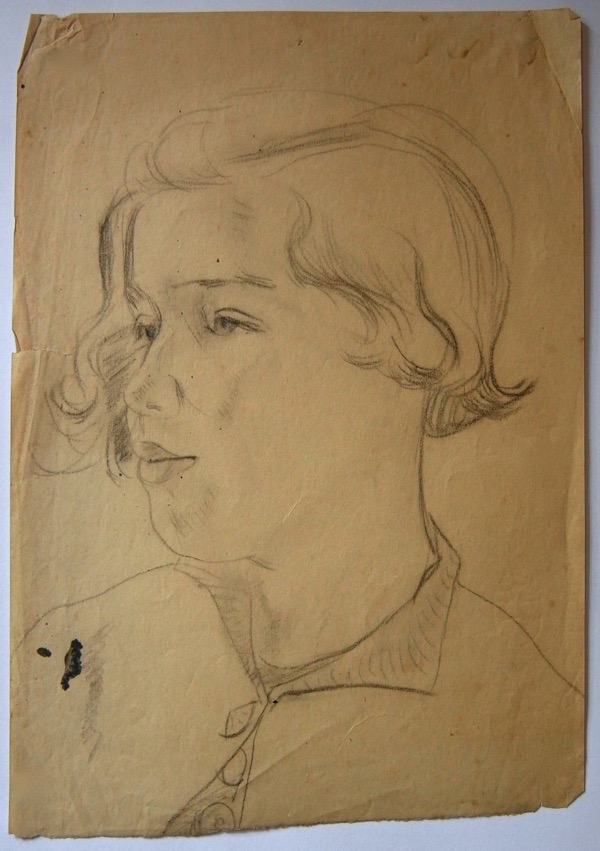


Clare Winston’s Drawings are at 31 Fournier St from next Tuesday 5th until Saturday 16th May. Numbers are limited and visits are by appointment only.
To receive an invitation, please email info@31fournierstreet.london saying when exactly you would like to visit and how many will be in your party.
You may also like to read about
Morris Goldstein, The Lost Whitechapel Boy
and
Hustings For Bethnal Green & Bow
The Spitalfields Trust presents ELECTION HUSTINGS with Parliamentary Candidates at 7pm on Tuesday 5th May at Toynbee Hall, Commercial St – discussing the proposed developments at Bishopsgate Goodsyard, in Norton Folgate, and on the Holland Estate. Admission free & all welcome.

An Election Entertainment by William Hogarth
You may also like to read about
Tower Over Bishopsgate Goodsyard

Canvassing for Votes by William Hogarth


