
The Man Beneath Trafalgar Square

Henry Croft
Trafalgar Sq is famous for the man perched high above it on the column, but I recently discovered another man hidden underneath the square who hardly anybody knows about and he is just as interesting to me. I have no doubt that if you were to climb up Nelson’s Column, the great Naval Commander standing on the top would have impressive stories to tell of Great Sea Battles and how he conquered the French, though – equally – if you descend into the crypt of St Martin in the Fields, the celebrated Road Sweeper who resides down there has his stories too.
Yet as one who was born in a workhouse and died in a workhouse, Henry Croft’s tales would be of another timbre to those of Horatio Nelson and some might say that the altitude history has placed between the man on the pedestal and the man in the cellar reflects this difference. Unfortunately, it is not possible to climb up Nelson’s Column to explore his side of this notion but it is a simple matter for anyone to step down into the crypt and visit Henry, so I hope you will take the opportunity when you next pass through Trafalgar Sq.
Henry Croft stands in the furthest, most obscure, corner far away from the busy cafeteria, the giftshop, the bookshop, the brass rubbing centre and the art gallery, and I expect he is grateful for the peace and quiet. Of diminutive stature at just five feet, he stands patiently with an implacable expression waiting for eternity, the way that you or I might wait for a bus. Yet in the grand scheme of things, he has not been waiting here long. Only since since 2002, when his life-size marble statue was removed to St Martin in the Fields from St Pancras Cemetery after being vandalised several times and whitewashed to conceal the damage.
Born in Somers Town Workhouse in 1861 and raised there after the death of his father who was a musician, it seems Henry inherited his parent’s showmanship, decorating his suit with pearl buttons while working as a Road Sweeper from the age of fifteen. Father of twelve children and painfully aware of the insecurities of life, Henry launched his own personal system of social welfare by drawing attention with his ostentatious outfit and collecting money for charities including Public Hospitals and Temperance Societies.
As self-appointed ‘Pearlie King of Somers Town,’ Henry sewed seven different pearly outfits for himself and many suits for others too, so that by 1911 there were twenty-eight Pearly King & Queens spread across all the Metropolitan Boroughs of London. It is claimed Henry was awarded in excess of two thousand medals for his charitable work and his funeral cortege in 1930 was over half a mile long with more than four hundred pearlies in attendance.
Henry Croft has passed into myth now, residing at the very heart of London in Trafalgar Sq beneath the streets that he once swept, all toshed up in his pearly best and awaiting your visit.

Henry Croft, celebrated Road Sweeper

At Henry Croft’s funeral in St Pancras Cemetery in 1930
You may also like to read about
Good News For The Marquis Of Lansdowne!
Thanks in no small part to the campaign waged by readers of Spitalfields Life in spring 2013, Hackney Council refused the Geffrye Museum permission to demolish the 1838 Marquis of Lansdowne in Cremer St as part of a redevelopment designed by David Chipperfield that would have seen the pub replaced by a concrete box. It was the success of this campaign that led to the founding of The East End Preservation Society in November 2013.
Subsequently, the Geffrye responded to public opinion by creating a better scheme for development of the museum, designed by Wright & Wright which includes the Marquis of Lansdowne restored and opens up new areas of the almshouses. Yesterday this proposal was granted an award of eleven million pounds by the Heritage Lottery Fund – which is a very satisfactory result for all parties.
Perhaps no-one is happier than George Barker who was born in the Marquis of Lansdowne in 1931 and whose family ran the pub for three generations, from before 1915 until after World War II, serving the joiners, wood turners, cabinet makers and french polishers of Haggerston.

The Marquis of Lansdowne
George Barker was born in the upper room of The Marquis of Lansdowne in 1931. It was his family home, spanning three generations of Barkers – his grandfather William who came from a village in East Anglia at the end of the nineteenth century, his mother Lilian who ran the pub alone through the war and opened up every day during the Blitz, and lastly himself, the one who got a grammar school education and a Masters degree in Maths and has lived for the last fifty years in a beautiful house in Chorleywood.
No infamous killer took his victim to The Marquis of Lansdowne for her last drink. Charles Dickens did not visit The Marquis of Lansdowne and base a character in one of his novels upon a local eccentric discovered propping up the bar. In fact, the story of The Marquis of Lansdowne is a more important one that either of these, it is that of the working people who lived in the surrounding streets, for whom it was the centre of their community and meeting place for their extended families. In this sense, it is a quintessential East End pub and the history of this place cannot be told without reference to these people.
Haggerston has changed almost beyond recognition in recent decades and, all this time, The Marquis of Lansdowne has remained as the lone sentinel of a lost world. Yet when George Barker told me the story of his family and the life they led there, he brought that world alive.
“My earliest memory is of being a kid playing on the street, everybody played on the street in those days. A couple of times, I went into the Geffrye Museum and we collected caterpillars in the gardens. They used to have a playground with swings and a place to play football at the back of the museum.
I was born at The Marquis of Lansdowne in February 1931, but my family’s involvement with the pub goes back to the beginning of the century. My grandfather William George Barker told me that the Barker family came from a group of villages near Ipswich, moving to Hoxton at the end of the nineteenth century. He came to London in 1899 and worked as a barman for a year in the East End before becoming a policeman for twenty years.
Frederick Daniel Barker, my grandfather’s brother, was licensee of The Marquis of Lansdowne until he died of TB in 1919, when my grandfather took it over from Frederick’s wife Mary Ann. Then, when my grandfather died in the thirties, my father George Stanley Barker took it over until he died in 1937 when my mother Lily ran it. She remarried in 1939 and, as Lilian Edith Trendall, she held the license until 1954 when her husband Frederick Trendall took over after her death. I think they all made a living but it wasn’t a terribly easy life.
We had a side bar and then another one on the corner we called the darts bar, as well as the front bar and the saloon bar. Even then, there were redundant doors which meant that at one time the pub was divided up into more bars. The saloon bar had upholstered bench seats and bar stools, but the other bars just had wooden benches with Victorian marble-topped tables. The curved bar itself was in the centre, spanning all the divisions with a tall central construction for display of spirits and optics, and the beer pumps were in the front bar. I remember, as you came in the side door from Geffrye St, the wall had a large decorative painted panel advertising Charrington’s Beer and there were mirrors at the rear. The pub windows were of etched and cut glass, and above the main door was an illuminated panel with the words ‘Toby Beer.’ It was a Charrington pub and a wagon came with dray horses to deliver once a week from the brewery in Mile End. Further down Cremer St was the Flying Scud, a Truman’s pub, and the Star & Pack, a Whitbread pub.
On the Geffrye St side of the building was a kitchen which was – in effect – where we all lived, and an office. Above the kitchen was my bedroom, with a window looking onto Geffrye St and the railway arches. On the first floor at the corner was the front room where we didn’t go very often, and the main bedroom – where I was born – was on Cremer St, divided from the front room by a construction of wooden panels, as if it once had been one big room. All the arches were coal depots in those days. It was brought by railway every morning at six thirty and all the coal men would be filling sacks, and bringing their horses and wagons to carry it away. But it never woke me up though, because I got used to it.
In those days, on one side of the pub was a terrace of houses and on the other there were three shops. I remember Mrs Lane who ran the sweet shop next door and Mrs Stanley who had a cats’ meat shop where they sold horsemeat. In the thirties, there was a couple of fellows making springs for prams in the building across the road which became a garage in the nineteen forties. I recall there was a baker’s on the other side of the street too and H.Lee, a big furniture manufacturer, on the corner of the Kingsland Rd.
My mother, Lily, ran The Marquis of Lansdowne singled-handed through World War II. It was heavily bombed in the surrounding streets and, when there were raids, she took shelter in the spirit cellar which had been reinforced with stanchions. She had grown up in the area, and most people knew her and she knew them, and they had been to school together. She was quite an outgoing woman who enjoyed a bit of banter and a lot of chat with the customers. She was the daughter of James Wilson who ran the scrap iron yard opposite across Cremer St under a couple of arches. He started the business there and he had a place in Tottenham, so he left his three sons to run it.
There was a friendly community on our doorstep, she ran the pub and her three brothers ran the scrap iron business across the road, and there was another uncle called Harmsworth who had another two arches where he ran a furniture business – one of my aunts married him. All my uncles and aunts lived within about one hundred yards of each other. They were the Barkers, the Wilsons and the Cheeks. A Barker married a Wilson and then a Wilson married a Cheek and then a Cheek married a Barker. My mother had another three children with my stepfather in the forties, and we all lived together in the Marquis of Lansdowne. There was me and my sister Eileen, plus the twins Maureen and Christine, and their younger brother Freddie.
At the age of eight, I was evacuated during the Blitz, but when I came back it was still quite dangerous so I went to stay with an aunt in Kensal Green. I never lost contact because I cycled over at weekends and moved back at the end of the war when I was thirteen.
In the fifties, the business started to drift away. People didn’t have much money and television came along, so it could be quiet on week nights but it was always busy at weekends, and for celebrations like VE Day and the Coronation we got a special licence and opened from midday until midnight. Even if people had moved away, they came back for Saturday evenings to meet with their relatives and friends. I would be serving behind the bar – probably a little younger than I should have been – and by the age of eighteen I was regularly working there. I always looked after the place when they went in holiday.
My mother died in 1954 and my stepfather took over the pub. I studied for a Masters Degree in Maths at Woolwich Polytechnic and I was away from 1954-56 doing National Service. In 1957, I left The Marquis of Lansdowne forever – I was working for Hawker Aircraft in Langley by then. I only went back occasionally after that, not too often. As people moved out, it started dwindling away and I think my stepfather sold it to a family called Freeland who had been coalmen under the arches and then he moved away too.
If it had been up to me, I probably would have become a publican but I wasn’t going to wait for everyone else to die off first and, because of the war, I went to grammar school and then to university. I haven’t been back to Haggerston since the nineteen sixties.”

George Barker in the yard at The Marquis of Lansdowne aged six in 1937

George Barker was born in the bedroom facing onto Cremer St, indicated by the window on the left.

At The Marquis of Lansdowne, 1957. George Barker on right, aged twenty-five, with sister Eileen, centre back. The other three are his half-brothers and sisters from his mother Lilians second marriage to Frederick Trendall. The twin girls are Maureen on the left and Christine on right, with their brother Freddie between them.

George Stanley Barker & Lilian Edith Wilson, married at St Leonards, Shoreditch on 7th September 1929. Lilian ran the pub after the death of her husband in 1937 until she died in 1954.

Ex-policeman William George Barker who ran The Marquis of Lansdowne from 1919 – photographed in 191o, with his wife Annie Susannah Oakenfold and son George Stanley Barker, who took over from his father and ran the pub until 1937.

20th December 1911, William George Barker is reprimanded for bring caught in pubs in Shoreditch and Spitalfields while on duty as a policeman – eight years later he became landlord of The Marquis of Lansdowne and spent the rest of his life in a pub. – “Inattention to duty and wasting his time by being off his Division and being in the White Hart Public House, High St, Shoreditch, out of the City from 3:30 to 4:50pm (1 hour & 2o minutes) while on duty on 13th instant. Also, being in the King’s Stores Public House, Widegate St, from 5:05 to 5:40pm (35 minutes) while on duty, same date.”

February 22nd 1919, William George Barker applies to leave the police to take over the running of The Marquis of Lansdowne from his sister-in-law after the death of his brother Frederick Daniel Barker. “I respectfully beg to apply to the Commissioner for permission to resign my appointment as Constable in the City of London Police Force, one month from the above date. My reason for doing so is that my sister-in-law Mrs Mary Ann Barker Licensee of The Marquis of Lansdowne Public House, No 32 Cremer St, Kingsland Rd, is unable to carry on the business in consequence of a nervous breakdown and she wishes me to hold the license and conduct the business on my own responsibility.”

May 9th 1919, Charrington’s, Anchor Brewery, Mile End, seeks a reference for William George Barker from the Commissioner of Police at Snow Hill. Presumably, the incidents of Christmas 1911 were discreetly forgotten.

Dating from the Regency era, The Marquis of Lansdowne is the only old building left on Cremer St

George Barker is delighted that his childhood home is saved
You may also like to read about
In Search Of Culpeper’s Spitalfields

Ragwort in Hanbury St
(The concoction of the herb is good to wash the mouth, and also against the quinsy and the king’s evil)
A year after a plaque was placed upon the erstwhile Spitalfields Organics at the corner of Puma Court and Commercial St, commemorating where Nicholas Culpeper lived and wrote The English Herbal, the celebrated seventeenth century Herbalist returned to his old neighbourhood for a look around and I was designated to be his guide.
Naturally, he was a little disoriented by the changes that time has wrought to Red Lion Fields where he once cultivated herbs and gathered wild plants for his remedies. Disinterested in new developments, instead he implored me to show him what wild plants were left and thus we set out together upon a strange quest, seeking weeds that have survived the urbanisation. You might say we were searching for the fields in Spitalfields since these were plants that were here before everything else.
Let me admit, I did feel a responsibility not to disappoint the old man, as we searched the barren streets around his former garden. But I discovered he was more astonished that anything at all had survived and thus I photographed the hardy specimens we found as a record, published below with Culpeper’s own annotations.

Honeysuckle in Buxton St (I know of no better cure for asthma than this, besides it takes away the evil of the spleen, provokes urine, procures speedy delivery of women in travail, helps cramps, convulsions and palsies and whatsoever griefs come of cold or stopping.)

Dandelion in Fournier St (Vulgarly called Piss-a-beds, very effective for obstructions of the liver, gall and spleen, powerful cleans imposthumes. Effectual to drink in pestilential fevers and to wash the sores. The juice is good to be applied to freckles, pimples and spots.)

Campion in Bishop’s Sq (Purges the body of choleric humours and helps those that are stung by Scorpions and other venomous beasts and may be as effectual for the plague.)

Pellitory of the Wall in Hanbury St (For an old or dry cough, the shortness of breath, and wheezing in the throat. Wonderfully helps stoppings of the urine.)

Herb Robert in Folgate St (Commended not only against the stone, but to stay blood, where or howsoever flowing, and it speedily heals all green wounds and is effectual in old ulcers in the privy parts.)

Sow Thistle in Princelet St (Stops fluxes, bleeding, takes away cold swellings and eases the pains of the teeth)

Groundsel off Brick Lane (Represses the heat caused by motions of the internal parts in purges and vomits, expels gravel in the veins or kidneys, helps also against the sciatica, griping of the belly, the colic, defects of the liver and provokes women’s courses.)

Ferns and Campanula and in Elder St (Ferns eaten purge the body of choleric and waterish humours that trouble the stomach. The smoke thereof drives away serpents, gnats and other noisome creatures which in fenny countries do trouble and molest people lying their beds.)

Sow Thistle and Herb Robert in Elder St

Yellow Wood Sorrel and Sow Thistle in Puma Court (The roots of Sorrel are held to be profitable against the jaundice.)

Comfrey in Code St (Helps those that spit blood or make a bloody urine, being outwardly applied is specially good for ruptures and broken bones, and to be applied to women’s breasts that grow sore by the abundance of milk coming into them.)

Sow Thistle in Fournier St

Field Poppy in Allen Gardens (A syrup is given with very good effect to those that have the pleurisy and is effectual in hot agues, frenzies and other inflammations either inward or outward.)

Fleabane at Victoria Cottages (Very good to heal the nipples and sore breasts of women.)

Sage and Wild Strawberries in Commercial St (The juice of Sage drank hath been of good use at time of plagues and it is commended against the stitch and pains coming of wind. Strawberries are excellent to cool the liver, the blood and the spleen, or an hot choleric stomach, to refresh and comfort the fainting spirits and quench thirst.)

Hairy Bittercress in Fournier St (Powerful against the scurvy and to cleanse the blood and humours, very good for those that are dull or drowsy.)

Oxe Eye Daisies in Allen Gardens (The leaves bruised and applied reduce swellings, and a decoction thereof, with wall-wort and agrimony, and places fomented or bathed therewith warm, giveth great ease in palsy, sciatica or gout. An ointment made thereof heals all wounds that have inflammation about them.)

Herb Robert in Fournier St

Camomile in Commercial St (Profitable for all sorts of agues, melancholy and inflammation of the bowels, takes away weariness, eases pains, comforts the sinews, and mollifies all swellings.)

Unidentified herb in Commercial St

Buddleia in Toynbee St (Aids in the treatment of gonorrhea, hepatitis and hernia by reducing the fragility of skin and small intestine’s blood vessel.)

Hedge Mustard in Fleur de Lys St (Good for all diseases of the chest and lungs, hoarseness of voice, and for all other coughs, wheezing and shortness of breath.)

Buttercup at Spitalfields City Farm (A tincture with spirit of wine will cure shingles very expeditiously, both the outbreak of small watery pimples clustered together at the side, and the accompanying sharp pains between the ribs. Also this tincture will promptly relieve neuralgic side ache, and pleurisy which is of a passive sort.)
You may like to read about
The Principal Operations Of Weaving, 1748
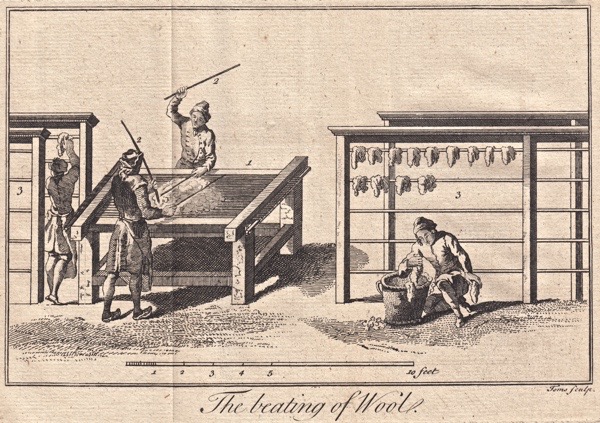
These copperplate engravings illustrate The Principal Operations of Weaving reproduced from a book of 1748 in the collection at Dennis Severs House. Many of these activities would have been a familiar sight in Spitalfields three centuries ago.


Ribbon Weaving




Dennis Severs House, 18 Folgate House, Spitalfields, E1
Click here to learn more about the HUGUENOT SUMMER festival
You make also like to read about
Portrait Of Sally Flood
Contributing Photographer Sarah Ainslie took these portraits of distinguished poet Sally Flood

LOOK AT THESE HANDS
By Sally Flood


Upon The Origins Of Baddeleys
Last Sunday, I told the story of John James Baddeley, the journeyman die sinker who rose to become Lord Mayor of London in 1922, and this week I explore the origins of this extraordinary family endeavour which spans five centuries and innumerable generations, and whose specialist printing business Baddeley Brothers still flourishes in Hackney

A mahogany four-train musical and quarter chiming longcase clock playing seven tunes, made by John Baddeley of Albrighton in Shropshire c.1760 (courtesy of Bonhams, London)
The celebrated Engraver and Satirist, William Hogarth, was first apprenticed as a Silver Engraver, while his contemporary, William Caslon, the father of British Letter Founding, was originally apprenticed to a Gunsmith – thus it comes as no surprise to discover a certain Phineas Baddeley apprenticed as a Clockmaker. You only have to look at the elegant italic lettering upon the engraved face of this fine eighteenth century longcase clock by John Baddeley to recognise the seamless nature of related trades in this era and the possibility of advancement for talented artisans who could redirect their skills to the most advantageous reward.
A skill in the creation of intricate and precise metalwork serves a Clockmaker, but may also be lent to the design of instruments. While draughtsmanship and the ability to carve lettering into metal plates permits an Engraver to create attractive designs for clients, he is also able to produce the printed copies too. Thus, in possessing technical and aesthetic skills equally, artisans were both designers and manufacturers, and through successive generations of Baddeleys, each apprenticed to the one before, individuals with diverse specialities found different ways to make an independent living.
As you will appreciate, this is a tale of many Baddeleys – and the earliest record of any of them is of Phineas Baddeley’s apprenticeship in July 1652 and his admittance at twenty-one years old to the Clockmakers’ Company in the City of London in 1661. Phineas established himself in Tong, situated on the boundary of Staffordshire and Shropshire with the Blue Mountains of Wales to the west and the Black Country, cradle of the Industrial Revolution, to the east. For subsequent generations in this border country, the Baddeleys enjoyed a significant reputation as clock and watchmakers, and a clock by John Baddeley of Albrighton counted out the hours at the church in Tong until 1983.
In the eighteenth century, John Baddeley rose to become a member of the Royal Society, was reputedly a clockmaker to George III (who collected more than two thousand timepieces) and, turning his attention to barometers and optics, invented a new type of refraction telescope. At his demise, he was recorded as ‘Gent’ in the Parish Register and commemorated by an unusual cast iron tomb in Albrighton churchyard, upon which the date of his death on January 25th 1804 is still legible as testimony to the enduring quality of his innovative memorial, most likely cast in the foundries of Coalbrookdale, less than ten miles away.
While other members of the Baddeley family embraced the possibilities of industry burgeoning in the shires around them, diversifying into producing jewellery in Birmingham and pottery in Stoke on Trent, it was John Rock Baddeley, born in 1797 in ‘The Cape of Good Hope,’ his father Thomas’s pub in Staffordshire, who first made his fortune in London. Remembered by subsequent generations as, “A clever draughtsman and very skilful die sinker, chiefly of jewellery spoon dies, badges and livery button dies,” John Rock married in Lewisham in 1818, but set set up home with his wife Lucy at 27 Seward St, Clerkenwell, where they had seven children.
It was a strategic location John Rock chose, positioned within proximity of the jewellery trade in Hatton Garden yet in the very midst of the clockmaking and printing industry which defined Clerkenwell at that time, ensuring professional security through the widest range of opportunities for employment. By 1841, he was in 63 Compton St- the next street to his brother Thomas, who had set up as an engraver in Rahere St, Clerkenwell. Although we know of no evidence they collaborated professionally, these two might be said to be the original ‘Baddeley Brothers’ who, by working as die sinkers and engravers at the fringe of the City of London, established a pattern of family industry in specialist printing which persists through their descendants to this day.
In the early nineteenth century, Hackney was still a rural area and, as a passionate fisherman, John Rock took keen advantage of it – setting out weekly with his rod and line north-eastward from Clerkenwell towards the White House Inn on the Hackney Marshes in search of sport. Besides founding the ‘True Waltonian Society’ in honour of Izaak Walton, whose ‘The Compleat Angler’ recorded Walton’s exploits fishing on the River Lea in the seventeenth century, John Rock was himself author of ‘The London Angler’s Book or Waltonian Chronicle’ which he published in 1834. As the sole surviving example of his engraving, his elegantly playful membership card for the Waltonian Society, designed in 1820, is the earliest Baddeleys’ print sample and a modest yet apt means to remember him.
Perhaps it was the connection to the White House Inn that led to John Rock’s son (who styled himself John Baddeley Junior, Engraver) marrying Elizabeth Beresford whose father was a Bailiff on the River Lea and ran a commercial fishery there? In 1841, after John Baddeley Junior had a completed a seven year apprenticeship to his father in Clerkenwell, the couple set up their first home in Goldsmith’s Row off Hackney Rd. The introduction of Rowland Hill’s Penny Post in 1840 boosted the trade for notepaper and envelopes in London, opening up the possibility to create all manner of personalised designs for stationery, often ornamented with crests and monograms.
Consequently, John Baddeley Junior’s business thrived and, in 1853, the growing family moved to a house in the Triangle, Mare St, with a large garden and a laundry which they converted into a workshop. So it was that they truly arrived in Hackney, at a location less than a hundred yards from where Baddeley Brothers now operates, more than one hundred and fifty years later.
“He made my die dish, spanner and a set of hammers,” recalled John Rock’s grandson John James Baddeley fondly, when he first set up on his own in Little Bell Alley in the City of London in 1865, drawing intimate consolation from the generations of skilled endeavour that lay behind him at the anxious moment of commencement of his own chapter in the story of Baddeleys.

Mahogany eight day longcase clock by Thomas Baddeley c.1715 (courtesy of Bonhams, London)

John Baddeley’s Prayerbook 1779

John Rock Baddeley’s design for a membership card for the True Waltonian Society, 1830

John James Baddeley’s annotation upon the reverse of the card, confirming it as the earliest surviving Baddeleys’ printing sample

Clerkenwell in 1820 before the railway came through

Izaak Walton’s house on the corner of Chancery Lane and Fleet St
You may also like to read about
John James Baddeley, Die Sinker
Last Call For Huguenots!

Click to enlarge Adam Dant’s Map of Huguenots in Spitalfields
Last year, we asked readers with Huguenot ancestors who once lived in this neck of the woods to come along to place their forebears on the Map of Huguenots in Spitalfields at Townhouse in Fournier St and more than three hundred of you did so.
Cartographer extraordinaire Adam Dant drew a huge map as big as a wall and Stanley Rondeau, whose great-great-great-great-great-great-grandfather Jean Rondeau arrived as an immigrant in 1685, was the very first put a pin in it to mark his ancestor. Now Adam Dant has painstakingly inscribed all the entries on the map and it is almost full.
Before the Map of Huguenots in Spitalfields is printed shortly, it will be displayed again at the Townhouse for the week beginning June 1st – so those who have ancestors on it may come along to check that the facts are correct and offering a last chance for anyone who wishes their Huguenot forebears to be included.
Later in the month, the Map of Huguenots in Spitalfields will be available as as limited edition print and everyone whose ancestors are on it will be invited to a party to meet each other and witness the unveiling of the completed map.
Spitalfields was the most concentrated Huguenot settlement in Britain of the twenty-five thousand French Protestants who fled across the Channel, to save their lives after the Revocation of the Act of Nantes, in 1685 – and who thereby introduced the word refugee into the English language.

Stanley places his ancestor Jean Rondeau on the map

Stanley Rondeau, Spitalfields’ most celebrated Huguenot

Stanley Rondeau congratulates Adam Dant on his Huguenot Map of Spitalfields

Stanley recounts the tale of the Rondeaus of Spitalfields for Adam
Photograph of map © Patricia Niven
Photographs of Stanley Rondeau & Adam Dant © Sarah Ainslie
The Map of Huguenots in Spitalfields is at Townhouse, 5 Fournier St, during the week beginning 1st June and the completed map will be unveiled later in the month.
Click here to learn more about the HUGUENOT SUMMER festival
You make also like to read


