
My Quilt Of Many Colours
In response to recent news and the nights closing in, I have been spending more time under my quilt

The great majority of my stories were written beneath this quilt that I made a few years ago and which has special meaning for me. Once dusk gathers, I retreat to my bed to work each afternoon, abandoning my desk that has become piled with layers of paper and taking consolation in the warmth and comfort under my quilt, as the ideal snug location to devise my daily compositions. While the autumn enfolds the city and rain falls outside, I am happy in my secure private space, writing to you through the long dark nights in Spitalfields.
This is the only quilt I ever made and I make no claims for my ability as a stitcher which is functional rather than demonstrating any special skill. Once I made a shirt that I sewed by hand, copying the pattern from one I already had, and it took me a week, with innumerable unpicking and resewing as I took the pieces apart and reassembled them until I achieved something wearable. It was a beautiful way to spend a week, sitting cross-legged sewing on the floor and although I am proud of the shirt I made, I shall not attempt it again.
My quilt is significant because I made it to incarnate the memory of my mother, and as a means to manifest the warmth I drew from her, and illustrated with the lyrical imagery that I associate with her – something soft and rich in colour that I could enfold myself with, and something that would be present in my daily life to connect me to my childhood, when I existed solely within the tender cocoon of my parents’ affections. My sweetest memories are of being tucked up in bed as a child and of my parents climbing onto the bed to lie beside me for ten minutes until I drifted off.
For several years, after the death of my father, I nursed my mother as she succumbed to the dementia that paralysed her, took away her nature, her mind, her faculties and her eventually her life. It was an all-consuming task, both physically and emotionally, being a housewife, washing bed sheets constantly, cooking food, and feeding and tending to her as she declined slowly over months and years. And when it was over, at first I did not know what to do next.
One day, I saw a woollen tapestry at a market of a fisherman in a sou-wester. This sentimental image spoke to me, like a picture in a children’s book, and evoking Cornwall where my mother was born. It was made from a kit and entailed hours of skillful work yet was on sale for a couple of pounds, and so I bought it. At once, I realised that were lots of these tapestries around that no-one wanted and I was drawn to collect them. Many were in stilted designs and crude colours but it did not matter to me because I realised they look better the more you have, and it satisfied me to gather these unloved artifacts that had been created at the expense of so much labour and expertise, mostly – I suspected – by old women.
I have taught myself to be unsentimental about death itself, and I believe that human remains are merely the remains – of no greater meaning than toenails or hair clippings. After their demise, the quality of a person does not reside within the body – and so I chose to have no tombstone for my parents and I shall not return to their grave. Instead, through making a quilt, I found an active way to engage with my emotion at the loss of a parent and create something I can keep by me in fond remembrance for always.
I laid out the tapestries upon the floor and arranged them. I realised I needed many more and I discovered there were hundreds for sale online. And soon they began to arrive in the mail every day. And the more I searched, the more discriminating I became to find the most beautiful and those with pictures which I could arrange to create a visual poem of all the things my mother loved – even the work of her favourite artists, Vermeer, Millet, Degas and Lowry, as well as animals, especially birds, and flowers, and the fishing boats and seascapes of her childhood beside the Cornish coast.
Over months, as the quilt came together, there with plenty of rejections and substitutions in the pursuit of my obsession to create the most beautiful arrangement possible. A room of the house was devoted to the quilt, where my cat Mr Pussy came to lie upon the fragments each day, to keep me company while I sat there alone for hours contemplating all the tapestries – shuffling them to discover new juxtapositions of picture and colour, as each new arrival in the mail engendered new possibilities.
The natural tones of the woollen dyes gave the quilt a rich luminous glow of colour and I was always aware of the hundreds of hours of work employed by those whose needlecraft was of a far greater quality than mine. After consideration, a soft lemon yellow velvet was sought out to line it, and a thin wadding was inserted to give it substance and warmth but not to be too heavy for a Summer night.
It took me a year to make the quilt. From the first night, it has delighted me and I have slept beneath it ever since. I love to wake to see its colours and the pictures that I know so well, and it means so much to know that I shall have my beautiful quilt of memories of my mother to keep me warm and safe for the rest of my life.


The first tapestry I bought.


Seventies silk butterflies from Florida.

From Thailand.


My grandmother had a print of Millet’s “The Angelus” in her dining room for more than sixty years.

Note the tiny stitches giving detail to the lion’s head in this menagerie.


A unique tapestry from a painting of a Cornish fishing village.

From the Czech Republic.


These squirrels never made it into the quilt.

I could not take this wonderful seascape from its frame, it hangs on my bedroom wall today
You may like to read about Mr Pussy in Winter
Hogarth At Bart’s Hospital

In 1733, when William Hogarth heard that the governors of St Bartholomew’s Hospital in Smithfield were considering commissioning the Venetian artist, Jocopo Amigoni, to paint a mural in the newly constructed North Wing of the hospital, he offered his own services free. Always insecure about his social status, it was a gesture of largesse that made him look good and provided the opportunity for Hogarth to prove that an English artist could excel in the grand historical style. Yet such was the mistaken nature of Hogarth’s ambition that his “Jesus at the Pool of Bethesda” is a curious hybrid at best. Illustrating Christ healing the sick, each of the figures in the painting illustrate different ailments, a bizarre notion that undermines Hogarth’s aspiration to the sublime classical style and results in a surreal vision of a dystopian arcadia instead. In plain words, it is a mighty piece of kitsch.
Let me take you through this gallery of maladies. Be warned, it is not a pretty picture, definitely not something you would choose to look at if you were unwell. In the detail below, on the extreme left we begin with two poor women. Some art historians believe the first represents Cretinism, or Down’s Syndrome to use the contemporary description. Another opinion suggests that the forearms of the two women, side by side, one fat and one thin, illustrate two forms of Consumption or Tuberculosis – whereby the thin woman has Phthisis which causes the body to waste, while the fat woman has the Scrofulous form that causes weight gain. The man with the stick is undeniably Blind. The fourth figure, with the anxious yellowish face may have Jaundice, or alternatively this could represent Melancholia, or Depression as we would call it. The bearded man with the red complexion has Gout, while the sling may be on account of a Septic Elbow Joint. The distressed woman beside him has an injured breast which may be Mastitis or an Abscess. Meanwhile, the child on the ground below this group has a curved spine and holds a crutch to indicate Rickets.

At the centre of the composition is Christ reaching out to the crippled man at the Pool of Bethesda, as described in the Gospel of St John. The bible tells us this man had been incapacitated by the pool for thirty-eight years, which makes the muscular physique that Hogarth gave him a little far fetched. It owes more to the requirements of the classical style than to veracity, although Hogarth did choose to portray him with a Chronic Leg Ulcer to introduce an element of authenticity to the figure.

In the background, a man is accepting a bribe from the servant of the naked woman with the wanton attitude on the right of the composition, this is to push the mother with the sick baby out of the way so that his mistress can get to the healing water of the pool first. The reason for her unscrupulous haste is that she has a Sexually Transmitted Disease, most likely Gonorrhea, indicated by the rashes upon her knees and elbows. Finally, we complete the sorry catalogue with the pitiful man with the swollen abdomen on the extreme right of the canvas, he has Liver Cancer.
Hogarth painted “Jesus at the Pool of Bethesda” in his studio in St Martin’s Lane in early 1737 and it was put in place at Bart’s in April. Although it is a huge painting, approximately thirty feet across, its position on the stairwell means that you see just a portion of the picture from the foot of the stairs, then you pass close by it as you ascend the staircase and only achieve a vision of the entire work from the head of the stairs. Let me say that this arrangement does the painting no service. When you see it close up, the broad theatrical brushstrokes of the framing scrolls and of the background, which were painted by George Lambert, scenery painter at Covent Garden, become crudely apparent.
Perhaps these ungainly miscalculations in “Jesus at the Pool of Bethesda” were what led Hogarth to paint the companion piece “The Good Samaritan” in situ, from a scaffolding frame. Did he get seduced by the desire for monumentalism while painting the “Jesus at the Pool of Bethesda” in his studio and forget that it would be seen close to, as well as from a distance? Time has done the picture no favours either. With innumerable cleanings and restorations, the canvas has buckled and now daylight prevents you from seeing the painting without reflections, blanking out whole areas of the image. Maybe this was the reason for Hogarth’s instruction that the picture should never be varnished? It was ignored.
I cannot avoid the conclusion that “Jesus at the Pool of Bethesda” was a misdirection for Hogarth. It has more bathos than pathos. He aspired to be an artist in the high classical style, yet we love Hogarth for his satires and his portraits. We love his humanity, recording the teeming society that flourished in the filth of eighteenth century London. These pictures speak more of life than any idealised visions of nymphs and swains frolicking in a bucolic paradise. And, even in this, his attempt at a classical composition, Hogarth’s natural sympathy is with the figures at the margins. Far from proving that an English artist could excel at the grand historical style,”Jesus at the Pool of Bethesda” illustrates why this mode never suited the native temperament. All the qualities that make this painting interesting, the human drama and pitiful ironies, are out of place in the idealised landscape that suited the tastes of our continental cousins.
Hogarth was born in Bartholomew Close and baptised around the corner from the hospital at St Bartholomew’s Church. At the time of “Jesus at the Pool of Bethesda,” Hogarth’s mother still lived nearby and she must have been proud to see her son’s painting installed in the fine new hospital buildings. It was symbol of how far he had come. Yet, for obvious reasons, the painting is mostly ignored in books of Hogarth’s work today, so the next time you are in Smithfield, go in and take a look, and savour its bizarre pleasures for yourself.

This woman has a sexually transmitted disease.

This man has cancer of the liver.


The poor box at the entrance to the North wing.

The new entrance to St Bartholomew’s Hospital built in 1702, with the North wing containing Hogarth’s mural just visible through the gate

St Batholomew’s Church in Smithfield where William Hogarth was baptised.
Photographs of the mural © Patricia Niven
You might also like to read about
Christ Church Crypt Restored

A new entrance to the crypt
A year ago, I photographed the crypt of Christ Church Spitalfields when all the walls had been cleared out and Nicholas Hawksmoor’s structure was revealed for the first time since the eighteenth century. Last week, I returned now the restoration has been completed, in the company of Biba Dow of Dow Jones Architects who has overseen the project.
Church architects did not design crypts with any other purpose than to support the nave, but the opportunistic clergy in the eighteenth century saw the commercial possibility of charging families for the storage of the remains of their loved ones as means to pay for the running costs of the church. Thus, by the eighteen-twenties, the crypt of Christ Church was full of bodies which packed the space until the nineteen-eighties when they were excavated and removed to the Natural History Museum. Subsequently, the homeless shelter begun by the Spitalfields Crypt Trust in 1965 acquired its own building in Shoreditch High St where it continues to operate today.
These changes permitted the opening of the crypt as a public space for the local community, offering a refectory, parish rooms and an intimate chapel, all within a flexible interior suitable for gatherings, both large and small. In fulfilling this brief, Dow Jones Architects have been scrupulous to undertake no intervention that cannot be reversed and to ensure the distinction between their sympathetic additions and the original structure is always apparent.
A York stone floor has been installed throughout, extending the streetscape into the crypt and complementing the Portland stone of the church. All new joinery, panelling and furniture is of oak and the metalwork of bronze, restricting the textures introduced alongside the patina of the crypt. This limited range of materials draws your eye back to the subtle irregularities of Hawksmoor’s vaulted roof and its architectural precedents – the Basilica Cistern in Istanbul and the Fish Market in Venice.
The refectory in the crypt is open to all from this Thursday 19th November, offering a new refuge to escape the clamour of Spitalfields within a space that has provided harbour to humanity for three centuries already.

Plaques declaring the boundaries of church’s land and commemorating the fire house

Crypt during restoration work

A stone ramp leads down to the refectory
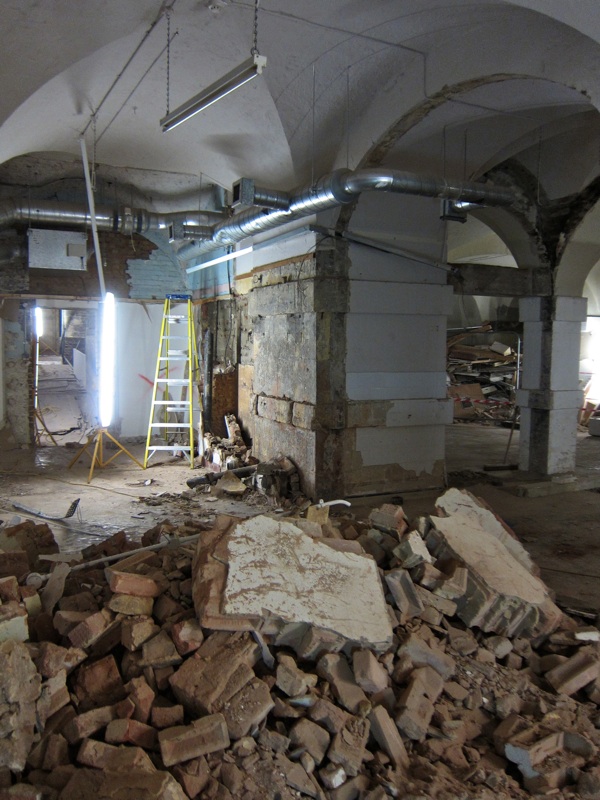
Crypt during restoration work

Eighteenth century shroud discovered during the excavations in 1984-1986

An intimate chapel in the crypt

Crypt during restoration work

Archaeological excavations in the crypt, 1984-86

The crypt restored

The crypt was used as a bomb shelter in World War Two

Memorial stone to Edward Peck, one of the commissioners of the church

The crypt restored

Crypt during restoration work

The dormitory of the homeless shelter in the crypt

The new refectory in the crypt

The refectory of the homeless shelter

Crypt during restoration work

New staircase leading to the nave

Recent art installation by Nicholas Feldmeyer

Crypt during restoration work

Looking back towards the entrance today

An East End family shelters from the London Blitz in the crypt of Christ Church
Shroud & Excavation Image © Natural History Museum
Archive Images courtesy Christ Church Spitalfields
You may also like to read about
A Brief History of London Crypts
The Secrets of Christ Church Spitalfields
Midwinter Light at Christ Church Spitalfields
A View of Christ Church Spitalfields
Irene Stride Remembers Spitalfields
Dr Margaret Clegg, Keeper of Human Remains
Colin O’Brien Returns to Clerkenwell
Contributing Photographer Colin O’Brien is giving a Magic Lantern Show at Bishopsgate Institute next Thursday 19th November at 7:30pm, showing his photographs of Clerkenwell and beyond, and telling the stories behind the pictures. Click here to book a ticket.

Colin O’Brien in St Peter’s Italian Church, Clerkenwell
Many of Colin O’Brien’s early photographs were taken with a Leica camera that he received ‘off the back of a lorry’ when he was growing up in Clerkenwell in the fifties. Recently this was restored again to working order for Colin by Leica, prompting him to make a sentimental pilgrimage to his old neighbourhood with his cherished camera.
“It was an exciting day when I held my 1931 Leica again, newly-restored and working for the first time in more that forty years. My photographic journey has been an eventful one – starting with a box camera and ending with a digital monster that includes a setting for any photographic eventuality. There were many cameras in between but my favourite was always the Leica.
This camera served me well in the fifties, sixties & seventies and I welcomed it back as if it were a long-lost relative. When I pulled out the 3.5cm Elmar lens, looked through the viewfinder and fired the shutter, it sounded good. The Elmar lens was the same one I used to take accident pictures with at the crossing of Clerkenwell Rd and Farringdon Rd in the fifties and sixties.
The next step was to buy a roll of film and shoot some pictures again. Way back in my youthful Leica days, my eyesight was perfect, my hands were supple, my brain activated more quickly and my limbs bent without creaking like an old wooden sailing ship. The repaired camera felt heavy and solid to the touch and it was only when I realised that it did not have an exposure meter or auto-focus and – after each frame – it had to be wound on manually, that I discovered I would have to remember how to do all these procedures in an instant if I stood any chance of capturing the passing scene.
Yet it was amazing how it all came back to me. A quick movement of the split image rangefinder to focus, an estimation of exposure based on experience and the tolerance of black and white film to under- or over-exposure, switching from the rangefinder to the viewfinder, and pressing of the shutter release placed conveniently on the top of the camera. ‘It’s as simple as that,’ I thought. Or is it? I followed the same procedure for my next shot, but nothing happened. I had forgotten to wind on the film.
Arriving in Clerkenwell, the memories came flooding back – mum and dad, my relatives, Mrs Leinweber and the kids I used to play with on the surrounding bomb sites. Only today it is different. Pret A Manger stands on the corner of Clerkenwell Rd and Farringdon Rd where the Metropolitan Tavern once was. Victoria Dwellings, the tenement where I grew up in the forties and fifties, has been replaced by so-called luxury flats. Where once stood Booth’s Dry Gin Distillery there is now a new office block and the hoarding is gone that displayed the ubiquitous Guinness advertisements which were part of my growing up.
What still remains are ‘the steps,’ where as kids we used to meet before setting out to play our games of Hopscotch, or Cowboys & Indians. I sat on the steps where Razzi Tuffano and Pidge Boffer sat way back in 1948 on the very spot where I raised my box camera to take their photograph. The Italian church is still there in Clerkenwell Road where I took the picture of the Carmelite nun sweeping rubbish into the street from the building next to the church where they lived.
Amazingly, the door to the church was open and I went inside. It was like entering another world from the drabness of the dull street walking in to the ornate Italian decoration of the Church. The place was empty. I stood looking at the altar where I used to be an altar boy in the forties and from where I once set off with the Italian Procession, an annual event which still happens today. I remember Beniamino Gigli coming to the church to sing and they put up speakers outside so that more people could hear him. It was strange to be back in this church again, which had meant so much to the Italian and Irish immigrants of Clerkenwell, including my own family and relatives, who lived in the area all those years ago.
The coup of the day for me was gaining access to the flats which now stand on the site of Victoria Dwellings and climbing onto the roof to look down onto the crossroads at the junction of Clerkenwell Rd & Farringdon Rd that was my childhood view. “
Colin O’Brien’s photographs of Clerkenwell in the fifties & sixties are currently on exhibition in the gallery at the Leica Store, 18 Royal Exchange, City of London, EC3V 3LT

Colin with his Leica in the fifties

Razzi Tuffano & Pidge Boffer photographed by Colin O’Brien in 1948

Colin O’Brien sits on the same steps in November 2015

A Carmelite nun sweeps the pavement in Clerkenwell, sixties

The same view today

Accident at the junction of Clerkenwell Rd & Farringdon Rd, early sixties

Junction of Clerkenwell Rd & Farringdon Rd, November 2015

Car crash at the junction of Clerkenwell Rd & Farringdon Rd, 1957

Colin O’Brien in Clerkenwell, November 2015
Portraits of Colin O’Brien copyright © Alex Pink
All other photographs copyright © Colin O’Brien

CLICK HERE TO ORDER A COPY OF COLIN O’BRIEN’S LONDON LIFE FOR £25
You may also like to take a look at
Sandra & Bob: Two Film Portraits
It is my pleasure to present these two recent film portraits of individuals who will be no strangers to readers – Sandra Esqulant, beloved Landlady of The Golden Heart in Spitalfields, and Bob Mazzer, Aldgate-born Photographer whose tube pictures we published last year as Underground.
LANDLADY by Orlando Gili
[youtube YBj5hCa3F60 nolink]
BOB MAZZER:UNDERGROUND & OTHER PICTURES by Richard Butchins
At Fishmongers’ Hall

This palatial building of Portland stone tucked under the west side of the foot of London Bridge is Fishmongers’ Hall. Many a time I have passed by on an errand to the Borough to buy fresh fish and cast my eyes upon it, so – as one for whom the worship of fish is almost a religion – I was delighted to enter this temple to the wonders of the deep last week.
The Fishmongers’ Company were already long-established on this site when they received their first Royal Charter in 1272 from Edward I, the fish-loving king, and their earliest hall on this site was recorded in 1301. A monopoly on fish trading brought great wealth to the Company, and in the fourteenth century three fishmongers were successive Lord Mayors of London, John Lovekyn, Sir William Walworth and William Askham. Subsequently, they secured Fishmongers’ Wharf in 1444 and retained its sole usage for unloading their catch until 1666, prior to the development of Billingsgate Market which traded on the east side of London Bridge until 1982.
This most-recent Fishmongers Hall was constructed as part of the new London Bridge in the eighteen-thirties, designed by Henry Roberts but constructed from drawings by George Gilbert Scott. The tone is partly that of a stately home and partly that of a lofty public institution, yet salmon pink walls in the vestibule and mosaics gleaming like fish scales conjure an atmosphere unique to the Fishmongers’ Company, heightened by an astonishing collection of historic paintings, sculptures and artefacts which evoke all things fishy.
A lavishly embroidered funeral pall created by nuns around 1500, portraying Christ handing the keys of Heaven to St Peter the fisherman and embellished with mermen and mermaids, testifies to a former age of credulity, while a sturdy chair fabricated with timber from old London Bridge and with a seat containing a stone from the same source reminds us of the detail of history in this spot. The combination of architectural opulence and multiple fish references suggests that the Hall itself might be understood as a fishmonger’s distinctive vision of Heaven, where St Peter awaits the newly-departed at the head of a gilded staircase.
At every turn in this building, you are reminded of fish, the ocean and the ancient trade established more than seven centuries in this place, which fills your mind with thoughts of fishmongery and makes it startling to peer out from the prevailing silence in the Fishmongers’ Hall upon the clamour of the modern city with the Shard looming overhead.

Crest of the Fishmongers’ Company

Wonders of the Deep, 1 by Arnold Von Hacken


Wonders of the Deep, 2 by Arnold Von Hacken


Wonders of the Deep, 3 by Arnold Von Hacken

Arnold Von Hacken’s eight paintings of Wonders of the Deep

Wonders of the Deep, 4 by Arnold Von Hacken


Wonders of the Deep, 5 by Arnold Von Hacken

This stained glass of the earlier Fishmongers’ Crest dates from the before the Fire of London

Wonders of the Deep, 6 by Arnold Von Hacken


Wonders of the Deep, 7 by Arnold Von Hacken


Wonders of the Deep, 8 by Arnold Von Hacken

Chair made from the timber of old London Bridge with a seat including a piece of stone from the bridge and a back showing designs of subsequent bridges


Turtle shell painted with the crest of the Fishmongers’ Company


Figure of St Peter the Fisherman from the Fishmongers’ barge


Queen Victoria presides over the Great Hall

Fishmongers’ crest in the Great Hall


Fishmongers’ crest from a steel muniment box

Fishmongers’ funeral pall embroidered by nuns c. 1500

Christ hands the keys of Heaven to St Peter, the Fisherman

Merman from the pall

Mermaid from the pall

Fishmongers’ Hall, Fishmongers’ Wharf

Interior of Billingsgate Market at 6am by George Elgar Hicks

Fishmongers’ Hall, London Bridge
Paintings reproduced courtesy of Fishmongers’ Hall
You may also like to take a look at
Derrick Porter’s Voices Of Hoxton
It is my great pleasure to announce that Derrick Porter’s impressive debut collection of poetry Voices of Hoxton is published this week. Click here to order a copy. Hear Derrick read this Friday 13th November at the launch at Peer Gallery, 97-99 Hoxton St, N1 6QL from 6:30pm.

Derrick Porter
This is the gentle face of Derrick Porter, craggy and wise, framed by snowy hair and punctuated with a pair of sharp eyes that reveal a hint of his imaginative capacity. Standing against a rural backdrop upon the banks of the river Ching in Essex not far from High Beach where John Clare was confined, Derrick looks every inch an English poet and he is quick to admit his love of nature. Yet, although he acquired an affection for the countryside at an early age and Chingford is his place of residence, the focus of Derrick’s literary landscape and centre of his personal universe is his place of origin – Hoxton.
“It was a place we all wanted to get out of – it was a tough place to live,” Derrick confessed to me, recalling his childhood, “but the the culture of Hoxton and that era was my imaginative education.”
“My interest in literature stems from spending so many years in hospital up to the age of thirteen and they used to read to us – I looked forward to it so much, I learnt to love reading stories,” he confided, explaining that he suffered from tuberculosis as a child and was exiled from London for long stretches in hospitals. “They made us stay out in the fresh air which was the worst possible thing because it actually helped the germs to flourish, when the foggy atmosphere of London was much more beneficial to sufferers – but they didn’t understand that in those days.
My dad worked at the Daily Mail as a printer and my mum was a housewife, but I never saw him until I was six when he returned from the war. He had been captured by the Japanese and was held in a prisoner of war camp. At first, they sent him to America which was where they kept them to build them up again before they came home.
Before the age of ten years old, I lived in a prefab in Vince St next to the Old St roundabout and then we moved to Fairchild House in Fanshawe St. The prefabs were made of asbestos without any insulation and were very cold in winter. As children, we used to break off pieces of asbestos and throw them on to the bonfire to watch them explode. Maybe that affected my health? We had free rein then and we played in the old bombed buildings at the back of Moorgate – that was our playground.
At thirteen, I had an operation to have half of my lung removed and they told my mother that they didn’t know if I would recover. From then on, I took care of my own health and I became a fitness and health junkie. When I left school I thought I’d like to go back to the countryside and, when the teacher asked my ambition, I said, ‘I’m going to work on a farm,’ he told me, ‘You won’t find many in ‘Oxton, Porter.’ My father got me a job as in the general printing trade but it did my lungs in.
I always had this compulsion to get away from Hoxton and write. So I decided to emigrate to Australia on my own. I knew I had to get away. I was nineteen when I went for two years. I was engaged to be married but I broke the engagement and emigrated. I went to writing workshops in Australia and my earliest poems were written while I was there. I got a job as a printer on the Sydney Morning Herald. At first, they told me I couldn’t get a job without a union card, but then there was a bit of skullduggery. They took pity on me and, when I got a job, they gave me a card.
After that, I travelled in the USA with this small bag of my poems. Then, in Las Vegas, I stayed in this $1-a-night fleapit for three nights while I was waiting for the coach to take me to Los Angeles. Twenty minutes after I had boarded the bus, I realised I had left my bag behind with all the poems I had written in the previous two years. I cried, I felt so dismayed. It was a significant loss.
On my return, I moved into Langbourne Buildings off Leonard St in Shoreditch. I was surrounded by my friends and family and this was where I first joined a writing group. It was in Dalston and I started to write regularly. After seven years, I began to write some decent poems and then I read in the Hackney Gazette about Centreprise Literary Trust. So I went along there and met Ken Worpole, and gave him some of my poems. Then he got back in touch and said he’d like to publish them, and that was the first work I ever had in print.
By now I was twenty-nine and married with two young children, and we were offered the opportunity of swapping our flat for a house in Orpington. It was a fabulous house with a garden and we couldn’t refuse, but the rent was three times the price. We lived there for thirty-odd years and my poetry developed, I became a member of the Poetry Society and had my works published in magazines, although I rarely send my poems out because I always think I can do better.
I bought paintings from D & J Simons & Sons Ltd, picture frame and moulding makers, in the Hackney Rd and, when I moved to Orpington, I bought all their ‘second’ picture frames off them and sold them there. I started working for myself, buying reproduction furniture and selling it in Orpington Village Hall and I earned a living from that for twenty years. But all the time I was writing, writing and I had a lot of encouragement from people.
I rework my poems a lot because I’d rather have one good one than a lot of mediocre ones. I have written a lot of poems and discarded most of them because I’d rather just keep my best. I love letter writing and I believe it can be an art if it is done well. As long as I live, I’ll carry on writing.”

Derrick and his childhood friend Roy Wild on the steps of the eighteenth century house in Charles Sq where they played as children
Sitting Under a Tree in Charles Square
The clear urgency of the voice caused me
to look up, my finger marking the place
in the newspaper I was then reading…
How old do you think this tree is? it asked.
I said it was here when I was a boy.
Well, it won’t be for much longer, it said.
The owner of the voice began to circle
the tree before running his hands over
the gnarled trunk as if in search of a precise spot.
From under his coat appeared a long-handled axe.
It would be better if you moved, he said.
But not before the tree had endured
several blows…and a large, older woman, shouted
Are we to suffer this nonsense again?
Come home and do something useful for once.
Instantly the attack ceased and – without
another word passing between them – his steps
quickened to reach, if not overtake, the other.
My thumb then lifted from the newspaper
returning my eye to the Middle East
where, as yet, no allaying voice can be heard.

Derrick standing outside the flat at Fairchild House in Fanshawe St where he grew up
Derby Day in Fairchild House
Walking along our third floor balcony
I can see – before I enter the door – the piano
blocking the view into our living room.
You are watching the TV, circling horses
in The Sporting Life as John Rickman
calls home another of those certainties
you always said you should have backed.
From the kitchen the clang of pots
tells me it’s a Friday and mum’s busy
preparing a stew. A day perhaps
when sand had been kicked into my face
and I’d come home to pump iron.
If so, my bedroom door will be locked
and I’ll be lifting sand-filled-petrol-cans
hung along an old broom handle.
It’s also possible it’s the evening
of the Pitfield Institute’s Weight-Lifting final
when I won my only trophy. Or the day
cash went missing and I bought my first watch.
But as I turn the key and enter the door
I want it to be the day when even
the piano joined in…and Gordon Richards
rode Pinza to victory in the Derby.

The Apprentice
When Mr Hounslow asked the class what jobs
we had in mind, I answered,
Working on a farm, sir. “You won’t find many
in Hoxton” the reply. Come summer
I started work for a musical instrument
supplier in Paul Street, close to the old Victorian
Fire Station later re-sited in Old Street.
For one day a week I was promoted
to van boy and helped deliver to the likes
of Ronnie Scott’s Jazz Club in Soho,
a world far removed from that of Hoxton.
Here I saw the upbeat side of the business,
the posh shiny part that could open doors
if you had the right kind of connections.
After a year working with men who enjoyed
nothing better than to send the new boys out
to buy rubber nails and glass hammers,
if never themselves discovering who put
the mouse droppings into their biscuit tin,
I began to question where I was heading.
That summer – while on holiday in Ostend
with the Lion Club – my dad handed in
my notice…and when I returned, was told
I had to start work in the Printing Trade.
Its every aspect – machinery, ink, oil,
noise and dust, the very air – a sort of
road taken, as old Hounslow might have said,
for there being no farms in Hoxton.

Derrick Porter at Fairchild House, Hoxton
Poems copyright © Derrick Porter
You may also like to read about
King Sour, Poet & Rapper of Bethnal Green


