
The Holland Estate Is Saved
This week, in response to a triumphant campaign, residents of Holland Estate have received letters from East End Homes revoking the demolition notices that were served upon them last year.
In 2015, social landlord East End Homes submitted a pre-planning application for demolition of the Estate next to Petticoat Lane prior to any consultation with the people who live there and a member of the staff of East End Homes told residents their homes were “unfit for human habitation.”
So Contributing Photographer Sarah Ainslie & I visited flats on the Estate to take these portraits and assess the accommodation for ourselves. We found the gracious brick structures are built of better quality materials than most modern developments and are humanely conceived, offering hospitable living spaces which are cherished and well-maintained by the occupants.
Working in partnership with Telford Homes, social landlord East End Homes proposed demolishing the Estate and replacing it with a high-rise development mixing private and social housing but, for the meantime, this plan is dismissed.

Ali Sahed Goyas & Jahnara Choudhury have lived on the Holland Estate for twenty-five years

Pascha Singh has lived on the Holland Estate for more than thirty years

Mahjdiyat, Shammi, Manveen & Arshan Ahmed at home

Yolanda De Los Buies has lived on the Holland Estate for seventeen years

Saleha Khanam with her son Shamsur Rahman and his wife Rushna Begum and their children Yaseen and Hamza – Four generations of this family have lived on the Holland Estate

Azar Ali has lived on the Holland Estate for thirty-one years

Nessa Aifun cares for her husband Rustum at home

Saleh Ahmed & Rusnobun Bibi and their grandchildren Aakifah & Ismael

Kabir Ahmed & Nasrin Rob with their children Aakifah & Ismael

Murtata Choudhury has lived on the Holland Estate for fifty years

Shikiko Aoyama Sanderson & Jarrod Sanderson have lived on the Estate for six years

Samirun Chowdhury with Saima Chowdhury and Taher Uddin outside Samirun & Saima’s home

Enrico Bonadio has lived on the Holland Estate for three years
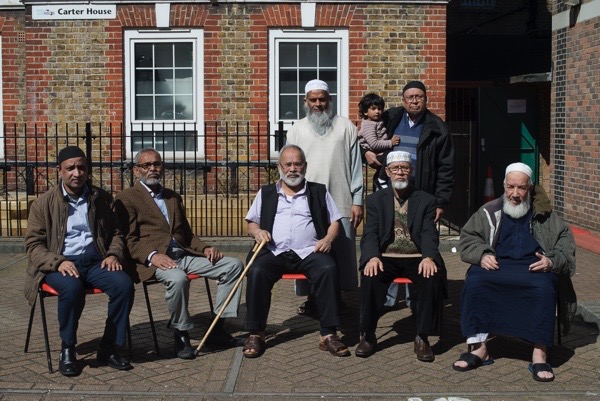
Rob Ali, Ali Sayed Goyas, Asab Miah, Murtata Choudhury, Saleh Ahmed with Aakifah Ahmed & Mohammed Ismael Ali
Photographs copyright @ Sarah Ainslie
You can follow the Residents Against Demolition campaign on
&
Twitter @bbcresidents
You might also like the read about
The First Rhubarb Of The Season

Lillie O’Brien & I were at Covent Garden Market before dawn to get the pick of the crop of forced rhubarb. It is the only English fruit that is in season now and we bought it straight off the truck that had driven down overnight from the famous Yorkshire Triangle, where a frost pocket sweetens the rhubarb naturally and, after four generations, the Oldroyd family still grow rhubarb by candlelight in the time-honoured method. Once upon a time there was a Rhubarb Express to deliver trainloads of rhubarb to the hordes of eager Londoners craving rhubarb, but yesterday there was just Lillie & me seeking rhubarb while the city slept.
Formerly a pastry chef at St John Bread & Wine, these days Lillie O’Brien is the London Borough of Jam – a one-woman operation producing small batches of the highest quality preserves from the freshest seasonal ingredients. Our joint mission was to buy the best rhubarb, drive back to Lillie’s tiny kitchen in Clapton and make it into jam. At five thirty, we were driving down to Covent Garden and by ten thirty we had jam, it was a highly satisfactory achievement for so early on a January morning.
At the market, we were greeted by Paul & Terry of Lenards wholesalers. By then, the night’s trading was already over but it was the ideal opportunity for a rhubarb hunt and Paul & Terry were the expert guides to lead us to the best options available. The one diversion from our rhubarb quest was for blood oranges from Sicily, and as I stood in the sub-zero temperature of the market, I was transported to Southern climes by the intense sweetness of the ruby-red flesh of this gleaming golden fruit. Lily took a box to make some marmalade.
We found fat rhubarb and thin rhubarb, long rhubarb and short rhubarb. Some that was past its best and some that looked rather pale. Apparently, chefs like fat rhubarb to create chunks in their crumble, but Lillie prefers a smooth texture to her jam and when she opened a box of skinny rhubarb – blushing almost coral in its redness – her eyes widened in excitement and I knew we were in business.
In a state of raging anticipation, we carried our crates of gleaming rhubarb into Lillie’s tiny kitchen and Lillie shrieked with excitement at the ice-cold water as she washed the stalks in the sink. We paused briefly to admire the aesthetics of the curly dappled flowers before we beheaded them mercilessly and Lillie chopped one kilo of rhubarb into small pieces, while Chester her cheeky blue cat rubbed at her ankles.
Since the age of twelve, Lillie worked at a part-time job at a food store called Tartine in her home town of Melbourne, where she grew up under the influence of her mother’s cookery. “When I was a child, my mother made crab apple jelly but when you are little, you don’t like it – so she had a cupboard to herself with a year’s supply.” Lillie recalled with a sentimental grin. On leaving school, Lillie did a three year cooking apprenticeship and then five years as a chef at the celebrated Cicciolina mediterranean bistro before deciding to come travelling around Europe for six months. A tour that was cut short when a pal walked into St John Bread & Wine to ask if there were any jobs, was told a pastry chef was required and gave Lillie’s name. “I went in for a trial and stayed for four years,” admitted Lillie, “which I have to say went very quickly. I made the jam and preserves while I was there. But then I decided wanted to be part of the market at Chatsworth Rd and I found that working at St John by day and making jam all night was quite tough. So it was time to move on from cheffing – from four years of rolling puff pastry that has given me enlarged muscles in my neck and from whisking eggs that has caused one arm to grow larger than the other! But I do miss it though…”
Lillie talked as she worked, weighing up the rhubarb and then transferring it to her beautiful copper jam pan. Copper is the best conductor of heat which means that the fruit will cook evenly, avoiding any overcooking that might compromise the flavour. This is why Lillie cooks her jam in small batches because larger amounts take longer to cook and the fruit does not cook consistently. Adding jam sugar and then the juice of a lemon, Lillie kept stirring as the liquid evaporated and the rhubarb reduced to an even texture. Meanwhile, she heated the jam jars and boiled the lids, both to sterilise them and to ensure that her hot jam had a hot jars to go into into, so there was no risk of the glass breaking.
Lillie constantly checked the consistency of the jam, its viscosity revealed by how it dripped from the spoon. Then she added the finely chopped stem ginger and the jam was almost ready. “I’m so happy, I’m beside myself with the colour! This is going to be the most beautiful rhubarb jam I ever made.” she declared in unmitigated delight, as she poured it from the pan through her jam funnel, making just four jars. This painstaking technique required Lillie to spend the rest of the day working through her twelve kilogrammes of rhubarb, yet ensured the unmediated fruitiness that characterises her jam.
An essential trip to Gardners Market Sundriesmen was required to purchase more labels for this new batch of jam before Paul Gardner left for the weekend, which meant that Paul was the lucky recipient of the first pot of jam. Then Lillie returned to her kitchen for a long day’s jam-making before writing the labels that evening, and all so the rhubarb & ginger jam can be on sale this weekend.
A lush deep pink jam with a vivid flavour that is more rhubarb than even rhubarb, a perfectly spreadable texture and a subtle piquancy of ginger – this is what I shall be having on my toast at breakfast, thanks to the London Borough of Jam.

Washing the rhubarb

Weighing the rhubarb

The rhubarb in Lillie’s jam pan

Adding the jam sugar

Testing the consistency
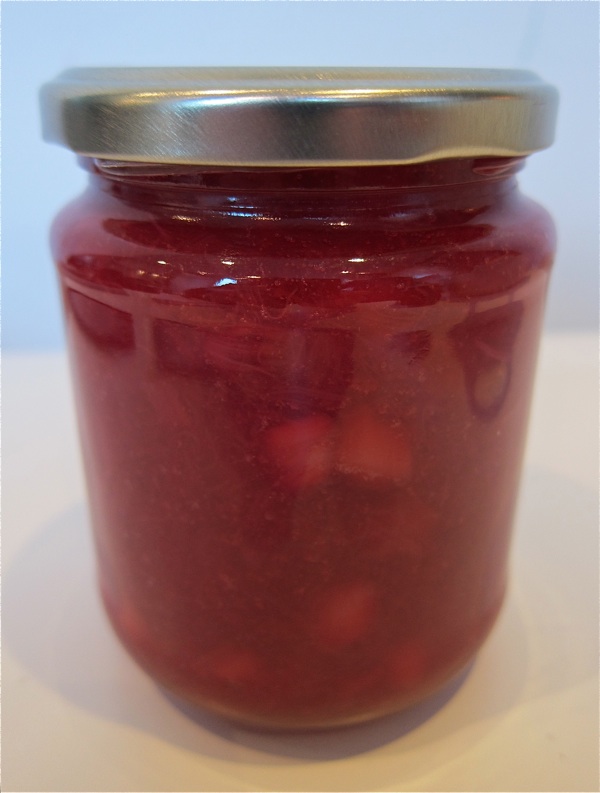
Rhubarb & Ginger Jam by the London Borough of Jam

Paul Gardner of Gardners Market Sundriesmen gets the first pot of rhubarb & ginger jam
You can buy jams and preserves by London Borough of Jam at Leila’s Shop, Violet Cakes & E5 Bakery, and each weekend from Lillie’s shop at 51d Chatsworth Rd, E5 0LH.
You may also like to read about
Simon Pettet’s Delft Tiles

Anyone who has ever visited Dennis Severs’ House in Folgate St will recognise this spectacular chimneypiece in the bedroom with its idiosyncratic pediment designed to emulate the facade of Christ Church. The fireplace itself is lined with an exquisite array of Delft tiles which you may have admired, but very few know that these tiles were made by craftsman Simon Pettet in 1985, when he was twenty years old and living in the house with Dennis Severs. Simon was a gifted ceramicist who mastered the technique of tile-making with such expertise that he could create new Delft tiles in an authentic manner, which were almost indistinguishable from those manufactured in the seventeenth century.
In his tiles for this fireplace, Simon made a leap of the imagination, creating a satirical gallery of familiar Spitalfields personalities from the nineteen-eighties. Today his splendid fireplace of tiles exists as a portrait of the neighbourhood at that time, though so discreetly done that, unless someone pointed it out to you, it is unlikely you would ever notice amongst all the overwhelming detail of Dennis Severs’ house.
Simon Pettet died of Aids in 1993, eight years after completing the fireplace and just before his twenty-eighth birthday, and today his ceramics, especially this fireplace in Dennis Severs’ house, comprise a poignant memorial of a short but productive life. Simon’s death imparts an additional resonance to the humour of his work now, which is touching in the skill he expended to conceal his ingenious achievement. As with so much in these beautiful old buildings, we admire the workmanship without ever knowing the names of the craftsmen who were responsible, and Simon aspired to this worthy tradition of anonymous artisans in Spitalfields.
When I squatted down to peer into the fireplace, I could not help smiling to recognise Gilbert & George on the very first tile I saw – Simon had created instantly recognisable likenesses that also recalled Tenniel’s illustrations of Tweedledum & Tweedledee. Most importantly, the spontaneity, colour, texture and sense of line were all exactly as you would expect of Delft tiles. Taking my camera and tripod in hand, I spent a couple of hours with my head in the fireplace before emerging sooty and triumphant with this selection of photographs.
When I finished photographing all the tiles, I noticed one placed at the top right-hand side that was almost entirely hidden from the viewer by the wooden surround on the front of the fireplace. It was completely covered in soot too. After I used a kitchen scourer to remove the grime, I discovered this most-discreetly placed tile was a portrait of Simon himself at work, making tiles. The modesty of the man was such that only someone who climbed into the fireplace, as I did, would ever find Simon’s own signature tile.

Gilbert & George

Raphael Samuel, Historian of the East End

Riccardo Cinelli, Artist

Jim Howett, Carpenter whom Dennis Severs considered to be the fly on the wall in Spitalfields

Ben Langlands & Nikki Bell, Artists who made extra money as housepainters

Simon de Courcy Wheeler, Photographer

Julian Humphreys who renovated his bathroom regularly – “Tomorrow is another day”

Scotsman, Paul Duncan, worked for the Spitalfields Trust

Douglas Blain, Director of the Spitalfields Trust, who was devoted to Hawksmoor

The person in this illustration of a famous event in Folgate St cannot be named for legal reasons

Keith & Jane Bowler of Wilkes St

Her Majesty the Cat, known as ‘Madge,’ watching ‘Come Dancing’

Marianna Kennedy & Ian Harper who were both students at the Slade

Phyllis & her son Rodney Archer

Anna Skrine, Secretary of the Spitalfields Trust


Simon Pettet, Designer & Craftman (1965-93)
Dennis Severs House, 18 Folgate St, Spitalfields, E1 6BX
You may also like to read about
At The Blessing Of The River

Contributing Photographer Colin O’Brien & I arrived at St Magnus the Martyr yesterday morning to encounter the Bishop of London illuminated by shafts of winter sunlight as he emerged from a cloud of incense to bless a bowl of chalk, thus enabling the parishioners to mark their houses in advance of the imminent arrival of the three kings. Yet this exercise of spiritual power was a mere prelude to the main event – the annual blessing of the river, as a celebration of the baptism of Jesus.
The lavish brocade robes of the priests gleamed as they processed along Lower Thames St and up through the gloomy underpass – where the incense conveniently masked a noxious smell – before they emerged onto London Bridge in splendour. From the other side, the Bishop of Southwark led another procession and the two parties met in the centre to exchange greetings and declaim prayers.
Invoking Noah and the waters of Jordan, the Bishop of London blessed the Thames and then – after checking no boat was passing underneath – the bishops tossed a wooden cross off the parapet into the river and the congregation was sprinkled with holy water. As I watched the crucifix float away across the swollen muddy waters, it seemed to me that – after the recent catastrophic deluge – perhaps this year the ceremony acquired additional significance as a plea for respite from flooding.


Photographs copyright © Colin O’Brien
You may also like to read about
Beating the Bounds at the Tower of London
Hot Cross Buns at St Bartholomew the Great
On Sunday Mornings
On Sunday – when I was a child – my father always took me out for the morning. It was a routine. He led me by the hand down by the river or we took the car. Either way, we always arrived at the same place.
He might have a bath before departure and sometimes I walked into the bathroom to surprise him there lying in six inches of soapy water. Meanwhile downstairs, my mother perched lightly in the worn velvet armchair to skim through the newspaper. Then there were elaborate discussions between them, prior to our leaving, to negotiate the exact time of our return, and I understood this was because the timing and preparation of a Sunday lunch was a complex affair. My father took me out of the house the better to allow my mother to concentrate single-mindedly upon this precise task and she was grateful for that opportunity, I believed. It was only much later that I grew to realise how much she detested cooking and housework.
A mile upstream there was a house on the other riverbank, the last but one in a terrace and the front door gave directly onto the street. This was our regular destination. When we crossed the river at this point by car, we took the large bridge entwined with gryphons cast in iron. On the times we walked, we crossed downstream at the suspension footbridge and my father’s strength was always great enough to make the entire structure swing.
Even after all this time, I can remember the name of the woman who lived in the narrow house by the river because my father would tell my mother quite openly that he was going to visit her, and her daughters. For she had many daughters, and all preoccupied with grooming themselves it seemed. I never managed to count them because every week the number of her daughters changed, or so it appeared. Each had some activity, whether it was washing her hair or manicuring her nails, that we would discover her engaged with upon our arrival. These women shared an attitude of languor, as if they were always weary, but perhaps that was just how they were on Sunday, the day of rest. It was an exclusively female environment and I never recalled any other male present when I went to visit with my father on those Sunday mornings.
To this day, the house remains, one of only three remnants of an entire terrace. Once on a visit, years later, I stood outside the house in the snow, and contemplated knocking on the door and asking if the woman still lived there. But I did not. Why should I? What would I ask? What could I say? The house looked blank, like a face. Even this is now a memory to me, that I recalled once again after another ten years had gone by and I glanced from a taxi window to notice the house, almost dispassionately, in passing.
There was a table with a bench seat in an alcove which extended around three sides, like on a ship, so that sometimes as I sat drinking my orange squash while the women smoked their cigarettes, I found myself surrounded and unable to get down even if I chose. At an almost horizontal angle, the morning sunlight illuminated this scene from a window in the rear of the alcove and gave the smoke visible curling forms in the air. After a little time, sitting there, I became aware that my father was absent, that he had gone upstairs with one of the women. I knew this because I heard their eager footsteps ascending.
On one particular day, I sat at the end of the bench with my back to the wall. The staircase was directly on the other side of this thin wall and the women at the table were involved in an especially absorbing conversation that morning, and I could hear my father’s laughter at the top of the stairs. Curiosity took me. I slipped off the bench, placed my feet on the floor and began to climb the dark little staircase.
I could see the lighted room at the top. The door was wide open and standing before the end of the bed was my father and one of the daughters. They were having a happy time, both laughing and leaning back with their hands on each other’s thighs. My father was lifting the woman’s skirt and she liked it. Yet my presence brought activities to a close in the bedroom that morning. It was a disappointment, something vanished from the room as I walked into it but I did not know what it was. That was the last time my father took me to that house, perhaps the last time he visited. Though I could not say what happened on those Sunday mornings when I chose to stay with my mother.
We ate wonderful Sunday lunches, so that whatever anxiety I had absorbed from my father, as we returned without speaking on that particular Sunday morning, was dispelled by anticipation as we entered the steamy kitchen with its windows clouded by condensation and its smells of cabbage and potatoes boiling.
My mother was absent from the scene, so I ran upstairs in a surge of delight – calling to find her – and there she was, standing at the head of the bed changing the sheets. I entered the bedroom smiling with my arms outstretched and, laughing, tried to lift the hem of her pleated skirt just as I saw my father do in that other house on the other side of the river. I do not recall if my father had followed or if he saw this scene, only that my mother smiled in a puzzled fashion, ran her hands down her legs to her knees, took my hand and led me downstairs to the kitchen where she checked the progress of the different elements of the lunch. For in spite of herself, she was a very good cook and the ritual of those beautiful meals proved the high point of our existence at that time.
The events of that Sunday morning long ago when my father took me to the narrow house with the dark staircase by the river only came back to me as a complete memory in adulthood, but in that instant I understood their meaning. I took a strange pleasure in this knowledge that had been newly granted. I understood what kind of house it was and who the “daughters” were. I was grateful that my father had taken me there, and from then on I could only continue to wonder at what else this clue might reveal of my parents’ lives, and of my own nature.
You may also like to read about
The Roman Ruin At The Hairdresser

Nicholson & Griffin, Hairdresser & Barber
The reasons why people go the hairdresser are various and complex – but this week Jane Sidell, Inspector of Ancient Monuments, and I visited a salon in the City of London for a purpose quite beyond the usual.
There is a hairdresser in Gracechurch St at the entrance to Leadenhall Market that is like no other. It appears unremarkable until you step through the tiny salon with room only for one customer and descend the staircase to find yourself in an enormous basement lined with mirrors and chairs, where busy hairdressers tend their clients’ coiffure.
At the far corner of this chamber, there is a discreet glass door which leads to another space entirely. Upon first sight, there is undefined darkness on the other side of the door, as if it opened upon the infinite universe of space and time. At the centre, sits an ancient structure of stone and brick. You are standing at ground level of Roman London and purpose of the visit is to inspect this fragmentary ruin of the basilica and forum built here in the first century and uncovered in 1881.
Once the largest building in Europe north of the Alps, the structure originally extended as far west as Cornhill, as far north as Leadenhall St, as far east as Lime St and as far south as Lombard St. The basilica was the location of judicial and financial administration while the forum served as a public meeting place and market. With astonishing continuity, two millennia later, the Roman ruins lie beneath Leadenhall Market and the surrounding offices of today’s legal and financial industries.
In the dark vault beneath the salon, you confront a neatly-constructed piece of wall consisting of fifteen courses of locally-made square clay bricks sitting upon a footing of shaped sandstone. Clay bricks were commonly included to mark string courses, such as you may find in the Roman City wall but this usage as an architectural feature is unusual, suggesting it is a piece of design rather than mere utility.
Once upon a time, countless people walked from the forum into the basilica and noticed this layer of bricks at the base of the wall which eventually became so familiar as to be invisible. They did not expect anyone in future to gaze in awe at this fragment from the deep recess of the past, any more than we might imagine a random section of the city of our own time being scrutinised by those yet to come, when we have long departed and London has been erased.
Yet there will have been hairdressers in the Roman forum and this essential human requirement is unlikely ever to be redundant, which left me wondering if, in this instance, the continuum of history resides in the human activity in the salon as much as in the ruin beneath it.


You may also like to read about
The First Hundred Penguin Books


I came across this set of the first hundred Penguin books in my attic when I was unpacking a box that has been sealed since I moved in. With their faded orange, indigo, green, violet and pink spines they make a fine display and I am fond of this collection that took me so many years to amass.
When I left college, I wrote to companies all over the country seeking work and asking if they would give me an interview if I came to see them. Then I travelled around on the cheap, through a combination of buses, trains and hitchhiking, to visit all these places – the industrial towns of the North and the Cathedral cities of the South – staying in bus stations, youth hostels and seedy B&Bs, and going along filled with hope to interviews that were almost all fruitless. It was the first time I encountered the distinctive regional qualities of Britain and in each city, to ameliorate the day of my interview, I took the opportunity to visit the museums, civic art galleries, cathedrals and castles that distinguish these places. Arriving at each destination, I would consult the directory and make a list of the second-hand booksellers, then mark them on a tourist map and, after the job interview, I would visit every one. There were hundreds of these scruffy dusty old shops with proprietors who were commonly more interested in the book they were reading behind the counter than in any customer. Many were simply junk shops with a few books piled in disorder on some shelves in the back or stacked in cardboard boxes on the pavement outside.
In these shabby old shops, I sometimes came upon Penguin books with a podgy penguin on the cover, quite in contrast to the streamlined bird familiar from modern editions. These early titles, dating from 1935 had a clean bold typography using Eric Gill’s classic sans typeface and could be bought for just twenty or thirty pence. So, in the manner of those cards you get in bubblegum packets, I began to collect any with numbers up to one hundred. In doing so, I discovered a whole library of novelists from the nineteen thirties and reading these copies passed the time pleasantly on my endless journeys. In particular, I liked the work of Eric Linklater whose playful novel “Poet’s Pub” was number two, Compton Mackenzie whose novel of the Edwardian vaudeville “Carnival” was ten, Vita Sackville-West whose novel “The Edwardians” was sixteen, T.F.Powys whose “Mr Weston’s Good Wine” was seventy-three and Sylvia Townsend Warner whose novel “Lolly Willowes” was eighty-four. After these, I read all the other works of these skillful and unjustly neglected novelists.
Eventually I found a job in Perthshire and then subsequently in Inverness, and from here I made frequent trips to Glasgow, which has the best second-hand bookshops in Scotland, to continue my collection. And whenever I made the long rail journey down South, I commonly stopped off to spend a day wandering round Liverpool or Durham or any of the places I had never been, all for the purpose of seeking old Penguins.
The collection was finally completed when I moved back to London and discovered that my next door neighbour Christine was the daughter of Allen Lane who founded Penguin books. She was astonished to see my collection and I was amazed to see the same editions scattered around her house. From Christine, I learnt how her father Allen was bored one day on Exeter St David’s Station (a place familiar to me), changing trains on the way to visit his godmother Agatha Christie. When he searched the bookstall, he could not find anything to read and decided to start his own company publishing cheap editions of good quality books. I presume he did not know that, if he had been there half a century earlier, he could have bought a copy of Thomas Hardy’s first published novel “Desperate Remedies”, because Exeter St David’s was where Hardy experienced that moment no writer can ever forget, of first seeing their book on sale.
I do not think my collection of Penguins is of any great value because they are of highly variable condition and not all are first editions, though every one predates World War II and they are of the uniform early design before the bird slimmed down. While I was collecting these, I thought that I was on a quest to build my career – a fancy that I walked away from, years later. Now these hundred Penguin books are the only evidence of my innocent tenacity to create a life for myself at that time.
Allen Lane’s idealistic conception, to use the mass market to promulgate good writing to the widest readership in cheap editions that anyone could afford, is one that I admire. And these first hundred are a fascinating range of titles, a snapshot of the British public’s reading tastes in the late thirties. Looking back, the search for all these books led me on a wonderful journey through Britain. If you bear in mind that I only found a couple in each city, then you will realise that my complete collection represents a ridiculously large number of failed job interviews in every corner of these islands. It was a job search than became a cultural tour and resulted in a stack of lovely old paperbacks. Now they sit on my shelf here in Spitalfields as souvenirs of all the curious places I never would have visited if it were not my wayward notion to scour the entire country to collect all the first hundred Penguins.


