
A Letter To The Times
Today, a new chapter opens in the story of our campaign to Save Norton Folgate with the publication of this letter in the The Times. Already a Judicial Review is scheduled in April to scrutinise the mishandling of British Land’s application by Boris Johnson and the Greater London Authority, now this letter asks Greg Clark, Secretary of State, to stage a Public Inquiry that can determine the best outcome for Norton Folgate.

To the Editor of The Times
We urge the Secretary of State, Greg Clark, to call in for his own determination – and hold a planning inquiry into – the British Land planning applications that are threatening the future of Norton Folgate in historic Spitalfields. This precious Conservation Area on the fringes of the City of London is under threat from plans by developer British Land to demolish a swathe of buildings for a banal office-led scheme. The plans were rejected by the democratically elected local Council, but this decision has been shamefully overruled by the Mayor of London, one of a string of permissions he has handed to developers against the will of local people and the mandate of local democracy.
Only a thorough public inquiry can determine the best outcome for this sensitive historic area. The Spitalfields Trust has commissioned its own scheme for the site from Burrell, Foley, Fischer Architects. This repairs and reuses the historic fabric, provides sensitive in-fill in keeping with the scale and character of the area as well as serving the interests of local businesses, particularly SMEs and micro enterprises, and the need for housing in the Borough. It has been independently costed, is viable, and could be delivered immediately and speedily, for a fraction of the development cost.
Signed
David Bailey CBE, Photographer
Alan Bennett, Writer
Clem Cecil, Director of SAVE Britain’s Heritage
Julie Christie, Actress
Dan Cruickshank, Architectural Historian
Ralph Fiennes, Actor
Mark Girouard, Architectural Historian
Tim Knox, Director of the Fitzwilliam Museum
Todd Longstaffe-Gowan, Garden Designer
Miriam Margolyes OBE, Actress
Suggs McPherson, Madness
John Nicolson MP, SNP spokesman on Culture, Media & Sport
Dame Sian Phillips, Actress
Jonathan Pryce, Actor
Charles Saumarez Smith, Chief Executive of the Royal Academy
Rohan Silva, Second Home
Rupert Thomas, Editor of World of Interiors
Jeanette Winterson, Writer

Please add your name to the illustrious list of those calling for a Public Inquiry by writing direct to the Secretary of State. The Spitalfields Trust suggest you include the following points in your letter which you can email to greg.clark.mp@parliament.uk or post to House of Commons, London, SW1A 0AA
- This is not just a very important case for London, it is also of national importance and has serious implications for Conservation Areas across the country.
- This fragile Conservation Area is protected by local Conservation Guidelines, which this application disregards.
- The vitality of the City does not depend upon demolishing some warehouses in Spitalfields.
- The democratic decision at a local level has been over-ruled by the centralised intervention of the Mayor of London.
- The Spitalfields Trust’s Conservation Scheme for Norton Folgate is independently costed and is viable. It could be delivered more quickly and far more cheaply than that proposed by British Land. It is based upon the repair of the existing historic buildings, with sensitive infill of empty sites in keeping with the Conservation Area.
- The Spitalfields Trust’s scheme would provide more affordable business accommodation, particularly for small businesses and provide more housing, both low cost and private, for the local borough.
- This case has given rise to substantial local and national controversy, and has been widely covered in the media.
- The whole-scale demolition of heritage assets in the Conservation Area conflicts fundamentally with national policies as set out in the National Planning Policy Framework in section 12 in relation to conserving and enhancing the historic environment.

Follow the Campaign at facebook/savenortonfolgate
Follow Spitalfields Trust on twitter @SpitalfieldsT
You may also like to take a look at
Beware the Curse of Norton Folgate!
Standing up to the Mayor of London
An Offer to Buy Norton Folgate
An New Scheme For Norton Folgate
Joining Hands to Save Norton Folgate
Dan Cruickshank in Norton Folgate
Taking Liberties in Norton Folgate
Pamela Cilia, Truman’s Bottling Girl

Pamela Cilia
The reputation of the Truman’s bottling girls has passed into legend in Spitalfields. In the course of my interviews, so many people have regaled me with tales of this heroic tribe of independent spirited females who wore dungarees and clogs which thundered upon the cobbles as made their way through the narrow streets en masse, that I have been seeking an interview with one of these glamorous and elusive creatures for years.
Consequently, I was more than happy to make a trip to Rainham to pay a call upon Pamela Cilia, who proved to be a fine specimen of a bottling girl, full of vitality, sharp intelligence and strong opinions to this day. Illuminated by sparkling charisma and filling with joyous emotion as she recounted her story, Pamela was no disappointment.
“I loved it, I loved it, really loved it. But when my husband discovered I was going to work at Truman’s, he said, ‘I don’t want you working in that *******.’ He called it a certain place. Yet he already worked there, so I said to him, ‘If you give the place such a bad name, why are you working there?’ My first job was at Charrington’s in Mile End Rd until that closed down, then I worked for Watney Mann’s for seven years in Sidney St before they sold it to Truman’s, and that’s how we all ended up in Truman’s.
In the bottling plant, you had the filler, then you had the discharger and the labelling. The boxes came down and we filled them up. If a vacancy appeared on a machine, they did it by seniority – I think there were about seven machines. They had one ‘Galloping Major’ that done pints and quarts, and all the others were little bottles. They also had the canning machine. I was mainly on the canning machine.
We never had all this ‘safety,’ like now. We never wore glasses, we never had earpieces, so it was really dangerous, especially when the bottles went ‘bang’– especially when you had one in your hand and it exploded. You’d be getting them out of the pasteuriser, then all of a sudden ‘bang, bang bang, bang!’ because they hit against one another and they were hot from the pasteuriser.
I was forty-four and my children were all at school. In those days we lived in two rooms. Two pound a week, that’s what we paid. And my friend Doris used to take the kids to school and she used to bring them home. I clocked in at half past seven and finished at five.
When we got paid on Thursday’s, we used to go over to the Clifton – Thursday was curry day. My friend Adele said ‘I’ll take you to an Indian restaurant.’ At first, she took me to a restaurant near Middlesex Street, near the old toilets. ‘I’ll take you there for a curry,’ she offered, so I said ‘All right’ but when we ate there, I told her, ‘Oh, I don’t like that, Adele.’ The food was too hot.
The following Thursday we went to the Clifton, and on the tables were peppers. Terry, the engineer – big bloke – he said ‘Pam …’ He was going out Adele and had a row with her, they weren’t talking. He said, ‘Pam, it’s no good asking her for a roll …’ So I offered, ‘All right, I’ll get one for you.’ He said, ‘I want cheese and tomato.’ I got him two cheese and tomato rolls, but I took a pepper and took the pips out and put them in with the tomato pips. Then I gave them to him and went home afterwards, because I knew what he would do. I was a bit of a joker. I didn’t worry about anything. Nobody got me down.
My sister was different. She was a worrier. I mean, I went there one day and she was crying her eyeballs out. And they all said to me. ‘Pam, Betty’s crying,’ and I said, ‘What are you crying for?’ So she told me that Yvonne, or whatever her name was, said, ‘We can’t go home in her car if we smoke.’ I said ‘Listen, you don’t need her car. You got a pair of legs. Walk on them. Or get a cab home. Don’t let them get you down.’ Well, all the girls in there, they said ‘Pam, how brave you are, you don’t care.’
I met my partner at Truman’s. He was a student of nineteen and I was forty-eight, they used to take students on at Truman’s at busy times. One day, I was out with Adele and she said,‘Pam, I’m not coming to dinner with you today’ and I went ‘You’re not? Why’s that?’ She said to me ‘A student has asked me to have a drink with him at dinner time.’ I replied, ‘Oh, I see, we’ll see about that’. I went straight over to Bernie and asked, ‘Excuse me, can I speak to you?’ And he said ‘Yes’ and I said ‘Are you taking my friend, Adele, for a drink at dinnertime?’ He said, ‘Yes’ and I said, ‘I don’t think so.’ He said, ‘What?’ and I said again‘I don’t think so.’ He said, ‘Why’s that?’ and I said, ‘If you take her then you’ve got to take me too.’ He went, ‘Oh, alright then, you can come too,’ and I said, ‘Never mind about alright, I’m coming…’
Later, Adele met a student too. Bernie was only nineteen when I met him and I’ve been with him for thirty-eight years. I’ve got four children from my first marriage. My youngest one is sixty-one now. I got one at sixty-one, one at sixty-two, one at sixty-three and the eldest one’s three years older, she’s sixty-six. So I’ve not done bad, bringing up four kids in two rooms. I may be eighty-three but I’m still as lively as if I was twenty-one.
I was brought up in Malta because my father was Maltese. We used to come back and forth, he was a seaman. In the end, he gave up the sea because he had malaria and he was in Addenbrooke’s hospital in Cambridge, where they told him that he could get better treatment in London – so we all moved back to where my mother came from.
There were a lot of Maltese people in the East End then, but they had a very bad name. My husband was Maltese. He was a good husband but he used to hate me talking to bad girls and I’d ask him, ‘Why?’ In Stepney, you’d see the prostitutes, you had them all living in them houses next the hospital where they had furnished rooms. If they saw you with your kids, you don’t say to your child, ‘Don’t talk to her, she’s no good, she’s a so-and-so.’ That’s not me. For me, she’s a human being. Her life is her life. What happened was he said ‘Look Pam, say there’s a crowd of Maltese in Whitechapel’ – which there used to be years ago, they all gathered near the station. He said, ‘You’re not gonna talk to them. I’m being straightforward with you.’ He didn’t want me to get categorised like that or be labelled.
He didn’t want me to work at the bottling plant either, but I done it anyway. See, I’m stubborn. You had every creed, every race. I mean I’m gonna be fair because I have to, I got to swear. When I went in in the morning, I’d say ‘Good Morning, Sweary Mary,’ and she’d say to me ‘F*** off, you Maltese bastard!’
‘You Irish, you Welsh, you Scotch, you Black, you White’ – she’d have a name for every one of one of them. We had Lil, we used to call her ‘Barley-Wine Lil’ because, as soon as she came in, she’d grab a plastic cup. We’d all be thinking she was drinking tea – but she wasn’t! This was seven o’clock in the morning and she was drinking barley wine!
It was very, very good experience for me. I mean, if anything happens to me, I’ve had a good life. I loved the atmosphere, the fighting, and the swearing. And to me, they were straightforward people. Because they’d row with you today and speak to you tomorrow. They didn’t hold it against you. See, I’m a type of person can’t hold rows with people, I just want to be friends, you know.
Once, Me & Adele went down Brick Lane to the market and Sweary Mary was in front of us. We were in our welly boots and our overalls. They had these big stalls down Wentworth Street on a Friday or a Thursday, and we saw Mary – well I tell you what, I’ve never run from nobody. I said to Adele, ‘Look, Sweary Mary’s in front.’ Adele shouts out ‘Sweary Mary!’ Oh, she just turned round and shouted at us ‘F*** off, you Truman’s whores.’ Oh, did we laugh. I mean, it’s not nice really, but that was us. We couldn’t do it today. When you got home you were a different person because you were in your family.
If someone phoned me up and said ‘Pam, there is a permanent vacancy at Truman’s, would you do it?’ The answer’d be, ‘Yes.’ I’d probably go with one leg. You had your ups and downs but there was no violence and – the beer! It was nobody’s business.
Terry, the bloke I gave the peppers to, he was a comedian. It was so hot in the bottling plant that all we had on was our cross-over aprons and our bras and pants. I had a high chair, and I had to grab these cans and pull them forward. One day, he came behind my chair and – this is all because of the pepper in the cheese and tomato roll – I knew he’d get me back, but he didn’t get me straight away. He took my chair and tipped it upside down over a container for old cardboard boxes. He shook me, picking me up and throwing me off my chair into the big container. I couldn’t get out, my friends had to pass me wooden boxes so I could make steps to get out. Well you know, it was dangerous.
Yes, we had a bad name. Like I told you, my husband didn’t want me to go there because of the bad name. But it doesn’t mean to say you’re all the same. Yes, I had a laugh and joke, I’m not saying I didn’t. As I said, that bloke Terry got hold of me, he turned me upside down, my boobs went over my shoulders, and I didn’t think nothing of it. But my husband – to this day – he never knew. I didn’t see harm in it. But no, it was good, I loved it. Honest, I loved it. If it hadn’t closed down, I would still be there. I would probably be the sweeper-up!
My husband died after I left Truman’s but I had already met Bernie, and the marriage was already on the rocks. I left him in the end. I always said, ‘Once my children grow up, I’m off.’ And when my children got married, the last one, I was off. And that is how I met Bernie.
At first, they all thought that he was a policeman and I knew that thieving was going on, pinching beer. So he came in one morning and he had navy trousers on, and Adele said to me, ‘Pam, there’s a policeman in here.’ So I said, ‘What do you mean, a policeman?’ I went to him ‘Oi, are you a policeman?’ and he said, ‘No.’ Of course, when we saw him in the morning, we used to shout, ‘Morning, Officer!’ But it’s true, his father was a police sergeant at Chequers and he grew up there. We always said he was a bit of a snob.
I’m eighty-three and Bernie’ll be fifty-eight this year. We just hit it off, age didn’t make any difference. We clicked from that day we met. And he is good as gold. It was fate. I say to myself, ‘It’s fate you meeting Bernie, he wanted a bottling girl.’ He’s been in a lot of places, Bernie. He met Harold Wilson and – who’s that other prime minister? But that’s another story…”

Pamela Cilia at home in Rainham – ” I’m eighty-three and still as lively as if I was twenty-one.”


Labels courtesy Stephen Killick
Transcript by Jennifer Winkler
You may also like to read these other Truman’s stories
First Brew at the New Truman’s Brewery
Tony Jack, Chauffeur at Truman’s Brewery
A Comic Alphabet


You might like to see other work by George Cruikshank
Jack Sheppard, Thief, Highwayman & Escapologist
The Bloody Romance of the Tower
Henry Mayhew’s Punch & Judy Man
and these other alphabets
Matt Walters, The Human Statue
An unexpected tap on the head in the Spitalfields Market yesterday was enough to convey the joyous news that my pal, Matt Walters the Human Statue, had returned after an absence of several years

Did you ever walk through the Spitalfields Market and feel the lightest touch upon you, as if the ghost of some long-departed market porter were reaching out across time? Very likely that was Matt Walters the Human Statue, who has been standing on a box in the market for the last five years and become the catalyst for the long-running drama that takes place each weekend in the narrow passage between the Creperie and the Rapha Cycle Club.
As visitors arrive in the Spitalfields Market, walking from the new development into the old building and enjoying the historic ambience, including the bronze figure of a man in flat cap, they are sometimes shaken from their reverie by a tap on the head from the living statue. The innocent hilarity thus engendered has become an attraction in its own right and you will regularly find a small crowd assembled here with cameras at the ready to record the never-ending amusement as a stream of unwitting newcomers are bamboozled in similar fashion.
The mysterious and slightly sinister charisma of the human statue is one of enduring fascination to adults and children alike. Most people are more than willing to enter into the light-hearted complicity required, with the rare of exceptions of little ones that become gripped with abject terror and big ones whose dignity is affronted by such unwarranted mischief. Yet, succumbing to the pull myself – like some latter-day Don Giovanni – I arranged a private assignation with the statue and he favoured me by breaking his customary silence.
“My father a was an Orthopaedic Surgeon and General Practitioner, but I left school after I flunked all my O levels. Then I lasted a couple of months studying catering until the craze of robotic dancing came in, and I found I was good at it and I could make a living out of being a robot.
After about ten years of doing that, I saw my first human statue in Paris and by then I’d had enough of being a robot. It was at Fontainbleu and I couldn’t understand why all the French were staring at this statue in a flowerbed, so I went up to touch it and she grabbed me – scared the living daylights out of me! I literally came back and – although I didn’t know how – I decided I was going to do it. I had a booking as a robot at a night club but I turned up and said, ‘I’m going to be a human statue.’ So I got my make-up on and painted myself up and stood in the foyer for two and a half hours and that was that. It didn’t go too well, as the club owner didn’t notice me and thought I’d gone home. But after two and a half hours my calves were killing me, so I dropped the character and stepped off my plinth, and the whole club freaked out – ‘Bloody hell, it’s alive!’
That was fifteen years ago, so I have been doing this for twenty-eight years now. It’s really hard to stand still, it takes a lot of core strength and you have to breathe quite shallowly. I’m looking around for who to pick and you can always tell who’s comfortable by the way they walk towards you. I lower my heartbeat while I’m standing, my pulse goes down to twenty-eight and I feel very relaxed. It nearly killed me in November though, because I had blood clots in my lungs and the doctor said it might be from standing still such a long time. But I am fully recovered and you know, ‘Worse things happen at sea!’ I hope I’ll be doing it for a few years yet, because no-one can see my age under the make-up. The oldest human statue is in the Ramblas in Barcelona – he is seventy-four and he looks like the perfect statue of a wizened old man.
I love what I do and there is the freedom of choosing your hours. Each day, I start at 11:30am and finish about 7:00pm with a few breaks in between. A policeman said to me, ‘Every time you touch someone, technically you are assaulting them.’ but people understand that it’s harmless. I’m very lucky with the comments I get, people say, ‘I’ve never seen anything as good as that.’ I’m at the top of my tree. I’m not begging, I’m a performer and people choose to put money in the tin or not. You always give your best performance and let people take as many photos as they like, whether they give you something or not.
Before the recession, business was really good. I had thirteen people working for me at one time – training them up, breaking them in and teaching them how to apply their make-up. I’d have four or five corporate events each week and at least one wedding each weekend. In the early days, I did the opening of every new Specsavers, that’s three hundred and sixty shops. And I did all the openings for Hotel du Vin too, for a while we were synonymous. It was a successful business until it all came crashing down around me and now I am a solo street entertainer – doing Spitalfields each Sunday, South Bank on Monday, Kingston on Thursday or Friday, and Wimbledon on a Saturday. It all depends where I’m racing – I used to do ultra-marathons but now I do cycle racing. My other passion is bird watching, I’ve seen the Peregrine Falcons at St Paul’s and at the Barbican. Half my ear is listening to birdsong and the other half is listening to people around me – you get so much more attuned when you are silent.
I dress up as a Chimney Sweep generally, but if it gets hot I paint myself white all over like a Sandstone Figure. I only do that if there’s a shower because otherwise it takes six boxes of baby-wipes to remove the make-up. I have great skin because I’m always exfoliating. I do other colours as well, so if there’s a corporate logo I can spray it on my body with a stencil and match up the colour. I also do a Roman Centurion, Stars & Stripes for 4th July, and Verdigris, and I do a Torch Bearer with a real flaming torch for night-time. I don’t wear gold or silver, I make myself up to look like a real bronze statue. I was Planet Hollywood’s human statue at the Trocadero for eight years. I was there for the Olympics and I’m going back for four or five days a week this summer. They regard it as a kind of subliminal advertising because people get involved with my act and then they go into the restaurant.
Nowadays, there’s all these people down in Covent Garden with masks which I regard as cheating. In my time, there used to be the Doggy Man who sat in a cat basket, Duncan the Silver Gladiator and the Leaning Man, who had his shoes nailed to a board and could lean forty-five degrees. There were four of us lined up, so you had to work hard to earn your money but I enjoyed the competition.
I’ve been in Spitalfields for five years. I came here just after it had been redeveloped and I dropped one of my cards off at the market office, and they rang me up and I have been here ever since. When I started, the owner of the cafe came out and said ‘I love what you do, you can have a free coffee in my cafe anytime.’ The security guards are very protective and the stall holders are very friendly too. You’d think people would suss out what I’m doing by now, but there’s always a mass of new people coming through and I’ve had tourists returning each year to find me. The glass roof keeps the rain off and it’s sheltered here, unlike Covent Garden where I was exposed to the cold and snow. I love Spitalfields, it’s a great place to be a statue.”


Matt Walters, Human Statue

Don Giovanni and the Statue by Alexandre-Évariste Fragonard, c. 1830-35.
You can book Matt Walters, the Human Statue, through Mechanical Fracture
You may also like to read about
At Clapton Beauty Parlour

Marcia Manning
Marcia believes that Clapton Beauty Parlour, opened by her parents in 1930, is London’s oldest family-run salon and I have no reason to doubt her. For me, it was the perfect excuse to take another trip to the hairdresser and the ideal opportunity to learn more of Hackney’s hidden hairdressing heritage. And Contributing Photographer Sarah Ainslie came along to capture Clapton’s celebrated coiffeuses.
“Both my grandparents’ families lived in Chatsworth Rd, my mother’s family lived in 104 and my father’s family lived at 83. He had his eye on my mother for a year until he got his opportunity to speak to her when the Prince of Wales visited Hackney. The route took him along Chatsworth Rd, so my father positioned himself behind my mother in the crowd and tapped her on the shoulder and asked to take her to the cinema. My aunt went as a chaperone, that’s what good class people did that in those days. My mother was maybe sixteen or seventeen and they started a courtship, and got married when mother was twenty-one in 1930. She was five months older than my father so, when they took the lease on this salon, it had to be in her name. She was already twenty-one but he was still twenty and they opened at Easter to catch the business.
My father’s family were all barbers. They lived above the shop at 83 Chatsworth Rd and the younger four brothers were all taught barbering by the eldest. Originally, the family came over from Russia where they were lumberjacks – none of them were barbers, it started here with the eldest brother. My father began when he left school at twelve and had to go out to work, he was a natural hairdresser. I recall him saying that hairdressing is a young man’s trade, because physically you cannot stand all day after the age of forty or fifty and because it’s the youngsters who dictate fashion.
When they opened this salon, it was ladies’ hairdressing. It was men’s barbering in Chatsworth Rd but when they opened this shop it was ladies only. He switched because he was a very futuristic man and he saw the future was in ladies’ hairdressing. After my parents opened up the salon, they were very often short of money and they would go to my grandmother in Chatsworth Rd who gave them money to keep them going. She would pawn her rings and reclaim them later. They used to worked until midnight. My mother made sandwiches for the girls who were working all day until 10:00 or 11:00pm. I remember them telling me that customers queued up outside from 6.30 or 7:00am to have their hair done before work.
My father was the hairdresser and my mother was very good at beauty and make up. Father took in fancy goods like gloves, handbags and they sold a lot of jewellery. He bought it and she sold it. Father sent her to Revlon and Max Factor to learn to do make up, so she knew all about that, and we sold all Max Factor and Revlon products here and also Leichner theatrical make up.
They lived above the salon at first and used Hackney Baths to wash. In 1936, when they had enough money, they bought a house in Upper Clapton. Father was a very advanced man. He learnt to drive and they were the first amongst their friends to have a fridge and a freezer and a mangle for wringing the washing. I loved using the mangle!
In the thirties, Vidal Sassoon was working in Whitechapel where he did his apprenticeship and then had his salon. He was only seventeen but in those days, you left school earlier – you were a man at fifteen or sixteen. His life was disrupted by the war when his salon was bombed out. The Sassoon family knew my parents and he came to see my father and asked, ‘I’ve got a few customers and I don’t want to lose them, can I work in your salon?’ My father replied, ‘Yes you can, here are the keys.’ Our salon was closed during the war because my father was in the fire service and he was injured and, after he recovered, he was stationed in Victoria Park on the anti-aircaft guns in the Home Guard. So he said to Vidal, ‘Here are the keys. Keep the salon clean. Use any products. Make sure you lock up.’
I first came here in 1974. I was never going into hairdressing. I went to Woodberry Down school in the year it opened and, when we had a careers evening, the headmistress said to my father ‘Well now Mr Manning, we’ve got to discuss Marcia’s future.’ She saw me as a model pupil. Although I had failed the scholarship exam, it was my luck that Woodberry Down opened that year so I became a model pupil and got six O levels and three A levels. Yet my father told her that I would be going into the family business. Well, that was all I needed to hear and I gritted my teeth against it. I went on to become a linguist and I studied at Holborn College of Languages but – low and behold – here I am today.
I’ve never done hairdressing but I’ve been running the place. The fact that I never learnt hairdressing has held me back, so I took myself off to Weller to do some short courses, even though you can’t just ‘do hairdressing,’ it’s a four-to-five year apprenticeship. I did colouring and that gave me a certain respect here among the staff. Before that, it was like running a plumbing business without being a plumber yourself, you can’t do it. Here, I’ve been a secretary with languages trying to keep these girls in order. My brother gave me a pat on the back and said, ‘Mum and dad would be really proud of you.’ I’ve managed to bring the salon into its eighty-fifth year.
About thirty years ago, there was a big thing about sunbeds, so I decided to go the Hair & Beauty Show at Olympia where they were displaying them. I had some empty rooms upstairs and I got a loan from the bank, and – my goodness it took off – I repaid the loan very quickly. You had to wait for an appointment, it was that busy, and I think this is also what my father found when he started, it took off.
We have one customer who is a hundred years old, Mrs Goodman. She is so alert, she comes on Wednesdays and we have lovely chats about the early days. She remembers my father and he has been dead for forty-two years. She must have been coming here for between fifty to sixty years. I have many customers who remember my father doing their hair for their weddings.
From the age of three or four, I was put on the counter and told that I had an important job, to watch. As far as I can remember, I’ve always been here. I love being here because this is where Mother and Father are, I feel the closeness. I just feel a bond with this place – this is my home.”
Once Marcia had told her story and given me a tour of the premises, from the former basement kitchen to the water tank in the roof, it was time for a word with Dawn Hammond, Marcia’s protégé and proud successor.
“It was my Saturday day job and I am the owner now. I took over seven years ago but Marcia still comes in two days a week and helps out. I lived just across the road when I was fifteen or sixteen and I saw there was a Saturday girl wanted. My mum used to do our neighbours’ hair and her own hair at home, she wanted to be a hairdresser but became a machinist. It was convenient for me, I didn’t have to fork out for bus fares and then Marcia took me on as an apprentice. I wanted to be an architect, but I haven’t got the brains for that. In architecture, you have to draw lines but in hair you have to draw angles, 180 and 360 degrees. If you hold the hair up, you just get a short back and side but, if you do an inverted bob. It’s all to do with angles.
Customers are different today. They see these models in the papers with black hair one week and blonde the next, they might be wigs. They say, ‘I want my hair like this’ – they have got black hair and they want it blonde, it ain’t gonna happen! When customers come in we turn into psychologists and, once we get to know them, they tell us their problems. I’ve got a customer who used to live near Victoria Park and now she has moved to Hove, but she still comes back to get her hair done. I ask her about her children and she asks about mine. With customers that we have been doing for years, we have a strong bond.”

Dawn Hammond


Marcia enjoys a blow dry


The shrine to Clapton Beauty Parlour’s history

Marcia in the seventies

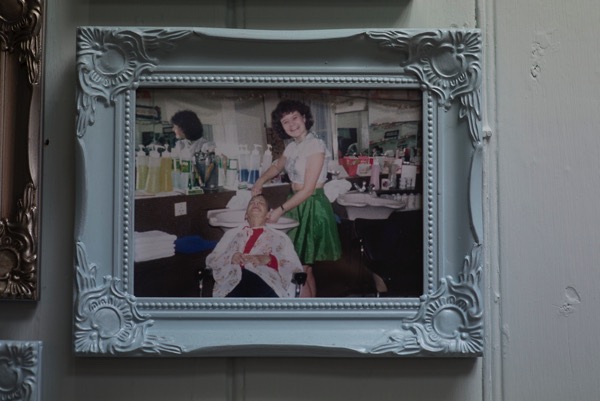
Marcia stands on the left and her mother sits in the centre at the salon in the eighties


Customers and coiffeuses in Clapton

Photographs copyright © Sarah Ainslie
Transcript by Simon Scott
Book your appointment at CLAPTON BEAUTY PARLOUR, 21 Lower Clapton Rd, Hackney, E5 0NS
You may also like to read about
Aaron Biber, London’s Oldest Barber
Street Life In London

In Brick Lane these days, almost everyone carries a camera to capture the street life, whether traders, buskers, street art or hipsters parading fancy outfits. At every corner in Spitalfields, people are snapping. Casual shutterbugs and professional photoshoots abound in a phantasmagoric frenzy of photographic activity.
It all began with photographer John Thomson in 1876 with his monthly magazine Street Life in London, publishing his pictures accompanied by pen portraits by Adolphe Smith as an early attempt to use photojournalism to record the lives of common people. I like to contemplate the set of Thomson’s lucid pictures preserved in the Bishopsgate Institute – both as an antidote to the surfeit of contemporary imagery, and to grant me a perspective on how the street life of London and its photographic manifestation has changed in the intervening years.
For centuries, this subject had been the preserve of popular prints of the Cries of London and, in his photography, Thomson adopted compositions and content that had become familiar archetypes in this tradition – like the chairmender, the sweep and the strawberry seller. Yet although Thomson composed his photographs to create picturesque images, in many cases the subjects themselves take possession of the pictures through the quality of their human presence, aided by Adolphe Smith’s astute texts underlining the harsh social reality of their existence.
When I look at these pictures, I am always startled by the power of the gaze of those who look straight at the lens and connect with us directly, while there is a plangent sadness to those with eyes cast down in subservience, holding an internal focus and lost in time. The instant can be one of frozen enactment, like the billboard men above, demonstrating what they do for the camera, but more interesting to me are the equivocal moments, like the dealer in fancy ware, the porters at Covent Garden and the strawberry seller, where there is human exposure. There is an unresolved tension in these pictures and, even as the camera records a moment of hiatus, we know it is an interruption before a drama resumes – the lost life of more than one hundred and thirty years ago.
The paradoxical achievement of these early street photographs is they convey a sense that the city eludes the camera, because either we are witnessing a tableau that has been composed or there is simply too much activity to be crammed into the frame. As a consequence it is sometimes the “wild” elements beyond the control of the photographer which render these pictures so fascinating – the restless children and disinterested bystanders, among others.
I long to go beyond the bounds of these photographs, both in time and space. And reading Adolphe Smith’s pen portraits, I want to know all these people, because in their photographs they appear monumental in their dignified stillness – as if their phlegmatic attitudes manifest a strength of character and stoicism in the face of a life of hard work.

Street Doctor – “vendors of pills, potions and quack nostrums are not quite so numerous as they were in former days. The increasing number of free hospitals where the poor may consult qualified physicians have tended to sweep this class of street-folks from the thoroughfares of London.”

An Old Clothes Shop, St Giles – “As a rule, secondhand clothes shops are far from distinguished in their cleanliness, and are often the fruitful medium for the propagation of fever, smallpox &c.”

Caney the Clown – “thousands remember how he delighted them with his string of sausages at the yearly pantomime, but Caney has cut his last caper since his exertions to please at Stepney Fair caused the bursting of a varicose vein in his leg and, although his careworn face fails to reflect his natural joviality, the mending of chairs brings him constant employment.”

Dealer in Fancy Ware (termed swag selling) – “it’s not so much the imitation jewels the women are after, it’s the class of jewels that make the imitation lady.”

William Hampton of the London Nomades – “Why what do I want with education? Any chaps of my acquaintance that knows how to write and count proper ain’t much to be trusted into the bargain.”

The Temperance Sweep – “to his newly acquired sobriety, monetary prosperity soon ensued and he is well known throughout the neighbourhood, where he advocates the cause of total abstinence..”

The Water Cart – “my mate, in the same employ, and me, pay a half-a-crown each for one room, washing and cooking. It costs me about twelve shillings a week for my living and the rest I must save, I have laid aside eight pounds this past twelve months.”

Survivors of Street Floods in Lambeth – “As for myself, I have never felt right since that awful night when, with my little girl, I sat above the water on my bed until the tide went down.”

The Independent Bootblack – “the independent bootblack must always carry his box on his shoulders and only put it down when he has secured a customer.”

Itinerant Photographer on Clapham Common – “Many have been tradesmen or owned studios in town but after misfortunes in business or reckless dissipations are reduced to their present more humble avocation.”

Public Disinfectors – “They receive sixpence an hour for disinfecting houses and removing contaminated clothing and furniture, and these are such busy times that they often work twelve hours a day.”

Flying Dustmen – “they obtained their cognomen from their habit of flying from from one district to another. When in danger of collison with an inspector of nuisances, they adroitly change the scene of their labours.”

Cheap Fish of St Giles – ” Little Mic-Mac Gosling, as the boy with the pitcher is familiarly called by all his extended circle of friends and acquaintances, is seventeen years old, though he only reaches to the height of three feet ten inches. His bare feet are not necessarily symptoms of poverty, for as a sailor during a long voyage to South Africa he learnt to dispense with boots while on deck.”

Strawberries, All Ripe! All Ripe! – “Strawberries ain’t like marbles that stand chuckin’ about. They won’t hardly bear to be looked at. When I’ve got to my last dozen baskets, they must be worked off for wot they will fetch. They gets soft and only wants mixin’ with sugar to make jam.”

The Wall-Workers (A system of cheap advertising whereby a wall is covered with an array of placards that are hung up in the morning and taken in at night) – Business, sir! Don’t talk to us of business! It’s going clean away from us.”

Cast-Iron Billy – “forty-three years on the road and more, and but for my rheumatics, I feel almost as hale and hearty as any man could wish .”

Labourers at Covent Garden Market – “it is in the early morning that they congregate in this spot, and they are soon scattered to all parts of the metropolis, laden with plants of every description.”

The London Boardmen – “If they walk on the pavement, the police indignantly throw them off into the gutter, where they become entangled in the wheels of carriages, and where cabs and omnibuses are ruthlessly driven against them.”

Workers on the Silent Highway – “their former prestige has disappeared, the silent highway they navigate is no longer the main thoroughfare of London life and commerce, the smooth pavements of the streets have successfully competed with the placid current of the Thames.”

Old Furniture Seller in Holborn – “As a rule, second-hand furniture men take a hard and uncharitable view of humanity. They are accustomed to the scenes of misery, and the drunkenness and vice, that has led up to the seizure of the furniture that becomes their stock.”

Mush-Fakers and Ginger-Beer Makers. – “the real mush-fakers are men who not only sell but mend umbrellas. By taking the good bits from one old “mushroom” and adding it to another, he is able to make, out of two broken and torn umbrellas, a tolerably stout and serviceable gingham.”

Italian Street Musicans -“there is an element of romance about the swarthy Italian youth to which the English poor cannot aspire.”

A Convicts’ Home – “it is to be regretted that the accompanying photograph does not include one of the released prisoners, but the publication of their portraits might have interfered with their chances of getting employment.”

The Street Locksmith – “there are several devoted to this business along the Whitechapel Rd, and each possesses a sufficient number of keys to open almost every lock in London.”

The Seller of Shellfish – “me and my missus are here at this corner with the barrow in all weathers, ‘specially the missus, as I takes odd jobs beating carpets, cleaning windows, and working round the public houses with my goods. So the old gal has most of the weather to herself.”

The “Crawlers” – “old women reduced by vice and poverty to that degree of wretchedness which destroys even the energy to beg.”
Images courtesy Bishopsgate Institute
Read the story of Hookey Alf of Whitechapel from Thomson’s Street Life in London
George Cruikshank’s Almanack, 1835
In 1835, George Cruikshank drew these illustrations of the notable seasons and festivals of the year in London for The Comic Almanack published by Charles Tilt of Fleet St and produced from 1835 – 53. Distinguished literary contributors included William Makepeace Thackeray and Henry Mayhew, but I especially enjoy George Cruikshank’s drawings for their detailed observation of the teeming street life of the capital. (Click on any of these images to enlarge)

JANUARY – Everybody freezes

FEBRUARY – Valentine’s Day

MARCH – March winds

APRIL – April showers

MAY – Sweeps on May Day

JUNE – At the Royal Academy

JULY – At Vauxhall Gardens

AUGUST – Oyster day

SEPTEMBER – Bartholomew Fair

OCTOBER – Return to Town

NOVEMBER – Penny for the Guy

DECEMBER – Christmas
You may also enjoy
George Cruikshank’s Comic Alphabet


