
John Claridge’s Moments Of Connection
Join me tonight, Wednesday 1st June for the EXHIBITION OPENING of John Claridge’s EAST END photography from 6pm at VOUT-O-RENEES, 30 Prescot St, Aldgate, E1 8BB. (Exhibition runs until 21st July)
Tomorrow, Thursday 2nd June is the LAUNCH PARTY for John Claridge’s EAST END book from 6pm upstairs at THE FRENCH HOUSE, 49 Dean St, Soho, W1D 5BG.
This Friday 3rd June, John Claridge is talking about his EAST END photography with Stefan Dickers at 7pm at WATERSTONES PICCADILLY, W1J 9HD. Email piccadilly@waterstones.com to reserve your free ticket.

Self-Portrait with Keith (standing behind with cigarette), E7 (1961).
“We still meet up for a drink and put the world to rights.”
Here is the young photographer John Claridge at seventeen years of age in 1961, resplendent in a blue suede jacket from Carnaby St worn with a polo neck sweater and pair of Levis, and bearing more than a passing resemblance to the character played by David Hemmings in ‘Blow-Up’ five years later.
On the evidence of this set of photographs alone it is apparent that John loves people, because each picture is the outcome of spending time with someone and records the tender moment of connection that resulted. Every portrait repays attention, since on closer examination each one deepens into a complex range of emotions. In particularly intimate examples – such as Mr Scanlan 1966 and the cheeky lady of 1982 – the human soul before John’s lens appears to shimmer like a candle flame in a haze of emotionalism. The affection that he shows for these people, as one who grew up among them in the East End, colours John’s pictures with genuine sentiment.
Even in those instances – such as the knife grinder in 1963 and the lady on the box in Spitalfields 1966 – in which the picture records a momentary encounter and the subjects retain a distance from the lens, presenting themselves with a self-effacing dignity, there is an additional tinge of emotionalism. In other pictures – such as the dance poster of 1964 and the windows in E1 of 1966 – John set out to focus on the urban landscape and the human subjects created the photographic moment that he cherished by walking into the frame unexpectedly. From another perspective, seeing the picture of the mannequin in the window, we share John’s emotional double-take on discovering that the female nude which drew his eager gaze is, in fact, a shop dummy.
For John, these photographs are not images of loss but moments of delight, savouring times well spent. If it were not for photography, John might only have flickering memories of the East End in his youth, yet these pictures capture the people that drew his eye and those that he loved half a century ago, fixing their images eternally.

Across the Street, E1 (1982) – “I did a double-take when I first saw this. In fact, it was a mannequin in the window. Still looked good.”

School Cap, Spitalfields (1963) – “I just found this surreal. It was as if the man behind was berating a nine-year-old who couldn’t care less.”

Two Friends, Spitalfields (1968) – “They were walking along sharing one piece of bread.”

The Box, Spitalfields(1960) – “I came across this lady sitting on an orange box, there was nothing else around. Then she got up and walked off with her box.”

Labour Exchange, E13 (1963) – “Never an uncommon sight.”

Ex-Middleweight Boxer, Cable St (1960) – “We were talking about boxing when he just gave me the thumps-up.”

Knife Grinder, E13 (1966) – “Every few weeks he would appear at the end of the street. Quite a cross-section of people had their knives sharpened!”

Mr Scanlon, E13 (1966) – “My next door neighbour. Always with a wicked sense of humour and an equally wicked smile.”

The Doorway, E2 (1962) – “To this day I would still like to know where her thoughts were.”

Crane Driver, E16 (1975) – “He could balance a crushed car on half a crown and still give you change.”

59 Club, E9 (1973) – “The noise of the pinball machines with the sound of the jukebox playing Jerry Lee.”

A 7/6 Jacket, E13 (1969) – “He had a small shed where he sold anything he could find, which he collected in a small handcart.”

A Portrait, E1 (1982) – “This special lady asked me ‘Why do you want to photo me?’ I replied ‘Because you look cheeky.’ This is the picture.”

Scrap Dealer, E16 (1975) – “This was shot in Canning Town, near the Terry Lawless boxing gym.”

The Step, Spitalfields (1963) – “A kid at play.”

Dance Poster, E2 (1964) – “I was taking a picture of the distressed posters when he glided past.”

The Windows, Spitalfields (1960) – “Behind every window.”

My Mum & Dad, Plaistow (1964) – “Taken in the backyard.”

Fallen Angel, E7 (1960) – “There were a lot of fallen angels in the East End.”
Photographs copyright © John Claridge

CLICK HERE TO ORDER YOUR COPY OF EAST END FOR £25
John Claridge’s East End Landscapes
Join me tomorrow, Wednesday 1st June, for the opening of the exhibition of John Claridge’s EAST END photography from 6pm at VOUT-O-RENEES, 30 Prescot St, Aldgate, E1 8BB. (Exhibition runs until 21st July)
This Thursday 2nd June, there is a book launch party for John Claridge’s EAST END from 6pm upstairs at THE FRENCH HOUSE, 49 Dean St, Soho, W1D 5BG.
On Friday 3rd June, John Claridge is talking about his EAST END photography with Stefan Dickers at 7pm at WATERSTONES PICCADILLY, W1J 9HD. Email piccadilly@waterstones.com to reserve your free ticket.

My Backyard, E.13 (1961) by John Claridge
“My bedroom and darkroom. What more could you want? Somewhere to get your head down. Somewhere to get your print down.”
When William Wordsworth was growing up, he had an overwhelming epiphany of the power of the landscape while out in a boat upon Grasmere beneath a starry sky, and photographer John Claridge had an equally influential experience at a similar age – in a very different kind of environment – while out on a night’s ratting expedition at a piggery next to the London Docks. “There was the glow of the lights of the dock, but all around us were vast expanses of darkness,” he told me in his excitement at recalling the wonder of the East End during his childhood in the nineteen-fifties, in the days before the halogen glow which obscures the stars today.
“It was a different kind of landscape – without fields – but it was a landscape I loved, the landscape I grew up with,” John confessed, remembering the acres of bombsites and craters, wasteland and allotments that he once knew, and which he recorded in these pictures. “When I was fifteen, I was interested in motorbikes, girls and photography, though I couldn’t say in what order,” he admitted to me with a laugh.
There is a certain cast of occluded light shared by many of these photographs that is partly the result of the London smog of that era, partly mist off the river and partly the light of the early morning when John delighted to explore the East End. “I’m still an early riser, from the days of getting up at five to do my paper round.” he explained, “I’d have breakfast with my dad and listen to his stories – that was my education – then I’d cycle around in the dawn delivering papers before school each morning. You always expected something to happen, but you had to let it happen – that was part of the excitement of seeing something that you weren’t expecting to see, and then you wanted to share it.”
In the post-war East End, prior to redevelopment, the open spaces created a landscape of possibility where nature thrived, where anyone could have an allotment, and where John liked to go scrambling on his motorbike. It was a landscape that offered emotional freedom and creative space to John, who as a fan of Dan Dare and Flash Gordon, was off on his own imaginative journey.
Ultimately, it was John’s talent that took the young photographer on a journey far from his native landscape, giving him a career filled with globe-trotting assignments. Today these early pictures record a place that no longer exists except as a personal landscape of memory. They show how the first landscape that met John’s eyes became the landscape upon which his vision as a photographer was shaped. And it is an epic landscape.

East End Blossom, E.1 (1960). “Blossom on a bomb site.”

Canning Town Bridge in the Fog, E.16 (1965). “Shot from my motorbike (Triton) – stopped, of course.”

Sewer Bank Rd, E.13 (1964). “My house was just over the fence to the right.”

Ford & Vauxhall, E.15 (1960). “Turner Prize?”

Clearing a Bomb Site, E.13 (1961). “The next street to where I lived.”

Iron Bridge, E.16 (1964). “An iron bridge across the railway line, not far from the docks.”

The East End Horse, Allen Gardens, Spitalfields (1972). “The horse takes a break from the harness of a dray cart.”

Smoke, E.16 (1963). “Winter’s morning looking towards Canning Town. I used to take my old scrambler motorbike and ride the bomb craters there.”
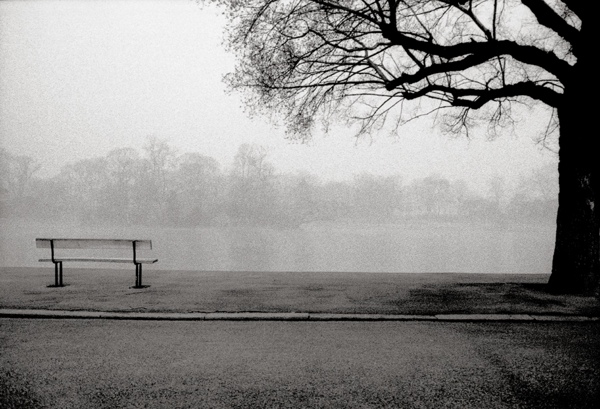
Vicky Park, E.3 (1962). “Where I used to take the occasional girlfriend.”

Canal, E.3 (1968). “Early morning, grey day but full of expectation.”

After the Rain, E.16 (1982). “That beautiful smell after everything’s had a good wash.”

Scrap Yard, E.16 (1982). “Sometimes it got muddy.”

The Path, E.7 (1960). “Neglected cemetery, always so quiet.”

Allotments, E.6 (1963). ” This area always had a strange presence, a symbiosis between industrial and natural.”

The Small Creek, E.3 (1987). Daybreak.

Along the Track, E.16 (1973). “Shot from a parapet, early morning above the rail-track. I wanted a bit of height.”

Rooftops, E.3 (1982). “There was always a great man-made sculpture around, not to every one’s taste but I liked it.”

Slag Heaps, E.6 (1963). “This area seemed to always have a greyness that sat in the sky.”

Spillers, E.16 (1987). ” I loved these buildings, it was like walking into an early sci-fi movie.”
Photographs copyright © John Claridge
Some Diversions By John Claridge
The first of five features celebrating the publication of John Claridge’s EAST END this week

The Daily Message in E3, 1972
Taken between 1959 and 1982, each one of these East End pictures by John Claridge contains a diversion of some kind – either illustrating an activity that is incidental to the flow of life or presenting an observation that is itself a distraction. “These are small incidents, humdrum diversions like going to the hairdresser or the baths, not shattering moments but part of the life of the community all the same,” he assured me. Yet although these sly visual anecdotes may refer to marginal or quotidian experiences, they can sometimes reveal as much or more about the texture and tenor of their times than any news photo of the day.
John collected his observations of life out of a fascination to explore the strange poetry of existence, revealing his interest in reflections upon images seen through glass, his passion for lettering and design, and especially his delight in people. He takes pleasure in observing how they inhabit a place, and how they show their creativity when they strive to make themselves at home, even in the most unlikely or inopportune of circumstances.

Bridalwear shop, Spitalfields 1966. “Wherever you went at that time, there was always a bridal shop.”

Twenty past one? Spitalfields 1967. “You couldn’t design it better!”

American wrestler and trainer, Walthamstow Town Hall 1982. “They asked me to take the picture.”

Barbers, Spitalfields 1964. (note spelling of ‘closing’)

Accordion player, Spitalfields, 1970. “He was playing under an arch and the sound drifted around, it was wonderful.”

Corsetiere, Whitechapel 1961. “A man came up to me while I was doing this and asked, ‘What are you doing?’ ‘I’m taking a picture,’ I said. ‘There’s something wrong with you, lad,’ he replied.”

East Ham baths, E6 1961. “After Saturday morning football, we always went to East Ham baths to have a bath.”

Football in the street, Spitalfields 1959.

Sweet kiosk, Spitalfields 1967. “See my reflection in this picture. She was so proud. Afterwards, she and her friends came out to be photographed.”

Snack bar – cold drinks, Spitalfields 1982.

Boy on a rocking horse, E2 1982. “Look at the conditions he’s living in. The bars look like a prison and he’s got nowhere to go.”

At the 59 bikers’ club, E9 1973. Founded by Father William Shergold, biker priest, in 1959 to bring mods and rockers together.

Lady on the balcony, Spitalfields 1962. “Her diversion for the day was standing there and watching the world go by.”

Windmill seller, E2 1961.

Washing day, E14 1961. “I just came out of my girlfriend’s house and she said, ‘Look, it’s washday across the road.'”

Man with jobs poster, Spitalfields 1963. “I asked him, ‘Are you alright for a couple of bob?’ and he sat in the sun for me for a moment.”

Ear piercing, Spitalfields 1964. Is this ear piercing done to people over five years of age, or has the jeweller been piercing ears since five years of age?

Hotdog van, Spitalfields 1961.

Cup of tea, Spitalfields 1964. “Settled onto this old sofa in the market, enjoying his cup of tea, he looks like he should be wearing an eighteenth century wig and coat.”
Photographs copyright © John Claridge
CLICK HERE TO ORDER YOUR COPY OF EAST END FOR £25
The Departure Of Richard Lee

Richard Lee
You need to be at Sclater St Market at dawn when the sunlight arrives horizontally from the east, and traders greet you and bid you good morning like one of their own. At six o’clock, I was awaiting the arrival of Richard Lee whose grandfather Henry William Lee started trading bicycles in this market in the eighteen-eighties, initiating a tradition continued through two world wars by his son Henry George Lee, and culminating in Richard Lee who has been here every Sunday for over sixty years. Yet now the time has come for Richard’s departure from Sclater St and I was there to record his final Sunday, after one hundred and thirty years of his family trading in bicycles and bicycle parts in the market.
In this time, three generations of Lees have seen the street change beyond all recognition and Richard now parks his van at the foot of a tower block, built upon a former bomb site where nineteenth century terraces once stood. In fact, as he set to work with stoic good humour, unpacking his battered van and assembling the stall – in recognition of his responsibility as custodian of the history of the market – Richard passed me some black and white photographs, showing the heaving market crowds of yesteryear enfolded by rows of small shops and proud Victorian pubs. Most remarkably, Richard’s father and grandfather are visible to the left of one of the pictures beside a stall hung with tyres and inner tubes which looks just as it does today.
Richard has been down here each Sunday since he was five years old and began working in the stall at thirteen. Now over seventy and of robust stature, he can still assemble his stall by slotting metal poles together with limber ease, informing me with satisfaction that this particular incarnation was manufactured to his specification fifty years ago at the cost of fifty pounds. ‘We used to wheel a barrow from Islington and my father pushed a bicycle and carried another over his shoulder,’ he admitted, recalling the arduous labour of former times.
Once the stalls were in place yet before the stock was unpacked, Richard Green and Clive Brown, stallholders at the western end of the market, convened with Richard over a cup of tea made from water boiled on a primus stove and Richard broke the news that he had sold his house in Essex and cancelled the debit for his weekly market licence. Only if the exchange of contracts upon his house did not go ahead would he return for another week. ‘My kids have flown and I can’t afford to keep a four bedroom house,’ he confessed in sober realism, ‘You can’t live on a pension anymore.’ Richard’s solution is to return to the north of England – whence his grandfather came to London in the nineteenth century – and buy a small house, leaving him enough money to live out his days.
Yet, before this could happen, another day’s trading awaited. Richard’s assistant ‘Steady Eddie’ arrived to hang up the tyres and inner tubes that are the long-recognised symbol and sign of the Lees’ stall, thereby completing the four hour process of setting up. Through the passage of the day, Richard stood at the front while Eddie sat at the rear undertaking repairs and their dialogue consisted of ‘Eddie, got a left-handed pedal?’ and ‘Richard, got a new inner tube?’ Recycled inner tubes repaired by Richard were priced at only one-pound-fifty compared to five pounds for a new one, yet customers could not resist offering just a pound. And when Richard fitted that left-handed pedal, the customer offered him five pounds, refused the ten pound charge asked for both the replacement pedal and the service. ‘I’ll take it off again!’ threatened Richard rolling his eyes, ‘I can’t do it for £5,’ – before he let it go for five pounds. ‘You see why I’m leaving,’ he confided to me in a whisper, catching my eye in weary resignation. ‘I like it when they offer you more than you ask,’ he added with a grin, summoning his humour again, ‘that doesn’t happen very often.’
‘When I was a kid down the waste, there’d be a rag and bone man who left stuff behind and, when he’d gone, I used to sell it,’ Richard continued, warming at the tender reminiscence. He cast his eyes to the left of his stall where he had spread out boxes of his grown-up children’s unwanted toys, cleared out in anticipation of his house sale, yet drawing a lot of interest in the market. ‘It’s a lot of old junk,’ he confessed apologetically, ‘it’s all stuff I’d throw away, but there’s more money in it than the proper stuff.’
The weather was kind for Richard’s last day of trading and a spell of unbroken sunshine brought out large crowds onto Brick Lane and into Sclater St but, by three o’clock as he started to pack up, dark clouds were gathering over Spitalfields. I asked Eddie what he would do without Richard. ‘I’m not a lazy man, I’m going to volunteer at a charity shop,’ he explained, ‘It’s Monday to Friday and there’s no lifting. I came to this country in 1978 but after thirty-five years working for British Rail, my back is gone.’
Old friends and regular customers came to pay their respects to Richard as the descending sun reached the western end of Sclater St. All appeared as usual, everyone packing up as they do each week at that time, yet Richard was packing up for ever. Unknown to all but a few that afternoon, something remarkable was passing into history.
Robert Green helped Richard carry his boxes to the van and told me he would wait until he was ready to go. Leaving them to their task, I paid my respects to Richard, shook hands and handed him the bottle of champagne I had secreted in my bag. But as I turned to go, he called me back. Richard brought out a spanner which had belonged to his grandfather, was used by his father and served Richard too. In use in this place all this time. After more than a century, it had become bent into a subtle curve that fitted the hand. Richard held up his cherished talisman to show me, glowing with pride and delight.
To my mind, the meaning of Sclater St as a place will always be bound up with the human qualities of Richard Lee and his fellow market stalwarts. Whatever architectural changes arrive in this contested site, I shall never be able to walk through Sclater St without thinking of Richard and the hardworking endeavours of his colleagues and their forebears, week after week, in all weathers and through centuries.

Henry George Lee (as a boy) is to be seen on the extreme left of this photo and his father Henry William (with hat and moustache) is the fifth from the left in this picture taken in the twenties

Unpacking the van at 6am


Tossing a tyre

‘Steady Eddie’ arrives to lend a helping hand


“I first came down here when I was five and I was thirteen when I started working on the stall.”

Clive Brown, stallholder opposite Richard Lee, shows off a case of vintage Leica cameras

Patricia & Robert Green, stallholders next to Richard Lee


Clive serenades the market, mid-afternoon

Richard with Gary Aspey, wheel truer

Packing up at 5pm


Packing the van at 6pm

Richard shows off his grandfather’s spanner ‘King Dick’- in use in this market by three generations over more than a century

Henry Wiliam Lee started trading in the market in the eighteen-eighties


Henry George Lee shows the proper way to fold a bicycle tyre in the Daily Mirror, 1979 (Click image to enlarge)

Richard Lee meets Edward Heath in the seventies

Richard Lee’s account of his family history

Richard Lee with Robert Green, old friend and long-term holder of the next pitch in Sclater St, celebrating the culmination of 130 years of the Lee family trading in the market
You might also like to read about
Sammy Fisher Of Old Montague St
Wednesday 1st June : EXHIBITION OPENING of John Claridge’s EAST END photography from 6pm at VOUT-O-RENEES, 30 Prescot St, Aldgate, E1 8BB. (Exhibition runs until 21st July)
Thursday 2nd June : BOOK LAUNCH PARTY for John Claridge’s EAST END from 6pm upstairs at THE FRENCH HOUSE, 49 Dean St, Soho, W1D 5BG.
Friday 3rd June : JOHN CLARIDGE IN CONVERSATION talking about his EAST END photography with Stefan Dickers at 7pm at WATERSTONES PICCADILLY, W1J 9HD. Emailpiccadilly@waterstones.com to reserve your free ticket.

I took an advance copy of John Claridge’s EAST END over to show my pal Paul Gardner, fourth generation proprietor of Gardners’ Market Sundriesmen in Commercial St, and he laughed when he opened the book and saw the first double page spread. Paul recognised the shopkeeper in John Claridge’s photograph as Sammy Fisher, standing in the doorway of his grocer’s shop in Old Montague St in 1961.
“That’s Sammy Fishoff,” Paul declared in fond recognition of an old friend, “He changed his name to Fisher because people teased him, saying ‘Piss off Fishoff!'”
“He used to buy his bags off me for his grocery shop and he was very sharp – if there was only 499 in a pack of 500 he’d spot it like that.
Sammy came to my wedding in 1982 and brought me a ceramic horse and cart. When I knew him, after his wife died, he came in my shop everyday and sat down and gave me advice on how to run the business. I’d give him faulty paper carrier bags and he’d stand in Petticoat Lane and sell them for 5p. He used to say, ‘Just because you buy it as a bargain, doesn’t mean you’ve got to sell it as a bargain.’
I think of Sammy in his red cap and with his trousers hitched up high. I didn’t know if he had any family, but when he died of a hernia in 1985, I went to his funeral and there weren’t many people there, until some relatives turned up from Manchester in a Rolls Royce. He always said, ‘I’ve got money! I’m going to leave you something in my will because you’ve been so good to me’ which was extraordinary because he was such a curmudgeon. In fact, he did leave me some money in his will – but it was less than he owed me!”
Paul Gardner’s recognition left me excited in anticipation of how many others we shall be able to identify in John Claridge’s pictures when his book is published next week.

Click image to enlarge
We are giving away 500 beautiful posters of John Claridge’s photograph of Sammy Fisher’s Grocery Shop from EAST END – you can pick one up free from Paul Gardner at Gardners Market Sundriesmen, 149 Commercial St, E1 and we shall be handing them out at The French House and Waterstones Piccadilly next week.
CLICK HERE TO ORDER YOUR COPY OF EAST END FOR £25
Morley Von Sternberg At 19 Princelet St
The old synagogue in Princelet St is one of Spitalfields’ most atmospheric and mysterious spaces, so I was thrilled when Architectural Photographer Morley Von Sternberg agreed to take these pictures for Spitalfields Life. The project was a natural one for Morley who was born in Whitechapel, and whose great-grandfather arrived from Minsk in 1878 and ran greengrocer’s shop on Brick Lane just around the corner from the synagogue.
Built by Samuel Worrall in 1719, 19 Princelet St was at first the home of the Ogier family, Huguenot refugees from France who established themselves as silk weavers in Spitalfields. Subsequently, the house became home to Irish and Polish immigrants before a synagogue was built in the garden in 1869.
David Rodinsky, caretaker of the synagogue, lived in a single room on the upper floor which he left in 1969 never to return, and Rachel Lichtenstein & Iain Sinclair’s Rodinsky’s Room explores the enigma of his disappearance.
You can visit 19 Princelet St on June 7th, 11th, 14th, 18th, 21st & 25th as part of A SPITALFIELDS JOURNEY, comprising a joint ticket for Dennis Severs House and the Museum of Immigration. Click here for tickets


Photographs copyright © Morley Von Sternberg
You may also like to read about
Dick Turpin, Butcher & Highwayman

Dick Turpin upon Black Bess
There is a story that Dick Turpin was apprenticed as a butcher in Whitechapel, and – whatever the truth of it – he returned consistently to this area of East London. There are further stories connecting him to the Red Lion in Whitechapel and the Nag’s Head in the Hackney Rd. Yet, as one who led an elusive transitory criminal existence and who achieved fame only after his death, the actuality of Dick Turpin’s life remains uncertain, overshadowed by the vivid fictions that were contrived later.
Richard Bayes, landlord of the Green Man in Leytonstone, was author of one of the earliest accounts, published in 1739 shortly after Turpin’s execution in York.“He was placed apprentice to a Butcher in White-chaple, where he served his Time, he was frequently guilty of Misdemeanours, and behaved in a loose disorderly Manner…” wrote Bayes, emphasising the authenticity of his narrative by taking a role in it himself. After a horse theft near Waltham Forest in 1736, Bayes tracked the stolen animal to the Red Lion Inn in Whitechapel and was attempting to retrieve it from Turpin’s accomplice Tom King when Turpin himself appeared in Red Lion St, a thoroughfare later subsumed into Commercial St.
“Turpin, who was waiting not far off on horseback, hearing a skirmish came up, when King cried out, ‘Dick, shoot him, or we are taken by God,’ at which instant Turpin fired his pistol, and it missed Mr. Bayes, and shot King in two places, who cried out, ‘Dick, you have killed me,’ which Turpin hearing, he rode away as hard as he could. King fell at the shot, though he lived a Week after, and gave Turpin the character of a coward…”
Yet it was primarily due to Harrison Ainsworth and his illustrator George Cruikshank in the novel “Rookwood” of 1834 that the story of the butcher-turned-brutal-petty-thief from Essex was transformed into the myth of Dick Turpin – the swashbuckling highwayman who stole from the rich and gave to the poor while charming the ladies with his valour and flamboyant style.
A century after Turpin’s death, highway robbery ceased to be a threat in this country, permitting the possibility of a romantic fiction upon the subject. In constructing the myth we recognise today, Ainsworth invented the notion of the death-defying ride to York upon Black Bess to establish an alibi. He ignored the banal fact that Turpin had been operating in Yorkshire for over a year before he was arrested under the name of John Palmer for shooting a “tame fowl,” and his true identity discovered after his arrest only when a letter he signed was recognised in the mail.
Born in Essex in 1705, Richard Turpin set up his own butchery business in Waltham and when trade was slow, he took to poaching venison in Epping Forest and became drawn into robbery as a member of the Gregory Brothers’ Essex Gang – one of many criminal gangs that existed on the margins of large cities when times were hard and law enforcement ineffectual.
Far from being the “gentleman” as Ainsworth characterised him, Turpin was capable of savage violence to achieve his desired ends, which this account from Read’s Weekly Journal of February 1735 reveals – “On Saturday night last, about seven o’clock, five rogues entered the house of the Widow Shelley at Loughton in Essex, having pistols &c. and threatened to murder the old lady, if she would not tell them where her money lay, which she obstinately refusing for some time. They threatened to lay her across the fire, if she did not instantly tell them, which she would not do. But her son being in the room, and threatened to be murdered, cried out, he would tell them, if they would not murder his mother, and did. Whereupon they went upstairs, and took near £100, a silver tankard, and other plate, and all manner of household goods.”
After the killing of Tom King, Turpin took refuge in Epping Forest where he shot one of the Forest-Keepers who tried to capture him, and the offer of a reward for his arrest for murder published in the Gentleman’s Magazine in June 1737 gives the only contemporary description – “Turpin was born at Thackſted in Eſſex, is about Thirty, by Trade a Butcher, about five Feet nine Inches high, brown Complexion, very much mark’d with the Small Pox, his Cheek-bones broad, his Face thinner towards the Bottom, his Viſage ſhort, pretty upright, and broad about the Shoulders.”
This account of the pock-marked broad-shoulder butcher does not quite match the devilishly handsome highwayman of popular lore, yet Turpin is recorded as meeting his death with remarkable courage. Sir George Cooke, Sheriff of Yorkshire, recalled that, “he behav’d himself with amazing assurance” at the execution and “bow’d to the spectators as he passed.” When it came to the moment and his head was in the noose,“he threw himself off the ladder and expired directly.” As the life of Dick Turpin ended, the legend of Dick Turpin was born.

Dick Turpin’s accomplice Tom King – shot in Commercial St.

Rescue of Lady Rookwood by Dick Turpin.

Dick Turpin & Tom King in the Arbour at Kiburn.

Dick Turpin’s flight through Edmonton.

Dick Turpin leaps the Hornsey Gate.

“I’ll let ’em see what I think of ’em!”

The death of Black Bess at the end of the ride to York.

Cover of a pamphlet published in York after Turpin’s execution.


Plates from “The Life of Richard Turpin” by Richard Bayes.

Title page of the life of Dick Turpin written by Richard Bayes, landlord of the Green Man in Leytonstone.

The opening page of Richard Bayes’account, placing Turpin as an apprentice butcher in Whitechapel.
 Richard Bayes’ account of his skirmish with Dick Turpin at the Red Lion in Whitechapel.

The former Nag’s Head opposite Hackney City Farm in the Hackney Rd. Dick Turpin was reputed to frequent an earlier coaching inn known as The Nag’s Head upon this site.
You may also like to read about


