
Mr Pussy In Midwinter
At Midwinter, I publish this favourite tale of my beloved old cat, Mr Pussy

It is Midwinter’s Day, and tonight – the longest night of the year – Mr Pussy will not stir from the chimney corner. Warmed by the fire of burning pallets, he has no need of whisky to bring him solace through the dark hours, instead he frazzles his brain in a heat-induced trance. Outside in the streets, Spitalfields may lie under snow, the paths may be coated in sheet ice and icicles may hang from the gutters, but this spectacle holds no interest for Mr Pussy. Like the cavemen of ancient times, his sole fascination is with the mesmerising dance of flames in the grate. And as the season descends towards its nadir in the plunging temperatures of the frozen byways, at home Mr Pussy falls into his own warm darkness of stupefaction.
Mr Pussy is getting old. The world is no longer new to him and his curiosity is ameliorated now by his love of sleeping. Once he was a brat in jet black, now he is a gentleman in a chenille velvet suit, and tufts of white hairs increasingly fleck his glossy pelt. Toward the end of summer, I noticed he was getting skinny, and then I discovered that his teeth have gone which meant he could no longer crunch the hard biscuits that were always his delight. Extraordinarily, he made little protest at his starvation diet, even as he lost weight through lack of food. Now I fill his dish with biscuits and top it up with water, so that he may satisfy his hunger by supping the resulting slush. And through this simple accommodation – plus a supplement of raw meat – his weight is restored to normal and he purrs in gratification while eating again.
Once Mr Pussy was a wild rover, ranging over the fields in Devon, disappearing for days on end and returning proudly with a dead rabbit in his mouth. Now he does not step beyond the end of the alley in Spitalfields and in these sub-zero temperatures only goes outside to do his necessary business. Sprinting up the stairs, and calling impatiently outside the door of the living room, he is ever eager to return to the fireside and warm his cold toes afterwards, sore from scraping at the frost in the vain attempt to dig a hole in the frozen earth. Like a visionary poet, Mr Pussy has acquired a vivid internal life to insulate himself against the rigours of the world and, in the absence of sunlight, the fire provides his imaginative refuge, engendering a sublime reverie of peace and physical ease.
Yet Mr Pussy still loves to fight. If he hears cats screeching in the yard, he will race from the house to join the fray unless I can shut the door first and prevent him. And even when he has been injured and comes back leaking blood from huge wounds, he appears quite unconcerned. Only two small notches in his ears exist as permanent evidence of this violent tendency, although today I regularly check his brow for tell-tale scratches and recently he has acquired some deep bloody furrows that have caused swelling around his eyes. But I cannot stop him going out, even though it is a matter of concern to me that – as he ages and his reflexes lessen – he might get blinded in a fight one day, losing one of his soulful golden eyes. Since he is blissfully unaware of this possibility, I must take consolation from his response when he could not eat, revealing that Mr Pussy has no expectations of life and consequently no fear of loss. His nature is to make his best accommodation to any exigency with grace.
And be assured, Mr Pussy can still leap up onto the kitchen counter in a single bound. He can still bring in a live mouse from the garden when he pleases and delightedly crunch its skull between his jaws on the bedroom floor. If I work late into the night, he will still cry and tug on the bed sheets to waken me in the early morning to see the falling snow. When the fancy seizes him, he can be as a sprightly as a kitten. Come the spring, he will be running up trees again, even if now – in the darkest depth of winter – he only wants to sleep by the fire.
Alone here in the old house in Spitalfields tonight, Mr Pussy is my sole companion, the perfect accomplice for a writer. When I take to my bed to keep warm while writing my stories, he is always there as the silent assistant, curled into a ball upon the sheepskin coverlet. As the years have gone by and Mr Pussy strays less from the house, I have grown accustomed to his constant presence. He has taught me that, rather than fear for his well-being, I need to embrace all the circumstances and seasons that life sends, just as he does.


You can read more about Mr Pussy here
More Of Sarah Ainslie’s Bingo Portraits
Ever since the bingo hall in the Hackney Rd was closed and sold by Mecca for redevelopment into luxury flats last year, a chartered bus has been departing most nights of the week to ferry the bingo stalwarts of Bethnal Green over to Camden Town. Contributing Photographer Sarah Ainslie & I loved our first trip to the bingo in such lively company so much that we could not resist going back again to meet more devotees of this compelling passtime and take their portraits.

Joyce Furness – “I’m eighty-seven and my grandaughter encouraged me to start playing bingo ten years ago because otherwise I don’t go out.”

Florence Anderson – “I’m eighty-one and I’ve been playing for sixty years. I used to go four times a week, it keeps your brain ticking over.”

Florence & Joyce – “It was brilliant at the hall in the Hackney Rd”

Patricia Rawlings – “I’m ninety-eight but I first started bingo at seventeen.”

Carmen Clarke – “I started coming to bingo with my mother twenty years ago.”

Pat Marr – “I’m ninety-one, I lost my son four years ago. I come here four nights a week because I’m not a stay-at-home-person. I don’t smoke, I don’t drink – what else is there to do?”

Susan Powell – “I’ve been coming to bingo for twenty years. You shouldn’t come here to win but, if you do, that’s a bonus.”

George Durant – “I used to go to the bingo hall in the Essex Rd and Wood Green before they closed, so now I come here.”

Mary Durant – “£300 was the most I ever won!”

George & Mary

Joyce & Florence -“We love our bingo”
Photographs copyright © Sarah Ainslie
You may also like to see the first set of
Sarah Ainslie’s Bingo Portraits

Luxury housing development proposed to replace the bingo hall in the Hackney Rd
Stephen Armstrong, Whitechapel Postman
Occasionally, people write correspondence addressed simply to “The Gentle Author, Spitalfields” and it is to the credit of the East End postal service that these letters arrive on my doormat. So today I return the favour with this interview of Whitechapel Postman, Stephen Armstrong, accompanied by a set of pictures from 2013 by Contributing Photographer Colin O’Brien whom we said farewell to this year.

Stephen Armstrong
Stephen Armstrong and I met in the early afternoon in Whitechapel, once the day’s round was done, and he ate mince pies with hot chocolate to revive his flagging spirits, after being awake since before dawn.
We were just across the road from sorting office which is only five minutes walk away from where he lives to the south and ten minutes walk from his round, which is to the north.
Steve spends a lot of time pounding the pavements of Whitechapel and it is unlikely that anyone knows the minutiae of these streets better than he. Reserved in manners yet resilient in spirit, Stephen has found his metier in delivering letters and becoming the spiritual guardian of his particular corner of the East End.
“I’ve been up since five this morning, that’s late for me! It gives me a little time to myself, to get ready and pootle around – because six o’ clock is when I start.
I always remember when I joined the Post Office, because it was the the day after the Poll Tax Riot, 1st April 1990. I got myself sacked from an oil refinery for edible oils for not working hard enough, then I did thirteen months training to be be a Dispensing Optician. That was all because I had mucked up my A Levels and was a general under-acheiver all round. Then I failed my Optician exams, so I needed a way out and the Post Office seemed like the ideal place to get my head together. It started as a temporary job but I’ve been here ever since.
I grew up in Dartford and worked in Dartford, until they more or less shut down the sorting office there. By then, I had met my wife Karen and moved to Whitechapel and I’d been trying to get a job in the Whitechapel Sorting Office for years. It was very difficult for me to get from Whitechapel to Dartford to start work at five in the morning, so they offered me the possibility of a transfer to Rochester. Eventually they said, ‘We might be able to transfer you to Whitechapel but you’ve said you don’t like going out doing deliveries.’ I said, ‘I don’t know because I’ve never tried it,’ and when I did it was a baptism of fire, but I absolutely loved it. That was just last year, 2012.
I like being outdoors and walking across the same piece of ground everyday, you see the changes that people in the city are normally cut off from, the flowers opening and leaves falling. You are in touch with time passing.
I walk five minutes from my home in Adelina Grove and kick off at Whitechapel Sorting Office at six each morning. The machine will have sorted everything from yesterday in order, there is a slot for every letterbox in the frame. Then it’s ‘walk sorted’ and you sort whatever mail has come in during the night – that’s about an hour’s work. At nine o’clock, it is breakfast time. You go off and have breakfast, by which time anything from the other East End districts will come in and we sort that.
Once you have got all your work, you make it into bundles with those elastic bands – the notorious ones that we drop all over the place. You pack your bag with the first bundle of work, it cannot be more than sixteen kilos. Some postmen have a trolley but I don’t, instead I have dropboxes where the rest of the mail is dropped off to me at each end of my area. Generally, it takes about two and a half to three hours walking to make my deliveries. There are lots of streets where no-one notices you, you become part of the street furniture. A few old ladies ask you to do this and that and I don’t mind. I’m not a friend, I’m an acquaintance – but I like to think I can be trusted.
I don’t mind the weather, though I can’t really handle the heat because you can’t take off any more than the minimum. I’ve got a collection of silly hats – a sou’wester for rain and a sunhat for summer. I love dogs though there are a couple who jump up to take the letters out of your hands but, if you are careful, you can save your fingers. I desperately try to make friends with all the dogs on my route. I had a dog of my own, Laika, for seven years and I miss her a lot, so I’m borrowing other people’s dogs briefly.
I think there’s going to be more post in future but it’ll be more parcels not letters. A lot more comes through mail order these days, but all business is done by emails so there’s fewer letters. It would be a sad thing if the regular post goes, yet nobody writes anymore they just send texts and emails. Even I don’t receive any mail anymore.”
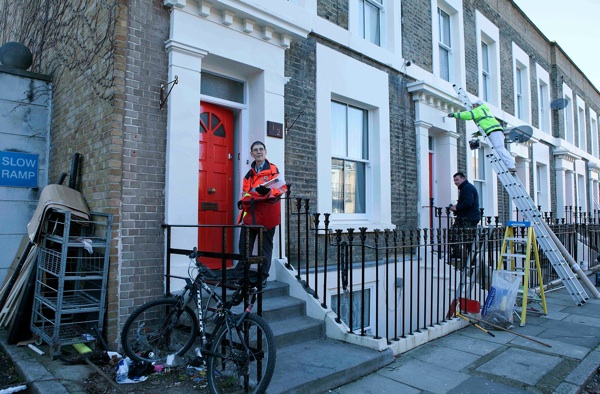


Steve delivers to Henrietta Keeper, Ballad Singer of Bethnal Green


Back to the drop box to pick up another load of letters

Off on the rounds again …

Bye!
Photographs copyright © Estate of Colin O’Brien
You may also like to read about
Spitalfields Market Parties Of Yesteryear

The van drivers of the Spitalfields Market certainly knew how to throw a party, as illustrated by this magnificent collection of photographs in the possession of George Bardwell who worked in the market from 1946 until the late seventies. George explained to me how the drivers saved up all year in a Christmas Club and hired Poplar Town Hall to stage shindigs for their families at this season. Everyone got togged up and tables overflowed with sponge cakes and jam tarts, there were presents for all and entertainments galore. Then, once the tables were cleared and the children safely despatched to their beds, it was time for some adult entertainment in the form of drinks and dancing until the early hours…


You may also like to take a look at
The Still & Star Is Saved!
Thanks in no small part to the hundreds of letters of objection written by you, the readers of Spitalfields Life, the Still & Star was saved from demolition this week when the City of London Corporation agreed to grant Asset of Community Value Status to this much-loved historic pub in Aldgate

Still & Star, 1 Little Somerset St, Aldgate
There is very little left of old Aldgate these days – though the Still & Star, just opposite the tube station yet hidden down Little Somerset St, is a rare survivor. This tiny pub on the corner of two alleys is believed to be unique in the City of London as the sole example of what is sometimes described as a ‘slum pub’ – in other words, a licensed premises converted from a private house.
Current landlord Michael Cox explained to me that the block once contained eight butcher’s shops which were all bought up by one owner, who opened the pub in 1820. Before it was renamed Little Somerset St, the passageway leading to the pub was ‘Harrow Alley’ but colloquially known as ‘Blood Alley.’ At that time, the City of London charged a tariff for driving cattle across the square mile and, consequently, a thriving butchery trade grew up in Aldgate and Whitechapel, slaughtering cattle before the carcasses were transported over to Smithfield.
There is no other ‘Still & Star’ anywhere else – the name is unique to this establishment – and Michael Cox told me the pub originally had its own still, which was housed in the hayloft above, while ‘star’ refers to the Star of David, witnessing the Jewish population of Aldgate in the nineteenth century.
All around us, pubs are being shut down and demolished yet, as regular readers will know, I have a particular affection for these undervalued institutions which I consider an integral part of our culture and history – necessary oases of civility in the chaos of the urban environment.

Still & Star, 1951 (Courtesy Heritage Assets/The National Brewery Centre)

Still & Star, 1968 (Courtesy Heritage Assets/The National Brewery Centre)

Still & Star today

Gustave Dore’s drawing of the Still & Star from ‘London: A Pilgrimage’

Still & Star by Gustave Dore, 1880, and as it is today – montage by Adam Tuck
“Let us pass down Harrow Alley, leading to the City Clothes Exchange. Harrow Alley is Petticoat Lane over again – smaller, and, if possible, dirtier than her neighbour. Bestriding the path, like a greasy Colossus, leaning against the wall, or squatting in the mud, are men and women by the score. Beside, behind, and before them, are spread out their miscellaneous wares, to which they supplicate your notice or imperatively demand your attention.
The various public-houses in Petticoat Lane, Harrow Alley, and elsewhere, are generally crammed to excess. Through the open doorways we look into the back rooms, where some dozen men are always smoking, their faces lost in the clouds of smoke which emanate from their lips. These men are known to the initiated as Petticoat Lane fencers, or receivers of stolen goods. Patiently they sit in these filthy rooms, waiting news from their scouts, who they throw out as antennae to ‘feel the way,’ or for the appearance of the thief’s confederate, who ‘gives the office,’ and tells where the booty may be found.”
from The Wild Tribes of London by Watts Philips, 1855

Butcher’s shop at the corner of Harrow Alley (known as Blood Alley) leading through to the Still & Star

Map of 1890 shows the Still & Star with nearby butcher’s shops and slaughterhouses

Charringtons’ record of the landlords (Courtesy Heritage Assets/The National Brewery Centre)

The office block that was proposed to replace The Still & Star
You may also like to read about
Geraldine Beskin, Witch
My friend Geraldine Beskin the Witch is hosting a celebration of SATURNALIA with live music from Cunning Folk and storytelling from Jo Clayton from 6:30pm tonight at the Atlantis Bookshop in Museum St, Bloomsbury, WC1. She described it to me as ‘a bit of festive fun with a twist.’ All welcome!

Geraldine Beskin presides as serenely as the Mona Lisa from behind her desk at the Atlantis Bookshop in Museum St, Bloomsbury – the oldest occult bookshop in the world, one of London’s unchanging landmarks and the pre-eminent supplier of esoteric literature to the great and the good, the sinister and the silly, since 1922. “My father came into the shop one day and Michael Houghton, a poet and a magician, who founded it and knew everyone from W.B.Yeats to Aleister Crowley, took a good look at him and said, ‘You’ll own this place one day,'” Geraldine told me, with a gentle smile that indicated a relaxed acceptance of this happy outcome as indicative of the natural order of things.
“I started working here when I was nineteen, and I’ve read a tremendous amount and I’ve done some of it – because you have to be a reader to be a good bookseller,” she said, casting her eyes around with proprietary affection at the sage green shelves lined with diverse and colourful books old and new, organised in alphabetical categories from angels and fairies, by way of magic and paganism, to werewolves and vampires.“This place was set up by magicians for magicians and that’s a tradition we continue today,” boasted Geraldine, who guards this treasure trove with her daughter Bali, the third generation in the book trade and a fourth generation occultist.
Yet in spite of the exoticism of her subject matter, Geraldine recognises the necessity for a certain rigour of approach.“There are New Age shops that sell dangly things and crystals, but we don’t, we’re a quality bookshop” she said, laying her cards boldly yet politely upon the table,”We are not faddist, we have an awareness of the contents of the books.” Working at her desk, sustained by copious amounts of tea, Geraldine is an enthusiastic custodian of a wide range of esoteric discourse upon matters spiritual. “The esoteric is an endless source of fascination,” she assured me, her eyes sparkling to speak of a lifetime’s passion,“There are so many facets to the esoteric that you need never run out of things to be amazed by.”
I am ashamed to confess that even though I pass it every time I walk to the West End, I never visited the Atlantis Bookshop before because – such is the nature of my credulity – I was too scared. But thanks to Simon Costin of the Museum of British Folklore who arranged my introduction to Geraldine, I made it across the threshold eventually, and once I was in conversation with Geraldine who admits to being a witch and practising witchcraft, although she prefers the term “occultist,” I discovered my fears were rootless. However, my ears pricked up at the innocent phrase, “I’ve done some of it,” which Geraldine dropped into the middle of her sentence quite naturally and so I enquired further, curious to learn more about the nature of “it.”
“My grandmother, me and my daughter all do it. My dad did it.” she declared, as if “it” was the most common thing in the world, “I come from a family of esoterics. I was born into it, so I think it would be immoral to own a shop like this and not appreciate what people are doing. Loosely it could be called witchcraft, but in reality it is a certain perception or background intuition.”
“Our subject has become very fashionable and young academics don’t have a bloody clue, which is very frustrating for us.” she continued, rolling her eyes at the inanity of humanity,“We try to disabuse people of the myths about witches, they are good kind people on the whole. Most witches are as mortgage-bound and dog-walking as everyone else. Most witches do healing, and buy toilet paper. And there is this side of trying to commune with nature and be aware of the cycle of change. It’s a very rich and rewarding way of life. I practise a bit of magic – there’s so much you can’t learn from books and you have to do it yourself.”
With her waist-length grey hair, deep eyes, and amusingly authoritative rhetorical style, Geraldine is an engaging woman of magnanimous spirit. And I cannot deny a certain vicarious excitement on my part, brightening a grim wintry morning to discover myself seated in this elegant empty bookshop in Bloomsbury in conversation with a genuine witch. Yet I was still curious about the nature of “it.” So I asked again.
“Witchcraft is a very benign religion, where you work around the seasons of the year,” explained Geraldine patiently, in a pleasant measured tone, “You start off in darkness, and, in Mid-Summer, the Holly King and the Corn King have a fight and the Holly King wins and then the light begins to decline. At Yule, they fight again and the Corn King wins and the light begins to come back to the world. In agrarian societies, people got up at dawn and worked until dusk, and they adjusted how they lived by the seasons. It was the Christians who gave us the devil and we don’t know what to do with him. We have a horned god who is the god of positive male energy – not a devil at all, but the poor soul has been demonized over the years.”
Geraldine convinced me that esoteric cultures from the ancient world remain vibrant, by reminding me that witches were always “green,” ahead of their time in ecological awareness, and – although she could not disclose names – by revealing that top celebrities, from princes to pop-stars, have always frequented the Atlantis Bookshop. “We make a play of only giving out the names of our famous dead customers,” she confided to me with a tantalising smirk. “Most of our customers are practitioners – witchcraft has become the default teenage rebellion religion today,” she added with an ambivalent grin, confirming that, in spite of everything, the future looks bright for witches.
[youtube g-jge7oUWAI nolink]

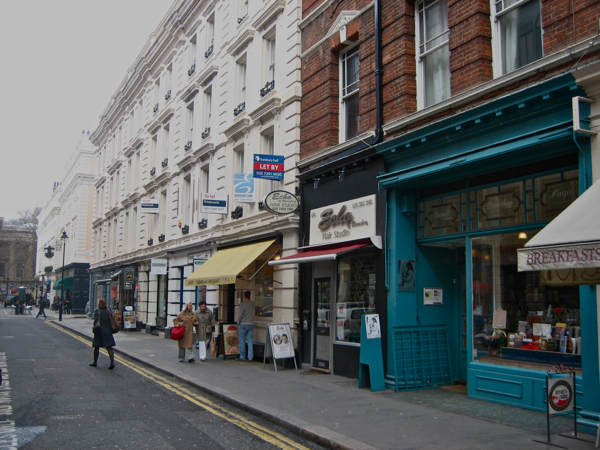
The British Museum awaits at the end of the street


Geraldine and her sister Tish outside the bookshop in the nineteen seventies – “Those were the days when the Rolling Stones and the Beatles used to come in.”
Brutal East End

Ashington House, Bethnal Green
There is little that divides opinion as sharply as concrete modernist architecture, inspiring an unreconcilable split between those who want it demolished and those who want it preserved. Yet the architectural term brutal is of French origin and simply refers to the use of raw concrete (béton brut), even if it is widely used as an expression of the perceived barbarism of buildings in this style.
Photographer Simon Phipps has spent fifteen years surveying these vanishing structures, capturing their lively geometry and dramatic use of textures before they are destroyed, to produce BRUTAL LONDON published by September Books, a catalogue of the capital’s most distinguished examples. His elegant black and white photography draws attention to the idealism of this style which, even when it was misguided, now appears preferable to the ubiquitous cynicism of much new architecture conceived merely as short-life cladding to achieve an effect.

Haggerston School, Weymouth Terrace, E2. Designed by Ernö Goldfinger for the London County Council. Built 1964–67, listed grade II.

Barbican, Silk St, City of London, EC2. Designed by Chamberlin, Powell & Bon for the Corporation of the City of London, Built 1962–82, listed grade II.

Robin Hood Gardens, Woolmore St, Poplar, E14. Designed by Alison and Peter Smithson for the Greater London Council. Built 1969–72, unlisted.

Glenkerry House, Brownfield Estate. Designed by Ernö Goldfinger for London County Council. Built by Greater London Council. Built 1965–67, listed grade II*.


Shoreditch Fire Station, Old Street, EC1. Designed by the Special Works Department of the London County Council Architects’ Department led by Geoffrey Horsfall. Built 1964, unlisted.

Golden Lane Estate, Goswell Rd, City of London, EC2. Designed by Chamberlin, Powell & Bon. Built 1953–63, listed grade II, (Crescent House Listed grade II*).

Newling Estate, Old Market Sq, Bethnal Green, E2. Designed by London County Council Architects’ Department. Built 1963, unlisted.

Keeling House, Claredale St, Bethnal Green, E2. Designed by Denys Lasdun of Fry, Drew, Drake & Lasdun. Built 1957–59, listed grade II*.

Middlesex St Estate, Middlesex St, City of London, E1. Corporation of London Architects’ Department. Built 1965–75, unlisted.

Crown Estate,Victoria Park Rd, E9. Designed by John Spence & Partners for the Crown Estate. Built 1967–77, unlisted.

Charles Hayward Building, part of the Queen Elizabeth Hospital for Children, Hackney Rd, E2. Designed by Lyons Israel Ellis. Built 1972, demolished 2015.

Bethnal Green Fire Station, Roman Rd, E2. Designed by Greater London Council Architects’ Department. Built 1966–67, unlisted.
Photographs copyright © Simon Phipps
Click here to order a copy of BRUTAL LONDON from September Books
You may also like to take a look at


