
Doorkins Magnificat, Southwark Cathedral Cat

‘Pussycat, pussycat, where have you been? I’ve been up to London to visit the Queen’
When Elizabeth II undertook an official visit to Southwark Cathedral, she stopped in her tracks once she spotted Doorkins Magnificat, the Cathedral Cat. I was informed that her Majesty was fascinated to meet this working feline who embodies the lines of the traditional nursery rhyme but I was not told if Doorkins also frightened a little mouse under her chair.
Verger Paul Timms is responsible for the Cathedral Cat – a duty that he oversees with tender devotion and yesterday morning he led me out into the courtyard where Doorkins likes to spend the quiet hours before noon. Sure enough, Paul only had to call and Doorkins appeared from a conveniently-placed stand of shrubs and shady undergrowth, running enthusiastically to greet us.
Quite a small cat, with delicate features and graceful movement, the gentle creature was happy to be petted and photographed while Paul Timms told me Doorkins’ story
“One of my jobs as Verger is opening the cathedral in the morning and closing it at night, and one particular morning in 2008, a young cat appeared at the door to the courtyard when I opened it at seven. Remarkably, we’d just been having a conversation with the Dean about the mouse problem and we had decided that we should get a cathedral cat, when – lo and behold – Doorkins appeared.
At first, I wouldn’t see him for a couple of days but then he came back and I started feeding him, and he began to present himself every day at the door at seven. I called him ‘Doorkins’ because he was the cat in the doorway, although sometimes people think we named our cat after Professor Richard Dawkins, the Atheist. It was the clergy who came up with ‘Magnificat.’
The congregation are in love with Dookins and give money for food and for visits to the vet. They asked us to produce postcards and greetings cards with pictures of the Cathedral cat, and Doorkins even has a facebook page. The vet discovered Doorkins was a female and of Abyssinian breed. She certainly has her mood swings and, somedays, she will let you pet you pet her but, on other days, you only have to look at her and she’ll scratch you.
They knew Doorkins in the Borough Market, she used to go over there and catch the mice. At first, she had divided loyalty and used to go to both the Market and the Cathedral but nowadays she is solely our Cathedral cat.
In the winter, Doorkins spends all her time in the cathedral. I open the door but she takes one look outside at the weather and walks back inside again. In the summer, she spends all her time outside. In the morning, she is in the courtyard and then in the afternoon she moves round to the churchyard. She’s very popular with visitors, they come to visit her and take her photograph, but when it gets too busy she goes down into the crypt where they can’t follow her, and just comes up every now and again to use her litter tray.
One day, a ginger cat appeared in the cathedral and they began having conversations, screetching at each other during services, so the Dean said, ‘One has to go.’ A Verger took Ginger home and adopted him. Another time, we had an an art installation created by an Artist-in-Residence with beautiful textiles and the Artist was scared what Doorkins might do to it, so she had to go to a cattery for three weeks, but she was quite happy once she came back and fell into her old routine again.
We think Doorkins is about ten or eleven, we’ve had her eight years and she was about two when she arrived.”

Southwark Cathedral

Doorkins Magnificat

Doorkins’ summerhouse at the south side of the cathedral


A painting of Doorkins greets visitors to the cathedral

Doorkins shares the same colouration as the cathedral

Doorkins merchandise in the cathedral shop

Doorkins recumbent in the cathedral yard
You may also like to read about
Drink-In At The Still & Star
Please join me & The Victorian Society for a drink-in at the Still & Star, Aldgate, from 6:30pm next Tuesday 16th August to celebrate this historic pub and learn how to stop its demolition. Meanwhile you can register your objection online at the City of London Planning website.

Still & Star by Gustave Dore, 1880, and as it is today – montage by Adam Tuck
“Let us pass down Harrow Alley, leading to the City Clothes Exchange. Harrow Alley is Petticoat Lane over again – smaller, and, if possible, dirtier than her neighbour. Bestriding the path, like a greasy Colossus, leaning against the wall, or squatting in the mud, are men and women by the score. Beside, behind, and before them, are spread out their miscellaneous wares, to which they supplicate your notice or imperatively demand your attention.
The various public-houses in Petticoat Lane, Harrow Alley, and elsewhere, are generally crammed to excess. Through the open doorways we look into the back rooms, where some dozen men are always smoking, their faces lost in the clouds of smoke which emanate from their lips. These men are known to the initiated as Petticoat Lane fencers, or receivers of stolen goods. Patiently they sit in these filthy rooms, waiting news from their scouts, who they throw out as antennae to ‘feel the way,’ or for the appearance of the thief’s confederate, who ‘gives the office,’ and tells where the booty may be found.”
from The Wild Tribes of London by Watts Philips, 1855

Gustave Dore’s drawing of the Still & Star, 1880, from ‘London: A Pilgrimage’

The Still & Star

The proposed office block
You may like to read my original story
Tony Hall’s Pub Photography

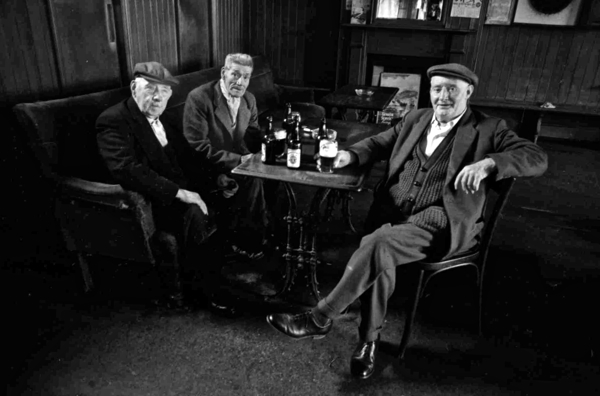
Libby Hall remembers the first time she visited a pub with Tony Hall in the nineteen sixties – because it signalled the beginning of their relationship which lasted until his death in 2008. “We’d been working together at a printer in Cowcross St, Clerkenwell, but our romance began in the pub on the night I was leaving,” Libby confided to me, “It was my going-away drinks and I put my arms around Tony in the pub.”
During the late sixties, Tony Hall worked as a newspaper artist in Fleet St for The Evening News and then for The Sun, using his spare time to draw weekly cartoons for The Labour Herald. Yet although he did not see himself as a photographer, Tony took over a thousand photographs that survive as a distinctive testament to his personal vision of life in the East End.
Shift work on Fleet St gave Tony free time in the afternoon that he spent in the pub which was when these photographs, published here for the first time, were taken. “Tony loved East End pubs,” Libby recalled fondly, “He loved the atmosphere. He loved the relationships with the regular customers. If a regular didn’t turn up one night, someone would go round to see if they were alright.”
Tony Hall’s pub pictures record a lost world of the public house as the centre of the community in the nineteen sixties. “On Christmas 1967, I was working as a photographer at the Morning Star and on Christmas Eve I bought an oven-ready turkey at Smithfield Market.” Libby remembered, “After work, Tony and I went into the Metropolitan Tavern, and my turkey was stolen – but before I knew it there had been a whip round and a bigger and better one arrived!”




The former “Laurel Tree” on Brick Lane

Photographs copyright © Libby Hall
Images Courtesy of the Tony Hall Archive at the Bishopsgate Institute
Libby Hall & I would be delighted if any readers can assist in identifying the locations and subjects of Tony Hall’s photographs.
You may also like to read
March’s New Cries Of London
Even though it is nine months since my CRIES OF LONDON book came out, yet I still cannot resist collecting more, especially when they are as appealing as those in this lovingly-handmade booklet from the early nineteenth century that I acquired for just a couple of pounds recently. The street names in the background of these images fascinate me, and I wonder if that is ‘White Hart Court’ Bishopsgate, in the first picture?


CLICK TO BUY A SIGNED COPY OF THE CRIES OF LONDON FOR £20
You may like to explore these sets of Cries of London
More John Player’s Cries of London
More Samuel Pepys’ Cries of London
Geoffrey Fletcher’s Pavement Pounders
William Craig Marshall’s Itinerant Traders
H.W.Petherick’s London Characters
John Thomson’s Street Life in London
Aunt Busy Bee’s New London Cries
William Nicholson’s London Types
Francis Wheatley’s Cries of London
John Thomas Smith’s Vagabondiana of 1817
John Thomas Smith’s Vagabondiana II
John Thomas Smith’s Vagabondiana III
Thomas Rowlandson’s Lower Orders
Music Hall Stars Of Abney Park Cemetery
When the summer heat hits the city and the streets get dusty and dry, I like to seek refuge in the green shade of a cemetery. Commonly, I visit Bow Cemetery – but recently I went along to explore Abney Park Cemetery in Stoke Newington to find the graves of the Music Hall Artistes resting there.
John Baldock, Cemetery Keeper, led me through the undergrowth to show me the memorials restored by the Music Hall Guild and then left me to my own devices. Alone in the secluded leafy glades of the overgrown cemetery with the Music Hall Artistes, I swore I could hear distant singing accompanied by the tinkling of heavenly ivories.

George Leybourne, Songwriter, Vocalist and Comedian, also known as Champagne Charlie (1842 – 1884) & Albert Chevalier (1861- 1923), Coster Comedian and Actor. Chevalier married Leybourne’s daughter Florrie and they all rest together.

George Leybourne – “Champagne Charlie is my name, Champagne Charlie is my name ,There’s no drink as good as fizz, fizz, fizz, I’ll drink every drop there is, is, is!”

Albert Chevalier – “We’ve been together now for forty years, An’ it don’t seem a day too much, There ain’t a lady livin’ in the land, As I’d swop for my dear old Dutch.”

G W Hunt (1838 – 1904) Composer and Songwriter, his most famous works were “MacDermott’s War Song” (The Jingo Song), “Dear Old Pals” and “Up In A Balloon” for George Leybourne and Nelly Power.

G W Hunt

Fred Albert George Richard Howell (1843 – 1886) Songwriter and Extempore Vocalist

Fred Albert

Dan Crawley (1871 – 1912) Comedian, Vocalist, Dancer and Pantomime Dame rests with his wife Lilian Bishop, Actress and Male Impersonator. He made his London debut at nineteen at Royal Victor Theatre, Victoria Park, and for many years performed three shows a day on the sands at Yarmouth, where he met his wife.They married in Hackney in 1893 and had four children, and toured together as a family, including visiting Australia, before they both died at forty-one years old.

Dan Crawley

Herbert Campbell (1844 – 1904) Comedian and Pantomime Star. The memorial behind the tombstone was erected by a few of his friends. Herbert Campbell played the Dame in Pantomime at Drury Lane for forty years alongside Dan Leno, until his death at at sixty-one.

Herbert Campbell, famous comedian and dame of Drury Lane

Walter Laburnum George Walter Davis (1847 – 1902) Singer, Patter Vocalist and Songwriter

Walter Laburnum

Nelly Power Ellen Maria Lingham (1854 – 1887) started her theatrical career at the age of eight, and was a gifted songstress and exponent of the art of male impersonation. Her most famous song was ‘The Boy I Love Is Up In The Gallery.” She died from pleurisy on 19th January 1887, aged just thirty-two.

Nelly Power – Vesta Tilley was once her understudy
The Music Hall Guild host a free guided walk through Abney Park Cemetery to visit the Music Hall Artistes on the last Saturday of each month – meet at the gates at 2pm
At The Still & Star

Still & Star, 1 Little Somerset St, Aldgate
There is very little left of old Aldgate these days – though the Still & Star, just opposite the tube station yet hidden down Little Somerset St, is a rare survivor. This tiny pub on the corner of two alleys is believed to be unique in the City of London as the sole example of what is sometimes described as a ‘slum pub’ – in other words, a licensed premises converted from a private house.
If it would interest you to visit this cosy characterful pub, which almost alone carries the history of this place, you had better do so soon because the City of London are currently considering an application to demolish it to for a huge new office development and, in the meantime, the premises are on the three-month lease.
Current landlord Michael Cox explained to me that the block once contained eight butcher’s shops which were all bought up by one owner, who opened the pub in 1820. Before it was renamed Little Somerset St, the passageway leading to the pub was ‘Harrow Alley’ but colloquially known as ‘Blood Alley.’ At that time, the City of London charged a tariff for driving cattle across the square mile and, consequently, a thriving butchery trade grew up in Aldgate and Whitechapel, slaughtering cattle before the carcasses were transported over to Smithfield.
There is no other ‘Still & Star’ anywhere else – the name is unique to this establishment – and Michael Cox told me the pub originally had its own still, which was housed in the hayloft above, while ‘star’ refers to the Star of David, witnessing the Jewish population of Aldgate in the nineteenth century.
Unfortunately this early nineteenth century building is not listed or in a Conservation Area which does not bode well for its preservation, but you can see the Planning Application on the City of London website which includes an option for anyone who wishes to object to the demolition. Click here to see details of the Planning Application and make a comment.
All around us, pubs are being shut down and demolished yet, as regular readers will know, I have a particular affection for these undervalued institutions which I consider an integral part of our culture and history – necessary oases of civility in the chaos of the urban environment.

Still & Star, 1951 (Courtesy Heritage Assets/The National Brewery Centre)

Still & Star, 1968 (Courtesy Heritage Assets/The National Brewery Centre)
Still & Star today

Harrow Alley by Gustave Dore, 1880

Butcher’s shop at the corner of Harrow Alley (known as Blood Alley) leading through to the Still & Star

Map of 1890 shows the Still & Star with nearby butcher’s shops and slaughterhouses

Charringtons’ record of the landlords (Courtesy Heritage Assets/The National Brewery Centre)
The office block that is proposed to replace the Still & Star, although the developers are offering to have a bar of that name within the new building
You may also like to read about
The Departure Of Viscountess Boudica

Boudica & Boudica
By the time you read this, the Viscountess Boudica will already be gone – taken her leave from London forever and slipped away from Bethnal Green early on Tuesday morning in a van loaded with her possessions – driving up the Great North Road towards her new home in Uttoxeter.
Before she left, I accompanied the Viscountess upon a last sentimental pilgrimage to the statue of her namesake in Westminster and, on the train back to Whitechapel, she explained to me the circumstances of her departure.
Viscountess Boudica arrived at her council flat in Bethnal Green on January 31st 2002 and she remembers it clearly. ‘A friend with a van helped me move from Poplar and we arrived at 10pm. The previous tenant had died in the flat, leaving piles of rubbish and hole in the plaster,’ she recalled, ‘While we moving in, they smashed the windows of my friend’s van and, after three days, I started receiving hate mail telling me to leave.’
Yet in spite of this inauspicious beginning, the Viscountess painted her flat pink and created a life for herself, becoming celebrated as a trendsetter for her flamboyant colourful outfits which made her popular among the crowds at Brick Lane Market. When I met the Viscountess six years ago in Cheshire St and began publishing interviews with her, I was shocked to learn of the frequent violence that the Viscountess received walking around the streets of the East End.
‘I’m not the kind of person that gives in,’ the Viscountess admitted to me then, ‘I find each area is different, you can’t ascertain in advance whether you’ll get mugged or chased, but you only have one life and you have to live it as you think fit. The kids abuse me and the police are useless, so I have to take care of myself. You have to stand up to them. They say they don’t like how I look, and I tell them, ‘If you don’t like it you can put up with it,’ because I’ve been through so much that I’m not going to be persecuted anymore.”
I will never forget the time she changed her name to Viscountess Boudica Denvorgilla Veronica Scarlet Redd by deed poll and persuaded me to fill out the section in her passport application form, vouching for the veracity of her new identity. It was an unlikely collaboration we enjoyed over the course of more than twenty stories I wrote, photographed and published in these pages, documenting the Viscountess’ seasonal celebrations, recording her remarkable collection of domestic appliances and her coloured outfits – all of which have now been destroyed. I shall miss visiting the pink flat in Bethnal Green to undertake interviews at the court of Viscountess Boudica and encountering her irrepressible courage and good humour, which always sent me away in a buoyant mood. She never failed to astonish me with her originality of thought.
In the end, it was not antipathy and prejudice which drove Viscountess Boudica out of Bethnal Green but a combination of welfare policy and bureaucratic indifference. Like thousands of others, she had her benefits reassessed recently, accompanied by a demand for repayment of money already paid out. The Viscountess found herself in debt and without income, yet facing demands for payment. Any possibility of resolving this mess disappeared when the powers-that-be lost her paperwork. Instead, the Viscountess received a Court Summons for non-payment of Council Tax and Eviction Notices for rent arrears. In the midst of this, she told me the council decided to increase the rent of her one bedroom flat from £100 a week to the ‘market value’ of £700 a week.
The crunch came with a burglary this spring when intruders trashed her flat and destroyed her bed, leaving the Viscountess sleeping on a chair for months. No wonder she asked to be transferred elsewhere and, when a bedsit near Uttoxeter in Staffordshire was offered at £68 a week, she leapt at the opportunity.
‘If you stay in a place too long, it becomes over-familiar,’ she informed me, summoning Dutch courage as we sat in her empty flat last week, ‘I feel there are no more opportunities for me here, but Uttoxeter is a large place with a lot of different people and it will be a new challenge. There will be a period of adjustment but adventures feed the imagination.’
‘I was overcome by people’s generosity,’ she confessed, referring to the online fundraising campaign, as we made our farewells, ‘I’d like to thank all the readers of Spitalfields Life for their emotional support and financial help. If anyone would like me to do them a drawing, send me an email and I will do it for them…’
The East End will be a lesser place without Viscountess Boudica, a kind soul who discovered bravery in the face of cruelty and became a neighbourhood dandy we were all proud to know.
You can contact Viscountess Boudica direct at boudicaredd@gmail.com

‘As they said to me in Islington when they saw my outfit, ‘There’s not a lot of people that’s got the courage.’’

‘I tried going out in Bethnal Green and the reaction was very hostile – from children who threw bottles at me – but I thought, ‘I’ll persevere because fashion is too drab and life should be full of colour.’’
Be sure to follow Viscountess Boudica’s blog There’s More To Life Than Heaven & Earth
You may like to take a look at
Viscountess Boudica’s Domestic Appliances
Viscountess Boudica’s Drawings
Viscountess Boudica’s Halloween
Viscountess Boudica’s Christmas
Viscountess Boudica’s Valentine’s Day
Read my original profile of Mark Petty, Trendsetter
and take a look at Mark Petty’s Multicoloured Coats


