
Ebbe Sadolin In London
Danish Illustrator Ebbe Sadolin (1900-82) visited London in the years following the War to capture the character of the capital, just recovering from the Blitz, in a series of lyrical drawings executed in elegant spidery lines. Remarkably, he included as many images of the East End as the West End and I publish a selection of favourites here from the forties.

George & Dragon, Shoreditch

St Katherine’s Way, Wapping

The Prospect of Whitby, Wapping

Stocks, Shoreditch

Petticoat Lane

Tower Green, Tower of London

The Olde Cheshire Cheese, Fleet St

Rough Sleeper, Shoreditch

Islington Green

Nightingale Lane, Wapping

Fleet St

Wapping churchyard


Tower of London

Commercial Rd, Stepney
St Pancras Station

High St, Plaistow

Bride of Denmark, Queen Anne’s Gate


Liverpool St Station
You may also like to look at
Ted Vanner, Model Steamboat Pioneer

Ted with SS Star
This is the earliest photograph of Ted Vanner, taken when when he was twenty-six years old in 1909, cradling one of his cherished creations with barely-concealed pride. Born in 1883 in Deptford as the second of seven children, Ted began his working life as a blacksmith and apparently gained no formal training as an engineer yet became a legendary innovator in model boat design. An early member of Victoria Model Steamboat Club, founded in 1904, Ted remained prominent in the club for more than sixty years until his death in 1955 when his wife Daisy continued to race his boats in her nineties until her death in 1973.
In later life, Ted Vanner recalled that he, along with other Victoria Model Steamboat Club members, took part in the first ever Model Engineer Regatta at Wembley in 1908. They all met at the Club Boat House in Victoria Park at 5:30am where Mr Blaney was busy cooking eggs and bacon over an oil stove for breakfast, and set out for Wembley in a horsedrawn van carrying boats and owners, ‘stopping at a few hurdles on the way.’
Working with the most rudimentary tools, it was his skill working with sheet metal and tinplate that set Ted Vanner apart from other competitors. According to Boat Club President Norman Phelps, Ted started with a ‘buck’ made from orange boxes and plasterer’s laths, which he would ‘plate’ with sections of cocoa tins. In order to create a joint that could be soldered, each plate overlapped the previous one, starting from the stern and working forward. This was Ted’s method to create elegantly stream-lined hulls that enabled him to produce model boats which were faster than his rivals. The refined shapes were achieved by ‘stroking’ the tin over a flat iron before the plates were soldered together with a large iron, heated either in the living room fire or on a gas ring.
In spite of these primitive construction techniques, Ted became an ambitious innovator. The early boats he built were steam driven tugs, such as he would have seen in the London Docks, but he quickly graduated to speed boats with sophisticated multi-cylinder engines. Ted acquired a reputation, competing at regattas all around the country, carrying his boats on the train and representing Victoria Model Steamboat Club in Paris in 1927, winning first prize with Bon-Ami, second prize with Leda III and third prize with Ledaette.
Today, Victoria Model Steamboat Club is one of only a small handful of surviving model boat clubs but you may still see their vessels on the Victoria Park Boating Lake each Sunday in Summer. Many of the boats in the collection are now over a century old and, if you are lucky, you may even get to see one of Ted Vanner’s creations in action. Seven of his elegant craft remain in working order, carrying his reputation into the future. An inspirational creator, making so much out of so little with such astonishing ingenuity, Ted Vanner is an unsung hero and legend in the civilised world of model boat clubs.

Victoria Model Steamboat Club, 1909

Outside the Club House in Victoria Park

Boats inside the Club House

Ted releases Danube III

Ted is second from left

Ted releases Leda III

Ted stands on the right in this photo in Paris in 1927


Ted is fourth from the right in this line up at St Albans

On the Round Pond Kensington, 1954

Ted wins a trophy for Victoria Park Steamboat Club at Forest Gate Regatta, May 10th 1954


Presenting the prizes at the Victoria Park Model Steamboat Regatta, 1955

At this Model Boat club dinner, Ted & Daisy Vanner sit in the middle of the back row

Daisy Vanner in the fifties

Daisy and Ted on the left

In her nineties, Daisy Vanner continued to compete in regattas with Ted’s boats after his death


Leda III and All Alone, two of seven of Ted’s boats still in working order today
With thanks to Tim Westcott for supplying the photographs accompanying this feature
You may also like to read about
Norman Phelps, Boat Club President
Lucinda Douglas Menzies at Victoria Park Steam Model Boat Club
At The Blind Beggar In Whitechapel

David Dobson, Landlord of the Blind Beggar
Henry VIII at the gaming machine – a rare image of this infamous monarch not recorded by Holbein yet a familiar sight in Whitechapel, where David Dobson landlord of The Blind Beggar delights to dress up in velvet robes and swan around like the ghost of the old king come back to haunt us.
The particular blind beggar in question is Henry de Montfort who lost his sight at the Battle of Evesham in 1265 and became the subject of a Tudor ballad recounting the myth of his salvation by a young woman of Bethnal Green – where he ended his years begging at the crossroads, cared for by his only daughter. Subsequently, the image of the beggar and his daughter became the seal of the Metropolitan Borough of Bethnal Green in 1900 and adorns the inn sign of The Blind Beggar in Whitechapel today.
Paradoxically, The Blind Beggar has become a site of pilgrimage for the devout, seeking the location of the founding of the Salvation Army by William Booth, who started his independent mission by preaching outside in 1865. Converted to housing now, the former Albion Brewery stands next door towering over the pub that served as its tap room, until it closed in 1979. In 1808, it was the enterprising landlord of The Blind Beggar who bought the small brewery next door and named it the Albion Brewery, which grew to be the third largest in Britain by 1880 and, at the beginning of the twentieth century, the first Brown Ale was brewed here by Thomas Wells Thorpe.
In 1904, ‘Bulldog’ Wallace, a member of The Blind Beggar Gang of pickpockets who frequented the pub, stabbed another man in the eye with an umbrella – initiating the notoriety that coloured the reputation of the pub in the twentieth century, which reached its nadir with the shooting of Georgie Cornell by Ronnie Kray in March 1966, as recounted to me by Billy Frost, the Kray Twins’ driver.
“We don’t glorify it, we want to be famous for other things,” admitted David Dobson when I joined him for a jar. “For example, I’ve got the finest collection of Japanese Carp in the East End,” he volunteered, as he led me into the garden and leaned over the vast tank full of fish, each as fat as my leg, so that his beloved charges might lift their heads from the water and permit him to stroke them affectionately under the chin.
“I enjoy the diversity of my clientele,” David confided, when I enquired about the rewards of his job, “Every day, I meet people from all over the world. We’ve had Jerry Springer here, and Brad Pitt’s popped in.”
Yet in spite of the glamour and the attention, David’s motive for acquiring the Blind Beggar is refreshingly simple. “I like drinking, so I bought the pub,” he confessed to me with an eager grin, raising a glass as he revealed a lifelong commitment to his pub, “It’s not a job for me, it’s way of life. I’m live here and I’m in every night – I’ll be leaving here in a box.”

The Blind Beggar, mid-nineteenth century – there has been a pub on this site since 1673

The current building was constructed in 1894

The Albion Brewery

The Watney Mann Brewery with The Blind Beggar attached

The Blind Beggar and the former Albion Brewery today

David Dobson, Publican & Proprietor

David and his Koi Carp

David pets his not-so-coy carp

“I wore it for a fancy dress party years ago, but now it’s just a habit.”

David and a local wag

David waits to welcome the Olympic Torch to Whitechapel in 2008

David Dobson – “I like drinking, so I bought the pub”
Colour photographs copyright © Estate of Colin O’Brien
The Blind Beggar, 337 Whitechapel Rd, London E1
You may also like to read about
The Disappearing Pubs of Marylebone
Sandra Esqulant, The Golden Heart
Phil Maxwell Returns To Sclater St Market

Markets are commonly assumed to be ephemeral, transitory phenomena compared to the buildings which surround them, yet very often the opposite is true. The Sclater St Market has persisted tenaciously through at least two centuries of architectural change. In spite of new blocks of flats in the generic modern London style looming overhead, Contributing Photographer Phil Maxwell found it as lively as ever with some of the same characters present from the eighties when he first began photographing markets in Spitalfields. ‘This market community is the last bastion of East Enders in the face of redevelopment,’ he informed me with pride and delight.


Photographs copyright © Phil Maxwell
You may also like to take a look at
Richard Lee of Sclater St Market
Robert Green of Sclater St Market
Phil Maxwell in Bethnal Green Rd
Phil Maxwell in Bethnal Green Rd
Phil Maxwell’s Kids On The Street
Phil Maxwell’s East End Cyclists
Phil Maxwell & Sandra Esqulant
The Nippers At The William Morris Gallery
On Thursday 19th January, I shall be giving an illustrated lecture about Horace Warner’s SPITALFIELDS NIPPERS and telling the stories behind his breathtaking photographs at the William Morris Gallery in Walthamstow. It is a singularly appropriate venue because Horace Warner was connected to William Morris through the Warner family wallpaper business of Jeffrey & Co who printed the wallpaper for Morris & Co. Click here for booking information


[youtube WOJlJ0qfFrs nolink]

Click here to order a copy of SPITALFIELDS NIPPERS by Horace Warner
You may also like to read about
Andrew Baker At Hiller Bros
Photographer Andrew Baker went along to capture the last days of Hiller Bros Market Barrow Makers in Bethnal Green after reading about the closure of the workshop last November on Spitalfields Life and here are a selection of his pictures

“As a kid I would see Market barrows all the time, wooden-wheeled with steel tyres, usually painted with lead paint in green and red, when I was out with me mother and grandmother (or Nan as I called her) during our regular visits to the High Street, Walthamstow Market or during occasional trips to Romford and the much heralded ‘The Roman’ – Roman Road Market. Now I only see three original barrows: one at Chrisp Street Market, pictured below, another on Bethnal Green Road, and one at Queens Market.
So when Hiller Brothers’ workshop was being cleared out I went to take a look. They were moving to new premises, after seventy-odd years. A familiar smell of damp wood and oxidised steel added to the cold November morning. There were a couple of blokes inside. Joe was the first I spoke to, after he finished talking to a woman, who seemed to be the guvnor. It was left to me to decide, after the other nodded and gestured ‘It’s him you need to speak to,’ when I asked to take a few photographs. ‘Quick’ the women said to me, ‘it,s all going, going forever!’ with a hint of excitement, pleased with a trophy she had just acquired .
What I found most surprising was the industry behind these barrows. To this day. the barrows are rented out and maintained by Hillers, with their leaf spring suspension, wooden wheels with steel tyres, made by a wheelwright – another artisan trade of the past – and crafted handles. These are heavy carts and cannot be maintained by just anyone.
The skill and craftsmanship that Hillers maintain to this day is remarkable. The name ‘Hiller Bros’ is always carved, free hand, by one of the Hillers, ‘Wouldn’t even be marked out with a pencil’ Mick told me.
I asked Mick how long he had worked with Market barrows and he replied, ‘Well I don’t know, but my daughter was conceived on one and she’s forty-seven!'”
– Andrew Baker


Hiller Bros barrow in use in Chrisp St Market
Photographs copyright © Andrew Baker
You may also like to might to read my original story
Tallis’ Street Views Of Bishopsgate 1838

Site of Bishopsgate Institute

The same location today
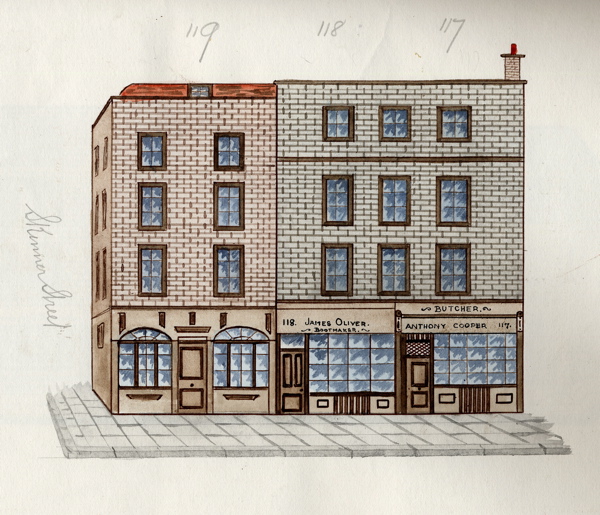
Before anyone ever dreamed of Google Street Views, there were Tallis’s London Street Views of the eighteen-thirties “to assist strangers visiting the Metropolis through all its mazes without a guide.” John Tallis created the precedent of a map which included pictures of all the buildings as a visual aid, commissioning the unfortunately-named artist Charles Bigot to do the drawings and writer William Gaspey to create the accompanying text. Tallis had his imitators, evidenced by this beautiful set of anonymous watercolours of every single facade in Bishopsgate, Spitalfields, dated to 1838 and preserved at the Bishopsgate Institute.
There is an obsessive quality to these paintings which drew my attention when I first came upon them, displaying an amateurism in the brushwork and lettering that recalls folk or outsider art. I cannot deny the appeal of recording every facet of the world in this way because there is a strange reassurance to be gained from looking at these neat little pictures. They are reminiscent of the visualisations created for buildings that are yet to be built, in which less salubrious elements are excluded in images designed to endear us to the proposals of architects and developers.
Although these views of Bishopsgate advertise their veracity by recording every single brick, I do not believe it actually looked like this because the buildings are uniformly clean and well maintained. In contrast to the chaotic nature of Google Street Views that record our contemporary cityscapes, there is a comic flatness in these drawings. They are more reminiscent of street scenes in toy theatres and those houses you find on model railway layouts, tempting me to paste them onto matchboxes and create my own personal Bishopsgate. Neat, tidy and eminently respectable, the early nineteenth century society envisioned by these innocuous facades is that of Adam Smith’s “nation of shopkeepers.”
While Bishopsgate itself is unrecognisably altered from the time of these drawings, the proportion of the buildings, providing a shop on the ground floor, with family accommodation and sometimes workshops above, is still familiar in Spitalfields today. The two stocks of brick used, red brick and the London yellow brick remain the predominant colours over one hundred and fifty years later. Sir Paul Pindar’s House, illustrated in the penultimate plate, was the lone survivor from the time before the Fire of London when Spitalfields was a suburb where aristocrats had their country residences. Today the frontage of Sir Paul Pindar’s House can be viewed at the Victoria & Albert Museum where it was moved in 1890.
Named Ermine St by the Romans, for centuries Bishopsgate was the major approach to the City of London from the north leading straight down to London Bridge, and the saddler and harness makers, and coach builders who set up business in the street reflected the nature of this location as a point of arrival and departure. There are some age-old trades recorded in these pictures which survived in Spitalfields until recent times, upholsterers, umbrella makers and leatherworkers, while the straw hat makers, cutlers, dyers, tallow sellers and corn dealers went long ago. Yet we still have plenty of hair dressers today. Let me admit, my favourite business here is Mr Waterworth, the Plumber – who could become a credible addition to a set of Happy Families, along with all his little squirts.

Corner of Houndsditch

Corner of Houndsditch


Corner of Union St, now Brushfield St

Corner of Brushfield St today


Corner of Primrose St

Corner of Primrose St


This space is now occupied by Liverpool St Station and the frontage of Sir Paul Pindar’s House is in the Victoria & Albert Museum


Archive images courtesy Bishopsgate Institute
You may also like to read about
The Romance of Old Bishopsgate


