
A Walk Through Roman London

Roman London is still under construction
From Spitalfields, you have only to walk down Bishopsgate to find yourself in Londinium, since the line of Bishopsgate St follows that of Ermine St which was the major Roman road north from London Bridge. Tombs once lined the path as it approached the City, just as they did along the Appian Way in Rome.
The essential plan of the City of London was laid out by the Romans when they built their wall around Londinium at the end of the second century, after Boudica and her tribes burnt the settlement. Eighty years earlier, the Romans had constructed a fort where the Barbican stands today and, in their defensive plan, they extended its walls south to the Thames and in an easterly arc that met the river where the Tower of London stands now.
A fine eighteenth century statue of the Emperor Trajan touts to the tourists at Tower Hill, drawing their attention to the impressive stretch of wall that survives there, striped by the characteristic Roman feature of courses of red clay tiles, inserted between layers of shaped Kentish Ragstone to ensure that the wall would be consistently level.
Just fifty yards from here at Cooper’s Row, round the back of the Grange City Hotel, is an equally spectacular stretch of wall that is off the tourist trail. Here you can see the marks of former staircases and medieval windows cut through to create a rugged monument of significant height.
Yet, in the mile between here and the Barbican, very little has survived from the centuries in which stone from the wall was pillaged for other buildings. It is possible to seek access to some corporate premises with lone fragments marooned in the basement, but instead I decided to walk over to All Hallows by the Tower which has a little museum of great charisma in its crypt. Here is part of the tessellated floor of a Roman dwelling of the second century and Captain Lowther’s splendid model of Roman London from 1928.
At the Barbican, a stretch of wall that was once part of the Roman fort is visible, punctuated by a string of monumental bastions which are currently under restoration. Walking up from St Paul’s, you come across the wall in Noble St first, still encrusted with the bricks of the buildings within which it was once embedded. Then you arrive at London Wall, an avenue of gleaming towers lining a windy boulevard of fast-moving traffic, which takes it name from the ancient edifice.
I was lucky enough to be permitted access to a secret concrete bunker, beneath the road surface yet above the level of the underground car park. Here was one of the gateways of Roman London and I saw where the wooden gate posts had worn grooves into the stone that supported them. At last, I could enter Roman London. In that underground room, I walked across the few metres of gravel chips that now cover the ground level of the former roadway between the gate posts, where the chariots passed through. Long ago, I should have been trampled by the traffic if I had stood there, just as I should be mown down if I stood in London Wall today. We switched out the light and locked the door on Roman London to emerge into the daylight again.
In the gardens of the Barbican, the presence of foliage and grass permits the bastions of the City wall to assert themselves, standing apart from the contemporary built environment that surrounds them. From here, I turned west to visit the cloister of St Vedast in Foster Lane, which has an intriguing panel of a tessellated floor mounted in a frame, and St Bride’s in Fleet St, where deep in the crypt, you can lean over a wall to see the floor of the Roman dwelling that once stood there, reflected in a mirror. The reality of these items stirs the imagination just as their fragmentary nature challenges it to envisage such a remote world.
By now, it was late afternoon. I was weary and the sunshine had faded, and it was time to make tracks quickly back to Spitalfields as the sky clouded over – yet I was inspired by my brief Roman holiday in London.

Eighteenth century bronze statue of Trajan at Tower Hill

Model of Roman London in the crypt of All Hallows by the Tower. Made by Captain Lowther in 1928, it shows London Bridge AD 400 – Spitalfields appears as a settlement of Britons beyond the wall.

Roman City Wall at Tower Hill

At Tower Hill

At Cooper’s Row

Lines of red clay tiles were inserted between the blocks of stone to keep the wall level


Tessellated floor in the crypt of All Hallows by the Tower

Timber from a Roman wharf preserved in the porch of St Magnus the Martyr

In the cloister of St Vedast Alias Foster

In the crypt of St Bride’s, Fleet St

Foundation of a Roman Guard Tower in Noble St

Outside 1 London Wall

Part of the entrance gate to Roman London in the underground chamber

Model of the north west entrance to Roman London

A fragment of wall in the underground chamber

Bastion at London Wall

You might also like to read
The Roman Ruin at the Hairdresser
The Billingsgate Roman Bathhouse
The Alphabet Of Lost Pubs A-C
Sometimes I find myself walking the streets looking for a pub. I am seeking an enclave of civility as a refuge from the barbarity of the city, a friendly bar where the publican lives upstairs and the residents of the street congregate. I am looking for a local.
Oftentimes, in accumulating disappointment, I stand and gaze at the fine buildings which once were pubs, now closed down and converted into flats or shops, or restaurants. So you can imagine my emotion when I discovered this cherished inventory of pubs from the early twentieth century, mostly pictured in their shining moment of glory, when the signwriting was crisp, the mirrors were polished and the lamps gleamed – the beloved drinking palaces of yesteryear. You can almost hear the clink of glasses, the hubbub of voices and distant tinkle of barroom ivories.
Today I am delighted to commence a new series presented in collaboration with Heritage Assets who work in partnership with The National Brewery Heritage Trust, publishing these historic photographs of the myriad pubs of the East End from Charrington’s archive for the first time. It is no exaggeration to say that every street corner was once a pub, thus the catalogue of our loss runs into hundreds and this first instalment of The Alphabet of Lost Pubs only covers A-C.
I wish we could have enjoyed a pint together in every one. Instead we must be thankful we can go there in spirit thanks to the alluring visions conjured by these entrancing photographs, which might have vanished forever if they had not been rescued from a skip twenty-five years ago by some far-sighted soul.

The Adam & Eve, 126 Abbey Rd, West Ham, E15 (Damaged by enemy action 1st July 1944, reopened 2nd April 1948, closed 1994)

The Albert Arms, 66 Bancroft Rd, Mile End, E1 (Destroyed by enemy action 1944)

The Albion, 423 Bethnal Green Rd, E2 (Opened prior to 1870, now known as Bar Valiente)

The Albion, 33 Albion Rd, Dalston, E8 (Opened prior to 1850, closed in 2002 and now residential)

The Albion, 211-212 High St (now The Highway), Shadwell, E1 (Opened prior to 1841, closed 1922 and now demolished)
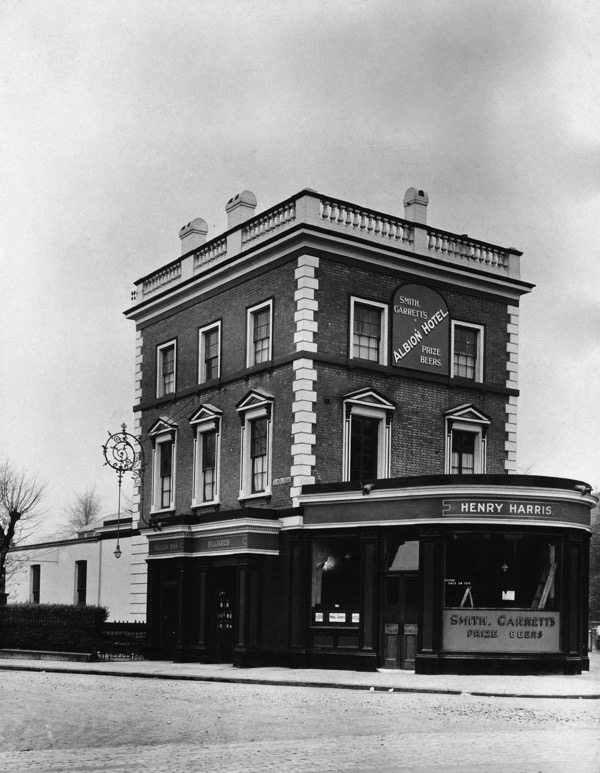
The Albion, 2 Clissold Rd, Stoke Newington, N16 (Opened prior to 1855, converted to residential use in nineteen nineties)

The Alfred’s Head, 49 Gold St, Stepney, E1 (Opened prior to 1849, now demolished)

The Alma, 41 Spelman St, Spitalfields, E1 (Opened prior to 1870, closed 2001 and now offices)

The Angel & Crown, 170 Roman Rd, Bethnal Green, E2 (Opened prior to 1809, rebuilt in 1951 and still open)

The Astric Lodge, 60 Stepney Green, E1 (Opened prior to 1818 and closed in 1997)

The Barley Mow, 7 New Gravel Lane, Shadwell, E1 (Opened prior to 1778, now demolished)

The Bedford Hotel, 220 Victoria Park Rd, Hackney, E9 (Built 1870, converted to residential use 1999)

The Beehive, 36 Holly St, Dalston, E8 (Opened prior to 1848, closed 1964 now demolished)

The Bell, 116 George St (now The Highway), Shadwell, E1 (Named in 1839, closed 1922)

The Benyon Arms, 155 De Beavoir Rd, Hackney, N1 (Opened prior to 1852, closed 1984 and now residential)

The Black Bull, 192 Stoke Newington High St, N16 (Opened 1826, closed 1981 and now Kentucky Fried Chicken)

The Black Horse, 168 Mile End Rd, E1 (Opened prior to 1856, closed 2010 and currently vacant)

The Blade Bone, 185 Bethnal Green Rd, E2 (Opened in 1823, destroyed by enemy action in World War II and rebuilt, then closed in 1999 and became The Noodle King now a development site for flats)

The Brewery Tap, 17 Stean St, Shoreditch, E8 (Opened prior to 1881, closed 1921 and now demolished)

The British Queen, 31 White Horse Lane, E1 (Opened prior to 1843 and closed 1934, now demolished)

The Bull’s Head, 58 St Katharine’s Way, E1 (Opened 1838, closed 1952)

The Burford Arms, 11 Burford Way, Stratford, E15 (Opened prior to 1872, closed in 1990 and demolished in 1994)

The Camden’s Head, 456 Bethnal Green Rd, E2 (Opened prior to 1816 and still open)

The Carlton, 238 Bancroft Rd, Mile End, E1 (Opened 1836 and still open today)

The Carpenters’ Arms, 151 Cambridge Heath Rd, E1 (Opened prior to 1839, rebuilt in the nineteen-sixties and still open)

The Cat & Mutton, 76 Broadway Market, Hackney, E8 (Opened prior to 1732 and still open)

The City Arms, 2 Dock Rd, Canning Town, E16 (Opened prior to 1867 and closed in 1934)

The Clapton Park Tavern, 9 Chatsworth Rd, Hackney, E5 (Opened prior to 1872, closed and converted to a restaurant in 2001)

The Colet Arms, 94 White Horse Rd, Stepney, E1 (Opened prior to 1851, closed in 2003 and now residential)

The Commercial Tavern, 142 Commercial St, Spitalfields, E1 (Built in 1865 and still open today)

The Commercial Tap, 66 Ben Jonson Rd, Stepney, E1 (Opened 1881 and closed 1934, now demolished)

The Conqueror, Boundary St, Shoreditch, E2 (Opened prior to 1872 and closed in 2007, now residential)

The Crooked Billet, 93 Hoxton St, Hoxton, N1 (Opened prior to 1841, closed 1938 and now demolished)

The Crown & Anchor, 35 Temple St, Bethnal Green, E2 (Opened prior to 1831, closure unknown)

The Crown & Dolphin, 56 Cannon St Rd, Shadwell, E1 (Opened 1851, closed 2002 and now residential)

The Crown, St John St, Clerkenwell, EC1 (Opened in 1910, closed in 1953 and now a shop)

The Crown, 19 Mayfield Rd, Dalston, E8 (Opened 1866 and closed in 1954)

The Crown, 34 Redchurch St, Shoreditch, E2 (Established late seventeenth century and renamed The Owl & The Pussycat in 1990)

The Crown, 14 Goodman St, Whitechapel, E1 (Opened in 1823, closed in 1952 and now demolished)

The Cutlers’ Arms, 2 Cutler St, Houndsditch, E1 (Opened prior to 1839, closed in the nineteen-fifities and is now demolished)
Photographs courtesy Heritage Assets/The National Brewery Heritage Trust

You may also like to take a look at
Phil Maxwell In Hanbury St
Originally known as Browne’s Lane, at the end of the eighteenth century Hanbury St was named after Sampson Hanbury who ran the Truman Brewery from 1788. It traverses Spitalfields connecting Commercial St with Whitechapel and is less than a mile in length, yet all the contrasts of the neighbourhood are visible along its extent. Contributing Photographer Phil Maxwell knows this better than most since he began photographing it in 1982, observing the changes as he walked daily between his home in Pauline House at the Vallance Rd end and The Golden Heart on the corner of Commercial St to the west.


Photographs copyright © Phil Maxwell
You may also like to take a look at
Phil Maxwell in Bethnal Green Rd
Phil Maxwell in Bethnal Green Rd
The Costume & Mantle Worker
I spent an interesting afternoon in the Bishopsgate Institute archive recently studying copies The Costume & Mantle Worker, a bilingual journal in English and Yiddish for members of the United Ladies Tailors Trade Union. In Spitalfields, we are still aware of the former textile trade and I was especially fascinated by these adverts, reproduced below, which set me on a quest to discover which of these premises are still standing.


Formerly B. Weinberg, Printer, 138 Brick Lane


Formerly Folman’s Hotel & Restaurant, 128 Whitechapel Rd, Opposite Pavilion Theatre


The Gentle Author’s tailors’ stool


Formerly M. S. Rosenbloom & Co for sewing machines, 50 Brick Lane


Pages of The Costume & Mantle Worker courtesy Bishopsgate Institute
You may also like to read about
Last Days Out With Colin O’Brien
Today, I look back at some of my favourite pictures by Contributing Photographer Colin O’Brien from 2013 – 2016. We clocked up over fifty assignments for Spitalfields Life working in partnership until his death in August this year, giving me cause to look back over all the adventures that we had together. Tonight at 6:30pm, I shall be reminiscing about my experiences working with Colin as part of his retrospective exhibition THIS ENGLAND at Unit G Gallery, 12a Collent St, E9 6SG.

Terry Smith, Envelope Cutter at Baddeley Brothers, July 2013

Anna Carter, Carters Steam Fair, August 2013

Carters Steam Fair, Victoria Park, August 2013

Savvas Kyriacou, Muscleworks Gym Bethnal Green, September 2013

Tony Stevens, Daneford Trust, Bethnal Green, September 2013

Gerry Cottle, Gerry Cottle’s Circus, September 2013

John Dolan & George the Dog, Shoreditch, October 2013

Steven Armstrong, Postman in Whitechapel, December 2013

Elam Forrester says goodbye to her home in Samuel House, Haggerston, prior to demolition, February 2014

Peter Sargent, Butcher in Bethnal Green, February 2014

Bob Rogers, Speakers Corner, February 2014

David Dobson, Landlord of the Blind Beggar, Whitechapel, March 2014

Ash Grove Bus Depot, Hackney, April 2014

Whitechapel Mission, May 2014

Whitechapel Mission, May 2014

Bob Mazzer, Howard Griffin Gallery, Shoreditch, June 2014

Jay the Tailor, Druid of Wormwood Scrubs, Primrose Hill, Midsummer 2014

Brogan Ferron, Weavers Fields Adventure Playground, Bethnal Green, September, 2014

Lottie Ferron, Weavers Fields Adventure Playground, Bethnal Green, September 2014

Chris Georgiou, Tailor, Kings Cross, September 2014

Jasmine Stone & her daughter Safia, Stratford, October 2014

Boar’s Head Parade, City of London, December 2014

Nativity Procession, Spitalfields, December 2014

Last day of The Gun, Spitalfields, February 2015

Walthamstow Marshes, August 2015

Flossie Reed & Vi Charlton, Hop-picking at Lamberhurst, Kent, September 2015

Ahmed Nassr, Olive Seller, Queen’s Market, Upton Park, October 2015

Lego Exhibition, Docklands, December 2015

London Bridge, January 2016

Upton Park, June 2016

George Parrin, Ice Cream Seller, Whitechapel, August 2016

Leon Powell, Denmark St, August 2016

I hope as many readers as can do so will come along to St James Church, Clerkenwell, on Thursday 17th November. The bells will ring from 5:30pm and we will commence at 6:00pm. We will be showing photographs and there will be reminiscences, readings, music and films, and a big party in the crypt to celebrate our friend from Clerkenwell, COLIN O’BRIEN. Make it a date in your diary.
You may also like to take a look at
Richard Ardagh At Wilton’s Music Hall
Designer, Typographer & Printer, Richard Ardagh of New North Press in Hoxton has collaborated with the pupils of Bigland School in Stepney to create these splendid letterpress signs for Wilton’s Music Hall, telling tales of its colourful history. Printed with wood blocks and metal type onto book cloth mounted on board in the nineteenth century manner, they are more than enough reason – should you ever require it – for a return trip to Wilton’s.


Visit Wilton’s Music Hall, Grace’s Alley, E1 8JB
You may also like to read about
Frances Mayhew, Wilton’s Music Hall
The Spitalfields Mulberry

Yesterday, Richard Chartres, Bishop of London presented Christ Church, Spitalfields, with a Mulberry tree to plant in the churchyard in memory of the twenty-thousand Huguenot refugees that came here in the seventeenth century. It was both the eve of the anniversary of the Revocation of the Edict of Nantes on 18th October 1685, which became the catalyst for the mass migration of French Protestants, and the day upon which the United Kingdom accepted the first child refugees from the camp in Calais.
Of Huguenot descent himself, the Bishop was far from unaware of the significance of the timing of his action, describing the Mulberry tree as emblematic of the prosperity brought by migrants – as demonstrated by the affluence of the former Huguenot silk industry in Spitalfields. The Mulberry sapling itself was a scion of seventeenth century tree planted as one of London’s only functioning Mulberry plantation in Chelsea, offering homegrown sustenance to silk worms.

Christ Church, Spitalfields

You may like to read my other stories about Mulberry trees
The Oldest Mulberry in the East End


