
Alan Dein’s East End Shops

P.Lipman, Kosher Poultry Dealers, Hessel St
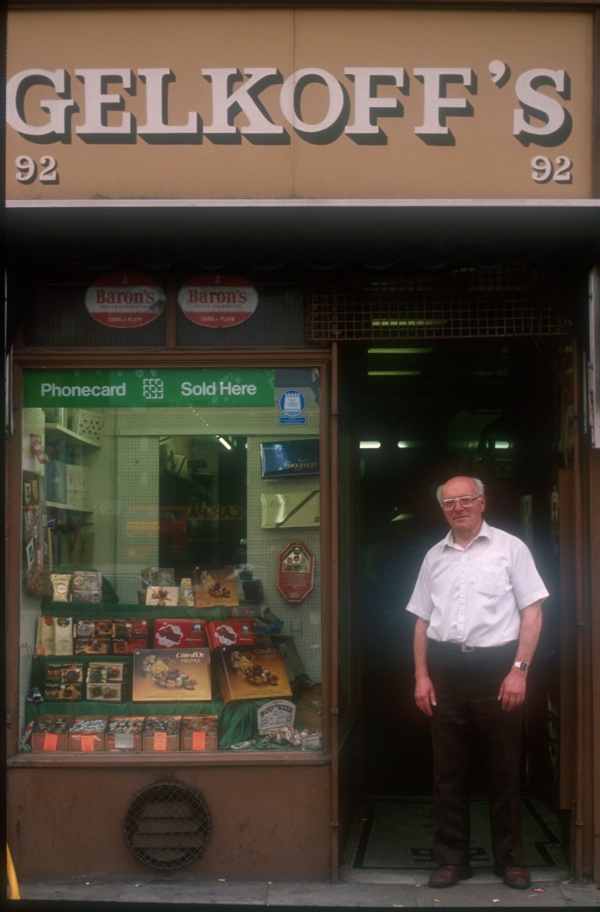
“In my twenties, I’d been doing a number of oral history recordings, working for the Museum of the Jewish East End which was very active recording stories of the life of Jewish people who had settled here.”explained Alan Dein, broadcaster and oral historian, outlining the background to his unique collection of more than a hundred photographs of East End shopfronts.
“My photographs of the derelict shopfronts record the last moments of the Jewish community in the area. The bustling world of the inter-war years had been moved into the suburbs, and the community that stayed behind was less identifiable. In the nineteen eighties they were just hanging on, some premises had been empty for more than five years. They were like a mouthful of broken teeth, a boxer’s mouth that had been thumped, with holes where teeth once were.”
Feeding his twin passions for photography and collecting, Alan took these pictures in 1988 while walking around the streets of the East End at a time when dereliction prevailed. Although his family came from the Jewish East End and his Uncle Lou was a waiter at Blooms, Alan was born elsewhere and first came to study. “As a student at the City of London Polytechnic in Old Castle St, I spent a lot of time hanging out here – though the heart of the area for me at that time was the student common room and bar.” he told me.
“Afterwards, in 1988, I moved back to live in a co-operative housing scheme in Whitehorse Rd in Stepney and then I had more time to walk around in this landscape that evoked the fragmentary tales I knew of my grandparents’ lives in the East End. The story I heard from their generation of the ‘monkey parade’, when once people walked up and down the Mile End Road to admire the gleaming shopfronts and goods on display. My family thought I was mad to move back because when they left the East End they put it behind them, and it didn’t reflect their aspirations for me.
The eighties were a terrible time for removing everything, comparable to what the Victorians had done a century earlier. But I have always loved peeling paint, paint that has been weathered and worn seafront textures, and this was just at the last moment before these buildings were going to be redeveloped, so I photographed the shopfronts because this landscape was not going to last.”
In many of these pictures, there is an uneasy contradiction between the proud facades and the tale of disappointment which time and humanity has written upon them. This is the source of the emotionalism in these photographs, seeing faded optimism still manifest in the confident choice of colours and the sprightly signwriting, becoming a palimpsest overwritten by the elements, human neglect and graffiti. In spite of the flatness of these impermeable surfaces, in each case we know a story has been enclosed that is now shut off from us for ever. Beyond their obvious importance as an architectural and a social record, Alan’s library of shopfronts are also a map of his exploration of his own cultural history – their cumulative heartbreak exposing an unlocated grief that is easily overlooked in the wider social narrative of the movement of people from the East End to better housing in the suburbs.
Yet Alan sees hope in these tantalising pictures too, in particular the photo at the top, of Lipman’s Kosher Poultry Dealers, in which the unknown painter ran out of paint while erasing the name of the business, leaving the word “Lip” visible. “A little bit of lip!” as Alan Dein terms it brightly, emblematic of an undying resilience in the face of turbulent social change.
SIGN THE PETITION TO SAVE OUR SHOPKEEPERS FROM THE NEW BUSINESS RATES

Goulston St

In Whitechapel

Commercial Rd

Redchurch St

Stepney Green

Cheshire St

Alie St

Hessel St

Hackney Rd

Quaker St

Mile End Rd

Toynbee St

Alie St

In E2

Brick Lane

Great Eastern St

Commercial St

Hessel St

Mile End Rd

Relocated to Edgeware

Bow Common Lane

Brick Lane

Ben Jonson Rd

Wilkes St

Bow Rd

Ridley Rd

New Goulston St.
Whitechapel High St

Alderney Rd, Stepney
Photographs copyright © Alan Dein
You may also like to take a look at
Philip Marriage, Photographer

Quaker St, 1967
The passage of time in Spitalfields became visible to Philip Marriage as he made successive visits over three decades to take these photographs. Working for HMSO publications in Holborn and commuting regularly through Liverpool St Station, he revisited Spitalfields sporadically over the years, drawn by a growing fascination with those streets where his ancestors had lived centuries earlier.
The poignant irony of these pictures is that while Philip came to Spitalfields in search of the past, he discovered many of the streets which interested him were retreating in time before his lens, disintegrating like phantoms into the ether, even as he was photographing them.
In 1967, when Philip Marriage first visited with his camera, he found a landscape scattered with bomb sites from World War II and he witnessed the slum clearance programme, as settled communities were displaced from their nineteenth century cottages and tenements into new housing complexes. Twenty years later, he encountered the opposing forces of redevelopment and conservation that were reshaping the streets to create the environment we recognise today.
But other, less obvious, elements affect our perception of time in these photographs too. Those pictures from 1967 exist in a lyrical haze which is both the result of air pollution caused by coal fires and the unstable nature of colour film at that time. By the eighties, the smog has been consigned to the past and better colour film delivered crisper images, permitting photographs which appear more contemporary to us.
Yet it was relatively recent events in Spitalfields, that came after he took his pictures, which render Philip Marriage’s photographs so compelling now – as windows into a lost time before the closure of the Truman Brewery and the Fruit & Vegetable Market.

Quaker St, 1987

Quaker St, looking west, 1967

Quaker St, looking west, 1987

Artillery Lane, 1967

Artillery Lane, 1985

Samuel Stores, Gun St, 1985

Samuel Stores, Gun St, 1986

Former Samuel Stores, Gun St, 1987

Verdes, Brushfield St, 1988

Verdes, Brushfield St, 1990

Poyser St, Bethnal Green, 1967

Poyser St, Bethnal Green, 1967

Cheshire St with Rag & Bone Man, 1967

Middleton St, Bethnal Green, 1967
Photographs copyright © Philip Marriage
You may also like to take a look at
Philip Marriage’s Spitalfields
Alan Dein’s East End Shopfronts of 1988
Mark Jackson & Huw Davies, Photographers
The Mystery of Isabelle Barker’s Hat

Even though I took this photograph of the hat in question, when I examined the image later it became ambiguous to my eyes. If I did not know it was a hat, I might mistake it for a black cabbage, a truffle, or an exotic dried fruit, or maybe even a specimen of a brain preserved in a medical museum.
Did you notice this hat when you visited the Smoking Room at Dennis Severs’ House in Folgate St? You will be forgiven if you did not, because there is so much detail everywhere and, by candlelight, the hat’s faded velvet tones merge unobtrusively into the surroundings. It seems entirely natural to find this hat in the same room as the painting of the gambling scene from William Hogarth’s “The Rake’s Progress” because it is almost identical to the hat Hogarth wore in his famous self-portrait, of the style commonly worn by men in his era, when they were not bewigged.
Yet, as with so much in this house of paradoxes, the hat is not what it appears to be upon first glance. If it even caught your eye at all because the gloom contrives to conjure virtual invisibility for this modest piece of headgear – if it even caught your eye, would you give it a second glance?
It was Fay Cattini who brought me to Dennis Severs’ house in the search for Isabelle Barker’s hat. Fay and her husband Jim befriended the redoubtable Miss Barker, as an elderly spinster, in the last years of her life until her death in 2008 at the age of ninety-eight. To this day, Fay keeps a copy of Isabelle’s grandparents’ marriage certificate dated 14th June 1853. Daniel Barker was a milkman who lived with his wife Ann in Fieldgate St, Whitechapel and the next generation of the family ran Barker’s Dairy in Shepherd St (now Toynbee St), Spitalfields. Isabelle grew up there as one of three sisters before she moved to her flat in Barnet House round the corner in Bell Lane where she lived out her years – her whole life encompassing a century within a quarter-mile at the heart of Spitalfields.
“I was born in Tenterground, known as the Dutch Tenter because there were so many Jews of Dutch origins living there. My family were Christians but we always got on so well with the Jews – wonderful people they were. We had a dairy. The cows came in by train from Essex to Liverpool St and we kept them while they were in milk. Then they went to the butchers. The children would buy a cake at Oswins the baker around the corner and then come and buy milk from us.” wrote Isabelle in the Friends of Christ Church magazine in 1996 when she was eighty-seven years old.
Fay Cattini first became aware of Isabelle when, in her teens, she joined the church choir which was enhanced by Isabelle’s sweet soprano voice. Isabelle played the piano for church meetings and tried to teach Fay to play too, using an old-fashioned technique that required balancing matchboxes on your hand to keep them in the right place. “I grew up with Isobel,” admitted Fay,“I think Isobel was one of the respectable poor whose life revolved around home and church. She had very thin ankles because she loved to walk, in her youth she joined the Campaigners (a church youth movement) and one of the things they did was to march up to the West End and back. She enjoyed walking, and she and her best friend Gladys Smith would get the bus and walk around Oxford St and down to the Embankment. Even when she was in her nineties, I never had to walk slowly with her.”
Years later, Fay and Jim Cattini shared the task of escorting Isabelle over to The Market Cafe in Fournier St for lunch six days a week. In those days, the cafe was the social focus of Spitalfields, as Fay told me,“Isabelle was quite deaf, so she liked to talk rather than listen. At The Market Cafe where she ate lunch every day, Isabelle met Dennis Severs. Dennis, Gilbert & George, and Rodney Archer were all very sweet to her. I don’t think she cooked or was very domestic but walking to The Market Cafe every day – good food and good company – then walking back again to her small flat on the second floor of Barnet House, that’s what kept her going.”
In fact, Fay remembered that Isobel gave her hat to Dennis Severs, who called her his “Queen Mother” in fond acknowledgement of her natural dignity, and he threw her an elaborate eightieth birthday party at his house in 1989. But although nothing ever gets thrown away at 18 Folgate St, when we asked curator David Milne about Isabelle Barker’s hat, he knew of no woman’s hat on the premises fitting the description – which was clear in Fay’s mind because Isabelle took great pride in her appearance and never went out without a hat, handbag and gloves.
“Although she was an East End person,” explained Fay affectionately,“she always looked very smart, quite refined, and she spoke correctly, definitely not a cockney. She had a pension from her job at the Post Office as a telephonist supervisor, but everything in her flat was shabby because she wouldn’t spend any money. As long as she had what she needed that was sufficient for her. She respected men more than women and refused to be served by a female cashier at the bank. Her philosophy of life was that you didn’t dwell on anything. When Dennis died of AIDS she wouldn’t talk about it and when her best friend Gladys had dementia she didn’t want to visit her. It was an old-fashioned way of dealing with things, but I think anyone that lives to ninety-eight is impressive. You had to soldier on, that was her attitude, she was a Victorian.”
When Fay showed me the photo you see below, of Isabelle Barker with Dennis Severs at her eightieth birthday party, David realised at once which hat belonged to her. Even though it looks spectacularly undistinguished in this picture, David spotted the hat in the background of the photo on the stand in the corner of the Smoking Room – which explains why the photo was taken in this room which was otherwise an exclusive male enclave.
At once, David removed the hat from the stand in the Smoking Room where it sat all these years and confirmed that, although it is the perfect doppelganger of an eighteenth-century man’s hat, inside it has a tell-tale label from a mid-twentieth century producer of ladies’ hats. It was Isabelle Barker’s hat! The masquerade of Isabelle Barker’s hat fooled everyone for more than twenty years and, while we were triumphant to have discovered Isabelle’s hat and uncovered the visual pun that it manifests so successfully, we were also delighted to have stumbled upon an unlikely yet enduring memorial to a remarkable woman of Spitalfields.

Dennis Severs & Isabelle Barker at her eightieth birthday party with the hat in the background

William Hogarth wearing his famous hat

Barker’s Dairy as advertised in the Spitalfields Parish Magazine in 1923

Fay and Isabelle in 2001
John Claridge’s East End Shops

Ross Bakeries, Quaker St, 1966
“I used to go to the shops with my mum every Saturday morning, and she’d meet people she knew and they’d be chatting for maybe an hour, so I’d go off and meet other kids and we’d be playing on a bombsite – it was a strange education!” John told me, neatly illustrating how these small shops were integral to the fabric of society in his childhood.“People had a pride in what they were selling or what they were doing” he recalled,“You’d go into these places and they’d all smell different. They all had their distinct character, it was wonderful.”
Although generations of the family were dockers, John’s father warned him that the London Docks were in terminal decline and he sought a career elsewhere. Consequently, even as a youth, John realised that a whole way of life was going to be swept away in the changes which were coming to the East End. And this foresight inspired John to photograph the familiar culture of small shops and shopkeepers that he held in such affection. “Even then I had the feeling that things were going to be overrun, without regard to what those in that society wanted.” he confirmed to me with regret.
As the remaining small shopkeepers fight for their survival, in the face of escalating rents, business rates and the incursion of chain stores, John Claridge’s poignant images are a salient reminder of the venerable tradition of local shops here that we cannot afford to lose.
SIGN THE PETITION TO SAVE OUR SHOPKEEPERS FROM THE NEW BUSINESS RATES

Shop in Spitalfields, 1964.

C & K Grocers, Spitalfields, 1982 – “From the floor to the roof, the shop was stocked full of everything you could imagine.”

Cobbler, Spitalfields, 1969.

Flo’s Stores, Spitalfields, 1962 – “All the shops were individual then. Somebody painted the typography themselves here and it’s brilliant.”

Fruit & Veg, Bethnal Green 1961 – “I’d been to a party and it was five o’clock in the morning, but she was open.”

W.Wernick, Spitalfields, 1962.

Fishmonger, Spitalfields, 1965.

Corner Shop, Spitalfields, 1961 – “The kid’s just got his stuff for his mum and he’s walking back.”

At W.Wernick Poulterers, Spitalfields, 1962 – “She’s got her hat, her cup of tea and her flask. There was no refrigeration but it was chilly.”

Fiorella Shoes, E2, 1966 – “There’s only four pairs of shoes in the window. How could they measure shoes to fit, when they couldn’t even fit the words in the window? The man next door said to me, ‘Would you like me to step back out of the picture?’ I said, ‘No, I’d really like you to be in the picture.”

Bertha, Spitalfields, 1982 – “Everything is closing down but you can still have a wedding! She’s been jilted at the altar and she’s just waiting now.”

Bakers, Spitalfields, 1959 – “There’s only three buns and a cake in the window.”

Jacques Wolff, E13 1960 – “His name was probably Jack Fox and he changed it to Jacques Wolff.”

Waltons, E13 1960 – “They just sold cheap shoes, but you could get a nice Italian pair knocked off from the docks at a good price.”

Churchman’s, Spitalfields, 1968 – “Anything you wanted from cigarettes to headache pills.”

White, Spitalfields 1967 – “I saw these three kids and photographed them, it was only afterwards I saw the name White.”

The Door, E2 1960.

The Window, E16 1982 – “Just a little dress shop, selling bits and pieces. The clothes could have been from almost any era.”

Victor, E14 1968 – “There’s no cars on the road, the place was empty, but there was a flower shop on the corner and it was always full of flowers.”
Photographs copyright © John Claridge
You may also like to take a look at
Along the Thames with John Claridge
At the Salvation Army with John Claridge
Tony Hall’s East End Shops

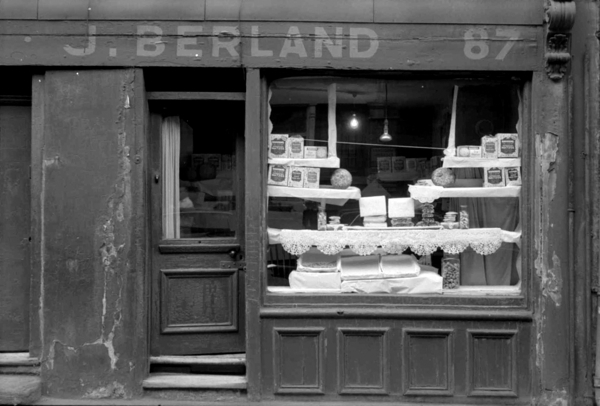
Tony Hall loved shops, as you can see from this magnificent array of little shops in the East End that he captured for eternity, selected from the thousand or so photographs which survive him.
In the sixties and seventies when these pictures were taken, every street corner that was not occupied by a pub was home to a shop offering groceries and general supplies to the residents of the immediate vicinity. The owners of these small shops took on mythic status as all-seeing custodians of local information, offering a counterpoint to the pub as a community meeting place for the exchange of everybody’s business. Shopkeepers were party to the smallest vacillations in the domestic economy of their customers and it was essential for children to curry their good favour if the regular chore of going to fetch a packet of butter or a tin of custard, or any other domestic essential, might be ameliorated by the possibility of reward in the form of sweets, whether there was any change left over or not.
Yet, even in the time these photographs were taken, the small shops were in decline and Tony Hall knew he was capturing the end of a culture, erased by the rise of the chain-stores and the supermarkets. To the aficionado of small shops there are some prize examples here – of businesses that survived beyond their time, receptacles of a certain modest history of shopkeepers. It was a noble history of those who created lives for themselves by working long hours serving the needs of their customers. It was a familiar history of shopkeepers who made a living but not a fortune. Above all, it was a proud history of those who delighted in shopkeeping.
SIGN THE PETITION TO SAVE OUR SHOPKEEPERS FROM THE NEW BUSINESS RATES




Photographs copyright © Libby Hall
Images courtesy of the Tony Hall Collection at the Bishopsgate Institute
You may also like to read
Libby Hall, Collector of Dog Photography
and take a look at these other pictures of East End Shops
At Paul Kirby’s Foam Shop

Near the top of Brick Lane, where it peters out into Bethnal Green, stands a lone house of mystery – accompanied by the gnarled stump of an old plane tree. Entirely at odds with the bland redevelopment that surrounds it, this edifice is unapologetic in its utilitarian idiosyncrasy and, when the windows glow at dusk on a rainy night, it possesses a magical allure which fascinates me. This is Paul Kirby’s foam shop.
For years, Paul Kirby has held out bravely against the “regeneration” that razed every other building in sight, and has emerged triumphant as the proud custodian of the last weaver’s house in the neighbourhood – built in the eighteenth century and incorporating a ship’s window into the frontage. “There’s been quite a lot of pressure to knock it down, but I took the council to court and won the case!” declared Paul in jubilant satisfaction, clasping his hands as he rocked back and forth in his easy chair.
You walk right in off the street into Paul’s workshop which occupies the entire ground floor of 74 Swanfield St, and is crammed with foam of every colour and description. On the left of this foam-lover’s paradise is the well-worn cutting board and, on the right, the tethered rolls of foam wait eager to spring into spongy life, while the space between is stacked with foam cushions – including a cherished Charles & Diana wedding souvenir foam cushion which, in astonishing testimony to Paul’s foam shop, has kept its bounce far longer than the ill-fated marriage ever did. And at the centre of all this foam sits Paul in his pork pie hat, a proud Englishman at home in his castle.
“I wouldn’t ever leave the East End now,” confided Paul, whose origins are in Mauritius, “I’ve got used to living in the bustling of Bethnal Green with all the cosmopolitans here. They looked down on foreigners when I first came to London in 1953 and it was hard to get a job or a room. Those were the darkest days, but I had some Jewish friends round here. It was a nice place to live, I loved it. It was elegant. I got a room in Code St off Brick Lane for fifty pence a week, from there I bought a lorry and started my own transport business.
Paul was conscripted into the British Army at eighteen years old from his home in Mauritius in 1950. When his mother died unexpectedly while he was in the forces, Paul was adopted by his commanding officer, who subsequently became Brigadier Kirby, and he returned to live in Britain with his new stepfather.
“I stayed with them in Hastings but it was difficult to get a job there, so he wrote me a letter which I took to a company in London and I got a job right away. Then he retired to St Austell in Cornwall and bought a Tudor house, where I used to visit at weekends. Although I was the only black man in St Austell, I had a lovely time. How people treated me there – it was unbelievable! When I got on the bus, they wouldn’t take money off me. They said, ‘Soldiers don’t pay!’
When I first came from Mauritius I was very fascinated by English furniture, especially Chesterfields, and I thought, ‘I’d like to make one of those.’ I’ve always been interested in furniture, so I studied upholstery. Since 1958 until now, I have been involved with upholstery, mostly lounge suites and I’ve made many Chesterfields.
In the sixties, I worked for the owner of this place. They manufactured reproduction furniture and I was their driver. There were scraps of fabric left over and they gave them to me. I asked the two machinists to make up cushion covers which I filled with scrap foam from the floor. And I took them down the market in Brick Lane on a Sunday and sold them for fifty pence each. And I made £20 each weekend and we shared it between us, which was pretty good when you realise that wages were only £8 a week.
I bought a two up/two down house in Bethnal Green, with no bathroom and an outside toilet, for £300. Then, in 1968, the furniture business moved to bigger premises so the boss asked me to run the shop for £8 a week. To start with, I sold secondhand furniture, wardrobes and things, and I just opened on Sunday because that was the only day people were walking about.
In the nineteen-seventies, we had a lot of problems with the National Front. Every weekend, there’d be marches and so on. I used to open up my house for the police to use the toilet because there’d be six bus loads of them waiting outside in case of trouble. I was in the middle of it because I was selling Union Jack cushions and some people asked me to stop selling them as it was a symbol adopted by the National Front, but I am an ex-army man and proud to be a citizen of the United Kingdom. It was not a nice time.
Around 1976, I started repairing furniture, recovering old three piece suites and reselling them, then in 1988 I took the place over and moved in and stayed ever since – but now I can’t compete with the big furniture warehouses, so I just do a bit of repair and sell foam, cushions and suchlike to local people. I have another home but I often stay here when I am working late, and most of my neighbours know me by my first name.”
Actively employed at eighty-three, Paul Kirby is now among the few who remember when Bethnal Green and Shoreditch were full of cabinet and furniture makers. And Paul has such a relaxed nature that his foam shop is an attractive place to linger to enjoy the peace and quiet, as if the very fabric of the building has now absorbed his personality – or as if the vast amount of foam insulates against the outer world, absorbing discord.
The recipient of kindness, Paul greets everyone who comes through the threshold with an equal generosity of spirit. You can be guaranteed of a welcome and a smile, as long as you have not come to knock down this venerable weaver’s house in the name of “regeneration” – because, after half a century, Paul and his building are one.


Paul Kirby

The mysterious allure of Paul Kirby’s foam shop at dusk
You may also like to read about other craftmen in Shoreditch
Spring Flowers At Bow

Seduced by promises of an early spring, I decided to return to Bow Cemetery to see if the bulbs were showing yet. Already I have some snowdrops, hellebores and a few primroses in flower in my Spitalfields garden, but at Bow I was welcomed by thousands of crocuses of every colour and variety spangling the graveyard with their gleaming flowers. Beaten and bowed, grey-faced and sneezing, coughing and shivering, the harsh winter has taken it out of me, but seeing these sprouting bulbs in such profusion restored my hope that benign weather will come before too long.
Some of my earliest crayon drawings are of snowdrops, and the annual miracle of bulbs erupting out of the barren earth never ceases to touch my heart – an emotionalism amplified in a cemetery to see life spring abundant and graceful in the landscape of death. The numberless dead of East London – the poor buried for the most part in unmarked communal graves – are coming back to us as perfect tiny flowers of white, purple and yellow, and the sober background of grey tombs and stones serves to emphasis the curious delicate life of these vibrant blooms, glowing in the sunshine.
Here within the shelter of the old walls, the bulbs are further ahead than elsewhere the East End and I arrived at Bow Cemetery just as the snowdrops were coming to an end, the crocuses were in full flower and the daffodils were beginning. Thus a sequence of flowers is set in motion, with bulbs continuing through until April when the bluebells will come leading us through to the acceleration of summer growth, blanketing the cemetery in lush foliage again.
As before, I found myself alone in the vast cemetery save a few Magpies, Crows and some errant squirrels, chasing each other around. Walking further into the woodland, I found yellow winter aconites gleaming bright against the grey tombstones and, crouching down, I discovered wild Violets in flower too. Beneath an intense blue sky, to the chorus of birdsong echoing among the trees, spring was making a showing.
Stepping into a clearing, I came upon a Red Admiral butterfly basking upon a broken tombstone, as if to draw my attention to the text upon it, “Sadly Missed,” commenting upon this precious day of sunshine. Butterflies are rare in the city in any season, but to see a Red Admiral, which is a sight of high summer, in February is extraordinary. My first assumption was that I was witnessing the single day in the tenuous life of this vulnerable creature, but in fact the hardy Red Admiral is one of the last to be seen before the onset of frost and can emerge from months of hibernation to enjoy single days of sunlight. Such is the solemn poetry of a lone butterfly in winter.

The spring bulbs are awakening from their winter sleep.

Snowdrops


Crocuses


Dwarf Iris


Winter Aconites


Daffodils will be in flower next week.


A single Red Admiral butterfly, out of season in mid-February – “sadly missed”
Find out more at Friends of Tower Hamlets Cemetery Park
You may also like to read about


