
Remembering Stratford’s Lost Industries
Too often when the story of the Queen Elizabeth Park – site of the 2012 Olympics – is told, the place is referred to as a former ‘wasteland’ prior to the ‘regeneration’ that we see today. Yet the truth is that this was once the location of hundreds of thriving local industries, many established over generations. Most of these premises were compulsorily purchased and demolished by the Olympic Authority, and a great proportion of these businesses closed down with a consequent loss of employment, skills and community, all for the sake of three weeks of sports events.
I have selected this gallery of dignified portraits from DISPERSAL, Picturing urban change in East London by Marion Davies, Juliet Davies & Debra Rapp which is published today, documenting these important industries and asserting the existence of this ‘lost’ manufacturing district in Stratford that has been conveniently marginalised from history in less than a decade.

Engineer Joe Mahari with a stator at Dowding & Mills, an electro-mechanical company founded in 1913 and established in White Post Lane over forty years but closed in Hackney Wick in 2010.

Brian Paverley finishing a stained glass panel at Goddard & Gibbs Studios Ltd, established in 1868. They did work for Westminster Abbey and the Chapel Royal at St James Palace, moved to Cooks Rd in 2001 but closed down when the Olympics arrived.

Tim Bird at New Image Upholstery. Tim ra the company with his wife Valerie since the mid-nineties but decided not to renew the lease due a rent increase at the time of the Olympics and they closed down the company.

Ahmed Rafik checking glass firing at the kiln at Bowdens Glass Ltd. This company specialising in curved glass had been established on this site since before the 1820s but closed in 2007.

Mandeep Sandhu in the milk store at Capital Dairy. Established in Bishopsgate, the dairy moved to Carpenters Rd in 1993 and then to Barking in 2007.

Paul Alexander adding ink to a printing duct at Club Le Print Ltd. This printing business was established for twenty-three years in King’s Yard but moved out to Thurrock in 2007.

Harry West, rag trade waste and textile merchant, at A&S Trading Company, set up by grandfather in the forties by dismantling Anderson shelters. He moved to Stratford in 2001 and was forced out by the Olympics but now trades from Epping and has weekly market stall in Hackney.

In the cold store at H.Forman & Sons, Salmon Smokers. Formans were first established in the East End in 1905. They moved to Stratford in 2002 and moved again to Hackney Wick in 2006 when they were displaced.

Jenny Mann owned the Golden Dragon take-away in Barking and ran a mobile catering van offering congee, rice and noodles until she sold up in 2011.

Waheed Rahman owner at Jay J Autos Ltd traded for ten years offering recycled spare car parts and repair work, until 2007 when he moved to South Woodford but the cost of relocation caused his company to close in 2013.

Mechanics Ghazansar Hussain & Jamshed Khan at Jay J Autos Ltd

Amerjeet & Gurdeep Singh at Lucky Wholesale Company, established by their father who worked as a door-to-door salesman in 1955 when he arrived from Delhi. Beginning in Shepherds Bush Market, they were in Aldgate East for thirty years, before moving to Straford in 2001. Before the Olympics, the brothers closed down the company and retired.

Erdal Oyak (centre), son Kozan and Uncle Andy at M&M Taxis

Seamstress checks coats made for Hackett at the finishing station at Panache Outerwear Ltd in Marshgate Lane. They were forced out from their factory by the Olympics but continue to operate from another location nearby.

Steve Goodchild, Transport Manager at Parkes Galvanising Ltd, established in Marshgate Lane since the fifties but closed in 2007

Cutting cloth at Panache Outwear Ltd

Pentaluck Ltd, wholesale dealers in Chinese vegetables, was established by Chin Check in Camberwell in 1991, moved to Waterden Rd in 2001 and then to Leyton in 2007.

Martin Walrand packing boxes at Tyrone Textiles Ltd in Marsgate Lane. Founded in 1978, this family-owned wholesale cloth business was in Stratford for seventeen years before moving to Enfield in 2007

Bradlee Priest cutting bracket feet at Priest Brothers. Established by his grandfather Ron Priest in the fifties in Bethnal Green, they relocated to Marshgate Lane in 2000 and moved to Chelmsford in 2007

Bow Tyres occupied a site that had opened as a car mechanic in 1917 under the name W J Cearns
Photographs copyright © Debra Rapp
Click here to buy a copy of DISPERSAL, Picturing urban change in East London published by Historic England. Spitalfields Life readers get 20% discount by entering code DISPSL17
You may also like to read about
At The Eagle Tavern

I wish you would take me out to the theatre. As the autumn nights draw in, I dream of leaving the gloomy old house one evening and joining the excited crowds, out in their best clothes to witness the spectacular entertainments that London has to offer. The particular theatre I have in mind is the Grecian Theatre attached to the Eagle Tavern in Shepherdess Walk, City Road between Angel and Old St.
The place seems to have developed quite a reputation, as I read yesterday, “The Grecian Saloon is really a hot house or a black hole, for the number of human beings packed in there every night would induce a supposition there was no other place of entertainment in London. At least two thousand persons were left unable to procure admission.” This was written in 1839, demonstrating that the popular art of having a good time – still pursued vigorously in the many pubs and clubs here today – is a noble tradition which has always thrived in the East End, outside the walls of the City of London.
“Up and down the City Road, in and out the Eagle, that’s the way the money goes…” The Eagle public house in the rhyme still exists to this day, though barely anything remains of the elaborate entertainment complex which developed there during the nineteenth century – apart from a single scrapbook that I found in the archive of the Bishopsgate Institute. All the balloon ascents, the stick fights, the operas, the wrestling and the wild parties may be over, and the thrill rides closed long ago, but there is enough in this album to evoke the extravagant drama of it all and fire my imagination with thoughts of glamorous nights out on the town.
You only have to walk through Brick Lane and up to Shoreditch on a Saturday night, through the hen parties and gangs of suburban boys out on a bevy, jostling among the crowds of the intoxicated, the drugged and the merely overexcited, to get a glimpse of what it might have been like two hundred years ago. With as many as six thousand attending events at the Eagle Tavern, we can assume that lines must have formed just as we see today outside nightclubs.
On the site of the eighteenth century Shepherd & Shepherdess Pleasure Garden, the Grecian Saloon developed at the Eagle Tavern to provide all kinds of entertainments, from religious events to conjuring and equestrian performances. There are only tantalising hints that survive of these bygone entertainments. Yet sentences like “We are glad to find that little Smith has recovered her hoarseness” and “We have little to find fault with save that the maniac was allowed to perambulate the gardens without his keeper” do set the imagination racing. There are many fine coloured playbills in the cherished album, crammed with enigmatic promises of exotic thrills. I wonder who exactly was the beautiful Giraffe Girl, or General Campbell, the smallest man in the world. Amongst so much hyperbole there is a disappointing modesty to learn that the central attractions are merely supported by the “artistes of acknowledged talent.”
Elaborate pavilions with all manner of special effects were constructed at the Grecian Saloon, which in turn became the Grecian Theatre in 1858 where Marie Lloyd made her stage debut aged fifteen. Eventually the building was acquired in 1882 by General William Booth of the Salvation Army and the parties came to an end. Yet this site saw the transition from eighteenth century pleasure garden to nineteenth century music hall. The many thousands of souls who experienced so much joy there over all those years impart a certain sacred quality to this location, even if it is now mostly occupied by Shoreditch Police Station.


Watercolours of the New Grecian Theatre in 1899, built during the management of George Augustus Oliver Conquest in 1858 and later purchased by General William Booth of the Salvation Army


Images courtesy Bishopsgate Institute
Dennis Anthony’s Petticoat Lane

If you are looking to spruce up your linen cupboard with some fresh bolster cases or if it is time to replace those tired tea towels and soiled doilies, then these two lovely gentlemen are here to help. They have some super feather eiderdowns and quality blanket sets to keep you snug and cosy on frosty nights, and it is all going for a song.
One summer Sunday in the nineteen fifties, Dennis Anthony took his camera down Petticoat Lane to capture the heroes of the epic drama of market life – all wearing their Sunday best, properly turned out, and even a little swanky. There is plenty of flash tailoring and some gorgeous florals to be admired in his elegant photographs, composed with dramatic play of light and shade, in compositions which appear simultaneously spontaneous and immaculately composed. Each of these pictures captures a dramatic moment – selling or buying or deliberating – yet they also reward second and third glances to scrutinise the bystanders and all the wonderful detail of knick-knacks gone long ago.
When the West End shops shut on Sundays, Petticoat Lane was the only place to go shopping and hordes of Londoners headed East, pouring through Middlesex St and the surrounding streets that comprised its seven “tributaries,” hungry for bargains and mad for novelty. How do I know this? Because it was the highlight of my parents’ honeymoon, when they visited around the same time as Dennis Anthony, and I grew up hearing tales of the mythic Petticoat Lane market.
I wish I could buy a pair of those hob-nailed boots and that beret hung up beside the two sisters in shorts, looking askance. But more even than these, I want the shirt with images of records and Lonnie Donegan and his skiffle group, hung up on Jack’s stall in the final photograph. Satisfied with my purchases, I should go round to Necchi’s Cafe on the corner of Exchange Buildings and join those distinguished gentlemen for refreshment. Maybe, if I sat there long enough, I might even glimpse my young parents come past, newly wed and excited to be in London for the first time?
I am grateful to the enigmatic Dennis Anthony for taking me to Petticoat Lane in its heyday. Stefan Dickers, Archivist at the Bishopsgate Institute, bought the prints you see here online and although they are labelled’ Dennis Anthony’ upon the reverse, nothing more is known bout the mysterious photographer.


You might also like to see
Laurie Allen of Petticoat Lane
The Wax Sellers of Wentworth St
Thomas Rowlandson’s Lower Orders

Great News!
Although Thomas Rowlandson was born as the son of a wool and silk merchant in Old Jewry in the City of London who went bankrupt when Thomas was just two years old, he had the unexpected good luck to inherit a fortune of £7,000 from a French aunt. Yet due to a profligate nature, Thomas’ inheritance got quickly squandered and he turned to caricature as a means of income, achieving memorable success. A series of life experiences which may permit us to surmise that Rowlandson’s use of the term Lower Orders, in the title of his Characteristic Sketches of the Lower Orders (a set of fifty prints published in 1820), was not entirely without irony.
While many sets of Cries of London over the centuries presented a harmonious social picture in which hawkers knew their place, I treasure Rowlandson’s work for the exuberant anarchy that he brings to his subjects who stride energetically through the London streets like they own them, gleefully lacking any sign of subservience. Rude, rambunctious, horny and venal as rats, these are Londoners that we can all recognise and, even though Rowlandson’s vision is not a flattering view of humanity, his lack of sentimentality endears us to his subjects in spite of their flawed natures.
In Rowlandson’s work, the drama of the city is all-consuming as everyone strives for gratification, whether making a living, seeking sexual pleasure, or simply to assert their being. These people appear childlike in their preoccupations, because nobody has time for self-conscious reflection when everyone is too busy pursuing life.
In the Newspaper Seller and the Cab Driver, the “lower orders” are placed in relation to their “superiors” and, in each case, the tension of the relationship is obvious. The Paper Sellers’ trumpet and loud cries are irking their customers by awakening them in the early morning, while the Cabbie is affronted by his meagre tip and challenges his passengers. And neither shows any regard for those who are offended by their lack of manners.
By contrast, in the plates of the Postman and the Rose Seller, the tension is erotic – the Postman checks out his young female customer while a voyeur cranes from a balcony above and the Rose Seller assumes a faux innocence when an old lecher chucks her under the chin – in each instance proposing transactions both covert and overt. Then there are the clownish Cat & Dogs’ Meat Seller, beset by hungry dogs, and the senile Night Watchman, oblivious of burglars. Only two hawkers demonstrate humility, the Knife Grinder preoccupied with his work and the Curds & Whey Seller sitting to watch the happy young mother and her children with tacit envy. Finally, the China Sellers and the Tinker mending pots and kettles are grotesques. The China Sellers ingratiate themselves in a predatory manner, but the Tinker meets his match in the demanding old hag.
There are some appealingly scruffy spontaneous lines are familiar to us in the drawings of Quentin Blake. By his early sixties, Rowlandson had sacrificed the precise elegant flowing lines of his early career for these off-the-cuff sketches which communicate character with great immediacy.
Ultimately, the central ambiguity and source of drama in Rowlandson’s Characteristic Sketches of the Lower Orders is the question – Who is playing who? It is apparent that there is no simple answer. Instead, Rowlandson presents a series of precise scenarios that trace delicate lines of social and economic distinction with wit and humanity, avoiding any didactic or moral conclusion. Above all, these wonderful prints illustrate that moral worth does not equate with the “Lower” or “Higher” orders, and their relative economic worth. Thomas Rowlandson’s Londoners are just as good and as bad each other.

Wot d’yer call that?

Cats and Dogs’ Meat?

Letters for Post?

Past one o’clock and a fine morning!

Buy my Sweet Roses?

Knives and Scissors to Grind?

Curds and Whey?

Any Earthenware? Buy a Jug or a Teapot?
 Pots and Kettles to Mend?


You may also like to take a look at
Marcellus Laroon’s Cries of London
More John Player’s Cries of London
William Nicholson’s London Types
Francis Wheatley’s Cries of London
In Old Clerkenwell

In St John’s Path
At weekends, when the crowds throng in Spitalfields, I sometimes walk over to Clerkenwell. Apart from those carousing in Exmouth Market, the place is like a ghost town on Saturday & Sunday, leaving the visitor free to explore the streets in peace.
There is a particular ramshackle quality to this quarter of London that especially appeals to me, where every street is either winding around a corner or sloping away down the hill, or both. Many of my formative experiences as a writer occurred in Clerkenwell, since from 1990 I rented a tiny office in Clerkenwell Close for ten years or so, and went there every day to write. When I could not write, I wandered the streets which became familiar to me as the urban landscape of my contemplation and, over time, I learnt something of their history too.
I wander around Clerkenwell and I think about the Mystery plays performed by clerks on the Green in the medieval era, about how the Close still follows the former cloister of the Priory of St John, about Wat Tyler addressing his rebel force upon the Green, about Oliver Cromwell’s house in Clerkenwell Close that had orchards down to the Fleet River, about the monstrous Middlesex House of Detention where thousands met their deaths, about Joseph Grimaldi playing at Sadler’s Wells, about Charles Dickens sitting with his reporter’s notebook in the Court House, about Vladimir Ilyich Lenin having a drink in the Crown, about Arnold Bennett’s Riceyman Steps and George Gissing’s The Nether World – two magnificent Clerkenwell novels – and, more recently, I think of Colin O’Brien photographing car crashes in the Clerkenwell Rd.

In Britton St

St John’s Gate, where Hogarth’s father ran a Latin-speaking Coffee House

Old Court House, Clerkenwell Green, where Dickens served as a cub reporter

Door at the rear of the Court House

On Clerkenwell Green

St James, Clerkenwell, by James Carr 1792

At the rear of the church

The church gates

In Pear Tree Court

In Amwell St

In Wilmington Sq

In Clerkenwell Close, where Oliver met the Artful Dodger in ‘Oliver Twist’

The old wall of the former Middlesex House of Detention

St James Clerkenwell

Farmiloe Building, St John St

In Passing Alley

Finsbury Savings Bank, Sekforde St since 1840 – customers included Charles Dickens

Sekforde Arms, since 1838

Sekforde St

Sekforde Arms

In Hayward’s Place

Woodbridge Chapel

Gleave & Co, Watch Repair Supplies, Albemarle Way

In Herbal Hill

In Back Hill

The Castle in Cowcross St since 1830

Coach & Horses in Ray St since 1808

Clerkenwell Fire Station, formerly Britain’s oldest 1872- 2014

Our Most Holy Redeemer, Exmouth Market

In Exmouth Market

Exmouth Arms since 1825

In Cafe Kick

Farringdon Tool Supplies, Exmouth Market
You may also like to take a look at
Eleanor Crow’s East End Fish Shops

Victoria Fish Bar, Roman Rd
I try to eat fresh fish at least once a week and so, as I travel around the East End, I tend to navigate in relation to the fish shops. Illustrator Eleanor Crow shares a similar passion, witnessed by these loving portraits of top destinations for fish, whether jellied eels, fish & chips or fresh on the slab. “These places are a reminder of our river-dependent history,” Eleanor informed me, “I love the look of London’s famous eel shops with their ornate lettering and wooden partitions. Nothing beats having a proper fishmongers’ shop or market stall in the neighbourhood – not only do the shops look good, but these guys really know about fish.”

F.Cooke, Broadway Market

The Fishery, Stoke Newington High St

George’s Place, Roman Rd

G. Kelly, Bethnal Green Rd

Mike’s Quality Fish Bar, Essex Rd

Davies & Sons, Hoe St

The Fish Plaice, Cambridge Heath Rd

Mersin Fish, Morning Lane

Dennis Chippy, Lea Bridge Rd

Kingfisher, Homerton High St

Mersin 2, Lower Clapton Rd

Golden Fish Bar, Farringdon Rd

Tubby Isaacs, formerly in Aldgate

L. Manze, Walthamstow High St

Sea Food & Fresh Fish, Chatsworth Rd

G. Kelly, Roman Rd

Steve Hatt, Essex Rd

Jonathan Norris, Victoria Park Rd

Downey Brothers, Globe Town Market Sq

Barneys Seafood, Chambers St

Billingsgate Market
Illustrations copyright © Eleanor Crow
You may also like to see Eleanor Crow’s other East End illustrations
Eleanor Crow’s East End Bakers
and read these other fish stories
The Markets of Old London

Clare Market c.1900
I never knew there was a picture of the legendary and long-vanished Clare Market – where Joseph Grimaldi was born – until I came upon this old glass slide among many thousands in the collection of the London & Middlesex Archaeological Society, housed at the Bishopsgate Institute. Scrutinising this picture, the market does not feel remote at all, as if I could take a stroll over there to Holborn in person as easily as I can browse the details of the photograph. Yet the Clare Market slum, as it became known, was swept away in 1905 to create the grand civic gestures of Kingsway and Aldwych.
Searching through this curious collection of glass slides, left-overs from the days of educational magic lantern shows – comprising many multiple shots of famous landmarks and grim old church interiors – I was able to piece together this set of evocative photographs portraying the markets of old London. Of those included here only Smithfield, London’s oldest wholesale market, continues trading from the same building, though Leather Lane, Hoxton Market and East St Market still operate as street markets, but Clare Market, Whitechapel Hay Market and the Caledonian Rd Market have gone forever. Meanwhile, Billingsgate, Covent Garden and Spitalfields Fruit & Vegetable Market have moved to new premises, and Leadenhall’s last butcher – once the stock-in-trade of all the shops in this former cathedral of poultry – closed last year.
Markets fascinate me as theatres of commercial and cultural endeavour in which a myriad strands of human activity meet. If you are seeking life, there is no better place to look than in a market. Wherever I travelled, I always visited the markets, the black-markets of Moscow in 1991, the junk markets of Beijing in 1999, the Chelsea Market in Manhattan, the central market in Havana, the street markets of Rio, the farmers’ markets of Transylvania and the flea market in Tblisi – where, memorably, I bought a sixteenth century silver Dutch sixpence and then absent-mindedly gave it away to a beggar by mistake ten minutes later. I often wonder if he cast the rare coin away in disgust.
Similarly in London, I cannot resist markets as places where society becomes public performance, each one with its own social code, language, and collective personality – depending upon the nature of the merchandise, the location, the time of day and the amount of money changing hands. Living in Spitalfields, the presence of the markets defines the quickening atmosphere through the week, from the Thursday antiques market to the Brick Lane traders, fly-pitchers and flower market in Bethnal Green every Sunday. I am always seduced by the sense of infinite possibility when I enter a market, which makes it a great delight to live surrounded by markets.
These old glass slides, many of a hundred years ago, capture the mass spectacle of purposeful activity that markets offer and the sense of self-respect of those – especially porters – for whom the market was their life, winning status within an elaborate hierarchy that had evolved over centuries. Nowadays, the term “marketplace” is sometimes reduced to mean mere economic transaction, but these photographs reveal that in London it has always meant so much more.

Billingsgate Market, c.1910
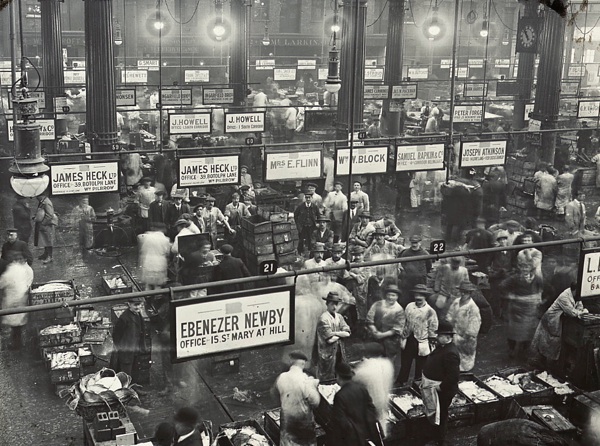
Billingsgate Market, c.1910

Whitechapel Hay Market c.1920 (looking towards Aldgate)

Whitechapel Hay Market, c.1920 (looking east towards Whitechapel)

Porters at Smithfield Market, c.1910

Caledonian Rd Market, c.1910

Book sale at Caledonian Rd Market, c.1910

Caledonian Rd Market, c.1910

Caledonian Rd Market, c.1910

Covent Garden Market, c.1920

Covent Garden Market, c.1910

Covent Garden, c.1910

Covent Garden Market, 1925

Covent Garden Market, Floral Hall, c.1910

Leadenhall Market, Christmas 1935

Leadenhall Market, c.1910

East St Market, c.1910

Leather Lane Market, 1936
 Hoxton Market, Shoreditch, 1910

Spitalfields Market, c.1930
Images courtesy Bishopsgate Institute
You may like to look at these old photographs of the Spitalfields Market by Mark Jackson & Huw Davies
Night at the Spitalfields Market
Other stories of Old London


