
The Gentle Author In Covent Garden
On Friday 19th May, I will be talking about the history of street trading in Covent Garden and showing old pictures of the CRIES OF LONDON at the London Transport Museum in the Piazza, as part of the launch evening for their SOUNDS OF THE CITY exhibition. Tickets available here
Today it is my pleasure to publish Marcellus Laroon’s vibrant engravings of the Cries of London that he drew while living in Covent Garden, reproduced here from an original edition of 1687 in the collection at the Bishopsgate Institute

The death of Oliver Cromwell and the restoration of Charles II made the thoroughfares of London festive places once again, renewing the street life of the metropolis – and when the Great Fire of 1666 destroyed the shops and wiped out most of the markets, an unprecedented horde of hawkers flocked to the City from across the country to supply the needs of Londoners .
Samuel Pepys and Daniel Defoe both owned copies of Marcellus Laroon’s Cries of London. Among the very first Cries to be credited to an individual artist, Laroon’s “Cryes of the City of London Drawne after the Life” were on a larger scale than had been attempted before, which allowed for more sophisticated use of composition and greater detail in costume. For the first time, hawkers were portrayed as individuals not merely representative stereotypes, each with a distinctive personality revealed through their movement, their attitudes, their postures, their gestures, their clothing and the special things they sold. Marcellus Laroon’s Cries possessed more life than any that had gone before, reflecting the dynamic renaissance of the City at the end of the seventeenth century.
Previous Cries had been published with figures arranged in a grid upon a single page, but Laroon gave each subject their own page, thereby elevating the status of the prints as worthy of seperate frames. And such was their success among the bibliophiles of London, that Laroon’s original set of forty designs – reproduced here – commissioned by the entrepreneurial bookseller Pierce Tempest in 1687 was quickly expanded to seventy-four and continued to be reprinted from the same plates until 1821. Living in Covent Garden from 1675, Laroon sketched his likenesses from life, drawing those he had come to know through his twelve years of residence there, and Pepys annotated eighteen of his copies of the prints with the names of those personalities of seventeenth century London street life that he recognised.
Laroon was a Dutchman employed as a costume painter in the London portrait studio of Sir Godfrey Kneller – “an exact Drafts-man, but he was chiefly famous for Drapery, wherein he exceeded most of his contemporaries,” according to Bainbrigge Buckeridge, England’s first art historian. Yet Laroon’s Cries of London, demonstrate a lively variety of pose and vigorous spontaneity of composition that is in sharp contrast to the highly formalised portraits upon which he was employed.
There is an appealing egalitarianism to Laroon’s work in which each individual is permitted their own space and dignity. With an unsentimental balance of stylisation and realism, all the figures are presented with grace and poise, even if they are wretched. Laroon’s designs were ink drawings produced under commission to the bookseller and consequently he achieved little personal reward or success from the exploitation of his creations, earning his living by painting the drapery for those more famous than he and then dying of consumption in Richmond at the age of forty-nine. But through widening the range of subjects of the Cries to include all social classes and well as preachers, beggars and performers, Marcellus Laroon left us us an exuberant and sympathetic vision of the range and multiplicity of human life that comprised the populace of London in his day.


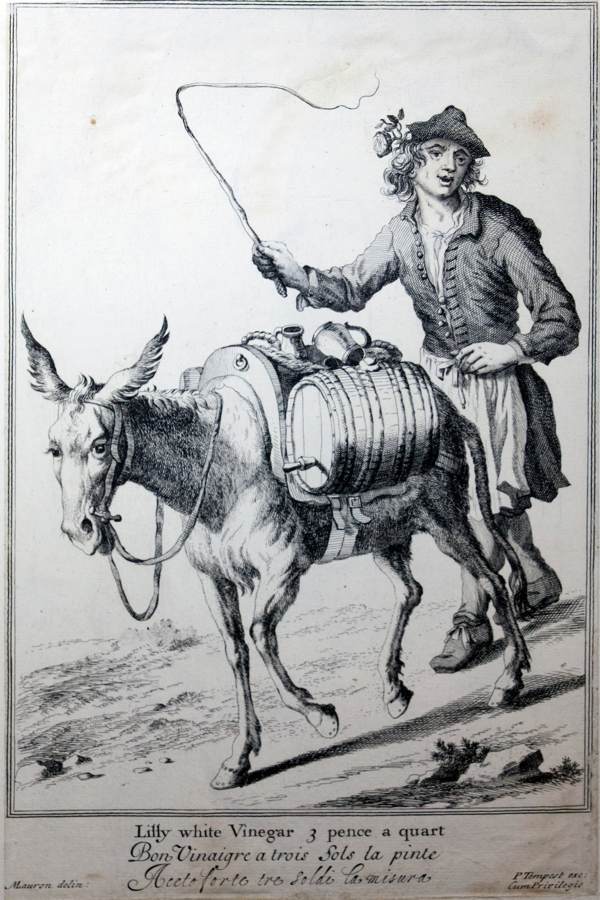


Images photographed by Alex Pink & reproduced courtesy Bishopsgate Institute
Peruse these other sets of the Cries of London I have collected
More John Player’s Cries of London
More Samuel Pepys’ Cries of London
Geoffrey Fletcher’s Pavement Pounders
William Craig Marshall’s Itinerant Traders
H.W.Petherick’s London Characters
John Thomson’s Street Life in London
Aunt Busy Bee’s New London Cries
William Nicholson’s London Types
Francis Wheatley’s Cries of London
John Thomas Smith’s Vagabondiana of 1817
John Thomas Smith’s Vagabondiana II
John Thomas Smith’s Vagabondiana III
Thomas Rowlandson’s Lower Orders
Homer Sykes’ Spitalfields

At the Queen’s Silver Jubilee in Brick Lane
From the moment he first came to London as a student until the present day, Homer Sykes has been coming regularly to Spitalfields and taking photographs. “It was very different from suburban West London where I lived, in just a few tube stops the contrast was extraordinary,” he recalled, contemplating the dislocated world of slum clearance and racial conflict he encountered in the East End during the nineteen seventies when these eloquent pictures were taken.
Yet, within this fractured social landscape, Homer made a heartening discovery that resulted in one of the photographs below. “The National Front were demonstrating as usual on a Sunday at the top of Brick Lane.” he told me, “I was wandering around and I crossed the Bethnal Green Rd, and I looked into this minicab office where I saw this Asian boy and this Caucasian girl sitting happily together, just fifty yards from the demonstration. And I thought, ‘That’s the way it should be.'”
“I walked in like I was waiting for a taxi and made myself inconspicuous in order to take the photograph. It seemed to sum up what should be happening – they were in love, and in a taxi office.”


In Princelet St

In Durward St

Great Eastern Buildings

In a minicab office, Bethnal Green Rd


Selling the National Front News on the corner of Bacon St
Photographs copyright © Homer Sykes
You may also like to take a look at
Homer Sykes, Photographer
Nevio Pellicci Goes To Market

Nevio Pellicci goes in search of Maris Piper
“This is my dad’s old car,” explained Nevio Pellicci as he drove Contributing Photographer Sarah Ainslie & me through Bethnal Green before dawn, “I just use it now for these market trips” – and he patted the dashboard affectionately in remembrance of Nevio Pellicci senior. Each Monday, Wednesday and Friday, Nevio drives over to the New Spitalfields Market to buy fresh vegetables for his celebrated family-run cafe in the Bethnal Green Rd which has been in business since 1900.
“I’m up at five-fifteen and at the cafe by six,” Nevio explained lightly, revealing that he had been working even before we set out that morning,”When I was a boy, my mum used to wake me at four-fifteen and I’d just roll over, but my dad used to switch the lights on. He was of the old school, he was a grafter. You always had be doing something, that’s how he prepared you for life ahead.”
We sped through the empty East End streets towards Leyton, where the nocturnal wholesale market was just winding down after a night’s trading. Once we drove through the security gates, Nevio’s first port of call was Johnny Bates – known as the Legend – a tall man with a shock of white hair, whose role goes by the arcane name of Cartminder. In other words, Johnny keeps an eye on Nevio’s car and makes sure his market purchases are safe when they are delivered to the car by the Porters. “I bring him a piece of bread pudding sometimes,” Nevio confided to me, “Not too often mind you, I don’t want to spoil him.”
We entered the vast market hall that stretched away into the distance with a bewildering array of stands displaying enough vegetables to feed a city, stacked up in tall metal towers. Nevio knew what he was looking for and went straight for the spring greens at Ernest Hammond, where he is a familiar customer – enough to be welcomed liked a long-lost relative by the fellows behind the desk. The current Mr Hammond informed me he is sixth generation in this family business, the oldest in the market.
When I looked around, Nevio was off searching among the produce, since the greens were merely the overture to his essential quest – for potatoes to make the chips for which Pelliccis are famous throughout the capital.“Mum won’t use anything else but these!” he announced, holding up a sack of Maris Piper in triumph.
“We used to get our veg delivered,” Nevio confessed to me, rubbing his hands in glee as we strode through the cavernous hall together, “But I prefer to come here, you get to see what you are buying and you save a lot of money.” Next stop was Aberdeen Stanton, third generation traders in the market. “This is where I get 95% of my stuff,” Nevio assured me with a proprietorial smile, “If they haven’t got it, they’ll find it for me.”
“I’m in and out in no time, I get everything and I’m back to the cafe,” admitted Nevio, once he had run through his list, yet since Sarah & I were there, he agreed to take a stroll around. Our last destination was Dino’s Cafe, that was formerly in Crispin St, Spitalfields, and moved here in 1991. “I used to come in here when I was bunking off school,” Nevio whispered to me. Taking a moment to shake hands with Ernesto Fiori, the proprietor, and greet Jim Olney, the paper bag seller from Donovans, we carried off cups of tea to drink on our way. As we were leaving, I met Keith Edwards, a Porter of forty-eight years standing – “I’ve Porters in my family in the London markets going back over a hundred years,” he told me.
Before I could pursue the conversation with Keith, we were outside in the sunrise as Porter, Terry Holt, arrived with Nevio’s order – delivered at the car where Johnny Bates was waiting. Terry boasted fifty-one years in the job. “I had three uncles down here as Porters in 1963,” he informed me proudly. Johnny Bates, thirty years a Cartminder, was not to be outdone –“My grandfather worked in Spitalfields Markt when he was eight years old and when the Market closed in the morning, he walked up through Quaker St, under the arches, whistling and then his mother came out the house with a piece of toast and his schoolbooks for him, and off he went to school.” After this disclosure, I knew why Johnny is known as ‘the Legend.’
We were chilled to the bone and, lacking the inborn vitality of market traders, Sarah & I were happy to be back in the warm at Pelliccis in Bethnal Green eating a hot breakfast. It had been an adventure, but for Nevio it happens three nights a week, every week, as a prelude to a day’s work in the cafe. The lengths some people will go to for fresh vegetables are astonishing.


Spring greens from Ernest Hammond


Lawrence


Ernest Hammond, six generations in the family business


Jim Olney, right, celebrated paper bag salesman

Nevio with Johnny Bates, legendary Cartminder


Nevio’s order for Pelliccis Cafe

Delivering the fresh veg at Pelliccis
Photographs copyright © Sarah Ainslie
E.Pellicci, 332 Bethnal Green Rd, E2 0AG
You may like to read my other Pellicci stories
Christmas Ravioli At E Pellicci
Maria Pellicci, The Meatball Queen of Bethnal Green
Colin O’Brien’s Pellicci Portraits ( Part One)
Colin O’Brien’s Pellicci Portraits (Part Two)
Philip Cunningham’s London Docks
Once, the East End had the ‘docks land’ but when the docks closed and the developers moved in they rechristened it the ‘docklands’ – a transformation recorded by Photographer Philip Cunningham

‘My paternal grandfather was a dock labourer all his life. He came from Dublin and was in the Irish gunners during the First World War. He suffered from shell shock afterwards yet managed to carry on working. I never met him as he died the year I was born. When the Docks were moved out of London, the speculators wanted to develop the old wharfs but, whenever they could not get planning consent, the wharfs would mysteriously catch on fire! Very convenient for them. What a grand rip-off it was!’ – Philip Cunningham

Construction of Tower Hamlets’ new Town Hall

Free Trade Wharf, Wapping


King Henry’s Wharf, Wapping

Greenwich


Regent’s Canal

Lusk’s Wharf

‘whenever they could not get planning consent, the wharfs would mysteriously catch on fire’


Three Mills Island, Bow


The Grapes, Limehouse

South of the river

Building frenzy on the Isle of Dogs


Isle of Dogs


London Docklands Development Corporation


Protest against the London Docklands Development Corporation

Philip’s grandfather, Arthur Cunningham, worked as dock labourer his whole life
Photographs copyright © Philip Cunningham
You may also like to take a look at
Philip Cunningham’s East End Portraits
More of Philip Cunningham’s Portraits
Yet More Philip Cunningham Portraits
Philip Cunningham at Mile End Place
Gary Arber At Home

Gary Arber shows off his collection of WWII incendiary bombs
If anyone else showed me their collection of Second World War incendiary bombs, I should be entirely astonished but with Gary Arber it was completely normal behaviour. Over the years, I have come to expect no less of him. Ever since I first visited Gary’s old print shop in the Roman Rd, where he oversaw the family business established by his grandparents a century earlier, I have learnt to appreciate Gary as the custodian of wonders.
Three years ago, when Gary sold up the shop, his magnificent collection of printing presses were hauled off to a new life elsewhere and W.F. Arber & Co Ltd passed into legend in the Roman Rd. Now it has taken its place in history as the print works where Emily Arber printed Suffragette handbills for Mrs Pankhurst, but Bow is a lesser place without Gary Arber as a living connection to the old East End.
Unable to contain my curiosity any longer, I realised it was my responsibility to take the train down to Romford to visit Gary and see how he is getting along these days, on behalf of everyone else who misses him in our neck of the woods. Thus it was I came to be standing in Gary’s ramshackle shed last week, gasping in awe as he showed off his collection of incendiary bombs, all now rendered entirely harmless you will be relieved to learn.
Constructed of pieces of other buildings, extended over time and filled with a large collection of old tools, Gary’s shed is a fine specimen of its kind. Yet casting an eye into the shadows, I realised that it descended to another level below ground. Gary explained to me that this subterranean construction was an Anderson Shelter where he, as a child, and Florence, his mother, slept each night during the Second World War while the bombs dropped on Romford.
In 1929, Gary’s father brought Florence down from the East End on an excursion to show her the newly-laid foundations of the house he had bought in which they were to spend their married life and where, in 1931, Gary was born. Apart from a short spell as a pilot in the Royal Air Force, Gary has lived here his whole life and the house exists today as a time capsule more-or-less, with an oxblood and butter paint scheme, an original yellow and black bathroom and a substantial enamelled iron stove in the kitchen. I should be very surprised if there are any other of the original occupants of this long suburban street still resident except Gary.
In this cosy dwelling, Gary and his wife, Ruby, pass their days watching the birds coming to visit the array of feeding devices, hung just outside the picture window in the rear parlour. I was informed the avian population in this particular corner of Romford consume half a ton of bird food annually, and Gary is especially proud of his population of over sixty sparrows that he has nurtured in recent years by making holes in the eaves where they can nest.
A glimpse at the photograph of the immaculately-tended garden with its flawless lawn and formal borders which formerly existed behind the printshop in Roman Rd reveals that Gary’s relaxed horticultural style is in strong contrast to his grandparents. Yet, in his parents’ day, the garden in Romford was similarly prim, with a lawn permitting clock golf which was a popular pastime among the Unitarian Congregation of Bow. Even after they left the East End, Gary’s parents were able to maintain their lively social life enjoyed among members of the congregation, by luring them to Romford with this innocent sport.
Gary is a free spirit in horticulture, scattering packets of wild flower seeds and declaring that there is no such thing as a weed in his garden. The outcome is an exuberant rush of dense growth at this time of year, with bluebells, forget-me-nots, dandelions and aquilega in plenty. It makes an ideal environment for the urban wildlife that Gary cherishes. An upturned boat serves as home to a pair of foxes and their litter of cubs, while a series of ponds provide dwellings for a variety of aquatic life.
As we passed the shed which bisects his garden, Gary pulled back the branches revealing our path ahead and announced, ‘You are now entering the Reserve,’ as if were stepping into an uncharted jungle. Here we stood and peered into the newt pond, hoping to catch glimpse of a golden newt but had to make do with columns of bubbles arising enigmatically from the bed. Most impressive was the carp pool beyond, inhabited by two vast pale creatures of more than twenty years of age and over two feet in length, accompanied by the fattest goldfish I ever saw. Gary stood in silent pleasure, mesmerised as they cruised ceaselessly around in the shadowy depths like ghosts.
Several hours passed while Gary and I negotiated his garden of relatively modest size, and he recounted his stories. Then, once Gary had potted a teazle to accompany the yellow flag iris that he gave me years ago which now occupies a boggy corner of my garden in Spitalfields, we repaired to his house for tea. Since Ruby was taking her afternoon nap in the parlour, we tiptoed through the tidy house with our cups of tea and ascended a creaky metal ladder to Gary’s untidy attic, where he prefers to spend his time while indoors.
Sometime in Gary’s youth, he must have discovered this loft and, out of respect for Ruby’s house-proud nature, today he restricts his stash of clutter and curiosities to this secret den. For my delight, Gary produced his father’s Air Raid Warden helmet, optical novelties for Magic Lanterns, finely-engraved wooden printing blocks and more. It was humid in the attic and I must confess I discovered myself dozing off while Gary regaled me with stories. This is a shameful admission but I include it here as evidence we need harbour no anxiety that Gary is living in a bereft state since his departure from the East End. Obviously, the closure of his grandparents’ printshop in the Roman Rd was an enormous responsibility for Gary which took its toll, physically and emotionally. Yet today Gary Arber is in fine fettle at eighty-six, he has put it all behind him and he is at home in Romford.


Gary feeds half a ton of birdseed to his garden visitors each year


Gary pots a teazle seedling for my garden

Gary’s newt pond in foreground

Anderson shelter in use as a store


Old Carp over two feet long live in Gary’s pond


Gary on holiday with his parents, Walter and Florence Arber in the thirties

Gary’s grandparents, Emily & Walter Francis Arber, who opened the print shop in 1897
Read my other stories about Gary Arber
James Brown at W.F.Arber & Co Ltd
Two Spitalfields Shopkeepers
Last week, I published Steven Harris‘ candid memoir of his childhood at Great Eastern Buildings off Brick Lane and today I present his poignant account of two local shopkeepers, one universally beloved and the other notorious by reputation, yet both well-known Spitalfields personalities at that time.

Everyone I ever spoke with recalled Great Eastern Buildings in affection and, without exception, everyone also knew and loved Harry Fishman, owner of the newsagent on the corner of Quaker Street and Brick Lane. Harry was a legend in his own lifetime who commanded a significant degree of respect and reverence, even though we local kids were forever pinching comics, sweets and even small coins from his shop.
In my childhood, Harry was already in his sixties, around 5’ 8”, a bit chubby and with a receding hairline. He existed as a kindly granddad figure who seemed to have an easy-going attitude and a constant smile on his face, always avuncular and jovial, in contrast to my own granddad, Knacker, who was a mean old goat. We children felt a sense of empathy with Harry despite our small scale pilfering. He was never angry or said anything bad about anyone. Accordingly, we always looked forward to visiting his store, run down as it was. My friend Sheila Bell remembers his generosity and how, in the fifties, she would go to Harry’s, hand over her halfpenny and get a whole cone of sweets. By the mid-sixties, inflation meant our halfpennies only bought four black jacks (chewy liquorice sweets) or fruit salads (multi-coloured chewy sweets) – nothing like a coneful.
Harry was married to Marion who was short and round, and not nearly as easy going as Harry. She was far more aware of our ‘tea leaf’ tendencies and more than willing to challenge us, as Sylvie Pattern confided to me, recounting how Marion gave her a dressing down for the activity of her sons, Stephen and Keith, nicking sweets. Fortunately, Marion was not a regular presence in the shop which permitted us to benefit from Harry’s largesse, turning a blind eye to our pilfering. Though how he managed to ignore one of the local kids, Snudge, once nicking seven large bottles of pop is beyond me.
Harry even rewarded us sometimes. ‘Harris, want to do a bit of work?’ he would occasionally call out to me and whichever other kid was nearby, offering the opportunity to earn maybe a shilling or a big bar of chocolate. Harry was not the greatest at house keeping and neither was Marion who, rumour had it, preferred to keep company with the local brewery workers. So cleaning up his place was a golden opportunity to pry. My Cousin Jackie once claimed to have stumbled upon a supply of pornographic mags, as sold in the shop, while someone else confessed to have eaten several bags of crisps discovered in an open box. Whatever the truth of these tales, it was our chance to poke into Harry’s private life and be guaranteed a reward too.
Harry lived on the two floors above the shop. The place was a mess and he left us with the simple instruction to ‘Get on with it,’ so we did just that. ‘What’s in here?’ was a constant exclamation, with the rejoinder ‘Dunno, better have a look.’ Much of what we found was a mystery to us – invoices, bills and bank statements – exciting things that never seemed to come our way. Whenever we thought he was due to arrive, we rushed about tidying and cleaning to create the impression of working and ensure a good pay out. On one occasion, I got one shilling and sixpence for my efforts but, on another day, only a medium-sized bar of chocolate which drew the verdict of ‘tight bastard’ when I had left the premises. Cousin Jackie once earned half a crown, though I strongly suspect she had actually done some work to earn it, unlike lazy little me.
Harry was generally well-liked in Great Eastern Buildings, allowed credit to the adults and even splitting up packets of cigarettes so people could buy them individually. Rather naughtily, he would also sell single cigarettes to children. Back then, this was simply ‘business’ and smoking was not considered the serious health risk that it is today. Hence, after one or two coughing fits up on the roof of the buildings, I was convinced it was not a good idea. Yet for my cousins Kevin and Leslie, this was the introduction to years of smoking in adulthood.
On most days, you could usually find a packet of five ‘Weights,’ which were the cigarette of choice, on the back shelf at Harry’s, reduced to just two or three fags. If money was tight, then cobbling together one from dog ends was not unknown. God knows the strength of toxins within, thus illustrating the truth of the expression ‘dying for a fag’!
Harry’s goodwill was widely appreciated and he was invited to the weddings of the Harris children when they grew up. I believe he passed away in the mid-eighties, shortly after his shop was compulsorily purchased by the local council for a pitifully low price. By everyone that lived in Great Eastern Buildings, Harry Fishman is warmly remembered to this day.
If Harry was the nice guy of the local retail trade, as far as we were concerned his alter-ego was Leon, a greengrocer who had a small corner shop one hundred yards in the opposite direction down Quaker St. Leon was a short and squat man, no more than 5’ 4” tall and almost equally wide, and we found him simply unpleasant. Unlike Harry, he evinced no humour, no sense of brotherhood or commonality, or even sympathy from the residents of Great Eastern Buildings
When I was reunited with my mother decades later, she recalled how Leon would often try to slip a hand around her waist. He was always trying it on with me until I slapped him, and then I stopped going there,’ she admitted to me. Perhaps wisely, Leon limited the number of kids entering his shop to two at a time. ‘Keep your hands to your sides,’ was his universal greeting barked upon our arrival. I cannot deny our sticky-fingered behaviour yet, equally, he was distinctly threatening to us. He head-butted my school friend Sui Wong, after being informed erroneously that Sui has scratched his car. Perhaps Leon’s hostility was the result of being frequently robbed? I know the Wheler House kids, Willy and Benny Norris, delighted in pilfering his store.
I heard that Sylvie Pattern once got credit or ‘tick’ off Leon but never paid him back, even though he came to her door to collect it. Yet, if Sylvie Pattern had managed to con Leon out of a little credit, he was not averse to such actions himself. Paul Ramsey recalled how his mother sent him to buy groceries and gave him a ten quid note, but Leon only gave him change for a five pounds. Despite Paul’s protests, Leon insisted only a fiver had been passed over yet Paul’s mother had shrewdly made a note of the serial number. When she arrived at Leon’s, there was no ten pound note in the till, although he admitted he had one in his wallet. Once she produced the serial number and matched it with the note in Leon’s wallet, the game was up. Leon grovelled in apology and, by compensation, he gave her a packet of twenty Weights. Leon retired sometime in the late seventies and no one knew what happened to him yet neither – I suspect – did anyone care. Poor Leon, he was never invited to any of our weddings.

Harry Fishman photographed by Clive Murphy, 1987

Harry Fishman’s shop on the corner of Brick Lane and Quaker St photographed by Clive Murphy, 1987

Leon’s shop photographed by Philip Marriage in 1967

Leon’s shop photographed by Alan Dein in the eighties

Steven Harris, aged twelve
If you remember Harry Fishman or Leon the Greengrocer, please add your memories in the comments
You may also like to read Steven Harris’ memoir
In Spitalfields, 1842
George Dodd came to Spitalfields to write this account for Charles Knight’s LONDON published in 1842. Dodds recalls the rural East End that still lingered in the collective memory and described the East End of weavers living in ramshackle timber and plaster dwellings which in his century would be ‘redeveloped’ out of existence by the rising tide of brick terraces, erasing the history that existed before.

Spitalfields Market
It is not easy to express a general idea respecting Spitalfields as a district. There is a parish of that name but this parish contains a small portion only of the silk weavers and it is probable that most persons apply the term Spitalfields to the whole district where the weavers reside. In this enlarged acceptation, we will lay down something like a boundary in the following manner – begin at Shoreditch Church and proceed along the Hackney Rd till it is intersected by Regent’s Canal, follow the course of the canal to Mile End Rd and then proceed westward through Whitechapel to Aldgate, through Houndsditch to Bishopsgate, and thence northward to where the tour commenced.
This boundary encloses an irregularly-shaped district in which nearly the whole of the weavers reside and these weavers are universally known as “Spitalfields” weavers. Indeed, the entire district is frequently called Spitalfields although including large portions of Bethnal Green, Shoreditch, Whitechapel and Mile End New Town. By far the larger portion of this extensive district was open fields until comparatively modern times. Bethnal Green was really a green and Spitalfields was covered with grassy sward in the last century.
It may now not unreasonably be asked, what is “Spitalfields”? A street called Crispin St on the western side of Spitalfields Market is nearly coincident in position with the eastern wall of the Old Artillery Ground and this wall separated the Ground from the Fields which stretched out far eastward. Great indeed is the change which this portion of the district has undergone. Rows of houses, inhabited by weavers and other humble persons, and pent up far too close for the maintenance of health, now cover the green spot now known as Spitalfields.
In the evidence taken before a Committee in the House of Commons on the silk trade in 1831-2, it was stated that the population of the district in which the Spitalfields weavers resided could be no less at that time than one hundred thousand, of whom fifty thousand were entirely dependent on the silk manufacture and remaining moiety more or less dependent indirectly. The number of looms seems to vary between about fourteen to seventeen thousand and, of these, four to five thousand are unemployed in times of depression. It seems probable, as far as the means exist of determining it, that the weavers are principally English or of English origin. To the masters, however the same remark does not apply, for the names of the partners in the firms now existing, point to the French origin of manufacture in that district.
A characteristic employment or amusement of the Spitalfields weavers is the catching of birds. This is principally carried on in the months of March and October. They train “call-birds” in the most peculiar manner and there is an odd sort of emulation between them as to which of their birds will sing the longest, and the bird-catchers frequently lay considerable wagers on this, as that determines their superiority. They place them opposite each other by the width of a candle and the bird who sings the oftenest before the candle is burnt out wins the wager.
If we have, on the one hand, to record the unthrifty habits and odd propensities of the weavers, let us not forget to do them justice in other matters. In passing through Crispin St, adjoining the Spitalfields Market, we see on the western side of the way a humble building, bearing much the appearance of a weaver’s house and having the words “Mathematical Society” written up in front. Lowly and inelegant the building may be but there is a pleasure in seeing Science rear her head in a locality, even if it is humble one.
A ramble through Bethnal Green and Mile End New Town in which the weavers principally reside, presents us with many curious features illustrative of the peculiarities of the district. Proceeding through Crispin St to the Spitalfields Market, the visitor will find some of the usual arrangements of a vegetable market but potatoes, sold wholesale, form the staple commodity. He then proceeds eastwards to the Spitalfields Church, one of the “fifty new churches” built in the reign of Queen Anne and along Church St to Brick Lane. If he proceed northward up the latter, he will arrive, first, at the vast premises of Truman, Hanbury & Buxton’s brewery, and then at the Eastern Counties Railway which crosses the street at a considerable elevation. If he extends his steps eastwards, he will at once enter upon the districts inhabited by the weavers.
On passing through most of the streets, a visitor is conscious of a noiselessness, a dearth of bustle and activity. The clack of the looms is heard here and there, but not to a noisy degree. It is evident in a glance that many of the streets, all the houses were built expressly for weavers, and in walking through them we noticed the short and unhealthy appearance of the inhabitants. In one street, we met with a barber’s shop in which persons could have “a good wash for a farthing.” Here we espied a school at which children were taught “to read and work at tuppence a week.” There was a chandler’s shop at which shuttles, reeds and quills, and the smaller parts of weaving apparatus were exposed for sale in a window in company with split-peas, bundles of wood and red herrings. In one little shop, patchwork was sold at 10d, 12d and 16d a pound. At another place was a bill from the parish authorities, warning the inhabitants that they were liable to a penalty if their dwelling were kept dirty and unwholesome, and in another – we regretted this more than anything else – astrological predictions, interpretations of dreams and nativities, were to be purchased “from three pence upwards.”
In very many of the houses, the windows numbered more sheets of paper than panes of glass and no considerable number of houses were shut up altogether. We would willingly present a brighter picture, but ours is a copy from the life.

Pelham St (now Woodseer St), Spitalfields

Booth St (now Princelet St), Spitalfields
Images courtesy © Bishopsgate Insitute


