
Rose At The Golden Heart
Rose
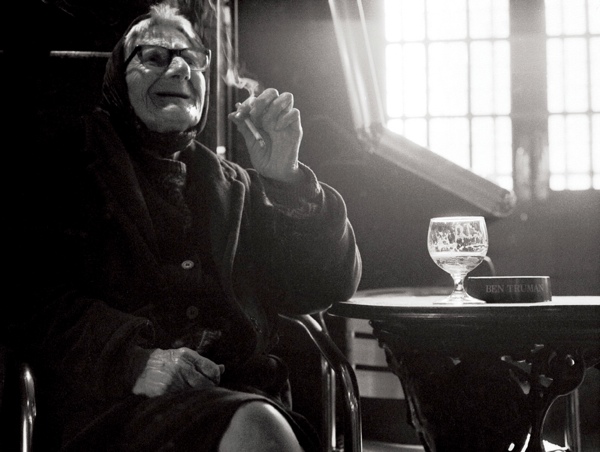
When Sandra Esqulant, celebrated landlady of The Golden Heart in Commercial St, saw this photo taken by Contributinf Photographer Phil Maxwell of Rose sitting in her barroom twenty years ago she told me the story of an unforgettable character who became one of her most loved regulars.
“I loved Rose. I don’t know what happened to her, she’s got to be dead now hasn’t she?
What happened was – you know how you fall in love with some people? – this woman appeared in the pub one day and I fell in love with her. I just liked her.
She asked for a rum & lemonade, and she never had to pay for a drink in my pub.
I used to have to warn everyone when Rose was coming in because she used to pick up everyone’s cigarettes and put them in her bag.
I used to dance with her.
You might think she was dumb, but she was the most astute person I ever met. She didn’t like my husband while I was there, but when I wasn’t there it was a different story!
My husband liked her a lot.
You know I lost my husband.
When she stopped coming, I went round to the Sally Army in Old Montague St, where she lived, but they told me they didn’t know what happened to her, so I went to the Police Station and they were going to search the morgue. I kept going back to the Sally Army and this Irish woman said to me, ‘Are you looking for Rose? She moved to Commercial Rd.’ So I went round to the Commercial Rd shelter and there was Rose. She was very sad because the Sally Army had put her out after forty years. So I used to send a cab to pick her up and take her back from my pub.
The Sally Army, they should have known how fond I was of her and told me where she had gone.
One Sunday, when I was on my own, she collected all the glasses and the ashtrays and the crisp packets and emptied them over the bar. I didn’t mind, Rose could do anything in my pub.
People like Rose would go into a pub and people wouldn’t serve them, but I had everyone in here – this was the dossers’ bar!
One day, Phil Maxwell asked Rose if he could put her in one of his films and she didn’t like that, but he set his camera on the table and took these pictures. And after that, he always had her picture in his exhibitions.
She must have known I was fond of her.
She did like me.
I know she liked me.
She was lovely.
She used to talk about her daughter, but I sometimes wonder if she ever had a daughter.
At Christmas, she always asked me for a Christmas box and, of course, I always gave her one.
They moved her out after forty years, what a thing to do to someone.
If Rose was here today, I’d let her smoke in my pub – I don’t care about the law.
Very special, she was.”


Photographs copyright © Phil Maxwell
See more of Phil Maxwell’s work here
Phil Maxwell’s Kids on the Street
Phil Maxwell & Sandra Esqulant, Photographer & Muse
More of Phil Maxwell’s Old Ladies
Phil Maxwell’s Old Ladies in Colour
Lucinda Rogers At Ridley Rd Market
In the first of a series, Contributing Artist Lucinda Rogers & I visit Ridley Rd Market in Dalston to meet some of the traders featured in her current exhibition Lucinda Rogers: On Gentrification – Drawings of Ridley Rd Market at House of Illustration in Kings Cross until March

Larry Julian, Chair of Ridley Rd Traders Association
Larry Julian – “I was a boy when I first came down here to help my parents Billy & Jeanie. Now I have been here fifty-five years and I am the fourth generation of our family in this market. My great-grandfather James Julian, he was one of the first down here. When I was a boy, all the fruit had to be properly displayed in tissue paper, and we weighed it out and wrapped it for our customers. We were always selling fruit & veg, but thirty-five years ago my mother had a stall selling toiletries while we were still selling the fruit & veg, so I took it over and my brother took over the fruit & veg. I get up at 4:30am and I get down here at 6:30am but, when I did the fruit & veg, I got up at 3am. I enjoy the social life and talking to all my customers. I am not rich but I have always made a living and, if I could have my time over again, I would do it all the same.”

Jimmy’s CD stall with fruit & veg stallholders
Jimmy Figgins – “I started out as DJ in clubs around this area, like the Four Aces and Oasis, as well as various pirate radio stations. Then, after I had done it for twelve years, some of those clubs became stripclubs. I did not want my life to be playing music for strip, so I came down here and Hoxton Market on Saturdays, selling CDs. Then, after twenty years, the market for CDs went down.” (This drawing shows the last day of Jimmy’s CD stall, he has now turned to selling takeway food.)

Cut yams and breadfruit at Back Home Yam Man
Dashamir Coku
– “A friend of mine used to work in the market and he asked me to help him out. We started down here twenty years ago with a stall, and now we have a stall and a shop. I get up at 3am and arrive here at 5:30am. I got to travel around Jamaica, Columbia, Brazil and Mexico, and because I am a cook, I learnt to cook this food. My wife is from Columbia, so I got to learn all about their vegetables. I sell vegetables from the Caribbean and South America, and my customers here in Ridley Rd Market include people from Cuba, Jamaica, St Lucia, Barbados and Montserrat.”

Jakey the parrot, with visiting parrot
“He was twenty years old when we got him. I used to keep Cockatiels, so when a customer split up with his wife, we agreed to have Jakey. That was seven years ago, he is twenty-seven now. Jakey is very cheeky and loves attention, but he can be moody and peck sometimes. He likes it when the parrot from next door visits.”
Drawings copyright © Lucinda Rogers
Lucinda Rogers: On Gentrification – Drawings from Ridley Rd Market is open at House of Illustration, Tuesday – Sunday from 10am-6pm until 25th March
You may also like to take a look at
Maria Pellicci, The Meatball Queen Of Bethnal Green
It is my pleasure to announce that the first meatballs of winter will be served at E.Pellicci in Bethnal Green next Wednesday 22nd November and I have already bagged first place in the line …

With the arrival of the first chills in Spitalfields, my mind turns to thoughts of steaming meatballs. So I hot-footed it up the road to Bethnal Green and the kitchen of Maria Pellicci, cook and beloved matriarch at E. Pellicci, the legendary cafe that has been run by her family since 1900. Although I find it hard to believe, Maria told me that meatballs are not always on the menu here because people do not ask for them. Yet she graciously assented to my request, and even granted me the honour of permitting my presence in her kitchen to witness the sacred ritual of the making of the first meatballs of the season.
For many years, meatballs and spaghetti comprised reliable sustenance that could deliver consolation on the grimmest winter day. If I found myself in a cafe and meatballs were on the menu, I had no reason to think further because I knew what I was having for lunch. But then a fear came upon me that drove away my delight in meatballs, I began to doubt what I was eating and grew suspicious of the origins of the ingredients. It was the loss of an innocent pleasure. Thus began the meatball famine which lasted ten years, that ended when Maria Pellicci made meatballs specially for me with fresh meat she bought from the butcher in the Roman Rd.
Maria has worked daily in her kitchen in Bethnal Green since 1961, preparing all the dishes on the menu at E.Pellicci freshly as a matter of principle. More than this, reflecting Maria’s proud Italian ancestry, I can confirm that for Maria Pellicci the quality of her food is unquestionably a matter of honour.
Maria mixed beef and pork together with eggs, parsley, onion and other herbs, seasoned it with salt and pepper, letting it marinate from morning until afternoon. Then, as we chatted, her hazel eyes sparkling with pleasure, she deployed a relaxed skill borne of half a century’s experience, taking bite-sized pieces from the mixture and rolling them into perfectly formed ruby red balls, before tossing them playfully onto a steel baking tray. I watched as Maria’s graceful hands took on independent life, swiftly rolling the meatballs between her flattened palms and demonstrating a superlative dexterity that would make her the virtuoso at any card table. In no time at all, she conjured one hundred and fifty evenly-sized meatballs that would satisfy thirty lucky diners the following morning.
I was at the snug corner table beside the serving hatch in Pellicci’s immaculately cosy cafe next day at the stroke of twelve. After more than ten years of waiting, the moment was at hand, as Anna Pellicci, Maria’s daughter proudly delivered the steaming dish, while Salvatore, Maria’s nephew, brought the Parmesan and freshly ground pepper. The wilderness years were at an end, because I had spaghetti and meatballs in front of me, the dish of the season. Maria made the tomato sauce that morning with garlic, parsley and basil, and it was pleasantly tangy and light without being at all glutinous. As a consequence, the sauce did not overwhelm the subtle herb-inflected flavour of the meatballs that crumbled and then melted in my mouth, the perfect complement to the deliciously gelatinous spaghetti. Sinking my teeth into the first meatballs of the twenty-first century, I could only wonder how I lived through all those years without them.
Outside a cold wind was blowing, so I took courage from ingesting a syrup pudding with custard, just to finish off the spaghetti and meatballs nicely, and restore substance to my attenuated soul. The special quality of E. Pellicci is that it is a family restaurant, and that is the atmosphere that presides. When I confided to Anna that my last living relative had died, she told me at once that I was part of their family now. Everyone is welcomed on first name terms at Pellicci’s in an environment of emotional generosity and mutual respect, a rare haven where you can enjoy honest cooking at prices everyone afford.
I call upon my readers to help me keep meatballs on the menu at E. Pellicci now, because we need them to help us get through the winter, brexit, and the rest of the twenty-first century that is to come. Let us send a collective message to the Pelliccis, that we love their meatballs with spaghetti, because when we have a cook like Maria Pellicci, the meatball queen of Bethnal Green, we cannot forgo the privilege of her genius.

Maria Pellicci has been making meatballs in Bethnal Green for half a century

Anna Pellicci with the first meatballs of the season in Bethnal Green

The coveted corner table, next to the serving hatch at E. Pellicci
E.Pellicci, 332 Bethnal Green Rd, E2 0AG
You may like to read my other Pellicci stories
Christmas Ravioli At E Pellicci
Colin O’Brien’s Pellicci Portraits ( Part One)
Colin O’Brien’s Pellicci Portraits (Part Two)
Kurt Hutton, Photographer
Continuing his series of profiles of photographers who pictured the East End in the twentieth century, Contributing Writer Mark Richards explores the photography of Kurt Hutton

Men drinking in The Prospect of Whitby, 1942
1934 was a defining year for British photography. Hitler’s restrictions on press freedom led to an exodus of photographers from Germany and Austria, who moved to London. These included emerging talents such as Edith Tudor-Hart, Bill Brandt and Wolf Suschitzky, as well as established photographers such as Kurt Hübschmann (1893–1960) who was born in Strasbourg and emigrated to England in 1934. On arrival, he changed his name to Kurt Hutton and is remembered by this name as a legendary photojournalist whose work influenced the younger photographers who established themselves in the thirties, such as Bert Hardy.
In Germany, Kurt already had a well-established career as a photographer. At first, his parents decided he should be a solicitor and he was sent to study Law at Oxford in 1911, but he soon found that this dry subject did not appeal to his creative spirit. In 1914, the outbreak of the First World War put all thoughts of a legal career on hold and he volunteered as an officer in the German cavalry. During this time, he learned some basic techniques of photography and his talent became evident immediately. After the war, he practised as an amateur photographer until he decided to make a career of it, after taking lessons in portrait photography in 1923.
Kurt pursued an humane approach to taking pictures, always seeking to preserve the dignity of his subjects. This is the common quality in all his photography – complemented by an irreverent sense of humour. In 1923, Kurt used his newly-acquired skills to establish a photo studio in Berlin with his wife, which they ran together until 1929 when he began to produce work for Simon Guttmann’s Deutsche Photodienst agency. This led to him being talent-spotted by Stefan Lorant, Editor-in-Chief at the Münchner Illustrierte Presse (Munich Illustrated Press), who commissioned work. This association with Lorant proved to be a seminal point in Kurt’s photographic career.
Stefan Lorant was the major editor in Germany at that time. A Hungarian with one Jewish parent, Lorant was a larger-than-life character, strongly opinionated and with a vision that would shape photojournalism for a generation to come. As editor of one of the two leading illustrated magazines in Germany, Lorant had come to know Hitler in the late twenties when Hitler was editing a Nazi magazine in Munich. Lorant even briefly dated Geli Raubul who was Hitler’s half-niece, but his commitment to the freedom of the press and refusal to bow to Nazi influence led to his arrest on 14th March 1933.
The end of press freedom in Germany led to a golden age of photojournalism in England. Lorant was released in 1934, arriving in England in April with only a smattering of English and a plan to reinvent British photojournalism. He established major publications such as Weekly Illustrated, Lilliput and Picture Post, all of which would feature Kurt’s photography.
Kurt’s Jewish origins put him and his wife at great risk in Germany and, after travelling to London to photograph Wimbledon in 1934, he made the decision to follow Stefan Lorant and move to England. He was accompanied by another Munich photographer, Hans Baumann who, on arrival. changed his name to Felix Man and joined Kurt as one of Lorant’s photographers.
Kurt photographed all tiers of English society including the residents of the East End. He had a natural talent for portraiture and his photographs of Churchill, Hemingway, Hitchcock and Ingrid Bergman are instantly recognisable. Characteristically, he employed a natural style to capture the spirit of his subjects. His output was prolific and, at times, made up nearly half of the photographs in some editions of Picture Post. Notable series included his photographs of George Orwell’s Wigan in 1939 which provide a unique visual record of life in that town just before the war.
An acknowledgement of the quality of Kurt’s photography is that his work was used as the standard against which other photographers were measured when learning their trade. Grace Robertson, an immensely talented photo-journalist in the fifties, recalled her work being thrown on the ground by her teacher who shouted “Kurt Hutton would never have taken pictures like these!”
The essence of Lorant’s vision for Picture Post was reflected Kurt Hutton’s approach to photography. It can be summed up in an editorial response to criticism over the inclusion of too many ‘ordinary people’ in the images appearing in the magazine. The response, which was probably written by Stefan Lorant read, “Picture Post firmly believes in the ordinary man and woman, thinks they have had no fair share in picture journalism, believes their faces are more striking, their lives and doings more full of interest than those of the people whose faces and activities cram the ordinary picture papers”
This statement explains why so many series of photographs about everyday life were included in Weekly Illustrated, Lilliput and Picture Post during the thirties and forties, when other publications focussed on celebrities, politicians and royalty.
For a time, Picture Post with Kurt Hutton and Felix Man as its leading photographers could do no wrong, but Stefan Lorant had not taken into account the impact of the impending war on his German refugee staff. In advance of the invasion of Poland, there was a fear that Britain would do a deal with Hitler and this would involve ‘insurgents’ such as Lorant and Hutton being sent back to Germany to certain death. Although this never came to pass, some emigrated to America, including Stefan Lorant who sailed for New York on board the Brittanic in July 1940, after having his freedom in Britain severely restricted.
Between September 1939 and April 1940, panic set in amongst some of the refugee photographers who were opposed to Hitler or had been forced to flee Germany due to their race, religion or political beliefs. A suspicion of all things German took hold of the public and, under special measures, ‘enemy aliens’ were interned. Amongst these were Kurt Hutton and Felix Man, whose cameras were confiscated when they were sent to the Isle of Man in 1939. It robbed Picture Post of its most experienced photographers. After it lost its editor and when all of its refugee photographers and journalists were interned, the magazine was down to only five members of staff.
Kurt Hutton remained in custody on the Isle of Man until 1941. His absence, along with the absence of the other leading lights in photojournalism at the time, offered a golden opportunity for new British photographers such as Bert Hardy, who stepped up to fill the gap, becoming the new lead photographer for Picture Post. Yet, even while interned on the Isle of Man, Kurt managed to get his hands on a camera and photographed holidaymakers there. He possessed an energy that was not be easily suppressed and, on his release in late 1941, he made his way back to London to start again.
The strength of Kurt’s work is immediately apparent when examining his archive. The wild abandon seen in one of his most well-known photographs of young women on a rollercoaster in 1938, as well as the risqué nature of the shot, typifies the unforced nature of his work. Unlike Bill Brandt, Kurt was drawn to employing what were known at the time as ‘miniature’ cameras – those using the relatively new 35mm format such as the Leica III. These were highly portable, versatile cameras and allowed for contact prints, which assisted editorial decisions. However, the cameras were mocked by ‘serious’ photographers who thought they were no better than toys, although the quality of Hutton’s work, and that of others who adopted the Leica, proves them wrong.
Kurt’s photography is not ‘street photography’ like that of Wolf Suschitzky or Henri Cartier-Bresson, yet neither is it in the poetic style of Bill Brandt and it is unlikely that Kurt considered his photographs to be Art. As social documentary, his work is a powerful record of everyday life during a period of profound social disruption. His photographs were produced in the knowledge that they would be coupled with text, but their quality was such they required no further explanation.
Kurt Hutton retired to Aldeburgh and produced a final photo series on Benjamin Britten who became a friend. It is a revealing series into the private life of this composer and a fitting finale to an extraordinary career of a pioneering photographer who is now mostly forgotten.

‘A large family’ London, 1945

Street artist David Burton working in Swiss Cottage, February 1945

Commissionaire talking to his dachshund in Piccadilly, 1938

Roasted chestnut seller in Piccadilly Circus, 1938

Young women on a rollercoaster, Southend Fair, 1938

Unemployed man with dog from The Wigan of George Orwell, 1939

Life in a back alley, from The Wigan of George Orwell, 1939

Father with children, from The Wigan of George Orwell, 1939

Holidaymakers relaxing on a bench in Douglas, Isle of Man, 1939

Winston Churchill, 1939

Ingrid Bergman and Alfred Hitchcock, 1948

Entrance to Old Buildings and Old Square, leading into Lincoln’s Inn Fields, 1951

Brokers at the London Stock Exchange in Throgmorton Street, November 1951

Benjamin Britten in his studio at The Red House, Aldeburgh 1958

Audience at a Britten performance, Aldeburgh Festival 1949

Picture Post photographers Kurt Hutton (left) and Bert Hardy in 1950
Photographs copyright © Estate of Kurt Hutton
You may also like to read about
Edith Tudor-Hart, Photographer
Petherick’s London Characters

These London Characters were drawn by Horace William Petherick, a painter and illustrator who once contributed pictures regularly to the Illustrated London News. He also collaborated on some children’s books with Laura Valentine, who wrote under the pseudonym Aunt Louisa, and the prints you see here are the product of such a collaboration.
When I first came across these pictures in the collection at the Bishopsgate Institute, they caught my eye at once with the veracity of their observation. I am fascinated by all the prints that were made through the ages of the street people of London, and I have seen so many now that I have learnt to recognise when these images become generic. Yet, although in form and composition, H.W.Petherick’s London Characters draw upon the traditional visual style of the Cries of London, there is clear evidence of observation from life in his vibrant designs.
The subtleties of posture and demeanour in each trade, and the fluent quality of vigorous movement, are true to those of working people. He captures the stance that reveals the relationship of each individual to the world, whether haughty like the Beadle, weary like the Dustman, playful like the Acrobat, deferential like the Cabman or resigned like the old wounded soldier working as a Commissionaire. In these images, they declare themselves as who they are, both the products and the exemplifiers of their occupations.
It was the Lamplighter that first drew my attention, gazing with such concentrated poise up to the light, which is cleverly placed outside the frame of the composition – indicated only by the cast of its glow. In the foggy street, the Lamplighter pauses for the briefest moment for the flame to catch, while a carriage rolls away to vanish into the mist. An instant later, he will move on to the next lamp, but the fleeting moment is caught. All these Characters are preoccupied with their business – walking with intent, pouring milk steadily, carrying a loaf carefully, cutting meat with practised skill, scrutinising an address on an envelope, pasting up a poster just so, or concentrating to keep three balls up in the air at once.
They inhabit a recognisable city and they take ownership of the streets by their presence – they are London Characters.

The Butcher Boy

The Milkman

The Baker

The Cat’s-Meat Man

The Waterman

The Street Boy

The Dustman

The Chimney Sweeper

The Cabman

The Orange Girl

The Turncock

The Navvy

The Lamplighter

The Telegraph Boy

The Beadle

The Muffin Man

The Basket Woman

The Postman

The Fireman

The Railway Porter

The Policeman

The Newspaper Boy

The Bill Sticker

The Costermonger

The Organ Grinder

The Commissionaire

The Acrobat
Images courtesy Bishopsgate Institute
You may like to take a look at
John Thomson’s Street Life in London
Aunt Busy Bee’s New London Cries
Marcellus Laroon’s Cries of London
More John Player’s Cries of London
William Nicholson’s London Types
Francis Wheatley’s Cries of London
John Thomas Smith’s Vagabondiana of 1817
Thomas Rowlandson’s Lower Orders
Nicholas Hawksmoor’s Churches

St George’s, Bloomsbury 1716 – 1731
In 1711, Nicholas Hawksmoor was fifty years old and, although he had already worked with Christopher Wren on St Paul’s Cathedral and for John Vanbrugh on Castle Howard, the buildings that were to make his name as an architect in London were yet to come. In that year, an Act of Parliament created the Commission for Building Fifty New Churches to serve the growing population on the fringes of the growing city. Only twelve of these churches were ever built, but Nicholas Hawksmoor designed six of them and – miraculously – they have all survived, displaying his unique architectural talent to subsequent generations and permitting his reputation to rise as time has passed.
Living in the parish of Christ Church and within easy reach of the other five Hawksmoor churches, I realised that sooner or later I should make a pilgrimage to visit them all. And so, taking advantage of some fleeting spells of sunlight and clear skies in recent days, I set out to the west, the south and to the east from Spitalfields to photograph these curious edifices.
In 1710, the roof of the ancient church of St Alfege in Greenwich collapsed and the parishioners petitioned the Commission to rebuild it and Hawksmoor took this on as the first of his London churches. Exceeding any repair, he remodelled the building entirely, although his design was “improved” and the pilasters added to the exterior by fellow architect Thomas Archer, compromising the clean geometric lines that characterise Hawksmoor’s other churches. His vision was further undermined when the Commission refused to fund replacing the medieval tower with an octagonal lantern as he wished, so he retained the motif, employing it at St George-in-the-East a few years later. Latterly, the tower of St Alfege was refaced and reworked by Hawksmoor’s collaborator John James in 1730. Yet in spite of the different hands at work, the structure presents a satisfyingly harmonious continuity of design today, even if the signature of Hawksmoor is less visible than in his other churches.
Before Hawksmoor’s involvement with St Alfege was complete in 1716, he had already begun designs for St George-in-the-East, St Anne’s Limehouse and Christ Church Spitalfields. In each case, he was constructing new churches without any limitation of pre-existing structures or the meddling hands of other architects. These three churches share many characteristics, of arched doorways counterpointed by arched and circular windows, and towers that ascend telescopically, in graduated steps, resolving into a spire at Christ Church, a lantern at St George-in-the-East and a square tower at St Anne’s. This is an energetic forceful mode of architecture, expressed in bold geometric shapes that could easily become overbearing if the different elements of the design were not balanced within the structure, but the success of these churches is that they are always proportionate to themselves. While the outcome of Hawksmoor’s architecture is that they are awe-inspiring buildings to approach, cutting anyone down to size, conversely they grant an increased sense of power to those stepping from the door. These are churches designed to make you feel small when you go in and big when you come out.
In 1716, Hawksmoor began work on what were to be the last two of his solo designs for churches, St Mary Woolnoth and St George’s, Bloomsbury. Moving beyond the vocabulary of his three East End churches, he took both of these designs in equally ambitious but entirely different and original directions. St Mary Woolnoth in the City of London was constructed upon a restricted site and is the smallest of Hawksmoor’s churches, yet the limitation of space resulted in an intense sombre design, as if the energy of his larger buildings were compressed and it is a dynamic structure held in tense equilibrium, like a coiled spring or a bellows camera held shut.
St George’s Bloomsbury was the last of Hawksmoor’s churches and his most eccentric, completed in 1731 when he was seventy as the culmination of twenty extraordinarily creative years. Working again upon a constricted site, he contrived a building with a portico based upon the Temple of Bacchus in Baalbek and a stepped tower based upon the Mausoleum at Halicarnassus which he adorned with a statue of George I upon the top, flanked by the lion and unicorn to celebrate the recent defeat of the Jacobites. Undertaken with such confidence and panache, Hawksmoor’s design is almost convincing and the enclosed location spares exposure, permitting the viewer to see only ever a portion of the building from any of the available angles.
The brooding presence of Hawksmoor’s churches has inspired all manner of mythologies woven around the man and his edifices. Yet the true paradox of Hawksmoor’s work stems from the fact that while he worked in the Classical style, he could never afford the opportunity to undertake the Grand Tour and see the works of the Renaissance masters and ruins of antiquity for himself. Thus, he fashioned his own English interpretation which was an expression of a Gothic imagination working in the language of Classical architecture. It is this curious disconnection that makes his architecture so fascinating and gives it such power. Nicholas Hawksmoor was incapable of the cool emotional restraint implicit in Classicism, he imbued it with a ferocity that was the quintessence of English Baroque.

St Alfege, Greenwich 1712-16

St Mary Woolnoth, Bank 1716-24

St George-in-the-East, Wapping 1714-1729

St Anne’s, Limehouse 1714-1730

Christ Church, Spitalfields 1714-1729
You may also like to take a look at
Singles Night At Novelty Automation
Comic genius and Professor Branestawm de nos jours, Tim Hunkin has patented a punch card match-making system and is launching it next Friday 24th November with a SINGLES NIGHT from 6-9pm at Novelty Automation, his satirical amusement arcade in Holborn. This is your chance to be among the first to try the punch card system for yourself. Whether you are seeking romance or just happy to make new acquaintances, it promises to be a lot of fun.

Tim Hunkin makes a few last minute adjustments to his Instant Eclipse machine

Tim Hunkin’s multiple choice match-making cards


Drawings copyright © Tim Hunkin
NOVELTY AUTOMATION, 1a Princeton St, Holborn, WC1R 4AX
You might also like to read about


