
Whitechapel Noise
Vivi Lachs introduces her new book, Whitechapel Noise: Jewish Immigrant life in Yiddish Song & Verse, London 1884-1914, exploring popular musical culture and how it spoke of social realities encountered by recent arrivals in the East End a century ago

Vivi Lachs by Sarah Ainslie
Hostu gezen a grinem”yid
hir blondzhendik aleyn?
Keyn koyrev nit, keyn goyel nit
un elnt vi a shteyn?
Di raykhe “kenen gornit ton”
Zey hobn tekhter, zin…
Di Londoner “komite-layt”
far zey iz er tsu GRIN.
Have you seen an immigrant Jew
Wandering here alone?
No relatives, no saviour
Just acutely lonely?
The rich ‘can’t do anything to help,’
They have daughters, sons…
And for the London ‘committee members’
He’s too new to be an immigrant.
London Bay Nakht (London At Night)
This Yiddish poem by Morris Winchevsky was published in 1884 in the newspaper Der Poylishe Yidl (The Polish Jew). Set to music and sung, the lyrics articulate a complaint about the rich, powerful London Jewish leadership who ignored the suffering of the poor, the unemployed, the homeless and the most recent immigrants. Each verse asks ‘have you seen?. London Bay Nakht pinpoints the social politics of its time – the homeless being moved on by the police and not allowed to rest, the death of a breadwinner leaving a family destitute, a newly-arrived Jewish immigrant not supported by the Jewish establishment until they have managed to survive in London for six-months. Morris Winchevsky was a Jewish socialist, a comrade of William Morris and his political poems became anthem for activists.
Whitechapel 1884 was a cacophony of talk, debate, laughter and bickering. All in Yiddish, because from the early eighteen-eighties the East End became home to over a hundred thousand Yiddish-speaking immigrants from Eastern Europe. They lived in cramped rooms, formed new relationships, struggled to find work in tailoring sweatshops, argued over politics and religion, discussed the latest strikes, the best bargain in Petticoat Lane, and Aaron Nager’s new song at York Minster Music Hall in Philpot St. Yiddish posters plastered the walls and printing houses produced scores of Yiddish newspapers, journals, pamphlets, and songsheets. Yiddish was ubiquitous in the streets, cafes, synagogues, markets and theatres.
Whitechapel Noise is a collection of tales of Jewish East End immigrant lives before the First World War. These tales have not been told before because they come from lyrics of penny song sheets sung in the Yiddish music hall and from the poetry and satire of Yiddish newspapers and journals that lie forgotten in libraries and archives. Popular poetry and pop songs are unusual sources for historians, yet these lyrics are immediate, filled with clever allusion and cheeky innuendo. Fierce battles about politics, sex and religion emerge.
More than four hundred rhyming lyrics depict the rich mosaic of immigrant life – pickpockets outside Broad St Station, courting couples at Crystal Palace, families struggling to pay rent on Berner St, child prostitution in Victoria Park and infants selling matches outside the Stock Exchange in Cornhill. Characters include William Gladstone, Lord Rothschild and anarchist leader Rudolf Rocker, as well as Yiddish theatre stars Beki Goldstein and Joseph Sherman. They speak of the 1892 general election, the 1905 Alien Act, and controversies surrounding the building of the Feinman Yiddish People’s Theatre in 1911. They reveal how the pressure of immigration changed religious practice and the roles of men and women. Lyrics describe working conditions in the sweating trades, child labour, and the age of consent. Others dramatise controversies over the decline of religious observance, levels of teachers’ pay, problems of gambling, sexual exploitation, and the clash between exponents of aesthetic high-brow Yiddish theatre and low-brow Yiddish music hall.
In a sheyner zumer nakht
gey ikh mir fartrakht.
Tref ikh mayn vaybl vi a tayvl
volkndik bay nakht
in ridzhent strit –
es vert mir nit git.
Oysgeshnitn azoy vayt,
un vinkt tsu yunge layt.
Nu freg ikh aykh,
tsi iz dos glaykh?
A brokh ir dort in zayt,
nor ikh of kors
bin balebos.
On a lovely summer night
I go out strolling and contemplating
And meet my wife like the devil
walking at night
In Regent Street
It won’t be good for me.
Her low-cut dress,
And winking at young people.
So tell me
Is this right?
To hell with her
I am, of course
The man of the house.
Vos Geyst Nisht Aheym, Sore-Gitl? (Won’t You Come Home Sarah-Gitl?)
Arn Nager, a well-known Yiddish comic, played roles in the Yiddish music-hall of pathetic and disgruntled men whose wives were running rings around them. His song Vos geyst nisht aheym, Sore-gitl?, describes Sarah-Gitl out and about kissing men in pubs while her husband throws a tantrum, ineffectually trying to get her to come home. At the top of the songsheet, the instruction reads, ‘to be sung to the tune of Won’t You Come Home, Bill Bailey?,’ a popular ragtime tune by Hughie Cannon written in 1902.
Yet Arn Nager’s song is far more than a mere Yiddish translation, the gender roles are reversed. Bill Bailey was gallivanting with other women while his wife pleaded with him to return, but in Yiddish the woman is given the promiscuous role. Why this turnaround? Clearly, it was not a reflection of everyday life. The situation may be funnier than the original, but there may also be a deeper reason. This is not the only song that pivots on gender role-reversal. Many similar examples offer an insight into the circumstances of immigrant life.
Amongst the audience, there were men who had chosen to leave the poverty of Eastern Europe to give their families a better chance in London yet struggled to be the breadwinner in this new world. Their wives worked long hours and they had to take in lodgers to make ends meet. The failure of their traditional role as patriarch gave them a sense of powerlessness and they may have taken cathartic relief in recognising a scenario in which a male protagonist experiences even greater humiliation than they had known.
You may notice words in the Yiddish text that come from English – popularly called Cockney Yiddish – such as ridzhent strit (Regent St), bavelkomt (welcomed), votsh un tsheyn (watch and chain) and bizi un slek (busy and slack periods in sweatshop work). The word grin in London Bay Nakht (London At Night) is the English word ‘green,’ taken here to mean a naive new arrival from Eastern Europe. London’s immigrant community was in a state of flux and this anglicized Yiddish reflected the spoken language of the Jewish East End streets.
Shuln makht men do lehavdl poshet gor fun kloysters
Peysekh hit men op getray
teykef nokh dem seyder geyt men esn oysters
anshtot afikoymen est men gor pay.
People make synagogues here out of churches
They keep Passover loyally
Yet right after the Seder they eat oysters
Instead of the ritual matza they eat pie.
Freg Keyn Katshanes (Don’t Ask Silly Questions) 1900
Many Eastern European immigrants were orthodox Jews and they often found London a challenging place to observe their religious practice. The established Anglo-Jewry had large synagogues which were more like churches than the small khevres or prayer rooms the immigrants prayed in. England brought added difficulties – of the requirement to work on the Sabbath and the temptation to abandon religion altogether, eating non-kosher pies and oysters. Some struggled with a middle way, seeking a practising Judaism that was more modern. Lyrics of these popular songs speak eloquently of day-to-day struggles as people assimilated with the changing reality of a new place, fulfilling their need to become settled and conform to new social standards.
Freg nit keyn katshanes, es iz england
Don’t ask silly questions, this is England!

Der Poylishe Yidl (The Polish Jew), Friday 15th August 1884

Morris Winchevsky

Der londoner kupletist, c.1903

Songsheet with photo of Arn Nager

The Sand Pit, from Living London 1901

Princess’ Hall from Living London, 1901

Der Bloffer, The Giving of the Torah in Whitechapel, 1912

In a East End Jewish Restaurant, from Living London 1901

Click here to buy Whitechapel Noise: Jewish Immigrant life in Yiddish Song & Verse, London 1884 – 1914 by Vivi Lachs at 20% discount. Enter the code WHITECHAPELNOISE at checkout.
Click here for Don’t Ask Silly Questions, songs from the book recorded by Katsha’nes
Click here for Whitechapel, mayn vaytshepl, songs from the book recorded by Klezmer Klub
You may also like to read about
Ron McCormick’s Spitalfields
Celebrating the publication of two books of Ron McCormick’s Whitechapel photographs by Cafe Royal Books, here is a further selection of Ron’s splendid pictures from the seventies when he lived in Princelet St, Spitalfields. Click here to order copies
A new expanded hardback edition of Chris Searle’s Whitechapel Boy, a reading of the poetry of Isaac Rosenberg including a photoessay by Ron McCormick is now available. Click here to order

Knifegrinder, Spitalfields

Fishman’s tobacconist & sweet shop, Flower & Dean St, Spitalfields

Entrance to Chevrah Shass Synagogue, Old Montague St

Clock seller, Sclater St

Dressed up for the Sunday market, Cheshire St

Maurice, Gents’ Hairdresser, Buxton St

Gunthorpe St

Club Row

Steps down to Black Lion Yard, Old Montague St

Old Castle St, Synagogue

Sunday market, Cheshire St

Corner of Gun St & Artillery Lane

Shopkeeper, Old Montague St

Inter-generational conflict on Princelet St

Goldstein’s Kosher Butcher & Poulterer, Old Montague St

Great Eastern Buildings, Quaker St

Convenience Store, Artillery Lane

Soup Kitchen for the Jewish Poor, Brune St

Alf’s Fish Bar, Brick Lane

Waiting for the night shelter to open, Christ Church Spitalfields

Resting, Spitalfields Market Barrows, Commercial St

Great Eastern Buildings, Quaker St

Rough sleeper, Spitalfields

Mother and her new-born baby in a one bedroom flat, Spitalfields
Photographs copyright © Ron McCormick
You may also like to take a look at
Mr Pussy Thinks He Is A Dog
With your help, I am producing a handsome collection of stories of my old cat, THE LIFE & TIMES OF MR PUSSY, A Memoir Of A Favourite Cat to be published by Spitalfields Life Books on 20th September. Below you can read an excerpt.
Support publication by preordering THE LIFE & TIMES OF MR PUSSY and you will receive a signed copy when the book is published.
Click here to preorder your copy

Mr Pussy thinks he is a dog, it all began with chewing my slippers. When I come home in the evening and sit down in the wing chair to eat my supper, it is Mr Pussy’s custom to lie at my feet, extending his claws like gleaming steel fishhooks. At this time of day, I am usually wearing my slippers and Mr Pussy cannot resist stretching out to hook a slipper, interrupting me painfully from my meal when his sharp claws pierce my skin. Compliant, I kick the slipper off and then Mr Pussy grips it triumphantly, holding the toe in his front paws, while kicking delightedly at the sole with his powerful back legs in the manner of a dog. Getting roused with excitement as the kicking accelerates, Mr Pussy flattens his ears, growls and turns to me with fierce eyes as if to say, “Look at me, I’m a dog!” Then he chews the slipper, just like a dog.
I have learnt to remove both my slippers as soon as Mr Pussy approaches, allowing him to undertake the usual dinner theatre performance without drawing blood from my feet. This slipper business was just the first of Mr Pussy’s canine traits that became apparent. Although, ever since he was fully grown, people proclaimed, “He’s so big, he looks like a dog!” In fact, Mr Pussy is larger than many dogs and is not in the least challenged by my neighbour’s Jack Russell, he just looks down his nose at the mutt.
Unlike most felines but in common with most canines, Mr Pussy loves water. Never concerned about getting his feet wet as cats usually are, he likes to roll in wet grass, then come into the house and shake off the raindrops. One day, when he came in soaked from the rain, I produced a towel and gave him a rub down. Mr Pussy craves this now, and will go out and get wet just to have the rub down afterwards, demanding this service with insistent miaowing that has more in common with the repeated barking of a dog than the delicate whisper of a pussycat. Once I knew Mr Pussy liked water, I gave him towel baths in Summer, to cool him when he languished in the heat. Standing him on the garden table, I soaked Mr Pussy with a wet flannel or sponge, gave him a good brushing and then towelled him down. The experience was a powerful one for Mr Pussy and sometimes his emotions got fixated on the brush, which he grasped in his paws with the same tender intensity that Elvis grasped his microphone. Afterwards, Mr Pussy ran around the garden steaming in the heat before taking a deep sleep in the shade.
Mr Pussy reminds me of my father’s Ginger Tom that once fell from the branch of an old oak at the bottom of our garden directly into the River Exe and swam confidently to the shore. In Devon, Mr Pussy used to go roving for miles and return days later with a dead rabbit in his mouth. In Spitalfields, he commands an alley instead, walking up to anyone that comes along, scrutinising them in the manner of a guard dog before greeting them affectionately. He has traded the life of an explorer and wild game hunter for that of a greeter and security guard. I do wonder if this altered circumstance created his curiously hybrid nature.
Mr Pussy likes humans because he has always been treated well and experience tells him they pose no threat. For Mr Pussy, any stranger is potentially another source of the adulation he needs to reinforce his ego. To be honest, there is an element of showing off. Mr Pussy likes to play to camera. Give him a ball and Mr Pussy will chase it up and down the house, bouncing it off the walls with the judgement and skill that indicates a simultaneous talent at both snooker and football – as long as there is an audience. Just stopping now and again, to touch up his grooming and check the spectators are giving him their full attention, like Cristiano Ronaldo, Mr Pussy possesses the killer combination of vanity, quick reflexes and powerful legs.
The canine trait that I appreciate most is Mr Pussy’s loyalty. He follows me around the house, running at my ankles just like a dog and sleeping contentedly beside my desk all day while I am writing. Whenever I leave the house, Mr Pussy walks out with me, hoping to follow at my heels. Always disappointed when I hasten my footsteps along the pavement to leave him behind, Mr Pussy does not understand why he cannot accompany me beyond Spitalfields into the city. Instead he consoles himself with his daily patrol of the territory whilst I am doing my errands – but makes absolutely certain to be there, poised for an emotional reunion upon my return, bounding to greet me. I am sure Mr Pussy thinks he is a dog.

With your help, I am producing a handsome collection of stories of my old cat, THE LIFE & TIMES OF MR PUSSY, A Memoir Of A Favourite Cat to be published by Spitalfields Life Books on 20th September. Below you can read an excerpt.
Support publication by preordering THE LIFE & TIMES OF MR PUSSY and you will receive a signed and inscribed copy when the book is published.
Click here to preorder your copy
Harry Levenson, Bookmaker

These are just some of the bouncing cheques presented by inveterate gambler Sidney Breton to Spitalfields’ first Bookmaker Harry Levenson and preserved today by his son David Levenson as momentos, eternally uncashed. Indicative of the scale of the compulsion, David has over a thousand pounds worth of these cheques dating from an era when the average salary was just £4 a week.
Before 1961, it was illegal to accept bets off the racecourse and there were no Betting Shops, only Commission Agents who – in theory – passed the bets onto the Bookmakers at the courses. Yet the Bookie’s Agents often took bets themselves, resulting in a lucrative business that existed in the shadows, and consequently – David Levenson revealed to me – the police took regular backhanders off his dad, until the change in the law. After that, Harry was able to obtain a permit and operate legally from his premises on the first floor at 13 Whites Row, conveniently placed for all the bettors who worked in the Spitalfields Market and Truman’s Brewery, as well as the passing trade down Commercial St.
When David came to Spitalfields, we made a pilgrimage together to Whites Row to find the site of his late father’s betting shop, and I learnt that Harry’s career as a Bookmaker was just one in a series of interventions of chance that had informed the family history.
“My father was born in 1919 and grew up in Regal Place off Old Montague St. His father Hyman, a tailor, came from Latvia and his mother Sarah came from Lithuania or Belarus, and they met in London. I once asked my father why his parents came here but he said they never wanted to talk about it, and I knew about the pogroms against the Jews, so I imagine there were pretty bad things.
I think it was a tough childhood, but when my father spoke of it, it was with fondness. After school – he told me – he used to walk to his grandparents’ house and sit on the step and wait for his grandfather to come home from work, and his grandfather used to take him to buy sweets.
My dad told me he was there, standing with the other Jewish boys, when Mosley tried to march through Whitechapel in 1936 and he said all they had was rolled up copies of the News of the World to defend themselves.
His elder brother, Sam, had a barber’s shop and after he left school in the late thirties my dad went to work with him until war broke out, when my dad was twenty. He was the most peaceable man you could meet, but when he joined the army he said, “I want to fight at once, I don’t want to march about.” So they recruited him into the Isle of Man Regiment and he served as a gunner on a Bofors Gun. He became one of only forty soldiers from his Battery to escape alive from the battleground of Crete – none of the Jews that were captured ever returned. In January 1943, he suffered serious shrapnel wounds when several of his fellow gunners were killed by a direct aircraft attack near Tripoli. Then his father, Hyman, died while Harry was recuperating but he did not find out until months later when his brother Sam broke the news in a letter in July.
When my father came back on leave, he found just a bombsite where Regal Place had been and all the flats were destroyed. But he discovered the family had gone to Nathaniel Buildings in Flower & Dean St and everybody was safe. Incredibly, the bomb had fallen on the only night his father had ever gone to the shelter. They were calling out in the street for, “Any off-duty soldiers?” and my father spent his entire leave searching for bodies in bombed-out buildings.
I could see no relationship in my father’s life to what he had been through in the war – I think he wanted to start again. Afterwards, he simply went back to work in his brother’s barber shop. He learnt to cut hair and became a barber. He started getting tips for horses, so he phoned up his other brother who worked in a betting office and placed bets. There were no betting shops at the time – it was illegal – but people asked my father, “Why don’t you take bets yourself?” And as more as more people came to place bets than to have their hair cut, he was making more money from being a bookmaker than a barber. Because it wasn’t legal, he wasn’t paying tax, and he was walking around with thousands of pounds in his pocket. But you could never call our family wealthy, we were just middle class. So it is a mystery to me where the money went.
When my mother, Ivy, met him he was flush with cash and he used to drive a Jowett Javelin. She thought he was a millionaire. Although he was brought up Jewish, she was Church of England, so I am not Jewish and he never made any attempt to bring me up in the faith. Ivy’s daughter Vivien was adopted by Harry, and the family moved to Kenton.
In 1961, the law changed and my dad obtained the first Bookmaker’s permit in Spitalfields. He moved the business out to Gospel Oak when I was about two, but he used to bring me back with him whenever he came visit his friend Dave Katz who had a factory making trousers off Commercial St. I remember walking around the streets when I was four or five years old, Spitalfields was frightening to a boy from the suburbs. It was a strange place.
My dad never gambled because he saw people lose all their money, and I’ve only ever had a little flutter myself – but my mother is ninety-three and she says it’s what keeps her going.”
[youtube Kl5KZcMhH24 nolink]
Harry Levenson speaks in 2002, recalling compulsive gambler Sidney Breton.


Harry Levenson obtained the first bookmaker’s permit in Spitalfields in 1961.

Harry’s grandparents, Morris & Sarah Moliz.

Harry’s parents, Hyman & Sarah Levenson of Regal Place, Spitalfields,

Harry holds the card in his class photo at Robert Montefiore School, Deal St. c. 1925.

Harry at his Bar Mitzvah, Great Garden St Synagogue, Spitalfields, 1932.

Harry (left) with an army pal in Cairo, September 1941. On the reverse he wrote, “I wish this had been taken outside Vallance Rd Park instead.”

Harry & Ivy Levenson at their marriage in 1957.

Harry takes Ivy for a spin in his Jowett Javelin.

Harry’s synagogue card, which lapsed in 1957 at the time of his marriage.

Harry returns to Old Montague St in 1980.

Harry revisits the site of Regal Place, off Old Montague St, where he was born in 1919.

Harry at Vallance Rd Park.

Harry reunited with an army comrade on the Isle of Man in 1989.

Harry with his granddaughter Katy in 2005.

David Levenson revisits 13 Whites Row where his father ran the first betting shop in Spitalfields.
Swan Upping On The Thames

Since before records began, Swan Upping has taken place on the River Thames in the third week of July – chosen as the ideal moment to make a census of the swans, while the cob (as the male swan is known) is moulting and flightless, and before the cygnets of Spring take flight at the end of Summer. This ancient custom stems from a world when the ownership and husbandry of swans was a matter of consequence, and they were prized as roasting birds for special occasions.
Rights to the swans were granted as privileges by the sovereign and the annual Swan Upping was the opportunity to mark the bills of cygnets with a pattern of lines that indicated their provenance. It is a rare practice from medieval times that has survived into the modern era and I have always been keen to see it for myself – as a vision of an earlier world when the inter-relationship of man and beast was central to society and the handling of our fellow creatures was a important skill. So it was my good fortune to join the Swan Uppers of the Worshipful Company of Vintners’ for a day on the river from Cookham to Marlow, just one leg of their seventy-nine mile course from Sunbury to Abingdon over five days. The Vintners Company were granted their charter in 1363 and a document of 1509 records the payment of four shillings to James the under-swanherd “for upping the Master’s swans” at the time of the “great frost” – which means the Vintners have been Swan Upping for at least five hundred years.
Swan Upping would have once been a familiar sight in London itself, but the embankment of the Thames makes it an unsympathetic place for breeding swans these days and so the Swan Uppers have moved upriver. Apart from the Crown, today only the Dyers’ and Vintners’ Companies retain the ownership of swans on the Thames and each year they both send a team of Swan Uppers to join Her Majesty’s Swan Keeper for a week in pursuit of their quarry.
It was a heart-stopping moment when I saw the Swan Uppers for the first time, coming round the bend in the river, pulling swiftly upon their oars and with coloured flags flying, as their wooden skiffs slid across the surface of the water toward me. Attended by a flotilla of vessels and with a great backdrop of willow framing the dark water surrounding them, it was as if they had materialized from a dream. Yet as soon as I shook hands with the Swan Uppers at The Ferry in Cookham, I discovered they were men of this world, hardy, practical and experienced on the water. All but one made their living by working on the Thames as captains of pleasure boats and barges – and the one exception was a trader at the Billingsgate Fish Market.
There were seven in each of the teams, consisting of six rowers spread over two boats, and a Swan Marker. Some had begun on the water at seven or eight years old as coxswain, most had distinguished careers as competitive rowers as high as Olympic level, and all had won their Doggett’s coat and badge, earning the right to call themselves Watermen. But I would call them Rivermen, and they were the first of this proud breed that I had met, with weathered skin and eager brightly-coloured eyes, men who had spent their lives on the Thames and were experts in the culture and the nature of the river.
They were a tight knit crew – almost a family – with two pairs of brothers and a pair of cousins among them, but they welcomed me to their lunch table where, in between hungry mouthfuls, Bobby Prentice, the foreman of the uppers, told me tales of his attempts to row the Atlantic Ocean, which succeeded on the third try. “I felt I had to go back and do it,” he confessed to me, shaking his head in determination, “But, the third time, I couldn’t even tell my wife until I was on my way.” Bobby’s brother Paul told me he was apprenticed to his father, as a lighterman on the Thames at fifteen, and Roger Spencer revealed that after a night’s trading at Billingsgate, there was nothing he liked so much as to snatch an hour’s rowing on the river before going home for an hour’s nap. After such admissions, I realised that rowing up the river to count swans was a modest recreation for these noble gentlemen.
There is a certain strategy that is adopted when swans with cygnets are spotted by the uppers. The pattern of the “swan voyage” is well established, of rowing until the cry of “Aaall up!” is given by the first to spot a family of swans, instructing the crews to lift their oars and halt the boats. They move in to surround the swans and then, with expert swiftness, the birds are caught and their feet are tethered. Where once the bills were marked, now the cygnets are ringed. Then they are weighed and their health is checked, and any that need treatment are removed to a swan sanctuary. Today, the purpose of the operation is conservation, to ensure well being of the birds and keep close eye upon their numbers – which have been increasing on the Thames since the lead fishing weights that were lethal to swans were banned, rising from just seven pairs between London and Henley in 1985 to twenty-eight pairs upon this stretch today.
Swan Upping is a popular spectator sport as, all along the route, local people turn out to line the banks. In these river communities of the upper Thames, it has been witnessed for generations, marking the climax of Summer when children are allowed out of school in their last week before the holidays to watch the annual ritual.
Travelling up river from Cookham, between banks heavy with deep green foliage and fields of tall golden corn, it was a sublime way to pass a Summer’s afternoon. Yet before long, we passed through the lock to arrive in Marlow where the Mayor welcomed us by distributing tickets that we could redeem for pints of beer at the Two Brewers. It was timely gesture because – as you can imagine – after a day’s rowing up the Thames, the Swan Uppers had a mighty thirst.


Martin Spencer, Swan Marker


Foreman of the Uppers, Bobby Prentice


The Swan Uppers of the Worshipful Company of Vintners, 2011

The Swan Uppers of 1900


The Swan Uppers of the nineteen twenties.


In the nineteen thirties.


The Swan Uppers of the nineteen forties.


In the nineteen fifties.

Archive photographs copyright © Vintners’ Company
You may also like to read about
Tower Repairs At Bow Church


Over recent months, I have been up and down the tower of Bow Church many times to observe the progress of repairs but perhaps the most memorable moment was when gilder Richard Harris applied the gold leaf to the cross on the top as the finishing touch. Richard is a veteran gilder who is responsible for the lustre on the pinnacles of Tower Bridge and spent an entire summer gilding all the decorative bosses on Blackfriars Bridge. Once Richard had applied the leaf and burnished it in place with his old toothbrush, the golden cross on top of Bow Church was visible all the way along the Bow Rd and will shine out over the East End for many decades to come.
The repair of the seven hundred year old tower has been supervised by a committed band of volunteers who raised the funding, hired the contractors and oversaw the project from beginning to end. Built in the fourteenth century on a piece of land granted by Edward II in the middle of the King’s Highway, St Mary At Bow was constructed to permit access to a place of worship when St Dunstan’s Stepney was unreachable due to deep mud in the winter months.
Over all this time, the tower has suffered its share of mishaps, including lightning damage in 1829 and a bomb in 1941. The rebuilding after the lightning strike sought to emphasise the medieval architecture of the church by adding battlements, yet when C.R. Ashbee of the Guild of Handicrafts repaired the fabric in 1900 he took a more enlightened approach. Using traditional materials and employing skilled craftsmen, his philosophy was to repair the church so that new work might be easily distinguishable from old. Thus the history of the building is readable to the critical observer.
This approach was that favoured by William Morris and is adopted by the Society for the Protection of Ancient Buildings today. Consequently, if you look at the tower of Bow Church you can clearly distinguish the old weathered blocks of Kentish Ragstone from the newly-installed pieces with their crisp corners that in generations to come will wear to resemble the earlier ones.
Much of the top half of the tower was rebuilt after the war in brick, with a wooden pergola in a Renaissance style upon the top to house the clock. In time, this pergola had become rotten and the clock faces of painted plywood needed replacing. New timber was spliced in to replace the rotten fabric, a new copper roof was installed to weatherproof the tower and four new steel clock faces were manufactured and enamelled to stand the test of time.
Much of this painstaking work was undertaken through the winter months, high up on scaffolding exposed to the wind and weather, but now the repair to the tower is complete and an ancient East End landmark is revealed afresh.

The cross prior to gilding

Looking towards the City in the spring

Looking east along the church roof

Weathered stone tracery on the east window

Preparation for a new lintel

Pieces of Kentish Ragstone cut to shape for the new lintel

The new lintel in place

A new stone is postioned

A new stone is slid into place

New corner stones in place on the tower

View into the church from the east window

Repairs to the wooden pergola, replaced rotten timber

Newly installed lightning conductor

Installing a new copper roof on the tower

A new clockface of enamelled steel arrives

New clockfaces installed with freshly gilded numerals
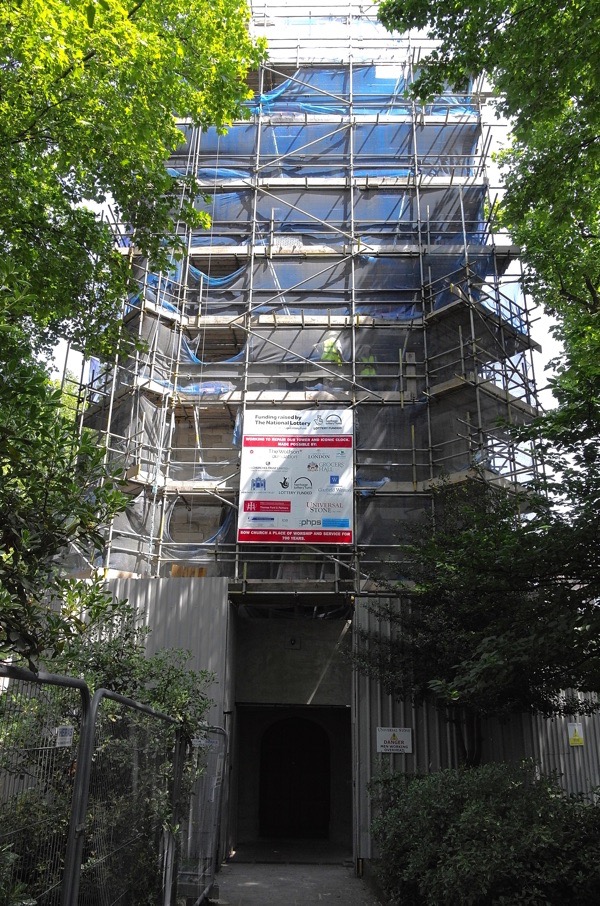
Tower under repair

The repaired tower is revealed

Celebratory cake by Erin Hiscock in honour of the completion of repairs
You may also like to read about
So Long, The Duke Of Wellington

The Duke of Wellington, 1939 – courtesy of The National Brewery Centre, Burton on Trent
I have long admired The Duke of Wellington swaggering on the corner of Brune and Toynbee St, flaunting its eccentrically-pitched roof and tall chimney stack in the style of a Tudor cottage like a swanky hat. It was always a pleasure to leave the clamour of the street and enter the peace of the barroom, where a highly concentrated game of darts was in progress.
Nick Harris, who ran the pub with licensee Vinny Mulhern in recent years, greeted me and explained that eighty per cent of the customers were darts players. “We’ve got so many teams, there are matches every Monday, Wednesday and Thursday,” he admitted to me, “I first came here as a member of a team to play in a match.”
There has been a pub on this site since at least the eighteen-fifties yet it closed forever last week, joining the sorry ranks of almost half the pubs across the East End which have closed since 2000. Recent law permits alteration in use of pubs without the necessity of planning permission, generating an unprecedented number of closures, as pubs that are economically viable and valued community meeting places are snapped up by predatory developers, eager to shut them down and convert the buildings to other uses that will deliver a quick profit.
Already, the lettering has been removed from the fascia, the inn sign has been taken down and the hoardings have gone up. Problems began for The Duke of Wellington when property developers Mendoza Limited bought the freehold for fifteen million pounds a few years ago. As owners, they had the right to prescribe the list of suppliers that Vinny, the tenant landlord, could buy from. As a consequence, he had to pay £265 a barrel where he paid £130 previously. Meanwhile, Vinny discovered Mendoza Limited had acquired a string of twenty-seven pubs for ‘conversion,’ employing questionable tactics to further their purpose.
“They’re saying we’ve been buying from unapproved suppliers and they’ve sent in a stocktaker,” Nick revealed. I learned Vinny had his weekly rent returned the day after he paid it. “I think they are getting ready to send the bailiffs in to change our locks for not paying the rent,” Nick confessed to me, turning emotional, “They don’t care – they don’t realise how much it offends good honest people who are just trying to make a living.”
Despite a long campaign to save the pub, Vinny has now gone and Mendoza’s planning application has been approved upon appeal, granting permission to gut the building, demolish part of it and pack in as many pokey hotel rooms as possible, building upon the garden and adjoining land.

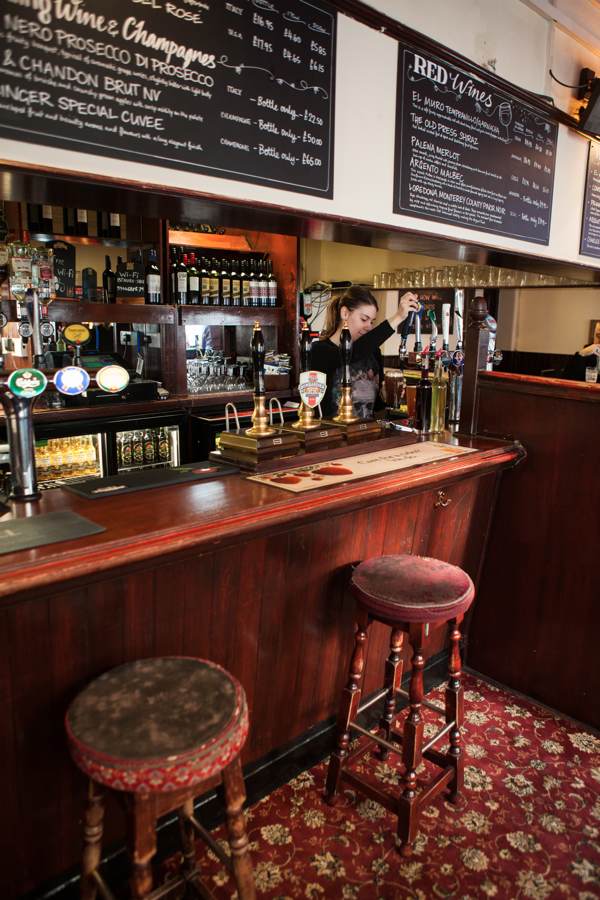


Vinny Mulhern, Publican


Nick Harris & Vinny Mulhern
Photographs copyright © Estate of Colin O’Brien
You may also like to take a look at


