
Tony Hall, Photographer

Bonner St, Bethnal Green
Tony Hall (1936-2008) would not have described himself as a photographer – his life’s work was that of a graphic designer, political cartoonist and illustrator. Yet, on the basis of the legacy of around a thousand photographs that he took, he was unquestionably a photographer, blessed with a natural empathy for his subjects and possessing a bold aesthetic sensibility too.
Tony’s wife Libby Hall, known as a collector of dog photography, revisited her husband’s photographs before giving them to the Bishopsgate Institute where they are held in the archive permanently. “It was an extraordinary experience because there were many that I had never seen before and I wanted to ask him about them.” Libby confessed to me, “I noticed Tony reflected in the glass of J.Barker, the butcher’s shop, and then to my surprise I saw myself standing next to him.”
“I was often with him but, from the mid-sixties to the early seventies, he worked shifts and wandered around taking photographs on weekday afternoons,” she reflected, “He loved roaming in the East End and photographing it.”
Born in Ealing, Tony Hall studied painting at the Royal College of Art under Ruskin Spear. But although he quickly acquired a reputation as a talented portrait painter, he chose to reject the medium, deciding that he did not want to create pictures which could only be afforded by the wealthy, turning his abilities instead towards graphic works that could be mass-produced for a wider audience.
Originally from New York, Libby met Tony when she went to work at a printers in Cowcross St, Clerkenwell, where he was employed as a graphic artist. “The boss was member of the Communist Party yet he resented it when we tried to start a union and he was always running out of money to pay our wages, giving us ‘subs’ bit by bit.” she recalled with fond indignation, “I was supposed to manage the office and type things, but the place was such a mess that the typewriter was on top of a filing cabinet and they expected me to type standing up. There were twelve of us working there and we did mail order catalogues. Tony and the others used to compete to see who could get the most appalling designs into the catalogues.”
“Then Tony went to work for the Evening News as a newspaper artist on Fleet St and I joined the Morning Star as a press photographer.” Libby continued,” I remember he refused to draw a graphic of a black man as a mugger and, when the High Wizard of the Klu Klux Klan came to London, Tony draw a little ice cream badge onto his uniform on the photograph and it was published!” After the Evening News, Tony worked at The Sun until the move to Wapping, using this opportunity of short shifts to develop his career as a graphic artist by drawing weekly cartoons for the Labour Herald.
This was the moment when Tony also had the time to pursue his photography, recording an affectionate chronicle of the daily life of the East End where he lived from 1960 until the end of his life – first in Barbauld Rd, Stoke Newington, then in Nevill Rd above a butchers shop, before making a home with Libby in 1967 at Ickburgh Rd, Clapton. “It is the England I first loved …” Libby confided, surveying Tony’s pictures that record his tender personal vision for perpetuity,”… the smell of tobacco, wet tweed and coal fires.”
“He’d say to me sometimes, ‘I must do something with those photographs,'” Libby told me, which makes it a special delight to publish Tony Hall’s pictures
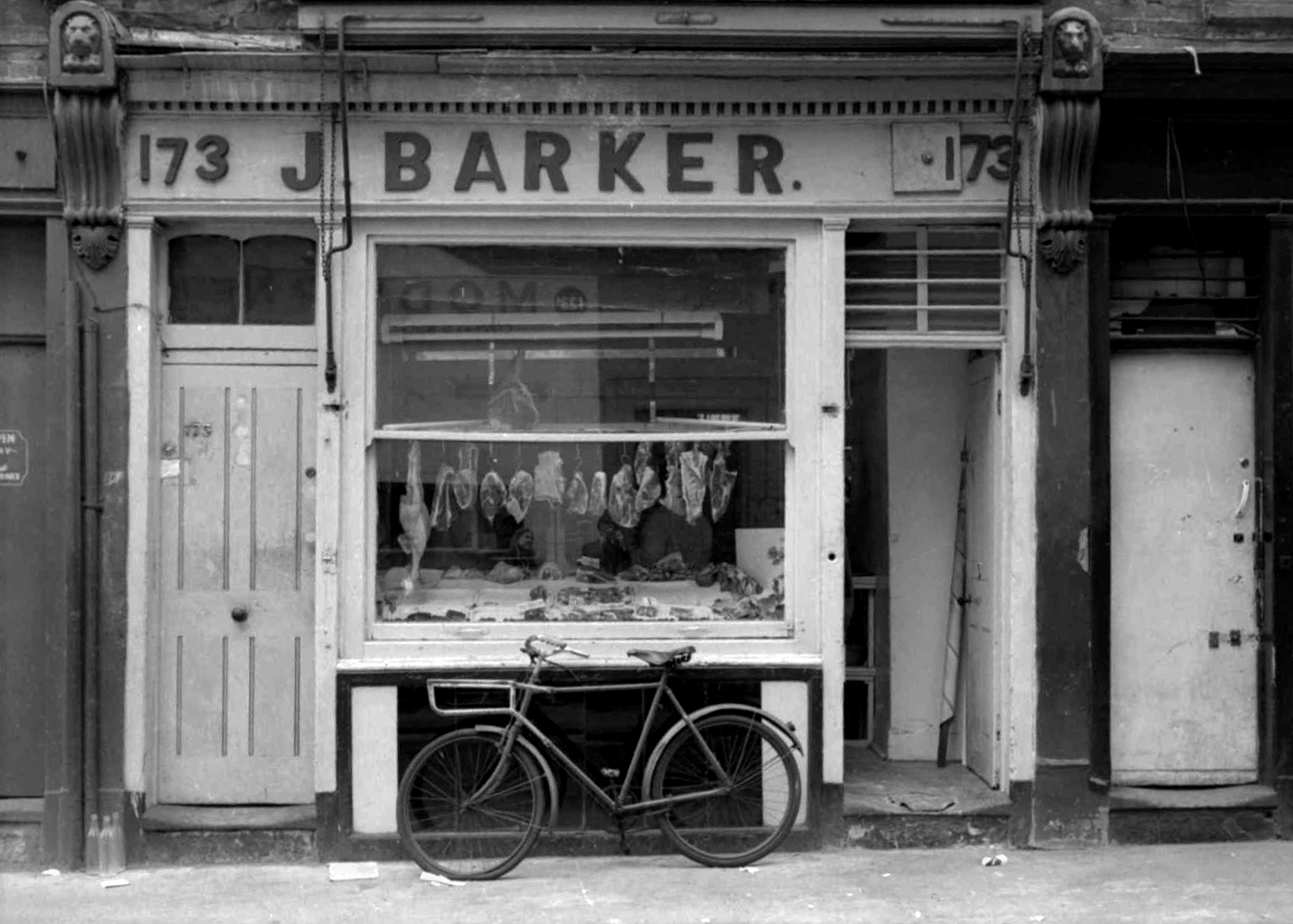
Click this picture to enlarge and see the reflection of Tony & Libby Hall in the window of J. Barker.

Children with their bonfire for Guy Fawkes


In the Hackney Rd

“I love the way these women are looking at Tony in this picture, they’re looking at him with such trust – it’s the way he’s made them feel. He would have been in his early thirties then.”


On the Regent’s Canal near Grove Rd


On Globe Rd

In Old Montague St

In Old Montague St

In Club Row Market

On the Roman Rd


In Ridley Rd Market

In Ridley Rd Market

In Artillery Lane, Spitalfields

 Tony & Libby Hall in Cheshire St
Photographs copyright © Libby Hall
Images Courtesy of the Tony Hall Archive at the Bishopsgate Institute
Libby Hall & I would be delighted if any readers can assist in identifying the locations and subjects of Tony Hall’s photographs.
You may also like to read
A New Tombstone For William Blake

Today is the one-hundred-and-ninety-first anniversary of William Blake’s death on 12th August 1827 and this afternoon at three o’clock a new tombstone will be unveiled in Bunhill Fields in City Rd, marking his last resting place. All are welcome to attend this free event which has been organised by the Blake Society.
For many years, a tombstone commemorating William and Catherine Blake with the phrase ‘near by lie the remains’ has stood in the burial ground but this new stone marks the exact spot of his interment. The slab is incised by Lida Cardozo with Blake’s text: ‘I give you the end of a golden string / Only wind it into a ball / It will lead you in at Heavens gate / Built in Jerusalems wall.’
At the unveiling, Philip Pullman and Rowan Williams will speak and a newly commissioned choral work will be performed. Guests will be invited to place one of one-hundred-and-ninety-one candles around the grave, commemorating the years since Blake’s death.
Click here to read about how the exact location of William Blake’s grave was established

“He who binds himself to a Joy, Does the winged life destroy. He who kisses the Joy as it flies, Lives in Eternity’s sunrise.”
Robson Cezar, King of the Bottletops‘ tribute to William Blake in Bunhill Fields
You may also like to read
In The Company Of Mr Pussy
With your help, I am producing a handsome collection of stories of my old cat, THE LIFE & TIMES OF MR PUSSY, A Memoir Of A Favourite Cat to be published by Spitalfields Life Books on 20th September. Below you can read an excerpt.
Support publication by preordering THE LIFE & TIMES OF MR PUSSY and you will receive a signed copy when the book is published.
Click here to preorder your copy

Unless I am out on the streets pursuing the subjects of my interviews, I spend most days of the week alone in the house with my old cat, Mr Pussy. When I am sitting writing, he likes to doze and thus offers undemanding company, savouring the quietude that reigns while I am composing my sentences. If I am working in bed, he will curl up on the covers so that I can just feel his weight pressing against my leg. If I am writing at my desk, he will perch upon an old stool with a seat woven of straw, attendant like a loyal secretary. If I am sitting beside the stove for warmth late at night, he will stretch out upon the bare floor to his greatest extent, until he resembles an animal skin rug.
A modest creature, he draws pleasure from my company and I am always flattered that he seeks me out to rest nearby. He does not draw attention to himself – just the occasional shrill exclamation upon entering the house to announce his return and sometimes a gentle tap of the paw upon my leg, as a reminder, should I neglect to fill his dish. At mealtimes, he commonly positions himself at my feet as I settle in the wing chair to eat my dinner, tracing the air with his nose to ascertain the menu. Yet he is rarely insistent and, if I grant him a morsel or permit him to lick the plate, he will do no more than taste, since he is curious rather than greedy and his concern is not to satiate his appetite but to feel included.
Even if others are around, it is in the nature of writing that it is a solitary activity. A connoisseur of stillness and a creature of tact, Mr Pussy understands this instinctively. He lounges in a silent reverie while I am working, before falling asleep and snuffling quietly to himself. During these long afternoons of contemplation, if I should lose concentration upon the task in hand, my thoughts often turn to my mother and how the pattern of my day has come to reflect hers. Once she had finished the housework, she delighted to sit for hours reading a novel just as I settle down to write once the day’s errands are accomplished – each of us enjoying the company of a cat.
I remember vividly how, when she was dying, she sought to make a reckoning of her life. My mother was insistent that I must have no doubt of her love for me and of my father, forgiving his volatile nature that had coloured the happiness of their marriage. “He couldn’t help it,” she admitted to me with a distracted frown. And then, quite unexpectedly, referring to the grey tabby that was my childhood pet, she said, “And the cat, she helped me, she was always with me.” In that moment, I recalled how the creature followed her around each day as she did the housework which caused her such anxiety and I remembered how, returning from school, I found her once cradling it as she wept for her loneliness. When the beloved animal expired, she vowed never to have another, such was the depth of her attachment.
Yet, after my father died, I acquired a black kitten in Mile End and presented it to her as a distraction from her grief. And thus, in my mother’s company, Mr Pussy grew accustomed to the afternoon routine, the empty house and the presence of one silently absorbed. Thus, when the cat and I are all alone now in the stillness of the middle of the day, it is as if time stops. My mother’s placid nature moulded his behaviour and, years after she died, his habits are the same. Mr Pussy seeks me out each afternoon to share the passage of the hours before nightfall and I acquiesce, thankful for the peace that prevails in his company.


With your help, I am producing a handsome collection of stories of my old cat, THE LIFE & TIMES OF MR PUSSY, A Memoir Of A Favourite Cat to be published by Spitalfields Life Books on 20th September.
Support publication by preordering THE LIFE & TIMES OF MR PUSSY and you will receive a signed and inscribed copy when the book is published.
In Old Holborn

Holborn Bars
Even before I knew Holborn, I knew Old Holborn from the drawing of half-timbered houses upon the tobacco tins in which my father used to store his rusty nails. These days, I walk through Holborn once a week on my way between Spitalfields and the West End, and I always cast my eyes up in wonder at this familiar fragment of old London.
Yet, apart from Leather Lane and the International Magic Shop on Clerkenwell Rd, I rarely have reason to pause in Holborn. It is a mysterious, implacable district of offices, administrative headquarters and professional institutions that you might never visit, unless you have business with a lawyer, or seek a magic trick or a diamond ring. So I resolved to wander in Holborn with my camera and present you with some of the under-appreciated sights to be discovered there.
Crossing the bed of the Fleet River at Holborn Viaduct, I took a detour into Shoe Lane. A curious ravine of a street traversed by a bridge and overshadowed between tall edifices, where the cycle-taxis have their garage in the cavernous vaults receding deep into the brick wall. John Stow attributed the name of Holborn to the ‘Old Bourne’ or stream that ran through this narrow valley into the Fleet here and, even today, it is not hard to envisage Shoe Lane with a river flowing through.
Up above sits Christopher Wren’s St Andrew’s, Holborn, that was founded upon the bank of the Fleet and stood opposite the entrance to the Bishop of Ely’s London residence, latterly refashioned as Christopher Hatton’s mansion. A stone mitre upon the front of the Mitre Tavern in Hatton Garden, dated 1546, is the most visible reminder of the former medieval palace that existed here, of which the thirteenth century Church of St Etheldreda’s in Ely Place was formerly the chapel. It presents a modest frontage to the street, but you enter through a stone passage way and climb a staircase to discover an unexpectedly large church where richly-coloured stained glass glows in the liturgical gloom.
Outside in Ely Place, inebriate lawyers in well-cut suits knocked upon a wooden door in a blank wall at the end of the street and brayed in delight to be admitted by this secret entrance to Bleeding Heart Yard, where they might discreetly pass the afternoon in further indulgence. Barely a hundred yards away across Hatton Garden where wistful loners eyed engagement rings, Leather Lane Market was winding down. The line at Boom Burger was petering out and the shoe seller was resting his feet, while the cheap dresses and imported fancy goods were packed away for another day.
Just across the road, both Staple Inn and Gray’s Inn offer a respite from the clamour of Holborn, with magnificent tranquil squares and well-kept gardens, where they were already raking leaves from immaculate lawns yesterday. But the casual visitor may not relax within these precincts and, when the Gray’s Inn Garden shuts at two-thirty precisely, you are reminded that your presence is that of an interloper, at the gracious discretion of the residents of these grand old buildings.
Beyond lies Red Lion Sq, laid out in 1684 by the notorious Nicholas Barbon who, at the same time, was putting up cheap speculative housing in Spitalfields and outpaced the rapacious developers of our own day by commencing construction in disregard of any restriction. Quiet benches and a tea stall in this leafy yet amiably scruffy square offer an ideal place to contemplate the afternoon’s stroll.
Then you join the crowds milling outside Holborn tube station, which is situated at the centre of a such a chaotic series of junctions, it prompted Virginia Woolf to suggest that only the condition of marriage has more turnings than are to be found in Holborn.

The One Tun in Saffron Hill. reputed to be the origin of the Three Tuns in ‘Oliver Twist’

In Shoe Lane

St Andrew Holborn seen from Shoe Lane

On Holborn Viaduct

Christopher Wren’s St Andrew Holborn

In St Etheldreda’s, Ely Place

Staircase at St Etheldreda’s

The Mitre, Hatton Garden

Charity School of 1696 In Hatton Garden by Christopher Wren

Choosing a ring in Hatton Garden

In Leather Lane

Seeking sustenance in Leather Lane

Shoe Seller, Leather Lane

Barber in Lamb’s Conduit Passage

Staple Inn, 1900


In Staple Inn


In Staple Inn

In Gray’s Inn

In Gray’s Inn Gardens


In Gray’s Inn

Chaos at Holborn Station

Rush hour at Holborn Station

Fusiliers memorial in High Holborn
You may also like to take a look at
So Long, Kevin Cordery

Kevin Cordery, Polisher & Plater
Earlier this year I interviewed Harry Permutt, Master Goldsmith, at the beautiful old workshop he shared in Panther House, Clerkenwell with Kevin Cordery, Finisher, for the past fifteen years. At the time, I did not write about Kevin but I was aware of him working quietly and conscientiously at his bench beneath a magnificent display of sconces he had restored. Harry and Kevin were under threat of eviction prior to redevelopment of the building and, shortly after I visited, they were given a week’s notice and told to go.
Harry rang me last week to tell me that he never saw Kevin after the eviction notice was served and that Kevin had taken his life a few weeks later. Although Kevin had a history of mental health problems, Harry believes it was the eviction from their workshop which tipped him over the edge.
All over London, people are losing their workspaces and livelihoods for the sake of redevelopment, as centuries-old trades are being displaced, yet the human cost of this is rarely taken into consideration.
I went over to Hatton Garden to visit Harry in his new workshop – a small windowless room in a sub-basement – to learn more about Kevin, so that his story is not simply forgotten.
“In this trade you meet a lot of people. I came across Kevin when I took work to him because he was good Finisher. I remember when I first knew Kevin, I was making a big three carat princess-cut gents single stone ring. It was all in platinum and I took it to Kevin to finish it off, it was a lovely job. He was based in the Colonial Building, 59/61 Hatton Garden with David and his friend Raymond, who were setters. They lived near to each other in Barkingside and they were Spurs supporters.
A Finisher makes the mount for a ring, cleans it up and polishes it before the stone goes in. Once the stone is set, he finishes it off before it goes back to the client. Kevin did not have any training or apprenticeship, he was a youngster who wanted to be a polisher and he was self-taught. He had a series of workshops and they were kicked out of 59/61 because of redevelopment. He did not know where to go but I was in 115 Clerkenwell Rd at the time, working with the Italians and the Sicilians. I said to him, ‘I’ll get you into our place. You’ll be working in the basement and it’ll be rent free as long as long as you finish our work off for us.’
He jumped at it, and that’s where our friendship started and took off. Then the landlord gave us twenty-four hours to get out and we moved to Panther House where we shared a workshop for fifteen years. We moved on the Sunday morning and we were up and running on Monday morning. It was tremendous and everybody loved the workshop. It had natural light, we had all our things on the wall and we used every part of that space.
We were two separate businesses but anything he wanted done – instead of sending it across the road -I would do it, same as he would do it for me. It was a partnership and it worked very well. We were working associates and we used to have a laugh and a joke.
At that time, Kevin started to go downhill, he couldn’t be put under pressure and he let customers dictate to him. I said to him, ‘Don’t allow it,’ but he used to agree to do jobs within minutes. They wanted it yesterday and he could never get a good price. Several times, he disappeared for about six months and I discovered he was very depressed. He wouldn’t talk about it. Before the end of last year, he disappeared and I could not speak to him. He was in a black hole. He lived alone. He used to look after his mother and father but they died.
He sent a text to all his friends saying, ‘Goodbye’ and police broke into his house. I was rung at midnight and I asked, ‘Is he in A & E?’ and they said, ‘Yeah, he’s drunk.’ He used to turn to the bottle. He had so many chances to cure himself but he didn’t. I think the circumstances contributed and he had a failed marriage.
Things got worse and worse, and then the move came. We were four years behind with the rent because the landlord had refused to collect even though I set up a direct debit. I think it was part of a strategy to get rid of us. Two arrogant officials came round in the morning on March 12th. They worked for the developer who had bought the building and one was the accountant who was after the money. They said, ‘You’re out, you’ve got to get out!’ I said, ‘We need at least four weeks notice.’ ‘We can’t do that,’ they told me. I explained that it was not our fault they neglected to collect the rent. Kevin did not react at all because by that time his brain was numb. He was badly affected by what happened that day and I could not get a word out of him. He was not coherent. He left early.
I could not be there next day, but I heard that the guy came back and Kevin went for him. After that Kevin stayed at home, not answering the phone to anyone, and I had to move everything out of the workshop. Two guys helped me and we worked until two in the morning.
I never saw Kevin again, I never even saw him before he died. I only learned in July when his wife rang me to ask if I still had anything of his. I didn’t and she said, ‘We’ll inform you when he’s going to be cremated.’ After the autopsy, it was declared an unexplained death by the coroner. He only lived a couple of weeks after he left Panther House and nobody knows exactly how he died. The police broke in and found him dead at home.
I know he did not want to leave Panther House, none of us wanted to. I don’t even think the development is going ahead, because they have property guardians in there now. I enjoyed sharing a workshop with Kevin because we bounced off each another. He was very good at what he did, he did all manner of things in the polishing business. Kevin was fifty-one years old and he could have carried on in the trade for another thirty years or more. “

Kevin Cordery and Harry Permutt
You may also like to read my original piece
A Roman Ruin At The Hairdresser

Nicholson & Griffin, Hairdresser & Barber
The reasons why people go the hairdresser are various and complex – but Jane Sidell, Inspector of Ancient Monuments, and I visited a salon in the City of London for a purpose quite beyond the usual.
There is a hairdresser in Gracechurch St at the entrance to Leadenhall Market that is like no other. It appears unremarkable until you step through the tiny salon with room only for one customer and descend the staircase to find yourself in an enormous basement lined with mirrors and chairs, where busy hairdressers tend their clients’ coiffure.
At the far corner of this chamber, there is a discreet glass door which leads to another space entirely. Upon first sight, there is undefined darkness on the other side of the door, as if it opened upon the infinite universe of space and time. At the centre, sits an ancient structure of stone and brick. You are standing at ground level of Roman London and purpose of the visit is to inspect this fragmentary ruin of the basilica and forum built here in the first century and uncovered in 1881.
Once the largest building in Europe north of the Alps, the structure originally extended as far west as Cornhill, as far north as Leadenhall St, as far east as Lime St and as far south as Lombard St. The basilica was the location of judicial and financial administration while the forum served as a public meeting place and market. With astonishing continuity, two millennia later, the Roman ruins lie beneath Leadenhall Market and the surrounding offices of today’s legal and financial industries.
In the dark vault beneath the salon, you confront a neatly-constructed piece of wall consisting of fifteen courses of locally-made square clay bricks sitting upon a footing of shaped sandstone. Clay bricks were commonly included to mark string courses, such as you may find in the Roman City wall but this usage as an architectural feature is unusual, suggesting it is a piece of design rather than mere utility.
Once upon a time, countless people walked from the forum into the basilica and noticed this layer of bricks at the base of the wall which eventually became so familiar as to be invisible. They did not expect anyone in future to gaze in awe at this fragment from the deep recess of the past, any more than we might imagine a random section of the city of our own time being scrutinised by those yet to come, when we have long departed and London has been erased.
Yet there will have been hairdressers in the Roman forum and this essential human requirement is unlikely ever to be redundant, which left me wondering if, in this instance, the continuum of history resides in the human activity in the salon as much as in the ruin beneath it.


You may also like to read about
Return To The Latin Market
Contributing Photographer Sarah Ainslie & I enjoyed our visit to the Latin Market in Seven Sisters so much that we returned to meet more of the traders. In spite of threats of closure, we were delighted to see that the market thrives as a teeming hive of small businesses and a vital focus for the Latin community in London. Next we are planning a Saturday night excursion to the market for salsa dancing.

Corina – “I came to this market eleven and a half years ago, I had a friend who ran this shop before me, selling clothes. I started bringing her clothes from my country, Romania. I was a single mother with two children and no access to benefits, so I had to do something. My son was seven months and my daughter was three. I got a loan from the bank and imported clothes from Romania to sell in Finsbury Park. But then I met a girl who ran this shop and she brought me here. At first, I used to clean the shop and change the clothes on the mannequins. This way my English improved. Then I bought the business and took it over.
Now I run a beauty parlour and this is how I support myself and my children. I studied to be a beautician twenty-six years ago in Romania and five years ago I decided to change from doing something I did not like to this. The certificates I had from Romania were not recognised here because technology has changed the profession. So I started to study again. I thought, “I’m old, I have two children and I have to work, so I cannot study” – but I did, and I won an award for excellence in 2015.”


Ari – “I learnt to be a barber in the Dominican Republic and I came to London via Madrid. I have been cutting men’s hair in my sister’s shop in this market for three years and built the business up. I get on with my customers very well and I enjoy cutting hair and barbering. This market is an important meeting place for Latinos.


Fernando – “In 2004, I started here with a small grocery shop but now I have a butcher, a baker, a cafe and I sell Colombian spirits. We have special events at the weekend, people come to dance and sing. It is a family event, people bring their children and everybody dances. This market is very important for our community because it is the only one of its kind in this country. It is a meeting point for people from Latin America and Africa. I want to stay here but I do not know what will happen to us in the future, they are saying we may have to move to another location. Nothing is clear.”

Nixon and Dago, baker and butcher

Catherine – “Me and my husband, we opened this shop here three years ago selling Colombian groceries. This is how we make our living. I run the business and order all the stock from a distributor in Spain. I want to extend the range of products that I sell and I hope to open a tapas bar one day.”


Pablo – “I came here five years ago when I had the opportunity to buy this cafe, before that I sublet half a unit from the Colombian bakery. I never had a mother to take care of me, I learnt to cook for myself out of necessity when I was eight years old. We were four brothers and sisters without a mother or a father, and I was working at nine years old shining shoes and selling cigarettes in the street in Colombia. At thirteen, I emigrated to Venezuela and then to Spain. Now I am here in London. The majority of my customers are Latin Americans, they work hard supporting their families by doing cleaning.”

Pablo with his son Christopher and Ana
Photographs copyright © Sarah Ainslie
Support the Campaign to Save the Latin Market
You may like to read our earlier story


