
Wilfred Owen In Shadwell
Wilfred Owen was killed in November 1918 but wrote this poem earlier that year

Wilfred Owen (1893 -1918)
Shadwell Stair in 1937

Shadwell Church

The Prospect of Whitby

Shadwell Church seen from the entrance to Shadwell Basin
You may also like to read about
Spitalfields Remembers
At the centenary of the end of the First World War, we remember the eighty-three men whose names are commemorated upon the war memorial in the churchyard at Christ Church. Vicky Stewart researched the lives of these people, uncovering biographical material where possible, while designer Adam Tuck created maps which show where they lived in Spitalfields and the vicinity.

War memorial at Christ Church photographed by John Claridge, 1961
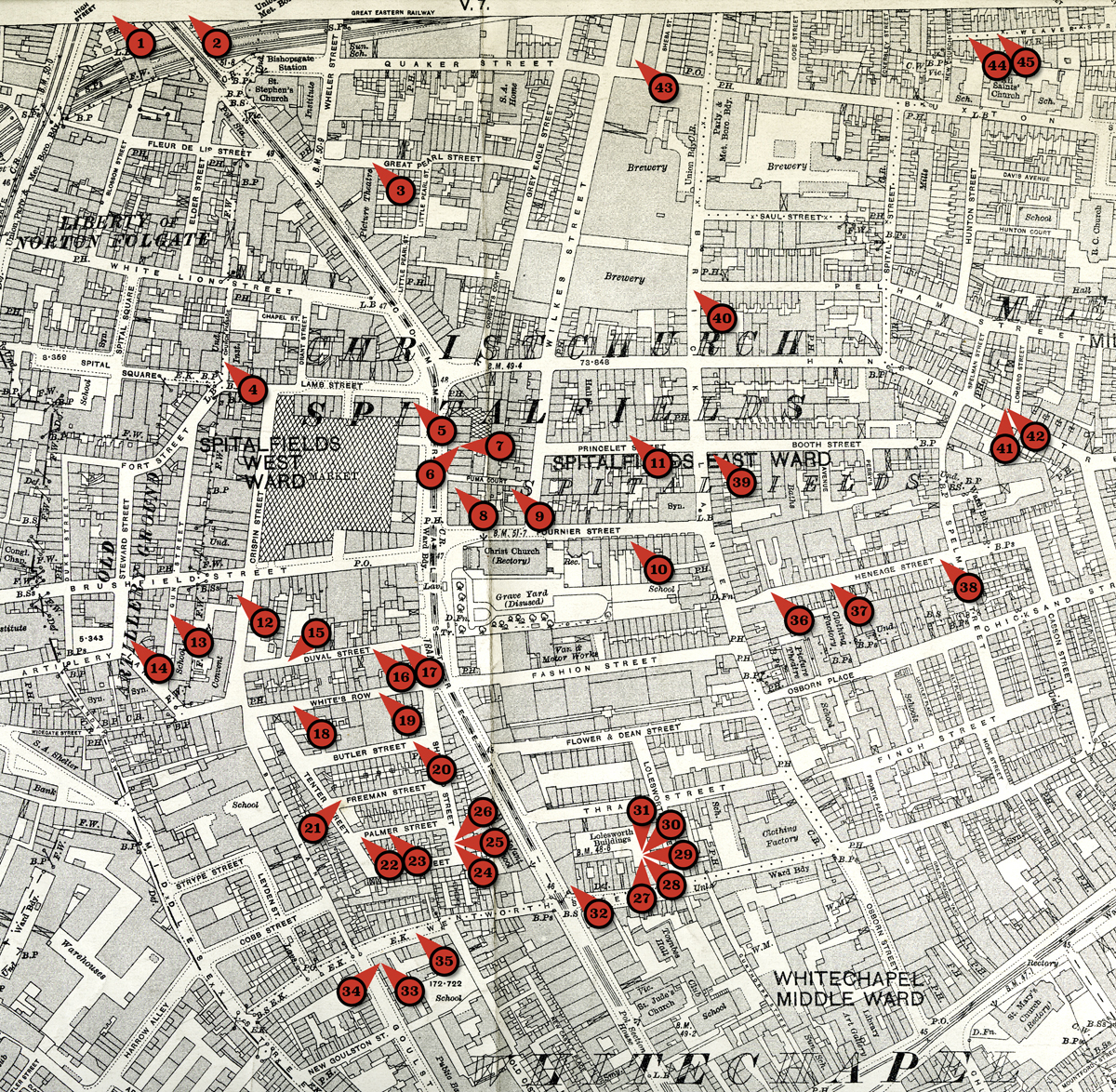
Click to enlarge this map which shows the homes we have traced in Spitalfields of those of who died

The memorial today – ‘Greater love hath no man than this that a man lay down his life for his friends’
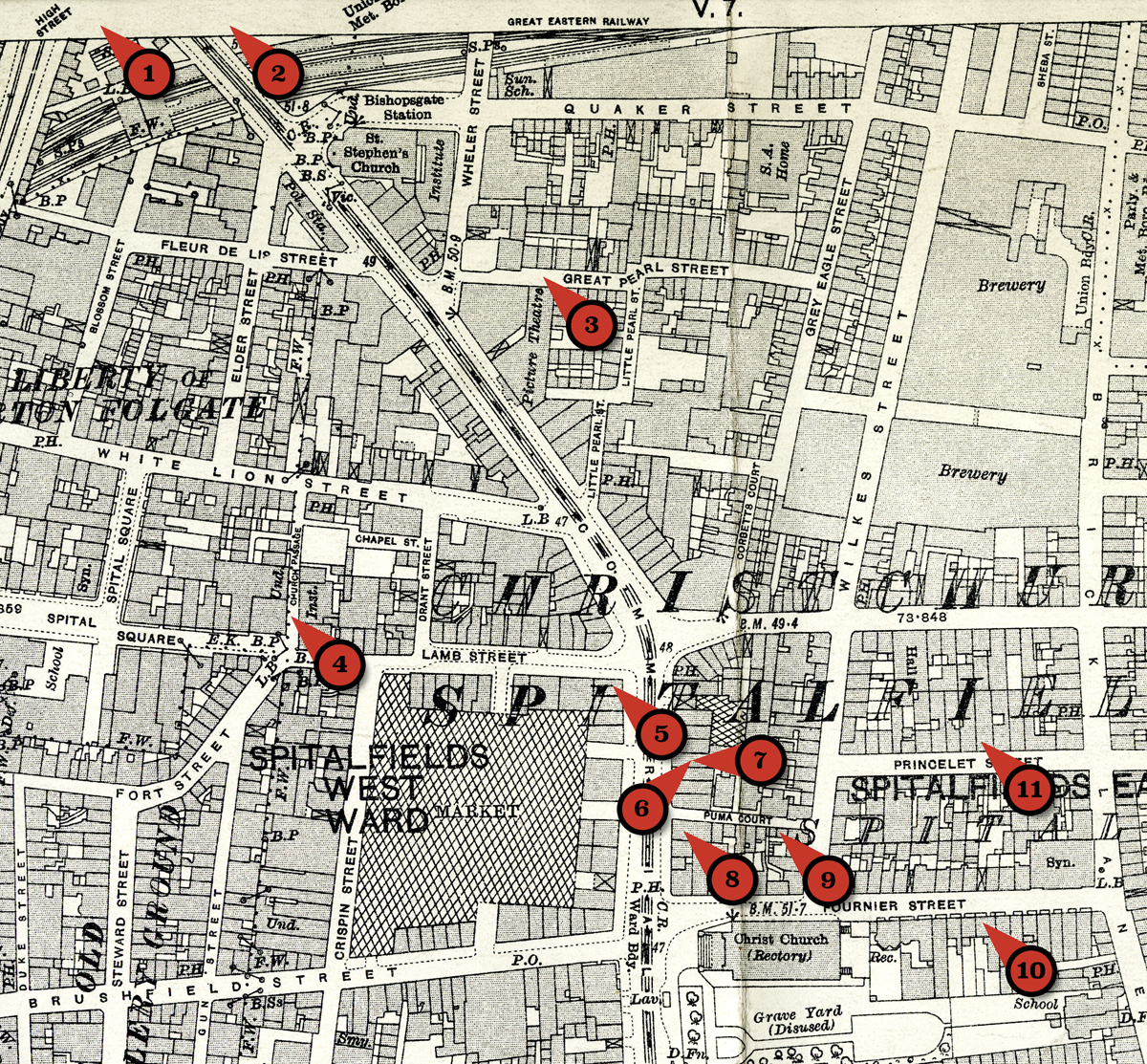
(Click to enlarge this map)
1. DAVID FREEMAN, Air Mechanic 3rd class. Service No 55241, Royal Flying Corps.
Died 29 May 1917, aged 37. Panel P.1.17 Plashet Jewish Cemetery.
David was born in 1880 in Poland, the Son of Jacob & Rachel Freeman, the eldest of five children. He married Louise and they lived at 22 Clifton Buildings, Camlet St, on the Boundary Estate.
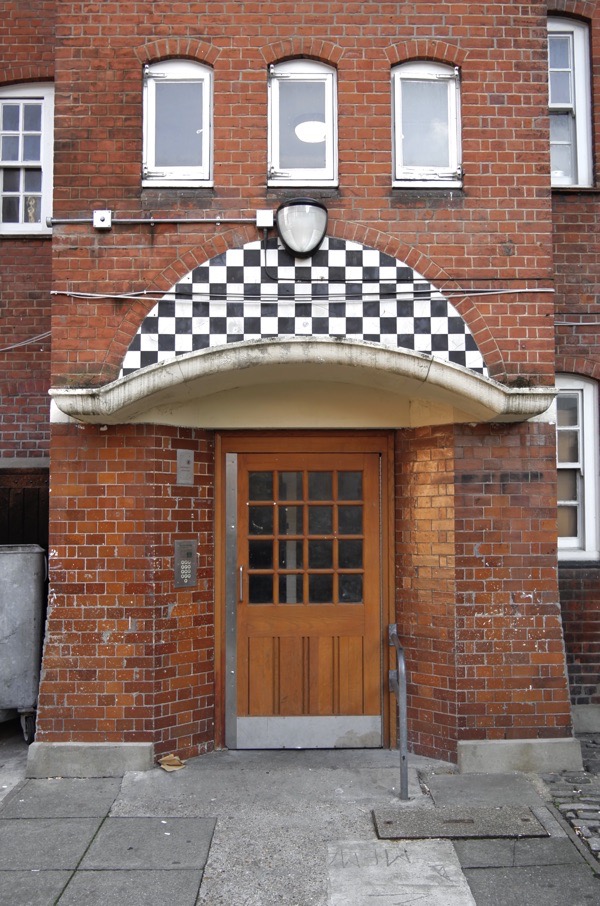
This is the doorway that David Freeman walked out of at Clifton Buildings
2. JOSEPH HARRIS, Corporal. Service No 13507, Royal Berkshire Regiment, 2nd Battalion.
Died 2nd April 1918, aged 23. Grave II. E. 4. Pargny British Cemetery.
Joseph’s father, Benjamin, a slipper maker from Warsaw who worked from home was unable to write his name, signing the census form with a cross. Joseph was born in Spitalfields and had four brothers and four sisters. His mother, Sarah, was a charwoman. By seventeen, Joseph was a general labourer and, when he died, the family were living at 33 Culham Buildings on the Boundary Estate.
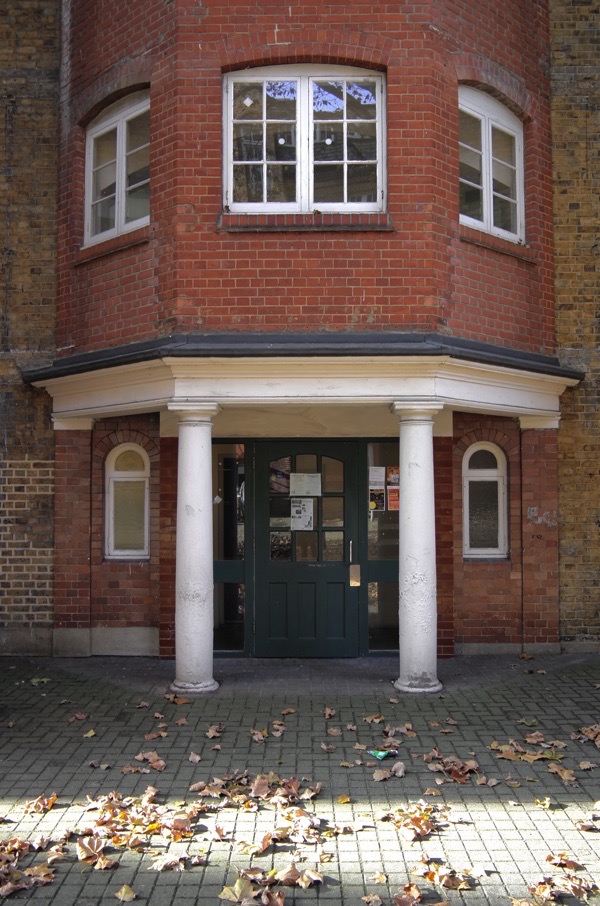
This is the doorway that Joseph Harris walked out of at Culham Buildings
3. JAMES DANIEL POPPY, Private.
James was Roman Catholic, born in 1885, and attended St Ann’s School in 1893 while living at 24 Gt Pearl Street. By 1901 he was a ‘Boy Under Detention’ at St David’s Reformatory School for Catholic Boys’ in Wales, run by Jesuits, where he received land-based nautical training. By 1906, aged twenty-one while living at 24 Thrawl St and working as a shoemaster, he entered Whitechapel Infirmary with a ‘swelled face.’ In 1909, now at 4 Flower and Dean St, he was treated in Stepney Workhouse Hospital for ulcerated legs. By 1915, he was a hawker and back in the Whitechapel Infirmary. His military career is unknown.
4. JOSEPH FREDERICK GOODSON, Rifleman. Service No 56007, King’s Royal Rifle Corps, 6th Battalion. City of London Rifles.
Died 20th June 1918, aged 19. Grave VIII. I. 12. Dernancourt Communal Cemetery Extension. Epitaph: ‘Oh for a glimpse of the grave where you’re laid only to lay a flower at your head, Mother.’
Born 10th May 1899 at 19a Corbetts Court and baptised at Christ Church, Spitalfields, Joseph went to St Mary’s School, Spital Sq, when the family lived at 2 Chapel Place. The following year, they moved just around the corner to 2 Nantes Place, Norton Folgate. He was one of six children born to Joseph & Norah Goodson until the year before he enlisted when a brother and sister both died.
5. HENRY GEORGE VINCENT, Private. Service No 16017, Norfolk Regiment, 7th Battalion.
Died 12th August 1916, aged 41. Grave IV. H. 19. Pozieres British Cemetery, Ovillers-la-Boiselles
Henry Vincent may have brought his young family to Spitalfields to work for the Great Eastern Railway, a short walk from his home at in Commercial St. His father, George, had worked on the railway as a goods clerk, rising to become Railway Station Master in Ramsey, Huntingdonshire, where Henry was born. He followed his father into the railway starting as a railway clerk while living in Tottenham and eventually became a correspondence clerk working from home at 117 Commercial St. The son of George and Mary Ann Vincent, he married the daughter of a farmer, Caroline Chapman, who lived in Hornsey Rise, Islington and they married there before moving to Tottenham. They had four children, three surviving infancy.

The door that Henry George Vincent walked out of at 117 Commercial St
6. & 7. MALCOLM & LESLIE ANDREW
MALCOLM ANDREW, Lieutenant. Service No 4722, Lancashire Fusiliers, attd. 104th Trench Mortar Bty.
Died 4 November 1918, aged 28. Grave VI. D. 1. Romeries Communal Cemetery Extension. Epitaph ‘In God’s Keeping’ (Gladys)
LESLIE WALTER ANDREW, Carpenter’s Crew. Service Number M13789, Royal Navy, H.M.S. Duncan
Died 17 November 1915, aged 19. Grave IV. E. 3. Taranto Town Cemetery Extension.
Malcolm & Leslie, born 1890 & 1896 respectively, were both baptised at Christ Church, Spitalfields, and lived at 96 Commercial St. Their father Thomas, a potato salesman and then a dairyman, was from the remote village of Granton in the Highlands of Scotland while their mother, Martha, was born in Jersey. By 1911, Malcolm, then twenty-one years old and single, a fruit salesman’s clerk, was living in a boarding house along with eight others in Hackney while Leslie, a greengrocery clerk, boarded with his sister at 25 Osborn St, Spitalfields. Malcolm was married to Gladys who later returned to her parents’ home on a farm near Tunbridge Wells. Malcolm signed up in 1917 and died seven days before the Armistice, the same day as his neighbour Thomas Anderson.
Leslie died from “a fracture of the skull consequent upon falling from aloft” whilst serving on HMS Duncan six months after enlisting. He was a motor body builder, who was recorded as 5 foot 5 3/4 inches tall with a 36 3/4 inch chest with black hair, hazel eyes, a fresh complexion and a scar to his right knee. Previously, he had served on HMS Pembroke II where his character was described as ‘Very Good.’
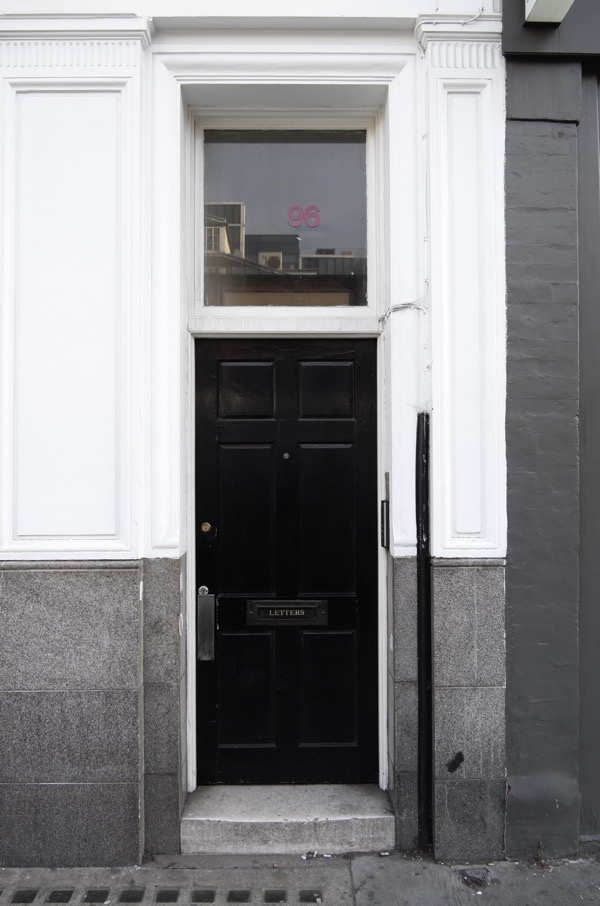
The door that Malcolm & Leslie Andrew walked out of at 96 Commercial St
8. WILLIAM HENRY PERCIVAL, Rifleman. Service No 534290, London Regiment (Prince of Wales’ Own Civil Service Rifles), 15th Battalion.
Died 8th June 1917, Age 19. Grave I. D. 16. Mendinghem Military Cemetery. Epitaph ‘He giveth his beloved rest’ (Father)
William Gray was adopted by Percy & Grace Percival, parents of Fred, born in Aldgate with a crippled left hand, and Stanley and Grace who both died young. Born on 15th Mar 1898 in Kentish Town, William entered Raywood St Infants School at age three, while living in Battersea, where his father an omnibus conductor. On 9th August 1909, his parents with their three surviving children were admitted to Poplar Workhouse. The children were ten and nine years old with the littlest just eleven months, when when their father was classed as ‘infirm’ and requiring an ‘infirm diet,’ while their mother was classed ‘firm.’ By the end of that year, baby Grace had died. On 20th Feb 1911, Percy was a ‘fruit hawker,’ by then aged forty-three and living at 82 Brushfield St, when he admitted himself to South Grove Workhouse, Whitechapel, as ‘destitute.’ By the time of William’s enlistment, the family were living at 7 Puma Court.
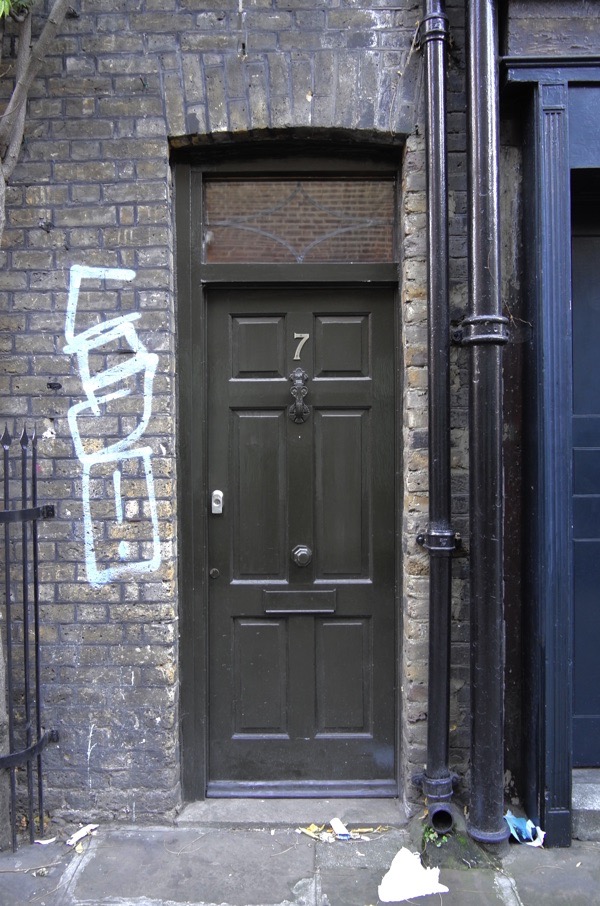
The door that William Henry Percival walked out of at 7 Puma Court
9. HARRY TIPPETT, Rifleman. Service No S/25195, Rifle Brigade, 11th Battalion.
Died 1st April 1918, aged 21. Grave P. VII. G. 4A. St Sever Cemetery Extension, Rouen.
The Tippett family home was 10 Puma Court, Commercial St. Harry was born on the 14th September 1897 and baptised at Christ Church, Spitalfields. By the time of his death in 1918 his mother, Sarah, widowed since 1911, had moved across the court into the Norton Folgate Almshouses, to “No 3 Alms Rooms, Puma Court.” Harry was one of eleven children, six of whom had died by 1911. By the time of the census his father William, a printer’s assistant, had been dead only a week, leaving Harry, age thirteen and still at school, the eldest son with three remaining sisters.
10. LESLIE LLEWELLYN LITTLEJOHN, QMS. Service No 10673, Royal Scots Lothian Regiment, 2nd Battalion.
Died 11th April 1917, aged 24. Grave I.M.2 Duisane British Cemetery.
Leslie was an orphan, born in Kensington on 5th Jan 1892. Given a home by Matthew, a blindmaker, and Ellen (Nellie) Littlejohn, he was the third of their six children. On July 15th, 1901 Nellie and all the children entered Britten St Workhouse in Chelsea. In 1909 Leslie, age fourteen, he spent a month in Whitechapel Infirmary with pneumonia and his address given as 14 Fournier St with his brother Cyril, listed as his relative, living in West Brompton.

The door that Leslie Llewellyn Littlejohn walked out of at 14 Fournier St
11. HENRY SHATKOVSKY, Private Service No 132092, Machine Gun Corps (Infantry), 8th Battalion.
Died 28th May 1918, aged 20. Soissons Memorial
Henry was the son of Jacob & Fanny Shatkofsky who lived at 19 Booth St (now Princelet St). Jacob died in 1919, followed in December 1927 by Henry’s brother Samuel, followed twelve days later by their mother. When the family buried Fanny alongside Jacob they erected a third stone between them with the inscription ‘In memory of their dear son Henry, Killed in Action 28th May 1918, aged 20.’ The graves are at the Edmonton Federation Cemetery laid our in 1889 on land donated by Lord Montague, MP for Whitechapel, for Jewish people in the East End who could not afford fees asked by other synagogues.
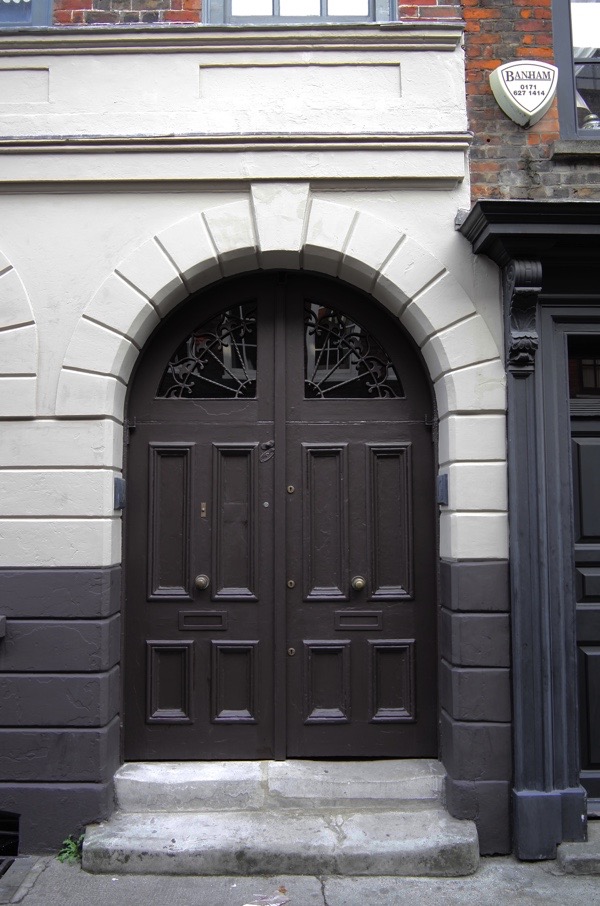
The door that Henry Shatkovsky walked out of at 19 Princelet St
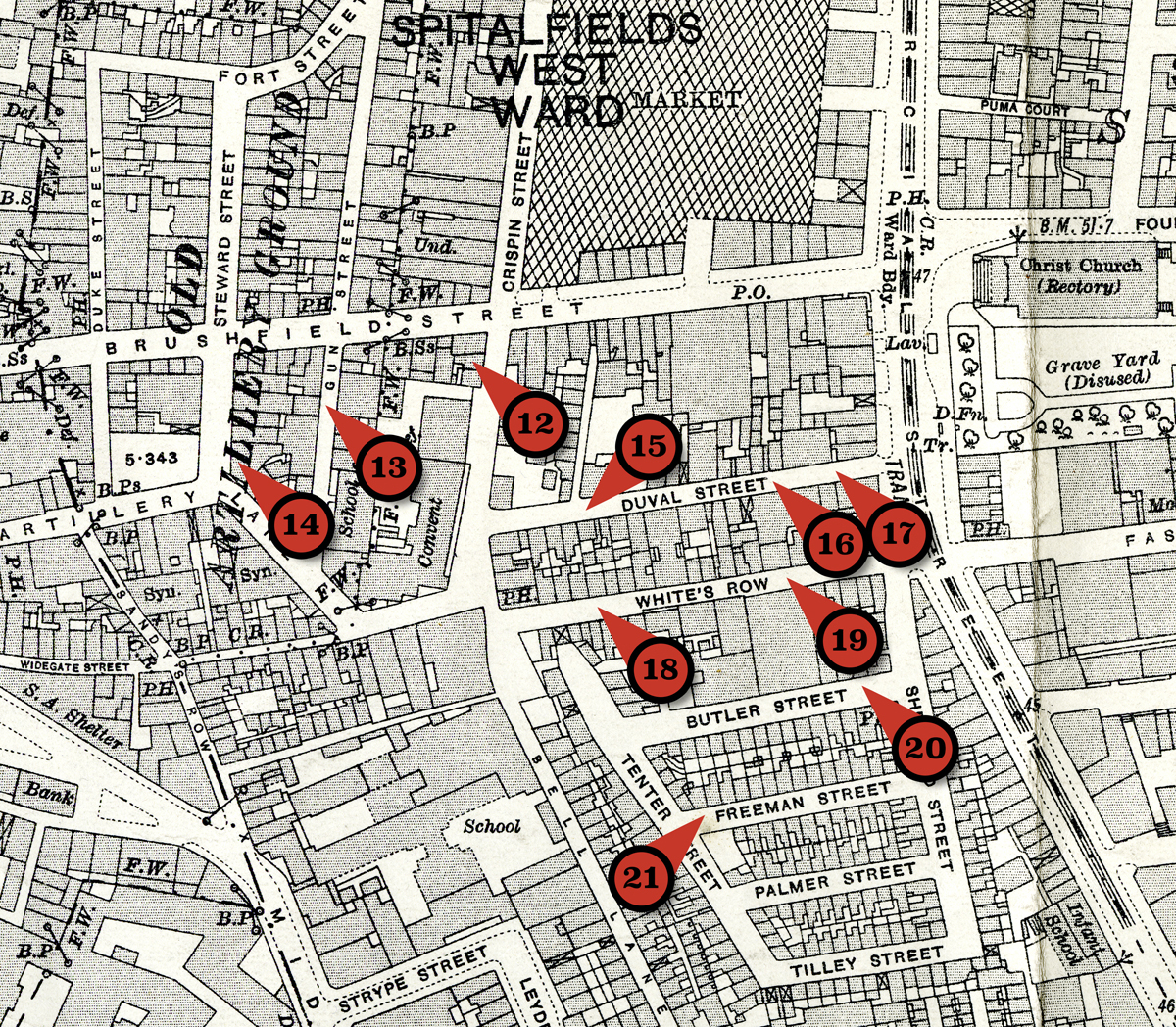
(Click to enlarge this map)
12. JAMES MINNS, Corporal. Service No 4/7904, West Yorkshire Regiment (Prince of Wales’s Own), 18th Battalion.
Died 3rd May 1917, aged 20. Panel Bay 4: Arras Memorial
James’s father George, of 56 Flower & Dean St, a brewer’s labourer, married Elizabeth Homewood in 1891 at Christ Church, Spitalfields. Her father was a weaver. On 14th May 1896, James was born and, at fourteen months, he was admitted to the Whitechapel Infirmary with measles, his mother staying with him as he was still suckling. The notes say that his father, then a dock labourer, had been ‘absent for two weeks.’ They lived in Hanbury St then but when he started at George Yard Charity School, the family lived in Aldgate. At six years old, he was re-admitted to Whitechapel Infirmary with an abscess on his face, his address now South Grove Workhouse where his mother lived while his father was at 9d Dorset St. A year on found him still at George Yard School but living in ‘shelters.’ In 1911, James’ parents were at 15 Little Pearl St but James then fourteen years old was an ‘inmate’ at the East London Industrial School in Lewisham for ‘Boys under Detention’, described as ‘a plumber.’ All boys had a trade title but received some schooling. At enlistment, he was living at 45 Crispin St.
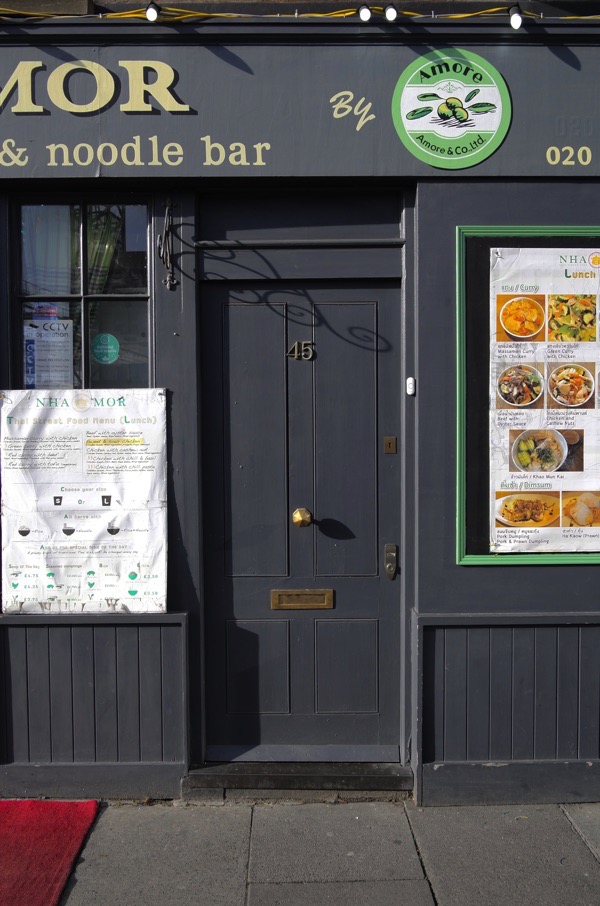
The doorway that James Minns walked out of at 45 Crispin St
13. CHARLES THOMAS KENNY, Rifleman. Service No R/32916, King’s Royal Rifle Corps, 10th Battalion.
Died 19th February 1917, aged 36. Panel Pier and Face 13 A and 13 B. Thiepval Memorial
Charles Keeny died leaving a wife and five surviving children. In 1901, Charles was a plumber living at 9 Paternoster Row, Spitalfields (now Brushfield St) with his parents John, a warehouseman, and Elizabeth – who ran their home as a lodging house – and six siblings. The family lived in two of the rooms, while the other four rooms were occupied by nineteen others. In January 1904, he married Jane Hayes, a hawker, who lived next door. By 1911, they had six children, one of whom died in infancy and they lived two doors from his parents. At the time of his death, the family were at 51 Gun St.
14. DAVID FLYNN, Driver. Service No 40123, Royal Field Artillery, “A” Bty. 83rd Brigade.
Died 29th October 1917, aged 21. Grave VI. B. 3. Bard Cottage Cemetery
In 1890, David Flynn was born in Spitalfields, one of seven children, two of whom died before 1911. His parents were David & Theresa Flynn, born in Holborn and the City, both men’s tailors. In 1911 David was sixteen and a contractor’s van boy, he was living with his parents and older brother James, eighteen years old, and younger sister Theresa, twelve years old. They lived in one room at 6 Tenter St, Spitalfields. At the time of his enlistment, the family lived at 35 Artillery Lane.
15. AUGUSTUS MAHONEY, Sergeant. Service No 8807, York & Lancaster Regiment, 2nd Battalion.
Died 21st March 1918. Bay 8, Arras Memorial
Augustus was born on 8th June 1888 to John & Mary Ann Mahoney, as the eldest of six children. His father, John, was a general labourer from Cork. In 1894, when Augustus enrolled at St Matthias School, the family were living at 41 Bacon St but by 1901 they had moved to 39 Dorset St – in the house at the entrance to Millers Court where thirty-seven people lived, seven families in seven rooms. When he was nineteen years in 1907, Augustus decided to leave his job as a news vendor and enter the army and by 1911 was serving in India. On Christmas Day 1917, he married Florence Squibb at the Church of St Mathew, Bethnal Green, but was killed just three months later.
16. JOSEPH DANIEL DISS, Gunner. Service No 125215, Royal Field Artillery, 306th Brigade.
Died 30th August 1917, aged 22. Grave VI. A. 5A. Wimereux Communal Cemetery
On 11th February 1901, Joseph Diss spent eight days with his siblings Mary & Edward in the City Rd Workhouse, where they were followed a few days later by brothers George & Walter. The family lived in an overcrowded house in Clerkenwell, which was home to eight families, totalling thirty-two people. Born in 1895 in Robin Court in the City of London, he was one of eleven children born to Thomas Diss, a hawker of wooden cases and his wife Minnie. Six children had died by 1911, when the remaining five with their parents plus Joseph, aged fifteen, a brewer’s van boy, lived in one room at 5 Duval St (Dorset St). Three months before the war, Joseph, then a carman, married Ellen, twenty years old, a packing case dealer who was pregnant with their first child. They lived at 7 Duval St. The year Daniel married, his younger sister Mary married Philip Schratsky, who was also killed.
17. BERTIE INGREY, Rifleman. Service No 14/45152, Royal Irish Rifles, 14th Battalion.
Died 7th December 1917, aged 25. Grave V. E. 21. Rocquigny-Equancourt British Cemetery
Born in 1892, Bertie was the son of Mrs. Agnes Garroway, of 2 Duval St, Spitalfields.
18. JAMES EAGLE, Rifleman. Service No 11475, King’s Royal Rifle Corps, 16th Battalion.
Died 20th May 1917, aged 23. Panel Bay 7. Arras Memorial.
In 1911, James Eagle’s mother, Anna, an out-of-work charwoman, was recorded as an ‘inmate,’ along with two hundred and fifty-nine others, at Providence Row Night Refuge in Crispin St, Spitalfields. James was born in Bow in 1894 and by 1917, the year James was killed, Anna was living at 33 Whites Row, with his brothers William and Thomas.
19. HARRY JOHNSON, Private. Service No 524482, Private Labour Corps, 111th Company
Died 23rd November 1918, aged 45. One of three graves ‘near the SE corner’ of Wevelgem Communal Cemetery.
Harry was the husband of Annie and they lived at 23 St Margarets Buildings, Whites Row. He was forty-one years old in 1914, three years over the age limit of thirty-eight for regular army enlistment.
‘The Labour Corps, formed in 1917, was manned by officers and other ranks who had been medically rated below the “A1” condition needed for front line service. Many were wounded. Units were often deployed for work within range of enemy guns, sometimes for lengthy periods. In the crises of March and April 1918 on the Western Front, Labour Corps units were used as emergency infantry. The Corps always suffered from its treatment as something of a second class organisation.’
20. ISAAC FRANKS, Private. Service No 282370, London Regiment (Royal Fusiliers), 4th Battalion.
Died 4th June 1917. Grave II. B. 11. Crooisilles Railway Cemetery.
Emanuel & Raynor Franks were born in Amsterdam, but their children all born in Spitalfields. Isaac was born on 25th January 1893. In 1900, when he was aged seven, the family were living at 3 Butler St (now Brune St) and he attended St Mary’s School. They lived with two other families making eighteen in one house, six adults and twelve children. Isaac’s father, Emanuel, was a hawker and the two other fathers in the house were ‘hawkers of lemons.’ By 1911, they had moved to 130 Rothschild’s Buildings, E Block, Spitalfields.
21. LOUIS BARZOLOI, Private. Service No. 611863, London Regiment, 1st/19th Battalion.
Died 7th December 1917, aged 23. Grave III. F. 7. Abbeville Communal Cemetery Extension.
Louis’s father, Philip, was a labourer in the London Docks and came from Leeds, while his mother, Hannah, was from Amsterdam. In 1901, Louis, age six years old, he was living with his Dutch Grandparents, Emanuel, a retired upholsterer, and his wife Betsy, along with his parents Philip & Hannah, and his four siblings at 8 Freeman St, Spitalfields. His brother Isaac was a cigar maker and fourteen-year-old David was a bookstall assistant. They shared their tiny terraced house with another couple. By 1911, the family were at 6 Butler St. His father, who was no longer a dockworker, and his brother David, were both hawkers of sweets, while his brother Jacob was a labourer in the market and Louis, then sixteen years old, was a boat riveter. All eight children were born in Spitalfields.
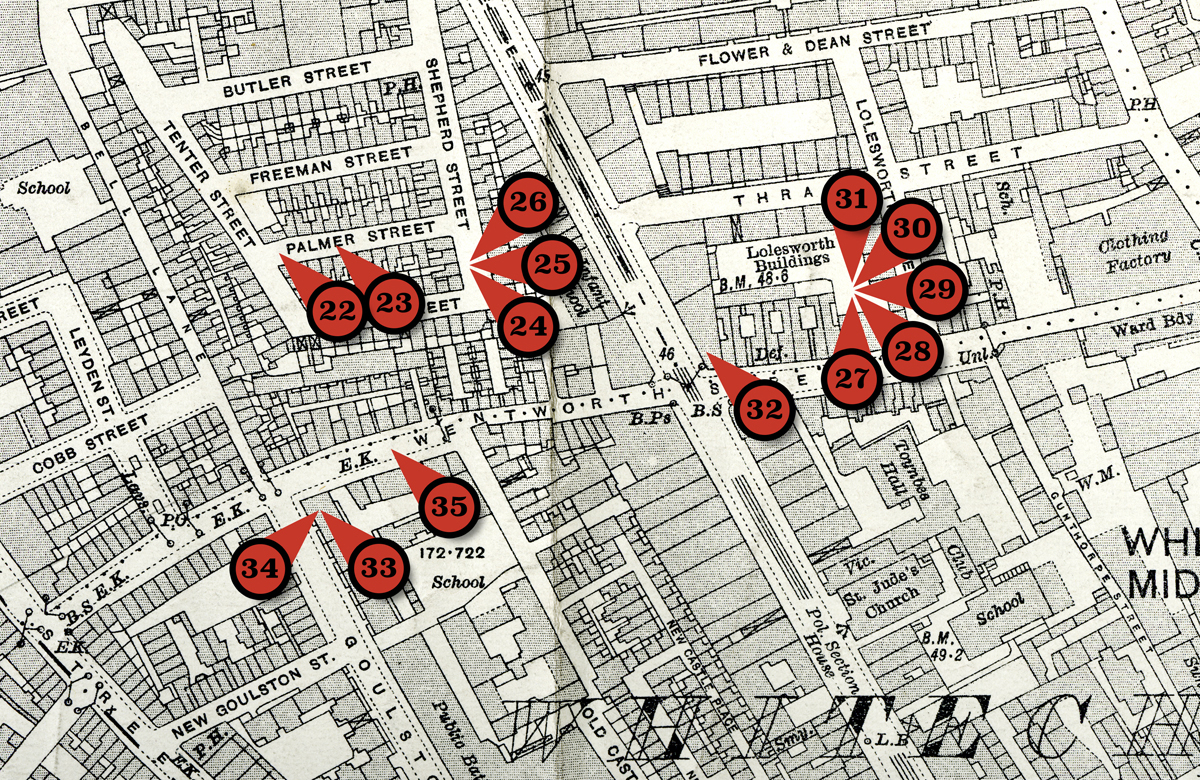
(Click to enlarge this map)
22. MOSES MICHAELS, Private. Service No 54958. Royal Welsh Fusiliers, 10th Battalion.
Died 3rd January 1917, aged 31. Grave VII. F. 4. Puchvilliers British Cemetery. Epitaph ‘Deeply mourned by his sorrowing mother, brother, aunts’
Moses’ father, Simeon, died when Moses and his brother Solomon were aged just three and one years old and thereafter their mother Rosetta (known as Rose) brought up her two sons while working from home as a dealer in old silk hats. Rose had grown up a few streets away in Gravel Lane, just off Petticoat Lane. Moses was born in 1887 at 9 Palmer St and by the age of fourteen he was working in the boot trade. Also living with them were Rose’s niece Bloomah, a cigar maker, and her brother Alexander, a repairing tailor, in which trade Moses joined him while his brother Sol became a tailor’s stock cutter.
23. ALEXANDER ISAACS, Rifleman. Service No 6044, Rifle Brigade, 9th Battalion.
Died 6th January 1916. Panel 46-48 & 50 Ypres (Menin Gate) Memorial.
Alexander was married to Sarah Isaacs who lived at 18 Palmer St.
24. MICHAEL HOLBROOK, Private. Service No 77180, London Regiment (Royal Fusiliers), 2nd/4th Battalion.
Died 25th April 1918, aged 18. Grave I. A. 1. Crouy British Cemetery, Crouy-Sur-Somme.
Michael’s family were Roman Catholic. Born in 1900, he was the son of John & Ellen Holbrook of 7a Shepherd Buildings, (now Toynbee St). At age thirteen, Michael was admitted to hospital with ulcerative tonsillitis. The family were then living at 11 Margaret’s Buildings, Whites Row. His hospital discharge states that his mother had moved to 194 Hanbury St and his father, a dock labourer, was living in Duval St (Dorset St).
25. GEORGE FIELDSEND, Private. Service No 211800, Rifle Brigade.
George was not killed in battle but died in Whitechapel in 1921 aged thirty-five, presumably from injuries sustained in the war. He was the son of Frederick Fieldsend & Norah Hennessey. His father was a market porter, and later a fruit and vegetable hawker. George and brothers Frederick & William followed their father into the trade. They had two sisters, Ellen & Nora. In 1896, they lived at 8 Corbett’s Court, Hanbury St. By 1901, the family lived at 5 Crispin St in a pub on the corner of Dorset St, the Horn of Plenty, where forty-two others lived, mainly families with children. By 1911, they were at 20a Shepherds Buildings. While working as a travelling salesman in June 1911, George married ‘the girl next door’ Ellen Bailey from No 19.
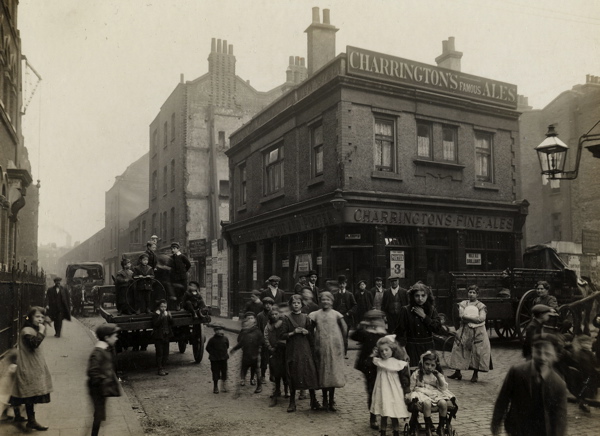
In 1901, the Fieldsend family lived above the Horn of Plenty at 5 Crispin St, as photographed by C A Mathew in 1911
26. GEORGE RANDALL, Private. Service No 205180, Queen’s Own (Royal West Kent Regiment), 11th Battalion.
Died 21st September 1917. Grave XXIV. H. 5A. Lijssenthoek Military Cemetery
George’s mother, Emma, lived by taking in washing and his father, Thomas, was a labourer. In 1891, Thomas & Emma and their children lived at 4 Brick Lane and, by 1901, they were at 27 Shepherd’s Buildings (Toynbee St) with the older son, Ernest, working as a horse groom and their father as a navvy. By 1911, George was no longer at home but his family were at 4 Wheler St, Spitalfields. At the time of his marriage at Christ Church in 1915 to Rose Everson, a glassblower of 132 Vallance Rd, George was a City Corporation servant and back living in Spitalfields again. George died just nine months after their first son, Edward William, was born on 23rd December 1916.
27. THOMAS DERBY ANDERSON, Private. Minns. Service No 49655, Northamptonshire Regiment, 1st Battalion.
Died 4th November 1918, aged 19. Grave D4. Le Rejet-de-Beaulieu Communal Cemetery. Family’s Epitaph ‘Gone But Not Forgotten.’
Thomas’ father, William, a cigar maker, was thirty-seven years older than his mother, with May, the youngest, born when he was seventy-one. Thomas was born on 31st May 1899 and baptised at Christ Church, Spitalfields, one of nine children in the family, living at 132 Lolesworth Buildings, Thrawl St. He attended George Yard Charity School, Whitechapel, (also known as the George Yard Ragged School). His older brother was a telegraph messenger and an older sister was a card box maker. He worked as a carman and was living in Lolesworth Buildings when he enlisted. He died seven days before the Armistice.
28. JOHN ALFRED BARNSLEY, Lance Corporal. Service No G/10818, The Queen’s (Royal West Surrey Regiment), “B” Coy. 11th Battalion.
Died 1st August 1917, aged 27. Panel 11 – 13 and 14. Ypres (Menin Gate) Memorial
After his father died when John was fourteen and his mother when he was twenty, John was left head of the family with four sisters, the youngest just eight, living in two rooms in Old Ford. John, a chairmaker, was born in 1890, the son of John Barnsley, a book laster, and his wife Emma.. In 1915, he was married at Christ Church, Spitalfields, by the Rector Charles H Chard, to Rose, a glass engraver, daughter of George Clements, a dock labourer and they lived at 167 Lolesworth Buildings, Thrawl St.
29. WILLIAM HENRY CLEMENTS, Private. Service No 295381, London Regiment (Royal Fusiliers), 2nd/4th Battalion.
Died 9th August 1918, aged 21. Panel 10. Vis-en-Artois Memorial.
When William was fourteen, his brother was employed as an upholsterer’s spring binder with his three sisters working as a cigarette labeller, a worker in a druggists and a charwoman. Born on 1st May 1897, Henry’s father George was a dock labourer and his mother Caroline was a charwoman. Their cousin lived with them in three rooms at 167 Lolesworth Buildings, Thrawl St. All were born in Stepney, except their mother who was from Hoxton. He started at George Yard Charity School on 12th January 1903 where many of the children starting at that time were listed as from Russia. Rose Clements, William’s sister, married John Barnsley – also on the memorial – and moved into the family home.
30. RENE GAUTIER, Corporal. Service No 10462, Gloucestershire Regiment, 7th Battalion.
Died 8th August 1915. Panel 102 to 105. Helles Memorial.
Rene’s parents, Fernand & Victorine (later called Adele) were born in France. Rene, one of eight children, was born in Paris but, by 1891, the family were living in a shared house in Shoreditch. By the time of his marriage in 1910 to Emily Wragg, aged twenty-one but already a spinster, he was a ‘moulding maker,’ as his father had been, and living at 202 Lolesworth Buildings. They were married at Christ Church. In 1911, Rene & Emily had a daughter, Gladys, who was just four when her father died.
31. WILLIAM ROBERT LIPMAN, Rifleman. Service No 5978, London Regiment, 17th Battalion.
Died 8th November 1916, aged 22. Panel X.C.5, Lijssenthoek Military Cemetery.
William was born on 3rd Nov 1893 in Spitalfields, as the youngest of five children of Joseph & Mary Ann Lipman. The family lived at 63 Lolesworth Buildings, Thrawl St. When William was born they lived in No 44 but, by the time he started at George Yard Charity School, they had moved across the Buildings into two rooms at No 63. William, like his father and older brother, was a carman while his elder brothers were a tea packer and a railway van guard.
32. PHILLIP SCHRATSKY, Rifleman. Service No R/22366, King’s Royal Rifle Corps, 7th Battalion.
Died 21sr March 1918, aged 24. Panel 61 to 64, Pozieres Memorial.
School records show Phillip was born in Romania on 30th May 1894, the eldest of eleven children born to Jack, a tailor, and Mary (Minnie) Schratsky. He started at Berner StSchool in 1900 while living at 51 Cable St but a few months later the growing family moved into two rooms at No 25 Block A, Rothschild’s Buildings in Flower and Dean St. Then they moved to three rooms in 20 Alexandra Buildings, Commercial St. Phillip and his father were tailor’s pressers and his fifteen-year-old brother Zucman was a cigarette maker. In 1914, he married Mary Diss who lived next door when he was at 6 Duval St, the younger sister of Daniel Diss, who was also killed in the war.
33. MOSES FRESCO,Rifleman. Service No 474352, London Regiment (The Rangers), 12th Battalion.
Died 9th April 1917, aged 20. Panel 1.A.27. London Cemetery, Neuville-Vitasse.
Moses’ father was a short man of 5 feet 6 inches who enlisted in the Army on 7th June 1915 stating his age asthirty-eight years. Howevee, he was actually forty-five years old with seven dependant children .The second of twelve children born to Alexander, a fish hawker, and his wife Betsy, Moses was born in 1897 in Spitalfields. In 1901, the family of six lived in two rooms at 171 Wentworth Buildings, but by the next year the family had mysteriously grown to eleven and lived in three rooms at 19 Grey Eagle St, which they shared with another couple.
34. CHARLES WASHINGTON, Private. Service No 6427, The King’s (Liverpool Regiment), 1st Battalion.
Died 10th March 1915, aged 36. ‘Missing at Givenchy.’ Panels 6 to 8, Le Touret Memorial.
Charles Washington, son of Henry Charles Stamm, was born in 1878 in Montreal, Canada, as one of four boys. Then his parents moved to Brooklyn, New York. By April 1899, aged twenty, he was a labourer living in Warrington where he enlisted in the Army for twelve years, but completed fifteen. He fought in the Boer War. Recorded as just 5 feet 5 inches tall and weighing nine and half stone stone, he had grey eyes, light brown hair, sallow complexion with numerous scars to his back and loins. By 1908, he had a scar on his jaw, two scars on his left hand and three tattoos to his arms – anchor, stars & stripes and a ‘female figure and bust.’ His character was described as ‘Indifferent.’ He was in hospital in Rangoon, later in Dublin, for various conditions including syphilis which caused ‘loss of feeling in both arms.’ He was on the Syphilis Register. In March 1900, he spent 56 days in the Military Prison, the first of various confinements for offences which included ‘using insubordinate language towards an officer’ (84 days), ‘drunk in town,’ ‘deficiency of kit and public clothi,g,’ ‘loss of equipment,’ ‘absence from Tattoo,‘ going AWOL and desertion. He forfeited pay ‘thru physical inefficiency.’ Yet on his death, the box for ‘Good Conduct Pay’ was ticked. In 1910, while living at 22 Whitechapel High St, he made a statement to the Thames Police Court about losing his Identity & Life Certificate, and by September 1911 he had moved to 198 Wentworth Buildings, Wentworth St. He changed his name to Isidor Stamm – occasionally calling himself Israel – and converted from Roman Catholic to Judaism prior to marrying Fanny Bearman in Mile End Old Town in July 1912. They had to no children. However, the Army received a letter from ‘Margaret’ in Warrington asking for his whereabouts as he was the father of her child. Fanny was awarded his Widow’s Pension of ten shillings a week.
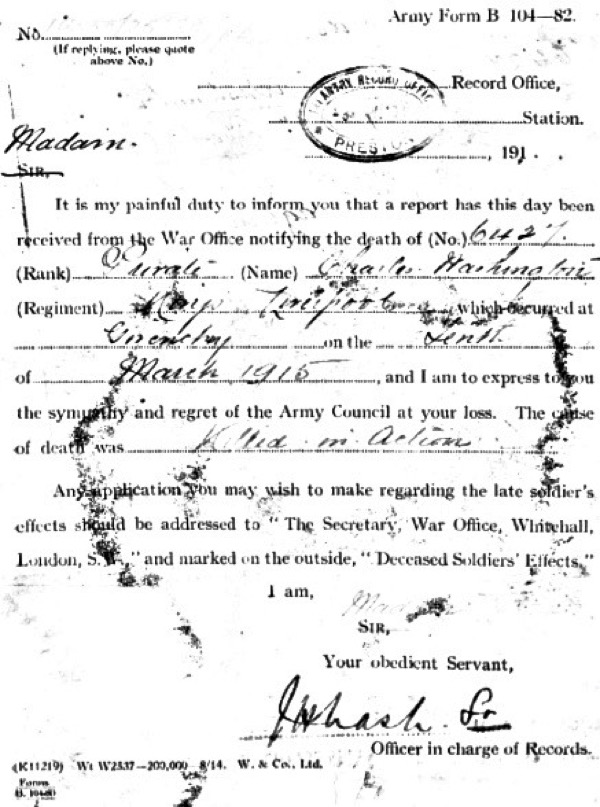
Letter to Fanny Washington informing her of the death of Charles Washington
35. JAMES HAYES, Private. Service No 8946, South Staffordshire Regiment, 2nd/8th Battalion.
Died 25th September 1915, aged 20. Panel XXX1.A.8, Cabaret-Rouge Cemetery, Souchez.
John, James’ father, was born in Bishopsgate and his mother, Elizabeth, in Spitalfields. James was born on 16th February 1894 and the family of six lived in Spitalfields, firstly at 116 Wentworth St, then they moved to 6 Flower & Dean St where they were when he started at George Yard Charity School. On finishing school, James followed his father to the docks where they both worked as labourers.
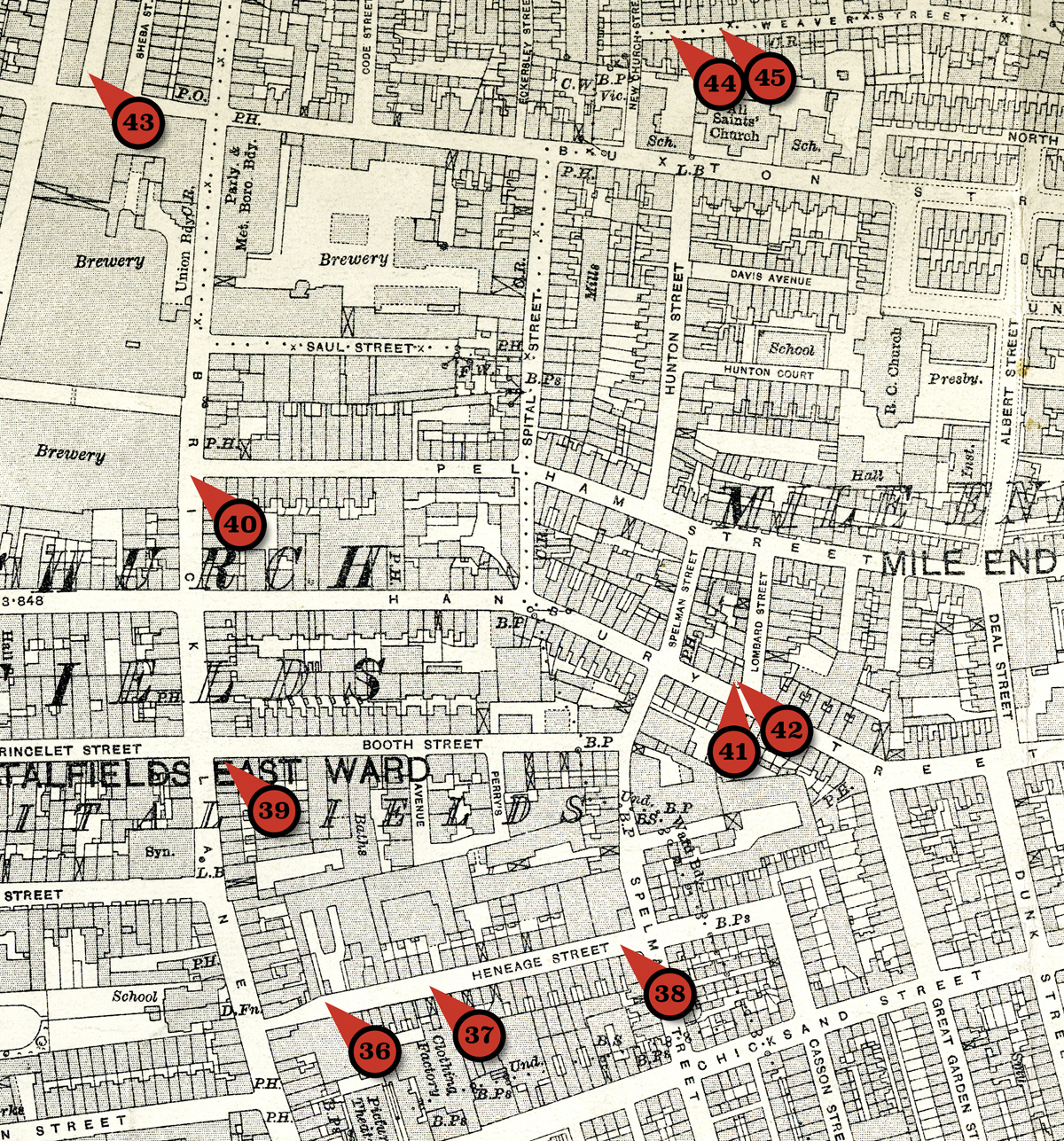
(Click to enlarge this map)
36. ALBERT E. SUTER, Company Quartermaster Sergeant. Service No 27496, Royal Engineers, Postal Section.
Died 22nd November 1918. Grave I. D. 2. Solesmes British Cemetery.
Albert’s wife was Louie, the daughter of the schoolmaster and mistress, Edward & Louisa Skinner, of Christ Church School, Brick Lane. They lived in the Schoolmaster’s House. Albert, when twenty-five years old and living in Notting Hill while working as a Post Office sorter, married Louie on the 10th January 1913. He had been baptised at Christ Church, Spitalfields, on 28th Sept 1887. His father, Alfred, was a carpenter, later a warehouseman, and the family lived at 4 Heneage St. Albert died just after war ended and Louie returned to the School House to live with her parents.

This is the doorway where Albert E. Suter walked out at 4 Heneage St
37. HYMAN MOSES, Private. Service No 37806, Northamptonshire Regiment, 9th Labour Company – transferred to (87874) 147th Company. Labour Corps.
Died 21st April 1918, aged 32. Grave XI. C. 11. Warlincourt Halte British Cemetery, Saulty. Epitaph ‘My dear husband Hymie mourned by his wife.’
Hyman’s parents were Barnett & Sarah Moses from Russia. Barnett was an umbrella stickmaker who worked from home. They had seven children but one died. Born in Spitalfields, Hyman was still living there at the time of his enlistment. In 1891 ,the family were living at 50 Grey Eagle St and by 1901 they were at 134 Brick Lane. By 1911, they were all at 27 Heneage St when Hyman, twenty-five years old and single, was a packer in the tobacco works, while his older siblings worked in the fur and millinery trades. Hyman married Hannah and they had a daughter, Rose and lived at 8 Palmer St, opposite Moses Michaels, who was the same age as him and was killed the previous year.
38. MORRIS GOODMAN, Rifleman. Service No S/19802, Rifle Brigade, 12th Battalion.
Died 24th August 1917, aged 27. Grave VIII. I. 13. Boulogne Eastern Cemetery.
Morris was born in 1890 and married Leah, with whom he had two children and lived at 35 Heneage St.
39. JOHN WRIGHT, Rifleman. Service No 6/608, Rifle Brigade, 9th Battalion.
Died 25th September 1915. Panel 46 – 48 and 50. Ypres (Menin Gate) Memorial.
John Alfred Wright was born in Spitalfields and baptised in Christ Church on 24th March 1889. The family lived at 27 George St in the heart of the Flower & Dean rookery. John had an older sister Sarah Ellen. By 1901, their mother had died and the family of three were living at 63 Brick Lane. At recruitment on 24th Aug 1914, John had become a general labourer like his father.
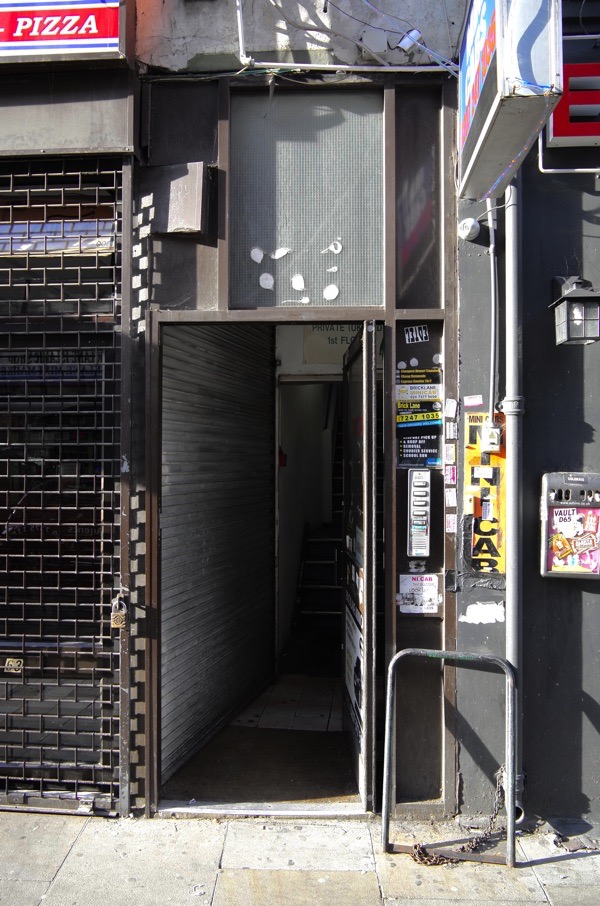
This is the doorway where John Wright walked out at 63 Brick Lane
40. FREDERICK GOLDSTEIN, Private. Service No 281362, London Regiment (Royal Fusiliers), 2nd/4th Battalion.
Died 19th May 1917. Panel Bay 9, Arras Memorial.
Frederick’s father Harris was from Plotska in Poland and his mother Annie from South Russia, both were tailor machinists. He was born on 22nd October 1895, as one of eight children all born in Spitalfields. Frederick joined his parents as a tailor machinist on leaving school. They lived at 2 New Church St, Brick Lane.
41. & 42. JAMES & THOMAS HUGHES
JAMES HUGHES, Rifleman. Service No 6/9878, Rifle Brigade, 11th Battalion.
Died 14th July 1918, aged 27. Grave 1.E.24, Ligny-St. Flochel British Cemetery, Averdoingt.
THOMAS HUGHES, Rifleman. Service No S/2458, Rifle Brigade, 12th Battalion.
Died 25th September 1915, aged 23. Panel 10, Ploegsteert Memorial.
James was admitted into the Whitechapel Infirmary with bubonic plague in February 1914, at the age of twenty-two, while living in lodgings in Flower & Dean St, still single and working as a chairmaker. Born May 1891 at 59 Wentworth St, he was the eldest child of seven born to Thomas Hughes, a haddock smoker, and his wife Rachel, all in Spitalfields. Thomas was born eighteen months after James. James & Thomas started at George Yard Charity School on the same day. In 1911, the family were at 38 Hanbury St. By then James had become a chairmaker and his mother worked as a ‘bedmaker in lodging houses.’ In 1912, Thomas, who had become a french polisher, was married to Sarah Strange and they had two daughters, Emma & Sarah.
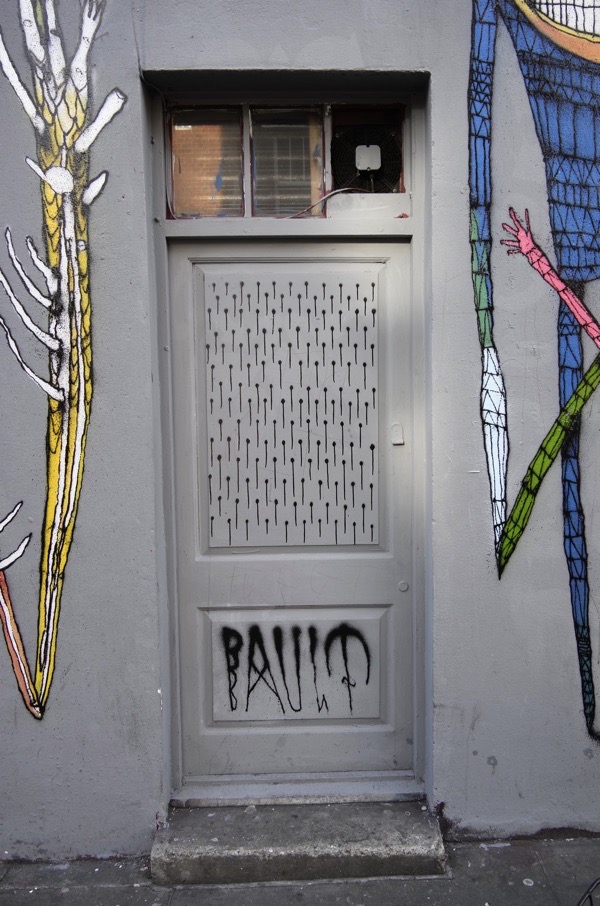
This is the doorway where James & Thomas Hughes walked out at 38 Hanbury St
43. HENRY LEE, Rifleman. Service No 21016, King’s Royal Rifle Corps, 21st Battalion.
Died 4th August 1917. Grave C19, Oak Dump Cemetery.
Henry, the son of Thomas Lee, was baptised in July 1886 at Christ Church, Spitalfields, when the family were living at 6 Gt Eastern Buildings and he was still living in Spitalfields at the time of his enlistment.
44. & 45. MARK & DAVID SHUSTER
MARK SHUSTER, Lance Corporal. Service No 33285, Lancashire Fusiliers, 18th Battalion.
Died 30th July 1916, aged 21. Addenda Panel, Thiepval Memorial.
DAVID SHUSTER, Private. Service No 33292, Lancashire Fusiliers, 18th Battalion.
Died 30th July 1916, aged 19. Panel Pier and Face 3 C and 3 D, Thiepval Memorial.
On 30th July 1916, the Shusters lost their two eldest sons, David & Mark, aged nineteen and twenty-one respectively. David had been a gents’ tailor. They were the eldest sons of nine children born to Russian immigrants, Vigdor (Victor) Shuster, who worked from home as a ‘finisher of boots,’ and his wife Golda, who bore him nine children. They lived at 4 Harriot Place, Fashion St, in 1901, moving to Bethnal Green, then Dalston, but by 1916 a newspaper report shows them back in Spitalfields, at 46 Weaver St. David & Mark joined the Lancashire Fusiliers together. On the day they died, their regiment was part of the Somme offensive attacking near the village of Guillemont. They are remembered at Thiepval along with 72,193 fellow soldiers from the Somme with no known grave.
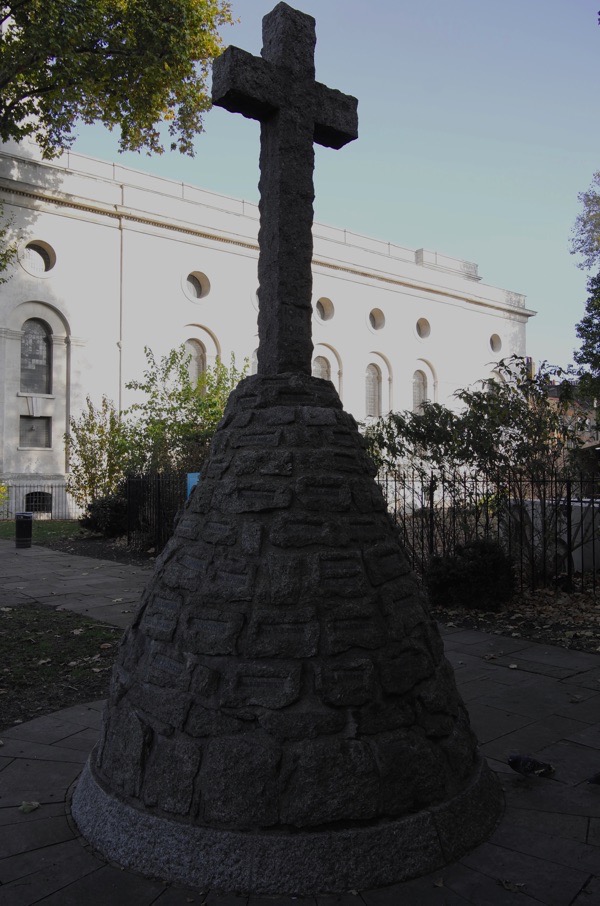
War memorial at Christ Church
NAMES FOR WHOM WE CAN TRACE NO ADDRESS IN SPITALFIELDS
ERNEST EDWARD DENCH, Lance Corporal. Service No 9351, East Lancashire Regiment, 2nd Battalion.
Died 4th March 1917, aged 28. Grave VII. A. 23. Fins New British Cemetery, Sorel-le-Grand
Enlisted in London
WALTER H HERSEY, Gunner. Service No 47144, Royal Field Artillery, 46th Bty.
Died 3rd November 1914. Grave I.A.17. Longuenesse (St Omer) Souvenir Cemetery
ERNEST PETERS, Rifleman. Service No R/21426, King’s Royal Rifle Corps, 9th Battalion.
Died 15th September 1916. Panel Pier & Face 13 A & 13 B Thiepval Memorial.
Edward Ernest Raymond Peters was born 24th January 1897, the son of John & Phoebe Peters, his father a recorded as a fly driver. He had nine brothers and sisters and they lived at 39 Nutley Lane, Reigate. By 1901, his father was a groom and, by 1911, a cab driver with Ernest, then fourteen years old, an errand boy. By the time Ernest enlisted he was living in Stepney.

Ernest Peters, the only one of the names on the memorial for whom we can find a photograph
ERNEST WILLIAM RANDELL, Rifleman. Service No 323355, London Regiment (City of London Rifles),1st/6th Battalion.
Died 8th October 1916. Panel Pier & Face 9 D. Thiepval Memorial
GEORGE RANDALL, Private. Service No 205180, Queen’s Own Regiment (Royal West Kent), 11th Battalion.
Died 21st September 1917. Lijssenhoek Militart Cemetery. Grave XX.1V.H.5A
George lived in Spitalfields but enlisted at St Paul’s Churchyard
ALBERT EDWARD RUSSELL, Rifleman. Service No S/14866, Rifle Brigade, 2nd Battalion.
Died between 22nd & 24th October 1916. Grave XXIX. A. 4. Caterpillar Valley Cemetery, Longueval
Albert was born in Bermondsey, lived in Spitalfields and enlisted in Shoreditch. By the time the graves were detailed his mother, Mrs S A Russell, was living in Croydon.
FREDERICK WRIGHT, Private. Service No 22042, Royal Fusiliers, 32nd Battalion.
Died 7th October 1916. Grave VIII. J. 5. A.I.F Burial Ground, Flers.
Frederick was born and lived in Spitalfields, and signed up in Shoreditch where many locals enlisted. On 7th October 1916, as part of the Somme offensive, Frederick’s unit attacked Bayonet Trench where he lost his life. Between 15th September and 7th Oct the Royal Fusiliers, 32nd Battalion, made three attacks with 185 men losing their lives of which 117 bodies were never found.
Additionally, there are these twenty-nine men for whom no records have yet been found and who are not listed by the Commonwealth War Graves Commission. It is possible that they died of injuries after the war and after the date range covered by the Commission.
Rifleman R Arnett
Private W Barlow
Private J J Benson
Private A W Buckley
Rifleman J Burgess
Private J H Carrol
Private T Carrol
Grenadier A Collins
Private G Cook
Private W Crawley
Private R N Davis
Private W H Evans
Private J Gannon
2nd Mechanic G Haines
Private H Hare
Rifleman R Hewson
Rifleman T Hughes
Private T J Kenyon
Private R Long
Private R Marshall
Private W H Mason
S.M.H. Mortimer
Rifleman G Page
Able Seaman T G Patten
Private S S Phillips
Sergeant W E Rackham
Private J Sullivan
Private F Smith
Private G N Vincent
Sergeant J Watts

Homeless men sleeping outside Christ Church photographed by Moyra Peralta in the eighties
Maps & C A Mathew photograph courtesy Bishopsgate Institute
You may also like to take a look at
Spitalfields Life At The Write Idea Festival
Next Saturday 17th November, Suresh Singh and The Gentle Author are both appearing at the Whitechapel Idea Store as part of the Write Idea Festival 2018 which runs from 16-18th November
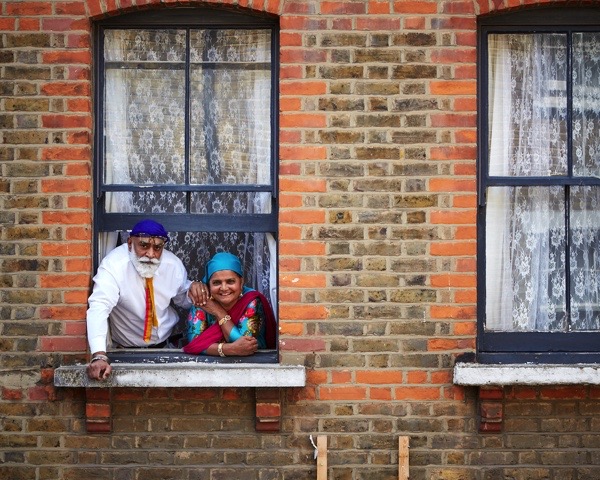
Photograph by Patricia Niven
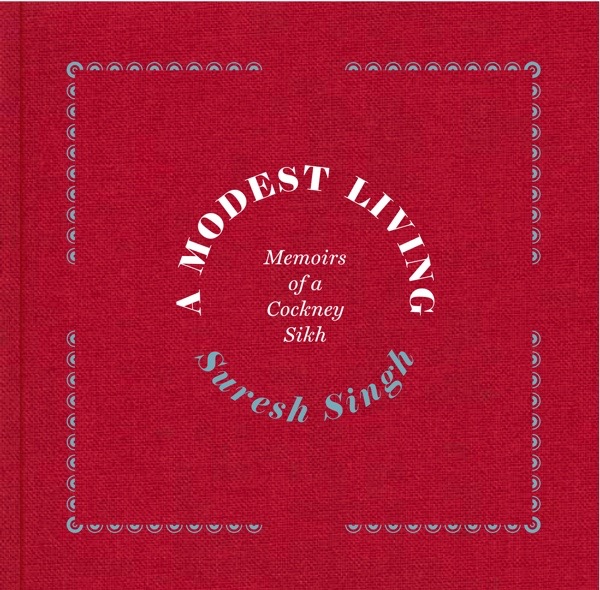
A MODEST LIVING, Memoirs of a Cockney Sikh
In the first London Sikh biography, Suresh Singh tells the candid and sometimes surprising story of his father Joginder, who came to Spitalfields in 1949. He sacrificed a life in the Punjab to work in England and send money home, yet found himself in his element among the mishmash of people who inhabited the streets around Brick Lane.
Born and bred in London, his son Suresh became the first Punjabi punk, playing drums for Spizzenergi and touring with Siouxsie & the Banshees.
Suresh Singh will be in conversation with Stefan Dickers of the Bishopsgate Institute and show photographs from his family collection. This event will have live subtitles.
1pm Saturday 17th November
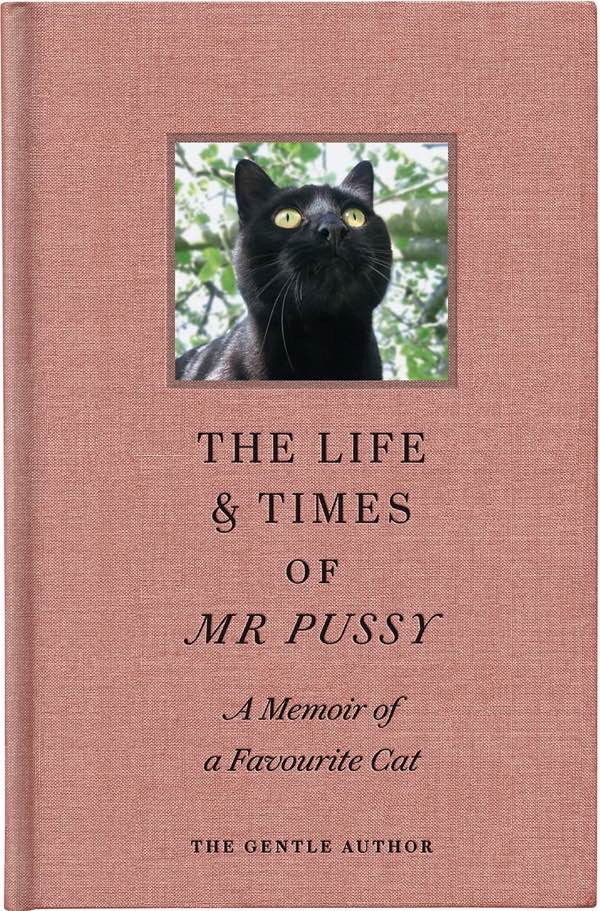
THE LIFE & TIMES OF MR PUSSY, A Memoir of A Favourite Cat
The Gentle Author will be reading tales of Spitalfields most famous feline.
“I was always disparaging of those who doted over their pets, as if this apparent sentimentality were an indicator of some character flaw. That changed when I bought a cat, just a couple of weeks after the death of my father. “
Filled with sentiment yet never sentimental, The Life and Times of Mr Pussy is a literary hymn to the intimate relationship between humans and animals
7pm Saturday 17th November

John Dempsey’s Street Portraits
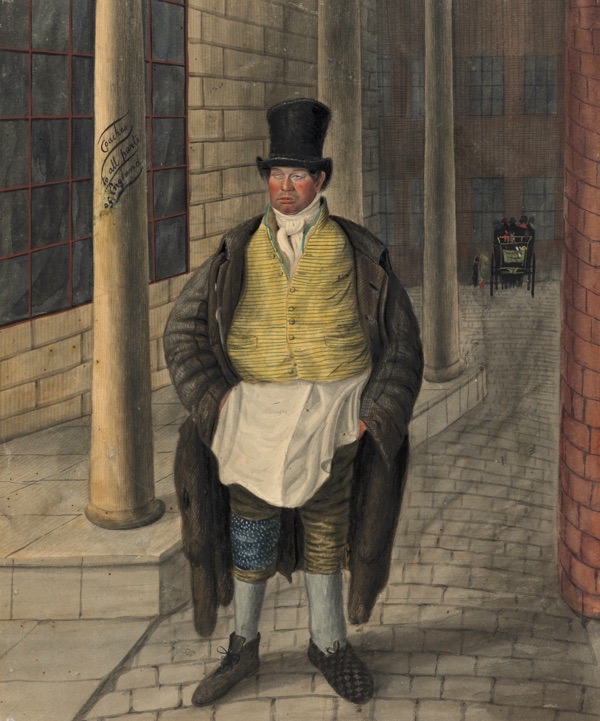
Fifty Years Porter, Charing Cross, 1824
It is my delight to present the first London publication of John Dempsey’s street portraits from the eighteen-twenties held in the collection of the Tasmanian Museum & Art Gallery. Orginally attributed to George Scharf, they were identified as the work of John Dempsey (1802-74) by curator David Hansen who discovered a folio of fifty-one portraits in 1996 in a drawer labelled ‘U’ for unknown.
Dempsey was an itinerant jobbing artist without any formal training who created ‘Likenesses of Public Characters’ in London and the provincial cities of England, as he travelled around in search of commissions for portrait miniatures and silhouettes. No record exists of any exhibitions and in 1845, he was declared bankrupt. Yet his achievement is unique and enduring.
In spite of Dempsey’s unconventional perspective and disproportionate figures, he created portraits full of humanity that evoke the presence of street people and the outcast poor with compassion and vitality. These are portraits of individuals and they are full of life. As an itinerant artist in an age that did not distinguish between street traders and beggars, he dignified his fellow travellers through his portraits. He understood their lives because he shared their precarious existence.
When I first saw these pictures, I was startled by how familiar they appeared to me and I assumed this was because I have spent so much time looking at prints of The Cries of London. But then I realised that I recognised the demeanour and expression of John Dempsey’s portraits because I see them, their crew and their kin, every day as I walk around the streets of London two centuries later.
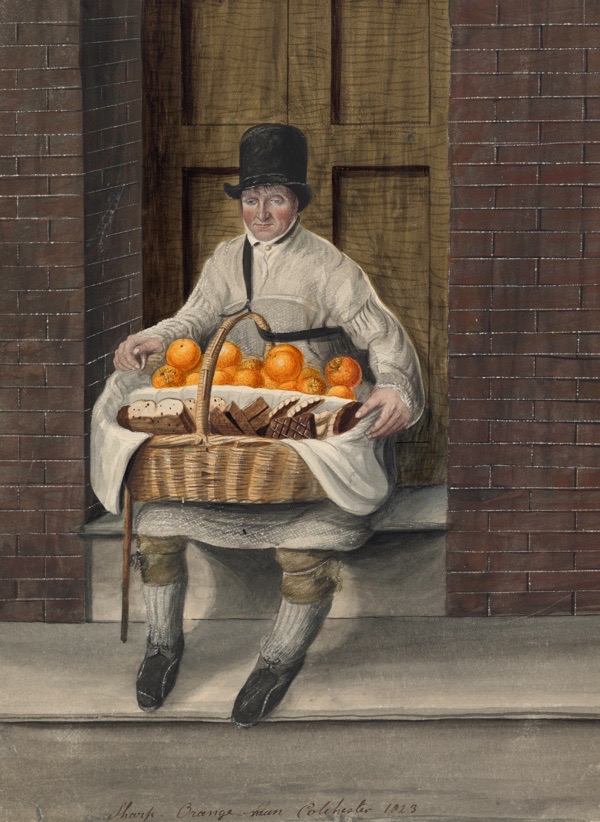
Sharp, Orange Man, Colchester, 1823
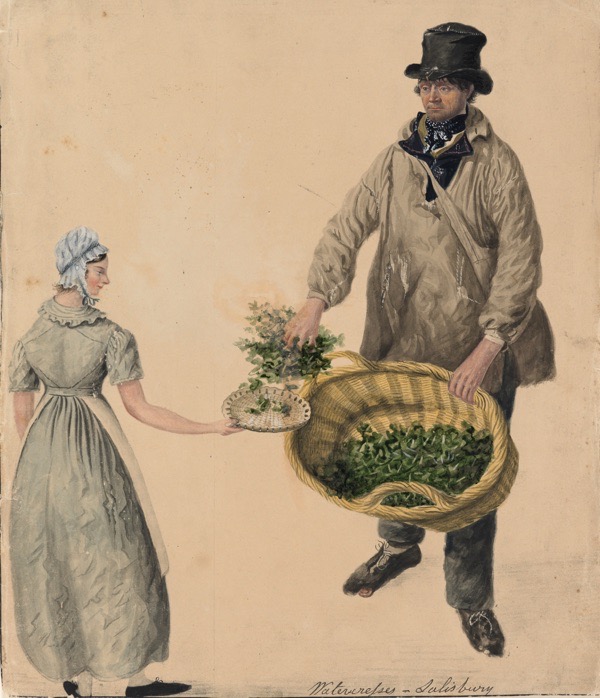
Watercress, Salisbury
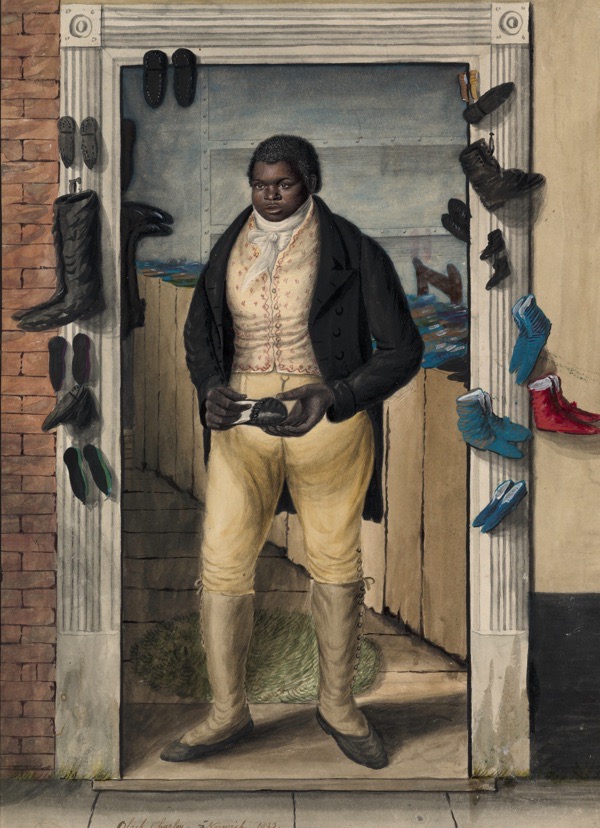
Black Charley, Bootmaker, Norwich, 1823
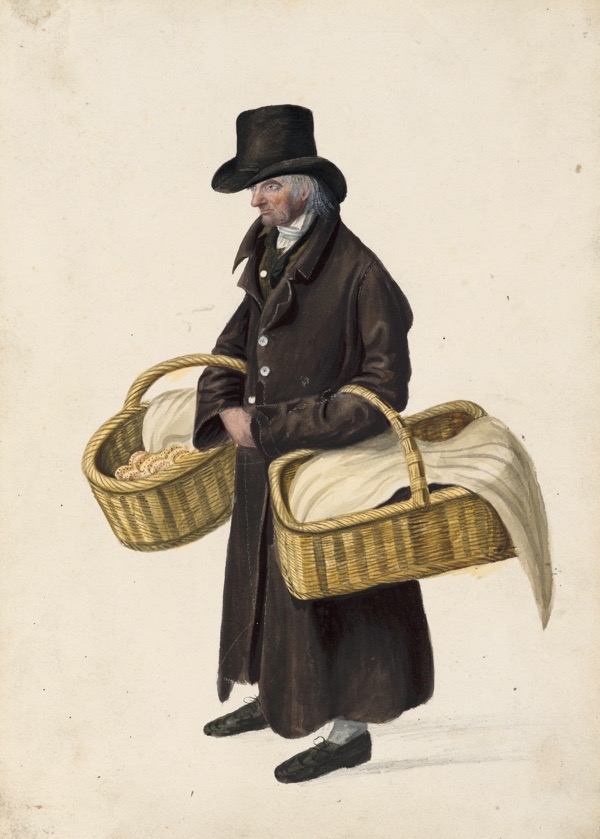
Muffin Man
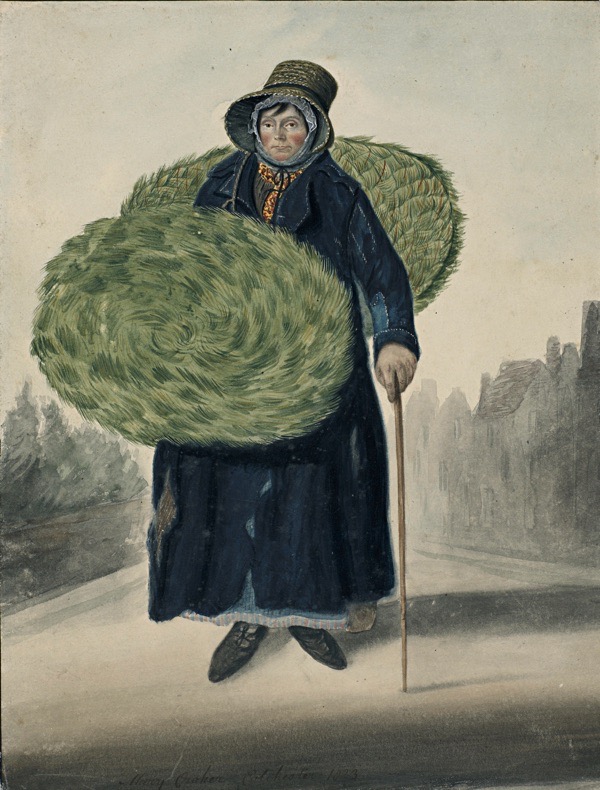
Mary Croker, Mat Woman, Colchester, 1823

Sam’l Hevens, Old Jew, 1824

Charles M’Gee, Crossing Sweeper, London, c 1824

Old Bishop, Pieman, Harwich
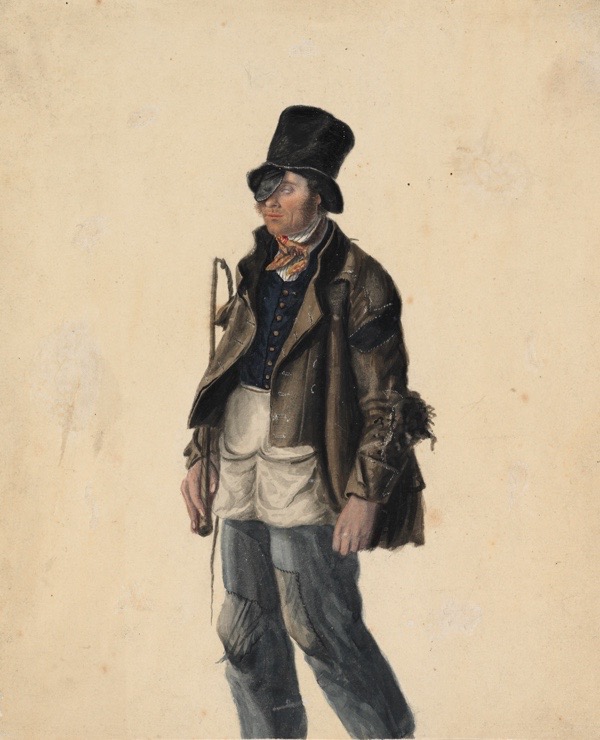
Woolwich, 1824
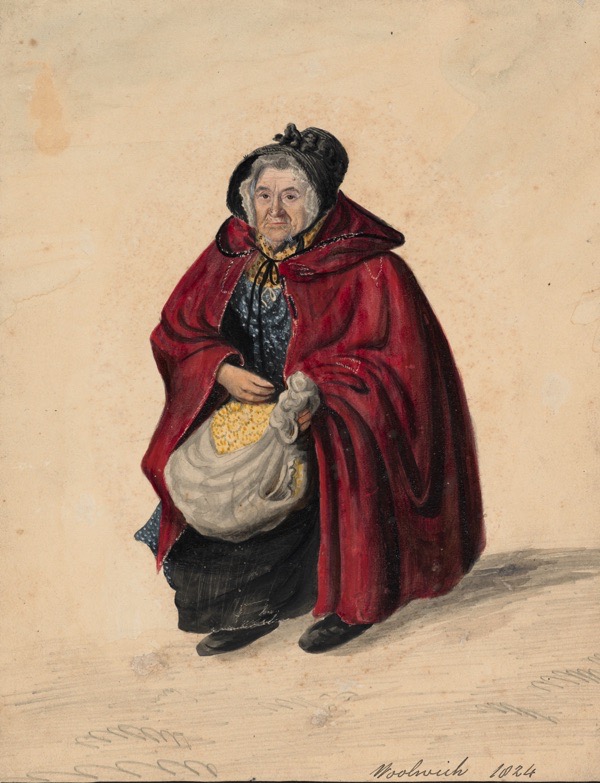
Match Woman, Woolwich, 1824
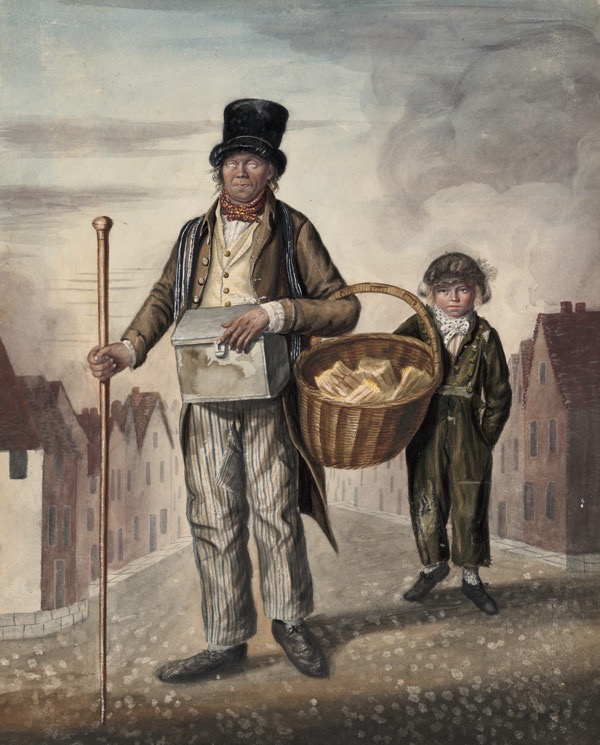
Mark Custings (commonly called Blind Peter) and his boy, Norwich, 1823

Copeman, Gardener, Yarmouth

A Bill Poster, 1825
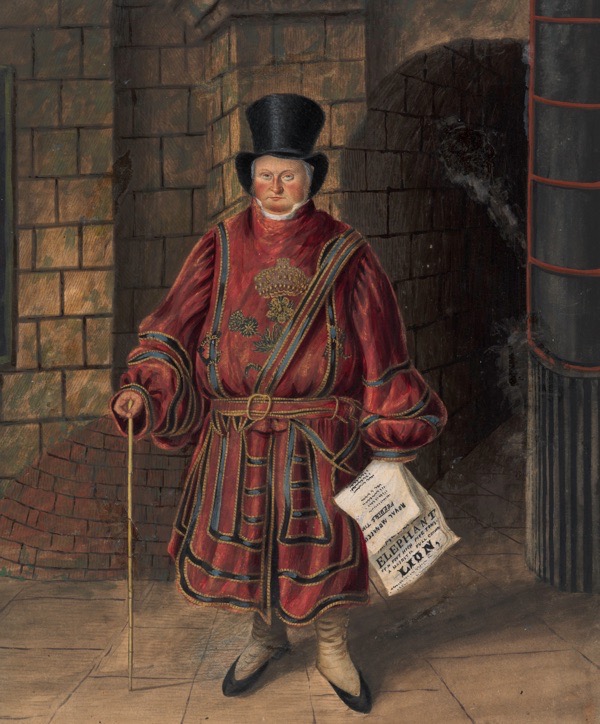
The Doorkeeper, Royal Managerie, Exeter ‘Change, (London) 1824
Images reproduced courtesy of Tasmanian Museum & Art Gallery
You may also like to take a look at
Rodney Holt, Designer & Set Builder

It was my great delight to meet Rodney Holt of Mojo Productions, the creative mastermind responsible for London’s most famous window displays, at Fortnum & Mason for the past thirty years. This bright-eyed genius with a shock of white hair flits around his workshop in Brentwood, Essex, grinning excitedly as he oversees his extravagant creations and encourages his minions just like Father Christmas in that other fabled workshop at the North Pole.
Rod and his team of specialists were putting the finishing touches to this year’s Christmas window displays before they were transported to Piccadilly for installation last week. The walls were lined with huge wooden frames, the same size as the shop windows, and each one was filled with a sequence of exotic animated confections, rotating lobsters, flying puddings, champagne fountains, exploding crackers and a train set circling eternally. All around lay fragments of former displays, including golden carriages, giant nutcracker dolls and the man in the moon.
Wandering around this bizarre interior was like exploring the unconscious imagination of Santa himself – the workshop where dreams and fantasies are manufactured. Yet Rod’s crew of painters and model makers worked placidly at their tasks despite the phantasmagoric contents of their workplace. Readers will be relieved to learn that everything is under control for Christmas 2018.
Rod & I retreated to his office, where a row of miniature shop windows contained the working models for this year’s displays. Here Rod told me his story and I was fascinated to learn how this overflowing of flamboyant creativity has its origins in the craft traditions of old East End.
“I was born in Bethnal Green but my family moved out to Essex after the war, when I was still a baby. There were jobs in Essex and my dad went to work at Ford’s in Dagenham and was there for forty years. Mum had ten children, so she was quite busy too. Her full name was Amy Rosina Goldring, so we think she might be Jewish. She came from an interesting family – one of her brothers was in the film industry in the early days, one did back-to-front sign writing with gold leaf, another had an accordion band in West End, The Accordionnaires, and her mother was a court dressmaker.
Dad was one of ten brothers and most of them worked in Spitalfields Market, some were traders but others used to make carts and barrows in the Hackney Rd. My dad was a French Polisher who kept a horse in Gibraltar Walk and used to make furniture deliveries on a flatbed cart. I remember him telling me that he used to deliver as far as Hampstead.
I left school and went to Hartley Green College, doing a course in Display & Exhibition Design. My career officer told me I should be a council tiler, that was the nearest they could get to an artistic career. So I said, ‘That’s no good,’ and I think it was my art teacher at school who suggested I do this. To be honest, I wanted to be a sculptor or a potter, but there were not many options then. If you wanted to be a potter, you worked on an assembly line in a pottery. I was at college for a couple of years and I did not learn a lot but I sorted out what I wanted to do. They did a day release scheme and I got sent to Selfridges in Oxford St. I got on well with everybody there and they said, ‘You’ve got a job here after you’ve taken your diploma.’ But I went to Paris instead of taking my diploma. I stole a mate’s bike out of an alleyway while he was away at university in Manchester and cycled off to France. When I came back, I went straight to Selfridges.
At Selfridges, I told them I knew nothing about fashion, so I could not be fashion dresser. I said, ‘I’d like to do all the toy windows and all the gardening windows,’ because those were the things I thought I could be more creative with. I was nineteen years old and they let me loose. I did one display where I had all the teddy bears marching out of the window which everybody liked. My idea was they were fed up and walking out. I got on alright there but I thought I do not really like this much. I wanted to join the team in the big studio up in the roof. I used to get on very well with all the guys there. After eighteen months, a couple of Australians who worked there and had come over land said, ‘We’re all fed up now, we think we should go off somewhere on a trip.’ I said, ‘That sounds good to me,’ and we went off to India. Mr Millard, the Managing Director, asked me, ‘Are you sure? Because the others have gone, you could move up the ladder.’ But I said, ‘No, I don’t want to go up the ladder, I’d rather go to India.’ He wished me all the luck in the world.
I only had a hundred quid but I made it to Kashmir by hitch-hiking, where my sister sent me another thirty quid to get home. It cost me six quid to get from Istanbul to London and I sold my blood to do it. When I got back, it all fell into place. Selfridges welcomed me back to work on the Christmas windows. I was lucky because it was the first time they were trying a different type of window. They did a set of windows that had no stock in them but told a story instead. The designer Peter Howitt had just finished the film of Alice in Wonderland and he was able to buy the sets. They gave us an old factory in Kensington where we sorted the scheme out. Pete asked for me, he said, ‘I’d like Rod because he doesn’t want to do window dressing really.’
Working freelance, I did all sorts – shops in the Kings Rd and themed pubs, clubs and bars. I worked for Peter on the original London Dungeon too. They gave me a mini with ‘London Dungeon’ on the side and an iron coffin on the roof! I had to be careful how I drove that about. I had quite a few contacts at Pinewood and Shepperton so I was able to purchase some great old props. We used to work overnight in the Dungeon and the stuff that happened was unbelievable.”


Rodney Holt, Designer, Set Builder & Model Maker
You may also like to read about
When Max Levitas Stormed The Savoy
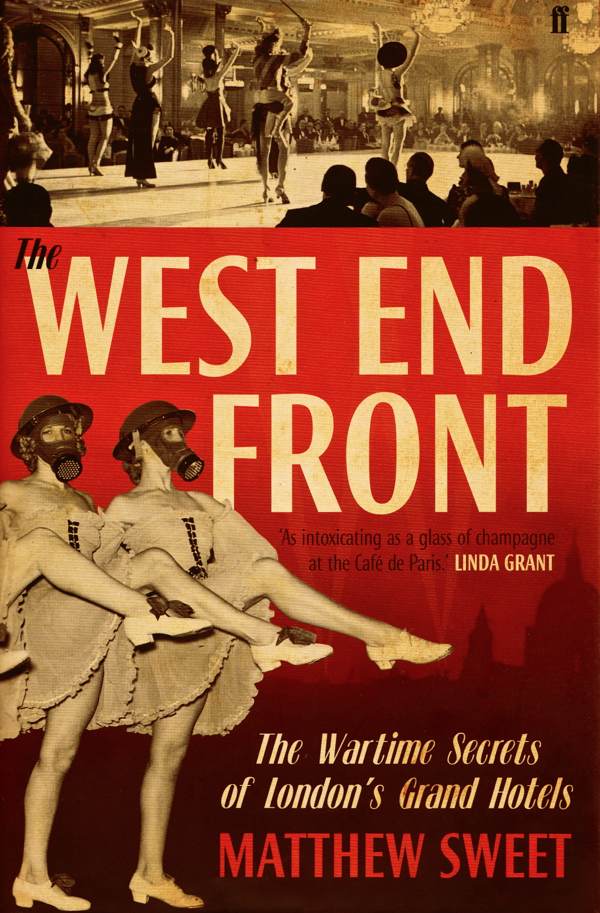
Remembering Max Levitas who died last Friday at one hundred and three years old, we present Matthew Sweet’s account of when Max and a band of East End Communist revolutionaries occupied the Savoy Hotel in 1940 from his book The West End Front.
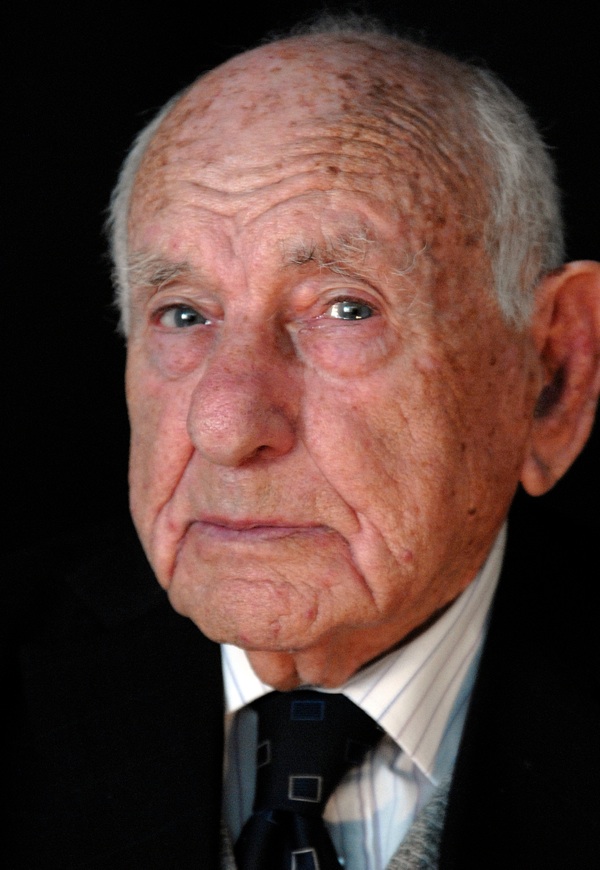
Max Levitas
There were forty of them. There were eighty. There were a hundred. They marched. They sauntered. They were angry. They were bewildered. They came with two dogs and they came with none. Theirs was a daring act that saved thousands of lives. Or it was a pretty piece of propaganda, gift-wrapped for the Führer. What happened beneath the Savoy Hotel on 14th September 1940, the eighth night of the Blitz, depended on the position of the observer: whether she or he was Red or anti-Red; East Ender or West Ender; dreaming of revolution or restoration.
That Saturday night, when those forty or eighty or a hundred arrived at the doors of the hotel – with their dogs, or dogless – a small army of journalists was on the premises for a briefing by the Ministry of Information. Few, however, wrote about their uninvited fellow guests until the war was safely over. The government also maintained a public silence on the story, despite the urgent Cabinet discussion held the following Monday morning – a discussion with sinister undertones. But old comrades, years later, made that West End outing into a famous victory, a second Battle of Cable Street. It worked its way into plays and novels, into the mythology of the British Left. And though no horses charged and no batons swung, the Savoy Hotel invasion was the most serious political demonstration of the war – and dramatic evidence that conflict with Germany did not bring the class war to an end.
Max Levitas has spent most of his long life on the front line of that conflict. He was part of the famous human barricade that halted the Blackshirts’ progress through the East End in October 1936. He stood his ground at Brady Mansions during a twenty-one-week rent strike – brought to an end only by the government’s decision to freeze rents for the duration of the war. He was one of the dozen Communist councillors elected to the Borough of Stepney in 1945, during that giddy moment when the electorate could still see the avuncular side of Joe Stalin.
He was there in 1991 when the Communist Party of Great Britain voted for dissolution and secured victory in the long war of attrition against itself. He was there, too, on that Blitz- struck Saturday night in 1940, shouldering the red banner of the Stepney Young Communist League as his group of demon- strators marched from the Embankment towards the silvered canopy of the Savoy. They marched for better air-raid shelters in the East End. They marched against the myth that the Luftwaffe had brought equality of suffering to Britain. And they received their marching orders from a series of urgent editorials in the Communist newspaper, the Daily Worker: ‘If you live in the Savoy Hotel you are called by telephone when the sirens sound and then tucked into bed by servants in a luxury bomb-proof shelter,’ the newspaper asserted. ‘But if you live in Paradise Court you may find yourself without a refuge of any kind.’ And above these words, in thick bold print: ‘The people must act.’
Max Levitas nodded in agreement when I read the article back to him. ‘The surface shelters protected you from shrapnel, from flak, but not much else,’ he reflects. ‘If a bomb fell on one of those it would collapse and kill everybody in it. The Communist Party argued for deep shelters. But the National Government wouldn’t listen. They wouldn’t even open the Underground. It was easy to ignore that message if you were sitting in the basement of a very nice hotel. So we decided to march on one.’ I asked him why they chose the Savoy. Max Levitas smiled a tolerant smile. ‘It was the nearest.’
I met Max Levitas at the Idea Store, that gleaming cultural institution planted in the East End to compensate locals for the assimilation of their much-loved public library into the Whitechapel Art Gallery. He was a small, cloth-capped nonagenarian, wrapped tightly in a raincoat and muffler. Standing on the studded purple rubber floor of the foyer, he looked like a preserved fragment of the old Stepney. It was a chilling morning in February, and he could spare me an hour before he went for his Turkish bath – a weekly ritual since the 1920s, when his father took him to the long-vanished Schewik steam rooms on Brick Lane. We took the lift to the top-floor café, secured two cups of tea and a table with a view of the bristling City skyline, and he told the story of his association with the area: how his parents fled the Lithuanian pogroms in 1912 and made landfall in Dublin, where Max was born three years later; how his father took the family first to Glasgow, and finally to Stepney, where work could be found among a supportive community of Jewish exiles. History radicalised those members of the Levitas clan it did not destroy: Max’s Aunt Sara and her family were burned to death in the synagogue of the Lithuanian shtetl of Akmian; Max’s father became a leading member of the distinctly Semitic, distinctly Red-tinged International Tailors and Pressers’ Union; Max’s elder brother, Maurice, fought against Franco’s forces in the Spanish Civil War; Max gave his youth to the Communist Party of Great Britain and was name-checked by Oswald Mosley in a speech denouncing the enemies of British Fascism.
The organisers of the Savoy invasion shared a similar ideological background: they were all revolutionaries. ‘And they’re all dead,’ Max sighed. ‘Some were clothing workers. Some were bootmakers. Some were dockers.’ It was an inventory of lost trades. The first names he sifted from his memory were two stevedores, Ted Jones and Jack Murphy, veterans of pre-war campaigns for unemployment relief. The rest comprised a knot of men from the Stepney Tenants’ Defence League, which organised rent strikes against slum landlords in the East End: George Rosen, its bullish secretary, known as ‘Tubby’; Solly Klotnick, a furrier and a veteran of the Battle of Cable Street; Solomon Frankel, a clothing worker who took a bullet in Spain that robbed him of the use of his right hand. Michael Shapiro, a wiry young academic from the London School of Economics. At the head of the group stood Phil Piratin, Communist councillor for Spitalfields, chief spokesperson of the invaders, and the author of the most widely read account of their night at the Savoy. His memoir Our Flag Stays Red (1948) puts seventy in the hotel lobby, among them a number of children and pregnant women.
Max’s memories were different. ‘There were forty of us,’ he affirmed. ‘I’m sure of that.’ I ask if there were any dogs. He shook his head. ‘No dogs,’ he said. ‘It was the Savoy.’
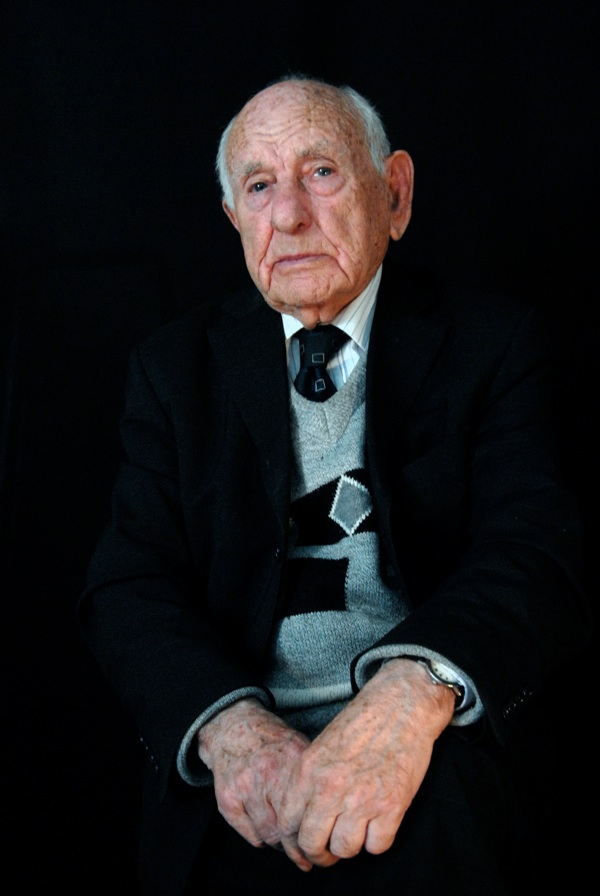
Portraits of Max Levitas copyright © Phil Maxwell
You may also like to read about
Schrodinger Takes Charge
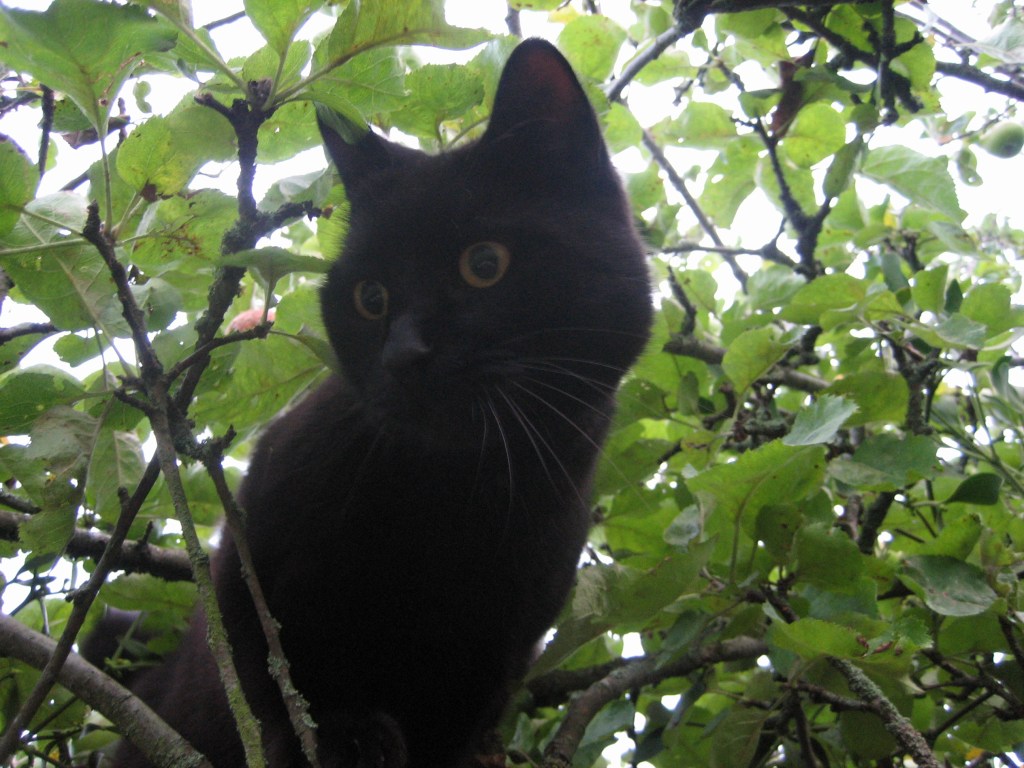
I shall be reading from THE LIFE & TIMES OF MR PUSSY, A MEMOIR OF A FAVOURITE CAT at 7pm on Saturday 17th November as part of the Write Idea Festival at the Whitechapel Idea Store. Click here for free tickets
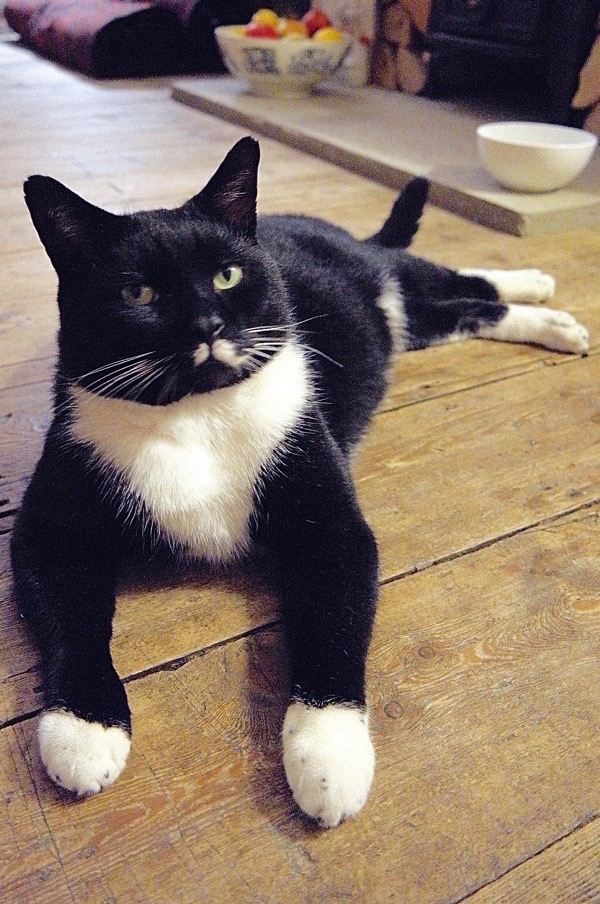
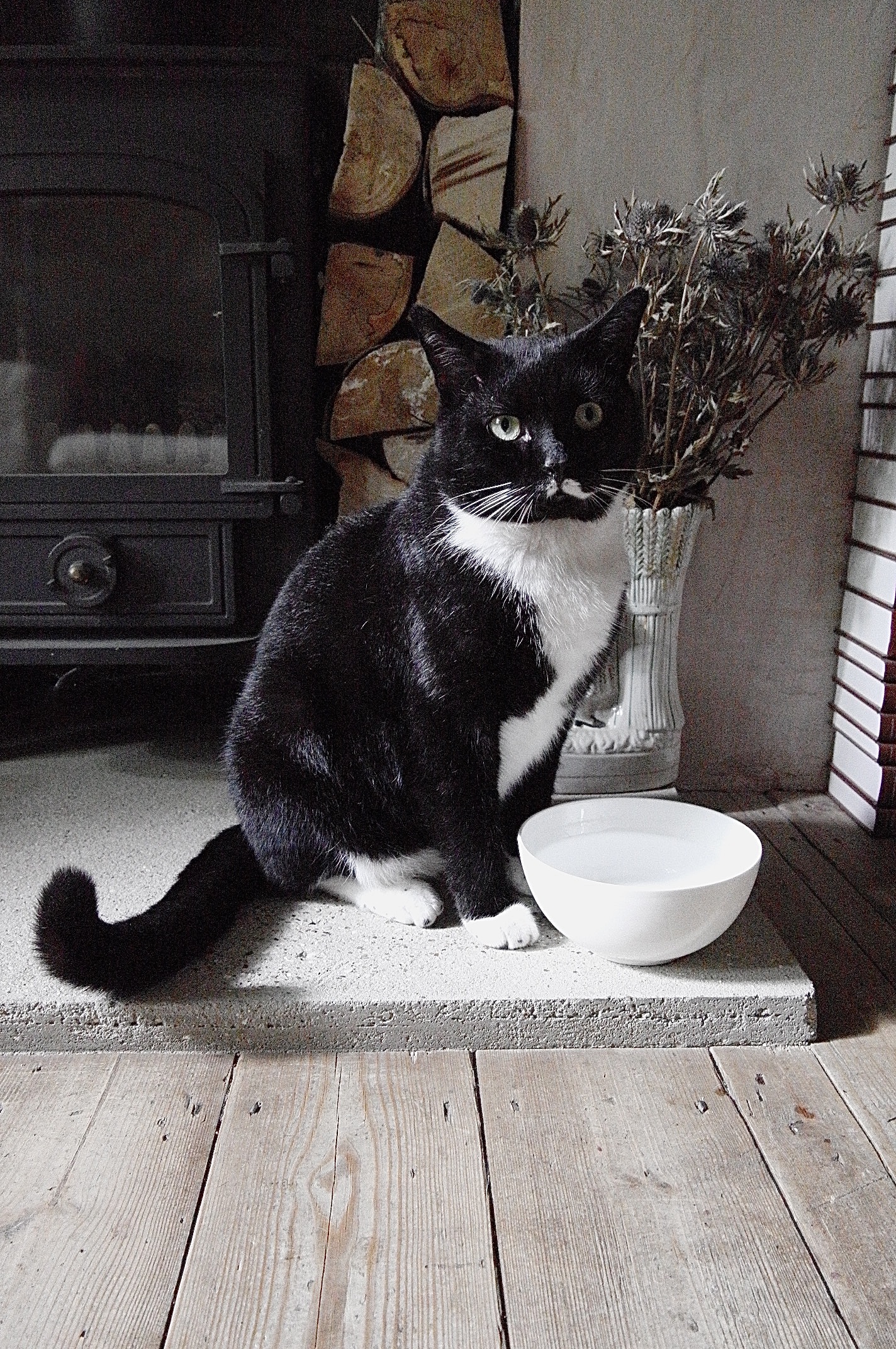
The sphinx
Over six months have passed since Schrodinger arrived in Spitalfields. These days, he comes and goes as he pleases through his cat flap, and knows how to open any door by leaping up and applying nimble pressure at just the right spot below the handle. Habitually now he settles down in the centre of the room or upon the arm of the sofa with his shoulders spread and his front legs extended in an expression of ownership. I call this familiar position ‘the sphinx.’
Like the sphinx Schrodinger retains his mystery, yet he opens his heart sometimes. If he discovers me at my desk, he delights to run and jump into the space between me and the back of the chair, rubbing himself against my spine and purring. There have been rare occasions when he has climbed around to sit upon my lap. Similarly, if he sees me lying upon the sofa with my head resting at one end against a cushion, he will leap onto the arm and rub himself against my hair, settling there snuggled against the back of my head. Sometimes he even climbs along the sofa to lie in the narrow space between me and the edge, before moving onto my stomach and cuddling there to feel the warmth of my body.
Yet Schrodinger’s personality has not softened. Like some latter day Joseph Merceron, he is subjugating the neighbourhood. I have become aware of fewer cats in the vicinity as he has extended his manor although – thankfully – he has made an exception for a neighbour’s pair of house cats, granting them free passage in his exclusion zone. Bare patches around Schrodinger’s neck and chest attest to his fights, where bites and scratches have formed red scabs and then taken off chunks of fur as he sheds the scabs before the fur grows again. It troubles me to wonder what injuries he inflicts on his combatants.
For some time, it was a matter of anxiety what might happen if Schrodinger were to confront a neighbour’s Staffordshire terrier, a lean and muscular young specimen. One day, I heard the sound of the confrontation that I dreaded and ran to the window fearing the worst. But I saw Schrodinger sitting alone in his sphinx position with his arms extended, eyes shining and his jaw clenched in an expression of ferocity. Indoors, I could hear the dog whimpering in fear and my neighbour comforting the poor creature. I realised that during Schrodinger’s years in Shoreditch, he had become familiar with the dogs belonging to the down-and-outs who frequented the church. Consequently, dogs prove no challenge to him. After that, I had to restrain Schrodinger physically twice by grabbing his back legs to prevent him climbing into the neighbour’s window to beat up their dog when they left it alone in the house.
In an attempt to encourage Schrodinger’s playful nature and educate him in the ways of house cats, I bought him six ping pong balls and left them on the carpet but he regarded them with disinterest. Yet I know he is happy because he always enters the house with his tail held up and runs to his dish of biscuits where he hunkers down to crunch enthusiastically until his hunger is satiated. Next he moves to his water dish and extends his long, lizard-like tongue, unfurling it down and lapping up the liquid in a quick repetitive gesture.
I have discovered the most effective means to puncture Schrodinger’s implacable nature is to brush him. It is by providing this service that I command his full attention. He has realised at last that I have a function. At first, I brush him gently on his head and then he stretches out his front legs as I brush his back. After I have brushed his chest and legs, he rolls onto his back so that I may brush his chest and belly. This inspires an abandoned frenzy of joy in which he rolls around on the carpet with his legs extended and his eyes gleaming in delight. He may even play with the ping pong balls afterwards, just so that I am not disappointed.
Thus Schrodinger has established his territory, his means of ingress and egress, his supply of food and water. He has company, he has grooming and a warm place to sleep. This is how Schrodinger took charge in Spitalfields.
You may like to read my earlier stories about Schrodinger
Click here to order a signed copy for £15












