At Arthur Beale

Did you ever wonder why there is a ship’s chandler at the top of Neal St where it meets Shaftesbury Avenue in Covent Garden. It is a question that Alasdair Flint proprietor of Arthur Beale gets asked all the time. ‘We were here first, before the West End,’ he explains with discreet pride, ‘and the West End wrapped itself around us.’
At a closer look, you will discover the phrase ‘Established over 400 years’ on the exterior in navy blue signwriting upon an elegant aquamarine ground, as confirmed by a listing in Grace’s Guide c. 1500. Naturally, there have been a few changes of proprietor over the years, from John Buckingham who left the engraved copper plate for his trade card behind in 1791, to his successors Beale & Clove (late Buckingham) taken over by Arthur Beale in 1903, and in turn purchased by Alasdair Flint of Flints Theatrical Chandlers in 2014.
‘Everyone advised me against it,’ Alasdair confessed with the helpless look of one infatuated, ‘The accountant said, ‘Don’t do it’ – but I just couldn’t bear to see it go…’ Then he pulled out an old accounts book and laid it on the table in his second floor office above the shop and showed me the signature of Ernest Shackleton upon an order for Alpine Club Rope, as used by Polar explorers and those heroic early mountaineers attempting the ascent of Everest. In that instant, I too was persuaded. Learning that Arthur Beale once installed the flag pole on Buckingham Palace and started the London Boat Show was just the icing on the cake. Prudently, Alasdair’s first act upon acquiring the business was to acquire a stock of good quality three-and-a-half metre ash barge poles to fend off any property developers who might have their eye on his premises.
For centuries – as the street name changed from St Giles to Broad St to Shaftesbury Avenue – the business was flax dressing, supplying sacks and mattresses, and twine and ropes for every use – including to the theatres that line Shaftesbury Avenue today. It was only in the sixties that the fashion for yachting offered Arthur Beale the opportunity to specialise in nautical hardware.
The patina of ages still prevails here, from the ancient hidden yard at the rear to the stone-flagged basement below, from the staircase encased in nineteenth century lino above, to the boxes of War Emergency brass screws secreted in the attic. Alasdair Flint cherishes it all and so do his customers. ‘We haven’t got to the bottom of the history yet,’ he admitted to me with visible delight.

Arthur Beale’s predecessor John Buckingham’s trade card from 1791

Nineteenth century headed paper (click to enlarge)


Alasdair Flint’s office

Account book with Shackleton’s signature on his order for four sixty-foot lengths of Alpine Club Rope

Drawers full of printing blocks from Arthur Beale and John Buckingham’s use over past centuries

Arthur Beale barometer and display case of Buckingham rope samples

Nineteenth century lino on the stairs

War emergency brass screws still in stock


More Breton shirts and Wellingtons than you ever saw

Rope store in the basement

Work bench with machines for twisting wire rope


Behind the counter

Jason Nolan, Shop Manager

James Dennis, Sales Assistant


Jason & James run the shop

Receipts on the spike

Arthur Beale, 194 Shaftesbury Avenue, WC2 8JP
You may also like to read about
Catching Up With Nicholas Borden
Painter Nicholas Borden came along to Doreen Fletcher’s opening on Thursday night to show support to a fellow artist. He invited me to come round next morning and see what he has been up to over the last year. I have been following Nicholas’s work since I met him painting in a blizzard in Vallance Rd in 2013. The paintings below are seen publicly for the first time today and are just a selection of Nicholas’s work from the past twelve months.

The meeting

Hackney Central, Looking Up Mare St

Hackney Central, Looking Down Mare St

London Wall

Valentine Rd

Trying to Cross the Road at the Old Bank, Islington

Victoria Park with Magpie

Trains with Seagull

Cassland Rd, Dusk

Broadway Market

In Bethnal Green

South Library, Essex Rd

Winter Street with Parked Motorcycle

Regent’s Canal, Summer Evening

Snow

Warner Place, Dusk

Waiting for the Bus

The View from my Front Window, Cassland Rd

Meynell Crescent

Winter Snow (work in progress)
Paintings copyright © Nicholas Borden
You may also like to take a look at
Nicholas Borden’s East End View
Nicholas Borden’s Winter Paintings
Nicholas Borden’s Spring Paintings
Tamara Stoll’s Ridley Rd Portraits
Photographer Tamara Stoll has been recording Ridley Rd Market – the people, places and stories – since 2011 and she sent me this fine collection of portraits of traders and shoppers.

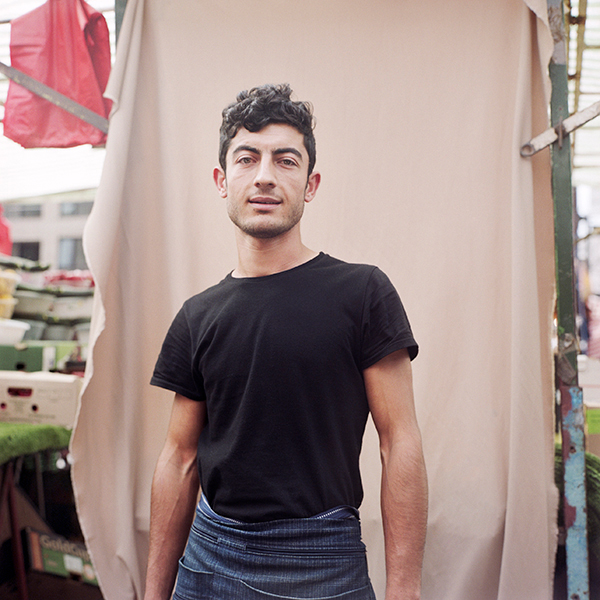
Rahmat Gul

Leigh Mayo
“My dad came from a family of fourteen brothers and sisters and they all worked with my nan on the stall. My aunt had a stall across the road and my great-grandmother, she started at the top of the market. They used to walk to Covent Garden Market or Spitalfields with a pram and buy mint and sell it for sixpence a bunch. That’s how we started down here. It has been handed down from generation to generation. Everyone helped each other and everyone got on. It was like a big family down here.
One weekend in 2008, my dad worked on a Saturday and was rushed into the hospital on the Sunday. They made a wreath for him out of fruit, veg and salads. Down this end of the market was completely shut, there wasn’t one stall open. Everyone shut up for my dad. They put a black cloth on his stall and it was full up with flowers. Everyone knew him and he had about a thousand people at his funeral. The procession came through Ridley Rd. If you go up to see Colin on the saucepans, he’ll tell you more.”

Grace, Audrey & Aiden

Angie

Umar & Paul

Barry Lambert

Terry & his family

Liz

Abdul Alizadeh

Angelique

Ali

Brothers

Ch Mushataq Ahmed & Ataa

David Hall

Dionne

Hamid

Hunar

Jason

Kikelomo Awojobi

Mr A James

Phil

Nigest Arava

Robert Evans
“My father Jack Evans started when he came back from the Second World War. He was in the Royal Navy during the Russian convoys. If you went into the water, you only had about to minutes to live but he survived that. That’s why I am here. I started about 1960. In those days, we used to sell a ton of potatoes each day – that’s forty days of potatoes nowadays. Modern day people don’t eat so many potatoes. They eat rice and takeaways, they’ve got choices. In those days you had to bring your own bag. We would have a queue of ten people lining up for potatoes. Cabbage was plentiful during the war, but there was a shortage of potatoes because they take longer to grow. In the war, customers had to buy cabbage to buy the potatoes, you could not just buy potatoes. It was all seasonal then, none of this ‘all year round.’ In the fifties and sixties, we used to sell six vegetables: potatoes, carrots, onions, cabbage and cauliflower or leeks, something like that. I was the first one down here to sell broccoli in about 1970.”

Shanti

Trevor

Vitor Perkola

Lucinda Rogers
Photographs copyright © Tamara Stoll
“You’ll find that people have been coming here for years. It’s the local place to go to get your shopping. This is a market in the original meaning of the word. You forget what you’re doing sometimes when you start talking, it’s a community.”
“Before pitches were licensed there used to be a Toby, a market inspector. He would blow a whistle and you would have had to run with your goods to get the best pitch possible. This caused quite a few arguments as you can imagine. There was a lot of trouble,this was before the Second World War, with what you called the blackshirts. They wore a uniform, black trousers and black shirts. They used to be at the corner of Ridley Road market and there used to be lots of fights. They started speaking – Britain was always free speech – and fighting broke out every time.”
“My mum shopped extensively here. The first generation of people that came here, obviously they cooked more authentically than we do. My kids will eat less authentically that I do and that will keep evolving down the line. It’s a place to come just to pick up that odd bit of tradition and have that connection. You buy plantain or yam, go home and cook it and it just gives you that memory of mum and dad and being at home.”
“The road was originally cobblestones for the horses and carts because the cart wheels run better on cobblestones, they don’t run on tar. But the cobbles weren’t laid very level, so you would have puddles here and a curve there and a puddle here. This market is on a bridge, the train runs under here. They changed it in the sixties because the cobbles were too heavy for the bridge, making it subside. So they took the stalls away and we were in Colvestone Crescent for a year while they repaired the bridge and concreted it over – and this is how you see it today. “
“I have been coming to this market for years. A bit of haggling, a bit of bartering, a bit of laughing, you get to know people as well. You build friendships, relationships, that kind of thing. So, it’s totally different to going to a shopping centre.”
“They call it a bread and butter market, and the best thing about it is the amount of variety of fruit and vegetables. Because they do piece selling, it’s very quick. You can load up, do your week’s shopping here in five, ten minutes. You walk down here and walk back up to the street in five minutes, it’s all done.”
“I was nineteen when I worked here in the late seventies. I used to sell wax printed African fabrics here. They have shops in Stamford Hill, here, Petticoat Lane. They still have businesses – Raynes. Cohen is their family name. Actually, they came from Yemen. There was an exodus of people from Yemen in the sixties and seventies and they came here and established a business.”
“This is where you meet the people, in the market, because sinceI started I have met five people already. That’s what the market is all about. People meet and talk, and just get on with it, buy your food and whatever. I just come out for a walk, it keeps me going.”
“If you go to Africa or you go to Jamaica, and you go down the markets, like Kingston Market in Jamaica, or Accra Market in Africa, it’s a lot like this. When you look at all these shops here, this is exactly how it is back home. So it’s like they’ve come here and they have set it up just like they would back home.”
You may also like to take a look at
Lucinda Rogers at Ridley Rd Market
Mia Sabel, Saddler

“My grandfather George Dobson was a Master Carpenter & Cabinet Maker, he taught me how to turn bannisters and make joints when I was a child, Mia Sabel the Saddler admitted to me, “and my mother taught me how to sew with a sewing machine too – so I was always quite proficient at making things.”
Just a short ride from Liverpool St Station delivered me to Walthamstow and a short walk from the station took me to the modest terrace where Mia works. Through a side gate, I entered the large garden where a log cabin with a wood-burning stove, surrounded by raised vegetable beds, provided the ideal location for an urban saddlery. Here in this enclave of peace Mia sat in the winter sunlight, illuminated like a woman painted by Vermeer, yet cutting and stitching leather with the skill of a Master Saddler.
It was an extraordinary discovery in the modern world, although equally a phenomenon of our times – since Mia used to work in the corporate financial sector and take the trip down to Liverpool St Station, until she set out to redirect her life towards independence by acquiring manual skills. Mia’s example fascinates me as the inverse of the familiar pattern in the East End where, through successive generations, traditional skills have been lost as the notion of a white collar desk job won precedence over working with your hands.
The irony is that Mia is able to complement her ability as a saddler with years of experience in the business world, granting her the acumen to make a living at this ancient trade.
Yet when you see Mia at work, the wonder is her scrupulous attention to technique. Even a humble line of stitching requires the precise choice of punch to make the correct-sized holes for the thread, the selection of the thread itself, the waxing of the thread and then the patience to work simultaneously with two needles and get the stitches perfectly even, and to ease the leather apart so it does not tear – all while holding the leatherwork in an ancient wooden clamp, known as a ‘clam.’ It is a beautiful thing to see such a fundamental task perfectly achieved.
At forty years old, Mia took a year out and worked in a stable while considering her options. “I looked at millinery, tailoring and saddlery,” she confessed to me, ” but I don’t like hats and, as a tailor, I realised I’d end up sewing in a basement, but there was a full-time course in saddlery ten miles from here in Enfield.”
“It was very physical and hard, it was for sixteen year olds. Quite a lot of the girls came from a horsey background whereas I am in a suburb with not a lot of horses around me,” Mia explained, looking up from her work with a grin of recognition, “I understood I couldn’t make a living making saddles, even though I know how to do that, so I’ve learnt to make bespoke luxury leather goods.” The custom watch strap has emerged as Mia’s unique speciality, permitting her the opportunity to make a strap that fits the wearer so precisely it only requires one hole for fastening.
Living in Walthamstow, not so far from William Morris’ house, Mia Sabel has grappled with many of the same issues about the role of the craftsman in the modern world, and developed a personal synthesis of romantic and realistic thinking – pursuing her unlikely course with hard work and flair. “I’m a jack-of-all-trades, I’ve even done shoe repairs,” she revealed to me with characteristic modesty, “Repairs teach you how things are made and I discovered how badly-made expensive bags can be, so I’ve learnt how to iron out those flaws in my own work.”

Mia uses two needles simultaneously on one thread to achieve her scrupulously regular stitches

Mia works with the saddlers’ clams on the right, dating from the eighteenth and nineteenth centuries

Punching holes for the stitches

Mia’s proud workmanship

Using a wooden clam to grip the leather in place, Mia stitches the strap

Mia Sabel is available for all kinds of leatherwork commissions and restoration work.
You may also like to read about
Billy & Charley’s Shadwell Shams

William Smith & Charles Eaton – better known as Billy & Charley – were a couple of Thames mudlarks who sold artefacts they claimed to have found in the Thames in Shadwell and elsewhere. Yet this threadbare veil of fiction conceals the astonishing resourcefulness and creativity that these two illiterate East Enders demonstrated in designing and casting tens of thousands of cod-medieval trinkets – eventually referred to as “Shadwell Shams” – which had the nineteenth century archaeological establishment running around in circles of confusion and misdirection for decades.
“They were intelligent but without knowledge,” explained collector Philip Mernick, outlining the central mystery of Billy & Charley, “someone told them ‘If you can make these, you can get money for them.’ Yet someone must also have given them the designs, because I find it hard to believe they had the imagination to invent all these – but maybe they did?”
Working in Rosemary Lane, significantly placed close to the Royal Mint, Billy & Charley operated in an area where small workshops casting maritime fixtures and fittings for the docks were common. Between 1856 until 1870, they used lead alloy and cut into plaster of paris with nails and knives to create moulds, finishing their counterfeit antiquities with acid to simulate the effects of age. Formerly, they made money as mudlarks selling their Thames discoveries to a dealer, William Edwards, whom Billy first met in 1845. Edwards described Billy & Charley as “his boys” and became their fence, passing on their fakes to George Eastwood, a more established antiques dealer based in the City Rd.
Badges, such as these from Philip Mernick’s collection, were their commonest productions – costing less than tuppence to make, yet selling for half a crown. These items were eagerly acquired in a new market for antiquities among the middle class who had spare cash but not sufficient education to understand what they were buying. Yet many eminent figures were also duped, including the archaeologist, Charles Roach Smith, who was convinced the artefacts were from the sixteenth century, suggesting that they could not be forgeries if there was no original from which they were copied. Similarly, Rev Thomas Hugo, Vicar of St Botolph’s, Bishopsgate, took an interest, believing them to be medieval pilgrims’ badges.
The question became a matter for the courts in August 1858 when the dealer George Eastwood sued The Athenaeum for accusing him of selling fakes. Eastwood testified he paid £296 to William Edwards for over a thousand objects that Edwards had originally bought for £200. Speaking both for himself and Charley, Billy Smith – described in the record as a “rough looking man” – assured the court that they had found the items in the Thames and earned £400 from the sale. Without further evidence, the judge returned a verdict of not guilty upon the publisher since Eastwood had not been named explicitly in print.
The publicity generated by the trial proved ideal for the opening of Eastwood’s new shop, moving his business from City Rd to Haymarket in 1859 and enjoying a boost in sales of Billy & Charley’s creations. Yet, two years later, the bottom fell out of the market when a sceptical member of the Society of Antiquaries visited Shadwell Dock and uncovered the truth from a sewer hunter who confirmed Billy & Charley’s covert means of production.
As they were losing credibility, Billy & Charley were becoming more accomplished and ambitious in their works, branching out into more elaborate designs and casting in brass. It led them to travel beyond the capital, in hope of escaping their reputation and selling their wares. They were arrested in Windsor in 1867 but, without sufficient ground for prosecution, they were released. By 1869, their designs could be bought for a penny each.
A year later, Charley died of consumption in a tenement in Wellclose Sq at thirty-five years old. The same year, Billy was forced to admit that he copied the design of a badge from a butter mould – and thus he vanishes from the historical record.
It is a wonder that the archaeological establishment were fooled for so long by Billy & Charley, when their pseudo-medieval designs include Arabic dates that were not used in Europe before the fifteenth century. Maybe the conviction and fluency of their work persuaded the original purchasers of its authenticity? Far from crude or cynical productions, Billy & Charley’s creations possess character, humour and even panache, suggesting they are the outcome of an ingenious delight – one which could even find inspiration for a pilgrim’s badge in a butter mould. Studying these works, it becomes apparent that there is a creative intelligence at work which, in another time, might be celebrated as the talent of an artist or designer, even if in Billy & Charley’s world it found its only outlet in semi-criminal activity.
Yet the final irony lies with Billy & Charley – today their Shadwell Shams are commonly worth more than the genuine antiquities they forged.


You may also like to read about
Doreen Fletcher In Her Own Words
At the opening of Doreen Fletcher’s RETROSPECTIVE, I publish this interview in which Doreen tells her story in her own words.
All are welcome tonight at the Private View of Doreen Fletcher’s RETROSPECTIVE at Nunnery Gallery, Bow Arts, Thursday 24th January from 6pm. The exhibition runs until 24th March.
I am IN CONVERSATION WITH DOREEN FLETCHER on Wednesday 30th January 7pm at Nunnery Gallery, showing the paintings and telling the stories. Click here for tickets

Portrait of Doreen Fletcher in her studio by Stuart Freedman
Doreen Fletcher – Looking back, I think I was attracted to painting even from the age of four or five. I loved colour and my dad used to take me to the local toy shop where I always insisted on the best quality paints. I was an only child, born into a working class family, and my parents were – as you might say these days – semi-literate. Consequently, from the age of about eight years old, I took responsibility for helping them out in dealing with officialdom, not unlike – I suppose – immigrant children in the East End today whose parents have limited English.
My mum and dad were very loving, and keen for me to have the opportunities they had missed. When I was five, I was bought a set of encyclopaedias from a salesman selling door-to-door on the never-never. It had colour reproductions of famous paintings such as Constable’s ‘The Hay Wain’ by Constable and Turner’s ‘The Fighting Téméraire’ and I thought they were wonderful.
I passed my eleven-plus exam but I had a very difficult time at grammar school because – although I was clever and always in the top six of the top stream – I came from the wrong side of the tracks. I felt I had to pretend I was from somewhere else, because most of the pupils came from professional middle-class families. Consequently, I could not invite school friends to our tiny terraced home. I did not speak with the right accent, have the social ease of the other children or possess their cultural knowledge.
The art room was a refuge for me because there I could express myself fluently under the expert tutelage of the art teacher Mr Hanford. He had trained at the Royal Academy School and was probably the only teacher of any influence I ever listened to. I loved Fridays when there was a two hour after-school art club. It was at one of these sessions that Mr Hanford advised against using black paint straight from the tube. To this day, I mix ultramarine and burnt umber for a warm black and raw umber and indigo for a cool black.
The Gentle Author – What work did your parents do?
Doreen Fletcher – Alice, my mother, worked in a munitions factory during the war and then became a domestic servant afterwards. It gave her ideas about not putting the newspaper or ketchup bottle on the table and she adopted ‘healthy eating,’ much to my irritation. She was also particular about keeping the front step, windows and net curtains clean. Colin, my dad, started off as a farm worker. He wanted to be a vet but due to illness he missed a year’s education at seven years old which meant that he left school hardly able to read or write.
After I was born, we moved from the village of Barlaston to Newcastle-Under-Lyme because my dad could earn more money in the town. In the late fifties, when the government erected pylons across the nation, he worked on the construction of these and later he found employment laying pipes for North Sea Gas. When my dad was fifty-seven, he had a brain haemorrhage at work, probably due at least in part to the vibrations of the pneumatic drill. He did not work again after that.
The Gentle Author – What was the first landscape that you knew?
Doreen Fletcher – It was composed of greys and browns – soot-streaked streets with sparrows and pigeons. I used to long for colour, for tinsel, for fairy lights and fairgrounds. Yet although I grew up in a two-up-two-down terrace in Stoke-on-Trent, every Sunday my parents took me on excursions by bus into the country, a different destination each time. This was rare at the time and I think it revealed their great sensitivity and care.
These trips were always accompanied by the purchase of a quarter pound of sweets and latterly, a brownie box camera that took tiny black and white photos. I liked going for long walks alone too. I was always looking and observing the variety of houses lining the streets I wandered through. Sometimes I roamed the countryside as well, walking along busy trunk roads. These days eyebrows might be raised, but there was nothing unusual in seeing unaccompanied children exploring back then. I loved my solitary walks.
The Gentle Author – What took you away from the Potteries?
Doreen Fletcher – I did not like living in a small town, it lacked cosmopolitanism. I hated the social constrictions and the pettiness I encountered. After A Levels, I decided I to study a subject that would earn me a living, so I enrolled on Bsc Sociology Course at North Staffordshire Polytechnic in Stoke. I have always been fascinated by other people’s lives, attitudes and behaviour.
However it proved a disastrous choice for me because the course dealt mostly with statistics and their interpretation. I did not even last two terms. So I went to work in a local tile factory – of which there were plenty in those days – where my job was sorting broken tiles. After six months I left, realising there was no future in it for me.
I knew my vocation was to be an artist. I spent a very happy year doing a foundation course in Newcastle-Under-Lyme. I felt at home there. I was comfortable and totally at ease in the chaotic atmosphere of the leaky portacabins that served as our studios. For the only time in my life, I did very little work. Instead I enjoyed making friends and formed a close relationship with a fellow student. Together we moved to London in 1972 where he attended Wimbledon School of Art and I worked as an art school model.
The Gentle Author – Did you apply to art school?
Doreen Fletcher – Yes, I applied to study at Croydon College. Even then, I was very independently minded and did not want a structured degree course where I might be expected to conform to a ‘house style’. At this point, I was painting quite a lot of self-portraits and still lifes.
One day in late 1973 I saw an exhibition of paintings of Mow Cop by Jack Simcock in Cork Street. Mow Cop was a hilltop village not far from my home. In Newcastle-under-Lyme, if I leaned out of my bedroom window at a dangerous angle, I could just see the Victorian folly on the summit of Mow Cop in the distance.
The houses were built out of Peak District sandstone and local millstone grit. The place was bleak and dour. I was captivated, deciding then that I wanted to be an urban landscape painter, recording my own environment.
The Gentle Author – Where did you live when you first came to London?
Doreen Fletcher – To begin with, I stayed around Wimbledon, then I spent seven years living in Paddington where my fascination with urban scenes escalated. Coming from a small town in the North, it was an exciting place to be. I was close to the Serpentine Gallery, Kensington Gardens, Notting Hill Gate and Portobello Road. I started painting local landmarks, the Electric cinema and the Serpentine boathouse. Then I became interested in Underground stations at night, Bayswater and Paddington. This project continued when I moved to the East End.
The Gentle Author – What brought you to the East End?
Doreen Fletcher – At that time artists were attracted to live and work in the East End because of the cheap studio space that was available. It was easy to rent because the local population were moving out and and artists were happy to live in dilapidated accommodation if it gave them room to work. Before long, a mutually supportive community of artists developed around Bow, Stepney and Mile End.
The Gentle Author – How do you remember the East End then?
Doreen Fletcher – I noticed the skies first, open and dramatic as they advanced into Essex. There were corrugated fences everywhere, still bombsites where buddleia proliferated and a few prefabs inhabited by artists. There was an openness in the streets which has since gone, now every corner has been built up and every vacant space filled.
Yet the distinctive quality of light remains particular to this part of London, a luminescence generated by the proximity of the river. I loved it here because I had had enough of the West End. It felt to me as if I were returning home. Like Stoke, the East End was predominantly working class and also had once been an important centre for industry. Corner shops and tiny pubs proliferated among street markets.
The Gentle Author – Why did you start painting the East End?
Doreen Fletcher – I was excited visually by being somewhere new to me yet that also reminded me of where I grew up. In the Potteries, the town planners’ ethos was ‘If it’s old, let’s sweep it away’ – regardless of its cultural and historical significance. I saw the same fate awaiting the East End. The first painting I did here was the bus stop in Mile End in 1983 and then Rene’s Café next.
The Gentle Author – Was this your full time occupation?
Doreen Fletcher – I was working as an artists’ model in an art school. It was the most boring job you could imagine, but I stuck at it during term-time so I could have periods of full-time painting. I was able to keep myself by working three days a week as a model.
The Gentle Author – How central to your life were your paintings at that time?
Doreen Fletcher – Painting was the focal point of my life. My studio was a small room at the top of a run-down three-storey house in Clemence Street. It faced north so the light was good for painting.
I walked around the East End at different times of day and in different weathers. Eventually a particular scene imprinted itself on my mind that could have potential as a painting. I did thumbnail sketches and took a photograph. Once I had gathered this information, I made a detailed drawing as a basis for the painting. This might evolve over a period of months or even years, as the tension built up between my need to represent reality and the demands made by the painting itself. I always struggle to resolve a picture in an abstract way as well as portraying a subject. To this day,I follow this methodical process to make a painting.
I worked a minimum of twenty-eight hours a week, a target I still adhere to. I was determined not to become a Sunday painter.
The Gentle Author – Did you have ambition for this work?
Doreen Fletcher – Yes and I did have some limited success in the eighties showing within the borough, receiving a few grants and being accepted in open exhibitions such as the Whitechapel and the London Group. Companies bought work from time to time and local people appreciated my paintings, but there was little interest from any critics or commercial galleries.
The Gentle Author – Did you pursue other avenues to get recognition for your work?
Doreen Fletcher – Once a month, I used to send off slides in response to competitions and requests for submissions in Artists’ Newsletter. It was time-consuming and costly without reward.
The Gentle Author – How did you maintain morale through those twenty years?
Doreen Fletcher – I am an optimist and I remained optimistic up until the late nineties, when my work grew increasingly unfashionable due to the rise of conceptual art. It became more difficult to find any places where I could exhibit my work that would even accept representational painting. My work was simply out of fashion My interest in the East End was waning too, as Canary Wharf transformed into a financial metropolis. I found I did not know what to paint any more. It felt as though a period of my life was coming to an end.
The Gentle Author – What made you feel that?
Doreen Fletcher – The East End was changing in a way that I could not understand or portray. The new buildings were densely packed, destroying the distinctive sense of place and community. At first, I was interested in the construction – on the Isle of Dogs for instance – but once it was finished there were just too many people and too much architectural uniformity.
The Gentle Author – Were there changes in your life too?
Doreen Fletcher – I grew more involved in teaching art to youngsters with special needs, taking a part-time job in further education. I became more interested because I found I was good at it and my teaching work was appreciated. Gradually, I worked more in the administrative side of education, supporting other lecturers.
The Gentle Author – Did you find that satisfying?
Doreen Fletcher – Yes, I was earning a salary and contributing to the community. It was rewarding to be working with other people after my years of isolation. I enjoyed participating in the local community rather than being an observer.
The Gentle Author – Once you had completed nearly twenty years of painting the East End, what were your feelings about that series of work?
Doreen Fletcher – I did not realise that I was creating any kind of social document at the time because I was so absorbed with each painting, each one constituting such a lot of work. I had tried very hard to get my pictures out there and get them seen. I had hoped for some kind of recognition. I was never ambitious in terms of international recognition but I did feel that the work was good enough to be recognised more than it was.
The Gentle Author – Were you disappointed?
Doreen Fletcher – Yes. I remember the day I made a conscious decision to pack away my paints. It was November 16th 2004. I said, ‘That’s it! I am not going to paint again.’ I had no knowledge that I was undertaking a journey and enduring a struggle that other artists in the East End had already experienced. If I had been aware of the East London Group and their example, I might have had the heart to continue.
The Gentle Author – Do you think your project reached its culmination?
Doreen Fletcher – At the time I did not think so, I believed I had done all that work for nothing. But looking at the work again, I am very glad I did it. I think it was important that I recorded something which has now vanished.
The Gentle Author – Do you think you evolved as a painter by doing this work?
Doreen Fletcher – If I had I been taken on by a gallery, I might have developed more as a painter. Instead, I think I found a method of working that suited what I was doing and I stuck with it. Maybe with a bit more encouragement I would have done what I am doing now, since I have come back to painting.
The Gentle Author – How do you judge if one of your paintings is successful?
Doreen Fletcher – A painting is successful for me when I believe I have captured an essence of a place in a moment. A picture must sit comfortably and solidly on the canvas. My concern as an artist is with the pockets of life that we ignore.
Now I have started painting again and the series of pictures I have been working in the last two years are the result of having lived in East London for thirty-five years. I have been reflecting on how much remains from the early years and come to appreciate how those people who still live here have adapted to the changes.
In the early eighties, this part of London was run down and very few people chose to be here. Some streets and buildings remain as reminders of that era, left to compete with new concepts of London that have emerged since the closing of local industries and the rise of corporate culture. In representing their utilitarian quality, I envisage my subjects not only as reminders of the past but also as active survivors struggling positively to find a place in a world changing beyond recognition.
I am a painter concerned with environments that are or have been inhabited. I try to resolve the struggle between how I see things and with abstraction, where the pictorial demands of structure, organisation and balance hold sway. My work is carried out slowly and methodically using a range of techniques to communicate a place of quietude and serenity. The difference between the work I am making today and the work I was doing before is that now I am a participant, no longer only an observer of East End life.

CLICK HERE TO ORDER A SIGNED COPY OF DOREEN FLETCHER’S BOOK FOR £20

George Cruikshank’s Comic Alphabet


You might like to see other work by George Cruikshank
Jack Sheppard, Thief, Highwayman & Escapologist
The Bloody Romance of the Tower
Henry Mayhew’s Punch & Judy Man
and these other alphabets