
Matt Walters, Human Statue

Did you ever walk through the Spitalfields Market and feel the lightest touch upon you, as if the ghost of some long-departed market porter were reaching out across time? Very likely that was Matt Walters, the human statue, who has been standing on a box in the market for the last ten years and become the catalyst for the long-running drama that takes place in the narrow passage between the Creperie and the Rapha Clubhouse.
As visitors arrive in the Spitalfields Market, walking from the new development into the old building and enjoying the historic ambience, including the bronze figure of a man in flat cap, they are sometimes shaken from their reverie by a tap on the head from the living statue. The innocent hilarity thus engendered has become an attraction in its own right and you will regularly find a small crowd assembled here with cameras at the ready to record the never-ending amusement as a stream of unwitting newcomers are bamboozled in similar fashion.
The mysterious and slightly sinister charisma of the human statue is one of enduring fascination to adults and children alike. Most people are more than willing to enter into the light-hearted complicity required, with the rare of exceptions of little ones that become gripped with abject terror and big ones whose dignity is affronted by such unwarranted mischief. Yet, succumbing to the pull myself – like some latter-day Don Giovanni – I arranged a private assignation with the statue and he favoured me by breaking his customary silence.
“My father a was an Orthopaedic Surgeon and General Practitioner, but I left school after I flunked all my O levels. Then I lasted a couple of months studying catering until the craze of robotic dancing came in, and I found I was good at it and I could make a living out of being a robot.
After about ten years of doing that, I saw my first human statue in Paris and by then I’d had enough of being a robot. It was at Fontainbleu and I couldn’t understand why all the French were staring at this statue in a flowerbed, so I went up to touch it and she grabbed me – scared the living daylights out of me! I literally came back and – although I didn’t know how – I decided I was going to do it. I had a booking as a robot at a night club but I turned up and said, ‘I’m going to be a human statue.’ So I got my make-up on and painted myself up and stood in the foyer for two and a half hours and that was that. It didn’t go too well, as the club owner didn’t notice me and thought I’d gone home. But after two and a half hours my calves were killing me, so I dropped the character and stepped off my plinth, and the whole club freaked out – ‘Bloody hell, it’s alive!’
That was fifteen years ago, so I have been doing this for twenty-eight years now. It’s really hard to stand still, it takes a lot of core strength and you have to breathe quite shallowly. I’m looking around for who to pick and you can always tell who’s comfortable by the way they walk towards you. I lower my heartbeat while I’m standing, my pulse goes down to twenty-eight and I feel very relaxed. It nearly killed me in November though, because I had blood clots in my lungs and the doctor said it might be from standing still such a long time. But I am fully recovered and you know, ‘Worse things happen at sea!’ I hope I’ll be doing it for a few years yet, because no-one can see my age under the make-up. The oldest human statue is in the Ramblas in Barcelona – he is seventy-four and he looks like the perfect statue of a wizened old man.
I love what I do and there is the freedom of choosing your hours. Each day, I start at 11:30am and finish about 7:00pm with a few breaks in between. A policeman said to me, ‘Every time you touch someone, technically you are assaulting them.’ but people understand that it’s harmless. I’m very lucky with the comments I get, people say, ‘I’ve never seen anything as good as that.’ I’m at the top of my tree. I’m not begging, I’m a performer and people choose to put money in the tin or not. You always give your best performance and let people take as many photos as they like, whether they give you something or not.
Before the recession, business was really good. I had thirteen people working for me at one time – training them up, breaking them in and teaching them how to apply their make-up. I’d have four or five corporate events each week and at least one wedding each weekend. In the early days, I did the opening of every new Specsavers, that’s three hundred and sixty shops. And I did all the openings for Hotel du Vin too, for a while we were synonymous. It was a successful business until it all came crashing down around me and now I am a solo street entertainer – doing Spitalfields each Sunday, South Bank on Monday, Kingston on Thursday or Friday, and Wimbledon on a Saturday. It all depends where I’m racing – I used to do ultra-marathons but now I do cycle racing. My other passion is bird watching, I’ve seen the Peregrine Falcons at St Paul’s and at the Barbican. Half my ear is listening to birdsong and the other half is listening to people around me – you get so much more attuned when you are silent.
I dress up as a Chimney Sweep generally, but if it gets hot I paint myself white all over like a Sandstone Figure. I only do that if there’s a shower because otherwise it takes six boxes of baby-wipes to remove the make-up. I have great skin because I’m always exfoliating. I do other colours as well, so if there’s a corporate logo I can spray it on my body with a stencil and match up the colour. I also do a Roman Centurion, Stars & Stripes for 4th July, and Verdigris, and I do a Torch Bearer with a real flaming torch for night-time. I don’t wear gold or silver, I make myself up to look like a real bronze statue. I was Planet Hollywood’s human statue at the Trocadero for eight years. I was there for the Olympics and I’m going back for four or five days a week this summer. They regard it as a kind of subliminal advertising because people get involved with my act and then they go into the restaurant.
Nowadays, there’s all these people down in Covent Garden with masks which I regard as cheating. In my time, there used to be the Doggy Man who sat in a cat basket, Duncan the Silver Gladiator and the Leaning Man, who had his shoes nailed to a board and could lean forty-five degrees. There were four of us lined up, so you had to work hard to earn your money but I enjoyed the competition.
I’ve been in Spitalfields for ten years. I came here just after it had been redeveloped and I dropped one of my cards off at the market office, and they rang me up and I have been here ever since. When I started, the owner of the cafe came out and said ‘I love what you do, you can have a free coffee in my cafe anytime.’ The security guards are very protective and the stall holders are very friendly too. You’d think people would suss out what I’m doing by now, but there’s always a mass of new people coming through and I’ve had tourists returning each year to find me. The glass roof keeps the rain off and it’s sheltered here, unlike Covent Garden where I was exposed to the cold and snow. I love Spitalfields, it’s a great place to be a statue.”


Matt Walters, Human Statue

Don Giovanni and the Statue by Alexandre-Évariste Fragonard, c. 1830-35.
You may also like to read about
John Thomas Smith’s Old London Cries

John Thomas Smith also known as ‘Antiquary Smith’ (1766–1833)
My interest in the Cries of London originally stemmed from writing about market traders in Spitalfields and thus I was fascinated to discover that – two hundred years ago – John Thomas Smith drew the street hawkers in London and it led him to look back at images from earlier centuries too. Similarly, Samuel Pepys collected prints of the Cries of London of his own day and from the past, which makes me wonder about my illustrious predecessors in this particular cultural vein and whether they also shared my passion for these prints as the only historical record of the transient street life of our ancient city.
A colourful character who claimed to have been born in the back of a Hackney carriage, John Thomas Smith became keeper of prints at the British Museum and demonstrated a superlative draftsmanship in his vivid street portraits – with such keen likenesses that, on one famous occasion, his subjects became suspicious he was working for the police and chased him down the street in a mob. The prints shown here are Smith’s drawings of prints from the seventeenth century which especially appealed to him, and that he discovered in the course of his work as an archivist.
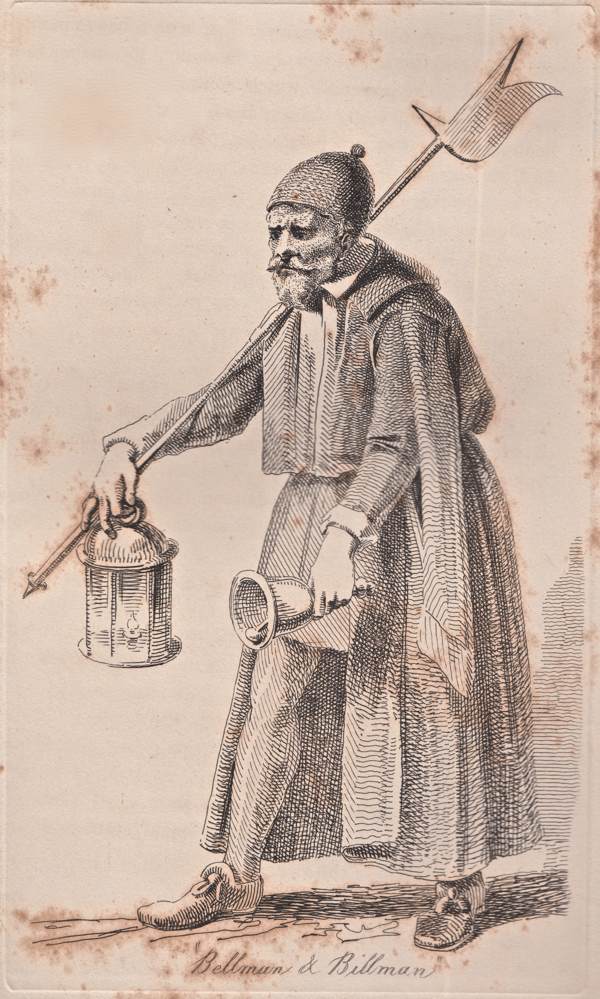
Bellman (Copied from a print prefixed to ‘Villanies discovered by Lanthorne and Candlelight’ by Thomas Dekker 1616)
“The Childe of Darkness, a common Night-walker, a man that had no man to wait upon him, but onely a dog, one that was a disordered person, and at midnight would beate at men’s doores, bidding them ( in mere mockerie) to look to their candles when they themselves were in their dead sleeps, and albeit he was an officer, yet he was but of light carriage, being known by the name of the Bellman of London.”
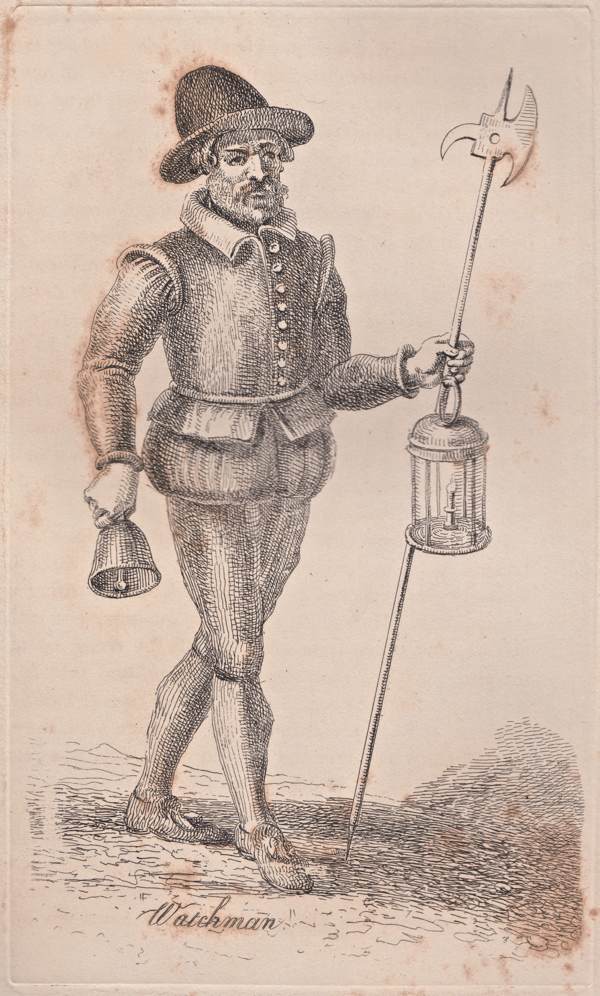
Watchman (Copied from a woodcut sheet engraved at the time of James I)
“The marching Watch contained in number two thousand men, part of them being old souldiers, of skill to be captaines, lieutenants, serjeants, corporals &c. The poore men taking wages, besides that every one had a strawne hat, with no badge painted, and his breakfast in the morning.”

Water Carrier (Copied from a set of Cries & Callings of London published by Overton)
“When the conduits first supplied the inhabitants, there were a number of men who for a fixed sum carried the water to the adjoining houses. The tankard was borne upon the shoulder and, to keep the carrier dry, two towels were fastened upon him, one to fall before him and the other to cover his back.”

Corpse-Bearer
“When the Plague was at its height, it was the business of the Corpse-Bearers to give directions to the Car-Men who went through the City with bells, which they rang at the same time crying, ‘Bring out your Dead.'”

Hackney Coachman (Copied from a print published by Overton in the reign of Charles II)
The early Hackney Coachman did not sit upon the box as the present drivers do, but upon the horse, like a postilion – his whip is short for that purpose, his boots which have large open broad tops, must have been much in the way when exposed to the weight of the rain. His hat was pretty broad and so far he was screened from the weather. In 1637, the number of Hackney Coaches in London was restricted to fifty but by 1802 it was eleven hundred.”

Jailor (Copied from Essayes & Characters of a Prison & Prisoners by Geffray Mynshul of Grays Inn, 1638)
“If marble-hearted Jaylors were so haplesse happy as to be mistaken and be made Kings, they would, instead of iron to their grates, have barres made of men’s ribs.”

Prison Basket Man (Copied from a print published by Overton in the reign of Charles II)
“One of those men who were sent out to beg broken meat for the poor prisoners. This custom which perhaps was as ancient as our Religious Houses has long been done away by an allowance of meat and bread having been made to those prisoners who are destitute of support. It was the business of such men to claim the attention of the public by their cry of ‘Some broken breade and meate for ye poore prisonors! For the Lord’s Sake, pitty the poore!'”

Rat Catcher (Copied from Cries of Bologna, etched by Simon Guillain from drawings by Annibal Carracci, 1646)
“There are two types of rats in this country, the black which was formerly very common but is now rarely seen, bring superseded by the large brown kind, called the Norway rat. The Rat Catcher had representations of rats and mice painted upon a square cloth fastened to a pole like a flag, which he carried across his shoulder.”

Marking Stones (Copied from a woodcut engraved in the time of James I)
“The marking stones were either of a red colour or comprised of black lead. They were used in the marking of linen so that washing could not take the mark out.”

Buy A Brush (Copied from a print published by Overton in the reign of Charles II)
“In those days, floors were not wetted but rubbed dry, even until they bore a very high polish, particularly when it was the fashion to to inlay staircases and floors of rooms with yellow, black and brown woods. These floors were rubbed by the servants who wore the brushes on their feet and they are in some instances so highly polished that they are dangerous to walk upon.”

Fire Screens (Copied from a print published by Overton in the reign of Charles II)
“It appears from the extreme neatness of this man and the goods which he exhibits for sale, that they were of a very superior quality, probably of foreign manufacture and possibly from Leghorn, from whence hats similar to those on his head were first brought into England”

Sausages (Copied from a print published by Overton in the reign of Charles II)
“The pork shops of Fetter Lane have been for upwards of one hundred and fifty years famous for their sausages, but those wretched vendors of sausages who cared not what they made them of in cellars in St Giles were continually persecuting their unfortunate neighbours, to whom they were as offensive as the melters of tallow, bone burners, soap boilers and cat gut cleaners.”
Take a look at John Thomas Smith’s drawings of nineteenth century street traders
A Bell-Themed Boutique Hotel?

Visualisation of the hotel lobby, showing the pit where Big Ben was cast
Raycliff Capital, the developers who want to turn the historic Whitechapel Bell Foundry into a bell-themed boutique hotel, have submitted their application to Tower Hamlets council for change of use from foundry to hotel. Now you get to have your say. Would you rather have the Whitechapel Bell Foundry converted into an upmarket hotel or would you rather it was a foundry, continuing a tradition of casting bells in Whitechapel that dates back to 1363?
A choice has to be made and Tower Hamlets council must establish which is the OPTIMUM VIABLE USE – this is a term in planning law which means the ideal purpose for a building. Since the Whitechapel Bell Foundry was built as a foundry and worked as a foundry for centuries, it is self-evident that this is the OPTIMUM VIABLE USE, not a boutique hotel.
United Kingdom Historic Building Preservation Trust (a charity with a distinguished track record in heritage-led regeneration) have announced a partnership with Factum Foundation (a global leader in the use of technology for the preservation of heritage and maker of sculptures for some of the world’s most famous artists). Together, they have the resources to buy the buildings off the developer at market value and re-open them as a foundry, re-equipped with up-to-date machinery, for the production of bells and art casting.
Bippy Siegal, the New York tycoon who owns Raycliff Capital often works with business associate Richard Caring in hotel projects. Recognising that there is a viable alternative to their boutique hotel proposal, Raycliff Capital have appropriated the language of their rivals by claiming they are actually ‘reinstating a foundry,’ meaning that bell polishing will happen in the lobby of their hotel sometimes. The reality is they are reducing the foundry use by more than 90%. In spite of this attempt to muddy the waters, I think the difference between a boutique hotel and a bell foundry is quite obvious.
You can help save the Whitechapel Bell Foundry as a living foundry by submitting an objection to the boutique hotel proposal to Tower Hamlets council. Please take a moment this weekend to write your letter of objection. The more objections we can lodge the better, so please spread the word to your family and friends.
HOW TO OBJECT EFFECTIVELY
Use your own words and add your own personal reasons for opposing the development. Any letters which simply duplicate the same wording will count only as one objection.
1. Quote the application reference: PA/19/00008/A1
2. Give your full name and postal address. You do not need to be a resident of Tower Hamlets or of the United Kingdom to register a comment but unless you give your postal address your objection will be discounted.
3. Be sure to state clearly that you are OBJECTING to Raycliff Capital’s application.
4. Point out the ‘OPTIMUM VIABLE USE’ for the Whitechapel Bell Foundry is as a foundry not a boutique hotel.
5. Emphasise that you want it to continue as a foundry and there is a viable proposal to deliver this.
6. Request the council refuse Raycliff Capital’s application for change of use from foundry to hotel.
WHERE TO SEND YOUR OBJECTION
You can write an email to
planningandbuilding@towerhamlets.gov.uk
or
you can post your objection direct on the website by following this link to Planning and entering the application reference PA/19/00008/A1
or
you can send a letter to
Town Planning, Town Hall, Mulberry Place, 5 Clove Crescent, London, E14 2BG


Members of East End Preservation Society deliver their petition of 10,000 signatures to Save the Whitechapel Bell Foundry to Downing St in 2017 (photograph Sarah Ainslie)
“The world famous Whitechapel Foundry is a landmark – both for its splendid use and its fine historic buildings. Bells cast at the foundry have sounded in cities around the world for hundreds of years. For many, that sound represents the heart and soul of London, and in the case of Big Ben in the Palace of Westminster it is the sound of Freedom. The existing buildings deserve the highest level of recognition and protection as a unique and important part of our heritage.”
Dan Cruickshank
You may also like to read about
Hope for The Whitechapel Bell Foundry
Royal Jubilee Bells At Garlickhythe
The Most Famous Bells in the World
A Visit To Great Tom At St Paul’s
A Petition to Save the Bell Foundry
Boiling The Eels At Barneys Seafood

On most mornings throughout the year, just a stone’s throw from the Tower of London, you will find them boiling the eels at Barney’s Seafood, under an old railway arch in Chambers St. For the past twenty-eight years Mark Button has presided there over the business that his father Eddie Button took over in 1970 from Barnet Gritzman (brother of Solomon Gritzman, the owner of Tubby Isaac’s), who was boiling eels here since before World War II. Thus you will know that this is an established location for the pursuit of one of the East End’s most traditional culinary tasks, the preparation of jellied eels.
I joined Stuart – a blocksman of twenty-two years’ experience – with a firm jaw and resolute eyes, at the rear of the arch in a room awash in pools of water, where he brandishes a fearsome curved blade with striking accomplishment, making short work of gutting and chopping great gleaming piles of eels. Arriving fresh from the tanks in Canning Town, Stuart tipped the morning’s eels out onto the bench where at first they slithered and slid in a shining mass. Then, gripping each one firmly by the head, Stuart decapitated it in the manner of those traitors of old across the road at Tower Hill, before slicing it open with a flick of the knife and disposing of both the head and the gut into the bin. It is a neat series of honed gestures that require both skill and years of practice, and you can be assured, Stuart has got the knack.
Interspersed with constant sharpening, since the eels’ back bone quickly blunts the long blade, Stuart likes to keep his knife razor sharp. “I’d rather cut my finger with a sharp blade than a blunt one!” he joked with enthusiastic grim humour as another eel’s head plopped into the bin. Yet make no mistake, Stuart has the greatest respect for eels. “Eels are very mysterious,” he said, turning philosophical and standing in absent-minded contemplation, with an eel and a blade in each hand, “There’s not a lot people know about eels. It’s funny how they know how to go to the Sargasso Sea, they’ve got a homing instinct.”
Once Stuart had chopped them up neatly, Paul the personable cook of ten years experience cooking eels, came from next door to collect the baskets of sliced fish and carry them through to the pots for boiling. Four tall steel cooking pots stood in a line on gas rings, each with filled with salt water and a bundle of parsley, some with eels already cooking and others just bubbling up to the boil, creating a wonderfully pungent sweet salty warm atmosphere. Paul tipped the eels straight into the hot water to cook, a process that can take between forty-five minutes to an hour and a half, depending on the type of eel, and he turned to lay out the bowls in neat lines upon shelves on the other side of the room, all ready for the eels when they are cooked. “Today we’ve got fresh Dutch eels and some frozen Chinese eels,” he explained helpfully, “Yesterday we had New Zealand eels and in a couple of weeks we’ll have the native Irish eels – they are best, seasonal, grown in the wild, nice texture and nice to eat.” Adding politely, “Have you ever thought of working in the fish industry?” he enquired – eager to make me feel included in such an enthralling process and flattering me with the question.
“You need to get them just before they’re cooked, when they’re as soft as possible” he continued, “because they harden afterwards,” – educating me, as he lifted a spoonful from the water and tasted one critically, before switching off the flames below and performing the delicate manoeuvre of sliding the pot off the cooking ring and onto a trolley. Catching me unawares so early in the morning, “Would you like to try one?” he asked – sensing my fascination – and naturally I assented. He passed me the morsel of pale eel flesh and I put it in my mouth. It was sweet and warm and it crumbled when I sank my teeth into it, releasing a delicate salty tangy flavour. In that instant, I wanted a plate of hot mashed potato to go with it, and I wanted more eels too. Paul did not know it was my first time, yet although I will have to wait until my next visit to a pie and mash shop to eat a plate of hot eels, I was converted.
Then Paul set about methodically distributing the eels equally into bowls, letting them cool and set in the jelly that is their natural preservative. And by then it was time for him to collect more baskets of sliced eels from Stuart and tip them into the cooking pot. Meanwhile, a stream of customers were pulling up outside and coming in excitedly to shake hands with Mark Button and carry away their bowls of fresh jellied eels for the weekend, as a tasty treat to restore their spirits. No other food excites such passion in the East End as the eel, and that is why East Enders delight to make the pilgrimage to Barney’s – they come to claim the dish that is their right.


“Eels are very mysterious, there’s not a lot people know about them”


Stuart, a blocksman of twenty-two years experience who learnt the trade from Eddie Button.


Eels simmering with parsley in cooking pots of salt water.


Paul the cook – “Have you ever thought of working in the fish industry?”


Mark Button, proprietor of Barney’s Seafoods
You may also like to read about
Fat Cats In The City, 1824
Fat cats in the City of London are nothing new as these elegant cartoons of Regency bankers from 1824 by Richard Dighton in the archive at the Bishopsgate Institute testify


Images courtesy Bishopsgate Institute
You may also like to take a look at
At God’s Convenience

“Slovenliness is no part of Religion. Cleanliness is indeed close to Godliness” – John Wesley, 1791
Oftentimes, walking between Spitalfields and Covent Garden, I pass through Bunhill Fields where – in passing – I can pay my respects to William Blake, Daniel Defoe and John Bunyan who are buried there, and sometimes I also stop off at John Wesley’s Chapel’s in the City Rd to pay a visit to the underground shrine of Thomas Crapper – the champion of the flushing toilet and inventor of the ballcock.
It seems wholly appropriate that here, at the mother church of the Methodist movement, is preserved one of London’s finest historic toilets, still in a perfect working order today. Although installed in 1899, over a century after John Wesley’s death, I like to think that if he returned today Wesley would be proud to see such immaculate facilities provided to worshippers at his chapel – thereby catering to their mortal as well as their spiritual needs. The irony is that even those, such as myself, who come here primarily to fulfil a physical function cannot fail to be touched by the stillness of this peaceful refuge from the clamour of the City Rd.
There is a sepulchral light that glimmers as you descend beneath the chapel to enter the gleaming sanctum where, on the right hand side of the aisle, eight cedar cubicles present themselves, facing eight urinals to the left, with eight marble washbasins behind a screen at the far end. A harmonious arrangement that reminds us of the Christian symbolism of the number eight as the number of redemption – represented by baptism – which is why baptismal fonts are octagonal. Appropriately, eight was also the number of humans rescued from the deluge upon Noah’s Ark.
Never have I seen a more beautifully kept toilet than this, every wooden surface has been waxed, the marble and mosaics shine, and each cubicle has a generous supply of rolls of soft white paper. It is both a flawless illustration of the rigours of the Methodist temperament and an image of what a toilet might be like in heaven. The devout atmosphere of George Dance’s chapel built for John Wesley in 1778, and improved in 1891 for the centenary of Wesley’s death – when the original pillars made of ships’ masts were replaced with marble from each country in the world where Methodists preached the gospel – pervades, encouraging solemn thoughts, even down here in the toilet. And the extravagant display of exotic marble, some of it bearing an uncanny resemblance to dog meat, complements the marble pillars in the chapel above.
Sitting in a cubicle, you may contemplate your mortality and, when the moment comes, a text on the ceramic pull invites you to “Pull & Let Go.” It is a parable in itself – you put your trust in the Lord and your sins are flushed away in a tumultuous rush of water that recalls Moses parting the Red Sea. Then you may wash your hands in the marble basin and ascend to the chapel to join the congregation of the worthy.
Yet before you leave and enter Methodist paradise, a moment of silent remembrance for the genius of Thomas Crapper is appropriate. Contrary to schoolboy myth, he did not give his name to the colloquial term for bowel movements, which, as any etymologist will tell you, is at least of Anglo-Saxon origin. Should you lift the toilet seat, you will discover “The Venerable” is revealed upon the rim, as the particular model of the chinaware, and it is an epithet that we may also apply to Thomas Crapper. Although born to humble origins in 1836 as the son of a sailor, Crapper rose to greatness as the evangelist of the flushing toilet, earning the first royal warrant for sanitary-ware from Prince Edward in the eighteen eighties and creating a business empire that lasted until 1963.
Should your attention be entirely absorbed by this matchless parade of eight Crapper’s Valveless Waste Preventers, do not neglect to admire the sparkling procession of urinals opposite by George Jennings (1810-1882) – celebrated as the inventor of the public toilet. 827,280 visitors paid a penny for the novelty of using his Monkey Closets in the retiring rooms at the Great Exhibition of 1851, giving rise to the popular euphemism, “spend a penny,” still in use today in overly polite circles.
Once composure and physical comfort are restored, you may wish to visit the chapel to say a prayer of thanks or, as I like to do, visit John Wesley’s house seeking inspiration in the life of the great preacher. Wesley preached a doctrine of love to those who might not enter a church, and campaigned for prison reform and the abolition of slavery, giving more than forty thousand sermons in his lifetime, often several a day and many in the open air – travelling between them on horseback. In his modest house, where he once ate at the same table as his servants, you can see the tiny travelling lamp that he carried with him to avoid falling off his horse (as he did frequently), his nightcap, his shoes, his spectacles, his robe believed to have been made out of a pair of old curtains, the teapot that Josiah Wedgwood designed for him, and the exercising chair that replicated the motion of horse-riding, enabling Wesley to keep his thigh muscles taut when not on the road.
A visit to the memorial garden at the rear of the chapel to examine Wesley’s tomb will reveal that familiar term from the toilet bowl “The Venerable” graven in stone in 1791 to describe John Wesley himself, which prompts the question whether this was where Thomas Crapper got the idea for the name of his contraption, honouring John Wesley in sanitary-ware.
Let us thank the Lord if we are ever caught short on the City Rd because, due to the good works of the venerable Thomas Crapper and the venerable John Wesley, relief and consolation for both body and soul are readily to hand at God’s convenience.


Nineteenth century fixtures by Thomas Crapper, still in perfect working order.


“The Venerable”

Put your trust in the Lord.

Cubicles for private worship.

Stalls for individual prayer.

In memoriam, George Jennings, inventor of the public toilet.


Upon John Wesley’s Tomb.

John Wesley’s Chapel

John Wesley’s exercise chair to simulate the motion of horseriding,

John Wesley excused himself unexpectedly from the table …

New wallpaper in John Wesley’s parlour from an eighteenth century design at Kew Palace.

The view from John Wesley’s window across to Bunhill Fields where, when there were no leaves upon the trees, he could see the white tombstone marking his mother’s grave.
You may also like to take a look at
Ken Sequin’s Badge Collection
From hundreds in his magnificent collection, Ken Sequin kindly selected badges for me with a local connection – and they comprise an unexpected history of the East End.
Button badges were invented in 1896, when Benjamin Whitehead of Whitehead & Hoag in New York filed a patent for a celluloid-covered metal badge, swiftly opening offices in London, Toronto & Sydney as the craze went global.
Adopted first as a means of advertising by tobacco companies, button badges were quickly exploited for political, religious and fund-raising purposes by all kinds of clubs and organisations.

Kingsland Rd Costermongers Association manufactured by E. Simons, late nineteenth century – one of the rarest badges, possibly a unique survivor

Souvenir of Dirty Dick’s in Bishopsgate, twenties or thirties

St John at Hackney Parochial School founded in 1275 is one of the oldest in the country, early twentieth century

Woolwich Arsenal Football Club, 1907

Hackney Band Club, hat badge c1873, one of the most radical Working Men’s Clubs

Boer War, 1900 – one of the very earliest button badges in this country

Reverse of previous badge, note local manufacturer

Royal Eye Hospital, Moorfields – early twentieth century

Lea Bridge Speedway Supporters’ Club – 1928-32

Dartford Pageant, 1932

Possibly the Regal Edmonton, 1934

Bethnal Green Men’s Institute, Gymnastics, Turin St, early twentieth century

Temperance and Salvation Army buttons, early twentieth century

Dockers Trade Union Badge, established 1889

A cache of badges found in an allotment shed in Walthamstow

World War II propaganda badges

Salvage. Dulwich Council

St George’s Sunday School, Weslyan Mission House, in the eighteen-nineties it took over Wilton’s Music Hall

Reverse of previous badge

WWII National Air Raid Precautions Animals Committee, dog’s identity badge

World War II badges for fundraising clubs to build airplanes

WWII Fundraising club to buy a destroyer

First Labour Mayor of Poplar, Will Crooks was elected MP for Woolwich in 1902

Reverse of buttons above

Dulwich & District Defence League, a Home Front battalion established in 1915

The Mildmay Hospital in Shoreditch was named after Francis Bingham Mildmay in 1890

Early twentieth century silver badge rewarding service in hospital ‘meals on wheels’ service

Barnado’s Young Helpers’ Badge with a portrait of the founder, early twentieth century

Tilbury Seamen’s Hospital, ‘For services rendered’ – possibly thirties

John Groom’s Crippleage & Flower Girls Mission, fund-raising rosettes, c 1900
Photographs copyright © Ken Sequin
You might also like to take a look at
John Gillman’s Bus Ticket Collection
Viscountess Boudica’s Domestic Appliances
Libby Hall’s Dog Photography Collection
Clive Murphy’s Matchbox Label Collection


