
Michelle Mason’s Flower Market
As you know, I always go to Columbia Rd Market each Sunday to buy a bunch of flowers. And I often pop in to visit Michelle Mason who has been running a shop there for several years and complements her displays with flowers from the market.
Growing fascinated by the changing varieties through the seasons of the year, Michelle began photographing her arrangements and now she has written a beautiful book, FLOWER MARKET, Botanical Style At Home, which is full of inspiration to create your own imaginative floral displays.
Michelle will be demonstrating how it is done at Townhouse Spitalfields on Tuesday 21st May at 6:30pm as past of the Chelsea Flower Show Festival Fringe. Click here for tickets

“Summer show-stoppers include blowsy Peonies, Roses, Foxgloves and Lupins and as the season unfurls through the warmer months of June, July and August the variety of flowers and foliage reaches its most glorious peak. This is, no doubt, the most productive and creative time for growers and florists as they prepare for summer weddings and other events.”

“I love the scent of early summer Stocks and the gorgeous apricot variety I used here filled the entire room with a sweet clove-like fragrance. Using an old glass jar I added white Anenomes, coral pink Freesia, zesty Ranunculus and a peach tea Rose for a romantic garden feel and set it against a botanical wall chart with illustrations of Sweet Peas. This scene was inspired by flower paintings from the Dutch Golden Age of the late 1600s, when still-life paintings depicting exotic botanicals became popular.”

“As we reach May and June, the flower market comes alive with colour and variety, ranging from Peonies the size of saucers to Roses in every shape and shade, exotic oriental Poppies, Delphiniums, Cornflowers, Phlox, pear-scented Snapdragons and so many dainty and delicate meadow flowers such as Forget-me-Nots, Fennel and Mustard flowers. The choice is overwhelming.”

“This botanical illustration from the twenties sets the tone for a delicately faded scene. The caramel-coloured Rose was the starting point for the flowers and I added the fragrant cream double Daffodils with a buttery yellow centre, aptly named ‘Cheerfulness’, with Hazel twigs, white Freesia and pearly butterfly Ranunculus.”

“This palette of spring colour, randomly arranged on a metal table, includes soft pink Primroses, Tulips, Grape Hyacinths, orange Ranunculus, yellow and blue Hyacinths, cream Freesia, Snowdrops and white Wax Flower.”

“Using old fabrics is a way to layer pattern and colour, and I especially like to use hessian, hemp and plain linens to add tone and texture, such as this sugar sack. The worn, faded cloth, stamped with Tate & Lyle, makes an attractive backdrop to the pale floral arrangement of white Lilac, Tulips with honey-coloured centres, cream Narcissi and palest pink Viburnum.”

“Winter displays need not be limited to evergreens and dried leaves. November offers colour like these caramel-coloured Ranunculus, Anemones and rosy apricot, peach and yellow late-flowering Iceland Poppies.”

“Beautiful, sweet-smelling Peonies are the quintessential summer blooms. They range from the ruffle- feathered pink blush variety ‘Sarah Bernhardt’ to the deep burgundy ‘Rubra Plena’ and the white ‘Alba Plena’, all of which have large velvety double flowers. ‘Coral Sunset’, a little less full-flowered but equally pretty, with a gold and apricot centre, reminds me of my grandmother’s garden.”

” In April and May the larger peony-like, fuller-flowered tulip varieties come on to the market in a blaze of colour from scorching hot reds to ballet-slipper pinks, yellows and ivory streaked with peach. ”

“Traditional flowers such as Forget-me-Nots, trailing Honeysuckle, wild sweet Briar, Lily-of-the-Valley (symbolising happiness), Lupins, Larkspur and Foxgloves make dreamy summer bouquets and add unusual elements to wedding flowers.”

“Little posies of peony Ranunculus, pink Viburnum blossom and Ammi Majus (a form of cow parsley sometimes known as Bishop’s Flower) in a collection of glassware from cloudy eau de vie bottles, chemists’ bottles, inkpots and an old jam jar.”
Photographs copyright © Michelle Mason
Click here to buy a copy of FLOWER MARKET by Michelle Mason direct from Pimpernel Press
Other CHELSEA FLOWER SHOW FRINGE EVENTS at Townhouse
BEE URBAN, between 2:30-4:30pm Saturday 18th May
The beekeepers who tend the bees on the roof of the National Theatre and the South Bank Centre will be displaying a mobile observation beehive. (No booking necessary)
THE BETHNAL GREEN MULBERRY, 6:30pm Wednesday 22d May
The Gentle Author tells the story of the campaign to save the East End’s oldest tree. (Click here to book)
EDIBLE LANDSCAPES, 12:30pm Thursday 23rd May
Jo Honan talks about how to identify edible plants and trees, including, lovage, saltbush, jostaberry, medlar, calendala and allium. Lecture includes a light lunch of edible plants. (Click here to book)
The Secrets Of Christ Church

There is a such a pleasing geometry to the architecture of Nicholas Hawksmoor’s Christ Church, Spitalfields, completed in 1729, that when you glance upon the satisfying order of the facade you might assume that the internal structure is equally apparent. Yet it is a labyrinth inside. Like a theatre, the building presents a harmonious picture from the centre of the stalls, yet possesses innumerable unseen passages and rooms, backstage.
Beyond the bellringers’ loft, a narrow staircase spirals further into the thickness of the stone spire. As you ascend the worn stone steps within the thickness of the wall, the walls get blacker and the stairs get narrower and the ceiling gets lower. By the time you reach the top, you are stooping as you climb and the giddiness of walking in circles permits the illusion that, as much as you are ascending into the sky, you might equally be descending into the earth. There is a sense that you are beyond the compass of your experience, entering indeterminate space.
No-one has much cause to come up here and, when we reached the door at the top of the stairs, the verger was unsure of his keys. As I recovered my breath from the climb, while he tried each key in turn upon the ring until he was successful, I listened to the dignified tick coming from the other side of the door. When he opened the door, I discovered it was the sound of the lonely clock that has measured out time in Spitalfields since 1836 from the square room with an octagonal roof beneath the pinnacle of the spire. Lit only by diffuse daylight from the four clock faces, the renovations that have brightened up the rest of the church do not register here.
Once we were inside, the verger opened the glazed case containing the gleaming brass wheels of the mechanism, turning with inscrutable purpose within their green-painted steel cage, driving another mechanism in a box up above that rotates the axles, turning the hands upon each of the clock faces. Not a place for human occupation, it was a room dedicated to time and, as intervention is required only rarely here, we left the clock to run its course in splendid indifference.
By contrast, a walk along the ridge of the roof of Christ Church, Spitalfields, presented a chaotic and exhilarating symphony of sensations, buffered by gusts of wind beneath a fast-moving sky that delivered effects of light changing every moment. It was like walking in the sky. On the one hand, Fashion St and on the other Fournier St, where the roofs of the ighteenth century houses topped off with weavers’ lofts create an extravagant roofscape of old tiles and chimney pots at odd angles. Liberated by the experience, I waved across the chasm of the street to residents of Fournier St in their rooftop gardens opposite, just like waving to people from a train.
Returning to the body of the church, we explored a suite of hidden vestry rooms behind the altar, magnificently proportioned apartments to encourage lofty thoughts, with views into the well-kept rectory garden. From here, we descended into the crypt constructed of brick vaults to enter the cavernous spaces that until recent years were stacked with human remains. Today these are innocent, newly-renovated spaces without any tangible presence to recall the thousands who were laid to rest here until it was packed to capacity and closed for burial in 1812 by Rev William Stond MA, as confirmed by a finely lettered stone plaque.
Passing through the building, up staircases, through passages and in each of the different spaces from top to bottom, there were so many of these plaques of different designs in wood and stone, recording those were buried here, those who were priests, vergers, benefactors, builders and those who rang the bells. In parallel with these demonstrative memorials, I noticed marks in hidden corners, modest handwritten initials, dates and scrawls, many too worn or indistinct to decipher. Everywhere I walked, so many people had been there before me, and the crypt and vaults were where they ended up.
My visit started at the top and I descended through the structure until I came, at the end of the afternoon, to the small private vaults constructed in two storeys beneath the porch, where my journey ended, as it did in a larger sense for the original occupants. These delicate brick vaults, barely three feet high and arranged in a crisscross design, were the private vaults of those who sought consolation in keeping the family together even after death. All cleaned out now, with modern cables and pipes running through, I crawled into the maze of tunnels and ran my hand upon the vault just above my head. This was the grave where no daylight or sunshine entered, and it was not a place to linger on a bright afternoon in May.
Christ Church gave me a journey through many emotions, and it fascinates me that this architecture can produce so many diverse spaces within one building and that these spaces can each reflect such varied aspects of the human experience, all within a classical structure that delights the senses through the harmonious unity of its form.

The mechanism of this clock runs so efficiently that it only has to be wound a couple of times each year


Looking up inside the spire

A model of the rectory in Fournier St

On the reverse of the door of the organ cupboard

In the vestry

For nearly three centuries, the shadow of the spire has travelled the length of Fournier St each afternoon
You may also like to read about
Harry Landis, Actor

“I was born and brought up in the East End, then I went away for fifty years and came back eight years ago – but I returned to a very different East End from the one I left,” admitted Harry Landis, as we stood together outside the former Jewish Soup Kitchen in Brune St.
“When I was four years old, I came here with my mother holding me in one hand and a saucepan in the other, to get a dollop of soup and a loaf of bread.” Harry confided to me, “When I returned, the soup kitchen had been converted into flats, and I thought it would be great to buy a flat as a reminder – but the one for sale was on the top floor with too many stairs, so I didn’t buy it. Yet I’d have loved that, living in the soup kitchen where I went as a child.”
“I don’t feel any sense of loss about poverty and the bad old days and people suffering,” Harry declared with a caustic grin, as we ambled onward down Brune St. And when Harry revealed that growing up in Stepney in the nineteen thirties, he remembers taking refuge in his mother’s lap at the age of ten when a brick came smashing through their window – thrown by fascists chanting, “Get rid of the Yids! Get rid of the Yids!” – I could understand why he might be unsentimental about the past.
We walked round into Middlesex St to the building which is now the Shooting Star, that was once the Jewish Board of Guardians where Harry’s mother came to plead her case to get a chit for soup at the kitchen. “I hate those jumped up Jews who blame poor Jews for letting down the race,” Harry exclaimed to me, in a sudden flash of emotion as we crossed the road, where he accompanied his mother at four years old to face the Board of Guardians sitting behind a long table dressed in bow ties and dinner jackets.
When she told the Board she had two children – even though she only had Harry – in hope of getting more of the meagre rations, the Guardians unexpectedly challenged Harry, requiring evidence of his mother’s claim. With remarkable presence of mind for a four year old, he nodded in confirmation when asked if he had a sister. But then the Guardians enquired his sister’s name, and – in an extraordinary moment of improvisation – Harry answered, “Rosie,” and the Board was persuaded. “She used to break her loaf of bread and give half to the poor Christians waiting outside the soup kitchen,” he told me later, in affectionate recognition of his mother’s magnanimous spirit, even in her own state of poverty.
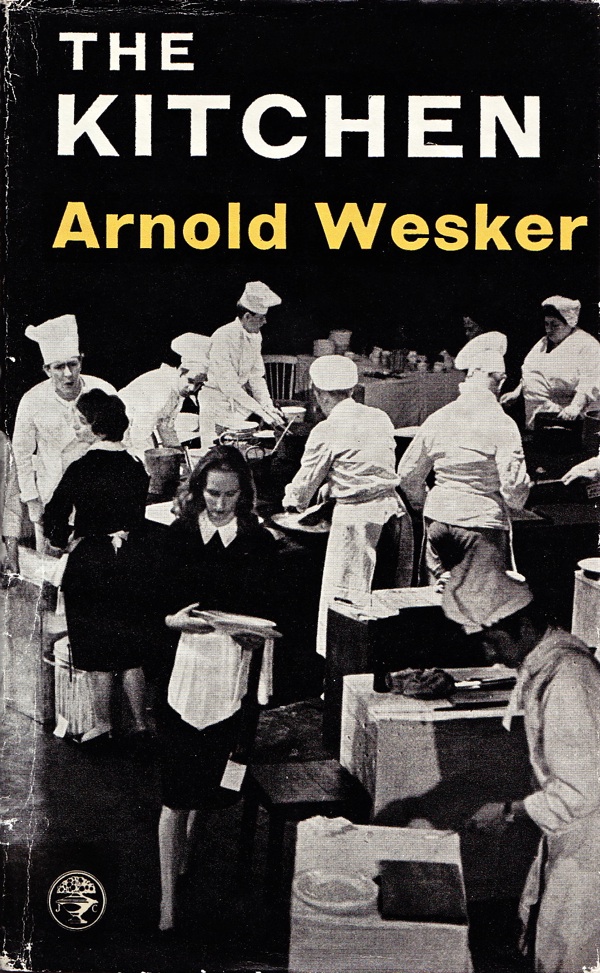
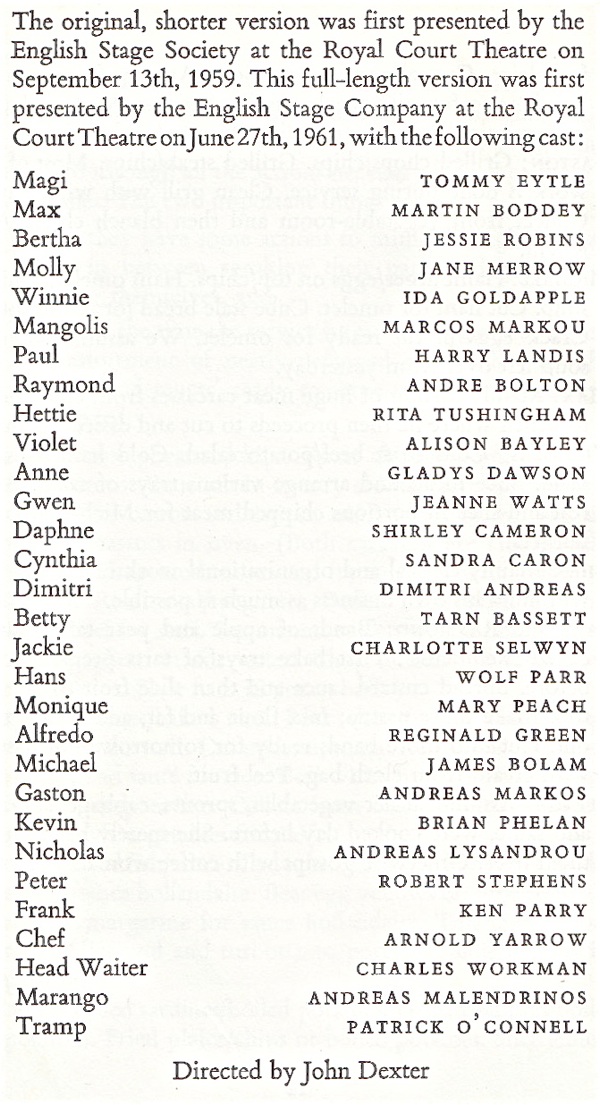
Yet the significance of Harry’s action reverberated far beyond that moment, because it revealed he had a natural talent for acting. It was a gift that took him on a journey out of the East End, gave him a successful career as an actor and director, and delivered him to the Royal Court Theatre where he originated the leading role in one of the most important post-war British plays, Arnold Wesker’s masterpiece “The Kitchen.” Although, ironically, at Stepney Jewish School where Harry was educated, the enlightened headmistress, Miss Rose, made the girls do woodwork and the boys learn cooking – and when Harry left at fourteen he wanted to become a chef in a kitchen, but discovered apprenticeships were only available to those of sixteen.
“They sent me to work in a cafe pouring tea but I didn’t last very long there, I did several jobs, window cleaner and milkman. And I used to go to the Hackney Empire every week, first house on a Monday because that was the cheapest – the company had just arrived, rehearsed with the band once and they were on at six, but the band weren’t sure what they were doing, so I enjoyed watching it all go wrong.
Being a cheeky little sod, I used to perform the show I’d seen on the Monday night next day at the factory where I worked – Max Miller’s jokes, the impersonators and Syd Walker who did a Rag & Bone act. 95% of them nobody knows now. “The shop steward, who was my mentor said, “You ought to be on the stage.”I’d never seen a play. I said, “Where do I go to see a play?” He said, “If you go the West End, the play will be about the tribulations of the upper classes, the problems of posh people. But there is one theatre in Kings Cross called the Unity Theatre, the theatre of the Labour & Trade Union Movement that does plays about ordinary people. I’m going there next Sunday night with my wife, if you’d like to come.” And I went. And at the Unity Theatre, that’s where my life changed.
It knocked me out because the people on the stage could have been living in my street and the language they spoke was the language we all spoke down the East End. The shop steward said, “You should be here, I’ll get you an audition.” I did my audition and I showed them my acting of bits I’d seen at the Hackney Empire, and they put me in the variety group. We performed shows in air raid shelters and parks. But then they transferred me to the straight acting section because I was fifteen and there was a shortage of men since they were all away at war. I was playing above my years but learning to act.
After two or three years of this and doing my military service, I returned to the Unity Theatre and the headmaster of a South London school saw me and said, “You should be professional, why don’t you apply for a grant from the London County Council to go to drama school?” I was twenty. He got me the form and we filled it out, and I was given a grant and money to live on. How times have changed! I did three years at Central School of Speech & Drama. You learnt RP (Received Pronunciation) but you never lost your own speech. I was considered a working class actor.
“I got cast in a wonderful play at the Royal Court Theatre, run by George Devine where they did the plays of John Osborne. It was “The Kitchen” by Arnold Wesker, and I played the part of Paul, the pastry cook – which is the Arnold Wesker character – that’s what he did when he worked in a kitchen. It was about himself. Arnold wrote without any knowledge of theatre, which is to say a play with twenty-five actors in it which only lasts seventy-five minutes. People said they could see the food we were cooking but it was all mimed…”
So Harry fulfilled his childhood ambition to become a chef – on stage – through his work as an actor in the theatre. To this day, he gratefully acknowledges his debt to the Unity Theatre and those two individuals who saw his potential – “I was going to be an amateur but I was pushed to the next stage,” he accepts. Harry enjoyed success as one of a whole generation of talented working class actors that came to prominence in the post-war years bringing a new energy and authenticity to British drama. Now Harry Landis has returned to his childhood streets and laid the ghosts of his own past, he is happy to embrace the changes here today, although he does not choose to forget the East End he once knew.
“It’s a different East End. The bombs got rid of a lot and it’s all been rebuilt. The Spitalfields Market is full of chains and it’s been gentrified, and you’ve got your Gilbert & Georges and your Tracey Emins, and the place is full of art studios and it’s become the centre of the world. It’s the new Chelsea. I sold my house in Hammersmith where I lived for forty years (that I bought for £2,000 with 100% mortgage from the LCC) and I came back and bought a flat here in Spitalfields with the proceeds. And the rest I put in the bank for when I am that constant thing – an out of work actor!”
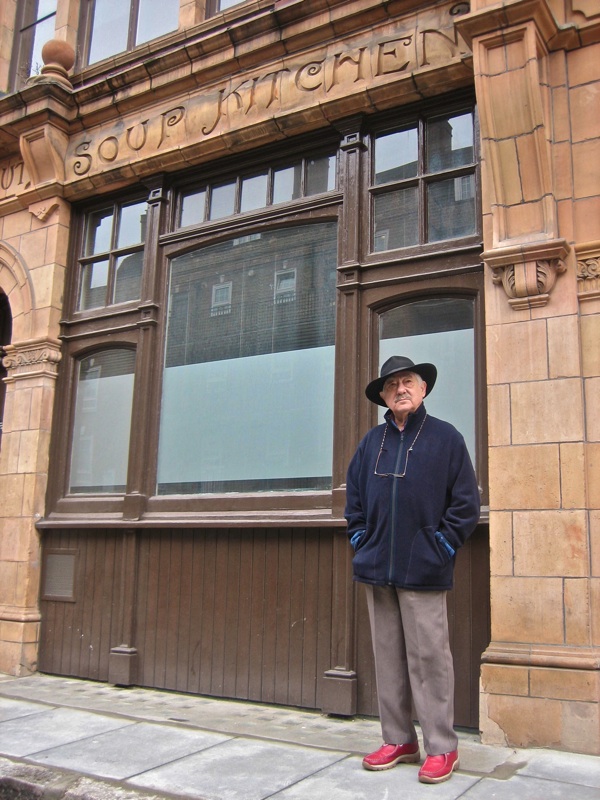
Outside the soup kitchen in Brune St where Harry came with his mother at the age of four
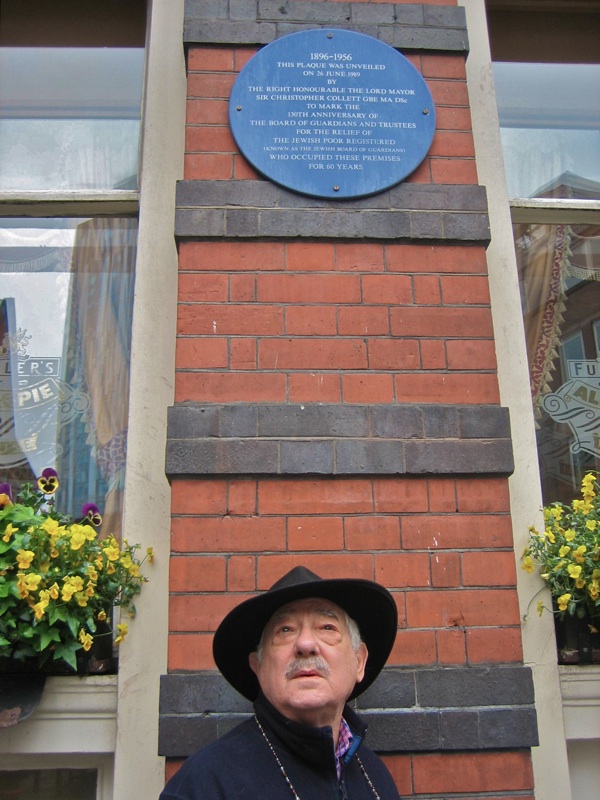
At the former Jewish Board of Guardians in Middlesex St
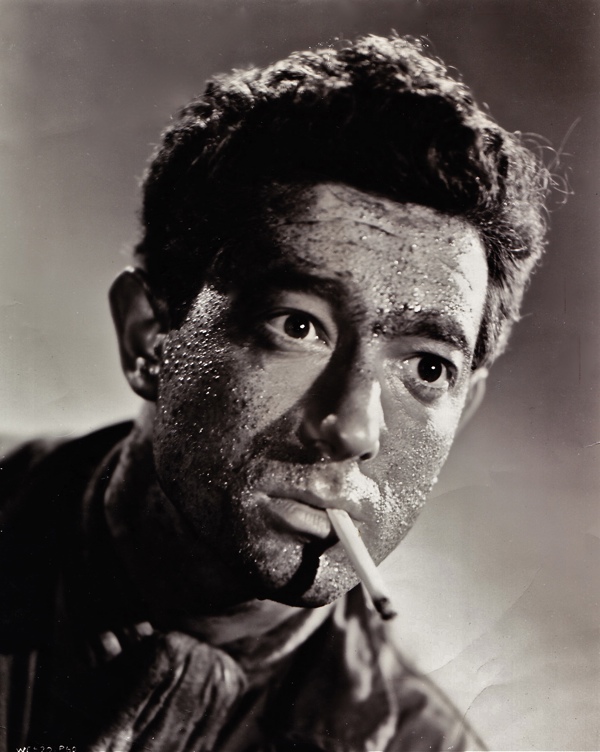
Harry as Private Rabin in “A Hill in Korea,” 1956
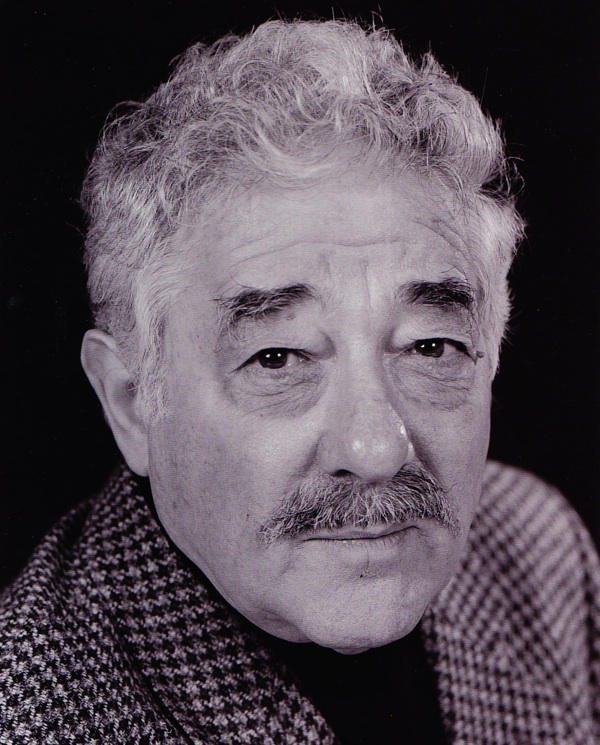
Harry Landis
The Bethnal Green Gasometers
If you care about the fate of the Bethnal Green gasometers, I recommend you attend the public consultations held by St William Homes (a joint venture by National Grid and the Berkeley Group) who are currently considering the option of retaining the gasometers as part of their redevelopment of the site.
The exhibition takes place this Saturday 11th May from 11:00am – 4:00pm, Monday 13th from 3:00pm – 7:00pm and Tuesday 14th from 11:00am – 3:00pm at the Redeemed Christian Church of God, 7-8 The Oval, Bethnal Green, E2 9DT.
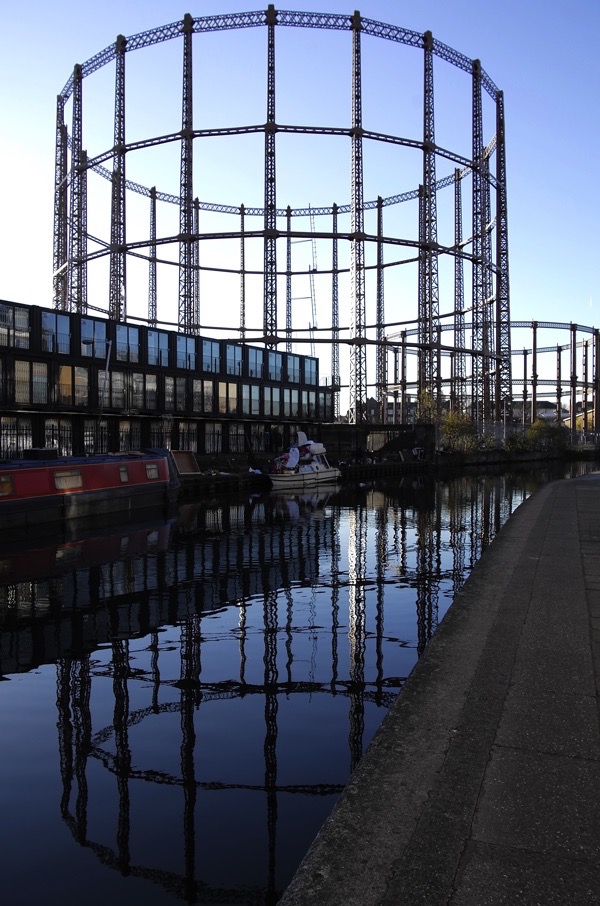
Behold the majestic pair of gasometers in Bethnal Green, planted regally side by side like a king and queen surveying the Regent’s Canal from aloft. Approaching along the towpath, George Trewby’s gasometer of 1888-9 dominates the skyline, more than twice the height of its more intricate senior companion designed by Joseph Clarke in 1866.
Ever since these monumental gasometers were granted a ‘certificate of immunity against listing’ by Historic England, which guarantees they will never receive any legal protection from destruction, their fate has been in the balance.
The Bethnal Green gasometers were constructed to contain the gas that was produced by the Shoreditch Gas Works, fired by coal delivered by canal. The thick old brick walls bordering Haggerston Park are all that remains today of the gas works which formerly occupied the site of the park, built by the Imperial Gas Light & Coke Company in 1823.
Crossing Cat & Mutton Bridge, named after the nearby pub founded in 1732, I walked down Wharf Place and into Darwen Place determining to make as close a circuit of the gasometers as the streets would permit me.
Flanked by new housing on either side of Darwen Place, the gasometers make a spectacularly theatrical backdrop to a street that would otherwise lack drama. Dignified like standing stones yet soaring like cathedrals, these intricate structures insist you raise your eyes heavenward, framing the sky as if it were an epic painting contrived for our edification.
Each storey of Joseph Clarke’s structure has columns ascending from Doric to Corinthian, indicating the influence of classical antiquity and revealing the architect’s chosen precedent as the Coliseum, which – if you think about it – bears a striking resemblance to a gasometer.
As I walked through the surrounding streets, circumnavigating the gasometers, I realised that the unapproachable nature of these citadels contributes to their magic. You keep walking and they always remain in the distance, always just out of reach yet looming overhead and dwarfing their surroundings. In spite of the utilitarian nature of this landscape, the relationship between the past and present is clear in this place and this imparts a strange charisma to the location, an atmosphere enhanced by the other-wordly gasometers.
After walking their entire perimeter, I can confirm that the gasometers are most advantageously regarded from mid-way along the tow path between Mare St and Broadway Market. From here, the silhouette of George Trewby’s soaring structure may be be viewed against the sun and also as a reflection into the canal, thus doubling the dramatic effect of these intriguing sky cages that capture space and inspire exhilaration in the beholder.
We hope that the developer recognises the virtue in retaining these magnificent towers and integrating them into their scheme, adding value and distinction to their architecture, and drama and delight to the landscape.
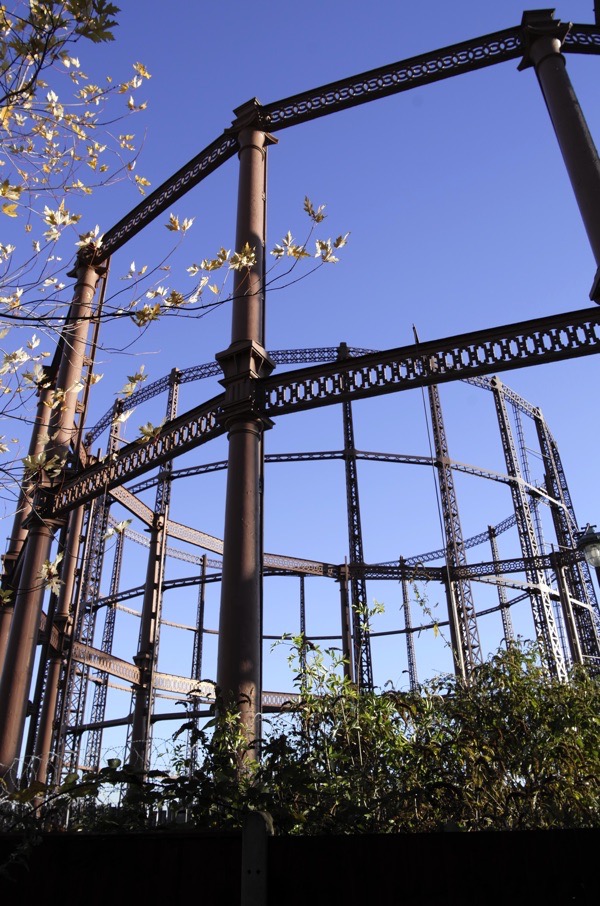
The view from Darwen Place
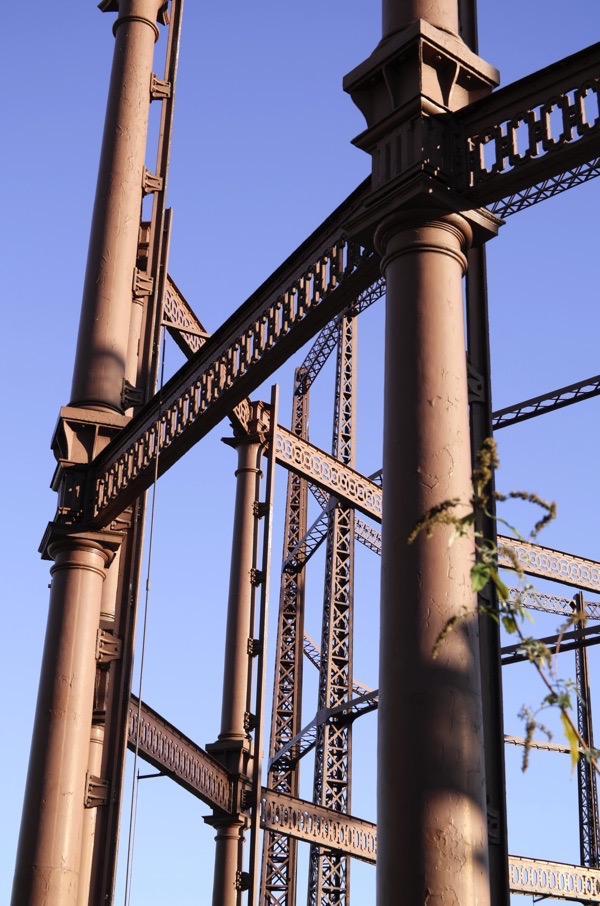
Decorative ironwork and classical columns ascending from Doric to Corinthian like the Coliseum
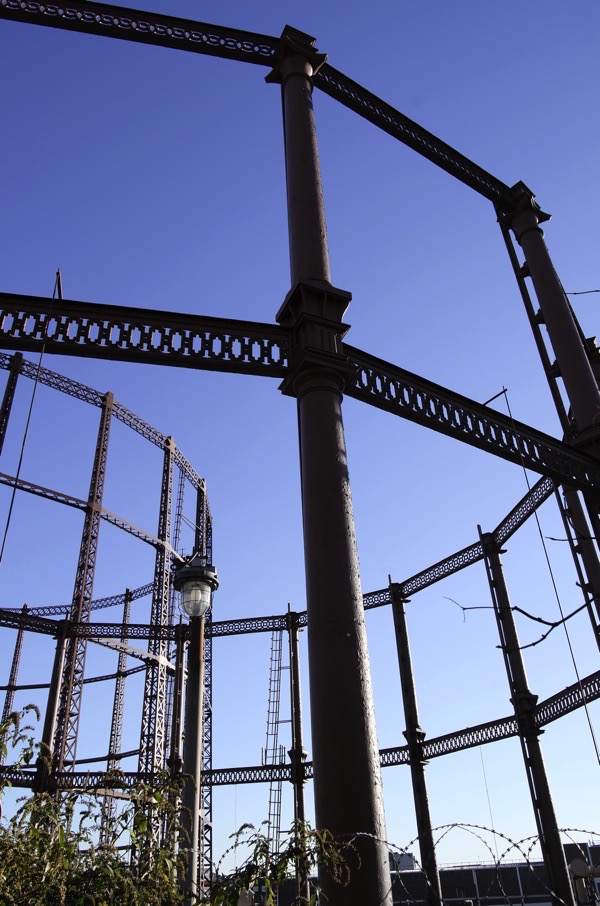
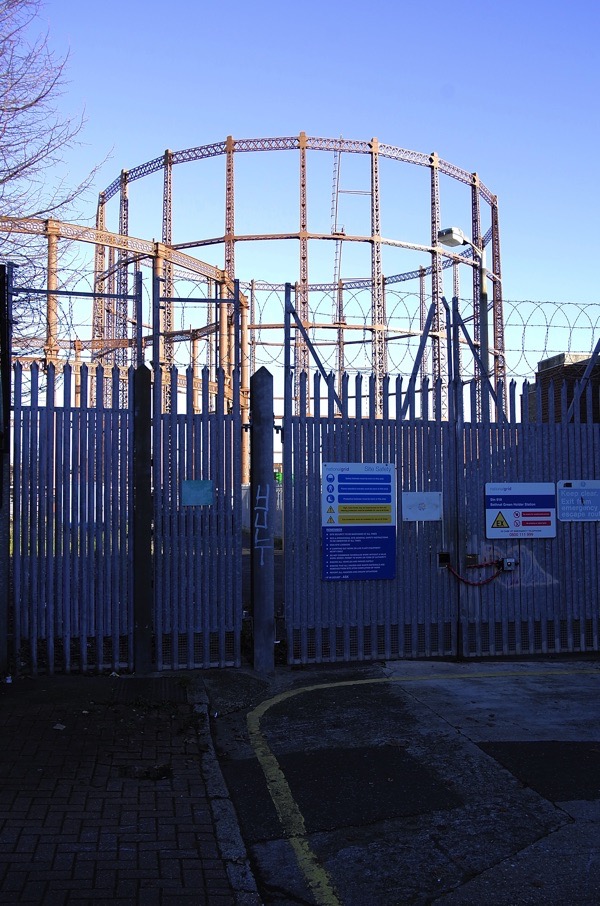
The view from Marian Place
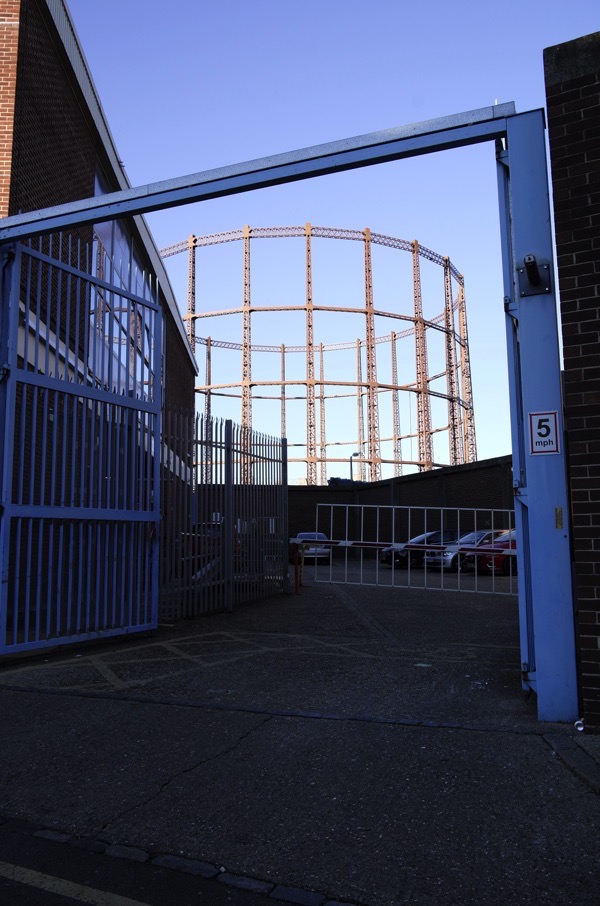
The view from Emma St
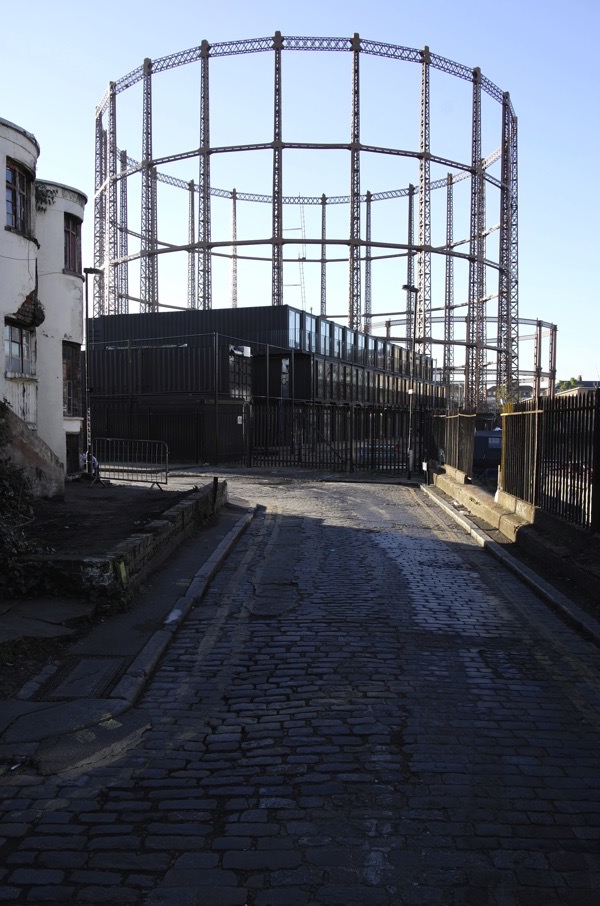
The view from Corbridge St
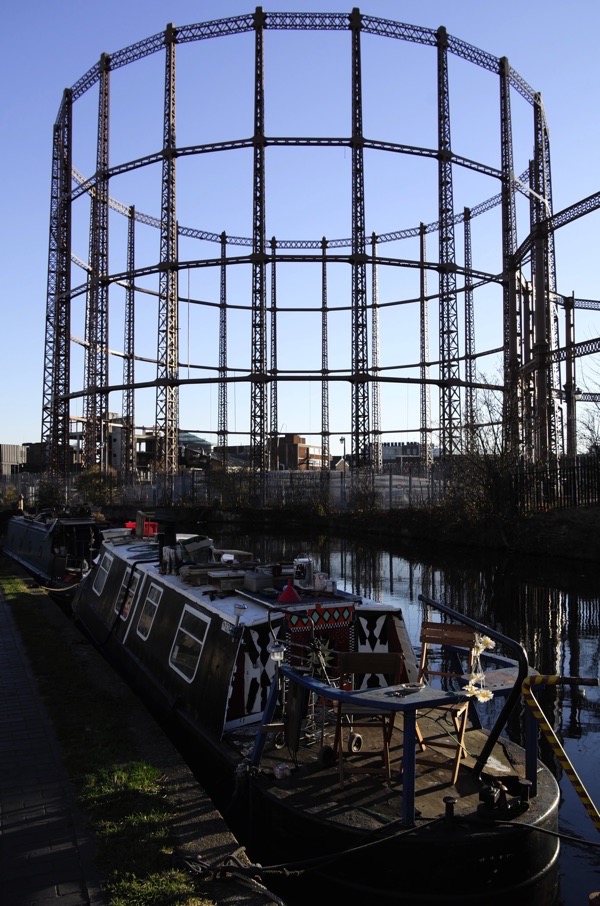
The view from Regent’s Canal towpath
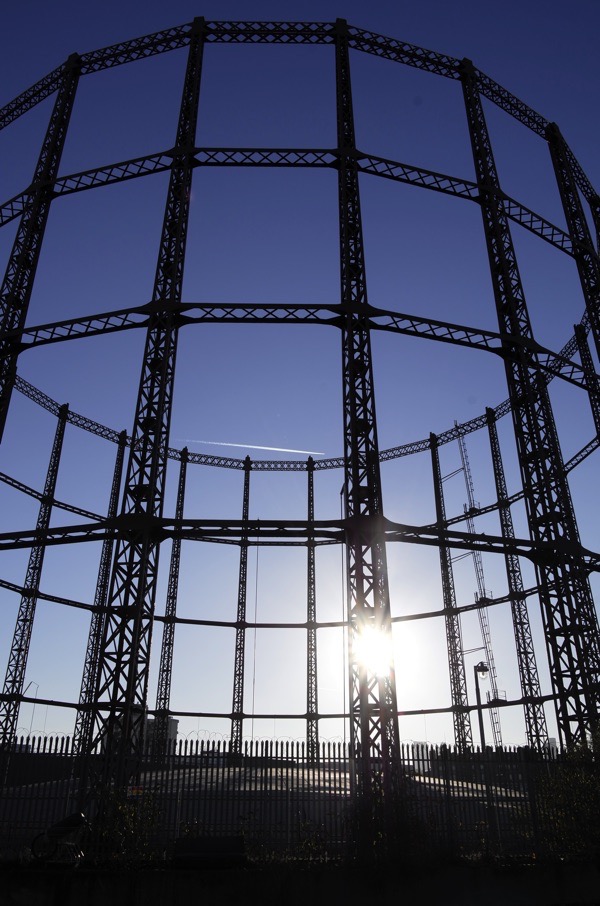
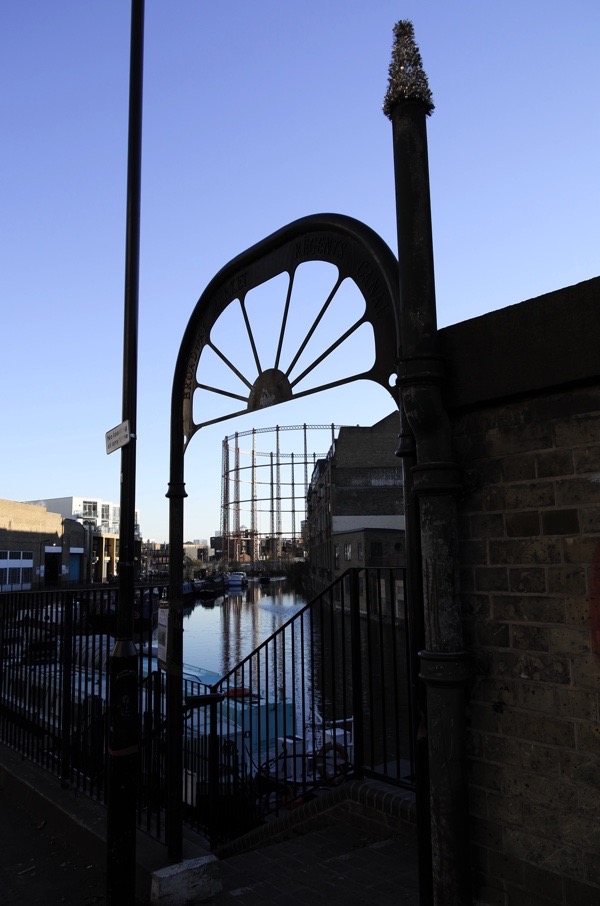
George Trewby’s gasometer of 1888 viewed from Cat of Mutton bridge over Regent’s Canal
You may also like to read
Memories of Ship Tavern Passage
Contributing Writer Gillian Tindall recalls her first job in a bookshop in Ship Tavern Passage in the City of London in the fifties. Gillian’s next book is about memory and will be published by Chatto & Windus in October.
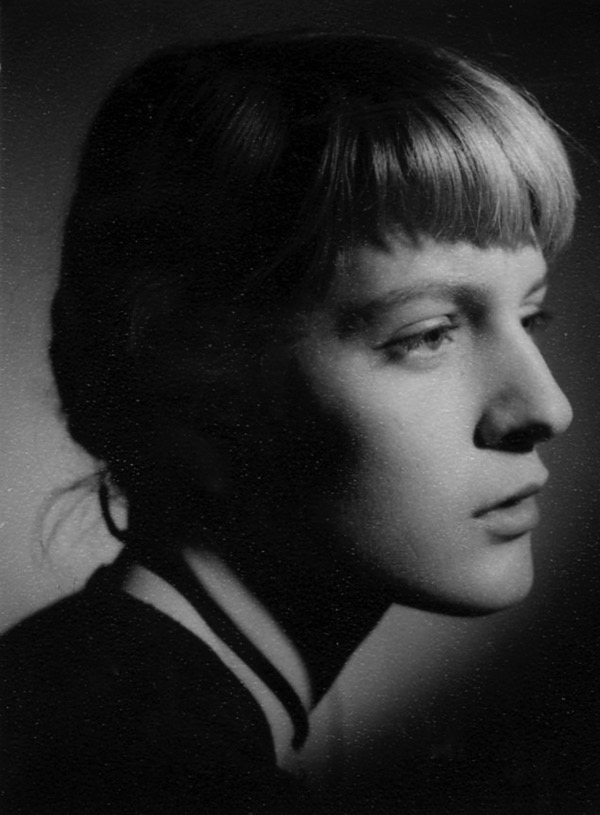
Gillian Tindall in the fifties
I was born in London but the blitz of the Second World War intervened too soon for me to have retained any memory of the house of my birth. Like most of the London babies and children of my generation I was bundled off to the countryside, in my case Sussex.
With the passing years this became my place of childhood. For though most of London had not been comprehensively wrecked by German bombs, the notion persisted for a good ten years after the war that most of it was only fit for redevelopment. London was admittedly very dirty still in that time of open fires before Clean Air Acts and the disappearance of steam trains. I remember my seven-year-old surprise – on a rare London visit one spring – at seeing how green the new leaves were in the parks. I was used to the joys of primrose and bluebells in the country, but against the sooty black town branches that ‘came off’ on your hands (“Darling, I told you not to touch!”) these London leaves amazed me with their delicate beauty.
In other respects London seemed a compelling but faintly sinister place, wonderfully busy with huge shops, tall buses and taxis hailed ‘for a treat,’ yet reputedly full of ‘slums’ that I never managed to locate. My mother wore a hat and her best coat when going ‘up to Town,’ yet sometimes I would glimpse in dark doorways or down side-streets people far shabbier and stranger than any to be seen in our country village. I longed to explore further.
The years passed and everything changed. My mother was dead, we moved house, and I found myself living near Hampstead Heath with my father. Grocery shopping and cooking in the intervals of working for a college entrance exam suited me fine, and my exploring project took off. But once the exam was done there was a vague feeling I ought to have a job. This was the modernity of the fifties: goodness me, a girl should not be hanging round at home, poor dear! A job was found for me in a bookshop off Gracechurch St in the City of London and, for a mercifully brief period in my life, I joined the inexorable morning and evening tide of rush hour travel.
Neither the bookshop nor its two other branches exist any more. Several years after my brief sojourn there it collapsed with, what I have been told, was an impressive backlog of debt and mismanagement. Indeed, even to my utterly ignorant perceptions, it seemed rather chaotically run. It was in Ship Tavern Passage which led into one end of Leadenhall Market and still does, though the alley as I knew it is gone. The market is flourishing still, if somewhat transformed. Its elaborate columns and façades beautified with dark red paint and gilding. The tempting meat and vegetable stalls that I remember and the one sandwich bar – to which I gratefully escaped for a late snack when lunch-hour customers had returned to their offices – have gone, to be replaced by restaurants and wine bars. The sole remaining old building in Ship Tavern Passage is, confusingly, an inn called the Swan (which I am told was only saved in 1985 from the developers’ wrecking ball by a last minute protest). The site that was occupied by the bookshop where I worked and by its modest neighbouring shops is now covered by the corporate architecture of Marks & Spencer.
I liked talking to customers about the books they were seeking, though many of these seemed to be allocated monthly by a national membership organisation, an institutional precursor to modern, informal book clubs. (Why – if these volumes were for members at a special rate – they had to be obtained in a bookshop puzzles me today. But so it was. The standard price for a hardback was seven shillings and sixpence, and there were relatively few paperbacks). However, my task – according to the dragon-lady who was head-assistant – was to dust the books full-time, since soot still reigned everywhere. I remember my forearms being permanently grey, for I soon learned to push up the sleeves of the black jersey I seem to have worn every day. The habit, though not the jersey, has remained with me for life.
In the basement was a less prestigious department where china was sold (a bad sign in a bookshop, as I now know) and pictures were brought in to be framed. Sometimes I would be sent down there, where I was terrorised by an ever-returning customer who was enraged that the picture he had left for framing had disappeared. In vain, would I repeat to him that it was nothing to do with me, while the other assistant (who knew nothing of the picture either and talked to me of little else beside her secret and exciting extra-marital affaire) hid in the stock-room. Once, I was rescued from the furious customer by a grander and much nicer lady than the dragon upstairs. She was the buyer for books, who used to take refuge in the basement to avoid being overwhelmed by publishers’ reps.
I was paid £5 a week cash in a small brown envelope, handed to me by a pay-clerk who for some reason disapproved of me – or perhaps just of life and his own circumstances. This modest sum would have been just enough for me to live on week to week, bed-sitters and fares both then being extraordinarily cheap. But as I was living at home with my father my wage was all – apart from the small cost of sandwiches – spending money. Only it was very difficult then in the City to buy the sort of things girls needed, such as stockings, underclothes and hair-ribbons. Even though ‘lady-typists’ had been a known species for most of the twentieth century, the Square Mile remained a preserve of men in three-piece suits and bowler hats.
I had got onto terms with only small segments of London and the City not at all, as I scuttled between Liverpool St tube station and Ship Tavern Passage, afraid of being late and incurring the dragon’s displeasure. Yet occasionally the nicer lady would suggest that I be sent on an errand to one of the big banks in Lombard St with – what I can only suppose – were the day’s takings, in a small canvas bag. Security did not seem to have been an issue in those peace-seeking, post-war times.
I enjoyed these outings into the sparrow-populated, starling-haunted streets, that were still lined with heavy Victorian buildings, not a glass tower in sight. But how ignorant I was! As I went by, Mary Woolnoth’s bell would chime – ‘with a dead sound on the final stroke of nine.‘ I had barely heard of TS Eliot then, let alone that he passed eight years in his thirties in tedious bank-employment just there, or had I any idea that he would become for me the prince of poets, haunting much of my adult work on place and history.
I also do not think I knew that a year or two before a temple of Mithras had been unearthed on a building site not far off, and was even then being laboriously (and rather ineptly) removed for re-erection at a different site nearby. I certainly did not know (since no one else seemed to then either) that the space which became Leadenhall Market was once the heart of the Roman basilica and forum, constructed in the first century AD. Its ruins were uncovered in 1881, when the iron structure of the Victorian market was going up. Only recently has it been confirmed that this was indeed the forum, the epicentre of judicial and financial administration. Some of the ruins are there to this day, carefully preserved in the basement of an upmarket gentlemen’s barbers, Nicholson & Griffin, on the corner of Gracechurch St.
I should like to go back to the old, unpretentious Leadenhall Market and the days when a cup of tea cost tuppence ha’penny and a cup of weak coffee thripence because coffee was posher. I should like to go back to the time when tube fares too were in pennies and no-one but the drunks round Spitalfields slept in the streets, because the newspapers every evening had columns and columns of attics and basements and little backrooms to rent for tiny weekly amounts.
I should not like to go back to being that dreamy girl in a grubby black jersey, a duffle coat and ‘ballet-slippers,’ who knew nothing much about anything and had all her life before her. However alarming various different national and world trends seem to be, and however tiresome it is for me no longer being able to walk all day round London (after a lifetime of doing this my over-used feet hurt and I get too tired), I think I should much rather be the me of today. Life has been satisfactory, and sometimes wonderful, but I do not want the labour of starting it all over again.
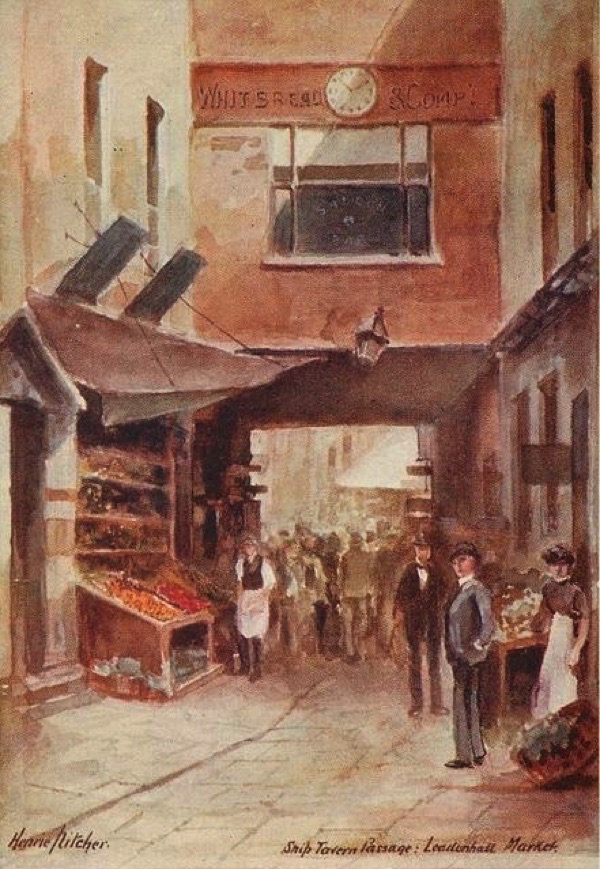
Ship Tavern Passage off Gracechurch St as portrayed by Henrie Pitcher in 1911 yet it was unaltered in the fifties when Gillian Tindall first knew it
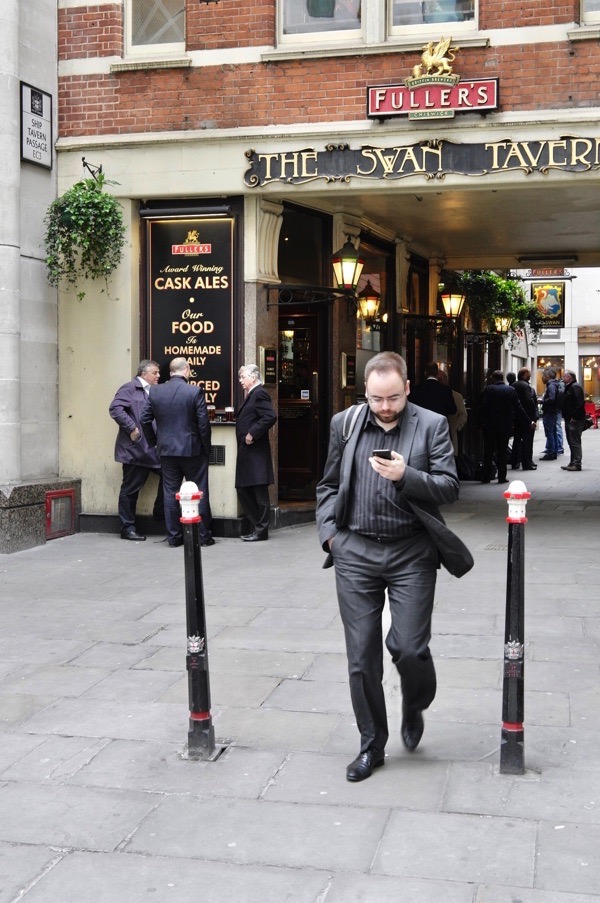
Ship Tavern Passage today
You may like to read these other stories by Gillian Tindall
At Captain Cook’s House in Mile End
Two Events At London Metropolitan Archive
Spitalfields Life is delighted to participate in the WORD ON THE STREET festival which runs at London Metropolitan Archive in Clerkenwell for the month of May. These events are free but advance booking is essential.

Spitalfields Breakfast by Isaac Cruickshank, 1794
THE LIVES OF THE JOURNEYMAN WEAVERS
A lecture by Julian Woodford, author of The Boss of Bethnal Green
Saturday 11th May 1:30pm
The story of London’s wealthy silk merchants and their fine houses in Spitalfields is familiar, but the lives of the poor journeymen weavers who actually made the silk are less commonly described. Julian Woodford will outline the realities of their existence, how they lived, worked and died. As many as twenty-thousand weavers lived in Spitalfields, Bethnal Green, Shoreditch and Whitechapel at the peak of the industry in the eighteenth century, mostly Huguenots of French ancestry.
Click here to book for Julian Woodford’s lecture
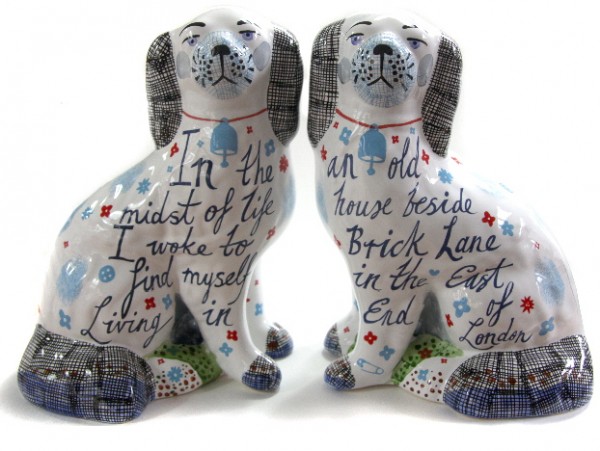
STORYTELLING FOR BEGINNERS
Wednesday 15th May 6:00pm
This writing workshop with The Gentle Author will be a practical exploration of what constitutes a story and how to fashion a compelling narrative from facts and anecdotes. The session will be of special interest to those attempting to write their own family histories and anyone else who wants to tell a story.
Click here to book for The Gentle Author’s writing workshop
These events are presented in partnership with the Huguenots of Spitalfields
Sally Flood, Poet

“I think my life is more in poetry than anything else”
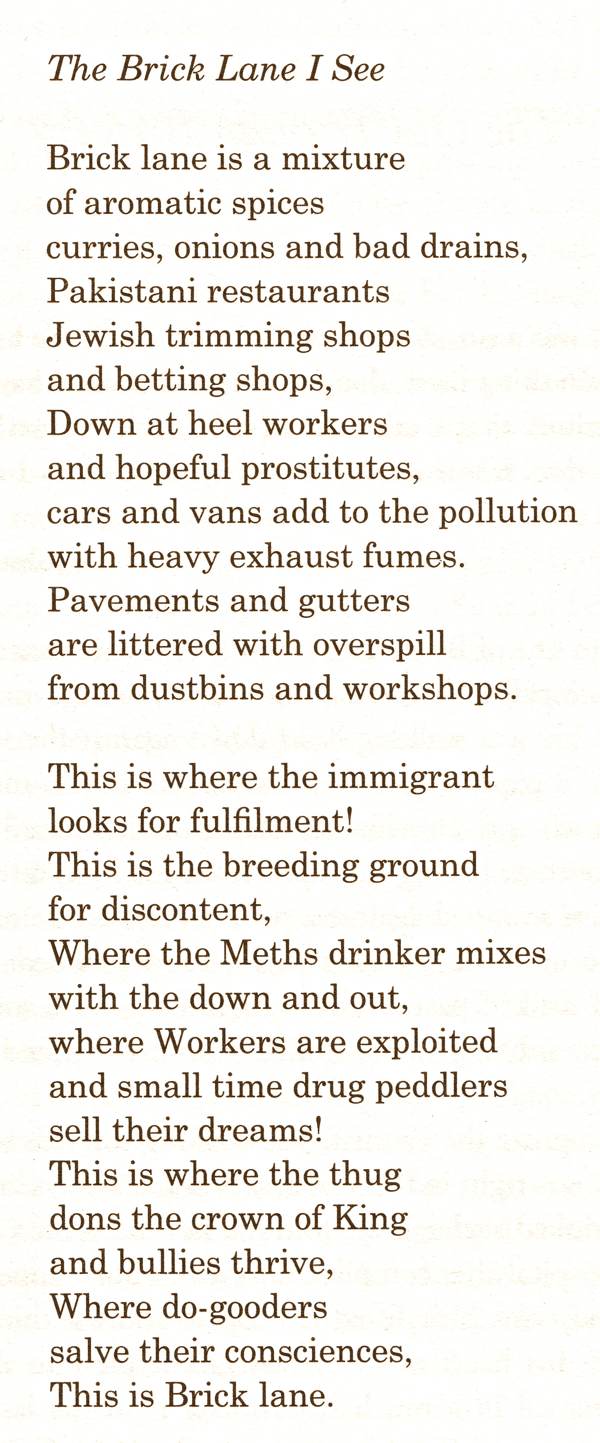
“I had always written, as a child,” admitted Sally Flood with a shrug, “but it wasn’t stuff you showed.” In the years when her thoughts wandered whilst working in the factory in Princelet St, Sally wrote poems on the paper that backed the embroidery in the machine she operated – but she always tore up her compositions when her boss appeared.
Then, when she was fifty years old, Sally took some of her poems along to the Basement Writers in Cable St and achieved unexpected recognition, giving her the confidence to call herself a poet for the first time. Since then, Sally’s verse has been widely published, studied in schools and universities, and she has become an experienced performer of her own poetry. “At work, I used to write things to make people laugh,” she explained, “I used to say, ‘Embroidery is my trade, but writing is my hobby.'”
“I’ve got drawers full of poems,” she confided to me with a blush, unable to keep track of her prolific writing, now that poetry is her primary occupation and she no longer tears up her compositions. “I’ve got so much here, I don’t know what I’ve got,” she said, rolling her eyes at the craziness of it.
Ambulance helicopters whirl over Sally’s house, night and day, the last in a Georgian terrace which is so close to the hospital in Whitechapel that if you got out of bed on the wrong side you might find yourself in surgery. Sally moved there more than half a century ago with her young family, and now she has three grandchildren and five great grandchildren. Framed pictures attest to the family life which filled this house for so many years, while today boxes of toys lie around awaiting visits by the youngest members of her clan.
“In 1975, when my children were growing up and the youngest was fifteen, I decided that I need to do something else, because I didn’t want to be one of those mothers who held onto her children too much.” Sally recalled, “So I joined the Bethnal Green Institute, and it was all ballroom dancing and keep fit, but I found a leaflet Chris Searle had put there for the Basement Writers, so I decided to write a poem and send it along to them. Then I got a letter back asking me to send more – and I was amazed because the poem I sent was one I would otherwise have torn up. Of your own work, you’ve got no real opinion.”
“On my first visit, I went along with my daughter, but there were children of school age and I was turning fifty. I wasn’t sure if I should be there until I met Gladys McGee who was ten years older than me. She was so funny, I learnt so much from her – she had been an unmarried mother in the Land Army. I started going regular, and the first poem I read was published.”
“I think my life is more in poetry than anything else. I sometimes think my writing is like a diary. Chris Searle of the basement writers made such an impression on my life, he gave me the confidence to do this. And when I did my writing, my life took off in a certain direction and I met so many fantastic people.”
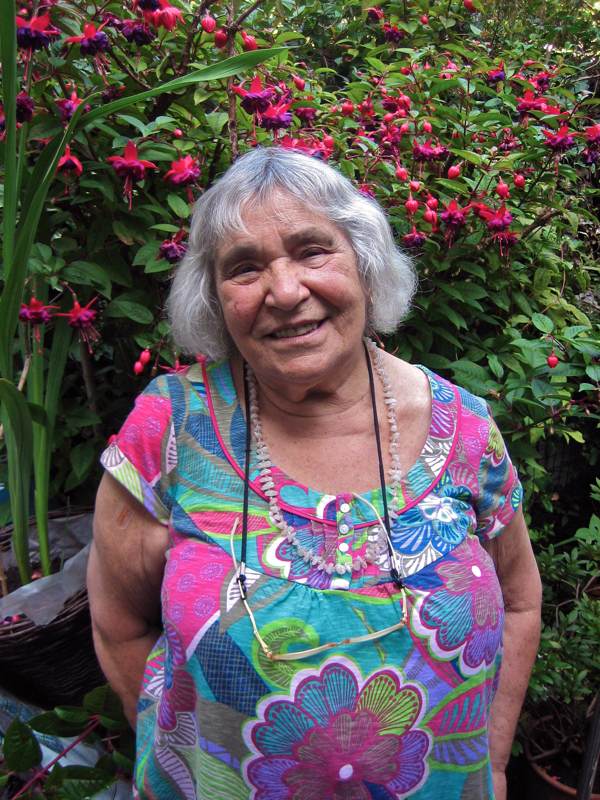
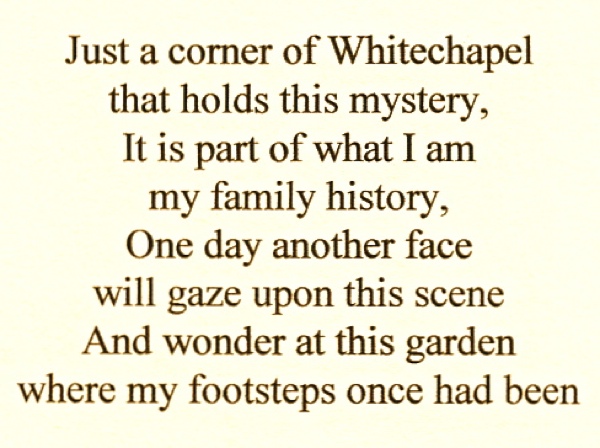
Sally’s house is full of cupboards and cabinets filled of files of poems and pictures and embroidery, and the former yard at the back has become a garden with luscious fuchias that are Sally’s favourites. After all these years of activity, it has become her private space for reflection. Sally can now get up when she pleases and enjoy a jam sandwich for breakfast. She can make paintings and tend her garden, and write more poems. The house is full with her thoughts and her memories.
“My grandparents were from Russia and they brought my father over when he was four years old.” Sally told me, taking down the photograph to remind herself, “He became cabinet maker and he was one of the best. In those days, they used to work from six until ten at night, so they knew what work was. I was born in Chambord St, Brick Lane, in 1925, and I grew up there. From there we moved to a two-up two-down in Chicksand St and from there to Bethnal Green, just before the war broke out. We had a bath in the kitchen with a tabletop. It was the first time we had a bath, before that we went to bathhouse. I’m telling you the history of the East End here!
I was evacuated to Norfolk at first. We took the surname Morris from father’s first name, so that people wouldn’t know we were Jewish. The people up there had a suspicion against Londoners and they thought we were all the same. But I was lucky, we ended up in a hotel on the river in Torbay in Devon. Life was fantastic, we used to go fishing. It was a different experience from my life in London. I joined the girl guides, I could never have done that otherwise. Where I was evacuated, they wanted to train me to be a teacher, but my mother came and took me back and said, “They’re going to exploit you, you’re going to be a machinist.”
“Being evacuated meant I went outside my culture, and I saw that English people were nice. I think that’s why I married outside my religion. We were together fifty-five years and I always say it wasn’t enough. If I hadn’t been evacuated I wouldn’t have done that.”
Sally put the photograph of her parents back on the shelf carefully, and turned her head to the pictures of her husband, her children, her grandchildren and great-grandchildren, on different sides of the room. I watched her looking back and forth through time, and the room she inhabited became a charged space in between the past and the future. This is the space where she does her writing. And then Sally brought out a book to show me, opening it to reveal it short poems in her handwriting accompanied by lively drawings of people, reminiscent of the sketches of L. S. Lowry or the doodles of Stevie Smith.
Sally is a paradoxical person. A natural writer who resists complacency, she continues to be surprised by her own work, yet she is knowledgeable of literature and an experienced teacher of writing. Appearing at the door in her apron and talking in her tender sing-song voice, Sally wears her erudition lightly, but it does not mean that she is not serious. With innate dignity and a vast repertoire of stories to tell, Sally Flood is a writer who always speaks from the truth of her experience.
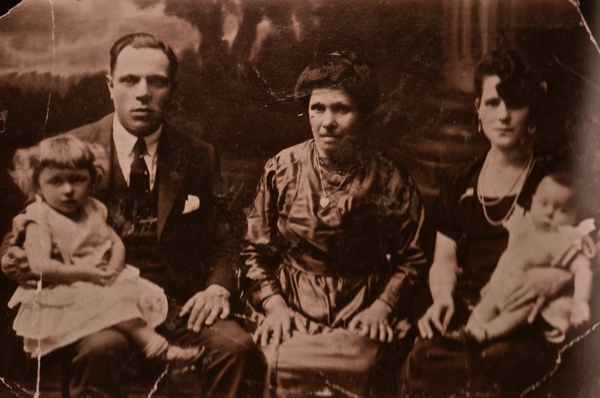
Maurice Grodinsky, Sally’s father is on the left with Sally’s mother, Annie Grodinsky, on the right, and Freda, Maurice’s mother, in between. At four years old, Maurice was brought to Spitalfields from Bessarabia at the end of the nineteenth century. The two children are Marie and Joey – when this picture was taken in 1925, Sally was yet to be born.
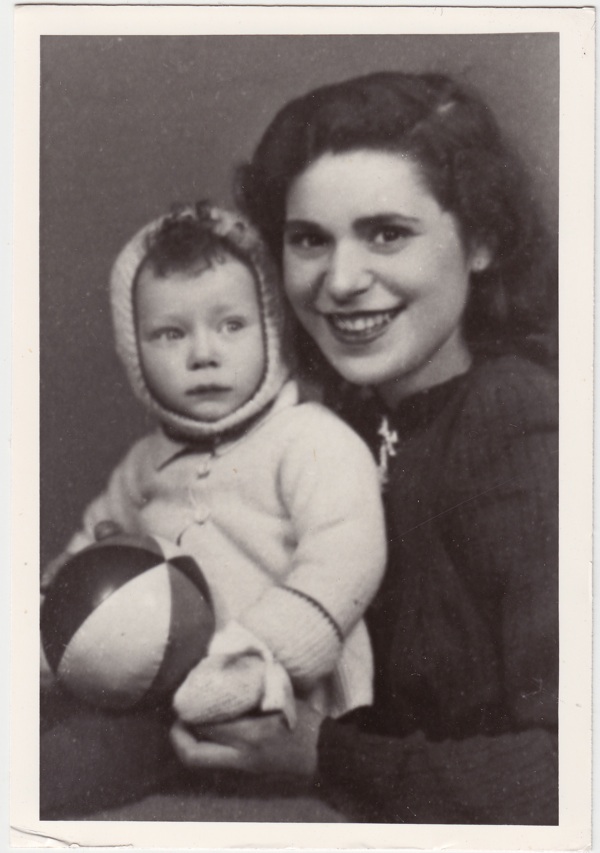
Sally with her first child Danny in the early nineteen fifties.

Sally’s children, Maureen, Jimmy, Pat and Theresa in the yard in Whitechapel in 1962.
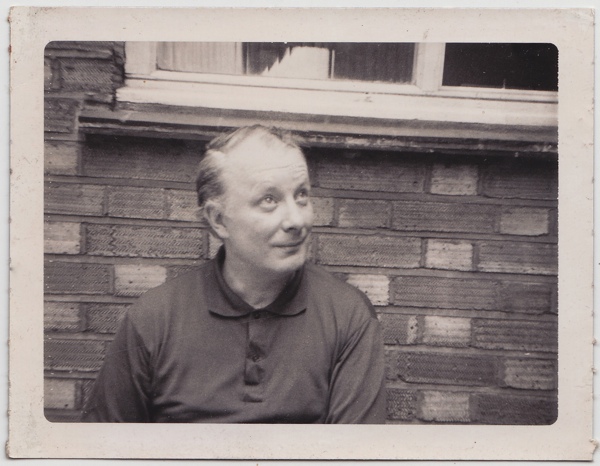
Sally’s husband, Joseph Flood.
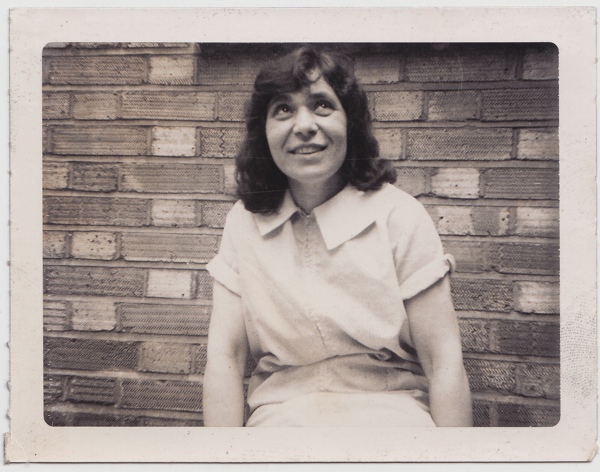
Sally in Whitechapel, early sixties.
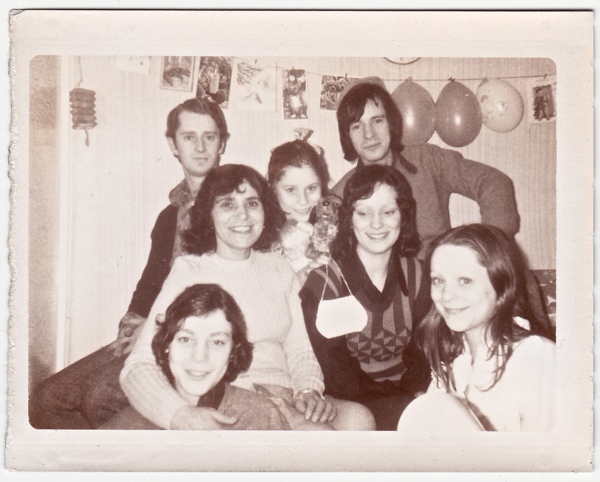
Sally with her children, Danny, Theresa, Jimmy, Maureen, Pat and Michael.
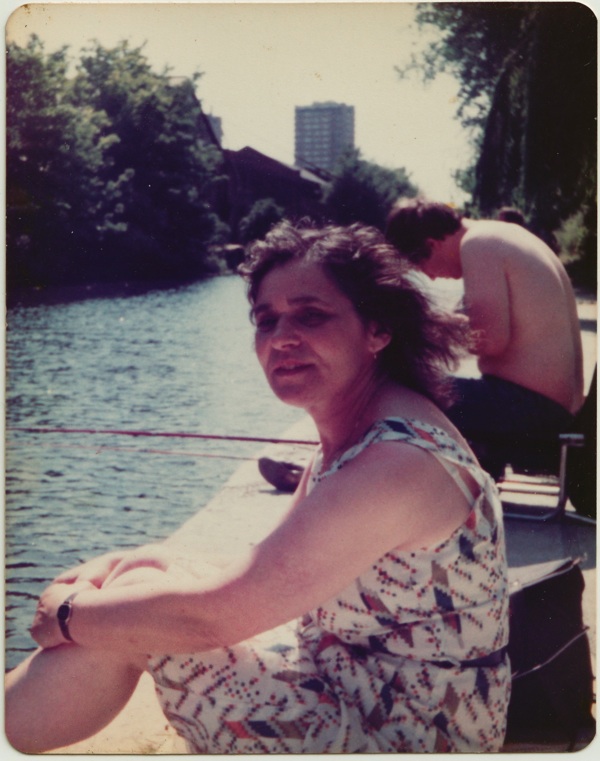
Sitting by the canal in the nineteen seventies.
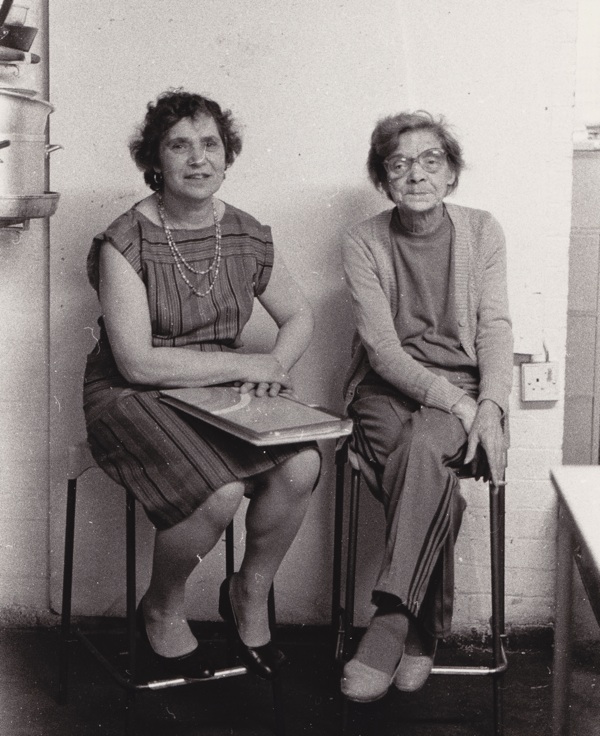
Sally with Gladys McGee at the Basement Writers.
You may also like to read about
Chris Searle & the Stepney School Strike
or












