In Jeffrey Johnson’s Footsteps
A few years ago, I published Jeffrey Johnson’s photographs of his favourite pubs from the seventies now held in the archive at Bishopsgate Institute. The author known as Rescue Dog Dexter – a graduate of my blog writing course – set out to discover what had become of Jeffrey Johnson’s pubs and this is what he found. Follow RESCUE DOG DEXTER, Every dog has their day and this is mine
I am now taking bookings for the next courses, HOW TO WRITE A BLOG THAT PEOPLE WILL WANT TO READ on May 11th/12th and November 9th/10th. Come to Spitalfields and spend a weekend with me in an eighteenth century weaver’s house in Fournier St, enjoy delicious lunches from Leila’s Cafe, eat cakes baked to historic recipes by Townhouse and learn how to write your own blog. Click here for details
If you are graduate of my course and you would like me to feature your blog, please drop me a line.

Knave of Clubs, Bethnal Green Rd

Present before 1735, the pub became a restaurant around 1994 before closing in 2001 and reopening as a bar called Dirty Bones

Crown & Woolpack, St John St, Clerkenwell

Believed to date from around 1851, the pub was open until 1990, then closed but has undergone refurbishment and is currently The Chapel, a hairdresser

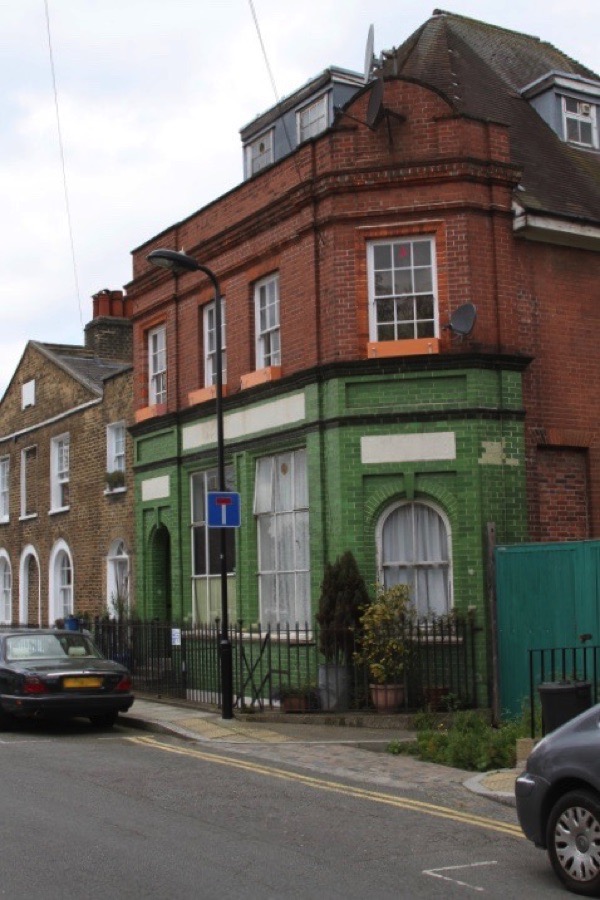
Dericote St, Broadway Market

This building appears unchanged however it is clearly a private residence now. The history is obscure, although we understand that it was once part of the Guinness empire

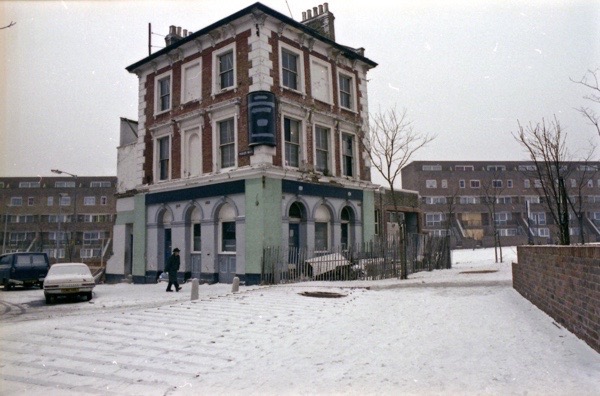
Brunswick Arms, Macdonald Rd, Archway

Demolished in the early eighties, there is no trace of the pub today

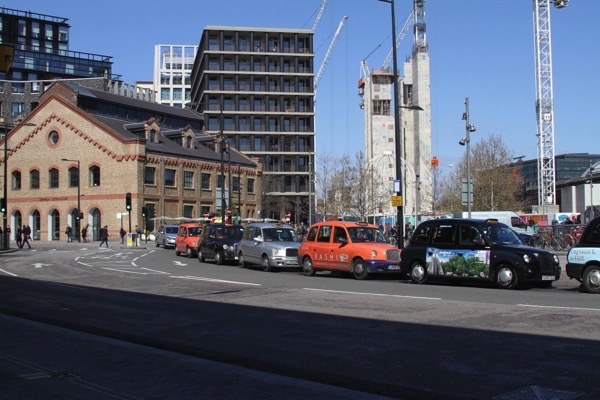
Old Bell Tavern, St Pancras

The same view today

Horn Tavern, Knightrider St, City of London (now known as The Centrepage)

Originally known as the Horn Tavern, the pub can be seen when crossing the foot bridge from Tate Modern to St Pauls. A grade II listed building, built in the mid-nineteenth century – the area around the pub has changed significantly

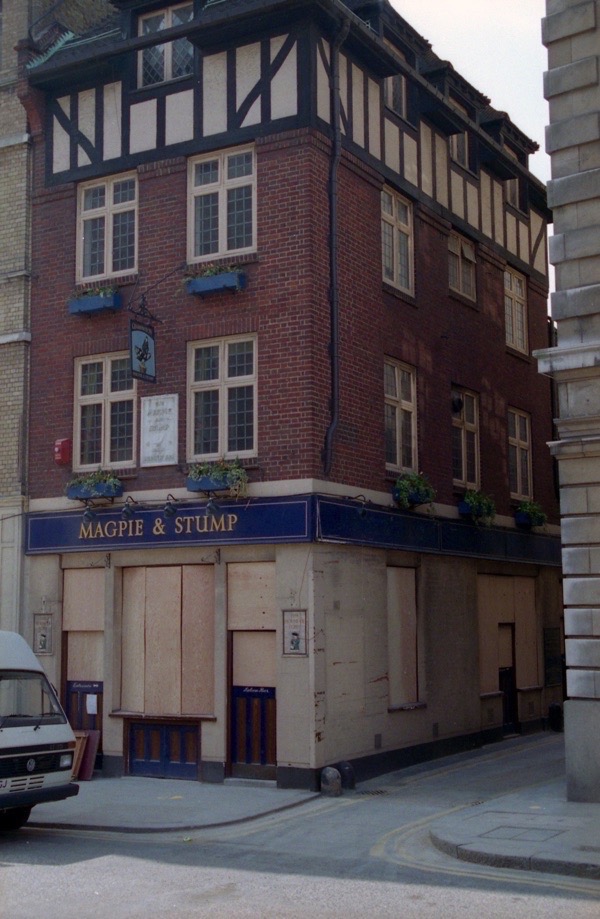
Magpie & Stump, Old Bailey

Opposite the Old Bailey, the Magpie & Stump was apparently nicknamed ‘Court Number 10’ as it was regularly filled with detectives and reporters

The Bull’s Head (Landlords fight to save City pub)

The Bull’s Head was demolished in 1990 to make way for this office development

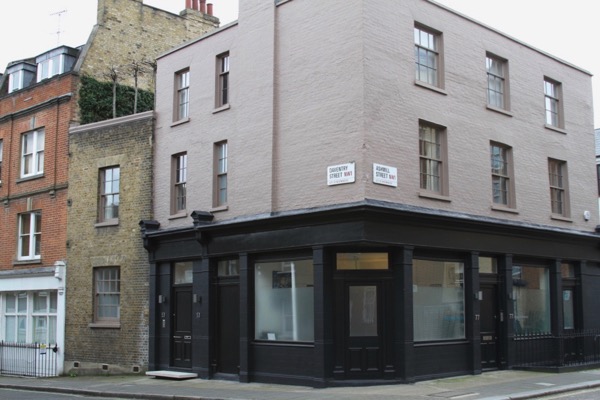
Marquis of Anglesey, Ashmill St

The pub closed around 2009 and became offices

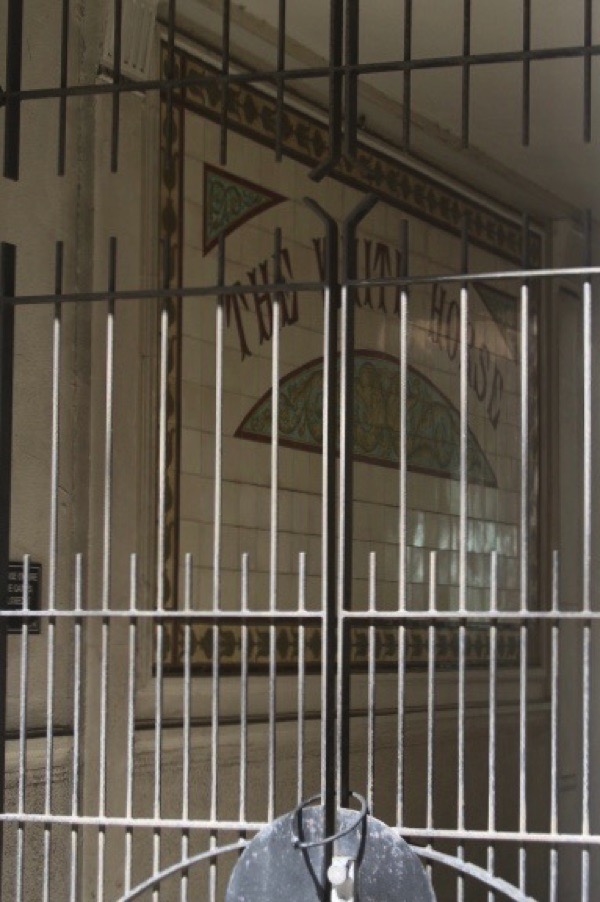
The White Horse, Little Britain

There seems to have been a pub on this site since 1765, it was rebuilt in 1892 but closed around 1971 and converted to offices

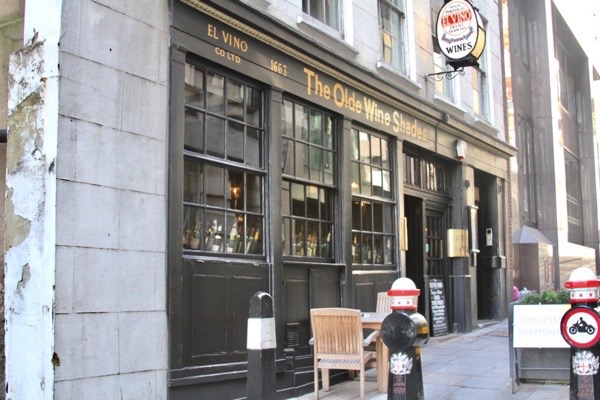
The Olde Wine Shades, City of London

This establishment was built in 1663, predating the Great Fire by three years. Due to the architectural and historical significance, it is grade II listed
Original photographs © Jeffrey Johnson
New photographs copyright © Rescue Dog Dexter
You may also like to take a look at
Ernest George’s Old London

Aldgate
Stefan Dickers, Archivist at Bishopsgate Institute, brought out these fine copper plate etchings by Ernest George (1839-1922) to show me this week. In the eighteen-eighties, George set out to immortalise those fragments of London which spoke of times gone by and Londoners long dead, recording buildings and views which have for the most part now disappeared.
I realise that my affection for these images sets me in line with the generations of chroniclers who have made it their business to document the transience of the city, starting with John Stow who wrote the very first Survey of London between 1560 and 1598 to describe the streets of his childhood that were vanishing before his eyes.
Ernest George’s etchings were published by the Fine Art Society in New Bond St in 1884, a magnificent temple of culture designed by Edward William Godwin which survived through the twentieth century only to close in August 2018.

Bishopsgate

Wych St, Strand

Fouberts Place, Soho

Crown Court, Pall Mall

St Bartholomew, Smithfield


Warwick Lane, City

Tower of London

London Bridge

Staple Inn, Holborn

Drury Lane

St John’s Gate, Clerkenwell

Limehouse

Shadwell
Images courtesy Bishopsgate Institute
You may also like to look at
Mavis Bullwinkle, Secretary

This is the earliest known photo of the remarkable Mavis Bullwinkle, seen here attending a Christmas party in 1932 at the Drill Hall in Buxton St, hosted by Rev Holdstock of All Saints’ Church, Spitalfields – Mavis can easily be distinguished to the left of the happy crowd, because she is a baby in her mother Gwendoline’s arms. In this picture, you see her at the centre of life in Spitalfields and even though this hall does not exist anymore and the church it was attached to was demolished in 1951, and everyone else in this photo has gone now too, I am happy to report that Mavis is still alive and kicking, to carry the story of this world and continue her existence at the centre of things in the neighbourhood.
Mavis’ grandfather, Richard Pugh, was a lay preacher who came to Spitalfields with his wife and family from North Wales in 1898, where he held bible classes at All Saints and spoke at open air meetings and, in the absence of social workers, counselled men from the Truman Brewery in their family problems. His mother paid for him to return alone to Wales to see her for two weeks annual holiday from the East End each year. But Mavis’ grandmother Frances never had a holiday, she said, “Why should people take notice of you when you talk of living the Christian life, when you have an easier time than they do?” Then in 1905, Richard died unexpectedly of pneumonia and Frances was left almost bereft in Spitalfields. She had to leave the church house and take care of her seven children alone. She received a modest pension from the Scripture Readers’ Union until her youngest son, Albert, was fourteen, the Truman Brewery gave her a small grant twice a year and she took work scrubbing floors.
The family moved into Albert Family Dwellings, a large nineteenth century block in Deal St, where subsequently Mavis grew up, living there until it was demolished in 1975 when they were rehoused in a new block in Hanbury St. And today, when I visited Mavis in Hanbury St less than a hundred yards away from the site of Albert Family Dwellings and she described her grandmother who died when she was six, an extraordinary perspective became apparent, connecting our world with that of Spitalfields more than a century ago.“I remember her shape and her North Wales accent, a lilt.” Mavis told me, conjuring the image in her mind’s eye,” She would always call my father Alfred, when everyone else called him Alf. She was short of stature and she worked hard.”
Mavis’ testimony of life in the East End is one of proud working class families who strove to lead decent lives in spite of limited circumstances. “People like to think that they were all drunks who dropped their ‘h’s, and they were dirty,” she said, eager to dispel this misconception, “Years ago, people were poor but they were completely clean. You can wash without a bathroom, but it takes a lot of work. My father used to put the water on to boil and pour it into the bath. And in the Family Dwellings, it was very well maintained, low rents, strict rules and a uniformed superintendent. When my mother was small and people had large families, if the superintendent saw children playing after eight o’ clock, he’d say ‘Go to bed!’ and you had to do it. I often think of it now when I see children playing outside at eleven at night. Then, everyone used to know each other and help one another. If you were going away on holiday, you’d tell everyone and they’d wave you goodbye.”
Mavis’ story of her family’s existence in Albert Family Dwellings spans the original flat where her grandmother lived with her two maiden aunts, and then Mavis’ parents’ flat that she grew up in. Mavis took care of her mother and the two aunts, who lived to be eighty-six,ninety and ninety-five respectively, even after they all moved out – seventy years after they first moved in as an act of expediency. But by then the nature of the place had changed and it was condemned as part of a slum clearance programme. “It suddenly went down hill in the late fifties when the housing association sold it,” admitted Mavis with a regreftul smile, looking from her living room window across the rooftops of Spitalfields to the space where Albert Family Dwellings formerly stood, a space that holds so much of her family history. If Mavis had married, she would have left Spitalfields but instead she stayed to care for the elderly members of her family and worked for forty years as a secretary in the social work department at the Royal London Hospital, where she was born in 1932. A woman of dauntless temperament, even retired now, she returns one day a week on a voluntary basis to do typing for the friends of the hospital and on another day each week she does reading with a reception class at Christ Church School in Brick Lane where she is a governor.
In Mavis’ personal landscape, Spitalfields’ neighbouring territory, the City of London holds an enduring fascination as a symbolic counterpoint to these streets where she makes her home. “I love the City because I went to school in the City at the Sir John Cass School,” she confided with pleasure, “and my father worked as a clerk in the City, at the Royal London Oil Company for fifty-one years. To go from Tower Hamlets to the City, crossing Middlesex St, was like crossing the River Jordan to the Promised Land. Everyone in Stepney used to dream of living in the City. Before the war, all kinds of people lived in the City, caretakers and such, not just rich people like now.” And then Mavis ran into another room to bring a framed certificate to show me and held it up with a gleaming playful smile of triumph. It read, “Mavis Gwendoline Bullwinkle, Citizen of the City of London.”
Mavis Gwendoline Bullwinkle – Citizen of Spitalfields – is a woman who makes no apology to call herself a secretary, because she is inspired by the best of that proud nineteenth century spirit which carried a compassionate egalitarian sense of moral purpose.

Mavis’ mother’s family, the Pughs of North Wales, photographed in Spitalfields in 1900. At the centre, Mavis’ grandmother Frances holds Mavis’ mother Gwendoline as a baby, with her grandfather Richard at her shoulder, a lay preacher who died unexpectedly of pneumonia four years later.


Handbill for one of Mavis’ grandfather’s bible classes at St Matthew’s Mission, Fulham.

Mavis’ mother Gwendoline and her sisters at All Saints School, Buxton St, Spitalfields, 1904. g – Gwendoline, l – Laura, a – Ada and h – Hilda.

Mavis’ father’s family, the Bullwinkles of Bow in 1917. Her grandmother Lousia sits on the left and her grandfather Edwin on the right. Mavis’ father Alfred stands between his two brothers Harry and Ted, both in Royal Air Corps uniform. The eldest daughter standing behind her mother was also Louisa but known as “Sis.”

Mavis, with her parents Gwendoline and Alfred, and younger sister Margaret in Barking Park, 1939 – before Mavis & Margaret were evacuated to Aylesbury.

Mavis stands on the extreme left of this picture of the All Saints Church Spitalfields choir, 1951.

Mavis sits at the centre of the picnic at this Christ Church, Spitalfields, Sunday School outing to Chalkwell in the late fifties – presided over by Mrs Berdoe (top centre).

Mavis Bullwinkle in her Hanbury St flat
At Victoria Park Model Steam Boat Club

Contributing photographer, Lucinda Douglas-Menzies became fascinated by the Victoria Park Model Steam Boat Club while out walking in the park. Over successive Sundays, her interest grew as she went back to watch the regattas, meet the members and learn the story of the oldest model boat club in the world, founded in 1904. Her photographic essay records the life of this society of gentle enthusiasts, many of whom have been making and racing boats on this lake for generations, updating the designs and means of propulsion for their intricate craft in accordance with the evolution of maritime vessels over more than a century. Starting on Easter Sunday, the club holds as many as seventeen regattas annually.
“Meet you at ten o’clock Sunday morning at the boating lake!” was the eager response of Norman Lara, the chairman, when Lucinda rang to enquire about his club. “On the morning I arrived, a group of about a dozen model boat enthusiasts were already settled in chairs by the water’s edge with a variety of handmade boats on display,” explained Lucinda, who was treated to a tour of the clubhouse by Norman. “We are very lucky, one of the few clubs to have this. Tower Hamlets are very good to us, they keep the weeds down in the lake and last year we were given a loo,” he said, adding dryly, “It only took a hundred years to get one.”
Meanwhile, the members had pulled on their waders and were preparing their vessels at the water’s edge, before launching them onto the sparkling lake. Here Norman introduced Lucinda to Keith Reynolds, the club secretary, who outlined the specific classes of model boat racing with the precision of an authority, “There are five categories of “straight running” boats. These include functional, scale boats (fishing boats, cabin cruisers, etc), scale ships (warships, cruise boats, liners, merchant ships, liners, merchant ships – boats on which you could sustain life for more than seven days), metre boats (with strict rules of engine size and length) and – we had to create a special category for this one – called “the wedge,” basically a boat made of three pieces of wood with no keel, ideal for children to start on.” In confirmation of this, as Lucinda looked around, she saw children accompanied by their parents and grandparents, each generation with their boats of varying sophistication and period design, according to their owners’ experience and age.
Readers of Model Engineering Magazine were informed in 1907 that “the Victoria Park Model Steam Boat Club were performing on a Saturday afternoon before an enormous public of small boys who asked, ‘What’s it go by mister?'” It is a question that passersby still ask today, now that additional racing classes have been introduced for radio controlled boats with petrol engines and even hydroplanes.
“We have around sixty members,” continued Keith enthusiastically, “but we could with some more, as a lot don’t sail their boats any longer, they just enjoy turning up for a chat. It’s quiet today, but you should come back next Sunday to our steam rally when the bank will be thick with owners who bring their boats from all over. Some are so big they run on lawn mower engines!”
It was an invitation that Lucinda could not resist and she was rewarded with a spectacle revealing more of the finer points of model boat racing. She discovered that “straight running,” which Keith had referred to, is when one person launches a boat with a fixed rudder along a course (usually sixty yards long) where another waits at the scoring gates to catch the vessel. The closer to a straight course your boat can follow, the more points you win, defined by a series of gates around a central white gate, which scores a bull’s-eye of ten points if you can sail your boat through it. On either side of the white gate are red, yellow and orange gates each with a diminishing score, because the point of the competition is to discover whose boat can follow the truest course.
Witnessing this contest, Lucinda realised that – just like still water concealing deep currents – as well as having extraordinary patience to construct these beautiful working models, the members of the boat club also possess fiercely competitive natures. This is the paradox of sailing model boats, which appears such a lyrical pastime undertaken in the peace and quiet of the boating lake, yet when so much investment of work and ingenuity is at stake (not to mention hierarchies of individual experience and different generations in competition), it can easily transform into a drama that is as intense as any sport has to offer.
Lucinda’s photographs capture this subtle theatre adroitly, of a social group with a shared purpose and similar concerns, both mutually supportive and mutually competitive, who all share a love of the magic of launching their boats upon the lake on Sundays in Summer. It is an activity that conjures a relaxed atmosphere – as, for over a century, walkers have paused at the lakeside to chat in the sunshine, watching as boats are put through their paces on the water and scrutinising the detail of vessels laid upon the shore, before continuing on their way.


Photographs copyright © Lucinda Douglas-Menzies
Ann Sotheran’s West End Champions

The Champion
Perhaps more than anywhere else in London, Oxford St is where the grief of the world can descend upon me without warning – especially when I make the foolish mistake of going to the West End to buy a pillowcase. In such circumstances, there is fortunately a nearby refuge where I can seek respite from the urban clamour. It is The Champion in Well St – just minutes walk from the nightmarish agglomeration of chain stores – where Ann Sotheran‘s magnificent stained glass windows cast a spell of benign quietude.
The Champion has been there on the corner of Wells St and Eastcastle St since before 1869 and you would be forgiven for assuming that the glorious array of stained glass dates from this era, but you would be mistaken because it was designed and installed in 1989. The husband and wife publicans who live upstairs informed me that this imaginative notion was the inspiration of a member of the Samuel Smith family of brewers who own the pub and commissioned the glass from Ann Sotheran to endow it with distinction.
Thirty years later these gaudy portraits of Victorian worthies offer a generous welcome to the weary shopper, proving that there is still mileage in the traditional pub when it is as cherished and as handsome as The Champion.

Florence Nightingale (1820-1910) gained professional status for nurses and raised hospital standards in the Crimea

Bob Fitzsimmons (1862-1917) The only Englishman to have won three world titles at different weights

Young Tom Morris (1851-1875) won four consecutive Open Championships, first at the age of seventeen

Capt Bertie Dwyer (1872-1967) ‘Flying Bertie Dwyer was one of the early Cresta riders, a President of the St Moritz Tobogganing Club and winner of several trophies

W G Grace (1848-1915) A legendary figure whose all round ability and enthusiasm dominated cricket for over thirty years

Edward Whymper (1840-1911) became a traveller and mountaineer, the first man to climb the Matterhorn and Chimborazo in the Andes

Capt Matthew Webb (1848-1883) was the first to swim the English Channel (thirty-four miles in twenty-one hours) He died swimming across Niagara Falls

David Livingstone (1813-1873) Originally sent to Africa as a missionary, he mapped and explored vast areas of the continent

William Renishaw (1861-1904) Winner of seven singles and seven doubles cups, he with his brother, made Lawn Tennis into a sport

Fred Archer (1857-1886) Possibly the greatest jockey ever, being Champion Jockey for thirteen consecutive years, with twenty-one classic victories


You may also like to read about
Paul Pindar’s House In Bishopsgate

House of Sir Paul Pindar by John Wykeham Archer
When William Shakespeare walked along Bishopsgate around 1600, he would have observed the construction of one of the finest of the mansions that formerly lined this ancient thoroughfare, Sir Paul Pindar’s house situated on the west side of the highway beyond the City wall next to the Priory of St Mary Bethlehem.
Paul Pindar was a City merchant who became British Consul to Aleppo and subsequently James I’s Ambassador to Constantinople. Although he returned home from his postings regularly, he did not take permanent residence in his house until 1623 when he was fifty-eight and between 1617-18 it served as the London abode of Pietro Contarini, Venetian Ambassador to the Court of St James.
Who can say what precious gifts from Sultan Mehmet III comprised the inventory of Ottoman treasures that once filled this fine house in Bishopsgate? Pindar’s wealth and loyalty to the monarch was such that he made vast loans to James and Charles I who both dined at his house, as well as contributing ten thousand pounds to the rebuilding of St Paul’s Cathedral. Yet Charles’ overthrow in 1649 meant that Pindar was never repaid and he died with huge debts at the age of eighty-five in 1650. What times he had seen, in a life that stretched from the glory days of Elizabeth I to the decapitation of Charles I.
Remarkably, Paul Pindar’s house survived the Great Fire along with the rest of Bishopsgate which preserved its late-medieval character, lined with shambles and grand mansions, until it was redeveloped in the nineteenth century. His presence was memorialised when the building became a tavern by the name of The Paul Pindar in the eighteenth century.
Reading the correspondence of CR Ashbee from the eighteen-eighties in the archives of the Society for the Protection of Ancient Buildings in Spital Sq, I was astonished to discover that, after Ashbee’s successfully campaign to save the Trinity Green Almshouses in Whitechapel, he pursued an ultimately fruitless attempt to rescue Paul Pindar’s house from the developers who were expanding Liverpool St Station.
In his poignant letters, arguments which remain familiar in our own time are advanced in the face of the unremitting commercial ambition of the railway magnates. CR Ashbee reminded them of the virtue in retaining an important and attractive building which carried the history of the place, even proposing that – if they could not keep it in its entirety – preserving the facade integrated into their new railway station would prove a popular feature. His words were disregarded but, since Paul Pindar’s house stood where the Bishopsgate entrance to Liverpool St Station is now, I cannot pass through without imagining what might have been and confronting the melancholy recognition that the former glories of Paul Pindar’s house are forever lost in time, as a place we can never visit.
The elaborately carved frontage, which concealed a residence much deeper than it was wide, was lopped off when the building was demolished in 1890 after surviving almost three hundred years in Bishopsgate. Once the oak joinery was dis-assembled, it was cleaned of any residual paint according to the curatorial practice of the time and installed at the Victoria & Albert Museum in South Kensington when it opened in 1909. You can visit this today at the museum, where the intricate dark wooden facade of Paul Pindar’s beautiful house – familiar to James I, Charles I and perhaps to Shakespeare too – sits upon the wall as the enigmatic husk of something extraordinary. It is an exquisite husk, yet a husk nonetheless.

Sir Paul Pindar (1565–1650)

Paul Pindar’s House by F.Shepherd

View of Paul Pindar’s House, 1812

Street view, 1838

The Sir Paul Pindar by Theo Moore, 1890

The Sir Paul Pindar photographed by Henry Dixon, 1890

Paul Pindar’s House as it appeared before demolition by J.Appleton, 1890

Facade of Paul Pindar’s House at the Victoria & Albert Museum

Bracket from Paul Pindar’s House at the Victoria & Albert Museum

Paul Pindar’s Summer House, Half Moon Alley, drawn by John Thomas Smith, c. 1800

Panelled room in Paul Pindar’s House

Bishopsgate entrance to Liverpool St Station
Archive images courtesy Bishopsgate Institute
You may also like to read about
The Romance of Old Bishopsgate
What Happened To Tadmans

February 2019

April 2019
Although Tadmans in Jubilee St, Whitechapel, was two hundred years old, it was not a listed building or in a Conservation Area which means there was no protection for it in planning law. Originally built as part of the Mercers’ Estate, constructed at the same time as Commercial Rd in the early nineteenth century, this fine Georgian corner building was a landmark for generations of East Enders who knew it first as the Mercers Arms, then as a greengrocer and more recently as the Stepney branch of Tadman’s, a family firm of local undertakers.
Neither the Spitalfields Historic Buildings Preservation Trust nor the East End Preservation Society knew of the plans to demolish Tadmans until after permission had been granted. The unprotected status of the beautiful old building, which Historic England refused to list, meant that no wider consultation was necessary. It was within the scope of planning law for the application to be decided by a case officer in the planning department without any even requirement to go to Tower Hamlets Development Committee.
After NW1 Developments Ltd received permission in May 2018 to demolish Tadmans and replace it with a block of luxury flats (without any ‘affordable’ housing) in generic spread-sheet architecture, they submitted a secondary application for a more ambitious development. It was only at this point that the Spitalfields Trust and the East End Preservation Society found out about the application and submitted objections, after the event. This was also when readers of Spitalfields Life wrote to object, taking advantage of the opportunity to request that Tadmans not be demolished.
At that moment there was an expectation that public opinion might be taken into account and, when the developers then withdrew their second application, there was hope that they had listened and Tadmans would be saved. Yet when the scaffolding went up earlier this month, it became apparent that the developers were going ahead with their original application, for which permission had already been granted, and demolition commenced.
In Hackney, the council planning department circulate monthly summaries of heritage-related planning applications to the relevant public amenity societies such as The Hackney Society. It is a great pity that Tower Hamlets cannot do the same. If the Spitalfields Trust and East End Preservation Society had known about the application to demolish Tadmans before it had been approved, there might have been a chance to save it.
Tadmans and some Regency terraces to the north of Jubilee St are all that remain of the original streetscape before the harsh post-war destruction and imposition of inferior modern buildings upon Stepney in the name of ‘slum clearance.’ If the remaining historic buildings are not in a Conservation Area because of the redevelopment that surrounds them, it does not make them less worthy of protection. Tower Hamlets Council has a statutory duty to protect heritage assets, including those not listed or in Conservation Areas. It was a responsibility that they failed to uphold on this occasion and the East End is a lesser place for it.
Geoffrey Fletcher recognised the distinctive nature of Tadmans when he drew it for his elegaic book, The London Nobody Knows, half a century ago – yet regrettably Tadmans is now consigned to history just as he feared.
 The replacement for Tadmans by architects Studio V

Geoffrey Fletcher’s drawing of Tadmans from The London Nobody Knows, 1962