John Claridge At The French House
Contributing Photographer John Claridge has been a regular at the French since the sixties and below you can read his eulogy to this beloved London institution. Now he has a book launch there and an exhibition of his photomontages in celebration of Lesley Lewis’ thirty years as publican, opening tonight – Wednesday 3rd July at 6pm. All are welcome to join us in raising a glass.

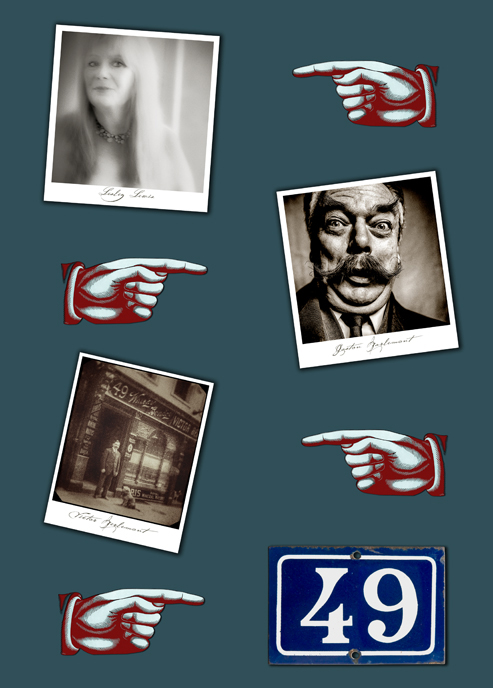
Gaston Berlemont, publican at the French House 1945-89

Lesley Lewis, publican at the French House since 1989
“I first went to Paris in the early sixties, when I was seventeen, working as an assistant to David Montgomery. We were there to shoot pictures for a fashion magazine and, early every morning before the shoot, we would go into a bar or brasserie for a coffee and a croissant. The smell of strong coffee, brandy and Gitanes, posters for art and photographic exhibitions – this was a whole beautiful new world and one that stayed with me.
In the sixties, I also started going to Ronnie Scott’s which was – at that time – in a basement in Gerrard St in Soho. One night on my way to Ronnie’s, I happened to pass the French. The door was open and the smell of coffee, French cigarettes and alcohol engulfed me. I walked in and the rest, as they say, is history.
It still holds that magic for me – a bohemian atmosphere, if you will. Full of artists, actors, poets, directors, media and, dare I say it, photographers. All crazy you understand! All with their own opinions and all very different, as it should be. And as the drink flows, all putting the world to rights, or at least trying to, and certainly with emotion.
I met landlord Gaston Berlemont in the early sixties. He invited me upstairs and introduced me to absinthe – the real stuff. It knocked my bloody head off! We started talking about all the wonderful people who had passed over the threshold, those who have passed away, those who are still around. Later I documented some of these people in my series Soho Faces, which at the moment totals over six hundred and fifty portraits.
It was thirty years ago that Lesley Lewis took over at Gaston’s retirement. After all these years, she ensures the French retains that magic. She not only encouraged me with my project of Soho Faces but also was a fantastic help. I regard her as a very special friend whom I love dearly.
To produce a small show and book that encompasses thirty years is impossible. So I thought I would approach it in an abstract way. Enough, I hope, to capture the smell of coffee, Gitanes, and of course alcohol, and including all the wonderful crazy people, past and present, who all call the French ‘home.’”


Images copyright © John Claridge
Lesley Lewis, The French House
Today, I commence a new occasional series in collaboration with photographer Sarah Ainslie of GREAT LANDLADIES OF LONDON.
I want to celebrate the wonderful women who are responsible for those cherished oases of culture and civility – the pubs which make London a city worth living in. I introduce them in no particular order but I choose to start with Lesley Lewis who has run the French House in Soho for thirty years.
Please send your suggestions of candidates for this series.

‘It is a sort of family, a very strange family’
When you walk into the French House in Dean St, you enter a magical realm of possibility where you discover you are welcome and where you might meet almost anyone. It is the last place I can think of where the spirit of old Soho lingers and where you feel you are at the heart of London. It is a public place and yet people behave as if they were in private, a place where – just by walking in the door – you become accepted into a community.
Since 1891 when it opened, there have only been three publicans at the French House. In 1989, Lesley Lewis took over when Gaston Berlemont passed into legend. Today, Lesley presides with a regal hauteur worthy of Catherine Deneuve, a shrewd humour worthy of Marie Lloyd and a generosity of spirit worthy of Mistress Quickly.
On the road to the French house, Lesley performed with a python in cabaret before graduating to managing a strip club in Old Compton St in 1979, where admission cost 50p and senior customers brought sandwiches to stay all day. As it turned out, these formative experiences proved the ideal qualifications when destiny called.
Lesley tells how Gaston Berlemont’s family took over the pub from the first landlord, a German by the name of Schimdt, whose wife returned – after he had left the country at the outbreak of WWI – to sign over the lease on September 12th, 1914. Gaston spent his whole life at the French House and, on his return from WWII, his father said,”Enough of that. You’re behind the bar, I’m off.”
It was a brawl in the twenties between French sailors smashing pint glasses over each other’s heads that led to the house policy of only serving half pints of beer, which continues to this day with the annual exception of April 1st.
During the last war, the pub – known as the York Minister – became a centre for French ex-patriates in London, serving wine which was a rare commodity then. Gaston’s daughter Giselle recalls Errol Flynn and Orson Welles tasting wine in the cellar at this time, and in June 1940 General De Gaulle wrote his famous speech in the bar -“La France a perdu une bataille. Mais la France n’a pas perdu la guerre!” After the war, the nickname of ‘The French House’ stuck and, in 1984, the name was officially changed.
With such illustrious predecessors, it was a great delight and privilege to sit down with Lesley in a quiet corner of the bar and hear her story in her own words over a glass of Ricard.
“I was General Manager at Peppermint Park, a restaurant and cocktail bar in Upper St Martin’s Lane, and when they sold the company I was offered redundancy or a pub. So I took the pub. It was the George & Dragon in Clerkenwell, a marvellous old pub. I had never poured a pint in my life, but some of my staff came with me because we were all made redundant, and that was the start of loving the pub business.
It took me a while to get into the swing of things and I learnt a good few lessons. We had no idea what we were doing but the customers helped us. After the first week, we were called together by some of the regulars and they said, ‘Lesley, this is fine. We don’t mind you looking after our pub for us.’ That is the truth of pubs, it is not my pub it is the customers’ pub – because without them, we are absolutely nothing.
Slowly, we learnt to pull pints and amuse the customers. We were next door to the school of journalism so we had a lot of students, but most of our customers were the old time, edge-of-the-East-End, Clerkenwell people. They were characters – all been pretty much wiped out, it is something quite different now.
I lived above the George & Dragon and I live upstairs here, it is a very difficult job to do without living on the premises because you are pretty much on for seven days a week. After about five years in Clerkenwell, they offered me a ‘wine bar,’ and this was the wine bar! I knew the French House already and I had always loved it, and I have been here thirty years.
It was always full of wonderful characters – it still is, but they are different kinds of characters today – writers, painters and bohemians. Gaston was the landlord then and it was condemned when he retired in 1989, which I did not discover until I went to get the licence and I was given three months to sort it out. The place had been left to rack and ruin, which I think is probably why Gaston wanted to retire. He was facing a huge bill, instead I got the huge bill but it was worth it.
We had to rebuild it in a way that people would not notice, so we were building through the night. It was the most loved place in the world and I had this feeling I was going to destroy it but the red linoleum on the bar top had to go. It is British oak to go with the rest of the interior and it cost a fortune. Then I had to bash it up a bit so it looked in tune with the whole pub. The windows had not opened since the sixties but we fixed that. There was this awful seating along the window and you burnt your ankles on the heating which was underneath, so we got rid of that and bar stools came in. This pub has evolved.
I have stayed thirty years at the French House because I love it, this is what I do. It is a sort of family, a very strange family. Most of my staff have been with me a very long time and we are very close. Eighty per cent of my customers are regulars and we are all close to each other. We help each other through everything. To be honest, I do not know what I would do without it.
A big city can be a lonely horrible place sometimes and if there is a place where you can go for a bit of comfort and conversation. It is not just about drinking, it is about going to have a chat with somebody, and feel safe in an environment that is yours – where you are not threatened in any way, as you are in a lot of clubs. It is for all ages. Our eldest customer is Norman who is ninety-two but he does not come in very often and our youngest is a year and two months, Georgie’s little boy who has been coming in here since he was conceived.
For me, it all about the people who have been in here over the years – like Francis Bacon, Dylan Thomas, Dan Farson and Lucian Freud. I think at some point just about everybody who is anybody has put a foot over the threshold. They are all still here in a funny kind of way. Their essence is here.
I think it is really important that we keep our pubs. You notice how – particularly in Soho – they are disappearing all the time. It is even more important in the country villages where, if the pub goes, there is nothing. People need to have somewhere to go. It is a very British thing, a pub.”

Portraits copyright © Sarah Ainslie
The French House, 49 Dean Street, Soho, London, W1D 5BG
You may also like to read about
At Chatham Royal Dockyard

Cliff, HMS Gannett
Behold the ancient mariner I met at Chatham Dockyard. After a long career navigating the seven seas, he now guides visitors around HMS Gannett permanently berthed in a dry dock on the Medway.
Over three hundred years, more than four hundred warships were constructed here and, during the eighteenth century, Chatham became one of this country’s largest industrial sites. Even today – thirty years after it ceased to be a working dockyard – the legacy of this endeavour over such a long period and on such a scale is awe-inspiring.
The vast wooden vault of the covered slipway, dating from 1834, is something akin to a cathedral or an aircraft hangar, and climbing up into the roof is a spatial experience of vertiginous amazement. At the other end of the dockyard, a ropewalk contains a room that is a quarter of a mile long for spinning yarn into cables. Midway between these two, I discovered the Commissioner’s Garden, offering a horticultural oasis in the midst of all this industry with a seventeenth century Mulberry at its heart.
Yet as my feet grew weary, my sense of wonder grew troubled by more complicated thoughts and emotions. The countless thousands that laboured long and hard in this dockyard through the centuries produced the maritime might which permitted Britain to wrestle control of the Atlantic from the French and the Spanish, and build its global empire, delivering incalculable wealth at the expense of the people in its colonial territories.
For better or worse, to see the machinery of this history made manifest at Chatham is an experience of wonder tinged with horror which cannot be easily reconciled, yet it is an inescapable part of this country’s identity that compels our attention if we are to understand our own past.

Horatio Nelson

HMS Gannet (1878)


The covered slipway (1838)

The covered slip was designed by Sir Robert Sebbings, Surveyor to the Navy Board & former Shipwright


HMS Ocelot (1962)


HMS Cavalier (1944)


Threads of yarn are twisted to make twine


Rope continues to be manufactured today in the ropewalk

Machinery from 1811 is still in use

The rope walk dates from 1729


Women were employed from 1864 when mechanisation was introduced

Officers’ houses (1722-33)

The Cashier’s Office where Charles Dickens’ father John Dickens worked as a clerk, 1817-22

Figures and coat of arms from HMS Chatham (1911) on the Admiral’s Offices

Sail & Colour Loft (1734) where the sails for HMS Victory were made

Admiral’s Offices (1808) with George III’s coat of arms

Entrance to the Commissioner’s Garden


Seventeenth century Mulberry tree in the Commissioner’s Garden


Richard Wellesley, brother of the Duke of Wellington, and Royal Dockyard Church (1755)

Main Gate (1720) with arms of George I
Visit CHATHAM HISTORIC DOCKYARD, open every day from February until November
You may also like to read about
In The Lavender Fields Of Surrey

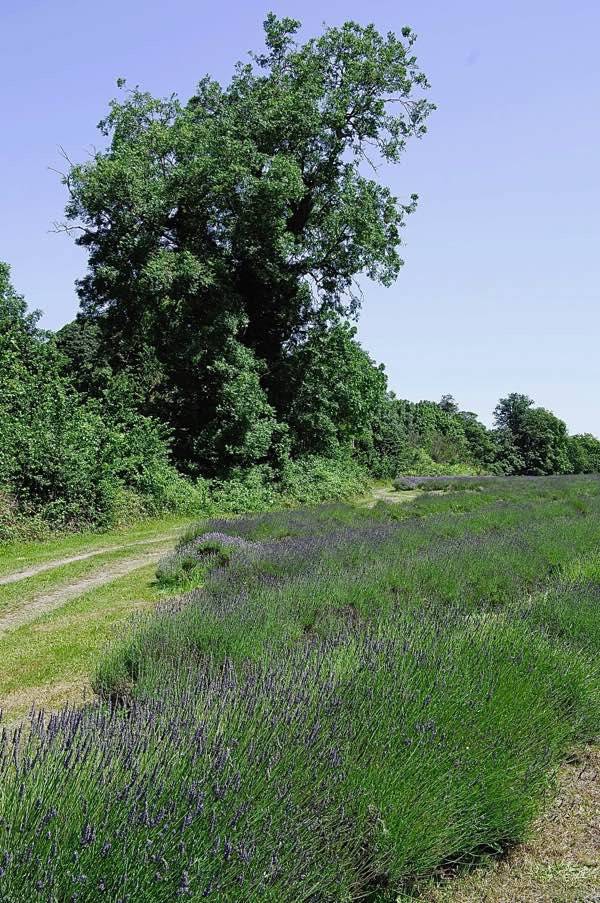
I cannot imagine a more relaxing way to enjoy a sunny English summer afternoon than a walk through a field of lavender. Observe the subtle tones of blue, extending like a mist to the horizon and rippling like the surface of the sea as the wind passes over. Inhale the pungent fragrance carried on the breeze. Delight in the orange butterflies dancing over the plants. Spot the pheasants scuttling away and – if you are as lucky as I was – encounter a red fox stalking the game birds through the forest of lavender. What an astonishing colour contrast his glossy russet pelt made as he disappeared into the haze of blue and green plants.
Lavender has been grown on the Surrey Downs for centuries and sold in summer upon the streets of the capital by itinerant traders. The aromatic properties and medicinal applications of lavender have always been appreciated, with each year’s new crop signalling the arrival of summer in London.
The lavender growing tradition in Surrey is kept alive by Mayfield Lavender in Banstead where visitors may stroll through fields of different varieties and then enjoy lavender ice cream or a cream tea with a lavender scone afterwards, before returning home laden with lavender pillows, soap, honey and oil.
Let me confess, I had given up on lavender – it had become the smell most redolent of sanitary cleaning products. But now I have learnt to distinguish between the different varieties and found a preference for a delicately-fragranced English lavender by the name of Folgate, I have rediscovered it again. My entire house is scented with it and the soporific qualities are evident. At the end of that sunny afternoon, when I returned from my excursion to the lavender fields of Surrey, I sat down in my armchair and did not awake again until supper time.


‘Six bunches a penny, sweet lavender!’ is the cry that invites in the street the purchasers of this cheap and pleasant perfume. A considerable quantity of the shrub is sold to the middling-classes of the inhabitants, who are fond of placing lavender among their linen – the scent of which conquers that of the soap used in washing. – William Craig Marshall’s Itinerant Traders, 1804

‘Delight in the orange butterflies dancing over the plants…’

Thomas Rowlandson’s Characteristic Series of the Lower Orders, 1820


‘Six Bunches a-Penny, Sweet Lavender – Six Bunches a-Penny, Sweet Blooming Lavender’ from Luke Clennell’s London Melodies, 1812

‘Spot the pheasants scuttling away…’

From Aunt Busy Bee’s New London Cries


Card issued with Grenadier Cigarettes in 1902


WWI veteran selling lavender bags by Julius Mendes Price, 1919


Yardley issued Old English Lavender talcum powder tins from 1913 incorporating Francis Wheatley’s flower seller of 1792

Archive images courtesy © Bishopsgate Institute
Mayfield Lavender Farm, 1 Carshalton Rd, Banstead SM7 3JA
You may also like to read about

CLICK TO BUY A SIGNED COPY OF THE GENTLE AUTHOR’S CRIES OF LONDON FOR £20
The Boishakhi Mela Parade
Tomorrow, the Boishakhi Mela is celebrated in Spitalfields starting around 11am

The streets of Spitalfields are closed off from dawn and, in the cool of early morning, an expectant hush lies upon the neighbourhood. Then, in the distance, comes the sound of drumming which grows and grows until around midday the Boishakhi Mela procession arrives, beneath a transparent blue sky, filling Brick Lane with a joyful chaos of colour and noise and life. The Mela, celebrating the Bengali New Year, is the largest Bengali festival held outside Bangladesh and, for one day, Spitalfields is transported to another continent.
From mid-morning, drummers, dancers, groups of children, and fantastic carnival animals gather on the far side of Spitalfields Market, before lining up in Lamb St. Once everyone is assembled, the mayor takes a photocall and cuts a ribbon. Then they all set off past the Golden Heart and into Hanbury St before erupting onto Brick Lane where, among curry houses, Bengali grocers and in the shadow of the mosque, the whole extravagant drama takes on its full meaning. The narrow street and tall buildings intensify the din of drumming, whistles and horns, while spectators find themselves crowded together and swept along by the infectious sense of carnival that rules Brick Lane. This annual moment, of the Boishakhi Mela procession passing through Brick Lane, manifests the jubilant apotheosis of Bengali culture, both here in the East End and for members of the Bengali diaspora across Britain.
I nipped around, in and out the crowd, jumping onto street furniture and sprinting through the side streets to catch every detail of the parade. Standing upon a telephone junction box, I found myself eye-to-eye with those riding the magnificent elephant, and party to spectacular perspectives up and down Brick Lane, of the procession of dancers and drummers stretching in either direction, as far as I could see. The lyrical images passing before my eyes added up to a poem, with each carnival float and attendants attired in silk and tinsel, comprising a sequence of verses featuring an owl, butterflies, a giant waterlily, an elephant and a turtle. It evoked the imaginative universe of a dream, or a collection of Indian folk tales, or a set of miniature paintings, except it was here now – loud and brash – and in your face in Brick Lane!
I followed the procession as it turned into Old Montague St where the atmosphere changed as the crowds ebbed away. In the residential streets, people leaned out of the windows of their homes to wave and the homeless woke from sleeping on the grass to witness an unlikely vision. From here, it was a short journey to arrive at Weavers’ Fields which held a funfair and a huge concert stage.
The parade is merely the catalyst to ignite the festivities and, for the rest of the day, the streets, parks and curry houses of the East End are full with high-spirited revellers enjoying the blessing of the sunshine. Everyone has plenty to celebrate, because it is Bengali New Year and the weekend summer arrives in Spitalfields too.


You may also like to read about
Fred Iles, Meter Fixer
I report the sad news that Marie Iles died last week on 16th June, the day before I her published her story. She is survived by her husband of sixty-five years, Fred Iles, and I am sure you will all wish to join with me in sending him our sympathies.

Fred & Marie Iles with Smudge
Fred Iles was born half a mile from his allotment in Stepney and his wife Marie grew up in Garden St that once stood where the allotment is today. They were married in St Dunstan’s, just across the road, and lived fifty yards away in Rectory Sq. As for Smudge, she is a local too and gave birth to two litters in the allotment shed.
Fred grows potatoes, cabbages, strawberries, gooseberries, runner beans and nasturtiums to draw the bees in his allotment, which is a small enclosure at the heart of Stepney City Farm. Surrounded by on all sides by other plots, this is a secluded corner sheltered from the wind where Fred can pass his time gardening peacefully in the company of his cat.
Fred had a good crop of strawberries this year and, while boney old Smudge patrolled the territory, Marie searched among the runner beans and discovered the first pickable specimens of the season.
“We never had a garden of our own. My grandfather Edmund lived with us when I was a child, he had come up to London from Bristol originally with two children and he ended up with four sons and three daughters. He was a great pigeon fancier and our backyard was all pigeon lofts where he kept three hundred pigeons – that’s a lot of pigeons. He was very successful at it and when he was dying he called me into his bedroom and showed me his box of medals and asked me to take one. I picked the silver one because it had a picture of a pigeon on it. There were gold ones I could have picked but I was too young to understand. He told me that Iles is a French name and that my ancestor fought in Napoleon’s army and was brought over to Bristol as prisoner of war and then stayed.
I was born in 1926 just half a mile from here in Hartford St, in a little cobbled yard called Wades Place. My father William was a seaman in his younger days and he went all over the world. I don’t know how he learnt about classical music but he was very knowledgeable and he used to play the Gounod’s Faust and Viennese waltzes on his harmonica for me.
I was here for part of the Blitz. It started on a Saturday afternoon at 3pm. I was in the yard and I heard the roar of the aeroplanes. I was thirteen and I thought it was our planes coming back, but it wasn’t. My father took me inside and we sat under the stairs which we thought was the safest place. I couldn’t see anything but I could hear the sound of the anti-aircraft guns and the engines of the planes and, at my age, I found it very exciting.
By the time they came back to bomb the docks, we had an Anderson shelter in the garden and we sat there listening to the sound of bombs dropping. My father decided it was too much and sent me and my mother and my sister to his brother in Oxford. He worked in the Morris factory which, at that time, was building aeroplanes and he got me job at fifteen making cowling panels for the side engines of Hawker Hurricanes. It was exciting work but it was miserable waiting in the cold for the bus to go to work at seven in the morning.
I got called up to the army on D-Day, June 6th 1944 and I was eighteen years old on my birthday, 30th June. They summoned me for 20th July, the day they tried to assassinate Hitler, so I had three weeks freedom before they put me in the army. By the time I’d learnt to shoot a gun, for some unknown reason they put me in the Royal Electrical Mechanical Engineers. I was posted to the anti-aircraft guns around London and then they sent me to an experimental laboratory in Shoeburyness where they were working on radar. I found I had an easy time for three and a half years until I was discharged in 1947.
I went to the Labour Exchange and the man said, ‘There’s not much going but I like the look of you so why not come and work on this side of the counter? And when a good job comes in you can get it.’ I worked there for six months, and my father was unemployed and he came in and signed on the dole. After six months, the London Electricity Board came along and I worked there for twenty-six years, at first in the office and then as a meter fixer.
When I started here at the allotment, it was quite hard. It was still a bomb site and I had to clear the bomb damage before I could plant anything. There were just six of us pensioners then and I needed something to do in my spare time. They retired me at sixty in 1986, but I started my allotment here four years before that. Smudge turned up on the allotment one day, fifteen years ago. And I thought ‘poor old cat’ and decided to feed it, so she made the allotment her home and now I have to come and feed her every day.”

Fred aged five with his sister Phyllis and cousin Rosamund in 1931, taken by Griffiths in the Roman Rd

Fred in uniform at eighteen years old, 1944

Fred and his pal Gimlet in Shoeburyness

Fred stands at the base of the aerial in Shoeburyness.

Fred (left) enjoys a pint with Bernard & Jack at Shoeburyness in 1946

Fred (top left) with pals on the beach at Shoeburyness

Fred & Marie get married at St Dunstan’s Stepney, 1st August 1953

Fred & Marie on their wedding day.

Fred in the seventies.

Fred & Marie with their prizewinning dog Rufus, in July 1984 at Stepney City Farm – when Rufus won the dog with the waggliest tail and best mongrel.

Fred grew some magnificent hollyhocks on the allotment in the nineties

“Smudge turned up on the allotment fifteen years ago. And I thought ‘poor old cat’ and I decided to feed it, so she made the allotment her home and now I come every day to feed her.”

Fred and Smudge

Gooseberry time in Stepney

Fred & Marie Iles celebrated their sixty-fifth wedding anniversary in 2018
Stepney City Farm runs a Farmers’ Market every Saturday from 10am – 3pm, selling food from local producers at affordable prices.
You may also like to read about
A Survey Of The Whitechapel Bell Foundry
In 1895, when C R Ashbee of The Guild of Handicrafts in Bow learned that Trinity House wanted to demolish Christopher Wren’s Trinity Green in Whitechapel, he published a survey of the architectural and cultural history of the almshouses to draw attention to why they should be saved.
C R Ashbee’s survey became the first volume of the Survey of London which continues to this day, currently preparing a Survey of Whitechapel. True to the spirit of their founder, the Survey have now published a pamphlet about the Whitechapel Bell Foundry, coinciding with the controversy over the future of this world-famous historical institution which is central to the identity of Whitechapel.
These beautifully produced pamphlets are free and I can send you one within the United Kingdom for a nominal price of £2 postage & packing. Click here to order a free pamphlet
Copies can also be picked up Townhouse Spitalfields, Whitechapel Idea Store, Tower Hamlets Local History Library in Mile End and London Metropolitan Archive in Clerkenwell.

Until its closure in 2017, the Whitechapel Bell Foundry was a remarkable survival. The business, principally the making of church bells, had operated continuously in Whitechapel since at least the 1570s.
It has been on its present site at 32–34 Whitechapel Rd and 2 Fieldgate St, with the existing house and office buildings, since the mid 1740s. On business cards, the firm made claims to being ‘Britain’s oldest manufacturing company’ and ‘the world’s most famous bell foundry.’ The first is not readily contradicted, the second is unverifiable but plausible. It has been said that the bell foundry ‘is so connected with the history of Whitechapel that it would be impossible to move it without wanton disregard of the associations of many generations.’
But it has moved, or rather the foundry has closed. Now in 2019 there are proposals and discussions about future use of the site. This booklet arises from the Survey of London’s current work in Whitechapel, which is to be brought together in volumes 54 and 55 in the Survey of London series, set for publication in 2021.
This booklet anticipates that, engaging with present circumstances through an illustrated history followed by transcripts of interviews. Altogether it addresses the historic use of the bell foundry as intrinsic to its meaning as a collection of buildings and as a place.

Internal courtyard of the Bell Foundry in snow (photograph by Derek Kendall)

[youtube Rd6_iUF5Kbg&t=1s nolink]
You may also like to read about
Nigel Taylor, Tower Bell Manager
Four Hundred Years at the Whitechapel Bell Foundry
Pearl Binder at Whitechapel Bell Foundry
Dorothy Rendell at Whitechapel Bell Foundry
Hope for The Whitechapel Bell Foundry
A Petition to Save the Bell Foundry
Save the Whitechapel Bell Foundry