Kois Miah At Robin Hood Gardens
Local resident and photographer Kois Miah visited families during the final years of Robin Hood Gardens and took these portraits, capturing the dignity of their existence in an estate condemned by many as a brutalist eyesore. “Whatever they think, there’s a huge sense of community here,” Kois admitted to me.
An exhibition of Kois Miah’s pictures entitled LIVED BRUTALISM opens next Thursday 22nd May and runs until 8th June at Four Corners Gallery, 121 Roman Rd, E2 0QN

Moyna Miah and his grandchildren, 9th April 2015

Del and Gaby, 13th September 2014

Samir Uddin and his children, 13th September 2015

Evening Rain, West Building, 1st September 2015

Taurus Miah, 9th April 2015

East Building, 24th June 2015

Summer fun day, 19th August 2014

Pat, 13th September 2015

Adrienne Sargent, 15th August 2016

Poplar High St, 31st March 2015

Jim, Caretaker, 23rd July 2014

West face of east building, 28th May 2016

Joanne, 28th May 2016

Mr & Mrs Hoque, 13th September 2015

On the balcony of the east building, 15th November 2015
Photographs copyright © Kois Miah
You may also like to read about
Impending Disaster At 3 Club Row

A pair of weavers’ houses at 3-5 Club Row dating from 1764/66
Ever since Boris Johnson used his executive power as Mayor of London to permit British Land to demolish more than 80% of the fabric of their Norton Folgate development site which sits entirely in a Conservation Area in Spitalfields, there has been an unruly climate of laissez-faire in the East End for the destruction of historic buildings.
Just last month, we saw the destruction of local landmark, Tadmans, a distinguished Regency corner building which had stood on the corner of Jubilee St in Whitechapel for two centuries. The fact that it was neither listed nor in a Conservation Area allowed a Planning Officer simply to grant permission for demolition without even the necessity of consulting councillors.
This week, an application was submitted to demolish this seventeen-sixties weavers’ house, one of a pair at 3-5 Club Row in the Redchurch St Conservation Area. The significance of this unique surviving pair of houses is outlined by Peter Guillery, Senior Historian at the Survey of London, in his definitive book The Small House in Eighteenth Century London. “In few, if any, other London districts would the provision of new housing have been so clearly and directly associated with the needs of a single industry,” he writes. They were “a local solution to a local problem,” built specifically for journeymen silk weavers of Bethnal Green – not the wealthy silk merchants of Spitalfields. These were the first buildings in Britain constructed specifically to fulfil the requirements of both living and working.
In January 2017, the Huguenots of Spitalfields responded to Tower Hamlets Council’s request for suggestions of buildings that merit Local Listing, by submitting applications for this pair in Club Row and nine other surviving weavers’ houses in the vicinity. Twenty-eight months later, no response was forthcoming until this week, when an enquiry was made regarding the threat of demolition of 3 Club Row, drawing this reply from the Planning Department.
“The application was considered along with a number a number of other nominations, however, a decision was made to not locally list these buildings as they were all located within Conservation Areas. This is because buildings in Conservation Areas already benefit from a degree of protection under the planning system, including a protection against demolition without permission. We have therefore decided to focus the designation on buildings that currently don’t have any protection or recognition in the planning process… It does not appear that your colleague was notified of this decision, and I am very sorry for this oversight.”
Yet Conservation Area status did not protect the buildings in Norton Folgate and the Planning Department’s focus on buildings that “currently don’t have any protection or recognition in the planning process” did not extend to Tadman’s in Whitechapel.
So now we are faced with the threat of the demolition of a rare survival of an eighteenth century weavers’ house in Shoreditch. The jaw-droppingly appalling Philistinism of the developer is such that they claim destroying this old building – which they have let it slip into decay – and replacing it with generic new spreadsheet architecture will be an improvement to the Conservation Area.
“Regards the demolition of the building, the assessment shows that No’s 3-5 do not make a positive contribution to the area’s special character … The proposed replacement scheme will be of a suitably high quality that will enhance the Redchurch St Conservation Area.” This is an extract from the developer’s Heritage Statement, the only part of their eighty page application in which they mention the historic building.
We need your help if we are to save this building. Below you will find instructions for how you can object effectively to stop the impending disaster at 3 Club Row.

Note the drawing of the developer’s Porsche in this rendering of the replacement
HOW TO OBJECT EFFECTIVELY
Use your own words and add your own personal reasons for opposing the development. Any letters which simply duplicate the same wording will count only as one objection.
1. Quote the application reference: PA/19/00932/A1
2. Give your full name and postal address. You do not need to be a resident of Tower Hamlets or of the United Kingdom to register a comment but unless you give your postal address your objection will be discounted.
3. Be sure to state clearly that you are OBJECTING to the demolition of 3 Club Row.
4. The building is exceptionally rare and significant and should be listed.
5. It is an historic building in a Conservation Area and part of the historic and architectural interest of the area.
6. The replacement scheme is not worthy a replacement.
WHERE TO SEND YOUR OBJECTION
You can register and object by clicking here if you have a UK postcode
or
you can write an email to
planningandbuilding@towerhamlets.gov.uk
or
you can send a letter to
Town Planning, Town Hall, Mulberry Place, 5 Clove Crescent, London, E14 2BG

3-5 Club Row, 1953
These houses were built between 1764 and 1766, specifically for the journeymen silk weavers of Bethnal Green and the related trades of silk throwsters, winders and dyers.
These are single depth, one-room-plan houses with a rear window, so light could permeate from front and back. The wide top-floor windows, built into the main body of the house rather than into the attics, were for maximum light, essential for colour-matching fine silk threads. The brick frontages allowed the construction of the staircases while the rear walls were often of wood.
They were constructed as multi-occupant, single-room, workshop-homes, with one family per floor and silk weaving at the top. A journeyman family could only afford one room and work dominated their lives, so no space was provided for much else, with the size of looms dictating the size of the rooms.
You may also like to read about
Bethnal Green Mulberry Lecture

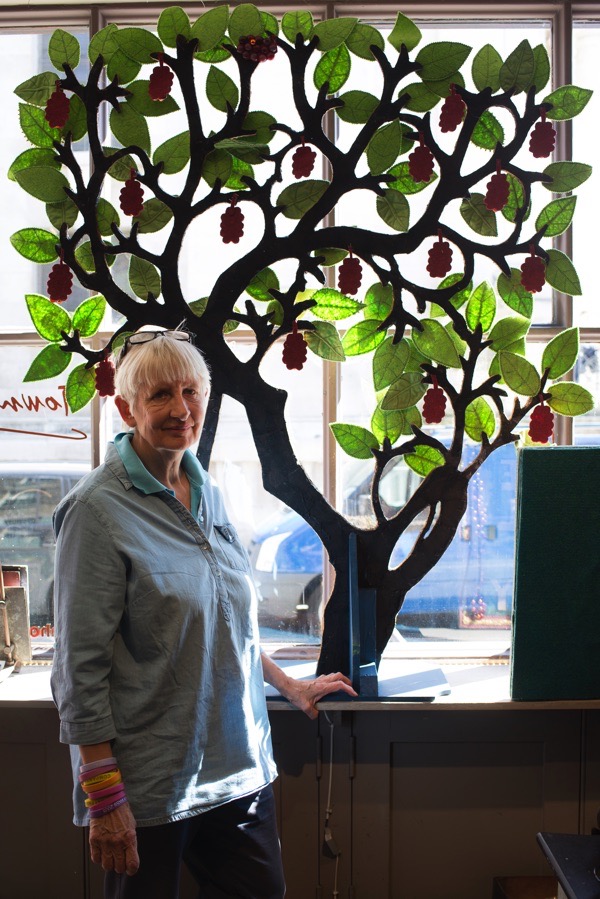
This week designer Jill Wilson installed her wonderful model of the Bethnal Green Mulberry in the window of Townhouse, Fournier St, for the Chelsea Flower Show Festival Fringe, promoting our campaign to stop developers digging up the oldest tree in the East End. We believe the Bethnal Green Mulberry is over four hundred years old – planted by Bishop Bonner, a Tudor Bishop of London, in the sixteenth century.
Next Wednesday 22nd May at 6:30pm, I shall be giving a lecture at Townhouse telling the story of the Bethnal Green Mulberry, its culture, history and the battle to save it. (Click here for free tickets)
I am delighted to report that our solicitor has confirmed we have grounds to call a Judicial Review at the High Court, challenging Tower Hamlets Council’s decision last September to give their consent to Crest Nicholson’s overblown housing scheme for the former London Chest Hospital next to Victoria Park, which involves digging up the Bethnal Green Mulberry.
This decision was taken in spite of the Tree Protection Order, the Mulberry’s designation as a Veteran Tree and the additional protection extended to such trees in the government’s revised planning policy guidelines last July.
We are very grateful to all of you who contributed £6,118 that we have raised so far for our legal fund to save the Bethnal Green Mulberry. At this moment, we need to find another £1,077 to pay a barrister who will take the case to the High Court and we ask your help to raise this sum.
CLICK TO CONTRIBUTE TO OUR FUND TO SAVE THE BETHNAL GREEN MULBERRY


Jill Wilson installs her magnificent creation

Photographs copyright © Sarah Ainslie

Graphic by Paul Bommer
Click here to read my feature in The Daily Telegraph about the scandal of the Bethnal Green Mulberry
Read more about the Bethnal Green Mulberry
Hope for The Bethnal Green Mulberry
The Fate of the Bethnal Green Mulberry
How Old is the Bethnal Green Mulberry?
Here We Go Round The Bethnal Green Mulberry
The Long Night Of The Phone Booths
William Taylor introduces Marcus Duran‘s fascinating photography of nocturnal phone booths

020 7702 3424, Aldgate 2019

Occupied, Aldgate 2019
The City of London may be the richest Square Mile in the world and mostly comprising office blocks, but the people who actually live there still need their rubbish cleared and their children educated. When I was a councillor in Portsoken ward in Aldgate, I was asked to assist residents with a whole motley of matters.
Sometimes I could help, but sometimes I could not. I was most likely to be effective where the request for help involved a combination of three factors. First, if it was possible to isolate the cause of the problem. Second, if everyone wanted the same outcome and was prepared to act together to achieve it. And third, if I knew who to talk to about it.
The Aldgate phone booth above in Marcus Duran’s photographic series of the disappearing KX100 BT booths is a case in point. The flats in the background behind the wall along Mansell St were in my ward and a number of the residents asked if I could help get rid of the booth in the photograph. I would say this particular request met two of my three criteria.
Maybe not everyone hated it, but no-one from the estate ever actually used it. In fact, the only people who used it were those calling in for a chemical fix in the middle of the night, turning the nicotine light of the phone box blue with toxic agitation and, typically, also waking up the entire neighbourhood.
In the second photograph, a woman is burying her head into the receiver, her knees flexing as she leans into the bargain she is striking. You can see her midriff revealed but you cannot see her face. The lights of passing traffic are traced across the image like road markings that have drifted from the highway, as though the camera itself is under the influence of an hallucinogen. Speed may be in the air but the body of the person in the phone booth is inert and collapsing. It is both a compelling and a sad image.
Marcus Duran’s photographs of the 1985 KX100 phone booths from Whitechapel to Wembley evoke the solitary world of backstreet London at night. There is in some an indication of the seasons. In one, the shadow of a tree falls across the pavement and, in another, snow has all but melted. Yet the overall effect is artificial and lunar – the booths possess an extra-terrestrial quality, as if they just materialised
One reason Marcus Duran photographed these booths is because they are about to disappear. Superseded by the ubiquitous mobile phone, they have become redundant and BT wants to get rid of them. They are a manifestation of the moment when BT re-launched itself after the privatisation of 1984. In the eighties, speed was definitely in the air as our economy became cybernetic. Stranded between the disappearing world of public subsidy and the new world of highly-leveraged private profit, the KX100 phone booth was a harbinger of this transformation, rendering the red phone box obsolete.
This was not the reason my constituents asked me to help get rid of the booth on Mansell St but, since they were certainly united in their request, I gave it a go. However when I tried to speak with someone was responsible, I was put through to BT’s Customer Services and provided with hypnotic music. It may be good to talk but it is not great to be put indefinitely on hold and, soon enough, I gave up. Yet I suspect that a modernising purge will accomplish what my feeble intervention never managed and sweep them all away before too long.

Disconnected & deleted # 1, Commercial Rd, February 2017

020 7702942, Bermondsey 2017

Disconnected & deleted # 2, Harrow 2019

Disconnected & deleted # 3, Finchley 2018

020 8986 4037, Hackney Central 2019

020 8902 4594, Wembley 2017

020 7247 9369, Underwood Rd, Whitechapel 2018

Disconnected & deleted # 4, Essex Rd, Islington 2017

020 8902 4594, Wembley 2017
Photographs copyright © Marcus Duran
Marcus Duran’s exhibition NOCTURNAL CALLING runs at the Dialogue Cafe, 130 Upper Clapton Rd, E5 9JY until the end of June
You may also like to take a look at
Leo Epstein Of Epra Fabrics

When the genial Leo Epstein, proprietor of Epra Fabrics says, “I am the last Jewish trader on Brick Lane,” he says it with such a modest balanced tone that you know he is stating a fact and not venturing a comment. “If you’re not a tolerant sort of person you wouldn’t be in Brick Lane,” he adds before scooting across the road to ask his neighbour at the Islamic shop to turn down the Friday prayer just a little. “I told him he can have it as loud as he wants after one o’clock when I’ve gone home.” he explains cheerily on his return – now we can hear ourselves think. “We all get on very well,” he confirms,”As one of my Bengali neighbours said to me, ‘On Brick Lane, we do business not politics.'”
While his son Daniel was in Israel, Leo was running the shop single-handedly, yet he managed – with the ease and grace of over sixty years experience – to maintain the following monologue whilst serving a string of customers, cutting bolts of fabric, answering the endless phone calls and arranging a taxi to collect an order of ten rolls of velvet.
“I started in 1956, when I got married. I used to work for a company of fabric wholesalers and one of our customers on Brick Lane said, “There’s a shop to let on the corner, why don’t you take it?” The rent was £6.50 a week and I used to lie awake at night thinking, “Where am I going to find it?” You could live on £10 a week then. My partner was Rajchman and initially we couldn’t decide which name should come first, combining the first two letters of our names, but then we realised that “Raep” Fabrics was not a good trade name and so we became “Epra” Fabrics.
In no time, we expanded and moved to this place where we are today. In those days, it was the thing to go into, the fabric trade – the City was a closed shop to Jewish people. My father thought that anything to do with rebuilding would be a good trade for me after the war and so I studied Structural Engineering but all the other students were rich children of developers. They drove around in new cars while I was the poor student who could barely afford my bus fare. So I said to my father, “I’m not going to do this.” And the openings were in the shmutter trade, I didn’t ever see myself working in an office. And I’ve always been happy, I like the business. I like the social part.
In just a few years, the first Indians came to the area, it’s always been a changing neighbourhood.The first to come were the Sikhs in their turbans, and each group that came brought their trades with them. The Sikhs were the first to print electronic circuits and they had contacts in the Far East, they brought the first calculators. And then came the Pakistanis, the brought the leather trade with them. And the Bengalis came and they were much poorer than the others. They came on their own, as single men, at first. The head of the family, the father would come to earn the money to send for the rest of the family. And since they didn’t have women with them, they opened up canteens to feed themselves and then it became trendy for City gents to come and eat curry here and that was the origin of the curry restaurants that fill Brick Lane today.
Slowly all the Jewish people moved away and all their businesses closed down. Twenty years ago, Brick Lane was a run down inner city area, people didn’t feel safe – and it still has that image even though it’s a perfectly safe place to be. I’ve always like it here.”
At any time over the last half a century, you could have walked up Fashion St, crossed Brick Lane and entered Epra Fabrics where you would have been greeted by Leo, saying “Good morning! May I help you?’ with respect and civility, just as he does today. After all these years, it is no exaggeration when he says, “Everyone knows me as Leo.” A tall yet slight man, always formally dressed with a kippa, he hovers at the cash desk, standing sentinel with a view through the door and West along Fashion St to the towers of the City. Here you will find an unrivalled selection of silks and satins. “This is Brick Lane not Park Lane,” is one of Leo’s favourite sayings, indicating that nothing costs more than a couple of pounds a metre. “We only like to take care of the ladies,” is another, indicating the nature of the stock, which is strong in dress fabrics.
“I lived through the war here, so the attack wasn’t really that big a deal,” he says with a shrug, commenting on the Brick Lane nail bomb of 1999 laid by the racist David Copeland, which blew out the front of his shop, “Luckily nobody was seriously hurt because on a Saturday everything is closed round here, it’s a tradition going back to when it was a Jewish area, where everything would close for the Sabbath.”
“Many of the Asian shop owners come in from time to time and say,’Oh good, you’re still here! Why don’t you come and have a meal on us?’ You can’t exist if you don’t get on with everybody else. It was, in a way, a weirdly pleasant time to see how everyone pulled together,” he concludes dryly, revealing how shared experiences brought him solidarity with his neighbours. Leo Epstein is the last working representative of the time when Brick Lane and Wentworth St was a Jewish ghetto and the heart of the shmutter trade, but he also exemplifies the best of the egalitarian spirit that exists in Brick Lane today, defining it as a place where different peoples co-exist peacefully.


You may also like to read about
The Soup Kitchens Of Spitalfields
Today Philip Carstairs traces the history of Spitalfields through its soup kitchens and, if this leaves you hungry for more, he will be speaking about soup kitchens at London Metropolitan Archives at 2:30pm on Tuesday May 21st (Click here for tickets)
This feature is complemented by Stuart Freedman‘s photographs taken at the Jewish Soup Kitchen in Brune St, Spitalfields, in 1990

Jewish Soup Kitchen 1902, 17-19 Brune St

Huguenot Soup Kitchen 1797, 115 Brick Lane
You cannot write a history of Spitalfields without describing its soup kitchens, nor can you write a history of soup kitchens without discussing Spitalfields. The relationship between the two is deeply entwined and both their stories are complex and interesting. The history of these kitchens encapsulates the changes in this place since the seventeenth century.
Spitalfields still has two buildings that once housed soup kitchens. The Spitalfields Soup Society functioned on Brick Lane from the late-eighteenth century and the London Soup Kitchen for the Jewish Poor operated on Brune Street from 1902. Both these institutions were deeply embedded in the community and have long histories.
However these were not the first soup kitchens in Spitalfields. Soon after Huguenot refugees settled in the second half of the seventeenth century, they set up La Soupe. Although soup had been used charitably almost since it was invented, this was the first institution in England set up to serve soup. One reason for providing soup rather than money was that benefactors repeatedly claimed beneficiaries “wickedly disposed of the money in tobacco and brandy.” Thus the “advantage” of soup was that it was hard to trade or sell. Additionally, La Soupe carried out careful casework before issuing soup, investigating the circumstances of each applicant to ensure they really deserved the help.
Between 1689 and 1826 when it closed, La Soupe moved several times, yet always in the vicinity of the Spitalfields market. After 1741, it seems to have stopped providing soup and distributed bread and meat instead. At the same time, local residents weew also providing soup to the less well-off. Newspapers in 1767 reported that “a gentleman” was giving soup to more than fifty Spitalfields poor from his house and John Gray, a Quaker journeyman pewterer, is recorded as regularly taking soup to his neighbours in the late-eighteenth century. Extreme poverty grew commonplace when the silk industry entered its long decline and the Society of Friends was at the forefront of the local philanthropy.
The late 1790s were times of great hardship for the poor across Britainas the Napoleonic wars, recession and high food prices brought famine. In Spitalfields, the silk industry was hit by falling demand and competition from smuggled silk. This great distress prompted two friends, William Phillips and William Allen, to organise a soup charity which became the best known soup kitchen in the country. Others sought its advice or bought the manuals it published. Its relationship to La Soupe is unclear. William Allen grew up in Spitalfields on Steward St where his father, Job Allen, was a silk weaver. So William must have known of La Soupe’s existence and history, although it is never mentioned in the surviving documents.
The “Society for supplying the Poor with a good and nutritious Meat Soup established in Spitalfields in 1797,” as its minute book proudly proclaims, was set up in late 1797, yet did not start supplying soup until the following January. When advertising in the press, they wisely shortened its name to the “Spitalfields Soup Society.” It seems to have operated until the early twentieth century as a soup kitchen and was still in existence as a charity in the sixties.
Although almost none of the founding committee were Spitalfields residents or associated with the silk trade (Allen was a chemist of distinction and Phillips a printer) the soup kitchen responded to the ups and downs of the silk industry throughout the ensuing century, opening when downturns threw thousands out of work and closing when times improved again. The list of committee members and donors was a catalogue of the City’s burgeoning banking and insurance sector, with Barclays, Hoares, Gurneys and others digging deep in their pockets. The partners in the Truman & Hanbury Brewery became the principal organisers until handing over control to the Rector of Christ Church in 1883.
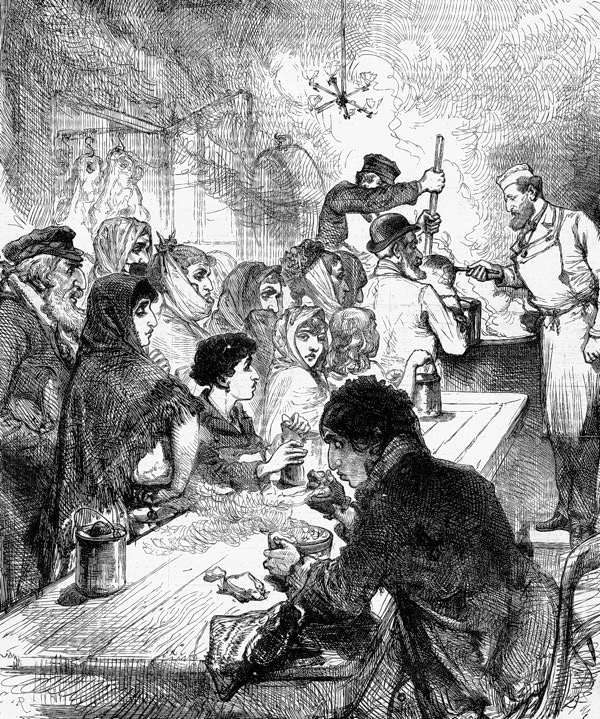
The soup house ( the term “soup kitchen” was not widely used until the mid-nineteenth century) always remained at the same address, although the building was reorganised at some point before the 1860s when the famous print below from the Illustrated London News of the soup kitchen was engraved. As the picture shows, the soup kitchen, located behind the shops on the street frontage, was always busy when open. For six days a week, it served beef soup between 2,000 and 4,000 people from Spitalfields and neighbouring parishes.
The other principal soup kitchen in the neighbourhood was the London Soup Kitchen for the Jewish Poor. This started life in 1800 in the corner of Duke’s Place, Aldgate near the Great Synagogue, but closed around 1802. The Jewish soup kitchen was refounded in 1854 in Whitechapel when immigration from Eastern Europe increased significantly and moved north to Fashion Street in 1866 as the Jewish community expanded northward.
By the 1890s, the increasing number of Jewish refugees meant that these premises, squeezed into a stable yard, were no longer viable and – as is ever the case in Spitalfields – they were to be redeveloped. So the charity raised £10,000 to build the Brune Street premises which opened in 1902. Here several thousand received soup and bread every day. This fine building was a strong statement that the Jewish community would look after its poor and it only ceased operations after the Second World War.
There have been several other soup kitchens in the area. In around 1795, five ordinaries (an ordinary was the equivalent of a café) in Spitalfields were paid by a charitable subscription raised in the City to provide half-price soup to the poor (there were a further sixteen ordinaries selling subsidised soup in Shoreditch, Bethnal Green and Whitechapel). Two of the Spitalfields ordinaries were on Brick Lane, one at either end, and the others were on Fashion Street, Lamb Street and Smock Alley (now Artillery Passage). The Smock Alley building is now occupied by Ottolenghi’s Restaurant. The proprietor of this ordinary, George Franklin, continued providing soup to the local poor for twenty years. Another large soup kitchen operated between 1847 and about 1855 at St Matthias’ Chapel on St John Street (now under the railway).
This significant element of the Spitalfields history has been largely forgotten and the documents lost or scattered. Yet, even piecing together the story from remaining fragments, it is clear that these charities and individuals provided an invaluable service in supplying sustenance to a significant proportion of the population when no other form of welfare was available.

The Jewish Soup Kitchen in Fashion St, 1867 (Illustrated London News)

The Jewish Soup Kitchen in Spitalfields, 1879 (Illustrated London News)

The Jewish Soup Kitchen in Spitalfields, 1990, photographed by Stuart Freedman

Groceries awaiting collection

A volunteer offers a second hand coat to an old lady

An old woman collects her grocery allowance

A volunteer distributes donated groceries

View from behind the hatch

A couple await their food parcel

An ex-boxer arrives to collect his weekly rations

An old boxer’s portrait, taken while waiting to collect his groceries

An elderly man leaves the soup kitchen with his supplies
Photographs copyright © Stuart Freedman
Archive images courtesy Bishopsgate Institute
You may also like to take a look at
Philip Marriage In Spitalfields

On the corner of Gun St & Brushfield St, 1967
In Spitalfields, the closure of the Truman Brewery in 1989, the moving of Fruit & Vegetable Market in 1991 and the subsequent redevelopment of the site in 2002, have changed our neighbourhood so rapidly that even the recent past – of the time before these events – appears now as the distant past. Time has mysteriously accelerated, and we look back from the other side of the watershed created by these major changes to a familiar world that has been rendered strange to us.
Such was my immediate reaction, casting my eyes over Philip Marriage’s photographs. Between 1967 and 1995, Philip visited Spitalfields regularly taking photographs, after discovering that his ancestors lived here centuries ago. And the pictures which are the outcome of his thirty-year fascination comprise a spell-binding record of these streets at that time, taken by one on a personal quest to seek the spirit of the place.
“I worked in London from 1959 to 1978 and, for the first ten years, I commuted from Enfield to Liverpool St Station. So I was aware of Spitalfields from that time, though my real interest started when I discovered that my great-great-grandfather was a silk weaver at 6 Duke St, Old Artillery Ground. And I found records of others sharing the Marriage (then French Mariage) surname in the area as far back as 1585.
My job – as a graphic designer and later Design Manager – for HMSO Books (the former government publishers) was based on Holborn Viaduct so I was near enough to Somerset House, the Public Records Office and the Guildhall Library to undertake family history research in my lunchtime. In the autumn of 1967, I visited Spitalfields with my camera for the first time to see if I could locate any of the places associated with my family. In those days colour print film was expensive and I mostly took transparencies, but later Ilford brought out a cheap colour film for a pound a roll which provided twenty small colour prints and each negative returned mounted in 2×2 cardboard mounts – quite novel, but affordable.
When I married in 1968 and moved to Hertfordshire, my family history researches came to an end. Then, in 1978, my job took me to Norwich where I’ve remained since. However, I occasionally found myself in London and, if time permitted whilst waiting for the Norwich train, I always nipped out of Liverpool St Station and down Brushfield St for a brief reminder of my favourite places.”

Crispin St, 1985.

Spital shop, 1970.

Parliament Ct, 1986.

H.Hyams, Gun St, 1970.

Corner of Fashion St & Brick Lane, 1979.

Fashion St, 1979.

Toynbee St, 1970.

The Jolly Butchers, Brick Lane, 1985.

The Crown & Shuttle, Norton Folgate, 1987.

Boundary Passage with The Ship & Blue Ball, 1985.

The Carpenter’s Arms at the corner of Cheshire St & St Matthew’s Row, 1985.

Brick Lane, 1985.

Tour in Hanbury St, 1985.

Corner of Wentworth St & Leyden St, 1990.

Brushfield St, 1990.

Mosley Speaks, 1967.

Fournier St, 1985.

Corner of Quaker St & Grey Eagle St, 1986.

Truman Brewery, Brick Lane, 1985.

E. Olive Ltd, Umbrella Manufacturers, Hanbury St, 1985.

E. Olive Ltd, Umbrella Manufacturers, Hanbury St, 1985.

Corner of Lamb St & Commercial St, 1988.

Brushfield St, 1990.

Spitalfields Market, 1986.

Brushfield St, 1985.

Gun St, 1985.

Brushfield St, 1985.

Christ Church, Spitalfields, 1985.
Photographs copyright © Philip Marriage
You may also like to look at
Alan Dein’s East End Shopfronts of 1988
Mark Jackson & Huw Davies, Photographers