
A Photograph of Jeremiah Donovan
Even five years after I published Horace Warner’s Spitalfields Nippers, new stories continue to appear about the subjects of these astonishing portraits taken in Quaker St around 1900

Jerry Donovan or ‘Dick Whittington & His Cat’
JEREMIAH DONOVAN was born in 1895 in the City of London. His parents Daniel, a news vendor, and Katherine Donovan lived at 14 Little Pearl St, Spitalfields. By 1901, the family were resident at Elizabeth Buildings, Boleyn Rd. In 1919, Jeremiah married Susan Nichols and they had one son, Bertram John Donovan, born in 1920.
I have always admired Horace Warner’s portrait of Jeremiah Donovan, not least because I know how hard it is to get a cat to look into the lens and it must have been especially difficult with a long exposure.
When we researched the lives of the Spitalfields Nippers, we were surprised by the range of outcomes. In spite of their modest beginnings, you could not generalise about their adult lives. We could not help becoming emotionally invested in their stories and were overjoyed when new facts came to light or living relatives got in touch. The brief biography above is all that we managed to discover about Jeremiah Donovan at that time.
You can imagine my delight when his granddaughter, Irene, contacted me recently with fond memories of Jeremiah – who she remembered as a quiet man. She was only thirteen he died and had never seen Horace Warner’s photograph until now. Sometimes people speculate whether Jeremiah was blind but she was able to dispel this notion, both he and his cat were simply photographed wincing into the sun.
There is a poignant quality to an account of an adult life when read while studying a picture of the child. Horace Warner’s portrait is a precious photograph because it is a rare piece of historical evidence of the Irish in the East End.
My response to Irene’s story is one of relief that Jeremiah Donovan lived until 1956 and died at the age of sixty-one – since around a third of the children in Horace Warner’s photographs did not reach adulthood. How fortunate he was to survive World War I and return and have a family.
Once you know the biography, his photograph becomes curiously emblematic. Jeremiah’s affinity with animals and his weak chest were to stay with him throughout his life
What I love about the stories of the Spitalfields Nippers is that they bridge the remote world of nineteenth century Spitalfields with our own present day.
JEREMIAH DONOVAN, my grandfather, by Irene Dean (Donovan)
‘His parents Daniel and Kathleen originated in Ireland, they came to England and settled in Spitalfields. He had two sisters, Kathleen and Bridget, and a brother, James, known as ‘Jimmy.’ He could have had more siblings but I do not recall any others being mentioned.
Jerry volunteered for World War I in 1914 when he was nineteen and was stationed at first at City of London Barracks in Moorgate. He joined the Royal Artillery and was gassed in France. As I child, I remember he always suffered with his chest.
The only photograph I ever recall seeing of him was as a very young man in his pill box hat and uniform with braid across the front. He told me that he looked after the horses for the gun carriages. After the war, I believe he worked in a cigarette factory on Kingsland Rd.
In the twenties, he lived with my grandmother – who I never met until after he died – in Kenning Terrace near Hoxton Market. The reason I did not meet her – Susan but known to us as ‘Betty’ until later was that she left Jerry when my dad was six years old and he was fostered by another family during the week while Jerry was at work.
My dad did not like the name of Bertram and was always known as ‘Jack.’ He was born in Kenning Terrace in 1920. My mum was also born in Hoxton in 1920 and they grew up together. She came from a family of eleven and my dad was best friends with her brother Joe, so he was always at her house.
My grandad was very good to my mum during World War II when my dad was away in the Eighth Army in North Africa and Italy. He made sure that my mum and I had what we needed if he could, so I grew up very close to him in place of my father.
My first memories are from when I was five, staying with my grandfather for weekends when he lived in Cowper Rd, Stoke Newington. Later I visited him in Boleyn Rd with my mother and sister, but by then he was very sick man – almost bed-bound.
At this funeral in 1956, there was only my dad, mum and me, together with his partner of many years, Emma – who disappeared days after the funeral and was never heard of again.
I think Jerry would be proud to know, after only having one child, that he has nine great-grandchildren who all doing well and flourishing. Many of whom have graduated from university.”


Click here to buy a copy of Spitalfields Nippers for £20
You may also like to read about
An Astonishing Photographic Discovery
The Wax Sellers Of Wentworth St

Franceskka Abimbola, Franceskka Fabrics
On a rainy Sunday in Spitalfields when everything is grey, I wend my way to Wentworth St to visit the African textile stores, that glow like multicoloured lanterns illuminated in the dusk – where a troupe of magnificent women preside, each one a shining goddess in her own universe. A radiance which photographer Jeremy Freedman celebrates in his exuberant portraits.
Sunday is when it all happens in Wentworth St, when customers coming from as far as away as Aberdeen and the Netherlands converge to savour its wonders as the international destination for the best Holland Wax, French Lace, Swiss Voile and Headties to be found anywhere.
Weaving through the Petticoat Lane Market and pausing in the drizzle to gaze into the shop windows, you will spy the fine ladies of Wentworth St holding court in their shops to the assembled throng, simultaneously displaying the wit of matriarchs, the authority of monarchs and the glamour of movie-stars, and all dressed up to show off the potential of their textiles. Identified upon the fascias by their first names, as Franceskka Fabrics, Tayo Fashions & Textiles, and Fola Textile, many of these women put themselves forward personally as bold trendsetters, designing their own fabrics, defining the fashion and styling their customers too. In this, the oldest part of Spitalfields, the textile industry which has defined this neighbourhood for centuries is alive and thriving today thanks to the talents of these shrewd businesswomen of Wentworth St.
Franceskka Abimbola, whose business is the longest established here, welcomed me into her kaleidoscopic shop with mirrored ceiling and walls draped in lush fabrics, just as there was a brief lull in the mid-afternoon trade. “In the late eighties, I came here from Edinburgh to Petticoat Lane to buy this fabric and I found the dealers didn’t wear it and didn’t understand it,” she explained with a humorous frown, “I spoke to Solomon at Renee’s who introduced me to his supplier. So then I wanted to be the first African woman to open a shop, and I used to buy it and sell it from the back of a car. But when I spoke to the supplier about opening my own place, he said, ‘You want to open a shop and start selling my fabrics? I’m going to break you into pieces!'”
Undeterred, Franceskka bravely opened her shop in the Kingsland Rd – at a respectable distance – and, fourteen years ago, she was one of the very first to open in Wentworth St, thus initiating this extraordinary phenomenon where now every other shop here sells Wax, all fiercely competing with their own styles and prices. Thankfully, Franceskka is still in one piece and, in reward for her courage, she is a big success.
“Lots of Nigerian women came at first to buy and ask advice,” she revealed delightedly, “but then women from Gambia, Senegal, Sierra Leone, Zimbabwe and Ghana came too. Many didn’t know how to tie the headtie so I teach them how to do it.” With an unassuming relaxed presence, Franceskka, who has a Post Graduate Diploma in Business Studies, controls her international business empire from this tiny shop, extending to two more in Lagos and a third in Abuja. “I go to the fabric exhibitions in Paris and Spain to get inspiration, I design the fabrics myself and get them manufactured in Switzerland. The French Laces are in vogue at the moment and they are very expensive, but if it’s for a wedding people will go all out to look beautiful,” she said, with a delicate smile and lift of her brow, merely hinting at the razzle-dazzle on offer.
Banke Adetoro at Royal Fashions incarnates the notion of sassy with her extravagant eyelashes, constantly fluttering like butterflies. “There’s nothing you want that you can’t get here,” she informed me with an amused gesture of unqualified authority, when I dropped in, “I get all the latest stuff. I can do as many as twenty buying trips in a year. My shop is the biggest and the most beautiful!” You really need to visit this shop to experience the vast phantasmagoria of patterns on display.
By contrast, across the road at Tayo Fashions & Textiles, I met the alluring Tayo herself in her modestly-sized shop. “My mother used to do this back in Africa, and I picked it up,” she confided to me quietly, “I just started trading at home and through the church, and then I started in a small shop with a little help from the bank. Now I have a shop in Lagos too and I go three times a year.” Outlining the convenient balance between the trade in both continents, “At Christmas it’s busy there when it’s quiet here, and it’s busy here in the Summer when it’s quiet there,” she said. Tayo’s two sons help her out in the shop and I was fascinated that in every single shop I visited these women had their children present. In fact, most had come into it through their families and some already had their children working with them, and I found it an interesting contrast to the perceived dilemma between children and career that many European women face.
Betwixt the fabulous fabric shops in Wentworth St are those selling the accessories to complete the outfit, the gleaming metallic pointy shoes and matching bags in multiple colourways and, of course, the jewellery. My favourite is Beauty Stones, lined entirely with coral necklaces that cascade like a waterfall down the walls to create an environment enraptured like a magic cave in a fairy tale. “In the beginning of African culture, anyone that wears it will be honoured,” declared Onome, the gentle custodian of the coral, “In Africa, we believe it is more precious than gold but, in this market, I have realised that lots of people are in love with it too.” Standing proud, Onome who is a celebrant in her own tribe, gestured to the coral that surrounded her, feeling its benign presence. “It’s my mother’s business,” she continued fondly,”but when she died ten years ago I couldn’t let the business die too.” And today the business is lively, since Onome’s nine children work in the shop (two were adopted after her sister’s death) and, as we spoke, happy little children ran around our legs playing with strings of corals beads they were threading. “It’s really is lovely to look at – sometimes when I put my hand on a bead, it tells me what to do, how to make the necklace,” Onome admitted, clasping a string of coral in her hand, “and the children are very good at the beads too, it’s in the family.”
Speaking with the Wax sellers of Wentworth St, who taught me the Yoruba concept of “Aso- Ebi” – using co-ordinated textiles at a social gathering to express the inter-relationships of all the people there – I realised that these shops contain an entire cultural universe with its own sophisticated language spoken in the vocabulary of textiles. Fashion exists here but, more than this, each decision taken, both in the choice and combination of fabrics makes a personal statement, which gives every single outfit a vibrant poetry all of its own.

Sheba Eferoghene, Novo Fashions

Tayo Oladele, Tayo Fashions & Textiles

Onome Efebeh-Atano, Beauty Stones

Josephine Yokessa, Beauty Solutions

Tayo Raheem, Royal Fashions

Fola Mustapha, Fola Textile

Honey, Honey Textiles

Bola Ilori AKA Madame Boltex, Boltex Textiles

Veronica Ogunmola, Monique Texiles

Tayo Oladele, Tayo Fashions & Textiles

Benke Adetoro, Benke Fashions

Monique Azenabor, Monique Textiles

Franca Aina, Vina Textiles
Photographs copyright © Jeremy Freedman
You may also like to read
At Simpsons Chop House

Occasionally I make forays into the City of London to visit some of my favourite old dining places there, and Simpsons Chop House – in a narrow courtyard off Cornhill since 1757 – is one of the few establishments remaining today where the atmosphere of previous centuries still lingers. Thomas Simpson opened his “Fish Ordinary Restaurant” in 1723 in Bell Alley, Billingsgate, serving meals to fish porters, before moving to the current site in Ball Court, serving the City gents who have been the customers ever since.
Once you pass through the shadowy passage tapering from Cornhill and emerge into the sunlight descending upon Ball Court, you feel transported into a different era, as if you might catch a glimpse of Charles Dickens and William Thackeray arriving for one of their customary lunches from the office of the Cornhill Magazine next door. Ahead of you are the two seventeenth century dwellings combined by Thomas Simpson, where a menu unchanged in two hundred and fifty years is still served upon each of the three floors, in rooms that are domestic in scale, linked by the narrow staircases of a private house.
The lunchtime rush comes late, around one, which makes midday the ideal time to arrive – permitting the opportunity to climb the stairs and explore before the City gents arrive to claim their territory with high spirits worthy of schoolboys, and, most importantly, it affords a chance to introduce yourself to the noble ladies of Simpsons, who gather in the grill room on the ground floor from around eleven thirty for a light snack and a lively chat to brace themselves before meeting their admirers.
These fine waitresses preside with such regal authority and character, they welcome customers as if they were old friends come to pay court at their personal salon or boudoir. And it is only appropriate that it should be so, since Simpsons was the first establishment to employ waitresses at the beginning of the twentieth century, even though women were not admitted as diners until 1916 – which licences the current females, making up for more than two centuries of lost time.
The redoubtable leading ladies among the coterie of Simpsons’ chop house goddesses are Jean Churcher and Maureen Thompson, who have both been here over thirty years, know all the regular customers, and carry between them the stories and the spirit of this eminent landmark, which has an atmosphere closer to that of a private lunch club than a restaurant. “I do feel like I’ve been here since the eighteenth century,” admitted Maureen, chuckling with self-effacing humour, “I’ve served three Prime Minister’s grandsons, Macmillan, Lloyd George and Churchill.”
“Midday was the bankers, one o’clock was the insurance people from Lloyds and two o’clock was the metal exchange brokers, and then they’d all mix up,” recalled Jean, waving her hands in a gesture of crazed hilarity to communicate the innumerable long afternoons of merrymaking she has seen here, in the days when banks allowed their staff to drink at lunchtime. Let them tell you tales of the old days when the chops were grilled on an ancient contraption which set the chimney on fire with such regularity that patrons would simply take up their lunch plates and copies of the Financial Times, and step out into the courtyard until the fire brigade appeared.
Before too long, the first diners arrived to interrupt our tête à tête, and I was despatched to the nether regions of the basement to meet the object of all the ladies’ affections, Scotsman Jimmy Morgan, still lithe and limber at seventy-eight, and cycling twenty miles every day thanks to a pacemaker and an artificial hip. I found Jimmy in his tiny burrow of an office deep beneath the chop house, sorting out paperwork. “I worked as a waiter at the George & Vulture next door for three years and E.J.Rose & Co, the company who were reopening Simpsons in 1978, after a two year closure, offered me the job as manager.” he explained to me politely in his lilting Glaswegian cadence,”It was a success right away, people were waiting for it to reopen. We did a free day on the first day to get in touch with all our old customers who worked around the corner.”
“I think my name’s still above the door and it’s gone all brown, it needs a wash. I was going to retire fifteen years ago but they asked me to stay on and , as my assistant manager was a friend, a waiter from the George & Vulture days, I asked if we could swap wages because I wanted him to get more money. I come in two days now. I live in New Eltham. I bicycle, I used to come by train but I’ve been coming by bike for nigh on twenty years. It takes me an hour, I tie it up on the railings and that’s it. It’s not too bad in this heat, I take my jacket off and put it in the saddle bag.”
Down in the cellar bar, the customers had not begun to arrive yet and, since we were alone, Jean took this discreet opportunity to bring out her calendar from under the counter, featuring all the staff in their birthday suits. My eyes popped at the impressive pairs of stiltons and jugs of ale placed strategically in these images, while Jean confided that she had been diagnosed with breast cancer in 2007 at the age of fifty-seven and that Clive Ward the current manager had lost his wife to cancer. Consequently, the staff got together and decided, as an act of solidarity, to bare all for this calendar which sold out within six weeks to their customers, raising more than ten thousand pounds for charity. It was indicative of the unique sense of community that exists at Simpsons chop house, where diners return, even long after they have retired, to maintain friendships with those they have known all their working lives.
Climbing the stairs again up to the sunlight in Ball Court, I found it full of City gents chattering like a flock of birds. There I met Alex who has been coming since 1972. “The menu hasn’t changed since then,” he reassured me, ‘The stewed cheese is still a favourite.”

Awaiting the lunchtime rush at Simpsons, the oldest tavern in the City of London.

Jimmy Morgan, manager since 1978, cycles ten miles from Eltham to Cornhill and back


Jean Churcher, Queen of the basement bar

In the Grill Room

Maureen Thompson, Queen of the Grill Room

The brass rails were installed for the top hats of the gentlemen of the stock exchange and the bowler hats worn by the brokers

In Ball Court

Clive Ward, manager

Emerge into the sunlight descending upon Ball Court and you feel transported into a different era

The staff of Simpsons in 1922
You might also like to read about
Peri Parkes’ East End
One of the great joys of compiling my book East End Vernacular, artists who painted London’s East End streets in the 20th Century was discovering artists who were new to me.
An outstanding example was Peri Parkes who painted the East End in the eighties and is now to have the first solo show of his paintings posthumously at Town House Gallery in Spitalfields, opening on Friday 22nd November and running until 8th December.
Many of these paintings are being hung publicly for the first time.
Email fiona@townhousespitalfields.com to attend the preview on Thursday 21st November.

House in the East, 1980-81
It was through the artist Doreen Fletcher, who is celebrated for her paintings of the East End, that I first learnt about the work of Peri Parkes.
Doreen wrote, ‘My good friend Peri Parkes was perhaps the artist with the most integrity I have ever met. His standards were so high that he was reluctant to exhibit anything he produced, always finding the outcome lacking somehow. Fellow artists tried hard to persuade him to have a one man show to no avail. He painted the East End assiduously during the eighties until he took a teaching post in Cornwall in 1992, however he continued to revisit to Bow right up until his death too soon at the age of fifty-six.’
On Doreen’s recommendation, I took the train to Hertford to meet Peri’s daughters, Lucie & Zoe who showed me fifty of their father’s paintings which have been mostly stored in a cupboard since he died in 2009. The quality and significance of this work was immediately apparent and I knew at once that I must devote a chapter in my book East End Vernacular, Artists Who Painted London’s East End Streets in the 20th Century to celebrate the rare talent and rigorous vision of Peri Parkes.
Out of the tragedy of a broken relationship, Peri Parkes created a transcendent series of paintings and it is impossible not to touched by the self portraits that he included in his work, of the lonely man walking in the park or climbing onto his bike.
Lucie & Zoe are the custodians of this legacy and they spoke affectionately to me about their father as we sat surrounded by his wonderful paintings.
Zoe – My father was from Hampstead Garden Suburb in Finchley. He had a Greek mother – who named him Pericles, she came from quite a well-to-do family and his father was a solicitor. Dad was born and grew up there but he left home very young, about sixteen. Then he met Lindsey, my mum, and they had me when he was just eighteen. My grandmother bought a house in Ridge Rd Crouch End and we all lived there.
Lucie – When he was nineteen, he got a scholarship to the Slade. I should add that when he was sixteen, he went off to Afghanistan, back-packing. He and mum first met at the railway station, just before he was about to leave and there was obviously a spark. Once he came back, they met up again and married when he was eighteen and mum was seventeen.
Zoe – When I was a baby, he used to take me off to college with him. He put me on his back and off we would go to the Slade.
Lucie – Mum had agoraphobia after she had Zoe, so he had to take her with him – a nineteen-year-old with his baby.
Zoe – They split up when I was six and Lucie was three, around 1979. He went to stay with his friend Martin Ives in a prefab in Conder St, Stepney and we stayed with our mum in her mum’s house. After that he got a housing association flat next to Bow Rd Station and then he moved just around the corner to Mornington Grove.
Lucie – He never had a studio, he just painted in the flat where he lived. He was completely unmaterialistic and his whole flat was his studio with bare floors, bare walls, furniture that he picked up from skips or off the street, boxes and then piles and piles of paints. All over the furniture there was paint splatters and full ashtrays. He did not really ever think about comfort.
Zoe – He was so driven by painting. He had a one track mind. He did not really want anything else in life but to be able to paint and to go to the pub.
Lucie – We used to go and stay with him every other weekend in the prefabs and hang around in the back yard, I remember doing snail races and counting slugs while he painted.
Zoe – He took us round galleries quite a lot, which as children was quite boring to us – but he used to get very enthusiastic about things he wanted to see.
Lucie – To say he was very self-absorbed is only half the picture because he was not egotistical, he was actually quite a humble person, and a loving and affectionate dad. I remember lying in bed in the prefabs when it was freezing cold and he used to tell us stories, and they were brilliant. We loved him and loved being with him, but he was not really able to give to his relationships because everything was about painting.
Zoe – I think he struggled with depression a lot, whether it was to do rejection as an artist or with not getting things right. He was a real perfectionist and he had massive temper flare ups if he was not satisfied with his work. Yet he had a real community in London. He used to go to the Coborn Arms every night and he had a crew of friends there.
Lucie – Nothing he did was ever right or good enough for him. He was always striving to be better. He could not give his paintings away let alone sell them but, if he did give one away to a family member, he took it back because it was not quite good enough. If he was here now, he would be looking at his paintings, very dissatisfied, and he would want to make changes.
He was driven to paint what he saw in front of him. I do not think he was driven to tell the story of the East End, it was just that, wherever he was, he painted obsessively to capture what he was seeing. Most of them are from his window in his living room or the back of his prefab.
Zoe – He was always submitting pictures for exhibitions and competitions, and he took the rejection quite personally.
Lucie – When his relationship broke down with mum he was deeply hurt. I think the more things went wrong in his life, the more he channelled everything into painting. I can remember him taking us home on the tube once and him looking at us and tears pouring down his face. That sticks with me because I knew then that he really cared and was hurt by the whole thing, but he could not express any of that – it all went into his painting.
Zoe – I look at these paintings and I see them as dad’s life at the time, from the time arrived in the East End in 1977 until he left in 1992. The style at the beginning is quite different from the later ones. He went on holiday to the tiny town of St Just on the farmost westerly point of Cornwall and fell in love with it. The day after returning from holiday he saw a job for a part time art teacher there in the newspaper, it was like an act of fate. He had taught Art at the Blessed John Roche School in Poplar and he wanted out of London. He loved it in Cornwall and lived in the most remote place. He said Cornwall was as close as he could get to Greece in this country.
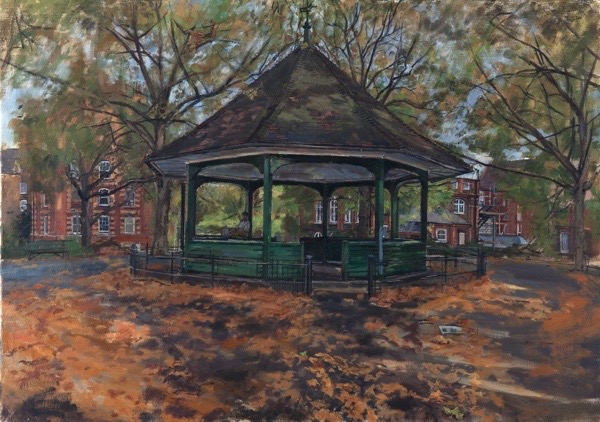
Arnold Circus, 1990-92

The Dinner Ladies, c.1986-9 (Wellington Way School, Bow E3)

Wellington Way School E3, 1985-6

Bow Triangle in Winter, 1990-92

The Departure, c.1992-4 (Mornington Grove, Bow E3)

Bow Church, c.1987-92

Conder St, Stepney, 1977-80

Conder St, Stepney, c.1980

City view from St Bernard’s School, St Matthew’s Row, E2, c.1987 (Click on this image to enlarge)
Paintings copyright © Estate of Peri Parkes

Click here to buy a copy of EAST END VERNACULAR for £25
At The Mile End Assembly Room
Today’s post is by Dr Heather Blasdale Clarke, a dance teacher and historian who is an authority on early Australian colonial dance

Music of the Mile End Assembly, 1748
In 1764, Captain James Cook moved with his young family to a new terraced house at 7 Assembly Row, Mile End. This area on the outskirts of London was developing as a respectable and convenient location for those with an interest in maritime affairs. Nearby were the fine houses of prosperous members of the East India Company, and along Mile End Rd stood the Trinity Almshouses, built in 1695 to house the “decayed Masters and Commanders of ships or ye widows of such.”
Situated behind Assembly Row terrace was the Mile End Assembly Room. In the eighteenth century, assembly rooms were important venues at a time when dancing was a noteworthy social activity. They also provided for meetings, concerts and other entertainments. This particular venue was celebrated in the dance Mile End Assembly, which was first published in 1748 and was reprinted four times over the next nine years, reflecting its popularity.
Very little is known about Cook’s personal or family life and it is entirely possible that he took advantage of the proximity to the Assembly Rooms for dancing, tea-drinking and socialising on his days of leisure. It would have been a central meeting place for the owners and captains of ships in the East India Company, as well as officers in the Royal Navy who lived in the area. It may have provided Cook with the opportunity to meet people who could help advance his career.
Another place nearby where dancing was popular was the Bell Tavern. Just a short walk from the wharves, shops and warehouses which lined the bustling waterfront, the Bell Tavern on the Ratliff Highway was one of the few reputable establishments in Shadwell, offering food and lodgings to visiting seamen.
It seems Cook stayed at the Tavern on occasions in the years from 1746 to 1755, on his trips from Whitby to London, delivering cargos of coal, wood, and other produce. It could take a week to unload a collier, during which time the crew was billeted in the wharf side taverns. He would have been aware that music and dance were key amusements for sailors, and conducive to their well-being and good humour, a factor he recognised when encouraging his crew to dance on the long voyages in the Pacific.
It was at the Tavern that Cook first encountered Elizabeth Batts, daughter of the well-respected proprietors, Mary and John. On 21st December 1762, James, aged thirty-four, and Elizabeth, aged twenty, married at St Margaret’s Church, Barking. After the wedding they lived for a time with her parents in Upper St, Shadwell. Cook had returned to sea to survey the coast of Newfoundland but raced home when he learnt of the arrival of their first child, James. This addition to the family sparked the move to their own house at Mile End, where they enjoyed family life together whenever Cook was home from sea.
Although Elizabeth knew about the lives of seafaring men and the long separations which were the lot of sailors’ wives, little could she have anticipated the protracted voyages her husband undertook to the far side of the world. Of their seventeen years of marriage, approximately four were spent together, before they were parted by his death in 1779. Elizabeth lived for another fifty-six years, surviving all six of their children. George, Joseph and Elizabeth died in infancy, Nathaniel, aged fifteen died eight months after his father, Hugh died, aged seventeen in 1793, from scarlet fever and James, thirty-one, drowned in 1794. Throughout her life Elizabeth maintained the greatest respect for her husband and regarded her memories as sacred. Prior to her death in 1835, she destroyed all their private records and correspondence. Little is known of their life together, but perhaps one of her happy reminiscences was dancing at the Mile End Assembly.
Nothing remains of Cook’s home in Mile End. Despite the house being recognised as a significant historical building, it was demolished in 1958 to widen access to a car park. Now a plaque on a brick wall designates the site of his family home. The location of the once famous Assembly Room is still recalled by a thoroughfare named Assembly Passage.

Assembly Passage

Advertisement for the Mile End Assembly, Public Advertiser, October 18th 1769

Captain Cook’s house, c.1936


Captain Cook’s house, c.1940


Wall constructed after demolition of Captain Cook’s house, 1968


Civic dignitaries unveil a plaque to Captain Cook in 1970

Elizabeth Cook (1742–1835) by William Henderson, 1830

Captain James Cook (1728-79) by Sir Nathaniel Dance-Holland, c. 1775
 Captain James Cook’s signature
Archive images courtesy Tower Hamlets Local History Library & Archives
Read more about Dr Heather Clarke’s studies at Australian Colonial Dance
The Fate Of The Whitechapel Bell Foundry

Geoffrey Chaucer wrote of bell casting to the east of the City of London when he lived above the gatehouse in Aldgate and the earliest record of bell founding in Whitechapel is 1360. Yet last night a decision was made by Tower Hamlets Council which could draw this noble foundry history to an end after seven centuries in this place.
I arrived at the Town Hall for the meeting to decide the fate of the Whitechapel Bell Foundry with a sense of foreboding and unfortunately this was not dispelled. It was obvious something was amiss when the international petition of over 20,000 people to save the foundry, another of over 2000 residents of the borough and 780 letters of objection to the hotel proposal were passed over by the planning officer in the blink of an eye. Instead, careful attention was paid to the points raised in the five letters of support received for the bell-themed boutique hotel proposal for the foundry.
The emphasis throughout was on how the hotel scheme guaranteed the preservation of the listed eighteenth-century buildings, while the most significant heritage asset – that of the foundry usage itself – was dismissed as having being extinguished when it shut two years ago. As if a theatre is no longer a theatre when a play is not being performed.
Bippy Siegel, the New York plutocrat who bought the foundry to redevelop it as a hotel, sat in the council chamber presiding as his silver-tongued minions played their roles to deliver his desired outcome. Bippy recently bought a stake in the Soho House chain and this Whitechapel development with its rooftop swimming pool has all the characteristics of a Soho House property.
In Bippy’s first proposal, the foundry buildings were to become restaurants and bars. But when this attracted public objections and UK Historic Building Preservation Trust published their alternative proposal for a revitalised foundry, he amended his scheme to include some of the elements of the UKHBPT scheme. His second application deliberately played down the boutique hotel and played up ‘re-instating the foundry.’ In this version, the new hotel is separate at the back of the site and the front buildings become creative workshops with a coffee shop overlooking a small foundry.
Yet Councillor Leema Qureshi spoke for many when she said, ‘I am not convinced by the benefits of the Raycliff scheme. The history is going to be wiped out.’
Bearing in mind UKHBPT’s award-winning track record at Middleport Pottery which has led the regeneration of Stoke, she asked if Bippy’s company, Raycliff, had undertaken any projects of this nature before. The council adviser informed her that this question was not relevant to the application in front of them, but I believe the answer is that Raycliff are solely in the hotel, restaurant and hospitality business.
It would not be hard for Raycliff – once their hotel tower is built – to revert to their original plan of absorbing the foundry buildings into the hotel, using these spaces for bars, restaurants and a private members’ club. And by then, it will be too late for anyone to object and the opportunity of continuation of real foundry usage in Whitechapel will be gone forever.
Some attention was paid by the councillors to the UKHBPT/Factum Foundation scheme to continue a proper working foundry and it was queried why they had not submitted their own planning application if there were really serious. Yet UKHBPT/FF want to continue the previous use and therefore require no planning permission.
The debate over the issue of Optimum Viable Use grew rather convoluted, starting from the unproven position that the previous use was no longer viable because the foundry shut in 2017 and concluding that Raycliff’s proposal is the Optimum Viable Use because it is ready to go and it protects the building.
Yet Councillor Dan Tomlinson made the most important statement of the evening when he said, ‘If we approve this now and we don’t give attention to the people who are proposing an alternative scheme, then we have missed that opportunity forever.’
It was like watching the execution of an innocent man where everyone agreed that – bearing in mind the lack of evidence – the most prudent option was to execute him anyway because the noose was ready and it ensured there could be no future harm.
They voted three against and three in favour, with the chairman using his casting vote to approve it. Then the council chamber broke up in disorder.
In fact, while the Planning Consent had been voted on and approved, the Listed Building Consent had not been voted on by the committee. In the uproar, Chairman Abdul Mukit had a brief discussion with the council advisor about whether they should assume the result was the same for both the Planning Consent and the Listed Building Consent. Astonishingly, they agreed to do so without this vote even taking place.
I walked to the station with Nigel Taylor who worked at the Whitechapel Bell Foundry for forty years. ‘It does not end here,’ he declared to me in exasperation, before running for his train.


Campaigners at the Town Hall photographed by Sarah Ainslie
You may also like to read about
D Day For The Whitechapel Bell Foundry
Schrodinger says, bring a bell and gather at 6pm tonight outside the Town Hall, Mulberry Place, 5 Clove Crescent, E14 2BG prior to the public Planning Committee Meeting which will decide upon the developers’ application for change of use from bell foundry to bell-themed boutique hotel

Planning reasons why Tower Hamlets Council should reject the application for change of use from bell foundry to boutique hotel
1. The developer Raycliff is proposing constructing a hotel on land at the rear of the foundry and using the listed foundry buildings as a café and workspaces. This change of use of the foundry buildings causes ‘substantial harm’ as defined by the National Planning Policy Framework.
2. The benefits that the developer claims the hotel will bring cannot be used to justify the harm done to the foundry itself.
3. The foundry site and the foundry business within it comprise the listed building and the heritage asset. Raycliff, Historic England and Tower Hamlets Council, ALL recognise that the conversion from a working foundry is harmful to this heritage asset.
There is NO justification for this substantial harm.
BECAUSE:
A. The hotel can happen anyway.
B. The foundry can continue as a working foundry.
C. There is no evidence that this cannot happen since no marketing to find a company to continue the foundry use has been done.
The planning argument put forward by Tower Hamlets Planning Officers, recommending approval of Raycliff’s application, is flawed and this is set out in detail in the legal statement by Litchfields, UK Historic Building Preservation Trust’s planning advisors, which is attached below.
The Trust’s scheme for the listed foundry buildings delivers highly skilled artisan and contemporary jobs for the youth of the borough AND apprenticeships, JUST as they have done in Stoke, one of the most deprived communities in this country. This scheme does not preclude the construction of a hotel on the land at the rear of the foundry.
There is overwhelming international and local support for the retention of a proper working foundry at Whitechapel Bell Foundry.
STOP THIS HERITAGE VANDALISM and throw out this application.
TELL THE APPLICANT to come back with a planning application for the land at the rear of the foundry only, AND sell the foundry to someone who will run this country’s oldest business for the benefit of everyone.
Click on the legal statement below by Litchfields, (UK Historic Building Preservation Trust’s planning advisors) to enlarge and read


You may also like to read about
Nigel Taylor, Tower Bell Manager
Four Hundred Years at the Whitechapel Bell Foundry
Pearl Binder at Whitechapel Bell Foundry
Dorothy Rendell at Whitechapel Bell Foundry
Hope for The Whitechapel Bell Foundry
A Petition to Save the Bell Foundry
Save the Whitechapel Bell Foundry
So Long, Whitechapel Bell Foundry
Fourteen Short Poems About The Whitechapel Bell Foundry


