
In William Blake’s London
On the eve of the great poet’s birthday, let me take you on a journey to William Blake’s London

Glad Day in Lambeth
If you wish to visit William Blake’s London, just turn left outside Waterloo Station, walk through the market in Lower Marsh, cross Westminster Bridge Rd and follow Carlisle Lane under the railway arches. Here beneath the main line in Lambeth was once the house and garden where William & Catherine Blake were pleased to sit naked in their apple tree.
Yet in recent years, William Blake has returned to Lambeth. Within the railway arches leading off Carlisle Lane, a large gallery of mosaics based upon his designs has been installed, evoking his fiery visions in the place where he conjured them. Ten years work by hundreds of local people have resulted in dozens of finely-wrought mosaics bringing Blake’s images into the public realm, among the warehouses and factories where they may be discovered by the passerby, just as he might have wished. Trains rumble overhead with a thunderous clamour that shakes the ancient brickwork and cars roar through these dripping arches, creating a dramatic and atmospheric environment in which to contemplate his extraordinary imagination.
On the south side of the arches is Hercules Rd, site of the William Blake Estate today, where he lived between 1790 and 1800 at 13 Hercules Buildings, a three-storey terrace house demolished in 1917. Blake passed ten productive and formative years on the south bank, that he recalled as ‘Lambeth’s vale where Jerusalem’s foundations began.’ By contrast with Westminster where he grew up, Lambeth was almost rural two hundred years ago and he enjoyed a garden with a fig tree that overlooked the grounds of the bishop’s palace. This natural element persists in the attractively secluded Archbishop’s Park on the north side of the arches in the former palace grounds.
To enter these sonorous old arches that span the urban and pastoral is to discover the resonant echo chamber of one of the greatest English poetic imaginations. When I visited I found myself alone at the heart of Lambeth yet in the presence of William Blake, and it is an experience I recommend to my readers.


‘There is a grain of sand in Lambeth that Satan cannot find”


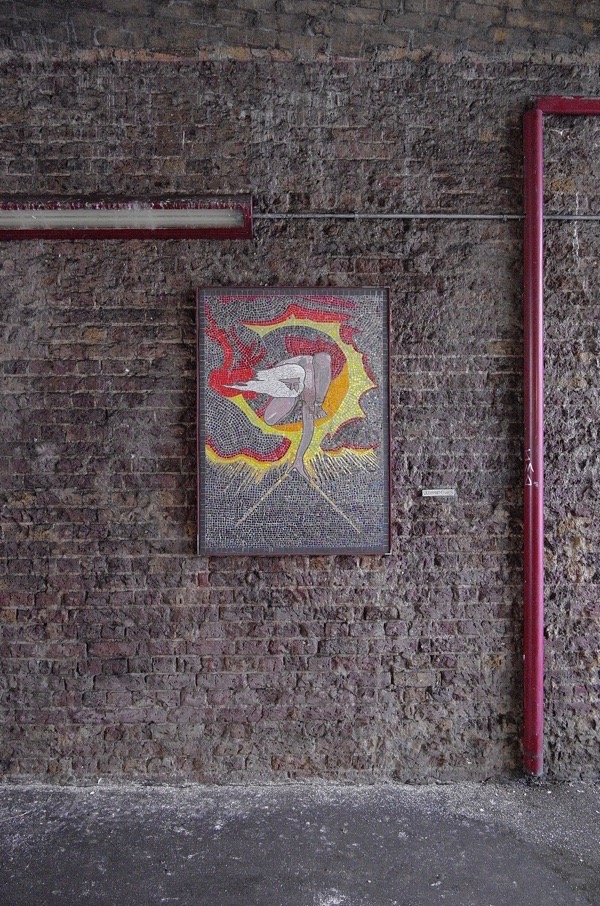


These mosaics were created by South Bank Mosaics which is now The London School of Mosaic
You may also like to take a look
At Clapton Community Football Club

Photographer Max Reeves has been documenting the drama and delight of the extraordinarily successful phenomenon that is Clapton Community Football Club over its inaugural year. With a shirt inspired by the colours of the International Brigades and the Spanish Republican flag, CCFC defines itself as an inclusive endeavour, celebrating the heroic East End Brigades of the thirties.
Large attendances and enthusiastic crowds demonstrate that CCFC has become a genuine community focus in Clapton. Owned by the fans and collectively-run, the club is a co-operative with 1300 members internationally, including a majority from Spain who joined in solidarity with the Republican flag.

Wilberforce Wanderers, winter 2018

The Curve, late autumn 2018

Samurai Rovers, early spring 2019

FC Roast, early autumn 2018

Eastfield FC, late autumn 2018

Stonewall FC, early winter 2018

Stonewall FC, early winter 2018

Chipperfield Corinthians, winter 2018

Ware Sports, midwinter 2018

Clapton Legends XI, early spring 2019

The Curve, late autumn 2018

Ware Sports, midwinter 2018

Samurai Rovers, early spring 2017

Eastfield, midwinter 2018

Eastfield, midwinter 2018

Samurai Rovers, winter 2018
Photographs copyright © Max Reeves
Copies of Max Reeves’ photographic book ‘TON’ are available direct from www.claptoncfc.co.uk
You may also like to read about
The Walking Footballers Of West Ham
The Curry Chefs Of Brick Lane

This is the ideal moment for a hot curry to warm the spirits, so I set out with photographer Jeremy Freedman to make the acquaintance of some of Brick Lane’s most celebrated Curry Chefs. We were privileged to be granted admission to the modest kitchens tucked away at the back or in the basement of the curry houses, where Head Chefs marshal whole teams of underchefs in a highly formalised hierarchy of responsibility.
It was a relief to step from the cold street into the heat of the kitchens, where we discovered our excited subjects glistening with perspiration, all engaged in the midst of the collective drama that results in curry. We found that these were men who – for the most part – had worked their way up over many years from humble kitchen porters to enjoy their heroic leading roles, granting them the right to a degree of swagger in front of the lense.
We encountered the charismatic Zulen Ahmed, pictured above, standing over his clay-lined tandoori oven beneath the Saffron restaurant where he has been Head Chef for ten years now. Trained by the renowned Curry Chef, Ashik Miah, Zulen served eight years as a porter before ascending to run his own kitchen, now supervising a team consisting of two chefs who do the spicing and make the sauces, a tandoori chef, two cooks who cook rice and poppadums, a second chef who prepares side dishes and a porter who does the washing up. “The Head Chef listens to everybody,” he explained deferentially, with his staff standing around within earshot, and thereby revealing himself to be a natural leader.
Across the road at Masala, we met Head Chef, Shaiz Uddin, whose mother is a chef in Bangladesh. She taught him to cook when he was ten years old. Shaiz told me he worked in her kitchen as Curry Chef for seven years, before he came to London ten years ago to bring the authentic style to Brick Lane, where today he is known for his constant invention in contriving new dishes for his eager customers.
It was quickly apparent that there is a daily routine common to all the curry kitchens of Brick Lane. At eleven each morning, the chefs come in and work until three to prepare the sauces and half cook the meat for the evening. At three they take a break until six, while the underchefs, who arrive at three, prepare the vegetables and salad. Then at six, when the chefs return, the rice is cooked and – now the kitchen is full – everyone works as a team until midnight, when it is time to throw out the leftovers and make the orders for the next day. This is the pattern that rules the lives of all involved. “I like to be busy,” Nurul Alam, Head Chef at Preem & Prithi, informed me blithely – he regularly cooks three hundred curries a night.
“When I started, I dreamed of being a chef,” confessed Jamal Uddin, Head Chef at Bengal Cuisine, referring to his ambition when he came here to Brick Lane from Bangladesh aged nineteen. For the last fourteen years, Jamal has reigned supreme in his kitchen with a Tandoori Chef, a Cook and a Porter working under his supervision as he prepares as many as two hundred curries every day. “I love cooking,” he admitted to me as his gleaming face broke into a smile, though whether it was the intensity of his emotion or the humidity in the kitchen that was the cause of his glowing complexion, I never ascertained.
Syed Jahan Mir, Head Chef at Chillies Restaurant, told me he came to this country at the age of eighteen with his mother and father. Syed was able to learn from his father who was also a chef and they started out together at first, working side by side in the same restaurant. “He’s better than me, but now he is retired to Sunderland I am the best!” Syed asserted, placing a hand on his chest protectively. “Of course I like it,” he confirmed for me with fierce pride, “Twenty-four years, I’ve been doing this, just making curry – it’s my profession.” A poet with spices, Syed creates his own personal mixture for curry. “It’s all the blending,” he emphasised, running his fingers through the golden powder in a steel dish to demonstrate its special properties.
Mohammed Salik still remembers arriving in Britain at the age of seven. “It was quaint and nice here and the people so good, not overcrowded and dirty like my country,” he recalled with a sublime smile of reminiscence, “My dad used to work at the Savoy, but I wanted to be part of the community here in Brick Lane.” Starting as kitchen porter, Mohammed spent the first five years watching and learning and is now Head Chef at Eastern Eye Restaurant. Our brief conversation in the kitchen was eclipsed by the arrival of a bucket on a piece of string from the restaurant above and inside was a yellow slip of paper, occasioning a polite, apologetic glance from Syed as he turned away to study the handwriting and order his team to work, making up the order.
At Cinnamon, Head Chef and veteran of twenty-five years in the business, Daras Miya was keen to introduce me to the two smiley, hardworking young Kitchen Porters under his care, skinny twenty-four year old Belal Ahmed who has been there three months and also works as a waiter, and nineteen year old Mizanor Rahman who started a week ago. Newly married and with little English, wide-eyed Mizanor was experiencing his first winter in London, after marrying his wife who came from Britain to Bangladesh find a husband.
Finally, at the Aladin we met Brick Lane’s most senior Curry Chef, the distinguished Rana Miah who started work in 1980 as a kitchen porter when he arrived from Bangladesh, graduating to chef in 1988. “At that time we served only Bengalis, but by 1995 the customers were all Europeans,” he recalled, describing his tenure as chef at one of Brick Lane’s oldest curry houses, which opened in 1985 and is second only to the Clifton in age. Rana explained that he runs his kitchen upon the system of “Handy Cooking,” based around the use of large stock pots to cook the food. “That’s the way it’s done in Bangladesh,” he confirmed, “This is a traditional restaurant.” As the longest serving Curry Chef, Rana gets frequent consultations from the other chefs on Brick Lane and, remains passionate about his vocation, arriving before everyone each day and leaving after everyone else too.
We never asked the Curry Chefs to cross their arms, but they all assumed this stance, independently and without prompting. It is a posture that proposes professionalism, dignity and self-respect, yet it also indicates a certain reticence, a reserved nature that prefers to let the culinary creations speak for themselves. So I ask you to spare a thought for these proud Curry Chefs, working away like those engineers slaving below deck on the great steam ships of old, they are the unseen and unsung heroes of Brick Lane’s Curry Mile.

Abdul Ahad Forhad, Curry Chef at Monsoon, 78 Brick Lane – “I’m the master of curry!”

Head Chef Shaiz Uddin with his colleague Monul Uddin, Tandoori Chef at Masala, 88 Brick Lane

Nurul Alam, Head Chef at Preem & Prithi, 124/6 Brick Lane, cooks three hundred curries a night

Abdul Tahid, Head Chef at Papadoms, 94 Brick Lane

Jamal Uddin, Head Chef at Bengal Cuisine, 12 Brick Lane

Syed Jahan Mir, Head Chef at Chillies Restaurant, 76 Brick Lane

Mohammed Salik, Head Chef at Eastern Eye Balti House, 63a Brick Lane

Daras Miya, Head Chef at Cinnamon, 134 Brick Lane

Belal Ahmed & Mizanur Rahman, porters at Cinnamon 134, Brick Lane

Rana Miah, Brick Lane’s longest serving Curry Chef stands centre, flanked by Kholilur Rahman and Mizanur Khan in the kitchen of the Aladin, 132 Brick Lane
Photographs copyright © Jeremy Freedman
You may also like to read about
A Bloomsbury Jamboree

In gleeful collaboration with Tim Mainstone of Mainstone Press and Joe Pearson of Design for Today, I am organising a BLOOMSBURY JAMBOREE, as a one-day festival of books and print, illustration, talks and seasonal merriment on SUNDAY 8th DECEMBER from 11am until 5pm.
It takes place at the magnificent ART WORKERS GUILD, 6 Queens Sq, WC1, which was founded in 1884 by members of the Arts & Crafts movement including William Morris and C R Ashbee. These oak panelled rooms lined with oil paintings in a beautiful old house in Bloomsbury offer the ideal venue to celebrate our books, and the authors and artists who create them.
There will be book-signings and a programme of ticketed lectures, as well as live music and entertainment for all ages, plus we have invited twenty friends to exhibit, including print and paper makers, small press publishers, toy makers, bee keepers, potters and craft workers.
Genius inventor Tim Hunkin will be bestowing instant beatifications for the festive season – King of the Bottletops, Robson Cezar, has made fifty bottle top crowns for parties and celebrations – favourite illustrators Alice Pattullo and Paul Bommer will be selling their prints – silhouette cutter, Matyas Selmeczi will be doing free portraits – New Dawn Traders will be offering olive oil and other produce from small farmers in Portugal imported by sail power – Caroline Bousfield of Victoria Park Village will be displaying her own pottery, and Tessa Hunkin of Hackney Mosaic Project will bring small mosaics for purchase.
All our Spitalfields Life Books titles will be in stock and there will be opportunities to meet Eleanor Crow, Adam Dant, Doreen Fletcher, Suresh Singh, Julian Woodford and The Gentle Author who will be signing and inscribing copies of their books.

Art Workers Guild

Art Workers Guild

Art Workers Guild

Click here for a talk on JOHN MINTON’S COMMERCIAL ART by Martin Salisbury at noon

Click here for a talk on MEMOIRS OF A COCKNEY SIKH by Suresh Singh at 1pm

Click here for a talk on JOHN PIPER’S BRIGHTON AQUATINTS by Alan Powers at 1pm
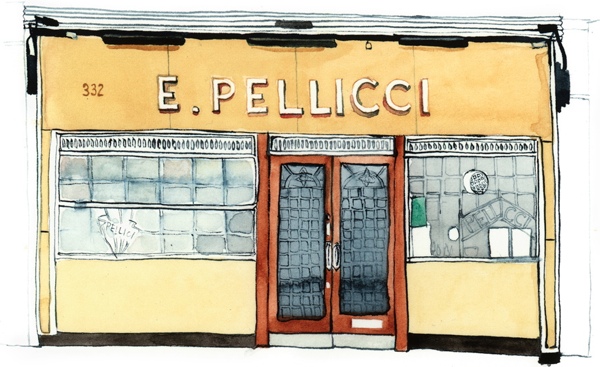
Click here for a talk on SHOPFRONTS OF LONDON by Eleanor Crow at 2pm

Click for a talk on ERIC RAVILIOUS’ LOST PICTURE PUFFIN by Joe Pearson at 2pm

Click here for a talk on GHASTLY FACADISM in London by The Gentle Author at 3pm

Click here for a talk on MAPS OF LONDON & BEYOND by Adam Dant at 3pm

Click here for a DARKTOWN QUIZ by Jonny Hannah at 4pm

Genius Inventor, Tim Hunkin in his workshop

King of the Bottletops wearing one of his bottletop crowns (Photograph by Sarah Ainslie)

Illustrator Alice Pattullo

Silhouette Cutter Matyas Selmeczi (Photograph by Colin O’Brien)

New Dawn Traders import produce to London from small farmers in Portugal by sail power

Caroline Bousfield makes pots in Victoria Park Village

Tessa Hunkin & Hackney Mosaic Project

David Kira Ltd, Banana Merchants

To anyone that knows Spitalfields, David Kira Ltd is a familiar landmark at 1 Fournier St next to The Ten Bells. Here, at the premises of the market’s foremost banana merchant – even though the business left nearly thirty years ago – the name of David Kira still stands upon the fascia to commemorate the family endeavour which operated on this site for over half a century.
This is a story of bananas and it began with Sam Kira in Southend, a Jewish immigrant from Poland who became naturalized in 1929 and started a company called “El Dorado Bananas.” Ten years later, his son opened up in Fournier St as a wholesaler, taking a lease from Lady Fox but having to leave the business almost at once when the war came, bringing conscription and wiping out the banana trade. Yet after the war, he built up the name of David Kira, creating a reputation that is still remembered fondly in Spitalfields and, since the shop remains, it feels as if the banana merchants only just left.
“When I first came to the market as a child of seven, we lived in Stoke Newington and took the 647 trolley bus to Bishopsgate and walked down Brushfield St. Every opportunity, I came down to enjoy the action and the atmosphere, and the biggest thrill was getting up early in the morning – I always remember being sent round to the Market Cafe to get mugs of tea for all the staff. When I joined my father David in 1962, aged sixteen, my grandfather Sam had died many years earlier. There was me and my father, John Neil (who had been with my father his entire working life), Ted Witt our cashier, two porters, Alf Lee and Billy Alloway (known as Billy the thief) and we had an empty boy. Our customers were High St greengrocers and market fruit traders, and we prided ourselves on only selling the best quality produce. Perhaps this was why we had a lot of customers. It was hard work and long working hours, getting up at half past four every morning to be at the market by five thirty. I used to sleep for a couple of hours in the afternoon when I got home, until about six, then I’d get up and return to bed at eleven until four thirty – I did that six days a week.
We received our shipments direct from Jamaica through the London Docks – bananas in their green state on long stalks – they arrived packed in straw on a lorry and it was very important that they be unloaded as soon as they arrived, whatever time of day or night the ship docked, because the enemy of the banana is the cold. They were passed by hand through a hatch in the floor to the ripening rooms downstairs – it took five days from arrival until they were saleable. Since the bananas came from the tropics, it was not so much the heat you had to recreate as the humidity. We had a single gas flame in the corner of each ripening room, the green bananas hung close together on hooks from the ceiling and, when the flame was turned down, a little ethylene gas was released before the door was sealed. Once they were ripened, they had to be boxed. You stood with a stalk of bananas held between your legs and struck off each bunch with a knife, placing it in a special box, three foot by one foot – a twenty-eight pound banana box.
During the sixties, dates were only sold at Christmas but in the seventies when the Bangladeshi people arrived, we started getting requests for dates during Ramadan. I contacted one of the dates suppliers and I asked him to send me thirty cases, and they were sold to Bengali greengrocers in Brick Lane before they even touched the floor. Subsequently, we sold as many dates as we could get hold of, more even than at Christmas. During this period, we also saw the decline of the High St greengrocers due to the supermarkets, however we found we were able to compensate for the loss of trade by fulfilling the requirements of the Asian community.
Eventually, they started importing pre-boxed bananas in the eighties, so our working practices changed and the banana ripening rooms became obsolete. My late father would be turning in his grave if he knew that bananas are now placed in cold storage, which means they will quickly turn black once they get home.
In 1991, when the market moved, we were offered a place in the new market hall but trading hours became a free-for-all and, although we started opening at three am, we were among the last to open. By then I was married and had children, and without the help of my father and John Neil who had both retired, I found it very difficult to cope. It was detrimental to my health – so, after a year, I sold the company as a going concern. I didn’t know what I wanted to do, but by chance I bumped into a colleague who worked in insurance and he introduced me to his manager. I realised in that type of business I could continue to be self-employed, so I trained and qualified and I have done that for the past twenty years. When I think back to the market, I only got two weeks a year holiday and I felt guilty even to put that pressure on my father and John Neil when I was away.”
Proud of his father’s achievement as a banana merchant, Stuart delighted to tell me of Ethel, the rat-catching cat – named after the ethylene gas – who loved to sleep in the warmth of the banana ripening rooms and of Billy Alloway’s tip of sixpence that he nailed to the wall in derision, which stayed there as his memorial even after he died. Stuart cherishes his memory of his time in the market, recognising it as a world with a culture of its own as much as it was a place of commerce. Today, the banana trade has gone from Spitalfields where once it was a way of life, now only the name of David Kira – heroic banana merchant – survives to remind us.

Sam Kira (far right) dealing in bananas in London and Southend.

Sam Kira’s naturalization papers.

David Kira at the Spitalfields Fruit Exchange – he is centre right in the fifth row, wearing glasses and speaking with his colleague.
 The banana trade ceased during World War II.

David Kira as a young banana merchant

David Kira (left) with his son Stuart and business partner John Neil

David Kira and staff


Stuart Kira in the doorway of his former office of twenty years, where his father and grandfather traded for over fifty years

David Kira Ltd, 1991
First and last pictures copyright © Mark Jackson & Huw Davies, 1991
You may also like to read about
Jimmy Huddart, Spitalfields Market Porter
Peter Thomas, Fruit & Vegetable Supplier
Ivor Robins, Fruit & Vegetable Purveyor
John Olney, Donovan Brothers Ltd
Jim Heppel, New Spitalfields Market
Blackie, the Last Spitalfields Market Cat
and take a look at these galleries of pictures
The Forgotten Corners Of Old London

Who knows what you might find lurking in the forgotten corners of old London? Like this lonely old waxwork of Charles II who once adorned a side aisle of Westminster Abbey, peering out through a haze of graffiti engraved upon his pane by mischievous tourists with diamond rings.
As one with a pathological devotion to walking through London’s side-streets and byways, seeking to avoid the main roads wherever possible, these glass slides of the forgotten corners of London – used long ago by the London & Middlesex Archaeological Society for magic lantern shows at the Bishopsgate Institute – hold a special appeal for me. I have elaborate routes across the city which permit me to walk from one side to the other exclusively by way of the back streets and I discover all manner of delights neglected by those who solely inhabit the broad thoroughfares.
And so it is with many of these extraordinary pictures that show us the things which usually nobody bothers to photograph. There are a lot of glass slides of the exterior of Buckingham Palace in the collection but, personally, I am much more interested in the roof space above Richard III’s palace of Crosby Hall that once stood in Bishopsgate, and in the unlikely paraphernalia which accumulated in the crypt of the Carmelite Monastery or the Cow Shed at the Tower of London, a hundred years ago. These pictures satisfy my perverse curiosity to visit the spaces closed off to visitors at historic buildings, in preference to seeing the public rooms.
Within these forgotten corners, there are always further mysteries to be explored. I wonder who pitched a teepee in the undergrowth next to the moat at Fulham Palace in 1920. I wonder if that is a cannon or a chimney pot abandoned in the crypt at the Carmelite monastery. I wonder why that man had a bucket, a piece of string and a plank inside the dome of St Paul’s Cathedral. I wonder what those fat books were next to the stove in the Worshipful Company of Apothecaries’ shop. I wonder who was pulling that girl out of the photograph in Woolwich Gardens. I wonder who put that dish in the roof of Crosby Hall. I wonder why Charles II had no legs. The pictures set me wondering.
It is what we cannot know that endows these photographs with such poignancy. Like errant pieces from lost jigsaws, they inspire us to imagine the full picture that we shall never be party to.

Tiltyard Gate, Eltham Palace, c. 1930

Refuse collecting at London Zoo, c. 1910

Passage in Highgate, c. 1910

Westminster Dust Carts, c. 1910

The Jewel Tower, Westminster, 1921

Fifteenth century brickwork at Charterhouse Wash House, c1910

Middle Temple Lane, c. 1910

Carmelite monastery crypt, c. 1910

The Moat at Fulham Palace, c. 1920

Clifford’s Inn, c. 1910

Top of inner dome at St Paul’s Cathedral, c. 1920

Apothecaries’ Hall Quadrangle, c. 1920

Worshipful Company of Apothecaries’ Shop, c.1920

Unidentified destroyed building near St Paul’s, c. 1940

Merchant Taylors’ Hall, c. 1920

Crouch End Old Baptist Chapel, c. 1900

Woolwich Gardens, c. 1910

The roof of Crosby Hall, Richard III’s palace in Bishopsgate , c. 1910

Refreshment stall in St James’ Park, c. 1910

River Wandle at Wandsworth, c. 1920

Corridor at Battersea Rise House, c. 1900

Tram emerging from the Kingsway Tunnel, c. 1920

Between the interior and exterior domes at St Paul’s Cathedral, c. 1920

Fossilised tree trunk on Tooting Common, c. 1920

St Dunstan-in-the-East, 1911

Cow shed at the Queen’s House, Tower of London, c. 1910

Boundary marks for St Benet Gracechurch, St Andrew Hubbard and St Dionis Backchurch in Talbot Court, c. 1910

Lincoln’s Inn gateway seen from Old Hall, c. 1910

St Bride’s Fleet St, c. 1920
Glass slides courtesy Bishopsgate Institute
You may also like to take a look at
Pomegranates At Leila’s Shop

Now is the season for pomegranates. All over the East End, I have spotted them gleaming in enticing piles upon barrows and Leila’s Shop in Calvert Avenue has a particularly magnificent display of glossy red Spanish ones. Only a few years ago, these fruit were unfamiliar in this country and I do remember the first time I bought a pomegranate and set it on a shelf, just to admire it.
My father used to tell me that you could eat a pomegranate with a pin, which was an entirely mysterious notion. Yet it was not of any consequence, because I did not intend to eat my pomegranate but simply enjoy its intriguing architectural form, reminiscent of a mosque or the onion dome of an orthodox church and topped with a crown as a flourish. This was an exotic fruit that evoked another world, ancient and far away.
As months passed, my pomegranate upon the shelf would dry out and wither, becoming hard and leathery as it shrank and shrivelled like the carcass of a dead creature. A couple of times, I even ventured eating one when my rations were getting low and I was hungry for novelty. It was always a disappointing experience, tearing at the skin haphazardly and struggling to separate the fruit from the pithy fibre. Eventually, I stopped buying pomegranates, content to admire them from afar and satiate my appetite for autumn fruit by munching my way through crates of apples.
Then Leila McAlister showed me the traditional method to cut and eat a pomegranate – and thus a shameful gap in my education was filled, bringing these alluring fruit to fore of my consciousness again. It is a simple yet ingenious technique of three steps. First, you cut a circle through the skin around the top of the fruit and lever it off. This reveals the lines that naturally divide the inner fruit into segments, like those of an orange. Secondly, you make between four and eight vertical cuts following these lines. Thirdly, you prise the fruit open, like some magic box or ornate medieval casket, to reveal the glistening trove of rubies inside, attached to segments radiating like the rays of a star.
Once this simple exercise is achieved, it is easy to remove the yellow pith and eat the tangy fruit that is appealingly sharp and sweet at the same time, with a compelling strong aftertaste. All these years, I admired the architecture of pomegranates without fully appreciating the beauty of the structure that is within. Looking at the pomegranate displayed thus, I can imagine how you might choose to eat it one jewel at a time with a pin. It made me wonder where my father should have acquired this curious idea about a fruit which was rare in this country in his time and then I recalled that he had spent World War II in the Middle East as a youthful recruit, sent there from Devon at the age of nineteen.
Looking at the fruit opened, I realised I was seeing something he had seen on his travels so many years ago and now, more than ten years after he died, I was seeing it for the first time. How magical this fruit must have seemed to him when he was so young and far away from home for the first time. They call the pomegranate ‘the fruit of the dead’ and, in Greek mythology, Persephone was condemned to the underworld because of the pomegranate seeds that she ate yet, paradoxically, it was the fabled pomegranate which brought my youthful father back to me when he had almost slipped from my mind.
Now, thanks to this elegant method, I can enjoy pomegranates each year at this time and think of him.


“its intriguing architectural form, reminiscent of a mosque or the onion dome of an orthodox church and topped with a crown as a flourish”


First slice off the top, by running a sharp knife around the fruit, cutting through the skin and then levering off the lid.

Secondly, make radiating vertical cuts through the skin following the divisions visible within the fruit – between four and eight cuts.

Thirdly, split open the pomegranate to create a shape like a flower and peel away the pith.
Leila’s Shop, 15-17 Calvert Avenue, London E2 7JP
You may also like to read my other stories about Leila’s Shop
Vegetable Bags from Leila’s Shop


