At Chatham Royal Dockyard

Cliff, HMS Gannett
Behold the ancient mariner I met at Chatham Dockyard. After a long career navigating the seven seas, he now guides visitors around HMS Gannett permanently berthed in a dry dock on the Medway.
Over three hundred years, more than four hundred warships were constructed here and, during the eighteenth century, Chatham became one of this country’s largest industrial sites. Even today – thirty years after it ceased to be a working dockyard – the legacy of this endeavour over such a long period and on such a scale is awe-inspiring.
The vast wooden vault of the covered slipway, dating from 1834, is something akin to a cathedral or an aircraft hangar, and climbing up into the roof is a spatial experience of vertiginous amazement. At the other end of the dockyard, a ropewalk contains a room that is a quarter of a mile long for spinning yarn into cables. Midway between these two, I discovered the Commissioner’s Garden, offering a horticultural oasis in the midst of all this industry with a seventeenth century Mulberry at its heart.
Yet as my feet grew weary, my sense of wonder grew troubled by more complicated thoughts and emotions. The countless thousands that laboured long and hard in this dockyard through the centuries produced the maritime might which permitted Britain to wrestle control of the Atlantic from the French and the Spanish, and build its global empire, delivering incalculable wealth at the expense of the people in its colonial territories.
For better or worse, to see the machinery of this history made manifest at Chatham is an experience of wonder tinged with horror which cannot be easily reconciled, yet it is an inescapable part of this country’s identity that compels our attention if we are to understand our own past.

Horatio Nelson

HMS Gannet (1878)


The covered slipway (1838)

The covered slip was designed by Sir Robert Sebbings, Surveyor to the Navy Board & former Shipwright


HMS Ocelot (1962)


HMS Cavalier (1944)


Threads of yarn are twisted to make twine


Rope continues to be manufactured today in the ropewalk

Machinery from 1811 is still in use

The rope walk dates from 1729


Women were employed from 1864 when mechanisation was introduced

Officers’ houses (1722-33)

The Cashier’s Office where Charles Dickens’ father John Dickens worked as a clerk, 1817-22

Figures and coat of arms from HMS Chatham (1911) on the Admiral’s Offices

Sail & Colour Loft (1734) where the sails for HMS Victory were made

Admiral’s Offices (1808) with George III’s coat of arms

Entrance to the Commissioner’s Garden


Seventeenth century Mulberry tree in the Commissioner’s Garden


Richard Wellesley, brother of the Duke of Wellington, and Royal Dockyard Church (1755)

Main Gate (1720) with arms of George I
Visit CHATHAM HISTORIC DOCKYARD, open every day from February until November
You may also like to read about
In The Lavender Fields Of Surrey

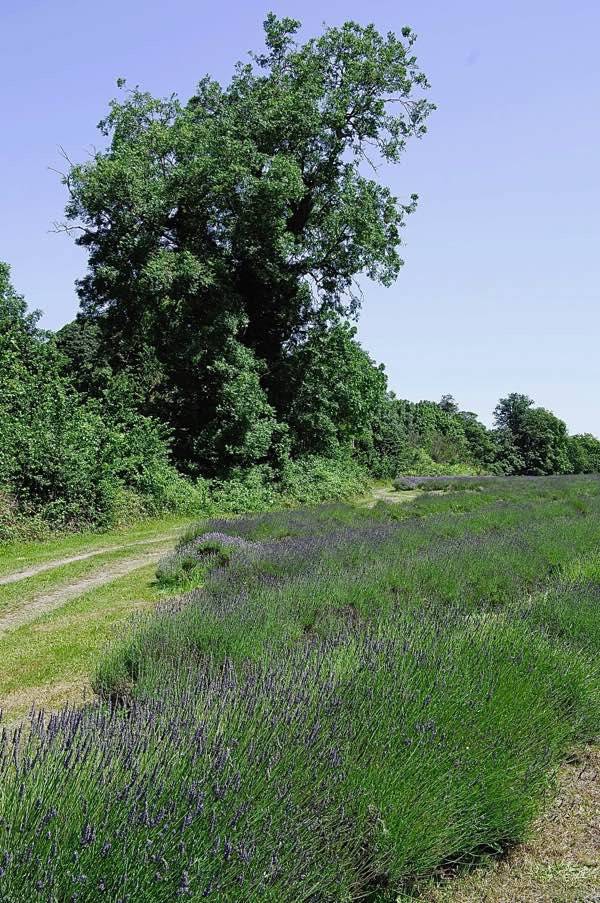
I cannot imagine a more relaxing way to enjoy a sunny English summer afternoon than a walk through a field of lavender. Observe the subtle tones of blue, extending like a mist to the horizon and rippling like the surface of the sea as the wind passes over. Inhale the pungent fragrance carried on the breeze. Delight in the orange butterflies dancing over the plants. Spot the pheasants scuttling away and – if you are as lucky as I was – encounter a red fox stalking the game birds through the forest of lavender. What an astonishing colour contrast his glossy russet pelt made as he disappeared into the haze of blue and green plants.
Lavender has been grown on the Surrey Downs for centuries and sold in summer upon the streets of the capital by itinerant traders. The aromatic properties and medicinal applications of lavender have always been appreciated, with each year’s new crop signalling the arrival of summer in London.
The lavender growing tradition in Surrey is kept alive by Mayfield Lavender in Banstead where visitors may stroll through fields of different varieties and then enjoy lavender ice cream or a cream tea with a lavender scone afterwards, before returning home laden with lavender pillows, soap, honey and oil.
Let me confess, I had given up on lavender – it had become the smell most redolent of sanitary cleaning products. But now I have learnt to distinguish between the different varieties and found a preference for a delicately-fragranced English lavender by the name of Folgate, I have rediscovered it again. My entire house is scented with it and the soporific qualities are evident. At the end of that sunny afternoon, when I returned from my excursion to the lavender fields of Surrey, I sat down in my armchair and did not awake again until supper time.


‘Six bunches a penny, sweet lavender!’ is the cry that invites in the street the purchasers of this cheap and pleasant perfume. A considerable quantity of the shrub is sold to the middling-classes of the inhabitants, who are fond of placing lavender among their linen – the scent of which conquers that of the soap used in washing. – William Craig Marshall’s Itinerant Traders, 1804

‘Delight in the orange butterflies dancing over the plants…’

Thomas Rowlandson’s Characteristic Series of the Lower Orders, 1820


‘Six Bunches a-Penny, Sweet Lavender – Six Bunches a-Penny, Sweet Blooming Lavender’ from Luke Clennell’s London Melodies, 1812

‘Spot the pheasants scuttling away…’

From Aunt Busy Bee’s New London Cries


Card issued with Grenadier Cigarettes in 1902


WWI veteran selling lavender bags by Julius Mendes Price, 1919


Yardley issued Old English Lavender talcum powder tins from 1913 incorporating Francis Wheatley’s flower seller of 1792

Archive images courtesy © Bishopsgate Institute
Mayfield Lavender Farm, 1 Carshalton Rd, Banstead SM7 3JA
You may also like to read about

CLICK TO BUY A SIGNED COPY OF THE GENTLE AUTHOR’S CRIES OF LONDON FOR £20
The Boishakhi Mela Parade
Tomorrow, the Boishakhi Mela is celebrated in Spitalfields starting around 11am

The streets of Spitalfields are closed off from dawn and, in the cool of early morning, an expectant hush lies upon the neighbourhood. Then, in the distance, comes the sound of drumming which grows and grows until around midday the Boishakhi Mela procession arrives, beneath a transparent blue sky, filling Brick Lane with a joyful chaos of colour and noise and life. The Mela, celebrating the Bengali New Year, is the largest Bengali festival held outside Bangladesh and, for one day, Spitalfields is transported to another continent.
From mid-morning, drummers, dancers, groups of children, and fantastic carnival animals gather on the far side of Spitalfields Market, before lining up in Lamb St. Once everyone is assembled, the mayor takes a photocall and cuts a ribbon. Then they all set off past the Golden Heart and into Hanbury St before erupting onto Brick Lane where, among curry houses, Bengali grocers and in the shadow of the mosque, the whole extravagant drama takes on its full meaning. The narrow street and tall buildings intensify the din of drumming, whistles and horns, while spectators find themselves crowded together and swept along by the infectious sense of carnival that rules Brick Lane. This annual moment, of the Boishakhi Mela procession passing through Brick Lane, manifests the jubilant apotheosis of Bengali culture, both here in the East End and for members of the Bengali diaspora across Britain.
I nipped around, in and out the crowd, jumping onto street furniture and sprinting through the side streets to catch every detail of the parade. Standing upon a telephone junction box, I found myself eye-to-eye with those riding the magnificent elephant, and party to spectacular perspectives up and down Brick Lane, of the procession of dancers and drummers stretching in either direction, as far as I could see. The lyrical images passing before my eyes added up to a poem, with each carnival float and attendants attired in silk and tinsel, comprising a sequence of verses featuring an owl, butterflies, a giant waterlily, an elephant and a turtle. It evoked the imaginative universe of a dream, or a collection of Indian folk tales, or a set of miniature paintings, except it was here now – loud and brash – and in your face in Brick Lane!
I followed the procession as it turned into Old Montague St where the atmosphere changed as the crowds ebbed away. In the residential streets, people leaned out of the windows of their homes to wave and the homeless woke from sleeping on the grass to witness an unlikely vision. From here, it was a short journey to arrive at Weavers’ Fields which held a funfair and a huge concert stage.
The parade is merely the catalyst to ignite the festivities and, for the rest of the day, the streets, parks and curry houses of the East End are full with high-spirited revellers enjoying the blessing of the sunshine. Everyone has plenty to celebrate, because it is Bengali New Year and the weekend summer arrives in Spitalfields too.


You may also like to read about
Fred Iles, Meter Fixer
I report the sad news that Marie Iles died last week on 16th June, the day before I her published her story. She is survived by her husband of sixty-five years, Fred Iles, and I am sure you will all wish to join with me in sending him our sympathies.

Fred & Marie Iles with Smudge
Fred Iles was born half a mile from his allotment in Stepney and his wife Marie grew up in Garden St that once stood where the allotment is today. They were married in St Dunstan’s, just across the road, and lived fifty yards away in Rectory Sq. As for Smudge, she is a local too and gave birth to two litters in the allotment shed.
Fred grows potatoes, cabbages, strawberries, gooseberries, runner beans and nasturtiums to draw the bees in his allotment, which is a small enclosure at the heart of Stepney City Farm. Surrounded by on all sides by other plots, this is a secluded corner sheltered from the wind where Fred can pass his time gardening peacefully in the company of his cat.
Fred had a good crop of strawberries this year and, while boney old Smudge patrolled the territory, Marie searched among the runner beans and discovered the first pickable specimens of the season.
“We never had a garden of our own. My grandfather Edmund lived with us when I was a child, he had come up to London from Bristol originally with two children and he ended up with four sons and three daughters. He was a great pigeon fancier and our backyard was all pigeon lofts where he kept three hundred pigeons – that’s a lot of pigeons. He was very successful at it and when he was dying he called me into his bedroom and showed me his box of medals and asked me to take one. I picked the silver one because it had a picture of a pigeon on it. There were gold ones I could have picked but I was too young to understand. He told me that Iles is a French name and that my ancestor fought in Napoleon’s army and was brought over to Bristol as prisoner of war and then stayed.
I was born in 1926 just half a mile from here in Hartford St, in a little cobbled yard called Wades Place. My father William was a seaman in his younger days and he went all over the world. I don’t know how he learnt about classical music but he was very knowledgeable and he used to play the Gounod’s Faust and Viennese waltzes on his harmonica for me.
I was here for part of the Blitz. It started on a Saturday afternoon at 3pm. I was in the yard and I heard the roar of the aeroplanes. I was thirteen and I thought it was our planes coming back, but it wasn’t. My father took me inside and we sat under the stairs which we thought was the safest place. I couldn’t see anything but I could hear the sound of the anti-aircraft guns and the engines of the planes and, at my age, I found it very exciting.
By the time they came back to bomb the docks, we had an Anderson shelter in the garden and we sat there listening to the sound of bombs dropping. My father decided it was too much and sent me and my mother and my sister to his brother in Oxford. He worked in the Morris factory which, at that time, was building aeroplanes and he got me job at fifteen making cowling panels for the side engines of Hawker Hurricanes. It was exciting work but it was miserable waiting in the cold for the bus to go to work at seven in the morning.
I got called up to the army on D-Day, June 6th 1944 and I was eighteen years old on my birthday, 30th June. They summoned me for 20th July, the day they tried to assassinate Hitler, so I had three weeks freedom before they put me in the army. By the time I’d learnt to shoot a gun, for some unknown reason they put me in the Royal Electrical Mechanical Engineers. I was posted to the anti-aircraft guns around London and then they sent me to an experimental laboratory in Shoeburyness where they were working on radar. I found I had an easy time for three and a half years until I was discharged in 1947.
I went to the Labour Exchange and the man said, ‘There’s not much going but I like the look of you so why not come and work on this side of the counter? And when a good job comes in you can get it.’ I worked there for six months, and my father was unemployed and he came in and signed on the dole. After six months, the London Electricity Board came along and I worked there for twenty-six years, at first in the office and then as a meter fixer.
When I started here at the allotment, it was quite hard. It was still a bomb site and I had to clear the bomb damage before I could plant anything. There were just six of us pensioners then and I needed something to do in my spare time. They retired me at sixty in 1986, but I started my allotment here four years before that. Smudge turned up on the allotment one day, fifteen years ago. And I thought ‘poor old cat’ and decided to feed it, so she made the allotment her home and now I have to come and feed her every day.”

Fred aged five with his sister Phyllis and cousin Rosamund in 1931, taken by Griffiths in the Roman Rd

Fred in uniform at eighteen years old, 1944

Fred and his pal Gimlet in Shoeburyness

Fred stands at the base of the aerial in Shoeburyness.

Fred (left) enjoys a pint with Bernard & Jack at Shoeburyness in 1946

Fred (top left) with pals on the beach at Shoeburyness

Fred & Marie get married at St Dunstan’s Stepney, 1st August 1953

Fred & Marie on their wedding day.

Fred in the seventies.

Fred & Marie with their prizewinning dog Rufus, in July 1984 at Stepney City Farm – when Rufus won the dog with the waggliest tail and best mongrel.

Fred grew some magnificent hollyhocks on the allotment in the nineties

“Smudge turned up on the allotment fifteen years ago. And I thought ‘poor old cat’ and I decided to feed it, so she made the allotment her home and now I come every day to feed her.”

Fred and Smudge

Gooseberry time in Stepney

Fred & Marie Iles celebrated their sixty-fifth wedding anniversary in 2018
Stepney City Farm runs a Farmers’ Market every Saturday from 10am – 3pm, selling food from local producers at affordable prices.
You may also like to read about
A Survey Of The Whitechapel Bell Foundry
In 1895, when C R Ashbee of The Guild of Handicrafts in Bow learned that Trinity House wanted to demolish Christopher Wren’s Trinity Green in Whitechapel, he published a survey of the architectural and cultural history of the almshouses to draw attention to why they should be saved.
C R Ashbee’s survey became the first volume of the Survey of London which continues to this day, currently preparing a Survey of Whitechapel. True to the spirit of their founder, the Survey have now published a pamphlet about the Whitechapel Bell Foundry, coinciding with the controversy over the future of this world-famous historical institution which is central to the identity of Whitechapel.
These beautifully produced pamphlets are free and I can send you one within the United Kingdom for a nominal price of £2 postage & packing. Click here to order a free pamphlet
Copies can also be picked up Townhouse Spitalfields, Whitechapel Idea Store, Tower Hamlets Local History Library in Mile End and London Metropolitan Archive in Clerkenwell.

Until its closure in 2017, the Whitechapel Bell Foundry was a remarkable survival. The business, principally the making of church bells, had operated continuously in Whitechapel since at least the 1570s.
It has been on its present site at 32–34 Whitechapel Rd and 2 Fieldgate St, with the existing house and office buildings, since the mid 1740s. On business cards, the firm made claims to being ‘Britain’s oldest manufacturing company’ and ‘the world’s most famous bell foundry.’ The first is not readily contradicted, the second is unverifiable but plausible. It has been said that the bell foundry ‘is so connected with the history of Whitechapel that it would be impossible to move it without wanton disregard of the associations of many generations.’
But it has moved, or rather the foundry has closed. Now in 2019 there are proposals and discussions about future use of the site. This booklet arises from the Survey of London’s current work in Whitechapel, which is to be brought together in volumes 54 and 55 in the Survey of London series, set for publication in 2021.
This booklet anticipates that, engaging with present circumstances through an illustrated history followed by transcripts of interviews. Altogether it addresses the historic use of the bell foundry as intrinsic to its meaning as a collection of buildings and as a place.

Internal courtyard of the Bell Foundry in snow (photograph by Derek Kendall)

[youtube Rd6_iUF5Kbg&t=1s nolink]
You may also like to read about
Nigel Taylor, Tower Bell Manager
Four Hundred Years at the Whitechapel Bell Foundry
Pearl Binder at Whitechapel Bell Foundry
Dorothy Rendell at Whitechapel Bell Foundry
Hope for The Whitechapel Bell Foundry
A Petition to Save the Bell Foundry
Save the Whitechapel Bell Foundry
Pamela Cilia, Truman’s Bottling Girl

Pamela Cilia
The reputation of the Truman’s bottling girls has passed into legend in Spitalfields. In the course of my interviews so many people have regaled me with tales of this heroic tribe of independent spirited females. who wore dungarees and clogs which thundered upon the cobbles as made their way through the narrow streets en masse, that I have been seeking one of these glamorous and elusive creatures for years.
Consequently, I was more than happy to make a trip to Rainham to pay a call upon Pamela Cilia, who proved to be a fine specimen of a bottling girl, full of vitality, sharp intelligence and strong opinions to this day. Illuminated by sparkling charisma and filling with joyous emotion as she recounted her story, Pamela was no disappointment.
“I loved it, I loved it, really loved it. But when my husband discovered I was going to work at Truman’s, he said, ‘I don’t want you working in that *******.’ He called it a certain place. Yet he already worked there, so I said to him, ‘If you give the place such a bad name, why are you working there?’ My first job was at Charrington’s in Mile End Rd until that closed down, then I worked for Watney Mann’s for seven years in Sidney St before they sold it to Truman’s, and that’s how we all ended up in Truman’s.
In the bottling plant, you had the filler, then you had the discharger and the labelling. The boxes came down and we filled them up. If a vacancy appeared on a machine, they did it by seniority – I think there were about seven machines. They had one ‘Galloping Major’ that done pints and quarts, and all the others were little bottles. They also had the canning machine. I was mainly on the canning machine.
We never had all this ‘safety,’ like now. We never wore glasses, we never had earpieces, so it was really dangerous, especially when the bottles went ‘bang’– especially when you had one in your hand and it exploded. You’d be getting them out of the pasteuriser, then all of a sudden ‘bang, bang bang, bang!’ because they hit against one another and they were hot from the pasteuriser.
I was forty-four and my children were all at school. In those days we lived in two rooms. Two pound a week, that’s what we paid. And my friend Doris used to take the kids to school and she used to bring them home. I clocked in at half past seven and finished at five.
When we got paid on Thursday’s, we used to go over to the Clifton – Thursday was curry day. My friend Adele said ‘I’ll take you to an Indian restaurant.’ At first, she took me to a restaurant near Middlesex Street, near the old toilets. ‘I’ll take you there for a curry,’ she offered, so I said ‘All right’ but when we ate there, I told her, ‘Oh, I don’t like that, Adele.’ The food was too hot.
The following Thursday we went to the Clifton, and on the tables were peppers. Terry, the engineer – big bloke – he said ‘Pam …’ He was going out with Adele and had a row with her, they weren’t talking. He said, ‘Pam, it’s no good asking her for a roll …’ So I offered, ‘All right, I’ll get one for you.’ He said, ‘I want cheese and tomato.’ I got him two cheese and tomato rolls, but I took a pepper and took the pips out and put them in with the tomato pips. Then I gave them to him and went home afterwards, because I knew what he would do. I was a bit of a joker. I didn’t worry about anything. Nobody got me down.
My sister was different. She was a worrier. I mean, I went there one day and she was crying her eyeballs out. And they all said to me. ‘Pam, Betty’s crying,’ and I said, ‘What are you crying for?’ So she told me that Yvonne, or whatever her name was, said, ‘We can’t go home in her car if we smoke.’ I said ‘Listen, you don’t need her car. You got a pair of legs. Walk on them. Or get a cab home. Don’t let them get you down.’ Well, all the girls in there, they said ‘Pam, how brave you are, you don’t care.’
I met my partner at Truman’s. He was a student of nineteen and I was forty-eight, they used to take students on at Truman’s at busy times. One day, I was out with Adele and she said,‘Pam, I’m not coming to dinner with you today’ and I went ‘You’re not? Why’s that?’ She said to me ‘A student has asked me to have a drink with him at dinner time.’ I replied, ‘Oh, I see, we’ll see about that’. I went straight over to Bernie and asked, ‘Excuse me, can I speak to you?’ And he said ‘Yes’ and I said ‘Are you taking my friend, Adele, for a drink at dinnertime?’ He said, ‘Yes’ and I said, ‘I don’t think so.’ He said, ‘What?’ and I said again ‘I don’t think so.’ He said, ‘Why’s that?’ and I said, ‘If you take her then you’ve got to take me too.’ He went, ‘Oh, alright then, you can come too,’ and I said, ‘Never mind about alright, I’m coming…’
Later, Adele met a student too. Bernie was only nineteen when I met him and I’ve been with him for thirty-eight years. I’ve got four children from my first marriage. My youngest one is sixty-one now. I got one at sixty-one, one at sixty-two, one at sixty-three and the eldest one’s three years older, she’s sixty-six. So I’ve not done bad, bringing up four kids in two rooms. I may be eighty-three but I’m still as lively as if I was twenty-one.
I was brought up in Malta because my father was Maltese. We used to come back and forth, he was a seaman. In the end, he gave up the sea because he had malaria and he was in Addenbrooke’s hospital in Cambridge, where they told him that he could get better treatment in London – so we all moved back to where my mother came from.
There were a lot of Maltese people in the East End then, but they had a very bad name. My husband was Maltese. He was a good husband but he used to hate me talking to bad girls and I’d ask him, ‘Why?’ In Stepney, you’d see the prostitutes, you had them all living in them houses next the hospital where they had furnished rooms. If they saw you with your kids, you don’t say to your child, ‘Don’t talk to her, she’s no good, she’s a so-and-so.’ That’s not me. For me, she’s a human being. Her life is her life. What happened was he said ‘Look Pam, say there’s a crowd of Maltese in Whitechapel’ – which there used to be years ago, they all gathered near the station. He said, ‘You’re not gonna talk to them. I’m being straightforward with you.’ He didn’t want me to get categorised like that or be labelled.
He didn’t want me to work at the bottling plant either, but I done it anyway. See, I’m stubborn. You had every creed, every race. I mean I’m gonna be fair because I have to, I got to swear. When I went in in the morning, I’d say ‘Good Morning, Sweary Mary,’ and she’d say to me ‘F*** off, you Maltese bastard!’
‘You Irish, you Welsh, you Scotch, you Black, you White’ – she’d have a name for every one of one of them. We had Lil, we used to call her ‘Barley-Wine Lil’ because, as soon as she came in, she’d grab a plastic cup. We’d all be thinking she was drinking tea – but she wasn’t! This was seven o’clock in the morning and she was drinking barley wine!
It was very, very good experience for me. I mean, if anything happens to me, I’ve had a good life. I loved the atmosphere, the fighting, and the swearing. And to me, they were straightforward people. Because they’d row with you today and speak to you tomorrow. They didn’t hold it against you. See, I’m a type of person can’t hold rows with people, I just want to be friends, you know.
Once, Me & Adele went down Brick Lane to the market and Sweary Mary was in front of us. We were in our welly boots and our overalls. They had these big stalls down Wentworth Street on a Friday or a Thursday, and we saw Mary – well I tell you what, I’ve never run from nobody. I said to Adele, ‘Look, Sweary Mary’s in front.’ Adele shouts out ‘Sweary Mary!’ Oh, she just turned round and shouted at us ‘F*** off, you Truman’s whores.’ Oh, did we laugh. I mean, it’s not nice really, but that was us. We couldn’t do it today. When you got home you were a different person because you were in your family.
If someone phoned me up and said ‘Pam, there is a permanent vacancy at Truman’s, would you do it?’ The answer’d be, ‘Yes.’ I’d probably go with one leg. You had your ups and downs but there was no violence and – the beer! It was nobody’s business.
Terry, the bloke I gave the peppers to, he was a comedian. It was so hot in the bottling plant that all we had on was our cross-over aprons and our bras and pants. I had a high chair, and I had to grab these cans and pull them forward. One day, he came behind my chair and – this is all because of the pepper in the cheese and tomato roll – I knew he’d get me back, but he didn’t get me straight away. He took my chair and tipped it upside down over a container for old cardboard boxes. He shook me, picking me up and throwing me off my chair into the big container. I couldn’t get out, my friends had to pass me wooden boxes so I could make steps to get out. Well you know, it was dangerous.
Yes, we had a bad name. Like I told you, my husband didn’t want me to go there because of the bad name. But it doesn’t mean to say you’re all the same. Yes, I had a laugh and joke, I’m not saying I didn’t. As I said, that bloke Terry got hold of me, he turned me upside down, my boobs went over my shoulders, and I didn’t think nothing of it. But my husband – to this day – he never knew. I didn’t see harm in it. But no, it was good, I loved it. Honest, I loved it. If it hadn’t closed down, I would still be there. I would probably be the sweeper-up!
My husband died after I left Truman’s but I had already met Bernie, and the marriage was already on the rocks. I left him in the end. I always said, ‘Once my children grow up, I’m off.’ And when my children got married, the last one, I was off. And that is how I met Bernie.
At first, they all thought that he was a policeman and I knew that thieving was going on, pinching beer. So he came in one morning and he had navy trousers on, and Adele said to me, ‘Pam, there’s a policeman in here.’ So I said, ‘What do you mean, a policeman?’ I went to him ‘Oi, are you a policeman?’ and he said, ‘No.’ Of course, when we saw him in the morning, we used to shout, ‘Morning, Officer!’ But it’s true, his father was a police sergeant at Chequers and he grew up there. We always said he was a bit of a snob.
I’m eighty-three and Bernie’ll be fifty-eight this year. We just hit it off, age didn’t make any difference. We clicked from that day we met. And he is good as gold. It was fate. I say to myself, ‘It’s fate you meeting Bernie, he wanted a bottling girl.’ He’s been in a lot of places, Bernie. He met Harold Wilson and – who’s that other prime minister? But that’s another story…”

Pamela Cilia at home in Rainham – ” I’m eighty-three and still as lively as if I was twenty-one.”


Labels courtesy Stephen Killick
Transcript by Jennifer Winkler
You may also like to read these other Truman’s stories
First Brew at the New Truman’s Brewery
Tony Jack, Chauffeur at Truman’s Brewery
A Botch-Up In Bishopsgate
The centuries old White Hart in Bishopsgate has been botched up with a cylindrical office block on top, facaded and the ancient cellars destroyed. It is a development by Amsprop, the company of Sir Alan Sugar, who began his career nearby in Petticoat Lane and for whom this will serve as his monument in the East End.
One of the most popular posts of recent years has been THE CREEPING PLAGUE OF GHASTLY FACADISM. Now I have written a book which is a gallery of the most notorious facades and a humorous analysis of facadism – the unfortunate practice of destroying everything apart from the front wall and constructing a new building behind it – revealing why this is happening and what it means.
Since I announced it last week, I have raised half the funds for the book – there are two ways you can help.
1. I am seeking readers who are willing to invest £1000 in THE CREEPING PLAGUE OF GHASTLY FACADISM. In return, we will publish your name in the book and invite you to a celebratory dinner hosted by yours truly. If you would like to know more, please write to me at spitalfieldslife@gmail.com
2. Preorder a copy of THE CREEPING PLAGUE OF GHASTLY FACADISM and you will receive a signed and inscribed copy in October when the book is published. Click here to preorder your copy
Please suggest other facades I should include.

The White Hart (1246-2015)
Charles Goss, one of the first archivists at the Bishopsgate Institute, was in thrall to the romance of old Bishopsgate and in 1930 he wrote a lyrical history of The White Hart, which he believed to be its most ancient tavern – originating as early as 1246.
“Its history as an inn can be of little less antiquity than that of the Tabard, the lodging house of the feast-loving Chaucer and the Canterbury pilgrims, or the Boar’s Head in Eastcheap, the rendezvous of Prince Henry and his lewd companions.”
In Goss’ time, Bishopsgate still contained medieval shambles that were spared by the Fire of London and he recalled the era before the coming of the railway, when the street was lined with old coaching inns, serving as points of departure and arrival for travellers to and from the metropolis.
“During the seventeenth and eighteenth centuries, The White Hart tavern was at the height of its prosperity.” he wrote fondly, “It was a general meeting place of literary men of the neighbourhood and the rendezvous of politicians and traders, and even noblemen visited it.”
The White Hart’s history is interwoven with the founding of the Hospital of St Mary Bethlehem in 1246 by Simon Fitz Mary, whose house once stood upon the site of the tavern. He endowed his land in Bishopsgate, extending beneath the current Liverpool St Station, to the monastery and Goss believed the Brothers stayed in Fitz Mary’s mansion once they first arrived from Palestine, until the hospital was constructed in 1257 with the gatehouse situated where Liverpool St meets Bishopsgate today. This dwelling may have subsequently become a boarding house for pilgrims outside the City gate and when the first licences to sell sweet wines were issued to three taverns in Bishopsgate in August 1365, this is likely to have been the origin of the White Hart’s status as a tavern.
Yet, ten years later in 1375, Edward III took possession of the monastery as an ‘alien priory’ and turned it over to become a hospital for the insane. The gateway was replaced in the reign of Richard II and the date ‘1480’ that adorned the front of the inn until the nineteenth century suggests it was rebuilt with a galleried yard at the same time and renamed The White Hart, acquiring Richard’s badge as its own symbol. The galleried yard offered the opportunity for theatrical performances, while increased traffic in Bishopsgate and the reputation of Shoreditch as a place of entertainments drew the audience.
“Vast numbers of stage coaches, wagons, chaises and carriages passed through Bishopsgate St at this time,” wrote Goss excitedly, “Travellers and carriers arriving near the City after the gates had been closed or those who for other reasons desired to remain outside the City wall until the morning, would naturally put up at one of the galleried inns, or taverns near the City gate and The White Hart was esteemed to be one of the most important taverns at that time. Here they would find small private rooms, where the visitors not only took their meals but transacted all manner of business and, if the food dispensed was good enough, the wine strong, the feather beds deep and heavily curtained, the bedrooms were certainly cold and draughty, for the doors opened onto unprotected galleries – but apparently they were comfortable enough for travellers in former days.”
The occasion of Charles Goss’ history of The White Hart was the centenary of its rebuilding upon its original foundations in 1829, yet although the medieval structure above ground was replaced, Goss was keen to emphasise that, “When the tavern was taken down it was found to be built upon cellars constructed in earlier centuries. Those were not destroyed, but were again used in the construction of the present house.” This rebuilding coincided with Bedlam Gate being removed and the road widened and renamed Liverpool St, after the Hospital of St Mary Bethlehem had transferred to Lambeth in 1815. At this time, the date ‘1246 ‘- referring to the founding of the monastery – was placed upon the pediment on The White Hart where it may be seen to this day.
“This tavern which claims to be endowed with the oldest licence in London, is still popular, for its various compartments appear always to be well patronised during the legal hours they are open for refreshment and there can be none of London’s present-day inns which can trace its history as far back as The White Hart, Bishopsgate,” concluded Goss in satisfaction in 1930.
In 2011, permission was granted by the City of London to demolish all but the facade of The White Hart and in 2015 the pub shut for the last time to permit the construction of a nine storey cylindrical office block of questionable design, developed by Sir Alan Sugar’s company Amsprop. Thus passes The White Hart after more than seven centuries in Bishopsgate, and I am glad Charles Goss is not here to see it.

The White Hart by John Thomas Smith c. 1800

The White Hart from a drawing by George Shepherd, 1810

White Hart Court, where the coaches once drove through to the galleried yard of the White Hart

Design by Inigo Jones for buildings constructed in White Hart Court in 1610

Seventeenth century tavern token, “At The White Hart”

Reverse of the Tavern Token ” At Bedlam Gate 1637″

The White Hart as it appeared in 1787

The White Hart, prior to the rebuilding of 1829

“When the tavern was taken down it was found to be built upon cellars constructed in earlier centuries. Those were not destroyed, but were again used in the construction of the present house.” – Charles Goss describing the rebuilding of 1829. These ancient vaults were destroyed in the current redevelopment.

The White Hart in 2015

The White Hart

Seen from the churchyard of St Botolph’s Bishopsgate by James Gold, 1728

Seen from the south west

Seen from Liverpool St

The meeting of the old and new in Liverpool St

The development seen from Houndsditch
Archive images courtesy Bishopsgate Institute

The exterior cover of the book…

…which opens to reveal the title.
CLICK HERE TO ORDER A COPY OF THE CREEPING PLAGUE OF GHASTLY FACADISM